
MARKET INTELLIGENCE BRIEF (MIB)
Tuesday, September 1, 2026
US forces struck IRGC targets inside Iran; WTI jumped 5.82% to $90.75 and Energy was the only green sector of note. The 10-Year hit a one-year high of 4.799% and gutted software — Oracle -5.23%, CrowdStrike -6.90%. Soft JOLTS and a cooling ISM left September hike odds at 66%. Gold fell 2.39%; the safe-haven bid never came. Anthropic signed a $35 billion cloud deal with Nvidia-backed Lambda. A judge let the shale price-fixing case proceed against Exxon, EOG and Occidental.
TABLE OF CONTENTS
A. EXECUTIVE SUMMARY
B. MARKET DATA
C. HIGH-IMPACT STORIES (5)
D. MODERATE-IMPACT STORIES (8)
E. ECONOMY WATCH (4)
F. EARNINGS WATCH (3)
G. WHAT’S NEXT
H. CHART OF THE DAY
A. EXECUTIVE SUMMARY -> TOP
US forces struck IRGC targets inside Iran at noon ET, and the tape priced it as a supply shock rather than a growth scare: WTI settled +5.82% at $90.75 while the S&P 500 fell 0.71% and both the 2-Year and 10-Year Treasury yields rose, the latter to a one-year high of 4.799%. Crude up, equities down and yields up together is the stagflationary signature, and it is why soft JOLTS and a decelerating ISM left September hike odds at 66% — the Fed’s binding constraint is now inflation, so weak growth data no longer bids bonds. The damage was narrow rather than broad: Energy (+1.69%) led, with only Utilities, Healthcare and Consumer Defensive also green, while debt-financed AI infrastructure absorbed the worst — Oracle -5.23%, CrowdStrike -6.90%, Dell -6.80%. Dow Transports’ 2.51% fall against the Dow’s 0.79% was the cleanest read on where the fuel-cost hit actually lands.
• CENTCOM struck IRGC targets in Iran at noon ET after two VLCCs carrying roughly 2 million barrels of Saudi crude each were hit near Hormuz. WTI +5.82% to $90.75, its highest close since July 23; Brent +5.01% to $95.25. Energy (+1.69%) was the day’s leading sector.
• The front end confirmed the hawkish message — 2-Year +4.8 bps to 4.398%, moving further than the 10-Year’s +4.1 bps to a one-year-high 4.799%. VIX +9.45% to 16.33. Long-duration software was gutted: CrowdStrike -6.90%, Palo Alto Networks -5.24%, Oracle -5.23%.
• Soft data changed nothing. July JOLTS missed at 7.271M with June revised down 177K, and ISM Manufacturing slipped to 54.6 against 55.2 expected — yet September hike odds held at 66%. Governor Barr said the Fed should “act decisively to raise rates” if inflation fails to moderate.
• The safe-haven bid never arrived. Gold -2.39% to $4,374.49, silver -3.50%, platinum -2.51%, copper -2.31% and bitcoin -1.86% all fell into a war headline, while the dollar firmed 0.26% — rising real rates overwhelmed the geopolitical premium.
• AI demand and AI financing pointed opposite ways. Anthropic signed a roughly $35B six-year cloud deal with Nvidia-backed Lambda for 350 MW at a Hut 8 site — about $80B of contracted compute in a month — while Dell fell 6.80% on duration and then rose roughly 9% after the bell on a $25B guidance raise.
• Two legal overhangs opened. A federal judge let the shale price-fixing MDL proceed against ExxonMobil, Diamondback, EOG and Occidental; seven state attorneys general asked the STB to reject the $85B Union Pacific-Norfolk Southern merger (UNP -3.34%, NSC -2.87%).
1. The crisis hedges failed at the moment of the crisis — A war headline arrived and neither of the two assets most portfolios hold as insurance worked: Treasuries sold off and gold fell 2.39%. That is not an anomaly, it is the arithmetic of a supply shock. Higher oil with an inflation-constrained Fed raises real rates, which marks down duration and non-yielding assets simultaneously. Copper and platinum falling alongside gold rules out an industrial-demand story and leaves the discount rate as the single common factor. Allocators carrying a 60/40 book, or gold as geopolitical insurance, were long the wrong protection today by roughly 240 basis points.
2. The AI trade has become a rate trade — A 4 basis point move in the 10-Year took 5-7% out of AI-levered equity, because the build-out is now debt-financed at scale: Oracle funded roughly $56B of fiscal 2026 capex partly with $43B of new borrowing, and its equity is now a direct function of the cost of that money. What was a multiple sensitivity has become a cash-cost sensitivity. The Anthropic-Lambda structure sharpens the point — Nvidia is chip vendor, investor in the cloud provider and leaseholder on the building, so a meaningful share of visible AI demand is underwritten by the company booking the revenue. Dell’s split session, down 6.80% on rates and up roughly 9% after hours on demand, is the dispersion to trade rather than the index level.
3. Bad growth news has stopped being good news — Two soft prints inside ninety minutes moved September hike odds by a tenth of a percentage point. For most of this cycle a weak labour number pulled the front end down; today it did not move it at all, because the Committee’s binding constraint has switched from employment to inflation and the oil shock reinforced that constraint on the same morning the data argued against it. The practical consequence is that the implicit hedge inside every balanced portfolio — bonds rallying when growth disappoints — is suspended until inflation expectations are anchored again. Friday’s payrolls is the first release big enough to test whether it still exists at all.
 — Leading economic indicators. Accurate market forecasts. Apply for membership at join.recessionalert.com
B. MARKET DATA -> TOP
Renewed U.S.-Iran hostilities in the Strait of Hormuz — tanker strikes overnight following mutual military strikes — sent WTI up 5.8% and Brent up 5.0%, dragging the 10-Year Treasury Yield to a one-year high of 4.80% alongside hawkish Fed Governor Barr rate-hike commentary. Equities fell broadly (S&P 500 -0.71%, Nasdaq 100 -1.29%), with high-multiple software and chip names bearing the brunt — CrowdStrike -6.9%, Dell -6.8%, Palo Alto -5.2%, Oracle -5.2% — as rising duration risk crushed long-dated growth multiples, while Energy (+1.69%) was the lone standout sector. Gold fell 2.4% despite the risk-off tape as rate-hike odds dominated the safe-haven bid, and Apple bucked the tech rout (+2.6%) as John Ternus formally succeeded Tim Cook as CEO.
CLOSING PRICES – Tuesday, September 1, 2026:
MAJOR INDICES
Dow Theory bear confirmation is developing — DJIA and DJTA have both posted three straight lower closes, extending Monday’s pattern into a second session. Today’s DJIA/DJTA split (-0.79% vs -2.51%, a 1.72-point gap) is the day’s clearest divergence: oil-driven fuel costs hit transports far harder than industrials broadly. Russell 2000 (-1.23%) underperformed the S&P 500 (-0.71%), consistent with small-caps’ greater rate sensitivity as yields jumped, while the NYSE Composite’s milder -0.46% decline shows breadth held up better than the headline indices.
| Index | Close | Change | %Move | Why It Moved |
|---|---|---|---|---|
| S&P 500 | 7,631.47 | -54.67 | -0.71% | Iran-Hormuz oil shock and rate-hike repricing hit risk assets broadly |
| Dow Jones | 52,766.88 | -419.02 | -0.79% | Blue-chips absorbed the shock better than transports or tech |
| DJ Transportation | 20,767.36 | -534.65 | -2.51% | Fuel-cost spike from the oil surge hit carriers directly |
| Nasdaq 100 | 29,077.22 | -379.75 | -1.29% | High-multiple software and chip names hit hardest by the yield spike |
| Russell 2000 | 2,920.13 | -36.32 | -1.23% | Small-caps’ greater rate sensitivity amplified the yield-driven selloff |
| NYSE Composite | 24,349.28 | -112.67 | -0.46% | Broader-market breadth held up better than the headline indices |
VOLATILITY & TREASURIES
VIX spiked 9.45% as both the 10-Year (+4.1 bps to 4.80%, a one-year high) and 2-Year (+4.8 bps to 4.40%) climbed together — an inflation-fear signature, not a recession-fear one; in a growth scare, yields would have fallen as bonds caught a bid. DXY’s modest 0.26% gain confirms the dollar is tracking the same hawkish-Fed, geopolitical-risk mix rather than diverging from it.
| Instrument | Level | Change | Why It Moved |
|---|---|---|---|
| VIX | 16.33 | +1.41 (+9.45%) | Geopolitical shock plus hawkish Fed repricing spiked options fear |
| 10-Year Treasury Yield | 4.799% | +4.1 bps | Global bond selloff pushed the 10Y to a one-year high |
| 2-Year Treasury Yield | 4.398% | +4.8 bps | Fed Governor Barr’s hawkish remarks lifted rate-hike odds to 66% |
| US Dollar Index (DXY) | 99.68 | +0.26 (+0.26%) | Modest safe-haven and rate-differential support |
COMMODITIES
Gold (-2.39%), silver (-3.50%) and platinum (-2.51%) fell together despite the Iran-driven risk-off tape — rate-hike expectations from Fed Governor Barr’s hawkish signal are dominating the safe-haven bid. Copper’s parallel -2.31% decline confirms the read: a stronger dollar and higher real yields, not fading industrial demand, are pressuring the complex uniformly. Bitcoin’s milder -1.86% loss tracked the broader equity selloff rather than decoupling into its own narrative.
| Asset | Price | Change | %Move | Why It Moved |
|---|---|---|---|---|
| Gold | $4,374.49/oz | -$107.01 | -2.39% | Rate-hike expectations dominated the safe-haven bid |
| Silver | $64.65/oz | -$2.34 | -3.50% | Tracked gold lower on the same rate-driven pressure |
| Copper | $6.5333/lb | -$0.1542 | -2.31% | Stronger dollar and higher real yields pressured industrial metals |
| Platinum | $1,749.25/oz | -$44.95 | -2.51% | Moved with the broader precious-metals decline |
| Bitcoin | $77,454 | -$1,469 | -1.86% | Tracked the broader equity risk-off tape |
ENERGY
WTI (+5.82%) and Brent (+5.01%) moved almost in lockstep, with the spread barely widening — the Strait of Hormuz risk is being priced as a global supply threat rather than a regional one. Dutch TTF (+3.17% in dollar terms) far outran Henry Hub (+0.51%), confirming Europe’s proximity to Middle East supply risk versus insulated US domestic gas. Oil rising while equities fell simultaneously marks this a stagflationary supply shock, not a demand-driven rally.
| Asset | Price | Change | %Move | Why It Moved |
|---|---|---|---|---|
| Crude Oil (WTI) | $90.75/bbl | +$4.99 | +5.82% | Strait of Hormuz tanker strikes raised supply-disruption risk |
| Crude Oil (Brent) | $95.25/bbl | +$4.54 | +5.01% | Strait of Hormuz tanker strikes raised supply-disruption risk |
| Natural Gas (Henry Hub) | $2.950/MMBtu | +$0.015 | +0.51% | Largely insulated US domestic gas sat out the crude shock |
| Natural Gas (Dutch TTF) | $24.52/MMBtu | +$0.75 | +3.17% | Europe’s proximity to Middle East supply risk drove the sharper move |
S&P 500 SECTORS
Energy’s dominance is unanimous across every horizon — +1.69% today, +3.81% this week, +40.73% YTD — confirming the oil shock as a structural rather than one-day story. Defensives (Utilities +0.67%, Healthcare +0.63%, Consumer Defensive +0.18%) were the only other sectors to hold green, a classic risk-off rotation. Technology’s -1.25% masks wide internal dispersion between Apple’s CEO-transition rally and the yield-driven software/chip rout.
| Sector | 1-Day | 1-Week | 1-Month | 3-Month | 6-Month | YTD | 12-Month |
|---|---|---|---|---|---|---|---|
| Energy | +1.69% | +3.81% | +7.12% | +8.25% | +13.60% | +40.73% | +41.25% |
| Utilities | +0.67% | -1.76% | -4.20% | -4.54% | -9.81% | -1.20% | +1.87% |
| Healthcare | +0.63% | -2.47% | +5.20% | +15.97% | +9.10% | +10.09% | +23.86% |
| Consumer Defensive | +0.18% | -1.34% | -0.93% | +2.44% | -4.97% | +6.87% | +4.81% |
| Real Estate | -0.10% | -2.99% | -2.81% | +1.80% | +0.84% | +8.46% | +3.69% |
| Communication Services | -0.55% | -2.16% | -5.34% | -5.74% | -0.57% | -2.52% | +8.34% |
| Financial | -0.86% | -1.73% | -0.97% | +9.78% | +12.55% | +6.92% | +11.29% |
| Technology | -1.25% | +0.86% | +3.43% | -6.09% | +27.42% | +22.53% | +32.17% |
| Industrials | -1.43% | -2.60% | -3.56% | -5.49% | -4.06% | +8.91% | +12.45% |
| Consumer Cyclical | -1.76% | -2.77% | -4.27% | -3.11% | +0.70% | -5.18% | -2.49% |
| Basic Materials | -1.95% | -5.16% | +9.10% | -0.73% | -1.64% | +18.09% | +32.70% |
TOP MEGA-CAP MOVERS:
GAINERS
| Company | Ticker | Close | Change | Why It Moved |
|---|---|---|---|---|
| Amphenol Corp | APH | $163.18 | +2.92% | No discrete same-day catalyst identified |
| Apple Inc | AAPL | $325.13 | +2.61% | John Ternus formally succeeded Tim Cook as CEO today |
| Chevron Corp | CVX | $211.05 | +2.38% | Iran-Hormuz driven oil price surge lifted energy majors |
| ExxonMobil Holdings Corp | XOM | $164.55 | +2.24% | Iran-Hormuz driven oil price surge lifted energy majors |
| Johnson & Johnson | JNJ | $271.19 | +2.01% | No discrete same-day catalyst identified; defensive healthcare rotation amid the broad risk-off tape |
DECLINERS
| Company | Ticker | Close | Change | Why It Moved |
|---|---|---|---|---|
| Crowdstrike Holdings Inc | CRWD | $215.07 | -6.90% | 10Y yield’s push to a one-year high crushed high-multiple software |
| Dell Technologies Inc | DELL | $425.00 | -6.80% | Rate-sensitivity plus pre-earnings positioning ahead of tonight’s AMC report |
| Palo Alto Networks Inc | PANW | $362.09 | -5.24% | 10Y yield’s push to a one-year high crushed high-multiple software |
| Oracle Corp | ORCL | $141.32 | -5.23% | Most-leveraged mega-cap AI builder ($43B debt-funded capex) exposed to rising borrowing costs |
| Lam Research Corp | LRCX | $290.20 | -3.74% | Chip-equipment names sold off alongside software on the same rate-sensitivity theme |
— Institutional-grade intelligence for serious investors. Apply for membership at join.recessionalert.comC. HIGH-IMPACT STORIES -> TOP
BEARISH
1. CENTCOM Strikes IRGC Targets Across Iran at Noon ET — WTI Jumps 5.82% to $90.75 and Energy Is the Only Green Sector
The core facts:US Central Command confirmed that American forces “began striking Islamic Revolutionary Guard Corps targets in Iran at noon ET” on Tuesday, in response to attacks on commercial shipping in the Strait of Hormuz and on US service members in the region. Four projectiles struck the port cities of Chabahar and Konarak in the southeast, with further explosions reported east of Bandar Abbas and around Qeshm Island inside the strait itself. The triggering attacks were on two VLCCs carrying roughly 2 million barrels of Saudi crude each — the Sidr (Bahri) and the Senegal Prosperity (Sinokor) — hit by projectiles within minutes of one another northeast of Khasab, Oman, both with AIS transponders disabled and no casualties reported. Brent was already up about 2% before the CENTCOM announcement and added nearly 2% more on the headline, closing at $95.25 (+5.01%); WTI settled at $90.75 (+5.82%), its highest close since July 23. An IRGC spokesman said the United States “will regret its new attacks,” and a senior Iranian official told Reuters that for every American strike Iran would respond many times over, with no regional target out of reach. President Trump warned via Truth Social that further retaliation would be met “at a much harder and higher level.”
Why it matters:This is the transition from a contained tit-for-tat to a supply shock the tape is now pricing. The signature is unambiguous and it is stagflationary rather than recessionary: crude rose 5.8% while the S&P 500 fell 0.71% and the Nasdaq 100 fell 1.29%, and critically the 10-Year and 2-Year Treasury yields rose together — 4.1 bps and 4.8 bps respectively. In a growth scare bonds catch a bid and yields fall. They did the opposite, which means the market read this as an inflation event, not a demand event. Energy (+1.69%) was the single green sector against ten others, and Dow Transports (-2.51%) took three times the damage of the Dow itself (-0.79%) as fuel costs landed directly on carriers. The most consequential detail is CENTCOM’s own qualification that the strikes are precise and represent no change to the standing blockade and sanctions strategy — Washington is signalling that it is punishing shipping attacks rather than opening a campaign against Iranian energy infrastructure. That distinction is the entire difference between crude in the low nineties and crude materially higher, and it is the thing a portfolio manager is now paying to watch. Roughly a fifth of global seaborne crude transits Hormuz; the strait is not currently closed, and every position in energy, transports and rate-sensitive duration is implicitly a bet on whether it stays open.
What to watch:Whether Iran’s promised retaliation targets shipping again or US bases, and whether CENTCOM’s “no change to strategy” framing survives it — a strike on loading infrastructure at Ras Tanura or Juaymah is the escalation that takes Brent through $100. Tonight’s API crude inventory print at 16:30 ET and Wednesday’s EIA petroleum status report at 10:30 ET are the first inventory reads against the move.
BEARISH
2. The Front End Finally Confirms — 10-Year Yield Hits a One-Year High at 4.799% and Duration Risk Guts High-Multiple Software
The core facts:The 10-Year Treasury yield rose 4.1 bps to 4.799%, a one-year high, while the 2-Year rose 4.8 bps to 4.398% — the short end moving further than the long end for the first time in this repricing. The damage was concentrated with unusual precision in long-duration equity: CrowdStrike fell 6.90%, Dell 6.80%, Palo Alto Networks 5.24%, Oracle 5.23% and Lam Research 3.74%, against a Nasdaq 100 down 1.29% and a Russell 2000 down 1.23%. The VIX spiked 9.45% to 16.33 and the dollar index added 0.26% to 99.68. Oracle’s decline was singled out in coverage as the most leveraged position in the group: it funded roughly $56 billion of fiscal 2026 capital expenditure partly through $43 billion of new debt, making its equity a direct function of the borrowing cost that just repriced. Dell’s 6.80% fall was not earnings-driven — its results did not land until after the close.
Why it matters:Yesterday’s story was that Fed Chair Warsh carried a hawkish message to the G20 and the front end declined to confirm it. Today it confirmed. That is the development, and it changes the character of the move from a term-premium story into a policy-expectations story. The mechanical consequence is that the AI trade and the rate trade have stopped being independent. Every large builder of AI capacity is now financing it with debt at scale, which converts a valuation-multiple sensitivity into a cash-cost sensitivity — Oracle is simply the clearest expression of a structure that also describes the hyperscalers and the neoclouds. Note the internal contradiction the tape is carrying: Dell fell 6.80% on duration and then rose roughly 9% after the bell on a blowout AI quarter and a $25 billion guidance raise. The rate channel and the demand channel are pointing in opposite directions on the same names on the same day, and that dispersion — not the index level — is where the risk sits. Technology closed down only 1.25% because Apple’s 2.61% gain masked the rout underneath it.
What to watch:Whether the 2-Year holds above 4.40%, which would mark the front end committing to a September hike rather than merely flirting with it. Friday’s August non-farm payrolls at 08:30 ET is the release most likely to break the level in either direction.
UNCERTAIN
3. Soft JOLTS and a Cooling ISM Landed on a Market That Did Not Reprice — September Hike Odds Held at 66%
The core facts:Two soft data points arrived within ninety minutes of each other — July JOLTS job openings missed with a sharp downward revision to June, and ISM Manufacturing decelerated across new orders, employment and backlogs. Section E carries the readings in full. What the data did to the market is the story here, and the answer is close to nothing: CME FedWatch put the probability of a September rate hike at 66% at 09:35 ET, against 66.1% on Monday. Yields rose rather than fell, with the 2-Year adding 4.8 bps. Fed Governor Michael Barr, speaking the same morning, said that “if inflation appears not to be moderating sufficiently, then I think we should act decisively to raise rates,” while allowing that the Fed “can take a bit more time” if the data cooperate. He described the labour market as “stable” and inflation as “too high — and has been for over five years.”
Why it matters:A market that ignores dovish data is telling you what its reaction function has become. For most of this cycle a soft labour print would have pulled the front end down several basis points; today it did not move rate-hike odds by a tenth of a percentage point. The reason is that the Committee’s binding constraint has switched from employment to inflation, and today’s oil shock reinforced exactly that constraint at the same moment the labour data argued the other way. Barr’s remarks are genuinely conditional and should not be over-read as a fresh signal — the monetary passage was a secondary section of a speech substantively about financial inclusion — but the conditionality is the point: the Fed has told the market the trigger is inflation, and the market has responded by pricing the trigger and discounting everything else. For positioning, this is the regime in which bad growth news stops being good news for bonds. That removes the hedge most balanced portfolios are implicitly carrying, and it is why a 0.71% down day in the S&P came with rising yields rather than falling ones.
What to watch:Friday’s August payrolls, consensus +58,000 against a prior of -23,000, is the first release big enough to test whether soft labour data can move hike odds at all. Watch the FedWatch September probability rather than the headline print — if a weak number leaves 66% intact, the reaction function is confirmed.
BEARISH
4. A Federal Judge Lets the Shale Price-Fixing Case Proceed Against ExxonMobil, Diamondback, EOG and Occidental
The core facts:Judge Matthew L. Garcia of the US District Court for the District of New Mexico denied most defendants’ motions to dismiss in In re: Shale Oil Antitrust Litigation, MDL No. 3119, allowing a consolidated price-fixing action to proceed against the largest US shale producers. The suits, filed from 2024, allege that producers coordinated to restrain shale output and thereby support prices for crude, gasoline, diesel and heating oil. The court held that “parallel conduct — reduced relative output of shale oil production — when read in combination with allegations addressing market structure, communications, common ownership, and anomalous output decisions” makes the conspiracy claims plausible, and found that the complaints identified interactions among producers going beyond ordinary industry information exchange. Garcia also rejected the argument that the case would drag the court into US energy and foreign policy, writing that the operative question is simply whether domestic companies coordinated production cuts — conduct antitrust law already reaches. Defendants include ExxonMobil, Diamondback Energy, EOG Resources, Occidental Petroleum, Permian Resources, Expand Energy and the privately held Continental Resources. This is a denial of dismissal, not a finding of liability.
Why it matters:The timing is the analysis. On the day crude jumped 5.82% and Energy was the only sector to close green, a federal court certified as plausible the claim that the sector’s defining post-2020 behaviour — capital discipline, shareholder returns over volume growth — was a conspiracy rather than a strategy. Those two facts pull in opposite directions for the same shareholders. Surviving dismissal converts an abstract legal risk into a discovery process, and discovery in an output-coordination case means internal communications, board materials and investor-day commitments about production restraint being read back to executives who made them publicly and repeatedly. The practical exposure is behavioural before it is financial: producers now have a live incentive to demonstrate independent decision-making, which at the margin argues for adding barrels into a tightening market. That is a genuinely awkward position with Hormuz under attack, and it is the reason this is not merely a legal-page story. Treble damages under the Sherman Act across crude, gasoline, diesel and heating oil purchasers is a large number, but it is years away and heavily discounted; the near-term transmission runs through capital-allocation behaviour, not the balance sheet.
What to watch:Whether any named producer alters its stated 2027 capital or production plan in the next quarter — a break from the sector’s uniform discipline would be the first observable consequence of the ruling. Watch the MDL 3119 docket for a class-certification schedule, which sets the real timeline.
BULLISH
5. Anthropic Signs a $35 Billion Cloud Agreement With Nvidia-Backed Lambda — Nvidia Holds the Lease, Hut 8 Builds the Site
The core facts:Anthropic has signed a six-year, roughly $35 billion agreement to buy cloud capacity from Lambda, an Nvidia-backed provider, covering approximately 350 megawatts at a data centre Hut 8 is developing in Nueces County, Texas. The structure is the notable part: Lambda will install Nvidia-purchased chips in the facility, and Nvidia itself holds the lease on the data centre, having locked in that capacity with Hut 8 some weeks earlier. Neither company had publicly confirmed the arrangement as of the close. The deal follows a separate roughly $45 billion commitment Anthropic made earlier this month to rent capacity from Nscale, another Nvidia-backed provider, in West Virginia. Anthropic has been signing capacity agreements since encountering a compute shortage earlier this year. The report broke at approximately 19:59 ET on Monday, after the previous edition published.
Why it matters:Eighty billion dollars of contracted compute from a single private model developer inside one month is a demand signal that sits directly against today’s rate-driven de-rating of AI infrastructure equity. But the structure deserves more attention than the headline number. Nvidia is the chip vendor, an investor in the cloud provider, and the leaseholder on the building — three positions in one transaction. That is vendor financing at the infrastructure layer, and it means a meaningful share of reported AI demand is being underwritten by the company that books the revenue. For a portfolio manager the read-through is two-sided and should be held that way: the contracted backlog is real, dated and large, which supports the capex cycle through at least 2027 and validates the power-and-land constraint thesis that has re-rated data-centre developers like Hut 8; equally, circular structures compress the distance between a demand signal and a supply commitment, and they are exactly what makes a capex cycle fragile if end-demand disappoints. Today’s tape showed the market can mark down AI-levered equity 5-7% on a 4 bp move in the 10-Year. A financing chain this tightly coupled is more sensitive to that than the headline contract values suggest.
What to watch:Formal confirmation from Anthropic, Lambda or Hut 8, which none has yet provided — and whether Lambda’s reported IPO plans proceed, since a public filing would disclose the customer-concentration and Nvidia-relationship terms this deal only hints at. Broadcom’s results Wednesday after the close are the next hard datapoint on whether AI order flow is still accelerating.
— Quantifying recession risk so you don’t have to guess. Apply for membership at join.recessionalert.comD. MODERATE-IMPACT STORIES -> TOP
BEARISH
6. Seven State Attorneys General Ask the STB to Reject the $85 Billion Union Pacific-Norfolk Southern Merger
The core facts:The attorneys general of Montana, Iowa, Kansas, Florida, North Dakota, South Dakota and Tennessee filed jointly with the Surface Transportation Board on Tuesday morning, arguing that the revised $85 billion Union Pacific-Norfolk Southern merger application “fails to present a prima facie case” that the combination serves the public interest. The filing cites a projected 50% combined share of US Class I freight traffic for the merged carrier. Union Pacific, a $172.65 billion company, closed down 3.34% at $290.62; Norfolk Southern, at $74.79 billion, closed down 2.87% at $332.96. The Dow Jones Transportation Average fell 2.51% on the session, though the bulk of that move was the oil shock rather than this filing.
Why it matters:This is a political problem more than a legal one, and that makes it harder to handicap. The seven signatories are overwhelmingly agricultural states in the northern plains and the corn belt — captive-shipper territory, where a single railroad already sets the price for moving grain, fertiliser and coal. Their objection is not really about market share arithmetic; it is that the last transcontinental consolidation would remove the residual competitive tension their shippers rely on. The STB is required to weigh public interest rather than antitrust harm alone, which gives state opposition genuine procedural weight that it would not carry at the DOJ. Union Pacific’s 3.34% decline is the market marking down completion odds, not pricing a break fee. For holders, the asymmetry is unattractive: approval delivers a synergy story already substantially in the price, while rejection or a heavily conditioned approval — trackage rights, rate caps, divestitures — removes it entirely. The revised application was already a response to earlier objections, which tells you the sponsors have limited concessions left to make.
What to watch:Whether additional states join the filing before the STB’s comment deadline — the count matters more than the content at this stage. Watch also for shipper-coalition filings from grain and chemical groups, historically the more effective opposition at the Board.
UNCERTAIN
7. S&P Global Is Exploring a Multibillion-Dollar Spinout of Capital IQ Pro
The core facts:Bloomberg reported at approximately 14:13 ET that S&P Global, a $129.76 billion company, is in early discussions about separating Capital IQ Pro, its data and research platform, potentially through a standalone public listing valued in the high single-digit billions. The unit competes directly with FactSet and LSEG’s data division. S&P Global closed up 1.00% at $440.21, having traded more than 3% higher intraday before fading into the bell. The report is explicit that deliberations are preliminary and that S&P Global may not proceed.
Why it matters:The fade from +3% to +1% is the most informative part of the session. The market’s first instinct was to price a sum-of-the-parts unlock — S&P Global trades as a ratings business with a data business attached, and separating the latter would let it be valued against pure-play data comparables rather than blended into a cyclical credit multiple. The reversal suggests second thoughts about what is actually being proposed. Capital IQ Pro is the platform through which S&P Global’s ratings, indices and market-intelligence content reaches institutional desks; spinning out the distribution layer while retaining the content raises immediate questions about intercompany pricing and about whether the parent ends up a supplier to a company it no longer controls. That structure has worked elsewhere and has also destroyed value elsewhere. For competitors the read-through is more straightforward: a separately capitalised Capital IQ Pro with its own equity currency would be a more aggressive bidder for data assets than a division inside a ratings agency, which is a modest negative for FactSet and LSEG on any timeline where this actually happens.
What to watch:Any confirmation or denial from S&P Global — at this stage the company has said nothing, and management commentary at the next investor event is the first place a real intention would surface.
UNCERTAIN
8. Gold, Silver, Platinum and Copper All Fell Through a Geopolitical Shock — the Safe-Haven Bid Never Arrived
The core facts:On a day the United States struck targets inside Iran and crude rose 5.82%, the entire metals complex fell in unison. Gold dropped 2.39% to $4,374.49 an ounce, silver 3.50% to $64.65, platinum 2.51% to $1,749.25 and copper 2.31% to $6.5333 a pound. Bitcoin, often traded as an adjacent hedge, fell 1.86% to $77,454. The dollar index rose 0.26% to 99.68 and both the 2-Year and 10-Year Treasury yields climbed. Every one of those moves is the opposite of the standard risk-off template, in which gold and Treasuries rally together while the dollar firms.
Why it matters:Gold does not hedge geopolitical risk; it hedges negative real rates, and today it behaved accordingly. With the front end pricing a two-thirds chance of a September hike and nominal yields at a one-year high while the oil move is a supply shock rather than a demand shock, real rates rose — and a non-yielding asset was marked down against them. The uniformity is what makes this diagnostic rather than anecdotal: copper falling 2.31% alongside gold rules out an industrial-demand explanation, because a demand scare would separate the two, and platinum tracking both rules out an idiosyncratic precious-metals story. What remains is a single common factor — the discount rate. For allocators the uncomfortable implication is that in an inflation-constrained regime the two assets most portfolios hold as crisis insurance, duration and gold, stop diversifying at exactly the moment a crisis arrives. That was demonstrated today rather than argued. Positioning that assumed a Middle East escalation would be gold-positive was wrong by roughly 240 basis points in a single session.
What to watch:Whether gold re-couples with geopolitical headlines if Iran retaliates — a rally on the next escalation with yields still rising would mean the risk premium has finally overwhelmed the rate channel. Friday’s payrolls is the cleaner test of the rate channel itself.
BULLISH
9. Rosenblatt Launches Online Travel and Mobility Coverage With Buy Ratings on Uber, DoorDash, Booking and Airbnb
The core facts:Rosenblatt Securities analyst Scott Devitt initiated coverage across online travel and mobility on Tuesday, rating all four names Buy: Uber at a $100 price target ($153.68 billion market cap), DoorDash at $270 ($97.78 billion), Booking Holdings at $245 ($147.04 billion) and Airbnb at $220 ($107.63 billion). Devitt called recent autonomous-vehicle-headline weakness in Uber “an attractive entry point to a high-quality, durably compounding platform,” described DoorDash as “the most defensible operator in mobility and delivery” on the strength of its DoorDash/Wolt/Deliveroo network, argued that the market overstates AI-disintermediation risk at Booking, and said the overhang from Airbnb’s new-business investment is lifting as those initiatives show traction.
Why it matters:A four-name coverage launch across roughly $506 billion of market capitalisation is a considered sector view rather than a stock call, and the thesis running through it is that two specific bear cases are overpriced. The first is autonomous vehicles disintermediating Uber’s network; the second is AI agents disintermediating Booking’s. Both are variations on the same argument — that a technology shift removes the aggregator’s role — and Devitt is taking the other side on both, in favour of network density and supply relationships as the durable asset. That is a coherent position and it is also the consensus bear case being challenged, which is what makes an initiation useful rather than decorative. The caveat is that these are consumer-discretionary platforms rated Buy on a day the sector fell 1.76%, the front end priced a two-thirds chance of a hike, and crude rose 5.8% — every one of which is a headwind to discretionary travel and delivery demand. The calls are about competitive position over years; the tape is about the cost of capital now, and the two need not agree for a long time.
What to watch:Whether other banks follow on the AI-disintermediation-is-overstated thesis for Booking, which is the most contrarian limb of the note and the easiest to falsify with a single quarter of soft bookings growth.
BULLISH
10. Deutsche Bank Initiates the AI Networking Complex at Buy, Naming Coherent and Lumentum Top Hardware Picks
The core facts:Deutsche Bank analyst Gianmarco Conti initiated coverage of AI data-centre optical and networking spending at 14:00 ET, rating five names Buy: Cisco Systems ($432.53 billion), Arista Networks ($238.7 billion), Hewlett Packard Enterprise ($67.27 billion), Coherent ($53.27 billion) and Lumentum ($63.96 billion, with a $1,200 price target — the only target disclosed in the note). Coherent and Lumentum were named top picks in AI hardware, with Deutsche Bank noting that Nvidia has invested $2 billion in each. The Cisco thesis cites its combination of silicon, optics and networking together with $9.3 billion of hyperscaler AI orders; the Arista thesis cites enterprise and sovereign-AI exposure. Separately, Evercore ISI initiated Lumentum at Outperform with a $1,100 target on Monday — this is a second bank, not a repeat of that call.
Why it matters:The interesting choice here is where in the stack Deutsche Bank is putting its conviction. The top picks are not the $432 billion switching incumbent but the two optical-component suppliers, both of which count Nvidia as a $2 billion investor. That is a bet that the binding constraint on AI build-out has moved from compute to interconnect — that once you have the accelerators, moving data between them at scale is the scarce capability, and the pricing power sits with the people who make the optics rather than the people who assemble the boxes. It is a defensible read and it is consistent with what Anthropic’s contracted-capacity deals and Dell’s $95 billion backlog imply about the physical scale of what is being built. Two cautions belong on it. Four of the five initiations carry no disclosed price target, which limits how much can be inferred about upside. And optical components are a historically brutal industry — high fixed costs, rapid generational transitions and customer concentration that becomes an acute liability the moment a hyperscaler pauses.
What to watch:Broadcom’s results Wednesday after the close, which will show whether AI networking revenue is growing faster than AI compute revenue — the direct test of Deutsche Bank’s interconnect-is-the-bottleneck thesis.
BULLISH
11. Google Signs a 396 MW Geothermal Power Agreement With Fervo Energy for a Potential Utah Data Centre
The core facts:Alphabet’s Google unit signed a 396-megawatt power purchase agreement with Fervo Energy, described by both parties as the largest enhanced-geothermal PPA on record — a superlative resting on the companies’ own release and not independently confirmed. The power comes from Fervo’s Cape Station project in Utah and is earmarked for a potential Google data centre, with delivery beginning in 2028. Google holds an option to expand the offtake by roughly 600 MW, to about 1 gigawatt in total, by June 2030. Fervo, public since May 2026, rose more than 25% intraday. This is an infrastructure procurement commitment rather than M&A or a capital raise.
Why it matters:Power, not silicon, is the constraint that decides where AI capacity gets built, and a 396 MW firm baseload contract with a 1 GW option is Google buying a decade of siting optionality. The technical distinction matters more than the megawattage: enhanced geothermal runs at high capacity factors around the clock, which is what a training cluster actually needs and what solar and wind cannot supply without storage that does not yet exist at this scale. Signing a 2028 delivery date means Google is contracting for capacity two years before it needs it, which is a statement about expected scarcity rather than expected demand. The read-through for utilities and independent power producers is that hyperscalers are increasingly willing to underwrite new generation directly rather than queue for grid interconnection — a structural bypass of the regulated utility model that removes the most attractive incremental load from utility rate bases. Note the caution on today’s single-name attribution: several outlets reported Alphabet lower on the day and linked it to this announcement, which is an unconfirmed inference rather than a demonstrated cause.
What to watch:Whether Google exercises any part of the 600 MW expansion option before the June 2030 deadline, and whether a competing hyperscaler signs a comparable enhanced-geothermal contract — the second such deal would establish this as a category rather than a one-off.
BULLISH
12. Morgan Stanley Upgrades Robinhood to Overweight With a $150 Target, Citing Undervalued Per-Customer Monetisation
The core facts:Morgan Stanley analyst Michael Cyprys upgraded Robinhood Markets to Overweight from Equal Weight and raised his price target to $150 from $124. The thesis rests on monetisation per customer that Cyprys argues the market undervalues — specifically prediction markets, wealth management and continued active-trader share gains — and he forecasts a 23% compound annual revenue growth rate to $8.0 billion by 2028. Robinhood’s market capitalisation stands at $93.06 billion.
Why it matters:The upgrade is really an argument that Robinhood has stopped being a brokerage. A 23% revenue CAGR to $8 billion cannot come from equity commissions or payment for order flow at any plausible share; it requires the newer lines — prediction markets in particular — to become material. That reframes the stock from a cyclical retail-trading proxy, which is how it has largely traded and which makes it a poor holding into a tightening cycle, to a platform compounding across several revenue pools. Whether that reframing is right is genuinely open, and prediction markets specifically carry regulatory risk that is not a modelling assumption but a binary. The near-term tension is the same one running through today’s tape: a 23% growth story is a long-duration asset, and the session just demonstrated what a 4 bp move at the long end does to long-duration assets. At a $93 billion market capitalisation Robinhood is below the $100 billion threshold at which this report treats a name as systemically relevant, which is the right way to size the call.
What to watch:Robinhood’s next disclosure of prediction-market volumes and revenue — the single line item that determines whether the Morgan Stanley path to $8 billion is credible or aspirational.
BEARISH
13. BofA Cuts PG&E to Neutral and Slashes Its Target 46% to $13, Saying the Wildfire Bill Leaves Financing Risk Unaddressed
The core facts:Bank of America downgraded PG&E to Neutral from Buy at 11:52 ET and cut its price target to $13 from $24, a reduction of roughly 46%. The stated reason is that California’s newly passed wildfire legislation “fails to address utility financing risks,” leaving the financing and liability exposure that the bill was expected to resolve substantially intact. PG&E’s market capitalisation is $30.96 billion. BofA and Barclays also downgraded Edison International on the same legislation; Edison is not covered here at a $22.63 billion market capitalisation. BMO separately downgraded PG&E to Market Perform on Monday — Tuesday’s action is a second bank, not a restatement of that call.
Why it matters:A 46% target cut on the day after a legislative outcome is a sell-side capitulation, and it is the second bank in two sessions to reach the same conclusion. The substance is that California’s utilities have spent years trading on the expectation that the legislature would eventually cap or socialise catastrophic wildfire liability, and the bill that finally arrived did not do it. What is left is a regulated utility whose tail risk is uncapped and whose cost of capital must therefore rise — which is precisely the wrong balance-sheet profile to carry into a session where the 10-Year hit a one-year high. The sector read-through is broader than two names: if the most fire-exposed jurisdiction in the country has demonstrated that legislative relief will not arrive even after two decades of catastrophic losses, then investors must price wildfire liability as a permanent feature of Western utility equity rather than a transitional problem. Utilities closed up 0.67% today as a defensive rotation, which makes the California names a clear negative outlier within a sector the market was otherwise buying.
What to watch:PG&E’s next debt issuance and the spread it clears at, which is the direct market test of BofA’s financing-risk claim. Watch also for California regulators signalling any administrative workaround, the only remaining route to relief now that the legislative one has closed.
— Separating signal from noise since 2007. Apply for membership at join.recessionalert.comE. ECONOMY WATCH -> TOP
Tuesday’s data split the difference: hard growth-tracking accelerated (GDPNow to 4.8% for Q3) even as hard labor and manufacturing data cooled — JOLTS job openings missed estimates with a sharp downward revision to June, and ISM Manufacturing slipped to 54.6 on broad-based deceleration in orders, employment and backlogs, though price pressures stayed elevated. Fed Governor Barr’s remarks captured the split, conditioning a possible rate increase on inflation failing to moderate while stopping short of committing to one. With payrolls due Friday and the September 16 FOMC meeting two weeks out, the Fed faces resilient growth, softening labor internals and sticky prices at once — a combination that keeps both a hike and a hold plausible.
ISM Manufacturing PMI Slips to 54.6 in August, Missing Estimates as Orders and Employment Cool (ISM / PR Newswire, Sept 1, 2026)
What they’re saying:The Institute for Supply Management’s Manufacturing PMI fell to 54.6% in August, down from 55.6% in July and below the 55.2% consensus estimate — an eighth straight month of expansion, but a broadly weaker one. New Orders dropped to 53.7% from 56.7%, Employment fell to 51.2% from 52.8%, and Backlog of Orders slid to 51.8% from 55.0%, while Prices held at an elevated 71.1%. ISM Chair Susan Spence said 58% of survey comments were negative, citing pricing volatility, the Iran conflict, lengthening lead times and tariffs as headwinds.
The context:The across-the-board deceleration in new orders, employment and backlogs — alongside input prices that did not ease at all — points to a factory sector still expanding but losing momentum under tariff and geopolitical cost pressures, keeping mild stagflation risk in the conversation even as the headline stays above 50. A separate survey, S&P Global’s final August Manufacturing PMI, told a firmer story at 53.9 (revised up from a 53.2 flash read) with employment at its fastest pace since May — a reminder of how much a “manufacturing is slowing” read depends on which survey a PM is watching.
What to watch:ISM Services PMI, due Thursday, September 3, for confirmation of whether the slowdown is spreading beyond factories.
JOLTS Job Openings Miss Estimates at 7.271 Million as June Reading Revised Sharply Lower (BLS, Sept 1, 2026)
What they’re saying:July job openings totaled 7.271 million, below the roughly 7.3 million consensus estimate, while June’s reading was revised down by 177,000 to 7.182 million — the largest downward revision since 2025.
The context:The miss follows a July non-farm payrolls report that showed the economy shed 23,000 jobs, with hiring in professional and business services down 188,000 — the one sectoral shift the Bureau explicitly flagged as significant. Two straight soft JOLTS prints alongside a negative payrolls month have shifted trader positioning toward a more dovish Fed reaction function, in some tension with this week’s Fed commentary (see Barr, below).
What to watch:Friday, September 4’s August Non-Farm Payrolls report — consensus +58K after July’s -23K — is the week’s decisive labor-market data point.
Fed Governor Barr: Central Bank Should “Act Decisively” to Raise Rates if Inflation Doesn’t Moderate (Federal Reserve, Sept 1, 2026)
What they’re saying:Speaking Tuesday, Fed Governor Michael Barr said “if inflation appears not to be moderating sufficiently, then I think we should act decisively to raise rates,” but added that if data give him “confidence that inflation is moderating on a path to 2 percent,” the Fed “can take a bit more time to assess our policy stance.” He called the labor market “stable” and the economy “growing solidly,” while saying inflation “remains too high — and has been for over five years.”
The context:Barr’s remarks are explicitly conditional rather than a fresh policy signal, landing on a day when JOLTS and ISM argued for patience and GDPNow argued for confidence — leaving the September 16 FOMC decision genuinely two-sided just over two weeks out.
What to watch:Fed Governor Waller and Cleveland Fed President Hammack both speak Thursday, September 3, ahead of the September 16 FOMC meeting.
Atlanta Fed’s GDPNow Raises Q3 Growth Tracking Estimate to 4.8% (Federal Reserve Bank of Atlanta, Sept 1, 2026)
What they’re saying:The Atlanta Fed’s GDPNow model now tracks 4.8% real GDP growth for Q3 2026, up from 4.6% in its prior update, after a volatile August in which the running estimate ranged as high as roughly 6% and as low as 4.0%.
The context:A well-above-trend growth tracker sits uneasily against today’s softer labor and manufacturing-employment data — the kind of divergence between hard growth-tracking and hard labor data that has defined the tape for much of the summer, and one the Fed will need to reconcile heading into September 16.
What to watch:The next GDPNow update following Friday’s payrolls report and this week’s ISM Services and trade balance releases.
— Know the probability before the market prices in the risk. Apply for membership at join.recessionalert.comF. EARNINGS WATCH -> TOP
YESTERDAY AFTER THE BELL (Markets Reacted Today)
No major earnings yesterday after the bell from companies with >$100B market cap. Monday’s full calendar carried eight reporters led by Science Applications International at a $5.36 billion market capitalisation — roughly one-twentieth of the inclusion threshold — and its only two after-the-bell names, Cango Inc and Pyxis Tankers, are sub-$100 million companies.
TODAY BEFORE THE BELL (Markets Already Reacted)
BULLISH
14. Medtronic (MDT): +1.53% | Beat on Both Lines and Raised Full-Year Guidance Twice Over
The Numbers:Released: BMO. Fiscal Q1 2027 revenue of $9.756 billion versus $9.55 billion expected, up 13.7% both as reported and organically. Non-GAAP diluted EPS of $1.45 beat the $1.39 consensus by 4.44% and came in ahead of the company’s own guidance; GAAP diluted EPS was $1.14. Medtronic raised full-year fiscal 2027 organic revenue growth guidance to 7.25%-7.75% from 6.75%-7.25%, and lifted the floor of its non-GAAP EPS range to $5.94-$6.00 from $5.90-$6.00. Market capitalisation $117.81 billion.
The Problem/Win:Cardiovascular carried the quarter. The portfolio delivered $3.927 billion in revenue, up 19.5% as reported and 18.9% organically, with Electrophysiology Therapies growing in the high twenties — the pulsed-field ablation franchise continuing to take share in the fastest-growing category in cardiac rhythm management. Double-digit organic growth at a company of this size is unusual, and the fact that reported and organic growth were identical at 13.7% means none of it came from currency.
The Ripple:Healthcare was one of only three sectors to close green, up 0.63%, and Medtronic’s 1.53% gain outpaced it. The electrophysiology read-through is directly competitive for Boston Scientific and Johnson & Johnson’s Biosense Webster unit, both fighting for the same pulsed-field ablation share; Johnson & Johnson closed up 2.01% on the day, though on defensive rotation rather than any identified catalyst of its own.
What It Means:A defensive mega-cap that beat, raised and grew cardiovascular revenue nearly 20% is precisely the profile that works in a rate-shock, geopolitical-risk session — and it did. The pending Diabetes separation remains the swing factor on the multiple rather than the numbers.
What to watch:The Diabetes separation structure. Management confirmed a split-off is the current preferred route among several capital-markets options including a spin-off or offering, but stated that no final decision has been reached — the choice materially changes the share count and the tax treatment.
TODAY AFTER THE BELL (Markets React Tomorrow)
BULLISH
15. Dell Technologies (DELL): +9% AH | A $95 Billion AI Backlog and a $25 Billion Guidance Raise Erased a 6.8% Down Day
The Numbers:Released: AMC. Fiscal Q2 2027 revenue of $46.97 billion versus $44.89 billion expected, a 5.69% beat and 57.8% growth year over year. Adjusted EPS of $7.04 against a $4.91 consensus — a 43.69% beat. Net income rose to $4.13 billion, or $6.34 per share, from $1.16 billion and $1.70 a year earlier. Dell raised full-year fiscal 2027 revenue guidance by $25 billion to $192 billion, up 69% year over year, and guided non-GAAP EPS to $25.50, up 148%. Shares rose roughly 9% in extended trading after closing down 6.80% at $425.00 in the regular session. Market capitalisation $275.52 billion.
The Problem/Win:AI-optimised servers generated $16.40 billion of revenue in the quarter, double the year-ago figure, on record orders of $60.90 billion that lifted ending backlog to $95.00 billion. Dell now projects $74 billion of AI server revenue for the full year. The order number is the one that matters: $60.9 billion booked in a single quarter against $16.4 billion recognised means the backlog is building faster than Dell can ship, which is a supply-constrained problem rather than a demand one.
The Ripple:This lands directly on the day’s central contradiction. Dell fell 6.80% during the session on duration risk as the 10-Year hit a one-year high, then rose 9% after the bell on AI demand — a roughly 16-point round trip driven by two entirely different variables. The read-through is broadly positive for Supermicro, Hewlett Packard Enterprise (reporting Wednesday) and the Nvidia supply chain, and it corroborates the scale implied by Anthropic’s contracted-capacity deals. The margin question is the offset: AI servers carry structurally lower gross margins than Dell’s traditional business, so 69% revenue growth converts to far less operating leverage than the headline suggests.
What It Means:The largest single-quarter AI order book yet disclosed by a systems vendor, from a company the market marked down 6.8% that same afternoon for being rate-sensitive. If the after-hours move holds, it argues the AI demand signal can still overwhelm the rate signal on company-specific news — but only where the numbers are this emphatic.
What to watch:The AI server gross margin disclosed on the call — the single number that determines whether a $95 billion backlog is a profit story or a revenue story. Broadcom reports Wednesday after the close and will corroborate or contradict the order-acceleration picture.
UNCERTAIN
16. Palo Alto Networks (PANW): -2% AH | Beat Both Lines With 34% Revenue Growth and Was Sold Anyway
The Numbers:Released: AMC. Fiscal Q4 2026 adjusted EPS of $1.02 against a $0.98 consensus, on revenue of $3.41 billion versus $3.35 billion expected — revenue up 34% from $2.54 billion a year earlier. The company added nearly $1 billion of Net New Next-Generation Security ARR in a single quarter. Shares fell about 2% in extended trading, following a 5.24% decline to $362.09 during the regular session. Market capitalisation $295.10 billion.
The Problem/Win:The win is genuine and the market did not want it. CEO Nikesh Arora told CNBC that accelerating AI-driven attacks are forcing customers to rebuild defences faster, and disclosed more than 2,000 customer briefings in the wake of the Anthropic Mythos launch, up from roughly 1,200 the prior quarter — a near-doubling of pipeline engagement in three months. Palo Alto also announced plans to acquire agentic AI startup Console. The problem is positional rather than operational: after a 34% revenue quarter the stock had a high bar, and roughly $1 billion of net new ARR was the number that had to clear it.
The Ripple:Palo Alto was one of the day’s four worst mega-cap decliners before it reported, alongside CrowdStrike (-6.90%), Dell (-6.80%) and Oracle (-5.23%) — a cohort defined by high multiples rather than by anything sector-specific. A beat that still sells off is a warning for CrowdStrike and the rest of the security complex that operational execution is not currently sufficient to defend a premium multiple against the rate backdrop.
What It Means:Compare with Dell, which beat by 43% and rose 9%. The market is still paying for AI-driven upside, but the beat now has to be enormous rather than merely solid. A 4% EPS beat and 34% growth bought Palo Alto a further 2% decline on top of a 5.24% session.
What to watch:Fiscal 2027 Next-Generation Security ARR guidance on the call, which is the metric that has driven this stock’s multiple for two years. Terms and consideration for the Console acquisition have not been disclosed.
WEEK AHEAD PREVIEW:
Q2 2026 earnings season is effectively complete at 97% reported. Only one session in the next five business days carries a reporter above $100 billion, and both of them land on Wednesday.
Broadcom (AVGO) — AMC, Wednesday, September 2 — consensus $3.22 EPS on $29.24 billion revenue, $1,758.78 billion market cap. The week’s main event and the single most important read on whether AI order flow is still accelerating. JPMorgan reiterated Overweight on Monday emphasising a path to more than $100 billion in AI revenue — this print is the first direct test of that claim. Dell’s $60.9 billion of record AI server orders and a $95 billion backlog, disclosed tonight, set a high bar; watch AI networking revenue specifically against AI compute, which is the direct test of Deutsche Bank’s interconnect-is-the-bottleneck thesis initiated today.
Snowflake (SNOW) — AMC, Wednesday, September 2 — consensus $0.45 EPS on $1.48 billion revenue, $110.84 billion market cap. Product revenue growth and net revenue retention are the two lines that matter, alongside any quantification of AI-workload consumption. Snowflake is exactly the long-duration, high-multiple software profile that was marked down hardest today, and Palo Alto’s post-beat decline tonight is the relevant precedent for how a solid quarter is likely to be received.
No company above $100 billion reports Thursday, September 3 (largest: CIENA at $51.01 billion), Friday, September 4 (a single row on the entire day, KNOT Offshore Partners at $379.04 million), Tuesday, September 8 (largest: Casey’s General Stores at $28.38 billion) or Wednesday, September 9 (largest: Sunbelt Rentals at $27.50 billion). Monday, September 7 is Labor Day and US markets are closed. Q3 2026 earnings season begins mid-to-late October.
— US market commentary trusted by family offices and institutions. Apply for membership at join.recessionalert.comG. WHAT’S NEXT -> TOP
UPCOMING RELEASES:
| Date | Event | Why It Matters |
|---|---|---|
| Wed, Sep 2 | EIA Crude Oil and Gasoline Stocks (prior +0.095M / -2.536M) | The first hard inventory read against a 5.82% crude move. A draw on top of the Hormuz risk premium confirms physical tightness rather than pure headline pricing; a build argues the move is a fear trade that can retrace. |
| Wed, Sep 2 | ADP Employment Change (expected +48K) | The first labour datapoint since JOLTS missed and June was revised down 177K. A soft ADP two days before payrolls raises the stakes on Friday without, on today’s evidence, moving hike odds. |
| Wed, Sep 2 | Factory Orders MoM (expected +0.7%) | A cross-check on ISM Manufacturing’s deceleration in new orders and backlogs. Firm orders against a weakening survey would suggest the August cooling is sentiment-led rather than demand-led. |
| Wed, Sep 2 | MBA 30-Year Mortgage Rate (prior 6.78%) | The transmission channel from a one-year-high 10-Year into the household sector. A print above 6.90% puts housing and rate-sensitive consumer discretionary back under pressure. |
| Thu, Sep 3 | Initial Jobless Claims (expected 205K) | The highest-frequency labour signal available before payrolls. Claims have stayed low through two soft JOLTS prints and a negative payrolls month; a break higher would be the first corroboration that hiring weakness is turning into firing. |
| Thu, Sep 3 | Fed Waller and Hammack speeches | The last scheduled Governor and Reserve Bank commentary before the September 16 FOMC. After Barr’s conditional “act decisively” framing, the market is looking for whether the hawkish message is a consensus or a subset of it. |
| Thu, Sep 3 | Balance of Trade (expected -$90B), Exports and Imports | A direct input to Q3 GDP tracking, which the Atlanta Fed just raised to 4.8%. A wider deficit is the most likely source of a downward revision to a growth estimate that already sits uneasily beside soft labour data. |
| Fri, Sep 4 | August Non-Farm Payrolls (expected +58K) and Unemployment Rate (expected 4.1%) | The week’s decisive release and the cleanest test of whether soft labour data can move rate expectations at all. July shed 23,000 jobs; if a weak August print leaves September hike odds near 66%, the inflation-first reaction function is confirmed. |
| Fri, Sep 4 | Average Hourly Earnings (expected +0.3% MoM, +3.0% YoY) and Participation Rate (prior 61.4%) | With the Committee’s constraint now inflation rather than employment, the wage line inside the payrolls report may matter more to the front end than the headline count. An upside surprise alongside a $90 crude print is the hawkish combination. |
| Mon, Sep 7 | US markets closed — Labor Day | A three-day weekend with an active Middle East escalation means headline risk accumulates while cash markets cannot price it. Positioning into Friday’s close carries gap risk into Tuesday’s open. |
KEY QUESTIONS:
1. Does Iran’s promised retaliation target shipping again or US bases — and does CENTCOM’s insistence that the strikes represent no change to the standing blockade strategy survive it? That distinction is the entire difference between crude in the low nineties and crude through $100.
2. Can soft labour data still move the front end? A JOLTS miss and a cooling ISM shifted September hike odds by a tenth of a percentage point today. If Friday’s payrolls disappoints and 66% holds, the market has told you it will only trade the inflation side of the mandate.
3. If the 2-Year holds above 4.40%, how much further can debt-financed AI infrastructure de-rate? Today a 4 basis point move at the long end took 5-7% out of the most leveraged builders, and roughly $80 billion of newly contracted compute did nothing to offset it.
— US market commentary trusted by family offices and institutions. Apply for membership at join.recessionalert.comH. CHART OF THE DAY -> TOP
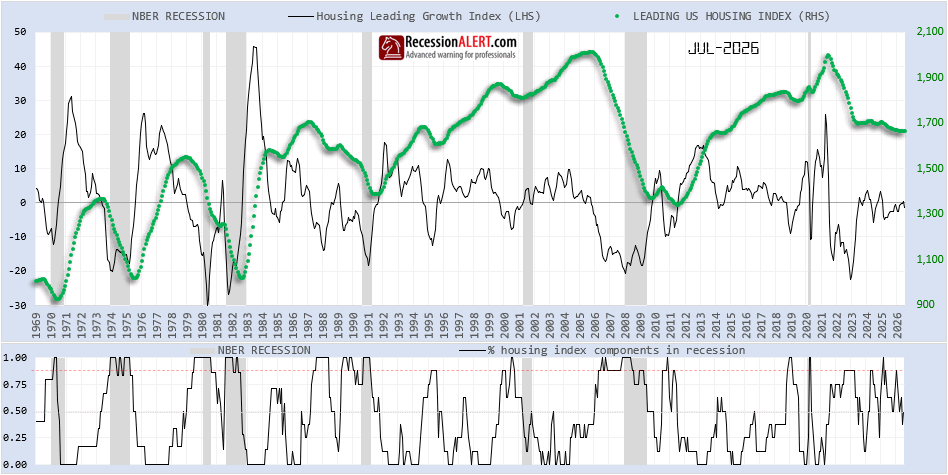
Four of the eight housing measures improved in July, and not one of them counts a finished house. The gains are permission and opinion: permits, builder mood, existing-home sales, and months’ supply — which enters the index upside-down, scoring +0.41 while the shelf actually filled from 9.3 months to 9.6. The losses are output that already happened: completions -8.50, at 1.212M homes and -16.8% on the year; starts -3.60, down 12.4% in a month; new-home sales at 607k. That gap is a choice. A permit is an option — cheap to hold, quietly expiring, and it pays nobody. Breaking ground draws a loan and hires a crew against 488,000 unsold homes, roughly 117,000 already finished. So builders discount instead: the median new home has fallen to $393,800, a five-year low, while the median existing home set a record $434,100 in its 37th straight month of gains. New homes now sell $40,300 — 9.3% — below used ones, reversing a premium that stood for roughly five decades. Owners holding cheap mortgages refuse to list against 6.66%; builders have no such choice. Those monthly choices accumulate, and the green line is only the black one’s running tally: July’s level fell by exactly 1.27, July’s growth print, and 16.9 points across twelve months. Sixteen sub-zero months, a single +0.31 in June, then this. Sentiment can be revised by Friday. A foundation cannot — and the tally only ever adds what actually got poured.
What it means: the monthly sales figures will show you the volume, but the damage is in homebuilders’ margins. They are shifting houses by cutting prices and paying buyers’ costs, so the money kept on each sale shrinks. The sign this is genuinely turning would be two positive months in a row from the growth index — last seen in January 2025.
Market Intelligence Brief (MIB) Ver. 19.43
For professional investors only. Not investment advice.
© 2026 RecessionALERT.com

Comments are closed.