
MARKET INTELLIGENCE BRIEF (MIB)
Wednesday, September 2, 2026
Equities snapped a three-day skid as the 10-year touched 4.818%, highest since November 2023, then reversed; S&P +0.46%, Russell 2000 +1.13%, VIX -6.79%. ADP added just 38,000 jobs before Friday’s payrolls. A judge spared Google’s ad exchange from divestiture. Chevron committed $7 billion to Venezuela as Washington widened sanctions relief. Nvidia rose 3.21% on a re-reported $14 billion Hugging Face deal. Uber cut 10% of staff as Delivery Hero backed its bid. Diesel closed 12.8 cents below its all-time high.
TABLE OF CONTENTS
A. EXECUTIVE SUMMARY
B. MARKET DATA
C. HIGH-IMPACT STORIES (7)
D. MODERATE-IMPACT STORIES (7)
E. ECONOMY WATCH (5)
F. EARNINGS WATCH (4)
G. WHAT’S NEXT
H. CHART OF THE DAY
A. EXECUTIVE SUMMARY -> TOP
Equities snapped a three-session decline as the 10-year touched 4.818% — its highest since November 2023 — then reversed to close at 4.782%, down 1.4 basis points, with the S&P 500 up 0.46% to 7,666.60, the Russell 2000 leading at 1.13% and the VIX collapsing 6.79%. The proximate trigger was ADP’s 38,000 August print, which pulled the 2-year down 2.3 basis points — but a 9,000-job miss does not settle an FOMC argument about inflation, and Governor Barr’s call to “act decisively” and Williams’ reading of the yield surge as economic strength rather than inflation fear both stood. Breadth was real — NYSE Composite +0.60%, with Basic Materials +1.83% and Communication Services +1.16% leading on the Google ad-exchange ruling — but the rate-sensitive complex sat it out: Real Estate was the only red sector, Utilities managed 0.16% as PG&E deferred $2 billion of 2027 capex, and long-duration software was sold hard, CrowdStrike -5.42% and Palantir -5.81%, on a session yields fell.
• The 10-year touched 4.818% and reversed — the highest intraday level since November 2023, before closing at 4.782%, down 1.4 bps; the 2-year eased 2.3 bps to 4.371% and the VIX collapsed 6.79% to 15.23.
• ADP private payrolls added just 38,000 in August — the slowest pace since January, against 47,000 expected; Friday’s nonfarm payrolls consensus is a 58,000 gain after July’s outright 23,000 loss, with unemployment seen at 4.1%.
• Google keeps AdX — Judge Brinkema rejected the DOJ’s divestiture demand in favour of conduct remedies, noting no buyer had ever been identified; the full opinion stays sealed roughly 14 days. Communication Services closed +1.16%.
• Chevron commits more than $7 billion to Venezuela — one of eight energy deals signed in Caracas with Energy Secretary Wright present, targeting roughly 600,000 bpd; OFAC widened sanctions relief to coal, minerals and gold the same day, while ExxonMobil said nothing has changed.
• Nvidia +3.21% to $224.41 — Hugging Face re-reported at $12.9 billion plus a $1 billion retention package, signing possible this week; that is roughly $170 billion of market value added against a $14 billion deal, so the tape repriced strategy, not economics.
• Diesel closed within 12.8 cents of its all-time high — $5.6879 national average, up 54.1% year over year, with distillate stocks 10.1% below a year ago, refineries at 98.0% utilisation and a 4.45 million barrel crude draw against a 1.1 million consensus.
1. The yield reversal was clean; the rotation underneath it was not — Falling yields alongside a collapsing VIX and small-cap leadership is a textbook risk-on session, yet the names sold were precisely those whose multiples discount against the rate that fell. CrowdStrike (-5.42%, up 97% year-to-date through Monday) and Palantir (-5.81%, sold into a fresh $127 million Army TITAN production award) read as mechanical profit-taking in the most crowded rate-sensitive corner rather than a crack in demand. But 4.818% is now the level that has to hold: a decisive break re-opens the duration compression that hit software today, and Friday’s payrolls is the test.
2. Energy has become the inflation channel the Fed cannot write off as transitory — Diesel is 54.1% higher year over year with distillate stocks 10.1% below year-ago levels, refineries at 98.0% utilisation and demand already falling — tightness that cannot be relieved by running the existing fleet harder, because there is nothing left to run. That is exactly the input-cost pressure the Beige Book recorded in eight of twelve districts, and exactly what a committee arguing about whether to hike again cannot dismiss. Chevron’s Venezuelan barrels and Sunday’s OPEC+ meeting address the 2027-2030 curve, not the next quarter’s CPI.
3. The AI capital chain became measurable at every layer on the same day — Microsoft will disclose Azure revenue for the first time under a two-segment fiscal 2027 structure, Broadcom has guided fourth-quarter AI semiconductor revenue to $21.7 billion, Dell exited its quarter with a $95 billion AI-server backlog, and Vertiv paid up to $2.6 billion to move upstream into grid interconnection and on-site generation. Nvidia’s reported $14 billion for Hugging Face — a 3x mark in under a year on a company that refused it at $7 billion — is the same story at the distribution layer. The binding constraint has migrated from silicon to power and distribution, and the numbers to test the return on it are finally being published.
 — Leading economic indicators. Accurate market forecasts. Apply for membership at join.recessionalert.com
B. MARKET DATA -> TOP
Equities snapped a three-day losing streak as Treasury yields pulled back from a multi-year intraday high — the 10-year touched 4.818%, its highest since November 2023, before easing to close down 1.4bps. The rally was broad, with the Russell 2000’s 1.13% gain outpacing the mega-cap indices and the NYSE Composite confirming participation beyond large caps. Within tech, the tape split sharply: Nvidia (+3.21%) and Dell (+15.81%, earnings-driven) led gainers, while high-multiple software and security names — CrowdStrike (-5.42%) and Palantir (-5.81%) — sold off on rate sensitivity after their outsized 2026 gains. Crude held just below Tuesday’s spike highs on the ongoing Strait of Hormuz standoff, while Dutch TTF hit its highest level since January 2023 on the same risk.
CLOSING PRICES – September 2, 2026:
MAJOR INDICES
Russell 2000’s 1.13% gain topped the tape, with NYSE Composite breadth (+0.60%) confirming a broad advance beyond mega-caps. The Dow’s push back above 53,000 came alongside Nasdaq 100’s more modest 0.23% gain — a split between yield-sensitive blue chips catching a bid and growth/software names still digesting the day’s earlier Treasury-yield spike. DJ Transportation’s -0.26% was the lone benchmark decliner.
| Index | Close | Change | %Move | Why It Moved |
|---|---|---|---|---|
| S&P 500 | 7,666.60 | +35.13 | +0.46% | Broad rally as Treasury yields eased off a multi-year intraday high; snapped a three-day losing streak. |
| Dow Jones | 53,061.95 | +295.07 | +0.56% | Led by Nvidia and Dell; crossed back above 53,000 as yields pulled back from the session high. |
| DJ Transportation | 20,713.48 | -53.88 | -0.26% | Lagged the broader tape; no discrete same-day catalyst identified. |
| Nasdaq 100 | 29,143.33 | +66.11 | +0.23% | Modest gain masked a split tape — Nvidia/Dell strength offset by a sharp pullback in high-multiple software/security names. |
| Russell 2000 | 2,953.17 | +33.03 | +1.13% | Outperformed every other benchmark; small-caps led the day’s rally. |
| NYSE Composite | 24,495.55 | +146.28 | +0.60% | Broad-based advance, confirming the rally’s breadth beyond the large-cap indices. |
VOLATILITY & TREASURIES
VIX’s 6.79% collapse alongside falling yields is a clean risk-on signal, not a fear repricing — the 10-year’s pullback from its 4.818% intraday high (highest since November 2023) shows bonds and equities moving together today. The 2-year eased in step with the 10-year, leaving the curve’s shape little changed; DXY sat essentially flat, sidelined by the yield reversal rather than driving it.
| Instrument | Level | Change | Why It Moved |
|---|---|---|---|
| VIX | 15.23 | -1.11 (-6.79%) | Fear gauge collapsed as the three-day equity slide reversed. |
| 10-Year Treasury Yield | 4.782% | -1.4 bps | Touched 4.818% intraday — highest since November 2023 — before paring back into the close. |
| 2-Year Treasury Yield | 4.371% | -2.3 bps | Eased in tandem with the long end. |
| US Dollar Index (DXY) | 99.56 | -0.12 (-0.12%) | Roughly flat; sidelined by the yield reversal. |
COMMODITIES
Gold (+0.92%) and silver (+0.88%) moved together on continued safe-haven demand tied to Middle East risk, while copper’s 0.09% gain shows industrial metals barely participating — a split confirming the bid is fear-driven, not a broad reflation trade. Bitcoin was essentially flat, sitting out the equity rally entirely.
| Asset | Price | Change | %Move | Why It Moved |
|---|---|---|---|---|
| Gold | $4,436.79/oz | +$40.39 | +0.92% | Continued its bid as a safe haven amid elevated Middle East risk. |
| Silver | $65.95/oz | +$0.58 | +0.88% | Tracked gold higher. |
| Copper | $6.6063/lb | +$0.0058 | +0.09% | Little changed; industrial-demand read stayed muted versus precious metals’ safe-haven bid. |
| Platinum | $1,768.75/oz | +$2.35 | +0.13% | Roughly flat. |
| Bitcoin | $77,458 | -$26 | -0.03% | Essentially unchanged; sat out the broader risk-on move. |
ENERGY
WTI and Brent both held just below Tuesday’s spike highs, consolidating rather than extending the Strait of Hormuz risk premium. Natural gas diverged sharply by geography: Henry Hub’s 3.20% jump reflects domestic weather demand, while Dutch TTF’s climb to its highest level since January 2023 reflects the same Hormuz-driven LNG supply fears pressuring crude — a European, not US, risk channel.
| Asset | Price | Change | %Move | Why It Moved |
|---|---|---|---|---|
| Crude Oil (WTI) | $90.65/bbl | +$0.43 | +0.48% | Consolidating near Tuesday’s highs after US strikes near the Strait of Hormuz; no fresh escalation today. |
| Crude Oil (Brent) | $95.26/bbl | +$0.61 | +0.64% | Held just off a six-week high on the same Hormuz risk premium. |
| Natural Gas (Henry Hub) | $2.997/MMBtu | +$0.093 | +3.20% | Rose to a five-week high on forecasts for above-normal temperatures lifting cooling demand. |
| Natural Gas (Dutch TTF) | $24.92/MMBtu | +$0.38 | +1.56% | Climbed to its highest level since January 2023 as Hormuz tensions raised fears of disrupted LNG flows — a distinct, geopolitical driver from Henry Hub’s weather-based move. |
S&P 500 SECTORS
Basic Materials (+1.83%) led today after a down week (-2.21%), a sharp reversal. Industrials was flat on the day but remains the weakest sector over the week (-3.55%) and month (-6.14%) — a structural, not one-day, laggard. Real Estate was the only sector red today, extending its own weekly and monthly declines.
| Sector | 1-Day | 1-Week | 1-Month | 3-Month | 6-Month | YTD | 12-Month |
|---|---|---|---|---|---|---|---|
| Basic Materials | +1.83% | -2.21% | +8.15% | +2.80% | -0.02% | +20.26% | +35.25% |
| Communication Services | +1.16% | -0.25% | -4.79% | -4.06% | -0.26% | -1.43% | +9.85% |
| Financial | +1.14% | -0.53% | -0.33% | +12.45% | +12.86% | +8.14% | +13.35% |
| Healthcare | +0.87% | -0.69% | +6.06% | +16.16% | +9.52% | +11.01% | +24.55% |
| Technology | +0.42% | +0.96% | -0.42% | -4.16% | +26.60% | +23.39% | +34.53% |
| Consumer Cyclical | +0.27% | -1.88% | -4.00% | -1.78% | -0.71% | -4.92% | -1.44% |
| Consumer Defensive | +0.23% | -0.69% | -1.07% | +2.02% | -4.36% | +7.11% | +5.14% |
| Energy | +0.17% | +3.80% | +8.13% | +7.88% | +14.03% | +40.96% | +41.40% |
| Utilities | +0.16% | -1.91% | -3.69% | -3.66% | -10.04% | -1.04% | +2.65% |
| Industrials | +0.00% | -3.55% | -6.14% | -5.19% | -4.56% | +8.92% | +13.40% |
| Real Estate | -0.51% | -2.84% | -3.14% | +1.51% | +0.05% | +7.81% | +4.61% |
TOP MEGA-CAP MOVERS:
GAINERS
| Company | Ticker | Close | Change | Why It Moved |
|---|---|---|---|---|
| Dell Technologies Inc | DELL | $492.20 | +15.81% | Earnings-driven (FQ2 report, Tue AMC). |
| NVIDIA Corp | NVDA | $224.41 | +3.21% | Bloomberg: NVDA reported nearing a $14B Hugging Face deal (unconfirmed) — outsized versus the deal’s size, likely reflects broader AI-strategy read-through too. |
| Oracle Corp | ORCL | $145.75 | +3.13% | No discrete same-day catalyst identified. |
| T-Mobile US Inc | TMUS | $187.30 | +2.82% | No discrete same-day catalyst identified. |
| GE Vernova Inc | GEV | $921.94 | +2.61% | No discrete same-day catalyst identified. |
DECLINERS
| Company | Ticker | Close | Change | Why It Moved |
|---|---|---|---|---|
| Palo Alto Networks Inc | PANW | $328.48 | -9.28% | Earnings-driven (FQ4 report, Tue AMC). |
| Palantir Technologies Inc | PLTR | $169.46 | -5.81% | Rate-sensitive pullback amid the day’s yield spike; fell despite a new Army TITAN production award. |
| Crowdstrike Holdings Inc | CRWD | $203.42 | -5.42% | Rate-sensitive pullback after a +97% YTD run; characterized as mechanical profit-taking. |
| RTX Corp | RTX | $200.78 | -2.13% | No discrete same-day catalyst identified. |
| Arista Networks Inc | ANET | $186.10 | -1.67% | No discrete same-day catalyst identified; broader high-multiple tech softened amid the day’s yield spike. |
— Institutional-grade intelligence for serious investors. Apply for membership at join.recessionalert.comC. HIGH-IMPACT STORIES -> TOP
BEARISH
1. Iran Answers Tuesday’s US Strikes With Missiles and Drones Across Four Gulf Neighbours — the Heaviest Exchange in More Than a Month
The core facts:Iran launched combined missile and drone attacks early Wednesday against Bahrain, Kuwait, Jordan and Iraq, in retaliation for the renewed wave of US strikes on Iran late Tuesday. Jordan said 13 ballistic missiles entered its airspace, with 10 intercepted and three falling in remote areas. Bahrain said its air defences intercepted and destroyed Iranian drones, and Kuwait’s state news agency reported firefighters bringing under control a blaze at a residential complex in the capital struck by what it called a hostile Iranian drone. In northern Iraq the IRGC claimed combined missile and drone attacks on US positions near Erbil and said it killed American personnel — casualty claims are disputed on both sides and are not resolved here. The United Arab Emirates separately condemned Iran’s “hostile attacks” across the region. Reporting describes the exchange as the heaviest between the US and Iran in more than a month.
Why it matters:The market’s answer was consolidation rather than escalation: WTI settled at $90.65 (+0.48%) and Brent at $95.26 (+0.64%), both holding just below Tuesday’s spike highs, while gold added 0.92% to $4,436.79 and Dutch TTF gained 1.56% to $24.92/MMBtu on the LNG channel rather than the crude one. That restraint is worth reading carefully, because the physical evidence is contested. Kpler’s preliminary data put Tuesday’s Strait of Hormuz commodity-vessel crossings at four, against ten on Monday and a ten-day average near 13; Energy Secretary Chris Wright said on the record that 17 million barrels of crude transited the strait on Monday; ING argues that once bypass volumes are counted, Persian Gulf flows are running above pre-war levels. Those three readings cannot all be right, and the disagreement between vessel trackers and the US government is itself the finding. Underneath it, EIA reported a 4.5 million barrel commercial crude draw for the week ended August 28 against a consensus draw near 1.1 million, with refinery utilisation at 98.0% — a tight physical market absorbing a live military conflict.
What to watch:Any confirmed strike on Gulf oil infrastructure — Fujairah, the Saudi East-West pipeline, Basra or ADNOC facilities — would break the consolidation pattern immediately. The seven core OPEC+ producers meet Sunday, September 6 to set October levels.
UNCERTAIN
2. The 10-Year Touches 4.818% and Then Reverses — Equities Snap a Three-Day Skid While High-Multiple Software Is Left Behind
The core facts:The 10-year Treasury yield touched 4.818% intraday, the highest level since November 2023, before easing to close at 4.782%, down 1.4 basis points. That ended a five-session run in which the yield climbed from 4.625% on August 25 to 4.799% on September 1 — verified session by session against each day’s published tape. The 2-year eased 2.3 basis points to 4.371%. Equities took the reversal as permission: the S&P 500 rose 0.46% to 7,666.60, the Dow 0.56% to 53,061.95, the Russell 2000 1.13% and the NYSE Composite 0.60%, while the VIX collapsed 6.79% to 15.23. The index snapped three consecutive down sessions (August 28, August 31 and September 1). But the Nasdaq 100 managed only 0.23%, because the tape split: CrowdStrike fell 5.42% to $203.42 and Palantir 5.81% to $169.46. Palantir declined even as the US Army moved its TITAN program into production, issuing $192 million of delivery orders for eight initial systems — $127 million to Palantir and $65 million to Anduril, delivering over the next 18 months.
Why it matters:Two things happened at once and only one of them is a risk signal. Falling yields alongside a collapsing VIX and small-cap leadership is a clean risk-on session — bonds and equities moving together, with the dollar index flat at 99.56 and refusing to travel with either. What is not benign is the composition. The names that were sold are long-duration growth stories whose multiples are discounted against exactly the rate the market spent the previous five sessions repricing, and they were sold on a day the yield fell. CrowdStrike was up 97% year-to-date through Monday’s close, which is the more likely explanation — mechanical profit-taking in the most crowded rate-sensitive corner rather than a crack in the demand story, and Palantir falling into a fresh production award argues the same way. Real Estate was the session’s only red sector, at -0.51%, and Utilities managed just +0.16% while sitting -1.91% on the week: the rate-sensitive complex did not participate in the relief.
What to watch:4.818% is now the level that has to hold; a decisive break above it re-opens the duration compression that hit software this session. Friday’s payrolls report at 8:30 AM ET is the next test.
BULLISH
3. A Federal Judge Spares Google’s Ad Exchange — Brinkema Rejects the DOJ’s Divestiture Demand in Alphabet’s Second Structural Reprieve in a Year
The core facts:US District Judge Leonie M. Brinkema of the Eastern District of Virginia issued an initial two-page decision rejecting the Justice Department’s demand that Alphabet divest AdX, its advertising exchange, and opted instead for conduct rules governing how Google must operate in the ad market — including requirements that its advertising tools interoperate with rival platforms. Brinkema said she agreed with most of the remedies proposed by the two sides. The full opinion, which contains the specific remedies, was issued under seal and remains sealed for 14 days to let the parties propose redactions, so the remedies themselves are not public and are not characterised here. At closing arguments Brinkema had questioned how long a forced sale would take and noted that no buyer for AdX had been identified. The ruling follows the April 2025 liability finding that Google illegally monopolised two ad-tech markets.
Why it matters:This is the second time in twelve months a federal court has found Alphabet liable and then declined to break anything off it. The pattern now has enough repetitions to be priced as a rule rather than an outcome: the government keeps winning on liability and losing on remedy, and the reason Brinkema gave — that no credible acquirer for AdX was ever identified — is a structural feature of these markets rather than a failure of this particular case. That materially lowers the tail risk embedded in every other pending platform antitrust action, because the remedy phase is where the valuation damage lives. Communication Services was the session’s second-strongest sector at +1.16%, behind only Basic Materials. One trap worth flagging: Judge Mehta’s separate search-remedies decision landed on September 2, 2025, exactly one year to the day before this one, and searches surface it as though it were current.
What to watch:The unsealed opinion is due around September 16 and is the first moment the actual remedies become knowable. Watch also for a DOJ appeal, which would keep the structural question alive.
BULLISH
4. Washington Presides Over Eight Venezuelan Energy Deals — Chevron Commits $7 Billion, Eni Takes Junin 5, and OFAC Widens Sanctions Relief Beyond Oil
The core facts:Eight energy agreements were signed at the Miraflores Presidential Palace in Caracas on Wednesday, with US Energy Secretary Chris Wright present and acting President Delcy Rodriguez signing for Venezuela, in deals described at the ceremony as representing tens of billions of dollars of investment. Chevron’s own newsroom release commits more than $7 billion over the next five years, targeting roughly 600,000 barrels per day against approximately 275,000 to 300,000 today, with new acreage at Carabobo-1 and Carabobo-2-South-A through Petroindependencia S.A. (Chevron 49%), the Ayacucho 8 area adjacent to Petropiar S.A., and Petroboscan S.A. in Zulia State; production costs are cited under $20 per barrel. CEO Mike Wirth: “Chevron’s history in Venezuela spans more than a century, and our expanded position reflects our confidence in the country’s deep resource potential and its ability to compete for investment within our portfolio for decades.” Eni gained exclusive rights to explore the Junin 5 field, and its CEO Claudio Descalzi said new wells could begin as soon as Thursday, targeting 1 million bpd. GE Vernova will help revitalise Venezuela’s electricity sector. Separately and on the same day, OFAC issued amended General Licences 51D, 54C and 55A plus amended FAQ 1247, extending Venezuela sanctions relief to coal, minerals and gold. All of Chevron’s current Venezuelan output is exported to the United States. ExxonMobil said Tuesday that “nothing has changed” on its Venezuela position.
Why it matters:A second, non-OPEC+ supply channel is being opened at precisely the moment a Hormuz risk premium sits in the crude price and diesel cracks are at or near records. The barrels are real but slow — Chevron is guiding to roughly a doubling over five years, not five months — so this does nothing for the physical tightness EIA reported this week and everything for the shape of the 2027-2030 curve. The more immediate signal is the widening of the relief itself: extending general licences from oil into coal, minerals and gold on the same day as the signing tells you the administration is treating Venezuela as a strategic supply relationship rather than a narrow oil carve-out. Exxon’s public refusal to move is the counterweight and is worth taking seriously, because it says the majors do not agree on whether the legal and expropriation risk has actually been retired. GE Vernova’s participation also puts a US power-equipment name inside a sovereign reconstruction — it closed +2.61% among the day’s mega-cap gainers.
What to watch:Whether Eni’s Thursday spud actually happens is the first concrete test of how fast these agreements convert to activity. Watch also the expiry dates attached to the new general licences, which were not on OFAC’s recent-actions page.
UNCERTAIN
5. ADP’s 38,000 Miss Lands Three Days Before Payrolls Into a Fed That Cannot Agree With Itself
The core facts:Private payrolls rose 38,000 in August against 47,000 expected, the slowest pace since January — Section E carries the full data layer, including the sector composition. What matters here is the reaction, and it was a repricing of the front end rather than the whole curve: the 2-year eased 2.3 basis points to 4.371% while the 10-year fell 1.4, and equities used the softer labour read to end a three-session decline. No dated post-Beige-Book reading of September hike odds could be established on the session, and the figures that could be pinned belong to Monday and Tuesday, so no same-day odds number is printed here. Consensus for Friday’s nonfarm payrolls is a 58,000 gain after July’s outright loss of 23,000, with the unemployment rate seen at 4.1%.
Why it matters:The soft print arrived into an FOMC that is visibly split on the record. Governor Barr said on Tuesday that if inflation “appears not to be moderating sufficiently, then I think we should act decisively to raise rates.” New York Fed President John Williams said on Wednesday that he remains in wait-and-see mode and attributed the yield surge to economic strength rather than inflation risk. Wednesday’s Beige Book sat between them, describing modest growth in ten of twelve districts alongside prices rising in eight — the shape that gives both men evidence. That is why a 9,000-job miss did not move the policy debate: a labour market cooling this gently is not the variable that settles a hike argument being conducted about inflation. Friday’s payrolls is the last major data release before the blackout window, which loads it more heavily than a single monthly print normally deserves.
What to watch:Nonfarm payrolls, the unemployment rate and average hourly earnings on Friday, September 4 at 8:30 AM ET. Governor Waller speaks Thursday at 8:30 AM ET — the last major Board voice before blackout.
UNCERTAIN
6. Nvidia’s Hugging Face Deal Is Re-Reported at Roughly $14 Billion With a $1 Billion Retention Package and Signing Possible This Week
The core facts:Bloomberg reported overnight that Nvidia’s agreement to acquire the AI platform Hugging Face is valued at $12.9 billion plus a roughly $1 billion employee retention package — approximately $14 billion all-in — and could be reached as soon as this week. The $12.9 billion figure was first reported on August 26-27; the retention package, the all-in number and the imminent-signing timeline are what is new. Bloomberg’s own caveat is that no final agreement has been reached and that terms or timing could change, and Nvidia has not confirmed it. NVDA closed at $224.41, up 3.21%, on a market capitalisation of $5.42 trillion. JPMorgan reiterated Overweight the same session without a stated target, writing that “we see constructive demand fundamentals coupled with inflecting capital return supporting material upside to the stock.” Hugging Face declined a $500 million Nvidia investment at a $7 billion valuation late last year and last raised $235 million in 2023 at $4.5 billion.
Why it matters:The arithmetic does not support reading this as a transaction story. A 3.21% move on $5.42 trillion is roughly $170 billion of market value against a reported $14 billion purchase — twelve times the deal size — so whatever the market repriced, it was not the economics of the acquisition. What it plausibly repriced is the strategic implication: Nvidia paying a 3x mark in under a year for the default distribution layer of open-weight models, having been refused at $7 billion, is a statement about where it thinks the ecosystem lock-in sits now that the compute layer is contested by custom silicon. That reading has a same-session corroboration in Broadcom guiding fourth-quarter AI semiconductor revenue to $21.7 billion. Nvidia and Dell together carried the Dow’s 0.56% gain.
What to watch:A signed agreement this week would convert a reported deal into a disclosed one; the absence of one by Friday is itself information. Watch for antitrust commentary given Hugging Face’s position as a neutral model repository.
UNCERTAIN
7. Lutnick Signals a Broader Semiconductor Tariff Framework on a Build-Here-or-Pay Test — With Nothing Behind It on the Record
The core facts:Commerce Secretary Howard Lutnick told CNBC’s Squawk Box on Wednesday morning that the administration is working on a framework for semiconductor tariffs and that “all of the companies know they’re coming.” He set out the test as “If you build here, you don’t pay, but if you don’t build here, expect to pay,” adding “We will be successful in semiconductors. They’re going to be built in America.” No rate, no product scope and no effective date were given. Nothing corresponding was filed for public inspection at the Federal Register on Wednesday — the complete public-inspection enumeration returned 109 documents and none was a presidential or trade proclamation — and USTR’s press office has posted nothing since August 20. The existing instrument is Proclamation 11002, signed January 14, 2026, which imposes 25% on a narrow set of advanced logic semiconductors. Secondary write-ups attach an “up to 100%” figure for South Korean and Taiwanese firms that do not invest in the US, but that statement could not be dated to Wednesday rather than an earlier appearance and is not attributed here.
Why it matters:This is a signal, not an act, and the distinction is the whole story. Semiconductors are the market’s most concentrated exposure, and a broad tariff on them applied against a domestic-investment test would redraw the cost base of every fabless designer and every foundry customer in the S&P 500. Yet the tape priced none of it: Technology closed +0.42%, Nvidia rose 3.21%, and Stifel initiated Taiwan Semiconductor at Buy with a $515 target the same day, calling it a “must-own” multi-year position. Either the market has learned to discount trade rhetoric that arrives without a Federal Register document, or it is under-pricing a framework that a Section 232 initiation could make real inside a month. The contrast with the Section 232 pharmaceutical tariffs — which begin for Annex III companies on September 29 with a date attached — is the useful calibration.
What to watch:A Federal Register filing or a new Section 232 investigation initiation on semiconductors is the moment this becomes an instrument. Until one appears, treat the framework as unscoped.
— Quantifying recession risk so you don’t have to guess. Apply for membership at join.recessionalert.comD. MODERATE-IMPACT STORIES -> TOP
BULLISH
8. Uber Cuts 10% of Its Workforce and Exits Two African Markets on the Same Day Delivery Hero’s Boards Endorse Its EUR 41.50 Offer
The core facts:Uber announced a global management restructuring via an internal email from CEO Dara Khosrowshahi, cutting roughly 3,300 roles — about 10% of staff. The plan reduces managers by approximately 20%, halves the number of one- and two-person teams, and removes staff more than seven layers down from the CEO; engineering, science and delivery divisions are being combined, as are delivery operations across restaurants, retail and direct. Khosrowshahi wrote that growth “has also brought complexity: more layers, more coordination, more fragmented ownership.” Bloomberg separately reported at 11:36 AM ET that Uber will exit Nigeria and Uganda as part of the same restructure. Hours earlier, Delivery Hero’s management and supervisory boards published their joint reasoned statement formally recommending acceptance of Uber’s takeover offer, calling the EUR 41.50 per share price “fair and adequate”; the deal is reported at roughly EUR 13 billion, which outlets render as $14.8 billion or $15 billion depending on FX convention. The acceptance period expires November 5. UBER closed at $76.45, up 1.61%, on a $156.15 billion market capitalisation.
Why it matters:Doing both on one day is the message. A company does not remove a fifth of its management layer and exit two country markets on the morning its target’s boards endorse a EUR 13 billion acquisition unless it is deliberately funding the deal out of a leaner operating base — and the specific cuts named, one- and two-person teams and reports more than seven levels deep, are the signature of a span-of-control exercise rather than a demand problem. That distinction matters for the read-through: this is not evidence that mobility or delivery volumes are deteriorating, and it should not be extrapolated to peers as a demand signal. What it does signal is that the consolidation phase in delivery is being financed by operating leverage rather than by equity, at a moment when the cost of the alternative has risen with the curve.
What to watch:The November 5 acceptance deadline is the gate on the Delivery Hero transaction. Watch also whether the Nigeria and Uganda exits extend to other sub-scale markets, which would reframe this as a portfolio retreat rather than a cost action.
BULLISH
9. Microsoft Collapses Three Reporting Segments Into Two and Will Disclose Azure Revenue for the First Time
The core facts:Microsoft released supplemental materials on Wednesday containing restated historicals and a revised fiscal 2027 reporting structure, collapsing three segments into two: “Agents and Infra,” covering cloud, AI software and traditional business software, and “Devices and Consumer,” covering Windows, Xbox, Bing and LinkedIn advertising. Azure sales will be broken out for the first time. One figure circulating in the same coverage is deliberately not treated as new here: a roughly $175 billion calendar-2026 capital expenditure number, tied to a change in datacenter and office useful life from 15 to 25 years and a shift from finance to operating leases, could not be established as newly disclosed Wednesday rather than restated from the July 29 fiscal 2026 fourth-quarter release. The underlying 8-K was not read.
Why it matters:Azure’s absolute revenue has been the most conspicuous missing number in mega-cap software. Microsoft has disclosed a growth rate without a base for years, which has made it impossible to size Azure against AWS or Google Cloud without triangulating from commercial bookings — and impossible to judge what the capital expenditure is actually buying per dollar. Supplying the base changes the quality of every AI-infrastructure estimate built on top of it, and it arrives in a week when the rest of the chain became measurable: Dell exited its quarter with $16.4 billion of AI-server revenue and a $95 billion backlog, and Broadcom guided fourth-quarter AI semiconductor revenue to $21.7 billion. The layer that has been opaque is the one closest to the end customer, which is where the return on all of it is finally settled. Segment recuts also reset comparability, so the restated historicals are the thing to read rather than the headline structure. Separately, an Exchange Online authentication outage that began August 31 remained unresolved through Wednesday’s session.
What to watch:The fiscal 2027 first-quarter report is the first print on the new basis and the first disclosed Azure revenue line. Watch whether Amazon or Alphabet respond with comparable granularity.
BEARISH
10. PG&E Defers $2 Billion of 2027 Capital Spending and Opens a Strategic Review as JPMorgan Cuts Its Target 28%
The core facts:PG&E said Wednesday that its 2027 capital plan drops to $11.4 billion from $13.4 billion, cutting 2027 debt needs by roughly $2 billion, and that it is launching a strategic review. The action follows the California Assembly adjourning on September 1 without passing wildfire legislation. CEO Patti Poppe: “California’s wildfire liability framework continues to create financing risks that drive higher costs, affect customer affordability, and limit investment in the energy system.” JPMorgan’s Aidan Kelly cut his price target to $18 from $25 — a 28% reduction — while keeping an Overweight rating. The same analyst cut Sempra to $102 from $113 the same day, also keeping Overweight. PCG closed at $13.33, down 5.19%, on a $29.36 billion market capitalisation. Yesterday’s report covered Bank of America’s downgrade and target cut on the same name; the trigger here is the company’s own capital-plan decision.
Why it matters:A regulated utility exists to grow its rate base, and cutting planned capital expenditure by 15% is the most explicit statement available that the cost of financing that growth has become the binding constraint. The mechanism is worth being precise about: this is not a demand problem or a regulatory disallowance, it is an unresolved liability framework raising the risk premium on new debt until the incremental project stops clearing its hurdle. Californians therefore get less grid investment because the legislature did not act, which is the outcome the liability framework was ostensibly designed to prevent. The paired Sempra cut from the same analyst on the same day says the market is treating this as a state-level cost-of-capital repricing rather than a company-specific event. Utilities managed only +0.16% on a session when every other sector but Real Estate rose, and sit -1.91% on the week and -3.69% on the month.
What to watch:Whether California’s legislature returns to wildfire liability before the next session, and what the strategic review’s scope turns out to cover — asset sales would be a materially different signal from a financing restructure.
UNCERTAIN
11. Elliott Builds a Deutsche Telekom Stake and Moves to Block the Roughly $300 Billion T-Mobile US Combination
The core facts:Bloomberg reported at approximately 3:54 PM ET that Elliott Management has built a position in Deutsche Telekom and wants the company to abandon its full merger with T-Mobile US — in which Deutsche Telekom holds roughly 53% — and pursue larger share buybacks instead. The stake size was not disclosed; Germany’s notification threshold is 3% and no filing was identified, so the size is unknown rather than known to be small. Deutsche Telekom’s market capitalisation is EUR 136.17 billion, roughly $148 billion; T-Mobile US is $200.91 billion and closed at $187.30, up 2.82%. Reuters, Investing.com and Yahoo all attribute to the single Bloomberg report. No evidence ties T-Mobile’s close to the report, which landed six minutes before the bell, and no causation is inferred here.
Why it matters:A full combination of Deutsche Telekom and T-Mobile US would be among the largest telecom transactions ever attempted, and the assumption embedded in most sell-side models is that the obstacle is regulatory. An activist at the parent is a categorically different constraint: it cannot be cleared by concessions to an antitrust authority, it operates on a shareholder-vote timetable rather than a review timetable, and it attacks the transaction’s logic rather than its competitive effects. The buyback alternative Elliott is reportedly pushing is also the more defensible one on current arithmetic — Deutsche Telekom’s stake in a $201 billion subsidiary is worth more than its own EUR 136 billion capitalisation, which is the sort of holding-company discount an activist is built to attack. That said, the entire story rests on one report with no disclosed position size, and should be held as a lead until a notification appears.
What to watch:A German voting-rights notification crossing the 3% threshold would convert this from a report into a disclosed position. Watch for Deutsche Telekom’s own response.
BEARISH
12. Retail Diesel Closes to Within 12.8 Cents of Its All-Time High and Gasoline Holds Above $4
The core facts:AAA’s national daily averages for September 2 put regular gasoline at $4.1203, up from $4.0954 on Tuesday, against $4.1014 a week ago and $3.1869 a year ago — a 29.3% year-on-year increase. Diesel printed $5.6879, up from $5.6325 on Tuesday, against $5.6230 a week ago, $5.3637 a month ago and $3.6903 a year ago — up 54.1% year over year. AAA’s own record highs are $5.0165 for gasoline, set June 14, 2022, and $5.8159 for diesel, set June 19, 2022, which places diesel 12.80 cents, or 2.2%, below its all-time high. These are retail survey averages rather than exchange prices. The supply backdrop from Wednesday’s EIA balance sheet: distillate stocks of 104.2 million barrels sit 10.1% below a year ago, refinery utilisation is running at 98.0% against 94.3% a year ago, and distillate product supplied on a four-week average has fallen to 3.680 million barrels per day from 3.894 a year ago.
Why it matters:Diesel is the input price for freight, agriculture and construction, so a 54% year-on-year move is not a consumer-sentiment story but a cost shock that propagates into goods prices with a lag of one to two quarters. The composition of the EIA data is what makes it worrying rather than merely high: distillate demand is falling at the same time as stocks sit 10% below year-ago levels and refineries run at 98% utilisation. Demand destruction alongside tight inventory and maximum throughput means the tightness is supply-side and cannot be relieved by running the existing fleet harder — there is nothing left to run. That is precisely the channel Wednesday’s Beige Book described when it recorded input-cost pressure in energy and transportation across districts, and precisely what a committee arguing about whether to hike again cannot write off as transitory.
What to watch:Whether diesel takes out $5.8159, which would be the first all-time high in the series since June 2022. Russia’s diesel export ban expires September 30.
BULLISH
13. Vertiv Buys UtilityInnovation Group for Up to $2.6 Billion, Pushing the Data-Centre Trade Further Up the Power Chain
The core facts:Vertiv announced at approximately 6:35 AM ET Wednesday that it will acquire UtilityInnovation Group. Its Form 8-K, Item 1.01, with an earliest event date of September 1, specifies “approximately $1.45 billion in upfront cash at closing, subject to customary adjustments for working capital, indebtedness and transaction expenses,” plus “additional potential cash consideration of up to $1.15 billion in cash, payable in 2 tranches if earned,” calculated against EBITDA targets. The transaction is expected to close in the fourth quarter of 2026. VRT closed at $256.70, up 0.29%, on a $98.83 billion market capitalisation.
Why it matters:The binding constraint on AI capacity has been migrating away from silicon for several quarters, and this transaction prices that migration explicitly. Vertiv already sells the thermal management and power distribution inside the building; UtilityInnovation moves it upstream into grid interconnection and on-site generation, which is where projects now actually stall. Three same-session data points sit on the same chain: Broadcom guided fourth-quarter AI semiconductor revenue to $21.7 billion, Dell exited its quarter with a $95 billion AI-server backlog, and GE Vernova signed a sovereign power agreement in Caracas. The deal structure is the analytically interesting part — up to 44% of maximum consideration is contingent on EBITDA earnouts, which says Vertiv is buying a capability whose cash flows it is not yet willing to underwrite, and that is a more honest read on interconnection economics than the headline number suggests.
What to watch:Fourth-quarter close, and whether the earnout tranches are disclosed with enough granularity to infer what interconnection capacity is actually worth. Watch for competing bids from the electrical-equipment majors.
BULLISH
14. The New York Fed Finds No Broad Official Retreat From Dollar Assets — on the Day the 10-Year Touched a Multi-Year High
The core facts:The New York Fed published “Are Central Banks Moving Out of Dollar Assets?” on Liberty Street Economics Wednesday, authored by Goldberg, Hannaoui and Parthasarathy. The dollar’s share of global official foreign exchange reserves fell from 64% in 2015 to 56% in 2025. The authors decompose it: the 2015-19 decline of 2.8 percentage points split roughly evenly between changes in preference (1.2 points) and changes in reserve size (1.5 points), while the 2019-23 decline of 2.3 points was “driven almost entirely by just four countries: China, Russia, Mexico, and Morocco.” Roughly equal numbers of countries raised as cut their dollar holdings in both windows. The conclusion, verbatim: “there is little evidence of a widespread official diversification away from dollars, despite the decline in the dollar share of aggregate official reserves.” The dollar index closed at 99.56, down 0.12%.
Why it matters:The timing makes this more than an academic note. On the session the 10-year touched its highest level since November 2023, the single most popular structural explanation for the yield backup — that official foreign demand for Treasuries is in secular retreat — was taken apart by the institution that runs the System Open Market Account. If the aggregate share decline is arithmetic rather than behaviour, and the behavioural component is four identifiable sovereigns with idiosyncratic reasons, then the term premium has to be explained by something domestic: coupon supply, inflation risk, or the growth story Williams offered the same day. Each of those has a different policy answer and a different duration for the pain. Investors who have been positioning for a structural buyer strike should note that the flat dollar on a session of falling yields is consistent with the paper rather than against it.
What to watch:The IMF’s quarterly COFER release is the next hard data point on reserve composition. Foreign official custody holdings reported weekly by the New York Fed are the higher-frequency proxy.
— Separating signal from noise since 2007. Apply for membership at join.recessionalert.comE. ECONOMY WATCH -> TOP
August’s data cut both ways: labor cooled again (ADP’s 38K print, the slowest pace since January) while Factory Orders surprised higher (+0.9%) and the Fed’s Beige Book found price pressures persisting across eight of twelve districts. NY Fed’s Williams framed the 10-year yield’s climb to a level not seen since November 2023 as a signal of economic strength rather than inflation risk, even as a much larger-than-expected crude oil draw, amid fresh Iran-US tensions, keeps energy costs elevated. That leaves the Fed’s September 16 meeting without a unified read: Governor Barr wants to “act decisively” on inflation, while Williams stays “wait-and-see.” Friday’s payrolls report is the next tiebreaker.
ADP: Private Payrolls Add Just 38,000 in August, Missing Estimates (CNBC, Sept 2, 2026)
What they’re saying:Private employers added 38,000 jobs in August, well below the 47,000 economists expected and down from July’s 44,000 — the slowest pace of hiring since January. Education and health services led with 45,000 new positions, while goods-producing industries shed 10,000 (manufacturing down 17,000) and professional/business services cut 16,000 roles.
The context:This is the last major labor-market data point before Friday’s BLS nonfarm payrolls report, where consensus calls for a 58,000 gain after July’s outright loss of 23,000. The soft print reinforced a cooling-labor narrative and eased bond-market pressure modestly, tempering some of the inflation concern that has driven yields higher this week.
What to watch:BLS Nonfarm Payrolls, the unemployment rate, and average hourly earnings — all due Friday, September 4 at 8:30 AM ET.
US Factory Orders Rise 0.9% in July, Topping Forecasts on Aircraft Demand (Reuters/Census Bureau, Sept 2, 2026)
What they’re saying:New orders for US factory goods rose 0.9% in July, beating the 0.6% consensus and reversing a revised 0.2% June decline. The gain was driven by a 2.3% jump in transportation equipment orders, including a 12.7% surge in civilian aircraft and parts; orders were up 6.5% year-over-year.
The context:Orders for non-defense capital goods excluding aircraft — a proxy for business equipment investment — were flat rather than the previously reported 0.2% gain, pointing to softness beneath the aircraft-driven headline. The beat adds to a mixed manufacturing picture a day after ISM’s August factory PMI slipped to 54.6, missing estimates, and feeds the same “data staying firm enough to keep the Fed cautious” read that has kept yields elevated.
What to watch:ISM Services PMI, due Thursday, September 3.
Fed’s Beige Book Shows Modest Growth Continuing, Price Pressures Persist (Federal Reserve, Sept 2, 2026)
What they’re saying:The Beige Book, prepared for the September 16 FOMC meeting, found economic activity growing modestly in 10 of 12 districts since early July, unchanged in pace from the prior report. Employment rose only slightly overall — three districts reported modest gains, four slight gains, five no change — while prices rose in eight of twelve districts, with input costs elevated in manufacturing and construction from energy, raw materials, and transportation.
The context:The report lands three weeks before the Fed’s next rate decision and describes modest-but-not-weak growth alongside price pressures that leave little room to ease — consistent with the stagflation-adjacent tension markets have been pricing. Contacts across districts flagged heightened uncertainty tied to energy prices, tariff policy, and international conflict.
What to watch:The September 16 FOMC decision and accompanying Summary of Economic Projections.
NY Fed’s Williams: Surging Bond Yields Reflect Economic Strength, Not Inflation Fear (CNBC, Sept 2, 2026)
What they’re saying:New York Fed President John Williams said the recent surge in long-term Treasury yields — the 10-year touched its highest intraday level since November 2023 — is not being driven by inflation fears but by “a strong U.S. economy and a strong economic outlook fueled by big investments in AI and data centers and technology in general.” He said he remains in “wait-and-see” mode on whether an additional rate hike is warranted.
The context:The comments came the same day Treasury officials reportedly acted to help limit the yield increase, and as the Beige Book flagged price pressures tied partly to energy costs — crude has been supported this week by a larger-than-expected inventory draw and reports of fresh Iran-US strikes threatening Middle East supply. Williams’ “strength, not inflation risk” framing pushes back against the more hawkish read implied by Governor Barr’s Tuesday remarks that the Fed “should act decisively” if inflation does not moderate.
What to watch:Whether other FOMC voters echo Williams’ framing or Barr’s more hawkish tone ahead of the September 16 meeting; the path of the 10-year yield into Friday’s payrolls report.
US Crude Inventories Post Surprise 4.45 Million Barrel Draw, Quadruple Forecast (EIA, Sept 2, 2026)
What they’re saying:US commercial crude stocks fell 4.45 million barrels in the week ended August 28, far exceeding the 1.1 million-barrel draw expected and reversing the prior week’s small 95,000-barrel build — the steepest weekly drawdown since early August. Gasoline stocks also fell, though by less than forecast (-1.17 million vs. -1.9 million expected).
The context:The draw comes as WTI crude trades in the low-$90s intraday, supported both by the inventory data and reports of fresh Iran-US strikes raising concern over Middle East supply. Firmer energy prices complicate the inflation picture the Fed is already watching, feeding the same price-pressure narrative the Beige Book flagged today.
What to watch:EIA’s next weekly petroleum report; any escalation in Iran-US tensions and its pass-through to gasoline prices.
— Know the probability before the market prices in the risk. Apply for membership at join.recessionalert.comF. EARNINGS WATCH -> TOP
YESTERDAY AFTER THE BELL (Markets Reacted Today)
BULLISH
15. Dell Technologies (DELL): +15.81% | A $95 Billion AI Backlog Resets What an AI Server Order Book Looks Like
The Numbers:Released: AMC, Tuesday, September 1. Fiscal Q2 2027 revenue of $46.97 billion versus $44.89 billion expected, a 4.63% beat and up 58% year over year — a company record. Non-GAAP diluted EPS of $7.04 against $4.91 consensus, a 43.34% beat and up 203% year over year; GAAP EPS $6.34. ISG revenue rose 89% to $31.8 billion, with $16.40 billion of AI server revenue recognised in the quarter, $60.90 billion of record AI server orders, and a $95.00 billion ending backlog. Traditional servers and networking grew 122% and storage 26%; CSG revenue rose 20%, its eighth consecutive quarter of growth. Full-year revenue guidance was raised by $25 billion to $192 billion, with non-GAAP EPS guided to $25.50. Shares closed the Tuesday regular session at $425.00, down 6.80%, before the print.
The Problem/Win:The win is the order book rather than the quarter. $60.9 billion of AI server orders against $16.4 billion recognised means Dell booked roughly 3.7 times what it shipped, and the $95 billion backlog is now larger than the entire raised full-year revenue guidance for its server segment. Management also guided the ISG operating income rate up just over a point year over year even as AI server revenue more than triples — which is the single most contested number in the AI hardware complex, because the bear case on server assemblers has always been that AI volume arrives at margins that destroy the mix.
The Ripple:At least eleven firms raised targets on Wednesday. JPMorgan went to $635 from $565 (Overweight), Melius to $735 from $650, Raymond James to $617 from $500, Bernstein to $650 from $500, Barclays to $603 from $550, Bank of America to $600 from $505, Citigroup to $600 from $515, Mizuho to $600 from $500, Evercore to $575 from $550, Goldman Sachs to $570 from $510, Piper Sandler to $558 from $497, Truist to $505 from $360, UBS to $500 from $455, TD Cowen to $500 from $450 and Morgan Stanley to $499 from $434. The print also reset the bar for Broadcom’s report the same evening.
What It Means:Backlog of this size converts Dell from a cyclical box assembler into something closer to a contracted revenue stream, and the ISG margin guide is the reason the multiple re-rated rather than just the estimates. The risk is now concentration and delivery rather than demand.
What to watch:Whether the ISG operating income rate actually expands as guided in the next two prints — that is the number the entire re-rating rests on. Watch the conversion rate of the $95 billion backlog into recognised revenue.
UNCERTAIN
16. Palo Alto Networks (PANW): -9.28% | Beat Both Lines, Added $1 Billion of Net New ARR, and Fell Anyway
The Numbers:Released: AMC, Tuesday, September 1. Fiscal Q4 2026 revenue of $3.41 billion versus $3.35 billion expected, up 34% year over year; adjusted EPS of $1.02 against $0.98 consensus, a 4.35% beat, with GAAP EPS of -$0.35. Next-Generation Security ARR grew 63% year over year to $9.10 billion, with nearly $1 billion of net new NGS ARR added in a single quarter and remaining performance obligations at a record $14.2 billion. Fiscal 2027 guidance was set at $14.10-$14.20 billion of revenue and $4.16-$4.19 of EPS. The company also announced plans to acquire the agentic AI startup Console. Shares closed the Tuesday regular session at $362.09, down 5.24%, and then fell 9.28% on Wednesday to $328.48.
The Problem/Win:Nothing in the demand data explains a 9% decline. NGS ARR up 63% to $9.1 billion with a billion dollars of net new in one quarter is the strongest platformisation evidence the company has produced. The objection is to shape and margin: fiscal Q1 guidance implies a sequential revenue decline, and the market is reading the fiscal 2027 EPS range against the cost of both the platform build and the Console acquisition. This is a multiple compression, not an estimate cut.
The Ripple:The divergence between the tape and the Street is the story. Six firms raised price targets on Wednesday while the stock fell 9.28%: RBC to $475 from $434 (Outperform), DA Davidson to $420 from $345 (Buy), Susquehanna to $415 from $350 (Positive), Rosenblatt to $415 from $355 (Buy), Citigroup to $410 from $400 (Buy) and BTIG to $404 from $380 (Buy). Every one of those targets sits well above the close. The selling also travelled: CrowdStrike fell 5.42% on the session with no company-specific news, and Palo Alto’s decline compounded the same rate-driven pressure on high-multiple security names described in Section C.
What It Means:A company that beats both lines, grows recurring revenue 63% and loses 14% of its value across two sessions is being repriced on the discount rate, not the business. That makes it a rates trade wearing a fundamentals costume — which cuts both ways if the 10-year retreats from 4.8%.
What to watch:Whether fiscal Q1 revenue lands above the sequential decline the guide implies. Zscaler reports Thursday, September 3 after the close and is the nearest read on whether this is sector-wide or company-specific.
TODAY BEFORE THE BELL (Markets Already Reacted)
No major earnings before the bell from companies with >$100B market cap.
TODAY AFTER THE BELL (Markets React Tomorrow)
UNCERTAIN
17. Broadcom (AVGO): -2%+ AH | AI Revenue Triples to $16.7 Billion and the Stock Falls on a $230 Million Guidance Shortfall
The Numbers:Released: AMC, Wednesday, September 2. Fiscal Q3 2026 revenue of $29.59 billion against a $29.24 billion calendar consensus and a street estimate near $29.5 billion; adjusted EPS of $3.32 versus $3.22 on the calendar and $3.25 on the street, extending a streak of beats now running nine consecutive quarters. AI semiconductor revenue of $16.7 billion grew 221% year over year, comfortably clearing the $16 billion management had guided to at the prior report. Fourth-quarter guidance is where the reaction came from: total revenue of $34.8 billion against a $35.03 billion estimate, AI semiconductor revenue of $21.7 billion (up 236% year over year), and a non-GAAP operating margin of 66% against a 66.5% estimate. Shares fell more than 2% in extended trade. Market capitalisation $1,747.17 billion.
The Problem/Win:The win is unambiguous and enormous — AI semiconductor revenue more than tripled year over year and the fourth-quarter guide implies it grows another 30% sequentially to $21.7 billion. The problem is arithmetic at the margin: a $230 million shortfall against a $35.03 billion revenue estimate is a 0.7% miss, and half a point of operating margin. When a stock has run on an AI-acceleration narrative, guidance that is merely excellent rather than ahead is a de-rating event, and that is what happened here.
The Ripple:The $21.7 billion AI guide is the largest single forward number in the custom-silicon complex and it lands the same week Dell reported a $95 billion AI server backlog and Microsoft moved to disclose Azure revenue for the first time — three independent confirmations that AI infrastructure spend is still accelerating at every layer. The negative after-hours reaction is therefore about Broadcom’s multiple rather than the sector’s demand, and peers exposed to the same order flow should be read that way. Networking names that sold off during Wednesday’s session, including Arista at -1.67%, were moving on rates rather than on this print.
What It Means:The bar for AI-levered semiconductors has moved from beating estimates to beating them by enough. A 221% growth quarter that trades down on a 0.7% guidance miss is a sentiment measurement, not a fundamentals one — but it tells you how much acceleration is already in the price.
What to watch:The split between AI networking and AI compute revenue on the call is the disclosure that determines how much of the $21.7 billion is defensible against custom-silicon competition. Watch Thursday’s open for whether the after-hours decline holds.
BULLISH
18. Snowflake (SNOW): +20% AH | A 38% EPS Beat and a Raised Full-Year Guide Answer the Question Palo Alto Just Failed
The Numbers:Released: AMC, Wednesday, September 2, for the quarter ended July 31. Fiscal Q2 2027 total revenue of $1.55 billion against $1.48 billion expected, up 35% year over year; adjusted EPS of $0.62 versus $0.45 consensus, a 38% beat. Product revenue was $1.49 billion, up 37% year over year. The company reported 828 customers with trailing twelve-month product revenue above $1 million, up 27% year over year, and 829 Forbes Global 2000 customers. Full-year product revenue growth guidance was raised to 36% year over year. CEO Sridhar Ramaswamy: “Snowflake delivered another strong quarter, with product revenue of $1.49 billion, up 37% year-over-year, as Snowflake continues to power the enterprise AI revolution.” Shares surged 20% in extended trade. Market capitalisation $106.00 billion.
The Problem/Win:The win is that growth accelerated at scale and the company raised into it. Product revenue growth of 37% on a $6 billion annualised base, with the full-year guide lifted to 36%, means consumption is rising rather than merely renewing — and the 27% growth in $1 million-plus customers says the expansion is coming from existing accounts deepening, which is the highest-quality form of software growth there is. The EPS beat of 17 cents on a 45-cent estimate also indicates operating leverage arriving faster than the model assumed.
The Ripple:The contrast with Palo Alto Networks in the same 24 hours is instructive and should be read together: both are high-multiple software names beating consensus, and one lost 9.28% while the other gained 20% after hours. The difference is the guide — Palo Alto’s implied a sequential revenue decline, Snowflake’s raised the full year. On a session when duration risk was being repriced hard, the market paid for forward acceleration and punished forward deceleration, regardless of the quarter just reported. That is the template for how the rest of the high-multiple software complex will be judged into the September FOMC.
What It Means:Data-platform consumption is the cleanest available proxy for whether enterprise AI is moving from pilot to production, because inference workloads land on the warehouse. A 37% product revenue quarter with a raised guide is the most direct evidence yet that it is.
What to watch:Net revenue retention on the call, and whether the after-hours gain holds through Thursday’s open. Snowflake’s market capitalisation has drifted from $114.87 billion on August 31 to $106.00 billion today — the move takes it decisively away from the $100 billion coverage floor.
WEEK AHEAD PREVIEW:
Q2 2026 earnings season is effectively complete at 97% reported. No company above $100 billion market capitalisation reports on Thursday, September 3 (largest: CIENA, $50.13B), Friday, September 4 (a single row on the entire day, KNOT Offshore Partners at $390.11M), Tuesday, September 8 (largest: Casey’s General Stores, $27.89B) or Wednesday, September 9 (largest: Sunbelt Rentals, $27.51B). Monday, September 7 is Labor Day and US markets are closed. The next mega-cap reports both land on Thursday, September 10.
Oracle (ORCL) — AMC, Thursday, September 10 — consensus $1.73 EPS on $19.13B revenue; $419.83B market cap. Fiscal 2027 guidance calls for 34% constant-currency revenue growth with first-quarter cloud revenue up 58-64% against continued margin pressure, so remaining performance obligations and the OCI gross margin trajectory are the two lines that decide the quarter. Jefferies reiterated Buy on Wednesday while cutting its target to $290 from $320, writing that “we like the setup despite seasonally soft F1Q, with sentiment near peak-negative and most bad news priced in.” Oracle closed Wednesday at $145.75, +3.13%.
Adobe (ADBE) — AMC, Thursday, September 10 — consensus $6.08 EPS on $6.69B revenue; $111.22B market cap. The debate is AI monetisation rather than the quarter: Creative freemium monthly active users passed 90 million in the second quarter, up more than 70%, and Firefly ARR approached $300 million, against a company target of 10.2% fiscal 2026 ending ARR growth and roughly 45% non-GAAP operating margins. Citi raised its target to $301 from $228 while keeping Neutral, arguing a beat and guidance raise may obscure whether Adobe can convert expanding freemium AI usage into durable paid growth in fiscal 2027. RBC raised its target to $315 from $285 on Wednesday; the stock closed at $279.79, -2.20%.
Q3 2026 earnings season begins mid-to-late October.
— US market commentary trusted by family offices and institutions. Apply for membership at join.recessionalert.comG. WHAT’S NEXT -> TOP
UPCOMING RELEASES:
| Date | Event | Why It Matters |
|---|---|---|
| Thu, Sep 3 | ISM Services PMI (expected 54.3) | The larger half of the economy, and the read that matters after Tuesday’s manufacturing PMI slipped to 54.6 and missed. A firm print with hot prices-paid would harden the case Governor Barr made for acting decisively on inflation; a soft one puts the cooling-labour read from ADP on firmer ground. |
| Thu, Sep 3 | Fed Governor Waller speech, 8:30 AM ET; Cleveland Fed’s Hammack also speaks | The last major Board voice before the pre-FOMC blackout window. With Barr hawkish on Tuesday and Williams in wait-and-see mode Wednesday, Waller is the swing testimony on whether the September 16 debate is about holding or hiking. |
| Thu, Sep 3 | Initial Jobless Claims (expected 205K) | The highest-frequency labour read into Friday’s payrolls. Claims have stayed low through a hiring slowdown; a break higher would turn a cooling-demand story into a firing story and change the Fed’s calculus materially. |
| Thu, Sep 3 | Balance of Trade (expected -$90B), Exports (prior $314.7B), Imports (prior $388.0B) | A direct input to Q3 GDP tracking, and the cleanest running measure of how the tariff framework is reshaping trade flows — relevant with Commerce Secretary Lutnick signalling a broader semiconductor tariff regime that has no Federal Register document behind it yet. |
| Fri, Sep 4 | Nonfarm Payrolls (expected +58K), Unemployment Rate (expected 4.1%), Average Hourly Earnings (expected +0.3% MoM, +3.0% YoY) | The week’s defining release, and the last major data point before the FOMC blackout — which loads it more heavily than a single monthly print normally deserves. July was an outright 23,000 loss and ADP printed 38,000; a second negative month would force the hawks to argue for a hike into a contracting labour market. Earnings are the variable to watch as closely as the headline. |
| Sun, Sep 6 | OPEC+ meeting — seven core producers set October output levels | Falls on a weekend, so it prices at Monday’s open into a market already carrying a Hormuz risk premium, a 4.45 million barrel crude draw and diesel 12.8 cents from an all-time high. With refineries at 98.0% utilisation there is no domestic slack to absorb a supply disappointment. |
| Mon, Sep 7 | US markets closed — Labor Day | A three-day weekend immediately after payrolls and across the OPEC+ decision. Positioning into Friday’s close carries two event risks with no ability to trade them until Tuesday. |
| Wed, Sep 9 | MBA 30-Year Mortgage Rate (prior 6.79%); API Crude Oil Stock Change (prior -2.6M) | The mortgage rate is the cleanest transmission of the 10-year’s move to the household sector, and matters more with the yield having touched a 2023-era high. API is the first check on whether last week’s outsized crude draw was a one-off or the start of a trend. |
| Wed, Sep 16 | FOMC decision and Summary of Economic Projections; Google ad-tech opinion expected to unseal | The Beige Book prepared for this meeting describes modest growth in ten of twelve districts alongside price increases in eight — evidence both camps can cite. The updated dot plot is the first collective read on whether the committee’s hawkish wing has support. Separately, Judge Brinkema’s sealed opinion is due around the same date, and is the first moment Google’s actual conduct remedies become knowable. |
KEY QUESTIONS:
1. Does 4.818% hold? Wednesday’s reversal let equities snap a three-day skid, but high-multiple software was still sold on a day yields fell. If Friday’s payrolls or Thursday’s services print pushes the 10-year decisively through that level, does the duration compression that hit CrowdStrike and Palantir broaden into the whole growth complex?
2. Which framing wins inside the FOMC — Barr’s “act decisively” on inflation, or Williams’ reading that the yield surge reflects AI-driven economic strength rather than inflation risk? Waller speaks Thursday as the last Board voice before blackout, and diesel running 54% above year-ago levels gives the hawks a live input-cost argument the labour data does not answer.
3. Is the Google outcome now the template? Two federal courts in twelve months have found Alphabet liable and declined to break anything off it, with the absence of a credible acquirer cited as the reason. If the remedy phase is where the valuation risk lives and it keeps failing, how much of the antitrust discount embedded across the platform names is still justified?
— US market commentary trusted by family offices and institutions. Apply for membership at join.recessionalert.comH. CHART OF THE DAY -> TOP
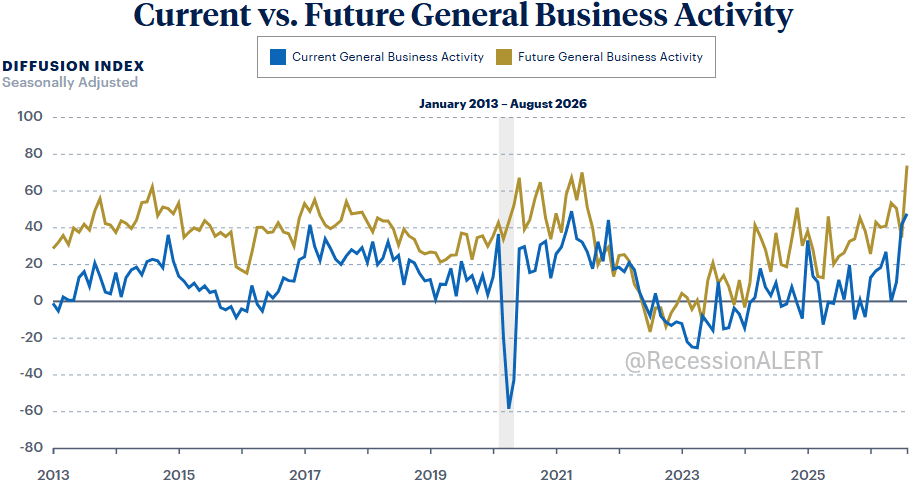
Everyone will look at the gold line. The story is in the blue one, and in a survey that isn’t on this chart at all. The Philadelphia Fed polled its manufacturers 10–17 August: current conditions at 47.4, the best since April 2021, after a year averaging 4.6. Its nonmanufacturers, asked about the same district in the same weeks, came in at -8.2. That 55.6-point spread is the widest of the 186 months the two surveys have overlapped since March 2011, and services usually sit about ten points above factories, not fifty-five below. In eight prior extremes the gap closed every time, always by services rising — episodes bunched in 2011 and the 2020–21 rebound. A record, not a rule. Neither survey measures output: both count breadth only — firms reporting improvement minus firms reporting deterioration — across one district, Delaware, southern New Jersey and eastern and central Pennsylvania. What corroborates it isn’t orders, which fell, but hiring and hours: the share adding staff hit a four-year high, the workweek measure nearly doubled, and not one firm reported paying less for inputs. Still, holding 47.4 needs a bigger majority reporting improvement on an already-improved month, then bigger again; all twenty prior readings above 40 were lower six months on, landing near 31 — three and a half times the 58-year average of 8.9. So manufacturing comes down on arithmetic alone. Whether that gap closes on anything better depends on the survey nobody is looking at.
What it means: if you hold anything priced off the US rate path, expect this index to slide for reasons that have nothing to do with a weakening economy. The roughly 31 it points to by February still beats seven of every eight months since 2016. It breaks only if manufacturing is still 34 points clear of services by then — a lead never once seen before this month.
Market Intelligence Brief (MIB) Ver. 19.44
For professional investors only. Not investment advice.
© 2026 RecessionALERT.com

Comments are closed.