
MARKET INTELLIGENCE BRIEF (MIB)
Monday, August 31, 2026
US strikes near the Strait of Hormuz and Iran’s overnight retaliation sent WTI up 3.50% to $86.32 and European gas to its highest since January 2023. Nine of eleven sectors closed red. California’s wildfire bill omitted the liability cap: PG&E -18%, Edison -23%. The FTC and 22 states sued Amazon over a $20bn ad-auction scheme; AMZN -2.50%. Warsh went hawkish at the G20 but the two-year refused to confirm. Aon bought USI for $17bn, all debt-funded.
TABLE OF CONTENTS
A. EXECUTIVE SUMMARY
B. MARKET DATA
C. HIGH-IMPACT STORIES (6)
D. MODERATE-IMPACT STORIES (7)
E. ECONOMY WATCH (5)
F. EARNINGS WATCH (0)
G. WHAT’S NEXT
H. CHART OF THE DAY
A. EXECUTIVE SUMMARY -> TOP
A US strike on IRGC rocket launchers near the Strait of Hormuz and Iran’s overnight retaliation against Gulf air bases repriced energy risk across the tape, but the cross-asset signature — yields up, dollar down, gold lower — marks this a cost-push supply shock rather than a growth scare, and it lands on an economy the Fed chair is already describing in hawkish terms. The tension sits in the curve: the ten-year rose 3.3 basis points to 4.755% on the oil premium while the two-year fell 0.2 to 4.348%, declining to ratify the 72% Polymarket odds on a 2026 hike that Warsh’s G20 remarks reinforced. What markets pointedly did not price is closure of the strait — a 0.33% index decline with the VIX still under 15 assumes escalation stays contained. Breadth was the tell: nine of eleven sectors closed red, with only Energy (+1.84%) and Technology (+0.22%) green — the AI complex absorbed a macro shock that cyclicals wore in full.
• Hormuz escalation lit both ends of the energy complex: WTI +3.50% to $86.32 and Brent +2.74% to $90.71 after US forces struck IRGC launcher positions on Larak Island and the IRGC fired missiles and drones at air bases in Jordan and the UAE overnight. Dutch TTF gas +5.19% to $23.92/MMBtu, touching €70.49/MWh intraday — its first print above €70 since January 2023 — while Henry Hub managed only +1.32%. Roughly a fifth of world seaborne oil and of global LNG transits the waterway.
• Distillate is the tighter squeeze and the less visible one: Russia extended its diesel, marine fuel and gasoil export ban through September 30 after Ukrainian drones struck the KINEF refinery at Kirishi — the 21st refinery strike in August, the highest monthly total of the war. More than 30% of Russian refining capacity is now offline against roughly 17% on Friday, from a country that supplied about 10% of global diesel before the escalation.
• California’s SB 492 emerged without the $6 billion liability cap utility investors had positioned for: PG&E −18% to $13.57, Edison International −23% to $54.22, Sempra −2%. The bill also leaves insurer subrogation intact, keeps the 2028 sunset and provides no mechanism to replenish the state Wildfire Fund. BMO, Mizuho and Wells Fargo cut ratings within hours; Utilities closed −0.91%, the third-worst sector.
• The FTC and 22 state attorneys general sued Amazon over its advertising auction: the complaint alleges a hidden “soft reserve price” charged winning bidders their own submitted bid roughly 80% of the time despite a stated one-cent-above-second-place rule, generating more than $20 billion since 2019 across more than a million brands and sellers. AMZN −2.50% to $259.77, the session’s largest mega-cap decliner — and a third live proceeding against its highest-margin segment.
• The AI complex was the only place capital went to hide: JPMorgan reiterated Overweight across the infrastructure chain — Broadcom, Nvidia, AMD, Marvell, MACOM, Astera Labs, Micron and SanDisk — with SanDisk +5.50% and Micron +2.77% among the five largest mega-cap gainers and the Nasdaq 100 (+0.08%) the only major index green. Nvidia separately took $3.5 billion of MediaTek’s $3.9 billion zero-coupon convertible at a 115% conversion premium, tied to MediaTek adopting NVLink Fusion.
• Corporate activity ran against the tape: Aon agreed to buy USI Insurance Services from KKR for $17 billion in cash, funded entirely with new debt, with buybacks suspended and accretion not arriving until 2028 — roughly four times KKR’s 2014 entry price. Eli Lilly bought Merida Biosciences for up to $2.875 billion, a Phase 1 autoimmune asset placed deliberately outside the incretin franchise. Baird upgraded Deere to Outperform at an $800 target on mid-2027 corn futures clearing farmer breakevens; DE +2.6% against Industrials −0.68%.
1. This is a cost-push shock, and the tail in it is not priced — Every cross-asset marker points the same way: yields rose rather than fell, the dollar softened 0.27% instead of catching a haven bid, and gold fell 0.72% while the hedging demand went into crude and duration. That is an inflation-premium response, not a flight to quality, and it should be traded as a margin and input-cost problem rather than a demand one. What the tape also says is that nobody is paying for the extreme: a 0.33% index decline with the VIX at 14.92 is not a market pricing any interruption to Hormuz transit. Positioning across the board is calibrated to escalation staying contained — a cheap assumption to hold and an expensive one to be wrong about, and the asymmetry is the actionable part of today.
2. The hawkish narrative has exactly one confirming instrument, and it stayed silent — Warsh took the Jackson Hole thread to the G20, describing a “global investment surge” that has displaced the savings glut and edging closer to acknowledging that rate increases may be needed; Polymarket’s 2026-hike contract moved to 72% from 68% on Thursday. The Dallas Fed manufacturing index jumping to 11.6 from 1.3 supports the same story. But a genuine repricing of the policy path shows up in the two-year first, and the two-year fell 0.2 basis points. The more coherent reading of today’s ten-year move is the oil premium, not a policy repricing at all. A prediction market at 72% and a curve that has not priced a hike cannot both be right; until the front end confirms, the burden of proof sits with the hawks, which argues against pre-emptively de-rating long-duration growth on Fed risk. Tuesday’s ISM, Thursday’s Waller and Hammack, and Friday’s payrolls are the tests.
3. Two tail risks repriced in opposite directions on the same day — Capital left the sector owned for safety and went into the sector owned for growth. California’s refusal to cap wildfire liability breaks the bond-proxy framing that regulated utilities are held on: without a cap and without a replenishment mechanism, the downside is unbounded, which is why an 18% and a 23% move can happen with no change in cash flow. The precedent runs well past California, raising the cost of equity for every utility carrying wildfire exposure and the customer cost of the grid capex they must fund. Meanwhile AI infrastructure absorbed a geopolitical shock and finished green — functioning as a defensive allocation, which is not what it was a week ago. Note where the strongest price action sat: memory, the most cyclical and least contracted link in the chain. Broadcom on Wednesday tests whether the earnings path justifies the flows.
 — Leading economic indicators. Accurate market forecasts. Apply for membership at join.recessionalert.com
B. MARKET DATA -> TOP
US strikes on Iranian rocket launchers near the Strait of Hormuz — the first US-Iran exchange in a month — sent oil sharply higher (WTI +3.50%, Brent +2.74%) and equities broadly lower, with the Dow’s -0.70% leading declines on blue-chip cyclical exposure while the Nasdaq 100 (+0.08%) held flat behind Technology’s resilience. The move is a selective, not systemic, risk-off: 9 of 11 S&P sectors fell, with only Energy and Technology in the green. VIX jumped 3.40% alongside rising yields (10Y +3.3bps) — an inflation-fear, not recession-fear, signature typical of a supply-shock energy story. Tesla (+5.51%) and CrowdStrike (+5.77%, to a fresh 52-week high) led mega-cap gainers on idiosyncratic strength, while Amazon (-2.50%) and GE Aerospace (-2.01%) lagged.
CLOSING PRICES – August 31, 2026:
MAJOR INDICES
The Nasdaq 100’s near-flat +0.08% against broad declines elsewhere marks a selective, not systemic, risk-off session — tech’s resilience (sector +0.22%) absorbed the geopolitical shock that hit cyclicals and small-caps harder. Russell 2000’s -0.54% modestly outpaced the S&P’s -0.33% to the downside, while NYSE breadth (-0.50%) confirms the damage was broad beneath the divergence, not concentrated in a few names.
| Index | Close | Change | %Move | Why It Moved |
|---|---|---|---|---|
| S&P 500 | 7,686.14 | -25.62 | -0.33% | Broad risk-off on Strait of Hormuz oil-supply shock |
| Dow Jones | 53,185.90 | -374.09 | -0.70% | Blue-chip cyclical/industrial exposure to Mideast escalation |
| DJ Transportation | 21,302.01 | -76.74 | -0.36% | Tracked broader risk-off, modest decline |
| Nasdaq 100 | 29,456.97 | +23.54 | +0.08% | Tech resilience offset macro headwind; roughly flat |
| Russell 2000 | 2,956.45 | -15.92 | -0.54% | Small-caps underperformed on broad risk-off |
| NYSE Composite | 24,461.95 | -123.23 | -0.50% | Confirmed broad-based decline beneath index level |
VOLATILITY & TREASURIES
VIX’s +3.40% jump alongside higher yields (10Y +3.3bps, 2Y roughly flat) is the inflation-fear signature, not recession fear — a supply-shock energy story pushes yields up, not down, distinguishing this session from a growth scare. DXY’s modest -0.27% slip despite the risk-off tape suggests the dollar isn’t catching a safe-haven bid this time; oil and Treasuries are absorbing the flight instead.
| Instrument | Level | Change | Why It Moved |
|---|---|---|---|
| VIX | 14.92 | +0.49 (+3.40%) | Geopolitical risk premium on US-Iran clash |
| 10-Year Treasury Yield | 4.755% | +3.3 bps | Inflation-fear repricing on oil supply shock |
| 2-Year Treasury Yield | 4.348% | -0.2 bps | Roughly unchanged |
| US Dollar Index (DXY) | 99.44 | -0.27 (-0.27%) | Modest softening despite risk-off tape |
COMMODITIES
Gold fell -0.72% even as the dollar softened, an unusual pairing that signals this session’s safe-haven flows bypassed bullion for oil and bonds instead. Silver (-0.86%) and Platinum (-2.91%) tracked gold lower rather than showing an industrial-demand story of their own. Bitcoin’s flat +0.38% shows no idiosyncratic move — it’s simply tracking the modest broader risk-off.
| Asset | Price | Change | %Move | Why It Moved |
|---|---|---|---|---|
| Gold | $4,497.24/oz | -$32.66 | -0.72% | Pulled back even as dollar softened; haven flows favored oil/bonds |
| Silver | $67.20/oz | -$0.58 | -0.86% | Tracked gold lower |
| Copper | $6.69/lb | +$0.03 | +0.47% | Roughly flat |
| Platinum | $1,800.30/oz | -$54.00 | -2.91% | Sharp pullback; no discrete same-day catalyst identified |
| Bitcoin | $78,893.00 | +$295.00 | +0.38% | Muted move, tracking broader risk sentiment |
ENERGY
WTI (+3.50%) and Brent (+2.74%) both rallied hard on the Strait of Hormuz supply shock, with WTI the stronger of the two — the Brent-WTI spread narrowed to $4.39 from $4.81, so the bid was not concentrated in the seaborne benchmark even though a shipping chokepoint was the catalyst. Natural gas barely participated (Henry Hub +1.32%), confirming this is a crude-specific supply shock, not a broad energy-inflation trade. Rising oil alongside falling equities is the stagflationary read — a cost-push shock, not a demand signal.
| Asset | Price | Change | %Move | Why It Moved |
|---|---|---|---|---|
| Crude Oil (WTI) | $86.32/bbl | +$2.92 | +3.50% | Strait of Hormuz supply-shock rally |
| Crude Oil (Brent) | $90.71/bbl | +$2.42 | +2.74% | Rose on Strait of Hormuz supply risk; lagged WTI on the session |
| Natural Gas (Henry Hub) | $2.926/MMBtu | +$0.038 | +1.32% | Modest gain; largely sat out the crude-specific shock |
| Natural Gas (Dutch TTF) | $23.92/MMBtu | +$1.18 | +5.19% | Tracked European gas-supply risk premium alongside crude |
S&P 500 SECTORS
A rare 9-of-11 sector sweep to the downside — only Energy (+1.84%, WTI’s supply-shock rally) and Technology (+0.22%) held green, marking this as broad geopolitical risk-off rather than sector rotation. Financials, Industrials and Real Estate all fell alongside rising yields, consistent with the inflation-fear read rather than a flight-to-safety into rate-sensitive names.
| Sector | 1-Day | 1-Week | 1-Month | 3-Month | 6-Month | YTD | 12-Month |
|---|---|---|---|---|---|---|---|
| Energy | +1.84% | +0.55% | +4.01% | +7.89% | +10.34% | +38.39% | +39.32% |
| Technology | +0.22% | +3.21% | +6.41% | -3.74% | +27.06% | +24.09% | +31.53% |
| Consumer Defensive | -0.27% | -2.24% | -1.52% | +2.00% | -6.20% | +6.68% | +5.28% |
| Healthcare | -0.44% | -2.45% | +4.19% | +13.53% | +6.93% | +9.41% | +23.70% |
| Financial | -0.54% | -0.43% | +0.75% | +11.14% | +12.25% | +7.84% | +12.35% |
| Industrials | -0.68% | -1.17% | +0.25% | -3.10% | -4.76% | +10.50% | +12.94% |
| Basic Materials | -0.75% | -2.15% | +12.53% | +2.79% | -4.61% | +20.44% | +35.96% |
| Consumer Cyclical | -0.75% | -1.22% | -0.25% | -1.67% | +1.05% | -3.48% | -1.40% |
| Utilities | -0.91% | -1.98% | -4.79% | -3.45% | -11.34% | -1.86% | +0.76% |
| Real Estate | -0.92% | -2.71% | -2.49% | +2.34% | +0.27% | +8.57% | +4.35% |
| Communication Services | -1.50% | -1.10% | -1.15% | -7.42% | -0.34% | -1.98% | +8.60% |
TOP MEGA-CAP MOVERS:
GAINERS
| Company | Ticker | Close | Change | Why It Moved |
|---|---|---|---|---|
| CrowdStrike Holdings Inc | CRWD | $231.00 | +5.77% | No discrete same-day catalyst identified; continuation of the Aug 26 earnings beat/guidance raise — shares touched a fresh 52-week high intraday |
| Tesla Inc | TSLA | $367.95 | +5.51% | No discrete same-day catalyst identified; continuation of the autonomous-driving and robotics theme — the 500-unit Einride Semi order (Aug 18) and the Optimus Fremont production start (Aug 27) both predate the session |
| Sandisk Corp | SNDK | $1,566.70 | +5.50% | No discrete same-day catalyst confirmed; a same-morning JPMorgan Overweight reiteration across AI infrastructure named both memory names, causation unestablished, on the continuing AI-memory capacity re-rating theme |
| Palo Alto Networks Inc | PANW | $382.13 | +2.84% | Rallied ahead of Tuesday’s fiscal Q4 earnings, lifted by peer CrowdStrike’s strong Aug 26 results boosting AI-cybersecurity sentiment |
| Micron Technology Inc | MU | $158.95 | +2.77% | No discrete same-day catalyst confirmed; a same-morning JPMorgan Overweight reiteration across AI infrastructure named both memory names, causation unestablished, on the continuing AI-memory capacity re-rating theme |
DECLINERS
| Company | Ticker | Close | Change | Why It Moved |
|---|---|---|---|---|
| Amazon.com Inc | AMZN | $259.77 | -2.50% | FTC and 22 state attorneys general filed suit over an alleged secret ad-surcharge scheme, claiming $20bn-plus of inflated advertising auction charges since 2019 |
| Philip Morris International Inc | PM | $187.30 | -2.39% | No discrete same-day catalyst identified |
| Alphabet Inc (Class C) | GOOG | $335.41 | -2.18% | Declined in line with broader Communication Services sector weakness (-1.50%) |
| Alphabet Inc (Class A) | GOOGL | $339.35 | -2.09% | Declined in line with broader Communication Services sector weakness (-1.50%) |
| GE Aerospace | GE | $335.71 | -2.01% | No discrete same-day catalyst identified |
— Institutional-grade intelligence for serious investors. Apply for membership at join.recessionalert.comC. HIGH-IMPACT STORIES -> TOP
BEARISH
1. US Strikes Iranian Launchers in the Strait of Hormuz, Iran Retaliates Overnight — Crude Jumps 3.50% and Nine of Eleven Sectors Close Red
The core facts:US forces struck two Islamic Revolutionary Guard Corps rocket-launcher positions on Larak Island, off Bandar Abbas, on Sunday, August 30, after a US official said IRGC forces had been observed preparing to launch rockets carrying sea mines into the Strait of Hormuz. US Central Command spokesman Capt. Tim Hawkins confirmed the action — the first direct US military strike on Iran in roughly a month. Overnight into Monday the IRGC fired ballistic missiles and drones at the King Hussein and Al Azraq air bases in Jordan and a drone toward the Al Minhad area in the UAE. Jordan’s military said it intercepted eight missiles that had breached its airspace before they caused damage; the UAE confirmed intercepting a drone approaching from Iran over its territorial waters and denied reports of a strike on Al Minhad. West Texas Intermediate settled at $86.32 a barrel, up 3.50%, and Brent closed back above $90 at $90.71. The S&P 500 fell 0.33% to 7,686.14, the Dow 0.70% to 53,185.90, and the VIX rose 3.40% to 14.92.
Why it matters:The cross-asset signature identifies this as a cost-push supply shock rather than a growth scare, and the distinction governs how it should be traded. The 10-year yield rose 3.3 basis points to 4.755% while the 2-year fell 0.2 basis points — yields moving up, not down, is the inflation-premium response, not the flight-to-quality one. Nine of eleven S&P sectors closed red with only Energy (+1.84%) and Technology (+0.22%) green, and the dollar softened 0.27% rather than catching a haven bid, meaning the hedging demand went into crude and duration instead. Roughly one-fifth of world seaborne oil passes through Hormuz, so the tail risk being priced is transit disruption rather than lost production. Equally important is what the market did not do: a 0.33% index decline and a VIX still under 15 is not a market pricing closure of the strait. That leaves an asymmetry — positioning is calibrated to escalation staying contained, which is a cheap assumption to hold and an expensive one to be wrong about.
What to watch:Whether Iranian retaliation stays confined to intercepted strikes on Gulf air bases rather than shipping. Tuesday’s API crude stocks at 16:30 ET and Wednesday’s EIA weekly petroleum report at 10:30 ET are the first inventory reads on whether the move is physical or positional.
BEARISH
2. California’s SB 492 Omits the Wildfire Liability Cap — PG&E Falls 18%, Edison International 23%
The core facts:California’s wildfire reform bill, SB 492, emerged without the liability protections utility investors had positioned for. The legislation does not include a proposed $6 billion per-event liability cap, does not bar insurer subrogation claims, does not repeal the 2028 sunset on the continuation fund, and establishes no mechanism to replenish the state Wildfire Fund once its resources are exhausted. PG&E closed down 18% at $13.57, Edison International fell 23% to $54.22, and Sempra declined 2% to $82.22. Downgrades followed within hours: BMO Capital cut PG&E to Market Perform from Outperform with a price target of $21, down from $28; Mizuho cut PG&E to Neutral at a $16 target from $21, Sempra to Neutral from Outperform at $84 from $104, and Edison International to Neutral at $70 from $86. Wells Fargo also downgraded PG&E. Utilities finished as the third-worst S&P sector at -0.91%.
Why it matters:This is a repricing of tail risk, not of earnings, which is why the moves are so violent relative to any change in cash flow. Regulated utilities are owned as bond proxies — long-duration, rate-regulated, low-beta. A liability cap is what makes that characterisation defensible in a state where a single ignition event can generate claims larger than the equity. Without a cap, and without a replenishment mechanism once the Wildfire Fund is drawn down, the downside is unbounded and the bond-proxy framing fails. The read-through runs well past California: this outcome sets the political precedent that legislatures will not durably socialise wildfire liability, which raises the cost of equity for every utility with meaningful wildfire exposure and, by extension, the customer cost of the grid-hardening capex those same utilities need to fund. Watch the credit channel as much as the equity one — Edison and PG&E are investment-grade issuers whose spreads now carry an uncapped legal claim ahead of them.
What to watch:Whether SB 492 is amended to restore a cap before the legislative session closes, and any rating-agency outlook changes on PG&E or Edison International in the coming days.
UNCERTAIN
3. Warsh Carries the Hawkish Thread to the G20 — but the Front End Refused to Confirm It
The core facts:Fed Chair Kevin Warsh used his first substantive international remarks in the job, at the G20 finance ministers’ meeting in Asheville, North Carolina, to describe an environment of “a global investment surge” driven by AI-related capital expenditure and to declare that “secular stagnation seems like a description of a past long ago.” He offered no new rate guidance. Polymarket’s contract on a Fed rate hike in 2026 sits at 72%. The rates market’s response was split rather than uniformly hawkish: the 10-year Treasury yield rose 3.3 basis points to 4.755% while the 2-year fell 0.2 basis points to 4.348%, and the dollar index softened 0.27% to 99.44. Section E covers the remarks and the odds repricing in full.
Why it matters:The curve steepened on a session that was supposed to be about near-term hike risk, and that is the tell worth trading. A genuine repricing of the policy path shows up in the 2-year first, because that is the instrument that discounts the next four meetings. It did not move. The more coherent reading of today’s 10-year move is that it is the oil-driven inflation premium described in story 1, not a policy repricing at all — the long end paid up for the supply shock while the front end declined to ratify a hike the Chair pointedly did not signal. That leaves two positions in tension: a prediction market at 72% on a 2026 hike, and a Treasury curve that has not priced one. One of them is wrong, and until the 2-year confirms, the burden of proof sits with the hawkish narrative rather than against it. For equity positioning, this argues against pre-emptively de-rating long-duration growth on Fed risk while the front end is silent.
What to watch:The 2-year yield is the confirming instrument — a decisive break above 4.45% would be the first genuine ratification of the hike narrative. Waller speaks Thursday at 08:30 ET and Hammack at 15:00 ET, ahead of Friday’s August payrolls at 08:30 ET.
BEARISH
4. The FTC and 22 States Sue Amazon Over a “Secret Ad Surcharge Scheme” Alleged to Have Taken More Than $20 Billion
The core facts:The Federal Trade Commission, joined by the attorneys general of 22 states, filed suit against Amazon in the US District Court for the Western District of Washington. The complaint alleges that since a 2019 change to its auction rules Amazon told advertisers they would pay only “one cent more” than the second-place bidder, while in practice charging winning bidders their own submitted price roughly 80% of the time, using a hidden “soft reserve price” and an internally-termed invented auction participant. The FTC says the practice affected more than one million brands and sellers and generated in excess of $20 billion in additional revenue. The suit covers Sponsored Products, Sponsored Brands and Display advertising. Amazon called the action “misguided” and says its auction design saved advertisers $8 billion between 2021 and 2025. Amazon closed down 2.50% at $259.77, the largest mega-cap decliner of the session.
Why it matters:Advertising is Amazon’s highest-margin business and the segment that has carried consolidated operating leverage while retail margins stayed thin, so an allegation aimed at the pricing mechanism itself is a margin question before it is a legal one. The specific claim — that a second-price auction was operated as a first-price auction without disclosure — is unusually concrete for an FTC filing, and it is the kind of allegation that is provable or falsifiable from Amazon’s own auction logs rather than from expert testimony about market definition. That makes the litigation risk less diffuse than the agency’s standing antitrust case. This is also an additional front rather than a substitute: it follows the $2.5 billion Prime-practices settlement of September 2025 and sits alongside the separate FTC and 17-state antitrust case already set for trial next year. The cumulative regulatory overhang on the highest-multiple part of Amazon’s earnings mix is now three distinct proceedings.
What to watch:Amazon’s next 10-Q for any change in advertising-revenue disclosure or accrual for legal contingencies, and the court’s initial scheduling order for how quickly this reaches discovery.
UNCERTAIN
5. European Gas Breaks €70/MWh for the First Time Since January 2023 as Hormuz Threatens Gulf LNG
The core facts:The Dutch TTF front-month contract, Europe’s gas benchmark, traded to an intraday high of €70.49/MWh on Monday — its first move above €70 since January 2023 — rising more than 5% after midday in Europe. In the US units used in Section B the settled close was $23.92/MMBtu, up 5.19%. The catalyst was the renewed US-Iran exchange described in story 1, which revived concern over LNG cargoes transiting the Strait of Hormuz; roughly one-fifth of global LNG trade normally passes through the waterway, and Gulf flows have been heavily curtailed since the war began, constraining Qatari cargoes in particular. US domestic gas barely participated: Henry Hub rose 1.32% to $2.926/MMBtu.
Why it matters:The gap between TTF at a three-and-a-half-year high and Henry Hub up barely one percent is the whole story for a US portfolio, and it points the trade at the export complex rather than the domestic curve. A European benchmark at these levels widens the transatlantic arbitrage that US liquefaction economics depend on, which is a direct positive for US LNG exporters and for the contracted volumes underpinning their capex commitments. It is simultaneously a cost shock to European industry and a floor under global gas that feeds back into the same inflation channel as crude — which is why the sentiment here is genuinely two-sided rather than a clean long. The nuance worth holding is that this is a transit and cargo-availability problem, not a production one: nothing has been destroyed, so the premium can decompress as quickly as it built if Gulf shipping normalises. That argues for expressing the view in the export chain, which retains value across a range of European prices, rather than in the spread itself.
What to watch:European storage levels entering the withdrawal season, and Thursday’s EIA natural gas storage report at 10:30 ET for whether US inventories are being drawn to feed export demand.
BEARISH
6. Russia Extends Its Diesel Export Ban to September 30 After a Record 21 Refinery Strikes in August
The core facts:A Russian government resolution published Saturday, August 29 extended through September 30 the ban on exports of diesel, marine fuel and gasoil by direct producers; the restriction had been due to expire August 31. The government cited the need to stabilise the domestic fuel market amid persistent shortages. Early Sunday, August 30, Ukrainian drones struck the KINEF refinery at Kirishi in Leningrad Oblast — Russia’s second-largest, with annual crude processing capacity of roughly 20 million metric tons — sparking major fires, with Leningrad Oblast Governor Alexander Drozdenko confirming debris damage to nearby residential buildings. Ukraine has now attacked Russian refineries at least 21 times since the start of August, the highest monthly total of the full-scale war, and reporting places more than 30% of Russia’s actual refining capacity offline. Russia supplied roughly 10% of global diesel before the escalation. This extends rather than repeats the refinery-strike story carried in Friday’s report, where the disrupted share stood at approximately 17%.
Why it matters:The physical tightness in global energy right now is in distillate, not crude, and that distinction matters more than the headline barrel price. Diesel is the industrial economy’s fuel — freight, rail, agriculture, construction and mining all run on it — so a distillate squeeze transmits into US goods inflation through delivered cost rather than through the pump, which is a slower and stickier channel than gasoline. Removing roughly a tenth of global supply from the export market while a third of the producing capacity is physically damaged is a structurally different event from a crude price spike, because refining capacity cannot be restored by an OPEC decision. The immediate beneficiaries are complex US refiners, whose crack spreads widen when global product supply tightens faster than crude does. The compounding risk is the sequencing: this lands in the same week as the Hormuz escalation, so crude and products are being squeezed from opposite ends of the barrel simultaneously.
What to watch:US distillate crack spreads, and the distillate inventory line in Wednesday’s EIA weekly petroleum report at 10:30 ET, for whether the global squeeze is pulling down US stocks.
— Quantifying recession risk so you don’t have to guess. Apply for membership at join.recessionalert.comD. MODERATE-IMPACT STORIES -> TOP
UNCERTAIN
7. Nvidia Puts $3.5 Billion Into MediaTek’s Convertible Bonds — and Buys Another NVLink Fusion Customer
The core facts:Nvidia purchased $3.5 billion of MediaTek’s $3.9 billion zero-coupon overseas convertible bond offering, MediaTek’s largest ever. The bonds were priced August 31, are set to close September 8, and will list on the Singapore Exchange. The conversion price of NT$4,513.75 per share represents a 115% premium to MediaTek’s NT$3,925 close on the issuance date. Alphabet also participated; its allocation was not disclosed. As part of the arrangement MediaTek will adopt Nvidia’s NVLink Fusion platform as a prebuilt, prequalified design foundation for customers developing custom AI accelerators and multi-die XPUs, and the two companies extended collaboration across DGX Spark and RTX Spark systems and software-defined automotive. Jensen Huang framed it as “AI is transforming every computing platform — from the world’s largest AI factories to the PC.” MediaTek chief executive Rick Tsai said the deal strengthens a collaboration spanning cloud AI infrastructure, local AI computing and automotive.
Why it matters:NVLink Fusion is the interconnect moat, and that is the correct lens for this transaction. Every custom-silicon programme routed through Fusion terminates on Nvidia’s fabric, so an accelerator designed to compete with Nvidia’s GPUs still arrives inside Nvidia’s system architecture — which is precisely why funding a partner’s balance sheet to adopt it is rational rather than generous. The structure is also, unavoidably, the vendor-financing pattern the market has started to scrutinise across the AI complex: the supplier capitalises the customer that then adopts the supplier’s standard, and revenue quality questions follow wherever that shape appears. The 115% conversion premium is the detail that cuts against the harshest reading — at that strike Nvidia is not underwriting equity upside, it is buying ecosystem lock-in with a zero-coupon instrument that only converts on a near-doubling. That is a cheaper and more defensible trade than the circular-financing framing implies, but it does add a third AI counterparty exposure to Nvidia’s balance sheet.
What to watch:The offering’s September 8 close and Singapore listing, and whether any further custom-silicon designer adopts NVLink Fusion on comparable terms — that is the test of whether this is a standard or a subsidy.
UNCERTAIN
8. Trump Says Venezuelan Crude Will Refill the SPR — Where Reserves Sit at Their Lowest Since 1982
The core facts:Venezuela’s interim President Delcy Rodríguez confirmed a 25-year bilateral energy agreement with the United States in a televised address on Saturday, August 29, calling it “historic” and saying Venezuela retains ownership and sovereignty over its resources. Trump expanded on it via social media on Sunday, August 30, pledging that oil secured under the deal would be used to refill the Strategic Petroleum Reserve, which fell roughly 5.3 million barrels during August to 293.4 million barrels — its lowest level since 1982. The agreement covers 17 strategic oilfields holding approximately 65 billion barrels of recoverable reserves, with an initial production target of 1.5 million barrels per day against current Venezuelan output near 1.2 million and 3.5 million in the late 1990s. Reported terms include up to $100 billion of investment into Venezuela’s oil sector and $19 per barrel produced and sold to the US flowing to Caracas. Chevron, India’s ONGC, GE Vernova, Eni and GeoPark are named as preparing to finalise participation agreements.
Why it matters:The counter-case is dated, named and considerably stronger than the headline. David Goldwyn, a former State Department energy envoy, told CNBC on Monday the arrangement “will have absolutely no impact on gasoline prices or Venezuelan production for that matter for years to come,” putting the fields at five to seven years from delivering incremental output at best. Rystad estimates $180 billion of investment through 2040 would be required to restore peak production, and export terminals are reported to have tankers waiting up to 30 days to load. The SPR claim carries a specific technical problem on top of the timing one: much of Venezuela’s crude is extra-heavy and fails SPR minimum specifications, so the barrels most readily available are not the barrels the reserve can accept. The market read the arithmetic correctly — crude rallied 3.50% on Hormuz today with no visible offset from a 65-billion-barrel supply announcement. For portfolios this is not a supply story for this cycle; it is a Chevron and oilfield-services optionality story with a very long fuse, and it carries real legal and transparency risk that is already drawing scrutiny.
What to watch:Whether the named participants actually sign definitive participation agreements, and any Department of Energy solicitation for SPR crude purchases specifying acceptable grades.
UNCERTAIN
9. Aon Buys USI From KKR for $17 Billion, Funded Entirely With New Debt
The core facts:Aon plc agreed to acquire USI Insurance Services from KKR and other shareholders for $17 billion in cash. The agreement was dated August 30 per Aon’s 8-K and announced publicly Monday. Aon expects to fund the transaction entirely through new debt while intending to remain investment-grade rated, and said it does not plan to repurchase shares in the near term as it prioritises paying down that debt. USI is the tenth-largest US insurance broker, generating roughly $3 billion in annual revenue with more than 10,500 employees across close to 200 offices. The combined middle-market platform is expected to produce approximately $6.5 billion of revenue and $395 million of annual run-rate net adjusted EBITDA synergies, accretive to adjusted earnings per share in 2028, with closing expected in the fourth quarter of 2026 subject to regulatory approval. USI chairman and chief executive Mike Sicard is expected to become Aon’s President and Global CEO of Middle Market. KKR and Caisse de dépôt et placement du Québec took USI private in 2014 for $4.3 billion.
Why it matters:Two signals sit inside this, and the smaller number carries the larger one. KKR is realising roughly four times its 2014 entry price on an insurance-distribution asset, which tells you what private capital now pays for fee-based, recurring, hard-market-insensitive revenue — and by extension what the public brokers are being marked against. The financing is the more consequential fact for Aon holders. A $17 billion acquisition funded entirely with new debt, with buybacks suspended and accretion not arriving until 2028, materially changes the capital-return profile of a stock that has been owned precisely as a defensive compounder with steady repurchases. Investors are effectively being asked to accept two years of deleveraging in exchange for middle-market scale. That is a defensible trade on the industrial logic and a genuine change in the risk characteristics of the position, which is why the sentiment here is not simply positive.
What to watch:Rating-agency commentary on whether Aon holds its investment-grade rating through the debt raise, and whether Marsh McLennan or Arthur J. Gallagher respond with middle-market acquisitions of their own.
BULLISH
10. Eli Lilly Buys Merida Biosciences for Up to $2.875 Billion — a Bet Placed Outside Obesity
The core facts:Eli Lilly announced a definitive agreement to acquire Merida Biosciences for up to $2.875 billion in cash, comprising an upfront payment plus contingent milestone payments. The transaction is expected to close in the fourth quarter of 2026, subject to customary conditions including regulatory approval. Merida is a four-year-old private biotechnology company developing biologics engineered to selectively degrade pathogenic autoantibodies — an approach intended to address the underlying biological cause of autoimmune and allergic disease rather than broadly suppressing the immune system. Its lead programme, MER511, is in Phase 1 development for Graves’ disease and thyroid eye disease.
Why it matters:Lilly’s equity story has become almost entirely an incretin story, and the multiple embeds an assumption that the obesity franchise compounds without meaningful competitive erosion. A $2.875 billion Phase 1 autoimmune asset is financially immaterial against that balance sheet, which is exactly why the signal is directional rather than numerical: management is buying optionality outside the franchise the market pays it for, at a point when the incretin competitive set is widening. The scientific angle is the part worth understanding. Selective degradation of pathogenic autoantibodies is a fundamentally different mechanism from the broad immunosuppression that underpins the large existing autoimmune franchises, and if it works it addresses the population that cannot tolerate systemic immunosuppression — a genuinely additive market rather than a share-shift one. Phase 1 is early enough that the probability-weighted value is small; the disclosure value about capital-allocation intent is not.
What to watch:Timing of MER511 Phase 1 readouts in Graves’ disease, and whether Lilly follows with further autoimmune bolt-on acquisitions — a pattern would confirm this is diversification strategy rather than an opportunistic single asset.
BULLISH
11. Baird Upgrades Deere to Outperform With an $800 Target as 2027 Corn Futures Clear Farmer Breakevens
The core facts:Baird analyst Mircea Dobre upgraded Deere & Co to Outperform from Neutral and raised his price target to $800 from $640, implying roughly 27% upside from Friday’s close. Dobre said Deere offers “the cleanest setup” given its high exposure to North American row-crop equipment demand, writing that “mid-27 corn futures are now above farmer breakevens, with soy improving as well” and that deteriorating crop conditions together with 2026/27 marketing-year stocks-to-use ratios both indicate sustainable price momentum and rising per-acre 2027 farmer margins, which correlate closely with future equipment demand. He cited early order-program commentary showing planters and sprayers up mid-single digits. Deere shares rose approximately 2.6% on the session; AGCO, upgraded in the same note, rallied alongside it. Deere carries a market capitalisation of roughly $177 billion.
Why it matters:Agricultural equipment is a lagged derivative of crop prices operating through farm income, and the cycle turns when forward futures clear the cost of production rather than when sentiment improves — because that is the point at which a farmer can underwrite a multi-year equipment payment. Anchoring the call on mid-2027 corn futures above breakeven is therefore a materially different argument from the trough-calling that has characterised most of the sell-side work on this group through the downturn, and it is falsifiable against a screen. The order-program datapoint matters more than the price target: planters and sprayers up mid-single digits is the earliest hard read on 2027 demand available, and it is company-sourced rather than modelled. Worth noting the context — Industrials fell 0.68% on the session, so this was a genuine idiosyncratic bid against a weak tape rather than a sector move.
What to watch:Mid-2027 corn and soybean futures relative to breakeven — the entire thesis rests on that spread holding — and Deere’s next early order program update for confirmation the mid-single-digit trend persists.
BULLISH
12. JPMorgan Reiterates the Entire AI-Infrastructure Chain on the One Day the Nasdaq 100 Closed Green
The core facts:JPMorgan reiterated Overweight ratings across the AI-infrastructure complex, describing “AI as a durable multi-year driver of semiconductor demand” and naming Broadcom, Nvidia, AMD, Marvell, MACOM, Astera Labs, Micron and SanDisk as key beneficiaries of the ongoing buildout. The note emphasised a path to more than $100 billion of AI revenue at Broadcom and roughly 70% year-on-year growth in Marvell’s optical business. Melius separately reiterated a Buy on Nvidia. Bank of America reiterated Buy on Dell Technologies and lifted its price target to $505 from $500 on the view that fiscal 2027 is “not peak earnings,” with AI server revenue and ISS growth supporting higher EPS into fiscal 2028. Evercore ISI initiated coverage of Lumentum Holdings at a buy-equivalent rating with a $1,100 price target. The Nasdaq 100 closed +0.08% at 29,456.97 — the only major index in the green — and Technology (+0.22%) was one of only two green sectors. SanDisk (+5.50%) and Micron (+2.77%), both named in the JPMorgan note, ranked among the session’s five largest mega-cap gainers.
Why it matters:On a session driven by a Middle East supply shock that pushed nine of eleven sectors red, the AI complex absorbed the macro hit and the Nasdaq 100 finished higher — that divergence is the single most important market fact of the day after energy, and it is what makes a cluster of sell-side reiterations worth more attention than any one of them would be alone. Six buy-side-relevant calls from four banks landing in one session is a positioning signal about where the marginal institutional dollar is being directed when macro risk rises. What it does not settle is durability. The largest moves came in memory, which is the most cyclical and least contracted link in the chain, so the strongest price action sat on the weakest structural claim. Read this as evidence that AI capex is currently functioning as a defensive allocation rather than as confirmation of the underlying earnings path — a distinction Broadcom’s report this week will test directly.
What to watch:Broadcom’s results Wednesday after the close are the largest single test of the $100 billion AI-revenue thesis this week, with Dell reporting Tuesday after the close.
BULLISH
13. Bernstein Reiterates Outperform on SpaceX at $248, Framing Launch Dominance Against a Hard Direct-to-Device Problem
The core facts:Bernstein analyst Douglas Harned reiterated an Outperform rating on SpaceX with a $248 price target. The call rests on the company’s launch dominance and on the AI-driven orbital data-centre theme, while explicitly flagging direct-to-device mobile connectivity as the “hardest business” the company is pursuing given the physics constraints involved, ahead of a launch target in late 2027. SpaceX has traded on Nasdaq since its initial public offering in June 2026.
Why it matters:Orbital compute is the first genuinely new demand vector for launch capacity since commercial broadband constellations, and it is the part of this thesis institutional investors are least likely to have modelled. It also quietly ties SpaceX to the same AI capital-expenditure cycle driving the semiconductor complex covered in story 12 — a correlation that matters for portfolio construction, because a name bought as aerospace diversification may in fact be a second expression of an existing AI-capex position rather than a hedge against it. Harned’s caution is the more useful half of the note. Direct-to-device carries the largest addressable market in the company’s roadmap and the weakest physics, and an analyst willing to name that in a positive call is providing the bear case alongside the bull case, which is unusual and worth crediting. With a late-2027 target the segment contributes optionality rather than near-term cash flow.
What to watch:Slippage in the late-2027 direct-to-device launch timeline, and any named orbital-compute customer commitments — the latter would move that theme from thesis to backlog.
— Separating signal from noise since 2007. Apply for membership at join.recessionalert.comE. ECONOMY WATCH -> TOP
Monday’s data and commentary split along a familiar fault line: hawkish policy signaling against resilient-to-strong growth data. Dallas Fed manufacturing surged to 11.6 from 1.3 — the highest since January 2025 — while Warsh, in his first international remarks as Fed chair, edged closer to endorsing rate hikes and cited a “global investment surge” reshaping the outlook; Polymarket’s hike-odds contract jumped to 72% from 68% in response. Goldman’s Solomon reinforced the growth case, citing AI-driven productivity and $350B in combined infrastructure spending, while Bessent defended the Treasury’s doubled debt buybacks against Druckenmiller’s fiscal-discipline warning. PMs should watch whether Friday’s payrolls confirm the hawkish repricing.
Dallas Fed Manufacturing Index Surges to 11.6, Highest Since January 2025 (Dallas Fed / FXStreet, Aug 31, 2026)
What they’re saying:The Dallas Fed’s Texas Manufacturing Outlook Survey climbed to 11.6 in August from 1.3 in July, the highest reading since January 2025. The strength was broad-based: the company outlook index rose 5.8 points to 19.2, production climbed to 16.1 from 10.1, new orders jumped to 22 from 6.4, and capacity utilization strengthened to 12.8 from 5.9.
The context:A reading above zero signals expansion, and this month’s jump is the sharpest one-month acceleration in the survey in over a year — a regional but closely-watched early read on national manufacturing momentum heading into Tuesday’s national ISM Manufacturing PMI print.
What to watch:Tuesday’s ISM Manufacturing PMI (consensus 55.2) and Friday’s August jobs report for confirmation that the regional pickup is broadening nationally.
Fed Chair Warsh Edges Closer to Rate-Hike Signal in First International Remarks at G20 (CNBC / Investing.com, Aug 31, 2026)
What they’re saying:Speaking at the G20 finance meeting in Asheville, NC — his first substantive international remarks as Fed chair — Warsh said the world is in the midst of a “global investment surge” that has reversed the prior “global savings glut,” and came closer than previously to acknowledging that interest rate increases may be needed to reduce price pressures. President Trump, asked about the comments, said Warsh “will do what he has to do.”
The context:This follows Friday’s Jackson Hole speech in which Warsh warned inflation was “not meaningfully” improved; today’s remarks extend that hawkish thread into a new, international venue. Polymarket’s “Fed rate hike in 2026” contract moved to 72% today from 68% at Thursday’s close, a fresh 4-point repricing on top of last week’s 11-point surge.
What to watch:Fed speeches from Waller (Thu) and Hammack (Thu) this week, and Friday’s August jobs and average hourly earnings data, for whether the hawkish repricing holds or reverses.
Fed’s Warsh Pledges Continued “Reform-Oriented” Bank Deregulation Push at G20 (Seeking Alpha, Aug 31, 2026)
What they’re saying:Also at the G20 meeting, Warsh said the U.S. “will stay reform-oriented” in banking regulation, arguing that reassessing bank rules can improve financial-system robustness by adapting them to current market strengths. Warsh has previously favored less restrictive annual stress testing, lower regulatory capital and liquidity requirements, and faster approvals for large bank mergers.
The context:A continued deregulatory tilt from the Fed chair is a incremental positive for bank profitability and capital-return capacity, particularly for large regional and money-center banks facing lighter stress-test and capital requirements.
What to watch:Any formal rulemaking proposals on stress-test methodology or capital requirements, and bank M&A approval activity, as concrete follow-through on this rhetoric.
Goldman Sachs CEO Solomon Sees AI Productivity Boom Lifting US Growth (CNBC, Aug 31, 2026)
What they’re saying:Goldman Sachs CEO David Solomon said “the economy is doing well” and consumers remain “quite resilient,” adding the firm is “not finding a lot of risk in the credit system.” He said six or seven large companies will spend a combined $350 billion on AI infrastructure this year, and expects the productivity gains from AI deployment to be “enormous” over the next five to ten years.
The context:Solomon’s read on credit-market health is notable given his firm’s vantage point across corporate and consumer lending, and reinforces the AI-capex-as-growth-driver narrative underpinning above-trend GDPNow tracking estimates this quarter — though he cautioned productivity gains “never move in a straight line.”
What to watch:Hyperscaler capex guidance in upcoming earnings and credit-spread behavior for early signs of AI-investment-driven risk building in the credit system.
Bessent Defends Doubled Treasury Debt Buybacks After Druckenmiller Calls Them a “Mistake” (CNBC / Bloomberg, Aug 31, 2026)
What they’re saying:Treasury Secretary Scott Bessent, speaking from the G20 meeting, defended the administration’s recent decision to more than double the size of its government debt repurchases, saying “the U.S. bond market has been the best performing market since the president came in.” He said he had since spoken with Stanley Druckenmiller, whose Aug. 24 Wall Street Journal op-ed called the buyback expansion a “mistake,” and that the conversation went “fine.”
The context:Druckenmiller’s op-ed warned the Treasury’s intervention was undermining “the only fiscal disciplinarian the U.S. has left,” raising a credible-voice challenge to the administration’s bond-market management just as the deficit runs toward a projected $2.1T for FY2026 — a fiscal-credibility question that cuts against Bessent’s framing of the buybacks as a market-support success.
What to watch:Treasury’s next quarterly refunding announcement and buyback schedule for whether the program scales further or is trimmed in response to the criticism.
— Know the probability before the market prices in the risk. Apply for membership at join.recessionalert.comF. EARNINGS WATCH -> TOP
YESTERDAY AFTER THE BELL (Markets Reacted Today)
No major earnings yesterday after the bell from companies with >$100B market cap. This session follows a weekend, so this subsection covers the full market-closed span from Friday, August 28 after the bell through this morning’s open: Friday’s after-the-bell calendar carried no reporter above $100B, and neither Saturday, August 29 nor Sunday, August 30 produced any earnings release. Berkshire Hathaway, the recurring Saturday reporter, released its second-quarter results on Saturday, August 8 and is not scheduled again until November 2, 2026.
TODAY BEFORE THE BELL (Markets Already Reacted)
No major earnings before the bell from companies with >$100B market cap. The largest reporter on today’s calendar in either bucket was Science Applications International Corp (SAIC) at a $5.42B market cap, roughly one-twentieth of the inclusion threshold.
TODAY AFTER THE BELL (Markets React Tomorrow)
No major earnings after the bell from companies with >$100B market cap. The largest after-the-bell name on today’s calendar is Cango Inc at $98.04M.
WEEK AHEAD PREVIEW:
Q2 2026 earnings season is effectively complete at 97% reported, but the off-cycle technology and healthcare calendar delivers five companies above $100 billion over the next two sessions — after which the week empties entirely.
Palo Alto Networks (PANW) — AMC, Tuesday, September 1 — +2.84% today — consensus $0.98 EPS on $3.35B revenue, $311.44B market cap. Key focus: whether the AI-security demand that drove peer CrowdStrike’s late-August beat and ARR guidance raise is showing up in Palo Alto’s own next-generation security ARR, and platformisation deal counts. The stock rallied into the print on that read-across, which raises the bar the results have to clear.
Dell Technologies (DELL) — AMC, Tuesday, September 1 — consensus $4.92 EPS on $44.90B revenue, $295.62B market cap. Key focus: AI server backlog conversion and, critically, AI server gross margin — Bank of America reiterated Buy today and raised its target to $505 from $500 arguing fiscal 2027 is “not peak earnings,” so the debate is margin trajectory rather than demand. Marvell’s margin guidance last week sharpened that question across the AI hardware chain.
Medtronic (MDT) — BMO, Tuesday, September 1 — consensus $1.39 EPS on $9.55B revenue, $116.03B market cap. Key focus: diabetes and cardiovascular segment growth and any margin commentary on tariff exposure. Medtronic plc is an S&P 500 constituent trading as ordinary US-listed common shares and is fully in scope for this section.
Broadcom (AVGO) — AMC, Wednesday, September 2 — consensus $3.22 EPS on $29.24B revenue, $1,761.92B market cap. Key focus: custom AI accelerator (XPU) revenue and the path toward the $100B-plus AI revenue figure JPMorgan reiterated today, plus any commentary on hyperscaler order visibility. This is the week’s most consequential print by a wide margin and the direct test of the AI-infrastructure thesis in story 12.
Snowflake (SNOW) — AMC, Wednesday, September 2 — consensus $0.45 EPS on $1.48B revenue, $114.87B market cap. Key focus: product revenue growth and net revenue retention, and whether AI workload consumption is translating into durable credit burn rather than one-off experimentation.
No company above $100 billion reports Thursday, September 3 or Friday, September 4 — the largest names on those days are CIENA ($54.19B) and KNOT Offshore Partners ($373.17M) respectively. Monday, September 7 is Labor Day and the calendar is empty. Q3 2026 earnings season begins mid-to-late October.
— US market commentary trusted by family offices and institutions. Apply for membership at join.recessionalert.comG. WHAT’S NEXT -> TOP
UPCOMING RELEASES:
| Date | Event | Why It Matters |
|---|---|---|
| Tue, Sep 1 | ISM Manufacturing PMI (expected 55.2) | The national confirmation test for today’s Dallas Fed surge to 11.6 from 1.3. A print near consensus makes the regional pickup a broadening story and hands the hawks a growth argument to sit alongside the inflation one; a miss reopens the question of whether Warsh is tightening into a soft patch. |
| Tue, Sep 1 | JOLTS Job Openings (expected 7.3M) | First of four labour reads this week. With the front end refusing to ratify a 2026 hike, a firm openings number is one of the few things that could start moving the two-year toward the 72% odds the prediction market is already carrying. |
| Tue, Sep 1 | ISM Manufacturing Employment (prior 52.8) | The manufacturing labour component ahead of Friday’s payrolls, and a cross-check on whether the Dallas Fed’s production and new-orders strength is translating into hiring. |
| Tue, Sep 1 | API Crude Oil Stock Change (16:30 ET) | The first inventory read since the Hormuz escalation, and the first evidence on whether the 3.50% WTI move is physical tightness or positional risk premium. |
| Tue, Sep 1 | Fed Barr Speech | A read on whether the hawkish repricing extends beyond the Chair, and on the Board’s appetite for the deregulatory agenda Warsh restated at the G20. |
| Wed, Sep 2 | ADP Employment Change (expected 47K) | Private payrolls proxy two days before the BLS print. A consensus 47K would be a soft number to set against a Fed chair talking about tightening, sharpening the growth-versus-inflation tension in the mandate. |
| Wed, Sep 2 | EIA Weekly Petroleum Report (10:30 ET) — crude and gasoline stocks | The week’s most important energy datapoint. The distillate inventory line matters more than the crude headline: with Russian export capacity curtailed and over 30% of its refining offline, the question is whether the global product squeeze is now pulling down US stocks and widening refiner crack spreads. |
| Wed, Sep 2 | Factory Orders MoM (expected 0.6%) | Hard-data corroboration for the new-orders strength in today’s regional survey and Tuesday’s ISM, and a read on whether capital goods demand is holding up outside the AI capex channel. |
| Wed, Sep 2 | MBA 30-Year Mortgage Rate | The transmission check on today’s 3.3bp rise in the ten-year. If the oil-driven term premium is passing through to mortgage rates, the housing channel absorbs a supply shock it had no part in. |
| Thu, Sep 3 | ISM Services PMI (expected 54.3) | Services is where the wage-and-price pressure Warsh keeps pointing at actually lives. The prices-paid component is the single most policy-relevant line in the week outside payrolls, and it now carries an energy pass-through question it did not have on Friday. |
| Thu, Sep 3 | Fed Waller (08:30 ET) and Fed Hammack (15:00 ET) speeches | The clearest test of whether the hawkish thread is a Chair position or a Committee position. With the two-year declining to confirm a 2026 hike, two Governors bracketing the trading day is where that disagreement gets priced. |
| Thu, Sep 3 | Initial Jobless Claims (expected 205K) | Still the highest-frequency labour signal available, and the one that would break first if the cost-push shock started feeding into hiring freezes. |
| Thu, Sep 3 | Balance of Trade (expected −$90B); EIA Natural Gas Storage (10:30 ET) | Trade carries the tariff and energy-import read. The gas storage line is the direct test of the LNG export thesis: with Dutch TTF at a three-and-a-half-year high, whether US inventories are being drawn to feed export demand determines if the transatlantic arbitrage is real or notional. |
| Fri, Sep 4 | August Non-Farm Payrolls (expected 58K) and Unemployment Rate (expected 4.1%) | The week’s decisive print. A 58K consensus is weak enough that a hawkish Fed would be tightening into visible labour softening; a beat gives the two-year permission to move toward the hike the prediction market has already priced. This is the event that resolves the curve-versus-Polymarket disagreement one way or the other. |
| Fri, Sep 4 | Average Hourly Earnings (expected +0.3% MoM, +3.0% YoY) | The inflation half of the jobs report and the number Warsh’s argument most depends on. Wage growth holding at 3% while energy costs are rising is the combination that makes a second-round effect plausible rather than theoretical. |
KEY QUESTIONS:
1. Which side of the hike disagreement breaks first — Polymarket at 72% or a two-year yield at 4.348% that has not moved? Thursday’s Waller and Hammack remarks and Friday’s payrolls are the only scheduled events capable of resolving it this week, and the front end has to move before the hawkish narrative is anything more than rhetoric.
2. Is the crude move physical or positional? Nothing has been destroyed and nothing is blockaded — a risk premium built on transit fear can decompress as fast as it built. Tuesday’s API and Wednesday’s EIA inventories are the first honest tests, and the distillate line matters more than the crude headline given Russia’s export ban and the refining capacity now offline.
3. Does the California wildfire precedent travel? If legislatures will not durably socialise wildfire liability, the bond-proxy framing that regulated utilities are owned on fails wherever that exposure exists — and the cost of equity for grid-hardening capex rises with it. Watch for a restored cap before the session closes and for rating-agency outlook changes on PG&E and Edison International.
— US market commentary trusted by family offices and institutions. Apply for membership at join.recessionalert.comH. CHART OF THE DAY -> TOP
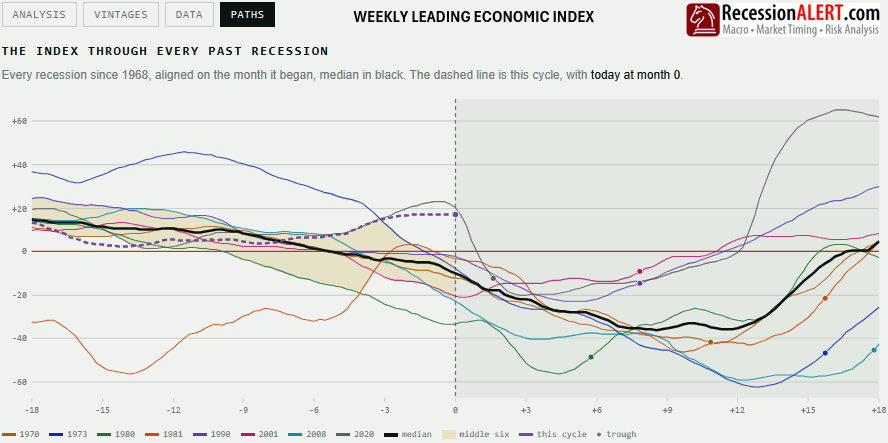
The reflex is to distrust a house indicator that reports no recession. Invert it. Since 1968 the WLEI — RecessionALERT’s weekly leading index, seven equally weighted inputs where zero is the trip-wire — has registered all eight recessions and missed none. Its one error ran the other way: a single false alarm, November 2022 to December 2023, in a growth scare that fooled nearly every leading indicator, the yield curve included. A gauge that cries wolf but never sleeps through the fire earns its credibility in the quiet, and it has been quiet 2.64 years. It stood down in December 2023 — two and a half years before the Conference Board’s LEI turned its six-month growth rate positive. Seven of the eight recessions began with the index already under zero, the median at -9.97 and under it five months before the start. Today it reads +17.14, 19 points clear of the band that brackets the middle six of those run-ups, and climbing 1.88 points a month where the median path fell 1.28 into month 0. Direction, not just level, has the wrong sign. The asymmetry is engineered. Every input has to earn its place by turning early; measures that turn friendly only once a downturn is landing were screened out. That buys the occasional early fright; the alternative is a downturn that arrives unannounced. Only one of those mistakes is survivable, and it is the only one this index has made.
What it means: if you are positioned for a slowdown, the bigger risk is now an upside surprise — which hurts long-dated bonds and defensive positioning more than it helps. Watch for this index dropping back below zero. It has gone there at every recession since 1968, and not once since December 2023.
Market Intelligence Brief (MIB) Ver. 19.37
For professional investors only. Not investment advice.
© 2026 RecessionALERT.com

Comments are closed.