
MARKET INTELLIGENCE BRIEF (MIB)
Wednesday, August 19, 2026
Treasury doubled its long-bond buybacks and the tape turned: 10-year -6.8 bps, dollar -0.86%, gold +3.60%. Not a Fed trade: the July minutes showed several members ready to hike, nobody for a cut, and the market shrugged. Chips fell 5.6% a second day, all 30 down. Merck +12.60% on the first Phase 3 win for a cancer vaccine. Marvell handed Google a $12.2bn warrant; Broadcom paid -4.61%. Canada’s 50% tariffs pause three days; Bitcoin +6.25% on an SEC framework.
TABLE OF CONTENTS
A. EXECUTIVE SUMMARY
B. MARKET DATA
C. HIGH-IMPACT STORIES (7)
D. MODERATE-IMPACT STORIES (6)
E. ECONOMY WATCH (5)
F. EARNINGS WATCH (3)
G. WHAT’S NEXT
H. CHART OF THE DAY
A. EXECUTIVE SUMMARY -> TOP
Equities closed broadly higher on a fiscal catalyst rather than a monetary one: Treasury’s decision to at least double its long-bond buybacks to $4 billion pulled the 10-year down 6.8 bps to 4.638% against 1.1 bps at the 2-year — a term-premium bull flattener carrying no dovish policy signal. That distinction is why the advance coexisted with July FOMC minutes showing several participants ready to hike and none arguing for a cut — a document already stale on arrival. Breadth confirmed the move (NYSE Composite +0.32%, Russell 2000 +0.50%) but leadership was defensive and dollar-driven — Healthcare +3.37% on Merck’s vaccine readout, Basic Materials +3.62% on the metals surge — against Technology -0.69% as the chip complex fell 5.6% for a second session with all 30 PHLX components down. Left unpriced was the policy risk: Section 338 duties on $20 billion of Canadian imports rest on a social-media pause with nothing published to effect it, three days before they attach.
• The day’s rates catalyst was fiscal, not monetary — Treasury will at least double its liquidity-support buybacks in long-dated coupons from $2 billion to at least $4 billion per operation, running September 9 to November 4. The 30-year gave up roughly 9 bps to about 5.19%, one session after setting a 19-year high near 5.33%. VIX -6.00% to 14.89, DXY -0.86% to 98.80.
• The chip complex fell a second consecutive 5.5% with all 30 PHLX components down — Dell -6.64%, Lam Research -6.33%, Broadcom -4.61%. This time it happened on a broad advance with falling yields and a weaker dollar, which removes beta as the explanation and points to de-grossing. Nasdaq 100 -0.22% against Russell 2000 +0.50%.
• Merck +12.60% to a 52-week high, adding roughly $44 billion — the INTerpath-001 trial of intismeran autogene with Keytruda met both endpoints in resected melanoma, the first Phase 3 success for an individualised neoantigen therapy. Healthcare led the market at +3.37%, with Eli Lilly +4.46% and Thermo Fisher +4.16% carried along.
• Marvell +9.85% on a $12.18 billion warrant granted to Google — 58,970,907 shares at $206.58, roughly 7% of the company, vesting one tranche per $500 million of custom-product revenue. Broadcom closed -4.61% on no adverse news of its own; nothing in its own Google agreement was cancelled.
• Precious metals surged together while copper sat flat — gold +3.60% to $4,579.96, silver +4.38%, platinum +5.43% against copper at +0.22%. Basic Materials was the top sector at +3.62%. Bitcoin’s separate +6.25% to $68,659 traced to the SEC’s proposed “Regulation Crypto Assets” and its exit ramp from securities classification.
• AI infrastructure financing met resistance in two places — Nebius fell 9.87% on a $4.50 billion convertible raise equal to about 7.4% of its market capitalisation, and SK hynix approved a 40 trillion won ($28.6 billion) share cancellation rather than deploy the cash into capacity. CrowdStrike -5.30% into its August 26 print despite three brokers raising targets.
1. The bid under this market came from the debt manager, not the central bank — the shape of the curve move is the proof. A 6.8 bp fall at the 10-year against 1.1 bps at the 2-year is term premium repricing, not the policy path, and it arrived alongside a falling dollar and a falling VIX — the mirror image of a growth scare, where bonds rally as the dollar catches a haven bid. What equities bought today was a signal that Treasury will lean against disorderly long-end pricing with total public debt approaching $40 trillion. That backstop is real, but it is a supply mechanism with a defined start date and no monetary content, and its first live test is the enlarged operation on September 9.
2. AI capital is repricing at the funding end, not the demand end — three separate observations pointed the same way in one session. Nebius raised $4.50 billion in converts for data centres and lost 9.87%, the market declining to underwrite the buildout at the offered price. SK hynix, the dominant HBM supplier into accelerators, chose to cancel 3.3% of its equity rather than fund incremental fabs. And the chip complex fell 5.6% with 30 of 30 components down on a day every macro condition favoured long-duration growth. No demand datapoint changed. What changed is the cost of financing the commitments, at the point in the cycle when they are largest — and Google’s Marvell warrant shows the customers extracting equity for the privilege of ordering.
3. The rotation had somewhere to go, and the risk is what it left behind — Healthcare +3.37% on a genuine platform readout and Basic Materials +3.62% on a rate-driven metals move gave sellers of the AI complex a destination, which is why the S&P still closed green with the Nasdaq 100 red. But note what the tape ignored: minutes in which no participant argued for a cut, against a market pricing roughly a 31% September hike probability on data the Committee never saw. Positioning is built entirely on the post-meeting softening, and the metals leg unwinds mechanically if the dollar stabilises. Both legs of today’s rotation depend on rates staying where the buyback announcement put them.
 — Leading economic indicators. Accurate market forecasts. Apply for membership at join.recessionalert.com
B. MARKET DATA -> TOP
A Treasury debt-buyback expansion eased bond-market pressure, driving yields and the VIX lower together and lifting the S&P 500 (+0.21%), Dow (+0.22%) and NYSE Composite (+0.32%); a 5.6% plunge in the PHLX Semiconductor Index dragged the Nasdaq 100 (-0.22%). Breadth was broad outside chips — Russell 2000 (+0.50%) and Healthcare (+3.37%, Merck +12.6% on a melanoma-vaccine trial win with Moderna) led, while Technology (-0.69%) and Industrials (-1.19%) lagged on the semiconductor rout (Dell -6.6%, Lam Research -6.3%, Broadcom -4.6%). Gold surged 3.6% to $4,580/oz as the dollar fell 0.86%, while Bitcoin’s 6.25% gain traced to a separate SEC crypto-regulation proposal, decoupled from the equity/bond rally. VIX fell 6% alongside the yield decline, confirming bonds are endorsing rather than resisting the risk-on move.
CLOSING PRICES – Wednesday, August 19, 2026:
MAJOR INDICES
NYSE breadth (+0.32%) and the Dow (+0.22%) confirmed a broad advance, while the Nasdaq 100’s -0.22% shows the pullback was concentrated in chips, not a market-wide risk-off. DJ Transportation (-0.16%) and the Dow (+0.22%) sit inside a 0.4-point spread — no meaningful Dow Theory divergence today. Russell 2000’s 0.50% gain marks a modest small-cap outperformance versus the S&P’s 0.21%, consistent with the lower-yield, weaker-dollar backdrop rather than a broad breadth confirmation.
| Index | Close | Change | %Move | Why It Moved |
|---|---|---|---|---|
| S&P 500 | 7,707.98 | +16.22 | +0.21% | Treasury buyback expansion eased bond pressure; healthcare gains offset chip drag |
| Dow Jones | 53,463.05 | +119.65 | +0.22% | Blue-chips advanced on the bond-market relief rally; limited semiconductor exposure |
| DJ Transportation | 21,460.84 | -34.39 | -0.16% | Modest pullback tracking broader industrial softness |
| Nasdaq 100 | 29,426.02 | -64.93 | -0.22% | PHLX Semiconductor Index plunged 5.6%, dragging the tech-heavy index lower |
| Russell 2000 | 3,032.94 | +15.05 | +0.50% | Small-caps outperformed on lower yields and a weaker dollar; limited mega-cap semi exposure |
| NYSE Composite | 24,707.27 | +78.13 | +0.32% | Broad-market breadth gain, in line with the S&P advance |
VOLATILITY & TREASURIES
VIX fell 6% as the Treasury’s expanded buyback program eased term-premium concerns, pulling the 10Y down 6.8bps and the 2Y down 1.1bps — a bull-flattening move signaling reduced bond-supply fear, not growth risk (the inverse of a VIX-up/yields-up inflation-fear signature). DXY’s 0.86% slide tracked the yield decline rather than a safe-haven bid, and the joint equity-bond rally confirms the bond market is endorsing, not resisting, the risk-on tone.
| Instrument | Level | Change | Why It Moved |
|---|---|---|---|
| VIX | 14.89 | -0.95 (-6.00%) | Risk appetite improved broadly on the Treasury buyback relief rally |
| 10-Year Treasury Yield | 4.638% | -6.8 bps | Treasury’s expanded debt buybacks eased bond-supply pressure |
| 2-Year Treasury Yield | 4.164% | -1.1 bps | Tracked the long end lower on the same catalyst |
| US Dollar Index (DXY) | 98.80 | -0.86 (-0.86%) | Dollar softened alongside the broader yield decline |
COMMODITIES
Gold, silver and platinum surged together (+3.6% to +5.4%) on the weaker dollar and lower yields — precious metals moving in lockstep, not splitting, signals a rate/dollar-driven move rather than a differentiated safe-haven or industrial-demand story. Copper’s flat 0.22% confirms this wasn’t a growth/industrial signal. Bitcoin’s 6.25% gain decoupled entirely from the metals rally, tracing instead to a fresh SEC crypto-regulation proposal — a crypto-specific catalyst, not a risk proxy.
| Asset | Price | Change | %Move | Why It Moved |
|---|---|---|---|---|
| Gold | $4,579.96/oz | $+159.36 | +3.60% | Weaker dollar and falling yields on the Treasury buyback news |
| Silver | $66.845/oz | $+2.808 | +4.38% | Tracked gold’s rate-driven rally |
| Copper | $6.5070/lb | $+0.0145 | +0.22% | Roughly flat; muted industrial-demand read |
| Platinum | $1,828.00/oz | $+94.20 | +5.43% | Rode the broader precious-metals rally |
| Bitcoin | $68,659.0 | $+4,040.0 | +6.25% | SEC’s proposed crypto-regulation framework lifted digital assets |
ENERGY
WTI and Brent both sat out the rally entirely (+0.25% and +0.48%), confirming the day’s dominant driver was a bond/dollar story, not a commodity-wide move — oil moving with equities but by a negligible amount is a non-signal rather than a demand read. Henry Hub was similarly flat. Dutch TTF’s 0.89% gain was a pure EUR/USD pass-through (the underlying €/MWh price was unchanged) rather than any European-gas-specific development, so there is no US-Europe energy divergence to report today.
| Asset | Price | Change | %Move | Why It Moved |
|---|---|---|---|---|
| Crude Oil (WTI) | $84.27/bbl | $+0.21 | +0.25% | Little net move; oil sat out the day’s rally |
| Crude Oil (Brent) | $91.46/bbl | $+0.44 | +0.48% | Similarly muted |
| Natural Gas (Henry Hub) | $2.781/MMBtu | $+0.005 | +0.18% | Flat session |
| Natural Gas (Dutch TTF) | $21.88/MMBtu | $+0.19 | +0.89% | EUR/USD appreciation pass-through; €/MWh price unchanged |
S&P 500 SECTORS
Healthcare (+3.37% 1D) led on Merck’s vaccine-trial win and is also the year’s strongest sector (+28.61% 12M) — a session catalyst reinforcing an existing trend. Basic Materials (+3.62% 1D) rode the gold/silver rally, extending a strong month (+10.77%) and year (+37.47%). Technology (-0.69%) and Industrials (-1.19%) were the day’s laggards on the semiconductor selloff, though both remain solidly positive over 12 months.
| Sector | 1-Day | 1-Week | 1-Month | 3-Month | 6-Month | YTD | 12-Month |
|---|---|---|---|---|---|---|---|
| Basic Materials | +3.62% | +1.66% | +10.77% | +6.99% | -0.83% | +18.45% | +37.47% |
| Healthcare | +3.37% | +4.11% | +8.11% | +17.93% | +10.08% | +13.01% | +28.61% |
| Consumer Cyclical | +2.13% | +0.73% | +3.12% | +2.59% | +1.15% | -1.65% | +2.01% |
| Real Estate | +1.04% | +1.19% | -0.94% | +3.67% | +4.20% | +11.27% | +10.19% |
| Consumer Defensive | +0.74% | +1.02% | +2.29% | -2.79% | -3.33% | +9.04% | +5.66% |
| Communication Services | +0.60% | +0.12% | -2.23% | -8.21% | +2.01% | -1.91% | +9.84% |
| Utilities | +0.01% | -0.23% | -2.67% | -1.81% | -5.08% | +1.93% | +4.29% |
| Energy | -0.10% | +2.95% | +6.18% | +1.25% | +15.43% | +37.98% | +45.24% |
| Technology | -0.69% | -2.43% | +1.83% | +5.61% | +24.26% | +22.34% | +29.87% |
| Financial | -0.89% | -1.38% | +1.54% | +11.70% | +8.29% | +7.17% | +13.86% |
| Industrials | -1.19% | -2.84% | +2.01% | +3.29% | +0.25% | +14.25% | +18.66% |
TOP MEGA-CAP MOVERS:
GAINERS
| Company | Ticker | Close | Change | Why It Moved |
|---|---|---|---|---|
| Merck & Co | MRK | $152.20 | +12.60% | Joint melanoma-vaccine trial with Moderna cut recurrence, sharply de-risking the program |
| Marvell Technology | MRVL | $237.27 | +9.85% | 8-K disclosed a ~$12.18B Google warrant tied to an expanded custom-silicon/TPU partnership |
| Eli Lilly | LLY | $1,280.34 | +4.46% | No single confirmed catalyst; Q2 earnings beat is stale, recent pipeline deals (AlzeCure, OmniAb) are modest relative to size |
| Tesla | TSLA | $351.12 | +4.23% | Permit filings revealed a dedicated Cybercab wireless-charging hub buildout in Austin |
| Thermo Fisher Scientific | TMO | $613.54 | +4.16% | No distinct company-specific catalyst confirmed; tracked the healthcare sector’s rally |
DECLINERS
| Company | Ticker | Close | Change | Why It Moved |
|---|---|---|---|---|
| Dell Technologies | DELL | $437.55 | -6.64% | PHLX Semiconductor Index plunged 5.6%, with all 30 components declining |
| Lam Research | LRCX | $307.17 | -6.33% | PHLX Semiconductor Index plunged 5.6%, with all 30 components declining |
| CrowdStrike Holdings | CRWD | $201.63 | -5.30% | Pre-earnings profit-taking and insider sales amid stretched software valuations |
| GE Aerospace | GE | $356.23 | -5.03% | No single confirmed catalyst; profit-taking after a strong run amid a rich valuation |
| Broadcom | AVGO | $362.48 | -4.61% | PHLX Semiconductor Index plunged 5.6%, with all 30 components declining |
— Institutional-grade intelligence for serious investors. Apply for membership at join.recessionalert.comC. HIGH-IMPACT STORIES -> TOP
BULLISH
1. Treasury Doubles Its Long-Bond Buybacks and the 30-Year Breaks From a 19-Year High — the Day’s Rates Catalyst Was Fiscal, Not Monetary
The core facts:The Treasury announced today that it will at least double the maximum size of its liquidity-support buyback operations in nominal long-dated coupons, from $2 billion to at least $4 billion per operation, covering both the 10-to-20-year and 20-to-30-year sectors. The larger operations run from September 9 through November 4. The reaction was immediate and one-directional: the 10-year yield fell 6.8 bps to 4.638%, the 2-year fell only 1.1 bps to 4.164%, and the 30-year gave up roughly 9 bps to about 5.19% — one session after it had set a 19-year high near 5.33%. The dollar index fell 0.86% to 98.80 and the VIX fell 6.00% to 14.89. The S&P 500 closed +0.21% at 7,707.98, the Dow +0.22% and the NYSE Composite +0.32%.
Why it matters:The shape of the move is the information. A 6.8 bp fall at the 10-year against a 1.1 bp fall at the 2-year is a bull flattener driven almost entirely by term premium — the market repricing the cost of absorbing long-dated supply, not repricing the path of policy. That distinction matters because it means today’s rally in bonds carries no dovish signal about the Fed whatsoever, which is precisely why it could coexist with a hawkish FOMC document released the same afternoon. Equally telling is what fell alongside yields: a weaker dollar and a lower VIX in the same session as a bond rally is the signature of supply relief, the mirror image of the growth-scare pattern where bonds rally as equities and the dollar catch a haven bid. Treasury has effectively confirmed it will lean against disorderly long-end pricing with total public debt approaching $40 trillion — a backstop equities can lean on, and one that arrived with the 30-year at levels last seen in 2007.
What to watch:The first enlarged operation on September 9 — whether actual purchase sizes reach the $4 billion ceiling, and whether the 30-year holds below 5.20% into it. A return above 5.33% would signal the announcement bought duration relief rather than a durable floor.
UNCERTAIN
2. Trump Pauses the First-Ever Section 338 Tariffs on Canada Roughly Two Hours Before They Attached — and Nothing Was Published to Effect It
The core facts:Late Tuesday evening, hours before 50% duties on roughly $20 billion of Canadian imports were set to attach at 12:01 a.m. ET Wednesday, Trump announced a three-day pause, citing a deal subject to the finalization of documents. The duties now attach at 12:01 a.m. ET Saturday, August 22. They were imposed under three proclamations signed July 20 invoking Section 338 of the Tariff Act of 1930 — the first use of that provision by any US president — targeting autos, alcoholic beverages and dairy. USTR said the agreement would include broader market access for American goods and economic security commitments; no terms were released. Prime Minister Carney said substantial progress had been made “although important work still remains.” USD/CAD fell to roughly 1.3810, down 0.62%.
Why it matters:The pause exists as a social-media post and nothing more. No presidential document, notice or rule suspending or amending the Section 338 actions was published in the Federal Register, and no USTR, BIS or OFAC document was published at all for the date — so importers face a legal position in which the proclamations remain operative on their face and the relief is verbal. That is a live compliance exposure, not a technicality: the proclamation annexes reach hundreds of tariff lines well beyond the three headline sectors, a valid USMCA certificate of origin does not exempt covered goods, and there is no published in-transit exception, so liability turns on date of entry for consumption. Two further unknowns carry real money. Reported terms halving Section 232 steel and aluminium duties from 50% to 25% rest on a single outlet and no government document; and no source states whether Canada’s own retaliatory tariffs on steel, aluminium and autos come off, even though their removal was made a US precondition on August 14. A three-day extension is the shortest possible reprieve, which is itself a signal about how much remains unsigned.
What to watch:The Federal Register and CBP CSMS guidance before Saturday’s 12:01 a.m. ET deadline — a published document is the only thing that converts the pause from rhetoric into an enforceable position for importers clearing goods this week.
UNCERTAIN
3. The July Minutes Show Several Participants Ready to Hike and Nobody Arguing for a Cut — and the Market Did Not Reprice at All
The core facts:The minutes of the July 28-29 FOMC meeting were released at 14:00 ET. Section E carries the policy detail; what belongs here is the distribution and the market’s response to it. Several participants were prepared to raise rates at the meeting itself, and many said a hike would be needed if inflation does not decline toward 2%. No participant argued for easing — the entire distribution ran from hold to hike. Against that, the market moved the wrong way for a hawkish document: yields fell across the curve, the dollar fell 0.86%, the VIX fell 6.00%, and the S&P 500, Dow and NYSE Composite all closed higher.
Why it matters:The document was economically stale on arrival, and that is the whole explanation for the non-reaction. Four prints the Committee never saw at the July meeting have already done the repricing: the August 7 payrolls report (-23,000 with combined revisions of -103,000), August 12 CPI (headline 3.4% y/y, core 2.5%), August 13 PPI (final demand flat m/m) and August 14 retail sales (-0.6% m/m) cut September hike odds from roughly two-thirds immediately after the meeting to about a third by August 14. A market that has already moved past a document cannot be moved by it. The risk this creates is asymmetric and under-appreciated: positioning is now built on data that softened after the meeting, while the Committee’s own revealed preference — with zero participants entertaining a cut — sits materially more hawkish than a 31% hike probability implies. Any upside surprise in the September inflation data would force repricing against a market that has stopped listening to the hawks.
What to watch:Chair Warsh’s first Jackson Hole keynote as Chair on Friday, August 28 — nineteen days before the September 16 decision, and unusually high-information because this Fed no longer telegraphs ahead of meetings.
UNCERTAIN
4. Marvell Hands Google a $12.2 Billion Warrant on Roughly 7% of the Company — and Broadcom Pays for It
The core facts:An 8-K filed today disclosed that Marvell has issued Google a warrant to purchase up to 58,970,907 common shares at an exercise price of $206.58 — about $12.18 billion if fully exercised, which would make Alphabet Marvell’s fifth-largest holder at roughly 7% of the company. Vesting is performance-based: approximately 1.36 million shares vest in equal quarterly instalments over the first year, and the remainder splits into 240 tranches running from fiscal Q3 2027 through fiscal 2033, one tranche released per $500 million of eligible custom-product revenue generated through Google. The scope covers AI inference accelerators, storage controllers, network interface controllers, memory interface controllers and near-memory compute attached to the TPU ecosystem. The underlying commercial agreement is dated July 29; today’s disclosure is the trigger. Marvell closed +9.85% at $237.27 on a roughly $194 billion market cap. Broadcom closed -4.61% at $362.48.
Why it matters:Nothing was cancelled — Broadcom’s April long-term agreement with Google covering custom AI chips and rack components through 2031 remains in force. What changed is share of wallet, and the warrant structure is the tell. By tying 240 tranches to $500 million revenue increments, Google has converted a supplier relationship into an equity option whose value it controls directly through its own purchasing decisions, and has done so at an exercise price struck below where Marvell now trades. This is the hyperscalers formalising a second source for custom silicon at the vendor’s expense, and it puts a price on incumbency: Broadcom shed roughly 4.6% on a day when no adverse news about Broadcom itself was published. For portfolio managers holding the custom-ASIC complex, the read-through is that single-hyperscaler concentration is now a valuation liability rather than a moat, and the mechanism by which it gets repriced is dilution granted to the customer.
What to watch:Broadcom’s next quarterly disclosure of custom-AI ASIC revenue and any commentary on 2027-2028 program allocation — the first hard test of whether this is incremental capacity or displacement.
BEARISH
5. The Chip Complex Falls a Second Consecutive 5.5% With All 30 Components Down — This Time on a Day Everything Else Rallied
The core facts:The PHLX Semiconductor Index fell 5.6% with every one of its 30 components declining, one session after a 5.4% fall. Dell closed -6.64% at $437.55, Lam Research -6.33% at $307.17 and Broadcom -4.61% at $362.48. The damage was sufficient to drag the Nasdaq 100 to -0.22% at 29,426.02 on a day when the S&P 500 rose 0.21%, the Dow 0.22%, the NYSE Composite 0.32% and the Russell 2000 0.50%. Technology finished -0.69% as the second-worst S&P sector. No single confirmed catalyst was identified for the complex-wide decline; the Broadcom component is attributable to the Marvell-Google disclosure covered above.
Why it matters:Yesterday’s chip decline came on a risk-off session and was easy to dismiss as beta. Today’s came on a broad advance with falling yields, a weaker dollar and a 6% drop in the VIX — every macro condition that should support long-duration growth equity was present, and the chip complex fell anyway. Breadth removes the last alternative explanation: 30 of 30 down is not stock selection, it is the market marking an entire exposure lower irrespective of individual fundamentals. That combination points to positioning rather than news, and specifically to de-grossing in the most crowded trade of the cycle. The mechanical consequence is visible in the index spread — the Nasdaq 100 negative while the Russell 2000 gained 0.50% is a 0.72-point dispersion that describes a market rotating out of AI capex beneficiaries into everything else. Two sessions do not make a de-rating, but they establish that the chip complex is no longer being bought on macro relief, which is a change of regime from every dip since June.
What to watch:Nvidia’s fiscal Q2 print after the close next Wednesday, August 26 — consensus is roughly $91.99 billion of revenue on $2.09 EPS, and it is the only event this month capable of settling whether this is positioning or fundamentals.
BULLISH
6. Merck and Moderna Post the First Positive Phase 3 for an Individualised Cancer Vaccine — Merck Adds Roughly $44 Billion and Drives the Day’s Best Sector
The core facts:The INTerpath-001 trial of intismeran autogene plus Keytruda in completely resected stage IIB-IV melanoma met both its primary endpoint of recurrence-free survival and its key secondary endpoint of distant metastasis-free survival versus Keytruda alone, across more than 1,100 patients. Both companies confirmed the result in primary releases; they will present at an upcoming international medical meeting and engage regulators on filings. Merck closed +12.60% at $152.20, a new 52-week high and roughly $44 billion of market value added. Healthcare was the day’s best-performing S&P sector at +3.37%, with Eli Lilly +4.46% and Thermo Fisher +4.16% carried along.
Why it matters:This is the first Phase 3 success for an individualised neoantigen therapy — a modality that manufactures a distinct product for each patient — and the platform read-through is larger than the melanoma indication. Merck’s specific problem is well known to anyone holding the name: Keytruda’s principal patents expire toward the end of the decade, and a combination that extends the franchise into adjuvant settings addresses that cliff directly rather than through the usual answer of acquisition. For Moderna the result revalues an mRNA pipeline the market had substantially written down. The sector-level move is the part that matters to allocators: a +3.37% day in Healthcare on a single readout, against a sector already leading the market at +28.61% over twelve months, is a session catalyst reinforcing an existing trend rather than a reversal — and it arrived on a day the chip complex fell 5.6%, which is exactly the rotation defensive-growth buyers have been waiting for.
What to watch:The medical-meeting presentation of the full dataset — hazard ratios and the durability curve are what determine whether this supports a filing in adjuvant melanoma alone or across additional tumour types.
BULLISH
7. Gold, Silver and Platinum Surge Together as the Dollar Breaks — a Rate Trade, Not a Fear Trade
The core facts:Gold rose 3.60% to $4,579.96 an ounce, silver 4.38% to $66.845 and platinum 5.43% to $1,828.00 — the whole precious complex moving in lockstep on the day the dollar index fell 0.86% to 98.80 and the 10-year yield fell 6.8 bps. Copper was effectively unchanged at +0.22%. Basic Materials was the top S&P sector at +3.62%, extending a +10.77% month and a +37.47% twelve months. The move reverses yesterday’s session, when gold fell 1.79% and silver roughly 4%.
Why it matters:Copper is what makes this readable. When precious metals rally 3.6% to 5.4% together while the industrial metal sits flat, the driver is the denominator — real rates and the dollar — not a growth impulse and not a differentiated haven bid. That is a cleaner signal than it appears, because it tells you the metals rally and the equity rally are the same trade expressed twice, both financed by the Treasury buyback announcement rather than by any change in the risk outlook. The uniformity also rules out the interpretation that most concerns allocators: a genuine flight to safety splits the complex, bidding gold hardest and leaving platinum behind, and today did the opposite with platinum leading at +5.43%. The practical implication is that this move unwinds if the dollar stabilises. It is also worth noting how violently the complex is now trading in both directions — a 1.79% fall followed by a 3.60% rise in consecutive sessions is not the behaviour of a quiet hedge allocation, and position sizing should reflect that.
What to watch:The dollar index at 98.80 — a recovery back above 100 would remove the entire mechanical support for this move, while a further break lower extends it regardless of the risk backdrop.
— Quantifying recession risk so you don’t have to guess. Apply for membership at join.recessionalert.comD. MODERATE-IMPACT STORIES -> TOP
BEARISH
8. The UAE Severs All Trade With Iran and Tehran Rejects the Missile Charge — While a Third China-Linked Supertanker U-Turns Inside Hormuz
The core facts:The UAE announced the suspension of all trade, commercial exchange and financial transactions with Iran, after stating that two Iranian ballistic missiles were fired toward it on Tuesday — both falling into the sea, one inside Emirati territorial waters — and that they were aimed at maritime navigation routes in the Strait of Hormuz. Iran’s Foreign Ministry called the accusation baseless today, its first formal response. Separately, ship-tracking published today shows the tanker Hestia transited into the Gulf along the Omani coast early Wednesday, then reversed and sailed out — the third China-linked vessel to U-turn inside the strait after the Sea V and the Amara on Tuesday. Dubai had become Iran’s largest trading partner, ahead of China and Turkiye, supplying roughly a third of Iran’s annual imports. No dollar value for the bilateral trade was published in any source reached. Crude barely moved on the session: WTI +0.25% to $84.27, Brent +0.48% to $91.46.
Why it matters:The tanker U-turns are the observable that matters, because they price transit risk in behaviour rather than in rhetoric. Vessels are entering the strait, evaluating conditions and leaving — that is a commercial judgement being made in real time by Chinese buyers, and it is a cleaner read on the waterway’s usable capacity than any statement from any government. Iran’s formal rejection matters for a narrower reason: it forecloses near-term de-escalation of the Emirati embargo, which removes the most plausible path back to normal Gulf trade flows in the next few weeks. What should give US allocators pause is the disconnect between all of this and the oil price. Crude sat out a session in which a major Gulf state cut off Iran’s largest import channel and a third supertanker refused the transit — which means either the market has fully discounted a prolonged closure, or it is not pricing escalation risk at all. Both readings imply asymmetry: there is far more room for crude to react to bad news here than to good.
What to watch:Daily Hormuz transit counts — a normal run-rate is roughly 73 vessels a day, and recent tracking has recorded single-digit and even single-vessel days. That series, not the headline crude price, is where a genuine supply event would appear first.
BULLISH
9. Bitcoin Jumps 6.25% on the SEC’s Proposed “Regulation Crypto Assets” — the One Move That Did Not Trace to the Treasury
The core facts:Bitcoin rose 6.25% to $68,659, gaining $4,040 on the session and trading as high as roughly $69,000, with ether up about 10%. The catalyst was the SEC’s proposal of “Regulation Crypto Assets,” a tailored securities-offering framework for certain investment contracts involving crypto assets. The proposal creates two exemptions — issuers may raise up to $5 million over four years or up to $75 million annually, subject to disclosure requirements — and, critically, allows certain crypto assets to exit securities classification and the associated reporting obligations once a project fulfils defined managerial commitments. Several crypto executives met the President at the White House on Wednesday afternoon.
Why it matters:The exit ramp from securities classification is the substantive change, and it is the first time the Commission has proposed a mechanism rather than an enforcement posture. Mature networks — bitcoin and ethereum foremost — would gain a defined path out of registration and reporting, which is the precondition institutional allocators have cited for years when explaining why the asset class stays outside mandates. The offering exemptions matter less: $5 million over four years and $75 million annually are small-issuer thresholds, not institutional capital formation. What makes today instructive for cross-asset positioning is that bitcoin’s move was idiosyncratic. Gold rose 3.60% on the dollar, equities rose on the Treasury buyback, and bitcoin rose on the SEC — three rallies, three unrelated catalysts. Anyone holding bitcoin as a macro hedge or a liquidity proxy got no confirmation of that thesis today; the correlation that showed up was to Washington, not to the dollar or to real rates.
What to watch:The comment period and whether the final rule preserves the de-registration pathway — that provision, not the offering exemptions, is what determines whether this changes institutional access.
BULLISH
10. SK Hynix Approves the Largest Share Cancellation in Korean History the Morning After Memory Lost 135 Trillion Won
The core facts:SK hynix’s board approved a 40 trillion won repurchase-and-cancellation programme, roughly $28.6 billion — the largest cancellation by a Korean listed company. It covers up to 24 million shares, about 3.3% of shares outstanding, bought between August 20 and November 19 and then cancelled outright. The board also raised the shareholder-return target to over 50% of cumulative 2025-2027 free cash flow. The announcement came the morning after SK hynix fell 9.75% and Samsung Electronics fell 7.82%, a combined loss of roughly 135 trillion won in market value, with management framing the programme as a response to the market pricing the company below intrinsic value. The US-listed ADR rose about 8% overnight.
Why it matters:This reaches US portfolios through the memory and AI-capex read-through, and the signal is about capital discipline at the supply end of the AI buildout. SK hynix is the dominant supplier of high-bandwidth memory into AI accelerators; a company at that node choosing to cancel 3.3% of its equity rather than deploy the cash into capacity is telling the market it sees better value in its own shares than in incremental fab investment. That is a materially different message from the capex-at-any-price posture that has driven memory equities for two years, and it lands in the same week that the US chip complex has fallen roughly 5.5% on consecutive sessions with all 30 PHLX components down. The cancellation is also permanent in a way buybacks often are not — retired shares cannot be reissued to offset compensation dilution, which makes the per-share arithmetic real rather than cosmetic. For US holders the practical exposure is through the memory read-through into domestic names and through AI-capex sentiment generally, not through the Korean listing.
What to watch:The buyback window opening tomorrow, August 20, and running to November 19 — actual daily repurchase volumes will show whether the 24 million-share ceiling is a commitment or a headline.
BEARISH
11. Nebius Raises $4.50 Billion in Convertibles for AI Data Centres and Falls 9.87% — the Session’s Largest Capital Raise Was Also Its Largest Repudiation
The core facts:Nebius Group launched a $4.50 billion convertible senior notes private offering in two tranches — $2.75 billion due 2030 and $1.75 billion due 2034 — with initial purchasers holding a 13-day option for a further $375 million of the 2030s and $300 million of the 2034s, $675 million in total. The notes are senior unsecured and convertible at Nebius’s election into cash, Class A ordinary shares or a combination. Proceeds fund data-centre construction, AI cloud platform investment, footprint expansion and GPU procurement. The terms were confirmed in an SEC Form 6-K and the company’s own release. The stock closed at $223.90 against a prior close of $248.43, down 9.87%, on volume above 50 million shares, leaving a market capitalisation of roughly $60.87 billion.
Why it matters:A raise equal to roughly 7.4% of market capitalisation, met with a near-10% decline, is the market declining to underwrite the buildout at the offered price — and that is a data point about the neocloud financing channel rather than about one company. This was the only sizeable corporate issuance of the session, arriving in a record month for high-grade supply that had already passed $145.2 billion by Monday. The convertible structure is the informative part: converts are what issuers reach for when straight debt is expensive relative to the equity story they can sell, and the immediate 9.87% response says the equity story is no longer clearing. Set against the same week’s evidence — the PHLX complex down roughly 5.5% twice, and SK hynix choosing share cancellation over capacity — the pattern is consistent: capital is becoming more expensive for AI infrastructure at precisely the point in the cycle when the commitments are largest.
What to watch:Whether the initial purchasers exercise the $675 million upsize option within its 13-day window — declining it would confirm the book was not covered at the level the headline size implies.
UNCERTAIN
12. CrowdStrike Falls 5.30% Into Next Week’s Print on a Day Three Brokers Raised Their Targets
The core facts:CrowdStrike closed -5.30% at $201.63, one of the five largest mega-cap decliners of the session on a roughly $205 billion market capitalisation. No adverse company-specific news was published. In the same session Mizuho reiterated Outperform and raised its target to $240, Truist kept its Buy and raised to $245, and Cantor Fitzgerald maintained Overweight and raised to $250 — every one of those targets above the closing price. The company reports fiscal Q2 2027 after the close on Wednesday, August 26, having guided to annual recurring revenue of $5,792.6-$5,794.6 million and total revenue of $1,436.0-$1,442.0 million.
Why it matters:Sell-side targets going up while the stock goes down 5.30% is a positioning signal, not a fundamental one — holders are de-risking ahead of the print regardless of what the models say, which is the pattern that shows up when the bar has been set by price rather than by guidance. The bar is explicitly high: after a 19% rally since the first-quarter print, one broker has flagged that a beat of more than 3% to second-quarter and full-year net-new ARR consensus may be required to satisfy expectations, having noted the stock’s negative reaction last quarter despite a 2-3% topline beat. That is the definition of a name where good results are not sufficient. The wider read is that today’s software weakness sat alongside a 5.6% fall in the chip complex, which complicates the rotation-into-software thesis that explained yesterday’s tape — on this session, high-multiple growth was sold across both.
What to watch:Net-new ARR on August 26 against the roughly $286 million consensus — the topline is not the number that will move this stock.
BULLISH
13. Eli Lilly Licenses Trans-Amplifying RNA Vaccine Technology From Amplitude on the Same Day mRNA Cancer Data Reset the Sector
The core facts:Eli Lilly signed a strategic research collaboration and licence agreement with Amplitude Therapeutics covering trans-amplifying RNA (taRNA) vaccines for infectious disease. Lilly receives exclusive, target-specific development and commercialisation rights; Amplitude leads taRNA optimisation and selected preclinical work, after which Lilly assumes further preclinical, clinical, manufacturing, regulatory and commercial responsibility. Lilly also holds an option to add up to two additional infectious-disease targets. Financial terms were not disclosed — no upfront, milestone or royalty figure was published — and the initial programmes were not identified. Lilly closed +4.46% at $1,280.34, moving with a Healthcare sector that gained 3.37%.
Why it matters:The sequencing is what gives an undisclosed-terms preclinical deal significance today. taRNA is a self-amplifying architecture that separates the replicase from the antigen-encoding strand, with the practical goal of achieving protective expression at far lower doses than conventional mRNA — the constraint that has governed both reactogenicity and cost of goods across the modality. Lilly taking exclusive rights to that platform on the same session that intismeran autogene delivered the first positive Phase 3 for an individualised neoantigen therapy is not coincidence so much as confirmation: the large-cap pharma bid for RNA platform assets is being re-established after two years in which the market treated the modality as a pandemic artifact. For a company whose valuation rests overwhelmingly on incretins, an option on infectious-disease vaccines is cheap diversification, and the absence of disclosed terms suggests the upfront was small enough not to require it.
What to watch:Whether Lilly exercises the option on either additional target — that decision, rather than any preclinical milestone, is the first observable read on how the platform is performing internally.
— Separating signal from noise since 2007. Apply for membership at join.recessionalert.comE. ECONOMY WATCH -> TOP
Today’s FOMC minutes showed a Fed nine votes from an outright hawkish shift — three regional presidents dissented for a hike, and participants called inflation risk “skewed to the upside” — yet markets shrugged it off, with the S&P 500, Dow, and NYSE Composite all closing higher and the 10-year yield falling. Empire State manufacturing hit its best reading since 2021 and GDPNow held above 4% for Q3, underscoring growth resilience even as September hike odds have slid to roughly 31% on data the Committee never saw. Housing remains the soft spot: NAHB builder confidence ticked up to 35 but stayed below the neutral 40 line for a 16th straight month. Watch whether the growth data holds into September’s payrolls and CPI prints.
FOMC July Minutes Show 9-3 Hold With Three Dissents for a Hike as Inflation Risk Seen “Skewed to Upside” (Federal Reserve, Aug 19, 2026)
What they’re saying:The minutes of the Fed’s July 28-29 meeting, released today, showed the Committee voted 9-3 to hold rates at 3.50%-3.75%, with regional presidents Beth Hammack, Neel Kashkari, and Lorie Logan dissenting in favor of a 25bp hike. Participants described inflation risks as “skewed to the upside” and broad-based across goods and services, while noting labor demand and supply remained roughly balanced.
The context:Despite the hawkish tone, markets shrugged off the release — the S&P 500, Dow, and NYSE Composite all closed higher, the 10-year yield fell 6.8 bps to 4.638%, the dollar slid 0.86%, and the VIX dropped 6.00%. The muted reaction likely reflects that the minutes describe a meeting from three weeks ago; September hike odds have already fallen to roughly 31% (from near two-thirds) on data the Committee never saw at the July meeting. The three-way dissent is still the largest in over a decade, reflecting genuine internal division over whether current policy is restrictive enough.
What to watch:Fed officials’ public remarks and the next payrolls and CPI prints ahead of the September FOMC meeting, which will determine whether the hawkish minority gains traction.
US Crude Inventories Post Surprise 4.4M Barrel Build as Oil Prices Rise on Strong Refinery Demand (EIA, Aug 19, 2026)
What they’re saying:The EIA reported commercial crude stocks rose 4.4 million barrels for the week ended August 14, versus a forecast 0.6 million-barrel draw, lifting total stocks to 428.8 million barrels. Despite the bearish headline, both WTI and Brent traded roughly 0.5% higher on the day.
The context:Refinery utilization hit 97.2% of capacity — near cycle highs — while crude imports fell, suggesting the build reflects strong throughput rather than weak demand. The divergence between rising stocks and rising prices signals the market read through the headline number to underlying demand strength.
What to watch:The next EIA weekly release on August 26 and OPEC+ supply signals heading into September.
Atlanta Fed GDPNow Holds Above 4% for Q3, Signaling Growth Well Above Trend Despite Recent Cooling (Federal Reserve Bank of Atlanta, Aug 18, 2026)
What they’re saying:The GDPNow model’s Q3 2026 estimate stood at 4.0% as of August 18, down from 4.3% on August 14 and a peak of 6.2% in early August, but still well above the economy’s roughly 2% trend rate.
The context:The swings in the tracking estimate — from 5.0% to 6.2% to 4.0% within three weeks — reflect choppy incoming data rather than a genuine deceleration, and the model continues to point to a Q3 that outpaces Q2’s 1.5% print by a wide margin.
What to watch:The next GDPNow update on August 26, alongside durable goods and PCE data due the same day.
Empire State Manufacturing Index Nearly Doubles Forecasts, Hits Highest Level Since Late 2021 (Federal Reserve Bank of New York, Aug 17, 2026)
What they’re saying:The Empire State Manufacturing Survey jumped to 20.6 in August, crushing the median forecast of 11.0 and marking the fifth straight month of expansion — the strongest reading since December 2021. New orders and shipments both rose, and the employment index continued to expand.
The context:The beat adds to evidence that manufacturing activity is holding up better than feared, though the prices-paid index climbed to 58.6, underscoring that input cost pressures remain elevated even as activity strengthens — a combination that complicates the Fed’s inflation calculus.
What to watch:The Philadelphia Fed Manufacturing Index, due Thursday, August 20, for confirmation of the regional manufacturing trend.
Builder Confidence Ticks Up to 35 but Stays Below 40 for a 16th Straight Month (NAHB/Wells Fargo, Aug 17, 2026)
What they’re saying:The NAHB/Wells Fargo Housing Market Index rose one point to 35 in August, beating the consensus estimate of 33. Current sales conditions improved two points to 39, while six-month sales expectations held steady at 43.
The context:Despite the modest beat, the index has now spent 16 consecutive months below the neutral 40 threshold, and roughly 30% of builders are still cutting prices to move inventory — evidence that elevated financing costs and construction expenses continue to outweigh the recent uptick in sentiment.
What to watch:New Home Sales, due Tuesday, August 25, for whether builder optimism is translating into actual transactions.
— Know the probability before the market prices in the risk. Apply for membership at join.recessionalert.comF. EARNINGS WATCH -> TOP
YESTERDAY AFTER THE BELL (Markets Reacted Today)
No major earnings yesterday after the bell from companies with >$100B market cap. The largest after-the-bell reporter on Tuesday, August 18 was Keysight Technologies (KEYS) at a $54.59B market cap, followed by Toll Brothers (TOL) at $13.89B. No ADR above $100B reported after Tuesday’s close.
TODAY BEFORE THE BELL (Markets Already Reacted)
BULLISH
14. Analog Devices (ADI): -0.89% | Record Quarter and an Above-Consensus Guide, Sold Anyway With the Chip Complex
The Numbers:Released BMO. Fiscal Q3 2026 (quarter ended August 1) revenue of $4.02B versus $3.92B expected, a 2.62% beat and a company record, up roughly 40% year over year. Adjusted EPS $3.45 versus $3.34 expected, a 3.20% beat and up 68% year over year; GAAP diluted EPS $2.74, up 163%. Q4 guidance of $4.3B ± $0.1B revenue with adjusted EPS of $3.86 ± $0.15 and an adjusted operating margin around 52.0%. Trailing-twelve-month operating cash flow $5.5B and free cash flow $4.9B, 40% and 36% of revenue. Market cap $181.81B. Stock closed -0.89%.
The Problem/Win:Data Center and Industrial led the growth, with CEO Vincent Roche saying ADI exceeded the midpoint of its revenue, margin and earnings outlook on broad-based demand. The 52% adjusted operating margin guide is the standout — analog semiconductors converting AI data-centre demand into margin rather than just volume. The company returned $1.7B to shareholders in dividends and buybacks during the quarter.
The Ripple:The print landed into a PHLX Semiconductor Index that fell 5.6% with all 30 components declining. ADI’s -0.89% was in fact one of the mildest chip declines of the session — Lam Research fell 6.33% and Broadcom 4.61% with no results at all — which is the clearest available evidence that the sector move was positioning rather than fundamentals.
What It Means:The first large semiconductor print since the AI de-rating beat on every line and guided above, and the stock still fell. That is a useful calibration for anyone modelling the group: the current drawdown is not being driven by deteriorating results, and results alone are not currently sufficient to arrest it.
What to watch:Whether the $4.3B Q4 guide holds through Nvidia’s August 26 print — if the sector rerates on Nvidia, ADI’s above-consensus outlook becomes the anchor for the analog names.
UNCERTAIN
15. TJX Companies (TJX): -4.21% | Raised the Year, Cut the Quarter — and the Quarter Won
The Numbers:Released BMO. Fiscal Q2 2027 net sales of $15.18B versus $15.16B expected, up 5% year over year, with consolidated comparable sales up 4%. Adjusted EPS $1.22 versus $1.19 expected, a 2.60% beat; GAAP EPS $1.36. Full-year EPS guidance raised to $5.31-$5.36 from $5.08-$5.15, with full-year pretax profit margin guidance lifted to 12.3%-12.4% from 11.9%-12.0%. Q3 adjusted EPS guidance of $1.30-$1.32, below the $1.35 consensus. Market cap $159.63B. Stock closed -4.21%.
The Problem/Win:A 4% consolidated comp is a strong number for a retailer of this size and the full-year raise was substantial — roughly 22 cents at the midpoint. The stock fell anyway because the Q3 guide came in three to five cents light against consensus. Management also raised the long-term global store target to 7,500, a commitment to physical expansion at a point in the cycle when most of retail is defending square footage rather than adding it.
The Ripple:Consumer Cyclical was nonetheless the third-best S&P sector at +2.13%, so TJX’s decline was idiosyncratic rather than a read on the consumer. It sat alongside Lowe’s, which cut its full-year outlook and rose 2.02% — two retailers, opposite guidance revisions, opposite stock reactions.
What It Means:Off-price demand is intact; the multiple is not. A name that raises the year and still loses 4.21% on a soft near-term guide is being held to a standard where beats are assumed, and that leaves limited room for the second half.
What to watch:Whether the Q3 shortfall is timing or margin — the reconciliation excluded tariff refund net benefits, so the size of that adjustment in the Q3 print is the number that settles it.
UNCERTAIN
16. Lowe’s (LOW): +2.02% | Guidance Cut to the Bottom of the Range, and the Stock Rose Anyway
The Numbers:Released BMO. Q2 2026 (quarter ended July 31) total sales of $25.96B versus $26.13B expected, a 0.67% miss, against $23.96B a year earlier. Adjusted EPS $4.40 versus $4.22 expected, a 4.19% beat; GAAP diluted EPS $4.27, flat year over year, on net earnings of $2.4B. Comparable sales rose 0.2%. Full-year sales guidance moved to $92B — the bottom of the prior $92B-$94B range — with comparable sales now seen flat versus a prior flat-to-up-2%, and full-year adjusted EPS narrowed to $12.25 from $12.25-$12.75. The quarter carried $96M in pre-tax expenses tied to the Foundation Building Materials and Artisan Design Group acquisitions. Market cap $123.36B. Stock closed +2.02%.
The Problem/Win:The 0.2% comp was carried entirely by Pro and home services alongside a 15.7% rise in online sales, against persistent DIY weakness — the same split Home Depot reported yesterday, but from a weaker starting point at +0.2% versus Home Depot’s +1.7%. The FBM and ADG acquisitions are an explicit bet on the Pro channel, and the $96M of deal expenses is the visible cost of executing it during a soft quarter.
The Ripple:Real Estate rose 1.04% and Consumer Cyclical 2.13% on a session when the 10-year fell 6.8 bps, so the housing-linked complex had a rate tailwind independent of the print. That backdrop is the most plausible reason a guidance cut was rewarded with a 2.02% gain.
What It Means:The market treated the DIY weakness as already priced and the Pro pivot as the live variable. With comps guided to flat for the year, the equity is now a rates-and-integration story rather than a same-store-sales story.
What to watch:Pro-segment disclosure in the Q3 print for evidence the FBM and ADG integrations are adding revenue rather than only expense.
TODAY AFTER THE BELL (Markets React Tomorrow)
No major earnings after the bell from companies with >$100B market cap. The largest after-the-bell reporter today was Nordson (NDSN) at a $17.27B market cap. No ADR above $100B reported after today’s close.
WEEK AHEAD PREVIEW:
Q2 2026 earnings season is 88% reported and effectively complete for the index, but the calendar’s two most consequential prints are still ahead — the largest US retailer tomorrow, and the largest company in the world next Wednesday.
Walmart (WMT) — BMO, Thursday, August 20 — $909.61B market cap; consensus $0.74 EPS on $186.62B revenue. Key focus: general-merchandise comps and any tariff pass-through commentary. The print lands two days before the paused Section 338 duties on Canada are scheduled to attach, making management’s sourcing-cost guidance unusually consequential.
Deere (DE) — BMO, Thursday, August 20 — $156.73B market cap; consensus $4.69 EPS on $10.81B revenue. Key focus: large-agriculture order books and used-equipment inventory, the cleanest read available on farm-sector capital spending into 2027.
Bank of Montreal (BMO) — BMO, Tuesday, August 25 — $124.10B market cap; consensus $2.69 EPS on $7.00B revenue. Key focus: US commercial credit provisions and net interest margin, with the Canada tariff outcome resolved by then either way.
Bank of Nova Scotia (BNS) — BMO, Tuesday, August 25 — $108.08B market cap; consensus $1.49 EPS on $7.16B revenue. Key focus: international segment performance and credit migration in the Canadian mortgage book.
NVIDIA (NVDA) — AMC, Wednesday, August 26 — $5,264.95B market cap; consensus $2.09 EPS on $91.99B revenue against management guidance of roughly $91.0B. Key focus: the October-quarter outlook, Blackwell Ultra execution, gross-margin durability and hyperscaler demand commentary — all of which now matter more than the Q2 beat itself, with the chip complex down roughly 5.5% on each of the last two sessions.
CrowdStrike (CRWD) — AMC, Wednesday, August 26 — -5.30% today — $205.31B market cap; consensus $0.29 EPS on $1.44B revenue, against company guidance of $1,436.0-$1,442.0M revenue and $5,792.6-$5,794.6M ARR. Key focus: net-new ARR against roughly $286M consensus; one broker has flagged that a beat of more than 3% may be required given the stock’s negative reaction to a topline beat last quarter.
Salesforce (CRM) — AMC, Wednesday, August 26 — $168.79B market cap; consensus $3.27 EPS on $11.33B revenue. Key focus: Agentforce ARR, which passed $1.2B in fiscal Q1 at +205% year over year, plus any update on the $3.6B Fin acquisition targeted to close in fiscal Q4 and the $45.9B-$46.2B full-year revenue guide.
No company above $100B reports Friday, August 21 or Monday, August 24. ADRs excluded by scope: Alibaba (BABA, $308.96B, Thursday) and PDD Holdings (PDD, $128.39B, Monday). Q3 2026 earnings season begins in mid-October.
— US market commentary trusted by family offices and institutions. Apply for membership at join.recessionalert.comG. WHAT’S NEXT -> TOP
UPCOMING RELEASES:
| Date | Event | Why It Matters |
|---|---|---|
| Thu, Aug 20 | Initial Jobless Claims (expected 210K) | The highest-frequency read on a labour market that has already reversed September hike odds. August 7 payrolls came in at -23,000 with combined revisions of -103,000; claims are the first place further deterioration would show. |
| Thu, Aug 20 | Philadelphia Fed Manufacturing Index (expected 25) | The confirmation test for Empire State’s 20.6 print, which nearly doubled forecasts and marked the strongest reading since December 2021. Watch prices paid as closely as the headline — Empire’s climbed to 58.6, the combination that complicates the Fed’s calculus. |
| Sat, Aug 22 | Section 338 duties on ~$20B of Canadian imports attach at 12:01 a.m. ET | Not a calendar release but the hardest deadline in the window. The three-day pause exists only as a social-media post — no Federal Register, USTR, BIS or OFAC document. Absent a published instrument, the proclamations remain operative on their face and USMCA certification provides no exemption. |
| Tue, Aug 25 | CB Consumer Confidence (prior 90.8) | Follows the August 14 retail sales miss of -0.6% m/m. A second soft consumer datapoint would harden the case that the post-meeting data the market repriced on is a trend rather than noise. |
| Tue, Aug 25 | New Home Sales (prior 0.628M) | The transaction test for builder sentiment that has now spent 16 straight months below the neutral 40 threshold, with roughly 30% of builders still cutting prices. Sentiment ticked up to 35; this shows whether it converted. |
| Wed, Aug 26 | GDP Growth Rate QoQ, 2nd estimate (expected 1.5%, prior 2.1%); GDP Price Index (expected 6.3%, prior 3.6%) | A downward revision to Q2 growth alongside a sharply higher deflator is the uncomfortable combination for a Committee that already describes inflation risks as skewed to the upside. Reads against a GDPNow Q3 tracking estimate still at 4.0%. |
| Wed, Aug 26 | Core PCE Price Index MoM (prior 0.1%); PCE Price Index YoY (prior 3.7%) | The Fed’s preferred gauge, and the single most consequential print before the September 16 decision. With several July participants prepared to hike and none arguing for a cut, an upside surprise repositions a market pricing roughly a 31% hike probability. |
| Wed, Aug 26 | Durable Goods Orders MoM (prior 0.3%); ex-transport (prior 0.6%) | The cleanest public read on the capex cycle in a week when AI infrastructure financing visibly tightened. Core capital goods orders are where a genuine slowdown in equipment spending would surface first. |
| Wed, Aug 26 | Personal Income MoM (prior 0.2%); Personal Spending MoM (prior 0.3%) | Released with PCE and read together with it. Spending holding up against softening income would mean the savings rate is absorbing the gap — a configuration that does not extend indefinitely. |
| Wed, Aug 26 | EIA Crude Oil Stocks Change | Last week posted a surprise 4.4M-barrel build against a forecast 0.6M draw, to 428.8M barrels, with refinery utilisation at 97.2%. Reads against Hormuz transit disruption that crude has so far declined to price. |
| Wed, Aug 26 | Jackson Hole Symposium opens (Chair Warsh keynote Friday, Aug 28) | Warsh’s first Jackson Hole keynote as Chair, nineteen days before the September 16 decision and unusually high-information because this Fed no longer telegraphs ahead of meetings. The venue where a hawkish minority would be given cover, or denied it. |
KEY QUESTIONS:
1. Does Treasury’s buyback expansion hold the 30-year below 5.20% into the first enlarged operation on September 9, or does it prove to be duration relief that fades before the mechanism is even tested — with a return above 5.33% the signal that it bought days rather than a floor?
2. Two consecutive falls of roughly 5.5% in the chip complex, the second with all 30 PHLX components down on a session every macro condition favoured — is that de-grossing in the most crowded trade of the cycle, or the beginning of a fundamental de-rating that the AI capex names have not yet acknowledged?
3. If the July minutes show a distribution running only from hold to hike, with no participant entertaining a cut, what happens to positioning built entirely on the four post-meeting prints if PCE on Wednesday, August 26 surprises to the upside?
— US market commentary trusted by family offices and institutions. Apply for membership at join.recessionalert.comH. CHART OF THE DAY -> TOP
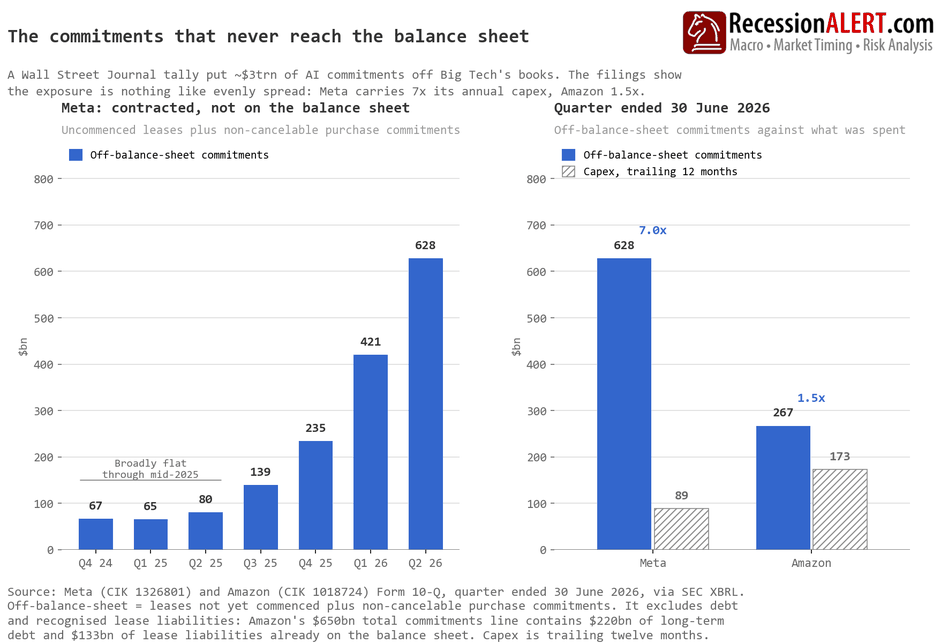
Two filings, same quarter, same disclosure: Meta ended June carrying seven times its trailing capex in uncommenced leases and non-cancelable purchase commitments; Amazon, spending nearly twice as much cash, carries one and a half. The Wall Street Journal’s tally of roughly $3trn across nine firms reached for an average of about 5x combined capex; no single number describes both. That comparison survives only if both sides are subtracted alike, and Amazon is where it breaks: the XBRL tag an analyst would reach for returns $650bn, a table total holding $220bn of long-term debt and $133bn of already-recognised lease liabilities. The unrecognised remainder is $267bn; take the tag whole and you overstate Amazon by 2.4x. Nothing is hidden — Note 9 and Note 4 publish this quarterly — it is simply unaggregated. And Meta did not grow into the position: the line was inert until the September 2025 quarter, then broke, adding $207.7bn in the June quarter alone, 2.33 times a full year’s capital spending. Those leases commence between now and 2036, on schedule rather than on demand. That makes this a single-name cash-flow question wearing a sector’s clothing, and the channels where it would surface first are supplier order books, utility loads and a 30-year Treasury at a 19-year high that makes each year of the lag dearer to carry. Meta has contracted seven years of its current capital spending; Amazon, eighteen months.
What it means: Meta has committed to far more spending than it has actually made. Those bills start hitting its earnings later this year. So watch its profit margins, not its balance sheet, which shows none of this yet. The sign it is cooling would be Meta adding less next quarter than the $207.7bn it just added — and it has not slowed once.
Market Intelligence Brief (MIB) Ver. 19.06
For professional investors only. Not investment advice.
© 2026 RecessionALERT.com

Comments are closed.