
MARKET INTELLIGENCE BRIEF (MIB)
Thursday, August 20, 2026
Wednesday’s Treasury buyback rally unwound in one session — 30-year back to 5.248%, S&P -0.87%, Dow -1.32%, VIX +7.52%. Bessent promised a bigger program, and “the toughest sanctions in history” on Iran: WTI +2.28%, gasoline a record for the date. Musalem and Daly split on whether the long end is a credibility warning. Walmart -9.15% on a comps miss. Memory bucked the tape again: Marvell +5.79%, Micron +3.97%. Bitcoin +5.07% past $72,000. Canada’s 50% duties attach Saturday with nothing published.
TABLE OF CONTENTS
A. EXECUTIVE SUMMARY
B. MARKET DATA
C. HIGH-IMPACT STORIES (5)
D. MODERATE-IMPACT STORIES (8)
E. ECONOMY WATCH (6)
F. EARNINGS WATCH (2)
G. WHAT’S NEXT
H. CHART OF THE DAY
A. EXECUTIVE SUMMARY -> TOP
Equities fell broadly as Wednesday’s Treasury-buyback rally in the long end unwound almost entirely inside one session, the 30-year back to 5.248% within a few basis points of Tuesday’s 19-year high while the S&P 500 lost 0.87% and the Dow 1.32%. The signature matters more than the magnitude: the VIX rose 7.52% alongside yields rather than against them — an inflation-fear pattern, not a growth scare — while Bessent’s vow of the “toughest sanctions in history” on Iran drove WTI to a fifth straight advance at $86.31 and gasoline to a record for the date. The Fed offered no anchor, with Musalem and Daly splitting in public over whether the long-end selloff is a credibility warning at all, five days before Warsh’s Jackson Hole keynote. Breadth confirmed indiscriminate de-risking rather than rotation: nine of eleven sectors red, Consumer Defensive worst at -2.16% on a day its bid should have been strongest.
• The long end erased Wednesday’s buyback rally inside a single session, and Bessent answered by promising a bigger one — the 30-year rose more than 5 bps to 5.248%, the 10-year 5.4 bps to 4.707% and the 2-year 1.3 bps to 4.192%, steepening the curve. The Fed supplied no shared diagnosis: Musalem called policy accommodative with underlying inflation at 2.5-3.0% and rejected the credibility read, while Daly called policy well positioned and the long-end move a global phenomenon. Neither votes this year.
• Iran escalation put crude on a fifth consecutive advance — Bessent described “a one-two punch” of blockade plus “the toughest sanctions in history” and said the administration would “collapse this regime,” urging Beijing to cooperate. WTI +2.28% to $86.31, Brent +1.80% to $93.27, Energy +0.68% as one of only two green sectors. AAA’s national gasoline average hit $4.10, a record for the date, with August at $4.06 — the highest month on record. Details due Monday, August 24.
• Walmart -9.15% was the single largest drag on the Dow, and the sell side split retail at the name level — Lowe’s drew eight dated actions with five target cuts and not one raise after an EPS beat, against three raises on Target; Lejuez, Chen and Shemesh each appear on both tapes moving in opposite directions. TJX was cut to Neutral by Citigroup with the target down $28 to $154. Consumer Defensive was the worst sector at -2.16%; Deere +6.94% ran the other way.
• Memory and AI silicon were the only equity strength on the board — Marvell +5.79% to $251.01, Micron +3.97% to $974.33 and SanDisk +2.02% to $1,600.62, three of just four mega-cap gainers. No discrete Thursday catalyst could be corroborated; the complex has been re-rating since SanDisk’s August 13 investor day and its HBM4 volume commitments. The same names fell 5.5% on both Tuesday and Wednesday — identical magnitude, opposite direction.
• Bitcoin +5.07% to $72,615, decoupling entirely from the risk-off tape — President Trump met Coinbase, Payward and Blockchain.com executives at the White House, called on Congress to pass the CLARITY Act before a September 15 deadline and floated “sizable” US purchases as a possibility rather than a policy. Roughly $1.74 billion of short liquidations, the second-largest such event on record, carried about half the move.
• Canada’s 50% Section 338 duties attach at 12:01 a.m. Saturday with nothing published to stop them — the White House Presidential Actions index, USTR’s press-release index and the full 118-document Federal Register public-inspection list for August 20 each show no instrument effecting the deal announced August 18. The session’s one trade filing points the other way: Proclamation 10984 sells Section 232 relief for US capacity commitments, with a stated floor of “no less than 25 percent” for producers north of the border.
1. The fiscal backstop failed its first live test, and the tape read the failure as inflation rather than growth — three independent tells point the same way: volatility rose with yields instead of against them, Consumer Defensive was the worst sector on a day its haven bid should have been strongest, and oil advanced while equities fell. A buyback is a liquidity operation, not a reduction in net issuance — it redistributes the duration the market must absorb without changing the quantity — and with total public debt through $40 trillion the market’s verdict inside twenty-four hours was that a $4 billion-per-operation facility does not offset term-premium repricing. The Treasury Secretary’s answer was to promise a larger facility rather than to address the supply. Warsh now has to arbitrate a committee with no shared framework for reading the one price doing the most damage to risk assets, in public, on August 28.
2. The sell side has stopped paying for the headline beat and started underwriting its composition — Walmart beat on EPS and revenue, raised full-year guidance across three metrics, and fell 9.15%. Lowe’s printed $4.40 against expectations and drew five target cuts with no raises, while Target’s sales beat drew three raises from partly the same analysts. Merck collected a 54% target increase from Morgan Stanley and a downgrade from RBC on the same morning, leaving a $29 spread across new numbers on a $375 billion mega-cap. The common element is dispersion at the name level while the sector call stays put, which tells a portfolio manager the weight is fine and the constituents are wrong. That is a materially higher bar going into Dollar General, Dollar Tree, Best Buy and Burlington on August 27.
3. Two assets stopped trading as risk expressions today, and neither decoupling is one to underwrite — the memory complex has now moved violently against the tape twice in three sessions, falling 5.5% on Tuesday and Wednesday with all thirty chip-index components down and rallying hard into a broad risk-off Thursday. A sector that ignores the macro in both directions is trading on its own supply-and-demand clock, which means it has stopped hedging an AI allocation and started adding an independent cycle risk to it. Bitcoin’s 5.07% gain against a 7.52% volatility spike replaced beta with a policy bid — but a legislative catalyst is binary and calendarised on September 15, the same day the FOMC convenes, and roughly half the week’s move rests on short covering that unwinds against the same book if the vote slips.
 — Leading economic indicators. Accurate market forecasts. Apply for membership at join.recessionalert.com
B. MARKET DATA -> TOP
Equities sold off broadly as Wednesday’s sharp yield decline reversed after the Treasury said it would expand long-dated bond buybacks, pushing the 10-year up roughly 5 bps and driving VIX up 7.5% — an inflation-fear rather than recession-fear signature. The Dow led losses (-1.32%) as Walmart tumbled 9.15% on a US comparable-sales miss despite beating on both EPS and revenue, while nine of eleven S&P sectors closed red and only commodity-linked Materials and Energy held gains. Crude jumped over 2% on renewed US-Iran supply risk, silver surged 3.6% alongside a broader precious/industrial metals bid, and Bitcoin decoupled entirely from the risk-off tape, spiking 5% on a Clarity Act push and a short squeeze. Chip and memory names bucked the tape — Marvell, Micron and SanDisk all gained on sustained AI-memory demand.
CLOSING PRICES – Thursday, August 20, 2026:
MAJOR INDICES
All six indices closed lower, but breadth was uneven: the Dow (-1.32%) and Russell (-1.34%) led declines — the Dow dragged by Walmart’s earnings-driven plunge, the Russell by broad small-cap de-risking — while DJ Transportation (-0.37%) and NYSE Composite (-0.64%) held up comparatively well. Nasdaq 100’s -0.72% shows mega-cap tech absorbing the shock better than cyclicals, confirming this was a broad but uneven risk-off move rather than a narrow tech-driven selloff.
| Index | Close | Change | %Move | Why It Moved |
|---|---|---|---|---|
| S&P 500 | 7,641.16 | -66.82 | -0.87% | Broad risk-off as bond-buyback-driven yield reversal sparked selling; Walmart’s comparable-sales miss weighed on the tape |
| Dow Jones | 52,759.21 | -703.84 | -1.32% | Walmart’s 9.15% plunge on a US comparable-sales miss was the single largest drag on the price-weighted index |
| DJ Transportation | 21,382.25 | -78.59 | -0.37% | Held up better than headline indices amid the broad selloff |
| Nasdaq 100 | 29,213.16 | -212.86 | -0.72% | Mega-cap tech cushioned by memory/chip strength (Marvell, Micron, SanDisk all gained) |
| Russell 2000 | 2,992.43 | -40.51 | -1.34% | Broad small-cap de-risking as yields backed up off Wednesday’s rally |
| NYSE Composite | 24,548.26 | -159.01 | -0.64% | Broad-market decline in line with the day’s risk-off tone |
VOLATILITY & TREASURIES
VIX’s 7.5% spike alongside rising 10Y and 2Y yields is an inflation-fear signature, not a recession-fear one — a growth scare would see yields fall as bonds catch a bid. The 10Y outpaced the 2Y (+5.4bps vs +1.3bps), modestly steepening the curve as Wednesday’s Treasury-buyback-driven rally partially reversed. DXY was essentially flat, suggesting the dollar isn’t yet pricing this as a durable risk-off regime.
| Instrument | Level | Change | Why It Moved |
|---|---|---|---|
| VIX | 16.01 | +1.12 (+7.52%) | Spiked alongside rising yields — an inflation-fear rather than growth-fear signature |
| 10-Year Treasury Yield | 4.707% | +5.4 bps | Wednesday’s buyback-driven rally partially reversed |
| 2-Year Treasury Yield | 4.192% | +1.3 bps | Modest rise, less than the 10Y — curve steepened slightly |
| US Dollar Index (DXY) | 98.86 | +0.03 (+0.03%) | Essentially flat on the session |
COMMODITIES
Silver (+3.57%) and platinum (+1.65%) sharply outpaced gold’s modest 0.67% gain, pointing to an industrial-demand bid rather than pure safe-haven flows — copper’s flat read tempers that somewhat. Bitcoin’s 5.07% surge, decoupled entirely from the equity risk-off tape, reflects idiosyncratic catalysts (a presidential push for the Clarity Act and a large short squeeze) rather than any cross-asset risk signal.
| Asset | Price | Change | %Move | Why It Moved |
|---|---|---|---|---|
| Gold | $4,575.55/oz | $+30.25 | +0.67% | Modest safe-haven bid, well behind silver and platinum |
| Silver | $68.177/oz | $+2.352 | +3.57% | Led precious metals higher on industrial-demand strength |
| Copper | $6.4840/lb | $-0.0120 | -0.18% | Essentially flat, tempering the industrial-metals-rally read |
| Platinum | $1,840.30/oz | $+29.80 | +1.65% | Tracked silver’s industrial-demand-driven strength |
| Bitcoin | $72,615.0 | $+3,503.0 | +5.07% | Decoupled from equities — Clarity Act regulatory push plus a large short squeeze |
ENERGY
WTI and Brent moved together (+2.28%/+1.80%), consistent with a global rather than regional supply story — renewed US-Iran tension is the driver, not a US-specific disruption. Natural gas sat out the rally, with Henry Hub down 1.71% on ample domestic supply even as Dutch TTF jumped 3.64% on tighter European conditions. Oil rising while equities fell is the stagflationary read: a cost-pressure signal, not a demand/growth one.
| Asset | Price | Change | %Move | Why It Moved |
|---|---|---|---|---|
| Crude Oil (WTI) | $86.31/bbl | $+1.92 | +2.28% | Renewed US-Iran supply-risk premium |
| Crude Oil (Brent) | $93.27/bbl | $+1.65 | +1.80% | Tracked WTI on the same Middle East supply-risk story |
| Natural Gas (Henry Hub) | $2.766/MMBtu | $-0.048 | -1.71% | Ample US domestic supply; decoupled from the crude rally |
| Natural Gas (Dutch TTF) | $22.48/MMBtu | $+0.79 | +3.64% | Tighter European conditions distinct from the US gas market |
S&P 500 SECTORS
Nine of eleven sectors closed red — a broad macro flush, not rotation. Only commodity-linked Basic Materials (+0.75%) and Energy (+0.68%) held gains. Tellingly, Consumer Defensive was the session’s worst performer (-2.16%) despite its usual safe-haven role, meaning there was no flight to quality beneath the surface — this was indiscriminate de-risking. Healthcare’s -1.80% pullback comes despite a strong 3-month (+15.11%) and 12-month (+25.80%) trend, looking like ordinary profit-taking within an uptrend.
| Sector | 1-Day | 1-Week | 1-Month | 3-Month | 6-Month | YTD | 12-Month |
|---|---|---|---|---|---|---|---|
| Basic Materials | +0.75% | +4.13% | +9.49% | +5.58% | -0.33% | +19.34% | +39.04% |
| Energy | +0.68% | +3.77% | +5.46% | +3.97% | +14.98% | +38.92% | +46.99% |
| Technology | -0.15% | -3.80% | +2.07% | +3.24% | +24.63% | +22.14% | +32.31% |
| Real Estate | -0.09% | -0.07% | -0.44% | +2.28% | +4.27% | +11.17% | +8.28% |
| Utilities | -0.61% | -1.15% | -5.27% | -3.11% | -6.47% | +1.32% | +2.96% |
| Communication Services | -0.77% | -2.07% | -1.61% | -9.05% | +1.22% | -2.66% | +10.32% |
| Financial | -0.84% | -2.74% | +0.67% | +8.99% | +8.25% | +6.27% | +13.19% |
| Consumer Cyclical | -1.39% | -0.84% | +2.45% | -1.17% | +0.30% | -2.94% | +1.23% |
| Industrials | -1.73% | -4.02% | +0.86% | -0.15% | -2.25% | +12.27% | +16.78% |
| Healthcare | -1.80% | +2.50% | +6.98% | +15.11% | +8.25% | +10.98% | +25.80% |
| Consumer Defensive | -2.16% | -2.01% | -0.31% | -4.08% | -5.15% | +6.68% | +2.52% |
TOP MEGA-CAP MOVERS:
GAINERS
| Company | Ticker | Close | Change | Why It Moved |
|---|---|---|---|---|
| Marvell Technology Inc | MRVL | 251.01 | +5.79% | Broad memory/chip rally on AI-memory demand; continued read-through from its Google AI-silicon partnership |
| Micron Technology Inc | MU | 974.33 | +3.97% | Memory-sector rally — HBM/AI memory demand, capacity sold out into 2026 |
| Thermo Fisher Scientific Inc | TMO | 627.55 | +2.28% | Continued momentum after this week’s Q2 beat and raised FY26 guidance |
| Sandisk Corp | SNDK | 1600.62 | +2.02% | Riding the broader memory-chip rally alongside Micron and Marvell |
DECLINERS
| Company | Ticker | Close | Change | Why It Moved |
|---|---|---|---|---|
| Walmart Inc | WMT | 103.84 | -9.15% | Q2 US comparable-sales miss on weak general merchandise, despite EPS and revenue beats and raised FY guidance |
| Space Exploration Technologies Corp | SPCX | 134.00 | -4.05% | 319M-share lockup unlock (~7% of shares outstanding) plus fresh Sell-rating initiations |
| RTX Corp | RTX | 212.29 | -3.66% | Profit-taking after a strong rally; insider-selling activity reported |
| GE Aerospace | GE | 344.64 | -3.25% | Aerospace/defense sector pullback despite an EPS/revenue beat and new USAF contract wins |
| Morgan Stanley | MS | 207.45 | -3.16% | No single confirmed catalyst; tracks broader financial-sector softness amid Treasury yield volatility |
— Institutional-grade intelligence for serious investors. Apply for membership at join.recessionalert.comC. HIGH-IMPACT STORIES -> TOP
BEARISH
1. The Treasury’s Buyback Intervention Is Unwound in a Single Session — and Bessent Responds by Promising a Bigger One
The core facts:Wednesday’s announcement that Treasury would raise the per-operation cap on 10- to 30-year buybacks from $2 billion to at least $4 billion, running September 9 through November 4, drove the 30-year yield down roughly 10 basis points to about 5.19%. By Thursday’s close nearly the entire move was gone. The 30-year finished up more than 5 basis points at 5.248%, back within a few basis points of the 19-year high set Tuesday; the 10-year rose 5.4 basis points to 4.707% and the 2-year 1.3 basis points to 4.192%, steepening the curve. Treasury Secretary Scott Bessent responded on Thursday by saying the program could be larger than the $4 billion upper limit, and that the administration would announce plans in the coming days to enlarge it. Equities took the reversal badly: all six major indices closed lower, with the Dow down 1.32% to 52,759.21, the Russell 2000 down 1.34%, the S&P 500 down 0.87% to 7,641.16 and the Nasdaq 100 down 0.72%. The VIX rose 7.52% to 16.01. Nine of eleven S&P sectors closed red.
Why it matters:The signature of this selloff is the important part. Volatility rose alongside yields rather than against them, which is an inflation-fear pattern, not a growth-fear one — a genuine growth scare pushes yields down as bonds catch a bid. Confirming it, Consumer Defensive was the session’s worst sector at -2.16% on a day its defensive bid should have been strongest, meaning there was no flight to quality beneath the surface of the decline. The deeper point is what the reversal says about the tool. A buyback is a liquidity operation, not a reduction in net issuance: it changes the distribution of duration the market must absorb, but not the quantity. With total public debt through $40 trillion in mid-August, the market’s verdict inside twenty-four hours was that a $4 billion-per-operation liquidity facility does not offset the term-premium repricing driving the long end — and the Treasury Secretary’s answer was to promise a larger facility rather than to address the supply.
What to watch:Whether the promised enlargement is announced before Chair Warsh’s Jackson Hole keynote on Friday, August 28, and whether the 30-year takes out 5.30% before the first enlarged operation on September 9.
BEARISH
2. Bessent Vows the “Toughest Sanctions in History” on Iran and a Regime Collapse — Crude Posts a Fifth Straight Advance and Gasoline Sets a Record for the Date
The core facts:Treasury Secretary Scott Bessent said Thursday: “It is a one-two punch. We have the blockade (on Iran), and we are going to have the toughest sanctions in history… It is going to work in Iran and we are going to collapse this regime.” He urged Beijing to cooperate, noting that “the Chinese get 50% (of their) energy from inside the Gulf” — China buys more than 80% of Iran’s shipped oil — and linked the economic and military tracks: “If we are doing the maximum economic pressure, then that means that likely there will not be a large-scale kinetic restart.” Details are set for a press conference on Monday, August 24. WTI rose 2.28% to $86.31 a barrel and Brent 1.80% to $93.27, a fifth consecutive advancing session, and Energy was one of only two S&P sectors to close green (+0.68%). AAA put the US national average gasoline price at $4.10 a gallon, the highest ever recorded on this date, up three cents week over week, with August averaging $4.06 — the highest month on record. Separately, and confirmed only against same-day secondary reporting of the Treasury release rather than the primary document, OFAC re-designated Hezbollah as an IRGC-Qods Force proxy and sanctioned a ten-person cash-courier network tied to oil smuggling.
Why it matters:Oil rising on a day equities fall is the stagflationary read — a cost-pressure signal rather than a demand signal — and it is the single cleanest explanation for why the VIX rose with yields rather than against them. The supply picture behind it is already extreme: the 60-day US-Iran interim agreement to reopen Hormuz expired Sunday, August 16 with no plans to renew, and Iranian crude exports are reported at roughly 46,800 barrels a day in mid-August against 1.545 million in late June, though that is a reported figure rather than a primary count. The escalation Bessent describes therefore does not target much remaining Iranian volume; it targets the buyers, which is where the market risk sits. And the transmission to the US consumer is already running — a record gasoline price for the date feeds directly into the CPI print the Fed is currently arguing about.
What to watch:Monday’s press conference, and specifically whether the sanctions architecture reaches Chinese refiners directly. On the consumer side, the AAA national average against $4.15.
BEARISH
3. Two Fed Presidents Split in Public Over Whether the Bond Selloff Is a Credibility Warning — Five Days Before Warsh’s Jackson Hole Keynote
The core facts:St. Louis Fed President Alberto Musalem told CNBC on Thursday that policy remains accommodative — the inflation-adjusted funds rate sits below where the committee believes the long-run neutral rate ought to be, and “financial conditions are pretty accommodative here.” He put underlying inflation at 2.5% to 3.0% against the 2% target and said it must be brought back “over the next 18 months,” arguing that “more gradual interest rate increases are preferable, better, less disruptive than later, potentially larger, potentially more abrupt increases.” He declined to prejudge September, saying his recommendation depends on the data, and separately rejected the idea that rising long yields signal lost Fed credibility, on the grounds that policy is conducted independently of fiscal policy. San Francisco Fed President Mary Daly took the other side the same day: policy is well positioned, she sees no evidence supporting pre-emptive hikes, and the rise in long-term yields is a global phenomenon rather than a signal about the Fed. The current target range is 3.50% to 3.75%; the FOMC next meets September 15-16. Neither man votes this year. The 2026 rotation seated Philadelphia’s Paulson, Cleveland’s Hammack, Dallas’s Logan and Minneapolis’s Kashkari, with Musalem, Boston’s Collins, Chicago’s Goolsbee and Kansas City’s Schmid rotating out — which is precisely why Musalem does not appear among the three dissenters of record on the July vote, all of whom are 2026 voters, despite holding the view he does.
Why it matters:Wednesday’s minutes established the committee’s distribution of views on the calibration of policy. Thursday established something more awkward: its two most articulate regional voices cannot agree on the diagnosis — on what the long end is actually telling them — in the same week the Treasury intervened directly in that market. That is a materially harder problem than a three-way dissent on a rate decision, because it means the committee has no shared framework for interpreting the one price that is currently doing the most damage to risk assets. And because neither man votes in September, this is a fight over the framing rather than the tally — which is exactly what a Jackson Hole keynote exists to settle. Warsh has to arbitrate it in public on August 28, and the market has no settled prior to trade against: same-day probability sources for September are irreconcilable, and the honest read is direction only — a hold is favoured, a hike is a live minority.
What to watch:Chair Warsh’s Jackson Hole keynote, Friday, August 28 at 10:00 a.m., and whether he addresses the Fed’s role in Treasury-market policy at all.
UNCERTAIN
4. Canada’s 50% Section 338 Duties Attach in 36 Hours With Nothing Published — and the Session’s Only Trade Filing Prices Tariff Relief in US Capacity
The core facts:The Section 338 duties — a 50% additional ad valorem charge across 439 tariff provisions under Proclamations 11046 (alcoholic beverages), 11047 (dairy) and 11048 (motor vehicles), covering roughly $20 billion of Canadian imports — attach at 12:01 a.m. ET on Saturday, August 22, following the August 18 proclamation that moved the date from August 19. As of Thursday’s close, nothing had been published to effect the deal announced that day. Three independent complete enumerations confirm the absence: the White House Presidential Actions index, whose only August 20 entry is the National Space Transportation Policy; USTR’s full August press-release index, which stops at August 18; and the complete 118-document Federal Register public-inspection list for August 20. The one filing of the session touching the North American tariff architecture was a Commerce/ITA information-collection notice for the Proclamation 10984 program, placed on public inspection at 08:45 ET. That program authorises Commerce to reduce Section 232 steel and aluminium tariffs for producers committing to new US primary production capacity supporting US vehicle manufacturing. Producers operating in Canada or Mexico may obtain up to half the otherwise applicable rate, subject to a floor the notice states explicitly: “The adjusted tariff rate under Proclamations 9704 and 9705 may be no less than 25 percent.” Only primary steel — first produced in a liquid state in a steelmaking furnace — and primary aluminium made by the Hall-Héroult process qualify.
Why it matters:Prime Minister Carney’s August 18 statement said “substantial progress has been made, although there is important work still to be done,” and the reported terms — steel and aluminium from 50% to 25%, autos from 25% to 15%, a possible steel quota, supply management preserved — remain unconfirmed and unpublished with a day and a half on the clock. The 10984 notice is the more informative document, because it shows what the administration is optimising for when it is not negotiating in public: not tariff relief granted as a diplomatic concession, but tariff relief sold in exchange for US capacity commitments, with a hard 25% floor for anyone whose furnaces are north of the border. That is a structurally different bargain from the one the word “deal” implies, and it is the version with a Federal Register citation. Separately, Commerce placed antidumping and countervailing duty orders on silicon metal from Australia and Norway on public inspection the same morning, attaching on publication August 21 — countervailing rates of 32.57% (Simcoa, Australia) and 17.27% (Elkem, Norway), antidumping rates of 6.16% and 2.47%. Silicon metal feeds aluminium alloying, silicones and polysilicon, the last already carrying a separate 15% Section 232 regime since August 6.
What to watch:12:01 a.m. ET Saturday, August 22. Either an instrument publishes before then or the duties attach on $20 billion of trade.
UNCERTAIN
5. European Gas Breaks €65/MWh With Storage at a Record Low for the Date While Henry Hub Sits Below $3 — the Widest Transatlantic Energy Split of the Cycle
The core facts:Dutch TTF broke €65/MWh on Thursday, its highest since March and up roughly 130% year to date, closing 3.64% higher at $22.48/MMBtu. EU storage stood at only about 57% full at the beginning of August — the lowest reading for that point in the year in the historical series — against a 90% target now flexible between 1 October and 1 December. The cited drivers are a Hormuz Strait effectively closed, extended Norwegian field outages, drought cutting hydro and nuclear generation, and heatwave power demand; Oxford Economics projects roughly €60/MWh through Q4 2026 and Q1 2027, against a 2022 crisis peak of €350/MWh. US Henry Hub went the other way, falling 1.71% to $2.766/MMBtu — and it did so against a bullish surprise. The EIA reported working gas in storage building just 16 Bcf for the week ending August 14 versus a 19 Bcf consensus and a prior week of +36 Bcf, reaching 3,169 Bcf, some 185 Bcf above the five-year average of 2,984 Bcf. Lower-48 output has averaged 111.6 Bcf/d so far in August, above July’s monthly record of 110.7 Bcf/d.
Why it matters:US natural gas is trading at roughly one-eighth the European price while the same strait closure repricing Brent to $93 and TTF to €65 leaves Henry Hub unable to hold a bid on a tighter-than-expected build. That spread is the cleanest available measure of US shale insulation from the Gulf conflict, and it runs straight into two things a US portfolio manager can act on: the cost advantage of gas-intensive domestic manufacturing, and LNG export netbacks that widen every time the two curves diverge further. It also caps the read-through in an important way. The beneficiaries are the export and industrial complex, not domestic gas producers — who are being told by their own market that record supply outweighs a supply war. And Europe enters the heating season with the thinnest storage cushion on record for the date, which is a live risk to European industrial demand and therefore to US exporters’ end customers.
What to watch:Next Thursday’s EIA storage report and whether Henry Hub can hold $2.70, alongside EU storage progress against the 1 October checkpoint.
— Quantifying recession risk so you don’t have to guess. Apply for membership at join.recessionalert.comD. MODERATE-IMPACT STORIES -> TOP
BULLISH
6. Memory and AI Silicon Are the Only Equity Strength on a Day Nine Sectors Closed Red — the Second Violent Move Against the Tape in Three Sessions
The core facts:Marvell Technology rose 5.79% to $251.01, Micron 3.97% to $974.33 and SanDisk 2.02% to $1,600.62 — three of only four mega-cap gainers on a session when the S&P 500 fell 0.87% and nine of eleven sectors closed lower. Technology was the third-best sector at -0.15%, and the Nasdaq 100’s -0.72% was the smallest decline among the six major indices. No discrete Thursday catalyst could be corroborated. The complex has been re-rating since SanDisk’s August 13 investor day, at which it modelled mid-to-high double-digit revenue growth from FY2028 through FY2030, committed to returning 100% of remaining cash to shareholders, and pointed to multi-year strategic customer agreements backing HBM4 volume shipments. Marvell’s continued strength also carries read-through from the Google warrant disclosed on August 19, which is prior-session news rather than a fresh trigger. TrendForce projects the DRAM market at $618.7 billion this year.
Why it matters:This is the second consecutive occasion on which the memory complex has moved violently against the tape in the space of three sessions — it fell 5.5% on both Tuesday and Wednesday with all thirty components of the chip index down, and has now rallied hard on a broad risk-off day. A sector that ignores the macro in both directions is not trading as a beta expression of the AI theme any more; it is trading on its own supply-and-demand clock, like a commodity. That has a concrete consequence for positioning. Memory has stopped hedging an AI allocation and started adding an independent cycle risk to it — which cuts both ways, as Tuesday and Wednesday demonstrated at exactly the same magnitude.
What to watch:Marvell’s Q2 FY27 report after the close on Thursday, August 27, against guidance of $2.7 billion in revenue plus or minus 5% and non-GAAP EPS of $0.93. Options pricing implies roughly a 14% move.
BULLISH
7. Bitcoin Clears $72,000 on a White House CLARITY Act Push and the Second-Largest Short Liquidation on Record — Decoupling Completely From the Risk-Off Tape
The core facts:Bitcoin rose 5.07% to $72,615, a second consecutive session above 5% and its first move above $70,000 since June, on a day the S&P 500 fell 0.87% and the VIX rose 7.52%. President Trump met crypto executives from Coinbase, Payward and Blockchain.com at the White House, called on Congress to pass the CLARITY Act before a September 15 deadline, and floated the possibility of the US buying “sizable” amounts of Bitcoin — a possibility raised, not a policy announced. The move was amplified by forced covering: $1.74 billion of short liquidations over the preceding twenty-four hours, the second-largest such event on record behind the October 10, 2025 crash at $2.47 billion. Separately, the CFTC’s Innovation Advisory Committee held its inaugural meeting from 13:00 to 16:00 EDT — its first since being constituted in January 2026 as successor to the Technology Advisory Committee — with an agenda covering crypto assets, artificial intelligence and prediction markets, and membership including executives from Coinbase, Ripple and Gemini. No outcome, recommendation or vote was published.
Why it matters:The decoupling is the analytically useful part. Bitcoin has spent most of 2026 trading as a high-beta risk expression; on Thursday it rose 5% while every major US index fell and volatility spiked more than 7%. What replaced the beta was a policy bid, and unusually, the policy bid has a date attached to it — the reported Senate procedural vote on the CLARITY Act falls on September 15, described as the practical deadline for the bill in this Congress and the same day the FOMC convenes. For a portfolio manager the implication is narrower than the price move suggests: a legislative catalyst is binary and calendarised, which makes this a positioning event rather than a change in the asset’s correlation regime. If the vote slips, the squeeze mechanics that carried roughly half of this week’s move unwind against the same book.
What to watch:The reported September 15 Senate procedural vote on the CLARITY Act, and whether spot-ETF inflows confirm the move or leave it resting on short covering.
UNCERTAIN
8. Eight Firms Cut Lowe’s and Three Raise Target on the Same Morning — the Same Three Analysts Appear on Both Tapes, Moving in Opposite Directions
The core facts:Lowe’s drew eight dated actions on Thursday, five of them target cuts and not one a raise, following a Q2 print of $4.40 EPS — a beat — paired with muted annual guidance: Telsey Advisory (Outperform, $280 to $260), Mizuho (Outperform, $280 to $250), Citigroup (Buy, $285 to $267), UBS (Buy, $285 to $275) and Truist (Buy, $255 to $254), plus reiterations from TD Cowen (Hold, $235), RBC (Sector Perform, $231) and KeyCorp (Overweight, $275). Target drew three, all raises, after a Q2 sales beat: Citigroup (Neutral, $148 to $160), TD Cowen (Hold, $155 to $160) and RBC (Outperform, $166 to $178). TJX drew Citigroup’s downgrade to Neutral from Buy with the target cut $28 to $154 from $182, Gordon Haskett’s move to Accumulate from Buy at $155, and a Wells Fargo cut to $140 from $160 at Equal Weight. Gordon Haskett made the identical Buy-to-Accumulate move on Walmart the same morning; no price target is recorded for that call, and a $110 figure circulating in one aggregator synthesis could not be corroborated. Consumer Defensive was the session’s worst sector at -2.16% and Consumer Cyclical fell 1.39%.
Why it matters:Lejuez, Chen and Shemesh each appear on both the Lowe’s and the Target tapes and moved in opposite directions within the same session. That is the signature of a name-level dispersion call rather than a sector view, and it is the more informative outcome — a coordinated sector downgrade would tell a portfolio manager to reduce weight, whereas this tells them the weight is fine and the constituents are wrong. It lands in the same week that Walmart beat on both EPS and revenue, raised full-year guidance across three metrics, and fell 9.15%. Taken together the sell side has stopped paying for the headline beat and started underwriting its composition, which is a materially higher bar going into the back half of the retail reporting calendar.
What to watch:Dollar General, Dollar Tree, Best Buy and Burlington all report before the bell on Thursday, August 27 — the next test of whether the split holds at the low end of the consumer.
UNCERTAIN
9. Morgan Stanley Raises Merck’s Target 54% and RBC Downgrades It the Same Morning — the Largest Single-Day Target Move of the Session, in Both Directions
The core facts:Morgan Stanley’s Terence Flynn upgraded Merck to Overweight from Equal Weight and raised his target to $179 from $116 — a 54% increase and the largest target move of the session on a roughly $375 billion mega-cap — citing pipeline optionality across intismeran autogene, sac-TMT in oncology and tulisokibart in inflammatory bowel disease as the bridge over the 2028 Keytruda patent cliff. The same morning RBC Capital’s Trung Huynh downgraded the stock to Sector Perform from Outperform while raising his target to $150 from $142. BMO Capital’s Evan Seigerman went to $170 from $142 at Outperform and UBS’s Michael Yee to $175 from $145 at Buy. Healthcare was the session’s second-worst sector at -1.80%, despite a 15.11% three-month and 25.80% twelve-month advance.
Why it matters:All four actions trace to Wednesday’s INTerpath-001 readout, in which intismeran autogene plus Keytruda met its endpoints in resected Stage IIB-IV melanoma across more than 1,100 patients — the first positive Phase 3 for an individualised neoantigen therapy. Thursday is where the sell side priced it, and the pricing did not converge: a $29 spread between the highest and lowest new targets, with the downgrade itself carrying a target raise. That shape — cutting the rating while lifting the number — is a valuation call after a run rather than a thesis reversal, and it is the honest reading of a stock that has already moved. Moderna, the partner on the programme, fell roughly 25% on Thursday after rising 176.9% on Wednesday, which is the same disagreement expressed in price rather than in ratings.
What to watch:Whether Merck commits to a filing timeline for intismeran autogene. The FDA released a final guidance consolidating its cell-and-gene-therapy FAQ on Thursday, which lands into exactly this regulatory pathway.
BULLISH
10. Rosenblatt Launches an Internet Book With Amazon at Buy and an AWS Growth Forecast Seven Points Above the Street
The core facts:Rosenblatt Securities’ Scott Devitt launched coverage across internet and e-commerce on Thursday. Amazon was initiated at Buy with a $335 target, on the argument that AWS exits 2026 growing 45% against Street consensus of 38% and clears $335 billion of annual revenue by 2028. Shopify was initiated at Buy with a $175 target, on the view that fears of AI disrupting the e-commerce platform are overstated, and eBay at Buy with a $120 target, citing a sharp acceleration in its turnaround. Alphabet carries a Buy at $410 from the same analyst on the same date, though the action type is disputed — one source reports an initiation while the dated per-stock record shows a reiteration. The same launch covered Etsy ($95), Chewy ($25), Wayfair ($125) and Xometry ($110), all below the $25 billion threshold for this section.
Why it matters:Most initiation notes are unfalsifiable within a quarter. This one is not. A 45%-versus-38% disagreement on the AWS exit rate is a specific claim about the single line item that has carried mega-cap technology multiples through 2026, and it will be settled by two prints rather than by narrative. The positioning is also notable: Communication Services fell 0.77% on the session and is the worst three-month sector in the index at -9.05%, so the Alphabet leg is being taken into weakness rather than momentum, and Devitt’s ordering — Amazon preferred within the pair — implies the cloud gap is doing the work rather than a general internet call.
What to watch:AWS revenue growth in Amazon’s next quarterly report, measured against the 38% consensus this note is betting against.
BULLISH
11. Santander Closes Its $12.2 Billion Webster Acquisition and Takes a $327 Billion US Balance Sheet
The core facts:Banco Santander, with a market capitalisation of $202.72 billion, completed on Thursday the acquisition of Webster Financial announced on 3 February 2026. Consideration was $75.00 per Webster share — $48.75 in cash, or 65%, plus 2.0548 Santander ADSs for the balance. The pro-forma US business carries roughly $327 billion of assets, $185 billion of loans and $172 billion of deposits as of 31 December 2025, serving nearly eight million customers, and Santander targets approximately 18% US return on tangible equity by 2028. The completion date and the pro-forma figures are confirmed against Santander’s own release; the $12.2 billion headline value is secondary-sourced, as the release itself does not disclose a deal value. Santander’s separate €1.825 billion buyback commences on August 24.
Why it matters:This is a completion, not an announcement, so it carries no deal-tape signal — what it carries is the finished shape of a foreign G-SIB assembling a top-tier US deposit franchise at precisely the moment the domestic regional banks that would have been the natural consolidators are still working through commercial-credit provisioning. A $172 billion deposit base and an 18% RoTE target is a competitive fact for every mid-cap US commercial bank in the Northeast, and it is now operative rather than pending. Financials fell 0.84% on the session, and Morgan Stanley was among the mega-cap decliners at -3.16% with no single confirmed catalyst, which is the ordinary state of a sector absorbing yield volatility rather than reacting to structural news.
What to watch:Santander’s first quarter reporting the combined US entity, and the RoTE trajectory against the 18% 2028 target.
BULLISH
12. The Fed Lifts a Nine-Year Cease-and-Desist Order on Deutsche Bank’s US Operations
The core facts:The Federal Reserve Board announced on Thursday the termination of the Cease and Desist Order dated 20 April 2017 against Deutsche Bank AG of Frankfurt, DB USA Corporation of New York and the Deutsche Bank AG New York Branch. The termination itself was effective 13 August; Thursday is the announcement of it. The same release issued a new Written Agreement dated 14 August with SouthPoint Bancshares, Inc. of Birmingham, Alabama, a small private holding company unrelated to this matter and not investable. Deutsche Bank trades in the US as an ADR and its current market value was not independently verified this session, so no market-capitalisation figure is stated here.
Why it matters:A nine-year supervisory constraint coming off a globally systemic bank’s US operations was the most consequential item on the Fed’s Thursday docket and the only genuine bank-regulatory action of the session. Enforcement terminations are a better read on where supervisory posture is actually moving than speeches are, because unlike a speech a termination requires the supervisor to certify on the record that the underlying deficiencies have been remediated. Read alongside the CFTC’s same-day proposal to strip the order-book mandate from swap execution facilities, two very different regulators moved in the same direction on one Thursday — and for a US portfolio manager the practical read-through is to the compliance-cost line and the balance-sheet flexibility of every foreign banking organisation still operating under a legacy order.
What to watch:Whether other legacy G-SIB orders of the 2015-2018 vintage are terminated over the coming months, which would confirm this as a posture shift rather than a single-institution outcome.
BEARISH
13. SpaceX Slips Back Below Its IPO Price as the Day-70 Tranche Unlocks 319 Million Shares — With Eight More Still to Come
The core facts:SpaceX fell 4.05% to $134.00, closing back below its $135 June IPO price, as roughly 319 million shares — about 7% of shares outstanding — became eligible to trade in the Day-70 tranche of a staggered post-IPO lockup. The structure releases in stages: 20% after Q2 2026 earnings, then 7% tranches every two to four weeks from August through October, a Q3-earnings-triggered release of roughly 28%, and all remaining 180-day shares on 8 December 2026. The first and by far the largest release came on 6 August, when 911.5 million shares unlocked — some 43% more than the 638.9 million floated in June — lifting the free float from 4.9% to 11.8% of shares outstanding. Cumulative unlocks now stand at roughly 1.23 billion shares across the two releases, with eight tranches still ahead. Fresh Sell-rating initiations from DZ Bank and Phillip Securities, citing valuation and customer-concentration risk, added to Thursday’s pressure.
Why it matters:This is a scheduled supply event, not a change in the business, and the schedule is the tradeable part — the remaining tranches arrive at known intervals through 8 December, so the overhang is calendarised rather than uncertain. The more instructive detail is that the market has already got the sign wrong once. The 6 August release was the largest of the entire programme and more than doubled the free float, and the stock rose 6.1% on the day, because the dilution had been sold in advance: SPCX had fallen almost 14% the session before and closed at an all-time low of $108.27. Thursday’s tranche was a quarter the size and produced a decline. Anticipated supply gets absorbed; the smaller, less-watched releases are the ones that bite. For a portfolio manager the live question is not this tranche but whether the bulk of the remaining 86% clears before the Q3 print or after it.
What to watch:The next 7% tranche, due within two to four weeks, and whether SPCX can reclaim $135 before it lands. The 8 December release of all remaining 180-day shares is the last and largest overhang of the year.
— Separating signal from noise since 2007. Apply for membership at join.recessionalert.comE. ECONOMY WATCH -> TOP
Thursday’s data leaned constructive: jobless claims fell to 206K, the Philly Fed’s manufacturing gauge hit a five-year high with prices paid actually declining, and the Conference Board’s Leading Index turned positive on a six-month basis for the first time since 2022 — a genuine easing of the economy’s most reliable recession signal. Housing told a different story, with starts down 12.4% even as permits rose, and Braskem Idesa’s $3.6B Chapter 11 filing underscored lingering credit stress outside systemically important sectors. St. Louis Fed’s Musalem reinforced Wednesday’s hawkish FOMC minutes, saying he’d have voted to hike in July — a reminder the data strength cuts against near-term rate-cut hopes as much as it cuts against recession fears — though San Francisco’s Daly pushed back the same day, calling policy well positioned and the long-yield rise a global phenomenon rather than a Fed credibility signal.
Initial Jobless Claims Fall to 206K, Beating Estimates as Continuing Claims Tick Higher (Department of Labor, Aug 20, 2026)
What they’re saying:Initial jobless claims fell to 206,000 for the week ended Aug 15, below the 210,000 consensus and down from a prior print revised to 212,000. Continuing claims, however, rose to 1.799 million versus 1.790 million expected — a softer signal beneath the encouraging headline.
The context:The layoffs side of the labor market remains resilient even as the duration of unemployment (continuing claims) ticks up, consistent with a “low hire, low fire” dynamic rather than active job destruction. The beat reduces near-term urgency for the Fed to act on labor weakness.
What to watch:Next initial claims print Aug 27; the 4-week moving average, currently 204.0K.
Philadelphia Fed Manufacturing Index Surges to a Five-Year High (Federal Reserve Bank of Philadelphia, Aug 20, 2026)
What they’re saying:The Philly Fed’s August manufacturing index jumped to 47.4 from 41.4, nearly double the 25.0 consensus and its highest reading since 2021. The employment component rose to 27.9 from 10.0 while prices paid fell to 40.9 from 53.9 — stronger activity alongside cooling input costs.
The context:New orders slipped to 30.1 from 37.0, but future business expectations rocketed to 73.6, the highest since 1983. The prices-paid decline is the more market-relevant detail — it argues against a re-acceleration in goods inflation even as activity firms.
What to watch:ISM Manufacturing PMI due early September; Richmond and Kansas City Fed regional surveys later this month.
Braskem Idesa Files Prepackaged Chapter 11 to Cut $920 Million in Debt (U.S. Bankruptcy Court, S.D. Texas, Aug 17, 2026)
What they’re saying:Braskem Idesa, the Mexican petrochemicals joint venture between Brazil’s Braskem SA (NYSE: BAK) and Grupo Idesa, filed a prepackaged Chapter 11 in Houston on Aug 17 to restructure roughly $3.6 billion in principal debt, cutting senior debt from about $2.5 billion to $1.6 billion.
The context:The filing reflects a prolonged petrochemical margin downturn driven by oversupply from new Chinese and Middle Eastern polyethylene capacity that has pressured producers globally. Trade vendors are being paid in the ordinary course, limiting supply-chain contagion, and Braskem SA retains majority ownership post-restructuring.
What to watch:Targeted emergence from Chapter 11 within 60-90 days; any read-through to Braskem SA’s own credit metrics.
Housing Starts Tumble 12.4% Even as Permits Rise, a Diverging Signal for Homebuilding (Census Bureau/HUD, Aug 18, 2026)
What they’re saying:July housing starts fell 12.4% to a 1.239 million annualized pace, well below the 1.35 million consensus and down from a revised 1.415 million in June. Single-family starts dropped 9.9% on the month. Building permits, however, rose 5% to 1.443 million, beating the 1.37 million estimate.
The context:The starts miss signals builders pulling back amid elevated mortgage rates (30-year near 6.65%) and soft buyer demand, but the permits beat points to a more resilient future pipeline — a genuine divergence rather than a one-directional read on the sector’s health.
What to watch:New Home Sales due Aug 25; the 30-year mortgage rate, currently 6.65% and down modestly week-over-week.
St. Louis Fed’s Musalem Says He Would Have Voted to Hike in July, Reinforcing Hawkish Split (CNBC interview, Aug 20, 2026)
What they’re saying:St. Louis Fed President Alberto Musalem said in a Thursday broadcast interview he would have supported a rate hike at the July FOMC meeting had he held a vote this year, arguing that raising rates now could reduce the need for more aggressive tightening later and that policymakers should weight core inflation over transitory supply shocks.
The context:The comments follow Wednesday’s July FOMC minutes, which showed three regional presidents dissenting in favor of a hike — the most fractured vote in years — with inflation risk described as “skewed to the upside.” A non-voter this year, Musalem’s remarks reinforce that the hawkish minority is not shrinking.
What to watch:Fed Chair Warsh’s Jackson Hole keynote, Friday, Aug 28.
Conference Board’s Leading Index Turns Positive on a Six-Month Basis for First Time Since 2022 (The Conference Board, Aug 20, 2026)
What they’re saying:The Conference Board’s Leading Economic Index rose 0.2% in July to 99.5, beating the 0.1% consensus, and its six-month growth rate turned positive (+0.2%) for the first time since 2022 — a sharp reversal from a 1.3% contraction over the prior six months.
The context:The LEI’s six-month diffusion has historically been one of the more reliable recession precursors; a shift to positive territory, even a marginal one, is a genuine easing of a signal that had been flashing warning for years. Consumer expectations remained the lone drag among components, a reminder the improvement is not yet broad-based.
What to watch:August LEI release in late September; whether the consumer-expectations component turns alongside the rest.
— Know the probability before the market prices in the risk. Apply for membership at join.recessionalert.comF. EARNINGS WATCH -> TOP
YESTERDAY AFTER THE BELL (Markets Reacted Today)
No major earnings yesterday after the bell from companies with >$100B market cap. The largest after-the-bell reporter on Wednesday, August 19 was Nordson (NDSN) at an $18.65B market cap, and no ADR above $100B reported after that session’s close.
TODAY BEFORE THE BELL (Markets Already Reacted)
UNCERTAIN
14. Walmart (WMT): -9.15% | Beat on Both Lines, Raised Guidance Three Ways, and Lost Nine Percent on the Quality of It
The Numbers:Q2 FY27 adjusted EPS $0.81 against $0.74 consensus, a 9.36% surprise; revenue $187.94B against $186.62B consensus, a 0.71% surprise and up 5.9% year over year; GAAP EPS $0.80. US comparable sales rose 2.6% against Street expectations of 3.7% to 3.8%. Global e-commerce sales rose 23%. Full-year FY27 guidance was raised on three metrics: net sales growth to 4.0%-5.0% from 3.5%-4.5%, adjusted operating income growth to 7.0%-8.5% from 6.0%-8.0%, and adjusted EPS to $2.80-$2.87 from $2.75-$2.85. Released BMO. Market capitalisation $826.37B after the move.
The Problem/Win:The beat was real and the raise was real, and the stock still lost 9.15% — the single largest drag on the price-weighted Dow, which fell 1.32%. Two things did it. US comparable sales missed by more than a full percentage point, and comps are the number that distinguishes winning share from absorbing price. And the margin expansion underpinning the operating-income raise leaned on roughly $2.9 billion of tariff refunds the company was eligible to receive — a non-recurring input arriving in the same line as operating leverage.
The Ripple:Consumer Defensive was the session’s worst sector at -2.16% on a broad risk-off day when its defensive bid should have been strongest — there was no flight to quality beneath the surface of Thursday’s selloff, and Walmart is the reason. Gordon Haskett downgraded the stock to Accumulate from Buy the same morning. The wider read-across is visible in the Lowe’s-versus-Target dispersion covered in Section D.
What It Means:A beat whose quality is challenged now costs more than a miss whose guidance is credible. At Walmart’s multiple the burden of proof has moved from the headline to the composition, and that reprices the whole staples complex going into the back half of the retail calendar.
What to watch:Whether the tariff-refund contribution is quantified as a separate line in Q3, and US comparable sales against a 3% bar.
BULLISH
15. Deere & Co (DE): +6.94% | First Year-Over-Year Profit Growth in Three Years, and Agriculture Did Not Deliver It
The Numbers:Q3 FY26 EPS $5.10 against $4.69 consensus, an 8.65% surprise, up from $4.75 a year earlier; equipment net sales $11.00B against $10.81B consensus, a 1.70% surprise, with total net sales and revenues of $12.61B, up 5%; net income $1.379B. Full-year net income guidance was raised at the low end to $4.75B from $4.50B, with the top end unchanged at $5.00B. Released BMO. Market capitalisation $167.61B.
The Problem/Win:This is Deere’s first year-over-year profit gain in roughly three years, and it did not come from agriculture. Production and Precision Agriculture — the core segment — saw revenue fall 6% and operating profit fall 9% on lower shipment volumes for large tractors and combines. Construction carried the quarter. Management affirmed that 2026 is the bottom of the agriculture equipment cycle while simultaneously guiding US and Canada large-ag sales down 15%-20% and South America down 15%-20%.
The Ripple:Deere closed up 6.94% on a session when Industrials fell 1.73% as the second-worst S&P sector, and on which RTX (-3.66%) and GE Aerospace (-3.25%) were both among the largest mega-cap decliners. That divergence is the tell: this was not an industrial-sector bid, it was a cycle-trough bid on a single name.
What It Means:The market paid for the affirmation of a cycle bottom rather than for the quarter itself. The standing offset is tariffs: direct expense of roughly $1.1 billion for fiscal 2026, or about $750 million net of refunds, which sits against any recovery in equipment margin.
What to watch:Whether the Q4 guide holds the trough call, and the Philadelphia Fed’s six-month capital expenditure index — at a 53-year high in August — as the leading read on equipment demand.
TODAY AFTER THE BELL (Markets React Tomorrow)
No major earnings after the bell from companies with >$100B market cap. The largest after-the-bell reporter today was Ross Stores (ROST) at a $73.46B market cap, and no ADR above $100B reported after today’s close.
WEEK AHEAD PREVIEW:
Q2 2026 earnings season is 88% complete. The calendar is empty at the mega-cap level on Friday, August 21 and Monday, August 24, then delivers nine names above $100 billion in three days — the Canadian bank cluster on either side of NVIDIA.
Bank of Montreal (BMO) — BMO, Tuesday, August 25 — $122.10B market cap; consensus $2.69 EPS on $7.00B revenue. Key focus: US commercial credit provisions and net interest margin, into a week when Canadian bank shares sold off 3%-4.4% on the hawkish FOMC minutes.
Bank of Nova Scotia (BNS) — BMO, Tuesday, August 25 — $106.54B market cap; consensus $1.50 EPS on $7.16B revenue. Key focus: the International segment and Canadian mortgage credit migration.
NVIDIA (NVDA) — AMC, Wednesday, August 26 — $5,247.77B market cap; consensus $2.09 EPS on $92.06B revenue. Key focus: the October-quarter outlook, Blackwell Ultra execution, gross-margin durability and hyperscaler demand — read directly against the memory-complex divergence in Section D.
CrowdStrike (CRWD) — AMC, Wednesday, August 26 — $193.82B market cap; consensus $0.29 EPS on $1.44B revenue. Key focus: net-new ARR against roughly $286M consensus.
Salesforce (CRM) — AMC, Wednesday, August 26 — $168.25B market cap; consensus $3.27 EPS on $11.33B revenue. Key focus: Agentforce ARR, the $3.6B Fin acquisition close, and the $45.9B-$46.2B full-year revenue guide.
Royal Bank of Canada (RY) — BMO, Thursday, August 27 — $284.54B market cap; consensus $2.93 EPS on $13.09B revenue. Key focus: loan-loss provisions and fee income, the two lines that have to carry the valuation premium Canadian banks command.
Marvell Technology (MRVL) — AMC, Thursday, August 27 — +5.79% today — $219.83B market cap; consensus $0.93 EPS on $2.71B revenue against company guidance of $2.7B plus or minus 5%. Key focus: custom silicon, guided above 20% growth for FY27, versus optical interconnect, guided above 70%. Options pricing implies roughly a 14% move.
Toronto-Dominion Bank (TD) — BMO, Thursday, August 27 — $197.42B market cap; consensus $1.77 EPS on $10.80B revenue. Key focus: US retail remediation progress and credit costs.
Canadian Imperial Bank of Commerce (CM) — BMO, Thursday, August 27 — $107.20B market cap; consensus $1.81 EPS on $5.80B revenue. Key focus: Canadian mortgage renewals and capital-markets revenue.
Excluded by scope as ADRs: Alibaba (BABA, $312.86B, reported Thursday BMO) and PDD Holdings (PDD, $127.42B, Monday BMO). Q3 2026 earnings season begins in mid-October.
— US market commentary trusted by family offices and institutions. Apply for membership at join.recessionalert.comG. WHAT’S NEXT -> TOP
UPCOMING RELEASES:
| Date | Event | Why It Matters |
|---|---|---|
| Sat, Aug 22 | Section 338 duties on Canada attach, 12:01 a.m. ET (50% ad valorem across 439 tariff provisions) | Roughly $20 billion of imports covering alcoholic beverages, dairy and motor vehicles. Nothing has been published to effect the August 18 deal — either an instrument lands first or the duties take hold. |
| Mon, Aug 24 | Treasury press conference on Iran sanctions architecture | The detail behind Bessent’s “toughest sanctions in history.” The market question is whether the regime reaches Chinese refiners directly, which is where the remaining transmission to crude sits. |
| Mon, Aug 24 | Chicago Fed National Activity Index (prior -0.02) | A broad 85-indicator composite. A move further below zero would argue growth is running under trend just as the long end prices an inflation problem. |
| Tue, Aug 25 | CB Consumer Confidence (prior 90.8); New Home Sales (prior 0.628M, +1.6% MoM); S&P/Case-Shiller Home Price YoY (prior 1.6%) | The direct follow-on to July’s 12.4% housing-starts collapse against a 5% permits beat. New Home Sales adjudicates whether the divergence is builder caution or genuine demand weakness at a 6.65% mortgage rate. |
| Wed, Aug 26 | Core PCE Price Index MoM (prior 0.1%); PCE Price Index YoY (prior 3.7%) | The week’s decisive print and the Fed’s preferred gauge, landing two days before Jackson Hole into a committee already split three ways on whether to hike. Record gasoline prices feed the headline directly. |
| Wed, Aug 26 | GDP Growth Rate QoQ, 2nd estimate (expected 1.5%, prior 2.1%); GDP Price Index QoQ (expected 6.3%, prior 3.6%) | A deceleration to 1.5% alongside a 6.3% deflator is the stagflationary combination the bond market has been pricing. The deflator is the number to watch, not the headline. |
| Wed, Aug 26 | Personal Income MoM (prior 0.2%); Personal Spending MoM (prior 0.3%); Durable Goods Orders MoM (prior 0.3%) | The consumer read-across to a retail tape that just punished Walmart 9.15% on a beat. Durable goods tests whether the Philly Fed’s five-year-high activity reading is showing up in national orders. |
| Wed, Aug 26 | Jackson Hole Symposium opens; EIA Crude Oil Stocks Change (prior 4.405M) | Three days of Fed commentary into an unresolved public disagreement over what rising long yields mean. EIA inventories matter more than usual with crude on a fifth straight advance. |
| Thu, Aug 27 | Initial Jobless Claims (prior 206K); Goods Trade Balance Adv (prior -$101.4B); EIA Natural Gas Storage | Claims test whether the “low hire, low fire” read holds as continuing claims drift to 1.799 million. Gas storage is the next check on whether Henry Hub can hold $2.70 against a European price eight times higher. |
| Fri, Aug 28 | Fed Chair Warsh Jackson Hole keynote, 10:00 a.m. ET | The week’s largest single risk. Warsh must arbitrate a committee that cannot agree on whether the long-end selloff is a credibility warning, in the same month Treasury intervened directly in that market. |
KEY QUESTIONS:
1. If a $4 billion-per-operation buyback was unwound inside twenty-four hours, what size of facility would the market actually respect — and does Treasury announce the enlargement before Warsh speaks on Friday, August 28, or after?
2. Does Warsh side with Musalem’s reading that policy is still accommodative, or Daly’s that the long-end move is global and says nothing about the Fed — and can he decline to arbitrate at all with the 30-year at 5.25%?
3. With gasoline at a record for the date and crude on a fifth straight advance, does Wednesday’s core PCE still look contained — or does the energy channel start showing up in the number the Fed is arguing over?
— US market commentary trusted by family offices and institutions. Apply for membership at join.recessionalert.comH. CHART OF THE DAY -> TOP
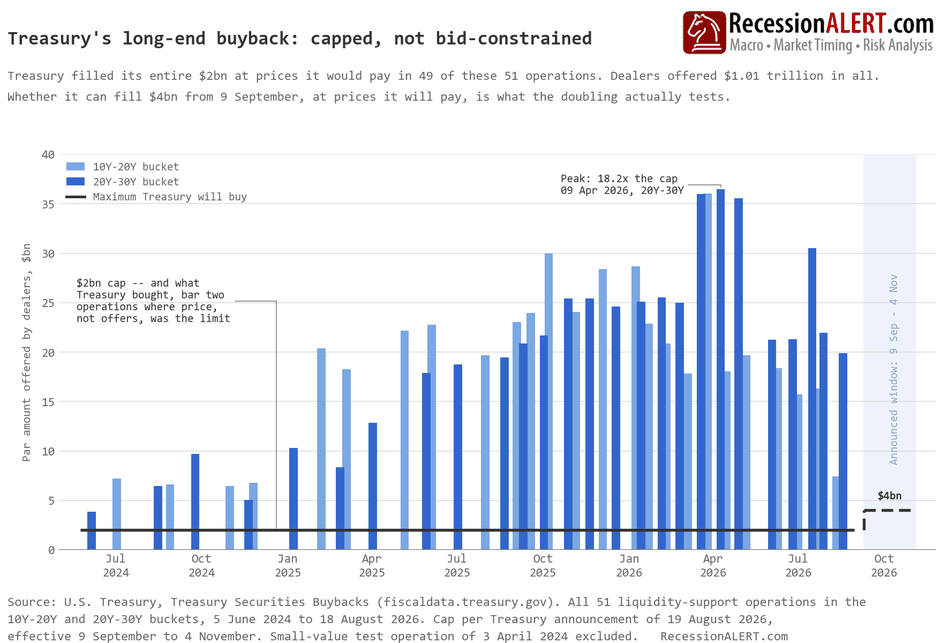
On 9 September, Treasury finds out whether its own long-end bid is real. The increment is roughly $5bn a month against about $102bn of gross 10Y-and-longer issuance — 5.2% of supply going to 10.3%. Too small to move net supply; large enough to settle a question 27 months of operations have left open. Treasury has never tried to buy more than $2bn here. One cap, 51 operations, filled to the last dollar in 49 — $1.01 trillion offered, $99bn bought. Read that as depth and the doubling is free. Twice it wasn’t: $0.79bn of $2bn taken on 20 November 2025 against $25.4bn offered; $0.20bn against $36.0bn on 19 March 2026. Both 20Y–30Y, both days when price, not the cap, was the limit. Offering into a buyback commits a dealer to nothing — nobody sells unless Treasury reaches their level. So this year’s 11.83x cover measures willingness to be asked, not paper available at Treasury’s bid. The 11 August operation drew 3.70x, the weakest since 2024. If the cap keeps binding at $4bn, Treasury has published a reaction function and will be expected to escalate it. If it starts falling short, the long end has been leaning on a bid that thins the moment it is drawn on — and an untested backstop is worth exactly what the market assumes, right up to the morning it gets marked.
What it means: If you hold long-dated Treasury bonds, or a fund that does, do not treat this as a floor under their price yet. Treasury has never actually bought $4bn at one of these buybacks, so nobody knows whether sellers will show up at a price it will pay. Two failed rounds after 9 September would say the support is thinner than it sounded.
Market Intelligence Brief (MIB) Ver. 19.09
For professional investors only. Not investment advice.
© 2026 RecessionALERT.com

Comments are closed.