
MARKET INTELLIGENCE BRIEF (MIB)
Tuesday, October 27, 2026
AMD jumped 5.45% after committing $1 billion to Meta’s equity raise and winning a custom-GPU deployment, leading the Nasdaq 100 up 1.29% and the S&P 500 back above 7,700. Meta fell 1.64% after pricing $37.5 billion of equity and facing a suit over Zuckerberg’s recap. Consumer confidence leapt to 91.7 against an 81 forecast as the FOMC meeting opened. Boeing sank 10.69% after earnings, pinning the Dow to a 0.03% gain. WTI slid 1.55% to $100.18 on Iran’s regional diplomacy.
TABLE OF CONTENTS
A. EXECUTIVE SUMMARY
B. MARKET DATA
C. HIGH-IMPACT STORIES (5)
D. MODERATE-IMPACT STORIES (6)
E. ECONOMY WATCH (5)
F. EARNINGS WATCH (8)
G. WHAT’S NEXT
H. CHART OF THE DAY
A. EXECUTIVE SUMMARY -> TOP
Stocks climbed into Wednesday’s Fed decision on a narrow, AI-hardware-led advance: the S&P 500 rose 0.60% to 7,722.60 and the Nasdaq 100 gained 1.29%, while the NYSE Composite added only 0.10% and Boeing’s 10.69% post-earnings slide held the Dow to +0.03%. The driver was supplier capital flowing into the AI build-out, with AMD committing $1 billion to Meta’s equity raise and Oracle planning a multi-gigawatt Nvidia build, and investors rewarded the vendors while Meta, the issuer, fell 1.64%. Treasuries did not share the calm: the 2-year yield rose 2.5 bps to 4.741%, its third straight gain, and the dollar firmed 0.42% on the day confidence printed 91.7 against an 81 forecast, even as the VIX fell 4.79%. Seven of 11 sectors rose, led by Basic Materials (+2.19%) and Technology (+1.58%), while Energy, the year’s leader, lagged at -1.75% as WTI slipped to $100.18 on Iranian diplomacy.
• AI hardware led: AMD rose 5.45% to $560.26 after committing $1 billion to Meta’s equity offering and winning a custom Instinct GPU deployment; Dell gained 7.47%, Arista 5.51% and Broadcom 4.00%, the last helped by a DA Davidson upgrade to Buy.
• Meta fell 1.64% to $620.19 after pricing an upsized $25 billion common offering at $625, below Monday’s $630.56 close, plus $12.5 billion of 6.50% mandatory convertible preferred; a pension fund sued in Delaware to block Zuckerberg’s non-voting-share recapitalization.
• Oracle rose 3.55% on a plan to scale Nvidia Vera Rubin systems to “multi-gigawatt” size, with no dollar or gigawatt figure, and will also offer Google TPUs, Cerebras and SambaNova chips; its fiscal 2027 capex target stays at about $90-95 billion.
• Demand data beat: Conference Board confidence rose to 91.7 against an 81 forecast and durable goods orders rose 1.8% against 1.5%, but orders excluding transportation missed at 0.5%, new home sales ran 5.3% below a year earlier and GDPNow edged down to 3.4% for the third quarter.
• Crude fell: WTI dropped 1.55% to $100.18 and Brent 0.95% to $109.69 as Iran pursued talks with Saudi Arabia, Turkey and Pakistan, outweighing an unconfirmed Houthi claim of a missile strike on Saudi Arabia’s Ras Tanura refinery.
• Washington on deals: the FTC plans to sue to block Cintas’ $5.5 billion UniFirst purchase, per Semafor (UniFirst about -8%, Cintas about -5%); the FCC cleared Amazon’s $10.8 billion Globalstar deal; Constellation won a conditional DOE loan commitment of up to $5 billion for nuclear uprates.
1. The AI build-out is increasingly financed by its own suppliers — AMD is putting $1 billion into Meta’s equity raise, with Nvidia reported to be committing $3 billion more, so Meta is raising money partly from the vendors it will pay for compute. Oracle is scaling to multi-gigawatt capacity with an unchanged capex range and no stated funding plan, and the DOE is now lending to Constellation for the power side. The market’s verdict was clear: suppliers rallied while Meta, the issuer, fell. For portfolios, that places secured demand with the chip and hardware vendors and the funding risk with the hyperscalers, which makes Microsoft’s and Alphabet’s capex guidance after Wednesday’s close the next test of the trade.
2. Bonds and stocks disagree about the Fed — The 2-year yield has risen 9.3 bps over three sessions to 4.741% and Polymarket prices a 77% chance of another hike this year, yet the VIX fell to 17.51 as the S&P 500 rose. Tuesday’s data favour the bond market’s reading: confidence beat by 10.7 points, 12-month inflation expectations stand at 5.8% and GDPNow’s 3.4% runs above Thursday’s 3.2% GDP consensus. The softer readings, orders excluding transportation and a 3.9% year-over-year fall in the new-home median price, are not enough to give the Fed a reason to sound dovish. Chair Warsh’s press conference, then Thursday’s GDP and PCE, will decide which market has it right.
3. Energy is priced for peace while the attack claims move closer to core assets — WTI is at the edge of $100 and Energy fell 1.75% as markets weighted Iran’s diplomacy above unconfirmed attack claims for a second session, which leaves the sector’s 46.17% year-to-date gain exposed to a peace dividend. But Monday’s claimed target was the East-West pipeline and Tuesday’s was Ras Tanura, the kingdom’s largest refinery and a Gulf export terminal, so a Saudi or Aramco confirmation of damage would reverse the move quickly. Lower crude eases one inflation input the Fed weighs on Wednesday; the risk is asymmetric.
 — Leading economic indicators. Accurate market forecasts. Apply for membership at join.recessionalert.com
B. MARKET DATA -> TOP
Chipmakers and AI hardware drove a rally the day before the Fed’s decision: the Nasdaq 100 rose 1.29% and the S&P 500 0.60%, back above 7,700, while Boeing’s 10.69% post-earnings slide held the Dow to a 0.03% gain. Participation was uneven, with seven of 11 sectors higher but the NYSE Composite up only 0.10% as Energy and Consumer Defensive fell. Transports (+1.70%) and the Russell 2000 (+1.16%) both outran the Dow, putting small caps back above 2,800. WTI fell 1.55% on Middle East diplomacy hopes, per Reuters, while the 2-year yield led Treasuries higher and the dollar firmed 0.42%.
CLOSING PRICES – Tuesday, October 27, 2026:
MAJOR INDICES
The advance was led by chips and transports rather than breadth: the NYSE Composite gained just 0.10% against the Nasdaq 100’s 1.29%. The Dow-Transports split (+0.03% vs +1.70%) traces on the Dow side to Boeing’s post-earnings slide; no single catalyst for the transports’ gain was confirmed. Dow Theory bull confirmation is now a six-session pattern, with transports closing above their 10-session high. The Russell 2000 has beaten the S&P 500 by 2.3 points over the past 10 sessions, a small-cap leadership signal that emerges today.
| Index | Close | Change | %Move | Why It Moved |
|---|---|---|---|---|
| S&P 500 | 7,722.60 | +45.83 | +0.60% | Chip and AI-hardware strength (AMD, Dell, Broadcom) outweighed Energy and Consumer Defensive losses; first close above 7,700 since October 21 |
| Dow Jones | 52,377.57 | +15.99 | +0.03% | Boeing (-10.69%) fell after its third-quarter report and was the Dow’s worst performer; Caterpillar (+3.11%) and Goldman Sachs (+2.07%) led, per Investing.com |
| DJ Transportation | 20,547.52 | +342.70 | +1.70% | No discrete same-day catalyst identified; outpaced the Dow by 1.67 points and closed above its 10-session high |
| Nasdaq 100 | 29,651.44 | +378.04 | +1.29% | AMD (+5.45%), Tesla (+4.04%) and Broadcom (+4.00%) led a semiconductor-heavy advance; Meta (-1.64%) and Netflix (-2.16%) lagged |
| Russell 2000 | 2,818.87 | +32.45 | +1.16% | Outpaced large caps; first close above 2,800 since October 9 |
| NYSE Composite | 24,210.68 | +23.82 | +0.10% | Declines in Energy, Consumer Defensive, Real Estate and Financial held the broad index to a fractional gain |
VOLATILITY & TREASURIES
The VIX fell as equities rose, but Treasuries did not join the relief: the 2-year rose 2.5 bps and the 10-year 1.4 bps the day before the FOMC decision, flattening 2s10s to 25.3 bps. A front-end-led rise alongside a firmer dollar points to rate-path caution going into Wednesday rather than growth fear.
| Instrument | Level | Change | Why It Moved |
|---|---|---|---|
| VIX | 17.51 | -0.88 (-4.79%) | Eased as the S&P 500 extended Monday’s gain |
| 10-Year Treasury Yield | 4.994% | +1.4 bps | No discrete same-day catalyst identified; edged higher the day before the FOMC decision |
| 2-Year Treasury Yield | 4.741% | +2.5 bps | Led the curve higher the day before the FOMC decision; no discrete same-day catalyst identified |
| US Dollar Index (DXY) | 102.39 | +0.43 (+0.42%) | No discrete same-day catalyst identified; firmed the day before the FOMC decision |
COMMODITIES
Copper (+1.81%) outran gold (+0.87%), an industrial-metals lead that matched the chip-led equity tape, while silver trailed gold and platinum slipped. Bitcoin’s 0.83% gain tracked equities rather than charting its own course.
| Asset | Price | Change | %Move | Why It Moved |
|---|---|---|---|---|
| Gold | $4,073.35/oz | $+34.95 | +0.87% | No discrete same-day catalyst identified; December contract higher from Monday’s settlement |
| Silver | $54.495/oz | $+0.154 | +0.28% | Modest gain, lagging gold |
| Copper | $6.6605/lb | $+0.1185 | +1.81% | No discrete same-day catalyst identified; rose alongside the equity advance and a 2.19% gain in Basic Materials |
| Platinum | $1,542.60/oz | $-2.80 | -0.18% | Slipped on the January contract, diverging from the other metals |
| Bitcoin | $80,761 | $+666 | +0.83% | Rose with equities |
ENERGY
WTI and Brent fell together, WTI by more, while Henry Hub rose 1.36% and decoupled from crude. Dutch TTF fell 2.06% from Monday’s highest close since at least April 15, splitting from US gas. Crude fell as Iran pursued talks with regional powers, per Reuters, so oil moved against rising equities.
| Asset | Price | Change | %Move | Why It Moved |
|---|---|---|---|---|
| Crude Oil (WTI) | $100.18/bbl | $-1.58 | -1.55% | Diplomacy hopes weighed after Iran’s Security Council chief met Supreme Leader Khamenei following talks with Saudi, Turkish and Pakistani representatives; the Houthis’ claimed strike on Saudi Arabia’s Ras Tanura refinery kept supply worries alive. Settled $99.90, down $1.86, per Reuters |
| Crude Oil (Brent) | $109.69/bbl | $-1.05 | -0.95% | Fell with WTI on the same Middle East diplomacy hopes (January contract); the expiring December contract settled $113.88, down $1.93, per Reuters |
| Natural Gas (Henry Hub) | $3.063/MMBtu | $+0.041 | +1.36% | No discrete same-day catalyst identified; December contract rose against falling crude |
| Natural Gas (Dutch TTF) | $30.878/MMBtu | $-0.649 | -2.06% | Retreated from Monday’s highest close since at least April 15, diverging from US gas |
S&P 500 SECTORS
Basic Materials led (+2.19%) despite negative 1-week and 1-month returns, while Energy, the YTD leader at +46.17%, was the session’s laggard (-1.75%). Seven of 11 sectors rose; Energy, Consumer Defensive (-0.84%), Real Estate (-0.79%) and Financial (-0.17%) fell. Communication Services barely held green (+0.04%) after a -6.13% week.
| Sector | 1-Day | 1-Week | 1-Month | 3-Month | 6-Month | YTD | 12-Month |
|---|---|---|---|---|---|---|---|
| Basic Materials | +2.19% | -1.03% | -1.63% | +2.57% | -4.56% | +9.37% | +17.67% |
| Technology | +1.58% | +1.93% | -2.79% | +13.11% | +15.65% | +25.54% | +21.10% |
| Consumer Cyclical | +1.18% | -0.57% | +4.62% | +3.52% | -2.59% | -5.25% | -5.72% |
| Industrials | +0.89% | +0.94% | -0.46% | -1.06% | -4.49% | +7.37% | +6.82% |
| Utilities | +0.78% | +1.70% | +7.96% | -4.20% | -8.51% | -0.59% | -6.42% |
| Healthcare | +0.20% | +0.03% | +3.39% | +5.13% | +19.10% | +11.80% | +15.27% |
| Communication Services | +0.04% | -6.13% | -7.09% | -4.53% | -9.79% | -6.61% | -2.66% |
| Financial | -0.17% | -0.18% | +0.39% | -2.18% | +6.70% | +3.59% | +8.76% |
| Real Estate | -0.79% | +0.11% | +1.07% | -8.78% | -4.09% | +3.43% | -1.18% |
| Consumer Defensive | -0.84% | -0.57% | +6.20% | +0.64% | +3.51% | +11.57% | +10.18% |
| Energy | -1.75% | +0.07% | +7.96% | +11.84% | +11.68% | +46.17% | +48.57% |
TOP MEGA-CAP MOVERS:
GAINERS
| Company | Ticker | Close | Change | Why It Moved |
|---|---|---|---|---|
| Dell Technologies | DELL | 501.96 | +7.47% | No discrete same-day catalyst identified; moved with a broad AI-hardware advance (Arista +5.51%, AMD +5.45%) |
| Arista Networks | ANET | 187.00 | +5.51% | No discrete same-day catalyst identified; rose with AI networking and hardware peers ahead of its quarterly report |
| Advanced Micro Devices | AMD | 560.26 | +5.45% | AMD said it will invest $1 billion in Meta’s equity offering and that Helios rack-scale systems are installed and in testing at Meta, deepening the companies’ partnership |
| GE Vernova | GEV | 895.08 | +4.67% | No discrete same-day catalyst identified; reports third-quarter results before Wednesday’s open |
| Analog Devices | ADI | 425.35 | +4.27% | No discrete same-day catalyst identified; analog chipmakers rose together (Texas Instruments +3.62%) |
DECLINERS
| Company | Ticker | Close | Change | Why It Moved |
|---|---|---|---|---|
| Exxon Mobil | XOM | 179.91 | -2.51% | Fell with crude (WTI -1.55%) on Middle East diplomacy hopes, per Reuters; Energy was the weakest sector (-1.75%) |
| Netflix | NFLX | 62.52 | -2.16% | No discrete same-day catalyst identified; extended Monday’s slide, closing below the $63.87 52-week low it touched on October 26, per Investing.com |
| Meta Platforms | META | 620.19 | -1.64% | Priced its $25 billion common-stock offering at $625, below Monday’s $630.56 close, per Investing.com; dilution concerns weighed |
| Coca-Cola | KO | 91.18 | -1.64% | Earnings-driven; reported third-quarter results before the open |
| Chevron | CVX | 228.23 | -1.63% | Fell with crude on Middle East diplomacy hopes, per Reuters; reports Friday |
— Institutional-grade intelligence for serious investors. Apply for membership at join.recessionalert.comC. HIGH-IMPACT STORIES -> TOP
BULLISH
1. AMD Commits $1 Billion to Meta’s Equity Raise and Wins a Custom-GPU Deployment; AMD Rises 5.45% as AI Hardware Lifts the Nasdaq 100 1.29%
The core facts:AMD said at 9:20 AM ET on Tuesday that it will invest $1 billion in Meta’s equity offering, and that Meta will deploy a custom AMD Instinct GPU built for its workloads. Meta was an early definition customer for the MI450 architecture, initial Helios rack-scale systems are installed and in testing at Meta with broader deployment expected “in the near future,” Meta is a lead customer for sixth-generation EPYC processors, and the two companies are co-developing a future EPYC generation, “Verano.” The release gives no deal value or gigawatt figure. CNBC and Investing.com also reported that Nvidia will commit $3 billion to the same offering; Nvidia’s own newsroom carried no release on the investment, so that figure rests on those reports. Mark Zuckerberg said in AMD’s release: “AMD has been a key partner in building out the compute that’s running our frontier models.”
Why it matters:AMD closed at $560.26, up 5.45%, and AI hardware led the tape: Dell rose 7.47%, Arista 5.51% and Broadcom 4.00%, the Nasdaq 100 gained 1.29% and Technology rose 1.58%, while the S&P 500 added 0.60% to 7,722.60, its first close above 7,700 since October 21. Chip suppliers putting their own capital into a customer’s equity raise is the clearest sign yet of the circular financing behind the AI build-out: Meta raises money partly from the vendors it will pay for compute. The market rewarded the vendors, not the issuer — Meta fell 1.64% (Story 5) — which says investors see the suppliers as the ones with secured demand. The rally was narrow, though: the NYSE Composite rose only 0.10%.
What to watch:Microsoft’s and Alphabet’s capex guidance after Wednesday’s close, and AMD’s own third-quarter results after the close on Tuesday, November 3, for any number attached to the Meta deployment.
BULLISH
2. Oracle Plans a “Multi-Gigawatt” Nvidia Vera Rubin Build and Will Offer Google TPUs, Cerebras and SambaNova Chips on Its Cloud; Oracle Rises 3.55%
The core facts:Nvidia and Oracle said on Tuesday that they plan to expand Oracle Cloud Infrastructure’s superclusters with Vera Rubin NVL72 systems to “multi-gigawatt scale,” and that Vera Rubin NVL72 and Nvidia’s Vera CPU are now generally available on OCI. The release gives no dollar value, gigawatt figure or contract terms, and describes the expansion as a plan rather than a firm order. Separately, Reuters reported that Oracle will offer Google’s tensor processing units for the first time, add inference chips from Cerebras and Intel-backed SambaNova, and use its own “Acceleron” networking chips in place of some Nvidia networking. Oracle did not say how it will pay and kept its fiscal 2027 capital spending target at about $90 billion to $95 billion. Oracle closed at $130.53, up 3.55%.
Why it matters:Oracle is spreading its compute across four chip suppliers while scaling the largest of them, which hedges supply risk and gives it pricing leverage over Nvidia. For Nvidia, a multi-gigawatt plan is significant even without terms: Jensen Huang has said Vera Rubin systems can generate up to $40 billion of Nvidia revenue per gigawatt. For Alphabet, OCI is the first major outside cloud to carry its TPUs. The risk is financing: Oracle is committing to more capacity with an unchanged capex range and no stated funding plan, a day after Meta turned to equity markets to pay for its own build-out.
What to watch:Oracle’s investor day later this week for capex, funding and any contracted gigawatt figure, and Alphabet’s cloud commentary after Wednesday’s close.
UNCERTAIN
3. Crude Falls as Iran Pursues Talks With Regional Powers, Despite a Houthi Claim of a Missile Strike on Saudi Arabia’s Ras Tanura Refinery; WTI Down 1.55% to $100.18
The core facts:Iran’s Supreme National Security Council secretary Mohsen Rezaei met Supreme Leader Ali Khamenei a day after talks in Tehran with representatives of Saudi Arabia, Turkey and Pakistan, Reuters reported. Houthi military spokesman Yahya Saree said on X that the group “fired a ballistic missile at the refinery in Saudi Arabia’s Eastern Province,” claiming a hit and large fires at Ras Tanura, the kingdom’s largest refinery and a Gulf export terminal; Saudi authorities did not comment, per Anadolu Agency, and the claim has not been confirmed. The Saudi-led coalition said it intercepted four drones and three ballistic missiles launched by the Houthis earlier in the day. WTI closed at $100.18, down 1.55%, and Brent at $109.69, down 0.95% on the January contract.
Why it matters:For a second session the market weighted diplomacy above unconfirmed attack claims, taking WTI to the edge of $100. Energy was the weakest sector at -1.75%, with Exxon Mobil down 2.51% and Chevron 1.63%, and the sector’s 46.17% year-to-date gain leaves it the most exposed to a peace dividend. But the claims are moving closer to the kingdom’s core export infrastructure — Monday’s targets were the East-West pipeline, Tuesday’s the main Gulf refinery and terminal — so a Saudi or Aramco confirmation of damage would reverse the move quickly. Lower crude eases one inflation input the Fed weighs on Wednesday; Europe’s gas market is less relaxed, with Dutch TTF holding near Monday’s highest close since at least April 15 despite a 2.06% fall.
What to watch:Any Saudi or Aramco statement on Ras Tanura, whether the Tehran contacts produce a second round, and Wednesday’s EIA petroleum inventory report at 10:30 AM ET.
UNCERTAIN
4. A Confidence Beat Lands as the FOMC Meeting Opens: the 2-Year Yield Rises 2.5 bps to 4.741% and the Dollar Firms 0.42% Into Wednesday’s Decision
The core facts:The Conference Board’s October consumer confidence index beat consensus by a wide margin (see Economy Watch), on the day the Federal Open Market Committee began its two-day meeting. The 2-year Treasury yield rose 2.5 bps to 4.741% and the 10-year 1.4 bps to 4.994%, flattening the 2s10s curve to 25.3 bps, and the dollar index rose 0.42% to 102.39. No source was found directly linking the yield or dollar move to the release. The Fed is expected to hold at 3.75%-4.00% on Wednesday, and Polymarket’s contract on another rate hike in 2026 stood at 77%. Officials are in the pre-meeting blackout.
Why it matters:The 2-year yield has now risen for three straight sessions, 9.3 bps in all, into the decision, and a resilient consumer weakens the case for patience on a hiking bias the market already prices at better than three in four for this year. Stocks are not pricing that risk: the VIX fell 4.79% to 17.51 as the S&P 500 rose. That leaves the press conference as the event that decides whether equities or the 2-year has read Chair Warsh correctly. Thursday’s third-quarter GDP and September PCE follow the decision, so any hawkish signal will be tested against fresh inflation data within a day.
What to watch:The FOMC statement at 2:00 PM ET on Wednesday, October 28 and Chair Warsh’s 2:30 PM ET press conference for any explicit December guidance; a 2-year yield holding above 4.7% afterwards would confirm the market is pricing a hike.
BEARISH
5. Meta Prices an Upsized $37.5 Billion Equity Sale at $625 and a Pension Fund Sues to Block Zuckerberg’s Non-Voting-Share Recapitalization; Meta Falls 1.64%
The core facts:Meta priced its Class A common offering at $25.0 billion, upsized from $22.5 billion — 40 million shares at $625.00 through forward sale agreements, with about $24.9 billion of proceeds expected on settlement by November 19, 2027 — plus $12.5 billion of 6.50% Series A mandatory convertible preferred that converts on or about August 15, 2029. Both offerings are expected to close on October 29. On Tuesday the Steamfitters Local 449 Pension Fund sued Mark Zuckerberg and Meta’s board in the Delaware Court of Chancery (No. 2026-1413) to block the non-voting-stock recapitalization approved on October 19, which takes full effect on January 17. The complaint says Zuckerberg could immediately sell 20% of his new non-voting shares, worth nearly $24 billion, and keep control with as little as a 0.6% economic stake: “The recapitalization is a gift to Zuckerberg.” Meta said it will “defend them vigorously.” Meta closed at $620.19, down 1.64%.
Why it matters:Pricing below Monday’s $630.56 close and upsizing the common tranche tells investors demand was there but only at a discount, and the shares gave back that discount on the first full session. The lawsuit links two things the market had treated separately: the equity programme that funds Meta’s AI spending, and a governance change that lets its founder monetise shares without giving up control. Communication Services barely held green at +0.04% after a -6.13% week, and Meta’s slide while its chip suppliers rallied (Story 1) shows who the market thinks carries the funding risk.
What to watch:Meta’s third-quarter results and capex guidance, the offerings’ closing on Thursday, October 29, and any Chancery Court scheduling on an injunction before the January 17 effective date.
— Quantifying recession risk so you don’t have to guess. Apply for membership at join.recessionalert.comD. MODERATE-IMPACT STORIES -> TOP
BEARISH
6. The FTC Tells Cintas It Plans to Sue to Block Its $5.5 Billion UniFirst Acquisition, Semafor Reports; UniFirst Falls About 8% and Cintas About 5%
The core facts:The Federal Trade Commission has told Cintas it plans to challenge its proposed $5.5 billion cash-and-stock purchase of UniFirst, Semafor reported on Tuesday, citing people familiar with the matter; the commission has not yet voted on filing suit, and FTC staff have raised concerns about the companies’ combined market share. Cintas agreed the deal in March after at least three formal approaches since 2022. UniFirst fell about 8% and Cintas about 5% in midday trading, per Reuters. None of Cintas, UniFirst or the FTC commented.
Why it matters:A threatened challenge to a $5.5 billion deal in a niche uniform-rental market shows the FTC is still willing to litigate horizontal mergers on market-share grounds, whatever the broader deregulatory tone. That raises the risk premium on in-market consolidation that relies on route and plant synergies, and it removes the cost savings Cintas, an $89.7 billion company, had promised from merging delivery routes, plants and supply chains.
What to watch:A formal FTC vote and complaint, and whether Cintas offers divestitures or chooses to litigate.
UNCERTAIN
7. The CFTC Sues Utah to Stop State Enforcement Against Federally Registered Prediction Markets and Says It Has Begun Proceedings Against Nine Other States
The core facts:The Commodity Futures Trading Commission filed a complaint for declaratory and injunctive relief against the State of Utah on Tuesday, seeking to stop it using state law to shut down CFTC-registered contract markets after Utah brought civil enforcement actions in state court against CFTC-regulated markets. The agency said it has begun legal proceedings against nine other states. Chairman Michael Selig said “Congress entrusted the CFTC to be the federal regulator with sole responsibility to oversee these markets” and that “Utah seeks to shut down prediction markets across a wide variety of markets.”
Why it matters:A federal regulator suing ten states on behalf of the markets it oversees turns the fight over event contracts into a federal-preemption case, which is what the industry needs to scale nationally. A win would protect sports and election contracts from a patchwork of state gambling laws and widen the addressable market for brokers and exchanges that list them; a loss would leave them operating state by state. The suit lands one week before the November 3 midterms.
What to watch:Any preliminary-injunction ruling in the Utah case and whether the CFTC names the nine other states in court filings.
BULLISH
8. Constellation Secures a Conditional DOE Loan Commitment of Up to $5 Billion for Nuclear Uprates at Eight Plants
The core facts:Constellation Energy said on Tuesday it has received a conditional commitment for a loan of up to $5 billion from the Department of Energy’s Office of Energy Dominance Financing, under the DOE’s UPRISE program, to support uprates at Braidwood, Byron, Clinton, Dresden, LaSalle and Quad Cities in Illinois, Calvert Cliffs in Maryland and Limerick in Pennsylvania. The commitment depends on due diligence, final financing documents and other conditions, and does not commit Constellation to any specific project. CEO Joe Dominguez said “This is how America wins the race for energy abundance,” and Energy Secretary Chris Wright said the department “is accelerating President Trump’s American nuclear renaissance.”
Why it matters:Uprates are the fastest way to add carbon-free baseload capacity for data centres because they use existing sites and licences, and federal debt lowers the cost of capital on projects tied to Constellation’s 20-year agreements with Google and Amazon, which already carry more than $7 billion of investment for about 1,080 MW. It also shows Washington is now financing the power side of the AI build-out directly. Utilities rose 0.78%.
What to watch:Whether the commitment converts into a final loan agreement, and any megawatt figures for the DOE-backed uprates.
BULLISH
9. General Motors Will Move Its Listing From the NYSE to Nasdaq on November 17, Becoming Eligible for the Nasdaq-100; GM Rises About 5.5%
The core facts:General Motors said on Tuesday, in a release and an 8-K, that its board approved on October 26 a transfer of its common stock listing to Nasdaq, with trading there beginning November 17 and the NYSE listing ending at the November 16 close. The stock keeps the “GM” ticker and shareholders need take no action. GM said the move makes it eligible for potential inclusion in the Nasdaq-100 index, which is not guaranteed. The shares closed at $80.54, up $4.23 or about 5.5%, per CNBC.
Why it matters:The gain is a bet on index demand: Nasdaq-100 inclusion would bring buying from the large passive funds that track it. It is also a competitive loss for the NYSE, which gives up one of its best-known industrial listings.
What to watch:Nasdaq’s annual reconstitution announcement in December, which determines whether GM enters the Nasdaq-100.
UNCERTAIN
10. DA Davidson Upgrades Broadcom to Buy as Shares Gain 4.00%; Citi Upgrades MercadoLibre and Ferguson, While Wolfe Cuts M&T and Huntington and William Blair Downgrades Moderna
The core facts:DA Davidson upgraded Broadcom to Buy from Neutral; Broadcom rose 4.00%. Citi upgraded MercadoLibre and Ferguson to Buy from Neutral. Wolfe Research downgraded M&T Bank to Underperform from Peer Perform and Huntington Bancshares to Peer Perform from Outperform, and assumed coverage of Fifth Third at Outperform. William Blair downgraded Moderna to Market Perform from Outperform.
Why it matters:The Broadcom upgrade fitted the session’s AI-hardware leadership (Story 1), with Broadcom among the Nasdaq 100’s leading gainers. The Wolfe calls point the other way for regional lenders, separating M&T and Huntington from Fifth Third the day before a Fed decision that could keep funding costs higher for longer; Financial was one of four sectors to fall, down 0.17%.
What to watch:Broadcom’s next leg as Microsoft and Alphabet report AI capex after Wednesday’s close.
BULLISH
11. The FCC Approves Amazon’s $10.8 Billion Acquisition of Globalstar, Clearing Spectrum for a Direct-to-Device Satellite Constellation
The core facts:The Federal Communications Commission approved Amazon’s acquisition of Globalstar on Tuesday, finding the deal serves the public interest and causes no horizontal or vertical competitive harm, because Globalstar operates mobile satellite services and wholesale capacity while Amazon Leo offers fixed satellite broadband. It dismissed the only opposing filing. Amazon agreed the $10.8 billion deal in April; Globalstar becomes a wholly owned subsidiary affiliated with Amazon Leo. Amazon has not updated its closing timetable, originally 2027.
Why it matters:The deal gives Amazon L-band and S-band spectrum for an April-filed plan of up to 5,105 direct-to-device satellites, positioning it against SpaceX in phone-to-satellite service. Clearing the main US regulatory hurdle without reported conditions removes the largest risk to a deal that turns Amazon Leo from a broadband network into a mobile one.
What to watch:Amazon’s third-quarter results after the close on Thursday, October 29, for an updated closing date and Amazon Leo capex.
— Separating signal from noise since 2007. Apply for membership at join.recessionalert.comE. ECONOMY WATCH -> TOP
The day before the FOMC decision, demand data came in stronger than expected. Conference Board confidence jumped to 91.7 against an 81 forecast, headline durable goods orders beat at 1.8%, and Atlanta Fed GDPNow still tracks third-quarter growth at 3.4%, above Thursday’s 3.2% consensus. The weaker readings sit beneath the headlines: orders excluding transportation missed, new home sales ran 5.3% below a year earlier with the median price down 3.9%, and consumers’ 12-month inflation expectations stand at 5.8%. The Fed is expected to hold on Wednesday, and Polymarket puts the odds of another rate hike this year at 77%; firm growth and elevated inflation expectations give it little reason to sound dovish. Thursday’s GDP and PCE releases are the next test.
Consumer Confidence Jumps to 91.7, Far Above the 81 Forecast, as Present Situation Index Climbs 8.6 Points (The Conference Board, Oct 27)
What they’re saying:The Conference Board’s Consumer Confidence Index rose 7.5 points to 91.7 in October, from a revised 84.2 in September and against a consensus of 81. The Present Situation Index rose 8.6 points to 120.4 and the Expectations Index rose 6.9 points to 72.6. The labor differential (consumers saying jobs are “plentiful” minus those saying jobs are “hard to get”) improved 2.4 points to +5.3%.
The context:The 10.7-point beat is the largest upside surprise among Tuesday’s releases. Every major component improved, but the gains are concentrated in current conditions: the Expectations Index still trails the Present Situation Index by 47.8 points. Twelve-month inflation expectations eased from September but remain elevated at 5.8%. Conference Board senior economist Fergus McCormick cautioned that “despite the increase in October, consumer confidence remained on the long-term downward trend.”
What to watch:September personal income and spending on Thursday, October 29 (spending expected +0.5%, prior +0.9%), and September PCE inflation the same morning (headline expected 3.6% year over year, prior 3.4%). Together they will show whether firmer sentiment is reaching consumption, and whether the 5.8% inflation expectations are being borne out.
Durable Goods Orders Rise 1.8%, Beating 1.5% Forecast, but Orders Excluding Transportation Miss at 0.5% (Census Bureau, Oct 27)
What they’re saying:New orders for manufactured durable goods rose $6.3 billion, or 1.8%, to $345.4 billion in September, above the 1.5% consensus and after a 0.1% gain in August. Transportation equipment led, up 4.6% to $119.8 billion. Excluding transportation, orders rose 0.5% against 0.6% expected (0.3% prior); excluding defense, they rose 2.2%. Nondefense capital goods orders jumped 6.2% to $107.8 billion.
The context:The headline beat rests on transportation equipment. The miss excluding transportation shows underlying factory demand running slightly below forecast, although it still picked up from August’s 0.3%. Shipments rose 0.9% to $336.8 billion, and unfilled orders rose 0.8% to a $1,623.6 billion backlog, up in 26 of the last 27 months. That backlog supports output into the fourth quarter. After Tuesday’s Census releases, the Atlanta Fed cut its third-quarter private investment nowcast to 19.4% from 19.9%.
What to watch:The ISM Manufacturing PMI on Monday, November 2 (prior 54.5), then revised durable goods data with factory orders on Tuesday, November 3 (factory orders prior +0.1%).
New Home Sales Beat at 676,000 Annualized but Run 5.3% Below a Year Earlier; Median Price Falls 3.9% (Census Bureau/HUD, Oct 27)
What they’re saying:Sales of new single-family homes ran at a seasonally adjusted annual rate of 676,000 in September, above the 650,000 consensus. That was 0.6% below August’s revised 680,000 and 5.3% below the 714,000 rate of September 2025. The median sales price was $400,400, up 3.9% from August but down 3.9% from a year earlier; the average price of $472,800 was down 6.7% year over year.
The context:The beat came against a lowered bar: August was revised down from 684,000. The Census Bureau also states that neither the monthly nor the annual change is statistically significant (confidence intervals of ±13.8% and ±12.5%). Builders held 476,000 homes for sale, 8.4 months’ supply at the current pace, against 8.2 months a year earlier. The year-over-year fall in new home prices contrasts with the firmer resale price indexes released the same morning.
What to watch:The MBA 30-year mortgage rate on Wednesday, October 28 (prior 7.41%), and the FOMC rate decision at 2:00 PM ET the same day, which sets the path for mortgage financing costs.
Home Price Growth Picks Up: Case-Shiller Annual Gain Rises to 2.7%, Above 2.5% Forecast; FHFA Index Up 0.3% in August (S&P Cotality / FHFA, Oct 27)
What they’re saying:S&P Cotality Case-Shiller home prices rose 2.7% year over year in August, above the 2.5% consensus and up from 2.5% in July. The Federal Housing Finance Agency’s House Price Index rose 0.3% month over month in August and 2.4% from August 2025.
The context:Both resale price measures firmed in August even with 30-year mortgage rates above 7%. The gains are still below inflation, however: headline PCE prices rose 3.4% year over year in August, so home values continue to fall in real terms. The two resale indexes rose even as the new-home median price fell 3.9% from a year earlier.
What to watch:September PCE inflation on Thursday, October 29 (headline expected 3.6% year over year). A print at or above that would widen the gap between home price gains and inflation.
Atlanta Fed GDPNow Edges Down to 3.4% for the Third Quarter Ahead of Thursday’s Advance GDP Estimate (Atlanta Fed, Oct 27)
What they’re saying:The Atlanta Fed’s GDPNow model estimated third-quarter real GDP growth at a 3.4% annualized rate on October 27, down from 3.5% on October 20. After Tuesday’s Census Bureau releases, the nowcast for real gross private domestic investment growth fell to 19.4% from 19.9%.
The context:The model sits above the 3.2% consensus for Thursday’s advance estimate and well above the second quarter’s 2.2%. A third-quarter print above 3% would show growth running well above trend just as the Fed weighs further tightening. Polymarket puts the probability of another Fed rate hike in 2026 at 77%, unchanged from Monday, and the Fed is expected to hold its target range at 3.75%-4.00% on Wednesday.
What to watch:The third-quarter advance GDP estimate on Thursday, October 29 (expected 3.2%), with the GDP price index (expected 3.5%, prior 6.1%), and the third-quarter Employment Cost Index on Friday, October 30 (expected +0.8%, prior +0.9%).
— Know the probability before the market prices in the risk. Apply for membership at join.recessionalert.comF. EARNINGS WATCH -> TOP
YESTERDAY AFTER THE BELL (Markets Reacted Today)
UNCERTAIN
12. Welltower (WELL): -5.77% | Normalized FFO Up 24.6% and Guidance Raised, but Net Income Misses
The Numbers:Released: AMC, Monday, October 26. Net income $0.54 per share vs $0.64 estimate; revenue $3.72B vs $3.64B estimate. Normalized FFO $1.67 per share, up 24.6% year on year; same-store NOI +15.8%, with seniors housing operating same-store NOI +21.0%. Full-year normalized FFO guidance raised to $6.47-$6.53 from $6.36-$6.44, and net income guidance to $3.31-$3.37 from $3.11-$3.19.
The Problem/Win:The operating business accelerated — seniors housing demand is driving double-digit same-store growth and a $0.10 lift to the FFO midpoint — but the shares fell 5.77% as the net income line missed; one outlet tied the drop to that miss rather than the raised outlook.
The Ripple:Real Estate was among the four declining sectors at -0.79%, with the 10-year yield edging up to 4.994%.
What It Means:A 6% drop on a raised FFO outlook says the valuation already priced the growth; the stock now needs rates to stop rising more than it needs another beat.
TODAY BEFORE THE BELL (Markets Already Reacted)
BULLISH
13. Coca-Cola (KO): -1.64% | Volume Up 5% and Guidance Raised, but Shares Slip on a 2027 Refranchising Headwind
The Numbers:Released: BMO. Comparable EPS $0.91 vs $0.88 estimate, up 11%; revenue $13.35B vs $12.92B estimate, up 7%. Organic revenue +7%; global unit case volume +5%. Full-year organic revenue growth guidance raised to at least 5%; comparable EPS growth of at least 11%; free cash flow guidance raised to at least $13.0B from about $12.4B.
The Problem/Win:Volume did the work rather than price, which is the quality investors want from a staples name. The offset was forward: the CFO flagged an 8-point revenue headwind and a 2-point EPS headwind in 2027 from refranchising Coca-Cola Beverages Africa.
The Ripple:Consumer Defensive fell 0.84%, one of four declining sectors, as money rotated into chips.
What It Means:A beat-and-raise met with selling reflects rotation and the 2027 optics more than the quarter; reported 2027 growth will look weaker than the underlying business.
UNCERTAIN
14. Boeing (BA): -10.69% | Wider Core Loss and a 777 Parts Shortage Overshadow a Record $745 Billion Backlog
The Numbers:Released: BMO. Core loss $0.34 per share vs $0.25 loss estimate; GAAP loss $0.26 per share; revenue $24.19B vs $23.95B estimate. Free cash flow about $0.5B, after roughly $0.7B of Justice Department settlement payments. Total backlog a record $745B. Long-term free cash flow targets kept at about $2B for 2026, $3B for 2027, $6B for 2028 and $10B for 2029.
The Problem/Win:The core loss was wider than expected, and Boeing disclosed a parts shortage at a key 777 supplier that has disrupted factory operations and is expected to last through the first half of 2027, while its 2027 target assumes 777X certification by mid-year.
The Ripple:Boeing was the Dow’s worst performer and held the average to a 0.03% gain, while Industrials still rose 0.89% and the Dow Transports 1.70%.
What It Means:Demand is not the issue; execution is. A supplier-driven delay to 777 output puts the 2027 cash target at risk, and the stock will trade on production rates rather than orders.
What to watch:Monthly delivery data in early November for 737 and 787 rates, and any update on the 777 supplier.
BULLISH
15. S&P Global (SPGI): -0.38% | Beat, Raised Guidance and a Strategic Review of Capital IQ
The Numbers:Released: BMO. Adjusted EPS $4.58 vs $4.43 estimate, up 9%; revenue $3.68B vs $3.64B estimate, up 7%. Indices revenue +20%, a 14th straight record quarter; Market Intelligence +7%; Ratings +2%. Several outlets report guidance raised to 7.5%-8.5% organic constant-currency growth and adjusted EPS of $17.70-$17.95.
The Problem/Win:S&P Global opened a strategic review of Capital IQ and related data businesses, including a possible separation, while keeping RatingsDirect, RatingsXpress and Enterprise Solutions; it gave no timeline.
The Ripple:An opening gain of about 4% faded to a fractional loss as Financial slipped 0.17%.
What It Means:Indices strength carried a quarter in which ratings issuance slowed; a Capital IQ separation would leave a higher-margin ratings-and-indices company, but the market wants a timeline before paying for it.
BULLISH
16. Corning (GLW): -1.13% | Optical Communications Sales Jump 44% on AI Demand; Fourth-Quarter Guide Above Consensus
The Numbers:Released: BMO. Core EPS $0.91 vs $0.88 estimate, up 36%; core sales $5.08B vs $5.03B estimate, up 19%. Optical Communications sales +44% to $2.38B, with Enterprise Networks +84% and products for generative AI more than doubling. Fourth-quarter guidance: core sales $5.2B-$5.3B and core EPS $0.96-$1.00.
The Problem/Win:AI data-centre fibre is now Corning’s growth engine; display and solar profitability remain weak spots.
The Ripple:The shares slipped on a day Technology rose 1.58%, as AI-hardware buying concentrated in chips and servers.
What It Means:Corning confirms that AI demand is broadening into optical connectivity; a beat-and-raise sold on the day suggests the optical trade is already heavily owned.
UNCERTAIN
17. HCA Healthcare (HCA): -3.29% | Beat on Volumes, but Lost Exchange Coverage Costs About $400 Million and 2027 Looks Flat
The Numbers:Released: BMO. Adjusted EPS $7.22 vs $6.65 estimate; revenue $19.85B vs $19.33B estimate, up 3.6%. Same-facility admissions +2.7%, equivalent admissions +3.0%, emergency room visits +5.1%; inpatient surgeries -1.4% and outpatient surgeries -3.7%. Market cap $97.42B on today’s calendar; included because it was carried forward at $100.73B on October 26.
The Problem/Win:A shift in payer mix, as patients who lost exchange coverage arrived uninsured, cut pre-tax income by about $400 million, and management said 2027 earnings should be broadly consistent with 2026.
The Ripple:Healthcare rose 0.20%, leaving HCA’s fall stock-specific.
What It Means:Hospital demand is holding, but the loss of exchange coverage is now a measurable earnings drag that a flat 2027 outlook does not yet offset.
TODAY AFTER THE BELL (Markets React Tomorrow)
UNCERTAIN
18. Visa (V): -1.2% AH | Beat on Cross-Border Strength, but Fiscal 2027 EPS Growth Guided Lower
The Numbers:Released: AMC. Adjusted EPS $3.48 vs $3.44 estimate; GAAP EPS $3.19; net revenue $12.14B vs $12.09B estimate, up 13%. Payments volume +9% in constant dollars, from 10% last quarter; cross-border volume +14%; processed transactions 74.2B, +10%. Fiscal 2027 EPS growth guided to low double digits to low teens; quarterly dividend raised 16% to $0.78.
The Problem/Win:Travel-driven cross-border volume carried the beat, but the 2027 outlook implies slower earnings growth than this year, and the shares slipped about 1.2% after hours, per Seeking Alpha.
The Ripple:Mastercard reports Thursday before the open; a cooling in US payments volume would read across to card issuers and consumer spending.
What It Means:The consumer is still spending, but more slowly at the margin; Visa’s guidance resets 2027 growth expectations for the payments group.
What to watch:Mastercard’s results before the open on Thursday, October 29, for confirmation of the volume slowdown.
BULLISH
19. Seagate Technology (STX): AH: n/a | Revenue Up 61% and Next-Quarter Guidance Far Above the July Outlook
The Numbers:Released: AMC. Non-GAAP EPS $7.68 vs $7.45 estimate; revenue $4.23B vs $4.15B estimate, up 61%. Non-GAAP gross margin 57.8%; free cash flow $1.5B; about $1.2B of debt retired; quarterly dividend raised about 3% to $0.76. Fiscal second-quarter guidance: revenue $4.8B plus or minus $100M and non-GAAP EPS $9.20 plus or minus $0.20.
The Problem/Win:AI-driven demand for mass-capacity drives, served by Seagate’s HAMR roadmap, is lifting both price and margin. Reports said the shares fell after hours despite the beat; no after-hours figure was available at writing.
The Ripple:The guide sets a high bar for Sandisk, which reports Thursday after the close.
What It Means:Storage is now an AI-capex beneficiary in its own right; a sell-off on a guide this strong would signal positioning, not fundamentals.
WEEK AHEAD PREVIEW:
Q3 2026 earnings season reaches its peak, with 42 companies above $100 billion reporting over the next five sessions, including Microsoft, Alphabet, Amazon and Apple, around Wednesday’s FOMC decision and Thursday’s GDP and PCE releases. Consensus EPS is from the earnings calendar.
GE Vernova (GEV) — +4.67% today — BMO, Wednesday, October 28 — consensus EPS $4.03; gas-turbine and grid backlog, and power-equipment demand from data centres.
Amphenol (APH) — BMO, Wednesday, October 28 — consensus EPS $0.73; AI data-centre connector and interconnect orders.
UBS Group (UBS) — BMO, Wednesday, October 28 — consensus EPS $0.91; wealth-management flows and Swiss capital-rule costs.
Automatic Data Processing (ADP) — BMO, Wednesday, October 28 — consensus EPS $2.77; pays-per-control trends as a read on US hiring.
Phillips 66 (PSX) — BMO, Wednesday, October 28 — consensus EPS $11.73; refining margins and chemicals.
Microsoft (MSFT) — AMC, Wednesday, October 28 — consensus EPS $4.71 on $90.62B revenue; Azure growth, capex guidance and AI capacity constraints.
Alphabet (GOOGL) — AMC, Wednesday, October 28 — consensus EPS $3.02 on $127.94B revenue; Google Cloud growth, TPU demand after Oracle’s deal (Story 2) and capex.
KLA (KLAC) — AMC, Wednesday, October 28 — consensus EPS $1.19; wafer-fab equipment demand and China exposure.
ServiceNow (NOW) — AMC, Wednesday, October 28 — consensus EPS $1.02; subscription growth and agentic-AI monetisation.
T-Mobile US (TMUS) — AMC, Wednesday, October 28 — consensus EPS $2.89; postpaid phone net adds against Verizon’s quarter.
Fortinet (FTNT) — AMC, Wednesday, October 28 — consensus EPS $0.86; firewall refresh cycle and billings.
Eli Lilly (LLY) — BMO, Thursday, October 29 — consensus EPS $5.68 on $22.58B revenue; GLP-1 volumes and pricing.
Mastercard (MA) — BMO, Thursday, October 29 — consensus EPS $5.17; payments volume after Visa’s slower guide (Story 18).
Merck (MRK) — BMO, Thursday, October 29 — consensus EPS $2.09; Keytruda trajectory and pipeline replacement.
Caterpillar (CAT) — BMO, Thursday, October 29 — consensus EPS $7.06; power-generation demand from data centres and construction volumes.
Linde (LIN) — BMO, Thursday, October 29 — consensus EPS $4.52; industrial-gas pricing and project backlog.
TotalEnergies (TTE) — BMO, Thursday, October 29 — consensus EPS $3.82; realised prices with Brent above $100 and LNG exposure.
Bristol Myers Squibb (BMY) — BMO, Thursday, October 29 — consensus EPS $1.10; growth portfolio against patent losses.
Altria (MO) — BMO, Thursday, October 29 — consensus EPS $1.51; cigarette volumes and smoke-free products.
Trane Technologies (TT) — BMO, Thursday, October 29 — consensus EPS $4.73 (market cap $101.45B, near the $100B line); data-centre cooling orders.
Amazon (AMZN) — AMC, Thursday, October 29 — consensus EPS $1.97 on $202.24B revenue; AWS growth, capex and Amazon Leo after the Globalstar approval (Story 11).
Intel (INTC) — AMC, Thursday, October 29 — consensus EPS $0.41 on $16.54B revenue; server-CPU demand and foundry progress.
Gilead Sciences (GILD) — AMC, Thursday, October 29 — consensus EPS $2.18; HIV franchise growth.
Sandisk (SNDK) — AMC, Thursday, October 29 — consensus EPS $46.67; NAND pricing after Seagate’s guide (Story 19).
Starbucks (SBUX) — AMC, Thursday, October 29 — consensus EPS $0.72; US comparable sales and turnaround progress.
Stryker (SYK) — AMC, Thursday, October 29 — consensus EPS $3.55; procedure volumes, a check on HCA’s weaker surgery counts.
Exxon Mobil (XOM) — -2.51% today — BMO, Friday, October 30 — consensus EPS $4.10; upstream realisations with crude near $100 and buybacks.
AbbVie (ABBV) — BMO, Friday, October 30 — consensus EPS $3.73; Skyrizi and Rinvoq growth.
Chevron (CVX) — -1.63% today — BMO, Friday, October 30 — consensus EPS $4.86; production growth and capital returns.
AstraZeneca (AZN) — BMO, Friday, October 30 — consensus EPS $2.59; oncology growth including the Imdelltra combination data.
Marriott International (MAR) — BMO, Monday, November 2 — consensus EPS $2.85; RevPAR trends and travel demand.
Apple (AAPL) — AMC, Monday, November 2 — consensus EPS $1.99 on $113.39B revenue; iPhone demand and Services growth.
Palantir Technologies (PLTR) — AMC, Monday, November 2 — consensus EPS $0.41; US commercial growth and government contracts.
Vertex Pharmaceuticals (VRTX) — AMC, Monday, November 2 — consensus EPS $4.80; cystic-fibrosis franchise and pain launch.
Shopify (SHOP) — BMO, Tuesday, November 3 — consensus EPS $0.47 on $3.74B revenue; merchant volume heading into the holiday quarter.
Pfizer (PFE) — BMO, Tuesday, November 3 — consensus EPS $0.73 on $15.86B revenue; oncology pipeline after Tuesday’s positive Elrexfio Phase 3 readout.
Eaton (ETN) — BMO, Tuesday, November 3 — consensus EPS $3.54; electrical orders from data centres and utilities.
Marathon Petroleum (MPC) — BMO, Tuesday, November 3 — consensus EPS $25.37; refining cracks, read alongside Phillips 66.
Advanced Micro Devices (AMD) — +5.45% today — AMC, Tuesday, November 3 — consensus EPS $1.94 on $13.08B revenue; MI450 ramp and the Meta custom-GPU deployment (Story 1).
Amgen (AMGN) — AMC, Tuesday, November 3 — consensus EPS $5.79; obesity pipeline and the Imdelltra data.
Arista Networks (ANET) — +5.51% today — AMC, Tuesday, November 3 — consensus EPS $1.08; AI back-end networking orders.
Booking Holdings (BKNG) — AMC, Tuesday, November 3 — consensus EPS $4.49; room nights and travel demand alongside Visa’s cross-border data.
Excluded as ADRs: Banco Santander, Equinor and GSK (Wednesday); Shell, Anheuser-Busch InBev and BBVA (Thursday); BP (Friday). Just below the $100 billion line: Equinix ($98.61B, Wednesday) and General Dynamics ($96.02B, Friday).
— US market commentary trusted by family offices and institutions. Apply for membership at join.recessionalert.comG. WHAT’S NEXT -> TOP
UPCOMING RELEASES:
| Date | Event | Why It Matters |
|---|---|---|
| Wed, Oct 28 | FOMC rate decision and statement, 2:00 PM ET (expected hold at 3.75%-4.00%); Chair Warsh press conference, 2:30 PM ET | The 2-year yield has risen 9.3 bps over three sessions to 4.741% and Polymarket prices a 77% chance of another hike this year, while the VIX sits at 17.51. Any explicit December guidance decides whether bonds or equities have read the Fed correctly. |
| Wed, Oct 28 | EIA crude stocks (expected -0.3M, prior -3.061M) and gasoline stocks (prior -2.952M), 10:30 AM ET | WTI closed at $100.18 on diplomacy hopes; a supply read lands while the market awaits any Saudi or Aramco statement on the claimed Ras Tanura strike. |
| Wed, Oct 28 | Advance goods trade balance (expected -$130B, prior -$132.1B), wholesale inventories (expected 0.4%, prior 0.5%); MBA 30-year mortgage rate (prior 7.41%) | The last inputs to GDPNow’s 3.4% third-quarter estimate before Thursday’s advance print; the mortgage rate tests a housing market where new home sales run 5.3% below a year earlier. |
| Thu, Oct 29 | Q3 advance GDP (expected 3.2%, prior 2.2%); GDP price index (expected 3.5%, prior 6.1%) | GDPNow tracks 3.4%, above consensus. A print above 3% the day after the decision would show growth running well above trend as the Fed weighs further tightening. |
| Thu, Oct 29 | September PCE price index (headline expected 3.6% YoY, prior 3.4%; MoM expected 0.5%); core PCE MoM (expected 0.3%, prior 0.2%) | The first inflation test of any hawkish signal from Wednesday, with consumers’ 12-month inflation expectations at 5.8%. |
| Thu, Oct 29 | Personal income (expected 0.3%, prior 0.2%) and personal spending (expected 0.5%, prior 0.9%); initial jobless claims (expected 200K, prior 194K) | Shows whether October’s jump in confidence to 91.7 is reaching consumption, and whether the labor market is holding as the Fed leans hawkish. |
| Fri, Oct 30 | Q3 Employment Cost Index (expected 0.8%, prior 0.9%); Chicago PMI (expected 55.5, prior 58.8); Fed’s Musalem speaks, 12:30 PM ET | Wage-cost growth is the input the Fed watches most closely for persistent inflation; Musalem gives the first post-decision Fed speech on this week’s calendar. |
| Mon, Nov 2 | ISM Manufacturing PMI (prior 54.5) and employment index (prior 52.7); Fed’s Goolsbee speaks | Tests whether underlying factory demand is firming after durable goods orders excluding transportation missed at 0.5%. |
| Tue, Nov 3 | September JOLTS job openings (prior 7.079M); factory orders (prior 0.1%); US midterm elections | Labor demand data lands on election day, one week after the CFTC sued Utah over state enforcement against federally registered prediction markets. |
KEY QUESTIONS:
1. Does Chair Warsh’s press conference on Wednesday validate the 2-year yield’s three-session climb and the 77% odds of another hike, or is the VIX at 17.51 right to look through it — and do Thursday’s GDP and PCE prints settle the argument?
2. Is chip suppliers’ capital flowing into customers’ equity raises a sign of secured AI demand or of financing strain, and will Oracle’s investor day later this week show how it funds a multi-gigawatt build with an unchanged $90-95 billion capex range?
3. With WTI at the edge of $100 and Energy priced for a peace dividend, does Iran’s outreach to Saudi Arabia, Turkey and Pakistan produce a second round of talks before an attack on core Saudi export infrastructure is confirmed?
— US market commentary trusted by family offices and institutions. Apply for membership at join.recessionalert.comH. CHART OF THE DAY -> TOP
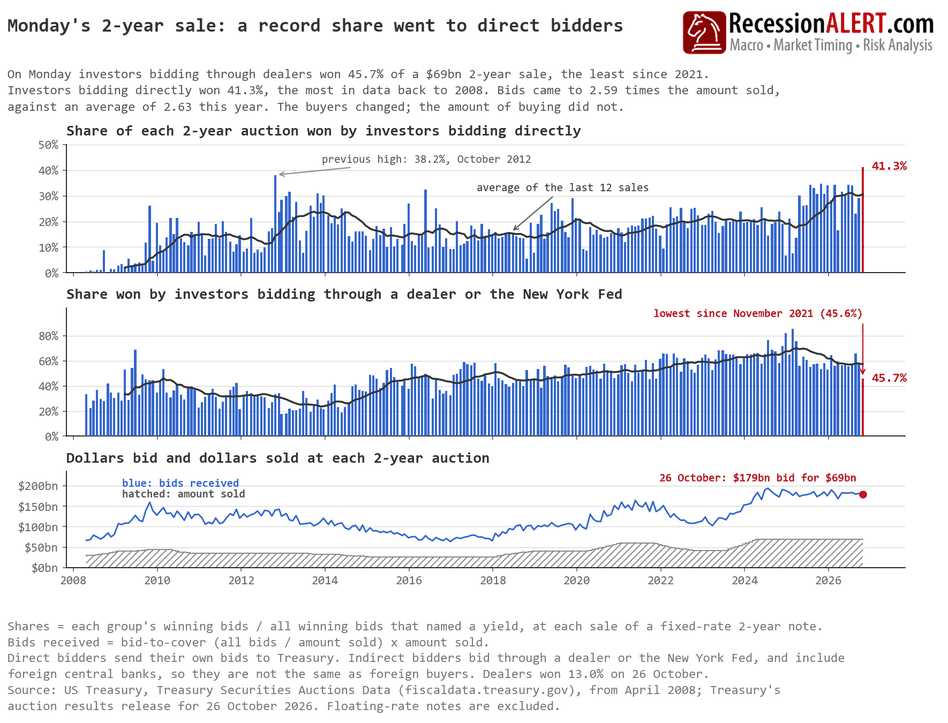
Monday’s 2-year sale looked like a retreat yet drew perfectly ordinary demand. Investors bidding through a dealer or the New York Fed won 45.7%, against a 58.8% average earlier this year, and the easy reading is that foreign buyers walked away. The labels cannot say that. Treasury’s own definitions put foreign money on both sides — central banks bid indirectly through the New York Fed, while any investor, foreign or domestic, can bid directly for its own account. “Indirect” names a route into the auction, not a passport. The measure that would catch buyers leaving barely moved: bid-to-cover — total bids divided by the amount sold — sat inside this year’s 2.44-2.75 range, and dealers, who absorb what others leave, took their usual share. In dollars, bids kept pace as the sale grew from $26bn in 2016 to $69bn: about $70bn was bid then, about $180bn now. The route shift is not a one-day event either: before July 2025, direct bidders had taken 34% or more of a 2-year sale just once since 2008, in October 2012; they have done it seven times from July 2025 on. The foreign signal worth watching sits outside the auction: Treasuries the Fed holds in custody for foreign official accounts are down about $184bn this year, a drift in holdings rather than proof of selling, and no explanation for Monday. This week’s 5-year and 7-year sales should be judged on the amount of buying, not the label on the buyer. Buyers are coming through a different door — the warning would be an emptier room.
What it means: The 2-year yield helps set what savers earn on CDs and what borrowers pay on car loans, and this sale shows ordinary demand setting it. So any jump this week is more likely to come from Wednesday’s Fed decision than from buyers walking away. For stock investors, the feared chain of foreign money leaving, yields jumping and shares falling would show up at these sales first. For the economy, the government’s short-term borrowing should stay routine. The warning: a 2-year sale covered less than 2.44 times, with dealers left over a fifth, last seen in November 2021.
Market Intelligence Brief (MIB) Ver. 19.96
For professional investors only. Not investment advice.
© 2026 RecessionALERT.com

Comments are closed.