
MARKET INTELLIGENCE BRIEF (MIB)
Wednesday, October 28, 2026
The Fed held at 3.75%-4.00%, but Governor Cook and Cleveland’s Hammack dissented for a hike and Warsh refused forward guidance; the 2-year still fell 4.1 bps. SK Hynix says DRAM and HBM are sold out through 2029, lifting Micron 5.86% and Lam 5.39%. Oracle jumped 10.73% after capping new AI fundraising at $20 billion. WTI rose 2.05% to $101.95 on Yemen fighting and Iran strike fears. GDPNow ends Q3 at 3.3%, setting up Thursday’s GDP and PCE.
TABLE OF CONTENTS
A. EXECUTIVE SUMMARY
B. MARKET DATA
C. HIGH-IMPACT STORIES (5)
D. MODERATE-IMPACT STORIES (7)
E. ECONOMY WATCH (5)
F. EARNINGS WATCH (13)
G. WHAT’S NEXT
H. CHART OF THE DAY
A. EXECUTIVE SUMMARY -> TOP
Stocks rose as the Fed’s hawkish hold met a dovish market read: the S&P 500 gained 0.28% and the Nasdaq 100 0.55%, and the 2-year yield fell 4.1 bps after the statement dropped September’s promise of a “timelier” return to 2% and Warsh declined to give forward guidance. Leadership came from the AI supply chain rather than rates, as SK Hynix’s sold-out-through-2029 signal lifted memory and equipment makers and Oracle’s 10.73% jump on a $20 billion fundraising cap eased fears over debt-funded build-outs. WTI’s 2.05% rise to $101.95 keeps energy inside the Fed’s reaction function, the pressure Warsh cited on the day two colleagues dissented for a hike. Seven of 11 sectors rose, led by Technology (+0.99%), while Utilities, Real Estate and Consumer Defensive lagged and the Dow Transports fell 2.46% on freight earnings, a growth-over-defence rotation rather than a broad risk-on day.
• Fed holds at 3.75%-4.00% in a 10-2 vote: Governor Cook, in her first dissent, and Cleveland’s Hammack preferred a quarter-point hike; Warsh rejected forward guidance “absent a crisis” and said one 2027 meeting will cover strategy only, with no rate vote. The 2-year fell 4.1 bps to 4.700%.
• Memory rally: SK Hynix said DRAM and HBM are effectively sold out through 2029 and added a 20 trillion won buyback; Sandisk rose 7.66%, Micron 5.86%, Lam Research 5.39% and Applied Materials 5.07%, and Technology (+0.99%) led all 11 sectors.
• Oracle rose 10.73% to $144.54 on a $30 billion fiscal 2029 free cash flow target, against analyst expectations of a negative figure, and a $20 billion cap on new fundraising through May 2030, split evenly between shares and debt.
• WTI rose 2.05% to $101.95 on Yemen fighting, worries over a US strike on Iran after the November 3 midterms and a surprise 1.9 million-barrel EIA crude draw; Brent closed at $110.54 and Dutch TTF rose 4.27%.
• GDPNow closes Q3 at 3.3%, a tenth above the 3.2% consensus for Thursday’s advance GDP, even as the September goods deficit widened to $134.9 billion against a $130 billion consensus.
• Policy overhangs: the Justice Department is questioning Nvidia’s $12.9 billion Hugging Face deal inside a broader probe of its sales tactics, and the Bank of Canada raised rates 25 bps to 2.5% to stop energy prices spreading.
1. A hawkish decision, a relieved front end, and a December call left to the data — Two dissents for a hike, including a Governor, and a statement describing activity “expanding at a strong pace” are hawkish on their face. The front end rallied anyway, because the statement swapped September’s “timelier” return to 2% for waiting on “the accumulation of more information,” and Warsh refused to pre-signal anything. Futures still priced a December 9 hike at roughly 82.6% after the decision, and Polymarket’s 2026-hike market rose to 80% from 77%. With guidance withdrawn, Thursday’s GDP (GDPNow 3.3%) and September PCE (headline expected to accelerate to 3.6% year on year from 3.4%) now carry the December decision almost alone.
2. Energy is now the inflation channel on both sides of the border — Warsh named higher energy prices in his opening remarks, two FOMC voters wanted a hike, and the Bank of Canada raised rates the same day explicitly to stop high energy prices spreading into other goods and services. Triple-digit WTI is therefore the main route by which a Middle East headline becomes a rate decision. The oil premium is tied to a dated window, the November 3 midterms and Gulf states reportedly told to prepare for “a short, intense military campaign” after them, so it can build or unwind quickly; Energy’s 9.80% one-month gain, the strongest of any sector, is exposed to both outcomes.
3. The AI build-out looks better funded, but the risk is moving rather than shrinking — SK Hynix’s sold-out-through-2029 statement makes demand visible for three more years, and Oracle’s cap on new fundraising answers the dilution and bond-supply fears that weighed on the trade. But Oracle shifts part of its funding onto suppliers and customers through vendor financing and prepayments, memory and equipment names now carry a large share of index gains, and the DOJ’s probe of Nvidia’s sales tactics opens a regulatory front on the sector’s largest weight. Microsoft and Alphabet capex commentary tonight and Amazon’s on Thursday are the next test of the demand all three stories assume.
 — Leading economic indicators. Accurate market forecasts. Apply for membership at join.recessionalert.com
B. MARKET DATA -> TOP
A memory-chip rally and the Fed’s hold carried the Nasdaq 100 up 0.55% and the S&P 500 0.28%, after SK Hynix’s record quarter lifted Micron, Sandisk and the chip-equipment makers and Oracle jumped 10.73% on its investor-day targets. Gains were tech-led with defensives lagging, and the Dow Transportation Average fell 2.46% on earnings-driven slides in Landstar and C.H. Robinson while the Dow added 0.19%. The Fed held at 3.75%-4.00% with two dissents favouring a hike; the 2-year yield fell 4.1 bps against a flat 10-year. WTI rose 2.05% on renewed Middle East supply worries and a surprise EIA crude draw, per Reuters.
CLOSING PRICES – Wednesday, October 28, 2026:
MAJOR INDICES
Chips carried the tape: the Nasdaq 100’s 0.55% outran the NYSE Composite’s 0.21%. The Dow-Transports split (+0.19% vs -2.46%) traces to earnings-driven slides in Transports components Landstar (-17.76%) and C.H. Robinson (-11.14%), leaving transports 2.46% below their 10-session high while the Dow sits within 1% of its own. The Russell 2000 has now beaten the S&P 500 by 3.4 points over the past 10 sessions, a small-cap leadership signal that extends into a second session.
| Index | Close | Change | %Move | Why It Moved |
|---|---|---|---|---|
| S&P 500 | 7,743.98 | +21.38 | +0.28% | Oracle (+10.73%) and Micron (+5.86%) led a chip and AI-infrastructure advance as the Fed held rates at 3.75%-4.00% |
| Dow Jones | 52,475.10 | +97.53 | +0.19% | Modest gain on FOMC day; no single component-level driver identified |
| DJ Transportation | 20,041.78 | -505.74 | -2.46% | Earnings-driven slides in freight components Landstar (-17.76%) and C.H. Robinson (-11.14%) after their third-quarter reports |
| Nasdaq 100 | 29,813.16 | +161.71 | +0.55% | Micron (+5.86%), Lam Research (+5.39%) and Applied Materials (+5.07%) rallied after SK Hynix’s record quarter; Meta (-1.24%) lagged |
| Russell 2000 | 2,830.51 | +11.64 | +0.41% | Outpaced the S&P 500 for a second session; no discrete small-cap catalyst identified |
| NYSE Composite | 24,261.28 | +50.60 | +0.21% | Oracle’s investor-day surge offset declines in Utilities, Real Estate and Consumer Defensive |
VOLATILITY & TREASURIES
The curve steepened from the front end on decision day: the 2-year fell 4.1 bps while the 10-year was essentially flat (+0.5 bps), widening 2s10s to 29.9 bps from 25.3. The hold carried two dissents in favour of a hike, from Cook and Hammack, and Warsh again declined to offer forward guidance. VIX eased 3.60% and the dollar slipped 0.17%.
| Instrument | Level | Change | Why It Moved |
|---|---|---|---|
| VIX | 16.89 | -0.63 (-3.60%) | Eased as equities rose through the Fed’s decision and Warsh’s press conference |
| 10-Year Treasury Yield | 4.999% | +0.5 bps | Essentially unchanged after the FOMC held at 3.75%-4.00%; Warsh said financial conditions had tightened somewhat since September |
| 2-Year Treasury Yield | 4.700% | -4.1 bps | Fell on FOMC day while the 10-year held flat, steepening the curve; the Fed held after September’s hike, with Cook and Hammack dissenting in the 10-2 vote for a further 25 bps |
| US Dollar Index (DXY) | 102.14 | -0.18 (-0.17%) | No discrete same-day catalyst identified; eased on FOMC day |
COMMODITIES
Precious metals split: gold edged 0.20% higher against its prior settlement while silver fell 0.74%, holding just above Monday’s lowest close since at least April 15. Copper and platinum posted small gains, and bitcoin’s 0.37% rise moved with the modest equity advance.
| Asset | Price | Change | %Move | Why It Moved |
|---|---|---|---|---|
| Gold | $4,082.65/oz | $+8.05 | +0.20% | No discrete same-day catalyst identified; December contract slightly above Tuesday’s settlement |
| Silver | $54.110/oz | $-0.403 | -0.74% | No discrete same-day catalyst identified; diverged from gold |
| Copper | $6.6770/lb | $+0.0245 | +0.37% | No discrete same-day catalyst identified |
| Platinum | $1,544.70/oz | $+7.50 | +0.49% | No discrete same-day catalyst identified; January contract firmer |
| Bitcoin | $81,092 | $+295 | +0.37% | Rose with equities; no crypto-specific catalyst identified |
ENERGY
Crude rose with equities, and WTI’s 2.05% gain outpaced Brent’s 1.03% on the January contract, narrowing the Brent-WTI spread to $8.59 from $9.51. Reuters tied the advance to renewed Middle East supply concerns and a surprise EIA crude draw. Dutch TTF jumped 4.27% to its highest close since at least April 15, while Henry Hub’s 0.93% gain was the smallest of the four.
| Asset | Price | Change | %Move | Why It Moved |
|---|---|---|---|---|
| Crude Oil (WTI) | $101.95/bbl | $+2.05 | +2.05% | Renewed Middle East supply worries (Houthi fighting in Yemen, including an attack on Aden airport, and concern over possible US strikes on Iran after the midterms) plus an EIA crude draw of 1.9M barrels against a forecast build. Settled $102.78, up $2.88, per Reuters |
| Crude Oil (Brent) | $110.54/bbl | $+1.13 | +1.03% | Rose with WTI on the same Middle East supply concerns (January contract); the expiring December contract settled $115.32, up $1.44, per Reuters |
| Natural Gas (Henry Hub) | $3.032/MMBtu | $+0.028 | +0.93% | No discrete same-day catalyst identified; December contract above Tuesday’s settlement, with the weekly EIA storage report due Thursday |
| Natural Gas (Dutch TTF) | $32.661/MMBtu | $+1.337 | +4.27% | No discrete same-day catalyst identified; highest close since at least April 15 |
S&P 500 SECTORS
Seven of 11 sectors rose, led by Technology (+0.99%), while the defensive trio of Utilities (-0.82%), Real Estate (-0.64%) and Consumer Defensive (-0.47%) lagged alongside Industrials (-0.10%). Energy extended its 9.80% one-month gain, and Communication Services edged up after a 4.76% weekly slide.
| Sector | 1-Day | 1-Week | 1-Month | 3-Month | 6-Month | YTD | 12-Month |
|---|---|---|---|---|---|---|---|
| Technology | +0.99% | +1.26% | -1.97% | +8.18% | +16.40% | +26.79% | +20.13% |
| Energy | +0.55% | +0.31% | +9.80% | +11.35% | +10.12% | +47.00% | +48.85% |
| Healthcare | +0.52% | +0.86% | +4.29% | +6.88% | +20.87% | +12.38% | +15.26% |
| Communication Services | +0.23% | -4.76% | -7.09% | -2.19% | -9.47% | -6.38% | -4.54% |
| Financial | +0.20% | -0.68% | +1.00% | -3.30% | +7.48% | +3.80% | +8.44% |
| Basic Materials | +0.17% | -0.70% | -1.21% | +0.45% | -2.78% | +9.57% | +19.05% |
| Consumer Cyclical | +0.01% | -0.47% | +4.76% | +2.29% | -2.43% | -5.23% | -7.23% |
| Industrials | -0.10% | -1.09% | -0.96% | -2.32% | -3.81% | +7.26% | +6.33% |
| Consumer Defensive | -0.47% | -0.34% | +6.57% | +2.09% | +3.46% | +11.05% | +10.00% |
| Real Estate | -0.64% | +0.42% | +0.51% | -8.30% | -3.85% | +2.83% | -2.08% |
| Utilities | -0.82% | +0.51% | +6.00% | -5.06% | -7.96% | -1.40% | -7.42% |
TOP MEGA-CAP MOVERS:
GAINERS
| Company | Ticker | Close | Change | Why It Moved |
|---|---|---|---|---|
| Oracle | ORCL | 144.54 | +10.73% | Investor day: targeted fiscal 2030 revenue of at least $225 billion, said capital spending peaks in fiscal 2027-28, capped additional AI financing at $20 billion through fiscal 2030 and expects free cash flow to turn positive in the second half of fiscal 2028, per Reuters |
| Sandisk | SNDK | 1,404.77 | +7.66% | Rallied with memory peers after SK Hynix reported record quarterly revenue above 100 trillion won; reports its own results after Thursday’s close |
| Micron Technology | MU | 983.23 | +5.86% | SK Hynix’s record quarter, an 80% operating margin and a plan to return about 100 trillion won to shareholders lifted the memory complex |
| Lam Research | LRCX | 253.82 | +5.39% | Customer SK Hynix said DRAM and HBM supply is effectively sold out through 2029, a read-through for chip-equipment demand; Lynx Equity Strategies reiterated a $400 target |
| Applied Materials | AMAT | 416.00 | +5.07% | Rose with chip-equipment peers after SK Hynix’s results; no Applied Materials-specific same-day catalyst identified |
DECLINERS
| Company | Ticker | Close | Change | Why It Moved |
|---|---|---|---|---|
| Space Exploration Technologies | SPCX | 145.23 | -2.25% | No discrete same-day catalyst identified; Fitch said Wednesday its BBB+ rating is unaffected by the roughly $40 billion GPU lease announced Monday |
| GE Vernova | GEV | 878.03 | -1.90% | Earnings-driven: reported third-quarter results before the open; shares rose in pre-market trading but closed lower |
| Palo Alto Networks | PANW | 394.49 | -1.79% | No discrete same-day catalyst identified |
| Dell Technologies | DELL | 493.79 | -1.63% | No discrete same-day catalyst identified; gave back part of Tuesday’s 7.47% gain |
— Institutional-grade intelligence for serious investors. Apply for membership at join.recessionalert.comC. HIGH-IMPACT STORIES -> TOP
UNCERTAIN
1. The Fed Holds With Two Dissents for a Hike, Warsh Refuses Forward Guidance and Announces a Strategy-Only Meeting in 2027; the 2-Year Yield Falls 4.1 bps
The core facts:The FOMC held the funds rate at 3.75%-4.00% in a 10-2 vote, with Governor Cook and Cleveland’s Hammack preferring a quarter-point hike (Section E carries the statement). In his opening remarks Chair Warsh said “while overall financial conditions are tighter, I’m unwilling and unable to call them tight,” and that “Energy and related prices have moved higher again in recent weeks.” In the Q&A he said he does not believe in forward guidance “absent exigent circumstances, absent a crisis” (CNBC). He also announced a schedule change starting next fall: the FOMC keeps eight meetings, but in 2027 one “will focus exclusively on broad monetary policy strategy, with neither a vote on the federal funds rate nor a policy statement anticipated,” and he expects two strategy meetings and six policy meetings in 2028. The market rallied at the front end. The 2-year fell 4.1 bps to 4.700%, the 10-year was essentially flat at 4.999% (+0.5 bps) and 2s10s widened to 29.9 bps from 25.3. The S&P 500 rose 0.28% and the VIX fell 3.60%.
Why it matters:The decision was hawkish and the reaction was not. Cook’s dissent is her first ever, per NBC and CNN, and it puts a Board member beside a regional president in the hike camp. Yet the front end rallied, because the statement dropped September’s promise of a “timelier” return to 2% in favour of waiting for “the accumulation of more information.” That makes December purely data-dependent rather than pre-signalled. Futures still priced a December 9 hike at roughly 82.6% intraday after the decision, per CME FedWatch as reported by Fox Business. Polymarket’s 2026-hike market rose to 80% from 77%. The schedule change has a market consequence of its own: seven rate-setting meetings in 2027 instead of eight leaves fewer scheduled windows to adjust policy, which raises the stakes of each one. With Warsh refusing guidance, Thursday’s prints now carry the December decision almost alone.
What to watch:Thursday’s 08:30 ET Q3 advance GDP (consensus 3.2%) and September PCE, then St. Louis Fed President Musalem at 12:30 ET Friday, the first scheduled Fed speech after the blackout ends.
BULLISH
2. SK Hynix Says DRAM and HBM Are Effectively Sold Out Through 2029 and Adds a ₩20 Trillion Buyback; Sandisk Rises 7.66%, Micron 5.86% and Lam Research 5.39%
The core facts:SK Hynix reported record third-quarter revenue of ₩104.62 trillion, its first quarter above ₩100 trillion, and operating profit of ₩83.33 trillion, an 80% margin. It said DRAM and HBM supply is effectively sold out through 2029. In a 6-K filed the same day, its board resolved a new ₩20 trillion share repurchase on top of the ₩40 trillion approved in August. It also set a Q3 dividend of ₩20,000 per share, half of it a special payout from gains on its indirect Kioxia investment, and a roughly ₩100 trillion shareholder-return plan for fiscal 2026. US memory and chip-equipment stocks rallied: Sandisk rose 7.66%, Micron 5.86%, Lam Research 5.39% and Applied Materials 5.07%. KLA (+3.33%), Marvell (+3.32%), AMD (+3.24%) and Broadcom (+2.77%) rose with the group. Technology (+0.99%) led the 11 sectors and the Nasdaq 100 gained 0.55%.
Why it matters:A supplier saying its output is committed for three more years is the strongest pricing-visibility signal the memory cycle can give. It shifts the debate from whether AI memory demand lasts to how much capacity gets built to meet it, which is why the equipment makers moved almost as much as the memory names. The capital-return scale matters too: a company returning roughly ₩100 trillion in a year is signalling that cash generation is running ahead even of its own investment needs. The risk is concentration. Memory and equipment are now carrying a large share of the index’s gains, so any crack in hyperscaler spending this week would hit the same names hardest.
What to watch:KLA’s December-quarter guidance after tonight’s close, and Sandisk’s results after Thursday’s close (consensus EPS $46.67 on $10.72 billion of revenue).
BULLISH
3. Oracle Targets $30 Billion of Free Cash Flow in Fiscal 2029 and Caps New AI Fundraising at $20 Billion; Shares Jump 10.73%
The core facts:At its financial analyst meeting at Oracle AI World in Las Vegas, CFO Hilary Maxson presented a free cash flow target of $30 billion for the fiscal year ending May 2029, with cash flow turning positive late in fiscal 2028. That follows negative free cash flow of $23.7 billion in fiscal 2026; analysts had expected fiscal 2029 to still be negative. Oracle capped new fundraising at $20 billion through May 2030, split evenly between shares and debt. It plans to add about 7 GW of data-center capacity, taking its fleet past 10 GW by the end of fiscal 2028. It reaffirmed the fiscal 2030 revenue target of at least $225 billion that it first set at its October 2025 analyst meeting. Oracle said: “Vendor financing, customer-provided hardware and customer prepayments are expected to reduce upfront cash requirements.” The shares rose 10.73% to $144.54, the session’s largest mega-cap gain, after falling 33% year to date.
Why it matters:Oracle has been the market’s test case for debt-funded AI build-outs. S&P cut it to one notch above junk in July, and its negative cash flow has hung over the whole AI-infrastructure trade. A hard ceiling on new equity and debt directly addresses the two fears holding the stock down: dilution, and a pipeline of bond supply into an investment-grade market already absorbing heavy tech issuance. The price is that part of the funding burden moves to suppliers and customers through vendor financing and prepayments. The risk is not eliminated; it moves onto partners’ balance sheets. The revenue target is unchanged, so the re-rating rests on the cash-flow path, which is a target rather than a result.
What to watch:Whether the ratings agencies respond to the funding cap, and the capex commentary from Microsoft and Alphabet tonight and Amazon on Thursday, which sets the demand Oracle’s capacity plan assumes.
BEARISH
4. Crude Rises as Yemen Fighting and Post-Midterm Iran Strike Worries Outweigh Tehran’s Diplomacy; WTI Closes Up 2.05% at $101.95
The core facts:WTI closed at $101.95, up 2.05%, and January Brent at $110.54, up 1.03%. Reuters tied the gain to three things: continued fighting in Yemen, including a Houthi attack on Aden airport on Wednesday reported by Yemeni government forces; worries that the US could strike Iran after next week’s midterms; and the EIA’s surprise crude draw, which Section E covers. Other outlets carried a Wall Street Journal report that the US has told several Gulf Arab states to be prepared for “a short, intense military campaign” after the November 3 elections. Diplomacy moved the other way. Iran’s foreign minister Araghchi said Tehran is “in close and ongoing contact with intermediaries” on its seven-day Hormuz reopening plan, and Axios reported a Qatar-led push to restart US-Iran talks. US Central Command said all primary Hormuz transit routes have been cleared of sea mines. UBS raised its year-end Brent forecast to $110 from $100 in a note reported Wednesday. Dutch TTF gas rose 4.27% to its highest close since at least April 15.
Why it matters:The market is pricing a dated event-risk window, not a supply loss. The premium could build into the midterms if strike reports firm up, or erode quickly after them; ING argues it can fall without any US-Iran deal if the vote passes quietly. In the meantime triple-digit crude is feeding straight into the Fed’s reaction function. Warsh named energy prices in his opening statement on the same afternoon two of his colleagues voted to hike. That makes oil the main channel through which a geopolitical headline becomes a December rate decision. Energy rose 0.55% on the day and is up 9.80% over the past month, the strongest one-month gain of any sector.
What to watch:Sunday’s OPEC+ meeting, expected to hold December targets, and any official US statement on Iran before the November 3 midterms.
BEARISH
5. The Justice Department Is Questioning Nvidia’s $12.9 Billion Hugging Face Deal Inside a Broader Probe of Its Sales Tactics
The core facts:Reuters reported Wednesday afternoon, and CNBC confirmed with a source, that the Justice Department is examining whether Nvidia’s $12.9 billion acquisition of Hugging Face would let it control a key distribution channel for AI models and software. The review sits inside a multi-year conduct investigation into Nvidia’s sales tactics. That includes alleged tying of GPU allocations to purchases of its networking products or Groq offerings, and past deals including Run:ai, SchedMD and the Groq arrangement. A DOJ spokesperson said “conduct investigations are distinct from routine merger reviews.” Nvidia expects the deal to close in the first half of 2027 and declined to comment, per CNBC. The shares slipped about 1.7% intraday, per Investing.com, but did not close among the session’s mega-cap decliners of 1.5% or more.
Why it matters:The merger question is the smaller part of this. A conduct case aimed at how allocation is used during shortages targets the commercial leverage behind Nvidia’s margins: the ability to make scarce GPUs a reason to buy the rest of the stack. Any remedy that forces Nvidia to sell components on unbundled terms would show up first in networking attach rates, a growing share of its revenue. Hugging Face adds a second front. Regulators now appear to treat the model-distribution layer as a chokepoint, which widens scrutiny from chips to the software ecosystem around them. As the market’s largest weight, Nvidia carries index-level exposure to any escalation.
What to watch:Whether the DOJ issues a second request on Hugging Face, which would signal an extended review beyond the first-half 2027 closing target, and any Nvidia disclosure of the conduct probe in its next filing.
— Quantifying recession risk so you don’t have to guess. Apply for membership at join.recessionalert.comD. MODERATE-IMPACT STORIES -> TOP
BULLISH
6. Lilly’s Retatrutide Beats Ozempic’s Highest Dose Head-to-Head in Type 2 Diabetes, With More Than Double the Weight Loss, a Day Before Lilly Reports
The core facts:Eli Lilly said at 06:45 ET that retatrutide beat Novo Nordisk’s Ozempic 2 mg in TRANSCEND-T2D-2. The open-label, 80-week Phase 3 trial enrolled 1,298 adults with type 2 diabetes on metformin, with or without an SGLT2 inhibitor. From a baseline of 8.3%, A1C fell 2.2% on retatrutide 9 mg and 12 mg against 1.8% on Ozempic. Weight fell 19.5% and 20.9% against 9.4%. Discontinuations due to adverse events were 4.8% and 7.9% against 2.7%. Lilly calls it the first Phase 3 trial comparing retatrutide with another incretin medicine. It gave no filing date.
Why it matters:A head-to-head win against the competitor’s highest approved dose is the comparison payers and prescribers weigh most. It extends Lilly’s lead into the next generation of incretin drugs while Novo is still defending the current one. The trade-off is tolerability: discontinuation on the top dose ran nearly three times Ozempic’s rate, which will shape labelling and dosing. For a company valued at about $1.2 trillion on the earnings calendar, the read-through is to franchise durability rather than this quarter.
What to watch:Lilly’s third-quarter results before Thursday’s open (consensus EPS $5.68 on $22.58 billion of revenue), and Novo Nordisk’s report on November 4.
UNCERTAIN
7. Deutsche Telekom Hits the Brakes on Combining With T-Mobile US and Holds Off on a Formal Bid, Bloomberg Reports, Hours Before T-Mobile’s Results
The core facts:Bloomberg reported at 14:59 ET, citing people familiar with the matter, that Deutsche Telekom’s plans to combine with its American arm T-Mobile US “have hit a snag.” The German parent has opted against submitting a formal bid for the time being, in part because of pushback from its works council. Bloomberg said the setback casts doubt on what would be the largest-ever public merger. Neither company had commented in the material available, and no terms for a combination have been published. T-Mobile reported third-quarter results after the close (see Section F).
Why it matters:A full combination would have changed T-Mobile’s ownership structure and could have carried a premium for minority holders. Shelving the bid removes that optionality for now. It also points to a constraint on cross-border megadeals that has nothing to do with regulators: German labour representation can stall a transaction before any antitrust review begins. The news landed on the day of T-Mobile’s earnings, so tomorrow’s move will mix the two.
What to watch:Any comment from either company on T-Mobile’s earnings call or in Deutsche Telekom’s next disclosure, and whether the works council’s position is made public.
UNCERTAIN
8. The Bank of Canada Raises Rates 25 bps to 2.5% to Stop Energy Prices Spreading, as Ottawa Reports “Limited Progress” in US Trade Talks
The core facts:The Bank of Canada raised its overnight rate target by 25 bps to 2.5% (Bank Rate 2.75%, deposit rate 2.45%), “to reduce the risk that continuing high energy prices spread broadly” to the prices of other goods and services. It said “There could be a need to increase the policy rate further,” but “given uncertainties, Governing Council agreed to proceed carefully.” On trade, a Canadian official told the Canadian Press on Tuesday evening that “there has been limited progress” in talks with Washington. Prime Minister Carney said Wednesday: “If those deals present themselves, we will pursue them, but we’re not at that position right now.” A US official described the talks as significant and ongoing. They centre on Section 232 tariffs of up to 50% on Canadian steel and 25% on autos, per Reuters as carried by other outlets.
Why it matters:A major US trading partner hiked on the same day the Fed held, and for the same reason the Fed’s dissenters gave. That shows energy pass-through being treated as a broad inflation threat across North America, not a transitory shock. For US markets, tighter Canadian policy plus stalled tariff talks squeezes the cross-border supply chains in autos, steel and energy that run through USMCA. It also strengthens the hawks’ case at the Fed’s December meeting.
What to watch:Whether the Lutnick-LeBlanc talks produce any Section 232 relief before the November 3 midterms, and the Canadian dollar’s reaction to the hike.
BULLISH
9. The Section 232 Probe of Robotics and Industrial Machinery Ends Without a Tariff; the White House Orders Negotiations Instead
The core facts:A proclamation signed October 28 adopts Commerce’s finding that imports of robotics, industrial machinery and their parts “threaten to impair the national security,” but sets no tariff rate, no product annex and no effective date. It directs Commerce and the US Trade Representative to negotiate with “any foreign trading partner” and report back within 180 days. If the talks fail, the President may consider “tariffs, duties, quotas, and fees.” The investigation opened on September 2, 2025. This is the second Section 232 case in a week to end without a tariff, after wind turbines on October 22. Whether the proclamation was posted before the 16:00 ET close has not been confirmed.
Why it matters:Industrial machinery is an input to almost every US capital project, so a tariff here would have raised the cost of the investment boom the Fed chair described the same afternoon. Two no-tariff outcomes in a week suggest the administration now uses Section 232 findings as negotiating leverage rather than an automatic levy. That lowers the near-term cost risk for US manufacturers and data-center builders, while keeping the threat alive for exporters in Japan, Germany and elsewhere.
What to watch:The 180-day negotiation update, due around late April 2027, and the proclamation’s publication in the Federal Register.
UNCERTAIN
10. The FTC Orders Nine Companies, Including Walmart, Target, Uber and Delta, to Explain How They Use Personal Data to Set Prices and Pay
The core facts:The Federal Trade Commission voted 2-0 to send Section 6(b) special orders on personalized pricing and compensation to Delta, United, JetBlue, Lyft, Uber, DoorDash, Instacart, Target and Walmart, which have 45 days to respond. Chairman Ferguson said “Consumers deserve to know whether companies use their web surfing habits or other personal data” to set prices. A 6(b) study is information-gathering, not an enforcement action.
Why it matters:The orders reach both sides of the gig and retail models: what customers are charged and what drivers and couriers are paid. For ride-hailing, delivery and airline revenue management, algorithmic pricing is the margin engine. A study does not change practices directly, but 6(b) findings have historically laid the groundwork for later rules and cases. The inquiry adds a regulatory overhang to names whose valuations assume pricing flexibility.
What to watch:Uber’s results before the open on November 4, the first chance for management to address the inquiry, and the 45-day response deadline in mid-December.
BEARISH
11. The Labor Department Will Finalize a PBM Fee-Disclosure Rule on Thursday, the WSJ Reports, Putting CVS Caremark and Express Scripts on the Clock
The core facts:The Wall Street Journal reported Wednesday that the Labor Department will finalize its pharmacy-benefit-manager disclosure rule on Thursday. PBMs serving self-insured employer plans under ERISA would have to disclose upfront the compensation they expect from drugmakers and pharmacies, and report actual earnings every six months. Employers would gain audit rights. The rule covers rebates, PBM-affiliated group purchasing organizations and spread pricing, and takes effect in July. It was proposed in January. The largest PBMs include CVS Health’s Caremark and Cigna’s Express Scripts.
Why it matters:PBM profitability rests partly on the opacity of rebate retention and spread pricing. Mandatory disclosure to the employer, with audit rights, hands the largest customer group the information it needs to renegotiate. The financial effect is likely to show up through contract repricing in the 2027-28 selling seasons rather than as an immediate charge, but it adds federal pressure to a business model already contested in Congress and the states.
What to watch:The final text on Thursday, especially any narrowing of the rebate and GPO definitions, and CVS Health’s results before the open on November 4.
BEARISH
12. Meta Goes to Trial in a Second Youth-Addiction Case and Indefinitely Delays New Commercial Terms After Publisher Complaints; Meta Falls 1.24%
The core facts:Meta and Snap went to trial in Los Angeles on Wednesday in the second individual-plaintiff case alleging that social media platforms are designed to be addictive; the companies lost the first, in March, for $6 million (Reuters). Separately, Meta indefinitely delayed the rollout of new commercial terms after publishers complained to EU and UK antitrust authorities (Reuters). Meta fell 1.24%, though neither item has been established as the cause. BofA reported record client outflows from Communication Services last week, a sector down 4.76% over the past week.
Why it matters:Individually the awards are small. The risk is precedent: a second plaintiff verdict would strengthen the hand of the many claimants behind these test cases and raise pressure for product-design remedies, which matter far more to engagement than damages do. The commercial-terms retreat shows European regulators constraining Meta’s terms with publishers before any formal ruling. Both land in the week Meta is completing a $37.5 billion equity raise, when investors are already pricing heavier dilution and capex.
What to watch:The closing of Meta’s forward sale and mandatory convertible offerings on Thursday, and opening testimony in the Los Angeles trial.
— Separating signal from noise since 2007. Apply for membership at join.recessionalert.comE. ECONOMY WATCH -> TOP
The Fed held at 3.75%-4.00%, but the vote carried the signal: two dissents in favour of an immediate hike, beneath a statement describing activity “expanding at a strong pace” and inflation that “remains elevated.” The day’s data agreed on strength. GDPNow closed the third quarter at 3.3%, above the 3.2% consensus for Thursday’s advance GDP, even as a wider $134.9 billion goods deficit trimmed net exports. A surprise crude draw added to the energy rally, with WTI closing up 2.05% at $101.95 ahead of Thursday’s September PCE. Polymarket odds of another Fed hike in 2026 rose to 80% from 77%, leaving Thursday’s GDP and PCE prints to decide whether December delivers it.
Fed Holds at 3.75%-4.00% in a 10-2 Vote as Cook and Hammack Dissent in Favour of a Hike (Federal Reserve, Oct 28)
What they’re saying:The FOMC left the federal funds target range at 3.75%-4.00% on a 10-2 vote, with Governor Lisa Cook and Cleveland Fed President Beth Hammack preferring to raise it by a quarter point at this meeting. The statement said “Economic activity is expanding at a strong pace” and “Inflation remains elevated,” adding that uncertainty “remains elevated owing, in part, to geopolitical developments” and that more information will help the Committee determine the appropriate policy stance.
The context:This is a pause after September’s hike, not an end to tightening: two voters wanted another increase now, and a Governor joining a regional president in a hawkish dissent widens the camp beyond the regional banks. Markets read the hold as relief at the front end, with the 2-year yield down 4.1 bps to 4.700% while the 10-year was essentially flat at 4.999% (+0.5 bps), steepening 2s10s to 29.9 bps. The VIX fell 3.60% and the dollar index slipped 0.17%. Polymarket’s “Another Fed rate hike in 2026?” market, which settles at the December 9 FOMC, rose to 80% from 77%.
What to watch:Thursday’s September PCE (core expected +0.3% MoM, headline YoY expected 3.6% from 3.4%) and Q3 advance GDP; Friday’s Q3 Employment Cost Index; and St. Louis Fed President Musalem on Friday, the first scheduled Fed speech after the blackout.
Goods Trade Deficit Unexpectedly Widens to $134.9 Billion in September as Imports Outpace Exports (Census Bureau, Oct 28)
What they’re saying:The advance goods trade deficit widened to $134.9 billion in September from $132.1 billion in August, against a consensus of $130 billion. Exports rose $5.3 billion to $209.2 billion, but imports rose $8.1 billion to $344.1 billion. In the same report, advance wholesale inventories rose 0.6% to $1,011.5 billion (consensus +0.5%), up 7.4% year on year, and retail inventories rose 0.3% to $885.3 billion.
The context:A miss of roughly $5 billion lands directly on Thursday’s GDP print. The Atlanta Fed’s GDPNow cut its estimate of net exports’ contribution to Q3 growth to -2.95 percentage points from -2.86 on this report, a heavy drag already offset by domestic demand. Inventory building is the other side of the trade: imports are partly landing on shelves, which adds to measured output this quarter but can borrow from the next.
What to watch:Thursday’s Q3 advance GDP for the net-export and inventory contributions; the full September trade report on Wednesday, November 4 (August deficit $105.6 billion including services).
GDPNow Closes Q3 at 3.3%, Above the 3.2% Consensus for Thursday’s Advance GDP (Atlanta Fed, Oct 28)
What they’re saying:The Atlanta Fed’s GDPNow model put third-quarter real GDP growth at 3.3% (seasonally adjusted annual rate), down from 3.4% on October 27. After the morning’s Census advance indicators, the nowcast of real gross private domestic investment growth slipped to 19.1% from 19.4%, and the net-export contribution fell to -2.95 percentage points from -2.86. This is the model’s last Q3 estimate; its first Q4 estimate comes Thursday.
The context:The final nowcast sits a tenth above the 3.2% consensus for the advance estimate and well above Q2’s 2.2%, which supports the FOMC statement’s “strong pace” language. Investment growth near 19% is carrying the quarter against a net-export drag of almost three points. Growth running above 3% with inflation elevated is the combination that keeps a December hike live.
What to watch:Thursday’s Q3 advance GDP (consensus 3.2%) and GDP price index (consensus 3.5% from 6.1%), and GDPNow’s first Q4 estimate the same day.
EIA Reports Surprise 1.9 Million-Barrel Crude Draw as WTI Closes Above $100 (EIA, Oct 28)
What they’re saying:US commercial crude inventories fell 1.892 million barrels to 410.6 million in the week ending October 23, against a consensus of no change, leaving stocks 5.3 million barrels below a year earlier. Gasoline stocks rose 3.87 million barrels against an expected 0.9 million draw. WTI closed at $101.95/bbl, up 2.05%, and Reuters tied the gain to renewed Middle East supply worries as well as the draw.
The context:This is the second straight weekly crude draw (prior week -3.06 million barrels), and it keeps oil above $100 as the Fed weighs a further hike. The large gasoline build tempers the read-through to pump prices, but sustained triple-digit crude feeds headline inflation at a moment when September headline PCE is already expected to accelerate to 3.6% year on year.
What to watch:Thursday’s September PCE price index (headline +0.5% MoM expected); the API inventory report on Tuesday, November 3 and EIA’s next weekly report on Wednesday, November 4.
Mortgage Applications Rise 3.4% as 30-Year Rate Falls to 7.37%, but Purchases Run 18% Below Last Year (MBA, Oct 28)
What they’re saying:The MBA’s Market Composite Index rose 3.4% in the week ending October 23, as the average 30-year fixed rate fell for a second week to 7.37% from 7.41%, its lowest in three weeks. The seasonally adjusted Purchase Index rose 4% but was 18% below the same week last year, and refinance applications rose 3% but were 61% lower year on year. The adjustable-rate share climbed to 11.3%, which the MBA called “the highest level in more than a year.”
The context:The weekly bounce does not change the trend. MBA Deputy Chief Economist Joel Kan said rates are “still more than a percentage point higher than the same week last year” and that “many homebuyers have put their purchase plans on hold.” The shift toward ARMs to lower monthly payments is a stress signal on affordability, with the 10-year Treasury yield holding near 5%.
What to watch:The next MBA weekly survey on Wednesday, November 4, and whether a post-FOMC move in the 10-year yield extends or reverses the two-week decline in mortgage rates.
— Know the probability before the market prices in the risk. Apply for membership at join.recessionalert.comF. EARNINGS WATCH -> TOP
YESTERDAY AFTER THE BELL (Markets Reacted Today)
UNCERTAIN
13. Visa (V): -0.31% | Fiscal Q4 Beat, but Fiscal 2027 EPS Growth Guided Slower Than This Year
The Numbers:Released AMC, Tuesday, October 27. Adjusted EPS $3.48 vs $3.44 estimate; net revenue $12.14 billion vs $12.09 billion, up 13%. Cross-border volume up 14%. Fiscal 2027 EPS growth guided to low double digits to low teens, slower than this year. Quarterly dividend raised 16% to $0.78.
The Problem/Win:The quarter cleared estimates on both lines and cross-border travel spending stayed strong. The guide set the tone, though: earnings growth stepping down next year shifts the debate from volume strength to whether pricing and value-added services can sustain margins.
The Ripple:Financials rose 0.20% on the day; Mastercard reports before Thursday’s open and will be read against Visa’s cross-border figures.
What It Means:A small decline on a clean beat says the market is pricing a deceleration year. The 16% dividend increase signals confidence in cash generation even as growth slows.
What to watch:Mastercard’s cross-border growth and 2027 commentary before Thursday’s open.
BULLISH
14. Seagate Technology (STX): +4.51% | Revenue Up 61% and a December-Quarter Guide Far Above Consensus; Shares Recover With the Memory Rally
The Numbers:Released AMC, Tuesday, October 27. Non-GAAP EPS $7.68 vs $7.45 estimate; revenue $4.23 billion vs $4.15 billion, up 61%. Fiscal Q2 guidance: revenue $4.8 billion plus or minus $100 million and EPS $9.20 plus or minus $0.20, far above consensus.
The Problem/Win:Mass-capacity storage demand from AI data centers drove another sharp step-up. The guide implies revenue rising roughly 13% quarter on quarter. The shares traded lower after hours on Tuesday, then closed up 4.51% as SK Hynix’s sold-out outlook lifted the whole storage and memory complex.
The Ripple:Sandisk (+7.66%) and Micron (+5.86%) led the memory group’s gains; Western Digital is the closest read-across in hard drives.
What It Means:Storage now has pricing power alongside DRAM and HBM. The overnight fade reversing into a gain shows how much the group trades on sector-wide supply signals rather than any single print.
What to watch:Sandisk’s results after Thursday’s close for confirmation of NAND pricing strength.
TODAY BEFORE THE BELL (Markets Already Reacted)
BULLISH
15. GE Vernova (GEV): -1.90% | Orders Nearly Double, 2026 Guidance Raised, a $9.0 Billion Trench Deal and a Doubled Buyback, but Shares Close Lower
The Numbers:Released BMO. EPS $4.81 vs $4.03 estimate; revenue $12.64 billion vs $11.99 billion, up 27% (18% organically). Orders $29.3 billion, up 96% organically; backlog $197 billion, up $20 billion in the quarter. Adjusted EBITDA margin 15.4%; free cash flow $5.4 billion. 2026 guidance raised: revenue $46.5-$47.5 billion (from $45.5-$46.5 billion), adjusted EBITDA margin 13.5%-14.5% (from 12%-14%) and free cash flow $16-$17 billion (from $11.5-$12.5 billion).
The Problem/Win:Power carried the quarter: orders of $21.8 billion, up 178% organically, and a 21.4% segment margin. Electrification orders fell 9% organically. Alongside the results, GE Vernova agreed to buy high-voltage grid equipment maker Trench Group from Triton for $9.0 billion, expected to close in late 2027, and doubled its buyback authorization to $20 billion.
The Ripple:The shares rose before the open and then closed down 1.90%, making GE Vernova one of the session’s mega-cap decliners; Industrials slipped 0.10%.
What It Means:Gas-turbine demand from data centers is running well ahead of plan, but after a large run the stock now needs more than a beat-and-raise to rise. The Electrification order decline is the detail the market chose to weigh.
What to watch:Whether Electrification orders recover next quarter, and the financing plan for Trench, which the company has not yet set out.
BULLISH
16. Amphenol (APH): +3.52% | Revenue Beats by $740 Million and Fourth-Quarter Sales Are Guided About 60% Above Last Year
The Numbers:Released BMO. Adjusted EPS $0.80 vs $0.73 estimate; revenue $10.23 billion vs $9.49 billion. Q4 guidance: sales of about $10.3-$10.5 billion, roughly 60% above a year earlier, and adjusted EPS of $0.81-$0.83. Full-year 2026 sales are now expected at $36.9-$37.1 billion.
The Problem/Win:AI data-center interconnect demand and the CommScope acquisition drove the beat. Amphenol now expects $5.1 billion of 2026 CommScope sales, up from $4.6 billion, with $0.18 of EPS accretion. The guidance excludes several pending acquisitions.
The Ripple:Its gain fits the day’s AI-hardware leadership, with Technology up 0.99%; TE Connectivity, a smaller connector peer, fell 1.82% after its own report.
What It Means:Amphenol is one of the cleanest ways the AI build-out reaches earnings outside the chipmakers. A guide this far above last year confirms the demand is still accelerating.
What to watch:Hyperscaler capex guidance from Microsoft and Alphabet tonight and Amazon on Thursday, which sets interconnect demand for 2027.
UNCERTAIN
17. UBS Group (UBS): -0.21% | Revenue Beat, Adjusted EPS Below Estimates
The Numbers:Released BMO. EPS $0.85 vs $0.91 estimate; GAAP EPS $0.93 vs $0.91; revenue $13.39 billion vs $13.07 billion. Figures from the earnings calendar.
The Problem/Win:Revenue came in ahead of expectations while adjusted earnings fell short. Segment detail on wealth-management flows and capital return could not be confirmed before publication.
The Ripple:European bank reactions to this morning’s reports were widely dispersed: Santander fell 6.26% while Deutsche Bank rose 4.33%.
What It Means:A near-flat reaction to mixed headline numbers suggests investors are waiting for the detail on wealth flows and the capital-return path rather than reacting to the EPS miss.
BULLISH
18. Automatic Data Processing (ADP): -2.64% | Small Beat and a Raised Full-Year Outlook, but Shares Fall
The Numbers:Released BMO. Adjusted EPS $2.82 vs $2.77 estimate, up 13%; revenue $5.49 billion vs $5.48 billion, up 6% (6% organic constant currency). ADP raised its fiscal 2027 guidance for revenue growth and adjusted EPS growth, from prior ranges of 5%-6% and 9%-11%; the new ranges were not confirmed before publication.
The Problem/Win:A raised outlook in the first quarter of the fiscal year is a solid start. But revenue only matched expectations, and the shares sold off on a print that offered little upside surprise.
The Ripple:Read-across to Paychex and payroll processors; ADP also announced an embedded small-business payroll product with PNC Bank the same day.
What It Means:ADP’s revenue tracks employment and client wages, so a mid-single-digit pace with a raised guide is consistent with a labour market the Fed chair called “quite positive.”
What to watch:The size of the guidance raise once the full release and call details are digested, and Thursday’s jobless claims.
UNCERTAIN
19. Phillips 66 (PSX): +1.95% | EPS Beats by 20% on Wider Crack Spreads as Revenue Misses
The Numbers:Released BMO. EPS $14.08 vs $11.73 estimate; revenue $42.41 billion vs $44.91 billion. Adjusted earnings $5.6 billion, up from $3.8 billion in the second quarter.
The Problem/Win:Refining drove the quarter. The company attributed the rise in refining income to higher realized margins and volumes as market crack spreads widened. Marketing, chemicals and midstream earnings fell from the second quarter on weaker fuel-marketing, polyethylene and gas-transport margins.
The Ripple:Energy rose 0.55% as crude climbed; Marathon Petroleum reports November 3 and Valero is the closest refining read-across.
What It Means:Refiners are the clearest equity winners from triple-digit crude while product cracks stay wide. The revenue miss mostly reflects pass-through pricing rather than weaker volumes.
What to watch:Marathon Petroleum’s results on November 3 and the direction of diesel cracks into winter.
TODAY AFTER THE BELL (Markets React Tomorrow)
BULLISH
20. Microsoft (MSFT): AH: n/a | Azure Accelerates to 48% Growth and Revenue Beats by $1.7 Billion as Spending on Property and Equipment Doubles
The Numbers:Released AMC, fiscal Q1 2027 (quarter ended September 30). Revenue $92.28 billion vs $90.62 billion estimate, up 19%; GAAP EPS $4.92 and non-GAAP EPS $4.89 vs $4.72 estimate. Microsoft Cloud revenue $63.9 billion, up 30%; Azure revenue up 48% (48% in constant currency) against guidance of about 45%. Operating income $45.9 billion, up 21%. Additions to property and equipment $39.4 billion, against $19.4 billion a year earlier.
The Problem/Win:Azure beat its own guide by about three points and Microsoft Cloud growth accelerated, which CFO Amy Hood highlighted. The quarter is the first reported under the recast segments: Agents and Infra ($76.8 billion, up 25%) and Devices and Consumer ($15.5 billion, down 3%).
The Ripple:The Azure figure is the first hyperscaler read of the week for the memory, equipment and interconnect names that led today’s session, and for Oracle’s capacity plan.
What It Means:Demand is not the constraint. The market’s verdict will turn on whether doubling capital spending is matched by guidance showing the returns, which the call will need to supply.
What to watch:Fiscal Q2 Azure guidance and full-year capex commentary on the call, and the stock’s opening move Thursday.
UNCERTAIN
21. Alphabet (GOOGL): AH: n/a | Revenue Slightly Below Estimates; Calendar Shows GAAP EPS Well Short
The Numbers:Released AMC. Revenue $127.58 billion vs $127.96 billion estimate. The earnings calendar records GAAP EPS of $2.12 against a $3.02 estimate; adjusted EPS was not yet posted. Figures from the earnings calendar; the company release had not been confirmed before publication.
The Problem/Win:On the calendar figures the quarter missed on both lines. What drove the gap in GAAP EPS, whether an operating shortfall or a one-time charge or investment mark, had not been established at publication, and it is the number that decides how the print is read.
The Ripple:Alphabet’s cloud growth and capex guidance feed directly into the chip, memory and interconnect names that led today; Communication Services is down 4.76% over the past week.
What It Means:Until the composition of earnings is known, treat the headline miss as unexplained rather than as a demand signal.
What to watch:Google Cloud revenue growth, the 2026 capex range and the reconciliation of GAAP to adjusted EPS in the release and on the call.
BULLISH
22. KLA (KLAC): AH: n/a | Beats on Revenue and EPS After a 3.33% Regular-Session Gain
The Numbers:Released AMC, September quarter. EPS $1.22 vs $1.19 estimate; GAAP EPS $1.18 vs $1.16; revenue $4.14 billion vs $4.04 billion, above the company’s prior guide of about $4.0 billion plus or minus $200 million. Figures from the earnings calendar.
The Problem/Win:A beat in the upper half of the guide range, delivered on the day a major memory customer said its supply is sold out through 2029. December-quarter guidance was not confirmed before publication.
The Ripple:Lam Research (+5.39%) and Applied Materials (+5.07%) led the equipment rally into the print; KLA’s guide will be read across the group.
What It Means:Process-control spending is a leading indicator for new fab capacity. A beat now supports the case that memory makers are converting sold-out demand into equipment orders.
What to watch:The December-quarter revenue guide against the roughly $4.5 billion implied by management’s earlier second-half comments.
UNCERTAIN
23. ServiceNow (NOW): AH: n/a | Subscription Revenue Up 21% and AI Contract-Value Target Raised; GAAP EPS Below Estimate
The Numbers:Released AMC. Subscription revenue $3.988 billion, up 21% (20.5% in constant currency); total revenue $4.11 billion vs $4.09 billion estimate. GAAP EPS $0.27 vs $0.35 estimate. Remaining performance obligations $29.7 billion. 2026 AI annual contract value target raised to $1.7 billion.
The Problem/Win:Subscription growth held above 20% and the AI target went up, but GAAP earnings missed. ServiceNow also announced an expanded partnership with OpenAI covering ChatGPT integration, a joint cybersecurity product and Codex in its workflow tools, with no financial terms disclosed.
The Ripple:The print is a read on whether enterprise software can monetise AI agents; Palo Alto Networks fell 1.79% in the regular session with no specific catalyst identified.
What It Means:Steady growth plus a higher AI target supports the thesis. The GAAP shortfall puts the focus on margins and stock-based compensation.
What to watch:Fourth-quarter subscription revenue guidance and current remaining performance obligation growth on the call.
BULLISH
24. T-Mobile US (TMUS): AH: n/a | Beats on GAAP EPS and Revenue on the Day Deutsche Telekom’s Combination Plan Stalls
The Numbers:Released AMC. GAAP EPS $3.22 vs $2.89 estimate; revenue $23.58 billion vs $23.15 billion. Figures from the earnings calendar; subscriber additions and guidance were not confirmed before publication.
The Problem/Win:Both headline lines beat. The context is unusual: hours earlier Bloomberg reported that Deutsche Telekom has opted against a formal bid to combine with T-Mobile for now (Story 7).
The Ripple:Verizon and AT&T are the read-across on postpaid phone competition and pricing.
What It Means:Thursday’s move will blend the earnings beat with the loss of near-term deal optionality, so the stock’s reaction will not be a clean read on the quarter.
What to watch:Postpaid phone net additions and any updated 2026 guidance, plus management comment on the parent’s plans.
BULLISH
25. Fortinet (FTNT): AH: n/a | EPS and Revenue Beat, With Revenue Inside the Company’s Guided Range
The Numbers:Released AMC. EPS $0.91 vs $0.86 estimate, above the company’s guide of $0.83-$0.87; GAAP EPS $0.86 vs $0.77; revenue $2.08 billion vs $2.06 billion, inside the guided $2.010-$2.100 billion. Figures from the earnings calendar.
The Problem/Win:Earnings cleared the top of guidance while revenue landed in the upper half of its range. Billings, the metric that drove the stock after the last two reports, was not confirmed before publication.
The Ripple:Cybersecurity peers enter Thursday on a weak footing after Palo Alto Networks’ 1.79% decline.
What It Means:Profitability is holding up. The full-year billings range, last set at $9.35-$9.55 billion, will decide whether the firewall refresh cycle is still accelerating.
What to watch:Third-quarter billings growth and any change to the full-year billings guide.
WEEK AHEAD PREVIEW:
Q3 2026 earnings season enters its heaviest stretch, with 24% of the S&P 500 reported as of FactSet’s October 23 update. Thursday brings Amazon, Lilly and Mastercard alongside Q3 GDP and September PCE.
Amazon (AMZN) — AMC, Thursday, October 29 — consensus EPS $1.97 on $202.22 billion of revenue; AWS growth and capex against the hyperscaler bar Microsoft set tonight.
Eli Lilly (LLY) — BMO, Thursday, October 29 — consensus EPS $5.68 on $22.58 billion; incretin volumes and the read-through from Wednesday’s retatrutide head-to-head win.
Mastercard (MA) — BMO, Thursday, October 29 — consensus EPS $5.17 on $9.66 billion; cross-border growth against Visa’s 14%.
Intel (INTC) — AMC, Thursday, October 29 — consensus EPS $0.41 on $16.54 billion; foundry progress and data-center CPU demand.
Merck (MRK) — BMO, Thursday, October 29 — consensus EPS $2.09 on $17.34 billion; Keytruda trajectory.
Caterpillar (CAT) — BMO, Thursday, October 29 — consensus EPS $7.06 on $20.76 billion; power-generation demand from data centers and the read-across from GE Vernova’s orders.
Linde (LIN) — BMO, Thursday, October 29 — consensus EPS $4.52 on $9.16 billion; industrial-gas pricing and electronics demand.
TotalEnergies (TTE) — BMO, Thursday, October 29 — consensus EPS $3.82 on $55.39 billion; upstream realisations at triple-digit crude and LNG.
Sandisk (SNDK) — AMC, Thursday, October 29 — +7.66% today; consensus EPS $46.67 on $10.72 billion; NAND pricing after SK Hynix’s sold-out outlook.
Gilead Sciences (GILD) — AMC, Thursday, October 29 — consensus EPS $2.19 on $7.80 billion; HIV franchise and lenacapavir uptake.
Bristol Myers Squibb (BMY) — BMO, Thursday, October 29 — consensus EPS $1.10 on $12.73 billion; growth portfolio against patent erosion.
Altria (MO) — BMO, Thursday, October 29 — consensus EPS $1.51 on $5.31 billion; cigarette volume declines and smoke-free products.
Starbucks (SBUX) — AMC, Thursday, October 29 — consensus EPS $0.72 on $9.22 billion; US comparable-store traffic under the turnaround plan.
Stryker (SYK) — AMC, Thursday, October 29 — consensus EPS $3.55 on $6.62 billion; procedure volumes after Boston Scientific’s guidance cut today.
Trane Technologies (TT) — BMO, Thursday, October 29 — consensus EPS $4.73 on $6.50 billion; data-center cooling orders. Market cap now $98.67 billion, just below the $100 billion line (carried at $101.45 billion in the October 27 preview).
Exxon Mobil (XOM) — BMO, Friday, October 30 — consensus EPS $4.12 on $105.43 billion; production growth and buybacks at $100-plus crude.
AbbVie (ABBV) — BMO, Friday, October 30 — consensus EPS $3.73 on $17.32 billion; Skyrizi and Rinvoq growth.
Chevron (CVX) — BMO, Friday, October 30 — consensus EPS $4.86 on $61.33 billion; Hess integration and capital returns.
AstraZeneca (AZN) — BMO, Friday, October 30 — consensus EPS $2.59 on $16.00 billion; oncology growth and US pricing.
Apple (AAPL) — AMC, Monday, November 2 — consensus EPS $1.99 on $113.39 billion; iPhone demand and the December-quarter guide.
Palantir (PLTR) — AMC, Monday, November 2 — consensus EPS $0.41 on $2.18 billion; US commercial growth.
Vertex Pharmaceuticals (VRTX) — AMC, Monday, November 2 — consensus EPS $4.80 on $3.42 billion; cystic fibrosis franchise and pain launch.
Marriott International (MAR) — BMO, Monday, November 2 — consensus EPS $2.85 on $6.93 billion; RevPAR and travel demand. Market cap $102.85 billion, within 3% of the line.
AMD (AMD) — AMC, Tuesday, November 3 — consensus EPS $1.95 on $13.09 billion; data-center GPU ramp after its Meta custom-GPU deployment.
Amgen (AMGN) — AMC, Tuesday, November 3 — consensus EPS $5.79 on $10.08 billion; obesity pipeline in a week of GLP-1 competition news.
Arista Networks (ANET) — AMC, Tuesday, November 3 — consensus EPS $1.08 on $3.33 billion; AI networking demand.
Shopify (SHOP) — BMO, Tuesday, November 3 — consensus EPS $0.47 on $3.74 billion; holiday-season merchant volumes.
Pfizer (PFE) — BMO, Tuesday, November 3 — consensus EPS $0.73 on $15.86 billion; cost cuts and the obesity pipeline.
Eaton (ETN) — BMO, Tuesday, November 3 — consensus EPS $3.54 on $8.53 billion; data-center electrical orders.
Marathon Petroleum (MPC) — BMO, Tuesday, November 3 — consensus EPS $25.37 on $46.60 billion; refining margins after Phillips 66’s beat.
Booking Holdings (BKNG) — AMC, Tuesday, November 3 — consensus EPS $4.49 on $9.55 billion; travel demand.
Qualcomm (QCOM) — AMC, Wednesday, November 4 — consensus EPS $2.17 on $10.14 billion; handset demand and AI PC chips.
McDonald’s (MCD) — BMO, Wednesday, November 4 — consensus EPS $3.38 on $7.29 billion; US traffic among lower-income consumers.
Uber Technologies (UBER) — BMO, Wednesday, November 4 — consensus EPS $0.86 on $14.67 billion; bookings growth and the FTC’s new personalized-pricing inquiry.
CVS Health (CVS) — BMO, Wednesday, November 4 — consensus EPS $1.66 on $104.72 billion; Caremark after Thursday’s expected PBM disclosure rule.
McKesson (MCK) — AMC, Wednesday, November 4 — consensus EPS $10.72 on $109.90 billion; drug-distribution volumes including GLP-1s.
ADRs above $100 billion reporting this window are not covered here: Shell, AB InBev and BBVA (Oct 29), BP (Oct 30), Arm and Novo Nordisk (Nov 4). Datadog ($99.97 billion, Nov 4 BMO) sits just below the line.
— US market commentary trusted by family offices and institutions. Apply for membership at join.recessionalert.comG. WHAT’S NEXT -> TOP
UPCOMING RELEASES:
| Date | Event | Why It Matters |
|---|---|---|
| Thu, Oct 29 | Q3 Advance GDP (expected 3.2%, prior 2.2%); GDP Price Index (expected 3.5%, prior 6.1%) | GDPNow closed the quarter at 3.3%, with investment growth near 19% offsetting a net-export drag of almost three points. Growth above 3% with inflation elevated is the combination that keeps a December hike live. |
| Thu, Oct 29 | September PCE: Core MoM (expected 0.3%, prior 0.2%); headline MoM (expected 0.5%, prior 0.3%) and YoY (expected 3.6%, prior 3.4%) | With Warsh refusing forward guidance, this is the print most likely to settle December. A headline acceleration would show triple-digit crude passing into the Fed’s preferred gauge. |
| Fri, Oct 30 | Q3 Employment Cost Index (expected 0.8%, prior 0.9%) | The broadest quarterly wage-cost gauge. A firm reading would strengthen the two hike dissenters’ case that inflation is broadening beyond energy. |
| Fri, Oct 30 | St. Louis Fed President Musalem speaks (12:30 PM ET) | The first scheduled Fed speech after the blackout, and the first read on how a divided committee frames December after Warsh declined to. |
| Sun, Nov 1 | OPEC+ meeting (expected to hold December targets) | Any surprise on supply would land on a market already carrying a geopolitical premium, with WTI at $101.95. |
| Mon, Nov 2 | ISM Manufacturing PMI, October (prior 54.5) | First survey read of the fourth quarter; the prices component will show whether energy costs are feeding through to factory inputs. |
| Tue, Nov 3 | US Midterm Elections | The dated risk window for oil: Gulf states were reportedly told to prepare for a short US military campaign after the vote. Canada’s talks on Section 232 steel and auto tariffs are also being watched for relief before it. |
| Tue, Nov 3 | JOLTS Job Openings, September (prior 7.079M) | Labour demand check for a Fed that sees activity “expanding at a strong pace”; a firm reading supports the hike case. |
| Wed, Nov 4 | ISM Services PMI, October (prior 54.9) | Services prices are where energy pass-through would turn into the broad inflation the Bank of Canada and the Fed’s dissenters are guarding against. |
KEY QUESTIONS:
1. Does Thursday’s September PCE, with headline inflation expected to accelerate to 3.6% year on year, confirm a December 9 hike that futures priced at roughly 82.6% after the decision, or give the committee room to wait?
2. Does the oil premium keep building into Tuesday’s midterms on US strike reports, or unwind if the vote passes quietly and the Qatar-led push to restart US-Iran talks gains ground?
3. Can memory and chip-equipment names keep carrying the AI trade if Microsoft and Alphabet tonight, or Amazon on Thursday, signal any moderation in capex?
— US market commentary trusted by family offices and institutions. Apply for membership at join.recessionalert.comH. CHART OF THE DAY -> TOP
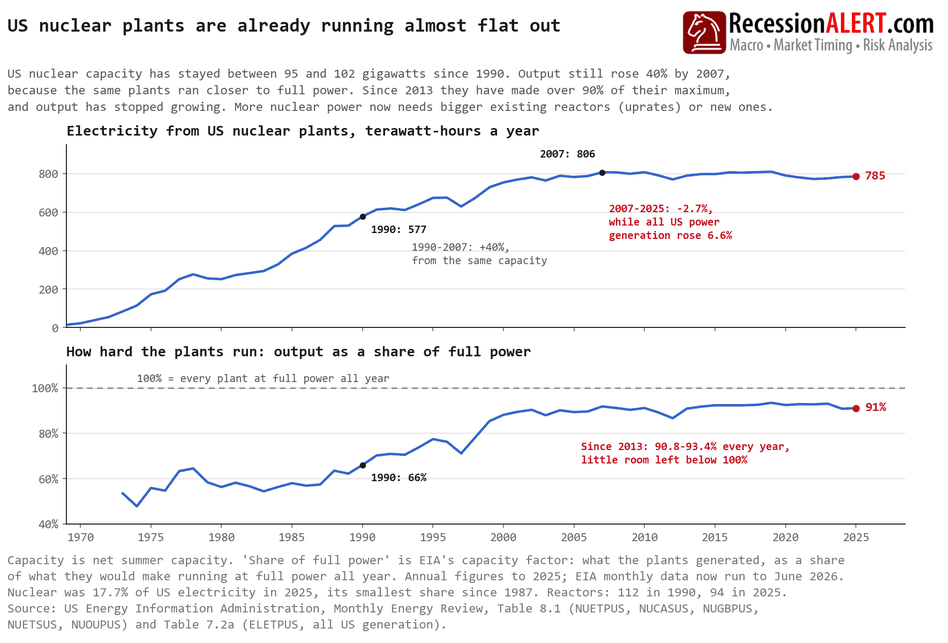
America’s reactors found 40% more electricity between 1990 and 2007 without adding capacity — they found it in the calendar. Every year or two a reactor must shut down to refuel, and those outages shrank from nearly three months in the early 1990s to about 32-35 days now. Each week cut from a shutdown became a week of full-power output, lifting capacity factor, the share of full-power output the plants actually deliver, from 66% to above 90%. But the trick is spent: a refuelling stop cannot shrink to nothing, and since 2013 the fleet has delivered 90.8-93.4% every year. Output can now grow only if capacity does, and capacity has hovered near 100 GW for 35 years. That is the yardstick for Constellation’s conditional Energy Department loan of up to $5bn for uprates, which raise the output of existing reactors. The lever is old and small: about 8 GW of uprates approved since 1977, which, with two new Georgia reactors, roughly held the fleet near 97 GW as older plants closed. All US generation is up 6.6% since 2007 while nuclear is down 2.7%, its share sliding to 17.7%, the lowest since 1987 — the grid has grown around a near-fixed nuclear pool, not through it. Watch whether yearly net summer capacity clears its 2012 high of 101.9 GW. The calendar has given all it can; from here, more nuclear power has to be built.
What it means: Extra nuclear power will now arrive only as fast as capacity is added, and uprates add it in small steps. For investors, companies that already own reactors control output that buyers cannot quickly add to, which should strengthen their hand when they sign long supply contracts with power-hungry customers. For the economy, growth that depends on round-the-clock power, from factories to data centres, will lean on other sources for most of its extra electricity. That changes only if yearly nuclear capacity climbs past its 2012 high of 101.9 GW.
Market Intelligence Brief (MIB) Ver. 19.97
For professional investors only. Not investment advice.
© 2026 RecessionALERT.com

Comments are closed.