
MARKET INTELLIGENCE BRIEF (MIB)
Wednesday, September 23, 2026
The 10-year yield jumped 16.2 bps to 5.110%, highest since June 2007, after a hot flash PMI (58.4) and a weak 5-year auction. Stocks fell with bonds: S&P 500 -0.75%, Russell 2000 -1.77%. Fed’s Barr: further adjustments “likely to be needed”; October hike odds near 73%. Brent surged 4.43% back above $100 on Iran’s UN defiance despite a US crude build. McDonald’s sank 4.81% on flat-traffic guidance. Bessent is “open” to extending the China truce before Thursday’s Xi summit.
TABLE OF CONTENTS
A. EXECUTIVE SUMMARY
B. MARKET DATA
C. HIGH-IMPACT STORIES (5)
D. MODERATE-IMPACT STORIES (6)
E. ECONOMY WATCH (5)
F. EARNINGS WATCH (0)
G. WHAT’S NEXT
H. CHART OF THE DAY
A. EXECUTIVE SUMMARY -> TOP
Stocks and bonds sold off together as a growth beat was read as a hiking signal: the S&P 500 fell 0.75% and the 10-year yield jumped 16.2 bps to 5.110%, its highest since June 2007, after S&P Global’s flash composite PMI hit 58.4 with input costs rising at the steepest pace since October 2022. Governor Barr’s call for “further policy adjustments” and Goolsbee’s warning against treating oil as transitory, on a day Brent rebounded 4.43% to $103.65, reinforced that read, and CME FedWatch put October hike odds near 73%, stripping equities of their usual bond hedge. Supply compounded it: a tailing 5-year auction at 5.033% and a long-end selloff that shrugged off Treasury’s tripled buyback announcement point to rising term premium, not just Fed pricing. Breadth was a macro flush, not rotation: ten of eleven sectors fell, Utilities (-1.83%) and Real Estate (-1.50%) paid for duration, Basic Materials (-2.23%) for the metals rout, and only Energy (+0.84%) rose.
• Long end breaks 5.1%: The 10-year rose 16.2 bps to 5.110% and the 2-year rose 11.8 bps to 4.895% in a bear steepener after the 5-year auction cleared at 5.033% with a 3.1 bp tail; Treasury’s plan to buy back up to $6 billion of longer-dated debt Thursday, triple the $2 billion first flagged, failed to steady the long end.
• Hot PMI, hawkish Fed: S&P Global’s flash composite PMI rose to 58.4 from 56.0, the fastest expansion since July 2021, with input costs rising at the steepest pace since October 2022; Governor Barr said further policy adjustments are “likely to be needed,” and the Atlanta Fed’s firm survey lifted year-ahead inflation expectations to 2.4% from 2.2%.
• Good news sells off: The S&P 500 fell 0.75% to 7,706.03, the Nasdaq 100 fell 0.85% from Tuesday’s record and the Russell 2000 fell 1.77%; the VIX rose 6.76% to 15.17, and the MBA’s 30-year mortgage rate rose to 7.12%, its highest since May 2024, in a survey week that closed before today’s yield jump.
• Brent back above $100: Brent rose 4.43% to $103.65 and WTI rose 2.57% to $92.85, both snapping five-session slides despite a 2.969 million-barrel EIA crude build; CNBC tied the gain to President Pezeshkian’s UN vow that Iran “cannot be made to surrender,” and a projectile hit an India-bound bulk carrier in Hormuz, killing one crew member.
• Consumer and supply warnings: McDonald’s fell 4.81% to $238.32 after its investor day paired an $8.5 billion franchisee-support plan with a forecast of flat industry traffic in its wholly owned markets “while inflation remains elevated”; SpaceX fell 4.11% to $148.36 ahead of Thursday’s lockup expiry on about 328 million shares.
• Trade and policy crosscurrents: Bessent said the US is “open” to extending the Busan truce or a “bigger deal” ahead of Thursday’s Trump-Xi summit; the White House denied a Politico report of a 90-day diesel export ban; Boeing rose 1.12% after finalizing 100 firm 737-8s for Turkish Airlines, plus 50 options.
1. Strong growth is now a rate risk, not an earnings tailwind — A 58.4 PMI with input costs at their steepest since 2022 and hiring at its fastest since June 2022 gives the Fed reasons to keep going, and three officials in three days, Musalem, Barkin and now Governor Barr, have signalled more tightening. The market’s response is the problem for a balanced portfolio: stocks and bonds fell together, the dollar rose 0.50% and gold fell 1.27%, so neither duration nor the usual haven cushioned the equity drawdown. Yesterday’s unpriced rate risk is now being priced. Until August PCE on September 30 shows whether pricing power is reaching consumers, strong data is likely to keep reading as hawkish, which favours pricing power and shorter duration over small caps and long-duration growth.
2. Term premium is back, and buybacks are not buying it down — The 10-year rose 16.2 bps against the 2-year’s 11.8 bps, indirect bidders took just 54.3% of the 5-year sale against a 65.2% average, and a tripled buyback announcement aimed at the long end did not stop the selloff. That points to investors demanding more compensation to hold duration, not only pricing more hikes. The transmission is already visible: a 7.12% mortgage rate measured before today’s jump, existing-home supply of 4.9 months, the highest in more than ten years, and Utilities down 12.23% over three months, the weakest of any sector on that horizon. Thursday’s buyback results are the next test.
3. Oil’s discount is fragile, and crude now feeds straight into rates — Five sessions of de-escalation pricing, built on Iran’s seven-day Hormuz offer and Saudi Arabia’s pipeline restart, unwound in one day as rhetoric hardened and transits stayed near zero: three commodity vessels on Tuesday against a 10-day average of about 15. A Brent-WTI spread widening to about $10.80 despite US and Cushing builds puts the stress on seaborne barrels. With Goolsbee arguing against looking through the shock, every oil headline is now a rate headline, and daily Hormuz transit counts, not US inventory data, are the variable to watch.
 — Leading economic indicators. Accurate market forecasts. Apply for membership at join.recessionalert.com
B. MARKET DATA -> TOP
A rates shock drove a broad selloff: Treasury yields surged on mounting Fed rate-hike worries, a September flash PMI showing the fastest private-sector growth since July 2021 (composite 58.4) and a rebound in crude, with the 5-year yield topping 5% for the first time since 2007. The decline was broad — ten of eleven sectors fell, and the Russell 2000 (-1.77%) lost more than twice as much as the S&P 500 (-0.75%). The standout divergence was cybersecurity, where Palo Alto Networks and CrowdStrike each rose about 5% against the tech slide. With the VIX up 6.76%, gold falling alongside stocks and the dollar firming with yields, this was a rates repricing, not a growth scare.
CLOSING PRICES – September 23, 2026:
MAJOR INDICES
The Russell 2000 (-1.77%) fell more than twice as hard as the S&P 500 (-0.75%) and Nasdaq 100 (-0.85%) as small caps took the brunt of the yield spike, while the Dow (-0.68%) and NYSE Composite (-0.75%) tracked the S&P — a broad decline, not a concentrated one. Over the past 10 sessions the S&P 500 has outpaced the Russell 2000 by 3.74 percentage points — narrow mega-cap leadership, breadth deteriorating — now in its third session. Transports posted a fourth straight lower close, but the same-day Dow/Transports gap was negligible (0.06pp), so there is no Dow Theory signal.
| Index | Close | Change | %Move | Why It Moved |
|---|---|---|---|---|
| S&P 500 | 7,706.03 | -58.61 | -0.75% | Fell as Treasury yields jumped on Fed rate-hike worries, a hot September flash PMI and rebounding oil |
| Dow Jones | 51,511.59 | -352.10 | -0.68% | Declined with the broad market on the yield surge as ten of eleven sectors fell |
| DJ Transportation | 19,739.91 | -147.88 | -0.74% | Fourth straight lower close; no discrete same-day catalyst identified |
| Nasdaq 100 | 30,470.29 | -262.10 | -0.85% | Pulled back from Tuesday’s record close; Alphabet (-3.79%) and Broadcom (-2.60%) among heavyweights lower |
| Russell 2000 | 2,838.66 | -51.26 | -1.77% | Led the decline as the 5-year Treasury yield topped 5% for the first time since 2007 |
| NYSE Composite | 23,848.25 | -180.82 | -0.75% | Broad decline across its membership, with Energy the only sector higher |
VOLATILITY & TREASURIES
VIX rose 6.76% while yields jumped — the 10Y up 16.2bps to 5.110% and the 2Y up 11.8bps — a rate-fear signature, not recession fear; in a growth scare bonds rally. The long end rising faster than the front end steepened the curve in a bear steepener, and the dollar’s 0.50% gain alongside higher yields points to rate repricing rather than a flight to safety.
| Instrument | Level | Change | Why It Moved |
|---|---|---|---|
| VIX | 15.17 | +0.96 (+6.76%) | Rose as the yield spike and rate-hike worries hit equities |
| 10-Year Treasury Yield | 5.110% | +16.2 bps | Jumped on Fed rate-hike worries, a hot flash PMI (composite 58.4, highest since July 2021) and higher oil |
| 2-Year Treasury Yield | 4.895% | +11.8 bps | Rose on expectations of further Fed hikes, trailing the 10Y |
| US Dollar Index (DXY) | 101.11 | +0.51 (+0.50%) | Firmed alongside higher US yields |
COMMODITIES
Every metal fell — platinum (-3.98%) and silver (-2.55%) led and gold slid 1.27% — alongside a firmer dollar and a 16bp jump in the 10Y, so gold offered no haven on a down day for equities. Copper’s milder -0.84% left industrial metals outperforming precious. Bitcoin (-2.23%) moved with equities, confirming the risk-off read rather than charting its own course.
| Asset | Price | Change | %Move | Why It Moved |
|---|---|---|---|---|
| Gold | $4,320.65/oz | $-55.75 | -1.27% | Slid alongside rising yields and a firmer dollar; no discrete gold-specific catalyst identified |
| Silver | $64.835/oz | $-1.695 | -2.55% | Fell twice as hard as gold in a broad metals selloff |
| Copper | $6.7788/lb | $-0.0572 | -0.84% | Eased with the metals complex, but held up better than precious metals |
| Platinum | $1,752.90/oz | $-72.60 | -3.98% | Led the precious-metals slide; no discrete same-day catalyst identified |
| Bitcoin | $84,245 | $-1,923 | -2.23% | Fell with risk assets as yields rose; no crypto-specific catalyst identified |
ENERGY
Brent (+4.43%) outpaced WTI (+2.57%) as both benchmarks snapped five-session losing streaks, widening the Brent-WTI spread to about $10.80 from $8.75. Henry Hub added 2.46%, while Dutch TTF was flat in euro terms, its dollar-denominated dip purely a currency effect. Oil rose while equities fell.
| Asset | Price | Change | %Move | Why It Moved |
|---|---|---|---|---|
| Crude Oil (WTI) | $92.85/bbl | $+2.33 | +2.57% | Rebounded after five straight losses as Iran’s President Pezeshkian told the UN that Iran “cannot be made to surrender” (CNBC); Wednesday’s EIA report showed a 3.0M-barrel crude build, which does not explain the gain |
| Crude Oil (Brent) | $103.65/bbl | $+4.40 | +4.43% | Back above $100 after five losing sessions, outpacing WTI, as Iran’s President Pezeshkian vowed at the UN that Iran will not surrender (CNBC) |
| Natural Gas (Henry Hub) | $3.038/MMBtu | $+0.073 | +2.46% | Extended Tuesday’s gain; no discrete same-day catalyst identified |
| Natural Gas (Dutch TTF) | $24.66/MMBtu | $-0.13 | -0.51% | Flat in euro terms (+0.05%); the dollar-denominated dip reflects a weaker euro (EUR/USD -0.56%) |
S&P 500 SECTORS
Ten of eleven sectors fell, with Energy (+0.84%) the lone gainer on crude’s rebound — a macro flush, not a rotation. Basic Materials swung from Tuesday’s top sector (+2.33%) to today’s worst (-2.23%) as precious metals slid, while Utilities (-1.83%) deepened a 3-month decline to -12.23%, the weakest of any sector on that horizon, as rate-sensitive sectors bore the yield surge.
| Sector | 1-Day | 1-Week | 1-Month | 3-Month | 6-Month | YTD | 12-Month |
|---|---|---|---|---|---|---|---|
| Energy | +0.84% | -2.00% | -0.94% | +14.40% | +1.28% | +36.31% | +38.91% |
| Consumer Defensive | -0.35% | -0.12% | -3.47% | -2.72% | +0.56% | +5.34% | +5.30% |
| Industrials | -0.69% | +0.83% | -2.64% | -7.08% | +2.27% | +8.88% | +10.75% |
| Technology | -0.79% | +5.87% | +7.90% | +8.68% | +37.53% | +29.67% | +28.85% |
| Financial | -0.92% | -1.84% | -4.62% | +1.99% | +13.25% | +3.30% | +6.04% |
| Healthcare | -1.17% | +0.49% | -3.98% | +6.98% | +14.78% | +7.62% | +20.31% |
| Real Estate | -1.50% | -1.32% | -7.37% | -5.79% | +3.79% | +3.38% | -0.35% |
| Consumer Cyclical | -1.52% | +0.98% | -5.54% | -1.33% | +2.27% | -7.73% | -9.60% |
| Communication Services | -1.82% | +0.14% | +1.95% | +3.62% | +8.91% | +1.00% | +3.29% |
| Utilities | -1.83% | -2.64% | -6.82% | -12.23% | -11.31% | -6.69% | -5.85% |
| Basic Materials | -2.23% | +0.55% | -7.36% | +5.16% | +7.53% | +14.06% | +23.41% |
TOP MEGA-CAP MOVERS:
GAINERS
| Company | Ticker | Close | Change | Why It Moved |
|---|---|---|---|---|
| Palo Alto Networks Inc | PANW | $393.30 | +5.00% | No discrete same-day catalyst identified; extended last week’s AI-safety-driven cybersecurity rally against a large-cap tech slide |
| Crowdstrike Holdings Inc | CRWD | $262.49 | +4.97% | No discrete same-day catalyst identified; rose with Palo Alto as the cybersecurity rally extended |
| Palantir Technologies Inc | PLTR | $191.79 | +3.68% | Reportedly lifted by a Rosenblatt Buy reiteration ($225 PT) citing the FAA’s AI flight-management rollout (not traced to a single primary article); also joined the security-software bid |
| ExxonMobil Holdings Corp | XOM | $161.23 | +1.59% | Tracked crude’s rebound (Brent +4.43%) in the only sector to close higher |
| Chevron Corp | CVX | $205.51 | +1.53% | Rose with Exxon on crude’s rebound as Energy was the lone sector gainer |
DECLINERS
| Company | Ticker | Close | Change | Why It Moved |
|---|---|---|---|---|
| Space Exploration Technologies Corp | SPCX | $148.36 | -4.11% | President/COO Gwynne Shotwell filed to sell ~$52M of stock under a June trading plan, ahead of a Sept 24 lockup expiry covering ~328M shares |
| Alphabet Inc (Class A) | GOOGL | $337.85 | -3.79% | No single confirmed catalyst; aggregator reports cite an appeals-court ruling letting youth-safety suits proceed and EU search changes (unverified, undated) |
| Sandisk Corp | SNDK | $1,816.57 | -3.73% | No discrete same-day catalyst identified; gave back part of Tuesday’s +6.82% AI-memory rally |
| Alphabet Inc (Class C) | GOOG | $334.98 | -3.58% | Class C shares mirrored the Class A decline; no single confirmed catalyst |
| Oracle Corp | ORCL | $144.56 | -3.11% | No discrete same-day catalyst identified; continuation of the AI-financing concerns behind its Sept 18 decline |
— Institutional-grade intelligence for serious investors. Apply for membership at join.recessionalert.comC. HIGH-IMPACT STORIES -> TOP
BEARISH
1. 10-Year Treasury Yield Closes at 5.110%, Highest Since June 2007, as a Weak 5-Year Auction and a Tripled Buyback Fail to Steady the Long End
The core facts:The 10-year Treasury yield jumped 16.2 bps to 5.110% and the 2-year rose 11.8 bps to 4.895%, a bear steepener. Wolf Street puts the 10-year at its highest since June 2007 and the 30-year at 5.39%, its highest since July 2004. The 5-year yield topped 5% for the first time since 2007 after Wednesday’s 5-year note sale cleared at 5.033% with a 3.1 bp tail (auction detail in Section E). Earlier in the session, Treasury said it would buy back up to $6 billion of longer-dated debt on Thursday, triple the $2 billion it had first communicated to investors in early August (Bloomberg). Wolf Street reported that the 20- and 30-year buyback “fell flat” as yields kept climbing.
Why it matters:A 5.1% 10-year raises the discount rate on every long-duration asset at once, and the damage landed where duration and financing costs bite hardest: Utilities fell 1.83%, Real Estate 1.50% and the Russell 2000 1.77%, more than twice the S&P 500’s 0.75% decline. The dollar’s 0.50% gain alongside higher yields and gold’s 1.27% drop mark this as a rate repricing, not a flight to safety. The buyback result is the more worrying signal: Treasury tripled a supply-relief operation aimed squarely at the long end, and the long end sold off anyway. That points to investors demanding more term premium for holding duration while the Fed is still hiking, and additional buybacks alone do not supply that premium. The 30-year mortgage rate had already crossed 7% before today’s move.
What to watch:Thursday’s up-to-$6 billion buyback results and whether the 10-year holds above 5.1% into Thursday’s jobless claims and the August PCE release on Wednesday, September 30.
BEARISH
2. Hot Flash PMI Turns Strong Growth Into a Selloff — Ten of Eleven Sectors Fall and the Russell 2000 Drops 1.77% as Markets Price More Hikes
The core facts:S&P Global’s September flash composite PMI jumped to 58.4, the fastest private-sector expansion since July 2021, with input costs rising at the steepest pace since October 2022 (Section E carries the data). Stocks and bonds fell together. The S&P 500 lost 0.75% to 7,706.03, the Nasdaq 100 fell 0.85% from Tuesday’s record close, the Dow slipped 0.68% and the Russell 2000 dropped 1.77%. Ten of eleven sectors fell. Energy (+0.84%) was the lone gainer, and Basic Materials (-2.23%) went from Tuesday’s best sector (+2.33%) to today’s worst. The VIX rose 6.76% to 15.17.
Why it matters:This was a clear case of good news being bad news. With the Fed having raised rates on September 16 and still signalling more, a growth beat paired with accelerating input costs reads to the market as another hike, not stronger earnings. Stocks falling alongside bonds rather than being cushioned by them removes the usual portfolio hedge, and small caps, which rely more on floating-rate and near-term refinancing, fell twice as hard as the large-cap indices. The hit was broad rather than concentrated: the Dow, S&P 500 and NYSE Composite all fell between 0.68% and 0.75%. That is the signature of a discount-rate shock, not of sector rotation.
What to watch:Friday’s August durable goods and final September Michigan sentiment, then the August PCE release on Wednesday, September 30, for whether the PMI’s pricing power is reaching consumer prices.
BEARISH
3. Barr’s Call for “Further Policy Adjustments” and Goolsbee’s Oil Warning Lift October Hike Odds to About 70%
The core facts:Governor Michael Barr said further policy adjustments are “likely to be needed” to bring inflation down in a timely fashion (Section E). Separately, Chicago Fed President Austan Goolsbee said on a Hoover Institution podcast released Wednesday that “for big negative supply shocks… you’d be better off just assuming from the beginning this thing is going to be pretty persistent on inflation,” adding “That’s maybe what’s happening with oil” and “So we better be careful” (Reuters). Futures-implied odds of a hike at the October 27-28 FOMC rose to 70% from about 55% earlier in the day (Reuters); CNBC put the CME FedWatch reading at about 73%. The 2-year yield rose 11.8 bps to 4.895%.
Why it matters:A Board governor now sits alongside Richmond’s Barkin and St. Louis’s Musalem in signalling more tightening. The repricing cannot be credited to Barr alone, because the odds moved after both the 09:45 ET PMI and his 10:05 ET remarks. Goolsbee’s comment matters more than its casual setting suggests. The standard central-bank response to an oil shock is to look through it as transitory, and he is arguing against doing that on the same day Brent climbed back above $100. If that view spreads, higher crude feeds straight into rate expectations rather than being discounted, and the 2-year’s jump shows the front end is already pricing it that way.
What to watch:Thursday’s Fed speakers (Williams, Barkin, Hammack and Paulson) and whether October hike odds hold near 70% into the September 30 PCE release.
BEARISH
4. Brent Jumps 4.43% Back Above $100, Snapping a Five-Session Slide Despite a Surprise US Crude Build
The core facts:Brent rose 4.43% to $103.65 and WTI 2.57% to $92.85, both ending five-session losing streaks and widening the Brent-WTI spread to about $10.80 from $8.75. The rebound came despite the EIA reporting a 2.969 million-barrel commercial crude build for the week ending September 18, when a draw had been expected, and a 2.266 million-barrel rise at Cushing. CNBC’s market coverage tied the gain to Iranian President Masoud Pezeshkian’s UN General Assembly address, in which he said Iran “cannot be made to surrender.” Shipping data pointed the same way. Kpler data cited by Reuters showed three commodity vessels transited the Strait of Hormuz on Tuesday, against a 10-day average of about 15. On Wednesday, UKMTO reported that a bulk carrier bound for India had been hit by a projectile in the strait, and the Indian embassy confirmed one crew member was killed. Energy (+0.84%) was the only S&P sector higher, led by Exxon Mobil (+1.59%) and Chevron (+1.53%).
Why it matters:The five-day slide had been driven by de-escalation signals: Iran’s seven-day offer to reopen Hormuz and Saudi Arabia’s East-West pipeline restart. Today showed how quickly that discount can reverse when rhetoric hardens and transits stay near zero. The widening Brent-WTI spread, on a week with a sizeable US and Cushing build, says the pressure is on seaborne international barrels, not on US inland supply. On a day the flash PMI flagged the steepest input-cost rise since 2022 and Goolsbee warned against treating oil as transitory, $100 Brent adds directly to the inflation case behind the rates selloff.
What to watch:Daily Hormuz transit counts against the roughly 15-vessel 10-day average, and whether Saudi East-West pipeline exports actually restart in the coming days.
UNCERTAIN
5. Bessent Says US Is “Open” to Extending the Busan Truce or a “Bigger Deal” After Meeting He Lifeng on the Eve of the Trump-Xi Summit
The core facts:Treasury Secretary Scott Bessent met Chinese Vice Premier He Lifeng in Washington on Wednesday for a second round of talks, following Sunday’s meeting in New York. Arriving, he said “we had some unfinished business from Sunday.” Afterwards, he said “we’re open to the idea of just continuing the Busan arrangement or examining the bigger deal,” a proposal he said China raised on Sunday (Reuters). He gave no details of what a larger deal would contain. US officials said China’s rare-earth magnet deliveries had “not been up to par.” The Busan truce expires on November 10. President Xi Jinping arrives for his first state visit in 11 years ahead of a White House summit with President Trump on Thursday, September 24.
Why it matters:Reuters described Bessent’s comments as the strongest signal yet that an extension of the truce is on the summit agenda. An extension would keep the suspensions of US port fees on China-linked ships and of China’s rare-earth controls in place past November 10, which matters most to autos, industrials and semiconductors that depend on Chinese magnets. The rare-earth complaint is the US side’s main leverage heading into Thursday. The market did not reward the signal today because rates dominated, so a concrete extension is not yet in prices. Nor, however, is a breakdown.
What to watch:Thursday’s White House summit readout: whether the truce is extended and for how long, and whether it includes any commitment on rare-earth delivery volumes.
— Quantifying recession risk so you don’t have to guess. Apply for membership at join.recessionalert.comD. MODERATE-IMPACT STORIES -> TOP
BEARISH
6. McDonald’s Falls 4.81% as Investor Day Pairs an $8.5 Billion Franchisee Support Plan With a Warning That Industry Traffic Will Stay Flat
The core facts:At Wednesday’s investor meeting, McDonald’s committed $8.5 billion over roughly a decade to franchisee support. About $5 billion of that is to be deployed by 2030 through rent relief and capital support. The company also targeted operating margins in the low- to mid-50% range by 2030 and restaurant-level efficiency gains of 250 basis points. CEO Chris Kempczinski said: “We expect industry traffic growth in our wholly owned markets will be flat while inflation remains elevated.” Shares closed at $238.32, down 4.81%, after touching $234.03 intraday, a near four-year low (Reuters). Wendy’s fell about 1% and Yum! Brands was little changed (24/7 Wall St.).
Why it matters:The largest US restaurant brand is telling investors that the consumer squeeze will not ease while inflation stays high, and it is paying franchisees to hold the system together. That is effectively a margin transfer from the franchisor to operators. The muted moves at Wendy’s and Yum! mark the decline as a verdict on McDonald’s own plan rather than a sector sell-off. Even so, flat-traffic guidance from the category leader is a negative signal for consumer discretionary spending on a day Consumer Cyclical fell 1.52%.
What to watch:Darden’s results before Thursday’s open for a second read on restaurant traffic, and whether McDonald’s holds above the $234.03 intraday low.
UNCERTAIN
7. White House Denies Politico Report of a 90-Day Diesel Export Ban as Energy Secretary Wright Says Only Voluntary Measures Are Under Discussion
The core facts:Politico reported Wednesday, citing people familiar with the matter, that the administration was preparing a plan to ban diesel exports for 90 days and that President Trump was inclined to put it forward by the end of the week; Reuters could not immediately verify the report. The White House denied it. Energy Secretary Chris Wright said nobody is considering a flat ban and that one could raise gasoline and jet fuel prices: “What’s being discussed is what’s the most efficient way to get more diesel into the United States of America, and continue maximum flows of gasoline and jet fuel.” AAA’s national average for diesel was $6.5217 on Wednesday, just below Tuesday’s record of $6.5276.
Why it matters:A day after Trump publicly backed a ban, the policy is openly contested inside the administration. The Energy Secretary is arguing against it on the grounds that it would raise other fuel prices, while the push comes from the political pressure of record pump prices before the midterms. For Gulf Coast refiners, an outright ban would remove export optionality and widen the gap between US and international diesel prices. A voluntary cap is a far milder outcome. The uncertainty itself now hangs over refiners’ export margins until a decision is announced.
What to watch:Any executive action on diesel exports by Friday, and whether AAA’s national diesel average sets a new record above $6.5276.
BULLISH
8. Boeing Finalizes Turkish Airlines Order for Up to 150 737 MAX Jets, With 100 Firm
The core facts:Boeing and Turkish Airlines finalized an order for 100 firm 737-8 aircraft plus 50 options, with substitution rights for the 737-10, at a New York signing attended by Turkish President Recep Tayyip Erdogan (Boeing release, 12:43 ET). The value was not disclosed. The deal converts the airline’s 2025 commitment for up to 150 737 MAX jets, made alongside an agreement for up to 75 787s, into a firm contract. Separately, Reuters reported that Bangladesh plans to buy 11 more Boeing jets, taking Biman’s planned orders to 25, as Dhaka seeks to narrow a trade imbalance of roughly $6 billion with the US. Boeing shares rose 1.12% to $199.93.
Why it matters:Firm orders are what reach backlog and support production-rate planning, and 100 firm 737-8s is one of the larger single-customer narrowbody commitments. The Bangladesh purchase shows aircraft being used as a bargaining chip in US tariff negotiations, a pattern that favours Boeing over Airbus for trade-exposed buyers. The read-through extends to GE Aerospace, whose CFM joint venture supplies the LEAP-1B engine on every 737 MAX.
What to watch:The SPEEA union contract vote running September 24 to October 4, ahead of the October 6 contract expiry, which is the main near-term risk to Boeing’s production ramp.
BULLISH
9. Federal Judge Dismisses Michigan’s Climate-Antitrust Suit Against Exxon, Chevron, BP and Shell
The core facts:US District Judge Jane Beckering of the Western District of Michigan dismissed the state’s antitrust suit against BP, Chevron, Exxon Mobil, Shell and the American Petroleum Institute. The court held that Michigan lacked antitrust standing and that proximate cause failed. The ruling is dated September 22 and was first reported after Tuesday’s close. The Justice Department issued statements on Wednesday. Associate Attorney General Stanley Woodward said “this dismissal should make states rethink the use of lawfare to enact climate change policy,” and Deputy Assistant Attorney General G. Charles Beller added that antitrust law “is not a tool to advance societal goals unrelated to competition.” Michigan Attorney General Dana Nessel’s office said it disagreed and was considering the state’s options.
Why it matters:This was the first attempt to use antitrust law, rather than nuisance or consumer-protection claims, to pursue the oil majors over climate. It failed at the threshold on standing and causation, which are the grounds hardest to cure on appeal. With the federal government actively backing the defendants, the ruling trims a tail liability for the majors. It will not move the stocks on its own: Exxon and Chevron rose with crude today.
What to watch:Whether Michigan files a notice of appeal to the Sixth Circuit.
BEARISH
10. SpaceX Falls 4.11%, the Session’s Largest Mega-Cap Decliner, Ahead of Thursday’s Lockup Expiry on About 328 Million Shares
The core facts:SpaceX (SPCX) fell 4.11% to $148.36. President and COO Gwynne Shotwell filed notice of a proposed sale of 342,170 shares, worth about $52 million, under a trading plan adopted in June. A lockup expiring on Thursday, September 24, makes about 328 million shares eligible for sale (24/7 Wall St.). The stock remains above its $135 June IPO price.
Why it matters:The lockup puts a large new block of stock up for sale at once, and a senior insider sale, even a pre-planned one, gives holders a reason to sell ahead of it. The decline also comes as valuation questions build after the stock’s run since the June IPO, on a day when rising yields hit long-duration growth names hardest. How SpaceX trades through the unlock will indicate how deep institutional demand runs beneath the retail enthusiasm that carried the IPO.
What to watch:Volume and price action on Thursday as the lockup expires, and the Starship test flight scheduled for Monday, September 28.
BULLISH
11. NYSE and Blockchain.com Sign an MOU to Offer Tokenized US Stocks and ETFs to Crypto Investors Outside Market Hours
The core facts:The New York Stock Exchange and Blockchain.com signed a memorandum of understanding to give Blockchain.com users access to tokenized versions of US exchange-listed stocks and ETFs through NYSE’s planned digital alternative trading system, subject to regulatory approvals. If launched, the service would allow trading outside regular market hours. Under a companion data agreement, NYSE parent Intercontinental Exchange will distribute Blockchain.com’s crypto market data and Blockchain.com will add ICE and NYSE stock data to its app. Blockchain.com reports more than 44 million accounts across more than 70 jurisdictions. The service is not yet live.
Why it matters:The largest US equity venue is moving to capture tokenized-equity demand rather than let crypto platforms build it on their own. It gains a distribution channel to a global, largely non-US investor base that already trades around the clock. For ICE it adds fee and data-revenue optionality. For platforms that already sell tokenized US stocks offshore, it means competing with the listing venue itself.
What to watch:Regulatory approval and a launch date for NYSE’s digital trading system, the step on which the whole arrangement depends.
— Separating signal from noise since 2007. Apply for membership at join.recessionalert.comE. ECONOMY WATCH -> TOP
The economy is running hot enough to keep the Fed tightening, and financing costs are rising to match. S&P Global’s flash composite PMI jumped to 58.4, the fastest private-sector expansion since July 2021, while input costs rose at the steepest pace since October 2022 — growth with inflation, which makes another hike, not a cut, the live question. Governor Barr said further policy adjustments are “likely to be needed,” and CME FedWatch put the odds of an October hike near 73%. The funding side tightened in step: a weak 5-year auction cleared at 5.033%, the 10-year rose 16.2 bps to 5.110%, and the 30-year mortgage rate crossed 7% to its highest since May 2024.
Flash PMI Surges to 58.4, Fastest Private-Sector Growth Since July 2021, as Input Costs Climb at Steepest Rate Since October 2022 (S&P Global, Sept 23)
What they’re saying:S&P Global’s flash US Composite PMI rose to 58.4 in September from 56.0 in August, the strongest expansion in private-sector activity since July 2021 and a fourth straight month of accelerating growth. Services rose to 58.7 from 56.5 against 56.0 expected, and the manufacturing PMI rose to 57.0 from 53.9, a 52-month high, against 53.5 expected. “US business continues to boom, with output growing at the fastest rate for over five years in September,” said Chris Williamson, S&P Global’s Chief Business Economist.
The context:Both components beat consensus by wide margins, and the detail was inflationary: input costs rose at the steepest pace since October 2022 on fuel and transport costs, with wage pressures intensifying, selling-price inflation picking up, and hiring at its fastest since June 2022. Markets read it as a reason for further hikes rather than as good growth news — the 10-year yield rose 16.2 bps to 5.110% and the dollar index gained 0.50% to 101.11, while the S&P 500 fell 0.75%. Williamson said historical comparisons point to annualized growth of around 5%, in line with the Atlanta Fed’s GDPNow estimate of 5.1% for Q3 (Sept 17).
What to watch:Friday’s August durable goods orders (expected -0.4%) and final September Michigan sentiment (expected 47.6), then the August PCE release on Wednesday, Sept 30, which will show whether firms’ pricing power is reaching consumer prices.
Fed’s Barr: “Further Policy Adjustments Are Likely to Be Needed” as October Rate-Hike Odds Jump to About 73% (Reuters/CNBC, Sept 23)
What they’re saying:Speaking at a Chicago Fed conference on housing affordability, Governor Michael Barr said “further policy adjustments are likely to be needed to ensure inflation comes down to target in a timely fashion,” arguing that risks to the 2% goal have grown while risks to the labor market have eased. He said he supported last week’s FOMC rate hike.
The context:Barr, a Board governor, joins Richmond’s Barkin (Sept 22) and St. Louis’s Musalem (Sept 21) in signaling more tightening ahead. CME FedWatch odds of a rate hike at the Oct 27-28 FOMC jumped to about 73%, according to CNBC and FXStreet. The 2-year Treasury yield, the most sensitive to policy expectations, rose 11.8 bps to 4.895%.
What to watch:Fed speakers Thursday — Williams, Barkin, Hammack and Paulson — with Williams and Hammack speaking again Friday; CME FedWatch odds of an October hike heading into the Sept 30 August PCE release.
5-Year Note Auction Clears at 5.033%, Highest Since Before 2006, on Weak Demand (US Treasury via Wolf Street, Sept 23)
What they’re saying:Treasury’s 5-year note auction priced at a high yield of 5.033%, up from 4.393% at the previous 5-year sale and the highest auction yield since before 2006. It tailed by 3.1 bps, with a bid-to-cover ratio of 2.21 against a 2.33 average. Indirect bidders took 54.3% against a 65.2% average, leaving dealers with 15.8% against 12.9%.
The context:Thin indirect participation at yields above 5% shows buyers demanding more compensation to absorb Treasury supply at a point when the Fed is still raising rates. Tuesday’s 2-year auction also cleared well above its predecessor (4.787% vs 4.204%). The 5-year yield topped 5% for the first time since 2007, and rate-sensitive stocks fell furthest: Utilities -1.83%, Real Estate -1.50%, and the Russell 2000 -1.77%.
What to watch:Whether the 10-year holds above 5.1% into Thursday’s jobless claims (expected 201K) and the Sept 30 PCE and final Q2 GDP releases.
30-Year Mortgage Rate Crosses 7% to 7.12%, Highest Since May 2024; Applications Fall 1.5% (MBA, Sept 23)
What they’re saying:The Mortgage Bankers Association’s average 30-year fixed contract rate rose 15 bps to 7.12% from 6.97% in the week ending Sept 18, its highest since May 2024. Total mortgage applications fell 1.5%, with refinance applications down 3% and purchase applications down 1%, while the adjustable-rate share of applications rose to 9.8%.
The context:The survey week closed before today’s 16.2 bp jump in the 10-year yield to 5.110%, so it does not yet reflect the latest move in rates. Housing was already soft: NAR’s August existing-home sales fell to a 3.98 million annual rate (Sept 10), with 4.9 months of supply, the highest in more than ten years. A rising ARM share shows borrowers turning to lower initial payments as fixed rates climb.
What to watch:August new home sales on Thursday (expected 0.62M vs 0.607M prior), Case-Shiller home prices on Tuesday, Sept 29, and next Wednesday’s MBA survey.
Atlanta Fed: Firms’ Year-Ahead Inflation Expectations Rise to 2.4% in September (Atlanta Fed, Sept 23)
What they’re saying:Year-ahead unit-cost expectations among Sixth District firms rose to 2.4% in September from 2.2% in August, according to the Atlanta Fed’s Business Inflation Expectations survey. Firms reported year-over-year unit-cost growth of 2.6%, and their 5-to-10-year expectations held at 2.8%, unchanged from June. Sales levels and profit margins compared with normal both declined.
The context:The uptick matches the flash PMI’s report of surging input costs and moves away from the Fed’s 2% target, supporting the hawkish case Governor Barr made the same day. Weaker sales and margins relative to normal suggest firms are absorbing part of those costs rather than passing all of them through.
What to watch:Friday’s final Michigan sentiment survey, including consumers’ inflation expectations, and the Sept 30 August PCE release (headline PCE was 3.7% year over year in July).
— Know the probability before the market prices in the risk. Apply for membership at join.recessionalert.comF. EARNINGS WATCH -> TOP
YESTERDAY AFTER THE BELL (Markets Reacted Today)
No major earnings yesterday after the bell from companies with >$100B market cap.
TODAY BEFORE THE BELL (Markets Already Reacted)
No major earnings before the bell from companies with >$100B market cap.
TODAY AFTER THE BELL (Markets React Tomorrow)
No major earnings after the bell from companies with >$100B market cap.
WEEK AHEAD PREVIEW:
Q3 2026 earnings season is at its earliest stage (0.6% of the S&P 500 reported), and the next five sessions carry two reporters above $100B.
Costco Wholesale (COST) — AMC, Thursday, September 24 — Consensus EPS $6.54 on revenue of about $94.97B. The first mega-cap retail report of the quarter, arriving with AAA’s national average for regular gasoline at $4.47. Key focus: comparable-sales momentum, membership-fee income and renewal rates, and any read on how higher rates and fuel costs are shaping member spending.
Micron Technology (MU) — AMC, Wednesday, September 30 — Company guidance calls for fiscal Q4 revenue of $50.0B ± $1.0B, a non-GAAP gross margin of about 86% and non-GAAP EPS of $31.00 ± $1.00; consensus sits above the midpoint at EPS $31.49 and revenue of $50.91B. Key focus: fiscal 2027 guidance, the pace of HBM4 ramp for NVIDIA’s Vera Rubin platform, and whether management signals further moderation in DRAM price increases, a key question after this month’s AI-memory rally.
Friday, September 25 has no scheduled reporters on the calendar, and Monday, September 28 and Tuesday, September 29 carry none above $100B (largest: Carnival, $29.86B, Tuesday BMO).
— US market commentary trusted by family offices and institutions. Apply for membership at join.recessionalert.comG. WHAT’S NEXT -> TOP
UPCOMING RELEASES:
| Date | Event | Why It Matters |
|---|---|---|
| Thu, Sep 24 | Fed speakers: Williams, Barkin, Hammack and Paulson | Tests whether the hawkish chorus from Musalem, Barkin and Governor Barr widens, with CME FedWatch pricing October hike odds near 73%. |
| Thu, Sep 24 | Initial Jobless Claims (expected 201K, prior 196K) | A low print would reinforce the flash PMI’s report of the fastest hiring since June 2022 and the labor-market side of the case for another hike. |
| Thu, Sep 24 | New Home Sales, Aug (expected 0.62M, prior 0.607M) | First housing read since the MBA 30-year rate crossed 7%, with existing-home supply already at 4.9 months. |
| Thu, Sep 24 | Trump-Xi White House summit; Treasury buyback of up to $6B | The summit decides whether the Busan truce and rare-earth suspensions extend past November 10; the buyback results show whether supply relief can steady the long end. |
| Fri, Sep 25 | Durable Goods Orders, Aug (expected -0.4%, prior 1.1%; ex-transportation expected 0.6%) | Shows whether business investment is keeping pace with the PMI’s boom as financing costs climb. |
| Fri, Sep 25 | Michigan Consumer Sentiment, Final Sep (expected 47.6, prior 51.7) | Consumer inflation expectations are the read to watch after firms’ year-ahead expectations rose to 2.4% in the Atlanta Fed survey. |
| Tue, Sep 29 | JOLTS Job Openings, Aug (prior 7.271M); CB Consumer Confidence, Sep (prior 89.4) | Labor demand and consumer mood against McDonald’s forecast of flat industry traffic in its wholly owned markets while inflation remains elevated. |
| Wed, Sep 30 | Core PCE Price Index, Aug (MoM prior 0.2%; headline YoY prior 3.7%); Personal Income and Spending | The Fed’s preferred gauge and the key test of whether the PMI’s surging input costs are reaching consumer prices ahead of the Oct 27-28 FOMC. |
| Wed, Sep 30 | GDP Growth Rate, Final Q2 (expected 1.5%, prior 2.1%); ADP Employment, Sep (prior 38K) | A backward-looking Q2 revision set against the Atlanta Fed’s Q3 GDPNow estimate of 5.1%; ADP gives the first private-payroll read for September. |
KEY QUESTIONS:
1. Does Thursday’s up-to-$6 billion buyback steady the long end, or is a 5.1% 10-year the new baseline as investors demand more term premium to hold duration?
2. Will August PCE on Wednesday, September 30 show the PMI’s input-cost surge reaching consumer prices and lock in an October 27-28 hike now priced near 73%?
3. Can Brent hold above $100 if Hormuz transits stay far below their roughly 15-vessel 10-day average, and will Thursday’s Trump-Xi summit extend the Busan truce past November 10 or leave rare-earth supply in doubt?
— US market commentary trusted by family offices and institutions. Apply for membership at join.recessionalert.comH. CHART OF THE DAY -> TOP
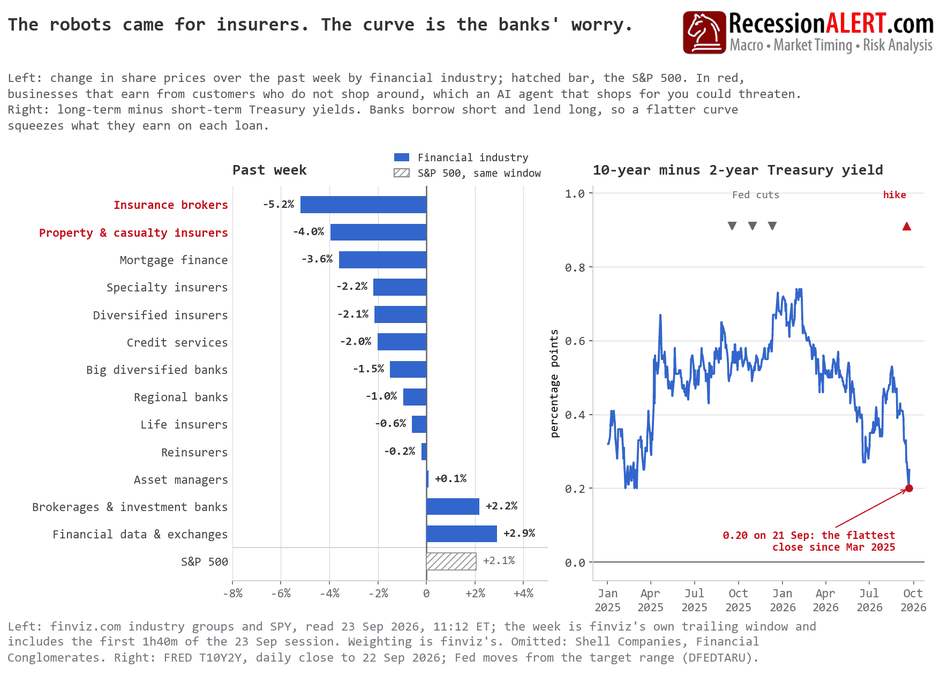
Two different fears hang over financial shares this week. The first landed on insurers. Over the week, insurance brokers fell 5.2% and property and casualty insurers 4.0%. Big banks slipped 1.5%, while exchanges and the S&P 500 rose. Investors cited AI agents like Meta’s new Muse, which works inside a user’s accounts and could shop around for every policy at renewal. That threatens the profit insurers earn from customers who do not compare prices. Britain shows what is at stake. From 2022 it banned insurers from charging renewing home and motor customers more than new ones, a change its regulator estimated would save consumers £4.2bn over ten years. What insurers lose when customers switch, households keep. The second fear is older and belongs to banks. Banks borrow short and lend long, so the gap between 10-year and 2-year Treasury yields is a rough guide to what each new loan earns. Last week’s Fed hike lifted short rates. On Monday that gap, the yield curve, closed at 0.20 percentage point, down from about 0.72 in January and the flattest since March 2025. But bank shares have not followed the curve this year. Their strongest rally of the year, from late May to late July, ran straight through the curve’s flattest point before this month. So the curve is a squeeze to come, not the verdict on this week. The robots have to win customers one renewal at a time. The curve reaches every new loan at once.
What it means: Treat these as two separate risks. For insurers and brokers, the danger is lost renewal income, which becomes real only if agents like Muse start moving customers, so watch for firms reporting more switching. For banks, a flat curve means thinner margins on new loans. That squeeze eases if the 10-year to 2-year gap closes above 0.75, higher than any close since at least 2024.
Market Intelligence Brief (MIB) Ver. 19.70
For professional investors only. Not investment advice.
© 2026 RecessionALERT.com

Comments are closed.