
MARKET INTELLIGENCE BRIEF (MIB)
Tuesday, September 22, 2026
Wall Street split: the Nasdaq 100 closed above its June peak as SanDisk (+6.82%) and Micron (+5.00%) ran, while the S&P bank index sank 3% on AI-disruption fears from Meta’s Muse agent, with Schwab down 6.1%. WTI fell 2.73%, a fifth straight loss, after Iran offered to reopen Hormuz within seven days. Trump pushed a diesel export ban; Valero, also downgraded, slid 4.10%. Fed’s Barkin on more hikes: “We’ll see.” Royal Caribbean tumbled 6.14% on a $3B Sandals stake report.
TABLE OF CONTENTS
A. EXECUTIVE SUMMARY
B. MARKET DATA
C. HIGH-IMPACT STORIES (5)
D. MODERATE-IMPACT STORIES (7)
E. ECONOMY WATCH (6)
F. EARNINGS WATCH (0)
G. WHAT’S NEXT
H. CHART OF THE DAY
A. EXECUTIVE SUMMARY -> TOP
The S&P 500 finished flat at 7,764.64 on a split tape: the Nasdaq 100 rose 0.82% to its first close above its June peak on AI-memory strength, while the Dow fell 0.36% as banks sold off. That selloff carried the AI-disruption trade into financials, with Meta’s Muse agent threatening inertia-dependent franchises such as Schwab, while a 2s10s curve near 21 bps squeezes lending margins a week after the Fed’s hike. US-Iran talks drained more war-risk premium, sending WTI down 2.73% for a fifth straight loss and the VIX down 4.44% to 14.21, yet a 10-year unchanged at 4.963% shows bonds are not pricing relief while Barkin keeps further hikes open. Breadth was narrow: 5 of 11 sectors rose, led by Basic Materials (+2.33%) and Technology (+0.87%), with Financial (-1.55%) last, marking rotation into supply-constrained AI components rather than broad risk appetite.
• Crude slides a fifth session: WTI fell 2.73% to $89.85 and Brent was flat at $98.60 (-0.01%) after Iran offered to reopen the Strait of Hormuz within seven days and Saudi Arabia began restarting its East-West pipeline to Yanbu; Bank of America nonetheless raised its year-end Brent forecast to $95 from $83.
• AI disruption reaches financials: The S&P 500 bank index fell 3%, with Schwab down 6.1%, Wells Fargo down 3.92%, JPMorgan down 3.42% and Bank of America down 3.04%; Allstate fell 5.5% as Meta’s Muse agent threatened inertia-dependent franchises, and the 2s10s spread closed near 21 bps.
• Memory carries the Nasdaq: The Nasdaq 100 rose 0.82% to 30,732.40, its first close above the June 2 peak, as SanDisk (+6.82%), Micron (+5.00%) and Seagate (+4.85%) led; hardware lagged, with Dell down 4.59% and Cisco down 4.50% after Piper Sandler cut its target to $125.
• Diesel export ban under review: Trump said he has pushed for a ban and Bessent said the administration is “examining whether it’s feasible”; Valero (-4.10%) and Marathon Petroleum (-3.16%) fell a second day, also hit by Jefferies downgrades to Hold.
• Hawkish Fed, softer factories: Barkin defended the September hike and said of further tightening “We’ll see”; the Richmond Fed manufacturing index fell to -2 from +4 as new orders dropped to -6, while ADP’s weekly pulse accelerated for a third week to 20,000 jobs.
• Deal and pipeline movers: Royal Caribbean fell 6.14% on a report it is nearing a roughly $3 billion deal for half of Sandals Resorts; Amgen rose 4.34% on a positive Phase 3 dazodalibep readout in Sjögren’s disease; Goldman Sachs is in talks to buy Palmer Square, a credit manager overseeing about $37 billion.
1. AI is sorting winners from losers, not lifting all boats — Tuesday rewarded scarcity and punished exposure. Memory and storage suppliers, seen as the binding constraint on data-centre build-outs, rallied while businesses that profit from customer inertia sold off as Meta’s Muse agent passed ChatGPT as the most-downloaded free iPhone app, and Netflix drew its second downgrade in a week on YouTube’s living-room gains. Enterprise systems vendors Cisco and Dell lagged too. With only 5 of 11 sectors higher and the S&P 500 ahead of the Russell 2000 by about 3.6 percentage points over 10 sessions, index-level calm hides wide dispersion: the portfolio question is which side of the AI line each holding sits on.
2. Crude relief is real but conditional — Iran’s seven-day Hormuz offer, a direct Araghchi-Witkoff meeting at the UN and Saudi Arabia’s pipeline restart have taken WTI $15.70 below its September 15 close, easing the inflation pressure behind last week’s hike. But Tehran’s conditions include ending the war on all fronts, Trump places any deal after the election, and Bank of America warns damaged infrastructure makes “rapid normalization unlikely.” Diesel is moving the other way: Russian refinery strikes and a possible US export ban would tighten global supply even as a ban would lower US prices, leaving refiners exposed to policy, price and valuation risk at once.
3. The rate path is the unpriced risk — Barkin left further hikes open and Deutsche Bank argues that swaps pricing only two more hikes by July 2027 underestimates a globally synchronised tightening cycle, yet the 2-year rose just 0.3 bp and the 10-year was unchanged. A hawkish repricing would hit twice: the long-duration memory leaders carrying the Nasdaq, and banks whose margins are already squeezed by a 2s10s spread near 21 bps. Governor Barr on Wednesday and August PCE on September 30 are the next tests.
 — Leading economic indicators. Accurate market forecasts. Apply for membership at join.recessionalert.com
B. MARKET DATA -> TOP
Markets were bifurcated as an AI-driven memory and semiconductor rally lifted the Nasdaq 100 to its first record close since June (+0.82%, led by SanDisk +6.82% and Micron +5.00% above $1,000), while a broad financial-sector rotation — JPMorgan, Wells Fargo and Bank of America all off more than 3% — dragged the Dow (-0.36%) and NYSE Composite (-0.24%) lower; the S&P 500 finished essentially flat. Crude tumbled (WTI -2.73%) on hopes for US-Iran diplomacy after a three-hour UN General Assembly meeting eased war-risk premiums, while natural gas surged 6.52% with no clear catalyst. The VIX plunged 4.44% to 14.21 even as yields held flat, and gold, silver, copper and platinum all advanced together.
CLOSING PRICES – September 22, 2026:
MAJOR INDICES
Nasdaq 100 (+0.82%) closed at its first record since June, powered by a sixth straight day of chip/memory gains (SanDisk, Micron), while the Dow (-0.36%) and NYSE Composite (-0.24%) lagged on a broad financial-sector rout. Over the past 10 sessions the S&P 500 has outpaced the Russell 2000 by roughly 3.6 percentage points — narrow mega-cap leadership, breadth deteriorating — extending into a second session even as the Russell outperformed today (+0.51%). Same-day Dow/Transports divergence was negligible (0.06pp), showing no Dow Theory signal.
| Index | Close | Change | %Move | Why It Moved |
|---|---|---|---|---|
| S&P 500 | 7,764.64 | -0.06 | -0.00% | Essentially flat as AI-driven tech gains offset a broad financial-sector selloff |
| Dow Jones | 51,863.69 | -185.14 | -0.36% | Its financial-heavy composition weighed on the index as banks sold off broadly |
| DJ Transportation | 19,887.79 | -83.11 | -0.42% | Tracked the broader blue-chip weakness; no discrete same-day catalyst identified |
| Nasdaq 100 | 30,732.40 | +250.04 | +0.82% | Closed at its first record high since June on a sixth day of AI-memory/chip gains |
| Russell 2000 | 2,889.92 | +14.56 | +0.51% | Outperformed on broad risk-on sentiment despite a weaker 10-session trend |
| NYSE Composite | 24,029.06 | -57.60 | -0.24% | Dragged lower by the financial-sector selloff across its broad membership |
VOLATILITY & TREASURIES
VIX plunged 4.44% to 14.21 on eased geopolitical risk, but Treasuries barely moved — the 10Y held near 4.96% and the 2s10s spread stayed roughly 21bps — so bonds are not confirming a growth-driven rally. That gap suggests today’s equity optimism is concentrated in AI/semis and geopolitical relief rather than a broader reflation or rate-cut repricing. DXY edged up 0.11%, a mild move that doesn’t explain the metals rally below.
| Instrument | Level | Change | Why It Moved |
|---|---|---|---|
| VIX | 14.21 | -0.66 (-4.44%) | Fell sharply on eased Iran war-risk premiums and AI-driven equity optimism |
| 10-Year Treasury Yield | 4.963% | +0.0 bps | Essentially unchanged; Treasuries did not confirm the equity rally |
| 2-Year Treasury Yield | 4.756% | +0.3 bps | Marginally higher; front-end little changed |
| US Dollar Index (DXY) | 100.54 | +0.11 (+0.11%) | Modest gain; did not weigh on the day’s broad metals rally |
COMMODITIES
Gold, silver, platinum and copper all advanced together (+0.28% to +2.11%) despite a firmer dollar (DXY +0.11%) — precious and industrial metals rarely rally in lockstep unless the driver is broader than safe-haven demand alone, hinting at a soft reflation trade. Bitcoin dipped 0.39%, decoupling modestly from the day’s broader risk-on tone in equities and metals rather than confirming it.
| Asset | Price | Change | %Move | Why It Moved |
|---|---|---|---|---|
| Gold | $4,396.20/oz | $+12.30 | +0.28% | Advanced alongside a broader metals rally despite a firmer dollar |
| Silver | $67.61/oz | $+1.20 | +1.80% | Outpaced gold on industrial demand alongside copper’s gain |
| Copper | $6.91/lb | $+0.14 | +2.11% | Rose with the broader industrial-metals complex |
| Platinum | $1,838.75/oz | $+37.35 | +2.07% | Tracked the day’s broad precious-metals advance |
| Bitcoin | $86,259 | $-335 | -0.39% | Dipped modestly, decoupling from the day’s broader risk-on tone |
ENERGY
WTI slid 2.73% while Brent was roughly flat, widening the spread after an intraday round-trip from a higher open — both benchmarks are down for a fifth straight session on hopes for US-Iran diplomacy following a three-hour UN meeting. Natural gas jumped 6.52% with no discrete same-day catalyst identified, moving independently of the crude complex. Dutch TTF was essentially flat (-0.17%), a clean decoupling from Henry Hub’s sharp domestic gain.
| Asset | Price | Change | %Move | Why It Moved |
|---|---|---|---|---|
| Crude Oil (WTI) | $89.85/bbl | $-2.52 | -2.73% | Fell for a fifth session on hopes for US-Iran diplomacy after a 3-hour UN meeting |
| Crude Oil (Brent) | $98.60/bbl | $-0.01 | -0.01% | Round-tripped from a higher open to close roughly flat, same Iran de-escalation theme |
| Natural Gas (Henry Hub) | $3.021/MMBtu | $+0.185 | +6.52% | No discrete same-day catalyst identified; surged independent of the crude complex |
| Natural Gas (Dutch TTF) | $24.79/MMBtu | $-0.04 | -0.17% | Essentially flat; decoupled entirely from Henry Hub’s sharp gain |
S&P 500 SECTORS
Financial (-1.55%) was the day’s weakest sector despite a strong six-month run (+14.13%), as Technology (+0.87%) extended its dominant multi-horizon lead (+37.87% 6-month, +32.14% 12-month) on the AI-memory rally. Energy, 2026’s top YTD performer (+35.20%), fell for a second straight week (-5.51% 1-week) — a sharp reversal from its 12-month leadership. Breadth was narrow: 5 of 11 sectors green, led by Basic Materials (+2.33%).
| Sector | 1-Day | 1-Week | 1-Month | 3-Month | 6-Month | YTD | 12-Month |
|---|---|---|---|---|---|---|---|
| Basic Materials | +2.33% | +1.92% | -5.09% | +5.98% | +11.46% | +16.66% | +27.26% |
| Consumer Defensive | +1.16% | -0.21% | -1.50% | -1.80% | +1.01% | +5.71% | +4.83% |
| Technology | +0.87% | +6.91% | +6.90% | +8.99% | +37.87% | +30.71% | +32.14% |
| Healthcare | +0.62% | +1.70% | -3.01% | +9.29% | +15.99% | +8.88% | +21.88% |
| Industrials | +0.53% | +2.17% | -2.94% | -5.96% | +3.70% | +9.62% | +12.04% |
| Consumer Cyclical | -0.02% | +1.96% | -4.21% | +0.89% | +3.48% | -6.29% | -8.43% |
| Real Estate | -0.17% | -0.57% | -5.44% | -4.37% | +4.68% | +4.95% | +0.99% |
| Utilities | -0.26% | -0.62% | -4.31% | -9.80% | -9.08% | -4.94% | -3.20% |
| Energy | -0.83% | -5.51% | -2.61% | +10.98% | +2.16% | +35.20% | +37.96% |
| Communication Services | -1.02% | +1.26% | +4.73% | +4.91% | +8.43% | +2.88% | +4.37% |
| Financial | -1.55% | -2.27% | -2.92% | +2.35% | +14.13% | +4.26% | +6.90% |
TOP MEGA-CAP MOVERS:
GAINERS
| Company | Ticker | Close | Change | Why It Moved |
|---|---|---|---|---|
| Sandisk Corp | SNDK | $1,887.04 | +6.82% | AI-memory re-rating continues; Rosenblatt initiated Buy 9/21 ($2,400 PT) |
| Micron Technology Inc | MU | $1,096.16 | +5.00% | Held above $1,000 as the AI-memory rally extended |
| Seagate Technology Holdings Plc | STX | $919.84 | +4.85% | Rode the same AI-memory/storage rally lifting SanDisk and Micron |
| Amgen Inc | AMGN | $410.24 | +4.34% | Positive Phase 3 dazodalibep results in Sjögren’s disease (09:00 ET release); rebound from the Sept 4-8 Lp(a) selloff |
| Lam Research Corp | LRCX | $310.96 | +2.87% | Rode the AI-capex/semis rally lifting Micron and SanDisk |
DECLINERS
| Company | Ticker | Close | Change | Why It Moved |
|---|---|---|---|---|
| Dell Technologies Inc | DELL | $548.92 | -4.59% | No discrete same-day catalyst identified; continuation of Morgan Stanley’s IT-hardware downgrade |
| Cisco Systems Inc | CSCO | $106.44 | -4.50% | Profit-taking on insider-sale disclosures and analyst price-target trims after its August rally |
| Wells Fargo & Co | WFC | $83.15 | -3.92% | Fell with the sector on AI-disruption worries tied to Meta’s Muse agent and a flattening yield curve (Reuters, Bloomberg) |
| JPMorgan Chase & Co | JPM | $340.00 | -3.42% | Fell with the sector on AI-disruption worries tied to Meta’s Muse agent and a flattening yield curve (Reuters, Bloomberg) |
| Bank Of America Corp | BAC | $56.20 | -3.04% | Fell with the sector on AI-disruption worries tied to Meta’s Muse agent and a flattening yield curve (Reuters, Bloomberg) |
— Institutional-grade intelligence for serious investors. Apply for membership at join.recessionalert.comC. HIGH-IMPACT STORIES -> TOP
BULLISH
1. Crude Falls a Fifth Straight Session as Iran Offers to Reopen Hormuz Within Seven Days and Saudi Arabia Restarts Its East-West Pipeline
The core facts:WTI fell 2.73% to $89.85 and Brent slipped 0.01% to $98.60 after round-tripping from a higher open, the fifth consecutive decline for both benchmarks. A senior Iranian official told Reuters that Tehran can reopen the Strait of Hormuz within seven days if Washington eases military pressure and lifts its blockade of Iranian ports, saying “The US needs to announce that it wants to resolve the issue diplomatically, make that official, and then agree on a timeline.” Later in the day, Iranian state media said Foreign Minister Araghchi met US envoy Witkoff on the sidelines of the UN General Assembly and set out three conditions: lifting the naval blockade, releasing frozen assets and ending the war on all “resistance” fronts. At the UN, President Trump said “I believe we’ll make a deal right after the election,” and US and Iranian officials then met for three hours. Separately, Saudi Arabia began restarting its East-West crude pipeline to Yanbu, which has been shut since the September 13 drone attacks; Bloomberg reported that the kingdom is aiming for a “meaningful restart of flows by Saturday.”
Why it matters:Diplomacy moved from mediators to a direct meeting on Tuesday, and Tehran’s offer now comes with a concrete timeline rather than only conditions. Together with a second Saudi export route coming back, it is draining the war-risk premium from crude: WTI is now $15.70 below its September 15 close of $105.55. Options traders are positioning for further declines. Bloomberg, citing preliminary ICE data, reported the most Brent put contracts ever traded in a single session. But the risk has not gone away. Iran’s conditions include an end to the war on all fronts, which Washington has not accepted. Trump’s timetable puts any deal after the November election. And Bank of America raised its year-end Brent forecast to $95 from $83 on Tuesday, warning that damaged infrastructure makes “rapid normalization unlikely.” For equities, cheaper crude takes pressure off the inflation outlook that drove last week’s Fed hike. That is the macro relief the 4.44% drop in the VIX to 14.21 is pricing.
What to watch:Whether Washington formally responds to Tehran’s three conditions, and whether Yanbu loadings resume by the Saturday, September 26 target; Wednesday’s 10:30 AM ET EIA inventory report follows an API build of 1.786 million barrels against an expected draw.
BEARISH
2. Financial Stocks Slide as Meta’s Muse Agent Stokes AI-Disruption Fears and the Yield Curve Flattens — Schwab Falls 6.1%, Bank Index Down 3%
The core facts:Financials were the S&P 500’s weakest sector, down 1.55%. Wells Fargo fell 3.92%, JPMorgan 3.42% and Bank of America 3.04%. Reuters reported that the S&P 500 bank index finished down 3%, with Charles Schwab down 6.1%, Ameriprise 4.4% and Raymond James more than 3%. Reuters linked the selloff to worries about competition from artificial intelligence, noting that Meta’s Muse AI agent had recently passed ChatGPT as the most-downloaded free iPhone app, as well as to uncertainty around AI-related IPOs and a flattening yield curve. Bloomberg separately reported that Muse was weighing on stocks that “depend on consumer inertia,” with Allstate down 5.5%. The 2s10s spread closed near 21 basis points (10Y 4.963%, 2Y 4.756%), and Reuters said it touched its flattest level since March 2025 intraday.
Why it matters:The AI-disruption trade that has already hit software is now reaching financials, and it is aimed at the businesses that profit most from customers who do not switch: brokerage cash sweeps, wealth-management fees and auto insurance. An agent that can compare products and move money for a user attacks that inertia directly. That is why the heaviest losses were at Schwab, Ameriprise and Allstate rather than at credit-sensitive lenders. The flatter curve adds a second, more conventional headwind. After the Fed’s September hike, a narrowing gap between long and short rates squeezes net interest margins just as deposit franchises are being questioned. The result was an unusually split tape: the Nasdaq 100 set a record while the Dow fell 0.36% and the NYSE Composite 0.24%, both dragged down by their financial weightings.
What to watch:Whether the 2s10s spread holds near 20 basis points, and whether Muse adoption keeps pressure on brokerage, wealth-management and insurance names beyond a single session.
BULLISH
3. Nasdaq Posts a Second Straight Record and the Nasdaq 100 Closes Above Its June Peak as SanDisk and Micron Extend the AI-Memory Rally
The core facts:The Nasdaq 100 rose 0.82% to 30,732.40, its first close above the June 2 peak of 30,660.60. The Nasdaq Composite added 0.45% to 27,244.28, which wire reports described as its second straight record close, after Monday’s tech-led rally produced its first record since June. Memory and storage names led: SanDisk rose 6.82% to $1,887.04, Micron 5.00% to $1,096.16, Seagate 4.85% and Lam Research 2.87%. Technology gained 0.87%, leaving the sector up 6.91% over the past week. The rally follows Rosenblatt’s Monday initiation of SanDisk at Buy with a $2,400 price target, which cast NAND flash as core AI infrastructure. Meanwhile the S&P 500 finished flat at 7,764.64 (-0.06 points).
Why it matters:AI leadership has narrowed further, from compute to memory. Investors are pricing a view that high-bandwidth memory and enterprise flash are now the binding constraints on AI data-centre build-outs, which gives the suppliers pricing power. The index record came on the same day financials fell 1.55%, so this is rotation rather than a broad risk-on move. Breadth confirms it: only 5 of 11 sectors rose, and over the past 10 sessions the S&P 500 has beaten the Russell 2000 by about 3.6 percentage points. Treasuries also did not join in, with the 10-year flat at 4.963%. That leaves the rally resting on a handful of richly valued memory names at a time when the Fed has just started raising rates.
What to watch:Micron’s fiscal fourth-quarter results, scheduled for September 30, which will test whether memory pricing and HBM guidance justify a share price above $1,000.
UNCERTAIN
4. Trump Backs a US Diesel Export Ban and Bessent Says the Administration Is “Examining Whether It’s Feasible” — Valero and Marathon Fall Again
The core facts:President Trump said on Tuesday that he has pushed for a diesel export ban in internal administration discussions and that a decision would be made quickly “one way or another.” Treasury Secretary Bessent told reporters: “We’re examining whether it’s feasible in terms of the overall refining capacity and whether a full or partial ban would work.” Trump also pressed Ukrainian President Zelenskyy over the recent strikes on Russian refineries, calling them “a serious hit on the Russians, but also a serious hit on the price of diesel.” Ukraine hit two more Russian refineries overnight, in Samara and Ufa. Refiners fell for a second day: Valero lost 4.10% to $377.14, Marathon Petroleum 3.16% to $389.68 and Phillips 66 1.90%. Jefferies also downgraded Valero and Marathon to Hold, citing valuations after both stocks more than doubled.
Why it matters:A ban would trade one cost for another. It would lower US diesel prices before the November midterms, helping farmers, truckers and the goods-inflation outlook the Fed is watching. But it would trap product on the Gulf Coast, compress the export margins that have driven refiners’ earnings, and pull supply out of a global market already tightened by Russia’s export ban and the strikes on its refineries. That would likely widen the gap between US and international diesel prices. The equity risk is concentrated in the largest distillate exporters, Valero and Marathon, and today’s losses came from a policy threat, weaker crude and an analyst downgrade all at once, which cannot be separated. The inflation benefit only arrives if the ban is actually imposed.
What to watch:The administration’s decision on a full versus partial ban, and Wednesday’s EIA report on distillate inventories and exports.
UNCERTAIN
5. Barkin’s “Why Hike?” Defense Leaves Further Tightening Open — “We’ll See” — as Treasuries Hold Flat
The core facts:In a speech in Baltimore on Tuesday, Richmond Fed President Barkin explained the September 16 rate hike and declined to rule out more (“Will additional hikes be required, and how many? We’ll see”). Section E carries the details. The market barely moved: the 10-year yield was unchanged at 4.963% and the 2-year rose 0.3 basis points to 4.756%. The dollar index rose 0.11% to 100.54.
Why it matters:Barkin kept the next step open, and the front end took it calmly, even though Musalem said on Monday that more hikes are likely needed and Deutsche Bank argues that swaps are underpricing the cycle. A flat 2-year after a pair of hawkish Fed voices means the market is not yet pricing a faster pace. That makes the rate path the main risk to Tuesday’s split equity tape: a repricing toward more hikes would hit the same long-duration AI-memory leaders that carried the Nasdaq to a record. Barkin’s argument that the “passing” shocks are not proving short-lived also connects directly to the oil and diesel stories. Falling crude supports the “one and done” view, while a diesel shortage works against it.
What to watch:Governor Barr on Wednesday, September 23, and August PCE on Wednesday, September 30, the first inflation print the Fed will judge its hike against.
— Quantifying recession risk so you don’t have to guess. Apply for membership at join.recessionalert.comD. MODERATE-IMPACT STORIES -> TOP
BEARISH
6. Royal Caribbean Falls 6.14% on a Report It Is Nearing a $3 Billion Deal for Half of Sandals Resorts
The core facts:Royal Caribbean is nearing a roughly $3 billion deal for a 50% equity stake in Sandals Resorts International, valuing the Caribbean all-inclusive chain at $6 billion. The report, first published by the Financial Times, was followed up by CNBC. Under the terms being discussed, some Stewart family members would keep equity and Royal Caribbean would become the controlling shareholder. Talks are ongoing and may not produce a transaction, and neither company has commented. Royal Caribbean shares fell 6.14% to $234.89.
Why it matters:Investors are pushing back on a move into land-based resorts. Royal Caribbean’s re-rating was built on high-margin cruise capacity and strong balance-sheet repair, and a $3 billion purchase of a lower-return business adds both leverage and execution risk just as a rate-hiking Fed is raising the cost of debt. The selloff signals that investors want cruise lines to return capital, not diversify, and it sets a hurdle for any similar move by peers.
What to watch:A definitive agreement and its financing mix, and Carnival’s results before the bell on Tuesday, September 29, for a read on cruise demand.
BEARISH
7. Cisco Slides 4.50% as Piper Sandler Trims Its Target to $125
The core facts:Piper Sandler cut its Cisco price target to $125 from $132 and kept a Neutral rating. Cisco fell 4.50% to $106.44, one of the session’s biggest mega-cap decliners, alongside a 4.59% drop in Dell. On the same day, Morgan Stanley downgraded Ericsson to Underweight, and Ericsson fell 4.20%.
Why it matters:Cisco rallied strongly after its August earnings, and analysts are now resetting targets to reflect how much of that is already in the price. With Dell also falling, the weakness in enterprise hardware stood out on a day when memory and storage names rallied. Within the AI trade, investors are rewarding the components seen as supply-constrained and taking profits in the systems and networking vendors, where competition limits pricing.
What to watch:Whether Cisco holds the $105 area, and any further target cuts across networking hardware ahead of Micron’s September 30 results.
BULLISH
8. Amgen Rises 4.34% as Dazodalibep Wins Its First Phase 3 Trial in Sjögren’s Disease
The core facts:At 9:00 AM ET, Amgen announced that its Phase 3 OASIZ 301 trial of dazodalibep, a CD40L antagonist, met its primary endpoint in moderate-to-severe systemic Sjögren’s disease. The trial enrolled about 621 patients and showed improvement on the ESSDAI disease-activity score at Week 48, with benefit visible from Week 4. The company did not disclose an effect size. The safety profile was described as manageable, with no increase in thromboembolic events or opportunistic infections. A second Phase 3 trial, OASIZ 303, is due to complete in the fourth quarter of 2026. Amgen shares rose 4.34% to $410.24, and BioPharma Dive reported that the result sent the stock up as much as 5% during the session.
Why it matters:The readout gives Amgen a new pipeline story two weeks after its steepest one-day fall since 2000, a selloff triggered when Novartis’s rival Lp(a) drug failed and raised doubts about Amgen’s olpasiran. Sjögren’s disease has no approved systemic therapy, according to the company, so a first-in-class drug could open a large immunology market. Until the magnitude of the benefit is published, however, the commercial case is still unproven.
What to watch:Full OASIZ 301 data at a medical meeting, and completion of OASIZ 303 in the fourth quarter, which appears to be needed before a filing.
UNCERTAIN
9. Goldman Sachs in Talks to Buy $37 Billion Credit Manager Palmer Square
The core facts:According to Bloomberg, citing people familiar with the matter, Goldman Sachs is the lead bidder and is in talks to acquire Palmer Square Capital Management, which oversees about $37 billion, including roughly $27 billion in collateralized loan obligations. No price has been reported, the $37 billion figure is assets under management rather than a deal value, and the talks could still fall apart.
Why it matters:The deal would expand Goldman’s fee-based private-credit and CLO business at a time when bank balance sheets are under pressure from a flattening curve and investors are reassessing traditional financial franchises. It continues the trend of large banks buying asset managers so they can capture credit returns without holding the loans. Ahead of a possible credit-cycle turn under Fed tightening, it is also a bet that CLO issuance and loan spreads remain healthy.
What to watch:An announced price and structure, and Goldman’s third-quarter results in October for any update on its asset and wealth management targets.
BEARISH
10. HSBC Downgrades Netflix to Hold, the Second Downgrade in a Week, as YouTube Gains Living-Room Share
The core facts:HSBC downgraded Netflix to Hold from Buy and cut its price target to $76 from $96. The note said “YouTube has been rapidly expanding its living-room footprint,” that Netflix’s share of US TV time is at a “multi-year low,” and that a “near-term recovery in engagement looks unlikely.” This follows Wells Fargo’s downgrade to Underweight on September 18. Netflix shares ended lower at $72.16.
Why it matters:Engagement is the metric that supports Netflix’s pricing power and its advertising build-out, and two downgrades in a week on the same thesis show that the Street is losing confidence in it. Communication Services was the second-weakest sector on Tuesday, down 1.02%. The argument that viewing time is shifting to free, creator-led video also widens a debate about the durability of subscription models, on the same day AI agents raised similar questions for financial franchises.
What to watch:Whether other brokers follow with engagement-driven cuts ahead of Netflix’s next earnings report.
BULLISH
11. FDA Expands Merck’s Winrevair Label to Recently Diagnosed PAH Patients on HYPERION Data
The core facts:The FDA approved a label update for Merck’s Winrevair (sotatercept) that adds data from the Phase 3 HYPERION trial in adults recently diagnosed with pulmonary arterial hypertension. Merck announced the approval at 6:45 AM ET. In HYPERION, Winrevair cut the risk of clinical worsening by 76% (hazard ratio 0.24, p<0.0001), with events in 10.6% of patients on the drug against 36.9% on placebo. Merck shares rose 0.94% to $150.91.
Why it matters:Moving Winrevair earlier in treatment widens the eligible population for one of Merck’s key growth drugs as Keytruda approaches loss of exclusivity. The HYPERION data support using it at diagnosis rather than as an add-on after other drugs fail, which could lengthen time on therapy and strengthen Merck’s case that its pipeline can replace Keytruda revenue.
What to watch:Winrevair sales in Merck’s third-quarter results, and whether treatment guidelines are updated to reflect the earlier-line data.
BULLISH
12. China Adds Two Drug-Precursor Chemicals to US Export Controls on the Eve of the Trump-Xi Summit
The core facts:China added two more drug-precursor chemicals to the list requiring export permits for shipments to the United States, Mexico and Canada, bringing the list to 18, AP reported from Beijing. The chemicals were not named and no effective date was given. The move comes ahead of the Trump-Xi summit, which begins on Wednesday, September 23. Separately, the Commerce Department issued a temporary rule, effective immediately through December 3, that restricts polysilicon and solar-cell import volumes ahead of the Section 232 tariffs taking effect on December 4.
Why it matters:Fentanyl precursors have been central to US-China trade friction, so tightening controls just before the summit is a goodwill gesture that supports the “constructive” tone negotiators set in New York on Monday. A deal that puts the planned tariff cuts on non-sensitive goods into effect would ease input costs for US importers. The polysilicon rule is a reminder that Washington is still tightening sector by sector even while talking.
What to watch:The summit’s opening on Wednesday evening and the main White House events on Thursday, September 24, for any tariff schedule or export-control commitments.
— Separating signal from noise since 2007. Apply for membership at join.recessionalert.comE. ECONOMY WATCH -> TOP
The first week after the Fed’s September 16 hike is producing a clear split: policymakers are leaning hawkish while regional activity softens. St. Louis’s Musalem called the new 3.75%-4.00% range “on the accommodative side,” and Richmond’s Barkin said “the risks to inflation outweigh the risks to maximum employment,” even as the Richmond Fed factory index slipped to -2 on falling orders. Labor data give the hawks cover, with ADP’s weekly pulse accelerating for a third week to 20,000, while Deutsche Bank warns that swaps pricing only two more hikes by July 2027 may be too few. Thursday’s jobless claims and next Tuesday’s JOLTS will test whether the labor market can absorb further tightening.
Richmond Fed Manufacturing Index Slips Into Contraction at -2 in September as Orders and Shipments Retreat (Richmond Fed, Sept 22)
What they’re saying:The Richmond Fed’s composite manufacturing index fell to -2 in September from +4 in August. Shipments dropped to -5 from +11 and new orders to -6 from +3, while the employment index improved to +7 from -2.
The context:The move below zero marks a loss of momentum for a Fifth District factory sector that had shown modest gains earlier in 2026, and it follows a stall in national industrial production in August. The split between rising employment and falling orders is the pattern to watch: if demand does not recover, hiring plans typically follow orders lower, just as the Fed has begun to tighten.
What to watch:August durable goods orders on Friday, September 25 (headline expected -0.4% after +1.1%; ex-transportation expected +0.6%), and the Dallas Fed Manufacturing Index on Monday, September 28 (prior 11.6).
ADP Weekly Pulse: Private Hiring Accelerates for a Third Straight Week to 20,000 Jobs per Week (ADP, Sept 22)
What they’re saying:Private employers added an average of 20,000 jobs per week in the four weeks ending September 5, according to ADP’s NER Pulse, up from 16,750 in the period ending August 29. ADP said hiring “accelerated for the third week.”
The context:The four-week average has doubled from 10,000 in the period ending August 15, a steady rebuild that is consistent with Barkin’s description of a labor market “on solid footing.” It gives hawks less reason to worry that tightening is landing on a weakening job market. The figures are preliminary and subject to revision.
What to watch:Initial jobless claims on Thursday, September 24 (expected 201K vs 196K prior), and August JOLTS job openings on Tuesday, September 29 (prior 7.271M).
Richmond Fed’s Barkin: “The Risks to Inflation Outweigh the Risks to Maximum Employment. That’s Why We Raised Rates” (Richmond Fed, Sept 22)
What they’re saying:In a speech titled “Why Hike?”, Barkin said “The risks to inflation outweigh the risks to maximum employment. That’s why we raised rates,” noting that “In July, headline PCE inflation was 3.7 percent. Core PCE came in at 3.3 percent.” On further tightening he said: “Will additional hikes be required, and how many? We’ll see.”
The context:Barkin said “The economy and the labor market remain on solid footing” and “Today, inflation is our troublemaker,” adding that the “passing” shocks “aren’t proving to be short-lived, or one-off events” as tariffs, the Middle East conflict and the AI build-out keep pressure on supply chains. His stance on more hikes is more open-ended than Musalem’s call for further restraint a day earlier.
What to watch:Barkin speaks again on Thursday, September 24 (8:00 AM ET); Cleveland Fed’s Hammack speaks on Thursday, September 24 and Friday, September 25.
St. Louis Fed’s Musalem: Policy Still “On the Accommodative Side,” More Rate Hikes Likely Needed (Reuters, Sept 21)
What they’re saying:Musalem told Reuters that the new 3.75%-4.00% federal funds range is “on the accommodative side” and that further rate hikes are likely needed. He said “without further policy restraint on inflation it is more likely to be substantially above our 2% target in 18 months than at target.”
The context:Musalem said “both persistent demand and recurring supply forces are continuing to contribute to keeping inflation risks elevated,” and argued it would be “less disruptive” to raise rates sooner in smaller steps than to resort to bigger moves later. That places him at the hawkish end of post-hike Fed commentary, and at odds with swaps pricing that Deutsche Bank says implies only two more hikes by July 2027.
What to watch:August PCE inflation on Wednesday, September 30 (headline prior 3.7% YoY), the next inflation print the Fed will judge last week’s hike against.
NY Fed’s Perli: Reserve Management Purchases Held at Zero Since Mid-August as Reserves Judged Ample (NY Fed, Sept 22)
What they’re saying:SOMA manager Roberto Perli said the Fed “felt it appropriate to reduce our RMPs to zero since mid-August,” after updated Treasury guidance meant “our forecast for reserve supply did change materially” while “our assessment of reserve demand was little changed.” He said about $400 billion of cumulative net bill issuance in July and August was absorbed with only “very modest upward pressure on repo rates.”
The context:Perli said overnight money market rates averaging “a bit below IORB” suggest reserves are “likely in the higher part of the ample range,” framing the pause as an operational call rather than a policy signal. He stressed that “RMPs are never on a preset course” and that the Desk stands “ready to adjust them again in the future,” leaving funding conditions as the variable to monitor while the Fed tightens through rates.
What to watch:Overnight repo and SOFR relative to IORB into the September 30 quarter-end.
Deutsche Bank: Markets May Be Underpricing a “Globally Synchronised Rate Hiking Cycle” (Deutsche Bank via Investing.com, Sept 21)
What they’re saying:Deutsche Bank macro strategist Henry Allen said interest rate swaps imply just two additional Fed rate hikes by July 2027, describing a “fundamental dislocation” between that pricing and the price pressures facing the Fed and the ECB. The bank noted that the Fed, ECB and Bank of Japan have all hiked in the past two weeks.
The context:Deutsche argues that “recent trends in commodity prices will push inflation higher still” and that more hawkish central bankers mean hikes will come faster and more frequently than markets assume. A repricing toward that view would raise front-end Treasury yields and financing costs further, a risk that Musalem’s call for more restraint makes more concrete.
What to watch:Fed Governor Barr on Wednesday, September 23, and Cleveland Fed’s Hammack on Thursday, September 24 and Friday, September 25, for signals on the pace of further hikes.
— Know the probability before the market prices in the risk. Apply for membership at join.recessionalert.comF. EARNINGS WATCH -> TOP
YESTERDAY AFTER THE BELL (Markets Reacted Today)
No major earnings yesterday after the bell from companies with >$100B market cap.
TODAY BEFORE THE BELL (Markets Already Reacted)
No major earnings before the bell from companies with >$100B market cap.
TODAY AFTER THE BELL (Markets React Tomorrow)
No major earnings after the bell from companies with >$100B market cap.
WEEK AHEAD PREVIEW:
Q3 2026 earnings season has barely begun (0.6% of the S&P 500 reported), and only one company above $100B reports in the next five business days.
Costco Wholesale (COST) — AMC, Thursday, September 24 — consensus EPS $6.54 on revenue of about $94.97B. Key focus: comparable-sales momentum and traffic as gasoline and diesel prices squeeze household budgets, fuel-margin contribution, and membership renewal rates.
Friday, September 25 has no scheduled reporters; the rest of the window is sub-$100B names, including Cintas and Paychex (Wednesday) and Carnival (Tuesday, September 29).
— US market commentary trusted by family offices and institutions. Apply for membership at join.recessionalert.comG. WHAT’S NEXT -> TOP
UPCOMING RELEASES:
| Date | Event | Why It Matters |
|---|---|---|
| Wed, Sep 23 | Fed Governor Barr speech (10:05 AM ET) | First Board voice since Barkin’s “We’ll see” on further hikes; a call for more restraint would test a 2-year that barely moved on Tuesday |
| Wed, Sep 23 | EIA Crude Oil Stocks Change (expected -0.6M, prior -0.64M) | API showed a 1.786M-barrel build against an expected draw; distillate inventories and exports now carry the diesel export-ban debate |
| Wed, Sep 23 | Trump-Xi Summit opens (8:00 PM ET); main White House events Thursday | China tightened fentanyl-precursor export controls on the eve; any tariff schedule or export-control commitments would ease input costs for US importers |
| Thu, Sep 24 | Initial Jobless Claims (expected 201K, prior 196K) | Tests whether the labor market ADP’s weekly pulse shows accelerating can absorb further tightening |
| Thu, Sep 24 | Fed speakers: Barkin (8:00 AM ET), Hammack (8:50 AM ET), Paulson (10:10 AM ET) | Three reads on the pace of further hikes while Deutsche Bank argues swaps are underpricing the cycle |
| Thu, Sep 24 | New Home Sales Aug (expected 0.62M, prior 0.607M) | Housing demand check with the 10-year near 4.96% after a -10.5% July print |
| Fri, Sep 25 | Durable Goods Orders Aug (expected -0.4%, prior +1.1%; ex-transportation expected +0.6%) | National read on the order weakness the Richmond Fed flagged, where new orders fell to -6 |
| Fri, Sep 25 | Michigan Consumer Sentiment Final Sep (expected 47.6, prior 51.7) | Household mood and inflation expectations as crude falls while diesel supply stays tight |
| Sat, Sep 26 | Saudi target for a “meaningful restart” of East-West pipeline flows to Yanbu | A second Saudi export route back online would extend crude’s slide; a miss would restore part of the war-risk premium |
| Tue, Sep 29 | JOLTS Job Openings Aug (prior 7.271M); CB Consumer Confidence Sep (prior 89.4) | Labor-demand gauge the hawks are leaning on; a drop would challenge the “solid footing” case for more hikes |
| Wed, Sep 30 | August PCE Inflation (headline prior 3.7% YoY) | The first inflation print the Fed will judge its September hike against |
KEY QUESTIONS:
1. Will Barr on Wednesday or August PCE on September 30 push the front end to price a faster hiking pace, and can the AI-memory leaders that carried the Nasdaq 100 to a record absorb that repricing?
2. Is Meta’s Muse a one-session scare or the start of a lasting de-rating of inertia-based franchises such as Schwab and Allstate, with a 2s10s spread near 21 bps adding margin pressure?
3. Will Washington formally answer Tehran’s three conditions and Saudi Arabia hit its Saturday Yanbu target, or will a diesel export-ban decision keep distillates tight even as crude falls?
— US market commentary trusted by family offices and institutions. Apply for membership at join.recessionalert.comH. CHART OF THE DAY -> TOP
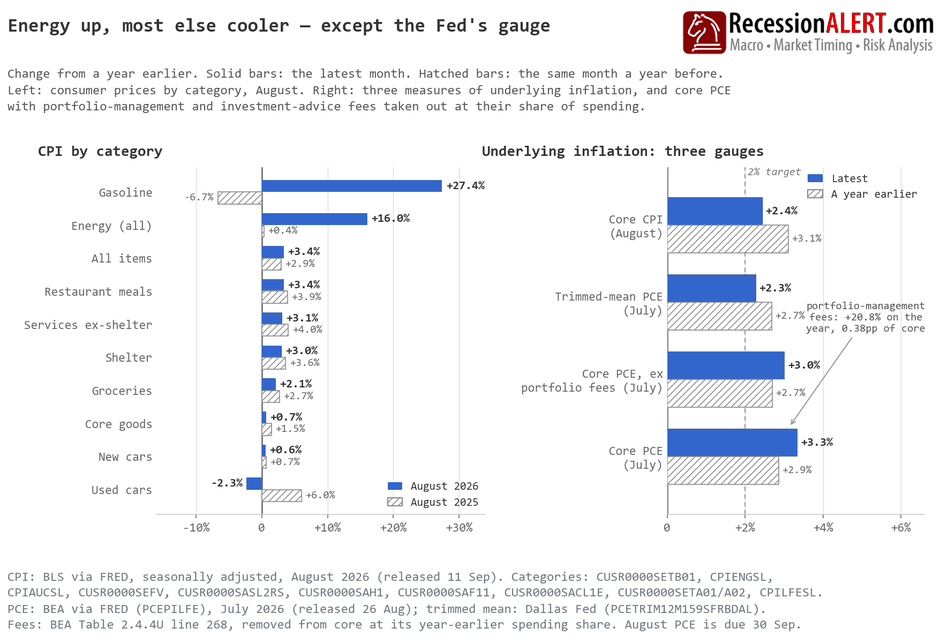
Some of the inflation Fed officials cite as they raise rates is billed on brokerage statements. Their preferred gauge, core PCE — a broad consumer-price measure with food and energy stripped out — is the only one of the three gauges here that rose over the year. It now runs 0.9 percentage point above core CPI, the widest gap since at least 1990; usually it runs about 0.4 point below. Part of the reason is bookkeeping. PCE counts what people pay to have their investments managed, which CPI leaves out, and government statisticians price those fees largely off the value of the assets. With stocks about 19% higher than a year earlier, the fees rose 21%, adding roughly 0.4 point. They are not the whole story: strip them out and core PCE still rose, to 3.0% from 2.7%. But the pressure is not broad. Outside energy, almost every price category is rising more slowly than a year ago, and the trimmed mean — which drops each month’s most extreme price moves and averages the rest — fell to 2.3%. That is hard to square with inflation “in all aspects of the economy,” as the Minneapolis Fed’s Kashkari put it days after last week’s rate hike. Stocks rose again in August, and that month’s PCE lands 30 September, a month before the Fed next meets. A rally can now pass for inflation in the very gauge used to argue for higher rates.
What it means: Slower price rises outside energy do not mean the Fed is done hiking. Its preferred gauge is partly tracking the stock market. So rates on credit cards and other loans that follow the prime rate, up to 7% last week, may stay higher for longer. This view is wrong if the trimmed mean climbs back above 2.6%, last seen a year ago.
Market Intelligence Brief (MIB) Ver. 19.70
For professional investors only. Not investment advice.
© 2026 RecessionALERT.com

Comments are closed.