
MARKET INTELLIGENCE BRIEF (MIB)
Thursday, September 24, 2026
The 10-year jumped 10.9 bps to 5.225%, its highest since 2007, and the 7-year auction cleared at the highest yield since 1993. Brent surged 4.25% to $107.46 on an Iranian threat to widen the war and Houthi missiles aimed at Saudi Arabia’s Yanbu terminal. The Fed’s Williams called another hike by year-end “reasonable.” META +4.50% held the S&P 500 flat as eight of 11 sectors fell. Anthropic committed $11.6B to Akamai’s cloud. ORCL -3.47% on a Project Jupiter force-majeure notice.
TABLE OF CONTENTS
A. EXECUTIVE SUMMARY
B. MARKET DATA
C. HIGH-IMPACT STORIES (5)
D. MODERATE-IMPACT STORIES (6)
E. ECONOMY WATCH (6)
F. EARNINGS WATCH (1)
G. WHAT’S NEXT
H. CHART OF THE DAY
A. EXECUTIVE SUMMARY -> TOP
The S&P 500’s flat close (-0.02%) masked a rate shock: the 10-year rose 10.9 bps to 5.225% against 4.6 bps on the 2-year, placing the repricing in term premium and inflation compensation rather than near-term Fed expectations, even as FOMC Vice Chair Williams called another hike by year-end “reasonable.” Demand for duration is thinning — the 7-year auction cleared at 5.085%, the highest since 1993, with indirect bidders taking 57.2% versus about 61% last month, as the Q2 current-account deficit widened to 3.0% of GDP. Oil compounded the pressure: CNBC tied Thursday’s leg of the bond selloff to Brent’s 4.25% jump on threats to Saudi Arabia’s Yanbu bypass terminal, yet Energy rose just 0.13%. Breadth was narrow — eight of 11 sectors fell as Meta (+4.50%) carried Communication Services (+1.67%) and Utilities (-0.99%, -13.60% over three months) extended their slide, leaving an index propped by one mega-cap with little cushion if long yields keep climbing.
• Long end at multi-decade highs: The 10-year rose 10.9 bps to 5.225%, its highest since June 2007, and the 30-year touched 5.501% intraday, its highest since June 2004; the 7-year auction cleared at 5.085%, the highest since April 1993, and Treasury’s tripled buyback accepted only $4.078 billion against its $6 billion maximum.
• Brent jumps 4.25% to $107.46: A military adviser to Khamenei warned the war could reach the Indian Ocean and the Saudi-led coalition intercepted six Houthi missiles aimed at Yanbu and Taif; crude dipped only briefly on a Reuters report of a phased US-Iran track to reopen Hormuz, and the Senate rejected an Iran war-powers resolution 49-50.
• Fed leans toward another hike: Williams called a hike by year-end “reasonable,” Philadelphia’s Paulson said “some modest further tightening may be warranted” and Cleveland’s Hammack saw inflation risks “tilted to the upside”; October hike odds sit near 70%, and jobless claims fell to 197K, below the 201K forecast.
• Mega-cap split: META +4.50% to $777.59 after JPMorgan lifted its target to $920 from $820 on Muse’s transaction-fee plan; ORCL -3.47% on a force-majeure notice over Project Jupiter’s delayed gas pipeline; LLY +2.68% on FDA approval of once-weekly insulin Onswik.
• AI compute stays in demand: Anthropic committed $11.6 billion over seven years to Akamai’s cloud, expandable to about $20 billion, and AKAM rose as much as 20% after hours; JPMorgan upgraded CoreWeave (+3.72%) on rising compute prices and BNP Paribas Exane upgraded Nebius (+7.44%).
• Trade truce and housing: The US-China Busan truce was extended to January 10 as Xi visited the White House; August new home sales rose 6.4% to 684K against 620K consensus, but Freddie Mac’s 30-year rate rose to 7.03%, its first reading above 7% since January 2025.
1. The long end, not the Fed, is setting the discount rate — The 10-year rose more than twice as far as the 2-year on a day three Fed speakers sounded hawkish, so the repricing sat in term premium rather than policy expectations. Two soft coupon auctions in two days, slipping indirect participation, a current-account deficit at 3.0% of GDP and a buyback that left about a third of its cap unused all describe a demand-for-duration problem that Fed hawkishness does not solve. For equities that is a higher discount rate without a matching growth upgrade, and the rate-sensitive corners are already paying: Utilities are down 13.60% over three months and mortgage rates have crossed 7%.
2. Oil and rates are now feeding each other — The threat is to Yanbu, the Red Sea outlet of Saudi Arabia’s East-West pipeline and the main route around Hormuz, which is why Brent’s premium over WTI widened to about $12.24 and why CNBC tied Thursday’s leg of the Treasury selloff to crude. Equities are treating oil as a cost rather than an earnings tailwind: Energy rose only 0.13% on a 4.25% Brent gain while the Dow Transports fell 1.33%. The phased-reopening track Reuters reported is the one development that could ease both shocks at once, but its short-lived price impact shows the market wants a signed step, not talks.
3. AI’s constraint is delivery and financing, not demand — Anthropic’s contracted Akamai commitment and JPMorgan’s rising-compute-price case for CoreWeave show demand still strong, while Oracle’s force-majeure notice shows the scarce inputs are fuel, permitting and power. The timing risk is shifting onto developers and debt-funded neoclouds just as the 10-year reaches 5.225%, and Paulson named the AI build-out as “one factor keeping underlying inflation stubbornly high” — so the spending that supports growth is also part of the Fed’s case for tightening. With one AI-linked mega-cap holding the S&P 500 flat, that feedback loop is the market’s central concentration risk.
 — Leading economic indicators. Accurate market forecasts. Apply for membership at join.recessionalert.com
B. MARKET DATA -> TOP
The bond rout deepened and crude spiked again, and equities absorbed both only by standing still: the 10-year yield jumped about 11 bps to 5.225% and the 30-year hit its highest level since 2004, while the S&P 500 finished essentially flat on a narrow, Meta-led tape with eight of 11 sectors lower. The AI complex split — Meta, AMD and Intel rallied while Oracle fell on a force-majeure notice over its Project Jupiter data center. Crude rose after a senior Iranian military official warned Tehran could widen the war to the Indian Ocean, lifting Brent above $107, and the Dow Transports lost 1.33% while oil climbed. The takeaway: the headline index is holding, but on one sector and against a rising discount rate.
CLOSING PRICES – Thursday, September 24, 2026:
MAJOR INDICES
Headline flatness masks a weak tape: the S&P 500 held unchanged on Meta-led Communication Services while the Dow, Russell 2000 and NYSE Composite all slipped. Dow Theory bear confirmation emerges today — the Dow has posted three straight lower closes and the Transports five, with the Transports 6.0% below their 10-session high. Large-cap leadership over small caps is now in its fourth session (S&P +1.5% vs Russell 2000 -1.9% over 10 sessions), and concentrated Nasdaq 100 leadership emerges today, outpacing the S&P by 3.2 points.
| Index | Close | Change | %Move | Why It Moved |
|---|---|---|---|---|
| S&P 500 | 7,704.13 | -1.90 | -0.02% | Flat: Meta (+4.50%) and Communication Services offset declines in eight of 11 sectors as the 10-year yield jumped and crude rose |
| Dow Jones | 51,349.98 | -161.61 | -0.31% | Third straight lower close; blue chips slipped as long-dated yields climbed; no single catalyst |
| DJ Transportation | 19,477.71 | -262.20 | -1.33% | Fifth straight lower close, falling while crude jumped more than 3%; no transport-specific catalyst identified |
| Nasdaq 100 | 30,478.86 | +8.56 | +0.03% | Meta, AMD and Intel gains offset weakness in hardware and storage names |
| Russell 2000 | 2,835.58 | -3.08 | -0.11% | Small caps edged lower on a day of sharply higher yields; no discrete catalyst identified |
| NYSE Composite | 23,817.10 | -31.15 | -0.13% | Modestly lower on narrow breadth — eight of 11 sectors declined |
VOLATILITY & TREASURIES
The long end led: the 10-year rose about 11 bps against roughly 5 bps on the 2-year, a bear steepening that reads as term-premium and inflation pressure rather than a sharper near-term Fed repricing. VIX rising alongside yields fits an inflation-fear signature, not a growth scare, and the dollar’s modest gain shows no safe-haven scramble.
| Instrument | Level | Change | Why It Moved |
|---|---|---|---|
| VIX | 15.67 | +0.49 (+3.23%) | Edged higher as yields and crude climbed on a flat equity tape |
| 10-Year Treasury Yield | 5.225% | +10.9 bps | Bond selloff extended to a level CNBC reported as the highest since 2007, with the 30-year at its highest since 2004; the same-day driver was not independently pinned down |
| 2-Year Treasury Yield | 4.941% | +4.6 bps | Rose less than the long end, steepening the curve |
| US Dollar Index (DXY) | 101.27 | +0.17 (+0.17%) | Firmed modestly alongside higher Treasury yields |
COMMODITIES
Precious metals slipped alongside the jump in yields — silver falling more than three times as far as gold — while copper and platinum held roughly flat, so the day’s rate shock landed on the non-yielding havens rather than on industrial metals. Bitcoin was flat, decoupled from both the equity tape and the oil spike.
| Asset | Price | Change | %Move | Why It Moved |
|---|---|---|---|---|
| Gold | $4,300.34/oz | $-18.06 | -0.42% | Eased as Treasury yields and the dollar rose; no discrete gold-specific catalyst identified |
| Silver | $64.007/oz | $-0.957 | -1.47% | Fell further than gold on the same rate pressure; no discrete catalyst identified |
| Copper | $6.7593/lb | $+0.0058 | +0.09% | Essentially flat; no discrete catalyst identified |
| Platinum | $1,754.60/oz | $+6.00 | +0.34% | Edged higher against softer precious metals; no discrete catalyst identified |
| Bitcoin | $84,216.0 | $+48.0 | +0.06% | Flat; no discrete crypto catalyst identified |
ENERGY
Brent (+4.25%) outpaced WTI (+3.32%), widening the Brent-WTI spread to about $12.24, as crude rose on an Iranian military official’s threat to extend the war to the Indian Ocean. Natural gas jumped 6.75% — twice crude’s move — and Dutch TTF rose 4.4%, so every energy line rallied on a day equities stood still.
| Asset | Price | Change | %Move | Why It Moved |
|---|---|---|---|---|
| Crude Oil (WTI) | $95.22/bbl | $+3.06 | +3.32% | Rose after a senior Iranian military official said Tehran could widen the war to the Indian Ocean if attacked, dimming Strait of Hormuz reopening hopes; pared gains on a report of US-Iran talks on a phased reopening |
| Crude Oil (Brent) | $107.46/bbl | $+4.38 | +4.25% | Same Iranian escalation threat; outpaced WTI, widening the Brent-WTI spread |
| Natural Gas (Henry Hub) | $3.227/MMBtu | $+0.204 | +6.75% | Thursday’s EIA storage report showed a build reported at 53 Bcf, slightly above forecasts, which does not explain the gain; market reports cited hot autumn weather forecasts lifting power-burn demand (not independently corroborated) |
| Natural Gas (Dutch TTF) | $25.09/MMBtu | $+1.06 | +4.43% | Rose alongside crude on the Iranian escalation headlines; no TTF-specific catalyst identified |
S&P 500 SECTORS
Eight of 11 sectors fell; only Communication Services (+1.67%), Healthcare (+0.63%) and Energy (+0.13%) held green. Utilities (-0.99%) extended a structural slide — -4.56% on the week and -13.60% over three months — on a day the 10-year jumped, while Technology slipped 0.40% despite still leading the week (+3.03%).
| Sector | 1-Day | 1-Week | 1-Month | 3-Month | 6-Month | YTD | 12-Month |
|---|---|---|---|---|---|---|---|
| Communication Services | +1.67% | +1.42% | +3.10% | +6.45% | +10.44% | +2.69% | +5.57% |
| Healthcare | +0.63% | +0.13% | -4.00% | +6.16% | +14.06% | +8.29% | +21.16% |
| Energy | +0.13% | -2.40% | +0.71% | +13.73% | +1.43% | +36.49% | +36.98% |
| Financial | -0.08% | -2.15% | -5.12% | +2.02% | +12.60% | +3.21% | +6.36% |
| Real Estate | -0.36% | -1.97% | -7.87% | -6.38% | +3.40% | +3.00% | -1.22% |
| Technology | -0.40% | +3.03% | +6.34% | +8.42% | +35.94% | +29.13% | +29.48% |
| Consumer Cyclical | -0.46% | -0.66% | -5.82% | -0.26% | +0.51% | -8.18% | -8.96% |
| Industrials | -0.62% | -0.51% | -3.25% | -9.04% | +0.75% | +8.21% | +10.20% |
| Consumer Defensive | -0.90% | -0.83% | -3.63% | -2.69% | -1.03% | +4.39% | +4.10% |
| Utilities | -0.99% | -4.56% | -8.15% | -13.60% | -12.59% | -7.62% | -7.31% |
| Basic Materials | -1.04% | -2.23% | -9.38% | +2.80% | +4.13% | +12.88% | +22.45% |
TOP MEGA-CAP MOVERS:
GAINERS
| Company | Ticker | Close | Change | Why It Moved |
|---|---|---|---|---|
| Meta Platforms | META | $777.59 | +4.50% | Extended its Muse-driven run after Zuckerberg laid out a Muse monetization plan at Meta Connect on Wednesday; JPMorgan raised its price target to $920 from $820 on Thursday |
| Intel | INTC | $127.36 | +3.88% | No company-specific catalyst identified; market reports framed the gain as an agentic-AI CPU-demand read-through from Meta’s Muse announcements, continuing the trade since Sept 21 (unverified as causal) |
| Eli Lilly | LLY | $1,181.89 | +2.68% | FDA approved Onswik (insulin efsitora alfa), a once-weekly basal insulin for type 2 diabetes, on Thursday; separately announced a licensing pact with InnoCare Pharma |
| Advanced Micro Devices | AMD | $629.26 | +2.38% | No company-specific catalyst identified; same agentic-AI CPU-demand framing as Intel, continuing a five-session run (unverified as causal) |
| Thermo Fisher Scientific | TMO | $678.39 | +1.97% | Touched an all-time high; no discrete same-day catalyst identified — continuation of the rally since its July 23 Q2 report |
DECLINERS
| Company | Ticker | Close | Change | Why It Moved |
|---|---|---|---|---|
| Oracle | ORCL | $139.54 | -3.47% | Bloomberg reported Oracle sent a force-majeure notice to the developer of Project Jupiter, its New Mexico data-center build, after the site’s gas-supply pipeline was delayed; Oracle seeks to defer payments if the 2028 timeline slips |
| Sandisk | SNDK | $1,753.62 | -3.47% | No discrete same-day catalyst identified; extended Wednesday’s decline |
| Walmart | WMT | $107.56 | -2.69% | No discrete same-day catalyst identified; fell ahead of Costco’s after-the-bell quarterly report, with Costco also lower |
| Dell Technologies | DELL | $536.02 | -2.51% | No discrete same-day catalyst identified; hardware and storage names (Sandisk, Seagate) also lower |
| IBM | IBM | $227.06 | -2.45% | No discrete same-day catalyst identified; continued weakness since its July Q2 report |
— Institutional-grade intelligence for serious investors. Apply for membership at join.recessionalert.comC. HIGH-IMPACT STORIES -> TOP
BEARISH
1. 10-Year Yield Jumps 10.9 bps to 5.225%, Highest Since 2007, as the 30-Year Touches a 2004 High and Treasury’s Tripled Buyback Goes Only Two-Thirds Used
The core facts:The 10-year Treasury yield rose 10.9 bps to 5.225% on Thursday and the 2-year 4.6 bps to 4.941%, a bear steepening. CNBC reported the 10-year at its highest level since June 2007 and the 30-year touching 5.501% intraday, its highest since June 2004, and tied Thursday’s leg of the selloff to a fresh jump in oil prices on top of Wednesday’s hot flash PMI. Treasury’s 20- to 30-year debt buyback, whose $6 billion maximum was tripled from August’s $2 billion, accepted only $4.078 billion of the $10.468 billion offered, taking 12 of 35 eligible issues. The session also carried the second soft coupon auction in two days, detailed in Section E.
Why it matters:The 10-year rose more than twice as far as the 2-year, so Thursday’s repricing sat in term premium and inflation compensation rather than in near-term Fed expectations. That is the harder problem for equities, because it raises the discount rate without a matching growth upgrade. The buyback result shows the limits of Treasury’s backstop: offers ran at about 2.6 times what Treasury chose to accept, leaving roughly a third of the enlarged cap unused on a day the long end was under pressure. The 5.225% close is the highest in Phase 1’s price history, which runs back to April 15, and the rate-sensitive sectors took the hit: Utilities fell 0.99% (-13.60% over three months) and Real Estate 0.36%, while Freddie Mac’s 30-year mortgage rate crossed 7%.
What to watch:Whether the 30-year holds above 5.5% into Friday’s durable goods and final Michigan sentiment, then August PCE on Wednesday, September 30.
BEARISH
2. Brent Jumps 4.25% to $107.46 as a Khamenei Adviser Threatens to Take the War to the Indian Ocean and Houthi Missiles Target Saudi Arabia’s Yanbu Terminal
The core facts:WTI rose 3.32% to $95.22 and Brent 4.25% to $107.46, widening the Brent-WTI spread to about $12.24, after Yahya Rahim Safavi, a military adviser to Supreme Leader Khamenei, said in a video released by Fars that “it is possible that – in response to more war – the front will expand even further, reaching the Indian Ocean and perhaps beyond.” The Saudi-led coalition said it intercepted six Houthi ballistic missiles aimed at Yanbu and Taif, with no damage reported, and French President Macron said France will send “soldiers, radar systems and defence systems” to protect Yanbu. Crude briefly dropped after Reuters reported at 12:18 ET that US and Iranian negotiators in New York were exploring a phased deal under which Iran would reopen the Strait of Hormuz and the US would lift its economic blockade; a White House official said Trump “holds all the cards.” The Senate rejected an Iran war-powers resolution 49-50.
Why it matters:Yanbu is the Red Sea outlet of Saudi Arabia’s East-West pipeline, the main route around Hormuz, so a missile attempt on it is an attack on the bypass rather than on the blockade itself. The $12 Brent premium over WTI shows the risk is being priced into seaborne crude, and the oil and rates shocks are now feeding each other: CNBC credited Thursday’s leg of the Treasury selloff to the oil move. Equities are not treating crude as an earnings tailwind — the Energy sector rose only 0.13% on a 4% Brent gain — while the Dow Transports fell 1.33%. The Reuters report is the first named negotiating track in days, but its short-lived price impact shows the market is waiting for a signed step, not talks.
What to watch:Any confirmation of the phased-reopening track from either government during the UN General Assembly, and whether Yanbu loadings resume; Brent’s hold above $105 is the market’s read of the bypass risk.
BEARISH
3. NY Fed’s Williams Calls Another Hike by Year-End “Reasonable” as Paulson Backs “Modest Further Tightening,” Keeping October Hike Odds Near 70%
The core facts:New York Fed President John Williams, speaking in London on Thursday, said investor forecasts suggested “another rate hike may be appropriate by the end of the year. That seems to me a reasonable way of thinking about it,” while declining to commit to October and saying the time for explicit forward guidance is over. His remarks came alongside Philadelphia’s Paulson and Cleveland’s Hammack, both 2026 voters, whose comments are covered in Section E. CME FedWatch put the probability of an October hike at around 70% on Thursday, according to reports citing the tool, with much of that repricing built on Wednesday after Governor Barr’s remarks.
Why it matters:Williams is the FOMC’s vice chair and a permanent voter, so his endorsement of market pricing tells investors the Fed’s leadership is not pushing back on a second hike this year. The market reaction shows where the pressure is: the 2-year rose 4.6 bps against 10.9 bps on the 10-year, so hawkish Fed talk is lifting the front end only modestly while doing nothing to anchor long yields. Speakers across the committee, from the vice chair to two regional voters, are now pointing the same way, which leaves the August PCE print as the main piece of evidence that could still change the October decision.
What to watch:Williams and Hammack both speak again on Friday, September 25; August core PCE on Wednesday, September 30 is the key input before the October 27-28 FOMC.
BULLISH
4. US and China Extend the Busan Truce to January 10 as Xi Arrives for a White House State Visit and Beijing Confirms the First AI Talks
The core facts:Treasury Secretary Bessent said on Fox’s “Special Report” on Wednesday evening, after he met Vice Premier He Lifeng and minutes after President Xi landed in Washington: “We have agreed today that we will extend what we call the Busan agreement, the economic détente between the two countries that was scheduled to end on Nov. 10 that is going to be extended until Jan. 10.” President Trump hosted Xi at the White House on Thursday for an Oval Office meeting and a state dinner, saying the two “have made tremendous strides on the issues facing our two countries.” In Beijing, Commerce Ministry spokesperson He Yadong confirmed the first US-China AI talks had taken place and said the sides discussed “plans for reducing tariffs, and extending trade arrangements agreed in Kuala Lumpur last October.” No trade instrument was signed during the session.
Why it matters:Wednesday’s report carried Bessent saying only that the US was “open” to an extension; the truce is now extended, removing a November 10 tariff cliff from the fourth-quarter calendar and buying two months for the larger package both sides have described. The Chinese confirmation matters because it came from MOFCOM rather than from Washington, and because it names tariff reductions rather than a simple rollover. Equities barely registered it — the S&P 500 finished flat and rates drove the day — which suggests the extension was expected once Bessent spoke on Wednesday and that the market is waiting for concrete tariff numbers.
What to watch:Remarks at Thursday evening’s state dinner and any joint statement before Xi leaves; the G20 trade ministerial in Milwaukee on September 30-October 1 is the next venue for tariff detail.
BULLISH
5. Meta Jumps 4.50% to Carry Communication Services and Hold the S&P 500 Flat as JPMorgan Lifts Its Target to $920 on the Muse Monetization Plan
The core facts:Meta rose 4.50% to $777.59, the session’s top mega-cap gainer, lifting Communication Services 1.67% as the day’s best sector while the S&P 500 closed down just 0.02% with eight of 11 sectors lower. JPMorgan’s Doug Anmuth raised his target to $920 from $820 and kept an Overweight rating, saying Muse has the potential to become “the most widely used consumer AI application since ChatGPT,” after CEO Mark Zuckerberg said at Meta Connect on Wednesday that the company will charge a small fee on transactions completed through the Muse agent. Benzinga’s ratings table also lists Thursday target raises from Raymond James ($860 from $650) and Citizens ($885 from $770).
Why it matters:The transaction-fee plan gives Muse a take-rate revenue model rather than a subscription one, which is why the Street is raising targets on a product that is only weeks old. It also exposes how narrow the tape has become: one stock’s gain held the headline index flat on a day the 10-year rose 10.9 bps and Brent gained more than 4%, while the Russell 2000, the Dow and the NYSE Composite all fell. An index held up by a single mega-cap has little cushion if yields keep rising.
What to watch:Whether Communication Services leadership broadens beyond Meta on Friday; if Meta stalls while the 30-year holds above 5.5%, the S&P 500 loses the only support it had on Thursday.
— Quantifying recession risk so you don’t have to guess. Apply for membership at join.recessionalert.comD. MODERATE-IMPACT STORIES -> TOP
BEARISH
6. Oracle Falls 3.47% After a Force-Majeure Notice on Project Jupiter, Its New Mexico “Stargate” Campus, as a Delayed Gas Pipeline Threatens the 2028 Timeline
The core facts:Oracle fell 3.47% to $139.54, tied with Sandisk as the session’s largest mega-cap decliner, after Bloomberg reported before the open that it had sent a force-majeure notice to the developer of Project Jupiter, a 2.45 GW data-center campus in New Mexico. The notice protects Oracle from payment obligations if the campus misses its 2028 target; Oracle is not exiting as tenant. The underlying cause is Energy Transfer’s gas line to supply the site’s fuel cells, delayed to February 1, 2027 after the New Mexico State Land Office denied a right-of-way. Oracle told CNBC: “Project Jupiter remains on our planned schedule. We are fully committed to New Mexico.”
Why it matters:This is a delivery problem, not a demand problem: the constraint on an AI campus here is fuel and permitting, not chips or customers. By invoking force majeure, Oracle is moving the timing risk onto the developer and its financiers, the leveraged layer of the AI build-out. That matters more on a day the 10-year closed at 5.225%, because a slipped schedule raises carrying costs for exactly the parties now holding the risk.
What to watch:Any revised in-service date for the pipeline beyond February 1, 2027, and whether other gas-powered AI campuses disclose similar permitting delays.
BULLISH
7. Anthropic Commits $11.6 Billion Over Seven Years to Akamai’s Cloud, Expandable to About $20 Billion, Sending Akamai Up as Much as 20% After Hours
The core facts:Akamai announced at 4:01 PM ET that Anthropic has signed an $11.6 billion, seven-year commitment to run its CPU workloads on Akamai Cloud, with provisions to expand by up to a further $9 billion, for a total of about $20 billion. Akamai issued Anthropic a warrant over about 7.7 million shares, up to roughly 5% of its common stock, at an exercise price of $111.33; about 2% vests with the initial commitment. Akamai expects about $5.5 billion of related capex, roughly $1.7 billion of it in 2026. Its shares rose as much as 20% in after-hours trading, with one report citing a gain of more than 26%. Akamai’s roughly $16 billion market cap sits below the usual threshold for this section; the story is included for the scale of the counterparty’s commitment.
Why it matters:This is a dated, contracted signal that AI labs now need large amounts of distributed CPU capacity, not only GPUs, and that they are willing to go beyond the hyperscalers to get it. Coming the same day as Oracle’s force-majeure notice, it points to the same conclusion from the other side: demand for compute remains strong and the scarce inputs are delivery, power and financing. The warrant structure also ties the supplier’s equity to the customer’s growth, a financing pattern the market has seen in other large AI contracts this year.
What to watch:Whether Akamai holds its after-hours gain in Friday’s regular session; each additional $3 billion Anthropic commits vests about 1% more of the warrant.
BULLISH
8. FDA Approves Lilly’s Once-Weekly Insulin Onswik as Lilly Also Signs a Deal Worth Up to $3.35 Billion With InnoCare; Shares Rise 2.68%
The core facts:The FDA approved Onswik (insulin efsitora alfa-gobe), a once-weekly basal insulin for adults with type 2 diabetes, Lilly announced at 6:45 AM ET Thursday. Approval rests on the QWINT Phase 3 program of more than 3,400 participants, in which weekly Onswik was non-inferior on A1C to daily insulin glargine and degludec; Lilly plans to launch it “in the coming months,” its fourth approval worldwide after Japan, Mexico and Europe. Separately, China’s InnoCare Pharma said it will receive up to $100 million in upfront and near-term payments and about $3.25 billion in milestones, plus royalties, to discover compounds for Lilly against up to five undisclosed targets. Lilly rose 2.68% to $1,181.89, the session’s third-largest mega-cap gainer, and Healthcare was one of only three sectors to finish higher.
Why it matters:Onswik extends Lilly’s diabetes franchise beyond its incretin drugs into basal insulin, where swapping 365 injections a year for 52 is a real convenience advantage for patients already on insulin. The InnoCare deal adds to a year of Lilly dealmaking that is putting its incretin cash flow to work across new targets. On a risk-off, rate-driven day, investors rewarded a mega-cap with a dated regulatory catalyst and defensive earnings.
What to watch:Lilly’s US launch date and list price for Onswik, which will determine how quickly weekly dosing takes share from daily basal insulin.
BULLISH
9. JPMorgan Upgrades CoreWeave on Rising Compute Prices and BNP Paribas Exane Upgrades Nebius; Nebius Gains 7.44%
The core facts:JPMorgan’s Samik Chatterjee upgraded CoreWeave to Overweight and raised his target to $125 from $120, citing stronger compute pricing, a push into short-term contracts at premium rates and 25% product price increases in July. CoreWeave closed up 3.72% at $90.13 after trading lower in the morning. BNP Paribas Exane upgraded Nebius to Outperform and raised its target to $399 from $260; Nebius rose 7.44% to $243.48. The two companies carry market caps of about $50 billion and $67 billion.
Why it matters:JPMorgan’s case rests on prices for rented GPU capacity going up, which runs directly against the concern that AI compute would become a commodity as supply grew. Together with Anthropic’s Akamai contract and Oracle’s delivery problem, Thursday’s news shows capacity that is already available commanding a premium. The risk runs the other way on rates: the neoclouds fund their build-outs with debt, so a 10-year at 5.225% raises their cost of growth even as pricing improves.
What to watch:Micron’s results on Wednesday, September 30 after the bell, the next hard read on AI infrastructure demand.
UNCERTAIN
10. Fed Proposes GENIUS Act Rules for Bank-Issued Stablecoins, Requiring Full Reserve Backing in Assets Such as Short-Term Treasury Bills
The core facts:The Federal Reserve Board released two proposals at 2:30 PM ET for payment-stablecoin issuers it supervises under the GENIUS Act. The first requires stablecoins to be fully backed by permissible reserve assets “such as short-term Treasury bills,” sets standardized capital requirements for credit and operational risk, and adds risk-management and safekeeping rules for reserves. The second creates a tailored application process for Board-supervised banks that want to issue stablecoins through a subsidiary. Comments are due 60 days after Federal Register publication. Governor Barr said, “I support the proposed rulemaking as a step in that direction,” while asking for clearer universal redemption rights. The FDIC and OCC published their own GENIUS Act proposals earlier this year, and CFTC staff separately updated their crypto FAQs on tokenized customer-fund investments on Thursday.
Why it matters:With the Fed’s proposal out, all three federal bank regulators now have GENIUS Act frameworks in progress, which gives banks a defined route to issue stablecoins and compete with non-bank issuers. The reserve rule points stablecoin demand at the front end of the Treasury curve, adding a potential buyer of bills at a time when the long end is struggling for demand. Bitcoin was flat at $84,216, so the market treated the proposals as expected plumbing rather than a catalyst.
What to watch:Federal Register publication of the two proposals, which starts the 60-day comment clock.
UNCERTAIN
11. Starbucks to Close About 250 Underperforming North American Cafes, Taking $300 Million of Restructuring Charges in Its Second Round of Closures Under Niccol
The core facts:Starbucks said on Thursday it will close about 250 underperforming cafes, roughly 1% of its more than 18,000 North American locations, with most closures before the end of fiscal 2026. It expects about $300 million of restructuring charges: roughly $200 million for early lease exits and employee separation benefits, and $100 million of non-cash impairment and disposal charges on company-owned store assets. It is the second round of North American closures during CEO Brian Niccol’s two-year tenure. The New York Times reported the shares flat in early trading, and the Consumer Cyclical sector fell 0.46%.
Why it matters:Two rounds of closures in two years show the turnaround still relies on cutting the store base as well as improving the stores that remain. The announcement comes in a difficult environment for discretionary spending, with AAA’s national average for regular gasoline at $4.48 against $3.16 a year ago and mortgage rates above 7%; Starbucks did not cite either factor. Investors largely looked through the charge, which suggests it was expected as part of the restructuring.
What to watch:Starbucks’ fiscal fourth-quarter report, the first to carry the charge, for whether North American comparable sales at the remaining stores keep improving.
— Separating signal from noise since 2007. Apply for membership at join.recessionalert.comE. ECONOMY WATCH -> TOP
Thursday’s data gave the Fed no reason to stand down and the bond market no reason to stop selling. Jobless claims fell to 197K, new home sales beat consensus by 64K, and Philadelphia Fed President Paulson said “some modest further tightening may be warranted” as Cleveland’s Hammack flagged upside inflation risk. The cost of that resilience is landing in funding markets: the 7-year note cleared at 5.085%, the highest since 1993, a day after a weak 5-year sale, and Freddie Mac’s 30-year mortgage rate crossed 7% for the first time since January 2025, after August’s housing strength had already been booked. Wednesday’s August PCE is the next test of whether inflation keeps justifying further hikes.
New Home Sales Jump 6.4% to 684K in August, Beating 620K Consensus, as Mortgage Rates Cross 7% (Census Bureau/Freddie Mac, Sept 24)
What they’re saying:Sales of new single-family homes rose 6.4% to a seasonally adjusted annual rate of 684,000 in August, well above the 620,000 consensus, from an upwardly revised 643,000 in July (first reported at 607,000). The median sales price was $393,700, up 0.4% on the month but down 5.8% from a year earlier, while inventory held at 483,000 homes, or 8.5 months of supply versus 9.0 in July.
The context:The beat is real but fragile: Census puts the monthly change at ±19.5%, so the gain is not statistically significant, and sales are still 2.0% below August 2025. More importantly, August’s contracts were signed before the latest rate shock. Freddie Mac’s 30-year fixed rate rose to 7.03% on Thursday from 6.95%, its first reading above 7% since January 2025, against 6.30% a year ago. Builders have been buying volume with price cuts (median down 5.8% YoY), and that lever gets harder to pull as financing costs climb.
What to watch:S&P/Case-Shiller home prices for July on Tuesday, Sept 29, and the MBA mortgage rate on Wednesday, Sept 30, the first week of applications fully priced above 7%. September new home sales follow on Oct. 27.
7-Year Note Auction Clears at 5.085%, Highest Since 1993, With Weaker Foreign Demand (US Treasury via MarketScreener, Sept 24)
What they’re saying:Treasury sold nearly $44 billion of 7-year notes at a high yield of 5.085%, the highest since April 1993, tailing the 5.078% market yield at the bid deadline. The bid-to-cover ratio slipped to 2.42 from 2.50 at last month’s sale, and indirect bidders, a group that includes foreign buyers, took 57.2% versus about 61% previously.
The context:This is the second soft coupon auction in two days, after Wednesday’s 5-year cleared at 5.033%, and it lands on a session when the 10-year yield rose 10.9 bps to 5.225% and the 30-year reached its highest level since 2004. Falling indirect participation matters because the US is running a wider external deficit (see below) that has to be financed from abroad. The 7-year was discontinued after April 1993 and reintroduced in 2009, so no auction since its reintroduction has cleared this high.
What to watch:August PCE inflation on Wednesday, Sept 30. A hot print would add inflation risk to a curve that is already struggling to absorb supply.
Initial Jobless Claims Dip to 197K, Below 201K Forecast; Four-Week Average Eases to 202,250 (Labor Department, Sept 24)
What they’re saying:Seasonally adjusted initial claims fell 1,000 to 197,000 in the week ended Sept 19, below the 201,000 consensus; the prior week was revised up 2,000 to 198,000. The four-week average eased 1,750 to 202,250, and insured unemployment rose 2,000 to 1,719,000 in the week ended Sept 12, with the insured unemployment rate unchanged at 1.1%.
The context:Layoffs remain very low and continuing claims are steady, consistent with Paulson’s assessment on Thursday that labor-market conditions “are stable and seem to have improved a bit.” For the Fed, a firm labor market removes the main argument for pausing after last week’s hike: with employment near its goal, policy attention stays on above-target inflation.
What to watch:August JOLTS on Tuesday, Sept 29, and next week’s claims on Thursday, Oct. 1, ahead of September payrolls on Friday, Oct. 2.
Fed’s Paulson: “Some Modest Further Tightening May Be Warranted”; Hammack Sees Inflation Risks “Tilted to the Upside” (Philadelphia Fed/Reuters, Sept 24)
What they’re saying:Philadelphia Fed President Anna Paulson said she supported last week’s 25 bp increase and that “if conditions evolve as I expect, some modest further tightening may be warranted,” adding that “underlying inflation is running in a range of about 2.5 to 3 percent, well above our 2 percent target” and “inflation has been too high for too long.” Cleveland Fed President Beth Hammack said separately that inflation risks are “tilted to the upside,” according to Reuters. New York Fed President Williams and Richmond Fed President Barkin also had scheduled appearances on Thursday.
The context:Paulson and Hammack are both 2026 FOMC voters. Paulson explicitly left the door open to more tightening after the Sept 16 hike to 3.75%-4.00%, while Hammack’s remarks stressed inflation risk without explicitly calling for another increase. Paulson grounded her view in an economy she described as resilient, noting that “real consumption growth accelerated to an annualized rate of 3.4 percent in the second quarter” and naming the AI buildout as “one factor keeping underlying inflation stubbornly high.” The 2-year yield rose 4.6 bps to 4.941% on the day, less than the 10-year’s 10.9 bps.
What to watch:Hammack speaks again on Friday, Sept 25 (2:00 PM ET) and Barkin on Wednesday, Sept 30. August core PCE that Wednesday is the key input before the October 28 FOMC decision.
Q2 Current-Account Deficit Widens 15.7% to $246.0B, 3.0% of GDP, Narrower Than $255B Forecast (BEA, Sept 24)
What they’re saying:The current-account deficit widened by $33.4 billion to $246.0 billion in the second quarter from a revised $212.6 billion, less than the $255 billion consensus. It rose to 3.0% of GDP from 2.7%, driven by a larger goods deficit that was partly offset by smaller deficits on primary and secondary income. The net international investment position deteriorated to -$22.42 trillion from -$21.27 trillion.
The context:The print beat expectations, but the direction is unfavorable: a wider external gap and a $1.15 trillion quarterly slide in the investment position both raise the US’s dependence on foreign capital. That dependence is being tested this week, with indirect-bidder participation falling at both the 5- and 7-year auctions.
What to watch:The advance August goods trade balance on Wednesday, Sept 30 (prior -$118.8B), the first read on third-quarter net exports.
Bank Economists See Solid Growth, Core PCE at 3.3% and Another Fed Hike in Q4 (American Bankers Association Economic Advisory Committee, Sept 2026)
What they’re saying:The ABA’s Economic Advisory Committee, made up of chief economists from large North American banks, projects real GDP growth of 2.7% in the third quarter, 2.2% in the fourth and 2.2% in 2027. It expects core PCE inflation to reach 3.3% in the fourth quarter, unemployment to stay around 4.2%, and, following last week’s Fed increase, another rate hike in the fourth quarter.
The context:The committee attributes growth mainly to business investment in data centers and technology equipment, which it sees rising 6.7% in the second half of 2026, with steady consumer spending also contributing. Its 2.7% Q3 call is well below the Atlanta Fed’s GDPNow tracker, last at 5.1% on Sept 17. The two agree on direction but not on magnitude, and both point to an economy strong enough to absorb further tightening.
What to watch:August core PCE on Wednesday, Sept 30 (prior 0.2% m/m), measured against the committee’s 3.3% year-end core path.
— Know the probability before the market prices in the risk. Apply for membership at join.recessionalert.comF. EARNINGS WATCH -> TOP
YESTERDAY AFTER THE BELL (Markets Reacted Today)
No major earnings yesterday after the bell from companies with >$100B market cap.
TODAY BEFORE THE BELL (Markets Already Reacted)
No major earnings before the bell from companies with >$100B market cap.
TODAY AFTER THE BELL (Markets React Tomorrow)
BULLISH
12. Costco Wholesale (COST): +1% AH (initial) | Revenue Beats by About $750 Million on 11% Sales Growth; EPS Includes a $0.15 Tariff-Refund Benefit
The Numbers:Released: AMC, Thursday, September 24, 2026. Fiscal fourth quarter (16 weeks): EPS $6.75 diluted vs. $6.55 estimated (+3.12%), up from $5.87 a year ago, including a non-recurring benefit of $0.15 per share from IEEPA tariff refunds; revenue $95.72B vs. $94.97B estimated (+0.80%). Net sales rose 11.2% to $93.9B from $84.4B, and net income was $2.998B vs. $2.610B. US comparable sales rose 10.7%, or 7.2% on an adjusted basis. Market cap $397.57B.
The Problem/Win:The win is on the top line: revenue came in about $750 million above the estimate, and adjusted US comps of 7.2% show traffic and ticket growth holding up. The earnings beat is narrower than it looks, since the $0.15 tariff-refund benefit, which Costco partly reinvested in member value, accounts for most of the gap to the estimate.
The Ripple:Walmart fell 2.69% into the print with no discrete catalyst identified, and Consumer Defensive fell 0.90%, so Costco’s report is the first hard data point on defensive retail since that selloff. Friday’s session will show whether a clean revenue beat lifts the group or stays specific to Costco.
What It Means:Costco is still growing sales at double digits while shoppers face $4.48 gasoline and rising borrowing costs. With the one-off stripped out, the quarter confirms a steady compounder rather than an upside surprise, which fits the muted initial reaction.
What to watch:Membership fee income and renewal rates on the earnings call, and whether the initial after-hours gain holds into Friday’s session.
WEEK AHEAD PREVIEW:
Q3 2026 earnings season is only beginning (0.6% of the S&P 500 had reported as of FactSet’s September 18 update), and two companies above $100B report over the next five business days.
Micron Technology (MU) — AMC, Wednesday, September 30 — consensus EPS $31.49 and revenue $50.91B against company guidance of $50.0B ± $1.0B; market cap $1,220.34B. Key focus: HBM pricing and supply, AI data-center memory demand, and fiscal 2027 capex. The print arrives after Sandisk fell 3.47% on Thursday, extending weakness in storage and memory names.
Accenture (ACN) — BMO, Thursday, October 1 — consensus EPS $3.18; market cap $108.56B. Key focus: fiscal 2027 revenue guidance, bookings, and whether AI is eroding demand for its hours-based consulting work or adding to it through generative-AI projects.
No other company above $100B reports on Friday, September 25, Monday, September 28 or Tuesday, September 29; the largest scheduled reporter across those days is Carnival (CCL, $29.84B), before the bell on Tuesday.
— US market commentary trusted by family offices and institutions. Apply for membership at join.recessionalert.comG. WHAT’S NEXT -> TOP
UPCOMING RELEASES:
| Date | Event | Why It Matters |
|---|---|---|
| Fri, Sep 25 | Durable Goods Orders, Aug (expected -0.4%; ex-transportation expected +0.6%) | Bank economists credit data-center and technology-equipment investment for most of the economy’s growth; a firm ex-transportation print strengthens the resilience case the Fed is citing for further tightening. |
| Fri, Sep 25 | Michigan Consumer Sentiment, Final Sep (expected 47.6) | Households face regular gasoline at $4.48 against $3.16 a year ago and mortgage rates above 7%; the survey’s inflation-expectations read feeds directly into the October hike debate. |
| Fri, Sep 25 | Fed speakers: Williams (5:15 AM ET), Hammack (2:00 PM ET) | Williams called another hike by year-end “reasonable” on Thursday and Hammack saw inflation risks “tilted to the upside”; any pushback against October hike odds near 70% would be the first from the committee’s leadership. |
| Fri, Sep 25 | UN General Assembly continues | The venue for any confirmation of the phased US-Iran track Reuters reported, under which Iran would reopen Hormuz and the US would lift its blockade; a signed step could ease both the oil and the rates shock. |
| Tue, Sep 29 | JOLTS Job Openings, Aug (prior 7.271M); CB Consumer Confidence, Sep (prior 89.4); Case-Shiller Home Prices, Jul (prior +2.1% YoY) | With claims at 197K, a firm openings count leaves the Fed no labor-market reason to pause; Case-Shiller shows whether falling new-home prices are spreading to existing homes. |
| Wed, Sep 30 | Core PCE Price Index, Aug (prior +0.2% m/m); PCE YoY (prior 3.7%); Personal Income and Spending, Aug | The key inflation input before the October 27-28 FOMC; bank economists project core PCE at 3.3% by the fourth quarter, and a hot print would add inflation risk to a curve already struggling to absorb supply. |
| Wed, Sep 30 | Q2 GDP (final estimate); ADP Employment, Sep (prior 38K); Advance Goods Trade Balance, Aug (prior -$118.8B); MBA Mortgage Rate (prior 7.12%) | The goods balance is the first read on third-quarter net exports after the Q2 current-account deficit widened to 3.0% of GDP; the MBA survey is the first week of applications fully priced above 7% on Freddie Mac’s measure. |
| Wed, Sep 30 | G20 trade ministerial, Milwaukee (through Oct 1) | The next venue for tariff detail after the US-China Busan truce was extended to January 10 and Beijing named tariff reductions as a topic. |
| Thu, Oct 1 | ISM Manufacturing PMI, Sep (prior 54.6); Initial Jobless Claims | A last read on factory activity and layoffs before September payrolls on Friday, October 2, with manufacturing already running in expansion territory. |
KEY QUESTIONS:
1. With the 10-year at 5.225% and the 7-year auction clearing at its highest yield since 1993, does Wednesday’s August core PCE give the long end a reason to stabilize, or does a hot print carry the 30-year decisively through 5.5%?
2. Does the phased US-Iran track produce a signed step during the UN General Assembly, or does the threat to Saudi Arabia’s Yanbu bypass keep Brent above $105 and the oil-rates feedback loop running?
3. How long can Meta hold up an index where eight of 11 sectors are falling — and if Communication Services leadership fails to broaden on Friday, which sectors absorb the next leg of higher yields?
— US market commentary trusted by family offices and institutions. Apply for membership at join.recessionalert.comH. CHART OF THE DAY -> TOP
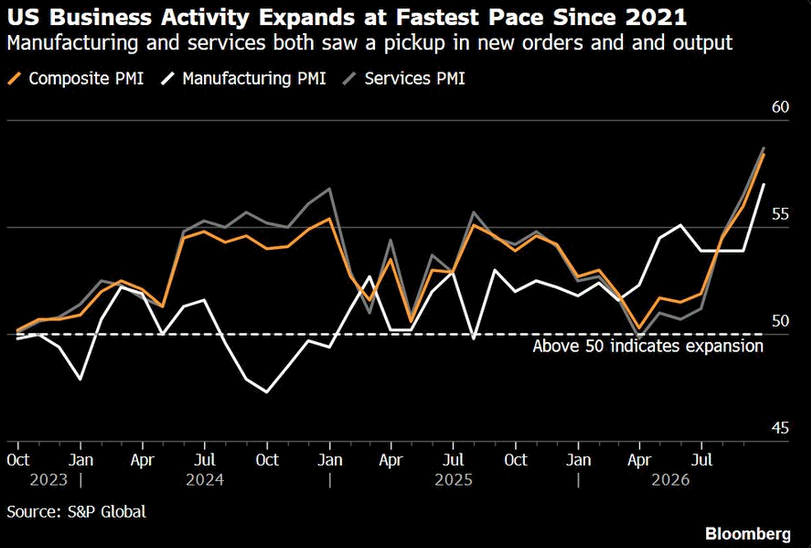
The growth in this survey is not what should worry bond markets — the queue is. The flash composite leapt from about 50 in April, in the war’s opening weeks, to 58.4, the biggest improvement since early 2015 outside the post-lockdown reopening, S&P Global says. Demand can turn that fast; capacity cannot. Backlogs of unfinished orders are growing at the sharpest rate since May 2022, supply bottlenecks rank among the most severe in the survey’s near-two-decade history excluding the pandemic, and firms report trouble finding staff despite the fastest hiring since June 2022. The queue even flatters the white line: the manufacturing index gives 15% of its weight to supplier delivery times, counted in reverse, so slower deliveries score as strength — though output and new orders climbed too. The queue is also leverage. Overall input-cost inflation is the highest since October 2022, and S&P’s Chris Williamson infers growing pricing power; selling-price inflation, up on August but below its March-to-July pace, does not yet show it in full, with competition restraining service firms, whose confidence sits well below trend. Against that backdrop, the 10-year yield jumped 13.9bp to 5.106%, its highest since 2007, the day Governor Barr said further policy adjustments are likely. Higher rates cannot hurry a delivery or train a machinist; they can only shorten the queue. The Fed can live with a fast economy. It cannot live with a waiting list.
What it means: Borrowing costs are likely to keep rising while suppliers stay stretched, which hurts long-term bonds and anyone taking out a mortgage. Companies that can pass higher costs on to customers are better placed; service firms facing stiff competition are being squeezed. This view is wrong if backlogs keep building through December while selling-price increases stay below the spring pace.
Market Intelligence Brief (MIB) Ver. 19.71
For professional investors only. Not investment advice.
© 2026 RecessionALERT.com

Comments are closed.