
MARKET INTELLIGENCE BRIEF (MIB)
Wednesday, July 8, 2026
Iran’s ceasefire collapsed as the U.S. struck 80+ targets and Treasury revoked Tehran’s oil waiver, sending WTI up 5.9% and Brent up 6.9%. The Dow sank 577 points (-1.1%) as nine of eleven sectors fell. Hawkish FOMC minutes showed nine of eighteen officials still eyeing a hike on AI-capex and oil-driven inflation risk. AI chips bucked the selloff — Broadcom’s $30B Apple deal, Nvidia’s China reports, and Arista +8.8%. Gold fell 1.7% despite the risk-off tape. May consumer credit unexpectedly contracted.
TABLE OF CONTENTS
A. EXECUTIVE SUMMARY
B. MARKET DATA
C. HIGH-IMPACT STORIES (3)
D. MODERATE-IMPACT STORIES (7)
E. ECONOMY WATCH (5)
F. EARNINGS WATCH (0)
G. WHAT’S NEXT
H. CHART OF THE DAY
A. EXECUTIVE SUMMARY -> TOP
Equities sold off broadly Wednesday as the Iran-Israel ceasefire collapsed and Washington moved to choke off Tehran’s oil exports entirely, but the real story is what didn’t happen: gold fell instead of rallying, signaling markets are pricing this as an inflation shock, not a flight-to-safety event. That distinction matters because it landed the same day the Fed’s own June minutes revealed a committee still split on whether to hike, with officials explicitly naming AI-capex demand and oil-driven prices as structural — not transitory — inflation risks. A softening consumer (May credit contracted for the first time since 2024) is pulling policy toward easing even as energy and Fed hawkishness argue for tightening, a genuinely two-sided setup heading into the July 28-29 FOMC meeting. The selloff was narrow rather than broad-based: AI-chip strength (Broadcom’s $30B Apple deal, Nvidia’s China reports) kept the Nasdaq positive, meaning the pain concentrated in cyclicals, financials, and Middle East-exposed industrials rather than the market as a whole.
• Dow -1.09% (-577 pts) to 52,348; S&P 500 -0.28%; Nasdaq 100 +0.27% as AI-chip strength decoupled tech from the broader selloff
• WTI +5.93% to $74.62, Brent +6.88% to $79.26 after Treasury revoked Iran’s oil-export license and the ceasefire collapsed
• FOMC June minutes: nine of eighteen officials still eyeing a hike; markets price ~76-79% odds of a July 28-29 hold
• Broadcom +4.83% on finalized $30B Apple chip deal; Nvidia +3.65% on China H200-approval reports; Arista +8.76% on new AI-fabric switch launch
• GE Aerospace -2.98%, RTX -2.96% on Middle East-driven commercial-aviation guidance cuts
• May consumer credit unexpectedly contracted for the first time since 2024; Realtor.com cut its 2026 home-sales and price forecasts on the same rate-path shift
1. Inflation shock, not risk-off — Gold’s failure to rally alongside a genuine geopolitical escalation is the day’s most telling signal: markets are pricing the Iran conflict as an oil-driven inflation event, not a flight-to-quality one, which is why Treasury yields rose in tandem with the VIX rather than falling.
2. The Fed’s policy dilemma just got harder — A hawkish, split FOMC now has to reconcile oil-driven inflation risk with a genuinely softening consumer (the first credit contraction since 2024), a combination that pulls policy toward both tightening and easing simultaneously heading into July 28-29.
3. AI capex is currently insulated from macro shocks — The Broadcom-Apple deal and Nvidia’s China developments were strong enough to keep the Nasdaq positive on a day the Dow fell over 1%, confirming the AI trade remains the market’s dominant idiosyncratic driver, decoupled from broader risk sentiment.
 — Leading economic indicators. Accurate market forecasts. Apply for membership at join.recessionalert.com
B. MARKET DATA -> TOP
Markets sold off after President Trump declared the U.S.-Iran ceasefire memorandum “over” and the Treasury revoked Iran’s oil-export license, sending WTI up 5.9% and Brent up 6.9% while the Dow shed 577 points (-1.1%); hawkish FOMC minutes reinforcing a longer rate pause compounded the pressure. The selloff was a near-total flush — nine of eleven S&P sectors closed red — with only Energy and AI-chip-driven Technology (Broadcom +4.8%, Nvidia +3.6%, Arista +8.8%) holding gains. Gold’s slide to $4,086 despite the risk-off tone is the day’s key divergence: rising oil is stoking inflation fears that keep yields elevated, undercutting gold’s usual safe-haven bid. Aerospace names (GE Aerospace, RTX) and cyclicals broadly bore the brunt of the Middle East-driven repricing.
CLOSING PRICES – Wednesday, July 8, 2026:
MAJOR INDICES
The pullback was Dow-led (-1.09%) versus a flat-to-higher Nasdaq 100 (+0.27%), as AI-chip strength (Broadcom, Nvidia, Arista) offset broad risk-off selling — a concentrated, not market-wide, retreat. Dow Theory bull confirmation remains in force for a third straight session: both DJIA and DJTA sit within 2% of their 10-session highs despite today’s dip, signaling the underlying uptrend is intact. Russell 2000’s -0.90% roughly tracked the S&P, showing no meaningful small-cap breadth deterioration.
| Index | Close | Change | %Move | Why It Moved |
|---|---|---|---|---|
| S&P 500 | 7,482.59 | -21.26 | -0.28% | Broad risk-off as Iran ceasefire collapses and oil surges |
| Dow Jones | 52,348.09 | -577.06 | -1.09% | Heaviest hit by Financials/Industrials exposure to the selloff |
| DJ Transportation | 21,733.9 | -38.8 | -0.18% | Modest decline, still tracking near multi-session highs |
| Nasdaq 100 | 29,252.56 | +75.59 | +0.27% | AI-chip rally (Broadcom, Nvidia, Arista) offsets broader selloff |
| Russell 2000 | 2,955.60 | -26.89 | -0.90% | Small-caps tracked the broad market decline |
| NYSE Composite | 23,790.61 | -226.35 | -0.94% | Broad-based decline across NYSE-listed issues |
VOLATILITY & TREASURIES
VIX’s 4.65% spike alongside rising 10Y (+5.1bps) and 2Y (+5.8bps) yields is an inflation-fear signature, not a recession scare — consistent with hawkish FOMC minutes flagging energy-driven price risk. The 2Y outpacing the 10Y confirms markets are repricing near-term rate-cut odds lower. Notably, the dollar index slipped despite the risk-off tape — the usual safe-haven bid is absent, since the shock is an inflation story rather than a classic flight-to-quality event.
| Instrument | Level | Change | Why It Moved |
|---|---|---|---|
| VIX | 16.88 | +0.75 (+4.65%) | Risk-off spike on Iran ceasefire collapse/oil shock |
| 10-Year Treasury Yield | 4.580% | +5.1 bps | Rose on hawkish FOMC minutes and oil-driven inflation risk |
| 2-Year Treasury Yield | 4.220% | +5.8 bps | Rose on reduced near-term rate-cut expectations |
| US Dollar Index (DXY) | 100.99 | -0.07 (-0.07%) | Slipped despite risk-off; safe-haven bid largely absent |
COMMODITIES
Gold fell to $4,086 even as equities sold off — an inversion of its usual safe-haven role, as surging oil prices raise inflation and rate-path concerns rather than growth fears. Silver (-4.32%) and platinum (-4.35%) fell in step with gold, confirming a precious-metals-wide repricing rather than an industrial-demand story alone. Bitcoin’s -2.13% decline tracked the broader risk-off tone, showing no independent crypto catalyst today.
| Asset | Price | Change | %Move | Why It Moved |
|---|---|---|---|---|
| Gold | $4,086.55/oz | -$70.85 | -1.70% | Fell as rate-path/inflation concerns outweighed safe-haven demand |
| Silver | $58.680/oz | -$2.650 | -4.32% | Tracked gold lower in a broad precious-metals retreat |
| Copper | $6.1180/lb | -$0.1080 | -1.73% | Declined with broader risk sentiment |
| Platinum | $1,590.70/oz | -$72.30 | -4.35% | Tracked precious metals lower |
| Bitcoin | $62,082.0 | -$1,353.0 | -2.13% | Tracked the broader risk-off tape |
ENERGY
WTI (+5.93%) and Brent (+6.88%) surged in near-lockstep after the U.S. revoked Iran’s oil-export license, confirming this is a global supply shock, not a regional disruption. Dutch TTF jumped 5.28% in sympathy, but Henry Hub fell 1.44% — the divergence shows US natural gas remains insulated from the Middle East crude story. Rising oil against falling equities marks a supply-shock, stagflationary read rather than a demand-driven rally.
| Asset | Price | Change | %Move | Why It Moved |
|---|---|---|---|---|
| Crude Oil (WTI) | $74.62/bbl | +$4.18 | +5.93% | Surged after Treasury revoked Iran’s oil-export license |
| Crude Oil (Brent) | $79.26/bbl | +$5.10 | +6.88% | Surged in lockstep with WTI on global supply-shock fears |
| Natural Gas (Henry Hub) | $3.218/MMBtu | -$0.047 | -1.44% | Decoupled from crude’s supply-driven rally |
| Natural Gas (Dutch TTF) | $16.41/MMBtu | +$0.82 | +5.28% | Rose in sympathy with crude on European supply-risk concerns |
S&P 500 SECTORS
Nine of eleven sectors closed red, with only Energy (+1.64%, extending a multi-week and YTD-leading rally) and Technology (chip-driven) holding gains. Basic Materials remains the market’s structural laggard, its -2.30% session deepening a -3.04% weekly and -6.79% three-month slide. Industrials’ reversal stands out — a +8.00% three-month gainer now down -5.08% for the week, tracking GE Aerospace and RTX’s Middle East-driven guidance concerns.
| Sector | 1-Day | 1-Week | 1-Month | 3-Month | 6-Month | YTD | 12-Month |
|---|---|---|---|---|---|---|---|
| Energy | +1.64% | +4.50% | -3.44% | -8.34% | +20.17% | +23.82% | +29.66% |
| Technology | +1.21% | -3.26% | +0.17% | +25.81% | +18.60% | +19.59% | +33.28% |
| Consumer Defensive | -0.49% | +1.16% | +0.92% | +2.03% | +7.89% | +7.50% | +3.95% |
| Utilities | -0.52% | -0.31% | +1.91% | -2.49% | +5.42% | +5.97% | +12.81% |
| Industrials | -1.00% | -5.08% | +0.83% | +8.00% | +11.28% | +15.61% | +22.29% |
| Consumer Cyclical | -1.15% | -0.55% | +0.56% | +6.74% | -6.28% | -4.93% | +3.65% |
| Healthcare | -1.27% | +2.07% | +7.95% | +11.08% | +5.97% | +6.27% | +22.71% |
| Communication Services | -1.29% | +2.24% | -1.38% | +9.68% | +3.83% | +4.43% | +33.84% |
| Real Estate | -1.55% | +0.28% | +0.48% | +7.06% | +8.82% | +9.26% | +7.85% |
| Financial | -1.79% | +1.82% | +5.71% | +11.60% | +1.06% | +3.67% | +11.66% |
| Basic Materials | -2.30% | -3.04% | -4.86% | -6.79% | +2.12% | +5.60% | +26.87% |
TOP MEGA-CAP MOVERS:
GAINERS
| Company | Ticker | Close | Change | Why It Moved |
|---|---|---|---|---|
| Arista Networks Inc | ANET | $181.05 | +8.76% | New AI-fabric switch launch (7060XE7) plus analyst price-target hikes to $200 |
| Sandisk Corp | SNDK | $1,727.18 | +6.77% | Continued momentum in the AI-linked NAND/storage trade |
| Broadcom Inc | AVGO | $388.69 | +4.83% | Expanded agreement with Apple on US-made components |
| NVIDIA Corp | NVDA | $204.12 | +3.65% | Reports Chinese firms plan to increase H200 chip purchases |
| Dell Technologies Inc | DELL | $431.97 | +3.52% | Evercore price-target hike to $500 on 757% YoY AI server revenue growth |
DECLINERS
| Company | Ticker | Close | Change | Why It Moved |
|---|---|---|---|---|
| Palo Alto Networks Inc | PANW | $320.59 | -4.88% | Profit-taking after an overbought rally, despite a 60% YoY ARR beat and raised FY26 guidance |
| American Express Co | AXP | $336.39 | -3.77% | Tracked the broad risk-off selloff tied to Iran ceasefire collapse |
| GE Aerospace | GE | $356.03 | -2.98% | Cut 2026 departure forecast, citing Middle East instability |
| RTX Corp | RTX | $194.91 | -2.96% | Middle East commercial-aviation exposure concerns despite raised guidance |
| Procter & Gamble Co | PG | $148.40 | -2.85% | Tracked the broader risk-off tape; no distinct company catalyst identified |
— Institutional-grade intelligence for serious investors. Apply for membership at join.recessionalert.comC. HIGH-IMPACT STORIES -> TOP
BEARISH
1. US Launches New Strikes on Iran After Tanker Attacks Near Strait of Hormuz; Trump Declares Ceasefire “Over,” Oil Surges Over 5%
The core facts:The U.S. military struck more than 80 targets inside Iran overnight — including air defense systems, command-and-control networks, radar sites, anti-ship missile capabilities, and small boats — in retaliation for Iranian attacks on three commercial vessels transiting the Strait of Hormuz. Speaking from the NATO summit in Turkey, President Trump declared the U.S.-Iran ceasefire memorandum “over” and threatened further strikes; the Treasury Department separately revoked the waiver permitting Iranian crude oil sales, with no transactions permitted after July 17. Iran claimed retaliatory strikes on more than 80 U.S. military facilities in Bahrain and Kuwait. WTI crude settled up 4.4% to $73.52/bbl and Brent rose 5.4% to $78.19/bbl. The Dow fell 576.76 points (-1.09%) to 52,348.39, with 9 of 11 S&P sectors declining; Materials suffered their worst single-day loss in over a year (-3%) while Energy (+2.42%) was the sole standout gainer. Gold, typically a safe-haven beneficiary, fell 2.24% to $4,066.40/oz as rising real-rate expectations outweighed geopolitical risk demand. The IMF separately flagged the energy shock in a downward revision to its global growth outlook, projecting oil could rise nearly 32% for 2026 if the conflict persists.
Why it matters:This is the most significant escalation since the two sides signed their ceasefire memorandum, and it directly undercuts the “normalization” narrative markets had been pricing — including EIA forecasts for Hormuz traffic recovery and Brent easing toward $74 later this year. The license revocation adds a durable sanctions-enforcement layer on top of the physical strikes, tightening global crude supply just as OPEC+ has counted on gradual Hormuz-traffic recovery to offset its own output increases. For US markets, a sustained oil-price shock complicates the Fed’s inflation calculus at the exact moment today’s FOMC minutes (Story 2) revealed a committee already split on the hike/hold question — the combination raises the odds of a stagflationary policy dilemma heading into the July 28-29 meeting.
What to watch:Whether Iran follows through on further retaliation and whether tanker traffic through Hormuz — which carries roughly 20% of global oil volume — is disrupted in coming sessions; Friday’s IMF global outlook detail for updated oil-price assumptions.
UNCERTAIN
2. FOMC June Minutes Reveal Committee Split Under New Chair Warsh; Nine of 18 Officials See Possible Hike
The core facts:Minutes from the June 16-17 FOMC meeting — Kevin Warsh’s first as Fed chair — released today at 2:00 PM ET, showed the committee genuinely divided on the rate path: “many participants” saw the appropriate year-end funds rate within or slightly below the current 3.50%-3.75% range, while “many other participants” judged it should be above that range. Nine of 18 officials’ dots pointed to at least one hike before year-end. Officials explicitly flagged sustained AI-infrastructure demand as a lasting source of upward pressure on technology-product and electricity prices, and noted tariff- and energy-driven inflation risk from the Strait of Hormuz closure remains tilted to the upside. The minutes carried unusual weight because Warsh withheld his own dot-plot projection at the June meeting, leaving the transcript as the only on-record committee statement ahead of the July 28-29 meeting. Treasury yields, already rising on the Iran escalation (Story 1), extended gains on the release; markets continue to assign roughly a 76-79% probability to a hold at the July meeting.
Why it matters:A genuinely split committee — with no clear signal from the chair himself — raises the risk of policy-communication surprises just as Warsh’s more terse, less-forward-guided communication style faces its first real stress test. The explicit acknowledgment that AI-capex demand is now a structural inflation input (not a transitory one) is new and durable: it means the Fed’s forward path is now entangled with the same AI-investment cycle currently roiling semiconductor valuations (Story 3), a linkage portfolio managers have not had to price before.
What to watch:June CPI, due July 14, as the next hard data point testing whether realized inflation is tracking the committee’s still-elevated expectations; any post-minutes commentary from voting members before the July 28-29 blackout period begins.
BULLISH
3. Broadcom’s $30B Apple Chip Deal and Nvidia’s China Approval Reports Fuel AI Semiconductor Rally Even as Broader Market Sells Off
The core facts:Apple and Broadcom finalized an expanded multi-year agreement valued at more than $30 billion — the largest such US-manufacturing commitment to date — covering more than 15 billion custom wireless/RF chips to be made domestically through 2031, alongside a $1.5 billion Apple investment to modernize Broadcom’s Fort Collins, Colorado plant; the deal is part of Apple’s broader $600 billion, four-year US investment pledge. Broadcom shares rose 4.5-4.8% on the news. Separately, Nvidia rose 3.65% on reports that Chinese regulators are preparing to lift restrictions allowing Alibaba, ByteDance, and other domestic AI firms to purchase H200 chips. The cluster extended to networking and server names: Arista Networks (+8.76%) launched new AI-fabric switches alongside analyst price-target hikes to $200, and Dell (+3.52%) received an Evercore price-target increase to $500 on 757% year-over-year AI server revenue growth. The complex was not uniform — AMD fell roughly 6.5% — but the broader move was strong enough that the Nasdaq (+0.2%) and Technology sector (+1.7%) decoupled from the Dow’s 1.09% Iran-driven decline.
Why it matters:The Apple-Broadcom agreement is a concrete, multi-year commitment that reinforces the durability of AI-driven semiconductor demand at a moment when investors have been questioning whether elevated AI-infrastructure valuations can hold. The Nvidia China development, if confirmed, would reopen a large addressable market that had been closed by export restrictions — a genuine demand-expansion catalyst rather than a sentiment-driven bounce. That this cluster was strong enough to offset a broad geopolitical risk-off day underscores how central the AI-capex trade remains to overall market direction.
What to watch:Formal confirmation of China’s H200 licensing approval from Chinese regulators or Nvidia itself; further detail on Apple-Broadcom production ramp timelines.
— Quantifying recession risk so you don’t have to guess. Apply for membership at join.recessionalert.comD. MODERATE-IMPACT STORIES -> TOP
BEARISH
4. GE Aerospace Falls for Second Session on Middle East Guidance Cut and Valuation Downgrade
The core facts:GE Aerospace shares fell 3.20% today, adding to Tuesday’s 3.17% decline, after the company cut its 2026 commercial-departures growth forecast from mid-single-digit to flat-to-low-single-digit, citing a low-double-digit decline in Middle East departures tied to the region’s ongoing conflict. The stock also faces a recent institutional downgrade to Sell on valuation grounds, with shares trading at a 47-50x forward P/E versus a 36.9x five-year average. RTX fell in sympathy on similar Middle East commercial-aviation exposure concerns, though its larger defense and missile segment provides a partial hedge that GE Aerospace lacks.
Why it matters:The departures cut is a direct, quantifiable read-through from the Iran escalation (Story 1) into commercial-aerospace aftermarket revenue — GE Aerospace’s highest-margin business — making it one of the cleaner corporate transmission channels of the Mideast conflict into US large-cap earnings. The valuation downgrade compounds the move: a stock priced for perfection has little room to absorb even a modest guidance trim.
What to watch:GE Aerospace’s Q2 2026 earnings date for confirmation of the revised departures trajectory; whether the Iran conflict (Story 1) shows signs of de-escalation, which would be the clearest path to a guidance reversal.
UNCERTAIN
5. Palo Alto Networks Falls 5.5% on Valuation-Driven Profit-Taking Despite Strong ARR Growth
The core facts:Palo Alto Networks shares fell 5.54% today, extending Tuesday’s 3.24% decline, even as the company’s underlying metrics remain strong — next-generation security ARR guidance of $8.9-8.95 billion implies 59-60% growth. The decline is attributed to profit-taking and technical overbought conditions after the stock reached record highs, compounded by valuation concerns: the forward P/E has expanded to nearly 90x following a roughly $30 billion acquisition spree (including the $25 billion CyberArk and $3.35 billion Chronosphere deals) that has raised integration and margin-dilution concerns. Today’s broader Middle East-driven risk-off tape (Story 1) added incremental pressure on high-multiple tech names.
Why it matters:The disconnect between strong fundamentals and a sharp share-price decline is a valuation story, not a business-quality story — but it signals that investors are growing less willing to pay premium multiples for growth-through-acquisition strategies in a market newly sensitive to rate risk (Story 2). The pattern is a useful read on sentiment fragility across other high-multiple cybersecurity and software names.
What to watch:Integration progress commentary on CyberArk and Chronosphere at the next earnings call; whether the stock stabilizes above technical support in the $150-160 range in coming sessions.
UNCERTAIN
6. Gold Falls to One-Week Low Despite Equity Selloff as Rate-Hike Repricing Overwhelms Safe-Haven Demand
The core facts:Gold fell 2.24% to $4,066.40/oz — its lowest level since July 2 — even as equities sold off broadly on the Iran escalation (Story 1), an inversion of its traditional safe-haven role. Silver and platinum fell in tandem (down roughly 3-4%), confirming a precious-metals-wide repricing rather than an isolated move. The decline is attributed to oil-driven inflation concerns pushing real-rate expectations higher and strengthening the dollar via petrodollar demand; markets are now pricing at least one Fed hike by year-end, which increases the opportunity cost of holding non-yielding gold.
Why it matters:Gold’s failure to rally on a genuine geopolitical shock is a meaningful signal: it confirms that today’s dominant market driver is the inflation/rate-path implication of the Iran conflict (Story 2) rather than pure risk aversion, since a risk-aversion-led selloff would typically lift gold alongside bonds. For portfolio managers, this reduces gold’s near-term reliability as a portfolio hedge against this specific type of Middle East escalation risk.
What to watch:Whether gold decouples again if the Iran conflict escalates further without a corresponding rise in rate expectations; the dollar index for confirmation of the petrodollar-strength thesis.
UNCERTAIN
7. May Consumer Credit Unexpectedly Contracts for First Time Since 2024 as Credit-Card Balances Shrink
The core facts:Today’s May consumer credit data (full figures in Section E) showed an outright contraction against a Street forecast for growth — the first such decline since late 2024, driven by the steepest drop in revolving (credit-card) balances in the same period. The data adds a market-relevant consumer-health signal to today’s session, with implications concentrated in credit-sensitive financials and consumer-discretionary names.
Why it matters:A genuine contraction in revolving credit, rather than merely slower growth, suggests households are actively pulling back on discretionary card spending as interest rates on outstanding balances sit near multi-year highs (22.15%). This reinforces a cooling-consumer narrative that would typically argue for Fed easing, but it lands the same day as a hawkish FOMC minutes release and an inflationary oil shock (Stories 1-2) — a combination that complicates rather than clarifies the Fed’s forward path, since weak consumer credit and rising inflation expectations pull policy in opposite directions simultaneously.
What to watch:June consumer credit data, due early August, to confirm whether the contraction is a one-month aberration or the start of a sustained pullback.
BEARISH
8. Realtor.com Cuts 2026 Home Price and Sales Forecasts, Citing Middle East-Driven Rate Pressure
The core facts:Realtor.com trimmed its 2026 existing-home sales forecast to 4.10 million units (from 4.13 million) and cut expected home-price growth to 1.2% — a pace that trails inflation, meaning real home values are effectively declining. The firm left its 6.3% mortgage-rate forecast unchanged but noted markets have swung from pricing one-to-two rate cuts by December to one-to-two hikes instead, a nearly full-point shift tied to the ongoing Middle East conflict (Story 1) and its inflationary spillover. New-home sales have softened as builder rate buydowns and price cuts lose effectiveness, with permits and starts pulling back most sharply in the South and West.
Why it matters:The forecast cut is a direct housing-sector transmission channel from today’s broader geopolitical/rate-path story: a full-point swing in rate expectations over a matter of months materially changes builder economics and buyer affordability math. Homebuilders and mortgage-sensitive names face a double headwind — higher-for-longer rates and cooling price appreciation — just as the sector had been counting on affordability improvements to sustain 2026 volume.
What to watch:June housing starts and permits data for confirmation of the regional pullback in the South and West; any further rate-path shift tied to developments in the Iran conflict.
BULLISH
9. Meta Commits $9.2 Billion to First Canadian AI Data Center, Extending Hyperscaler Capex Buildout
The core facts:Meta announced a C$13 billion (~$9.2 billion) one-gigawatt AI data center in Sturgeon County, Alberta — its first in Canada and 33rd globally — partnering with Pembina Pipeline for a long-term tolling agreement tied to a new natural-gas-fired power plant coming online in late 2030. The 2.9 million-square-foot facility is expected to create 3,000 construction jobs and 300 permanent roles, alongside a $60 million local infrastructure commitment.
Why it matters:The commitment demonstrates that hyperscaler AI-infrastructure capex continues to accelerate even as investors elsewhere debate the sustainability of AI-related valuations (a tension visible in this week’s semiconductor volatility, Story 3). The Pembina partnership signals growing demand for dedicated natural-gas generation to power AI data centers, a read-through for North American natural-gas producers and midstream operators beyond the immediate Meta capex figure.
What to watch:Meta’s Q2 2026 earnings call for updated full-year capex guidance and commentary on data-center ROI; further natural-gas demand commitments from other hyperscalers following the Pembina precedent.
UNCERTAIN
10. Bank of America Extends First $520 Million Credit Line to OpenAI Ahead of Planned IPO
The core facts:Bank of America extended a $520 million credit facility to OpenAI — its first loan to the company — after previously declining an earlier OpenAI financing request. The facility adds to an existing undrawn line from other banks, bringing OpenAI’s total available credit above $5 billion. BofA is also reportedly weighing an advisory role in OpenAI’s and Anthropic’s planned IPOs; OpenAI confidentially filed for a US listing last month targeting a valuation above $1 trillion, though a timeline delay has been discussed. BofA has helped raise nearly $500 billion in AI-related capital since last year, roughly 60% of that category’s investment-grade debt, leveraged-finance, and equity issuance.
Why it matters:The reversal — from declining to now extending credit — signals Wall Street’s escalating competition for a role in what could be one of the largest IPOs on record, but it also extends bank balance-sheet exposure to a still-unprofitable, pre-IPO borrower at a moment when AI-capex sustainability is already under market scrutiny (Story 3). For financials investors, the size is immaterial to BofA’s balance sheet, but the trend — banks racing to underwrite AI-adjacent credit and equity — is a signal of both fee-opportunity and concentration risk building in the sector.
What to watch:Confirmation of BofA’s or other banks’ formal IPO advisory mandates for OpenAI or Anthropic; any update on OpenAI’s IPO timeline.
— Separating signal from noise since 2007. Apply for membership at join.recessionalert.comE. ECONOMY WATCH -> TOP
Hawkish policy signals collided with softening ground-level data. June FOMC minutes showed nine of eighteen officials still eyeing a hike, reinforcing a “higher-for-longer” stance even as consumer credit growth stalled and Pantheon Macroeconomics warned labor-force participation could snap back, pushing unemployment higher in the second half. GDPNow’s modest upgrade to 1.4% offered a partial offset, while Realtor.com trimmed its housing outlook — fewer sales, but cooling prices should hand buyers more leverage. Markets are pricing resilience the incoming data isn’t fully confirming.
June FOMC Minutes Reveal Hawkish Split, Nine of Eighteen Officials Still Eye a Hike (Federal Reserve, July 8, 2026)
What they’re saying:Minutes from the June 16-17 meeting — Chair Kevin Warsh’s first — showed the Committee held rates at 3.50%-3.75% but remained split on the path ahead: 9 of 18 participants projected at least one hike by year-end, 8 saw no change, and only one anticipated a cut. Officials continued to view upside inflation risks as elevated, citing AI-related investment, tariffs, and Middle East tensions as potential price pressures, and staff revised inflation projections higher for both 2026 and 2027.
The context:The minutes were the Fed’s only substantive on-record account of the debate since Warsh has kept public communication deliberately quiet. The hawkish hold confirms a “higher-for-longer” stance and pushes back on market hopes for near-term easing. Treasury yields rose and equity futures softened modestly on the release, though the reaction was contained since the split was largely as expected.
What to watch:Fed speeches from Williams and Logan on Thursday, July 9, for fresh signals on the hike/hold debate ahead of the July 28-29 FOMC meeting.
Consumer Credit Growth Stalls in May, Badly Missing Forecasts (Federal Reserve G.19, July 8, 2026)
What they’re saying:Total consumer credit was roughly flat in May, printing -$0.18B against expectations for a $17.1B increase and down sharply from April’s $20.82B expansion. Revolving credit (credit cards) contracted on the month even as non-revolving credit — auto and personal loans — continued to expand.
The context:The near-complete stall in borrowing, concentrated in credit-card usage, points to households actively pulling back on discretionary spending even as elevated card APRs (above 21%) and record card balances make new borrowing more expensive. Combined with today’s hawkish FOMC minutes, the data cuts against the “resilient consumer” narrative markets have been pricing.
What to watch:June retail sales and the next G.19 consumer credit release (early August) for confirmation of a broader consumer pullback.
Pantheon Macroeconomics Warns Labor-Force Participation Faces “Snapback” Risk, Unemployment Seen Rising in H2 (Pantheon Macroeconomics, July 8, 2026)
What they’re saying:Pantheon Macroeconomics flagged that discouraged workers who have exited the labor force could re-enter as job openings stabilize, mechanically pushing the unemployment rate higher in the second half of 2026 even without a fresh wave of layoffs — a “snapback” in participation rather than a deterioration in job creation.
The context:A participation-driven rise in unemployment is a softer signal than a layoff-driven one, but it still complicates the Fed’s reaction function: a higher headline unemployment rate could be read as labor-market cooling even as underlying demand for workers holds up, adding noise to the September policy debate flagged in today’s FOMC minutes.
What to watch:The labor-force participation rate and unemployment rate in the next BLS jobs report; initial jobless claims Thursday, July 9 (expected 218K).
Atlanta Fed’s GDPNow Ticks Up to 1.4% for Q2 (Federal Reserve Bank of Atlanta, July 7, 2026)
What they’re saying:The Atlanta Fed’s GDPNow model raised its Q2 2026 real GDP growth estimate to 1.4% (seasonally adjusted annual rate) on July 7, up from 1.2% on July 1, as incoming data was incorporated into the nowcast.
The context:The upgrade is modest but offers a partial counterweight to today’s softer consumer-credit and labor-participation signals — growth is tracking below trend but not accelerating toward the “stall speed” some forecasters flagged earlier in the year.
What to watch:Further GDPNow revisions ahead of the BEA’s advance Q2 GDP estimate in late July.
Realtor.com Cuts 2026 Home Sales Forecast, Sees Affordability Improving Anyway (Realtor.com, July 8, 2026)
What they’re saying:Realtor.com cut its 2026 existing-home sales forecast to 1% growth (4.10 million units) from a December projection of 1.7% growth (4.13 million), citing geopolitical headwinds from the Middle East conflict that began in late February. Home-price growth was trimmed to 1.2% from 2.2%, and housing-starts growth to 2.0% from 3.1%; mortgage rates were held near 6.3%.
The context:The mixed revision cuts both ways: weaker sales and construction confirm the housing sector remains a drag on growth, but Realtor.com actually raised its forecast for mortgage-payment relief (to a 1.9% decline from 1.3%) as price growth cools, with Chief Economist Danielle Hale noting buyers are gaining negotiating power.
What to watch:Existing-home sales for June, due Thursday, July 9.
— Know the probability before the market prices in the risk. Apply for membership at join.recessionalert.comF. EARNINGS WATCH -> TOP
YESTERDAY AFTER THE BELL (Markets Reacted Today)
No major earnings yesterday after the bell from companies with >$100B market cap.
TODAY BEFORE THE BELL (Markets Already Reacted)
No major earnings before the bell from companies with >$100B market cap.
TODAY AFTER THE BELL (Markets React Tomorrow)
No major earnings after the bell from companies with >$100B market cap.
WEEK AHEAD PREVIEW:
Q1 2026 earnings season is effectively complete (89% reported); Q2 2026 season opens with one of its earliest large-cap reporters this week.
PepsiCo (PEP) — BMO, Thursday, July 9 — Consensus EPS ~$2.19-2.21 on ~$23.9B revenue (+5% YoY). Key focus: whether Frito-Lay North American snack volumes hold up or show further trade-down pressure; gross-margin and core operating-profit trends versus last year’s asset-writedown-distorted comparisons; rising tariff and input-cost pressures; and the volume-versus-pricing mix within organic growth. PepsiCo cut full-year sales and EPS guidance after Q1, a contrast to Coca-Cola’s guidance raise, making this report a key read on whether the gap between the two beverage giants widens or narrows.
Q2 2026 earnings season broadens meaningfully over the following two weeks as large-cap financials and industrials begin reporting.
— US market commentary trusted by family offices and institutions. Apply for membership at join.recessionalert.comG. WHAT’S NEXT -> TOP
UPCOMING RELEASES:
| Date | Event | Why It Matters |
|---|---|---|
| Thu, Jul 9 | Existing Home Sales (Jun, prior 4.17M; MoM prior +3.2%) | Direct read on housing demand and affordability, and a near-term test of today’s Realtor.com 2026 forecast cut |
| Thu, Jul 9 | Weekly Jobless Claims (Initial exp. 218K, prior 215K; Continuing prior 1,814K) | First hard labor-market print since today’s FOMC minutes flagged participation “snapback” risk for H2 unemployment |
| Thu, Jul 9 | Fed Speeches: Williams and Logan | First on-record commentary from voting members since today’s split FOMC minutes, ahead of the July 28-29 blackout period |
| Thu, Jul 9 | 30-Year Bond Auction (prior yield 5.020%) | Demand test for long-duration Treasuries as yields climb on oil-driven inflation risk |
| Fri, Jul 10 | WASDE Report | Agricultural supply/demand data relevant to food-price inflation tracking amid broader inflation concerns |
KEY QUESTIONS:
1. Does Thursday’s existing-home sales data confirm or contradict Realtor.com’s newly-cut 2026 housing forecast?
2. Will Williams’ and Logan’s Thursday remarks reveal which side of the FOMC’s hike/hold split carries more institutional weight heading into July 28-29?
3. Does the Iran conflict escalate further in the coming days, and if so, does oil’s rally force the Fed’s hand toward a hike despite softening consumer credit?
— US market commentary trusted by family offices and institutions. Apply for membership at join.recessionalert.comH. CHART OF THE DAY -> TOP
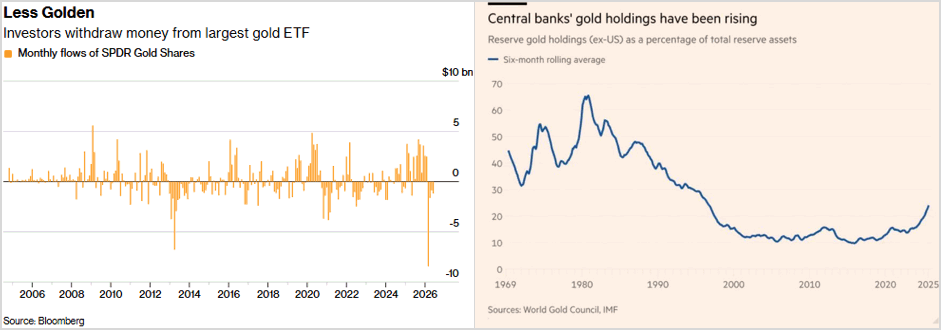
Central banks bought straight through a 25% crash — that is the whole tell. As Western capital dumped GLD in a single -9bn month, the deepest redemption in the fund’s twenty-year history, the official sector added 244 tonnes in Q1 alone, on pace for a fourth straight year above 700. The two panels resolve into one market once you see that gold’s marginal buyer has changed hands: from the price-sensitive ETF holder, who sells the drawdown and chases momentum, to the price-insensitive central bank, which executes a reserve mandate that never consults the tape. That mandate has a birthdate — 2022, when Russia’s frozen reserves proved the issuer can switch dollars and Treasuries off at will, and left gold as the only reserve asset with no counterparty to freeze, seize, or sanction. So the reserve share clawing off its 10% trough toward 24% is not a trade; it is a 55-year round trip reversing. The first-order read is that gold has decoupled from real yields and Western flows — price them and you misread it. The second-order read is the one that counts: a structural bid for the one unfreezable reserve is, mechanically, a structural bid against the dollar it replaces. De-dollarization isn’t a slogan; it is being priced, in metal.
Market Intelligence Brief (MIB) Ver. 18.42
For professional investors only. Not investment advice.
© 2026 RecessionALERT.com

Comments are closed.