
MARKET INTELLIGENCE BRIEF (MIB)
Tuesday, July 7, 2026
Chip stocks cratered despite Samsung’s blowout profit — Intel -9.66%, Nasdaq 100 -1.77% — as Reuters reported DeepSeek is building its own AI chip. NY Fed inflation expectations hit 3.7%, highest since 2023, lifting the 10-year 7bps and exposing a Hammack-hawkish, Williams-dovish Fed split before the July 28-29 FOMC. Oil spiked 5.3% after Iran struck tankers near Hormuz and Washington revoked Tehran’s export license. Healthcare’s rotation rally extended; Rivian sank 18% on a $1.5B raise, SpaceX slid 6.34% in its Nasdaq-100 debut.
TABLE OF CONTENTS
A. EXECUTIVE SUMMARY
B. MARKET DATA
C. HIGH-IMPACT STORIES (5)
D. MODERATE-IMPACT STORIES (5)
E. ECONOMY WATCH (5)
F. EARNINGS WATCH (0)
G. WHAT’S NEXT
H. CHART OF THE DAY
A. EXECUTIVE SUMMARY -> TOP
Equities retreated from record highs as three narratives converged: an AI-valuation reckoning in semiconductors, a policy-driven escalation in the Strait of Hormuz standoff, and a widening internal Fed rift over inflation. Samsung’s blowout profit couldn’t arrest the chip selloff — a “sell the news” signal that AI-infrastructure valuations have priced in near-perfection — while Reuters’ report that DeepSeek is building its own inference chip adds a structural threat to Nvidia’s pricing power; separately, Washington’s revocation of Iran’s crude export license layers a durable sanctions dimension onto the Hormuz tanker attacks that will outlast today’s price spike. The NY Fed’s inflation-expectations reading hit its highest since 2023 alongside a visible Fed split — Cleveland’s Hammack turning hawkish, New York’s Williams staying dovish — raising policy-communication risk heading into the July 28-29 FOMC. Breadth stayed narrow, not broadly risk-off: Healthcare’s rally extended a seven-week, nine-percent uptrend predating today, confirming a sustained rotation out of AI/tech risk ahead of Q2 earnings rather than a single-day flinch.
• Semiconductor rout deepens: Intel (INTC) -9.66%, Marvell -7.45%, Sandisk -7.26%, KLA -7.22%, and Lam Research -6.87% lead a broad chip selloff after Samsung’s earnings beat failed to calm AI-valuation fears; Nasdaq 100 -1.77%.
• Oil spikes on Hormuz attacks: WTI +5.32% to $72.20/bbl (Brent +0.36% to $76.16) after Iran struck two tankers near the Strait of Hormuz; the US Treasury revoked Iran’s crude export license after-hours, extending the move.
• Inflation expectations jump: NY Fed survey shows 1-year inflation expectations rising to 3.7%, highest since September 2023; 10-year yield +7.2 bps to 4.551%, VIX +3.6% to 16.13.
• Defensive sectors lead: Energy (+2.85%) and Healthcare (+1.37%) topped the tape — XOM +3.85%, CVX +3.52%, JNJ +3.05%, LLY +2.96% — while Technology (-1.95%), Industrials (-2.79%), and Basic Materials (-2.14%) lagged.
• Single-stock shocks: Rivian (RIVN) plunged 18% on a surprise $1.5 billion share offering tied to a DOE loan; SpaceX (SPCX) fell 6.34% on its Nasdaq-100 fast-track debut as index-fund flows were already absorbed.
• Growth data mixed: May trade deficit widened to $77.6B (+$23B sequentially); ADP Weekly Pulse showed hiring decelerating for a second straight week, adding a cooling-labor counterweight to today’s hot inflation print.
1. AI-Valuation Unwind Is Broadening, Not Isolated — Samsung’s sell-the-news reaction, DeepSeek’s move toward proprietary inference silicon, and Healthcare’s seven-week outperformance together confirm capital is structurally repositioning away from AI/tech concentration risk ahead of Q2 earnings, not reacting to a single bad headline. Portfolios overweight semiconductor exposure should expect continued volatility into mid-to-late July reporting.
2. Geopolitical Oil Risk Collides With a Hawkish-Leaning Fed — The Hormuz tanker attacks and Iran export-license revocation create a durable, policy-backed supply-risk premium just as inflation expectations hit a three-year high and the Fed’s internal messaging splits (Hammack hawkish, Williams dovish). This combination raises the odds of a volatile, communication-driven run-up to the July 28-29 FOMC.
3. Cooling Growth, Rising Inflation Complicate the Fed’s Path — A widening trade deficit and a second straight week of decelerating ADP hiring point to slowing growth, but today’s inflation-expectations spike argues the opposite direction for policy. That stagflation-adjacent tension, not either data point alone, is the more important signal for rate-path positioning into Q2.
 — Leading economic indicators. Accurate market forecasts. Apply for membership at join.recessionalert.com
B. MARKET DATA -> TOP
Equities pulled back from record highs as a broad rotation out of AI-linked semiconductors into defensive healthcare and energy dominated the tape — Intel led chip losses (-9.66%) after Samsung’s earnings miss reignited AI-bubble valuation concerns, dragging the Nasdaq 100 down 1.77% while the Dow held closer to flat. Crude oil spiked 5.32% after a projectile struck an LNG carrier near the Strait of Hormuz, lifting Energy (+2.85%) and Healthcare (+1.37%) to the day’s sector leaders even as Technology and Industrials each sank more than 2%. Treasury yields rose (10Y +7bps) after a New York Fed survey showed one-year inflation expectations climbing to 3.7% — the highest since September 2023 — pressuring gold (-1.22%) despite the Mideast risk backdrop.
CLOSING PRICES – Tuesday, July 7, 2026:
MAJOR INDICES
Dow Theory bull confirmation remains in force — DJIA and DJTA both sit within 2% of their 10-session highs, now in its third session. Beneath that, the Nasdaq 100’s 1.77% drop against the Dow’s 0.25% dip confirms a narrow tech-selloff, not a broad risk-off day. The 10-session S&P-vs-Nasdaq spread continues to favor the broad index over growth — a broadening rotation into value and cyclicals, now extending into a second session.
| Index | Close | Change | %Move | Why It Moved |
|---|---|---|---|---|
| S&P 500 | 7,503.75 | -33.68 | -0.45% | Broad rotation out of AI/tech into defensive healthcare and energy |
| Dow Jones | 52,924.56 | -131.35 | -0.25% | Pulled back from record highs; blue-chips relatively insulated from chip selloff |
| DJ Transportation | 21,772.7 | -98.3 | -0.45% | Tracked broader industrial weakness |
| Nasdaq 100 | 29,173.02 | -524.86 | -1.77% | Led losses on semiconductor selloff — Samsung earnings miss reignited AI-bubble valuation fears |
| Russell 2000 | 2,982.13 | -27.41 | -0.91% | Small-caps declined with broader risk-off tone |
| NYSE Composite | 24,016.96 | -58.16 | -0.24% | Broad composite tracked mixed defensive/energy rotation |
VOLATILITY & TREASURIES
VIX’s 3.6% rise alongside higher yields (10Y +7bps, 2Y +6bps) signals inflation fear, not recession fear — bonds are repricing on today’s NY Fed reading showing one-year inflation expectations jumping to 3.7%, the highest since September 2023. DXY’s modest firming alongside the Hormuz shipping attack suggests some safe-haven bid, though the move was too small to be the dominant driver.
| Instrument | Level | Change | Why It Moved |
|---|---|---|---|
| VIX | 16.13 | +0.56 (+3.60%) | Ticked up on tech selloff and Mideast shipping attack risk |
| 10-Year Treasury Yield | 4.551% | +7.2 bps | Rose on hot NY Fed inflation expectations reading |
| 2-Year Treasury Yield | 4.187% | +6.2 bps | Tracked the broader yield move on inflation repricing |
| US Dollar Index (DXY) | 101.09 | +0.24 (+0.23%) | Modest safe-haven bid tied to Mideast tensions and rate expectations |
COMMODITIES
Gold and silver fell in tandem — gold -1.22%, silver -3.09% — as rising real yields outweighed Mideast safe-haven demand, confirming today’s driver is rate expectations, not fear. Platinum’s flat print breaks from the precious-metals slide, while Bitcoin’s 1.11% decline tracked the broader tech/growth retreat rather than decoupling into its own narrative.
| Asset | Price | Change | %Move | Why It Moved |
|---|---|---|---|---|
| Gold | $4,116.70/oz | -$50.80 | -1.22% | Pressured by rising yields and hawkish Fed rate-hike bets |
| Silver | $60.405/oz | -$1.925 | -3.09% | Tracked gold lower, amplified by industrial demand concerns |
| Copper | $6.1825/lb | -$0.0495 | -0.79% | Modest decline alongside broader industrial metals softness |
| Platinum | $1,649.30/oz | +$6.20 | +0.38% | Roughly flat, diverging from the broader precious-metals slide |
| Bitcoin | $63,794.0 | -$715.0 | -1.11% | Tracked the broader risk-off tone in tech/growth assets |
ENERGY
WTI’s 5.32% surge on the Strait of Hormuz shipping attack sharply outpaced Brent’s 0.36% gain — an unusual divergence given Brent’s typical sensitivity to Mideast risk, suggesting the move reflects a domestic/technical squeeze as much as geopolitical premium. Natural gas sat out entirely, confirming the rally is a crude-specific supply-fear trade, not broad energy-inflation.
| Asset | Price | Change | %Move | Why It Moved |
|---|---|---|---|---|
| Crude Oil (WTI) | $72.20/bbl | +$3.65 | +5.32% | Projectile struck an LNG carrier near the Strait of Hormuz, raising Mideast supply-disruption fears |
| Crude Oil (Brent) | $76.16/bbl | +$0.27 | +0.36% | Muted reaction versus WTI despite the same catalyst |
| Natural Gas (Henry Hub) | $3.281/MMBtu | +$0.036 | +1.11% | Modest gain, underperforming crude’s surge |
| Natural Gas (Dutch TTF) | $14.76/MMBtu | $0.00 | 0.00% | Flat — no incremental European gas-specific catalyst |
S&P 500 SECTORS
Energy (+2.85%) and Healthcare (+1.37%) led as capital rotated out of Technology (-1.95%), Industrials (-2.79%) and Basic Materials (-2.14%) — a classic defensive/value shift on the day’s AI-valuation scare. Healthcare’s 1-month standout (+9.49%) confirms this is a sustained rotation, not a one-day blip, while Technology’s -7.08% 1-month slide shows the AI trade has been unwinding for weeks beneath its still-strong 3-month gain.
| Sector | 1-Day | 1-Week | 1-Month | 3-Month | 6-Month | YTD | 12-Month |
|---|---|---|---|---|---|---|---|
| Energy | +2.85% | +2.32% | -7.05% | -9.26% | +19.29% | +21.83% | +26.03% |
| Healthcare | +1.37% | +2.39% | +9.49% | +12.52% | +7.24% | +7.73% | +23.24% |
| Real Estate | +1.02% | -0.10% | +2.64% | +8.87% | +10.79% | +10.98% | +8.54% |
| Consumer Defensive | +0.86% | +0.17% | +3.03% | +0.76% | +8.08% | +8.03% | +4.49% |
| Communication Services | +0.45% | +3.76% | -1.63% | +9.76% | +3.22% | +2.88% | +22.26% |
| Utilities | +0.41% | -1.15% | +2.65% | -1.73% | +5.15% | +6.53% | +13.27% |
| Financial | -0.41% | +3.68% | +7.21% | +13.71% | +4.92% | +5.55% | +12.39% |
| Consumer Cyclical | -0.68% | +0.73% | -0.80% | +6.94% | -3.46% | -3.81% | +3.50% |
| Technology | -1.95% | -1.87% | -7.08% | +24.70% | +17.37% | +18.16% | +30.52% |
| Basic Materials | -2.14% | -0.02% | -7.55% | -4.52% | +6.56% | +8.08% | +28.77% |
| Industrials | -2.79% | -2.40% | +0.28% | +8.83% | +14.33% | +16.76% | +22.77% |
TOP MEGA-CAP MOVERS:
GAINERS
| Company | Ticker | Close | Change | Why It Moved |
|---|---|---|---|---|
| ExxonMobil Holdings Corp | XOM | $141.69 | +3.85% | Energy sector rally on Strait of Hormuz oil supply-shock spike |
| Chevron Corp | CVX | $174.01 | +3.52% | Energy sector rally on Strait of Hormuz oil supply-shock spike |
| Johnson & Johnson | JNJ | $267.24 | +3.05% | Defensive healthcare rotation out of AI/tech names |
| Lilly (Eli) & Co | LLY | $1,235.56 | +2.96% | Healthcare rotation plus GLP-1 momentum after Medicare Bridge program launch |
| Meta Platforms Inc | META | $615.58 | +2.55% | Continued optimism around planned “Meta Compute” cloud business |
DECLINERS
| Company | Ticker | Close | Change | Why It Moved |
|---|---|---|---|---|
| Intel Corp | INTC | $110.39 | -9.66% | Led chip selloff on AI-bubble valuation concerns; foundry losses/capex scrutiny ahead of July 23 earnings |
| Marvell Technology Inc | MRVL | $230.70 | -7.45% | Broad semiconductor selloff following Samsung earnings miss |
| Sandisk Corp | SNDK | $1,617.70 | -7.26% | Broad semiconductor selloff on AI-bubble valuation concerns |
| KLA Corp | KLAC | $216.47 | -7.22% | Broad semiconductor selloff on AI-bubble valuation concerns |
| Lam Research | LRCX | $326.13 | -6.87% | Broad semiconductor selloff on AI-bubble valuation concerns |
— Institutional-grade intelligence for serious investors. Apply for membership at join.recessionalert.comC. HIGH-IMPACT STORIES -> TOP
BEARISH
1. Semiconductor Rout Deepens as Samsung’s Record Profit Fails to Satisfy AI-Bubble Skeptics; Intel Sinks 9.66%, DeepSeek Chip Report Compounds Pressure
The core facts:Samsung Electronics reported preliminary Q2 operating profit of roughly $58 billion — a 19-fold jump year-over-year that beat analyst estimates — yet the stock fell as much as 10% intraday in Seoul and erased over $100 billion in market value as investors questioned whether elevated AI-chip demand can be sustained at current pricing. The reaction spread globally: Intel fell 9.66%, Marvell dropped 7.45%, Sandisk fell 7.26%, KLA fell 7.22%, and Lam Research fell 6.87% in US trading, while AMD, Applied Materials, and Western Digital all declined 6-10% intraday. Adding to the pressure, Reuters reported that Chinese AI startup DeepSeek — whose January 2025 model triggered a prior chip-stock selloff — has begun designing its own AI inference chip to reduce reliance on Nvidia and Huawei, sending Nvidia down roughly 1.5% premarket. The Nasdaq 100 fell 1.77% and the Technology sector dropped 1.95%, while Industrials (-2.79%) and Basic Materials (-2.14%) also sold off on the same AI-sustainability concerns.
Why it matters:This is a “sell the news” event, not a demand shock — Samsung’s results were genuinely strong, but the market’s reaction confirms elevated AI-infrastructure valuations have left little room for anything short of blowout upside surprises. The DeepSeek chip-design report reinforces a second, structural concern: even if near-term AI capex holds, Nvidia’s pricing power and market share face a longer-run threat from customers building proprietary silicon to control inference costs. The breadth of today’s selloff — reaching equipment makers, memory, and foundry names alike, not just AI-pure-plays — signals investors are repricing the entire semiconductor complex’s risk premium, not rotating within it.
What to watch:Intel’s July 23 earnings for foundry-division commentary and capex guidance; further detail on DeepSeek’s inference-chip timeline and any additional hyperscaler self-sufficiency announcements that would confirm a broader shift away from Nvidia dependency.
UNCERTAIN
2. Iranian Tanker Attacks Near Strait of Hormuz Spike Oil as US Revokes Iran’s Crude Export License
The core facts:Iran struck at least two tankers near the Strait of Hormuz today, including the Qatari LNG carrier Al-Rekayyat, which caught fire roughly 8 nautical miles east of Limah, Oman; a second tanker transiting the strait was hit by an unidentified projectile and suffered structural damage. WTI crude settled up 5.32% to $72.20/bbl while Brent rose a more muted 0.36% to $76.16 — an unusual divergence given Brent’s typical Mideast sensitivity. Prices extended sharply higher after hours when the US Treasury Department revoked Iran’s authorization to conduct certain crude oil sales, a direct policy response to the attacks; Brent popped as much as 5.6% and WTI 5.4% in after-hours trading. The Strait handles roughly 20% of global oil traffic, and today’s threat level for tanker crossings was raised to “severe.” Energy stocks led S&P sector gains (+2.85%), with ExxonMobil (+3.85%) and Chevron (+3.52%) topping today’s mega-cap gainers, while Industrials (-2.79%) and Basic Materials (-2.14%) sold off partly on the same risk-off impulse.
Why it matters:The attacks reaffirm how fragile the US-Iran interim peace agreement remains just weeks after the two sides signed a memorandum to end their four-month war — a reminder that the “normalization” narrative underpinning recent oil-forecast cuts (the EIA had projected Brent easing to $74 in Q3 as Hormuz traffic recovered) can reverse abruptly. The license revocation adds a second, more durable pressure point beyond the physical attacks: it formally tightens US sanctions enforcement on Iranian crude just as OPEC+ has been relying on a gradual Hormuz recovery to offset its own output hikes. For US markets, sustained oil-price volatility complicates the Fed’s inflation calculus at the same time today’s NY Fed survey showed inflation expectations climbing (Story 3).
What to watch:Tomorrow’s session for confirmation that the after-hours oil spike holds through regular trading; tanker-crossing volumes through Hormuz as the clearest real-time gauge of whether the ceasefire framework is unraveling.
UNCERTAIN
3. Treasury Yields Jump as NY Fed Survey Shows Inflation Expectations at Highest Since 2023
The core facts:Today’s NY Fed inflation-expectations reading (full data in Section E) coincided with a sharp Treasury selloff: the 10-year yield rose 7.2 bps to 4.551% and the 2-year rose 6.2 bps to 4.187%, while gold fell 1.22% and silver dropped 3.09% as rising real yields outweighed Mideast safe-haven demand. VIX rose 3.6% to 16.13. Fed Cleveland President Beth Hammack said she may advocate for higher rates if inflation pressures don’t moderate, while New York Fed President John Williams struck a more sanguine tone, telling Fox Business that falling energy prices make him more positive on the near-term inflation trajectory — a visible split in Fed messaging on the same day.
Why it matters:A 5-bps-plus move in the 10-year on a single data point is a meaningful repricing of rate-cut odds, not noise. Rising short-term inflation expectations complicate the case for near-term easing just as Chair Warsh’s data-dependent communication framework faces its first real test of internal consistency — Hammack’s hawkish lean and Williams’ dovish lean, delivered the same day, raise the risk of policy-communication surprises heading into the July 28-29 FOMC meeting. Combined with today’s oil spike (Story 2), the inflation-expectations backdrop now has two independent upward catalysts converging in the same session.
What to watch:June CPI, due mid-July, to confirm whether realized inflation is tracking these elevated expectations; the July 8 FOMC minutes for further insight into the committee’s internal guidance debate.
UNCERTAIN
4. SpaceX Falls 6.34% on First-Ever Nasdaq-100 Fast-Track Debut as “Buy the Rumor, Sell the News” Dynamic Plays Out
The core facts:SpaceX (SPCX) joined the Nasdaq-100 today, just 15 trading days after its June 12 IPO — the largest in history, with SpaceX now valued above $2 trillion — under a new fast-track rule adopted May 1, 2026 that allows any IPO ranked in the top 40 by market cap to enter the index after only 15 trading days. Despite the milestone, shares fell 6.34% to $149.58 from a $160.42 prior close. J.P. Morgan had estimated the inclusion would pull roughly $4.3 billion in forced passive buying into a stock with only a 3-5% public float, but most of that index-fund buying was already completed by the July 6 close and July 7 open, leaving the stock with little further room to run once the mechanical flows were absorbed.
Why it matters:This is the first-ever use of Nasdaq’s fast-track mega-IPO rule, a structural change to how large newly-public companies enter passive-fund flows, with real implications for index-fund positioning in future mega-IPOs. The muted-to-negative reaction echoes prior high-profile Nasdaq-100 additions like Palantir and Strategy, which also peaked around their inclusion dates — a pattern that should temper expectations that index membership is automatically a bullish catalyst, and a caution for investors chasing similar setups in SK Hynix’s upcoming $28 billion Nasdaq ADR listing (pricing July 9).
What to watch:Whether SPCX stabilizes or continues to unwind over the next several sessions as the “sell the news” dynamic plays out; SK Hynix’s July 9 pricing for a read on whether the pattern repeats.
BULLISH
5. Healthcare Rotation Extends to Multi-Year Highs as Investors Flee AI-Valuation Risk for Defensives
The core facts:Healthcare led S&P sectors again today (+1.37%), extending a rotation that has taken the sector up more than 7% over the past week and 9.49% over the past month — its strongest such stretch in years — as capital fled AI/tech valuation risk for defensive ground. Johnson & Johnson (+3.05%) and Eli Lilly (+2.96%) were both among today’s top mega-cap gainers, with Lilly’s rally aided by continued momentum from the Medicare GLP-1 Bridge program (a flat $50/month copay for weight-loss drugs) launched July 1, and Cardinal Health also trading near record highs. The move mirrors a broader defensive shift: Utilities also gained today, consistent with a rotation out of growth and into safety.
Why it matters:A sector move of this persistence and magnitude — not a one-day blip but a sustained multi-week trend — signals institutional capital is genuinely repositioning away from AI-infrastructure risk rather than merely trimming at the margin. For portfolio managers, Healthcare’s outperformance alongside Technology’s -7.08% one-month slide confirms today’s semiconductor selloff (Story 1) is part of a broader multi-week valuation unwind, not an isolated event, with real allocation consequences for growth-versus-value positioning heading into Q2 earnings season.
What to watch:Whether the rotation persists once Q2 2026 earnings season opens mid-to-late July and investors get fresh fundamental data to reassess both trades.
— Quantifying recession risk so you don’t have to guess. Apply for membership at join.recessionalert.comD. MODERATE-IMPACT STORIES -> TOP
UNCERTAIN
6. May Trade Deficit Widens $23 Billion Sequentially, Adding Q2 GDP Drag Despite Narrow Forecast Beat
The core facts:Today’s May trade balance data (full figures in Section E) showed the deficit widening sharply from April, narrowly beating the Street’s forecast even as the sequential deterioration was substantially larger. The dollar and GDP-tracking-sensitive sectors are the primary channels of market impact.
Why it matters:A widening deficit subtracts directly from GDP’s net-exports component, adding downside risk to Q2 growth-tracking estimates at a moment when the market is already digesting hot inflation expectations (Story 3) and a cooling labor market (Story 8) — a combination that complicates the Fed’s read on both growth and inflation simultaneously. The tariff-driven import front-running distorting the trade tape is a known, ongoing dynamic rather than a new structural shift, but the magnitude of May’s deterioration keeps net exports as a live drag on growth-tracking models heading into Q2 GDP season.
What to watch:June trade balance data, due mid-August, for confirmation of continued tariff-related import front-running.
UNCERTAIN
7. Fed Board Votes 6-1 to Ease Bank AML Enforcement Standard; Barr’s Dissent Signals Widening Deregulatory Rift
The core facts:Today’s Fed proposal raising the bar for citing banks over Bank Secrecy Act/AML deficiencies — requiring failures to be “significant or systemic” rather than isolated — passed 6-1, with Governor Michael Barr casting the lone dissent over what he called an “undefined standard” (full policy details in Section E). The change eases a compliance-cost overhang that has weighed on bank operating expenses.
Why it matters:A higher enforcement bar is a modest structural positive for regional and money-center bank compliance costs, continuing the Fed’s broader deregulatory push under Vice Chair Bowman’s risk-based supervisory framework. But Barr’s dissent — his latest in a string of objections to capital and supervisory-rating changes — is itself a signal worth tracking: a widening rift on the Board over how far to unwind post-2023 oversight tightening raises the risk of policy inconsistency as additional deregulatory proposals move through the pipeline this year, a dynamic bank-sector investors should weigh against the near-term cost relief.
What to watch:The public comment period and eventual final rule; further Barr dissents as additional deregulatory proposals move through the Board this year.
BEARISH
8. Rivian Craters 18% on Surprise $1.5 Billion Share Offering Tied to DOE Loan
The core facts:Rivian Automotive (RIVN) plunged as much as 18% today after announcing a public offering of 75 million Class A shares — priced around $20.14 — to fund the equity contribution required under a US Department of Energy loan. Goldman Sachs is leading the sale, which is expected to raise roughly $1.5 billion and dilute shareholders by approximately 6%, bringing total Class A shares outstanding to roughly 1.43 billion. The reversal is dramatic given the stock had rallied just days earlier on stronger-than-expected Q2 delivery results and a raised full-year outlook.
Why it matters:The scale and timing of the reversal — capital raised almost immediately after positive delivery news lifted the stock — illustrates the dilution risk still embedded in unprofitable EV manufacturers’ capital structures even as operational metrics improve. That the raise is tied to unlocking a DOE loan is a reminder that Rivian’s growth plan remains partly dependent on government financing support, a factor investors should weight against the underlying delivery and guidance improvements.
What to watch:Confirmation of the DOE loan’s final terms and disbursement timeline; whether RIVN stabilizes above the $18-20 range in coming sessions.
UNCERTAIN
9. GameStop Shareholders Approve Share-Count Increase, Keeping Door Open for Renewed eBay Bid
The core facts:GameStop stockholders approved all proposals at today’s 2026 Annual Meeting, including an amendment to more than double the company’s authorized common shares from 1 billion to 2.5 billion, with 68.7% of votes cast in favor. The authorization is tied to GameStop’s unsolicited, non-binding proposal — first delivered May 3 — to acquire all outstanding eBay shares it doesn’t already own for $125/share in a cash-and-stock combination, a bid eBay’s board previously rejected as “neither credible nor attractive.” Separately, GameStop’s board has tied CEO Ryan Cohen’s compensation to the company reaching a sustained $20 billion market capitalization.
Why it matters:Today’s vote is a procedural but consequential step: it gives GameStop the share capacity to fund a renewed or improved bid for eBay — an approximately $56 billion target — even though the original proposal was rebuffed. The move keeps a rare large-cap unsolicited retail-sector M&A situation alive and signals GameStop’s board remains committed to the strategic pivot toward diversification beyond its legacy gaming-retail business, a story worth monitoring for further developments given the scale of the target relative to GameStop’s own market cap.
What to watch:Any revised or sweetened proposal from GameStop following today’s authorization; eBay board commentary in response.
UNCERTAIN
10. ADP Weekly Pulse Shows Hiring Slowdown for Second Straight Week, Reinforcing Summer Cooling Narrative
The core facts:Today’s ADP NER Pulse reading (full figures in Section E) marked a second consecutive weekly deceleration in private payroll gains, a high-frequency proxy that has now confirmed the softer trend already visible in June’s monthly ADP report.
Why it matters:Two straight weeks of decelerating high-frequency hiring data reinforce the labor-cooling narrative underpinning recent Fed commentary, and matter directly for rate-path positioning: a genuinely softening labor market would typically argue for easier policy, but today’s hot NY Fed inflation-expectations print (Story 3) is pulling in the opposite direction. That tension — cooling growth data against rising inflation expectations — is the more important market signal than either data point in isolation, and it is exactly the kind of stagflation-adjacent mix that complicates the Fed’s forward path into the July 28-29 FOMC meeting.
What to watch:The next NER Pulse update, July 14; July’s ADP National Employment Report, due Aug. 5.
— Separating signal from noise since 2007. Apply for membership at join.recessionalert.comE. ECONOMY WATCH -> TOP
Today’s data split households from hard numbers: the NY Fed’s Survey of Consumer Expectations showed one-year inflation expectations climbing to 3.7% — the highest since September 2023 — even as job-finding confidence improved. Hard data leaned softer, with ADP’s weekly pulse decelerating for a second straight week (21K vs. 30.75K) and the trade deficit widening $23B sequentially to $77.6B despite narrowly beating forecast. The bright spot was supply chains: the Logistics Managers’ Index jumped to 71.1, its strongest reading since March 2022. Net effect: a labor market cooling gradually while inflation anxiety, not growth, is the more pressing tail risk.
NY Fed Survey: Inflation Expectations Rise to 3.7% as Labor Outlook Improves (Federal Reserve Bank of New York, July 7, 2026)
What they’re saying:The NY Fed’s June Survey of Consumer Expectations showed median one-year-ahead inflation expectations rising 0.2 point to 3.7% — the highest since September 2023 — while three-year expectations climbed to 3.3%. Job-finding expectations improved, job-loss expectations declined, and gas price growth expectations fell to their lowest since August 2022.
The context:The survey captures a genuinely split household outlook: inflation anxiety is building even as consumers feel more secure about the labor market. Rising short-term inflation expectations complicate the case for rate cuts, while improving job-security views support the “soft landing” narrative central to recent Fed commentary.
What to watch:June CPI, due mid-July, to confirm whether realized inflation is tracking these elevated expectations.
U.S. Trade Deficit Widens to $77.6B in May, Narrowly Beats Forecast (BEA/Census Bureau, July 7, 2026)
What they’re saying:The Commerce Department reported a $77.6 billion goods and services trade deficit for May, edging in below the Street’s $78.5 billion estimate but up $23.0 billion from April’s revised $54.6 billion shortfall. Exports fell to $317.7 billion while imports climbed to $395.3 billion.
The context:The narrow beat vs. consensus masks a much larger sequential deterioration, as front-loaded imports ahead of tariff deadlines continue to distort the trade tape. A widening deficit subtracts directly from GDP’s net-exports component, adding downside risk to Q2 growth tracking. Year-to-date, the deficit remains 40.6% narrower than the same period in 2025.
What to watch:June trade balance data, due mid-August, for confirmation of continued tariff-related import front-running.
ADP Weekly Pulse Shows Hiring Slowing for Second Straight Week (ADP, July 7, 2026)
What they’re saying:ADP’s NER Pulse — a four-week moving average of private payroll changes — showed employers adding an average of 21,000 jobs per week for the period ending June 20, down from 30,750 the prior week and marking a second consecutive weekly deceleration.
The context:The Pulse reading is a high-frequency proxy for the monthly ADP National Employment Report, which already showed private payrolls up just 98,000 in June. Two straight weeks of slowing hiring momentum reinforce the summer labor-market cooling flagged in recent Fed commentary.
What to watch:The next NER Pulse update, July 14; July’s ADP National Employment Report, due Aug. 5.
Logistics Managers’ Index Jumps to 71.1, Fastest Expansion Since March 2022 (LMI, July 7, 2026)
What they’re saying:The Logistics Managers’ Index rose to 71.1 in June from 69.5 in May — the first reading above 70 since March 2022. Inventory levels, warehousing utilization and pricing, and transportation utilization are all increasing at an increasing rate, while warehousing and transportation capacity are contracting.
The context:A sub-70 reading signals a materially tightening logistics market — freight demand and inventory restocking are running hotter than broader ISM manufacturing data suggests, and a potential early input-cost pressure point if capacity keeps contracting into peak shipping season.
What to watch:July’s LMI reading, due early August, to confirm whether capacity constraints keep building into the fall restocking cycle.
Fed Proposes Overhaul of Bank Anti-Money-Laundering Rules; Barr Casts Lone Dissent (Federal Reserve/Bloomberg, July 7, 2026)
What they’re saying:The Federal Reserve Board voted 6-1 to request comment on a proposal raising the bar for citing banks over Bank Secrecy Act/AML deficiencies, requiring failures to be “significant or systemic” before triggering supervisory action. Governor Michael Barr cast the sole dissenting vote, objecting to what he called an “undefined standard.”
The context:The proposal continues the Fed’s broader deregulatory push on bank supervision, easing a compliance cost overhang for regional and money-center banks alike. Barr’s dissent — echoing his prior objections on capital and supervisory-rating changes — signals a widening rift on the Board over how far to unwind post-2023 oversight tightening.
What to watch:The public comment period and eventual final rule; further Barr dissents as additional deregulatory proposals move through the Board this year.
— Know the probability before the market prices in the risk. Apply for membership at join.recessionalert.comF. EARNINGS WATCH -> TOP
YESTERDAY AFTER THE BELL (Markets Reacted Today)
No major earnings yesterday after the bell from companies with >$100B market cap.
TODAY BEFORE THE BELL (Markets Already Reacted)
No major earnings before the bell from companies with >$100B market cap.
TODAY AFTER THE BELL (Markets React Tomorrow)
No major earnings after the bell from companies with >$100B market cap. Four smaller-cap names reported AMC today (Penguin Solutions, Enerpac Tool Group, Kura Sushi USA, Saratoga Investment Corp) — none exceed the $100B selection threshold.
WEEK AHEAD PREVIEW:
Q1 2026 earnings season is effectively complete (89% reported). The immediate week ahead is quiet for mega-cap reporters: Wednesday, July 8’s highlighted slate (Levi Strauss, PriceSmart, AZZ, Helen of Troy) tops out at $9.48B market cap, well below the $100B threshold, and no >$100B names are yet scheduled for Thursday or Friday.
Q2 2026 earnings season begins in earnest mid-to-late July, with the first large-cap bank reporters typically leading off the cycle.
— US market commentary trusted by family offices and institutions. Apply for membership at join.recessionalert.comG. WHAT’S NEXT -> TOP
UPCOMING RELEASES:
| Date | Event | Why It Matters |
|---|---|---|
| Wed, Jul 8 | FOMC Minutes | First look at the committee’s internal debate ahead of the July 28-29 meeting — key for gauging how far apart hawkish (Hammack) and dovish (Williams) camps really are. |
| Wed, Jul 8 | Consumer Credit Change (exp. $17.1B, prior $20.73B) | A slowdown in credit growth would corroborate the cooling-consumer signal already visible in the ADP Weekly Pulse. |
| Wed, Jul 8 | Wholesale Inventories MoM (exp. 0.3%, prior 0.6%) | Feeds directly into Q2 GDP tracking alongside today’s wider trade deficit. |
| Thu, Jul 9 | Initial Jobless Claims (exp. 220K, prior 215K) | The market’s freshest read on labor-market cooling after two straight weeks of decelerating ADP hiring. |
| Thu, Jul 9 | Existing Home Sales (prior 4.17M) | A rate-sensitive gauge to watch given this week’s yield backup on hot inflation expectations. |
| Thu, Jul 9 | Fed Speeches — Williams, Logan | Follow-through from Williams’ dovish comments today; Logan’s remarks will help confirm whether the Fed’s internal split is widening or narrowing. |
KEY QUESTIONS:
1. Does the Hormuz oil spike hold through regular trading, or does it fade once the immediate shipping-attack headlines pass — and does the Iran export-license revocation keep a structural bid under crude regardless?
2. Do Wednesday’s FOMC minutes reveal a genuine Hammack-Williams policy rift, or was today’s public split just noise ahead of the July 28-29 meeting?
3. Is today’s semiconductor selloff the start of a durable AI-valuation reset, or a one-day flush that reverses once Q2 mega-cap tech earnings begin later this month?
— US market commentary trusted by family offices and institutions. Apply for membership at join.recessionalert.comH. CHART OF THE DAY -> TOP
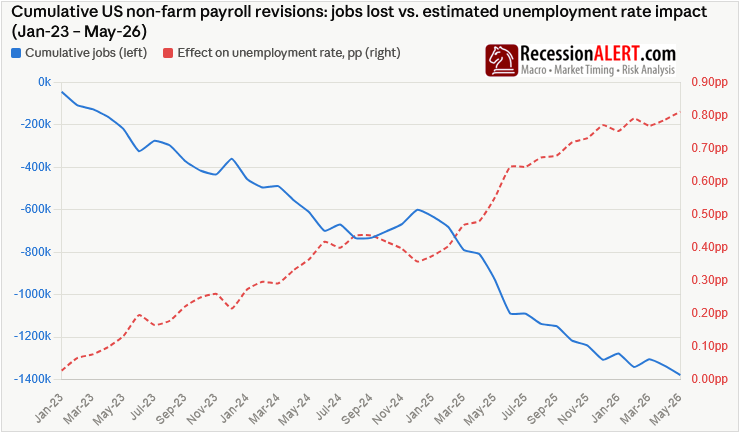
Household unemployment was right the whole time. For two and a half years, the Fed set policy off establishment-survey payrolls that overstated hiring by -1.4M jobs — roughly 0.8% of the labor force — while the household survey’s climb to a reported ~4.3% jobless rate logged the same softening in real time. The benchmark revisions unearthed no fresh weakness; they dragged the payroll survey down into line with what the household number already showed. The mechanism is the culprit. The establishment survey’s birth-death model imputes jobs from firm formation the monthly sample misses, and post-pandemic it manufactured phantom hires the recovery never produced; annual QCEW benchmarks — near-universal tax records covering roughly 95% of jobs — then claw those ghosts back. This is bias, not noise: 2.5 years of one-directional revision is systematic, since random error cancels. And it is accelerating — after a ~-600k plateau in late 2024, the series shed another -780k in five months, so the freshest prints are the most inflated. The cost lands twice: policymakers anchored “higher-for-longer” to the wrong survey and held too tight, while households already living the weaker market waited for the data to catch up. The revisions didn’t move the truth — they moved the number that was always lying toward it.
Market Intelligence Brief (MIB) Ver. 18.42
For professional investors only. Not investment advice.
© 2026 RecessionALERT.com

Comments are closed.