
MARKET INTELLIGENCE BRIEF (MIB)
Friday, September 25, 2026
Microsoft (MSFT) jumped 3.66%, leading the Dow and S&P 500, after a Copilot overhaul putting its agents on usage-based pricing. Core capital-goods orders rose 1.6%, but Michigan year-ahead inflation expectations climbed to 4.6%, keeping an October hike in play. WTI fell 2.01% on hopes of a phased US-Iran Hormuz deal. Xi left Washington with no new purchase deals and advanced chips off the table. BofA double-downgraded Nike (NKE) to Underperform with a $30 target, six days before earnings.
TABLE OF CONTENTS
A. EXECUTIVE SUMMARY
B. MARKET DATA
C. HIGH-IMPACT STORIES (5)
D. MODERATE-IMPACT STORIES (7)
E. ECONOMY WATCH (6)
F. EARNINGS WATCH (1)
G. WHAT’S NEXT
H. CHART OF THE DAY
A. EXECUTIVE SUMMARY -> TOP
Stocks rose on Friday, the S&P 500 up 0.51% and the Dow up 0.93%, as a Microsoft-led tech bid and softer crude outweighed a Fed openly weighing an October hike. Microsoft’s move to usage-based pricing for Copilot’s agents and a 1.6% jump in core capital-goods orders describe the same AI investment cycle, still broadening from chips into power and industrial equipment, while crude’s retreat on reported US-Iran Hormuz talks eased the market’s main inflation input. Bonds priced the other side: the 2-year rallied but the 30-year rose to 5.49% on the Treasury curve with the 10-year still above 5%, a steepening consistent with Cleveland Fed President Hammack’s view that policy is not restraining the economy outside housing. Breadth was solid but top-led: eight of 11 sectors rose, Technology (+0.85%) and Financials (+0.79%) led, Energy (-0.96%) trailed, and the Russell 2000 added only 0.07%.
• Microsoft leads: MSFT rose 3.66% to $516.17, leading the S&P 500 and the Dow, after a Copilot overhaul (Home, Code and an always-on Autopilot agent) that bills the agentic tools by usage rather than per seat; Oppenheimer raised its target to $570.
• Crude retreats on Hormuz hopes: WTI fell 2.01% to $92.71 and Brent fell 1.84% to $104.64 on reported talks over a phased US-Iran deal to reopen the Strait; Energy was the worst sector at -0.96%.
• Macro split: core capital-goods orders rose 1.6% and GDPNow tracks Q3 growth at 5.0%, but Michigan sentiment fell to 48.1 and year-ahead inflation expectations rose to 4.6% from 4.0%.
• Xi visit ends without numbers: no new purchase deals were announced; USTR Greer said details come Monday and that advanced semiconductors were not part of the talks.
• Data-center power bid: Wells Fargo launched on 16 electrical and HVAC names with seven Overweights; Trane rose 3.63%, Johnson Controls rose 3.33% and Vertiv rose 3.25%, and Eaton agreed to buy Italy’s COL Group at an €810 million enterprise value.
• Single-name risks: BofA double-downgraded Nike (NKE) to Underperform with a $30 target ahead of Oct 1 earnings; Merck and Daiichi Sankyo withdrew their accelerated-approval filing for I-DXd in small-cell lung cancer after Friday’s close.
1. The AI trade is moving from the chip to the meter and the switchgear — Microsoft’s decision to bill Cowork, Code and Autopilot by usage rather than per seat ties its AI revenue to how much work the agents actually do, the model Azure already runs on. The physical side showed up the same day: core capital-goods orders rose 1.6%, Atlas Energy Solutions ordered 283 MW of Caterpillar power equipment for an unnamed frontier AI lab, Wells Fargo launched on the electrical and HVAC group with seven Overweights, and Eaton agreed to buy COL Group’s European switchgear capacity. For portfolios, the beneficiaries are widening into Industrials, a sector still down 7.07% over three months, so sponsorship is arriving from a low base. The caution is valuation: a reported valuation of up to $150 billion for a potential IPO of SK hynix’s Solidigm shows how far AI has already repriced storage.
2. Strong growth is now the Fed’s argument for tightening, not a relief — GDPNow tracks third-quarter growth at 5.0%, capex is accelerating, and Cleveland Fed President Hammack, a 2026 voter, said policy is not restraining the economy outside housing. Households are the pressure point: Michigan sentiment fell to 48.1 while year-ahead inflation expectations rose to 4.6% and long-run expectations rose to 3.4%, even as Hammack judged expectations reasonably well anchored. CME FedWatch put the odds of a 25 bp October hike at 73% on Sept 23, per CNBC. Oil’s retreat helps at the margin, but the Hormuz talks are reported rather than concluded and Brent still closed at $104.64. The risk sits at the long end, where the 30-year closed at 5.49% on the Treasury curve and rate-sensitive Real Estate slipped 0.23%; Wednesday’s core PCE is the next test.
3. Diplomacy is holding the status quo, not resetting it — Xi left Washington with a framework but no dollar values, tariff rates, or energy, soybean or aircraft commitments, and USTR Greer ruled advanced semiconductors out of the talks, a signal that export controls on high-end AI hardware will not be traded for purchase commitments. Iran runs through both tracks: Ambassador Perdue said President Trump told Xi that helping Iran was “unacceptable,” while crude’s decline rests on phased Hormuz talks that neither side has concluded and Houthi strikes on Saudi Arabia continue. For positioning, chipmakers keep their export-policy overhang and oil’s relief remains contingent on headlines that can reverse; Monday’s USTR details are the first chance to put numbers on the trade side.
 — Leading economic indicators. Accurate market forecasts. Apply for membership at join.recessionalert.com
B. MARKET DATA -> TOP
Stocks closed a volatile week higher as a reprieve in crude, on hopes of a phased US-Iran deal to reopen the Strait of Hormuz, let equities look past a 10-year yield holding near its highest level since the financial crisis. The advance was broad-based risk-on, with Microsoft’s Copilot overhaul and a chip bid carrying technology while energy lagged on the oil retreat. Bonds largely joined the calmer tape: the VIX fell 5.1% and eight of 11 sectors rose as the 2-year and 10-year eased from Thursday’s highs, leaving the 30-year, up to 5.49% on the Treasury curve, as the one tenor that did not. Small caps barely moved, leaving large-cap leadership intact for a fifth straight session.
CLOSING PRICES – Friday, September 25, 2026:
MAJOR INDICES
The Dow led and snapped a three-week losing streak while the Russell 2000 barely moved. A Dow Theory non-confirmation emerges today: industrials sit within 1.4% of their 10-session high while transports remain 5.6% below theirs, reversing yesterday’s bear confirmation. Narrow mega-cap leadership is entrenched, with the S&P 500 beating the Russell 2000 by 3.4 points over 10 sessions for a fifth straight session, and concentrated tech leadership (Nasdaq 100 +4.2% vs S&P 500 +1.1% over 10 sessions) extends into a second session.
| Index | Close | Change | %Move | Why It Moved |
|---|---|---|---|---|
| S&P 500 | 7,743.41 | +39.28 | +0.51% | Microsoft’s Copilot-driven gain and a chip bid led as crude eased; closed out a weekly gain |
| Dow Jones | 51,828.62 | +478.64 | +0.93% | Led by high-priced gainers Microsoft and Caterpillar in the price-weighted average; snapped a three-week losing streak |
| DJ Transportation | 19,572.22 | +94.51 | +0.49% | Firmed with the broader tape but remains 5.6% below its 10-session high |
| Nasdaq 100 | 30,608.14 | +129.28 | +0.42% | Microsoft and Qualcomm gains offset pullbacks in Meta and Intel |
| Russell 2000 | 2,837.55 | +1.98 | +0.07% | Barely positive; small caps lagged large caps again |
| NYSE Composite | 23,912.59 | +96.09 | +0.40% | Broad gain, with eight of 11 sectors higher |
VOLATILITY & TREASURIES
The curve bull-steepened: the 2-year rallied 7.7 bps and the 10-year eased 4.1 bps from Thursday’s post-2007 high, leaving 2s10s at about 30 bps. Only the 30-year held out, rising about 2 bps to 5.49% on the Treasury curve, so the calmer risk tape signalled by a falling VIX and a softer dollar was confirmed at the front and belly but not at the very long end.
| Instrument | Level | Change | Why It Moved |
|---|---|---|---|
| VIX | 14.87 | -0.80 (-5.11%) | Fell as equities rallied into the weekend |
| 10-Year Treasury Yield | 5.167% | -4.1 bps | Eased from Thursday’s 5.208% close, its highest since 2007, as the curve bull-steepened; still above 5% |
| 2-Year Treasury Yield | 4.864% | -7.7 bps | Front end rallied; no discrete same-day catalyst identified |
| US Dollar Index (DXY) | 101.02 | -0.26 (-0.26%) | Eased; no discrete same-day catalyst identified |
COMMODITIES
Precious metals firmed together, with platinum and silver outpacing gold, while copper slipped, a split between the monetary and industrial complexes on a day the dollar eased. Bitcoin edged lower against a rising equity tape, decoupling from risk sentiment with no crypto-specific catalyst identified.
| Asset | Price | Change | %Move | Why It Moved |
|---|---|---|---|---|
| Gold | $4,321.15/oz | $+23.15 | +0.54% | Firmed as the dollar eased; no discrete same-day catalyst identified |
| Silver | $64.718/oz | $+0.716 | +1.12% | Outpaced gold; no discrete same-day catalyst identified |
| Copper | $6.7763/lb | $-0.0137 | -0.20% | Slipped; no discrete same-day catalyst identified |
| Platinum | $1,776.50/oz | $+24.50 | +1.40% | Led precious metals higher; no discrete same-day catalyst identified |
| Bitcoin | $84,050.0 | $-281.0 | -0.33% | Little changed; no crypto-specific catalyst identified |
ENERGY
WTI and Brent fell in near lockstep, extending the retreat that began with Thursday’s report of US-Iran talks on a phased Hormuz reopening, while the Brent-WTI spread held near $12, which The National puts at its widest since May. Henry Hub gave back part of Thursday’s pipeline-driven spike and Dutch TTF fell with crude. Oil fell while equities rose.
| Asset | Price | Change | %Move | Why It Moved |
|---|---|---|---|---|
| Crude Oil (WTI) | $92.71/bbl | $-1.90 | -2.01% | Extended the slide that began with Thursday’s report of US-Iran talks on a phased Hormuz reopening, plus Friday reports that Saudi Arabia’s East-West pipeline could reopen |
| Crude Oil (Brent) | $104.64/bbl | $-1.96 | -1.84% | Same Hormuz and pipeline drivers, tempered by continued Houthi attacks on Saudi Arabia |
| Natural Gas (Henry Hub) | $3.186/MMBtu | $-0.111 | -3.37% | Profit-taking after Thursday’s surge to a 13-week high on a Columbia Gas Transmission force majeure in Appalachia |
| Natural Gas (Dutch TTF) | $24.07/MMBtu | $-0.97 | -3.89% | Fell alongside crude; no discrete European catalyst identified |
S&P 500 SECTORS
Technology led again, extending a trend visible across its week, month and quarter. Energy, the year’s runaway leader, fell for a session that deepened its weekly reversal. Eight of 11 sectors rose; the holdouts were Energy (-0.96%), Communication Services (-0.58%) and rate-sensitive Real Estate (-0.23%), which slipped with the 10-year near post-2008 highs.
| Sector | 1-Day | 1-Week | 1-Month | 3-Month | 6-Month | YTD | 12-Month |
|---|---|---|---|---|---|---|---|
| Technology | +0.85% | +3.06% | +6.97% | +10.45% | +41.37% | +30.26% | +31.35% |
| Financial | +0.79% | -1.26% | -4.30% | +2.47% | +14.61% | +4.03% | +7.64% |
| Industrials | +0.76% | +0.25% | -3.47% | -7.07% | +4.13% | +9.03% | +11.98% |
| Basic Materials | +0.40% | -1.00% | -7.88% | +3.42% | +6.68% | +13.32% | +24.16% |
| Consumer Defensive | +0.40% | +0.17% | -2.82% | -3.23% | -0.05% | +4.81% | +4.51% |
| Utilities | +0.39% | -2.95% | -8.08% | -13.85% | -12.20% | -7.26% | -7.35% |
| Healthcare | +0.38% | +0.92% | -2.73% | +3.75% | +15.00% | +8.70% | +22.02% |
| Consumer Cyclical | +0.08% | -0.52% | -5.13% | -1.73% | +2.57% | -8.10% | -9.75% |
| Real Estate | -0.23% | -1.34% | -7.47% | -7.99% | +3.34% | +2.77% | -0.50% |
| Communication Services | -0.58% | +1.59% | +3.32% | +5.96% | +13.64% | +2.10% | +5.86% |
| Energy | -0.96% | -2.89% | -0.44% | +13.18% | -0.59% | +35.19% | +34.17% |
TOP MEGA-CAP MOVERS:
GAINERS
| Company | Ticker | Close | Change | Why It Moved |
|---|---|---|---|---|
| Dell Technologies | DELL | $562.89 | +5.01% | Reportedly lifted by a Morgan Stanley note citing AI-server demand and backlog (single-source attribution, unverified); remains below its Sept 17 record close |
| Qualcomm | QCOM | $201.97 | +3.97% | No discrete same-day catalyst confirmed; one aggregator credits a renewed Apple patent-licensing agreement whose announcement date is unconfirmed (unverified) |
| Microsoft | MSFT | $516.17 | +3.66% | Unveiled a Copilot overhaul (Home, Code and Autopilot agent); Oppenheimer raised its price target to $570 |
| Costco Wholesale | COST | $922.77 | +2.93% | Earnings-driven, following fiscal Q4 results released Thursday after the close |
| Texas Instruments | TXN | $278.07 | +2.74% | No discrete same-day catalyst identified; rose with a broad chip bid (Lam Research +2.62%, Applied Materials +2.27%) |
DECLINERS
| Company | Ticker | Close | Change | Why It Moved |
|---|---|---|---|---|
| Palo Alto Networks | PANW | $374.74 | -3.89% | No discrete same-day catalyst identified; cybersecurity peers also weaker (CrowdStrike -2.90%) |
| Intel | INTC | $123.00 | -3.45% | No discrete same-day catalyst identified; continuation of Thursday’s profit-taking after a roughly 223% year-to-date run |
| Meta Platforms | META | $751.66 | -3.33% | No discrete same-day catalyst identified; pullback after a weekly rally of roughly 13% on the launch earlier this week of its Muse AI agent |
| CrowdStrike | CRWD | $252.13 | -2.90% | No discrete same-day catalyst identified; moved with Palo Alto Networks (-3.89%) |
| Oracle | ORCL | $137.10 | -1.75% | No discrete same-day catalyst identified; extends Thursday’s 3.47% slide after its Project Jupiter force-majeure notice, amid reports of stressed pricing on related loans (unverified) |
— Institutional-grade intelligence for serious investors. Apply for membership at join.recessionalert.comC. HIGH-IMPACT STORIES -> TOP
BULLISH
1. Microsoft Jumps 3.66% to Lead the Dow and S&P 500 After Unveiling Its Biggest Copilot Overhaul, With Home, Code and an Always-On Autopilot Agent Priced on Usage
The core facts:Microsoft on Friday unveiled a Copilot rebuilt around three tabs. Home puts chat and Cowork, where longer jobs are delegated, on one screen and lets users create and edit Word, Excel and PowerPoint files without leaving Copilot. Code lets users without a development background build small applications, trackers, dashboards and automations by describing them in plain language. Autopilot is an agent given a name, a role and a goal by its owner that keeps working inside Microsoft 365 when nobody is using it; it enters private preview at the end of September, while Home and Code begin rolling out through Microsoft’s Frontier early-access program in the coming weeks. Chief Executive Satya Nadella called the product “a new OS for work.” Microsoft said customers will pay for Cowork, Code and Autopilot based on usage rather than through a per-seat subscription like the $30-per-user-per-month Microsoft 365 Copilot. Oppenheimer raised its price target to $570. The shares closed at $516.17, up 3.66%, and Microsoft led both the S&P 500 (+0.51%) and the Dow (+0.93%) higher.
Why it matters:The pricing change is the substance. Seat-based Copilot has faced persistent questions about adoption, and moving the agentic parts of the product to consumption billing ties Microsoft’s AI revenue to how much work the agents actually do, the same model its Azure cloud already runs on. It is also a direct answer to Anthropic and OpenAI, whose coding and agent tools have been competing for the same enterprise budgets, and it lands in a week when Meta’s Muse agent launch had put agentic AI at the centre of large-cap trading. For the index, a single mega-cap adding more than 3.5% on a product event carries real weight: Technology led all 11 sectors at +0.85%, with Microsoft and a broad chip bid doing the lifting.
What to watch:Autopilot’s private-preview launch at the end of September, and whether Microsoft’s next quarterly report begins to break out consumption-based Copilot revenue.
BULLISH
2. WTI Falls 2.01% to $92.71 and Brent 1.84% to $104.64 as Hopes for a Phased US-Iran Hormuz Deal Extend the Retreat, Pushing the Brent-WTI Spread to Its Widest Since May
The core facts:Crude fell on Friday, with WTI closing at $92.71 (-2.01%) and Brent at $104.64 (-1.84%). The pullback began during Thursday’s session, when Reuters, Bloomberg and Semafor reported that US and Iranian negotiators in New York, with Qatar mediating, were exploring a phased path out of the nearly seven-month conflict in which Tehran would reopen the Strait of Hormuz and Washington would lift its economic blockade. The National, citing Reuters, put the Brent-WTI spread at $12.68, its widest since May, and said the prospect of a US diesel export ban was weighing on WTI. Brent’s decline was tempered by continued Houthi attacks on Saudi Arabia, which said on Thursday it had intercepted missiles launched by the group. Gas fell with crude: Henry Hub lost 3.37% to $3.186 and Dutch TTF 3.89%. Energy was the worst of the 11 S&P 500 sectors at -0.96%, with Exxon Mobil down 0.96% and Chevron 0.58%.
Why it matters:Crude remains the market’s main inflation input, and Friday’s decline takes some pressure off a Fed that is openly weighing an October hike. But the talks have been reported, not concluded: the proposal founders on the same problem as earlier rounds, since neither side wants to give up its main source of leverage first, and Houthi strikes on Saudi infrastructure keep a floor under Brent. The widening spread is the domestic angle. A diesel export ban would trap refined product at home, which is bearish for US crude relative to seaborne barrels and would squeeze refiners’ export margins, and business groups are lobbying against it.
What to watch:Any formal US response to Iran’s terms for reopening Hormuz, and whether the White House signs the proposed diesel export ban, which had not appeared in its presidential-actions listing as of Friday afternoon.
UNCERTAIN
3. Xi Ends His White House Visit With No New Purchase Deals as USTR Greer Says the Sides Agreed on a “Subset” of Nonsensitive Goods, With Details Due Monday and Advanced Chips Off the Table
The core facts:Chinese President Xi Jinping left Washington on Friday at the end of his state visit without new purchase deals being announced. US Trade Representative Jamieson Greer told CNBC the US would send “agricultural products and medical devices” while “we’re getting from them, you know, consumer goods and other things that are non-sensitive,” and that “we will release on Monday, I think, a lot more details about what we’ve accomplished.” He said advanced semiconductors were not part of the talks: “These are the crown jewels of American technology… those conversations … (are) not really happening in these negotiations,” adding “We’re in a managed trade situation … we’ve had progress.” US Ambassador David Perdue said on Fox News that President Trump told Xi that helping Iran was “unacceptable.” Yahoo Finance reported that the two sides will hold a summit on AI issues, including safety, in Shenzhen in November. China’s 15% tariff on US liquefied natural gas remains in place.
Why it matters:The visit preserved the status quo rather than resetting it. The truce extension to January 10 was agreed as Xi arrived, so the question for markets was whether the summit would add substance, and on Friday it added a framework without numbers: no dollar value, no tariff rates and no energy, soybean or aircraft commitments. Greer’s refusal to put chips on the table matters most for US semiconductors, since it signals that export controls on high-end AI hardware will not be traded for purchase commitments. The Iran message links the trade track to the oil market, where China is the largest buyer of Iranian crude.
What to watch:The trade details USTR has promised for Monday, Sept 28, then the G20 Trade Ministerial in Milwaukee from Sept 29 to Oct 1, where Greer speaks on Sept 30.
UNCERTAIN
4. Fed’s Hammack Says Policy Is Not Restraining the Economy Outside Housing and That Rising Long Yields Reflect Real Rates, Not Lost Confidence on Inflation
The core facts:Cleveland Fed President Beth Hammack, a 2026 FOMC voter, used a panel at the Cleveland Fed’s inflation conference on Friday to argue that the bond selloff is not an inflation scare. “It’s real rates that have moved up more than the inflation expectations,” she said, adding “We’re reasonably well anchored from an inflation expectations perspective.” She attributed higher yields to a strong economic outlook, competition for investor capital from the technology sector and markets adjusting to monetary policy. She also said she does not see current policy restraining the economy outside housing, and that the two sides of the Fed’s mandate are generally not in conflict. The remarks came on the day the University of Michigan’s final September survey showed year-ahead inflation expectations rising to 4.6% (detailed in Section E). On the Treasury’s par curve the 30-year yield closed Friday at 5.49%, above Thursday’s 5.47%, with the 10-year above 5%, while the 2-year fell.
Why it matters:Hammack’s diagnosis cuts both ways for markets. Reading the long-end selloff as a rise in real rates on growth and AI capital demand, rather than as de-anchoring, is reassuring about the Fed’s credibility. But her view that policy is not yet restraining most of the economy is the argument for tightening further, and it comes from a voter. That combination is consistent with a curve that steepened from the front: the 2-year eased while the long end did not rally with equities. Her reading also sits awkwardly beside the Michigan survey, where both one-year and long-run expectations rose; if household expectations keep climbing, the “well anchored” judgement is the one that will be tested first.
What to watch:August core PCE on Wednesday, Sept 30, the last major inflation print before the Oct 27-28 FOMC, and the 30-year Treasury yield after Friday’s 5.49% close.
BULLISH
5. Core Capital-Goods Orders Jump 1.6% as the AI Build-Out Keeps Business Investment Running Hot, Supporting Industrials but Strengthening the Case for an October Hike
The core facts:Friday’s August durable goods report beat on the headline, and its core business-investment gauge, nondefense capital goods ex-aircraft, rose 1.6% (full data in Section E). The same day brought a concrete example of where the spending is going: Atlas Energy Solutions said it had signed cost-reimbursement agreements with an unnamed “leading frontier AI lab” and ordered an additional 283 MW of Caterpillar power-generation equipment for the customer, sending its shares up about 17% intraday. On the tape, Industrials rose 0.76% and Caterpillar was one of the two high-priced gainers, with Microsoft, that led the Dow’s 0.93% advance. The Atlanta Fed’s GDPNow tracker stood at 5.0% for third-quarter growth after the release.
Why it matters:Core orders are the leading indicator for equipment investment, and a 1.6% monthly gain says the AI infrastructure cycle is still broadening beyond chips into power, electrical and industrial equipment, the order books that support names such as Caterpillar, Eaton and Vertiv. That is the constructive read for cyclicals. The policy read is less friendly: an economy tracking 5% growth with rising capex gives the Fed little reason to hold back, and it reinforces Cleveland Fed President Hammack’s view the same day that policy is not restraining activity outside housing.
What to watch:ISM Manufacturing on Thursday, Oct 1, and the revised factory orders report on Friday, Oct 2, which updates Friday’s advance durable goods figures.
— Quantifying recession risk so you don’t have to guess. Apply for membership at join.recessionalert.comD. MODERATE-IMPACT STORIES -> TOP
UNCERTAIN
6. New Mexico Jury Finds Meta Deceived Users Over Cambridge Analytica-Era Privacy Protections as Four Brokers Lift Targets; Shares Fall 3.33%
The core facts:A jury in Santa Fe found on Friday that Facebook misled the public about its privacy protections in the investigations into data brokers that followed the Cambridge Analytica scandal, finding more than two million violations of New Mexico law according to the Associated Press. The state is seeking the $5,000-per-violation maximum, and the judge will set the amount at a later date. Meta said it disagrees with the verdict and will continue to defend itself. New Mexico won a separate $942 million judgment against Meta earlier this year over child-safety protections. On the same day Deutsche Bank raised its target to $820 from $750, Piper Sandler to $875 from $785, TD Cowen to $865 from $750 and Canaccord to $950 from $930, following the launch of Meta’s Muse AI agent. Meta closed at $751.66, down 3.33%, after a rally of roughly 13% earlier in the week.
Why it matters:The verdict adds to a growing stack of state-level liabilities that are individually manageable for a company of Meta’s size but hard to size in advance, because the penalty depends on a violation count that reports have not settled. How much of Friday’s decline it explains is not established: the stock was already giving back a sharp Muse-driven run, and analysts were raising targets into the drop. The split is the useful signal. Wall Street is pricing the agent opportunity upward while the legal overhang, which a judge rather than a jury will now quantify, sits outside those models.
What to watch:Judge Francis Mathew’s penalty determination, which has not been scheduled.
BEARISH
7. Bank of America Double-Downgrades Nike to Underperform and Cuts Its Target to $30 From $47, Six Days Before Earnings
The core facts:Bank of America analyst Lorraine Hutchinson cut Nike two notches to Underperform from Neutral on Friday and lowered her price target to $30 from $47. The note cites an incomplete cleanup of Nike’s North American marketplace, weaker Chinese sportswear demand and pressure in Europe, and warns of downside risk to earnings with innovation overshadowed; BofA now expects the turnaround to take until fiscal 2028. Nike closed at $35.75, down 0.67%, near levels last seen in 2014 and down about 43% this year. The company reports fiscal first-quarter results after the close on Thursday, Oct 1, with consensus EPS of $0.44 on revenue of $11.33 billion.
Why it matters:A double downgrade into an earnings print is a deliberate call that the quarter will not mark the bottom. It also pushes the recovery timeline beyond the horizon many investors had been underwriting. The modest reaction suggests much of the pessimism is already in the price, which is exactly why the October 1 guidance, rather than the quarter itself, will decide the next leg for discretionary retail sentiment.
What to watch:Nike’s fiscal first-quarter report and outlook after the close on Thursday, Oct 1.
BULLISH
8. Wells Fargo Launches Coverage of 16 Electrical and HVAC Names With Seven Overweights; Trane Rises 3.63% and Johnson Controls 3.33% as Eaton Agrees to Buy Italy’s COL Group
The core facts:Wells Fargo analyst Stephen Tusa started coverage of 16 multi-industry, electrical and HVAC companies on Friday: seven at Overweight, eight at Equal Weight and one at Underweight. The Overweights are Trane ($536 target), Vertiv ($340), Eaton ($503), Emerson ($177), Johnson Controls ($186), Carrier ($67) and Dover ($229); Honeywell, 3M, Parker-Hannifin and Rockwell Automation were among the Equal Weights, and Otis ($77) was the lone Underweight. Of Johnson Controls, the bank cited a “record backlog, DC-led orders, self-help on margins.” Trane closed up 3.63%, Johnson Controls 3.33%, Vertiv 3.25%, Carrier 2.73% and Dover 2.12%, while Otis fell 1.11%. Separately, Bernstein upgraded 3M to Market Perform from Underperform with a $171 target, and Eaton agreed to buy COL Group, an Italian maker of medium-voltage switchgear and grid-automation equipment, from Oaktree for an enterprise value of €810 million, adding EMEA capacity for data-center and utility customers.
Why it matters:The overweight list is effectively a map of the data-center power and cooling trade, and the stocks that moved most were the ones with the most direct exposure to it. A major bank launching on the group with a clear bullish tilt adds sponsorship to Industrials at a point when the sector has lagged, down 7.07% over three months. Eaton’s deal makes the same point from the corporate side: buying European switchgear capacity is a bet that AI-driven electrical demand will outrun existing plants.
What to watch:Whether the group holds Friday’s gains through ISM Manufacturing on Oct 1; Eaton expects the COL deal to close in the first quarter of 2027.
UNCERTAIN
9. SK Hynix’s US Storage Unit Solidigm Weighs a US IPO at a Valuation of Up to $150 Billion, Reuters Reports
The core facts:Solidigm, the US-based solid-state storage business of South Korea’s SK hynix, is considering a US initial public offering that could value it at up to $150 billion and raise about $15 billion, Reuters reported on Friday, citing people familiar with the matter. Pitch meetings with banks took place this week, and a listing could come as early as next year; the process is at an early stage. Solidigm declined to comment. SK hynix itself is valued at about $975 billion.
Why it matters:A $150 billion valuation for an enterprise SSD maker is a measure of how far AI has repriced memory and storage: data-center demand for high-capacity flash has turned what was a cyclical commodity business into a growth asset. A listing of that size would be among the largest US semiconductor IPOs, larger than Arm’s roughly $54 billion debut in 2023, and would give US investors a pure-play storage vehicle alongside Micron and SanDisk. It is a sourced report rather than a company announcement, so the valuation is an aspiration, not a price.
What to watch:Micron’s fiscal fourth-quarter report after the close on Wednesday, Sept 30, the next read on AI memory and storage pricing.
BEARISH
10. Merck and Daiichi Sankyo Withdraw Their Accelerated-Approval Filing for Ifinatamab Deruxtecan in Small-Cell Lung Cancer After FDA Talks
The core facts:Merck and Daiichi Sankyo said after Friday’s close that they have voluntarily withdrawn the biologics license application seeking accelerated approval of ifinatamab deruxtecan (I-DXd) for previously treated extensive-stage small-cell lung cancer. Discussions with the FDA showed that data from the Phase 2 IDeate-Lung01 trial “did not satisfy accelerated approval requirements.” Any future filing will rest on the confirmatory Phase 3 IDeate-Lung02 trial. The announcement came at 4:30 p.m. ET, so the share-price reaction will come on Monday.
Why it matters:I-DXd is one of three antibody-drug conjugates at the centre of Merck’s multibillion-dollar Daiichi partnership, which the company has positioned as a growth pillar as Keytruda approaches its loss of exclusivity. Losing the accelerated route in small-cell lung cancer pushes the first US launch back by the length of the Phase 3 readout. It also signals an FDA that is holding single-arm oncology data to a stricter standard, a read-through for other ADC developers relying on accelerated approvals.
What to watch:Merck’s and Daiichi Sankyo’s share-price reaction on Monday, Sept 28, and any timeline the companies give for IDeate-Lung02 data.
UNCERTAIN
11. Sixth Circuit Rules Ohio and Tennessee May Apply State Gambling Laws to Kalshi’s Sports Event Contracts, Rejecting the CFTC-Preemption Argument
The core facts:A unanimous panel of the US Court of Appeals for the Sixth Circuit ruled on Friday that Ohio and Tennessee may enforce their state gambling laws against Kalshi’s sports-event contracts. The court rejected Kalshi’s argument that the contracts are swaps regulated exclusively by the Commodity Futures Trading Commission, writing: “We hold that Kalshi has not shown that its sports-event contracts satisfy the statutory definition of a ‘swap’ so as to fall within the scope of the CFTC’s ‘exclusive jurisdiction.'” CNBC described the decision as another legal blow to prediction-market platforms.
Why it matters:Federal preemption is the legal foundation that lets prediction markets offer sports contracts in states where betting is restricted or taxed, and an appellate court has now rejected it. If the reasoning spreads, sports event contracts would fall under state gaming regulators, removing the regulatory arbitrage that has let these platforms compete with licensed sportsbooks nationwide. That is a relative positive for incumbent sportsbook operators and a negative for the brokers and exchanges that have been building prediction-market products.
What to watch:Whether Kalshi seeks rehearing en banc or Supreme Court review, and whether other states cite the ruling in pending enforcement actions.
BULLISH
12. Barclays Upgrades Humana to Overweight and Lifts Its Target to $515 From $407; Shares Rise 4.63%
The core facts:Barclays analyst Andrew Mok upgraded Humana to Overweight from Equal Weight on Friday and raised his price target to $515 from $407, calling the setup “particularly compelling.” Humana closed at $397.93, up 4.63%, giving the Medicare Advantage insurer a market value of about $48 billion. Healthcare rose 0.38% on the day.
Why it matters:Humana is the most Medicare Advantage-concentrated of the large insurers, so an upgrade is in effect a call that the worst of the sector’s cost-trend and reimbursement pressure is priced in. A 29% upside target from a major bank is a meaningful shift in sponsorship for a stock that has been a laggard, and it tends to pull capital toward the managed-care group as a whole when it lands.
What to watch:Medicare Advantage star ratings and plan-year 2027 enrollment data during the annual enrollment period that opens Oct 15.
— Separating signal from noise since 2007. Apply for membership at join.recessionalert.comE. ECONOMY WATCH -> TOP
The week closed on a split between an economy that is still building and households losing patience with prices. Business investment is the strong leg: core capital-goods orders jumped 1.6% in August, the Kansas City Fed’s factory gauge beat forecasts, and GDPNow tracks third-quarter growth at 5.0%. Consumers are the weak one, with Michigan sentiment at 48.1 and year-ahead inflation expectations up to 4.6%, the kind of drift that could feed what Cleveland Fed President Hammack called “an inflationary mindset” and named the biggest inflation risk, though she judged expectations reasonably well anchored for now. Hot growth plus rising inflation psychology is the combination that keeps an October hike in play, and August core PCE on Wednesday, September 30 is the next test.
Durable Goods Orders Hold Flat in August, Beating -0.4% Forecast, as Core Capital Goods Orders Jump 1.6% (Census Bureau, Sept 25)
What they’re saying:New orders for manufactured durable goods were virtually unchanged at $338.6 billion in August, against a consensus decline of 0.4%, after a 0.9% July gain. Transportation equipment fell 0.6% to $114.1 billion and held the headline flat; excluding transportation, orders rose 0.3%, short of the 0.6% expected. Orders for nondefense capital goods excluding aircraft, the core business-investment gauge, rose 1.6% to $87.6 billion after a 0.6% July gain.
The context:Core capital-goods orders are running 10.6% ahead of last year on a year-to-date basis (not seasonally adjusted), strength Wolf Street attributes to the AI infrastructure build-out. Delivered goods were softer: total durable-goods shipments fell 0.2%, the first decline after eight straight monthly increases, though core capital-goods shipments, which feed directly into GDP equipment investment, rose 0.6%. Unfilled orders climbed 0.6% to $1.61 trillion, a backlog that supports factory output into the fourth quarter.
What to watch:ISM Manufacturing on Thursday, Oct 1 (expected 54.8, prior 54.6), then the revised full factory orders report on Friday, Oct 2 (prior 0.9%), which updates today’s advance durable goods figures.
Michigan Sentiment Falls to 48.1 in Final September Reading as Year-Ahead Inflation Expectations Jump to 4.6% (University of Michigan, Sept 25)
What they’re saying:The final September Index of Consumer Sentiment came in at 48.1, above the 47.6 consensus but down 7.0% from August’s 51.7 and 12.7% below a year earlier. The expectations index fell 10.1% to 46.3 while current conditions slipped 1.9% to 50.9. Year-ahead inflation expectations jumped to 4.6% from 4.0%, the highest since June, and long-run expectations rose to 3.4% after three straight months at 3.3%.
The context:Survey director Joanne Hsu said sentiment reached “the lowest reading in four months and down 15% from January 2026.” The inflation readings matter more for policy than the headline: expectations rising at both the one-year and long-run horizons is the de-anchoring signal the Fed watches most closely, and it arrived on the same day Cleveland Fed President Hammack named an inflationary mindset as her biggest concern. With initial jobless claims at 197K last week, the squeeze on households is coming from prices rather than from the job market.
What to watch:Conference Board Consumer Confidence on Tuesday, Sept 29 (expected 90, prior 89.4) and August personal spending on Wednesday, Sept 30 (expected 0.8%, prior 0.2%).
Kansas City Fed Manufacturing Composite Rises to 14 in September, Topping Forecasts (Kansas City Fed via Newsquawk, Sept 24)
What they’re saying:The Kansas City Fed’s month-over-month manufacturing composite index rose to 14 in September from 10 in August. Breitbart, citing economists’ forecasts, reported that the gauge had been expected to slip to 8 and called the reading the strongest in more than a year.
The context:Regional Fed surveys are soft data, but the Tenth District beat landed a day before the national durable goods report showed core capital-goods orders up 1.6%, and it points the same way as the national ISM Manufacturing PMI, which printed 54.6 in August. Together they describe a factory sector expanding on investment demand even as consumer sentiment weakens.
What to watch:Dallas Fed Manufacturing Index on Monday, Sept 28 (prior 11.6), Chicago PMI on Wednesday, Sept 30 (prior 47.1), and ISM Manufacturing on Thursday, Oct 1 (expected 54.8).
Fed’s Hammack Calls an “Inflationary Mindset” the Biggest Risk; Schmid Asks Whether the AI “Ecosystem” Is Becoming Too Big to Fail (Cleveland Fed/Reuters, Sept 25)
What they’re saying:Speaking at a Cleveland Fed panel on Friday, Cleveland Fed President Beth Hammack said “the biggest risk with inflation is the formation of an inflationary mindset,” and that “the Fed needs to make sure policy is at a restrictive stance to lower inflation,” as reported by FXStreet. Earlier in the day, Kansas City Fed President Jeff Schmid said the Fed needs to understand whether the network of firms and contracts forming around artificial intelligence is becoming so large that the AI “ecosystem” is too big to fail, according to Reuters.
The context:Hammack, a 2026 FOMC voter, spoke a day after saying inflation risks were tilted to the upside, and on the same day the Michigan survey showed year-ahead inflation expectations jumping to 4.6%, although she said “We’re reasonably well anchored from an inflation expectations perspective” and that “it’s real rates that have moved up more than the inflation expectations.” Futures already lean toward another increase: CME FedWatch put the probability of a 25 bp hike at the October 27-28 meeting at 73% on Sept 23, per CNBC. Schmid’s remarks add a financial-stability dimension to a policy debate otherwise centred on inflation.
What to watch:Goolsbee, Musalem and Williams speak on Tuesday, Sept 29, and August core PCE on Wednesday, Sept 30 (expected 0.3%, prior 0.2%) is the next major inflation print before the October 27-28 FOMC.
Atlanta Fed GDPNow Edges Down to 5.0% for the Third Quarter as Investment Nowcast Eases (Atlanta Fed, Sept 25)
What they’re saying:The Atlanta Fed’s GDPNow model estimate for third-quarter real GDP growth slipped to 5.0% on Sept 25 from 5.1% on Sept 17. The nowcast for real personal consumption expenditures growth rose to 4.2% from 4.1%, while real gross private domestic investment growth eased to 18.7% from 19.2%.
The context:Even after the trim, the tracker sits well above the 2.7% third-quarter pace the American Bankers Association’s economic advisory committee projected this week, and far above the 1.6% consensus for the final second-quarter GDP estimate. A consumption nowcast above 4% sits awkwardly beside sentiment at 48.1, but on the tracker’s reading the Fed faces strong growth and rising inflation expectations at the same time.
What to watch:Final second-quarter GDP on Wednesday, Sept 30 (expected 1.6%, prior 2.1%) and August personal income and spending the same morning, the next major GDPNow inputs.
Brightline Files Chapter 11 to Restructure $5.5 Billion Debt Stack, Leaving Bond Principal Intact (Bloomberg via Insurance Journal, Sept 25)
What they’re saying:Florida’s privately owned passenger railroad filed for Chapter 11 in New Jersey on Thursday, Sept 24, listing assets and liabilities of between $1 billion and $10 billion against a $5.5 billion debt stack. Its $2.2 billion Series 2024 bonds will remain in place with no reduction in principal, as will a further $2.2 billion of bonds issued by associated entities. Assured Guaranty and other investors are providing $258 million of post-petition funding and $490 million of new debt once the company exits.
The context:The operating company is excluded from the filing, so trains continue to run. The report attributes the distress to lower-than-expected revenue, with ridership forecasts cut within months of the 2023 launch. A plan that keeps bond principal whole limits the immediate hit to municipal bondholders; the credit signal is the failure itself, a project-financed transport operator that could not service its debt from fares.
— Know the probability before the market prices in the risk. Apply for membership at join.recessionalert.comF. EARNINGS WATCH -> TOP
YESTERDAY AFTER THE BELL (Markets Reacted Today)
BULLISH
13. Costco Wholesale (COST): +2.93% | Fiscal Q4 Beats on EPS and Revenue as Comparable Sales Rise 9.4% and Digital Sales Top $33 Billion
The Numbers:Released: Thursday, Sept 24, after the close. EPS $6.75 vs $6.54 estimate (+3.2%), including a $0.15 benefit from IEEPA tariff refunds; revenue $95.72 billion vs $94.97 billion estimate (+0.8%). Net sales rose 11.2% to $93.9 billion. Comparable sales +9.4%, with comparable traffic +3.3% and digitally enabled comparable sales +19.5%. Membership fee income +7.3% to $1.849 billion; 150.4 million cardholders; worldwide renewal rate 89.8%, 92.3% in the US and Canada. Shares closed Friday at $922.77, up 2.93%.
The Problem/Win:Traffic, not price, did the work: a 3.3% gain in comparable visits and a 30% jump in traffic to the website and app show Costco still taking share from other retailers while consumer sentiment sits near 48. The one qualification is quality of earnings, since the tariff refund supplied $0.15 of the beat; without it EPS of about $6.60 still edged past consensus.
The Ripple:The Street’s reaction was cautious on valuation despite the beat. Raymond James cut its target to $1,050 from $1,100, Mizuho to $1,065 from $1,100 and Bernstein to $1,143 from $1,144, while DA Davidson was the lone raise, to $1,040. Consumer Defensive rose 0.40% on the day.
What It Means:Costco remains the cleanest read on a US consumer who is pessimistic in surveys but still spending on value and convenience. The stock’s premium multiple limits upside from a solid beat, which is why targets drifted lower even as shares rose.
What to watch:Costco’s September sales report in early October, the first monthly comparable-sales read of fiscal 2027.
TODAY BEFORE THE BELL (Markets Already Reacted)
No major earnings before the bell from companies with >$100B market cap.
TODAY AFTER THE BELL (Markets React Tomorrow)
No major earnings after the bell from companies with >$100B market cap.
WEEK AHEAD PREVIEW:
Q3 2026 earnings season is still in its off-cycle opening stretch, with only a handful of fiscal-year-offset reporters out; two names above $100 billion report over the next five business days, and none on Monday, Sept 28, Tuesday, Sept 29 or Friday, Oct 2.
Micron Technology (MU) — AMC, Wednesday, Sept 30 — Consensus EPS $31.52 on revenue of $51.07 billion, against company guidance of $50.0 billion ± $1.0 billion. The key focus is AI memory pricing and high-bandwidth memory supply into 2027; the report lands days after Reuters said SK hynix’s Solidigm is weighing an IPO at up to $150 billion, a live test of how richly the market values memory and storage.
Accenture (ACN) — BMO, Thursday, Oct 1 — Consensus EPS $3.18 on revenue of $18.03 billion; market cap $107.77 billion. The key focus is fiscal 2027 guidance and whether generative-AI bookings offset pressure on traditional consulting, with JPMorgan raising its target to $200 from $179 on Friday. Microsoft’s usage-priced Copilot agents raise the stakes on how much AI implementation work stays with integrators.
Nike ($53 billion) reports after the close on Oct 1 but falls below the $100 billion threshold; the big banks open the main Q3 season in mid-October.
— US market commentary trusted by family offices and institutions. Apply for membership at join.recessionalert.comG. WHAT’S NEXT -> TOP
UPCOMING RELEASES:
| Date | Event | Why It Matters |
|---|---|---|
| Mon, Sep 28 | USTR details on the outcomes of Xi’s state visit | Greer promised specifics after a visit that produced a framework without numbers; dollar values, tariff rates or any energy and soybean commitments would be the first hard terms since the truce was extended to January 10. |
| Tue, Sep 29 | JOLTS Job Openings, Aug (prior 7.271M) | With jobless claims at 197K, the labor market is not the source of the household squeeze; a sharp drop in openings would be the first sign that the Fed’s growth-versus-inflation trade-off is shifting. |
| Tue, Sep 29 | CB Consumer Confidence, Sep (expected 90, prior 89.4) | Michigan sentiment fell to 48.1 on prices; a steadier Conference Board reading would confirm that the pressure on households is inflation rather than jobs. |
| Tue, Sep 29 | Fed speakers: Goolsbee, Musalem, Williams | The first Fed commentary after Michigan’s 4.6% year-ahead inflation expectations and Hammack’s view that policy is not restraining the economy outside housing; New York Fed President Williams’ read on October carries the most weight. |
| Tue, Sep 29 | G20 Trade Ministerial, Milwaukee (through Oct 1; Greer speaks Sep 30) | Greer’s first multilateral platform after the Xi visit, and a read on whether “managed trade” with China extends to other partners. |
| Wed, Sep 30 | Core PCE Price Index MoM, Aug (expected 0.3%, prior 0.2%) | The last major inflation print before the Oct 27-28 FOMC, with CME FedWatch at 73% odds of a 25 bp hike as of Sept 23; a print at or above consensus leaves little in the data arguing against it. |
| Wed, Sep 30 | Personal Income and Spending, Aug (expected 0.4% and 0.8%; prior 0.4% and 0.2%) | A 0.8% spending gain would square GDPNow’s 4.2% consumption nowcast with sentiment at 48.1, and would add demand pressure to the hike case. |
| Wed, Sep 30 | GDP Growth Rate QoQ, Final Q2 (expected 1.6%, prior 2.1%) | Backward-looking against a third quarter GDPNow tracks at 5.0%; a downward revision would widen the gap between the second quarter and the current pace rather than change the Fed’s read. |
| Thu, Oct 1 | ISM Manufacturing PMI, Sep (expected 54.8, prior 54.6) | The national test of the capex strength in durable goods and the Kansas City Fed survey, and of whether Industrials can hold Friday’s Wells Fargo-driven gains. |
| Fri, Oct 2 | Nonfarm Payrolls and Unemployment Rate, Sep (expected 100K and 4.2%; prior 162K and 4.1%) | The last jobs report before the Oct 27-28 FOMC; consensus implies a clear slowdown in hiring, the one development that could cut against a hike case built on strong growth and rising inflation expectations. |
| Fri, Oct 2 | Factory Orders MoM, Aug (prior 0.9%) | Revises Friday’s advance durable goods report, including the 1.6% jump in core capital-goods orders. |
KEY QUESTIONS:
1. Does Wednesday’s core PCE confirm the rise in household inflation expectations, or leave room for Hammack’s judgement that expectations are reasonably well anchored ahead of the Oct 27-28 FOMC?
2. Will Monday’s USTR details put numbers on the Xi-visit framework, and can a phased US-Iran Hormuz deal advance while Houthi strikes on Saudi Arabia keep Brent above $100?
3. Can the AI power and equipment build-out keep carrying Industrials through Thursday’s ISM Manufacturing report while the 30-year yield sits near 5.5%?
— US market commentary trusted by family offices and institutions. Apply for membership at join.recessionalert.comH. CHART OF THE DAY -> TOP
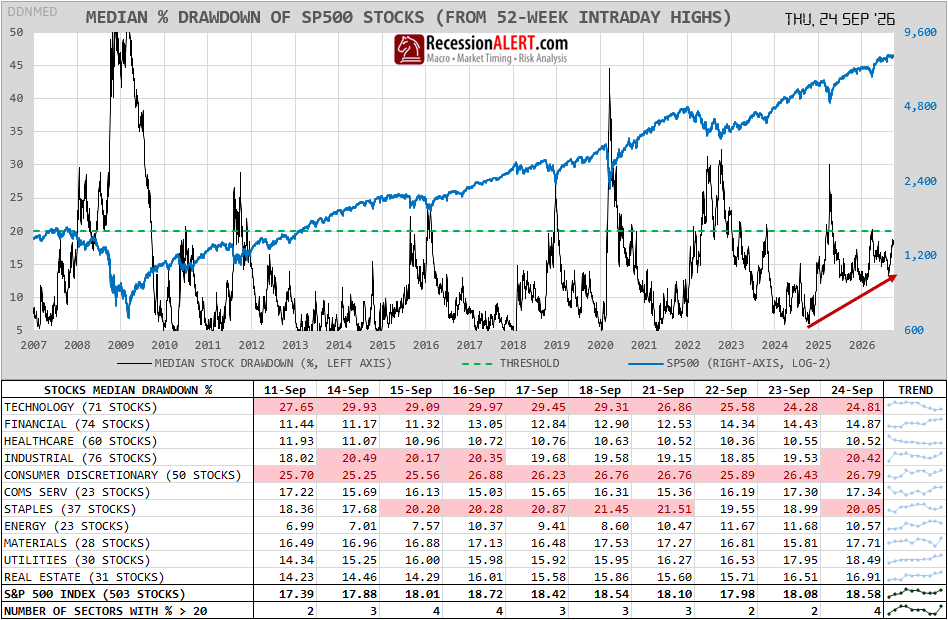
The warning in this chart is not in its spikes but in how it heals between them. The line tracks how far the median S&P 500 stock sits below its own 52-week high. In past bull markets it spiked in corrections, then sank back to roughly 5-8% as rallies carried most stocks back to their highs. Since the April 2025 spike to about 30%, that reset has not come: the lows have held near 10-12%, and the line now reads 18.6%. Nor is this a few giants carrying the index; the equal-weight S&P 500, which counts every stock the same, led it through August. What broke is that no rally lifts everyone at once. Each lifts a new group and strands the last. As the 10-year yield climbed from 4.97% to 5.225%, its highest since 2007, the damage spread into utilities, financials and real estate. That fits: the typical company is more exposed to borrowing costs than the cash-rich giants atop the index, so with Treasuries paying over 5%, each rally leaves more stocks behind. The floor rose like this through 2007 and 2021 before bear markets, and through 2015 before a mere correction. A rally pulling the median back under about 10% would rebuild it. Until then, this is a bull market that has stopped healing between injuries — not dead, but older than the index admits.
What it means: an S&P 500 index fund near its record rests on fewer companies than it looks; the ten largest are 37.8% of it. The typical stock outside them, especially utilities, financials and real estate, is already in a correction. If the next rally lifts it back within about 8% of its high, the warning fades; if not, the index itself is exposed.
Market Intelligence Brief (MIB) Ver. 19.71
For professional investors only. Not investment advice.
© 2026 RecessionALERT.com

Comments are closed.