
MARKET INTELLIGENCE BRIEF (MIB)
Wednesday, August 12, 2026
July CPI landed exactly on consensus — core at 2.5%, slowest since March 2021 — and the VIX collapsed 4.78% to 14.55, an eight-month low. But the 10-year rose anyway: Treasury booked a record $432B July deficit with customs receipts turning negative. AI hardware ripped (Dell +9.87%, Oracle +5.36%), funded by selling Microsoft and Amazon. Canada rejected a sweetened US offer seven days from the tariff cliff. Meta fell 3.38% as its 29-state trial began. Crude posted its biggest build since 2023.
TABLE OF CONTENTS
A. EXECUTIVE SUMMARY
B. MARKET DATA
C. HIGH-IMPACT STORIES (6)
D. MODERATE-IMPACT STORIES (6)
E. ECONOMY WATCH (5)
F. EARNINGS WATCH (1)
G. WHAT’S NEXT
H. CHART OF THE DAY
A. EXECUTIVE SUMMARY -> TOP
July CPI landed exactly on consensus across all four measures, and the reaction was concentrated entirely in volatility rather than rates — the VIX fell 4.78% to 14.55, its lowest since January, as hedges bought against a hot print were retired rather than any new information being learned. The curve’s refusal to follow is the session’s most important detail: the 2-year eased 1.5 basis points while the 10-year rose 0.8, a steepening that aligns not with the policy path but with the Treasury’s record $432 billion July deficit and net customs receipts that turned negative after $33.38 billion of tariff refunds. The advance itself was narrow: the S&P 500 rose 0.26% and the Nasdaq 0.74% while the Dow closed red. Technology’s 1.38% gain came from an intra-AI rotation funded by selling Microsoft and Amazon, leaving Communication Services (-0.88%) and Consumer Cyclical (-1.29%) behind — leadership this concentrated describes a relocation of AI exposure, not a broad risk-on session.
• CPI in line on every measure — headline 3.4% YoY, core 2.5%, the slowest annual core pace since March 2021. September hike odds fell to roughly 32-44% from 56.5% on August 3, extending an eight-session dovish drift; Cleveland Fed’s Hammack remains the hawkish outlier, arguing “more than one” increase is still needed.
• AI hardware bid, AI software sold. Dell +9.87%, Arista +6.39%, Oracle +5.36%, Micron +4.92% and Nebius +34.14% against Microsoft -2.26%, Amazon -1.83% and Palantir -2.23% — the latter falling despite a Citi upgrade to Buy. Foxconn disclosed that cloud and networking reached 51% of Q2 revenue, out-earning the iPhone for the first time.
• Treasury posted a record $432 billion July deficit, with net customs receipts running negative $8.55 billion. Tariff refunds of $33.38 billion under the Supreme Court’s IEEPA ruling have inverted a line item that was being scored as revenue; fiscal-year-to-date is $1.799 trillion with two months still to run.
• Three oil agencies published contradictory signals within hours. The EIA reported a 17.4 million barrel US crude build, the largest since January 2023; the IEA doubled its Q3 global deficit to 1.8 million b/d; OPEC cut 2026 demand growth for a fourth straight month, to 580,000 b/d — leaving a 2.2 million b/d gap with the IEA. WTI -0.70% to $82.62.
• Canada rejected a sweetened US offer seven days before the tariff cliff. Ottawa’s chief negotiator warned Washington that 50% duties on roughly $20-28 billion of trade, effective August 19, could halt talks outright — the equity tape has not priced it.
• The day’s two largest mega-cap decliners were both idiosyncratic. Meta -3.38% as jury selection began in the 29-state attorney general trial, with opening arguments August 18; Home Depot -3.12% after CEO Ted Decker began a multi-month medical leave six days before earnings.
1. The Binding Constraint Has Moved From the Price Level to the Financing — A benign inflation print that rallies the front end and leaves the long end higher is not a disinflation trade; it is the market accepting that policy risk has receded while declining to extend that comfort out the curve. The mechanism showed up in the same session’s data: a record monthly deficit, a customs revenue stream that has turned into a cash outflow, and a fiscal year that has already outspent the prior full year with two months remaining. For portfolios this reframes duration — the 10-year is increasingly a supply story rather than a policy story, and the next quarterly refunding matters more than the next dot plot.
2. Today’s Rotation Relocated AI Exposure Rather Than Reducing It — and It Funded the Supplier by Selling the Buyer — The money that bought Dell, Arista, Oracle and Micron came out of Microsoft, Amazon and Palantir, not out of cash or defensives. The logic is sound in isolation: hardware revenue is contracted, dated and visible, while platform monetisation is still a promise inside a multiple. But hyperscaler capex is precisely the revenue being bid up, so a sustained de-rating of the customers is the condition under which the suppliers’ order books get trimmed. Concentration risk is the practical consequence — the index is leaning harder on one theme on a day the Dow could not close green.
3. A 14.55 VIX Is Being Quoted Into a Calendar That Is Not Quiet — Volatility at an eight-month low prices out the tail that CPI just resolved, but the resolved risk was the only one on today’s list. The next eight sessions carry PPI and a 30-year auction tomorrow, retail sales and Michigan sentiment Friday, Meta’s opening arguments and Home Depot’s consumer read on August 18, the Canadian tariff deadline and a 320 million share SpaceX unlock on August 19-20 — and the September FOMC is still five weeks and one more CPI away. Eight sessions of dovish drift into a print that merely confirmed it leaves very little room for a favourable surprise and a great deal for an unfavourable one.
 — Leading economic indicators. Accurate market forecasts. Apply for membership at join.recessionalert.com
B. MARKET DATA -> TOP
Markets rallied modestly after a benign July CPI report (+0.1% m/m, 3.4% y/y) matched expectations, crushing the VIX 4.8% to 14.55 and reinforcing bets on continued Fed easing. Gains stayed narrow: an AI-server rotation — sparked by Super Micro’s blowout FY2027 guidance — lifted Dell, Lam Research, Applied Materials and KLA, while megacap software lagged, with Meta (-3.4%, a fresh Ninth Circuit litigation loss and EU privacy complaint) and Home Depot (-3.1%, CEO Ted Decker’s surprise medical leave ahead of earnings) the day’s largest decliners. The Dow closed flat (-0.04%) even as Transports jumped 1.44% and the Nasdaq 100 rose 0.74%, confirming concentrated rather than broad leadership. SpaceX surged on Musk’s AI-revenue remarks; gold firmed as a hedge against still-sticky core inflation.
CLOSING PRICES – Wednesday, August 12, 2026:
MAJOR INDICES
NYSE and S&P advanced but leadership stayed concentrated in growth/tech — the Dow’s flat close (-0.04%) against the Nasdaq 100’s +0.74% and DJ Transports’ +1.44% confirms breadth is narrower than the headline suggests. Dow Theory bull confirmation is in force: both DJIA and DJTA sit within 2% of their 10-session highs, though the signal only emerges today. Over the same 10-session window the Nasdaq 100 has outrun the S&P 500 by roughly 3.5 percentage points — a growth-over-broad tilt that reinforces the AI-hardware rotation dominating today’s tape rather than a market-wide advance.
| Index | Close | Change | %Move | Why It Moved |
|---|---|---|---|---|
| S&P 500 | 7,748.53 | +20.33 | +0.26% | Benign July CPI reinforced Fed easing bets |
| Dow Jones | 53,770.27 | -21.58 | -0.04% | AI-server gainers offset Meta/Home Depot-led declines |
| DJ Transportation | 21,604.70 | +307.10 | +1.44% | Tracked the broad post-CPI risk-on tone |
| Nasdaq | 29,742.60 | +217.13 | +0.74% | AI-hardware/semis rally led by Dell, Arista, Oracle |
| Russell 2000 | 3,045.56 | +18.44 | +0.61% | Broad participation in the post-CPI rally |
| NYSE Composite | 24,758.62 | +73.05 | +0.30% | Broad advance on inflation relief |
VOLATILITY & TREASURIES
VIX’s 4.8% plunge to 14.55 alongside a marginal 10Y yield uptick (+0.8bps) reads as relief rather than complacency — a benign CPI print removed a tail-risk catalyst without reviving disinflation optimism enough to pull yields lower. The 2Y eased slightly, mildly steepening the curve. DXY firmed slightly, a muted dollar reaction consistent with an in-line data print rather than a policy surprise.
| Instrument | Level | Change | Why It Moved |
|---|---|---|---|
| VIX | 14.55 | -0.73 (-4.78%) | Benign CPI removed near-term tail risk |
| 10-Year Treasury Yield | 4.692% | +0.8 bps | Modest uptick despite in-line data |
| 2-Year Treasury Yield | 4.203% | -1.5 bps | Front end eased on continued rate-cut bets |
| US Dollar Index (DXY) | 99.97 | +0.14 (+0.14%) | Muted reaction to in-line CPI |
COMMODITIES
Gold and silver rose together (+0.61%, +0.87%) on haven demand tied to still-sticky core CPI, while copper slipped 0.40% — precious metals decoupling modestly from industrial metals rather than moving as a single reflation trade. Platinum tracked gold higher. Bitcoin’s mild 0.28% pullback tracked the muted-risk tape rather than signaling an idiosyncratic crypto catalyst.
| Asset | Price | Change | %Move | Why It Moved |
|---|---|---|---|---|
| Gold | $4,468.00/oz | +$26.90 | +0.61% | Haven demand on sticky core inflation |
| Silver | $65.50/oz | +$0.57 | +0.87% | Tracked gold higher |
| Copper | $6.61/lb | -$0.03 | -0.40% | Industrial demand pause |
| Platinum | $1,762.80/oz | +$7.90 | +0.45% | Tracked the precious metals complex |
| Bitcoin | $63,581 | -$176.00 | -0.28% | Tracked the muted-risk tape |
ENERGY
WTI and Brent fell in tandem (-0.70%, -0.60%), a narrow spread confirming a global rather than regional pressure — likely demand-side softness rather than a supply disruption. Natural gas decoupled entirely, rising 1.01% on its own domestic weather/storage dynamics. Oil easing while equities rallied is a demand/growth-friendly combination, not a stagflationary one — supportive of today’s risk-on tone rather than working against it.
| Asset | Price | Change | %Move | Why It Moved |
|---|---|---|---|---|
| Crude Oil (WTI) | $82.62/bbl | -$0.58 | -0.70% | Global demand softness |
| Crude Oil (Brent) | $88.38/bbl | -$0.53 | -0.60% | Moved in lockstep with WTI |
| Natural Gas (Henry Hub) | $2.80/MMBtu | +$0.03 | +1.01% | Domestic weather/storage dynamics |
| Natural Gas (Dutch TTF) | $20.43/MMBtu | +$0.56 | +2.83% | European gas dynamics decoupled from US |
S&P 500 SECTORS
Technology (+1.38% today, +1.83% 1W, +3.35% 1M) extended its leadership run on the AI-hardware rotation, while Communication Services (-0.88% today, -3.09% 1W, -8.36% 3M) deepened a structural laggard pattern spanning every horizon — Meta’s litigation and capex overhangs are dragging the whole sector, not just the stock. Consumer Cyclical’s -1.29% led declines as Home Depot’s leadership shakeup weighed; Industrials and Real Estate outperformed despite being rate-sensitive, an odd pairing worth watching.
| Sector | 1-Day | 1-Week | 1-Month | 3-Month | 6-Month | YTD | 12-Month |
|---|---|---|---|---|---|---|---|
| Technology | +1.38% | +1.83% | +3.35% | +7.66% | +25.64% | +25.35% | +33.73% |
| Industrials | +1.37% | +2.93% | +3.05% | +2.66% | +3.87% | +16.22% | +22.40% |
| Real Estate | +0.92% | -1.44% | -0.35% | +0.84% | +3.32% | +9.79% | +9.22% |
| Utilities | +0.43% | +0.18% | -4.31% | -4.54% | -2.68% | +2.37% | +4.57% |
| Consumer Defensive | +0.37% | -0.46% | +1.64% | -1.94% | -3.58% | +7.94% | +3.68% |
| Financial | +0.32% | -0.16% | +2.79% | +11.91% | +7.76% | +8.57% | +17.32% |
| Healthcare | +0.18% | +2.43% | +5.00% | +13.20% | +7.31% | +8.54% | +29.32% |
| Energy | +0.10% | +4.73% | +5.54% | +2.77% | +14.77% | +34.07% | +41.80% |
| Basic Materials | -0.33% | +1.97% | +7.63% | -3.56% | -2.40% | +16.52% | +37.13% |
| Communication Services | -0.88% | -3.09% | -4.61% | -8.36% | -1.67% | -2.02% | +11.49% |
| Consumer Cyclical | -1.29% | -0.91% | +1.83% | -1.04% | -0.93% | -2.37% | +4.25% |
TOP MEGA-CAP MOVERS:
GAINERS
| Company | Ticker | Close | Change | Why It Moved |
|---|---|---|---|---|
| Dell Technologies Inc | DELL | 484.50 | +9.87% | Super Micro’s blowout FY2027 guidance sparked an AI-server read-through rally |
| Space Exploration Technologies Corp | SPCX | 146.15 | +9.65% | Musk told employees AI revenue could exceed all other SpaceX revenue by September |
| Arista Networks Inc | ANET | 210.50 | +6.39% | Rode the AI-server/networking capex rotation |
| Oracle Corp | ORCL | 153.28 | +5.36% | Tracked the AI-infrastructure demand rally |
| Micron Technology Inc | MU | 911.29 | +4.92% | Memory/AI-hardware demand read-through from Super Micro guidance |
DECLINERS
| Company | Ticker | Close | Change | Why It Moved |
|---|---|---|---|---|
| Meta Platforms Inc | META | 578.55 | -3.38% | Ninth Circuit rejected bid to escape youth-addiction lawsuits; EU privacy complaint over smart glasses |
| Home Depot Inc | HD | 343.43 | -3.12% | CEO Ted Decker’s surprise medical leave, six days ahead of Q2 earnings |
| Microsoft Corp | MSFT | 492.43 | -2.26% | Megacap software rotation out on the day’s AI-hardware trade |
| Palantir Technologies Inc | PLTR | 171.04 | -2.23% | Profit-taking amid rotation into AI-hardware names |
| Amazon.com Inc | AMZN | 267.28 | -1.83% | Megacap software/retail rotation out on the day’s AI-hardware trade |
— Institutional-grade intelligence for serious investors. Apply for membership at join.recessionalert.comC. HIGH-IMPACT STORIES -> TOP
BULLISH
1. An In-Line CPI Collapses the Volatility Bid and Extends an Eight-Session Dovish Drift — but the Long End Refuses to Follow
The core facts:July CPI landed exactly on consensus on all four measures this morning; Section E carries the print and its components in full. The market-impact layer is the subject here, and it was concentrated almost entirely in volatility rather than in rates. The VIX fell 4.78% to 14.55, its lowest level since January. Equities advanced narrowly: the S&P 500 rose 0.26% to 7,748.53, the Nasdaq 0.74% to 29,742.60 and the Russell 2000 0.61% to 3,045.56, while the Dow closed fractionally lower at 53,770.27, down 0.04%. The rates response was smaller than the equity and volatility response and split by maturity — the 2-year yield eased 1.5 basis points to 4.203% while the 10-year rose 0.8 basis points to 4.692%, a modest steepening. The dollar index firmed 0.14% to 99.97. Market-implied odds of a September rate increase fell again, extending a repricing that has been running for more than a week: the same contract traded near 56.5% on August 3, 49% on August 5, 45% on August 6 and the mid-30s by August 9-10, with today’s venues clustering between roughly 32% and 44%. The Federal funds target range stands at 3.50%-3.75% and the next FOMC meeting is September 15-16.
Why it matters:The important feature of today’s reaction is that an in-line print produced a large volatility move and a negligible rate move, and that combination tells you what the market was actually positioned for. A 4.78% decline in the VIX to the lowest level since January is not the market learning something new about inflation — a print that matches consensus on every line contains no information by construction. It is the market retiring a tail risk it had been paying to insure against. Traders were carrying protection into this release because the alternative scenario, a hot print landing on top of a five-session crude rally and a district Fed president publicly arguing for multiple increases, would have forced a violent repricing. That scenario did not happen, the hedges were unwound, and the index fell. What the equity tape did with the relief matters more than the relief itself: the advance was narrow, the Dow closed red, and leadership sat entirely in one theme. This was not a broad risk-on session, and reading the VIX in isolation would say otherwise. The rates market is where the caution sits, and it is the detail most likely to be overlooked. If today were a straightforward disinflation story the whole curve would have rallied. Instead the front end eased 1.5 basis points while the 10-year actually rose, which is a market accepting that the near-term policy risk has receded while declining to extend that comfort further out. The long end has its own problem today, and it appears three stories below this one: the Treasury reported a record July deficit and net customs receipts that have turned negative. A curve that steepens on benign inflation data is usually telling you the constraint has moved from the price level to the financing. The restraint is that eight sessions of dovish drift into a print that confirmed it is a market that has already collected most of this trade. A VIX at 14.55 leaves very little room for a favourable surprise and a great deal of room for an unfavourable one, and the September meeting is still five weeks and one more CPI report away.
What to watch:The 10-year yield rather than the 2-year — if it continues rising on benign inflation prints, the driver is Treasury supply rather than policy, and that is a different and less friendly regime for equities. Watch whether the VIX can hold below 15 through the August 13 Hammack and Barkin appearances, which are the first scheduled Fed communication since the print.
UNCERTAIN
2. Two Agencies Publish Opposite-Signed Oil Shocks the Same Morning — the EIA Reports the Largest US Crude Build in Three and a Half Years as the IEA Doubles Its Third-Quarter Deficit
The core facts:The Energy Information Administration reported at 10:30 AM ET that US commercial crude inventories rose 17.422 million barrels in the week ended August 7, to 424.4 million barrels, against a consensus expectation of a 1.4 million barrel draw — a miss of roughly 18.8 million barrels and the largest single-week build since January 2023. It confirms and roughly doubles the American Petroleum Institute’s 9.072 million barrel build reported after yesterday’s close. Products moved the other way but modestly: gasoline fell 0.968 million barrels against expectations for a 1.2 million draw, and distillate was essentially unchanged at -0.010 million against a 1.3 million expected draw. The Strategic Petroleum Reserve fell a further 6.1 million barrels to 298.7 million, dropping below 300 million. The same morning, the International Energy Agency’s August Oil Market Report raised its third-quarter global deficit to 1.8 million barrels a day, more than double the roughly 800,000 estimated a month ago and the deepest quarterly deficit since the fourth quarter of 2021. The IEA cut 2026 demand by a further 510,000 barrels a day, to a decline of 1.6 million, and cut supply harder — 2026 supply now seen falling 4.3 million barrels a day, with third-quarter supply reduced 1.7 million versus the July report. It named the continued closure of the Strait of Hormuz and unsecured transit through Bab el-Mandeb as the cause. The market sided with the inventory print: WTI fell 0.70% to $82.62 and Brent 0.60% to $88.38, breaking a five-session run of gains. Energy was the weakest of the day’s advancing sectors at +0.10%.
Why it matters:Two official agencies published shocks of opposite sign within hours of each other, and both cannot be describing the same market. The IEA is measuring the world and reporting the tightest quarterly balance in nearly five years; the EIA is measuring the United States and reporting the loosest weekly print in three and a half. The resolution is almost certainly geographic rather than contradictory, and that is the analytically useful part: barrels are accumulating in the country furthest from the disrupted chokepoints while the deficit concentrates where the chokepoints are. The US is becoming an inventory island. That is a comfortable position in the short run and a poor guide to the global price, which is why an 18.8 million barrel miss produced only a 0.70% decline in WTI rather than the rout a domestic-only reading would imply. What makes today’s build more than a weekly data point is that it confirms rather than contradicts. Yesterday’s API figure could be dismissed as an industry survey with a known tendency to diverge; the official print arrived at nearly double the size, which removes that escape route and establishes two consecutive weeks of substantial accumulation. Set against the IEA’s finding that global supply is down 4.3 million barrels a day for the year, a build of this magnitude in the world’s largest consumer points at demand rather than supply. That reading is corroborated elsewhere in the energy complex today and is the thread worth following: the story two entries below this one has OPEC cutting its 2026 demand-growth forecast for a fourth consecutive month. The SPR is the item that deserves more weight than it will get. At 298.7 million barrels and falling 6.1 million in a single week, the reserve is being drawn down at pace into a period the IEA has just told us will be the tightest quarter since 2021. Commercial inventories can be rebuilt by the market; the SPR is rebuilt only by policy, and drawing it below 300 million during a chokepoint closure removes the instrument that exists precisely for a chokepoint closure. Two limits belong on today’s conclusion. A single week’s build can reflect cargo-arrival timing, refinery maintenance scheduling or reserve-related flows rather than a change in the underlying balance, and a print this far outside consensus is exactly the kind that gets revised. The IEA’s forecast, meanwhile, is a projection with a resolution case embedded in it — it expects supply to rebound 8.3 million barrels a day next year — while the EIA’s number is a measurement of what already happened. Measurements and forecasts are not the same class of evidence, and the market’s decision to trade the measurement today was probably the right one.
What to watch:Next week’s EIA inventory report for whether a third consecutive build confirms the trend or the 17.4 million figure gets revised away — one outsized print is noise, three weeks is a demand signal. Watch the SPR line specifically, since another draw of this size would take the reserve toward levels at which refill becomes a fiscal decision rather than a market one.
BULLISH
3. The AI Trade Splits Again — This Time Software Is Sold to Fund the Hardware, and Microsoft and Amazon Are on the Wrong Side of It
The core facts:Four of the day’s five largest mega-cap gainers were AI-hardware names: Dell Technologies rose 9.87% to $484.50, Arista Networks 6.39% to $210.50, Oracle 5.36% to $153.28 and Micron 4.92% to $911.29. The decliners were their funding source — Microsoft fell 2.26% to $492.43, Palantir 2.23% to $171.04 and Amazon 1.83% to $267.28. Technology led all sectors at +1.38%, while Communication Services fell 0.88% and Consumer Cyclical 1.29%. The Nasdaq’s 0.74% gain against the Dow’s 0.04% decline confirms the narrowness, and over the last ten sessions the Nasdaq 100 has outrun the S&P 500 by roughly 3.5 percentage points. The proximate catalyst was a cluster of capacity and order disclosures rather than any single event. Super Micro guided fiscal 2027 revenue to $65-72 billion against roughly $52.5 billion of consensus; CoreWeave raised capital-spending guidance to $35-39 billion with backlog at $104.2 billion; and Nebius, which reported before the bell today, rose 34.14%. Alongside them, Cisco disclosed $4 billion of hyperscaler AI infrastructure orders in a single quarter, and Hon Hai Precision reported that its cloud-and-networking segment reached 51% of second-quarter revenue — the first time in the company’s history that AI infrastructure has out-earned the iPhone and every other consumer product combined, on revenue up 41% to NT$2.53 trillion.
Why it matters:Yesterday this report described the AI trade splitting between the companies that sell into the buildout and the platforms that monetise at the far end. Today it split again along a different and more revealing seam. The money that bought Dell, Arista, Oracle and Micron came out of Microsoft, Amazon and Palantir — not out of defensives, not out of cash. This is an intra-technology rotation, and that distinction is what makes the narrow breadth meaningful rather than merely thin. Investors are not reducing AI exposure; they are relocating it toward the part of the chain where the revenue is contracted, dated and visible, and away from the part where it is still a promise embedded in a multiple. Today’s disclosures explain why that relocation is rational. Foxconn’s 51% figure is the single most informative number of the session because it is structural rather than forward-looking: the world’s principal AI server assembler has crossed the point where AI infrastructure out-earns consumer electronics, and that is a completed fact, not a guide. Cisco’s $4 billion of hyperscaler orders in one quarter is the same kind of evidence from the networking layer. Super Micro’s guidance is roughly $13-19 billion above consensus, and CoreWeave’s $104.2 billion backlog is contracted revenue. Every one of those data points sits on the hardware side of the ledger. On the software side the equivalent evidence does not yet exist, and the market has begun charging for the difference. The uncomfortable version of this trade is that hardware revenue is somebody else’s capital expenditure, and capital expenditure is the most cancellable line in any budget. The names sold today — Microsoft and Amazon above all — are the customers whose spending decisions constitute the revenue being bid up. A rotation that funds the supplier by selling the buyer is internally inconsistent if held long enough, because a sustained de-rating of the hyperscalers is precisely the condition under which their capex plans get trimmed. It also concentrates the index further into a single theme at a moment when the Dow cannot close green and the advance-decline picture is visibly narrower than the headline indices suggest.
What to watch:Applied Materials reports tomorrow after the close — the cleanest available test of whether the wafer-fab-equipment order book supports the multiples now being paid for the hardware complex. Watch whether Microsoft and Amazon stabilise within a few sessions, because a rotation that keeps selling the customers to buy the suppliers eventually undermines its own thesis.
BEARISH
4. Canada Rejects a Sweetened US Offer Seven Days From the Tariff Cliff, and Its Lead Negotiator Has Told Washington the Talks May Not Survive It
The core facts:Canadian officials have rejected a newly sweetened US proposal that would have lowered certain sectoral tariffs but fell short of Ottawa’s baseline demands, according to reports published today. More consequentially, it emerged today that Canada’s chief trade negotiator Janice Charette told US Trade Representative Jamieson Greer in recent talks in Washington that imposing the scheduled tariffs on August 19 would be a “cliff” that risks halting negotiations outright — her argument being that Ottawa would lose the room to negotiate because it could not restrain the reactions of the Canadian public or the provincial premiers. The talks, attended by Trade Minister Dominic LeBlanc, Charette and Greer, were the third such meeting in three weeks. The sticking point is specific: Canada has conveyed that it cannot push the provinces to return US alcohol to store shelves without comprehensive tariff relief for steel and aluminium, and a revived tariff-quota arrangement for those metals remains on the table. The standing regime is three Section 338 proclamations issued July 20 imposing 50% duties on roughly $20 billion of Canadian imports across motor vehicles, alcohol and dairy, effective August 19 at 12:01 AM ET, with no USMCA exemption; carve-outs cover Section 232 goods, energy, potash and civil aircraft. Estimates of the affected trade run from $20 billion to $28 billion. USMCA itself remains un-renewed following the July 1 joint review.
Why it matters:The market has spent this year treating tariff deadlines as negotiating instruments that move, and that assumption has generally paid. Today supplies the first concrete evidence that this particular date may not, and it arrives with seven days left on the clock. Two facts are doing the work. The first is that the US improved its offer and Canada declined it anyway — a rejection of a sweetened proposal is a much stronger signal than a failure to reach a first agreement, because it establishes that the gap is structural rather than a matter of splitting a difference. The second is the character of Charette’s warning, which is easy to misread as a bargaining threat and is not one. She is not saying Ottawa would choose to walk away; she is saying it would lose the ability to stay, because the provincial and public reaction to a 50% duty would remove the domestic room a negotiator needs. That is a constraint argument, and constraint arguments are far harder to bluff and far harder to defuse than threats. A counterpart can call a bluff. It cannot legislate Canadian provincial politics. The alcohol-for-metals impasse illustrates precisely why the deal is hard. Ottawa cannot deliver what Washington wants, because the provinces control liquor distribution and will not comply without cover, and the cover Ottawa needs is exactly the steel and aluminium relief Washington has so far withheld. That is a circular dependency, not a price negotiation, and circular dependencies are not typically resolved in a week. For US portfolios the transmission is narrower than the headline number but real, and it is concentrated in autos, food and beverage distribution, and the industrial supply chains that cross the border repeatedly before a finished good exists. Fifty percent is a rate at which affected trade largely stops rather than repricing. The case for calm is genuine and should be stated plainly. Both sides are still meeting, three times in three weeks, and negotiators talk right up to deadlines precisely because that is when concessions become cheap relative to the alternative. A tariff-quota structure for steel and aluminium is a recognised landing zone that both sides have used before, and Greer’s stated interest in interim arrangements with both Canada and Mexico before year-end suggests Washington wants a process rather than a rupture. The equity market’s own verdict today was that this is not yet a priced risk: the tape rallied.
What to watch:Whether a meeting is scheduled between now and August 19 — the absence of a fourth session on the calendar would be the clearest signal that the cliff is real. Watch for any announcement of a tariff-quota framework on steel and aluminium, which is the specific concession that unlocks the alcohol impasse and therefore the deal.
BEARISH
5. A Record July Deficit as Tariff Receipts Turn Negative — the Refund Bill From the Supreme Court’s Tariff Ruling Is Now Showing Up in the Treasury’s Monthly Accounts
The core facts:The Treasury’s Monthly Budget Statement, released today, put the July federal deficit at $432 billion — a record for the month and the largest monthly gap since March 2021, $141 billion or 48% wider than July 2025. Section E carries the fiscal data in full. Two features drive the market-impact layer. First, the fiscal-year-to-date deficit has reached $1.799 trillion with two months still to run, already exceeding the entire fiscal 2025 shortfall. Second, and more consequentially, net customs receipts for the month were negative $8.55 billion after tariff refunds of $33.38 billion. Those refunds trace to the Supreme Court’s February 20, 2026 decision, in which the Court held 6-3 that tariffs imposed under the International Emergency Economic Powers Act were unlawful. The Court of International Trade followed in March with an order directing Customs and Border Protection to liquidate and reliquidate entries without regard to IEEPA duties, and CBP opened its refund process on April 20. The CIT’s order covers approximately $166 billion owed to roughly 330,000 importers. Unadjusted July outlays were a record $766 billion, up 22% year on year, though roughly $99 billion of that reflects August benefit payments made in July because the month began on a weekend; adjusting for calendar shifts puts the July deficit at $333 billion, still up 18% on the year. The 10-year Treasury yield rose 0.8 basis points to 4.692% on a day when the 2-year fell.
Why it matters:The headline deficit is inflated by a calendar artefact and the adjusted figure is the honest one, but the customs line is neither adjusted nor artefactual, and it is the number that changes the outlook. A tariff programme that was being scored as a revenue source has become, for at least one month, a net cash outflow from the Treasury. That is a structural reversal rather than a bad month: $33.38 billion refunded in July against a court-ordered total near $166 billion means roughly a fifth of the liability has been discharged, and the remainder is a known claim against future receipts that will keep suppressing the customs line for months. Any fiscal projection built on tariff revenue over the past year now has a hole in it running in both directions — the revenue that was collected is being given back, and the revenue that was forecast will not arrive. The transmission to portfolios runs through issuance, and today’s curve behaviour is consistent with the market beginning to price it. On a session when inflation data came in exactly on consensus and the front end rallied, the 10-year rose. That combination is difficult to explain with the policy path alone, because the policy path moved dovishly. It is straightforward to explain with supply: a fiscal-year deficit that has already exceeded the prior full year with two months remaining, and a revenue stream that has inverted, implies more Treasury borrowing than was assumed. The steepening is small and one session proves nothing, but the direction is the one the fiscal arithmetic predicts, and it is the mechanism by which a budget statement becomes an equity-relevant event rather than an accounting curiosity. There are real reasons not to overreact. The refund liability is large but finite and largely known, and a one-off return of previously collected duties is not a permanent deterioration in the fiscal position the way a spending increase would be. Much of the July distortion genuinely is the weekend calendar shift, and the adjusted $333 billion is a considerably less alarming figure than the headline. The administration retains alternative tariff authorities — Section 232, Section 301 and the Section 338 proclamations discussed two stories above — that are not affected by the IEEPA ruling and can replace some of the lost receipts. And a 0.8 basis point move in the 10-year is, on its own, nothing at all.
What to watch:The customs receipts line in next month’s Monthly Budget Statement — a second consecutive negative print would confirm the refund pace is sustained rather than a one-month catch-up. Watch the Treasury’s next quarterly refunding announcement for whether issuance sizes are raised, which is the point at which this becomes a duration story rather than a fiscal one.
BEARISH
6. Meta Falls 3.38% as Jury Selection Begins in the 29-State Attorney General Trial — the Largest Decliner on a Day the Index Rose
The core facts:Jury selection began today in federal court in Oakland, California in the lawsuit brought against Meta Platforms by 29 state attorneys general, with opening arguments scheduled for August 18. The states allege Meta unlawfully collected and used children’s data, deliberately designed its platforms to be addictive to minors, and misled consumers about it. The trial is proceeding on schedule because the Ninth Circuit, ruling on August 10, denied Meta’s emergency motion to delay it. In the same decision the appeals court declined to dismiss more than 3,000 federal lawsuits alleging that Meta, Google, TikTok and Snap designed their products to addict young users, holding that Section 230 provides a defence to liability rather than immunity from suit, and that the companies’ appeal was therefore premature. A separate privacy complaint has been filed in Europe concerning Meta’s smart glasses. Meta closed down 3.38% at $578.55, the largest decline among mega-caps on a session when the S&P 500 rose 0.26%. Communication Services was the weakest sector at -0.88% and remains the worst performer over one week at -3.09%, one month at -4.61% and three months at -8.36%. Meta’s 2026 capital-expenditure plan runs to $125-145 billion.
Why it matters:The Ninth Circuit’s ruling landed on Monday and the market had two sessions to absorb it. What happened today is different in kind: the trial actually started. That distinction is the whole story, because it converts a litigation risk that could be discounted at some probability into a live proceeding with a calendar, a jury and a discovery record that becomes public. Meta lost the last procedural mechanism available to delay it, and the case now runs to a verdict on a defined timetable. Markets are generally good at pricing the probability of an adverse ruling and generally poor at pricing the cost of the process itself — the internal documents that surface, the executive testimony, the headlines produced weekly for the duration. The Section 230 holding is the more durable development and the reason this is not merely a Meta problem. By characterising Section 230 as a defence rather than an immunity, the court removed the mechanism by which platform defendants have historically disposed of design-liability claims before discovery. More than 3,000 cases now proceed past the gate that used to stop them, and they run against Google, TikTok and Snap as well. That is a change in the cost structure of operating a consumer platform, not a single adverse outcome, and it is the most plausible explanation for why Communication Services is the worst sector across every horizon this report measures while Technology leads on all of them. A sector down 8.36% over three months against a Technology sector up 7.66% is not rotation; it is a re-rating, and the legal environment is the common factor. The heavy capital commitment sharpens the arithmetic: $125-145 billion of 2026 capex is a very large bet deployed into a business whose regulatory and litigation costs are rising simultaneously. The restraint is real and should temper the reading. Jury selection is the beginning of a trial, not a verdict, and the base rate for large corporate defendants settling multi-state actions before or during proceedings is high. Meta has the balance sheet to absorb an adverse judgment of almost any plausible size, and the states’ allegations remain allegations that have not been tested before a fact-finder. The Ninth Circuit explicitly did not rule on the merits of Section 230 as a defence — it ruled the appeal premature, which leaves the substantive protection intact for later stages. And the three-month sector underperformance predates this trial, so attributing all of it to litigation overstates the case.
What to watch:Opening arguments on August 18 and the first tranche of internal documents entered into the record — that evidence, not the eventual verdict, is what typically moves the stock during a trial of this kind. Watch whether Google, Snap and TikTok begin trading in sympathy with Meta on litigation headlines, which would confirm the market is pricing the Section 230 holding as sector-wide.
— Quantifying recession risk so you don’t have to guess. Apply for membership at join.recessionalert.comD. MODERATE-IMPACT STORIES -> TOP
UNCERTAIN
7. SpaceX Rises 9.65% on a Leaked All-Hands Meeting — Musk Says AI Will Out-Earn Rockets and Starlink Combined by September
The core facts:SpaceX shares rose 9.65% to $146.15, the second-largest mega-cap gain of the session, after the release of a 29-minute all-hands meeting in which Elon Musk told employees that AI revenue could overtake the combined revenue of the company’s rocket, spacecraft and satellite-internet businesses as early as September. Musk further estimated that a tenfold capacity expansion to 10 gigawatts could generate $300 billion to $500 billion annually, and said Starlink now has 22 million mobile subscribers. Morgan Stanley reiterated an Overweight rating with a $300 price target, arguing that the implied valuation discount on the AI business should lift as investors see more evidence of it. The move reverses yesterday’s 3.93% decline and takes the stock decisively above its $135 IPO price, having spent most of its post-listing life more than 50% below its high. Two constraints frame the rally. The company’s first earnings report since listing, released August 4, showed AI costs outrunning a revenue beat. And a share unlock on August 20 will release 320 million shares, equivalent to more than three typical days’ trading volume.
Why it matters:What moved almost ten percent of a mega-cap today was a projection delivered to staff, not a contract, a filing or a result. That is worth stating plainly because it defines what has been bought. The claim itself is genuinely striking — if AI revenue overtakes rockets and Starlink combined within weeks, the company the market listed is not the company it now owns, and the comparable set shifts from aerospace to compute. Musk’s $300-500 billion figure is explicitly conditional on a tenfold capacity expansion that does not exist yet, and should be read as an ambition rather than a forecast. But the 22 million Starlink mobile subscriber figure is a real operating datapoint, and Morgan Stanley’s argument is coherent: if a meaningful AI business is embedded inside a company still valued as a launch provider, the discount closes as the evidence accumulates. Today the market paid for the assertion in advance of the evidence. The tension with the August 4 report is the part that keeps this uncertain rather than simply positive. That release showed AI costs outweighing a revenue beat, which is the same fact pattern from the other direction: the AI business is large enough to move the cost line before it is large enough to move the revenue line. Whether September delivers the crossover Musk described is the entire question, and the timeline is short enough to be checked rather than debated. The mechanical overhang is unchanged and unaddressed by any of today’s news. Three hundred and twenty million shares become tradeable on August 20, into a stock that has just risen nearly ten percent on a management projection and has been above its IPO price for only a handful of sessions. Rallies built on narrative rather than results are precisely the ones that struggle to absorb supply of that size, because the marginal holder has no earnings anchor to defend.
What to watch:The August 20 unlock and whether the stock holds the $135 IPO price through it — absorbing 320 million shares without breaking that level would be the strongest signal the equity has produced since listing. Watch for any September disclosure that quantifies AI revenue separately, which is the only thing that can convert Musk’s claim into a valuation input.
BEARISH
8. Home Depot’s CEO Takes Medical Leave Six Days Before Earnings, and the Stock Falls 3.12% Into a Print It Now Cannot Explain Itself
The core facts:Home Depot filed an 8-K today disclosing that chair, president and chief executive Ted Decker, 63, has begun a temporary medical leave of absence expected to last several months. Decker informed employees in a memo the same day, saying he made the decision in partnership with his doctors. The company divided his responsibilities among three long-serving executives rather than naming a single interim chief: senior executive vice president Ann-Marie Campbell takes oversight of day-to-day operations; executive vice president and chief financial officer Richard McPhail takes oversight of financial management and the Pro subsidiaries, and has been designated interim principal executive officer for SEC purposes; and independent lead director Greg Brenneman will chair the board during the leave. The stock fell 3.12% to $343.43, the second-largest mega-cap decline of the session. Consumer Cyclical was the weakest sector at -1.29% and is the worst performer year to date at -2.37%. Home Depot reports fiscal second-quarter results on Tuesday, August 18.
Why it matters:A 3.12% decline on a medical leave is not the market forming a view about Decker’s health; it is the market repricing a specific event six days away. Home Depot’s quarterly print is one of the few genuine mega-cap reads on discretionary and big-ticket household spending, and it was already carrying more analytical weight than usual — this report flagged it yesterday as the test of whether the cluster of consumer guidance cuts among smaller names generalises above $25 billion. That print will now be delivered by an interim structure rather than by the executive who set the guidance. The specific loss is credibility on the forward statement, not on the reported quarter. Numbers for a quarter that has already closed are the CFO’s to present, and McPhail has been in the seat for years. Outlook commentary in a decelerating consumer environment is a different exercise: it requires an executive willing to attach personal authority to a forecast, and interim leadership structures reliably produce more conservative guidance because nobody in a temporary role wants to own an aggressive number. If second-half guidance comes in soft on August 18, the market will face a genuine attribution problem — weak demand or cautious stewardship — and will most likely price the worse of the two. The division of duties among three people rather than the appointment of one interim CEO is the detail most worth noting. It is the right governance answer for a temporary absence, since it avoids anointing a successor and keeps the seat open for Decker’s return. But it also means no single person holds the full operating picture during a period that includes an earnings release, and boards adopt this structure precisely when they expect the leave to be genuinely temporary. Read that way it is reassuring about Decker’s prognosis and unhelpful about decision-making speed. Against all of this, the substance of the business is unchanged. This is a scheduled, disclosed, temporary absence of the kind large companies manage routinely, the interim executives are long-tenured insiders rather than outside hires, and Home Depot’s quarter will be determined by housing turnover, rates and the professional contractor channel, none of which care who chairs the earnings call.
What to watch:The August 18 release, and specifically whether full-year guidance is reaffirmed or trimmed — a trim under interim leadership is the ambiguous outcome that would weigh on the whole discretionary complex. Watch whether the company gives any update on the expected duration of Decker’s leave, since “several months” spans two more earnings cycles.
BEARISH
9. OPEC Cuts Its 2026 Demand Growth Forecast for a Fourth Consecutive Month — and Still Sits More Than Two Million Barrels a Day Above the IEA
The core facts:OPEC’s August Monthly Oil Market Report, published today, cut the cartel’s 2026 world oil demand growth forecast to 580,000 barrels a day, the fourth consecutive monthly downgrade. Total 2026 demand is now put at 105.74 million barrels a day, reduced from 105.94 million a month ago when growth was forecast at 800,000 barrels a day. The trajectory of the revisions is the clearest signal in the document: roughly 1.0 million barrels a day in June, 780,000 in mid-July and 580,000 today. Non-OPEC+ liquids supply growth was held unchanged at 600,000 barrels a day, led by Brazil, the United States, Canada and Argentina. Looking further out, OPEC revised its 2027 demand growth forecast upward to approximately 2.2 million barrels a day. The organisation continues to assess a materially smaller demand impact from the Iran conflict than other forecasters — most directly the International Energy Agency, which in its own report published the same morning projects 2026 demand to decline by 1.6 million barrels a day.
Why it matters:The gap between the two forecasts is the story, and it is extraordinary. OPEC says 2026 demand grows by 580,000 barrels a day; the IEA says it falls by 1.6 million. That is a spread of roughly 2.2 million barrels a day between the two most closely watched forecasters in the industry, on the same calendar year, published within hours of each other. A divergence of that magnitude is not a modelling nuance — it is a disagreement about whether the world is consuming more oil or less, and it means any position taken on the oil balance is implicitly a bet on which institution is right. For a portfolio manager the practical consequence is that consensus forecasts of the energy complex currently carry far wider error bars than the published point estimates suggest. The trajectory matters more than the level, and it is the part that cuts against OPEC’s own framing. Four consecutive downgrades, running 1.0 to 0.78 to 0.58 million barrels a day, is a forecaster converging on a worse answer one increment at a time — the characteristic pattern of an institution revising toward a reality it initially resisted. OPEC has structural reasons to publish the more optimistic demand number, since the case for restoring production rests on demand being there to absorb it, and the group is scheduled to return 188,000 barrels a day to the market from September 1. A producer group cutting its demand forecast for the fourth straight month while simultaneously increasing supply is running a strategy its own analysis is progressively undermining. The 2027 upgrade to 2.2 million barrels a day deserves scepticism of the same kind. It is the standard shape of a forecast under pressure: near-term deterioration conceded, recovery deferred into a period far enough out that no one will be held to it. Set against today’s other energy news — the largest US crude build in three and a half years — the demand-side explanation for what is happening in the physical market is gaining evidence from several independent directions at once. The counterweight is that OPEC has been closer to right than the IEA through several previous cycles, and the IEA carries a well-documented tendency to overstate demand destruction from disruptions. If Hormuz reopens on any reasonable timeline, OPEC’s number will look like the sober one.
What to watch:Next month’s MOMR for a fifth consecutive cut, which would take OPEC’s growth forecast close to zero and effectively concede the IEA’s direction if not its magnitude. Watch the September 6 OPEC+ ministerial for whether the group pauses the supply restoration scheduled for September 1, which is the decision that would show it believes its own demand numbers.
UNCERTAIN
10. Apple Hires a Republican Washington Operator to Run Global Government Affairs — a Structural Answer to Three Simultaneous Policy Exposures
The core facts:Apple has named Nate Gatten vice president of global government affairs, effective August 31. Gatten joins from American Airlines, where he was executive vice president with responsibility spanning American Eagle, corporate real estate and government affairs, and where his departure forms part of a broader C-suite reorganisation announced earlier this week. He previously ran government affairs at JPMorgan Chase and managed Republican congressional relations at Fannie Mae. Gatten will report to Jennifer Newstead, senior vice president and general counsel. Kate Adams, the previous legal chief who had been serving as senior vice president of government affairs, remains in an advisory capacity until October 1. Reporting on the appointment indicates Apple specifically sought a candidate able to work effectively with the current administration.
Why it matters:A vice-presidential appointment does not normally warrant coverage in a market report, and this one qualifies because of what it says about how Apple now assesses its own risk profile rather than because of the individual. The company is carrying three distinct policy exposures at the same time: tariff exposure across a manufacturing base concentrated in Asia, App Store antitrust litigation that goes to the economics of its highest-margin revenue line, and the Section 232 semiconductor regime that determines the cost and availability of its most important input. Those are not three legal problems — they are three political problems with legal expressions, and they are converging on a single company. Elevating government affairs into a dedicated vice-presidential role, filled by someone whose background is Republican congressional relations rather than technology, is a judgment that the binding constraint has moved from the courtroom to Washington. The reporting-line change is the detail that carries the most information and is easiest to miss. Government affairs previously sat with the general counsel as an adjunct to the legal function; it now has its own senior executive who still reports through the legal organisation but owns the mandate outright. Companies restructure in this direction when they conclude that policy outcomes are better influenced before they become litigation than defended after. For shareholders that is a rational reallocation of effort, and the fact that Apple went outside technology entirely to find the person suggests it wanted relationships rather than domain knowledge. What keeps this uncertain is that political access is not a durable asset and its returns are unmeasurable. An appointment effective August 31 changes nothing about the tariff schedule, the antitrust docket or the semiconductor regime, and the specific value of a well-connected operator evaporates with the next change of administration. There is also a governance question in hiring for administration alignment: it invites the charge that policy outcomes are being purchased rather than argued, which is precisely the framing regulators elsewhere in this report are applying to large platforms. The near-term earnings impact is nil, and any assessment of whether this works will take years.
What to watch:Whether Apple secures a tariff exemption or a favourable Section 232 determination in the months after Gatten’s August 31 start, which is the only concrete test of whether the appointment changes outcomes. Watch whether other mega-cap technology companies make comparable government-affairs hires, which would confirm a sector-wide reassessment rather than a company-specific one.
UNCERTAIN
11. Nine Upgrades, Five Downgrades and a Reversal Inside Twenty-Four Hours — the Sell Side Is No Longer Moving as a Bloc
The core facts:An unusually dense round of ratings changes landed today. Upgrades: Citi raised Palantir to Buy from Neutral with a $235 target, up from $210; B. Riley raised Airbnb to Buy from Neutral, target $170 from $140; Bank of America raised Comcast to Buy from Neutral, target $37 from $31; Morgan Stanley moved Datadog to Overweight from Equal Weight; Citi raised Zoom to Buy from Neutral, target $106 from $94; Daiwa moved Merck to Outperform; Oppenheimer raised Intuitive Surgical to Outperform; Deutsche Bank raised Hilton to Buy from Hold, with CICC separately initiating both Hilton and Marriott at Outperform; and Citizens started Okta at Outperform with a $170 target. Downgrades: Wolfe cut Rivian to Underperform from Peer Perform with a $16 target; Berenberg cut Novo Nordisk to Hold from Buy; Jefferies cut Gap to Hold from Buy; Raymond James moved On Holding to Outperform from Strong Buy; and Oppenheimer cut Legend Biotech to Perform. Two cross-session patterns stand out: Airbnb was cut by Phillip Securities yesterday and upgraded by B. Riley today, and Gap was downgraded for a second consecutive session by a second firm, having been cut by Barclays yesterday. Palantir closed down 2.23% at $171.04 despite its upgrade.
Why it matters:Yesterday this report noted a cluster of consumer downgrades arriving from a single house on the same morning that three consumer companies independently cut guidance, and argued the coordination was the signal. Today’s pattern is the opposite and equally informative: two firms took opposite sides of the same name within twenty-four hours. Airbnb being cut on Tuesday and upgraded on Wednesday is not a sign that either analyst is wrong — it is a sign that the inputs currently support both conclusions, which is what happens when a business is priced for an outcome the data cannot yet adjudicate. Dispersion of that kind is a better description of the present environment than any single rating. Where the calls do agree, the skew is coherent and worth reading as a sector view: software, travel and healthcare up; electric vehicles and apparel retail down. Gap being cut by a second firm on consecutive days corroborates rather than contradicts yesterday’s consumer read, and Rivian’s cut to Underperform on weakening fundamentals despite recent share gains is an analyst explicitly refusing to follow price. Both point at the same discretionary softness the consumer complex has been signalling for several sessions, and Consumer Cyclical’s position as the worst-performing sector both today and year to date is consistent with it. The most instructive single data point is Palantir: upgraded to Buy with a target roughly thirty-seven percent above the prior close, and down 2.23% on the day. On an ordinary session that combination would be surprising. Today it is simply evidence of how completely the rotation described in the third story of this report overwhelmed stock-specific news — money left software names regardless of what the sell side said about them, and an upgrade could not hold a name on the wrong side of the trade. That is the honest limit on how much any of this matters right now. Ratings changes are a lagging read on sentiment that get transmitted through price only when nothing larger is moving, and today something larger was.
What to watch:Whether Palantir recovers the upgrade-implied move once the hardware rotation cools — if it does not, the sell side is behind the market on software valuations rather than ahead of it. Watch for a third downgrade of Gap or another apparel retailer, which would turn a two-firm pattern into a genuine sector call ahead of retail earnings.
BULLISH
12. LNG Feedgas Hits a One-Month High as Freeport Returns — the One Corner of the Energy Complex Where Demand Is Verifiably Tightening
The core facts:Natural gas diverged from crude today. Henry Hub rose 1.01% to $2.80 per MMBtu and Dutch TTF gained 2.83% to $20.43, while WTI and Brent both fell. Feedgas flows to Gulf Coast LNG export terminals climbed to their highest level in more than a month as facilities completed seasonal maintenance, reducing the volume of gas available to the domestic market. Freeport LNG’s maintenance programme, which began July 10 and affects 2.0 billion cubic feet a day of nominal capacity, is expected to complete in late August. Supporting the move, forecasts turned significantly hotter across the central and southern United States. Working against it, domestic supply remains strong, and third-quarter US LNG export volumes are now forecast to average 16.5 billion cubic feet a day, cut by 0.2 billion from the prior month’s estimate.
Why it matters:This is the smallest story in today’s report and it earns inclusion for one reason: it is the only part of the energy complex where demand is measurably increasing rather than being argued about. Everywhere else in this session the evidence points the other way — the largest US crude build in three and a half years, OPEC’s fourth consecutive demand downgrade, the IEA cutting consumption by a further 510,000 barrels a day. Against that, feedgas to Gulf Coast export terminals is at a one-month high and rising, and that is a physical flow measurement rather than a forecast. Gas and crude are decoupling because they are answering different questions, and on a day when the crude answer was unambiguously soft, the gas answer was not. The Freeport restart is the dated catalyst worth carrying forward. Two billion cubic feet a day of nominal export capacity returning in late August is a meaningful withdrawal from domestic supply at a point in the calendar when storage builds are supposed to be preparing for winter. Feedgas demand competes directly with domestic consumption, and a facility of that scale coming back removes a cushion that has been quietly supporting the US market since July 10. Dutch TTF rising 2.83% against Henry Hub’s 1.01% is consistent with European buyers pricing the same restart from the other side of the trade. The forward implication is straightforward: US gas has a supply-side tightening event on the calendar that crude does not. The restraint is that the fundamentals are genuinely balanced, not one-sided. Domestic supply remains strong enough to absorb a good deal of incremental export demand, and the third-quarter LNG export forecast was actually cut by 0.2 billion cubic feet a day this month — the direction of the forecast revision is down, not up, which sits awkwardly against the flow data. Weather forecasts at this range are also the least durable input in the complex and can reverse within a week. A 1.01% move in Henry Hub is not a signal on its own, and maintenance restarts are scheduled events that the forward curve has had six weeks to price.
What to watch:Confirmation that Freeport completes its return in late August as scheduled, and the daily feedgas nomination figures around that date — a slipped restart would remove the tightening this story rests on. Watch the weekly EIA natural gas storage reports for whether injections slow as export demand recovers, which is where a genuine tightening would first become visible.
— Separating signal from noise since 2007. Apply for membership at join.recessionalert.comE. ECONOMY WATCH -> TOP
Today’s data split along a fiscal-versus-inflation axis. July CPI landed exactly on consensus — core at 2.5% YoY, the slowest pace since March 2021 — trimming September hike odds and helping the 30-year mortgage rate ease to 6.77% as applications rose 3.6%. That disinflation comfort collided with a record $432 billion July budget deficit, driven by a $33 billion tariff-refund wave after the Supreme Court’s IEEPA ruling, and a hawkish dissent from Cleveland Fed’s Hammack, who says more than one hike is still needed. A surprise 17.4-million-barrel crude build added a demand-side question mark. Markets are pricing benign inflation; the fiscal and Fed-dissent signals argue the policy path is less settled than the CPI print alone suggests.
July CPI Holds at 3.4% as Core Inflation Cools to Slowest Pace Since March 2021 (Bloomberg/FXStreet, August 12, 2026)
What they’re saying:Headline CPI rose 0.1% month-over-month and 3.4% year-over-year in July, both matching consensus (0.1%/3.4% expected). Core CPI rose 0.2% MoM and 2.5% YoY — also in line with estimates and the slowest annual core pace since March 2021, down from 2.6% in June.
The context:Every major CPI component landed exactly on the Dow Jones/FactSet consensus, a rare outcome after a volatile spring driven by Iran-conflict energy costs. The in-line print led traders to trim odds of a September Fed rate hike even though inflation remains well above the Fed’s 2% target; the dollar index slipped modestly on the news.
What to watch:The August CPI report, due mid-September, and Fed commentary into the next FOMC meeting for confirmation the core disinflation trend holds.
July Federal Deficit Hits Record $432 Billion as Tariff Revenue Collapses on IEEPA Ruling (US Treasury/Yahoo Finance, August 12, 2026)
What they’re saying:The federal budget deficit widened to a record $432 billion in July, pushing the fiscal-year-to-date gap to $1.799 trillion and the 12-month rolling deficit to $1.9 trillion. Net customs receipts actually ran negative for the month — an $8.55 billion outflow — after the government issued $33.38 billion in tariff refunds.
The context:The refund wave stems from the Supreme Court’s ruling striking down the administration’s IEEPA tariffs, which the Committee for a Responsible Federal Budget estimates left tariff revenue roughly $250 billion lower than expected for the month. Adjusted for calendar/timing shifts (August benefit payments pulled into July), the deficit was $333 billion — still up 18% year-over-year.
What to watch:The August Monthly Treasury Statement (mid-September) for whether the refund-driven hole persists, and the FY2026 year-end deficit tally at the September 30 close.
US Crude Stockpiles Surge 17.4 Million Barrels, Largest Build Since January 2023 (EIA Weekly Petroleum Status Report, August 12, 2026)
What they’re saying:US commercial crude inventories jumped 17.422 million barrels in the week ended August 7 to 424.4 million barrels, versus a consensus estimate for a 1.4 million-barrel draw — the largest weekly build since January 2023. Cushing hub stocks rose 1.768 million barrels; gasoline stocks fell a smaller-than-expected 0.968 million barrels.
The context:The scale of the miss — nearly 19 million barrels versus expectation — points to either an import surge or a demand air-pocket. Crude inventories remain about 6% below the five-year seasonal average, which tempers the read as an outright demand-weakness signal rather than a supply glut.
What to watch:Next week’s EIA report (Wednesday, August 19) for confirmation or reversal, and WTI/Brent price action as traders reassess the demand outlook.
Cleveland Fed’s Hammack: “More Than One” Rate Hike Needed to Tame Broadening Inflation (Bloomberg, August 10, 2026)
What they’re saying:Cleveland Fed President Beth Hammack said a single 25-basis-point hike “probably doesn’t do a whole lot for the economy” and that multiple increases will likely be needed, citing businesses describing pricing pressure as “broadening rather than fading.” She dissented at the July FOMC meeting, preferring a quarter-point hike over the Committee’s hold.
The context:Hammack’s comments keep a hawkish minority voice in the spotlight even as today’s in-line CPI print argues for patience; her dissent underscores a genuine split on the Committee over how much more restraint is needed heading into the fall.
What to watch:Hammack is scheduled to speak again Thursday, August 13, alongside Richmond Fed’s Barkin — watch for whether today’s benign CPI print softens her tone.
Mortgage Demand Rebounds as 30-Year Rate Eases to 6.77%, Snapping Five-Week Rate Climb (MBA/CNBC, August 12, 2026)
What they’re saying:Mortgage applications rose 3.6% for the week ended August 7 as the average 30-year fixed rate ticked down to 6.77% from 6.81%. Purchase applications rose 3% and refinance applications rose 5%.
The context:The pullback in rates — the first meaningful reprieve after five straight weeks of increases — offered modest relief to buyers, though the 30-year rate remains close to its highest level in a year.
What to watch:Friday’s retail sales report (August 14) and next week’s MBA survey (August 19) for whether the rate reprieve translates into a sustained pickup in housing activity.
— Know the probability before the market prices in the risk. Apply for membership at join.recessionalert.comF. EARNINGS WATCH -> TOP
YESTERDAY AFTER THE BELL (Markets Reacted Today)
No major earnings yesterday after the bell from companies with >$100B market cap.
TODAY BEFORE THE BELL (Markets Already Reacted)
No major earnings before the bell from companies with >$100B market cap.
TODAY AFTER THE BELL (Markets React Tomorrow)
UNCERTAIN
13. Cisco Systems (CSCO): -5% AH | A Record Quarter and a $3.5 Billion Guidance Beat Sold Into a 57% Year-to-Date Run
The Numbers:Released AMC, with the conference call at 1:30 PM Pacific. Fiscal fourth-quarter revenue of $17.3 billion, up 18% year on year and ahead of the $16.84 billion consensus. Non-GAAP EPS of $1.22 against $1.17 expected, up 23%; GAAP EPS of $0.97, up 52% and well ahead of the $0.85 GAAP estimate. Full-year fiscal 2026 revenue of $63.3 billion, up 12%, with non-GAAP EPS of $4.33, up 14%. Guidance was the headline: fiscal 2027 revenue of $72.2-73.4 billion against roughly $68.69 billion of consensus, a beat of about $3.5 billion at the midpoint, with non-GAAP EPS guided to $5.05-5.11. First-quarter fiscal 2027 revenue is guided to $18.0-18.2 billion and non-GAAP EPS to $1.32-1.34. The company declared a quarterly dividend of $0.42 a share and repurchased approximately 13 million shares for $1.5 billion during the quarter.
The Problem/Win:The win is the order book, and it is emphatic. Cisco booked $4 billion of AI infrastructure orders from hyperscalers in the fourth quarter alone, taking the fiscal 2026 total to $9.3 billion — clearing, inside a single quarter, a full-year target the company had already raised to $9 billion earlier this month. Total product orders rose 35% year on year, and 25% excluding hyperscalers, with double-digit growth across every geography and customer market. Networking product orders grew 40%, an eighth consecutive quarter of double-digit growth. The problem sits in the same disclosure and explains the after-hours decline: the company expects approximately $7.5 billion of AI infrastructure orders in fiscal 2027, below the $9.3 billion booked in fiscal 2026. After a 57% year-to-date advance, a guided year-on-year decline in the single metric the equity has been re-rated on was enough to trigger profit-taking despite beats on every reported line.
The Ripple:The read-through is genuinely two-sided and lands on names that rallied hard today. Arista Networks closed up 6.39% and Dell up 9.87% on the AI-hardware rotation described in Section C, and Cisco’s $4 billion quarter corroborates the demand those moves were pricing. But the fiscal 2027 order guide is the first hard number from a major supplier suggesting the hyperscaler order cycle may plateau rather than compound, and it lands directly on the thesis underpinning the whole complex. Applied Materials reports tomorrow after the close into exactly this question.
What It Means:Cisco has decisively established itself as an AI infrastructure beneficiary rather than a legacy networking company, and the fiscal 2027 revenue guide validates the re-rating on a two-year view. The near-term risk is positioning rather than fundamentals — at a 57% year-to-date gain the bar had been raised to a level that a $3.5 billion guidance beat could not clear.
What to watch:Management’s characterisation of the $7.5 billion fiscal 2027 AI order expectation on the call — whether it is framed as conservatism or as visible demand, which determines if the after-hours reaction holds. Watch Arista and Dell tomorrow for whether Cisco’s order guide is read across the hardware complex or treated as company-specific.
WEEK AHEAD PREVIEW:
Q2 2026 earnings season is in its final stretch at 88% reported, with the remaining large-cap calendar dominated by the semiconductor-equipment and retail cohorts.
Applied Materials (AMAT) — AMC, Thursday, August 13 — consensus EPS $3.40 on revenue of $8.99 billion. The most consequential print of the week: the cleanest available read on whether the wafer-fab-equipment upcycle underwriting today’s semiconductor rally is showing up in bookings rather than forecasts. Cisco’s guided decline in fiscal 2027 AI orders, disclosed tonight, sharpens the question considerably. Key focus: order backlog, China export-control commentary, and leading-edge versus trailing-node capex mix.
Brookfield Corp (BN) — BMO, Thursday, August 13 — results at approximately 7:00 AM ET with the call at 10:00 AM ET; consensus EPS $0.62 on revenue of $1.67 billion. Key focus: distributable earnings before realisations, fee-related earnings growth in the asset-management franchise, insurance-solutions inflows, and monetisation activity — the last being the most rate-sensitive line and the one most exposed to the steepening described in Section C.
Home Depot (HD) — -3.12% today — BMO, Tuesday, August 18 — the quarter will be delivered under the interim leadership structure announced today following CEO Ted Decker’s medical leave. Key focus: comparable sales, the professional contractor channel, big-ticket discretionary demand, and above all whether full-year guidance is reaffirmed or trimmed — the single clearest mega-cap test of whether the consumer softness visible in smaller names has reached the large-cap complex.
Deere & Co (DE) — BMO, Thursday, August 20, with the call at 9:00 AM Central — consensus EPS $4.85, up 2.1% from $4.75 a year ago. Note this corrects the provisional August 13-14 window carried in the prior session, which reflected conflicting calendar sources; the date is now confirmed by the company. Key focus: large agricultural equipment order books, farm income and crop-price commentary, and construction demand.
The next FactSet Earnings Insight update is due Friday, August 14.
— US market commentary trusted by family offices and institutions. Apply for membership at join.recessionalert.comG. WHAT’S NEXT -> TOP
UPCOMING RELEASES:
| Date | Event | Why It Matters |
|---|---|---|
| Thu, Aug 13 | PPI MoM (expected +0.2%, prior -0.3%) | The pipeline check on today’s in-line CPI. A prior print of -0.3% makes the expected +0.2% a swing of half a point; an upside miss would undercut the core disinflation read and revive the September repricing the market has spent eight sessions unwinding. |
| Thu, Aug 13 | Fed speakers: Hammack and Barkin | The first scheduled Fed communication since the CPI print. Hammack dissented in July and has argued publicly that “more than one” increase is needed; whether a benign print softens her tone is the cleanest available read on how wide the Committee split really is. |
| Thu, Aug 13 | 30-Year Bond Auction; 30-Year Mortgage Rate | A direct test of long-end demand one day after a record $432 billion monthly deficit and a customs revenue line that has turned negative. Weak bidding or a tail would confirm that today’s steepening is a supply signal rather than a policy one. |
| Thu, Aug 13 | Initial Jobless Claims (expected 202K, prior 199K) | Claims below 200K have been the labour-market evidence supporting the case against near-term easing. A move above expectations would matter more than usual now that the inflation side of the mandate has produced a benign print. |
| Fri, Aug 14 | Retail Sales MoM (expected +0.1%, prior +0.2%); Control Group MoM (expected +0.3%, prior +0.5%) | The macro test of the consumer softness the micro data has been signalling — guidance cuts among smaller retailers, a second consecutive Gap downgrade, and Consumer Cyclical as the worst sector today and year to date. A control-group miss would generalise that read above $25 billion. |
| Fri, Aug 14 | Michigan Consumer Sentiment Prelim (expected 55.2, prior 55.4); 5-Year Inflation Expectations Prelim (expected 3.3%) | Sentiment near multi-decade lows is the demand-side counterweight to today’s disinflation. The 5-year expectations line is the more consequential number: at 3.3% it sits well above target, and any drift higher hands the hawkish minority its strongest argument. |
| Wed, Aug 19 | Section 338 tariffs on Canadian imports take effect, 12:01 AM ET | Three proclamations imposing 50% duties on roughly $20-28 billion of motor vehicles, alcohol and dairy, with no USMCA exemption. Ottawa rejected a sweetened offer today and its lead negotiator has warned the date could halt talks; at 50%, affected trade largely stops rather than reprices. |
| Wed, Aug 19 | EIA Weekly Petroleum Status Report | The confirmation point for today’s 17.4 million barrel build, the largest since January 2023. A third consecutive accumulation would establish a demand signal and corroborate OPEC’s fourth straight downgrade; a revision would return the print to noise. Watch the SPR line, now below 300 million barrels. |
KEY QUESTIONS:
1. Does Thursday’s 30-year auction absorb cleanly, or does the long end start demanding concession — the point at which a record deficit and negative customs receipts stop being an accounting story and become a duration one?
2. Does a fourth negotiating session with Ottawa appear on the calendar before August 19, or does the market have to price a 50% tariff it has so far treated as a deadline that will move?
3. With the VIX at 14.55 and September odds already repriced from 56.5% to the mid-30s, what is left to buy on a second benign print — and how much of Thursday’s PPI is a one-sided risk?
— US market commentary trusted by family offices and institutions. Apply for membership at join.recessionalert.comH. CHART OF THE DAY -> TOP
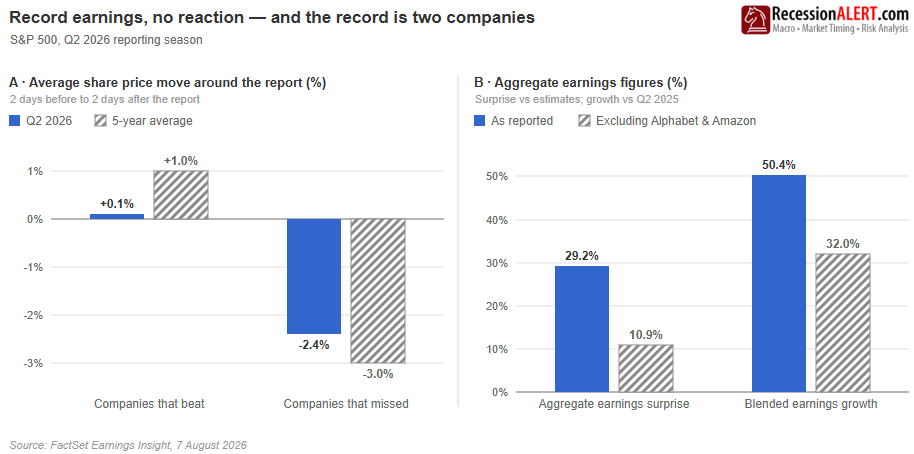
The best aggregate earnings surprise since FactSet began tracking in 2008 bought the average beating company one-tenth of one percent. The five-year norm is +1.0%, so nine-tenths of the beat premium is gone; the penalty is not, a miss still costing -2.4% against a -3.0% norm, four-fifths intact. The payoff around a print has gone from roughly 1:3 against you to roughly 1:24. Some of that missing reaction was never a reaction to earnings at all. Blended growth of 50.4% falls to 32.0% without Alphabet and Amazon — more than a third of index-level growth in two income statements — where roughly $151bn of other income sits: Alphabet’s $98bn in unrealized gains on equity securities and Amazon’s $53.4bn mark on its Anthropic stake, the balance sheet revalued and routed into the same EPS line as operations. The familiar frame for concentration is a seven-name cohort; this quarter needed two. Strip them and the record goes with them: a 10.9% surprise on 32.0% growth, very good, ordinary in kind. But +0.1% is still a collapse against a quarter that good, and there the cause is plainer: at an 86% beat rate, a beat carries no information. Analysts do not forecast marks, which is why Q3’s 27.4% sits nearer 32.0% than the headline — and why 2027 will be measured against a reported base no forecast contains. The next repricing will not need a bad quarter; a merely ordinary one will do.
What it means: size US equity exposure off the 32.0% operating growth rate, not the reported 50.4%. The difference is two companies’ investment marks, so part of the index’s earnings growth is itself a bet on equity markets.
Market Intelligence Brief (MIB) Ver. 18.59
For professional investors only. Not investment advice.
© 2026 RecessionALERT.com

Comments are closed.