
MARKET INTELLIGENCE BRIEF (MIB)
Tuesday, October 13, 2026
NY Fed Vice Chair Williams sees one more hike this year and none in 2027, a ceiling futures refuse to price, while Boston’s Collins wants rates “a bit further” higher. A Houthi missile set part of Saudi Aramco’s Dhahran headquarters ablaze after oil settled. Bank of America drew a $1.2B anti-money-laundering penalty on the eve of earnings. Applied Materials sank 6.69% on a missing spending forecast while Meta rose 2.63%. Citi and BlackRock both stepped back from US stocks.
TABLE OF CONTENTS
A. EXECUTIVE SUMMARY
B. MARKET DATA
C. HIGH-IMPACT STORIES (5)
D. MODERATE-IMPACT STORIES (7)
E. ECONOMY WATCH (4)
F. EARNINGS WATCH (6)
G. WHAT’S NEXT
H. CHART OF THE DAY
A. EXECUTIVE SUMMARY -> TOP
The S&P 500 finished essentially unchanged, down 0.02% at 7,805.45, but the flat close hid a rotation inside semiconductors and a heavy policy calendar. Applied Materials’ refusal to forecast wafer-fab equipment spending, citing physical and financial constraints rather than demand, sank equipment and memory names while AI-compute and analog chipmakers rallied. Treasuries bull-flattened as Williams put a ceiling on the cycle, yet Collins, Waller and newly released discount-rate minutes naming the AI buildout as a cost pressure kept the hawkish case intact into Wednesday’s CPI. Breadth was thin, with only four of 11 sectors higher: Energy led at +1.62% as the Houthis named every Aramco facility a target, Healthcare lagged on Johnson & Johnson’s earnings, and Technology’s near-flat close left it still down more than 3% on the week.
• Fed: NY Fed’s Williams sees “one more rate hike” this year and none in 2027, against futures giving about 90% odds the policy rate ends 2027 at least 50 bps higher; Boston’s Collins expects to “raise rates a bit further before the end of the year.” The 10-year fell 2.9 bps to 5.213% and the 2-year was flat at 4.793%.
• Saudi Aramco: A Houthi missile attack set part of the Dhahran headquarters on fire, reported at 4:32 PM ET, hours after the group told people near all Aramco facilities to evacuate. WTI rose 1.23% to $94.89 and Brent slipped 0.16% to $106.48, both settling before the report.
• Bank of America (BAC): $1.2 billion FinCEN penalty for admitted willful Bank Secrecy Act violations, crediting the OCC’s $750 million fine, the largest in OCC history; announced after the close, the day before Q3 results.
• Chips split: Applied Materials (AMAT) fell 6.69% to $464.24, KLA fell 3.22% and Micron fell 3.62%, while Oracle rose 4.23% and Meta (META) rose 2.63% on Truist’s Street-high $1,000 target.
• Allocators step back: Citi dropped its overweight on US equities, and BlackRock cut US equities to neutral while ending a Treasury underweight held for most of six years.
• Economy: Existing-home sales rose 1.5% to a 3.99 million pace, beating 3.95 million, but NAR said August and September were the two slowest months for sales this year; WSJ economists put 12-month recession odds at 24%.
1. The AI buildout is now an inflation input, not just a growth story — The discount-rate minutes record directors citing “competition for resources and supplies with the AI buildout,” and Governor Waller put AI-driven inflation pressure at two to three years, with productivity gains “still a few years out.” The same constraints showed up in the chip tape: Applied Materials pointed to factory space, supply chains and energy financing as the variables shaping equipment demand. That is a headwind for the equipment makers, whose orders face physical limits, and it gives the Fed’s hawks a non-energy argument that survives a fall in crude. Portfolios long AI compute but short the toolmakers’ cycle were rewarded Tuesday; that split is likely to persist while the build-out is capacity-bound.
2. Energy keeps the hawks in charge of the terminal-rate debate — Williams’ one-more-hike ceiling is the dovish outlier against Collins, Monday’s Hammack, and the eight officials already projecting a 2027 increase. The oil backdrop argues against him: the Aramco headquarters strike landed after the settlement, so Wednesday’s session is the first full price reaction, on the same morning as a CPI expected at 0.6% month over month and 3.6% year over year. OPEC has cut its 2026 demand-growth forecast to about 200,000 barrels a day, yet it still describes front-month prices outrunning forward prices — the market paying up for barrels it can get now. With core expected at only 2.5%, the pressure sits in the headline, where energy lands, and that is the inflation Collins and Williams flagged.
3. A 5.2% 10-year is now pulling money away from stocks — BlackRock and Citi stepping back on the same day removes marginal demand just as earnings season begins, and BlackRock’s preference for the front end means it is collecting yield rather than betting on a long-bond rally. Waller’s remark that the Treasury “safety, liquidity premium” is gone suggests the long end may not fall much even if the Fed stops soon, while a 7.49% MBA 30-year rate keeps housing pinned near this year’s lows. Bank results are the near-term test: Citigroup fell 5.60% and Wells Fargo 3.10% on their own numbers, and Bank of America reports Wednesday carrying a penalty its shares have not yet priced.
 — Leading economic indicators. Accurate market forecasts. Apply for membership at join.recessionalert.com
B. MARKET DATA -> TOP
Wall Street finished flat in a choppy session as two currents inside the chip complex cancelled out: memory and chip-equipment stocks fell on reports of a memory-density advance by China’s CXMT and on Applied Materials’ investor meeting, while Meta, AMD and the analog chipmakers rallied. The Dow reversed an intraday gain of as much as 0.9% as its reporting components landed, with Johnson & Johnson’s earnings-driven drop the heaviest weight, while transports edged higher. Bank results drew a split reaction, with Citigroup and Wells Fargo among the session’s largest mega-cap decliners. Treasuries rallied as the cash market reopened after Columbus Day, flattening the 2s10s curve to 42 bps ahead of Wednesday’s September CPI.
CLOSING PRICES – Tuesday, October 13, 2026:
MAJOR INDICES
The S&P 500 and NYSE Composite both closed flat, so this was a rotation beneath an unchanged tape rather than a broad move. The Dow’s loss came from its earnings-reporting components while transports rose, a split too small to signal on its own. Dow Theory bull confirmation is now in its fourth session, with both averages within 2% of their highs over the past 10 sessions. Small caps lagged again as the Russell 2000 slipped.
| Index | Close | Change | %Move | Why It Moved |
|---|---|---|---|---|
| S&P 500 | 7,805.45 | -1.79 | -0.02% | Flat in a choppy session as memory-chip and bank weakness offset gains in energy and communication services |
| Dow Jones | 51,670.10 | -180.45 | -0.35% | Reversed an intraday gain of as much as 0.9% as components reported; Johnson & Johnson’s earnings-driven 5.73% drop weighed most |
| DJ Transportation | 19,810.47 | +51.39 | +0.26% | Edged higher against the Dow; no discrete same-day catalyst identified |
| Nasdaq 100 | 30,569.48 | -95.22 | -0.31% | Memory and chip-equipment names fell on China CXMT competition fears and Applied Materials’ investor meeting; gains in Meta and AMD limited the decline |
| Russell 2000 | 2,783.37 | -11.11 | -0.40% | Small caps lagged the large-cap indices; no discrete same-day catalyst identified |
| NYSE Composite | 23,985.00 | -5.72 | -0.02% | Essentially flat, in line with the S&P 500 |
VOLATILITY & TREASURIES
Bonds rallied while the VIX barely moved, a calm options read on a day the chip complex sold off. The 10-year fell 2.9 bps while the 2-year was flat, a bull flattening that took the 2s10s spread to 42 bps from 45 bps. The dollar eased from Monday’s highest close since at least mid-April, so the bond bid did not come with a haven bid for the dollar.
| Instrument | Level | Change | Why It Moved |
|---|---|---|---|
| VIX | 15.27 | +0.06 (+0.39%) | Barely moved despite the chip selloff, ahead of Wednesday’s September CPI |
| 10-Year Treasury Yield | 5.213% | -2.9 bps | Fell as the cash market reopened after Columbus Day, ahead of Wednesday’s September CPI |
| 2-Year Treasury Yield | 4.793% | +0.2 bps | Flat as the cash market reopened after Columbus Day, ahead of Wednesday’s September CPI |
| US Dollar Index (DXY) | 102.20 | -0.39 (-0.38%) | Eased from Monday’s highest close since at least mid-April; no discrete catalyst identified |
COMMODITIES
Precious metals split: gold slipped only modestly while silver and platinum fell harder, the larger drop landing in the metals with more industrial demand. Copper was little changed, so that weakness did not extend to base metals. Bitcoin was flat and did not track the chip selloff.
| Asset | Price | Change | %Move | Why It Moved |
|---|---|---|---|---|
| Gold | $4,181.72/oz | $-8.88 | -0.21% | Edged lower ahead of Wednesday’s September CPI; no discrete same-day catalyst identified |
| Silver | $59.365/oz | $-1.148 | -1.90% | Underperformed gold; no discrete same-day catalyst identified |
| Copper | $6.7290/lb | $-0.0180 | -0.27% | Little changed after Monday’s gain; no discrete same-day catalyst identified |
| Platinum | $1,668.75/oz | $-24.75 | -1.46% | Fell alongside silver; no discrete same-day catalyst identified |
| Bitcoin | $83,226 | $+83 | +0.10% | Flat; no discrete same-day catalyst identified |
ENERGY
WTI rose while Brent slipped, narrowing the Brent-WTI spread by about $1.30. Reuters tied the mixed settlements to hopes that a US-Russia diesel deal frees more Russian supply, set against Saudi-led coalition strikes in Yemen. Natural gas rallied on both sides of the Atlantic, with Dutch TTF at its highest close since at least mid-April.
| Asset | Price | Change | %Move | Why It Moved |
|---|---|---|---|---|
| Crude Oil (WTI) | $94.89/bbl | $+1.15 | +1.23% | Settled higher in a mixed session Reuters tied to Saudi-led coalition strikes in Yemen weighed against hopes for more Russian diesel supply; extended gains after the settlement |
| Crude Oil (Brent) | $106.48/bbl | $-0.17 | -0.16% | Settled lower as hopes that the US-Russia diesel deal could free more Russian supply offset the Yemen strikes (Reuters); recovered most of that loss after the settlement |
| Natural Gas (Henry Hub) | $3.319/MMBtu | $+0.152 | +4.80% | Rallied from a $3.108 session low to close near the high; no discrete same-day catalyst identified |
| Natural Gas (Dutch TTF) | $28.485/MMBtu | $+0.908 | +3.29% | Highest close since at least mid-April; no discrete same-day catalyst identified |
S&P 500 SECTORS
Energy led both the day and the week, extending the year’s dominant trend, while only four of 11 sectors finished higher. Healthcare was the weakest sector, led by Johnson & Johnson’s earnings-driven drop. Technology’s near-flat close hid a split: Oracle, AMD and the analog chipmakers rose while memory and chip-equipment names fell, leaving the sector still down more than 3% on the week.
| Sector | 1-Day | 1-Week | 1-Month | 3-Month | 6-Month | YTD | 12-Month |
|---|---|---|---|---|---|---|---|
| Energy | +1.62% | +4.76% | +3.17% | +15.05% | +13.16% | +44.76% | +51.67% |
| Communication Services | +0.81% | +1.31% | +0.53% | -2.26% | +1.28% | +3.04% | +11.97% |
| Utilities | +0.47% | +1.32% | +1.02% | -7.32% | -10.46% | -2.29% | -6.36% |
| Consumer Cyclical | +0.05% | +0.59% | -0.02% | -3.89% | -3.19% | -6.51% | -3.01% |
| Technology | -0.06% | -3.25% | +5.50% | +7.39% | +26.48% | +29.62% | +31.19% |
| Financial | -0.18% | +0.30% | -4.28% | -3.61% | +5.72% | +3.00% | +10.48% |
| Real Estate | -0.22% | +1.16% | -3.60% | -7.59% | -4.05% | +2.16% | +1.83% |
| Consumer Defensive | -0.28% | +3.34% | +0.76% | +1.47% | +1.40% | +7.66% | +8.34% |
| Basic Materials | -0.43% | -1.19% | -2.95% | +2.95% | -7.36% | +10.82% | +20.24% |
| Industrials | -0.79% | -3.26% | -0.11% | -4.99% | -4.95% | +8.36% | +12.12% |
| Healthcare | -1.44% | +0.64% | -0.61% | +3.10% | +8.91% | +6.82% | +15.50% |
TOP MEGA-CAP MOVERS:
GAINERS
| Company | Ticker | Close | Change | Why It Moved |
|---|---|---|---|---|
| Oracle Corp | ORCL | $143.20 | +4.23% | No discrete same-day catalyst identified; a TipRanks report linking the move to a Project Jupiter power arrangement is unverified |
| Meta Platforms Inc | META | $762.50 | +2.63% | Truist raised its target to a Street-high $1,000 and Pivotal Research to $930 on Tuesday, both citing early adoption of the Muse AI assistant, a day after Monday’s Muse Wonder model launch |
| Texas Instruments Inc | TXN | $287.85 | +2.17% | No discrete same-day catalyst identified; analog chipmakers rose while memory and equipment names fell, following Monday’s launch of three AI data-center chips |
| Analog Devices Inc | ADI | $414.70 | +2.08% | No discrete same-day catalyst identified; moved with Texas Instruments as analog chipmakers diverged from the memory and equipment selloff |
| Advanced Micro Devices Inc | AMD | $605.53 | +1.90% | No catalyst confirmed as large enough to explain the move; same-day news included a credit-support agreement for Fermi’s Project Matador AI campus lease and an nVent cooling tie-up, after Monday’s Helion AI rack launch |
DECLINERS
| Company | Ticker | Close | Change | Why It Moved |
|---|---|---|---|---|
| Applied Materials Inc | AMAT | $464.24 | -6.69% | Fell on the day of its investor meeting, where, per Investing.com, it declined to give a wafer-fab-equipment industry spending forecast; KLA and Lam Research also fell |
| Johnson & Johnson | JNJ | $248.61 | -5.73% | Earnings-driven |
| Citigroup Inc | C | $124.53 | -5.60% | Earnings-driven |
| Space Exploration Technologies Corp | SPCX | $156.54 | -4.21% | No discrete same-day catalyst confirmed; reports cite an FAA environmental review of its Starbase expansion and concern over a $40 billion debt-funded chip purchase plan, both unverified and undated |
| Micron Technology Inc | MU | $953.19 | -3.62% | Fourth straight decline as media reports of a memory-density advance by China’s CXMT stoked competition fears (Reuters) |
— Institutional-grade intelligence for serious investors. Apply for membership at join.recessionalert.comC. HIGH-IMPACT STORIES -> TOP
UNCERTAIN
1. NY Fed’s Williams Sees One More Hike This Year and None in 2027, Putting the Vice Chair at Odds With Futures Pricing as Boston’s Collins Backs Further Tightening
The core facts:New York Fed President John Williams, the FOMC’s vice chair and a permanent voter, told Bloomberg News on Tuesday: “I haven’t changed my view that it may be appropriate to have one more rate hike. I don’t think at this time I have any reason to believe that we would need to do more.” He said 2027 inflation should be “near” the 2% target and that “there’s disinflationary forces at play,” adding that his forecast is for inflation “to come down quite a bit” next year. CNBC noted that CME FedWatch data gave about 90% odds that the policy rate ends 2027 at least half a percentage point above today’s level, and that eight of the 18 officials who submitted 2027 projections see another increase that year. After the close, Boston Fed President Susan Collins said she expects it will be appropriate “to raise rates a bit further before the end of the year.” The 10-year Treasury yield fell 2.9 bps to 5.213% as the cash market reopened after Columbus Day, while the 2-year was flat at 4.793%.
Why it matters:The day put the committee’s center of gravity on one more hike, and the open question is now the terminal rate rather than the direction. Williams is the most senior voice outside the Board to put a ceiling on this cycle, and his view directly contradicts a futures curve pricing at least two more hikes by the end of 2027. If his read prevails, front-end pricing beyond the next move is too aggressive, which supports the bull flattening seen Tuesday with the 2s10s spread at 42 bps. The counterweight is that Collins, Monday’s call for restriction from Cleveland’s Hammack, and the eight officials already projecting a 2027 hike leave plenty of room for the curve to be right. With inflation running above 3%, the next two CPI prints will decide which camp sets the path after October.
What to watch:September CPI on Wednesday, October 14, then Hammack (Thursday, 4:30 PM ET) and Chair Warsh (Thursday, 11:30 PM ET) before the pre-meeting blackout begins October 17 ahead of the October 27-28 FOMC.
BEARISH
2. Houthi Missile Attack Sets Part of Saudi Aramco’s Dhahran Headquarters on Fire, Hours After the Group Told People Near All Aramco Facilities to Evacuate
The core facts:Saudi Aramco’s headquarters in Dhahran was hit during a Houthi missile attack on Tuesday that caused a fire in part of the complex, Bloomberg reported at 4:32 PM ET, citing people with knowledge of the matter. The fire was put out; the extent of the damage was unclear, and it could not be established whether it was caused by a direct strike or by debris from intercepted projectiles. The Saudi-led coalition said earlier it had intercepted and destroyed “a ballistic missile launched by the terrorist Houthi militia at Dhahran.” At 11:37 AM ET, Houthi spokesman Yahya Saree had warned “all employees and citizens present near any facility belonging to Aramco to evacuate it,” after the coalition ordered civilians out of a site in Sanaa ahead of strikes. UKMTO separately reported that a tanker and a container ship were hit by projectiles of unknown origin in the Strait of Hormuz. President Trump said “The Houthis are behaving very badly” and, asked whether the US would join the Saudi strikes, replied, “I can’t tell you that.” WTI settled up 1.23% at $94.89 and Brent slipped 0.16% to $106.48; both settled before the headquarters report, with WTI extending gains afterward and Brent recovering most of its loss.
Why it matters:The Saudi-Houthi war has moved from airports and Yemeni depots to the corporate seat of the world’s largest oil producer, and the Houthis have now publicly named every Aramco facility as a target. Until now the oil-supply risk premium has centered on Hormuz and the Red Sea. A credible threat to Saudi Eastern Province infrastructure is a different order of risk, because spare capacity sits in the kingdom. Energy was the best S&P 500 sector on Tuesday at +1.62%, and Dutch TTF gas closed at its highest level since at least mid-April. Because the headquarters news landed after the settlement, Wednesday’s session is the first full price reaction. For the Fed, another leg up in crude feeds directly into the energy-led inflation that Collins and Williams both flagged.
What to watch:Whether Aramco reports damage at any production or processing site, and whether Brent breaks Monday’s intraday high of $107.33 when the full session reprices the attack on Wednesday.
BEARISH
3. Bank of America Hit With a $1.2 Billion Anti-Money-Laundering Penalty, Including the Largest Fine in OCC History, the Day Before It Reports Earnings
The core facts:After Tuesday’s close, the Treasury’s Financial Crimes Enforcement Network assessed a $1.2 billion penalty against Bank of America, N.A., which admits it willfully violated the Bank Secrecy Act. The admitted failures cover suspicious-activity reporting, its anti-money-laundering program and due diligence on foreign correspondent accounts. FinCEN said the bank failed to mitigate and report “priority national security risks,” including Chinese money-laundering networks and illicit finance along the southwest border. The OCC imposed a $750 million civil money penalty, which it said “is the largest in OCC history.” FinCEN’s fine credits that amount, so the two are not additive. The OCC cited a deficient transaction-monitoring system, late suspicious-activity reports, and a failure to complete “many significant steps” required by its December 2024 cease-and-desist order. OFAC separately settled with the bank for $11.6 million over apparent sanctions violations involving programs including Iran and Russia. Bank of America reports third-quarter results before the open on Wednesday, against consensus EPS of $1.10 on revenue of $30.58 billion.
Why it matters:The dollar amount is manageable for the second-largest US bank. The admission of willfulness and the OCC’s finding that the bank had not met its 2024 order are the bigger issues, because they raise the risk of further supervisory constraints and a longer, costlier remediation. It also counters the assumption that a lighter regulatory touch means lighter enforcement on financial-crime compliance. The timing is awkward for a group already under pressure: on Tuesday Citigroup fell 5.60% and Wells Fargo 3.10% on their own results, and the Financial sector slipped 0.18%. None of Tuesday’s bank-stock move reflects this penalty, which broke after 4:00 PM ET.
What to watch:Wednesday’s report and call: whether the penalty is booked in the third quarter, and whether management changes its buyback pace or remediation spending.
BEARISH
4. Applied Materials Sinks 6.69% After Declining to Forecast Industry Equipment Spending at Its Investor Day, Dragging Chip-Equipment Stocks Lower Before ASML Reports
The core facts:Applied Materials closed down 6.69% at $464.24, the largest decline among US mega-caps above $200 billion. According to Investing.com, the company declined at its investor day to provide a forecast for wafer-fabrication-equipment (WFE) spending. Chief Executive Gary Dickerson expressed confidence that demand for computing power would keep expanding rapidly, but pointed to available factory space, supply-chain constraints and the financing of energy infrastructure as variables that could shape the industry’s near-term path. KLA fell 3.22%, while Lam Research and ASML also declined. Micron fell 3.62% as media reports of a memory-density advance by China’s CXMT continued to weigh on memory names. The Nasdaq 100 lost 0.31%, but the Technology sector closed only 0.06% lower: Oracle rose 4.23%, Texas Instruments 2.17%, Analog Devices 2.08% and AMD 1.90%.
Why it matters:WFE spending is the market’s main gauge of how much of the AI build-out reaches chipmaking tools, and the industry’s largest US equipment maker declined to put a number on it. Dickerson’s list of constraints is the important part. It suggests the binding limits on capacity additions are now physical and financial, not demand, so tool orders could lag AI enthusiasm even if the end market holds. The tape agreed: the selloff was confined to equipment and memory while AI-compute and analog names rallied, a rotation within semiconductors rather than a retreat from tech. Technology is still down 3.25% over the week, so the group is losing its role as the index’s default leader.
What to watch:ASML’s third-quarter bookings and any 2027 outlook before the open on Wednesday, October 14, then Taiwan Semiconductor’s capital-spending guidance on Thursday.
BEARISH
5. Fed Minutes Show Seven Reserve Banks Sought a Higher Discount Rate by the September Hike, With Directors Naming the AI Buildout as a Source of Cost Pressure, as Waller Says AI-Driven Inflation Could Last Two to Three Years
The core facts:The Federal Reserve Board on Tuesday released discount-rate minutes for August 17, September 9 and September 16. In August, the directors of the Kansas City and Cleveland Reserve Banks requested a 4% primary credit rate, up from 3.75%. By September 9 the requests had widened to Cleveland, Chicago, Minneapolis and Kansas City. When the FOMC raised the federal funds target 25 bps to 3-3/4 to 4% on September 16, seven banks had requested the increase: Cleveland, Chicago, Minneapolis, Richmond, Atlanta, Kansas City and Dallas. The September 9 minutes record that “most directors observed input cost pressures from many sources, including oil and fuel prices, tariffs, rising healthcare expenses, and competition for resources and supplies with the AI buildout,” with hiring difficulties persisting for AI-related and data-center construction jobs. Speaking at the Bloomberg New Economy Forum in New Delhi on Tuesday, Governor Christopher Waller said AI-driven inflation pressure “could last anywhere from two to three years, given how much they’ve committed already to spend,” and that productivity gains “are still a few years out.” He said that “inflation expectations are well anchored” and that the “safety, liquidity premium on U.S. Treasurys is gone,” with higher yields doing “some of the work” of tightening.
Why it matters:The AI investment boom is now formally recorded inside the Fed as a source of inflation, through competition for labor, power and materials, rather than only as a future productivity dividend. A voting governor puts its duration at two to three years. That is the economic case for keeping policy restrictive into 2027, however hard Williams tries to cap the cycle, and it gives the hawks a non-energy argument that survives a fall in crude. Waller’s comment on Treasury safety is the market-relevant nuance. If part of the move to a 5.2% 10-year yield reflects a lost safety premium rather than rate expectations, the long end will not fall much even if the Fed stops after one more hike.
What to watch:The Beige Book at 2:00 PM ET on Wednesday, October 14, for whether districts again cite AI-related competition for labor, power and supplies.
— Quantifying recession risk so you don’t have to guess. Apply for membership at join.recessionalert.comD. MODERATE-IMPACT STORIES -> TOP
BEARISH
6. Citi and BlackRock Both Pull Back on US Stocks in One Day, With BlackRock Ending a Treasury Underweight It Has Held for Most of Six Years
The core facts:Citigroup dropped its “overweight” call on US equities and closed its long position in the S&P 500 Equal Weight index, Reuters reported. Citi said its POLLS indicator, which tracks positioning, optimism, liquidity, leverage and stress, recently reached levels that have historically coincided with market peaks. “We tactically take some risk off the table,” the bank said, though it stopped short of turning bearish. Separately, the BlackRock Investment Institute downgraded US equities to neutral and upgraded US Treasuries, favoring short-term bonds. “Higher yields and potentially excessive Fed tightening expectations create room to unwind our U.S. Treasury underweight — a mainstay for most of the last six years,” the team said, adding that it was “downgrading U.S. equities to neutral to manage potential volatility around the AI buildout” while retaining “our conviction in AI fundamentals.” The calls run against Goldman Sachs, which upgraded global equities to overweight on Monday. The S&P 500 closed down 0.02% at 7,805.45.
Why it matters:With the 10-year above 5.2% and short-dated Treasuries yielding close to 4.8%, cash and bonds now compete directly with equities. Two of the largest allocators acted on that on the same day. BlackRock’s preference for the front end is notable: it is not betting on a long-bond rally, it is collecting yield while waiting out AI-related volatility. Citi’s sentiment signal says the remaining risk is positioning rather than fundamentals. Neither is a call for a selloff, but a shift in model portfolios from overweight to neutral removes a source of marginal demand just as earnings season starts.
What to watch:Wednesday’s September CPI, which will test BlackRock’s view that Fed tightening expectations are “potentially excessive,” and whether the S&P 500 holds above 7,800.
BULLISH
7. Truist Sets a Street-High $1,000 Target on Meta on Early Muse Adoption, Lifting the Stock 2.63%, as JPMorgan Says It Will Block Outside AI Agents From Customer Accounts
The core facts:Meta Platforms rose 2.63% to $762.50, the second-largest gain among mega-caps above $200 billion. Truist raised its price target to a Street-high $1,000 from $763 and Pivotal Research raised its target to $930 from $790, both citing early adoption of the Muse AI assistant a day after Meta launched its Muse Wonder models. On the same day, JPMorgan Chief Executive Jamie Dimon told analysts that the bank will not allow outside AI agents to operate customer accounts: “We’re not going to allow just any … outside agent to come in inside the company, because it’s just too risky for clients and for JPMorgan.” A JPMorgan spokeswoman confirmed to CNBC that the bank blocks external agents from acting for retail customers. Agents can read some data through connectors such as Plaid but cannot move money or pay bills, and the bank gave no timeline for safeguards that would allow it. Communication Services rose 0.81%, the second-best sector of the day.
Why it matters:The Street is starting to value Muse as a consumer product with monetization potential, not an R&D cost, which supports Meta’s heavy AI capex. JPMorgan’s stance shows where that thesis meets friction. The most valuable things an agent can do, moving money and paying bills, depend on access that the largest US bank is refusing. For banks it is a defensive win: CNBC noted that bank stocks were hit in September when Muse topped the app charts, on fears that agents would move deposits out of low-yielding accounts. If other large banks adopt the same policy, that deposit-flight risk shrinks, along with part of Muse’s addressable use cases.
What to watch:Whether Bank of America and Morgan Stanley address outside-agent access on their earnings calls Wednesday, October 14.
UNCERTAIN
8. AT&T Agrees to Sell AT&T Mexico to Grupo Televisa and Fintech Holdings for $2 Billion After Bernstein Downgrades the Stock Over SpaceX Competition
The core facts:AT&T said after Tuesday’s close that it agreed to sell AT&T Mexico to Grupo Televisa and Fintech Holdings for $2 billion in cash at closing, subject to adjustments, plus “additional contractual and contingent benefits.” Closing is expected in the first quarter of 2027, subject to Mexican regulatory approvals, and the unit will be classified as held for sale in AT&T’s third-quarter 10-Q. “We have articulated a strong belief that the AI future will run on converged networks with dense fiber assets,” Chairman and CEO John Stankey said, adding that the sale fits the company’s strategy of focusing capital on growth opportunities in the US market. Earlier in the day, Bernstein downgraded AT&T to Market Perform from Outperform and cut its price target to $24 from $25, citing competitive pressure from SpaceX’s push into broadband and wireless, according to The Fly. AT&T shares closed up 1.60% at $22.85.
Why it matters:The sale ends a decade-long Mexican venture and redirects capital to domestic fiber, but at $2 billion up front it frees modest cash for a company of AT&T’s size. The more important signal is the Bernstein downgrade. It is one of the first mainstream analyst calls to treat SpaceX as a direct competitive threat to US wireless incumbents rather than a niche satellite provider. If that view spreads, the sector’s main defensive appeal, stable subscriber economics, comes under pressure just as AT&T narrows its focus to the US market.
What to watch:Whether other analysts follow Bernstein in pricing SpaceX into US wireless estimates, and Mexican regulators’ review of the Televisa-Fintech purchase.
UNCERTAIN
9. Delaware Jury Sides With Arm on Four Claims in Its Licensing Dispute With Qualcomm and Awards Qualcomm $1 on Each of Its Other Two
The core facts:A Delaware jury on Tuesday found for Arm on four claims in its contract dispute with Qualcomm and awarded Qualcomm $1 in damages on each of its other two claims, a total of $2, according to a statement from Arm. “We are pleased with the jury’s decision today finding for Arm on four claims,” Arm said, adding that Qualcomm had pursued the case to deprive it of billions of dollars under their license agreements. The case went to the jury last week. The dispute involves two of the largest companies in the semiconductor IP and mobile-chip ecosystem, Arm at roughly $273 billion in market value and Qualcomm at roughly $189 billion. No share-price reaction to the verdict could be established at the time of writing.
Why it matters:The verdict largely validates Arm’s position on how its architecture licenses can be used and transferred. That bears directly on the royalty economics underpinning Arm’s valuation as it pushes into data-center and PC chips. For Qualcomm, nominal damages on its winning claims mean the case ends without financial relief, leaving its license terms with Arm as the binding constraint on its custom-CPU strategy. The broader read-through is that Arm’s leverage over licensees has been tested in court and held.
What to watch:Qualcomm’s response and any post-trial motions, and how both stocks reprice in Wednesday’s session.
BULLISH
10. Visa Wins Beijing’s Approval to Set Up a Domestic Bank-Card Clearing Business in China, Six Years After Applying and Ahead of the Next Xi-Trump Meeting
The core facts:Visa said on Tuesday that it had received approval from the People’s Bank of China to set up a bank-card clearing business in the country. “This marks an important milestone toward the company serving China’s domestic payments market,” the company said. CEO Ryan McInerney said Visa looks forward to “taking the necessary steps in the process, pursuant to the PBOC’s regulations, to begin operating domestically in China.” Visa applied in May 2020. American Express received its processing license in June 2020, and Mastercard’s joint venture began processing payments in 2024 after receiving approval to prepare in February 2020. George Chen of The Asia Group told CNBC that Beijing approved the license “just ahead of the APEC Leaders’ Meeting in Shenzhen next month, where Xi [Jinping] and Trump are expected to meet again.”
Why it matters:Domestic clearing rights open a market long reserved for UnionPay. The near-term revenue opportunity is modest, because daily payments in China are dominated by WeChat Pay and Alipay, and the approval is preparatory, with further steps required before operations begin. The larger signal is political. Beijing is granting a long-pending license to a US financial company whose CEO chairs the US-China Business Council, ahead of a leaders’ meeting. That makes it a gesture of goodwill on trade and lowers the near-term risk of a fresh escalation affecting US firms operating in China.
What to watch:The APEC Leaders’ Meeting in Shenzhen next month, and whether Beijing pairs the Visa approval with other market-access decisions for US firms.
UNCERTAIN
11. OPEC Halves Its 2026 Oil Demand Growth Forecast to About 200,000 Barrels a Day but Raises 2027 to About 2.6 Million
The core facts:OPEC’s October monthly oil market report, released Tuesday, cut its forecast for 2026 world oil demand growth to roughly 200,000 barrels per day, from about 400,000 in September and about 600,000 in August, The Hill reported. It raised its 2027 demand growth forecast to about 2.6 million barrels per day, from roughly 2.4 million. “Heightened geopolitical tensions in the Middle East, disruptions to regional crude flows, and strong demand for prompt barrels pushed front-month prices higher relative to forward prices,” the report said. Brent settled down 0.16% at $106.48 and WTI rose 1.23% to $94.89.
Why it matters:This is the producer group itself acknowledging demand destruction at Brent above $100: two consecutive monthly cuts have taken this year’s growth forecast down by two-thirds since August. The large 2027 upgrade means OPEC sees the shortfall as deferred rather than lost, which supports prices once supply normalizes. For now, OPEC’s own description of front-month prices rising faster than forward prices shows the market paying up for barrels it can get today. That leaves headline inflation, and the Fed’s hiking bias, exposed to the next supply shock, such as Tuesday’s attack on Aramco.
What to watch:The IEA’s October Oil Market Report on Wednesday, October 14, for whether the agency follows OPEC in cutting 2026 demand.
UNCERTAIN
12. The Administration Invokes the Defense Production Act to Expand Delek’s Tyler, Texas Refinery as Diesel Averages $6.28 a Gallon
The core facts:Vice President JD Vance announced at a Texas rally on Tuesday that the administration has used the Defense Production Act to expand the Delek refinery in Tyler, Texas. “We want millions of gallons of commercial-grade and military-spec fuel to come out of this refinery, in addition to what it’s already producing,” Vance said. The Hill reported that it was unclear whether the authority would be used beyond this one refinery. AAA put national averages on Tuesday at about $4.34 a gallon for gasoline and $6.28 for diesel. Asked last week about using the act to lower prices, Andy Lipow of Lipow Oil Associates told The Hill that “refineries that are currently in operation are already making as much diesel as they possibly can.”
Why it matters:Using wartime industrial powers on a single refinery shows how far the administration is willing to intervene with diesel at crisis levels three weeks before the midterm elections. The practical effect is slow: expanding refinery capacity takes months, so it does nothing for this winter’s distillate prices. It also adds a policy-intervention risk that refiners and fuel-sensitive industries will have to price, alongside the administration’s separate diesel arrangement with Russia.
What to watch:Whether the White House extends the order to other refineries, and Thursday’s EIA weekly report for distillate inventories.
— Separating signal from noise since 2007. Apply for membership at join.recessionalert.comE. ECONOMY WATCH -> TOP
Tuesday’s economic signals favoured resilience over relief, leaving the Fed’s tightening bias intact. Existing-home sales beat forecasts at a 3.99 million pace, yet NAR still called August and September the year’s two slowest months, with mortgage rates near 7.5% shrinking the pool of qualified buyers. Boston Fed President Susan Collins said she expects it will be “appropriate to raise rates a bit further before the end of the year,” while the Wall Street Journal’s economist panel trimmed 12-month recession odds to 24% but expects higher bond yields to persist. Wednesday’s September CPI, forecast at 3.6% year over year from 3.4%, is the next test of how far that hiking bias runs.
Existing-Home Sales Rise 1.5% to a 3.99 Million Pace, Beating Forecasts, but August and September Were the Year’s Two Slowest Months (NAR, Oct 13)
What they’re saying:Existing-home sales rose 1.5% in September to a seasonally adjusted annual rate of 3.99 million, above the 3.95 million consensus and up from 3.93 million in August, but down 2.2% from a year earlier. The median existing-home price rose 1.3% year over year to $417,500, and inventory climbed 1.9% to 1.60 million units, or 4.8 months’ supply. NAR Chief Economist Lawrence Yun said “August and September marked the two slowest months for home sales this year,” adding that “further increases in mortgage rates in recent weeks mean fewer buyers can qualify to purchase a home.”
The context:The beat is a monthly bounce off a low base rather than a turn: sales fell year over year in all four regions, and month-over-month gains in the South and West were offset by a decline in the Northeast and a flat Midwest. With the MBA 30-year contract rate at 7.49% in its latest weekly survey and the 10-year Treasury yield at 5.213%, affordability remains the binding constraint. Rising inventory and lengthening days on market are shifting leverage to buyers, and Yun said sellers may need “price discounts and other incentives to attract buyers.”
What to watch:The MBA 30-year mortgage rate (Wed, Oct 14), the NAHB Housing Market Index (Mon, Oct 19; prior 32), and September Housing Starts, Building Permits and Pending Home Sales (Tue, Oct 20).
Boston Fed’s Collins Expects It Will Be “Appropriate to Raise Rates a Bit Further Before the End of the Year” (Federal Reserve Bank of Boston, Oct 13)
What they’re saying:Boston Fed President Susan Collins, speaking at the Boston Fed’s 25th Annual Regional and Community Bankers Conference, said she currently expects “it will be appropriate to raise rates a bit further before the end of the year.” She added that the decision would “depend importantly on how the totality of incoming data shapes my outlook and the associated balance of risks,” and highlighted the economy’s resilience and the risks of persistently elevated inflation.
The context:Collins discussed the FOMC’s recent decision to raise the federal funds rate and placed herself on a path toward further tightening, a day after Cleveland Fed President Beth Hammack called for a restrictive stance. Prediction markets already treat a 2026 rate hike as near-certain: Polymarket puts the odds of a Fed hike this year above 99% and of at least one cut at 4%, both unchanged from Monday. With the October 27-28 FOMC meeting two weeks away, her conditioning on “the totality of incoming data” puts Wednesday’s CPI at the center of the timing debate.
What to watch:September CPI (Wed, Oct 14; headline expected 0.6% month over month and 3.6% year over year from 3.4%, core expected 0.2% and 2.5%), Cleveland Fed President Hammack (Thu, Oct 15, 4:30 PM ET) and Chair Warsh (Thu, Oct 15, 11:30 PM ET), then the October 27-28 FOMC meeting.
WSJ Economists Trim 12-Month Recession Odds to 24% and Put 2026 Growth at 2.4%, but Expect Higher Bond Yields to Persist (Wall Street Journal, Oct 11)
What they’re saying:The Wall Street Journal’s quarterly survey of 71 academic, financial and business economists, conducted October 2-7, put the average probability of a U.S. recession in the next 12 months at 24%, down from 25% in July, with individual estimates ranging from 1% to 80%. Respondents forecast 2026 GDP growth of 2.42%, December 2026 CPI inflation of 3.48%, a December unemployment rate of 4.19%, and a 10-year Treasury yield of 5.10% at the end of 2026.
The context:The Journal framed the results around the view that “higher yields are expected to persist,” citing “a mix of improving growth, new inflationary pressures and concerns about the U.S. fiscal trajectory,” and economists said those factors had “forced them to re-evaluate their assumptions” about investor demand for Treasurys. Their 10-year forecasts for mid-2027 and end-2027 rose to 4.96% and 4.78%, from 4.3% and 4.26% in July, and the 10-year closed Tuesday at 5.213%, already above the panel’s year-end forecast. The panel’s 24% recession odds compare with Polymarket’s 8% for a recession by the end of 2026, a gap partly explained by the survey’s longer 12-month horizon.
What to watch:September CPI (Wed, Oct 14) and Retail Sales (Thu, Oct 15; expected 0.3% after 1.2%) as the next tests of the panel’s inflation and growth calls, followed by Industrial Production (Fri, Oct 16; expected 0.4%).
ADP’s Weekly Private-Payroll Estimate Rises to 24,750 From 23,750 (ADP, Oct 13)
What they’re saying:ADP’s weekly estimate of private-sector employment change, released at 8:15 AM ET, came in at 24,750, up from 23,750 in the prior release. No consensus forecast was published for the weekly series.
The context:The gain is modest: at 24,750 a week, private hiring would run at about 107,000 a month if sustained, a pace consistent with steady but unspectacular job growth. For a Fed weighing further hikes against elevated inflation, a stable labor signal removes any employment-side case for pausing, leaving Wednesday’s CPI as the more decisive input.
What to watch:Initial Jobless Claims (Thu, Oct 15; expected 200K, prior 197K) and the next ADP weekly estimate (Tue, Oct 20).
— Know the probability before the market prices in the risk. Apply for membership at join.recessionalert.comF. EARNINGS WATCH -> TOP
YESTERDAY AFTER THE BELL (Markets Reacted Today)
No major earnings yesterday after the bell from companies with >$100B market cap.
TODAY BEFORE THE BELL (Markets Already Reacted)
UNCERTAIN
13. JPMorgan Chase (JPM): -0.86% | Equities Trading Jumps 49% and NII Rises 13%, but EPS Trails Consensus on a Securities Loss and Buybacks Slow
The Numbers:Released: BMO. EPS $5.57 vs. $5.93 consensus; $5.75 excluding a $658 million pre-tax investment-securities loss ($0.18 a share). Reported revenue $50.2 billion vs. $51.23 billion expected; managed revenue $50.9 billion, up 8%. Net income $15.3 billion ($15.8 billion excluding the loss); ROTCE 20% (21% excluding it). Net interest income $27.1 billion, up 13%; NII excluding Markets $24.7 billion, up 6%. Markets revenue $10.3 billion, up 15%: Equities $5.0 billion (+49%), Fixed Income $5.4 billion (-4%). Investment banking fees $3.0 billion, up 14%. Provision $2.7 billion, including a $539 million net reserve build, mainly in Wholesale; card net charge-off rate 2.91%. CET1 13.9%. Net buybacks $664 million. The release gave no full-year guidance update.
The Problem/Win:The operating franchise was strong, led by equities trading and double-digit NII growth. The shortfall against consensus came from the securities loss and a reserve build concentrated in Wholesale lending. Dimon flagged the capital decision: “In line with our hierarchy, we reduced share repurchases this quarter,” adding that the bank believes it can deploy that capital “at very attractive returns.”
The Ripple:The bank group split: Goldman Sachs slipped 0.23% after a large beat, while Citigroup fell 5.60% and Wells Fargo 3.10%, leaving the Financial sector down 0.18%. On the call, Dimon also said JPMorgan will not let outside AI agents operate customer accounts, which limits the deposit-flight risk agents posed to bank funding.
What It Means:Underlying earnings power is intact, but slower buybacks and a Wholesale reserve build take away two supports the stock has relied on. The modest decline suggests investors are reading the miss as one-off rather than a turn in credit.
What to watch:Bank of America and Morgan Stanley on Wednesday, for whether Wholesale reserve builds and slower buybacks show up across the group.
UNCERTAIN
14. Johnson & Johnson (JNJ): -5.73% | Beats and Nudges Up Guidance, but a Talc Charge Cuts GAAP EPS to $0.09 and Adjusted EPS Falls 7.5% From a Year Ago
The Numbers:Released: BMO. Adjusted EPS $2.59 vs. $2.52 consensus, down 7.5% from $2.80 a year earlier; reported EPS $0.09 vs. $2.12. Sales $25.40 billion vs. $25.38 billion expected, up 5.9% reported and 6.1% on an adjusted operational basis. Innovative Medicine $16.76 billion (+7.7%); MedTech $8.64 billion (+2.5%). Full-year 2026 adjusted EPS guidance raised to $11.05-$11.15 (midpoint $11.10) from $10.96-$11.11; reported sales guidance midpoint raised to $101.2 billion from $101.1 billion.
The Problem/Win:Pharmaceuticals carried the quarter with 7.7% growth, while MedTech grew only 2.5%. The gap between reported and adjusted EPS reflects a one-time special charge for the proposed talc litigation resolution, along with costs tied to the Firefly Bio acquisition and the Sail Biomedicines collaboration. The release gives no reason for the share decline. Visible weak points are the year-over-year fall in adjusted EPS, a guidance raise of only $0.06 at the midpoint, and soft MedTech growth.
The Ripple:J&J was the heaviest drag on the Dow, which fell 0.35%, and pushed Healthcare to the day’s weakest sector at -1.44%.
What It Means:A beat-and-raise that still produces a 5.73% loss suggests positioning had run ahead of a quarter that improved only modestly. CEO Joaquin Duato’s call for “double-digit growth by the end of the decade” now needs MedTech to accelerate.
What to watch:Any timetable for the planned orthopaedics separation, and whether MedTech growth improves from 2.5% next quarter.
BULLISH
15. UnitedHealth Group (UNH): -0.20% | Beats by 13% and Raises Its 2026 Adjusted EPS Outlook to at Least $20.50 as the Medical Care Ratio Improves
The Numbers:Released: BMO. Adjusted EPS $4.69 vs. $4.14 consensus, up from $2.92 a year earlier; GAAP EPS $4.56. Revenue $112.69 billion vs. $111.31 billion expected, down about 0.4% year over year. Medical care ratio 88.4% vs. 89.9%, including $610 million of favorable prior-period reserve development. UnitedHealthcare operating earnings $2.8 billion (margin 3.3% vs. 2.1%); Optum operating earnings $3.7 billion (margin 5.6% vs. 3.6%), with Optum Health at $735 million vs. $41 million. Full-year 2026 guidance raised to adjusted EPS of at least $20.50 and GAAP EPS of at least $19.50.
The Problem/Win:Margin repair is running ahead of plan across both businesses, led by the turnaround at Optum Health. Part of the medical-cost improvement came from favorable reserve development rather than current-period trends. For 2027, at least 69% of Medicare Advantage members are in 4-star-or-better plans, which the company called in line with expectations.
The Ripple:UnitedHealth held nearly flat while J&J dragged Healthcare to the day’s weakest sector at -1.44%, so the managed-care recovery did not offset weakness elsewhere in the sector.
What It Means:The recovery story is confirmed. The flat reaction says much of it was priced in, and investors will discount the MCR improvement that came from reserve releases.
What to watch:The medical care ratio excluding prior-period reserve development, as the cleanest test of whether cost trends are actually improving.
BULLISH
16. Goldman Sachs (GS): -0.23% | EPS of $17.01 Beats $12.86 Consensus on a 72% Jump in Equities and Record Advisory Revenue
The Numbers:Released: BMO. EPS $17.01 vs. $12.86 consensus, up 39% year over year; charitable contributions reduced EPS by about $1.00. Net revenues $18.68 billion vs. $16.83 billion expected, up 23% year over year but down 8% from the second quarter. Net earnings $5.29 billion; ROE 18.7%. Global Banking & Markets $13.46 billion (+32%): investment banking fees $3.22 billion (+21%), Equities $6.44 billion (+72%), FICC $3.47 billion (-1%). Asset & Wealth Management $5.05 billion (+14%). Assets under supervision a record $4.10 trillion, with $97 billion of long-term net inflows. Platform Solutions $170 million (-72%) on markdowns of the Apple Card portfolio. Standardized CET1 12.4%; $4.49 billion returned, including $3.0 billion of buybacks.
The Problem/Win:Equities and advisory carried the quarter: the firm reported record advisory net revenues, record equities financing and record year-to-date net revenues. The soft spots were sequential, with net revenues down 8% and EPS down 19% from the second quarter, and FICC flat year over year.
The Ripple:Equities strength ran across the group (JPMorgan Equities +49%, Citi Equities +14%), a positive read-through for Morgan Stanley on Wednesday.
What It Means:A $4-a-share beat drew no rally, which suggests the market treats this trading strength as cyclical and is focused on the sequential slowdown and softer CET1.
What to watch:Morgan Stanley’s equities and wealth-management results before the open on Wednesday, October 14.
UNCERTAIN
17. Wells Fargo (WFC): -3.10% | EPS Edges Past Consensus With Help From a Tax Benefit, but Revenue Misses as Fee Income Falls 9% From the Second Quarter
The Numbers:Released: BMO. EPS $1.87 vs. $1.85 consensus, including $170 million of discrete tax benefits; up 13% year over year but down 6% from the second quarter. Revenue $21.87 billion vs. $22.31 billion expected, up 2% year over year. Net interest income $12.52 billion, up 5% year over year and 2% from the second quarter. Noninterest income $9.35 billion, down 9% from the second quarter and 1% year over year. Noninterest expense $13.74 billion, down 1%. Provision for credit losses $1.03 billion, up 51% year over year; net charge-offs $983 million. Average loans $1.03 trillion and average deposits $1.48 trillion, both up 11%. CET1 10.0%, down from 11.0% a year earlier. Buybacks about $2.5 billion.
The Problem/Win:Balance-sheet growth is real, with loans and deposits up 11%. But fee income fell sharply from the second quarter, the EPS beat leaned on tax benefits, and the provision rose by half. Chief Executive Charlie Scharf said “consumers are spending more, loan delinquencies are low,” and that expenses fell despite a 15% rise in revenue-related costs.
The Ripple:Wells Fargo and Citigroup were the weak spots of the bank group, while JPMorgan and Goldman held near flat.
What It Means:A tax-assisted beat with a revenue miss and a lower CET1 ratio gives investors little to pay for. Growing the balance sheet is consuming capital faster than it is lifting fee income.
What to watch:Whether CET1 stabilizes from 10.0% next quarter, which determines how long the bank can sustain buybacks of about $2.5 billion a quarter.
UNCERTAIN
18. Citigroup (C): -5.60% | Beats Estimates With 15% Services Growth, but Revenue Falls 4% From the Second Quarter and RoTCE Slips to 11.5%
The Numbers:Released: BMO. EPS $2.85 vs. $2.65 consensus, up 53% from $1.86 a year earlier (27% excluding a prior-year goodwill impairment). Revenue $23.85 billion vs. $23.72 billion expected, up 8% year over year but down 4% from the second quarter. Services $6.6 billion (+15%); Markets $6.1 billion (+6% year over year, -13% from the second quarter, with Equities down 25% sequentially); Wealth $3.3 billion (+15%); Banking $1.7 billion (+6%); US Consumer Cards $4.7 billion (flat). Provision $2.59 billion, with a $333 million net reserve build. Efficiency ratio 58.5%. RoTCE 11.5% vs. 13.0% in the second quarter. CET1 12.8%. More than $4 billion returned to shareholders.
The Problem/Win:Year over year the quarter was strong, with Services “up 15%, with momentum in every driver,” per CEO Jane Fraser. The release itself gives no reason for the selloff. The visible negatives are sequential: revenue, Markets and RoTCE all fell from the second quarter, the reserve build more than doubled from a year earlier, and Fraser said the bank will “pull forward investments” even as it expects to exceed this year’s return target.
The Ripple:Citigroup was the third-largest decline among mega-caps above $200 billion, behind Applied Materials and J&J.
What It Means:The restructuring is delivering year-over-year growth, but the market is penalizing a quarter-on-quarter fall in returns and higher investment spending. The question is now the path to the 11-13% RoTCE goal, not whether this year’s target is met.
What to watch:How much spending Citi pulls forward, and whether Markets revenue recovers from its 13% sequential drop in the fourth quarter.
TODAY AFTER THE BELL (Markets React Tomorrow)
No major earnings after the bell from companies with >$100B market cap.
WEEK AHEAD PREVIEW:
Q3 2026 earnings season is under way after Tuesday’s six big-bank and healthcare reports. Seven more companies above $100 billion report Wednesday and Thursday, and six report on Tuesday, October 20, as the season broadens beyond financials.
ASML Holding (ASML) — BMO, Wednesday, October 14 — EPS est. $12.19, revenue est. $13.16B. Key focus: third-quarter bookings and any 2027 outlook, a day after Applied Materials declined to forecast industry equipment spending.
Bank of America (BAC) — BMO, Wednesday, October 14 — EPS est. $1.10, revenue est. $30.58B. Key focus: how it accounts for Tuesday’s $1.2 billion anti-money-laundering penalty, net interest income and its buyback pace.
Morgan Stanley (MS) — BMO, Wednesday, October 14 — EPS est. $2.93, revenue est. $19.93B. Key focus: equities trading after big gains at Goldman (+72%) and JPMorgan (+49%), plus wealth-management net new assets.
BlackRock (BLK) — BMO, Wednesday, October 14 — EPS est. $14.32, revenue est. $7.42B. Key focus: organic base-fee growth, private-markets fundraising and flows, on a day its investment institute cut US equities to neutral.
Progressive (PGR) — BMO, Wednesday, October 14 — EPS est. $4.35, revenue est. $22.61B. Key focus: auto-insurance combined ratio and policy growth as pricing competition returns.
Charles Schwab (SCHW) — BMO, Thursday, October 15 — EPS est. $1.66, revenue est. $7.18B. Key focus: client cash balances and net interest margin with yields above 5%, plus trading activity.
Prologis (PLD) — BMO, Thursday, October 15 — EPS est. $0.78, revenue est. $2.18B. Key focus: industrial occupancy and rent growth, and data-center development, as higher yields weigh on real estate.
GE Aerospace (GE) — BMO, Tuesday, October 20 — EPS est. $2.00, revenue est. $12.84B. Key focus: whether it lifts its 2026 EPS guidance again after raising it to $7.65-$7.85 in July, LEAP engine turnaround times and spare-parts demand.
RTX (RTX) — BMO, Tuesday, October 20 — EPS est. $1.78, revenue est. $24.09B. Key focus: the defense and commercial backlog, Pratt & Whitney aftermarket and GTF engine costs, after Deutsche Bank downgraded the stock to Hold on Tuesday.
Netflix (NFLX) — AMC, Tuesday, October 20 — EPS est. $0.82, revenue est. $12.87B. Key focus: progress toward its target of roughly doubling ad revenue to about $3 billion this year, its 2026 revenue outlook of $51-51.4 billion and engagement trends.
Intuitive Surgical (ISRG) — AMC, Tuesday, October 20 — EPS est. $2.65, revenue est. $2.91B. Key focus: da Vinci procedure growth against its 13-15% full-year outlook, after US growth slowed to about 12% in the second quarter, and da Vinci 5 placements.
Chubb (CB) — AMC, Tuesday, October 20 — EPS est. $6.79, revenue est. $15.71B. Key focus: catastrophe losses against budget and the pace of softening in commercial property-and-casualty pricing.
Capital One (COF) — AMC, Tuesday, October 20 — EPS est. $5.50, revenue est. $16.25B. Key focus: domestic card charge-offs after a 4.71% rate in the second quarter, and Discover integration costs against its $2.5 billion synergy target.
No company above $100 billion reports on Friday, October 16 (Travelers, at $77.9 billion, is the largest) or Monday, October 19. Taiwan Semiconductor ($2.31 trillion, Thursday) is excluded as an ADR. Bank of New York Mellon reports Thursday just below the threshold at $95.7 billion.
— US market commentary trusted by family offices and institutions. Apply for membership at join.recessionalert.comG. WHAT’S NEXT -> TOP
UPCOMING RELEASES:
| Date | Event | Why It Matters |
|---|---|---|
| Wed, Oct 14 | September CPI (headline expected 0.6% MoM and 3.6% YoY, prior 3.4%; core expected 0.2% MoM and 2.5% YoY, prior 2.4%) | The decisive input for the October 27-28 FOMC. A hot headline backs Collins and the futures curve over Williams’ one-more-hike ceiling; a soft core print strengthens BlackRock’s view that tightening expectations are “potentially excessive.” |
| Wed, Oct 14 | Fed Beige Book (2:00 PM ET); Fed speakers Bowman (5:40 AM and 10:55 PM ET) and Barkin (1:30 PM ET) | Tests whether districts again cite competition with the AI buildout for labor, power and supplies, the cost pressure the discount-rate minutes and Waller flagged. |
| Wed, Oct 14 | IEA October Oil Market Report | Shows whether the IEA follows OPEC in cutting 2026 demand growth, released into the first full session after the Aramco headquarters strike. |
| Thu, Oct 15 | September PPI (expected 0.5% MoM, prior 0.4%; core expected 0.3%, prior 0.2%) and Retail Sales (expected 0.3%, prior 1.2%; control group expected 0.3%, prior 1.4%) | Pipeline inflation and consumer demand in one morning; a firm PPI alongside resilient spending would reinforce the case for further hikes before year-end. |
| Thu, Oct 15 | Initial Jobless Claims (expected 200K, prior 197K); Empire State (expected 10.3, prior 7.60) and Philadelphia Fed (expected 28.4, prior 37.8) manufacturing indexes | With ADP’s weekly estimate still steady, a low claims print leaves the Fed no employment-side reason to pause. |
| Thu, Oct 15 | EIA weekly crude (prior -3.186M) and gasoline (prior 0.382M) stock changes | Distillate inventories are the gauge for diesel at $6.28 a gallon and for whether the Defense Production Act order on Delek’s Tyler refinery changes anything near term. |
| Thu, Oct 15 | Cleveland Fed’s Hammack (4:30 PM ET) and Fed Chair Warsh (11:30 PM ET) | The last major Fed signals before the pre-meeting blackout begins October 17; Warsh’s read on CPI sets expectations for the October 27-28 decision. |
| Fri, Oct 16 | Industrial Production (expected 0.4%, prior 0%); Import Prices (expected 0.8%, prior 0.7%); Net Long-term TIC Flows for August (expected $125.7B, prior -$27.9B) | TIC flows bear on Waller’s claim that the Treasury safety premium is gone: a repeat of the prior month’s net outflow would fit a 10-year holding above 5.2%. |
| Mon, Oct 19 – Tue, Oct 20 | NAHB Housing Market Index (Mon, prior 32); September Housing Starts (prior 1.275M), Building Permits (prior 1.403M) and Pending Home Sales (prior 0.3% MoM) (Tue) | Shows whether September’s existing-home sales beat was a bounce off a low base or a turn, with the MBA 30-year rate at 7.49%. |
KEY QUESTIONS:
1. Does Wednesday’s CPI, with headline expected at 3.6% and core at just 2.5%, back Williams’ one-more-hike ceiling, or the futures curve pricing at least half a point more by the end of 2027?
2. Now that the Houthis have named every Aramco facility a target, does Aramco report damage at any production or processing site, and does Brent break Monday’s $107.33 intraday high when Wednesday’s full session reprices the attack?
3. With BlackRock and Citi both stepping back from US equities and the 10-year above 5.2%, can Wednesday’s bank earnings, led by Bank of America and its $1.2 billion penalty, keep the S&P 500 above 7,800?
— US market commentary trusted by family offices and institutions. Apply for membership at join.recessionalert.comH. CHART OF THE DAY -> TOP
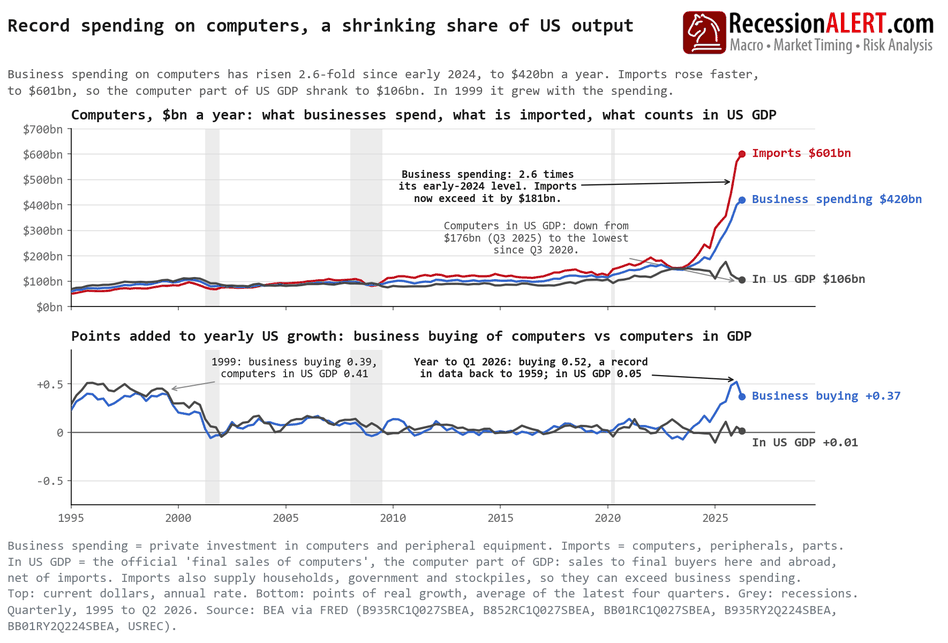
Business buying of computers has never added more to US growth — yet once imports are counted, computers added almost nothing. In the year to March that buying, which covers all business computers (the category AI servers sit in), lifted yearly growth by 0.52 percentage point, a record in data back to 1959; net of imports, computers added 0.05. The reason is how GDP is kept: a machine a US firm buys counts as investment wherever it was made, then is subtracted again as an import, so only the slice made, assembled and sold here stays. In 1999 that slice grew with the spending — buying added 0.39 point, computers net of imports 0.41. This time imports outran the buying, shrinking the US slice to $106bn, its lowest since 2020. Computers are now one in every eight dollars of everything the US imports, 12.9% against a previous high of 6.9% in 1995, and 57% of the import bill’s rise since early 2024. That reframes Cleveland Fed President Beth Hammack’s call for “more restriction in the economy”: she says demand from the AI buildout is “raising prices on key computer, electronic, and high-tech components.” Much of what a squeeze on computer orders cools is foreign output; its US grip runs through the channels she names: component prices, data-centre costs and construction workers. The 1999 boom enlarged the US slice; this one has shrunk it — the record is in the buying, not the output.
What it means: The US hiring Hammack points to is in construction. A rate rise aimed at this boom would lift households’ loan costs while much of the hardware it targets is imported. For AI-linked shares, a soft growth figure on 29 October would not by itself mean a cooling build-out; in the second quarter, buying fell yet computers’ net addition rose. For the economy, a pullback in computer buying would cost less growth than it seems, because imports would shrink too. The read changes if the computer part of GDP tops $150bn while business spending holds near $400bn.
Market Intelligence Brief (MIB) Ver. 19.79
For professional investors only. Not investment advice.
© 2026 RecessionALERT.com

Comments are closed.