
MARKET INTELLIGENCE BRIEF (MIB)
Monday, October 12, 2026
China’s CXMT reported next-generation DRAM progress and memory stocks slid: Sandisk fell 5.97% and Micron 3.88% as the Nasdaq 100 lost 0.71% while the Dow gained 0.38%. A deadly missile strike on Riyadh’s airport lifted Brent 1.35% to $106.13. Cleveland Fed’s Hammack says more restriction is needed. Meta jumped 3.38% on new Muse AI models. JPMorgan and Goldman underwrote just $1.3 billion of a $5 billion AI cloud loan. September CPI lands Wednesday, expected at 3.7% year over year.
TABLE OF CONTENTS
A. EXECUTIVE SUMMARY
B. MARKET DATA
C. HIGH-IMPACT STORIES (5)
D. MODERATE-IMPACT STORIES (8)
E. ECONOMY WATCH (3)
F. EARNINGS WATCH (0)
G. WHAT’S NEXT
H. CHART OF THE DAY
A. EXECUTIVE SUMMARY -> TOP
The S&P 500 slipped 0.06% in a Columbus Day session whose flat headline hid a split inside the AI trade: the Nasdaq 100 fell 0.71% after China’s CXMT reported progress on a next-generation DRAM design, challenging the supply discipline behind memory makers’ pricing power, while the Dow rose 0.38%. Investors sold AI capacity suppliers and bought companies with AI to sell, as Meta gained 3.38% on subscription-priced models and Salesforce rose about 2% on a Bank of America double upgrade, while lead banks declined to underwrite the chip-backed portion of a $5 billion AI cloud loan. The macro backdrop hardened, with a deadly strike on Riyadh’s airport lifting Brent 1.35% to $106.13 and Cleveland Fed President Hammack calling for more restriction, a message bonds will price only on Tuesday. Breadth beat the index, with seven of 11 sectors higher, led by Energy and Consumer Defensive, extending a defensive rotation as Technology finished last.
• Memory selloff from Seoul to Nasdaq: CXMT’s 4F² DRAM progress sent SK Hynix down 4.52% and Samsung down 4.39%; in New York SNDK fell 5.97%, MU 3.88% and MRVL 3.42%, leaving Technology (-1.17%) last of 11 sectors.
• Gulf conflict widens: A missile strike on Riyadh’s King Khalid airport killed a US citizen among others; WTI rose 1.43% to $93.16 and Brent 1.35% to $106.13, its highest close since September 24, while XOM gained 1.90%. Iran called the US reply on reopening Hormuz “insufficient.”
• Hammack leans hawkish: The Cleveland Fed voter said more restriction is needed, that higher yields have left financial conditions only neutral, and that she enters the October 27-28 FOMC with an open mind; cash Treasuries were shut, leaving the 10-year at 5.242%.
• AI adopters bid: META rose 3.38% on its Muse Wonder models; CRM rose about 2% after BofA’s double upgrade to Buy with a $285 target; AMZN is in talks to buy chip-software start-up Decart for up to $7 billion.
• AI credit caution: JPMorgan and Goldman underwrote only the $1.3 billion term loan in Volta’s $5 billion AI cloud financing, leaving the $3.7 billion chip-backed tranche unbacked, as Broadcom’s Hock Tan likened many AI investors to gamblers.
• Consumer strain builds: Bloomberg’s US Economic Surprise Index fell to -0.034 from a May peak of 0.446, and Moody’s Zandi put the Iran war’s cost at nearly $2,000 per household; SBUX rose 1.69% and CMG fell 3.75% after Starbucks said “we are not buying Chipotle.”
1. The AI Trade Is Sorting Monetizers From Capacity Suppliers — Every AI signal on Monday pointed the same way. Memory makers fell on a threat to future pricing power rather than current earnings, the banks leading Volta’s loan declined to underwrite its chip-backed tranche, and Broadcom’s chief questioned AI economics, while Meta, Salesforce and Amazon’s Decart bid showed investors paying for AI that can be sold or that lowers dependence on Nvidia. For portfolios, valuation support is migrating from the build-out’s suppliers toward companies with a visible revenue path, and the most richly valued hardware names carry the most multiple risk.
2. The Energy Shock Is Broadening, Not Unwinding — The Riyadh strike carries the conflict onto the territory of the world’s largest exporter, and Iran’s rejection of the US reply sets back the only active path to reopening Hormuz. The offsets are partial: Russia’s 500,000-ton diesel release capped crude’s gain, but the Russia-Ukraine energy truce Trump announced was broken within hours and remains unconfirmed by either side. With Zandi’s household cost estimate roughly doubling since July, Energy’s sector leadership and the defensive rotation look like hedges against a closure with no visible endpoint.
3. A Fed Leaning Tighter Into a Softening Economy — Hammack argues policy is not yet restrictive even with the 10-year above 5.2%, naming AI investment and market-driven wealth as the demand she wants cooled, while the surprise index has turned negative and Friday’s Michigan sentiment missed at 46.3. That stagflationary mix makes Wednesday’s CPI, expected at 3.7% headline against 2.5% core, the swing factor for an October hike, and it is the direct test of Goldman’s call that bonds will shift from portfolio headwind to hedge.
 — Leading economic indicators. Accurate market forecasts. Apply for membership at join.recessionalert.com
B. MARKET DATA -> TOP
A split, catalyst-light holiday session: with the cash Treasury market shut for Columbus Day, the Dow rose while the Nasdaq 100 fell as a memory-chip selloff, which began in Seoul after China’s CXMT reported progress on a next-generation DRAM design, dragged Technology. Breadth was firmer than the flat S&P 500 suggests, with seven of 11 sectors higher and Energy leading as crude rose on weekend Houthi attacks in Saudi Arabia. Meta was the standout counter-move in mega-cap tech, rising as it introduced its Muse Wonder AI models. The dollar index posted its highest close since at least mid-April, and the tape now turns to bank earnings from Tuesday and CPI on Wednesday.
CLOSING PRICES – Monday, October 12, 2026:
MAJOR INDICES
A two-speed tape: the Dow and NYSE Composite rose while the Nasdaq 100 and Russell 2000 fell, a split driven by the memory-chip selloff rather than broad risk aversion. The S&P 500’s near-flat close masks a 1.17% Technology drop offset by Energy, Consumer Defensive and Communication Services. Dow Theory bull confirmation is now in its third session: the Dow closed at its highest level in 10 sessions, and transports sit 1.25% below their own 10-session high.
| Index | Close | Change | %Move | Why It Moved |
|---|---|---|---|---|
| S&P 500 | 7,807.24 | -4.30 | -0.06% | Technology (-1.17%) fell as memory stocks slid; Energy, Consumer Defensive and Communication Services offset most of it |
| Dow Jones | 51,850.55 | +195.60 | +0.38% | Salesforce gained about 2% after Bank of America upgraded it two notches to Buy; lighter technology weighting cushioned the chip selloff |
| DJ Transportation | 19,759.08 | -45.06 | -0.23% | No discrete catalyst identified; slipped even as the Dow gained |
| Nasdaq 100 | 30,664.70 | -218.45 | -0.71% | Memory-led chip selloff, with Micron down 3.88%; Meta’s 3.38% gain cushioned the decline |
| Russell 2000 | 2,794.48 | -12.50 | -0.45% | No discrete catalyst identified; small caps lagged the large-cap indices |
| NYSE Composite | 23,990.73 | +51.63 | +0.22% | Broader tape firmer than the tech-heavy indices, with seven of 11 sectors higher |
VOLATILITY & TREASURIES
With the cash Treasury market closed for Columbus Day, yields barely moved and the 2s10s spread held at 45 bps, so the session offers no bond-market read on the equity split. The VIX’s rise ahead of CPI and bank earnings is modest positioning rather than stress. The dollar index’s 0.36% gain to its highest close since at least mid-April is the session’s clearest cross-asset move.
| Instrument | Level | Change | Why It Moved |
|---|---|---|---|
| VIX | 15.21 | +0.37 (+2.49%) | Edged up ahead of a week carrying bank earnings from Tuesday, CPI on Wednesday and PPI on Thursday |
| 10-Year Treasury Yield | 5.242% | -0.2 bps | Cash Treasury market closed for Columbus Day; quote reflects thin off-hours trading |
| 2-Year Treasury Yield | 4.791% | -0.2 bps | Cash Treasury market closed for Columbus Day; quote reflects thin off-hours trading |
| US Dollar Index (DXY) | 102.59 | +0.37 (+0.36%) | Highest close since at least mid-April; no discrete catalyst identified |
COMMODITIES
Gold and silver eased as the dollar firmed ahead of Wednesday’s CPI, while copper rose 1.08%, an industrial-over-haven split despite weekend attacks in Saudi Arabia. Bitcoin’s decline moved with the tech-led weakness rather than with the Dow’s gain.
| Asset | Price | Change | %Move | Why It Moved |
|---|---|---|---|---|
| Gold | $4,196.95/oz | $-19.35 | -0.46% | Slipped as the dollar firmed ahead of Wednesday’s CPI |
| Silver | $60.560/oz | $-0.488 | -0.80% | Followed gold lower |
| Copper | $6.7645/lb | $+0.0725 | +1.08% | Bloomberg cited Sunday’s fatal avalanche at Codelco’s El Teniente mine in Chile, where open-pit operations were already halted, and firm Chinese import demand |
| Platinum | $1,697.10/oz | $+3.60 | +0.21% | Little changed; no discrete catalyst identified |
| Bitcoin | $82,728.0 | $-841.0 | -1.01% | No discrete catalyst identified; fell alongside the tech selloff |
ENERGY
WTI and Brent rose in near lockstep, with the Brent-WTI spread little changed near $13, as weekend Houthi attacks in Saudi Arabia added a premium that Trump’s touted Russia diesel deal capped. Natural gas split across the Atlantic: Dutch TTF jumped 4.06%, with traders citing Gulf shipping strikes and colder forecasts, while Henry Hub fell 1.24%.
| Asset | Price | Change | %Move | Why It Moved |
|---|---|---|---|---|
| Crude Oil (WTI) | $93.16/bbl | $+1.31 | +1.43% | Weekend Houthi attacks in Saudi Arabia, including a strike on Riyadh’s airport the US Embassy said killed 13; gains capped by Trump’s touted Russia diesel deal |
| Crude Oil (Brent) | $106.13/bbl | $+1.41 | +1.35% | Same Saudi-attack risk premium, with further attacks on Sunday and fresh tanker strikes near Hormuz and off Oman’s Sohar |
| Natural Gas (Henry Hub) | $3.180/MMBtu | $-0.040 | -1.24% | Fell even though Hurricane Isaias shut about 25% of Gulf of Mexico gas output; no discrete catalyst for the decline identified |
| Natural Gas (Dutch TTF) | $27.705/MMBtu | $+1.082 | +4.06% | Traders cited strikes on Gulf shipping lanes and colder Northwest European forecasts, outweighing unconfirmed ceasefire headlines |
S&P 500 SECTORS
Seven of 11 sectors rose. Consumer Defensive led the week (+4.64%) and was second only to Energy today, extending a defensive rotation across sessions. Technology, the YTD leader at +29.68%, was both the day’s and the week’s laggard as memory stocks sold off; Consumer Cyclical, Basic Materials and Industrials were the other decliners.
| Sector | 1-Day | 1-Week | 1-Month | 3-Month | 6-Month | YTD | 12-Month |
|---|---|---|---|---|---|---|---|
| Energy | +1.31% | +3.49% | +0.73% | +12.47% | +9.08% | +42.45% | +45.17% |
| Consumer Defensive | +1.17% | +4.64% | +2.50% | +1.72% | +1.47% | +7.96% | +8.78% |
| Communication Services | +1.00% | +0.67% | +2.42% | -0.58% | +3.41% | +2.19% | +8.56% |
| Real Estate | +0.70% | +2.29% | -3.93% | -7.11% | -2.93% | +2.39% | +0.86% |
| Financial | +0.43% | +0.84% | -4.49% | -2.64% | +6.43% | +3.19% | +8.11% |
| Utilities | +0.40% | +3.66% | -0.96% | -8.51% | -10.48% | -2.75% | -7.12% |
| Healthcare | +0.33% | +1.60% | +2.23% | +4.96% | +11.41% | +8.39% | +15.21% |
| Industrials | -0.10% | -1.66% | -0.97% | -4.41% | -3.59% | +9.24% | +10.45% |
| Basic Materials | -0.35% | -0.18% | -4.58% | +3.06% | -6.68% | +11.29% | +18.70% |
| Consumer Cyclical | -0.67% | +1.64% | -0.47% | -2.66% | -1.07% | -6.51% | -6.61% |
| Technology | -1.17% | -3.02% | +3.39% | +6.88% | +28.66% | +29.68% | +25.73% |
TOP MEGA-CAP MOVERS:
GAINERS
| Company | Ticker | Close | Change | Why It Moved |
|---|---|---|---|---|
| Meta Platforms | META | $742.96 | +3.38% | Rose as it introduced its Muse Wonder and Muse Wonder Full AI models on Monday, following September’s Muse agent launch |
| Coca-Cola | KO | $89.79 | +1.98% | Moved with Consumer Defensive (+1.17%); no discrete same-day catalyst identified |
| ExxonMobil | XOM | $172.15 | +1.90% | Tracked crude higher after weekend Houthi attacks in Saudi Arabia; Energy (+1.31%) led all sectors |
| Citigroup | C | $131.92 | +1.76% | No discrete same-day catalyst identified; reports third-quarter results Tuesday |
| AbbVie | ABBV | $281.12 | +1.68% | No confirmed same-day catalyst; AbbVie released new Skyrizi and Rinvoq inflammatory bowel disease data on Sunday, but its link to the move is unverified |
DECLINERS
| Company | Ticker | Close | Change | Why It Moved |
|---|---|---|---|---|
| Sandisk | SNDK | $1,487.33 | -5.97% | Caught in a memory-sector selloff that began in Seoul, where Samsung and SK Hynix fell after China’s CXMT flagged DRAM progress; reports earnings October 29 |
| CrowdStrike | CRWD | $263.01 | -4.37% | No discrete same-day catalyst identified; Palo Alto Networks (-3.57%) fell alongside |
| Micron Technology | MU | $989.04 | -3.88% | China’s CXMT reported progress on a next-generation DRAM design, raising competition concerns; unconfirmed reports of possible strike action at its Taiwan sites were also cited |
| Palo Alto Networks | PANW | $403.83 | -3.57% | No discrete same-day catalyst identified; fell alongside CrowdStrike (-4.37%) |
| Marvell Technology | MRVL | $265.86 | -3.42% | No discrete same-day catalyst identified; fell with the memory-led chip selloff |
— Institutional-grade intelligence for serious investors. Apply for membership at join.recessionalert.comC. HIGH-IMPACT STORIES -> TOP
BEARISH
1. China’s CXMT Reports Progress on a Next-Generation DRAM Design, Setting Off a Memory Selloff From Seoul to Nasdaq That Makes Technology the Day’s Worst Sector
The core facts:ChangXin Memory Technologies (CXMT), China’s leading DRAM maker, said it had made key progress on a 4F² memory-cell structure, a design that fits more cells onto a chip and that Samsung and SK Hynix are also pursuing; mainstream commercial DRAM uses a 6F² cell. CXMT President Cao Kanyu told an industry event in Shanghai over the weekend that the company plans to introduce DDR5 registered memory modules for enterprise servers based on the technology by the end of 2026, without giving specifications or a launch date. SK Hynix closed down 4.52% and Samsung Electronics 4.39% in Seoul on Monday. In New York, Sandisk fell 5.97%, Micron 3.88% and Marvell 3.42%, Technology dropped 1.17% to finish last of the 11 sectors, and the Nasdaq 100 lost 0.71% while the Dow rose 0.38%.
Why it matters:Memory has been one of the strongest legs of the AI trade, because data-center demand has kept supply tight and prices high. A credible Chinese entrant in server-grade DRAM attacks the assumption that keeps those margins elevated: that capacity at the leading edge is limited to three suppliers. CXMT has not shown a product, so the threat is to the multiple investors pay for future pricing power, not to current earnings, which is why the selloff hit the most richly valued memory names hardest. The episode also shows how concentrated the market’s risk has become: one announcement from Shanghai was enough to leave the S&P 500 flat on a day when seven of its 11 sectors rose.
What to watch:ASML’s results on Wednesday, October 14 and Taiwan Semiconductor’s on Thursday, October 15, for whether memory-equipment orders and AI demand commentary support the sector’s valuations; Sandisk reports on October 29.
BEARISH
2. A Missile Strike on Riyadh’s Airport Kills 12, Including a US Citizen, and Lifts Brent to Its Highest Close Since September 24 as Energy Leads the Market
The core facts:A missile attack on Riyadh’s King Khalid International Airport on Saturday, October 10 killed 12 people and wounded 309, Saudi Arabia’s General Authority of Civil Aviation said; the dead included four Saudis and one US citizen. It was the latest in a series of Houthi strikes on the airport, and King Fahd International Airport in Dammam was attacked hours later; operations at Riyadh were temporarily suspended. Tankers were also struck near Hormuz and off Oman’s Sohar over the weekend. On Monday WTI rose 1.43% to $93.16 and Brent 1.35% to $106.13, Brent’s highest close since September 24. Energy rose 1.31% to lead all sectors, with ExxonMobil up 1.90%.
Why it matters:Until now the market’s supply risk has centered on shipping through Hormuz; a deadly strike on the Saudi capital’s main airport carries the conflict onto the territory of the world’s largest exporter and its spare capacity. Crude’s gain was restrained by President Trump’s touted Russian diesel deal, so Monday’s move understates how exposed prices are if attacks reach energy installations. For a Fed already debating further hikes, Brent above $105 keeps headline inflation elevated just as Wednesday’s CPI is expected to show it rising, and it strengthens the case that energy is feeding through to broader prices.
What to watch:Any Saudi retaliation against the Houthis and any further strikes on Saudi energy facilities, and whether Brent breaks above its September 24 close of $107.46; September CPI on Wednesday, October 14.
BEARISH
3. Cleveland Fed’s Hammack Says More Restriction Is Needed and Heads Into the October Meeting With an Open Mind on Another Hike
The core facts:Beyond her prepared remarks to the NABE Annual Meeting, covered in Section E, Cleveland Fed President Beth Hammack, a voter on the FOMC this year, said in a Reuters interview on Monday that more restriction is needed in the economy, though the timing is an open question, and that she will go into the October 27-28 meeting with an open mind. She said inflation appears lodged in a 2.5% to 3.0% range and that she hopes to bring it down without unemployment rising beyond its current 4.2%, pointing to relentless AI investment by hyperscalers and market-driven wealth gains as forces supporting demand. The cash Treasury market was closed for Columbus Day, leaving the 2-year yield at 4.791%.
Why it matters:Hammack is arguing that policy is not yet tight enough, and she has named the two forces the Fed would have to cool: corporate AI spending and wealth-driven consumption. Both are sustained by high equity prices, which means the policy she describes would work partly through the stock market. Because bonds were closed, the reaction to her remarks will arrive on Tuesday, and with the 10-year above 5.2% a further rise at the front end would extend the curve’s recent flattening. Her open mind on October makes Wednesday’s CPI the swing factor for a move this month rather than in December.
What to watch:The 2-year Treasury yield when cash trading resumes Tuesday, September CPI on Wednesday, October 14, and Hammack’s next appearance on Thursday at 4:30 PM ET.
UNCERTAIN
4. Trump Declares a Russia-Ukraine “Energy Ceasefire” as Russia Releases 500,000 Tons of Diesel for Export, but Moscow Strikes a Ukrainian Power Plant Within Hours
The core facts:President Trump said on Truth Social on Sunday, October 11 that Russia and Ukraine had agreed to an energy truce, an announcement that took Ukrainian officials by surprise. Russia struck Kharkiv’s power plant that evening. On Monday Kremlin spokesman Dmitry Peskov declined to confirm the arrangement: “Contacts are ongoing. As soon as we have anything to say on the matter, we will be sure to let you know.” President Zelensky said Ukraine would stop striking Russian refineries only if Russia stopped attacking Ukraine’s power grid. Separately, Russia’s government on Saturday, October 10 partially lifted its diesel export ban, allowing 500,000 tons to be sold abroad with immediate effect, following last week’s Trump-Putin diesel deal; Deputy Prime Minister Alexander Novak said domestic production was sufficient to supply both home and foreign markets.
Why it matters:Diesel is the tightest part of the energy shock, and Russian barrels returning to the market address it directly, which is why the diesel deal capped crude’s gain on Monday. A genuine halt to Ukrainian drone strikes on Russian refineries would add to that, by restoring the export capacity those strikes have removed. But the truce has not been confirmed by either combatant and was broken within hours by the side Washington says agreed to it, so investors should treat the relief as a headline until refinery attacks actually stop. The policy also carries political risk: it eases pressure on Moscow’s energy revenue less than a month before the midterms.
What to watch:Whether Ukrainian strikes on Russian refineries and Russian strikes on the Ukrainian grid both pause this week, and whether Russia lifts its broader diesel export ban when it expires on Saturday, October 31.
BEARISH
5. Iran Calls the US Reply to Its Hormuz Reopening Proposal “Insufficient” and Says It Will Not Open the Strait Until Its Conditions Are Met
The core facts:Mohsen Rezaei, head of Iran’s Supreme National Security Council, told state media on Sunday, October 11 that Washington had responded to the seven conditions Tehran sent about two weeks earlier for reopening the Strait of Hormuz: “They have given their reply, and we consider it insufficient.” He said the US had accepted some conditions while others remained unresolved, and added, “We are no longer in the process of responding to the Americans.” He said the strait would not be opened to the US, and no negotiations would take place, until the conditions are met. The US is blockading Iranian ports and has rejected Iran’s proposal to manage the strait jointly with Oman. Tankers were struck near Hormuz and off Oman’s Sohar over the weekend.
Why it matters:The exchange of proposals through intermediaries was the only active path to reopening the strait, and Iran’s response pushes a negotiated reopening further out at the same moment the conflict is widening to Saudi territory. That changes the shape of the oil risk premium: instead of a disruption investors could expect to unwind once talks progressed, they face a closure with no visible endpoint, which supports higher prices further along the futures curve and higher freight and insurance costs on every Gulf cargo. For US inflation, a prolonged closure means energy will keep feeding into prices well into 2027.
What to watch:Iran’s formal reply through intermediaries, which has no stated date, and any US response to the vessel strikes; Brent holding above $105 would show the market pricing a longer closure.
— Quantifying recession risk so you don’t have to guess. Apply for membership at join.recessionalert.comD. MODERATE-IMPACT STORIES -> TOP
BULLISH
6. Meta Launches Muse Wonder, Its Most Capable AI Models Yet, and Leads Mega-Cap Gainers With a 3.38% Rise
The core facts:Meta Platforms on Monday launched Muse Wonder and Muse Wonder Full, which it called its most capable AI models yet, as it seeks to compete more directly with OpenAI and Anthropic. Muse Wonder will soon power Meta’s Muse personal AI agent, initially for subscribers, while Muse Wonder Full is available to subscribers of its AI coding tool, Muse Code. “Fourteen months ago, we began an overhaul of our AI efforts, and in that time we’ve gone from rebuilding our foundations to pushing the frontier,” Meta said in a blog post. The shares rose 3.38% to $742.96, the largest gain among mega-caps, and helped Communication Services rise 1.00%.
Why it matters:Investors have questioned how Meta will earn a return on its heavy AI spending, and both new models are sold through subscriptions, giving it a revenue stream that does not depend on advertising. That makes Meta one of the few large AI spenders showing a product the market can price, which is why its stock rose on a day the chipmakers that supply that spending fell. The contrast is the session’s clearest sign that investors are now rewarding AI adopters with a monetization path over the suppliers of capacity.
What to watch:Subscriber figures for Muse and Muse Code, and capital spending guidance, in Meta’s third-quarter results.
BULLISH
7. Bank of America Double-Upgrades Salesforce to Buy From Underperform, Saying AI Will Deepen Enterprises’ Reliance on Its Platform
The core facts:BofA analyst Tal Liani raised Salesforce two notches to Buy from Underperform on Monday and lifted his price target to $285 from $160. His earlier concern had been that AI could disintermediate the company; after conversations with chief information officers and other market participants, he concluded that large enterprises are unlikely to replace platforms holding their business logic, data and compliance frameworks, and that AI should “deepen dependence on these platforms.” Salesforce rose about 2% and helped the Dow gain 0.38% on a day the S&P 500 slipped 0.06%.
Why it matters:The bear case on enterprise software this year has been that AI agents will replace application platforms. A move from the most bearish rating to the most bullish, based on what customers say rather than on valuation, is a direct challenge to that view, and it comes from an analyst who held it. If the argument spreads, it supports the shift visible in recent sessions from chipmakers toward software companies that sell AI to their installed base.
What to watch:Whether other brokers follow with upgrades, and Salesforce’s next quarterly report for AI-product revenue and renewal rates.
BULLISH
8. Goldman Sachs Upgrades Its Three-Month View on Global Equities to Overweight, Citing Earnings Growth and a Better Entry Point After the Pullback
The core facts:Goldman Sachs on Monday raised its three-month view on global equities to overweight from neutral, saying earnings growth remains supportive and the recent pullback has made valuations more attractive ahead of the third-quarter reporting season; the change brings its short-term view in line with its bullish 12-month stance. It remains overweight on the US and Asia and underweight on Europe, names higher rates and energy prices as the main near-term risks, and says midterm-election uncertainty could raise volatility from current low levels. It recommends a “barbell” of technology stocks and bond-like equities. Goldman also upgraded its 12-month view on government bonds to overweight: “We believe bonds should gradually move from portfolio headwind to hedge.”
Why it matters:The call is a bet that earnings can outrun the two forces that have weighed on stocks, a 10-year yield above 5.2% and Brent above $100. Pairing it with an overweight on government bonds signals that Goldman expects yields to fall from here, which would relieve the main pressure on equity valuations. That view is directly tested this week: bank results from Tuesday will show whether earnings are carrying the market, and CPI on Wednesday will show whether inflation lets yields ease.
What to watch:Bank earnings from Tuesday, October 13, and the 10-year yield after Wednesday’s CPI; a break lower in yields would support the bond half of the call.
UNCERTAIN
9. Amazon Is in Talks to Buy AI Start-Up Decart for Up to $7 Billion, a Bet on Software That Moves AI Workloads Between Chips
The core facts:Amazon is in talks to acquire Decart for up to $7 billion, The Wall Street Journal reported on Sunday, citing people familiar with the matter, and a deal could be finalized in the coming days if the talks hold and no other suitor emerges. Decart’s software optimizes AI models for a specific processor, cutting work that used to take months to a couple of weeks and letting companies shift workloads between chips as requirements or availability change; it also builds world models for games and robotics. Decart raised $300 million in May at a $4 billion valuation from investors including Nvidia’s venture arm and Sequoia. Anthropic had been in talks to buy the company last month at about $6 billion, according to Bloomberg, but reportedly withdrew after due diligence.
Why it matters:The largest obstacle to using alternatives to Nvidia is the cost of rewriting software for each chip. A tool that shrinks that cost would make Amazon’s own Trainium processors easier for cloud customers to adopt, lowering its dependence on Nvidia and improving the economics of its data-center spending. It also shows the price of AI talent and tooling: Amazon would pay about 75% more than Decart’s valuation five months ago, for a company another AI developer walked away from.
What to watch:A signed agreement in the coming days, and whether Amazon ties the deal to Trainium adoption in its third-quarter commentary.
BULLISH
10. Starbucks Says “We Are Not Buying Chipotle,” Lifting Its Shares 1.69% While Chipotle Falls 3.75%
The core facts:Starbucks said in a statement to NBC News on Monday that, although it does not comment on rumors as a matter of policy, “we are not buying Chipotle,” and that its team remains focused on its Back to Starbucks turnaround plan, with results due later in October. The Financial Times reported last Thursday that Starbucks had explored a takeover of Chipotle and hired advisers; Starbucks’ initial response did not clearly rule out interest. Starbucks Chief Executive Brian Niccol ran Chipotle until late 2024. Starbucks shares rose 1.69% to $92.28, and Chipotle’s fell 3.75% to $30.40 on volume about 48% above its three-month average.
Why it matters:Investors had marked Starbucks down on the prospect of a large acquisition in the middle of an unfinished turnaround, and the unequivocal denial removes that risk; the reversal in both stocks shows how much deal premium had been priced. For Chipotle, the loss of a potential bid leaves its shares resting on fundamentals, which have been weak, with the stock down about 20% over the past year. The episode also signals that Starbucks intends to put capital into its own recovery rather than into acquisitions.
What to watch:Chipotle’s third-quarter results on October 28 and Starbucks’ results later in October, for traffic trends at both chains.
UNCERTAIN
11. Bristol Myers’ Lung-Fibrosis Drug Succeeds at the Lower Dose but Fails at the Higher One, Reversing a 6% Premarket Gain Into a 2.60% Loss
The core facts:Bristol Myers Squibb said on Monday that admilparant met the primary endpoint of slowing the decline in lung capacity over one year at 60 mg in its Phase 3 ALOFT-IPF trial in idiopathic pulmonary fibrosis, but the 120 mg dose, while showing an effect, did not reach statistical significance. The company disclosed no efficacy figures. RBC’s Trung Huynh called the high-dose failure “confounding,” Leerink’s David Risinger said the results could support approval but the lack of a dose response raises questions, and William Blair’s Matt Phipps said the lower-dose success is “likely to open a blockbuster opportunity.” The shares rose more than 6% before the open, then closed down 2.60% at $57.58; Contineum Therapeutics, which is developing a drug that targets the same receptor, fell about 30% in morning trading. BMS also reported that its radiopharmaceutical RYZ101 met its primary endpoint at an interim analysis of a Phase 3 trial in neuroendocrine tumors.
Why it matters:A drug that works at a low dose but not a higher one invites the question of whether the benefit is real, and regulators will ask it too; that uncertainty is what turned the early rally into a loss. For a company facing patent expiries on major products, a new blockbuster in a disease with limited treatment options would matter, so investors will want the detailed data before pricing it. The read-through to Contineum shows the result is being treated as a test of the drug class, not just of one company.
What to watch:Presentation of the full ALOFT-IPF data, including effect sizes at each dose, and readout of the sister ALOFT-PPF trial, expected in early 2027.
BEARISH
12. JPMorgan and Goldman Limit Their Exposure on a $5 Billion AI Cloud Loan as Broadcom’s Hock Tan Likens Many AI Investors to Gamblers
The core facts:JPMorgan Chase and Goldman Sachs, which are leading a $5 billion loan sale for new AI cloud company Volta Infrastructure Holdings, have underwritten only a $1.3 billion term loan, while a $3.7 billion chip-backed loan is not underwritten by the banks, a move to protect themselves from potential risks, Bloomberg reported on Monday, citing people familiar with the deal. It described the step as rare and said investors are demanding higher yields for risky debt tied to the AI boom. Separately on Monday, Broadcom Chief Executive Hock Tan said the AI boom has attracted investors whose strategies resemble those of gamblers, suggesting some have little understanding of what they are betting on, and questioned whether businesses are wasting money on AI and the longer-term economics of money-losing AI labs.
Why it matters:Much of the AI data-center build-out is now financed with debt secured on chips, and when the lead banks decline to hold that risk themselves, it signals that lenders are pricing obsolescence and borrower risk more carefully. Higher borrowing costs for AI cloud start-ups slow the capacity orders that support chipmakers’ revenue. Coming from the head of one of the build-out’s largest suppliers, Tan’s skepticism about AI economics adds weight to the same concern, on a day when investors sold chipmakers while buying companies with AI products to sell.
What to watch:The final pricing of the Volta chip loan, and JPMorgan’s and Goldman’s comments on AI-related lending in their results on Tuesday, October 13.
UNCERTAIN
13. Medtronic’s MiniMed Exchange Offer Is Oversubscribed More Than Five Times, and Medtronic Will Distribute Its Entire Remaining Stake
The core facts:Medtronic said on Monday that holders tendered 298,024,452 of its shares in the exchange offer for MiniMed Group, its diabetes business, which expired at midnight on October 9. It will accept 55,032,401 shares at 4.5939 MiniMed shares each, distributing 252,813,348 MiniMed shares, and said: “Medtronic will not retain any of the outstanding shares of MiniMed common stock.” Because the offer was oversubscribed, tenders will be prorated at a preliminary factor of about 18.3%, with the final factor due on Wednesday, October 14.
Why it matters:The completed split-off removes MiniMed from Medtronic entirely and retires about 55 million Medtronic shares without spending cash, which raises earnings per share for the remaining business. Demand more than five times the shares accepted shows investors valued MiniMed above the terms on offer, a favorable signal for the standalone diabetes company. For Medtronic, the separation leaves a company focused entirely on its remaining medical-device franchises.
What to watch:The final proration factor on Wednesday, October 14, and how MiniMed shares trade once tendering holders receive them.
— Separating signal from noise since 2007. Apply for membership at join.recessionalert.comE. ECONOMY WATCH -> TOP
A quiet holiday Monday sharpened the stagflation tension running through the data. On the growth side, the Bloomberg U.S. Economic Surprise Index slipped below zero to -0.034 from a May peak of 0.446 as releases from the September jobs report to August consumer credit fell short of forecasts, and Moody’s Mark Zandi put the Iran war’s cost at nearly $2,000 per household. On the policy side, Cleveland Fed President Beth Hammack said a restrictive stance is needed and that the rise in yields has left financial conditions merely neutral, an argument for more tightening, not less. Wednesday’s CPI, expected at 3.7% year over year, will show which pressure the Fed has to answer first.
Hammack Calls for a Restrictive Stance and Says Higher Yields Have Left Financial Conditions Only Neutral (Federal Reserve Bank of Cleveland, Oct 12)
What they’re saying:Cleveland Fed President Beth Hammack told the NABE Annual Meeting that “a restrictive monetary policy stance is appropriate to ensure a timely return to 2 percent inflation,” while judging that “with the meaningful recent rise in yields, I see financial conditions as neutral rather than holding demand back.” She put August headline PCE inflation at 3.4% and core PCE at 3%, both above year-earlier readings of 2.7% and 2.9%, and said it is generally “preferable to make smaller adjustments, and to do so relatively quickly.”
The context:Calling for a restrictive stance while describing conditions as only neutral implies that she does not yet see policy as restrictive, a reading that points toward further tightening after the Fed’s September hike. She described inflation pressures as “relatively broad-based,” citing higher tariff rates on the supply side, AI-buildout demand for high-tech components, and rising oil, gasoline and diesel prices. Her one stated condition for a softer path: “If the labor market shows convincing signs of deterioration, the path of policy would likely need to respond,” with unemployment at 4.2%. With the cash Treasury market closed for Columbus Day, the remarks drew no bond-market read.
What to watch:Wednesday’s September CPI (headline expected at 3.7% year over year vs. 3.4% prior; core 2.5% vs. 2.4%), then Hammack again Thursday at 4:30 PM ET and Chair Warsh Thursday at 11:30 PM ET, ahead of the October 27-28 FOMC meeting.
Bloomberg U.S. Economic Surprise Index Slips Below Zero, Down From a May Peak of 0.446 (Seeking Alpha, Oct 12)
What they’re saying:A run of data releases falling short of forecasts has pushed the Bloomberg U.S. Economic Surprise Index to -0.034 as of Monday, down from its year-to-date peak of 0.446 in May, as Bloomberg Surveillance co-host Lisa Abramowicz pointed out. The misses include the September jobs report and the August consumer credit report. Abramowicz wrote that the reading is “edifying concerns that consumers will soon run out of steam to keep spending as much as prices keep rising.”
The context:A negative reading means the data are, on balance, coming in below expectations, and it arrives while inflation is still running well above target, with headline PCE at 3.4% in August. Friday’s preliminary Michigan sentiment reading of 46.3, below the 47.6 expected, fits the same pattern. Softening activity against sticky prices is the stagflationary mix that leaves a Fed leaning toward tightening with the least room to respond to weaker growth.
What to watch:Thursday’s September retail sales (expected +0.3% month over month after +1.2%) and control group (expected +0.3% after +1.4%) as the direct test of consumer stamina, plus Thursday’s Empire State (expected 12) and Philadelphia Fed (expected 27.8) surveys.
Zandi Estimates the Iran War Has Cost the Average U.S. Household Nearly $2,000 Over Eight Months (Moody’s Analytics via Seeking Alpha, Oct 12)
What they’re saying:Moody’s Analytics chief economist Mark Zandi estimates the war in Iran has cost the average U.S. household nearly $2,000 over the past eight months, a $265 billion total toll on the U.S. economy, with surging energy costs the first channel cited.
The context:The estimate has roughly doubled from the figure of about $1,000 per household Zandi published in early July, which he called “conservative” at the time. Energy pressure has not eased: WTI closed at $93.16 on Monday, up 1.43%, and Brent at $106.13 after weekend Houthi attacks in Saudi Arabia. A cost of this size is a direct drain on real disposable income at the same moment the surprise index shows consumer-facing data softening.
What to watch:Wednesday’s September CPI, where headline is expected at 0.6% month over month against 0.2% for core, a gap that measures the energy pass-through; then Thursday’s EIA crude and gasoline inventory data.
— Know the probability before the market prices in the risk. Apply for membership at join.recessionalert.comF. EARNINGS WATCH -> TOP
YESTERDAY AFTER THE BELL (Markets Reacted Today)
No major earnings yesterday after the bell from companies with >$100B market cap.
TODAY BEFORE THE BELL (Markets Already Reacted)
No major earnings before the bell from companies with >$100B market cap.
TODAY AFTER THE BELL (Markets React Tomorrow)
No major earnings after the bell from companies with >$100B market cap.
WEEK AHEAD PREVIEW:
Q3 2026 earnings season begins in earnest on Tuesday with the big banks, with only 3.8% of the S&P 500 reported so far; thirteen companies above $100 billion report over the next three sessions, against a backdrop of a 10-year yield above 5.2%, Brent above $100 and Wednesday’s CPI.
JPMorgan Chase (JPM) — BMO, Tuesday, October 13 — EPS est. $5.93, revenue est. $51.23B. Key focus: net interest income guidance with long yields above 5.2%, investment banking and trading revenue, and management’s read on consumer credit as energy costs rise; the bank is also a lead lender in AI cloud financing.
Johnson & Johnson (JNJ) — BMO, Tuesday, October 13 — EPS est. $2.52, revenue est. $25.38B. Key focus: pharmaceutical growth beyond its largest franchises, MedTech momentum and commentary on tariffs and drug pricing.
UnitedHealth Group (UNH) — BMO, Tuesday, October 13 — EPS est. $4.14, revenue est. $111.31B. Key focus: medical cost trends, Medicare Advantage margins and any early view of 2027.
Goldman Sachs (GS) — BMO, Tuesday, October 13 — EPS est. $12.86, revenue est. $16.83B. Key focus: advisory and underwriting fees, trading in a volatile rates market, and its approach to AI-linked lending after limiting exposure on the Volta loan.
Wells Fargo (WFC) — BMO, Tuesday, October 13 — EPS est. $1.85, revenue est. $22.31B. Key focus: loan growth, net interest income and expense discipline.
Citigroup (C) — BMO, Tuesday, October 13 — +1.76% today — EPS est. $2.65, revenue est. $23.72B. Key focus: progress on its restructuring, markets revenue and services growth.
ASML Holding (ASML) — BMO, Wednesday, October 14 — EPS est. $12.20, revenue est. $13.17B. Key focus: new orders as an early read on AI and memory capital spending after Monday’s memory selloff, and China export exposure.
Bank of America (BAC) — BMO, Wednesday, October 14 — EPS est. $1.10, revenue est. $30.58B. Key focus: net interest income, deposit costs and consumer spending trends.
Morgan Stanley (MS) — BMO, Wednesday, October 14 — EPS est. $2.93, revenue est. $19.93B. Key focus: wealth management net new assets and trading revenue.
BlackRock (BLK) — BMO, Wednesday, October 14 — EPS est. $14.32, revenue est. $7.42B. Key focus: fund flows after the bond selloff and growth in private markets.
Progressive (PGR) — BMO, Wednesday, October 14 — EPS est. $4.35, revenue est. $22.61B. Key focus: auto claims severity and policy growth.
Charles Schwab (SCHW) — BMO, Thursday, October 15 — EPS est. $1.66, revenue est. $7.18B. Key focus: client asset flows, client cash balances and net interest margin.
Prologis (PLD) — BMO, Thursday, October 15 — EPS est. $0.78, revenue est. $2.18B. Key focus: warehouse occupancy, rent growth and tariff effects on logistics demand.
Taiwan Semiconductor also reports Thursday, October 15, before the bell, but trades in the US as an ADR and falls outside this section’s scope; Bank of New York Mellon reports the same morning at a market value just below $100 billion. No company above $100 billion reports on Friday, October 16 or Monday, October 19.
— US market commentary trusted by family offices and institutions. Apply for membership at join.recessionalert.comG. WHAT’S NEXT -> TOP
UPCOMING RELEASES:
| Date | Event | Why It Matters |
|---|---|---|
| Tue, Oct 13 | Fed speakers: Waller, Barkin, Collins | First Fed voices after Hammack’s call for more restriction, on the day the cash Treasury market reopens to price her remarks; any echo of an open mind on October could lift the 2-year from 4.791%. |
| Tue, Oct 13 | Existing Home Sales – Sep (expected 3.96M, prior 3.98M) | Housing’s read on a 10-year yield above 5.2%; another decline would add to the run of misses that has pushed the economic surprise index below zero. |
| Tue, Oct 13 | Monthly Budget Statement – Sep (expected -$28B, prior -$167B) | Deficit trajectory bears on Treasury supply at a time when long-end yields are already the main pressure on equity valuations. |
| Wed, Oct 14 | CPI – Sep (headline expected 0.6% MoM, 3.7% YoY vs. 3.4% prior; core expected 0.2% MoM, 2.5% YoY vs. 2.4% prior) | The week’s decisive print: the headline-core gap measures energy pass-through, and Hammack’s open mind makes it the swing factor for a hike at the October 27-28 meeting rather than in December. |
| Thu, Oct 15 | PPI – Sep (expected 0.5% MoM, prior 0.4%; core expected 0.3%, prior 0.2%) | Confirms whether energy and tariff costs are building in the pipeline behind CPI, the broad-based pressure Hammack described. |
| Thu, Oct 15 | Retail Sales – Sep (expected +0.3% MoM, prior +1.2%; control group expected +0.3%, prior +1.4%) | The direct test of consumer stamina against energy costs Zandi puts near $2,000 per household; a miss would deepen the stagflationary read. |
| Thu, Oct 15 | Initial Jobless Claims (expected 200K, prior 197K); Empire State (expected 12, prior 7.60); Philadelphia Fed (expected 27.8, prior 37.8) | Hammack’s one stated condition for a softer path is convincing labor-market deterioration; claims near 200K would show none, and the regional surveys gauge whether factory activity is cooling. |
| Thu, Oct 15 | EIA Crude Oil and Gasoline Inventories (crude prior -3.186M bbl, gasoline prior +0.382M bbl) | With Brent at $106.13 and Hormuz still closed, US stocks show how much domestic supply is cushioning the Gulf disruption. |
| Thu, Oct 15 | Fed Hammack Speech (4:30 PM ET); Fed Chair Warsh Speech (11:30 PM ET) | Both land after CPI, PPI and retail sales; Warsh’s reading of that data is the clearest signal of whether the committee is moving toward an October hike. |
| Fri, Oct 16 | Industrial Production – Sep (expected 0.4% MoM, prior 0%); Import Prices – Sep (expected 0.7% MoM, prior 0.7%) | Output shows whether AI-buildout demand is offsetting weaker consumer data; import prices track the energy and tariff costs entering the supply chain. |
| Fri, Oct 16 | Net Long-term TIC Flows – Aug (expected $125.7B, prior -$27.9B) | Foreign demand for US assets with the 10-year above 5.2% and the dollar index at its highest close since at least mid-April. |
KEY QUESTIONS:
1. If Wednesday’s CPI matches the expected 3.7% headline while core holds near 2.5%, does the Fed treat energy pass-through as reason to hike on October 28, or does the soft core keep the next move in December?
2. Is CXMT’s DRAM progress a real threat to memory pricing power before it ships a product, and does the rotation from AI capacity suppliers toward AI monetizers extend through the rest of the week?
3. With Iran calling the US reply “insufficient” and the Russia-Ukraine energy truce unconfirmed, does Brent break above its September 24 close of $107.46?
— US market commentary trusted by family offices and institutions. Apply for membership at join.recessionalert.comH. CHART OF THE DAY -> TOP
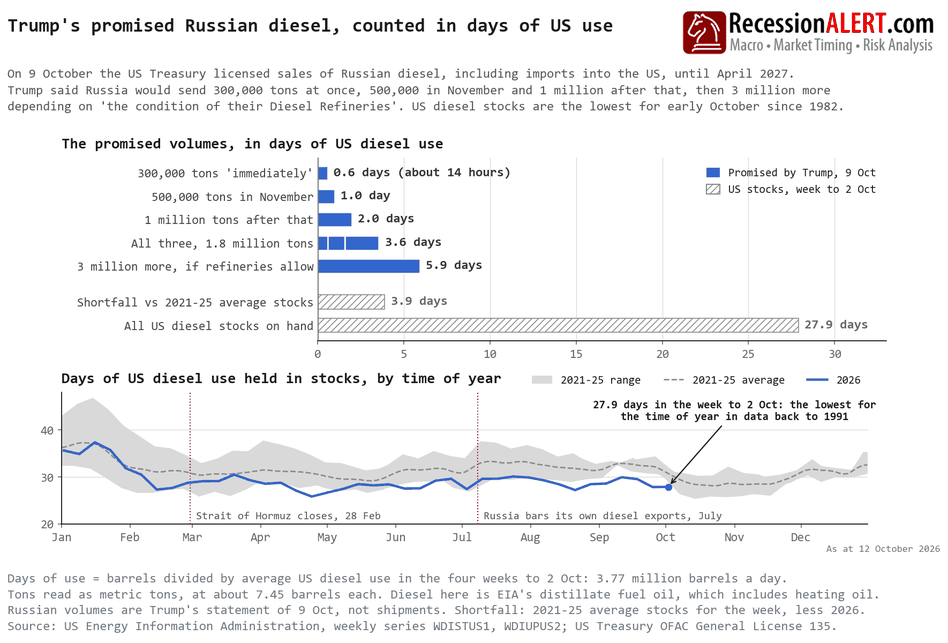
The US heads into winter with its leanest diesel stocks for early October since 1982, yet ships out about 13 barrels for every one it brings in. Exports have averaged 1.56 million barrels a day over the past four weeks, against 1.19 million in 2021-25, while refineries made more, not less — 5.17 million against 5.02 million in the same weeks of 2025. But stocks fell anyway: the drain is the dock, not the plant, which fits overseas buyers short of Gulf and Russian supply outbidding the domestic tank. That makes the US-import clause the least important line in a licence letting Russian diesel be sold anywhere: relief, if it comes, works through the world market, since every Russian ton a foreign buyer takes is a ton it need not pull from American refiners. Trump’s promise of Russian diesel is a ladder — about 14 hours at once, a day in November, two after that — and only all three rungs, 3.6 days, roughly cover the 3.9-day gap below the 2021-25 norm. And Russia must find the barrels: it has barred its producers from exporting diesel since July after drone strikes, and a further, larger tranche hangs on its refineries. Washington can authorise the trade; it cannot produce the barrels. Until they flow, a shortfall covering heating oil as well as road diesel lands on truckers, farms and oil-heated homes. The test is not whether Russian diesel reaches American docks; it is whether American diesel stops leaving them.
What it means: For households, diesel and heating oil look set to stay expensive into winter, since even the full promise covers days of use, not weeks. For stock investors, refiners’ margin, the price of diesel over crude, should stay wide while foreign buyers keep bidding. Russian barrels that actually flow would narrow it first. For the economy, dearer diesel raises the cost of moving goods, which can reach store prices in the months after. What would change this: US diesel exports back near 1.2 million barrels a day over four weeks, last seen in March.
Market Intelligence Brief (MIB) Ver. 19.79
For professional investors only. Not investment advice.
© 2026 RecessionALERT.com

Comments are closed.