
Markets hit all-time highs as Iran peace deal optimism crashed WTI -6% and AMD surged +18.6% on blowout Q1 earnings — Data Center +57%, Q2 guide $11.2B vs. $10.5B consensus; S&P +1.46%, Nasdaq 100 +2.09%. NVIDIA reclaimed $5T market cap on a $3.2B Corning optical deal. ADP April +109K sets up Friday’s binary NFP (range: 55K–165K). Fed’s Musalem and Goolsbee both turned hawkish, flagging rate hike scenarios even as oil crashed — April CPI May 12 is now pivotal.
TABLE OF CONTENTS
A. EXECUTIVE SUMMARY
B. MARKET DATA
C. HIGH-IMPACT STORIES (6)
D. MODERATE-IMPACT STORIES (5)
E. ECONOMY WATCH (6)
F. EARNINGS WATCH (6)
G. WHAT’S NEXT
H. CHART OF THE DAY
A. EXECUTIVE SUMMARY -> TOP
Equities surged to record closes Wednesday as two catalysts converged: Iran peace deal optimism crashed WTI crude nearly 6%, collapsing the Hormuz supply premium, while AMD’s Q1 blowout (Data Center +57%, Q2 guide $11.2B vs. $10.5B consensus) turbocharged the semiconductor complex. The macro read is Goldilocks — bonds and stocks rallied together, the 2Y and 10Y each falling 6.8 bps in a parallel shift signaling inflation relief, not recession fear. Yet the session’s sharpest tension is structural: even as oil crashed, Fed officials Musalem and Goolsbee simultaneously pivoted hawkish — flagging rate hike scenarios and calling the Iran war “an inflationary shock” — signaling the inflation problem has spread beyond energy into services and wages. Nine of 11 sectors gained, with Industrials (+2.37%) and Materials (+3.92%) outpacing Technology, a rotation from AI narrative into AI deployment that broadens the bull market’s earnings base.
• AMD +18.6% on blowout Q1 — Data Center revenue $5.8B (+57% YoY), Q2 guide midpoint $11.2B trounced $10.5B consensus; NVDA +5.8% in sympathy; Morgan Stanley led a wave of institutional price target raises as the AI GPU supercycle is confirmed at Q1 2026 print
• Iran peace deal: 48-hour binary — US and Iran said to be closing in on a one-page agreement including a nuclear moratorium and Hormuz reopening framework; WTI -5.94% to $96.20, Brent -7.16% to $102.00; deal unsigned — Tehran’s formal response within 48 hours is the next fulcrum for energy, rates, and equities
• NVIDIA reclaims $5T market cap alongside a $3.2B Corning optical manufacturing partnership — three new US factories to expand optical connectivity capacity tenfold, removing the bandwidth bottleneck for next-generation Blackwell GPU deployments at scale
• ADP April +109K beats 99K estimate, fastest hiring since January 2025; Friday’s NFP consensus 60K with a range of 55K–165K — unusually wide dispersion makes the payrolls report the most binary macro event in months; pay growth sticky at 4.4% YoY
• Fed turns hawkish in tandem — centrist Musalem and historically-dovish Goolsbee both flagged rate hike scenarios on the same day; Polymarket prices 20% hike probability for 2026; April CPI on May 12 becomes the next high-stakes reset for rate-sensitive sectors
• Treasury holds refunding coupon sizes steady — no supply shock, Q3 borrowing set at $671B via bills; 10Y yield -6.8 bps to 4.350% as Iran deal optimism and stable supply combined to allow bond and equity rallies to reinforce each other
1. A Rare Goldilocks Session — But Deal-Contingent — Today’s dual-catalyst structure produced the cleanest risk-on setup of the year: equities at records, bonds rallying, VIX compressing toward pre-war levels, and inflation expectations repricing lower as crude collapsed. The critical qualification is binary: none of this is permanent until the Iran deal is signed. A Tehran rejection or negotiation breakdown reverses the oil crash and the equity rally simultaneously — today’s record S&P 500 at 7,365 is fully contingent on 48 hours of diplomacy.
2. The AI Capex Cycle Enters Deployment Phase — AMD’s 57% Data Center growth and NVIDIA’s $3.2B Corning optical commitment tell the same story: AI infrastructure investment is accelerating into physical deployment — factories, fiber, and optical hardware — not just chips and software. Factory orders for computer and electronics just hit a 25-year monthly record. Industrials (+2.37%) outpacing Technology today is the market’s price signal that capital flows are rotating toward the build-out layer, broadening the AI bull market’s earnings base beyond mega-cap tech.
3. Inflation’s Second Front — Services, Wages, and a Hawkish Fed — Oil can crash on geopolitics, but Musalem and Goolsbee confirmed inflation has spread structurally beyond energy: NY Fed supply chain pressure index at a 4-year high, pay growth 4.4% YoY, PCE at 3.5%, PMI input costs at 2026 highs. The Fed is no longer neutral — hike optionality is now live. For rate-sensitive sectors (REITs, utilities, homebuilders, long-duration growth), the hawkish pivot is a separate bear case that coexists alongside today’s equity rally and will be tested by April CPI on May 12.
 — Leading economic indicators. Accurate market forecasts. Apply for membership at join.recessionalert.com
B. MARKET DATA -> TOP
Markets surged to fresh records Wednesday as two catalysts converged: Iran peace deal optimism crashed WTI crude nearly 6% while AMD’s blowout Q1 — Data Center revenue up 57%, Q2 guidance of $11.2B well above the $10.5B consensus — turbocharged the semiconductor complex. The S&P 500 (+1.46%) and Nasdaq 100 (+2.09%) both hit record closes with 9 of 11 sectors green, a macro-level flush rather than narrow rotation. The sharpest anomaly: gold rose 2.91% alongside collapsing oil — a signal that markets are not fully pricing in deal closure, with Iran uncertainty persisting even as the crude war-risk premium exits. Today’s gains are highly deal-contingent: a negotiation breakdown reverses the oil crash and the equity rally simultaneously.
CLOSING PRICES – May 6, 2026:
MAJOR INDICES
Nine of 11 sectors participated today — a macro-level flush confirming today’s dual catalyst was market-wide, not concentrated. The entrenched anomaly: Dow Theory non-confirmation for a fifth consecutive session, with DJIA setting a fresh 10-session high (49,911) while DJTA sits 7.1% below its own 10-session peak — transport not confirming industrial strength. Today’s DJIA/DJTA same-day split (+1.24% vs +1.73%) is below the 1.5% divergence threshold, confirming this is a trend signal, not a single-day quirk. S&P 500 and Russell 2000 10-session cumulative returns are nearly matched (+3.2% vs +3.7%), suggesting breadth remains broad — the bull case holding on that metric.
| Index | Close | Change | %Move | Why It Moved |
|---|---|---|---|---|
| S&P 500 | 7,365.03 | +105.81 | +1.46% | Iran peace deal optimism + AMD blowout earnings drove broad risk-on rally to record close |
| Dow Jones | 49,910.59 | +612.34 | +1.24% | Broad blue-chip participation; energy sector drag offset by industrial, tech, and financial strength |
| DJ Transportation | 20,366.3 | +346.0 | +1.73% | Iran ceasefire optimism boosted aviation and shipping outlook; fuel cost relief from crude collapse |
| Nasdaq 100 | 28,599.17 | +584.11 | +2.09% | AMD +18.6%, NVDA +5.8%; AI earnings confirmed infrastructure spending cycle intact; record close |
| Russell 2000 | 2,886.69 | +41.69 | +1.47% | Broad risk-on session; lower energy cost outlook supports domestic small-cap growth; record close |
| NYSE Composite | 23,284.39 | +275.72 | +1.20% | Broad market participation; 9 of 11 S&P sectors positive; confirms market-wide, not narrow, rally |
VOLATILITY & TREASURIES
The signal was in bonds catching a bid alongside stocks — both 2Y and 10Y fell 6.8 bps in a parallel shift, with the 2Y-10Y spread unchanged at 48 bps: inflation-relief, not recession-fear. VIX near-flat (+0.01) confirms no options-market stress. DXY -0.44% reflects risk-on dollar selling with no safe-haven bid needed. Bonds and equities are reading the Iran de-escalation identically — cheaper energy reduces inflation pressure while growth stays intact: the classic Goldilocks signature.
| Instrument | Level | Change | Why It Moved |
|---|---|---|---|
| VIX | 17.39 | +0.01 (+0.06%) | Near-flat despite equity surge; bonds rallying simultaneously signals inflation-relief, not fear of recession |
| 10-Year Treasury Yield | 4.350% | -6.8 bps | Iran deal eased oil-driven inflation fears; parallel shift with 2Y confirms easing price pressure, not growth alarm |
| 2-Year Treasury Yield | 3.870% | -6.8 bps | Front-end fell in parallel with 10Y; 2Y-10Y spread unchanged at 48 bps; curve shape confirmed Goldilocks relief |
| US Dollar Index (DXY) | 98.02 | -0.44 (-0.44%) | Risk-on selling; geopolitical hedging demand eased as Iran ceasefire optimism reduced safe-haven positioning |
COMMODITIES
Gold +2.91% alongside collapsing oil is the session’s most telling divergence: oil fell on Iran peace optimism, but gold rose because no deal is signed yet — uncertainty persists, and a falling DXY adds further lift. Silver (+5.78%), copper (+3.28%), and platinum (+5.10%) all surging together signals the market is pricing cheaper energy as a growth positive, not demand collapse. Bitcoin -0.29% sat out the entire macro trade — no crypto-specific catalyst in either direction.
| Asset | Price | Change | %Move | Why It Moved |
|---|---|---|---|---|
| Gold | $4,701.34/oz | +$132.84 | +2.91% | Iran deal not signed — geopolitical uncertainty persists; DXY -0.44% adds lift; decoupled from oil crash |
| Silver | $77.832/oz | +$4.251 | +5.78% | Industrial demand optimism; cheaper energy seen as manufacturing tailwind; precious metal complex strength |
| Copper | $6.1895/lb | +$0.1965 | +3.28% | Energy cost relief reducing demand destruction fears; growth-positive read on Iran de-escalation |
| Platinum | $2,076.05/oz | +$100.75 | +5.10% | Confluence of DXY weakness, industrial demand optimism, and broad precious metal complex surge |
| Bitcoin | $81,372.00 | -$233.00 | -0.29% | Essentially flat; no crypto-specific catalyst; sitting out the Iran macro trade in both directions |
ENERGY
WTI and Brent fell in near-lockstep (-5.94% and -7.16%) as Iran deal optimism unwound the Strait of Hormuz war-risk premium — pure supply normalization, not demand destruction. The Brent-WTI spread compressed from $7.81 to $5.80: global, not regional, supply dynamics. Dutch TTF -6.00% simultaneously priced out Europe’s gas war-premium. The critical macro read: oil fell while equities rose — cheaper energy is a growth catalyst here, not a stagflationary warning.
| Asset | Price | Change | %Move | Why It Moved |
|---|---|---|---|---|
| Crude Oil (WTI) | $96.20/bbl | -$6.07 | -5.94% | Iran peace deal reports; Strait of Hormuz supply normalization expectations unwound crude war-risk premium |
| Crude Oil (Brent) | $102.00/bbl | -$7.87 | -7.16% | Global supply normalization on Iran ceasefire; European crude war-risk premium unwinding fastest |
| Natural Gas (Henry Hub) | $2.723/MMBtu | -$0.065 | -2.33% | Followed crude lower; seasonal demand easing; war-risk premium on gas-adjacent energy markets reduced |
| Natural Gas (Dutch TTF) | $15.12/MMBtu | -$0.97 | -6.00% | European gas market priced out Iran/Hormuz war-premium; EUR/USD +0.48% amplified decline in dollar terms |
S&P 500 SECTORS
Nine of 11 sectors gained — a macro-level flush confirming today’s dual catalyst was market-wide. The starkest reversal: Energy (-3.68%), the YTD top performer (+29.93%), hit hardest as crude collapsed on Iran deal optimism — the year’s dominant trade unwinding in a single session. Utilities (-0.95%) lagged modestly on a risk-on tape. Basic Materials (+3.92%) topped the board for a third straight week, its 52-week leadership (+52.73%) reinforced by today’s metals complex surge.
| Sector | 1-Day | 1-Week | 1-Month | 3-Month | 6-Month | YTD | 12-Month |
|---|---|---|---|---|---|---|---|
| Basic Materials | +3.92% | +5.25% | +4.66% | +1.65% | +30.81% | +18.64% | +52.73% |
| Technology | +2.89% | +5.50% | +20.76% | +19.86% | +8.13% | +14.66% | +51.81% |
| Industrials | +2.37% | +4.53% | +8.82% | +5.84% | +16.76% | +16.58% | +36.99% |
| Communication Services | +1.89% | +5.56% | +15.20% | +8.31% | +13.70% | +8.97% | +45.50% |
| Consumer Cyclical | +1.76% | +3.42% | +12.74% | +0.22% | -2.75% | +0.58% | +19.71% |
| Real Estate | +1.45% | +2.37% | +7.21% | +6.10% | +8.10% | +9.38% | +7.73% |
| Financial | +1.27% | +1.28% | +5.12% | -3.02% | +3.20% | -2.21% | +13.38% |
| Healthcare | +0.56% | +2.66% | +0.29% | -5.00% | +2.45% | -3.92% | +9.14% |
| Consumer Defensive | +0.27% | +2.22% | +4.22% | -1.88% | +12.92% | +9.81% | +6.96% |
| Utilities | -0.95% | +0.89% | +0.71% | +6.64% | +5.71% | +9.52% | +21.15% |
| Energy | -3.68% | -2.80% | -4.05% | +12.18% | +31.65% | +29.93% | +46.20% |
TOP MEGA-CAP MOVERS:
GAINERS
| Company | Ticker | Close | Change | Why It Moved |
|---|---|---|---|---|
| Advanced Micro Devices | AMD | $421.39 | +18.61% | Q1 2026 blowout: Data Center +57% to $5.8B; Q2 guidance $11.2B crushed $10.5B consensus; AI GPU ramp accelerating |
| Lam Research Corp | LRCX | $297.17 | +7.75% | AMD earnings confirmed AI chip fab investment cycle; semiconductor equipment demand surge on capex outlook |
| GE Aerospace | GE | $305.83 | +6.68% | Iran ceasefire optimism boosts commercial aviation normalization; aerospace engine demand recovery expected |
| NVIDIA Corp | NVDA | $207.83 | +5.77% | AMD results reinforced AI GPU infrastructure spending thesis; data center capex cycle confirmed intact |
| KLA Corp | KLAC | $1,816.29 | +4.81% | Semiconductor equipment demand; AI chip production capacity expansion thesis re-affirmed by AMD results |
DECLINERS
| Company | Ticker | Close | Change | Why It Moved |
|---|---|---|---|---|
| Exxon Mobil Corp | XOM | $148.69 | -4.00% | WTI -5.94% on Iran peace deal; integrated E&P earnings directly leveraged to crude price collapse |
| Chevron Corp | CVX | $185.16 | -3.88% | Same Iran deal oil crash; Brent -7.16% pressures integrated oil profitability across upstream operations |
| Cisco Systems Inc | CSCO | $91.64 | -2.82% | Pullback from $94.30 all-time high hit May 5; rotation into higher-beta semis; networking equipment lagging AI hardware |
| Costco Wholesale Corp | COST | $995.75 | -2.03% | Defensive rotation unwinds as Iran risk-off thesis retreats; investor risk appetite rotates from safety to growth |
| Palantir Technologies Inc | PLTR | $133.79 | -1.56% | Mild profit-taking in high-multiple software name; no specific catalyst; risk-on rotation favors semis over software |
— Institutional-grade intelligence for serious investors. Apply for membership at join.recessionalert.comC. HIGH-IMPACT STORIES -> TOP
UNCERTAIN
1. US and Iran Said to Be Nearing One-Page Peace Deal — Nuclear Moratorium on the Table, WTI Crashes 9% to $92
The core facts:A Pakistani diplomatic source told Reuters that the US and Iran are closing in on a one-page agreement to end their war, with Washington expecting Tehran’s response on critical terms within 48 hours. Key reported elements include an Iranian moratorium on nuclear enrichment and a framework for reopening the Strait of Hormuz. WTI crude oil fell 9% to approximately $92–$93/barrel — its largest single-session decline since the conflict began — and Brent crude fell 7.8% to $101.27. The 10-year Treasury yield dropped 6 basis points to 4.37% as inflation expectations repriced lower. President Trump separately warned Iran it would be “bombed at a much higher level” if it failed to accept the deal. Hormuz throughput remains near zero versus 120+ ships per day pre-crisis.
Why it matters:A signed peace deal would be the most significant geopolitical development for US financial markets since the conflict began. If Hormuz reopens to commercial traffic, the structural oil supply premium that has kept WTI 28%+ above pre-crisis levels would collapse — with a full normalization potentially bringing WTI toward $70–$75. That outcome would: (1) materially reduce the CPI inflation path, reintroducing rate-cut optionality the Fed lost at ISM Services Prices Paid 70.7; (2) compress energy sector earnings and capex that have been inflated by elevated prices; (3) remove the geopolitical risk premium across all risky assets. But the uncertainty is real and symmetric: “nearing a deal” is not a signed deal. Iran has used negotiation theatrics before; Trump’s simultaneous threat of intensified bombing is deliberate dual-track pressure, not a contradiction. Nothing is finalized, and the 48-hour window for Tehran’s response introduces significant binary risk for markets.
What to watch:Tehran’s formal response to Washington’s terms within 48 hours — a counter-proposal or acceptance signals deal progress; silence or military action signals breakdown. Monitor Hormuz daily ship transit count (S&P Global Market Intelligence) as the real-time barometer of reopening progress. A WTI close below $90 would signal markets are pricing a high probability of a signed agreement.
BULLISH
2. S&P 500 Crosses 7,300 for the First Time — Closes at Record 7,365, Nasdaq Hits 25,839 as Peace Deal Optimism Drives Broad Risk-On
The core facts:The S&P 500 surged 1.46% to 7,365.12, crossing the 7,300 threshold for the first time in history. The Nasdaq Composite gained 2.02% to 25,838.94, setting a new all-time record. The Dow Jones Industrial Average added 612 points (+1.24%) to 49,910.59. Eleven of thirteen S&P 500 sectors were in positive territory, with Industrials leading at +2.7%, followed by Information Technology at +2.2% and Materials at +2.1%. Only Energy (-4.2%) and Utilities (-1.2%) declined. The VIX fell 3.74% to 16.73. Semiconductor stocks surged: AMD gained approximately +17% on post-earnings momentum, NVIDIA rose +5%, and the Philadelphia Semiconductor Index advanced over 2%, extending its 2026 year-to-date gain to approximately 59%.
Why it matters:The S&P 500 at 7,365 represents a complete repricing of the Iran conflict’s market discount — at this level, the index is simultaneously pricing in Q1 2026 earnings growth of +27.1% YoY, GDPNow Q2 tracking at 3.7%, AI infrastructure supercycle continuation, and meaningful probability of Hormuz normalization. For portfolio managers, the breadth of today’s rally is as important as its magnitude: Industrials and Materials leading alongside Technology signals the market is rotating from pure AI/tech thematic plays into cyclical growth — defense aerospace, grid infrastructure, and US manufacturing beneficiaries. The absence of the Russell 2000 leading (unlike yesterday’s triple ATH) suggests today’s rally is more sentiment-driven than yesterday’s structurally broad breakout, which is a minor caution. The VIX at 16.73 is the most significant normalizing signal: war-risk premium is being priced out of the options market, compressing hedging costs and reducing the incentive for portfolio insurance that was suppressing equity allocations.
What to watch:S&P 500 follow-through above 7,300 over 3–5 sessions — failed technical breakouts above round numbers are a common reversal pattern; Friday’s April NFP is the next binary macro event that could either validate or unwind this rally.
BULLISH
3. NVIDIA Reclaims $5 Trillion Market Cap — Announces $3.2B Corning Partnership to Build Three US Optical AI Factories
The core facts:NVIDIA surged approximately 5% to $206, pushing its market capitalization back above $5 trillion — making it the world’s most valuable publicly traded company again. Simultaneously, NVIDIA announced a long-term manufacturing partnership with Corning Incorporated: NVIDIA will acquire $500 million in Corning equity rights as part of a broader $3.2 billion commitment to expand US optical connectivity manufacturing for AI infrastructure. The deal involves building three new US factories in North Carolina and Texas, expanding optical manufacturing capacity tenfold and fiber production by 50%, creating over 3,000 American jobs. Corning shares surged approximately 14.6% to a record high. The technology: co-packaged optics dramatically increases AI data center data transfer speeds while reducing energy consumption — a critical bottleneck for next-generation Blackwell GPU deployments.
Why it matters:NVIDIA’s $5 trillion market cap reflects the AI infrastructure supercycle being repriced from possibility to certainty: the company that makes the chips that train and run AI is now worth more than the entire GDP of Germany. The Corning deal is analytically more important than the market cap milestone, however. Co-packaged optics solve the bandwidth and energy efficiency wall that would otherwise constrain GPU cluster scaling beyond 100,000-chip configurations — the deal signals NVIDIA is proactively removing the next bottleneck before it becomes a revenue constraint. For US manufacturing policy, the $3.2B commitment and 3,000+ jobs directly advance the America First manufacturing agenda without government subsidy, providing political cover for CHIPS Act continuation. For Corning, the deal transforms a mature industrial glass company into an AI infrastructure supplier — a secular re-rating of its business model. The downstream effect: every hyperscaler planning a Blackwell-based data center expansion now has higher confidence that the full-stack optical infrastructure will be domestically available.
What to watch:NVIDIA Q1 FY2027 earnings on May 20 — management’s commentary on Blackwell demand and co-packaged optics deployment timeline is the next critical data point; Corning’s Q2 2026 earnings for initial revenue contribution from the NVIDIA agreement.
UNCERTAIN
4. Oil Crash Triggers Dual-Market Regime Shift — Energy Sector -4.2%, 10Y Yield Falls 6 bps as Inflation Premium Collapses
The core facts:The 9% crash in WTI crude oil triggered simultaneous regime shifts across two major asset classes on Wednesday. The S&P 500 Energy sector fell 4.2% — its largest single-day decline since the Iran conflict began — as oil producers, refiners, and energy services companies marked down revenues and project economics at $92 oil versus the $100+ on which recent capex plans were built. Simultaneously, the 10-year Treasury yield fell 6 basis points to 4.37% as investors repriced the inflation trajectory lower: if WTI sustains below $95, the disinflation path toward 2% core PCE becomes materially faster. The EIA weekly petroleum report released today showed a crude inventory draw of only 2.31 million barrels, below market expectations — confirming that physical demand has not returned to Hormuz-disrupted supply chains at pace, reinforcing the case that the oil supply premium was largely sentiment-driven.
Why it matters:The dual repricing is the structural story beneath today’s headline peace-deal optimism. Energy sector earnings — which have been a significant tailwind to S&P 500 blended earnings growth in Q1 2026 — will face acute pressure if oil stabilizes near $90. XOM, CVX, COP, and EOG all have fiscal 2026 capex budgets built around $95–$100 oil; at $90, many upstream projects approach marginal economics, triggering asset write-downs and dividend coverage reviews. The bond market’s response is more unambiguously positive: 10Y at 4.37% versus 4.43% yesterday compresses the rate burden on rate-sensitive sectors (housing, REITs, utilities, small-caps) and reintroduces marginal feasibility for Fed rate cuts — not immediately, but on a 6–12 month horizon if the oil decline sustains. For portfolio construction, the key tension is that the two regime shifts partially offset each other: energy exposure (previously inflationary hedge) is now dilutive, while duration exposure (previously punished by rates) is modestly rehabilitated.
What to watch:WTI sustained below $90 would trigger formal credit agency energy sector reviews; the 10Y yield breaking below 4.30% would signal markets are pricing a full repricing of the inflation trajectory, opening the Fed cut debate. Energy names’ Q2 guidance revisions (beginning with Exxon/Chevron in late July) are the primary fundamental test of whether $90 oil breaks energy sector earnings.
UNCERTAIN
5. ADP April Employment +109K — Fastest Hiring Since January 2025, Beats 99K Estimate and Nearly Doubles March’s 62K Print
The core facts:ADP’s National Employment Report for April 2026 showed private sector employment increased by 109,000 jobs — beating the 99,000 consensus estimate and nearly doubling March’s 62,000 print. Annual pay growth held at 4.4% year-over-year. By sector, Education and Health Services led with +61,000 jobs; Trade, Transportation and Utilities added +25,000. The April print represents the fastest monthly hiring pace since January 2025. The ADP report is the primary employment gauge ahead of Friday’s Bureau of Labor Statistics April Nonfarm Payrolls report, where the economic calendar headline consensus stands at approximately +165,000 jobs — though forecasts range widely from 55,000 to 165,000, reflecting deep disagreement among economists about how much tariff enforcement and Iran-war disruption weighed on April hiring.
Why it matters:ADP +109K coming off a 62K March print signals April hiring acceleration — the opposite of the labor market deterioration that would be needed to justify Fed rate cuts in 2026. Combined with JOLTS hires surging +655K in March (reported yesterday), the picture is one of a services-led labor market that is not breaking down under $100+ oil or 3.6% rates. The implications are two-sided: for equity investors, +109K confirms GDPNow’s 3.7% Q2 2026 growth signal — consumer spending power is intact. For bond investors, a strong ADP print pushes the “first cut” probability curve further out. With ISM Services Prices Paid still at 70.7 (last month’s data), a labor market that won’t crack removes the other lever the Fed might use to justify cuts. Friday’s April NFP now has a higher implied expectation: a sub-150K NFP print would look like a statistical outlier given JOLTS and ADP; a print above 200K would be the decisive “higher for longer through year-end” signal. Pay growth at 4.4% is the other sticky variable — still running well above the Fed’s 2% inflation target path.
What to watch:Friday April NFP consensus ~165K (range: 55K–165K) — the unusually wide dispersion means the print carries binary risk in either direction. A print above 150K consistent with ADP/JOLTS locks in “no 2026 cuts” as base case; a print below 100K (consistent with the lower bank forecasts modeling tariff disruption) reopens the labor-side cut argument and would trigger a sharp bond rally and equity rerating.
BEARISH
6. Fed’s Musalem and Goolsbee Both Pivot Hawkish — Risks “Shifting More Toward Inflation,” Rate Hike Scenarios Now on the Table
The core facts:Two Federal Reserve officials delivered hawkish remarks on Wednesday in a notable simultaneous pivot. St. Louis Fed President Alberto Musalem (centrist) said risks are “shifting more toward inflation,” that inflation is running “meaningfully above” the 2% target, and explicitly flagged “plausible scenarios” requiring rates to move higher — not just on hold. Chicago Fed President Austan Goolsbee — historically one of the FOMC’s most dovish voices — called the Iran war “an increasingly inflationary shock” and warned against rate cuts until inflation is clearly returning to 2%. Musalem cited tariff pressures, elevated oil prices, and underlying inflation dynamics as compounding risks; Goolsbee noted inflation is rising even in service sectors largely insulated from tariffs and energy costs.
Why it matters:The analytical significance is not what each official said individually — it is that Musalem and Goolsbee are saying the same thing on the same day. Goolsbee has been the most persistent cut advocate on the FOMC throughout 2025–2026; when he aligns with a centrist on the hawkish side, it signals a broad committee shift, not just individual dissent. The introduction of rate hike scenarios by Musalem is the more disruptive element: markets have been pricing a single cut in 2026 as the base case, with no hike probability. If the forward guidance framework shifts to include hike optionality, the entire rate-sensitive complex reprices — REITs, utilities, long-duration growth, homebuilders, and leveraged credit all face multiple compression. Critically, this hawkish pivot is occurring on the same day oil dropped 9% — which normally would be dovish for the Fed. The fact that officials are pivoting hawkish even as oil falls suggests the inflation concern is structural (services, wages, tariffs) rather than purely energy-driven. That is the most bearish possible interpretation for rate cut timing.
What to watch:Friday’s April NFP and next week’s April CPI (May 13) — if both come in above consensus, the hike scenario Musalem flagged becomes the market’s new tail risk; any FOMC speaker retracting or softening Musalem’s rate-hike language would be a relief signal for rate-sensitive equities.
— Quantifying recession risk so you don’t have to guess. Apply for membership at join.recessionalert.comD. MODERATE-IMPACT STORIES -> TOP
BULLISH
7. Treasury Quarterly Refunding: Coupon Sizes Held Steady — No Supply Shock, Q3 Borrowing Set at $671B
The core facts:The US Treasury’s May 2026 Quarterly Refunding Statement held all coupon auction sizes unchanged: $58 billion 3-year notes (May 11), $42 billion 10-year notes (May 12), and $25 billion 30-year bonds (May 13), totaling $125 billion to refund $83.3 billion in maturing notes and raise approximately $41.7 billion in new cash. Q2 2026 net borrowing is estimated at $189 billion; Q3 2026 net borrowing is projected at $671 billion. Treasury Secretary Bessent retained the “at least” qualifier in forward guidance — signaling coupon sizes will remain stable “for at least the next several quarters.” TIPS auction sizes were also maintained at current levels. Treasury plans to lean on bill issuance to manage near-term funding needs amid potential tariff refund flows.
Why it matters:The bond market’s primary fear this quarter was that Treasury would increase long-duration coupon supply — which would pressure 10Y and 30Y yields higher regardless of Fed policy. Bessent’s decision to hold sizes steady removes that tail risk for the immediate term. The “at least the next several quarters” qualifier is an explicit forward commitment that limits the market’s need to hedge against supply uncertainty. The $671 billion Q3 borrowing estimate is elevated and will require careful execution, but because coupon sizes are capped, the additional borrowing will come via bills — a segment where demand from money market funds is deep and yield-insensitive. For fixed-income portfolio managers, the refunding is constructive: no additional duration supply pressure, which allows the oil-crash-driven yield compression today to be self-sustaining rather than offset by new issuance.
What to watch:Demand at the 10-year note auction on May 12 — bid-to-cover ratio and foreign/official demand will signal whether international buyers are maintaining US Treasury allocation despite geopolitical uncertainty; the August refunding announcement for any Q3-driven coupon size increase.
BEARISH
8. MBA 30-Year Mortgage Rate Climbs to 6.45% — Applications Stall as Spring Homebuying Season Peaks Under Rate Pressure
The core facts:The Mortgage Bankers Association weekly survey showed the 30-year fixed mortgage rate rose to 6.45% from 6.37% the prior week. The MBA Mortgage Market Index fell to 285.3, reflecting weakening application activity as rates climbed. The rate increase comes as the spring homebuying season — typically the strongest demand period of the year — is at its peak. The rate elevation reflects persistent inflation pressures embedded in the 10-year Treasury baseline, which only eased meaningfully today (6 bps to 4.37%) following the oil price collapse. Even at today’s post-oil-crash yield levels, the mortgage rate is likely to remain in the 6.30–6.40% range based on current spreads.
Why it matters:A 6.45% mortgage rate on the median US home price represents an annual payment approximately 28% higher than at 5.5% — a threshold that has historically suppressed first-time homebuyer entry into the market. Combined with still-elevated home prices (which have been sticky despite rate rises), housing affordability is at multi-decade lows. For US homebuilders (DHI, LEN, PHM) and mortgage originators (UWMC, RKT), application volume is a leading indicator of closings 60–90 days forward — weakness now portends Q3 2026 revenue pressure. One critical distinction: if the Iran peace deal materializes and WTI sustains below $90, the Fed’s inflation path clears faster, which would allow mortgage rates to drift toward 6.0–6.2% by year-end — a meaningful affordability improvement. The housing sector is uniquely rate-sensitive in this cycle and would be a primary beneficiary of any genuine Fed easing signal.
What to watch:Next MBA survey (released May 13) — if 30-year rates decline toward 6.3% following today’s 10Y yield drop, application volume rebound would signal latent demand; existing home sales (released May 22) for the first clean read on spring season trajectory.
BULLISH
9. Industrials Sector Leads S&P 500 at +2.7% — AI Infrastructure, Defense Aerospace, and US Manufacturing Spend Converge
The core facts:The S&P 500 Industrials sector gained 2.7% on Wednesday — the strongest performance of any sector and outpacing the broader index (+1.46%) by 124 basis points. Materials gained 2.1%, the second-best performing sector. The outperformance reflects a confluence of structural demand drivers: NVIDIA’s $3.2 billion US optical manufacturing partnership with Corning directly validates AI data center infrastructure construction spend; ongoing Iran-conflict defense aerospace demand for engine spares (F-35, F-15, F-16 components) sustains orders for companies like Howmet Aerospace (HWM, reporting tomorrow); and the peace deal optimism supports US grid buildout and electrification capex that was at risk of delay under elevated energy costs.
Why it matters:Industrials outperforming tech in a risk-on session is a regime-change signal. In AI-driven rallies of 2024–2025, tech consistently led Industrials by 2–3 percentage points on high-momentum days. Today’s pattern — Industrials +2.7% vs Information Technology +2.2% — signals institutional investors are broadening AI thematic exposure beyond software and chip companies into the physical build-out layer: factories, power equipment, fiber, and aerospace hardware. This has direct implications for portfolio construction: the AI capex cycle is entering its deployment phase, where the capital flows toward construction, grid, and manufacturing rather than pure semiconductor and hyperscaler names. The Materials sector +2.1% reinforces this — copper, steel, and industrial minerals benefit from AI data center construction and domestic manufacturing repatriation. For active managers, the rotation into Industrials and Materials at record S&P 500 levels suggests the bull case is broadening its earnings base beyond mega-cap tech.
BULLISH
10. VIX Falls to 16.73 — Geopolitical Fear Premium Exits Options Market as Iran Deal Hopes Price Out War Risk
The core facts:The CBOE Volatility Index (VIX) declined 3.74% to 16.73 on Wednesday, continuing a multi-day compression from the elevated war-risk levels that prevailed during the Iran conflict’s peak uncertainty phase. The VIX reached highs in the low-to-mid 20s during the most acute Hormuz disruption period; at 16.73, it is approaching the historical pre-crisis “normal” range of 14–17. The decline tracks directly with oil’s 9% drop and the Iran peace deal report — as energy supply risk recedes, the tail risk that drove equity options premiums higher is being unwound.
Why it matters:The VIX declining toward 15 has three mechanical market effects: (1) it reduces the cost of portfolio protection, making hedged equity exposure more attractive for previously risk-constrained institutional allocators; (2) it compresses the volatility risk premium embedded in options, reducing the apparent value of holding cash/defensive positions as insurance; (3) it signals that systematic volatility-targeting strategies (risk-parity, vol-targeting funds) will mechanically increase equity exposure as realized volatility falls. This creates a positive feedback loop: falling VIX → systematic equity buying → equity rally → lower realized volatility → VIX falls further. The key break level is 15.0 — below that, the VIX is in “bull market complacency” territory, which historically precedes either continued upside drift or sharp mean-reversion spikes when a negative catalyst emerges. A deal breakdown or NFP surprise would send VIX sharply back above 20.
What to watch:VIX below 15 would confirm full war-risk exit from options pricing; Friday’s NFP as the binary catalyst most likely to spike VIX back above 18 if the print diverges significantly from the consensus +175K expectation.
BULLISH
11. Morgan Stanley Raises AMD Price Target Following Q1 Beat — AI Chip Consensus Estimates Revised Higher Across the Sector
The core facts:Morgan Stanley raised its AMD price target following the company’s Q1 2026 earnings beat (revenue $10.25B vs $9.89B est, +38% YoY; Data Center $5.8B vs $5.56B est, +57% YoY; Q2 guide $10.9B–$11.5B vs $10.52B consensus). The analyst upgrade is one of multiple institutional calls revising AMD estimates higher after the after-hours print, with AMD shares gaining approximately +17% today to record highs. The broader analyst reaction reflects a sector-wide recalibration: AMD’s Q2 guide midpoint of ~$11.2B represents a near-20% beat above prior consensus, forcing every analyst with AMD, NVIDIA, and AI chip exposure to revisit their FY2026 and FY2027 estimates. The AI chip buy-side consensus is shifting from “will the buildout sustain” to “how much faster than expected.”
Why it matters:Analyst price target revisions following major earnings beats are mechanically bullish for index-level performance: institutional investors benchmarked to consensus estimates must revisit portfolio weights when the consensus itself moves up. AMD’s Q2 guide beat is large enough to pull the S&P 500 Information Technology sector’s aggregate earnings estimate higher, which in turn expands the universe of positions that are “underweight vs. consensus” — generating systematic buying pressure. The AMD result also establishes a high bar for NVIDIA’s May 20 report: if AMD’s AI chip business grew 57% YoY in Q1, market expectations for NVIDIA’s Blackwell-driven data center growth are now significantly elevated. The NVIDIA earnings event on May 20 becomes the next fulcrum point for the entire AI chip complex. For portfolio managers, today’s analyst action confirms the AI semiconductor bull case has fundamental backing — not just narrative — at Q1 2026 pricing.
What to watch:NVIDIA Q1 FY2027 data center revenue consensus (expected 2–3 weeks before May 20 earnings) as analysts revise up post-AMD; any downward revision from hyperscalers on AI capex guidance in their Q1 reports would undermine the AMD demand validation.
— Separating signal from noise since 2007. Apply for membership at join.recessionalert.comE. ECONOMY WATCH -> TOP
The week’s dominant tension is a labor-and-factory beat colliding with a building inflation alarm: ADP added 109K private jobs in April (best since January 2025) and factory orders surged 1.5% on a 25-year electronics record, yet the TBAC placed headline PCE at 3.5% and documented commodities breaching the 2022 pandemic peak. Two Fed officials formalized the risk shift Wednesday — Musalem flagged “plausible scenarios” requiring rates on hold, while Goolsbee called the Iran conflict “looking increasingly like an inflationary shock.” With GDPNow holding at 3.7% Q2, the data gives the Fed permission to stay put — but the Musalem-Goolsbee tandem signals the hike debate is live, and April CPI on May 12 is now the most consequential single data point on the calendar.
ADP: Private Payrolls +109K in April, Fastest Hiring Pace Since January 2025 (ADP/Stanford Digital Economy Lab, May 6, 2026)
What they’re saying:Private-sector employment rose 109,000 in April, beating the 99,000 consensus and nearly doubling March’s revised 62,000 gain — the fastest monthly hiring pace since January 2025. Education and health services led with +61,000; goods-producing added 15,000 (construction +10,000, manufacturing +2,000). Annual pay for job-stayers held at 4.4% YoY; job-changers 6.6%. Chief Economist Dr. Nela Richardson noted “small and large employers are hiring, but we’re seeing softness in the middle” as mid-sized firms (50-499 employees) added only 2,000 jobs.
The context:The ADP beat is encouraging but not conclusive — the 109K print still reflects a decelerating labor market from the 178K NFP in March, with mid-sized firms essentially stagnant. Healthcare continues to be the primary engine, a defensive sector that masks softer cyclical hiring. The wide gap between ADP’s 109K and Friday’s NFP consensus of ~60K reflects unusually high uncertainty about April employment — models appear to be pricing in significant tariff and Iran-war disruption to cyclical hiring not captured by ADP’s private-sector methodology.
What to watch:April NFP (Friday May 8, consensus ~60K vs prior 178K) — the wide spread vs. ADP’s 109K makes this the most uncertain payrolls report in several months. Initial Jobless Claims Thursday (May 7, exp. 205K vs prior 189K) will provide a directional preview.
Factory Orders Surge 1.5% in March, Computer and Electronics Hit 25-Year Monthly Record on AI Investment Boom (Census Bureau, May 5, 2026)
What they’re saying:New orders for manufactured goods jumped 1.5% in March to $630.4B — the largest monthly gain since November 2025 and well ahead of the +0.4% consensus. The increase was led by the largest single-month gain in computer and electronics orders in 25 years, driven by AI infrastructure buildout. Orders excluding transportation rose 1.6%. Factory shipments gained 1.4% to $633.9B; unfilled orders edged up 0.1% to $1.541T.
The context:The AI capital expenditure cycle is producing a measurable manufacturing demand pulse even as broader industrial production faces Iran war supply headwinds. A 25-year electronics record is the factory-floor equivalent of what hyperscaler CAPEX announcements are showing at the corporate level — the investment cycle is real and accelerating. The risk is that some portion reflects front-running of future purchases (consistent with the stockpiling pattern seen in S&P Global PMI) rather than sustained structural demand, but the magnitude of the beat suggests genuine order volume rather than pure timing.
What to watch:April Factory Orders (due early June) will test whether the AI-driven surge is sustained or a one-month anomaly. Durable Goods Orders advance estimate (typically late May) will provide the earlier read.
Fed Officials Signal Hawkish Risk Shift: Musalem Warns Inflation ‘Above Target,’ Goolsbee Calls Iran War ‘An Inflationary Shock’ (Federal Reserve, May 6, 2026)
What they’re saying:St. Louis Fed President Alberto Musalem said risks “have shifted more toward inflation,” with inflation “running meaningfully above our 2% target,” and flagged “plausible scenarios” requiring rates to remain on hold for some time — implicitly ruling out near-term cuts. Separately, Chicago Fed President Austan Goolsbee called the Iran war “looking increasingly like an inflationary shock,” warned against front-running AI productivity gains with rate cuts, and said the Fed’s “more dominant problem right now is likely inflation that’s too high.” Both noted the NY Fed’s Global Supply Chain Pressure Index jumped to its highest level since July 2022, amplifying cost pressures well beyond energy.
The context:These speeches represent a meaningful hawkish shift from the FOMC’s tone at the April 29 meeting (third consecutive hold at 3.50%-3.75%). Musalem is a centrist; Goolsbee has historically leaned dovish — simultaneous hawkish pivots from both officials signal the rate debate is live in a way not seen since early 2024. Powell characterized this shift at “the center” of the Fed at the April press conference. Polymarket now prices a 20% probability of a hike in 2026. If April CPI surprises to the upside, hike probability could accelerate materially.
What to watch:April CPI (Tuesday May 12) — the most important near-term data point for the Fed’s rate path. Also watch Hammack speech (Thu May 7, 2:05 PM ET) and Williams speech (Thu May 7, 3:30 PM ET) for any counterweight or confirmation of the hawkish tilt.
Treasury TBAC Flags Stagflation Risk: PCE at 3.5%, Oil Up 60% Since Iran War, Broad Commodity Index Breaches 2022 Pandemic Peak (U.S. Treasury TBAC, May 5, 2026)
What they’re saying:The Treasury Borrowing Advisory Committee’s May 5 report documents a stagflation risk profile: headline PCE at 3.5% YoY in March, core PCE at 3.2% YoY, with core CPI at just 2.6% YoY — a widening wedge between the Fed’s preferred measure and the headline index. Oil prices are up approximately 60% since the Iran war began and ~80% since the start of 2026. The broad commodity index has now risen above the pandemic-era record set in 2022. The TBAC characterized the labor market as a “fragile equilibrium,” with payrolls highly volatile (-133K in February, +178K in March) and unemployment holding in the 4.3-4.5% range.
The context:The TBAC report is the U.S. Treasury’s official economic assessment for sovereign debt market participants — it directly shapes auction strategy and is among the most authoritative macro snapshots the government produces. A broad commodity index above the 2022 pandemic high places current input cost pressures in the same tier as the supply shock that drove CPI to 9.1% — a significant threshold. The 60 bp wedge between core PCE and core CPI means the Fed’s actual inflation target gap is materially larger than headline readings suggest, giving the hawks a structural argument for a longer hold or potential tightening.
What to watch:April PCE (May 29) and April CPI (May 12) to determine whether the inflation trajectory is accelerating. 10-year Treasury yield — 4.39% as of last week — for the bond market’s inflation signal; the May 7 10-year auction will be watched for demand depth.
Mortgage Applications Fall 4.4% as 30-Year Rate Climbs to 6.45%, Average Loan Size Hits 36-Year High (MBA, May 6, 2026)
What they’re saying:Weekly mortgage applications declined 4.4% for the week ending May 2, as the average 30-year fixed rate rose 8 basis points to 6.45% — its highest level in a month. Purchase applications fell 4% for the week but remain 5% above the same week last year. Refinance activity fell again as rate incentives shrink. The average purchase loan size rose to $467,300 — the highest in the MBA’s history dating to 1990, surpassing the previous record.
The context:The record average loan size illustrates the affordability bifurcation: only higher-income buyers can qualify at current rates, driving the average ticket higher as volume falls. This is the same dynamic playing out in last week’s New Home Sales beat (682K) — builders are discounting aggressively to move inventory at the entry level, masking weak underlying demand. The 30-year rate increase reflects the Iran war’s inflationary pressure on Treasury yields. With PCE at 3.5% and Fed officials signaling a hawkish tilt, the rate trajectory faces upside risk precisely when the spring selling season needs stability.
What to watch:10-year Treasury yield trajectory is the primary driver of 30-year rates. April CPI (May 12) and the Fed’s June meeting stance will determine whether the 6.45% level is a ceiling or a floor for the spring market.
S&P Global US Composite PMI 51.7 in April: Expansion Driven by Defensive Stockpiling, Not Demand — Input Costs Hit 2026 High (S&P Global, May 5, 2026)
What they’re saying:The S&P Global US Composite PMI came in at 51.7 in April (revised from the 52.0 flash estimate), up from 50.3 in March, with services returning to expansion at 51.0 (vs. 51.3 expected) after March’s 49.8 contraction. However, the expansion was characterized as largely driven by defensive stockpiling — companies frontloading purchases ahead of anticipated supply disruptions and price increases from the Iran conflict. Input cost inflation hit its highest level of 2026 so far, and selling prices rose at the fastest pace in nine months.
The context:The same stockpiling pattern appeared in Monday’s ISM Services PMI (53.6%), which simultaneously showed new orders plunging 7.1pp — artificial front-loading masking deteriorating genuine demand signals. Two separate PMI surveys now confirm the same pattern: firms are buying ahead of disruption, not because of organic demand growth, which is the classic early signature of a stagflationary supply shock. If stockpiling activity normalizes in May-June, composite PMI could fall back below 50 even as price pressures remain elevated — the scenario the Fed most fears.
What to watch:May S&P Global PMI flash (released ~May 22) — watch for whether stockpiling activity unwinds and new orders continue to deteriorate. May ISM Services PMI (June 3) for independent confirmation.
— Know the probability before the market prices in the risk. Apply for membership at join.recessionalert.comF. EARNINGS WATCH -> TOP
YESTERDAY AFTER THE BELL (Markets Reacted Today)
BULLISH
12. Advanced Micro Devices (AMD): +16% AH / +17.8% Today | Data Center Surges 57%, Q2 Guide Crushes Street by Nearly 20%
The Numbers:Q1 2026 revenue: $10.25B vs $9.89B est (+38% YoY). Data Center segment: $5.8B vs ~$5.56B est (+57% YoY). Adjusted EPS: $1.37 vs $1.28 est. GAAP EPS: $0.84. Q2 2026 guide: $10.9B–$11.5B (midpoint ~$11.2B vs $10.52B consensus — a ~6.5% guide beat). Gross margin held above the guided 55% floor. Released: AMC May 5, 2026.
The Problem/Win:The win is comprehensive: AMD beat every material metric and guided substantially above consensus. The Data Center segment’s +57% YoY growth validates AMD’s Instinct MI450 GPU deployment at Meta (6GW commitment) and OpenAI (1GW) as real, scaled volume — not vaporware. The Q2 guide midpoint of $11.2B, nearly 20% above prior consensus, means sell-side analysts must revise forward estimates substantially higher today. Server CPU market share commentary: AMD expects server CPU market growth to exceed 35% YoY with CPU-to-GPU ratio approaching 1:1 in AI data centers — confirming AMD’s EPYC CPU is benefiting from AI rack demand alongside its GPU business.
The Ripple:AMD’s result is the sector’s second-largest AI chip validation of 2026 after NVIDIA’s Q4 FY2026 report. The Philadelphia Semiconductor Index (SOX) gained over 2% today. NVIDIA (+5%) benefited as AMD’s result validates the AI chip demand ecosystem rather than shifting share away from NVDA. SMCI surged +24.5% on its own Q1 earnings, reinforcing the full AI server supply chain theme. The AI bull market now has two independent confirmed demand signals from two competing chip architectures.
What It Means:AMD is executing a credible #2 AI chip strategy — not displacing NVIDIA but expanding the total addressable market with a competing architecture that hyperscalers use for workload diversification. At $10.25B Q1 revenue with a $11.2B Q2 midpoint guide, AMD is tracking toward $42–$43B in annualized revenue — a business that 18 months ago was considered structurally challenged in AI.
What to watch:AMD Q2 data center revenue vs. ~$6.5B implied; NVIDIA May 20 earnings as the confirmatory (or contradictory) read on whether AI chip demand is as strong as AMD’s Q2 guide suggests.
BULLISH
13. Arista Networks (ANET): +1.82% AH | Revenue +35% YoY, FY2026 AI Target Doubled to $3.5B
The Numbers:Q1 2026 revenue: $2.709B vs $2.61B est (+35.1% YoY, +8.9% QoQ). Non-GAAP EPS: $0.87 vs $0.81 est. GAAP EPS: $0.80. Full-year 2026 revenue guidance raised to $11.5B (+27.7% YoY). AI revenue target for 2026 raised to $3.5B — more than doubling AI sales annually. Released: AMC May 5, 2026.
The Problem/Win:Arista delivered a clean beat across all key metrics and raised full-year guidance. The AI revenue target doubling to $3.5B annually is the headline: Arista’s data center networking (EOS-based switching and routing for AI clusters) is being deployed at scale by hyperscalers building Blackwell and Instinct GPU clusters that require ultra-low-latency, high-bandwidth switching infrastructure. At $3.5B in AI-specific revenue, Arista is transitioning from a best-in-class networking vendor into an AI infrastructure play with recurring switching upgrade cycles.
The Ripple:Arista’s result validates the AI networking layer of the infrastructure buildout — complementary to AMD’s chip beat and NVIDIA’s Corning optical deal. The modestly muted AH reaction (+1.82%) reflects Arista’s already-elevated 2026 YTD gain (~32%) and the market’s absorption of the beat as “expected.” Peers Juniper Networks and Cisco benefit from AI networking tailwinds, though Arista remains the segment leader.
What It Means:Arista at $11.5B FY2026 revenue with 27.7% growth confirms the AI infrastructure networking market is sustaining enterprise-level spend — the upgrade cycle from traditional Ethernet to AI-optimized switching is a multi-year structural tailwind that benefits the entire networking stack.
TODAY BEFORE THE BELL (Markets Already Reacted)
BULLISH
14. Walt Disney (DIS): +7.54% | Streaming Income Surges 88% to $582M, First 10%+ Streaming Margin Achieved
The Numbers:Q2 FY2026 (fiscal quarter ending April 2026): Revenue $25.17B vs $24.87B est (+7% YoY). Adjusted EPS $1.57 vs $1.49 est (+5.4% beat). GAAP EPS $1.27. Streaming (Disney+/Hulu) revenue: $5.49B (+13% YoY). Streaming operating income: $582M (+88% YoY) — 10.6% operating margin. Experiences (parks/cruises): $9.5B (+7% YoY). FY2026 adjusted EPS growth guidance: ~12%. Share repurchase target raised to $8B (from $7B). Released: BMO May 6, 2026.
The Problem/Win:The structural win is the streaming margin milestone: a 10.6% operating margin in Q2 is Disney’s proof that the transition from loss-making streaming to profitable streaming is structurally complete — not a one-quarter event. Streaming revenue growing 13% YoY while income grows 88% demonstrates the unit economics are now inflecting positively. The +88% income growth on +13% revenue growth means every incremental streaming dollar is flowing primarily to the bottom line. The Experiences segment, which faced short-term headwinds from domestic park traffic declining 1%, delivered strong results internationally, offsetting the domestic softness.
The Ripple:Disney’s streaming profitability milestone is the most important read-through for the broader streaming sector. Netflix (NFLX) has already demonstrated mature streaming margins; Disney now confirms the model works at scale for a premium content library. The $8B buyback target raise is a shareholder return accelerator that reinforces management confidence in FCF generation.
What It Means:Disney’s successful pivot to streaming profitability removes the last major bear case (streaming losses drag) and restores the company’s fundamental value story: a premium IP library, a global parks/cruise business, and a now-profitable streaming operation delivering 12% adj. EPS growth with accelerating buybacks.
BULLISH
15. Uber Technologies (UBER): +8.53% | Gross Bookings +25% to $53.7B, Non-GAAP EPS +44%, Record $3B Buyback
The Numbers:Q1 2026 revenue: $13.20B vs $13.28B est (slight miss, +14% YoY). Gross Bookings: $53.7B (+25% YoY). Non-GAAP EPS: $0.72 (+44% YoY). GAAP EPS: $0.13 (includes one-time items). Adjusted EBITDA: $2.5B (+33% YoY). Free cash flow: $2.3B. Share buybacks: Record $3B returned this quarter. Q2 2026 guide: Gross Bookings $56.25B–$57.75B (+18–22% CC growth), Adj EBITDA $2.70B–$2.80B. Released: BMO May 6, 2026. Note: GAAP EPS of $0.13 reflects one-time charges; non-GAAP operating performance was strong.
The Problem/Win:The win is Uber’s profitability discipline at scale: non-GAAP EPS growing 44% YoY while returning a record $3B to shareholders in a single quarter confirms Uber has completed its transition from growth-at-any-cost to capital-efficient, FCF-generative operation. Gross Bookings +25% at $53.7B demonstrates the ride-share and delivery platforms are gaining share despite elevated gas prices — a testament to the inelastic nature of on-demand mobility demand. The slight revenue miss ($13.2B vs $13.28B) is a GAAP line item affected by one-time accounting items; the market immediately looked through it to Adj EBITDA and FCF.
The Ripple:Uber’s strong bookings growth despite elevated fuel costs is a positive read for Lyft and DoorDash. The record $3B buyback at Uber’s scale signals management sees FCF as durable and the share price as undervalued — a constructive capital allocation signal for growth-to-profitability transition peers across tech.
What It Means:Uber at Gross Bookings run-rate of ~$215B annually ($53.7B × 4) with 18–22% growth guidance and record buybacks confirms that the platform economy’s profitability thesis is intact — scaling revenue now drops substantially to the bottom line rather than being consumed by driver subsidies and market capture spend.
BULLISH
16. CVS Health (CVS): +7.65% | Medical Benefit Ratio Improves to 84.6%, EPS Beat 17.7%, FY2026 Guidance Raised
The Numbers:Q1 2026 total revenues: $100.43B vs $94.99B est (+6.2% YoY). Adjusted EPS: $2.57 vs $2.18 est (+17.7% beat). GAAP EPS: $2.30 (vs $1.41 prior year, +63% YoY). Insurance segment revenue: $35.97B (+3% YoY). Medical Benefit Ratio (MBR): 84.6% vs 86.3% est (prior year: 87.3%). FY2026 guidance raised: Adj EPS $7.30–$7.50 (from $7.00–$7.20), Revenue ≥$405B (from ≥$400B). Released: BMO May 6, 2026.
The Problem/Win:The key win is the MBR improvement from 87.3% (prior year) to 84.6% — a 270 basis point improvement that significantly exceeded the 86.3% consensus estimate. The MBR measures medical expenses as a percentage of insurance premiums; a lower MBR means the insurer is retaining more of each premium dollar, directly expanding operating margins. This result resolves the central bear case on CVS that has weighed on the stock: elevated medical costs driven by Medicaid redeterminations and Medicare Advantage utilization inflation. The Government business improvement was the primary driver, with prior-year premium deficiency reserves (a negative one-time charge of $448M) also absent this year.
The Ripple:CVS’s MBR improvement is a read-through for the entire managed care sector. UnitedHealth (UNH), Cigna (CI), Humana (HUM), and Centene (CNC) all face the same MBR pressure dynamic — CVS’s strong result suggests the worst of the utilization surge may have passed. Managed care peers gained on today’s CVS result.
What It Means:CVS at $100.43B revenue with a recovering MBR and raised FY2026 guidance signals that the company’s vertical integration strategy (pharmacy, insurance, MinuteClinic) is delivering operational efficiency ahead of schedule — a structural rerating argument for a stock that had been severely discounted on MBR concerns.
What to watch:UnitedHealth Q1 results as the sector-wide MBR confirmation; CVS Q2 MBR — a reading at or below 84% would confirm the structural improvement is sustained rather than a one-quarter correction.
TODAY AFTER THE BELL (Markets React Tomorrow)
UNCERTAIN
17. AppLovin (APP): +2.28% AH | Revenue +59% to $1.84B Beats, Strong Q2 Guide — SEC Data Probe Remains Active Overhang
The Numbers:Q1 2026 revenue: $1.84B vs $1.77B est (+59% YoY). Adjusted EPS: $3.56 vs $3.49 est. Adjusted EBITDA: $1.56B (+66% YoY) vs $1.50B est. EBITDA margin: 85%. Q2 2026 guidance: Revenue $1.915B–$1.945B (vs $1.89B est), EBITDA margin 84–85%. Released: AMC May 6, 2026. After-hours reaction: +2.28% to $479.64.
The Problem/Win:The win is AppLovin’s Axon AI advertising platform continuing to compound — 59% revenue growth with 85% EBITDA margins is an exceptional combination that few companies at this scale achieve. The Q2 guide above consensus extends the track record of consistent beats and raises. The problem is the SEC investigation into AppLovin’s data collection practices, confirmed as “still active and ongoing” as of February 2026. If regulators determine Axon’s data methodology breaches securities reporting rules, the company could face fines, operational constraints on ad measurement, or forced methodology changes — all of which would impair the revenue growth trajectory that drives the valuation. The muted +2.28% AH reaction (versus a typical 5–10% AH move on a result this strong) reflects the SEC overhang dampening the re-rating potential.
The Ripple:AppLovin’s growth validates the AI-powered advertising technology thesis — programmatic ad placement optimized by machine learning continues to outperform traditional ad targeting. The Trade Desk (TTD) and Digital Turbine benefit from the broader AI-adtech growth narrative, though both lack AppLovin’s margin profile.
What It Means:AppLovin is a high-conviction AI adtech compounder with a legitimate regulatory cloud. The fundamental business case is intact; the SEC investigation creates a binary risk event that cannot be sized or timed — making position sizing the primary risk management question for institutional allocators.
What to watch:Any SEC enforcement action or formal charges against AppLovin; Q2 2026 Axon revenue attribution methodology in management commentary as the regulator’s primary focus area.
WEEK AHEAD PREVIEW:
Q1 2026 earnings season is 63% complete with the heaviest reporting week now behind us. Thursday brings a cluster of large-cap names across QSR, biotech, and defense aerospace — all key sector bellwethers for Q2 guidance visibility.
McDonald’s (MCD) — BMO, Thu May 7 — EPS est: $2.74, Rev est: $6.47B. Key focus: Global comparable sales growth (US and international), loyalty program performance (210M active users driving ~$37B annually), and any Q1 weather/high-base headwinds management guided at yearend 2025. With consumer confidence improving on Iran deal optimism, traffic trends are the primary read-through for discretionary consumer spending.
Howmet Aerospace (HWM) — BMO, Thu May 7 — EPS est: $1.11, Rev est: $2.24B. Key focus: Defense aerospace engine spares revenue ($369M est, +10.8% YoY target) driven by sustained F-35/F-15/F-16 maintenance demand; commercial transportation segment ($318M est, +4.2% YoY). HWM has beaten EPS estimates in 3 of 4 recent quarters; 24 of 26 analysts rate it Buy. A clean beat here validates the defense aerospace manufacturing supercycle thesis ahead of the Iran peace deal resolution.
Gilead Sciences (GILD) — AMC, Thu May 7 — EPS est: $1.89, Rev est: $6.89B. Key focus: Lenacapavir (Yeztugo) HIV prevention ramp — projected to reach $800M in 2026 sales after generating $150M in 2025; Biktarvy treatment market share (52%+ US); Trodelvy oncology pipeline (first-line metastatic breast cancer approvals expected 2026). The FDA priority review of the bictegravir/lenacapavir combination STR is the pipeline watch item with binary approval potential.
Friday May 8 brings the week’s decisive macro event: April Nonfarm Payrolls (consensus ~175K), which will determine whether the Fed’s “higher for longer” posture is validated or challenged heading into Q2.
— US market commentary trusted by family offices and institutions. Apply for membership at join.recessionalert.comG. WHAT’S NEXT -> TOP
UPCOMING RELEASES:
| Date | Event | Why It Matters |
|---|---|---|
| Thu, May 7 | Initial Jobless Claims — week of May 2 (exp: 205K, prior: 189K) | Directional preview for Friday’s NFP; a jump above 220K would validate the bearish payrolls models and spike rate-cut probability; a print near 189K confirms labor market resilience and reinforces the hawkish Fed case |
| Thu, May 7 | Nonfarm Productivity Q1 Prel (exp: +1.4%, prior: +1.8%) & Unit Labor Costs Q1 Prel (exp: +2.6%, prior: +4.4%) | Unit labor costs are the Fed’s wage-inflation signal — a deceleration from +4.4% toward +2.6% would ease the hawkish pivot narrative; a surprise above +3% would reinforce Musalem/Goolsbee’s structural inflation argument and lift rate hike probability further |
| Thu, May 7 | Consumer Inflation Expectations Apr (prior: 3.4%) | Fed closely watches inflation expectation anchoring; a rise above 3.4% on the same day Musalem flagged hike scenarios would accelerate the market’s repricing of the Fed’s reaction function ahead of next week’s CPI |
| Thu, May 7 | Fed Gov. Hammack Speech (2:05 PM ET) & Fed President Williams Speech (3:30 PM ET) | First Fed commentary after today’s Musalem/Goolsbee hawkish pivot — markets will watch for confirmation of the broad committee shift or a dovish counterweight; Williams as NY Fed President carries special weight on rate path guidance |
| Fri, May 8 | Nonfarm Payrolls Apr (exp: 60K, prior: 178K); Unemployment Rate Apr (exp: 4.3%, prior: 4.3%) | Most binary macro event in months — the 55K–165K forecast range reflects deep disagreement on tariff and Iran-war disruption to hiring; a print above 150K locks in “no 2026 cuts” as base case; a print below 80K reopens the labor-side cut argument, spikes VIX, and reverses the Iran rally’s rate-sensitive gains |
| Fri, May 8 | Average Hourly Earnings YoY Apr (exp: +3.8%, prior: +3.5%) | Wage acceleration from +3.5% to +3.8% would compound ADP’s 4.4% pay-growth signal and cement the structural inflation narrative; a miss below +3.5% would provide the only dovish offset to an otherwise hawkish payrolls print |
| Fri, May 8 | Michigan Consumer Sentiment Prel May (exp: 49.5, prior: 49.8) & Michigan 5-Year Inflation Expectations Prel May (prior: 3.5%) | Consumer sentiment near 49 remains at recessionary-signal territory; the 5-year inflation expectations figure is the Fed’s long-run anchoring check — a rise above 3.5% alongside a hawkish NFP would be a dual-trigger for rate hike probabilities to accelerate materially |
KEY QUESTIONS:
1. Does Tehran respond to Washington’s terms within 48 hours with acceptance or a counter-proposal — and does WTI close below $90, signaling markets are pricing a high probability of deal closure? Or does silence or a military escalation reverse today’s oil crash and equity rally simultaneously?
2. Does Friday’s NFP validate ADP’s +109K signal with a print above 130K — locking in “no 2026 cuts” as the base case — or does it confirm the bearish tariff/Iran-disruption models with a sub-80K print that reopens the labor-side rate-cut debate and spikes VIX back above 20?
3. Do Thursday’s Fed speeches from Hammack and Williams reinforce the Musalem/Goolsbee hawkish pivot — confirming a broad committee shift toward hike optionality — or provide dovish counterweight that gives rate-sensitive sectors (REITs, homebuilders, utilities) relief heading into next Tuesday’s pivotal April CPI?
— US market commentary trusted by family offices and institutions. Apply for membership at join.recessionalert.comH. CHART OF THE DAY -> TOP
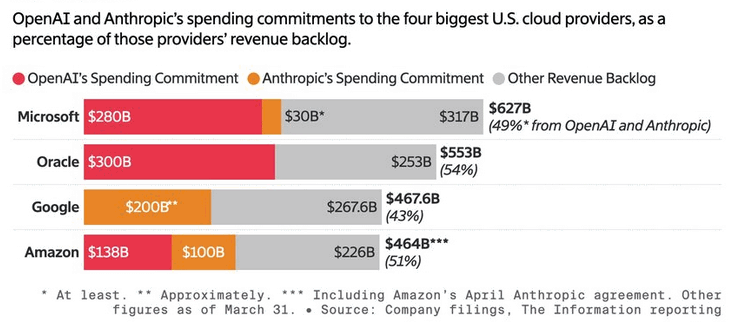
Chart of the Day: Roughly half the four hyperscalers’ combined backlog — $1.05T of $2.1T — sits on two private, unprofitable counterparties. Microsoft (49%), Oracle (54%), Google (43%) and Amazon (51%) are booking RPO that depends on OpenAI and Anthropic raising fresh capital, repeatedly, to honour it. The AI bubble probably ends in a 50%+ drawdown — but it could run another +50% higher first, and take years to unwind. The actual drivers? All private. Buying the hyperscalers isn’t an AI bet; it’s a bet on the suppliers of companies you can’t audit. Second-order visibility on a first-order bet.
Market Intelligence Brief (MIB) Ver. 17.89
For professional investors only. Not investment advice.
© 2026 RecessionALERT.com

Comments are closed.