
MARKET INTELLIGENCE BRIEF (MIB)
Monday, October 26, 2026
Anthropic filed its public S-1 for a Nasdaq IPO as ANT, and the Nasdaq 100 rose 1.09% as AI hardware led. Meta (META) fell 1.88% on a roughly $35 billion stock offering to fund its AI build-out. The 2-year yield rose 3.0 bps two days before Wednesday’s Fed decision. Lula’s fourth term sank Brazilian assets, with Petrobras (PBR) down 13.99%. WTI fell 1.60% as regional envoys opened talks in Tehran. Tesla (TSLA) jumped 5.21% on a Barclays upgrade.
TABLE OF CONTENTS
A. EXECUTIVE SUMMARY
B. MARKET DATA
C. HIGH-IMPACT STORIES (5)
D. MODERATE-IMPACT STORIES (7)
E. ECONOMY WATCH (3)
F. EARNINGS WATCH (2)
G. WHAT’S NEXT
H. CHART OF THE DAY
A. EXECUTIVE SUMMARY -> TOP
Anthropic’s public S-1 revived the AI trade, lifting the Nasdaq 100 1.09% and the S&P 500 0.70%, but the same morning showed how the build-out is now being paid for: Meta launched roughly $35 billion of common and mandatory convertible stock and SpaceX committed to a $40 billion GPU lease, turning AI capex from an earnings question into a financing question. Bonds refused to share the relief, with the 2-year yield up 3.0 bps after a $69 billion auction while the 10-year slipped 1.4 bps, a front-end repricing that keeps year-end hike odds near 75% two days before an expected Fed hold, with CPI inflation at 3.7%. Crude fell as envoys opened de-escalation talks in Tehran, and Brazil’s post-election rout stayed contained to Brazilian assets. Breadth was thin: six of 11 sectors rose, Technology (+1.47%) and Industrials (+1.09%) led, and Communication Services (-1.36%) extended a 6.75% weekly slide.
• Anthropic filed the public version of its S-1 for a Nasdaq listing under the ticker ANT, disclosing first-half revenue of $16.3 billion, up 1,300%; press reports put a potential valuation at $1.5 trillion to $2 trillion. AI hardware led the rebound: Cisco (CSCO) rose 3.51%, Lam Research (LRCX) 3.22% and Micron (MU) 2.98%.
• Meta (META) fell 1.88% after launching about $35 billion of Class A common and mandatory convertible preferred stock and planning a separate at-the-market program of up to $60 billion, not expected to begin before the first quarter of 2027; NVIDIA, AMD and Broadcom indicated non-binding interest in up to $5.0 billion of the common.
• Front end sells off into the Fed: the 2-year yield rose 3.0 bps to 4.716% after a $69 billion auction while the 10-year fell 1.4 bps to 4.980%, flattening 2s10s to 26 bps. The Fed is expected to hold at 3.75%-4.00% on Wednesday, with CME FedWatch pricing nearly 75% odds of a hike by year-end.
• Brazil repriced after Lula won a fourth term: in US trading Itaú Unibanco (ITUB) fell 20.37%, Ambev (ABEV) 14.24% and Petrobras (PBR) 13.99%, the real dropped 10.5% against the dollar, and the Treasury cancelled bond auctions set for October 27 and 29.
• Deals and calls: Tesla (TSLA) rose 5.21%, the day’s largest mega-cap gain, on a Barclays upgrade citing an anticipated SpaceX combination; Range Resources (RRC) jumped 17.66% on EQT’s all-stock acquisition; Instacart (CART) rose 7.87% and DoorDash (DASH) fell 6.10% on a WSJ report of advanced talks at about $17 billion; Lockheed Martin (LMT) gained 5.13% on a Morgan Stanley upgrade.
• WTI fell 1.60% to $101.62 and Brent 1.11% to $110.46 as Saudi, Pakistani and Turkish envoys opened de-escalation talks in Tehran; Houthi claims of strikes on Saudi Arabia’s East-West pipeline remain unconfirmed.
1. AI Spending Has Moved Into the Capital Markets — Three disclosures in one session show the build-out outgrowing operating cash flow: Anthropic’s IPO filing, Meta’s equity raise with a $60 billion at-the-market program behind it, and SpaceX’s $40 billion GPU lease with an Apollo-managed entity. The market split the trade cleanly, bidding the suppliers (Cisco, Lam, Micron, and Intel up 4.04% on New Street’s agentic-AI server-CPU call) while selling the issuer, with Communication Services down 8.56% over the month. Three chip vendors indicating interest in Meta’s stock deepens the circularity investors already question. Microsoft and Alphabet on Wednesday and Amazon on Thursday now report against a new test: whether capex guidance implies more issuance.
2. Activity Is Cooling at the Margin While Prices Are Not — The Chicago Fed activity index turned only marginally positive at 0.07, and beneath the Dallas Fed’s headline rise to 13.4, Texas new orders fell to 9.3 from 30.7 while the raw materials price index rose to 55.3 from 52.2. That is the mix that argues against a pivot, and the 2-year yield is pricing it while equities are not: the VIX fell 5.19% to 18.44. If Chair Warsh’s press conference validates a December hike, rate-sensitive sectors carry the risk, and Thursday’s Q3 GDP (3.2% expected) and September PCE (3.6% year over year expected) decide whether the hawkish read holds into the November 3 midterms.
3. Relief Is Selective: Oil Eases, Gas and Emerging Markets Do Not — Crude priced the Tehran talks, but Dutch TTF rose 2.14% to its highest close since at least April 15, and EQT’s purchase of Range Resources is a bet on gas scale as LNG and data-center demand rise. Brazil’s sovereign cancelled auctions rather than issue into a 10.5% currency drop, yet the dollar index rose only 0.18%, so the contagion channel to US portfolios runs through EM funds and ADRs rather than through the dollar. Closer to home, Reuters reports US-Canada talks on Section 232 steel and auto relief that could land before November 3, against a scheduled rise to 50% on January 1, 2027.
 — Leading economic indicators. Accurate market forecasts. Apply for membership at join.recessionalert.com
B. MARKET DATA -> TOP
Anthropic’s IPO filing revived the AI trade, and a tech-led rebound lifted the Nasdaq 100 ahead of the S&P 500 as semiconductor and AI-hardware names led. The bounce was concentrated rather than broad: only six of 11 sectors rose, the Russell 2000 and NYSE Composite trailed, and Communication Services fell as Meta launched a roughly $35 billion stock offering to fund its AI build-out. Crude retreated on hopes for Middle East diplomacy. Bonds declined to join the relief, with the 2-year yield rising while the 10-year slipped, flattening the curve two days before Wednesday’s Fed decision.
CLOSING PRICES – Monday, October 26, 2026:
MAJOR INDICES
A tech-led session: the Nasdaq 100 outpaced the S&P 500 while the Dow, Russell 2000 and NYSE Composite trailed, so the rebound was concentrated rather than broad. Dow Theory bull confirmation holds for a fifth straight session, with transports (+0.81%) outpacing the industrials. Over 10 sessions the S&P 500 still leads the Nasdaq 100 by 2.87 points, an entrenched nine-session broadening signal, though today’s tech bounce narrowed the gap from 3.83 points on Friday.
| Index | Close | Change | %Move | Why It Moved |
|---|---|---|---|---|
| S&P 500 | 7,676.77 | +53.09 | +0.70% | Technology led as Anthropic’s IPO filing lifted AI-linked shares; Communication Services was the only sector down more than 0.5% |
| Dow Jones | 52,361.58 | +146.42 | +0.28% | Lagged the tech-led S&P 500 and Nasdaq 100 as gains concentrated in AI hardware |
| DJ Transportation | 20,204.82 | +162.91 | +0.81% | Outpaced the Dow; no discrete transport catalyst identified |
| Nasdaq 100 | 29,273.40 | +315.88 | +1.09% | AI rebound on Anthropic’s IPO filing; Tesla, Intel and Cisco gains outweighed declines in Meta and Netflix |
| Russell 2000 | 2,786.66 | +10.76 | +0.39% | Small caps trailed the mega-cap tech rebound |
| NYSE Composite | 24,189.91 | +72.64 | +0.30% | Broad-market gain under half the S&P 500’s; five of 11 sectors fell |
VOLATILITY & TREASURIES
The VIX eased as equities rebounded, but bonds did not confirm the relief: the 2-year yield rose 3.0 bps while the 10-year slipped 1.4 bps, flattening 2s10s by about 4.4 bps to 26 bps. A rising front end two days before the FOMC decision points to rate-path caution rather than growth fear, and the dollar edged higher alongside it.
| Instrument | Level | Change | Why It Moved |
|---|---|---|---|
| VIX | 18.44 | -1.01 (-5.19%) | Eased as the S&P 500 rebounded from two days of losses |
| 10-Year Treasury Yield | 4.980% | -1.4 bps | Little changed ahead of Wednesday’s FOMC decision |
| 2-Year Treasury Yield | 4.716% | +3.0 bps | Front end rose ahead of Wednesday’s FOMC decision; Deutsche Bank expects a hawkish message even if the Fed holds, per Investing.com |
| US Dollar Index (DXY) | 101.99 | +0.18 (+0.18%) | Edged higher alongside the rise in 2-year yields |
COMMODITIES
Precious metals sat out the equity rebound: platinum fell to its lowest close since at least April 15 and silver closed flat at its own low for that period, while gold managed only a modest gain. Copper rose with the industrial and tech bid, and Bitcoin slipped, decoupling from the risk-on tape.
| Asset | Price | Change | %Move | Why It Moved |
|---|---|---|---|---|
| Gold | $4,026.22/oz | $+18.32 | +0.46% | Modest gain on the December contract, holding just above $4,000 |
| Silver | $53.928/oz | $-0.021 | -0.04% | Flat; lowest close since at least April 15 |
| Copper | $6.5460/lb | $+0.0385 | +0.59% | Rose alongside the rebound in industrial and tech equities |
| Platinum | $1,532.70/oz | $-29.70 | -1.90% | Lowest close since at least April 15 (January contract); no discrete catalyst identified |
| Bitcoin | $79,921 | $-562 | -0.70% | Slipped against the equity rebound |
ENERGY
Both crude benchmarks fell as hopes for Middle East diplomacy, including Qatari mediation in Tehran, outweighed unconfirmed Houthi claims of strikes on Saudi infrastructure, per Reuters. Oil fell while equities rose. European gas went the other way: Dutch TTF climbed to its highest close since at least April 15 while Henry Hub held flat.
| Asset | Price | Change | %Move | Why It Moved |
|---|---|---|---|---|
| Crude Oil (WTI) | $101.62/bbl | $-1.65 | -1.60% | Hopes for a diplomatic breakthrough, with Qatari mediators in Tehran, weighed; Houthi attack claims on Saudi Arabia limited losses. Settled $101.76, down $1.51, per Reuters |
| Crude Oil (Brent) | $110.46/bbl | $-1.24 | -1.11% | Same diplomacy-versus-attacks drivers as WTI. Quoted on the January contract after the roll; the expiring December contract settled $115.81, down $0.91, per Reuters |
| Natural Gas (Henry Hub) | $3.053/MMBtu | $+0.003 | +0.10% | Little changed; quoted on the December contract, which trades well above the expiring November contract |
| Natural Gas (Dutch TTF) | $31.475/MMBtu | $+0.660 | +2.14% | Highest close since at least April 15, decoupling from flat US gas |
S&P 500 SECTORS
Six of 11 sectors rose, led by Technology (+1.47%), a rebound for a sector still down 5.17% over the month. Communication Services (-1.36%) was the laggard on the day and the week (-6.75%), deepening a 1-month slide to -8.56% as Meta’s offering and Netflix’s decline weighed. Energy slipped 0.22% with crude but remains the 12-month leader at +50.16%.
| Sector | 1-Day | 1-Week | 1-Month | 3-Month | 6-Month | YTD | 12-Month |
|---|---|---|---|---|---|---|---|
| Technology | +1.47% | +0.18% | -5.17% | +8.56% | +11.98% | +23.59% | +20.91% |
| Industrials | +1.09% | +0.15% | -2.49% | -5.26% | -6.21% | +6.47% | +6.47% |
| Consumer Cyclical | +1.00% | -0.97% | +1.86% | +1.27% | -4.39% | -6.34% | -6.90% |
| Real Estate | +0.50% | +2.76% | +1.50% | -8.29% | -2.51% | +4.26% | +0.09% |
| Basic Materials | +0.25% | -3.24% | -5.54% | -0.72% | -8.70% | +7.03% | +15.15% |
| Healthcare | +0.13% | +2.29% | +3.58% | +4.38% | +18.85% | +11.59% | +15.35% |
| Financial | -0.02% | +1.03% | -0.52% | -3.70% | +7.08% | +3.77% | +10.03% |
| Energy | -0.22% | +2.01% | +10.03% | +16.15% | +15.23% | +48.76% | +50.16% |
| Consumer Defensive | -0.35% | +0.57% | +7.39% | +1.85% | +5.28% | +12.52% | +10.70% |
| Utilities | -0.49% | +2.09% | +6.37% | -6.45% | -9.29% | -1.36% | -5.94% |
| Communication Services | -1.36% | -6.75% | -8.56% | -4.43% | -10.24% | -6.64% | -1.55% |
TOP MEGA-CAP MOVERS:
GAINERS
| Company | Ticker | Close | Change | Why It Moved |
|---|---|---|---|---|
| Tesla | TSLA | 391.62 | +5.21% | Barclays upgraded to Overweight from Equalweight and raised its target to $450 from $370, citing an anticipated combination with SpaceX, per Investing.com |
| GE Vernova | GEV | 855.12 | +4.92% | No discrete same-day catalyst identified; rose ahead of its Q3 report on Wednesday |
| Texas Instruments | TXN | 298.12 | +4.72% | No discrete same-day catalyst identified; rose with a broad semiconductor rally (Lam Research +3.22%, Micron +2.98%) |
| Intel | INTC | 90.47 | +4.04% | New Street Research upgraded to Buy from Neutral with a $125 target, citing a structural server-CPU shortage driven by agentic AI, per Investing.com |
| Cisco Systems | CSCO | 110.24 | +3.51% | No discrete same-day catalyst identified; rose with AI networking names (Arista +2.80%) as Anthropic’s IPO filing lifted AI shares |
DECLINERS
| Company | Ticker | Close | Change | Why It Moved |
|---|---|---|---|---|
| Merck | MRK | 140.61 | -3.21% | Fell with partner Moderna as investors continued to react to Phase 3 data for their personalized melanoma vaccine presented at ESMO 2026, which showed a 42% reduction in recurrence or death against 49% in the earlier Phase 2b, per Investing.com |
| Netflix | NFLX | 63.90 | -2.96% | Extended its earnings-driven slide since the October 20 Q3 report to a 52-week low; Huatai Financial cut to Hold from Buy, per Investing.com |
| Meta Platforms | META | 630.56 | -1.88% | Launched public offerings of about $35 billion in common stock and convertible preferred stock to fund its AI expansion, per Reuters |
| UnitedHealth Group | UNH | 410.70 | -1.77% | No discrete same-day catalyst identified; extended Friday’s decline |
| Mastercard | MA | 613.50 | -1.62% | No discrete same-day catalyst identified; card networks weak (Visa -0.91%) ahead of Visa’s results Tuesday and Mastercard’s Thursday |
— Institutional-grade intelligence for serious investors. Apply for membership at join.recessionalert.comC. HIGH-IMPACT STORIES -> TOP
BULLISH
1. Anthropic Files Its Public S-1 for a Nasdaq IPO Under the Ticker “ANT”; the Nasdaq 100 Rises 1.09% as AI Hardware Leads a Tech Rebound
The core facts:Anthropic filed the public version of its Form S-1 with the SEC on Monday morning for a Nasdaq listing under the ticker ANT. The prospectus leaves the share count and price range blank; press reports have put a potential valuation at $1.5 trillion to $2 trillion, against a $965 billion post-money valuation in its May private round, and NPR reported the IPO could come as soon as November. The filing formally discloses first-half 2026 revenue of $16.3 billion, up 1,300%, adjusted operating income of $1.6 billion against a $1.8 billion loss a year earlier, and a net loss of nearly $81 billion — figures first reported on October 20 from the confidential draft. Moody’s senior vice president Raj Joshi called the swing in adjusted operating income “a strong positive for the AI ecosystem.”
Why it matters:The S&P 500 rose 0.70% to 7,676.77 and the Nasdaq 100 1.09%, the S&P’s first gain after two down sessions, with Technology the top sector at +1.47%. Investing.com’s closing report credited the filing with lifting AI shares, and AI hardware led: Cisco +3.51%, Lam Research +3.22%, Micron +2.98% and Arista +2.80%. A listing at the reported valuation would rank among the largest IPOs ever and give public investors their first direct read on a frontier-model developer’s economics, at a moment when AI financing is under scrutiny — Meta launched a $35 billion equity raise the same morning (Story 2). The rebound was narrow, though: only six of 11 sectors rose and the NYSE Composite gained just 0.30%, so the filing revived the AI trade rather than broad risk appetite.
What to watch:An amended S-1 setting the price range and share count, and whether the AI-hardware bid holds through Microsoft’s and Alphabet’s results after the close on Wednesday, October 28.
BEARISH
2. Meta Launches About $35 Billion of Common and Mandatory Convertible Stock to Fund Its AI Build-Out and Plans a $60 Billion At-the-Market Program; Shares Fall 1.88%
The core facts:Meta’s free writing prospectus, dated October 26, sets out $22.5 billion of Class A common stock sold through forward sale agreements with Morgan Stanley and Goldman Sachs, with a 30-day option for $3.375 billion more, plus 250 million depositary shares of Series A Mandatory Convertible Preferred Stock (proposed ticker METAM) that convert on or about August 15, 2029; Reuters put the combined offerings at about $35 billion. NVIDIA, AMD and Broadcom indicated interest in up to $5.0 billion of the Class A stock, which the filing says is “not binding.” Meta expects no proceeds from the initial forward sale and will settle the forwards on or before November 19, 2027. Separately, it plans an at-the-market program of up to $60 billion of Class C common, not expected to begin until the first quarter of 2027; no agreement has been signed. Meta closed at $630.56, down 1.88%.
Why it matters:One of the largest AI spenders is now funding its build-out with equity as well as cash flow, which turns AI capex from an earnings question into a dilution question for shareholders. Communication Services was the weakest sector at -1.36%, deepening its slide to -6.75% on the week and -8.56% over the month. The forward structure lets Meta lock in issuance now and take the cash over more than a year, and three of its own chip suppliers indicating interest in buying its stock deepens the circular financing between AI customers and AI vendors that investors have been questioning.
What to watch:Pricing of both offerings, and capex guidance from Microsoft and Alphabet on Wednesday and Amazon on Thursday for signs that other hyperscalers will also turn to equity markets.
UNCERTAIN
3. Saudi, Pakistani and Turkish Envoys Open De-Escalation Talks in Tehran After Qatari Mediation; WTI Falls 1.60% to $101.62 as Houthi Attack Claims on Saudi Arabia Go Unconfirmed
The core facts:Saudi Defence Minister Prince Khalid bin Salman, Pakistan’s army chief Field Marshal Asim Munir and Turkish intelligence chief Ibrahim Kalin met President Masoud Pezeshkian, Foreign Minister Abbas Araqchi and Supreme National Security Council secretary Mohsen Rezaei in Tehran on Monday, per Reuters. The Saudi Foreign Ministry said the aim was to “prevent the return of military escalation.” Qatari mediators were in Tehran on Sunday. Iran’s conditions are an end to the US blockade of its ports and the lifting of sanctions on its oil exports, and an Iranian official said the nuclear programme would not be discussed until those are met. The Houthis said they attacked pumping stations on Saudi Arabia’s East-West pipeline and Riyadh airport; Saudi Arabia has not confirmed the attacks, and the airport resumed operations at two terminals on Sunday. Iranian security officials also told Reuters that Tehran has plans to attack Gulf undersea cables if the US and Israel strike again.
Why it matters:WTI closed at $101.62, down 1.60%, and Brent at $110.46, down 1.11% on the January contract, as the market weighted diplomacy above unconfirmed attack claims; Energy slipped 0.22%. The talks follow an interim peace agreement in June that broke down when fighting resumed, and Iran’s conditions run through US policy, so any de-escalation still depends on Washington, where President Trump said on Friday the US may carry out another military operation. Lower crude eases the inflation pressure the Fed faces on Wednesday, but the East-West pipeline is the Kingdom’s main export route bypassing Hormuz, so a confirmed hit would reverse the move quickly. Europe’s gas market is not pricing relief: Dutch TTF rose 2.14% to its highest close since at least April 15.
What to watch:Whether the Tehran talks produce a follow-up round, any Saudi or Aramco statement on the pipeline, and Wednesday’s EIA petroleum inventory report.
BEARISH
4. The Front End Sells Off Into Wednesday’s Fed Decision: the 2-Year Yield Rises 3.0 bps to 4.716% After a $69 Billion Auction as the Curve Flattens to 26 bps
The core facts:The 2-year Treasury yield rose 3.0 bps to 4.716% while the 10-year slipped 1.4 bps to 4.980%, flattening the 2s10s curve by about 4.4 bps to 26 bps. The Treasury sold $69 billion of 2-year notes at a high yield of 4.708% with a bid-to-cover ratio of 2.59, per TreasuryDirect’s auction results. The Fed is expected to hold at 3.75%-4.00% on Wednesday with year-end hike odds near 75% (see Economy Watch), and Deutsche Bank expects a hawkish message even if the Fed holds, per Investing.com. The dollar index rose 0.18% to 101.99.
Why it matters:A rising 2-year beside a falling 10-year is a policy-path signal, not a growth scare: the market is pricing a hold that keeps the hiking bias alive rather than a pivot, and a large 2-year auction cleared just below the session’s closing yield into that pricing. Equities ignored it — the VIX fell 5.19% to 18.44 — which leaves stocks exposed if Chair Warsh’s press conference validates a December hike. With the 10-year holding just under 5%, the long end is not yet demanding more term premium, so the risk is concentrated in the front end and in rate-sensitive sectors.
What to watch:The FOMC statement at 2:00 PM ET on Wednesday, October 28 and the 2:30 PM ET press conference, then Thursday’s Q3 GDP and September PCE; a 2-year yield holding above 4.7% after the decision would confirm the market is pricing December.
BEARISH
5. Brazilian Assets Crash After Lula Wins a Fourth Term: Itaú Unibanco Closes Down 20.37% and Petrobras 13.99% in US Trading as the Real Drops 10.5% and Brasília Cancels Bond Auctions
The core facts:Luiz Inácio Lula da Silva won Sunday’s runoff with 51.8% of valid votes to Senator Flávio Bolsonaro’s 48.2%, per the Superior Electoral Court — the first time since 1989 that a candidate has won the runoff after losing the first round. The iShares MSCI Brazil ETF was 25% lower at 10:30 AM ET and trading in São Paulo was halted by an automatic circuit breaker, per CNBC; the real fell 10.5% against the dollar to its lowest since December 2025, per LSEG. US-listed shares closed sharply lower: Itaú Unibanco -20.37%, Ambev -14.24% and Petrobras -13.99%. The Brazilian Treasury cancelled inflation-linked and fixed-rate bond auctions scheduled for October 27 and October 29. Bolsonaro refused to concede and said he would seek to have the result annulled, Reuters reported.
Why it matters:Markets had priced a Bolsonaro win after the first round, so the result is a repricing of fiscal risk rather than a political headline. Citi cited investor concern over “fiscal policy, state-owned enterprises, and the broader reform agenda,” and ING’s Chris Turner pointed to a 7-8% budget deficit and 70% net debt-to-GDP ratio. Cancelled auctions are a credit-stress signal: the sovereign chose not to issue into the selloff. For US portfolios the transmission runs through emerging-market funds, Brazilian ADRs and dollar-funded Latin American credit; it stayed contained on Monday, with the S&P 500 up 0.70% and the dollar index up only 0.18%.
What to watch:Whether the Treasury restores its bond auctions, any central bank intervention to support the real, and the progress of Bolsonaro’s annulment challenge.
— Quantifying recession risk so you don’t have to guess. Apply for membership at join.recessionalert.comD. MODERATE-IMPACT STORIES -> TOP
BULLISH
6. Barclays Upgrades Tesla to Overweight With a $450 Target on an Anticipated SpaceX Combination, and Tesla Rises 5.21%, the Day’s Largest Mega-Cap Gain; SpaceX Commits to a $40 Billion GPU Lease
The core facts:Barclays raised Tesla to Overweight from Equal Weight and lifted its price target to $450 from $370 before the open, citing an anticipated combination with SpaceX, an improving core auto business and early Robotaxi signs, per Investing.com. Tesla closed at $391.62, up 5.21%, the largest gain among mega-caps. Separately, SpaceX disclosed in an 8-K filed Monday that on October 24 it entered a binding commitment letter for a master finance lease of graphics processing unit pods with an entity managed by Apollo Global Management, with about $40 billion of aggregate principal payments; lease schedules are expected to begin in the first half of 2027 as the GPUs are delivered, and the master lease is expected to close before year-end. The filing does not name the chip supplier. SpaceX shares closed down 0.40%.
Why it matters:Barclays is valuing Tesla partly as a route into SpaceX’s AI ambitions, which ties the stock more closely to the AI compute cycle than to auto demand. The SpaceX lease is the third large AI financing disclosed on Monday, after Meta’s equity raise and Anthropic’s IPO filing: hyperscale compute is now being paid for with leases, convertibles and public equity, not only operating cash flow. That widens the investor base for AI spending, and also the number of balance sheets exposed if returns disappoint.
What to watch:Any formal disclosure from Tesla or SpaceX on a combination, and the closing of SpaceX’s master lease before year-end.
BULLISH
7. Morgan Stanley Upgrades Lockheed Martin to Overweight With an $835 Target as Shares Gain 5.13%; New Street Upgrades Intel to Buy and UBS Upgrades Ross Stores, While Block Is Cut
The core facts:Morgan Stanley upgraded Lockheed Martin to Overweight from Equal Weight with an $835 price target, per 24/7 Wall St’s morning roundup; the shares closed up 5.13% at $635.20. New Street Research upgraded Intel to Buy from Neutral with a $125 target, citing a structural server-CPU shortage driven by agentic AI, per Investing.com; Intel rose 4.04% to $90.47. UBS raised Ross Stores to Buy from Neutral and lifted its target to $315 from $239; Ross gained 2.10%. Morgan Stanley cut Block to Equal Weight from Overweight and lowered its target to $80 from $90; Block fell 2.50%.
Why it matters:The calls mapped onto the session’s leadership: Industrials (+1.09%) and Technology (+1.47%) were the two best sectors. The Intel upgrade is the more consequential for the AI trade, because it argues that agentic workloads extend AI demand from accelerators into general-purpose server CPUs. That thesis meets a hard test within days, when Intel reports after Thursday’s close.
What to watch:Intel’s third-quarter results after the close on Thursday, October 29, against revenue guidance of $15.8 billion-$16.8 billion and any comment on server-CPU supply.
UNCERTAIN
8. DoorDash Is in Advanced Talks to Buy Instacart at About $17 Billion, the WSJ Reports; DoorDash Falls 6.10% and Instacart Rises 7.87%
The core facts:DoorDash is in advanced talks to acquire grocery-delivery rival Instacart, with a deal possible as soon as this week, The Wall Street Journal reported on Monday, citing people familiar with the matter; the talks could still fall apart. The deal could value Instacart at about $17 billion, against roughly $12 billion before the sale reports began, per Investing.com’s account of the report. DoorDash closed at $168.44, down 6.10%, and Instacart rose 7.87%, extending Friday’s gain of about 9% after The Information reported it was exploring a sale and had held preliminary talks with DoorDash and Uber.
Why it matters:Friday’s report was an exploration with two possible buyers; today’s is a single bidder in advanced talks with a price, which turns a possibility into a negotiation. The reported price is about 40% above Instacart’s pre-report value, and a combination of two of the largest US delivery platforms carries clear antitrust risk — the concern that helped end their 2021 talks, when Instacart was valued at $40 billion to $50 billion. A deal would test how the current antitrust regime treats horizontal platform mergers.
What to watch:A definitive agreement this week, its cash-and-stock mix, and any regulatory reaction.
UNCERTAIN
9. EQT Agrees an All-Stock Acquisition of Range Resources, Creating a Producer of More Than 9 Bcfe/d With a Pro Forma Enterprise Value Above $50 Billion; Range Jumps 17.66%
The core facts:EQT will acquire Range Resources in an all-stock deal announced at 4:00 AM on Monday, with each Range share converting into 0.987 EQT shares; EQT shareholders will own about 73% of the combined company and Range shareholders about 27%. The combined company will have more than 9 Bcfe/d of net production, more than 30 years of inventory, nearly 3 million net acres and a pro forma enterprise value of more than $50 billion. EQT targets $325 million of base annual synergies within two years, with a path to more than $600 million, and expects BBB-quality credit metrics at closing; Range CEO Dennis Degner and one other Range representative will join EQT’s board. Closing is expected in the first quarter of 2027. Range closed up 17.66% and EQT down 1.40%.
Why it matters:The deal builds an Appalachian gas producer of unusual scale as US gas demand from LNG exports and data centers rises. It was announced while Henry Hub sits near $3.05, little changed on the day, and European gas reached its highest close since at least April 15, a spread that rewards scale and low-cost supply. An all-stock structure with investment-grade credit preserves balance-sheet capacity, and the target’s surge against the acquirer’s dip is the usual pattern of a deal the market expects to close.
What to watch:Shareholder votes and regulatory review ahead of the expected first-quarter 2027 close, and whether other gas producers pursue mergers in response.
BULLISH
10. The US and Canada Are Negotiating Relief From Section 232 Tariffs on Steel and Autos, Possibly Before the November 3 Midterms, Reuters Reports
The core facts:The US and Canada are working on a deal to ease Section 232 tariffs of up to 50% on Canadian steel and 25% on Canadian autos, Reuters reported on Monday, citing two US and four Canadian sources. One Canadian source said a steel and auto deal was possible before the November 3 elections, while US sources said Washington wants further Canadian concessions. Commerce Secretary Howard Lutnick, whose department administers the 232 tariffs, is central and in regular contact with Canada’s Dominic LeBlanc. A Canadian industry source said: “If it happens, it’ll happen fast. But my sense is it’ll be a narrowed deal, if it even happens.” LeBlanc’s spokesperson said Canada “remains in constructive dialogue.” Talks collapsed in August, partly over duties on medium- and heavy-duty vehicles, and President Trump predicted at a Sunday rally that the dispute would be resolved “soon.”
Why it matters:Trump has already announced an increase to 50% on Canadian steel and autos from January 1, 2027, so a deal would head off a scheduled escalation rather than merely trim existing duties. Integrated North American auto supply chains, steel-intensive manufacturers and Detroit automakers carry the most exposure; Industrials rose 1.09% on Monday. The talks are separate from Friday’s order reshuffling which Canadian products face Section 338 duties, which takes effect on October 30.
What to watch:Any announcement before November 3, and whether a deal covers medium- and heavy-duty vehicles, the issue that broke the August talks.
BULLISH
11. ESMO Weekend: Amgen and AstraZeneca’s Imdelltra Combination Cuts the Risk of Death by 58% in Small Cell Lung Cancer, Roche’s Divarasib Beats Amgen’s Lumakras Head to Head, and the FDA Widens Pfizer’s Talzenna Label
The core facts:Amgen’s Phase 3 DeLLphi-305 trial, presented at ESMO’s Presidential Symposium on Saturday and published in The New England Journal of Medicine, showed Imdelltra plus AstraZeneca’s Imfinzi as first-line maintenance in extensive-stage small cell lung cancer cut the risk of death by 58% (hazard ratio 0.42), with median overall survival of 21.1 months versus 12.7 months; Amgen said it is “moving with urgency” to share the results with regulators. On Sunday, Roche’s KRAScendo 1 trial showed divarasib beat sotorasib (Amgen’s Lumakras) or adagrasib in previously treated KRAS G12C lung cancer, with an overall survival hazard ratio of 0.56 and median survival of 17.7 versus 12.0 months. On Monday at 1:41 PM ET, Pfizer said the FDA expanded approval of Talzenna plus Xtandi to HRR gene-mutated metastatic prostate cancer at an earlier stage, based on the Phase 3 TALAPRO-3 trial’s estimated 52% reduction in the risk of radiographic progression or death. Amgen rose 1.22%, AstraZeneca 0.33% and Pfizer fell 0.80%.
Why it matters:DeLLphi-305 moves Imdelltra into an earlier and much larger first-line setting, and Amgen still rose although KRAScendo 1 sets up a rival standard of care in KRAS G12C lung cancer at the expense of its own Lumakras. The Pfizer approval moves a combination into an earlier, broader prostate cancer population and extends Xtandi’s franchise, which Pfizer shares with Astellas in the US. Healthcare edged up only 0.13%, so the readouts moved individual names rather than the sector, ahead of a heavy week of drugmaker earnings.
What to watch:Regulatory filing timelines for Imdelltra in first-line maintenance, and the oncology outlook from Merck and Bristol Myers Squibb on Thursday and AstraZeneca on Friday.
BEARISH
12. The FTC and 20 States Sue Dollar General, Alleging Its Stores Charged More at the Register Than Shelf and Advertised Prices; Shares Fall 3.22%
The core facts:The Federal Trade Commission and 20 states sued Dollar General on Monday in the US District Court for the Middle District of Tennessee, after a 2-0 Commission vote. The complaint alleges that thousands of the chain’s more than 21,000 stores charged shoppers more at the register than the prices shown on shelves, price tags and advertisements, that the company received tens of thousands of complaints, and that it knew of the problem and failed to fix it. The claims rest on the FTC Act, the Gramm-Leach-Bliley Act and state laws. “Dollar General has betrayed the trust of millions of American consumers,” said Christopher Mufarrige, Director of the FTC’s Bureau of Consumer Protection. Dollar General closed at $128.42, down 3.22%.
Why it matters:A joint federal and multistate action against a $28 billion discount chain makes register-price accuracy an enforcement priority across retail, not only an inspection issue for local weights-and-measures offices. The FTC has not stated the relief it seeks, so the financial exposure is open-ended, and remediation would add labour and systems costs across its store base. It also lands on the low-income shoppers who are the most price-sensitive part of the consumer base, with inflation at 3.7%.
What to watch:Dollar General’s formal response, the relief the complaint seeks, and whether other discount and grocery chains face similar actions.
— Separating signal from noise since 2007. Apply for membership at join.recessionalert.comE. ECONOMY WATCH -> TOP
Activity data opened the week holding up, but prices and the Fed are the story. The Chicago Fed’s national activity gauge turned marginally positive at 0.07 and Texas factory sentiment improved, yet Texas production and new orders slowed sharply while input prices accelerated, with the raw materials index at 55.3. That mix keeps the Fed on a hawkish hold: no change is expected Wednesday with annual CPI inflation at 3.7% and nearly 75% odds of a hike by year-end, and the 2-year yield rose 3.0 bps today as the curve flattened. Thursday’s Q3 GDP and September PCE are the swing data before the midterms.
Dallas Fed Manufacturing Index Rises to 13.4, but Texas Production and New Orders Slow Sharply as Input Prices Climb (Dallas Fed, Oct 26)
What they’re saying:The Dallas Fed’s Texas general business activity index rose to 13.4 in October from 9.8, and the company outlook index climbed to 16.1 from 8.7. Beneath the headline, the production index nearly halved to 15.8 from 29.5, new orders fell to 9.3 from 30.7, and capacity utilization dropped to 13.7 from 23.9.
The context:The Dallas Fed summarized the month as “Texas manufacturing activity remains solid, though pace of growth moderates,” with production still above its series average. Price pressure moved the other way: raw materials prices rose to 55.3 from 52.2 and finished goods prices to 29.9 from 27.6, while wages and benefits eased to 20.8 from 27.4. Respondents cited fuel costs, the freight market, data center spending, interest rates and the USMCA negotiations, and the future general business activity index jumped to 38.1 from 20.8.
What to watch:Tuesday’s September durable goods orders (headline expected +1.5% after 0%; ex-transportation +0.6%), Friday’s Chicago PMI (expected 55.5 from 58.8), and ISM Manufacturing on Monday, November 2 (prior 54.5).
Chicago Fed National Activity Index Turns Positive at 0.07 in September (Chicago Fed, Oct 26)
What they’re saying:The Chicago Fed National Activity Index rose to 0.07 in September from -0.08 in August, swinging back into positive territory. August’s reading now stands at -0.08, revised down from the -0.04 previously reported.
The context:The Chicago Fed scales the index so that zero corresponds to growth at the economy’s historical trend rate, with positive readings signalling above-trend growth. September’s print is only marginally above trend, and the Chicago Fed associates rising recession risk with a three-month average below -0.70, a level the two latest monthly readings are nowhere near. The Atlanta Fed’s GDPNow model put third-quarter growth at 3.5% as of October 20.
What to watch:Thursday’s Q3 advance GDP (expected 3.2% annualized versus 2.2% in Q2), with GDPNow updates on Tuesday and Wednesday ahead of it.
Fed Expected to Hold at 3.75%-4.00% Wednesday as Hike Odds by Year-End Stay Near 75% (CNBC, Oct 26)
What they’re saying:The Fed is expected to leave its target range at 3.75%-4.00% when its two-day meeting ends Wednesday, with CME FedWatch pricing less than a 10% chance of another quarter-point hike this week but nearly 75% odds of at least one hike by year-end, per CNBC. September’s CPI lifted annual inflation to 3.7%. “Inflation is still the No. 1 problem in the U.S. economy, and there are a lot of signs it is getting more broad-based,” said Navy Federal Credit Union chief economist Heather Long, adding that “given that it’s right before an election,” the Fed “won’t hike in October.”
The context:Bank of America’s Aditya Bhave warned in an October 23 note that “If the Fed holds, markets could question the Fed’s inflation-fighting credibility.” Bonds leaned hawkish today: the 2-year yield rose 3.0 bps to 4.716% while the 10-year slipped 1.4 bps to 4.980%, flattening the 2s10s curve by about 4.4 bps to 26 bps, and Polymarket’s contract on another Fed hike in 2026 eased to 77% from 78%. CME Group’s Mark Shore noted that the four times the Fed raised rates near a midterm, in 1978, 1982, 2018 and 2022, were all tied to rising inflation.
What to watch:The decision on Wednesday, October 28 at 2:00 PM ET and Chair Warsh’s 2:30 PM ET press conference; Thursday’s Q3 advance GDP and September PCE (headline expected 3.6% year over year from 3.4%, core 0.3% month over month from 0.2%); and Friday’s Q3 Employment Cost Index (expected 0.8% quarter over quarter).
— Know the probability before the market prices in the risk. Apply for membership at join.recessionalert.comF. EARNINGS WATCH -> TOP
YESTERDAY AFTER THE BELL (Markets Reacted Today)
No major earnings yesterday after the bell from companies with >$100B market cap.
TODAY BEFORE THE BELL (Markets Already Reacted)
UNCERTAIN
13. Verizon Communications (VZ): -3.49% | Raises 2026 Guidance for a Third Straight Quarter on 406,000 Postpaid Phone Additions, but Revenue Falls Short
The Numbers:Released: BMO, Monday, October 26. Adjusted EPS of $1.31 beat the $1.27 consensus by 2.81% (GAAP EPS $1.25, up 6.8%). Revenue of $34.31 billion, up 1.5%, missed the $34.77 billion estimate by 1.31%. Adjusted EBITDA rose 8.0% to $13.8 billion, which the company called its highest quarterly result. Postpaid phone net additions were 406,000 and broadband net additions 314,000 (155,000 fiber, 159,000 fixed wireless). Free cash flow for the first nine months was $18.0 billion, up 14.3%. Full-year 2026 guidance was raised: postpaid phone net additions of 1.1 million-1.2 million (from the upper half of 750,000-1.0 million), adjusted EPS of $5.04-$5.06 (growth of 7.0%-7.5%), and free cash flow growth approaching 12% (from 9%-10%).
The Problem/Win:Subscriber momentum is the win: CEO Dan Schulman called it “another record-breaking quarter,” and the net-add guidance lift is large. Alongside the results, Verizon announced an AI infrastructure agreement with AWS valued at more than $2.0 billion to scale distributed compute for AI workloads. The problem is the top line: revenue grew only 1.5% and missed, leaving it the clearest weak point as the shares fell 3.49% despite the guidance raise.
The Ripple:Communication Services was the weakest sector at -1.36%, though Meta’s equity offering (Story 2) did most of the damage there. Verizon’s stronger net-add guidance raises the bar for T-Mobile US, which reports after the close on Wednesday.
What It Means:Verizon is delivering subscriber volume and cash flow, but with revenue growing about 1.5% the market needs to see the net additions convert into faster service-revenue growth. The raised free cash flow outlook adds balance-sheet flexibility in the meantime.
What to watch:T-Mobile US’s postpaid account additions and churn after the close on Wednesday, October 28.
TODAY AFTER THE BELL (Markets React Tomorrow)
UNCERTAIN
14. Welltower (WELL): AH: n/a | Normalized FFO Rises 24.6% to $1.67 and 2026 Guidance Is Raised Again, but GAAP EPS Trails the Estimate
The Numbers:Released: AMC, Monday, October 26. Normalized FFO of $1.67 per diluted share rose 24.6% year over year. Net income attributable to common stockholders was $0.54 per diluted share, against a $0.64 estimate. Total-portfolio same-store NOI grew 15.8% and Seniors Housing Operating same-store NOI 21.0%, with average occupancy up 320 basis points year over year, same-store revenue up 9.1% and RevPOR up 5.3%. Full-year 2026 normalized FFO guidance was raised to $6.47-$6.53 per diluted share from $6.36-$6.44. Shares rose 1.39% in the regular session before the release; no after-hours move was available at the time of writing.
The Problem/Win:Senior-housing operating fundamentals are the win: 21.0% same-store NOI growth in the operating portfolio, driven by occupancy and pricing. Capital deployment continues at scale, with $4.1 billion of gross investments in the third quarter and $21.0 billion closed or under contract year to date. The GAAP shortfall against the estimate is the blemish, though normalized FFO is the measure the guidance is built on.
The Ripple:Real Estate rose 0.50% on Monday. The raise is a read-through for senior-housing operators and healthcare REIT peers as the 10-year yield holds just below 5%.
What It Means:Welltower is growing through operating gains in senior housing and heavy acquisition volume, and a third guidance raise this year shows that growth holding with the 10-year yield near 5%.
What to watch:Tuesday’s 9:00 AM ET conference call for the acquisition pipeline and the occupancy outlook into 2027.
WEEK AHEAD PREVIEW:
Q3 2026 earnings season hits its peak: 41 companies above $100 billion report over the next five sessions, including Microsoft and Alphabet on the afternoon of the Fed’s October 28 decision, Amazon on October 29, ExxonMobil and Chevron on October 30, and Apple on November 2.
Visa (V) — AMC, Tuesday, October 27 — Consensus EPS $3.44. Key focus: cross-border volume growth, which ran at 13% in the fiscal third quarter, and fiscal 2027 net revenue guidance, after American Express’s 8% billed-business growth.
Coca-Cola (KO) — BMO, Tuesday, October 27 — Consensus EPS $0.88. Key focus: organic revenue growth and price/mix against full-year guidance of about 5% organic growth.
Boeing (BA) — BMO, Tuesday, October 27 — Consensus EPS -$0.25. Key focus: a first 737-10 delivery date after the FAA certification, 737 production rates and cash burn.
Seagate Technology (STX) — AMC, Tuesday, October 27 — Consensus EPS $7.45. Key focus: nearline supply allocated into 2028 and the HAMR ramp, after Western Digital’s beat and $5.1 billion guide last week.
S&P Global (SPGI) — BMO, Tuesday, October 27 — Consensus EPS $4.43. Key focus: ratings revenue as debt issuance holds up, in its first quarter excluding the spun-off Mobility business.
Corning (GLW) — BMO, Tuesday, October 27 — Consensus EPS $0.88. Key focus: optical communications growth from AI data centers and progress toward its Springboard sales targets.
HCA Healthcare (HCA) — BMO, Tuesday, October 27 — Consensus EPS $6.65; market cap $100.7 billion, just above the threshold. Key focus: same-facility admissions, which rose 2.5% in the second quarter, the 2026 net income outlook of $6.3 billion-$6.7 billion, cut in July, and any comment on the proposed ACA subsidy-verification rule.
Microsoft (MSFT) — AMC, Wednesday, October 28 — Consensus EPS $4.71. Key focus: Azure growth against guidance of about 45% at constant currency, and fiscal first-quarter capex of about $50 billion, after Meta turned to equity markets to fund its AI build-out (Story 2).
Alphabet (GOOGL) — AMC, Wednesday, October 28 — Consensus EPS $3.03. Key focus: Google Cloud growth after 82% in the second quarter, 2026 capex guidance of $195 billion-$205 billion, and the OpenAI distribution deal.
GE Vernova (GEV) — BMO, Wednesday, October 28 — Consensus EPS $4.01; +4.92% today. Key focus: gas-turbine orders and slot reservations against a target of at least 125 GW by year-end, the backlog, $176 billion in the second quarter, and any comment on the wind-turbine Section 232 proclamation.
KLA (KLAC) — AMC, Wednesday, October 28 — Consensus EPS $1.19. Key focus: results against guidance of $4.0 billion in revenue, and wafer-fab equipment demand after Lam Research’s rebound today.
Amphenol (APH) — BMO, Wednesday, October 28 — Consensus EPS $0.73. Key focus: IT datacom sales driven by AI data centers and record orders, and the CommScope integration.
ServiceNow (NOW) — AMC, Wednesday, October 28 — Consensus EPS $1.02. Key focus: subscription revenue against guidance of about 20.5% growth, and AI monetisation through Now Assist.
T-Mobile US (TMUS) — AMC, Wednesday, October 28 — Consensus EPS $2.89. Key focus: postpaid account additions, now its headline metric, after Verizon added 406,000 postpaid phones and raised its full-year target (Story 13), and its response to SpaceX’s push into US wireless service.
UBS Group (UBS) — BMO, Wednesday, October 28 — Consensus EPS $0.91 (no ADR label; NYSE-listed shares). Key focus: the pace of its $3 billion buyback under proposed Swiss capital reforms, and wealth-management net new assets.
Fortinet (FTNT) — AMC, Wednesday, October 28 — Consensus EPS $0.86. Key focus: billings against guidance of $2.25 billion-$2.35 billion and the firewall refresh cycle, after cybersecurity’s rebound last week.
Automatic Data Processing (ADP) — BMO, Wednesday, October 28 — Consensus EPS $2.77. Key focus: US pays per control, which grew just 1% last quarter, as a read on payroll growth, and interest income on client funds.
Phillips 66 (PSX) — BMO, Wednesday, October 28 — Consensus EPS $11.73. Key focus: refining margins and utilization, including the supply disruption at Lake Charles that drew an emergency SPR exchange last week.
Amazon (AMZN) — AMC, Thursday, October 29 — Consensus EPS $1.97. Key focus: AWS growth after 36.8% in the second quarter, its fastest in 18 quarters, and 2026 capex of about $220 billion; Q3 guidance was $197 billion-$202 billion in net sales.
Eli Lilly (LLY) — BMO, Thursday, October 29 — Consensus EPS $5.68. Key focus: Mounjaro and Zepbound volumes against 2026 revenue guidance of $85 billion-$87 billion, raised in July.
Mastercard (MA) — BMO, Thursday, October 29 — Consensus EPS $5.17; -1.62% today. Key focus: net revenue growth after 12% underlying growth in the second quarter, with full-year guidance held, and cross-border volumes.
Intel (INTC) — AMC, Thursday, October 29 — Consensus EPS $0.40; +4.04% today. Key focus: revenue against guidance of $15.8 billion-$16.8 billion and server-CPU supply, after New Street’s upgrade on an agentic-AI CPU shortage (Story 7).
Merck (MRK) — BMO, Thursday, October 29 — Consensus EPS $2.09; -3.21% today. Key focus: Keytruda sales and the commercial outlook for intismeran after the INTerpath-001 melanoma data presented at ESMO.
Caterpillar (CAT) — BMO, Thursday, October 29 — Consensus EPS $7.04. Key focus: power-generation sales to data centers, which grew 72% in the second quarter, a record $72.1 billion backlog, and 2026 sales growth guidance of mid to high teens.
Linde (LIN) — BMO, Thursday, October 29 — Consensus EPS $4.52. Key focus: industrial gas volumes and pricing as a read on global manufacturing, and energy cost pass-through with European gas at its highest close since at least April 15.
TotalEnergies (TTE) — BMO, Thursday, October 29 — Consensus EPS $3.82 (no ADR label). Key focus: refining and LNG earnings with Brent at $110.46 on the January contract and Gulf supply disrupted.
Gilead Sciences (GILD) — AMC, Thursday, October 29 — Consensus EPS $2.18. Key focus: HIV franchise growth and how guidance absorbs the $0.79-$0.83 fourth-quarter EPS charge from the PepStar acquisition announced on October 22.
Sandisk (SNDK) — AMC, Thursday, October 29 — Consensus EPS $46.61. Key focus: results against its guidance of $44-$46 in EPS and $10.3 billion-$10.8 billion in revenue, and NAND pricing.
Bristol Myers Squibb (BMY) — BMO, Thursday, October 29 — Consensus EPS $1.10. Key focus: Eliquis sales, which rose 22% to $4.48 billion in the second quarter, against non-GAAP EPS guidance of $6.75-$7.00, and the zola-cel restart timeline after last Friday’s disclosure of a patient death.
Altria (MO) — BMO, Thursday, October 29 — Consensus EPS $1.51. Key focus: smokeable volumes and pricing against adjusted EPS guidance of $5.61-$5.72, narrowed in July.
Stryker (SYK) — AMC, Thursday, October 29 — Consensus EPS $3.55. Key focus: organic growth against 2026 guidance of 8.3%-9.3%, which analysts said requires a significant second-half step-up.
Starbucks (SBUX) — AMC, Thursday, October 29 — Consensus EPS $0.72. Key focus: US comparable sales against guidance of 6.5% or greater for the quarter, after 7.9% in the third quarter.
Trane Technologies (TT) — BMO, Thursday, October 29 — Consensus EPS $4.73; market cap $100.1 billion, newly above the threshold. Key focus: data-center demand behind record applied bookings, against third-quarter guidance of about 10% organic revenue growth and adjusted EPS of about $4.70, and full-year adjusted EPS guidance of $15.20-$15.30.
ExxonMobil (XOM) — BMO, Friday, October 30 — Consensus EPS $4.10. Key focus: the roughly $4.5 billion refining-margin boost to Energy Products that the company pre-flagged against a $1.3 billion hit from lower liquids prices, and $2.5 billion of negative timing effects.
AbbVie (ABBV) — BMO, Friday, October 30 — Consensus EPS $3.73. Key focus: Skyrizi and Rinvoq, which AbbVie expects to exceed $31 billion in combined 2026 sales, after the FDA approved a subcutaneous Skyrizi induction regimen in Crohn’s disease on October 23, per the company.
Chevron (CVX) — BMO, Friday, October 30 — Consensus EPS $4.86. Key focus: refining margins, which UBS said lifted its third-quarter EPS estimate to $4.93, and cash flow with crude above $100.
AstraZeneca (AZN) — BMO, Friday, October 30 — Consensus EPS $2.59 (no ADR label; NYSE-listed ordinary shares). Key focus: whether it reaffirms 2026 guidance of mid-to-high single-digit revenue growth and low double-digit core EPS growth, after ESMO data for Imfinzi with Amgen’s Imdelltra and for Tagrisso with savolitinib (Story 11).
Apple (AAPL) — AMC, Monday, November 2 — Consensus EPS $1.99. Key focus: John Ternus’s first call as CEO, revenue against guidance of 9%-11% growth with iPhone up in the mid-teens, gross margin guided to 47%-48%, and the first nine days of iPhone 18 Pro sales.
Palantir Technologies (PLTR) — AMC, Monday, November 2 — Consensus EPS $0.41. Key focus: revenue against third-quarter guidance of $2.160 billion-$2.164 billion, and US commercial growth against a full-year outlook of more than $3.424 billion, at least 134% growth.
Vertex Pharmaceuticals (VRTX) — AMC, Monday, November 2 — Consensus EPS $4.80. Key focus: the cystic fibrosis franchise and Alyftrek uptake, Casgevy infusions and the Journavx launch ramp, and the November 30 FDA decision date for povetacicept in IgA nephropathy.
Marriott International (MAR) — BMO, Monday, November 2 — Consensus EPS $2.85; market cap $102.9 billion, just above the threshold. Key focus: results against third-quarter adjusted EPS guidance of $2.74-$2.82, and international RevPAR as Middle East travel demand weakens.
Excluded as ADRs: SK Hynix, HSBC and Novartis (October 27); Banco Santander, Equinor and GSK (October 28); Shell, Anheuser-Busch InBev and BBVA (October 29); BP (October 30). Just below the $100 billion threshold: Waste Management at $96.3 billion (October 27), Equinix at $95.5 billion (October 28) and General Dynamics at $96.6 billion (October 30). Berkshire Hathaway has not announced its third-quarter release date; last year it reported on a Saturday, November 1. The Fed decides on October 28, followed by the Q3 GDP advance estimate and September PCE on October 29.
— US market commentary trusted by family offices and institutions. Apply for membership at join.recessionalert.comG. WHAT’S NEXT -> TOP
UPCOMING RELEASES:
| Date | Event | Why It Matters |
|---|---|---|
| Tue, Oct 27 | Durable Goods Orders, September (expected +1.5%, prior 0%; ex-transportation expected +0.6%, prior +0.3%) | The first hard read on business equipment demand this week, as AI spending shifts toward equity and lease financing; a miss would echo the Dallas Fed’s sharp drop in Texas new orders. |
| Tue, Oct 27 | CB Consumer Confidence (expected 81, prior 81.9); New Home Sales (expected 0.65M, prior 0.684M) | Household sentiment and housing demand with CPI inflation at 3.7% and the 30-year mortgage rate at 7.41% in last week’s MBA survey. |
| Wed, Oct 28 | FOMC Rate Decision, 2:00 PM ET (hold at 3.75%-4.00% expected); Chair Warsh Press Conference, 2:30 PM ET | The market prices a hold but nearly 75% odds of a hike by year-end; a 2-year yield holding above 4.7% after the decision would confirm December is in play. |
| Wed, Oct 28 | EIA Crude Oil Inventories (expected -0.3M, prior -3.061M) | Tests whether physical balances support WTI above $100 after Monday’s 1.60% drop on the Tehran talks. |
| Thu, Oct 29 | Q3 GDP, Advance (expected 3.2% annualized, prior 2.2%); GDP Price Index (expected 3.5%, prior 6.1%) | GDPNow stood at 3.5% on October 20; a strong print alongside firm prices would reinforce the case for a December hike. |
| Thu, Oct 29 | PCE Price Index, September (headline expected 3.6% YoY, prior 3.4%; core expected +0.3% MoM, prior +0.2%); Personal Spending (expected +0.5%, prior +0.9%) | The Fed’s preferred inflation gauge lands the day after the decision and could reprice the hike odds the press conference sets. |
| Thu, Oct 29 | Initial Jobless Claims (expected 200K, prior 194K) | A weekly check on whether the labour market is loosening as the Fed weighs a December hike. |
| Fri, Oct 30 | Q3 Employment Cost Index (expected +0.8% QoQ, prior +0.9%); Chicago PMI (expected 55.5, prior 58.8); Fed’s Musalem speaks, 12:30 PM ET | A slower rise in labour costs would ease one inflation channel; Musalem’s remarks are the first scheduled Fed speech after the decision. Revised Section 338 duties on Canadian products also take effect. |
| Mon, Nov 2 | ISM Manufacturing PMI (prior 54.5); Fed’s Goolsbee speaks, 11:15 AM ET | Shows whether the Dallas Fed’s slowdown in production and orders is spreading nationally, and whether input prices are rising nationally as they are in Texas. |
| Tue, Nov 3 | US Midterm Elections | A Canadian source told Reuters a US-Canada deal on Section 232 steel and auto tariffs was possible before the vote; Thursday’s GDP and PCE are the last major data before it. |
KEY QUESTIONS:
1. Will Chair Warsh’s press conference on Wednesday validate the nearly 75% odds of a hike by year-end, and does the 2-year yield hold above 4.7% after the decision?
2. After Meta’s $35 billion equity raise, will Microsoft, Alphabet and Amazon capex guidance this week point to more AI spending funded by stock and leases rather than cash flow?
3. Do the Tehran talks produce a follow-up round, or does a confirmed strike on Saudi Arabia’s East-West pipeline reverse crude’s decline?
— US market commentary trusted by family offices and institutions. Apply for membership at join.recessionalert.comH. CHART OF THE DAY -> TOP
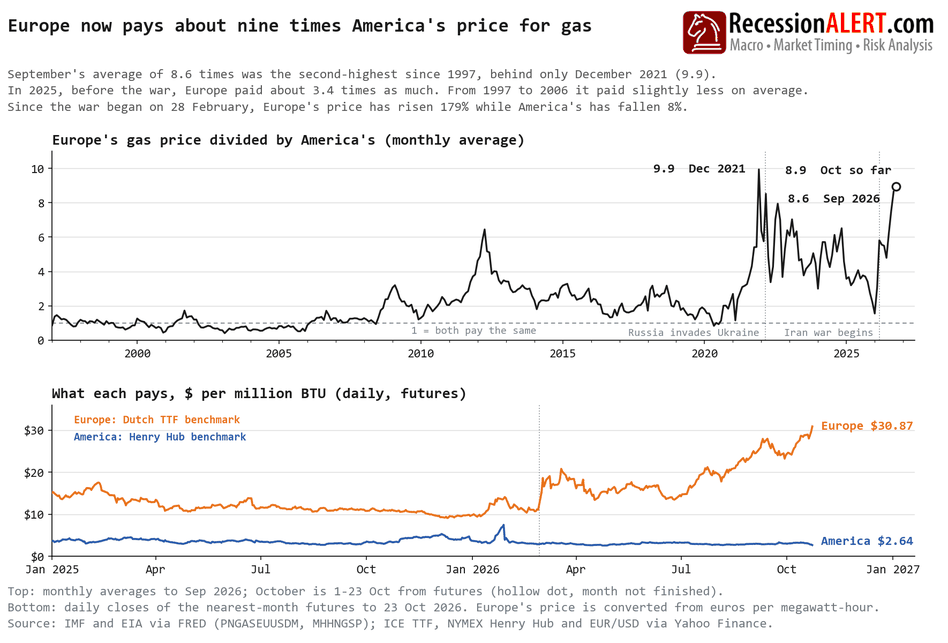
Europe’s gas costs about a third of its 2022 peak, yet the gap with America is wider. In September Europe averaged $25.49 per million BTU, against $69.98 in August 2022; divided by America’s price, that came to 8.6, above that August’s 7.9. The extreme is coming from the bottom of the fraction. In 2022 the Henry Hub benchmark, America’s reference price, climbed alongside Europe’s to $8.81. This time its futures are -8% since the Iran war began on 28 February, while Europe’s are +179%. The reason is arithmetic. In its October outlook, the Energy Information Administration expects US output to rise by 3.9 billion cubic feet a day in 2027 while exports of liquefied gas — the only way American gas reaches Europe — rise by just 1.0 billion. Exports take about a sixth of what America produces; the rest stays home and competes for American buyers, which is why the agency sees Henry Hub averaging $3.16 next year. The war lifted Europe’s side of the fraction; America’s growing supply keeps the other side pinned near $3 — short of a hard winter at home, with US storage only 1% above normal. That pairing is new: the only two other months since 1997 at 8 or more, December 2021 and March 2022, came in the run-up to and opening of Europe’s Russian gas crisis. An 8x ratio used to take a European emergency — now it takes little more than cheap American gas.
What it means: Europe’s gas shock should stay out of American winter bills. Cheap wholesale gas is not cheap gas at home, though: utility gas prices are still up 5% on a year, faster than inflation. US chemical and fertiliser makers, which use gas as fuel and raw material, keep paying a fraction of what European rivals pay. That edge supports their margins while it lasts. For the economy, cheap fuel is a buffer against an energy war abroad. The test is a hard American winter: two straight months above $5 at Henry Hub, last seen in 2022.
Market Intelligence Brief (MIB) Ver. 19.95
For professional investors only. Not investment advice.
© 2026 RecessionALERT.com

Comments are closed.