
MARKET INTELLIGENCE BRIEF (MIB)
Friday, October 23, 2026
Houthi attacks in Saudi Arabia lifted Brent 3.05% to $116.62, its third straight weekly gain, as UN Ambassador Waltz warned the Iran war could last another year. The Dow fell 1.23% while the Nasdaq 100 finished flat. Flash PMI selling prices rose at the sharpest rate since August 2022 and Michigan year-ahead inflation expectations hit 4.7%, ahead of Wednesday’s Fed decision. CrowdStrike jumped 8.25%, gold slid 1.25%, and Instacart rose about 9% on reported sale talks with Uber and DoorDash.
TABLE OF CONTENTS
A. EXECUTIVE SUMMARY
B. MARKET DATA
C. HIGH-IMPACT STORIES (5)
D. MODERATE-IMPACT STORIES (6)
E. ECONOMY WATCH (3)
F. EARNINGS WATCH (3)
G. WHAT’S NEXT
H. CHART OF THE DAY
A. EXECUTIVE SUMMARY -> TOP
Blue chips absorbed the cost of a widening Gulf conflict: the Dow fell 1.23% and the S&P 500 lost 0.52% as Houthi attacks in Saudi Arabia lifted Brent 3.05% to $116.62, while UN Ambassador Waltz’s warning that the Iran war could last another year argued for a durable oil premium rather than a spike. The shock is travelling through inflation rather than fear — the VIX rose just 2.21% to 19.45 and gold fell 1.25%, while the 10-year yield rose 4.3 bps to 4.994% on a day the flash PMI showed selling prices rising at the sharpest rate since August 2022. That leaves Wednesday’s FOMC meeting facing firmer price signals even as futures cut the odds of another hike by December to 76% from 87%. Breadth was poor, with eight of 11 sectors lower and Consumer Defensive (-1.75%) last; only Energy, Technology and Real Estate rose, a rotation into oil and a chip-and-cybersecurity rebound rather than a broad retreat.
• Crude extended its rally on Houthi attacks in Saudi Arabia: Brent rose 3.05% to $116.62 (Reuters put its settlement at the highest since April 29) and WTI gained 3.69% to $103.14. Energy (+2.52%) led all sectors, with Chevron (CVX) up 2.88% and ExxonMobil (XOM) up 2.79%, and the Energy Department authorized an SPR exchange of up to 400,000 barrels to Phillips 66’s Lake Charles refinery.
• The Dow dropped 652.82 points (1.23%) to 52,215.16 and the S&P 500 lost 0.52% while the Nasdaq 100 finished flat; American Express (AXP) fell 3.68% on its results, and Procter & Gamble (PG) and Coca-Cola (KO) each lost 2.76% with no discrete same-day catalyst identified.
• Price pressure into the Fed: the flash composite PMI eased to 57.6 but selling prices rose at the sharpest rate since August 2022; Michigan sentiment finalized at 48.0 (46.3 expected) as year-ahead inflation expectations rose to 4.7%, the highest since May; the 10-year yield climbed 4.3 bps to 4.994%.
• Cybersecurity rebounded from Thursday’s AI selloff: CrowdStrike (CRWD) jumped 8.25% and Palo Alto Networks (PANW) rose 7.22%, the session’s two largest mega-cap gains; the cited catalysts, an Evercore ISI survey and PHP vulnerability disclosures, could not be independently confirmed.
• Iran rhetoric escalated: UN Ambassador Mike Waltz said the war could last another year, US Ambassador to Turkey Tom Barrack said of a weekend strike, “Absolutely,” and an IRGC-linked source on Iranian state TV claimed transit of “non-compliant” ships through Hormuz had been halted (unverified); MUFG says Hormuz flows remain close to pre-conflict levels.
• Elsewhere: Instacart closed about 9% higher on a report of preliminary sale talks with Uber and DoorDash, both of which fell; Bristol Myers Squibb (BMY) lost 2.41% after a patient death in its zola-cel MS trial; gold fell 1.25% to $4,009.70, and silver and platinum posted their lowest closes since at least April 15.
1. War Risk Is Being Priced as Inflation, Not Fear — Brent is up 6.3% on the week, its third straight weekly rise, yet gold fell 1.25% on Friday and 4.30% on the week, the dollar firmed 0.21% and the VIX stayed below 20. Markets are reading the Gulf conflict through the inflation-and-rates channel rather than as a reason to buy safety, which makes oil, not equity volatility, the gauge to watch through any weekend escalation. For portfolios, Energy (+2.52%) led all sectors on the day and also leads on the 1-month, 3-month, YTD (+49.09%) and 12-month horizons, while the traditional haven has not hedged this war at all.
2. The Fed Meets With Hike Odds Falling and Price Signals Rising — Futures price a 92% chance of a hold on Wednesday and the odds of another hike by December have fallen to 76% from 87% a week ago, after the 10-year yield declined each week from 5.276% on October 2 to 4.994%. Friday’s data cut the other way: S&P Global’s Chris Williamson said selling prices indicate consumer inflation “is likely to rise further above the Fed’s target,” and household year-ahead expectations rose to 4.7%. With no new projections at this meeting, the statement and press conference carry the whole signal; a 10-year close back above 5% would mark the bond rally unwinding, and Q3 GDP and September PCE follow on Thursday.
3. Rotation, Not Retreat — but Oil Squeezes the Consumer — Thursday’s AI-hardware selloff sank the Nasdaq 100 2.90% while Consumer Defensive rose 3.13%; Friday reversed it, with chips and cybersecurity rebounding and Consumer Defensive (-1.75%) giving back more than half that gain. Over the week the Dow rose 0.41% and the S&P 500 slipped 0.47%. The common thread is cost: crude above $100 is a headwind for the consumer names that fell hardest, Michigan’s current-conditions index fell 8.3% on buying conditions for durables, and Thursday’s September personal spending (0.3% expected after 0.9%) will show whether households are already pulling back.
 — Leading economic indicators. Accurate market forecasts. Apply for membership at join.recessionalert.com
B. MARKET DATA -> TOP
Houthi attacks in Saudi Arabia sent crude sharply higher and kept equities on the defensive a day after Thursday’s AI selloff, with the Dow falling 1.23% while the Nasdaq 100 finished flat. This was a blue-chip slide, not a tech one: semiconductors and cybersecurity rebounded while consumer, financial and industrial heavyweights sold off, and only three of 11 sectors rose, led by Energy. The sharpest move against the tape came in cybersecurity, where CrowdStrike (+8.25%) and Palo Alto Networks (+7.22%) rallied. Treasuries gave back part of Thursday’s haven rally, the 10-year rising 4.3 bps to 4.994%, while gold fell 1.25% despite the oil shock — the haven trade did not engage.
CLOSING PRICES – Friday, October 23, 2026:
MAJOR INDICES
The Dow’s 1.23% drop against a flat Nasdaq 100 made this a blue-chip selloff rather than a tech one, and the NYSE Composite (-0.65%) fell further than the S&P 500, so weakness was broader than the headline suggests. Dow Theory bull confirmation holds for a fourth session, with both averages within 1.3% of Thursday’s 10-session highs. Over 10 sessions the S&P 500 (-2.40%) has outperformed the Nasdaq 100 (-6.24%), an entrenched eight-session broadening signal as growth lags the wider market.
| Index | Close | Change | %Move | Why It Moved |
|---|---|---|---|---|
| S&P 500 | 7,623.68 | -39.75 | -0.52% | Eight of 11 sectors fell as crude jumped on Houthi attacks in Saudi Arabia; a semiconductor rebound after Thursday’s AI selloff limited the loss |
| Dow Jones | 52,215.16 | -652.82 | -1.23% | Blue-chip selloff across consumer, financial and industrial names; not a tech-led decline |
| DJ Transportation | 20,041.91 | -252.52 | -1.24% | Matched the Dow’s decline almost exactly as crude surged; no discrete transport catalyst identified |
| Nasdaq 100 | 28,957.53 | -1.16 | -0.00% | Flat; a rebound in semiconductors and cybersecurity after Thursday’s Meta-triggered AI selloff offset losses elsewhere |
| Russell 2000 | 2,775.90 | -8.13 | -0.29% | Small caps lost less than large caps; no discrete catalyst identified |
| NYSE Composite | 24,117.27 | -158.26 | -0.65% | Broad decline, deeper than the S&P 500’s; Energy’s gain did not offset consumer and financial weakness |
VOLATILITY & TREASURIES
Yields and the VIX rose together, but the bond move is a partial retracement: the 10-year recovered only a quarter of Thursday’s 17.2 bp plunge and closed below 5%. The 2-year (+3.8 bps) lagged the 10-year (+4.3 bps), a marginal steepening ahead of Wednesday’s FOMC decision. The dollar’s 0.21% gain came with a weaker euro, which Reuters tied to concerns over France’s finances, rather than a haven bid.
| Instrument | Level | Change | Why It Moved |
|---|---|---|---|
| VIX | 19.45 | +0.42 (+2.21%) | Edged higher as equities extended Thursday’s losses; no discrete volatility catalyst identified |
| 10-Year Treasury Yield | 4.994% | +4.3 bps | Rose after Thursday’s 17.2 bp drop, the benchmark’s biggest one-day decline in nearly four years, per Reuters; still below 5% |
| 2-Year Treasury Yield | 4.686% | +3.8 bps | Rose with the 10-year ahead of the FOMC decision due Wednesday, October 28; no discrete same-day catalyst identified |
| US Dollar Index (DXY) | 101.82 | +0.21 (+0.21%) | Firmer as the euro fell on concerns over France’s finances, per Reuters |
COMMODITIES
Gold and silver fell even as crude surged and Middle East risk rose — the haven trade did not engage, with a firmer dollar and higher yields alongside. Silver and platinum closed at their lowest levels since at least April 15. Copper’s 1.59% gain split industrial metals from precious ones, while Bitcoin was essentially flat after Thursday’s 3.96% drop.
| Asset | Price | Change | %Move | Why It Moved |
|---|---|---|---|---|
| Gold | $4,009.70/oz | $-50.70 | -1.25% | No discrete same-day catalyst identified; fell alongside a firmer dollar and higher Treasury yields |
| Silver | $53.970/oz | $-1.037 | -1.89% | Tracked gold lower; lowest close since at least April 15 |
| Copper | $6.5000/lb | $+0.1020 | +1.59% | No discrete same-day catalyst identified; rose against the precious-metals decline |
| Platinum | $1,555.50/oz | $-21.40 | -1.36% | Followed precious metals lower; lowest close since at least April 15 |
| Bitcoin | $81,454.00 | $+188.00 | +0.23% | Essentially flat after Thursday’s 3.96% drop; no discrete catalyst identified |
ENERGY
WTI (+3.69%) and Brent (+3.05%) rose together on Houthi attacks in Saudi Arabia, with WTI gaining slightly more and the Brent premium narrowing to about $13.50. Oil rose against falling equities. Gas split sharply across the Atlantic: Henry Hub fell 5.97% while Dutch TTF rose 3.40% to its highest close since at least April 15.
| Asset | Price | Change | %Move | Why It Moved |
|---|---|---|---|---|
| Crude Oil (WTI) | $103.14/bbl | $+3.67 | +3.69% | Houthi attacks in Saudi Arabia, including on energy infrastructure, raised supply-disruption fears; settled $103.27, up $3.80, per Reuters |
| Crude Oil (Brent) | $116.62/bbl | $+3.45 | +3.05% | Same Houthi attacks, plus an oil spill reported off the UAE coast; settled $116.72, up $3.55, its highest settlement since April 29, per Reuters |
| Natural Gas (Henry Hub) | $2.629/MMBtu | $-0.167 | -5.97% | No discrete same-day catalyst identified; the November contract expires October 28 |
| Natural Gas (Dutch TTF) | $30.607/MMBtu | $+1.008 | +3.40% | European gas prices jumped, per Reuters; highest close since at least April 15; no discrete catalyst identified |
S&P 500 SECTORS
Only three of 11 sectors rose — Energy (+2.52%), Technology (+0.54%) and Real Estate (+0.06%) — and Energy also leads the 1-month, 3-month, YTD and 12-month columns. Consumer Defensive (-1.75%) gave back more than half of Thursday’s 3.13% gain to finish last, while Communication Services (-1.40%), which Reuters said fell on a report that SpaceX is exploring a US wireless carrier program, is negative on every horizon.
| Sector | 1-Day | 1-Week | 1-Month | 3-Month | 6-Month | YTD | 12-Month |
|---|---|---|---|---|---|---|---|
| Energy | +2.52% | +1.50% | +9.21% | +15.27% | +15.37% | +49.09% | +52.83% |
| Technology | +0.54% | -0.01% | -5.75% | +5.36% | +10.53% | +21.79% | +20.48% |
| Real Estate | +0.06% | +0.96% | +0.75% | -8.38% | -3.55% | +3.73% | -0.59% |
| Industrials | -0.60% | -1.23% | -2.81% | -6.56% | -7.23% | +5.31% | +6.82% |
| Utilities | -0.63% | +0.69% | +7.31% | -6.47% | -8.82% | -0.87% | -5.44% |
| Basic Materials | -0.67% | -3.71% | -5.36% | -0.87% | -9.25% | +6.75% | +15.90% |
| Healthcare | -1.13% | +1.85% | +3.85% | +6.42% | +18.44% | +12.49% | +18.93% |
| Financial | -1.14% | +0.17% | +0.32% | -2.99% | +7.68% | +3.77% | +10.25% |
| Consumer Cyclical | -1.36% | +0.06% | +0.94% | +1.32% | -5.99% | -7.27% | -6.84% |
| Communication Services | -1.40% | -5.29% | -7.84% | -1.52% | -8.31% | -5.38% | -0.13% |
| Consumer Defensive | -1.75% | +0.40% | +8.19% | +4.43% | +4.42% | +12.90% | +10.72% |
TOP MEGA-CAP MOVERS:
GAINERS
| Company | Ticker | Close | Change | Why It Moved |
|---|---|---|---|---|
| CrowdStrike Holdings | CRWD | $257.57 | +8.25% | Cybersecurity rally; Investing.com attributes it to an Evercore ISI channel survey published October 23 and two critical PHP vulnerabilities disclosed October 21 (not independently corroborated) |
| Palo Alto Networks | PANW | $380.55 | +7.22% | Rallied with CrowdStrike; Investing.com cites the same Evercore ISI survey and PHP vulnerability disclosures (not independently corroborated) |
| Chevron | CVX | $233.21 | +2.88% | Crude’s 3.69% jump on Houthi attacks in Saudi Arabia lifted Energy, the day’s top sector |
| ExxonMobil | XOM | $183.21 | +2.79% | Moved with crude and the Energy sector on the Houthi attacks in Saudi Arabia |
| Micron Technology | MU | $877.55 | +2.46% | Rebounded with semiconductors after Thursday’s AI selloff; Investing.com cites an October 23 LYNX Equity Strategies note on SK Hynix scrapping a Solidigm IPO, which could not be independently confirmed |
DECLINERS
| Company | Ticker | Close | Change | Why It Moved |
|---|---|---|---|---|
| American Express | AXP | $313.22 | -3.68% | Earnings-driven; reported Q3 results before the open, and its CEO said the company needs to become more “agile and efficient,” per Reuters |
| Procter & Gamble | PG | $161.02 | -2.76% | No discrete same-day catalyst identified; follows Thursday’s (October 22) earnings report, amid a sector-wide Consumer Defensive decline |
| Coca-Cola | KO | $92.71 | -2.76% | No discrete same-day catalyst identified; sector-wide Consumer Defensive decline, the day’s weakest sector; reports Q3 on Tuesday |
| GE Aerospace | GE | $285.64 | -2.69% | No discrete same-day catalyst identified |
| Eli Lilly | LLY | $1,273.46 | -2.54% | No discrete same-day catalyst identified; no company release on October 23; reports Q3 on October 29 |
— Institutional-grade intelligence for serious investors. Apply for membership at join.recessionalert.comC. HIGH-IMPACT STORIES -> TOP
BEARISH
1. Brent Rises 3.05% to $116.62 and WTI 3.69% to $103.14 on Houthi Attacks in Saudi Arabia, as Energy Leads All Sectors With a 2.52% Gain
The core facts:Crude extended its rally on Friday as Houthi attacks in Saudi Arabia, including on energy infrastructure, stoked supply-disruption fears. Brent closed at $116.62, up 3.05%, and WTI at $103.14, up 3.69%; Reuters put Brent’s settlement at its highest since April 29. According to The National, the Houthis claimed strikes over the prior 48 hours on the Defence Ministry headquarters in Riyadh, an Aramco site at Yanbu and the airports at Dammam and Abha; the article attributed none of the claims to Saudi officials. The Energy Department authorized an emergency exchange of up to 400,000 barrels from the Strategic Petroleum Reserve to Phillips 66’s Lake Charles, Louisiana, refinery to offset a crude supply disruption whose cause it did not name. In Europe, Dutch TTF gas rose 3.40% to $30.607/MMBtu, its highest close since at least April 15, while US Henry Hub gas fell 5.97% to $2.629. Energy (+2.52%) led all sectors, with Chevron up 2.88% and ExxonMobil up 2.79%.
Why it matters:Brent has gained 6.3% this week, from $109.73 at the previous Friday’s close, its third straight weekly rise, and once again the haven trade did not join in: gold fell 1.25%. Crude at these levels feeds straight into the price data the Fed will weigh on Wednesday, and Friday’s flash PMI already tied the sharpest rise in selling prices since August 2022 to oil (Story 4). The physical picture is less severe than the futures imply: MUFG’s Edward Bell and Soojin Kim said flows through the Strait of Hormuz “are still holding at close to pre-conflict levels” at elevated shipping rates, so the premium rests on the risk of disruption more than on barrels already lost. With fuel prices a political issue ahead of the November 3 midterms, the SPR exchange follows Thursday’s Defense Production Act order as a second federal intervention in two days.
What to watch:Weekend developments in the Gulf ahead of Monday’s open, then ExxonMobil and Chevron results before the bell on Friday, October 30, which will show how much of the price surge is reaching refining and upstream earnings.
BEARISH
2. Washington Signals a Long War and a Possible Weekend Strike on Iran, While an IRGC-Linked Source Says Transit of “Non-Compliant” Ships Through Hormuz Has Been Halted
The core facts:UN Ambassador Mike Waltz told the Financial Times, in an interview published Friday, that the war could last another year and that the US Navy can maintain its blockade “for the foreseeable future,” according to CBS News. Tom Barrack, the US ambassador to Turkey, told Israeli army radio: “Could there be a strike this weekend? Absolutely.” CBS noted that Barrack has no direct role in Iran policy. President Trump, leaving the White House late Friday morning, said the US “could, if we wanted to, just take all of the oil,” adding: “We could take the whole country.” Iranian state TV, citing an unnamed source close to the IRGC Navy, said all movement of “non-compliant” vessels through the Strait of Hormuz had been “completely halted,” and warned of a “much more forceful” response if US escorts resume; the claim was not independently verified. Foreign ministers from eight European and Middle Eastern countries met in Istanbul and urged diplomacy.
Why it matters:The statements push the expected length of the conflict out by months, which matters more for asset prices than any single strike: it argues for a durable risk premium in crude and for inflation staying above the Fed’s target for longer. Other markets barely registered it. The VIX rose only 2.21% to 19.45 and gold fell, which leaves crude as the market’s main outlet for war risk. That makes the oil price, rather than equity volatility, the gauge to watch for an escalation over the weekend.
What to watch:Any US or Israeli action against Iran over the weekend, and whether tanker traffic through Hormuz falls from the near-normal levels MUFG describes.
BEARISH
3. Blue Chips Sell Off: The Dow Drops 652.82 Points (1.23%) While the Nasdaq 100 Finishes Flat, as Eight of 11 Sectors Fall and Consumer Defensive Finishes Last
The core facts:The Dow fell 652.82 points, or 1.23%, to 52,215.16, and the S&P 500 lost 0.52% to 7,623.68, while the Nasdaq 100 finished flat at 28,957.53 (-0.00%). The NYSE Composite fell 0.65%, further than the S&P 500, and the Dow Jones Transportation Average dropped 1.24%. Eight of 11 sectors declined, led by Consumer Defensive (-1.75%), Communication Services (-1.40%), Consumer Cyclical (-1.36%), Financial (-1.14%) and Healthcare (-1.13%); only Energy (+2.52%), Technology (+0.54%) and Real Estate (+0.06%) rose. The largest mega-cap decliners were American Express (-3.68%, on its results; Story 14), Procter & Gamble (-2.76%), Coca-Cola (-2.76%), GE Aerospace (-2.69%) and Eli Lilly (-2.54%). No discrete same-day catalyst was identified for any of the last four.
Why it matters:Friday reversed Thursday’s pattern. Then, an AI-hardware selloff sank the Nasdaq 100 2.90% while Consumer Defensive rose 3.13%. Friday, semiconductors and cybersecurity rebounded (Story 6) while defensive and blue-chip names sold off, and Consumer Defensive gave back more than half of Thursday’s gain. Over the week the S&P 500 slipped 0.47% from 7,659.44, while the Dow, despite Friday’s drop, rose 0.41% from 52,002.41. With no single catalyst behind the blue-chip losses and the VIX still below 20, the session reads as money moving between groups rather than a broad retreat from risk, though the rising oil price is a cost headwind for exactly the consumer names that fell hardest.
What to watch:Coca-Cola’s results before the open on Tuesday, October 27, then Alphabet and Microsoft after the close on Wednesday, hours after the FOMC decision, a test of which side of this week’s rotation holds.
BEARISH
4. Price Pressure Builds Into Wednesday’s Fed Decision: Flash PMI Selling Prices and Household Inflation Expectations Rise as the 10-Year Yield Climbs 4.3 bps to 4.994%
The core facts:S&P Global’s flash October PMI showed selling prices rising at the sharpest rate since August 2022, and the University of Michigan’s final October survey put year-ahead inflation expectations at their highest since May (Section E carries the data). The 10-year Treasury yield rose 4.3 bps to 4.994% and the 2-year 3.8 bps to 4.686%, recovering about a quarter of Thursday’s 17.2 bp drop. Fed funds futures price a 92% chance that the FOMC holds its 3.75%-4.00% range on Wednesday, and the probability of another hike by December has eased to 76% from 87% a week earlier.
Why it matters:Bond markets have spent three weeks pricing a less aggressive Fed, with the 10-year yield falling each week, from 5.276% on October 2 to 4.994%, just as the price data turned the other way. S&P Global’s Chris Williamson said selling prices are rising “at a pace that indicates consumer price inflation is likely to rise further above the Fed’s target,” and pointed to “the renewed surge in oil prices,” which continued on Friday (Story 1). That gap between easing hike odds and firming inflation signals is the risk going into a meeting at which the Fed, which raised rates in September, publishes no new projections. Friday’s rise in yields was modest and no source tied it to the data, so the market has not yet repriced on these readings.
What to watch:The FOMC decision at 2:00 PM ET on Wednesday, October 28, and the 2:30 PM press conference, then the Q3 GDP advance estimate and September PCE on Thursday; a 10-year close back above 5% would signal the week’s rally is unwinding.
UNCERTAIN
5. Trump Reshuffles Which Canadian Goods Face Section 338 Duties, Effective October 30, as the White House Cites About $20 Billion of Canadian Retaliation
The core facts:A presidential proclamation signed on October 23 changes the scope of Canadian products subject to the additional duties imposed under Section 338, which the White House describes as a response to Canada’s discrimination against US commerce in motor vehicles. Per the White House fact sheet, plywood sheets, some paper products, certain machinery and refrigeration equipment, and certain packing crates and boxes come off the list, while certain valves, carpets and waste products are added, effective October 30. The duties apply whether or not goods qualify under the USMCA, and on top of Section 232 tariffs. The fact sheet cites Canada’s new retaliatory tariffs on “about $20 billion of U.S. exports” and says Canada “walked away from a near-final trade deal.”
Why it matters:The action re-targets the duties on the largest US trading relationship rather than lifting them. Removing plywood, paper and packing materials trims costs on inputs used in US construction and shipping, while the additions keep pressure on Ottawa. The White House did not quantify the trade covered by either list, so whether the net effect is relief or escalation cannot be judged from the published material. For markets, the signal is that the dispute is being managed product by product ahead of the midterms rather than resolved.
What to watch:The October 30 effective date, and whether Ottawa answers with changes to its own retaliatory list or with a return to negotiations.
— Quantifying recession risk so you don’t have to guess. Apply for membership at join.recessionalert.comD. MODERATE-IMPACT STORIES -> TOP
BULLISH
6. CrowdStrike Jumps 8.25% and Palo Alto Networks 7.22%, the Session’s Largest Mega-Cap Gains, as Cybersecurity Rebounds From Thursday’s AI Selloff
The core facts:CrowdStrike closed at $257.57, up 8.25%, and Palo Alto Networks at $380.55, up 7.22%, the two largest gains among US companies valued above $200 billion. Both rose alongside a rebound in semiconductors after Thursday’s Meta-triggered AI selloff, which helped hold the Nasdaq 100 flat while the Dow fell 1.23%. Investing.com attributed the rally to an Evercore ISI channel-partner survey published October 23 and to two critical PHP vulnerabilities disclosed October 21; neither explanation could be independently confirmed.
Why it matters:The two names did most of the work keeping Technology (+0.54%) positive on a day eight sectors fell, and they did it a day after the AI-infrastructure trade broke. Because the catalyst is unconfirmed, the move rests on positioning more than on news, and it will need support from reported numbers to last.
What to watch:Fortinet’s results after the close on Wednesday, October 28, the first read on security budgets from a mega-cap peer.
UNCERTAIN
7. Instacart Explores a Sale and Has Held Preliminary Talks With Uber and DoorDash, The Information Reports; Instacart Closes About 9% Higher While Both Suitors Fall
The core facts:Instacart, legally Maplebear, is exploring a possible sale and has held preliminary talks with potential buyers including Uber and DoorDash, The Information reported, citing people familiar with the matter; the talks are ongoing and may not lead to a deal, per the Reuters account. Instacart closed about 9% higher in regular trading, Uber closed down nearly 3% and DoorDash fell more than 4%. Instacart declined to comment, and Uber and DoorDash did not immediately respond to Reuters. Instacart’s market value is about $12 billion; a typical 30% to 40% takeover premium would imply roughly $16 billion to $17 billion.
Why it matters:A sale would consolidate US grocery delivery under one of the two largest delivery platforms. Antitrust is the obvious hurdle: DoorDash’s 2021 talks to acquire Instacart, at a reported valuation of $40 billion to $50 billion, collapsed partly over antitrust concerns, according to Reuters. Investors marked down both potential buyers, a sign that they see paying a premium as the risk rather than the opportunity.
What to watch:Whether any of the three companies confirms the talks, and how a bidder addresses the antitrust review that ended the 2021 discussions.
BEARISH
8. Bristol Myers Squibb Discloses a Patient Death in Its Early-Stage Zola-Cel CAR-T Study in Multiple Sclerosis; Shares Fall 2.41%
The core facts:Bristol Myers Squibb disclosed on Friday, in a conference readout reported by Reuters, that a patient died in its Phase 1 trial of zolacabtagene autoleucel (zola-cel), a CAR-T therapy being tested in 66 patients with relapsing or progressive multiple sclerosis. The patient died of septic pneumonia about 44 days after infusion and one day after high-dose chemotherapy, having developed delayed motor symptoms that did not respond to treatment. A spokesperson said “The patient had a late onset side effect, a series of other complications and was heavily pretreated prior to CAR T,” and “We remain confident in the safety and efficacy profile we have observed in Phase 1.” BMS said the death was unrelated to its voluntary September pause of zola-cel studies, and that it is working with the FDA to resume enrollment in early 2027. Shares closed at $61.48, down 2.41%.
Why it matters:CAR-T in autoimmune disease is one of the industry’s most closely watched expansion bets, and the class was already under scrutiny: BMS paused its zola-cel studies in September after Novartis halted eight of its own cell-therapy trials, according to Reuters. A death in an MS population, where patients are far less sick than in the blood cancers CAR-T was built for, raises the safety bar for the whole category. Healthcare (-1.13%) was among the session’s weaker sectors.
What to watch:BMS’s third-quarter results before the open on Thursday, October 29, for an update on the FDA discussions and the 2027 restart timeline.
UNCERTAIN
9. CMS Proposes Verifying Eligibility Before ACA Subsidies Are Paid, Ending Automatic Subsidized Re-Enrollment From 2028 Plans
The core facts:The Centers for Medicare & Medicaid Services on October 23 proposed an Exchange Pre-Eligibility Verification rule implementing the Working Families Tax Cuts law. Consumers seeking advance premium tax credits or income-based cost-sharing reductions would generally need certain eligibility criteria verified before receiving that help. Currently enrolled consumers would keep subsidies on automatic re-enrollment only if they confirm certain criteria each year and pass re-verification; otherwise they would be re-enrolled without financial assistance. The requirements begin with 2028 plans, with the first pre-Open Enrollment window opening August 1, 2027, and comments are due 30 days after publication. CMS gave no estimate of the effect on enrollment or costs. Administrator Mehmet Oz said “Federal subsidies should only go to eligible Americans, not to fraudsters gaming the system.” Marketplace-focused insurers fell, with Oscar Health down 6.99% and Centene down 1.50%; the release time was not established, so a link to those moves cannot be confirmed.
Why it matters:Ending passive subsidized re-enrollment is the kind of administrative change that tends to shrink enrollment among healthier, less engaged members, which worsens the risk pool for exchange insurers and adds to uncompensated care at hospitals. CMS has not estimated the effect, so the size is unknown. The 2028 start date leaves time for litigation and lobbying, but it adds a policy overhang to a group already exposed to the marketplace.
What to watch:Federal Register publication, which starts the 30-day comment period, and commentary on exchange volumes from HCA Healthcare’s results before the open on Tuesday, October 27.
BULLISH
10. PhillipCapital Flips SpaceX From Sell to Buy on Its AI Business, Lifting Its Target to $250 From $75; Shares Rise 1.89% After Thursday’s 9.14% Drop
The core facts:PhillipCapital double-upgraded SpaceX to Buy from Sell early Friday, citing its AI business, with a target that implies about 70% upside, CNBC reported at 7:02 AM ET. The firm had initiated coverage at Sell with a $75 target in August. SpaceX closed at $147.49, up 1.89%, a day after falling 9.14% on a Reuters report that Tesla and SpaceX had hired advisers and were weighing merger structures.
Why it matters:A reversal by one of the stock’s few bears, on a company valued at about $2 trillion, matters for index weight and for sentiment around the merger story. It also bears on telecoms: Reuters tied Friday’s 1.40% fall in Communication Services to a report that SpaceX is exploring a US wireless carrier program, so a more valuable SpaceX is a better-funded competitor for the carriers.
What to watch:Any formal Tesla or SpaceX statement on a combination, and Verizon’s results before the open on Monday, October 26, and T-Mobile’s after the close on Wednesday, for how the carriers address the SpaceX threat.
BEARISH
11. Gold Falls 1.25% to $4,009.70 Despite the Oil Shock, and Silver and Platinum Post Their Lowest Closes Since at Least April 15
The core facts:Gold fell $50.70, or 1.25%, to $4,009.70 an ounce, silver lost 1.89% to $53.970 and platinum 1.36% to $1,555.50; silver and platinum closed at their lowest levels since at least April 15. Copper rose 1.59% to $6.5000 a pound. The declines came with a firmer dollar, the DXY up 0.21% to 101.82, and higher Treasury yields, and no discrete same-day catalyst was identified. Over the week gold has fallen 4.30% from $4,189.92, silver 5.54% from $57.135 and platinum 5.31% from $1,642.65.
Why it matters:Precious metals falling during a Middle East escalation and a 3% oil rally (Stories 1 and 2) shows the market treating the war through the inflation-and-rates channel, with higher yields and a firmer dollar, rather than as a reason to buy safety. Gold miners felt it: Newmont fell 4.59% despite beating estimates (Story 13). Copper’s gain against the precious-metals decline points to the strength in industrial activity that Friday’s PMI also showed.
What to watch:Whether gold holds $4,000 into Wednesday’s FOMC decision; a hawkish message would add to the pressure through yields and the dollar.
— Separating signal from noise since 2007. Apply for membership at join.recessionalert.comE. ECONOMY WATCH -> TOP
Friday’s data sharpened the tension ahead of Wednesday’s FOMC decision: business activity is running hot while prices and household moods move the wrong way. S&P Global’s flash composite PMI eased only to 57.6, with output “consistent with GDP growing at a 5% annualized rate,” per Chris Williamson, but selling prices rose at the sharpest rate since August 2022 as oil costs fed through. Households feel it: Michigan sentiment held at 48.0 while current conditions fell 8.3% and year-ahead inflation expectations rose to 4.7%. Futures still price a 92% chance the Fed holds on October 28, and December hike odds eased to 76% from 87% a week earlier, with Thursday’s Q3 GDP and September PCE the next tests.
Michigan Consumer Sentiment Finalizes at 48.0, Beating the 46.3 Consensus, as Year-Ahead Inflation Expectations Rise to 4.7% (University of Michigan, Oct 23)
What they’re saying:The final October Index of Consumer Sentiment was 48.0, above the 46.3 consensus and one-tenth of a point below September’s 48.1; it is 10.4% lower than a year ago (53.6). The current conditions index fell 8.3% to 46.7 from 50.9, while the expectations index rose 5.4% to 48.8 from 46.3. Year-ahead inflation expectations rose to 4.7% from 4.6%, and long-run expectations to 3.5% from 3.4%.
The context:Survey director Joanne Hsu said the drop in current conditions “was driven entirely by buying conditions for durables” and that “purchasing power continues to dominate consumer views of the economy.” Inflation expectations over both horizons rose “for the second straight month to their highest readings since May”; year-ahead expectations stood at 3.4% in February, before the Iran conflict. Rising household inflation expectations are an unwelcome signal for a Fed that raised rates in September.
What to watch:CB Consumer Confidence on Tuesday, Oct 27 (expected 80.5, prior 81.9), then September personal income, spending and PCE inflation on Thursday, Oct 29 (headline PCE expected 0.5% m/m, prior 0.3%).
Flash US Composite PMI Eases to 57.6 from 58.4, but Selling Prices Rise at the Sharpest Rate Since August 2022 (S&P Global, Oct 23)
What they’re saying:The flash composite output index slipped to 57.6 from 58.4, a two-month low, with services activity at 57.9 (September: 58.8) and manufacturing output at 55.8 (56.2). The manufacturing PMI rose to 56.0 from 55.9, a 53-month high. New orders grew at the fastest pace in over four-and-a-half years, goods export orders rose for the first time since June of last year, and employment rose at the second-fastest pace in over four years.
The context:Chris Williamson of S&P Global Market Intelligence said the output readings are “consistent with GDP growing at a 5% annualized rate after a 4% expansion was signalled for the third quarter,” above the 3.0% consensus for Thursday’s advance Q3 GDP estimate. The cost side is the concern: he pointed to “the renewed surge in oil prices” and said selling prices are rising “at a pace that indicates consumer price inflation is likely to rise further above the Fed’s target in the coming months.” WTI closed at $103.14 on Friday, up 3.69%.
What to watch:The Q3 GDP advance estimate on Thursday, Oct 29 (expected 3.0%, prior quarter 2.2%), and the Q3 Employment Cost Index on Friday, Oct 30 (expected 0.8%, prior 0.9%), for whether strong hiring is feeding through to wages.
Futures Price a 92% Chance the Fed Holds at 3.75%-4.00% on October 28, While December Hike Odds Ease to 76% from 87% a Week Ago (Investing.com Fed Rate Monitor, Oct 23)
What they’re saying:As of 4:25 PM ET Friday, fed funds futures priced a 92.0% probability that the FOMC holds its 3.75%-4.00% target range on Wednesday and an 8.0% probability of a 25 bp hike, down from 16.1% a week earlier. For the December 9 meeting, the probability of at least one more hike was 76.3%, against 86.5% a week ago, while the chance of no further hike by December rose to 23.7% from 13.6%.
The context:Polymarket’s “Another Fed rate hike in 2026?” contract stood at 78% Yes, in line with futures. The easing in hike odds came in a week when the 10-year Treasury yield fell 17.2 bps on Thursday, its largest one-day drop in nearly four years per Reuters, before rising 4.3 bps to 4.994% on Friday. Policymakers are in their pre-meeting blackout, and Friday’s PMI price signal and Michigan inflation expectations both cut against the lower hike odds.
What to watch:The FOMC decision at 2:00 PM ET on Wednesday, Oct 28, and the press conference at 2:30 PM ET, followed by September core PCE on Thursday, Oct 29 (expected 0.3% m/m, prior 0.2%).
— Know the probability before the market prices in the risk. Apply for membership at join.recessionalert.comF. EARNINGS WATCH -> TOP
YESTERDAY AFTER THE BELL (Markets Reacted Today)
BULLISH
12. Western Digital (WDC): -2.97% | Revenue Up 55% and a $5.1 Billion Second-Quarter Guide, but the Shares Slip
The Numbers:Released: AMC, Thursday, October 22. Fiscal Q1 2027 revenue $4.38B vs $4.14B estimated, up 55% year over year; non-GAAP EPS $4.64 vs $4.11; non-GAAP gross margin 58.1%. Fiscal Q2 guidance: revenue $5.1B ± $100M (up 66% to 72% year over year), non-GAAP gross margin 60% to 61%, non-GAAP EPS $5.80 ± $0.20. Quarterly dividend raised 17% to $0.175; $1,001M of shares repurchased in the quarter.
The Problem/Win:The quarter cleared the August outlook, whose midpoints were $4.1B of revenue and $4.00 of EPS, and the CFO credited robust exabyte growth and improved pricing. CEO Irving Tan said “Fiscal 2027 is off to a strong start, with results exceeding expectations.” The guide points to another step up in both revenue and margin.
The Ripple:The shares fell 2.97% to $343.67 anyway, a day after Thursday’s AI-hardware selloff sank the Nasdaq 100 2.90%. Several brokers cut targets after the report, among them Cantor ($900 to $625), Rosenblatt ($800 to $650) and TD Cowen ($540 to $430), while JPMorgan raised its target to $650 from $600, per MarketBeat.
What It Means:The fundamentals of AI-driven storage demand keep accelerating, but the stock now trades on the AI-hardware cycle as a whole, and a strong beat was not enough to offset this week’s de-rating.
What to watch:Seagate’s results after the close on Tuesday, October 27, and Sandisk’s on Thursday, October 29, for confirmation of storage pricing.
UNCERTAIN
13. Newmont (NEM): -4.59% | A Beat and Lower Cost Guidance Are Overrun by Gold’s Slide
The Numbers:Released: AMC, Thursday, October 22. Q3 EPS $2.20 vs $1.96 estimated; revenue $6.36B vs $6.27B. About 1.3 million attributable gold ounces and $1.9B of free cash flow in the quarter; $7.26B of free cash flow over nine months. Full-year cost guidance improved to $925/oz costs applicable to sales and $1,520/oz all-in sustaining costs; full-year production guidance on track.
The Problem/Win:The operating quarter was clean, with record third-quarter adjusted net income cited in the release. Newmont also agreed with Barrick to move Fourmile and other development properties into the Nevada Gold Mines joint venture, with a $1.95B cash payment to Barrick due after the Fourmile contribution, expected in the fourth quarter.
The Ripple:Gold fell 1.25% to $4,009.70 on Friday and 4.30% over the week, and silver closed at its lowest since at least April 15 (Story 11). Newmont’s 4.59% drop tracked the metal, not the quarter; Basic Materials fell 0.67%.
What It Means:Lower costs and strong cash flow protect margins, but with the haven bid absent, miners are trading as leveraged plays on a falling gold price.
What to watch:Gold’s $4,000 level into Wednesday’s FOMC decision.
TODAY BEFORE THE BELL (Markets Already Reacted)
UNCERTAIN
14. American Express (AXP): -3.68% | Raises EPS Guidance to $18.30-$18.60, but a One-Off Gain Flatters the Quarter and Revenue Comes in Just Short
The Numbers:Released: BMO, Friday, October 23. Revenue net of interest expense $20.06B vs $20.12B estimated, up 9%. GAAP EPS $5.42, including a $1.11 gain on the sale of its GBTG stake and a $0.37 restructuring charge; adjusted EPS $4.68 vs $4.50 consensus. Billed business $454.0B, up 8%. Provision for credit losses $1.0B vs $1.3B a year earlier, reflecting a reserve release; net write-off rate 1.8% vs 1.9%. Full-year 2026 EPS guidance raised to $18.30-$18.60 ($17.60-$17.90 adjusted), with the company “on track” for 10% revenue growth.
The Problem/Win:Part of the GBTG gain funded a $336M restructuring “related to efficiency initiatives,” and Bloomberg reported that the company will cut about 5% of its global headcount, roughly 3,500 jobs. Credit improved and spending held up, with Travel & Entertainment up 10% and Goods & Services up 7%, but the headline beat leaned on a reserve release and the guidance raise rests partly on a one-time gain.
The Ripple:AXP was the session’s largest mega-cap decliner and a weight on the Dow’s 1.23% fall (Story 3); Financial fell 1.14%.
What It Means:The affluent cardholder is still spending, but investors marked down a quarter whose upside came from below the revenue line; the job cuts point to a company protecting margins rather than chasing growth.
What to watch:Visa after the close on Tuesday, October 27, and Mastercard before the open on Thursday, October 29, for whether the spending trend extends across the networks.
TODAY AFTER THE BELL (Markets React Tomorrow)
No major earnings after the bell from companies with >$100B market cap.
WEEK AHEAD PREVIEW:
Q3 2026 earnings season reaches its heaviest stretch, with 38 companies above $100 billion reporting over the next five sessions, including Alphabet and Microsoft on the afternoon of the Fed’s October 28 decision, Amazon on October 29, and ExxonMobil and Chevron on October 30.
Verizon Communications (VZ) — BMO, Monday, October 26 — Consensus EPS $1.27. Key focus: postpaid phone net additions and churn, after Friday’s telecom selloff on a report that SpaceX is exploring a US wireless carrier program.
Welltower (WELL) — AMC, Monday, October 26 — Consensus EPS $0.64. Key focus: senior-housing occupancy and same-store NOI growth against a full-year normalised FFO midpoint of $6.40, raised in July, with the 10-year yield just below 5%.
Visa (V) — AMC, Tuesday, October 27 — Consensus EPS $3.44. Key focus: cross-border volume growth, which ran at 13% in the fiscal third quarter, and fiscal 2027 net revenue guidance, after American Express’s 8% billed-business growth.
Coca-Cola (KO) — BMO, Tuesday, October 27 — Consensus EPS $0.88; -2.76% today. Key focus: organic revenue growth and price/mix against full-year guidance of about 5% organic growth, as Consumer Defensive finished the week’s last session as the weakest sector.
Boeing (BA) — BMO, Tuesday, October 27 — Consensus EPS -$0.25. Key focus: a first 737-10 delivery date after the FAA certification, 737 production rates and cash burn.
S&P Global (SPGI) — BMO, Tuesday, October 27 — Consensus EPS $4.43. Key focus: ratings revenue as debt issuance holds up, in its first quarter excluding the spun-off Mobility business.
Corning (GLW) — BMO, Tuesday, October 27 — Consensus EPS $0.88. Key focus: optical communications growth from AI data centers and progress toward its Springboard sales targets.
HCA Healthcare (HCA) — BMO, Tuesday, October 27 — Consensus EPS $6.65; market cap $101.6 billion, just above the threshold. Key focus: same-facility admissions, which rose 2.5% in the second quarter, the 2026 net income outlook of $6.3 billion-$6.7 billion, cut in July, and any comment on Friday’s ACA subsidy-verification proposal (Story 9).
Seagate Technology (STX) — AMC, Tuesday, October 27 — Consensus EPS $7.42. Key focus: nearline supply allocated into 2028 and the HAMR ramp, after Western Digital’s beat and $5.1 billion guide (Story 12).
Alphabet (GOOGL) — AMC, Wednesday, October 28 — Consensus EPS $3.03. Key focus: Google Cloud growth after 82% in the second quarter, 2026 capex guidance of $195 billion-$205 billion, and the OpenAI distribution deal.
Microsoft (MSFT) — AMC, Wednesday, October 28 — Consensus EPS $4.71. Key focus: Azure growth against guidance of about 45% at constant currency, and fiscal first-quarter capex of about $50 billion, as investors question AI spending.
GE Vernova (GEV) — BMO, Wednesday, October 28 — Consensus EPS $3.99. Key focus: gas-turbine orders and slot reservations against a target of at least 125 GW by year-end, the backlog, $176 billion in the second quarter, and any comment on the wind-turbine Section 232 proclamation.
KLA (KLAC) — AMC, Wednesday, October 28 — Consensus EPS $1.18. Key focus: results against guidance of $4.0 billion in revenue, and wafer-fab equipment demand after Lam Research’s 11.76% slide on Thursday.
Amphenol (APH) — BMO, Wednesday, October 28 — Consensus EPS $0.73. Key focus: IT datacom sales driven by AI data centers and record orders, and the CommScope integration.
ServiceNow (NOW) — AMC, Wednesday, October 28 — Consensus EPS $1.02. Key focus: subscription revenue against guidance of about 20.5% growth, and AI monetisation through Now Assist.
T-Mobile US (TMUS) — AMC, Wednesday, October 28 — Consensus EPS $2.89. Key focus: postpaid account additions, now its headline metric, and its response to SpaceX’s push into US wireless service.
UBS Group (UBS) — BMO, Wednesday, October 28 — Consensus EPS $0.91 (no ADR label; NYSE-listed shares). Key focus: the pace of its $3 billion buyback under proposed Swiss capital reforms, and wealth-management net new assets.
Fortinet (FTNT) — AMC, Wednesday, October 28 — Consensus EPS $0.86. Key focus: billings against guidance of $2.25 billion-$2.35 billion and the firewall refresh cycle, after CrowdStrike and Palo Alto Networks rallied more than 7% on Friday (Story 6).
Automatic Data Processing (ADP) — BMO, Wednesday, October 28 — Consensus EPS $2.77. Key focus: US pays per control, which grew just 1% last quarter, as a read on payroll growth, and interest income on client funds.
Phillips 66 (PSX) — BMO, Wednesday, October 28 — Consensus EPS $11.73. Key focus: refining margins and utilization, including the supply disruption at Lake Charles that drew an emergency SPR exchange on Friday (Story 1).
Amazon (AMZN) — AMC, Thursday, October 29 — Consensus EPS $1.96. Key focus: AWS growth after 36.8% in the second quarter, its fastest in 18 quarters, and 2026 capex of about $220 billion; Q3 guidance was $197 billion-$202 billion in net sales.
Eli Lilly (LLY) — BMO, Thursday, October 29 — Consensus EPS $5.70; -2.54% today. Key focus: Mounjaro and Zepbound volumes against 2026 revenue guidance of $85 billion-$87 billion, raised in July.
Mastercard (MA) — BMO, Thursday, October 29 — Consensus EPS $5.17. Key focus: net revenue growth after 12% underlying growth in the second quarter, with full-year guidance held, and cross-border volumes.
Intel (INTC) — AMC, Thursday, October 29 — Consensus EPS $0.40. Key focus: revenue against guidance of $15.8 billion-$16.8 billion and the rising equipment and capacity spending its CFO flagged, after this week’s chip selloff.
Merck (MRK) — BMO, Thursday, October 29 — Consensus EPS $2.09. Key focus: Keytruda sales and the commercial outlook for intismeran after the INTerpath-001 melanoma data.
Caterpillar (CAT) — BMO, Thursday, October 29 — Consensus EPS $7.04. Key focus: power-generation sales to data centers, which grew 72% in the second quarter, a record $72.1 billion backlog, and 2026 sales growth guidance of mid to high teens.
Linde (LIN) — BMO, Thursday, October 29 — Consensus EPS $4.52. Key focus: industrial gas volumes and pricing as a read on global manufacturing, and energy cost pass-through with European gas at its highest close since at least April 15.
TotalEnergies (TTE) — BMO, Thursday, October 29 — Consensus EPS $3.82 (no ADR label). Key focus: refining and LNG earnings with Brent above $116 and Gulf supply disrupted.
Gilead Sciences (GILD) — AMC, Thursday, October 29 — Consensus EPS $2.18. Key focus: HIV franchise growth and how guidance absorbs the $0.79-$0.83 fourth-quarter EPS charge from the PepStar acquisition announced on October 22.
Sandisk (SNDK) — AMC, Thursday, October 29 — Consensus EPS $46.20. Key focus: results against its guidance of $44-$46 in EPS and $10.3 billion-$10.8 billion in revenue, and NAND pricing.
Bristol Myers Squibb (BMY) — BMO, Thursday, October 29 — Consensus EPS $1.10. Key focus: Eliquis sales, which rose 22% to $4.48 billion in the second quarter, against non-GAAP EPS guidance of $6.75-$7.00, and the zola-cel restart timeline after Friday’s disclosure of a patient death (Story 8).
Altria (MO) — BMO, Thursday, October 29 — Consensus EPS $1.51. Key focus: smokeable volumes and pricing against adjusted EPS guidance of $5.61-$5.72, narrowed in July.
Stryker (SYK) — AMC, Thursday, October 29 — Consensus EPS $3.55. Key focus: organic growth against 2026 guidance of 8.3%-9.3%, which analysts said requires a significant second-half step-up.
Starbucks (SBUX) — AMC, Thursday, October 29 — Consensus EPS $0.72. Key focus: US comparable sales against guidance of 6.5% or greater for the quarter, after 7.9% in the third quarter.
ExxonMobil (XOM) — BMO, Friday, October 30 — Consensus EPS $4.10; +2.79% today. Key focus: the roughly $4.5 billion refining-margin boost to Energy Products that the company pre-flagged against a $1.3 billion hit from lower liquids prices, and $2.5 billion of negative timing effects.
AbbVie (ABBV) — BMO, Friday, October 30 — Consensus EPS $3.74. Key focus: Skyrizi and Rinvoq, which AbbVie expects to exceed $31 billion in combined 2026 sales, after the FDA approved a subcutaneous Skyrizi induction regimen in Crohn’s disease on Friday, per the company.
Chevron (CVX) — BMO, Friday, October 30 — Consensus EPS $4.86; +2.88% today. Key focus: refining margins, which UBS said lifted its third-quarter EPS estimate to $4.93, and cash flow with crude above $100.
AstraZeneca (AZN) — BMO, Friday, October 30 — Consensus EPS $2.59 (no ADR label; NYSE-listed ordinary shares). Key focus: whether it reaffirms 2026 guidance of mid-to-high single-digit revenue growth and low double-digit core EPS growth, days after the ESMO oncology congress.
Excluded as ADRs: SK Hynix, HSBC and Novartis (October 27); Equinor and GSK (October 28); Shell, Anheuser-Busch InBev and BBVA (October 29); BP (October 30). Just below the $100 billion threshold: Waste Management at $95.7 billion (October 27), Trane Technologies at $97.9 billion (October 29) and General Dynamics at $94.5 billion (October 30). The Fed’s decision on October 28 lands in the middle of the season’s peak, followed by the Q3 GDP advance estimate and September PCE on October 29.
— US market commentary trusted by family offices and institutions. Apply for membership at join.recessionalert.comG. WHAT’S NEXT -> TOP
UPCOMING RELEASES:
| Date | Event | Why It Matters |
|---|---|---|
| Mon, Oct 26 | Chicago Fed National Activity Index (prior -0.04); Dallas Fed Manufacturing Index (prior 9.8) | A regional check on the flash PMI, which put manufacturing at a 53-month high; the Dallas survey covers the center of US oil production with WTI above $100. |
| Tue, Oct 27 | Durable Goods Orders (expected 0.6%, prior 0%); ex-transportation (prior 0.3%) | Tests whether the PMI’s fastest new-orders growth in over four-and-a-half years is reaching hard investment data. |
| Tue, Oct 27 | CB Consumer Confidence (expected 80.5, prior 81.9); New Home Sales (expected 0.66M, prior 0.684M) | A second household read after Michigan’s current-conditions index fell 8.3%; Michigan’s survey director said purchasing power “continues to dominate consumer views,” and a further decline here would confirm it. |
| Wed, Oct 28 | FOMC Rate Decision 2:00 PM ET (hold at 3.75%-4.00% expected); Press Conference 2:30 PM ET | Futures price a 92% chance of a hold and 76% odds of another hike by December; with no new projections, the statement and press conference must address oil-driven price pressure the bond market has been looking past. |
| Wed, Oct 28 | EIA Crude Oil Stocks Change (prior -3.061M barrels) | With Brent at $116.62 and the Energy Department releasing SPR crude to Phillips 66, another draw would show the US market tightening alongside the Gulf risk premium. |
| Thu, Oct 29 | Q3 GDP Advance (expected 3.0%, prior 2.2%); GDP Price Index (expected 3.5%, prior 6.1%) | S&P Global’s PMI signalled 4% growth for Q3, above consensus; a strong print the day after the Fed decision would reinforce the case for another hike. |
| Thu, Oct 29 | September PCE Price Index (expected 0.5% m/m, prior 0.3%); Core PCE (expected 0.3% m/m, prior 0.2%); Personal Income (expected 0.3%) and Spending (expected 0.3%, prior 0.9%) | The Fed’s preferred inflation gauge lands a day after the decision; a hot core reading would undercut the drop in December hike odds, while slower spending would show whether households are pulling back. |
| Fri, Oct 30 | Q3 Employment Cost Index (expected 0.8%, prior 0.9%); Chicago PMI (prior 58.8) | The PMI showed employment rising at the second-fastest pace in over four years; the ECI shows whether that hiring is feeding through to wages. |
| Fri, Oct 30 | Fed’s Musalem speaks, 12:30 PM ET | The only Fed speaker on the week’s calendar, two days after the decision, and the first chance to hear how a policymaker reads the new data. |
| Fri, Oct 30 | Revised Section 338 duties on Canadian goods take effect | Plywood, some paper products and packing materials come off the list while certain valves, carpets and waste products are added; Ottawa’s response will show whether the dispute escalates or returns to negotiation. |
| Tue, Nov 3 | US Midterm Elections | Fuel prices are a political issue, and Washington has intervened twice in two days, with a Defense Production Act order and an SPR exchange; further moves on energy and trade are possible before the vote. |
KEY QUESTIONS:
1. Will Wednesday’s FOMC statement and press conference validate the drop in odds of another hike by December to 76% from 87%, or lean against it after the flash PMI’s sharpest selling-price rise since August 2022 and Michigan year-ahead inflation expectations of 4.7%?
2. Is crude’s premium about risk or about lost barrels? MUFG says Hormuz flows remain close to pre-conflict levels; a weekend strike or a real fall in tanker traffic would turn Brent’s $116.62 from a risk price into a supply price.
3. Can consumer-facing blue chips absorb crude above $100? After Consumer Defensive’s 1.75% slide and an 8.3% drop in Michigan’s current-conditions index, Thursday’s personal spending (0.3% expected after 0.9%) will show whether households are already pulling back.
— US market commentary trusted by family offices and institutions. Apply for membership at join.recessionalert.comH. CHART OF THE DAY -> TOP
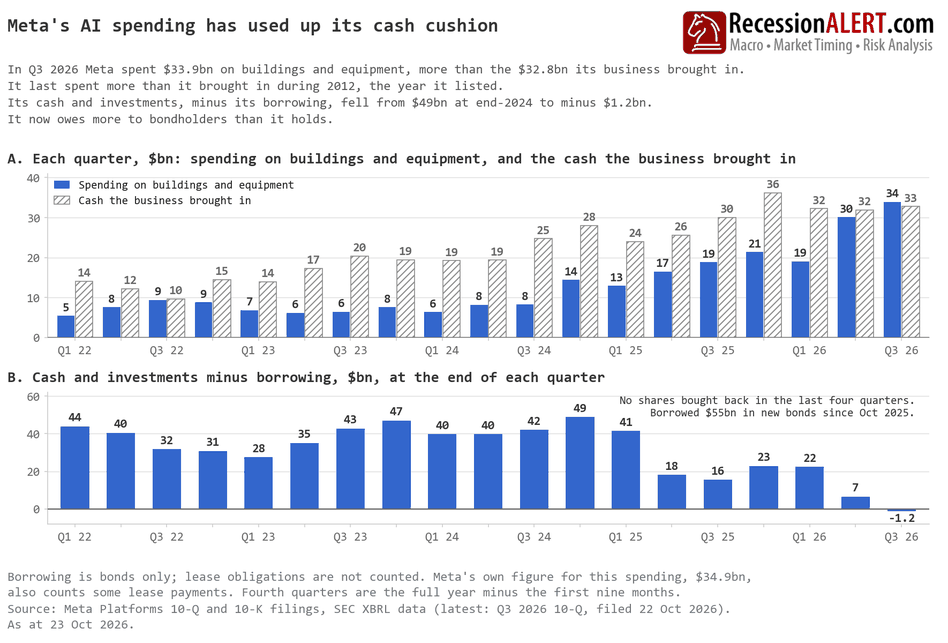
For two years Meta handed its spare cash back to shareholders; now it owes bondholders more than it holds in cash and investments. At end-2024 its cash and investments exceeded its bonds by $49bn; by September they fell $1.2bn short, the first time as a public company Meta has crossed that line — before counting a single lease. Nothing forced it. In the 2022 advertising slump, spending reached 97% of cash flow because both moved against Meta: spending rose while cash from the business fell by almost a third. This time that cash rose 9% on the year while spending on buildings and equipment rose 80%, to $33.9bn on the chart’s measure. A squeeze ends when advertisers come back; a decision ends only when management changes its mind. Meanwhile buybacks stopped — $62.3bn in the eight quarters to Q3 2025, none in the four since — and $54.8bn of new bonds covered what Meta’s own cash did not; the interest bill has roughly quadrupled in a year. Its own guidance says the climb continues: fourth-quarter spending of $49-59bn on Meta’s broader measure, against a $34.9bn record. Reuters reported on 22 October that the cost of insuring Meta’s debt against default had touched an all-time high, as investors grappled with concerns about its AI spending. Lenders now have a say over whatever the business’s own cash does not cover. The company that used to buy back its own shares is now selling its own IOUs.
What it means: Meta is no longer buying its own shares, so its stock price will rest more heavily on whether the AI spending pays off. Many households own Meta through index funds and retirement plans, so that bet now sits inside ordinary savings. For the economy, the data-centre build-out continues, but more of it now rests on borrowed money. That leaves it more exposed to the credit market than it was a year ago. Watch the fourth quarter: a return to buybacks, or cash and investments climbing back above bonds, would say the shift is reversing.
Market Intelligence Brief (MIB) Ver. 19.91
For professional investors only. Not investment advice.
© 2026 RecessionALERT.com

Comments are closed.