
MARKET INTELLIGENCE BRIEF (MIB)
Thursday, October 22, 2026
An AI-hardware rout sank the Nasdaq 100 2.90% and dragged the S&P 500 down 1.21%, yet two of three S&P stocks rose. Lam Research fell 11.76% and GE Vernova lost 10.64%. Treasuries caught a haven bid, cutting the 10-year yield 17.2 bps to 4.951%. Brent jumped 3.73% to $112.88, its highest close since May 4, after Houthi strikes on Saudi targets. Trump invoked the Defense Production Act for domestic oil. Moderna sank 17.57% on leaked Phase 3 melanoma data.
TABLE OF CONTENTS
A. EXECUTIVE SUMMARY
B. MARKET DATA
C. HIGH-IMPACT STORIES (5)
D. MODERATE-IMPACT STORIES (5)
E. ECONOMY WATCH (4)
F. EARNINGS WATCH (13)
G. WHAT’S NEXT
H. CHART OF THE DAY
A. EXECUTIVE SUMMARY -> TOP
The Nasdaq 100’s 2.90% drop, its steepest since June 23, repriced the financing risk of the AI build-out rather than the economy: worries over the cost of borrowing for data centers and chips hit chipmakers and the power names priced for data-center demand, on a day initial claims beat at 194,000 and the Conference Board raised its 2026 growth forecast to 2.2%. The 10-year yield fell 17.2 bps to 4.951% even as Brent rose 3.73% on Houthi strikes against Saudi targets, so the bond market weighted an AI-led tightening of financial conditions above the oil shock, six days before an FOMC that has been weighing further tightening. Breadth told the same story: about two of every three S&P 500 stocks rose, all five gaining sectors were defensive or rate-sensitive, led by Consumer Defensive (+3.13%), and Technology fell 3.23% to extend a 6.58% one-month loss.
• Chipmakers led the Nasdaq 100 down 2.90% while the Dow finished up 0.02%: Lam Research (LRCX) fell 11.76% after its results, Applied Materials (-8.16%), AMD (-8.10%) and Intel (-8.04%) followed, and CoreWeave dropped 10.1% amid debt worries, per AP.
• The power trade split: GE Vernova (GEV) fell 10.64% and Vistra dropped 9.93% on the day HSBC initiated it at Buy, while regulated utilities Southern (+3.74%) and Duke (+3.92%) rallied.
• Brent rose 3.73% to $112.88, its highest close since May 4, after a Houthi strike on a Saudi airport and a claimed hit on Aramco’s Yanbu facility; Trump invoked the Defense Production Act for domestic oil production, refining and logistics, naming no dollar amount.
• Tesla and SpaceX have hired advisers for early merger talks, Reuters reports; SpaceX (SPCX) fell 9.14% and Tesla (TSLA) slipped 3.08% as CLSA and BNP Paribas Exane upgraded Tesla.
• Moderna (MRNA) fell 17.57% after leaked Phase 3 melanoma data showed a 0.58 hazard ratio, at the low end of expectations; Lockheed Martin (LMT) rose 6.96% on the day it reported Q3 results and agreed a 10-year F-35 framework for 850 aircraft that still needs congressional authority.
• Initial claims fell to 194,000 against 200,000 expected and the leading index held flat at 99.6; the 30-year mortgage rate eased to 7.32%, still 1.13 points above a year ago, as Washington targeted housing costs with an executive order and a proposed ban on large investors buying single-family homes from January 7, 2027.
1. The AI trade’s weak point has moved from demand to financing — Lam Research was punished for guidance only modestly above consensus, CoreWeave sold off on debt worries, and the merchant generators and grid-equipment makers priced for data-center demand fell 6%-11% while rate-regulated utilities rose. With Technology down 6.58% over a month and Consumer Defensive up 9.11%, this is the latest leg of an established rotation rather than a one-day shock, and a reported OpenAI raise at a $1.25 trillion pre-money valuation, below earlier reports of an ask above $1.4 trillion, adds to the question of what the largest AI buyers can fund. Exposure to chip equipment and AI power now rides on Alphabet’s and Microsoft’s capex plans, which arrive on the same afternoon as the FOMC decision.
2. Bonds priced the equity shock over the oil shock, and that can reverse — The 10-year fell 17.2 bps on a day Brent jumped and claims beat, two inputs that would ordinarily push yields higher, and gold fell 2.65%, so the haven bid went to Treasuries alone. Yet the supply threat is widening: the Houthi campaign has moved to civilian infrastructure and, by its own claim, to Yanbu, the Red Sea outlet Saudi Arabia relies on to bypass Hormuz, and the Energy sector fell 0.75% as equity investors treated the price as a demand and margin hit. A rally built on positioning rather than a change in the inflation outlook leaves duration exposed if crude holds near a five-month high into the Q3 GDP and September PCE releases on October 29.
3. Washington is acting on supply and costs, not on rates — The Defense Production Act determination for oil, the housing order and investor ban, the wind-turbine Section 232 finding without a tariff and the F-35 multiyear framework all work through procurement, regulation or the threat of later action, ahead of the November 3 midterms. None changes near-term supply or the 7.32% mortgage rate, and Thursday’s 17.2 bp fall in the 10-year did more for affordability than either housing document. The sector effects are concrete, though: title insurers face a hit to refinance revenue, private mortgage insurers face trimmed premiums, large single-family rental owners such as Invitation Homes and American Homes 4 Rent are confined to build-to-rent and renovation channels, and wind supply chains carry a tariff option on a 180-day clock.
 — Leading economic indicators. Accurate market forecasts. Apply for membership at join.recessionalert.com
B. MARKET DATA -> TOP
A renewed selloff in AI hardware split the tape: chipmakers sank on worries over the cost of financing the AI build-out, pulling the Nasdaq 100 down 2.90% while the Dow finished flat and the NYSE Composite edged higher. Beneath the headline loss, money rotated into defensives — Consumer Defensive (+3.13%) led all sectors — and Treasuries drew a haven bid that cut the 10-year yield by 17.2 bps to 4.951%. The anomaly was energy: Brent jumped 3.73% to its highest close since May 4 on Houthi attacks on Saudi infrastructure, yet the Energy sector fell 0.75%. Metals offered no shelter, with silver sliding to its lowest close since at least April 15.
CLOSING PRICES – Thursday, October 22, 2026:
MAJOR INDICES
A concentrated AI-hardware selloff, not a broad one: the Nasdaq 100 lost 2.90% while the NYSE Composite and Russell 2000 edged higher. Transports outran the flat Dow by 1.85 points on earnings-driven rail gains at CSX and Union Pacific. Dow Theory bull confirmation is now in its third session, with both averages closing above their 10-session highs, and the broadening rotation — the S&P 500 ahead of the Nasdaq 100 by 4.4 points over 10 sessions — is an entrenched seven-session pattern.
| Index | Close | Change | %Move | Why It Moved |
|---|---|---|---|---|
| S&P 500 | 7,663.43 | -93.74 | -1.21% | AI-chip selloff, with Nvidia (-4.40%) the largest drag per AP, outweighed gains in defensives; per AP, two of every three S&P 500 stocks rose |
| Dow Jones | 52,867.98 | +11.89 | +0.02% | Flat; strength in consumer-defensive and healthcare shares offset losses in technology and industrials |
| DJ Transportation | 20,294.43 | +371.87 | +1.87% | Earnings-driven rail gains: CSX +6.76% (reported Oct 21 after the close) and Union Pacific +3.55% (reported Oct 22 before the open) |
| Nasdaq 100 | 28,958.69 | -863.83 | -2.90% | Semiconductor-led AI selloff (Lam Research -11.76% after earnings, Applied Materials -8.16%, AMD -8.10%) on worries over the cost of borrowing to fund AI build-outs, per AP |
| Russell 2000 | 2,784.03 | +3.01 | +0.11% | Small caps sidestepped the mega-cap tech selloff on a day Treasury yields fell sharply |
| NYSE Composite | 24,275.53 | +22.41 | +0.09% | Positive breadth beneath the headline loss as defensive, healthcare and rate-sensitive shares rose |
VOLATILITY & TREASURIES
The VIX jumped 14.15% while yields fell hard — a flight-to-safety signature, with bonds bought as AI stocks tumbled, not an inflation scare, and notable on a day crude rose. The 10-year fell 17.2 bps against 16.0 bps for the 2-year, a mild bull flattening that leaves 2s10s at 30.3 bps. The dollar slipped 0.17% rather than catching a haven bid.
| Instrument | Level | Change | Why It Moved |
|---|---|---|---|
| VIX | 19.04 | +2.36 (+14.15%) | Jumped as the AI-chip selloff hit the Nasdaq 100 |
| 10-Year Treasury Yield | 4.951% | -17.2 bps | Haven buying as AI stocks tumbled, per AP; the drop came despite lower weekly jobless claims |
| 2-Year Treasury Yield | 4.648% | -16.0 bps | Fell with the 10-year in a bull flattening; 2s10s at 30.3 bps |
| US Dollar Index (DXY) | 101.61 | -0.17 (-0.17%) | Edged lower alongside falling Treasury yields; no discrete dollar catalyst identified |
COMMODITIES
Metals sold off with tech rather than acting as havens: silver led the slide to its lowest close since at least April 15, platinum and copper followed, and gold gave up 2.65%. The decline came as Treasury yields fell, so higher rates do not explain it. Bitcoin’s 3.96% drop tracked the tech selloff rather than decoupling from it.
| Asset | Price | Change | %Move | Why It Moved |
|---|---|---|---|---|
| Gold | $4,039.90/oz | $-110.10 | -2.65% | Fell in a broad metals selloff as equities slid; dealer commentary cited Fed-hike expectations, but Treasury yields fell 17 bps, so that explanation does not fit the session. No discrete same-day catalyst identified |
| Silver | $54.625/oz | $-3.085 | -5.35% | Lowest close since at least April 15; dealer commentary cited fast-money selling in thin trade (unverified). No discrete same-day catalyst identified |
| Copper | $6.3993/lb | $-0.1802 | -2.74% | No discrete same-day catalyst identified; fell with the broad metals selloff |
| Platinum | $1,570.15/oz | $-65.75 | -4.02% | No discrete same-day catalyst identified; fell with gold and silver |
| Bitcoin | $81,515.00 | $-3,359.00 | -3.96% | Slid alongside the tech selloff |
ENERGY
Houthi attacks on Saudi infrastructure and reports that Aramco told staff to evacuate its Dhahran headquarters lifted crude, per Reuters; Brent outpaced WTI and the Brent premium widened to $13.78. Dutch TTF rose 3.31% while Henry Hub slipped 0.47%, even though the weekly storage build came in slightly below expectations. Oil rose while equities fell.
| Asset | Price | Change | %Move | Why It Moved |
|---|---|---|---|---|
| Crude Oil (WTI) | $99.10/bbl | $+1.95 | +2.01% | Rose with Brent as Houthi attacks on Saudi infrastructure stoked Gulf supply fears; settled $99.47, up $2.32, per Reuters |
| Crude Oil (Brent) | $112.88/bbl | $+4.06 | +3.73% | Houthi attacks on Saudi infrastructure and reports that Aramco told staff to evacuate its Dhahran headquarters lifted risk premium; settled $113.17, up $4.35, per Reuters, its highest close since May 4 |
| Natural Gas (Henry Hub) | $2.777/MMBtu | $-0.013 | -0.47% | Thursday’s EIA report showed a 77 Bcf storage injection, slightly below the ~79 Bcf consensus, which does not explain the dip; mild weather forecasts had weighed on futures earlier in the week, per NGI |
| Natural Gas (Dutch TTF) | $29.689/MMBtu | $+0.950 | +3.31% | Highest close since at least April 15, rising alongside crude’s Gulf risk premium; Reuters reports Russian officials urged the EU to reconsider its planned Russian LNG import ban, citing low European storage |
S&P 500 SECTORS
A defensive rotation visible across horizons: Consumer Defensive led the day and extended a +9.11% month, while Technology, still up 21.12% year to date, fell across a third horizon running (-3.32% 1W, -6.58% 1M). All five gainers were defensive or rate-sensitive — Consumer Defensive, Utilities, Real Estate, Healthcare and Financial. Energy fell 0.75% against a rally in crude.
| Sector | 1-Day | 1-Week | 1-Month | 3-Month | 6-Month | YTD | 12-Month |
|---|---|---|---|---|---|---|---|
| Consumer Defensive | +3.13% | +3.55% | +9.11% | +7.94% | +5.87% | +14.91% | +13.30% |
| Utilities | +1.70% | +2.64% | +6.92% | -6.96% | -8.09% | -0.24% | -5.21% |
| Real Estate | +1.30% | +1.16% | +0.33% | -8.64% | -3.75% | +3.66% | -0.25% |
| Healthcare | +1.15% | +2.31% | +5.69% | +8.18% | +18.51% | +13.77% | +20.50% |
| Financial | +0.44% | +1.58% | +1.38% | -0.95% | +8.53% | +4.98% | +11.14% |
| Energy | -0.75% | +1.57% | +6.67% | +9.73% | +12.14% | +45.43% | +51.26% |
| Consumer Cyclical | -1.26% | +0.27% | +1.87% | +3.85% | -3.60% | -5.99% | -6.44% |
| Industrials | -2.32% | -1.09% | -2.83% | -5.89% | -7.51% | +5.95% | +5.80% |
| Communication Services | -2.50% | -6.26% | -5.20% | +1.67% | -6.21% | -3.97% | +0.07% |
| Basic Materials | -2.57% | -2.65% | -5.71% | +0.13% | -8.02% | +7.48% | +16.32% |
| Technology | -3.23% | -3.32% | -6.58% | +3.86% | +12.85% | +21.12% | +18.57% |
TOP MEGA-CAP MOVERS:
GAINERS
| Company | Ticker | Close | Change | Why It Moved |
|---|---|---|---|---|
| Procter & Gamble | PG | $165.59 | +5.58% | Earnings-driven; fiscal first-quarter results released before the open |
| Home Depot | HD | $327.73 | +4.33% | No discrete same-day catalyst identified; beat its sector by 5.6 points on a day the 10-year yield fell 17 bps (a rate-sensitivity link, unverified) |
| Johnson & Johnson | JNJ | $267.61 | +3.81% | Presented first real-world pulsed field ablation data at the Asia Pacific Heart Rhythm Society meeting, per Investing.com; how much of a 3.8% move that release explains is unverified, on a day Healthcare rose 1.15% |
| Salesforce | CRM | $250.29 | +3.52% | No discrete same-day catalyst identified; rose against a 3.23% decline in Technology |
| Netflix | NFLX | $67.05 | +3.09% | No discrete same-day catalyst identified; a partial rebound from Wednesday’s slide to a 52-week low, despite a Wolfe Research downgrade to Peer Perform |
DECLINERS
| Company | Ticker | Close | Change | Why It Moved |
|---|---|---|---|---|
| Lam Research | LRCX | $230.15 | -11.76% | Earnings-driven; results released Oct 21 after the close |
| GE Vernova | GEV | $827.42 | -10.64% | No discrete company-specific catalyst identified; sold off with AI-power and grid-infrastructure names amid AI-capex worries, per Investing.com (unverified). Reports Oct 28 |
| SpaceX | SPCX | $144.75 | -9.14% | Investors weighed Musk’s Tesla-merger remarks from Tesla’s Oct 21 post-close earnings call, per reports, alongside the tech selloff; reversed part of Wednesday’s post-results gain |
| Applied Materials | AMAT | $375.58 | -8.16% | Fell with chip-equipment peer Lam Research’s earnings-driven slide; no AMAT-specific same-day catalyst identified |
| Advanced Micro Devices | AMD | $507.93 | -8.10% | No discrete AMD-specific catalyst identified; fell with the AI-chip selloff, 4.9 points worse than Technology |
— Institutional-grade intelligence for serious investors. Apply for membership at join.recessionalert.comC. HIGH-IMPACT STORIES -> TOP
BEARISH
1. AI-Hardware Selloff Sinks the Nasdaq 100 2.90%, Its Steepest Loss Since June 23, as Chip and AI-Power Names Crack and Two of Three S&P 500 Stocks Rise
The core facts:The Nasdaq 100 fell 2.90% to 28,958.69, its steepest one-day loss since June 23, and the S&P 500 dropped 1.21% to 7,663.43, its worst session since July 29, ending a three-session winning streak. The damage was concentrated: the Dow finished up 0.02%, the NYSE Composite rose 0.09% and the Russell 2000 0.11%, and per AP about two of every three S&P 500 stocks gained. Chipmakers led the decline — Applied Materials -8.16%, AMD -8.10%, Intel -8.04%, Micron -6.26%, Nvidia -4.40% and Broadcom -4.31%, with Lam Research -11.76% after its results (Section F) — and CoreWeave fell 10.1%, per AP. The selloff reached the power trade: GE Vernova -10.64%, Vistra -9.93%, Talen -7.81%, Vertiv -7.81% and Eaton -6.33%, while regulated utilities Southern (+3.74%) and Duke (+3.92%) rallied. AP attributed the move to worries that the high cost of borrowing to build data centers and buy AI chips could threaten the AI boom, along with concerns that prices had run too high, and cited debt worries around CoreWeave, which borrowed to buy Nvidia chips. Technology was the worst sector at -3.23%; Consumer Defensive led at +3.13%.
Why it matters:This was a rotation, not a liquidation: breadth was positive, small caps rose and the bond market took the haven bid (Story 2), which points to investors repricing the financing risk of the AI build-out rather than the economy. That distinction matters for positioning — the names that fell hardest are those whose earnings depend on hyperscaler capex continuing to accelerate, and the market punished Lam Research for guidance only modestly above consensus, showing how little room for disappointment is left in the supply chain. The power-producer split is the clearest tell: merchant generators and grid-equipment makers priced for data-center demand fell 6%-11% while rate-regulated utilities rose, and Vistra dropped 9.93% on the same day HSBC initiated it at Buy. Technology is now down 6.58% over a month while Consumer Defensive is up 9.11%, so this is the latest leg of an established rotation. An after-the-close CNBC report, relayed by Investing.com, that OpenAI is nearing a raise of up to $30 billion at a $1.25 trillion pre-money valuation, below earlier reports of an ask above $1.4 trillion, adds to the question of what the largest AI buyers can fund.
What to watch:Alphabet and Microsoft report capex plans after the close on October 28, the same afternoon as the FOMC decision, and Amazon and Intel follow on October 29. A Nasdaq 100 close below Thursday’s 28,958.69 would extend the drawdown into the hyperscaler prints.
UNCERTAIN
2. Treasuries Draw a Haven Bid: The 10-Year Yield Falls 17.2 bps to 4.951%, the Largest One-Day Drop Since at Least April 15, on a Day Crude Jumped and Claims Beat
The core facts:The 10-year Treasury yield fell 17.2 bps to 4.951%, its largest one-day decline since at least April 15 and its lowest close since September 17, and the 2-year fell 16.0 bps to 4.648%, a mild bull flattening that left the 2s10s spread at 30.3 bps from 31.5 bps. The 10-year had closed as high as 5.315% on October 5. The VIX jumped 14.15% to 19.04 and the dollar index slipped 0.17% to 101.61. AP said investors were buying government bonds in search of something safer to own as AI stocks tumbled. The rally came on a session when Brent rose 3.73% and initial jobless claims fell to 194,000 against 200,000 expected (see Economy Watch) — two inputs that would ordinarily push yields higher. Gold fell 2.65%, so the haven bid went to Treasuries rather than metals. The Fed is in its communications blackout ahead of the October 28 decision, with the funds rate target at 3.75%-4.00%.
Why it matters:A 17 bp fall driven by equity risk-off rather than data is the bond market saying the AI selloff could tighten financial conditions on its own, which changes the calculus for an FOMC that has been weighing further tightening with the 10-year above 5% for much of October. Lower long yields cut the cost of the AI build-out’s debt financing that equities were worried about, and they flowed straight into rate-sensitive equities: Home Depot rose 4.33%, Real Estate 1.30% and Utilities 1.70%. The risk is that the move unwinds just as fast — it rested on positioning rather than a change in the inflation or growth outlook, crude is at a five-month high, and the 30-year mortgage rate only fell to 7.32% in this week’s survey, before Thursday’s rally.
What to watch:Whether the 10-year holds below 5.0% into the October 28 FOMC decision at 2:00 PM ET, and the Q3 GDP advance estimate and September PCE on October 29, the first data able to confirm or reverse Thursday’s move.
BEARISH
3. Brent Closes at $112.88, Its Highest Since May 4, as Houthis Hit a Saudi Airport and Iran Claims Seven Tankers Struck Near Hormuz; CENTCOM Disputes the Mine Claims
The core facts:Brent closed at $112.88, up 3.73%, its highest close since May 4, and WTI closed at $99.10, up 2.01%, widening the Brent premium to $13.78 from $12.22. A Houthi strike late Wednesday on King Fahd International Airport near Dammam killed two people and injured eight, according to Saudi Arabia’s Civil Aviation Authority, and Houthi spokesman Yahya Saree claimed strikes on an Aramco facility in Yanbu, causing a fire, and on the Defense Ministry in Riyadh, without offering evidence for the ministry strike. Reuters, citing people familiar, reported that Aramco told staff to evacuate its Dhahran headquarters. Iran’s state TV, quoting the Revolutionary Guard’s navy, said four tankers were hit and caught fire while transferring oil and three more were disabled by mines west of the Strait of Hormuz, and warned it could target US bases; an unnamed CENTCOM spokesperson told Al Jazeera the mine claims are incorrect and that 95% of vessels are getting through. President Trump posted that Iran “is doing everything they can to drive up the price of oil prior to the US Midterm Election.” Separately, Libya’s National Oil Corporation said unauthorized individuals shut the valve on the Hamada-Zawiya crude pipeline.
Why it matters:The Houthi campaign has moved from Saudi oil fields to civilian infrastructure and, by its own claim, to the Red Sea export outlet at Yanbu — the route Saudi Arabia relies on to bypass Hormuz — so the market is pricing a threat to the region’s spare export capacity, not just to transit through the strait. The widening Brent-WTI spread shows the premium is in seaborne Middle East-linked barrels. Yet the Energy sector fell 0.75% while crude rose, which says equity investors see the price as a supply shock that hurts demand and margins rather than a durable earnings tailwind for producers. With TTF also up 3.31%, the inflation impulse lands on Europe and on US distillate prices at a moment when the Fed is deciding whether to tighten.
What to watch:Friday’s meeting of European and Iranian diplomats in Istanbul, whose agenda includes Hormuz and Yemen, and any Saudi confirmation of damage at Yanbu. A Brent close above the May 4 level would mark a new high for the period.
UNCERTAIN
4. Trump Invokes the Defense Production Act for Domestic Oil Production, Refining and Logistics, Authorizing Federal Purchases and Financial Support but Naming No Dollar Amount
The core facts:A Presidential Determination dated October 22 under Section 303 of the Defense Production Act finds that domestic petroleum production, refining and logistics capacity is essential to the national defense, and that industry cannot provide it in a timely manner without presidential action because of constrained financing, long lead times, permitting and infrastructure bottlenecks, and supply-chain limitations. It covers exploration and production, gathering and transmission pipelines, storage and marine terminals, and authorizes and directs the Secretary of War to make “necessary purchases, commitments, and financial instruments to enable these projects,” waiving the statute’s usual prerequisites. It builds on the national energy emergency declared on January 20, 2025. The memorandum names no dollar amounts, projects, deadlines or specific fuels, and does not mention the Middle East.
Why it matters:The determination opens a channel for federal money — purchase commitments, offtake guarantees, financing — into oil infrastructure that the market alone has not been building, which is a structural rather than an immediate response to a Brent price at a five-month high (Story 3). Without an appropriation or named projects its near-term effect on supply is nil; refining capacity in particular takes years to add. The signal matters more than the mechanism: Washington is now treating fuel supply as a defense matter two weeks before the midterms, following Wednesday’s moves on heating oil, which raises the odds of further intervention in product markets. For refiners and midstream operators, federal backing for capacity is a long-run margin headwind if it adds supply, and a near-term source of capital if it funds their projects.
What to watch:Publication in the Federal Register and any first purchase commitments or named projects from the Department of War. Phillips 66 (October 28) and Valero’s results (Section F) are the read on how refiners view new capacity.
UNCERTAIN
5. Tesla and SpaceX Hire Advisers and Weigh Merger Structures, Reuters Reports; SpaceX Falls 9.14% as Analysts Upgrade Tesla on Merger Sentiment
The core facts:Reuters reported Thursday, citing three sources, that Tesla and SpaceX have both hired advisers for early-stage merger talks after SpaceX approached Tesla in recent weeks. The structures under consideration include SpaceX buying Tesla or a combination under a new holding company, with an all-stock deal among the options, and advisers are in contact with Elon Musk’s lawyers to keep him out of the talks. Insiders fear Musk’s public comments could invite shareholder scrutiny and delay the process by weeks; Reuters, citing Barclays, said a deal could be announced before Tesla’s annual meeting in December. On Tesla’s October 21 call Musk said a deal would need backing from 50% of all Tesla shares, “quite a high hurdle.” SpaceX fell 9.14% to $144.75 and Tesla 3.08% to $374.58, the day after its results (Section F). CLSA upgraded Tesla to Hold from Underperform, raising its target to $400 from $310 and citing “sentiment around a merger,” and BNP Paribas Exane upgraded it to Neutral with a $420 target from $266.
Why it matters:A combination of two companies worth more than $3 trillion together would put the governance question — a controlling shareholder on both sides — in front of every Tesla holder and index fund. The market’s split reaction is the point: SpaceX holders sold the prospect of absorbing a slower-growing auto business, while Tesla’s downside was cushioned by analysts who explicitly upgraded on the deal rather than the quarter, so merger optionality is now part of Tesla’s valuation. The process risk is high — independent committees, a Texas legal framework untested on a deal like this, global antitrust review — and any slippage in the talks would remove support the stock has just been given.
What to watch:Any statement from either company’s special committee, and whether Tesla sets a date for its December annual meeting, the window Barclays flagged for an announcement.
— Quantifying recession risk so you don’t have to guess. Apply for membership at join.recessionalert.comD. MODERATE-IMPACT STORIES -> TOP
BEARISH
6. Moderna Falls 17.57% After Leaked Phase 3 Melanoma Vaccine Data Show a 0.58 Hazard Ratio, at the Low End of Expectations; Merck Slips 1.76%
The core facts:Results from the Phase 3 INTerpath-001 trial of Moderna and Merck’s intismeran autogene plus Keytruda in resected stage IIB-IV melanoma leaked online Thursday, days before their scheduled presentation, and the companies published them in a release at 2:59 PM EDT. In 1,137 patients the combination cut the risk of recurrence or death by 42% versus Keytruda alone (recurrence-free survival hazard ratio 0.58, 95% CI 0.45-0.75, p<0.001) and the risk of distant metastasis or death by 38% (HR 0.62), at a median follow-up of 24.6 months; the paper has been accepted by NEJM and will be presented in ESMO’s Presidential Symposium. Analysts had looked for a hazard ratio below 0.60, and RBC, noting the 0.51 in the Phase 2 study, called 0.58 “at the low end of expectations.” Moderna closed at $202.63, down 17.57%, after trading as much as 25% lower, and Merck closed at $147.24, down 1.76%. Merck’s Jane Healy said, “This is not a subtle benefit.”
Why it matters:The trial succeeded and the stock still lost a sixth of its value, because Moderna’s valuation had come to rest on its oncology pipeline replacing shrinking vaccine revenue, and the market wanted proof the effect would hold at Phase 2 strength. RBC’s view captures the new debate — “While approval seems likely, commercial success is far less certain” — as an individualized vaccine must compete with cheaper neoadjuvant immunotherapy. For Merck the stakes are smaller but real: the combination is part of its plan to extend the Keytruda franchise beyond the 2028 patent cliff, and a modest benefit narrows that bridge.
What to watch:The full presentation at ESMO on Saturday, including subgroup and safety detail, and Merck’s Q3 results on October 29.
UNCERTAIN
7. Washington Moves on Housing Costs: An Executive Order Targets Mortgage and Title Insurance, and Treasury Proposes Rules Barring Large Investors From Buying Single-Family Homes From January 7
The core facts:President Trump signed the executive order “Decreasing Housing Costs for the American People” on October 22. It lets the FHFA direct Fannie Mae and Freddie Mac to pilot proactive cancellation of mortgage insurance once borrowers reach the required equity; to expand their title-acceptance pilot into a nationwide program in which an automated title review can replace a lender’s title insurance policy on eligible refinances; and to pass the savings to borrowers. It creates a manufactured-housing task force, co-chaired by HUD and the FHFA, to report within 180 days, and directs the USDA and VA to cut the interest rates on their direct home loans. The same day Treasury proposed rules implementing the ROAD to Housing Act: from January 7, 2027, an investor controlling at least 350 single-family homes may not buy another, with exceptions for build-to-rent, renovate-to-rent and homeownership programs and safe harbors including a renter’s right of first refusal and a 30-day first look. Comments are due 30 days after Federal Register publication.
Why it matters:Both measures work on the costs around a mortgage rather than the rate itself, which at 7.32% is 1.13 points above a year ago (see Economy Watch) and is the binding constraint on housing turnover; the order does not touch zoning, lumber tariffs or rates on conventional loans. The title-insurance provision is the most direct hit to an industry’s revenue, since refinance policies are a core product for title insurers, and the mortgage-insurance pilot trims premiums for private mortgage insurers on new loans. The investor ban constrains large single-family rental owners such as Invitation Homes and American Homes 4 Rent to build-to-rent and renovation channels. The policy push arrives as Thursday’s 17.2 bp fall in the 10-year yield (Story 2) does more for affordability than any provision in either document.
What to watch:Federal Register publication of the Treasury rule, which starts the 30-day comment clock, and FHFA’s guidance to Fannie Mae and Freddie Mac on the title and mortgage-insurance pilots. September new home sales on October 27 give the next read on demand.
UNCERTAIN
8. Section 232 Proclamation Finds Wind-Turbine Imports Threaten National Security but Imposes No Tariff, Ordering Trade Talks and a 180-Day Report
The core facts:A proclamation dated October 22 adopts the Commerce Department’s finding that imports of wind turbines and their components “threaten to impair the national security of the United States,” but imposes no new tariff. It directs Commerce and the US Trade Representative to pursue negotiations with trading partners and to update the President within 180 days, and says that if no agreement is reached or it proves ineffective, the President may take other actions, including tariffs. Existing steel, aluminum and copper tariffs on turbine components stay in place. The finding calls wind “an unreliable and intermittent energy source” and cites cybersecurity risks from foreign-made networked inverters, radar interference with air traffic control and defense missions, and domestic blade capacity that “has not meaningfully increased.” GE Vernova fell 10.64% on the session amid the AI-power selloff (Story 1); no link between the proclamation and the move has been established.
Why it matters:Choosing negotiation over an immediate tariff spares wind developers and turbine makers a direct cost increase for now, but the 180-day clock — roughly late April 2027 — leaves a tariff option hanging over every project that sources components abroad, which complicates financing decisions today. The language of the finding matters as much as the remedy: by framing wind as unreliable and inverters as a security vulnerability, it builds a record that could support restrictions on grid-connected equipment more broadly, not just turbines. That is a risk for onshore and offshore wind supply chains already facing policy hostility, and a modest positive for gas-fired generation equipment.
What to watch:GE Vernova’s results on October 28 for any comment on its wind segment and supply chain, and any announced negotiations with major turbine-exporting countries.
BULLISH
9. Lockheed Martin and the Department of War Agree a 10-Year F-35 Framework for 850 US Aircraft at 156 a Year, Pending Multiyear Authority From Congress
The core facts:Lockheed Martin and the Department of War announced a framework agreement for multiyear F-35 production and sustainment covering 850 US aircraft over 10 years with initial spares, international orders across Lots 21-30, a continued production rate of 156 aircraft a year, and 10 years of modification kits and sustainment. It is not yet a contract: terms, pricing and schedules will be finalized through a formal award only if Congress grants multiyear procurement authority and the associated appropriations “in the coming months.” No contract value was given; the company said the arrangement would save taxpayers billions over the aircraft’s life. CEO Jim Taiclet said it “strengthens the way we can plan and invest in the F-35 enterprise.” Lockheed closed at $589.91, up 6.96%, on the same day it reported Q3 results (Section F), so the move cannot be attributed to the framework alone.
Why it matters:A decade of locked-in volume converts the F-35 from lot-by-lot negotiation, which has repeatedly delayed contracts and squeezed cash flow, into a visible production schedule, and multiyear deals typically let a contractor and its suppliers buy materials in bulk and invest ahead of demand. That stability flows down the supply chain to engine and component makers. The congressional condition is the risk: multiyear authority needs legislation and funding, and the timing collides with the midterms and year-end budget negotiations, so the framework is a strong signal of intent rather than booked revenue.
What to watch:Whether multiyear F-35 authority appears in the fiscal 2027 defense authorization and appropriations bills, and the timing of a definitized contract award.
UNCERTAIN
10. Gilead Agrees to Buy PepStar’s Oral IL-23R Inhibitor Program for $1.275 Billion in Cash, a Deal That Will Cut Fourth-Quarter EPS by About $0.79-$0.83
The core facts:Gilead said after the close that it will acquire worldwide rights to privately held PepStar Therapeutics’ oral IL-23R inhibitor program, led by HCXT-2001, an extended half-life macrocyclic peptide in Phase 1 development, for $1.275 billion in upfront cash payable at closing, subject to customary adjustments. The primary target is inflammatory bowel disease, with potential use in psoriasis. Closing is expected in the fourth quarter, and the deal is expected to reduce Gilead’s GAAP and non-GAAP EPS by approximately $0.79 to $0.83 in that quarter. Separately, Texas Attorney General Ken Paxton announced a $45 million settlement with Gilead resolving a 2023 suit alleging illegal incentives to providers under Texas Medicaid. Gilead closed at $157.19, up 2.36%, before the deal announcement.
Why it matters:Gilead is paying a large upfront price for an early-stage asset because an oral pill hitting the IL-23 pathway — where injectable antibodies already dominate IBD treatment — would be a major commercial advantage if it works, and it pushes Gilead further into inflammation to diversify beyond HIV. The EPS hit is an accounting charge for acquired in-process research, not an operating deterioration, but it will make the fourth-quarter print look weak against consensus and must be reflected in guidance on October 29. The deal fits a broader pattern of large-cap pharma buying early pipeline assets for cash.
What to watch:Gilead’s Q3 results and updated full-year guidance after the close on October 29, which should incorporate the fourth-quarter charge.
— Separating signal from noise since 2007. Apply for membership at join.recessionalert.comE. ECONOMY WATCH -> TOP
Thursday’s data described an economy that is still expanding, with the strain concentrated in consumers and housing. Initial jobless claims fell to 194,000 against 200,000 expected, and the Conference Board’s leading index held flat at 99.6 as the Board raised its 2026 growth forecast to 2.2%. The weak spots sit with households: falling consumer expectations were the largest drag on the leading index, and the 30-year mortgage rate, though down to 7.32%, remains 1.13 points above a year ago. The 10-year yield still fell 17.2 bps, a haven move the labor data did not drive. The October 28 FOMC decision and the October 29 Q3 GDP and September PCE releases are the next tests.
Initial Jobless Claims Fall to 194,000, Beating the 200,000 Consensus, as Continuing Claims Rise to 1.728 Million (Labor Department, Oct 22)
What they’re saying:Seasonally adjusted initial claims fell 6,000 to 194,000 in the week ending October 17, below the 200,000 consensus; the prior week was revised up to 200,000 from 199,000. The four-week average eased 1,000 to 197,750. Continuing claims rose 25,000 to 1,728,000 in the week ending October 10, with the insured unemployment rate unchanged at 1.1%.
The context:Layoffs remain low: the four-week average is below 200,000, and unadjusted initial claims of 172,390 compare with 205,653 in the same week of 2025. Continuing claims rose on the week but, on an unadjusted basis, remain below year-ago levels at 1.48 million against 1.67 million. The beat did not lift yields: the 10-year Treasury yield fell 17.2 bps to 4.951% as haven buying during the AI-chip selloff outweighed the labor data.
What to watch:Next week’s claims report on Thursday, Oct 29 arrives alongside the Q3 GDP advance estimate and September PCE. A four-week average that stays under 200,000 would leave little labor-market slack heading out of the October 28 FOMC meeting.
Leading Economic Index Holds Flat at 99.6 in September as the Conference Board Raises Its 2026 GDP Forecast to 2.2% (Conference Board, Oct 22)
What they’re saying:The Leading Economic Index was unchanged at 99.6 (2016=100) in September after a 0.1% decline in August, slightly better than the 0.1% decline expected, and rose 0.6% over the six months from March to September. The Coincident index rose 0.3% to 115.3 and the Lagging index rose 0.5% to 121.1. The Conference Board now expects real GDP growth of 2.2% in 2026 and 2.0% in 2027, up from the 1.9% and 1.8% it forecast a month ago.
The context:Five of ten components contributed positively, led by the interest rate spread and average weekly hours in manufacturing. A large decline in consumer expectations was the biggest drag, with smaller drags from stock prices, new orders for capital goods and building permits. Justyna Zabinska-La Monica of the Conference Board said the index is “becoming less dependent on consumer spending and more dependent on business investment.”
What to watch:CB Consumer Confidence on Tuesday, Oct 27 (prior 81.9) will show whether consumer expectations keep weighing on the index. The Q3 GDP advance estimate on Thursday, Oct 29 (prior quarter 2.2%) tests the Board’s upgraded growth call.
Kansas City Fed Manufacturing Index Slows to 16 from 20 in October as the Composite Eases to 11 (Kansas City Fed, Oct 22)
What they’re saying:The Kansas City Fed’s October manufacturing index fell to 16 from 20, and its composite index eased to 11 from 14. Both readings remain above zero, meaning more Tenth District factories reported growth than contraction.
The context:The slowdown is in pace, not direction: regional factory activity still grew in October, at a slower rate than in September. The survey covers Colorado, Kansas, Nebraska, Oklahoma, Wyoming, western Missouri and northern New Mexico, so it is a regional read on manufacturing rather than a national one.
What to watch:The Dallas Fed manufacturing index on Monday, Oct 26 (prior 9.8) and September durable goods orders on Tuesday, Oct 27 will show whether the slower pace is spreading.
30-Year Mortgage Rate Falls to 7.32% from 7.40%, Still 1.13 Points Above a Year Ago (Freddie Mac, Oct 22)
What they’re saying:Freddie Mac’s 30-year fixed rate averaged 7.32% this week, down from 7.40%, and the 15-year fixed fell to 6.68% from 6.71%. A year ago the two rates were 6.19% and 5.44%. Freddie Mac said the decline offers “some relief to prospective homebuyers.”
The context:The relief is small against a 1.13-point gap to last year, and housing data already show the cost: September pending home sales fell 7.3% and housing starts dropped 5.2% to 1.221 million, both reported October 20. Thursday’s 17.2 bp fall in the 10-year yield, to 4.951%, came on the day of release and is not part of this week’s survey.
What to watch:September new home sales on Tuesday, Oct 27 (prior 0.684 million) and the MBA 30-year mortgage rate on Wednesday, Oct 28 (prior 7.41%), ahead of the FOMC decision at 2:00 PM ET that day.
— Know the probability before the market prices in the risk. Apply for membership at join.recessionalert.comF. EARNINGS WATCH -> TOP
YESTERDAY AFTER THE BELL (Markets Reacted Today)
UNCERTAIN
11. Meta Platforms (META): -6.98% | Record Revenue Fails to Hold an After-Hours Gain as AI Spending Worries Push Its Default-Insurance Cost to a Record
The Numbers:Released: Wednesday, October 21, AMC. Revenue a record $64.60B vs. $63.34B expected. GAAP EPS $3.83 including a teen mental-health settlement charge; $7.40 excluding it vs. $6.54 expected. 2026 capex range narrowed to $135B-$145B. New non-voting Class C shares to trade from late January 2027. Shares closed at $648.85.
The Problem/Win:The revenue beat and a capex range trimmed at the top initially lifted the stock about 2% after hours, but the gain reversed in Thursday’s session as the AI-hardware selloff (Story 1) refocused investors on the cost of the build-out. Reuters reported that the cost of insuring Meta’s debt against default touched an all-time high on Thursday as investors grappled with its plan to spend more on AI.
The Ripple:Communication Services fell 2.50%, the third-worst sector. Analysts mostly raised targets with no rating changes — Mizuho to $950 from $750, Susquehanna to $850 from $650, BofA to $845 from $810 — while TD Cowen trimmed to $850 from $865.
What It Means:A record credit-default-swap level at one of the world’s most profitable companies shows the AI financing debate has reached the credit market; the stock now trades on capex discipline more than on revenue.
What to watch:Alphabet and Microsoft’s capex guidance on October 28, the next test of whether investors will fund rising AI spending.
UNCERTAIN
12. Tesla (TSLA): -3.08% | Small EPS Beat on Flat Revenue as Net Income Falls 29%; Upgrades Lean on the SpaceX Merger
The Numbers:Released: Wednesday, October 21, AMC. Adjusted EPS $0.48 vs. $0.45 expected. Revenue $28.05B, in line with $28.06B. Automotive revenue -3%; net income -29% to $787M; capex $3.73B. CLSA put operating income down 56% year over year at $718M and free cash flow at $1.53B. Shares closed at $374.58.
The Problem/Win:The core business is shrinking in profit even as cash flow stayed positive, and Musk added nothing new on the SpaceX merger on the call. The day’s news flow moved to the reported adviser hiring on both sides (Story 5).
The Ripple:SpaceX fell 9.14%. CLSA upgraded Tesla to Hold with a $400 target and BNP Paribas Exane to Neutral at $420; JPMorgan raised its target to $430 and Morgan Stanley to $410.
What It Means:Upgrades driven by deal sentiment rather than the quarter mean Tesla’s valuation is increasingly a bet on a corporate combination, not on auto margins.
UNCERTAIN
13. Lam Research (LRCX): -11.76% | Record Revenue but a December-Quarter Guide Barely Above Consensus Triggers the Session’s Largest Mega-Cap Decline
The Numbers:Released: Wednesday, October 21, AMC. EPS $2.20 vs. $2.18 expected. Record revenue $8.22B vs. $8.14B. December-quarter revenue guidance $8.60B ± $0.40B vs. $8.53B consensus; management cited supply constraints. Shares closed at $230.15.
The Problem/Win:A narrow beat and a guide only modestly above consensus were not enough for a stock that AP noted had surged 52.4% this year, and supply constraints suggest the company cannot fully meet demand in the near term.
The Ripple:Applied Materials fell 8.16% with no company-specific news, leading the chip-equipment group lower. Needham cut its target to $290 from $390, Morgan Stanley to $339 from $385 and Mizuho to $360 from $365, all keeping positive ratings.
What It Means:Wafer-fab equipment demand is intact but priced for upside; in-line guidance is now treated as a miss across the group.
What to watch:KLA’s results after the close on October 28 against its $4.0 billion revenue guidance.
BULLISH
14. Texas Instruments (TXN): -1.81% | Revenue Up 28% and a Better-Than-Seasonal Fourth-Quarter Guide, but the Chip Selloff Wins the Day
The Numbers:Released: Wednesday, October 21, AMC. EPS $2.62 vs. $2.44 expected. Revenue $6.06B, up 28%, vs. $5.94B. Q4 revenue guidance $5.80B-$6.30B, better than seasonal. Shares closed at $279.50.
The Problem/Win:A clean beat and a guide that runs ahead of the usual fourth-quarter decline point to a continuing recovery in analog and embedded demand, a cycle distinct from AI spending.
The Ripple:The stock fell far less than AI-exposed chipmakers and Technology’s 3.23% decline. JPMorgan raised its target to $365 from $340 and Stifel to $370 from $360, while Mizuho cut to $290 from $305.
What It Means:Industrial and auto chip demand is improving independently of the AI trade, which makes analog names a relative refuge inside a falling sector.
BULLISH
15. IBM (IBM): +0.26% | Software Growth Guidance Raised to 7%-8%; Shares Recover From an After-Hours Drop as Analysts Lift Targets
The Numbers:Released: Wednesday, October 21, AMC. Adjusted EPS $2.95 vs. $2.85 expected. Revenue $17.10B vs. $16.82B. Software revenue +8%; full-year software growth guidance raised to 7%-8%; free-cash-flow outlook raised.
The Problem/Win:Shares fell more than 3% after hours on Wednesday after an initial gain, but finished Thursday slightly higher as the raised software and cash-flow outlooks held up against the tech selloff.
The Ripple:Baird raised its target to $260 from $230, JPMorgan to $269 from $250, Barclays to $277 from $262 and BMO to $265 from $230.
What It Means:Enterprise software and services with cash generation are holding value while AI hardware is repriced, which favors IBM’s mix.
TODAY BEFORE THE BELL (Markets Already Reacted)
BULLISH
16. Procter & Gamble (PG): +5.58% | Organic Sales Up 4% With Volume Leading and Every Category Growing; Full-Year Guidance Held
The Numbers:Released: BMO. Core EPS $2.00 vs. $1.88 expected; diluted EPS $1.97. Net sales $23.3B, up 4%, vs. $22.80B. Organic sales +4.0% (volume +2.4 points, pricing +0.4, mix +1.1), against +2% a year earlier. Full-year organic sales and EPS growth guidance unchanged. Shares closed at $165.59, the session’s top mega-cap gainer.
The Problem/Win:Volume-led growth across all 10 categories and all six regions is the quality the market had doubted, since recent staples growth leaned on price. Management warned that cost headwinds will increase over the next few quarters, and CEO Shailesh Jejurikar said he expects “geopolitical and economic challenges” to continue.
The Ripple:Consumer Defensive led all sectors at +3.13%, extending a 9.11% gain over the past month, and AP credited P&G with helping limit the index’s losses.
What It Means:The defensive rotation now has an earnings anchor; staples are being bought for growth, not just safety.
What to watch:Coca-Cola’s results on October 27 for whether volume-led growth extends across staples.
BULLISH
17. Union Pacific (UNP): +3.55% | Carloads Up 6% and Adjusted EPS Up 15% as Rails Lead the Transports Higher
The Numbers:Released: BMO. Adjusted EPS $3.53, up 15%, vs. $3.47 expected; diluted EPS $3.49. Revenue $7.20B vs. $7.16B. Revenue carloads +6%. Operating ratio 59.1% reported, 58.8% adjusted.
The Problem/Win:Volume growth of 6% is the standout in a freight market that has been mixed, and it turned into double-digit earnings growth with the operating ratio roughly flat year over year.
The Ripple:The Dow Jones Transportation Average rose 1.87% on a flat Dow, with CSX up 6.76% after its own results Wednesday evening and Norfolk Southern up 3.09%.
What It Means:Rising rail volumes are a physical-economy signal that runs counter to the tech-led equity weakness and supports the view that growth is intact.
UNCERTAIN
18. Blackstone (BX): +8.38% | Distributable Earnings Beat on Slightly Light Revenue; Shares Jump as Yields Fall
The Numbers:Released: BMO. Distributable EPS $1.32 vs. $1.26 expected. Revenue $3.22B vs. $3.27B. GAAP EPS $0.83 vs. $1.24 expected.
The Problem/Win:The distributable-earnings beat, the measure investors value Blackstone on, outweighed the GAAP and revenue shortfalls. Segment detail on inflows and assets under management could not be confirmed.
The Ripple:The 17.2 bp fall in the 10-year yield (Story 2) supports valuations of real estate and private-credit assets, and Financials rose 0.44%.
What It Means:Alternative managers are a leveraged play on lower long rates; Thursday’s move shows how quickly they respond when yields turn.
BULLISH
19. Lockheed Martin (LMT): +6.96% | Sales Up 11%, Record $292 Billion Backlog and a Second Straight Guidance Raise
The Numbers:Released: BMO. EPS $7.97 vs. $7.52 expected. Sales $20.71B, up 11%, vs. $20.48B. Net earnings above $1.8B, up 14%. Free cash flow about $3B. Backlog a record $292B. Full-year sales, EPS and free-cash-flow guidance raised for the second consecutive quarter. Shares closed at $589.91.
The Problem/Win:Broad beats on sales, earnings and cash, plus a higher outlook, came alongside the same-day F-35 multiyear framework (Story 9).
The Ripple:The gain came on a day Industrials fell 2.32%, making defense one of the few industrial pockets to rise.
What It Means:Wartime demand is converting into backlog and cash, and the multiyear framework extends that visibility into the next decade if Congress acts.
BULLISH
20. Valero Energy (VLO): -2.40% | Refining Operating Income Jumps to $8.8 Billion From $1.6 Billion, yet Shares Fall With Energy
The Numbers:Released: BMO. EPS $23.90 vs. $21.17 expected. Revenue $46.10B vs. $42.71B. Refining segment operating income $8.8B vs. $1.6B a year earlier; refining throughput averaged 3.0 million barrels a day. Renewable Diesel operating income $353M vs. a $28M loss a year earlier.
The Problem/Win:Wartime product margins, especially for diesel, produced a quarter several times larger than a year ago. Why the shares fell on the beat was not established; the Energy sector fell 0.75% even as Brent rose 3.73%.
The Ripple:The same day, the White House invoked the Defense Production Act to support domestic refining and logistics capacity (Story 4), a long-run question for refiners’ margins.
What It Means:Refiners are earning peak-cycle margins, and the market is discounting how long they last rather than rewarding the quarter.
What to watch:Phillips 66’s results on October 28 for confirmation of fourth-quarter crack spreads.
UNCERTAIN
21. Spotify Technology (SPOT): +11.10% | Subscribers and Operating Income Edge Past Guidance; EPS Misses Consensus
The Numbers:Released: BMO. EPS $2.79 vs. $3.14 expected. Revenue $5.58B vs. $5.59B (€5.0B, in line with guidance). Premium subscribers 306M vs. 305M guided; monthly active users 788M, in line. Operating income €672M vs. €670M guided; gross margin 33.0% vs. 32.9% guided. Market cap $120.2B (US-listed ordinary shares, not an ADR).
The Problem/Win:Every operating metric met or slightly beat the company’s own guidance; the EPS miss against consensus did not weigh on the shares. Fourth-quarter guidance could not be confirmed.
The Ripple:The 11.10% gain came against a 2.50% decline in Communication Services.
What It Means:Steady execution on subscribers and margins is being rewarded as investors move away from capex-heavy technology.
TODAY AFTER THE BELL (Markets React Tomorrow)
BULLISH
22. Western Digital (WDC): AH: n/a | EPS and Revenue Clear the Top of the Company’s Own Guidance Range
The Numbers:Released: AMC. EPS $4.64 vs. $4.11 expected. Revenue $4.38B vs. $4.14B. In August the company guided to adjusted EPS of $3.85-$4.15 and revenue of $4.1B ± $0.1B, so both figures exceeded the top of the range. Updated guidance and the after-hours reaction were not available at writing.
The Problem/Win:Hard-drive demand from AI data centers continues to outrun the company’s own expectations.
The Ripple:A read-through for Seagate (October 27) and Sandisk (October 29), and a test of whether storage names escape the AI-hardware selloff.
What It Means:The beat is large, but after Lam Research the reaction will hinge on forward guidance rather than the quarter.
What to watch:Friday’s open, and Seagate’s results after the close on October 27.
BULLISH
23. Newmont (NEM): AH: n/a | Beat With All-In Sustaining Costs of $1,454 an Ounce and Cost Guidance Improved, on a Day Gold Fell 2.65%
The Numbers:Released: AMC. EPS $2.20 vs. $1.96 expected. Revenue $6.36B vs. $6.27B. Attributable gold production 1.3 million ounces, on track for 5.3 million for the year. Costs applicable to sales $832/oz; all-in sustaining costs $1,454/oz; full-year guidance improved to $925/oz and $1,520/oz. Free cash flow $1.9B; net cash $3.2B.
The Problem/Win:With gold above $4,000 an ounce and sustaining costs near $1,450, margins per ounce are exceptional, and lower cost guidance adds to them.
The Ripple:Newmont fell 3.03% in the regular session as gold dropped 2.65% to $4,039.90 and Freedom Broker cut the stock to Hold; Agnico Eagle fell 5.98%.
What It Means:The operating story is strong, but miners trade on the gold price, which fell with the broader metals selloff Thursday.
What to watch:Agnico Eagle’s results on October 28 and whether gold holds $4,000.
WEEK AHEAD PREVIEW:
Q3 2026 earnings season reaches its heaviest stretch, with 35 companies above $100 billion reporting over the next five sessions, including Alphabet and Microsoft on the afternoon of the Fed’s October 28 decision and Amazon on October 29.
American Express (AXP) — BMO, Friday, October 23 — Consensus EPS $4.50. Key focus: billed-business growth against its raised 10% full-year revenue growth guidance, and card credit after Capital One’s lower charge-offs.
Verizon Communications (VZ) — BMO, Monday, October 26 — Consensus EPS $1.27. Key focus: postpaid phone net additions and churn after AT&T’s slowdown and the satellite-competition sell-off.
Welltower (WELL) — AMC, Monday, October 26 — Consensus EPS $0.64. Key focus: senior-housing occupancy and same-store NOI growth against a full-year normalised FFO midpoint of $6.40, raised in July; a beneficiary if Thursday’s fall in yields holds.
Visa (V) — AMC, Tuesday, October 27 — Consensus EPS $3.44. Key focus: cross-border volume growth, which ran at 13% in the fiscal third quarter, and fiscal 2027 net revenue guidance.
Coca-Cola (KO) — BMO, Tuesday, October 27 — Consensus EPS $0.88. Key focus: organic revenue growth and price/mix against full-year guidance of about 5% organic growth, after P&G’s volume-led quarter lifted staples.
Boeing (BA) — BMO, Tuesday, October 27 — Consensus EPS -$0.25. Key focus: a first 737-10 delivery date after the FAA certification, 737 production rates and cash burn.
S&P Global (SPGI) — BMO, Tuesday, October 27 — Consensus EPS $4.43. Key focus: ratings revenue as debt issuance holds up, in its first quarter excluding the spun-off Mobility business.
Corning (GLW) — BMO, Tuesday, October 27 — Consensus EPS $0.88. Key focus: optical communications growth from AI data centers and progress toward its Springboard sales targets.
HCA Healthcare (HCA) — BMO, Tuesday, October 27 — Consensus EPS $6.65; market cap $101.2 billion, back above the threshold. Key focus: same-facility admissions, which rose 2.5% in the second quarter, and the 2026 net income outlook of $6.3 billion-$6.7 billion, cut in July.
Seagate Technology (STX) — AMC, Tuesday, October 27 — Consensus EPS $7.42. Key focus: nearline supply allocated into 2028 and the HAMR ramp, after Western Digital’s beat.
Alphabet (GOOGL) — AMC, Wednesday, October 28 — Consensus EPS $3.03. Key focus: Google Cloud growth after 82% in the second quarter, 2026 capex guidance of $195 billion-$205 billion, and the OpenAI distribution deal.
Microsoft (MSFT) — AMC, Wednesday, October 28 — Consensus EPS $4.71. Key focus: Azure growth against guidance of about 45% at constant currency, and fiscal first-quarter capex of about $50 billion, as investors question AI spending.
GE Vernova (GEV) — BMO, Wednesday, October 28 — Consensus EPS $3.99. Key focus: gas-turbine orders and slot reservations against a target of at least 125 GW by year-end, the backlog, $176 billion in the second quarter, and any comment on the wind-turbine Section 232 proclamation; -10.64% today, among the session’s top mega-cap decliners.
KLA (KLAC) — AMC, Wednesday, October 28 — Consensus EPS $1.18. Key focus: results against guidance of $4.0 billion in revenue, and wafer-fab equipment demand after Lam Research’s 11.76% slide.
Amphenol (APH) — BMO, Wednesday, October 28 — Consensus EPS $0.72. Key focus: IT datacom sales driven by AI data centers and record orders, and the CommScope integration.
T-Mobile US (TMUS) — AMC, Wednesday, October 28 — Consensus EPS $2.89. Key focus: postpaid account additions, now its headline metric, and competition from satellite-to-phone service.
ServiceNow (NOW) — AMC, Wednesday, October 28 — Consensus EPS $1.02. Key focus: subscription revenue against guidance of about 20.5% growth, and AI monetisation through Now Assist.
UBS Group (UBS) — BMO, Wednesday, October 28 — Consensus EPS $0.91 (no ADR label; NYSE-listed shares). Key focus: the pace of its $3 billion buyback under proposed Swiss capital reforms, and wealth-management net new assets.
Fortinet (FTNT) — AMC, Wednesday, October 28 — Consensus EPS $0.86. Key focus: billings against guidance of $2.25 billion-$2.35 billion and the firewall refresh cycle.
Automatic Data Processing (ADP) — BMO, Wednesday, October 28 — Consensus EPS $2.77. Key focus: US pays per control, which grew just 1% last quarter, as a read on payroll growth, and interest income on client funds.
Phillips 66 (PSX) — BMO, Wednesday, October 28 — Consensus EPS $11.73. Key focus: refining margins after Valero’s surge in refining income, and refinery utilization.
Amazon (AMZN) — AMC, Thursday, October 29 — Consensus EPS $1.96. Key focus: AWS growth after 36.8% in the second quarter, its fastest in 18 quarters, and 2026 capex of about $220 billion; Q3 guidance was $197 billion-$202 billion in net sales.
Eli Lilly (LLY) — BMO, Thursday, October 29 — Consensus EPS $5.70. Key focus: Mounjaro and Zepbound volumes against 2026 revenue guidance of $85 billion-$87 billion, raised in July.
Mastercard (MA) — BMO, Thursday, October 29 — Consensus EPS $5.16. Key focus: net revenue growth after 12% underlying growth in the second quarter, with full-year guidance held, and cross-border volumes.
Intel (INTC) — AMC, Thursday, October 29 — Consensus EPS $0.40. Key focus: revenue against guidance of $15.8 billion-$16.8 billion and the rising equipment and capacity spending its CFO flagged, after Thursday’s chip selloff.
Merck (MRK) — BMO, Thursday, October 29 — Consensus EPS $2.09. Key focus: Keytruda sales and the commercial outlook for intismeran after Thursday’s INTerpath-001 data.
Caterpillar (CAT) — BMO, Thursday, October 29 — Consensus EPS $7.04. Key focus: power-generation sales to data centers, which grew 72% in the second quarter, a record $72.1 billion backlog, and 2026 sales growth guidance of mid to high teens.
Linde (LIN) — BMO, Thursday, October 29 — Consensus EPS $4.52. Key focus: industrial gas volumes and pricing as a read on global manufacturing, and energy cost pass-through with European gas prices rising.
TotalEnergies (TTE) — BMO, Thursday, October 29 — Consensus EPS $3.82 (no ADR label). Key focus: refining and LNG earnings with Brent at a five-month high and Gulf supply disrupted.
Bristol Myers Squibb (BMY) — BMO, Thursday, October 29 — Consensus EPS $1.10. Key focus: Eliquis sales, which rose 22% to $4.48 billion in the second quarter, against non-GAAP EPS guidance of $6.75-$7.00.
Altria (MO) — BMO, Thursday, October 29 — Consensus EPS $1.51. Key focus: smokeable volumes and pricing against adjusted EPS guidance of $5.61-$5.72, narrowed in July.
Gilead Sciences (GILD) — AMC, Thursday, October 29 — Consensus EPS $2.18. Key focus: HIV franchise growth and how guidance absorbs the $0.79-$0.83 fourth-quarter EPS charge from the PepStar acquisition (Story 10).
Sandisk (SNDK) — AMC, Thursday, October 29 — Consensus EPS $46.20. Key focus: results against its guidance of $44-$46 in EPS and $10.3 billion-$10.8 billion in revenue, and NAND pricing.
Stryker (SYK) — AMC, Thursday, October 29 — Consensus EPS $3.55. Key focus: organic growth against 2026 guidance of 8.3%-9.3%, which analysts said requires a significant second-half step-up.
Starbucks (SBUX) — AMC, Thursday, October 29 — Consensus EPS $0.72. Key focus: US comparable sales against guidance of 6.5% or greater for the quarter, after 7.9% in the third quarter.
Trane Technologies (October 29) sits just below the $100 billion threshold at $98.8 billion. The Fed’s decision on October 28 lands in the middle of the season’s peak, followed by the Q3 GDP advance estimate and September PCE on October 29.
— US market commentary trusted by family offices and institutions. Apply for membership at join.recessionalert.comG. WHAT’S NEXT -> TOP
UPCOMING RELEASES:
| Date | Event | Why It Matters |
|---|---|---|
| Fri, Oct 23 | Michigan Consumer Sentiment, Final (expected 46.3, prior 48.1) | A large decline in consumer expectations was the biggest drag on September’s leading index; a weaker final reading would confirm that the strain in the economy sits with households. |
| Mon, Oct 26 | Dallas Fed Manufacturing Index (prior 9.8) | Shows whether the slower pace in the Kansas City Fed survey, whose manufacturing index eased to 16 from 20, is spreading to other regions. |
| Tue, Oct 27 | Durable Goods Orders (prior 0%); ex-transportation (prior 0.3%) | The Conference Board says the leading index now depends more on business investment than on consumer spending, so capital-goods orders are the test of that shift. |
| Tue, Oct 27 | CB Consumer Confidence (prior 81.9); New Home Sales (prior 0.684M) | The first housing-demand read since pending home sales fell 7.3% and the 30-year mortgage rate held at 7.32%, 1.13 points above a year ago. |
| Wed, Oct 28 | FOMC Rate Decision, 2:00 PM ET (target range 3.75%-4.00%); Press Conference, 2:30 PM ET | The first decision since the 10-year fell back below 5% on haven buying; the press conference will show whether an AI-led tightening of financial conditions or crude near a five-month high weighs more on a committee that has been considering further tightening. |
| Wed, Oct 28 | EIA Crude Oil Stocks (prior -3.061M) | US inventories set the domestic cushion against a Gulf supply shock that has lifted Brent to its highest close since May 4. |
| Thu, Oct 29 | Q3 GDP Advance (prior 2.2%); GDP Price Index (prior 6.1%) | Tests the Conference Board’s upgraded growth call and is one of the first data points able to confirm or reverse Thursday’s bond rally. |
| Thu, Oct 29 | September Core PCE MoM (prior 0.2%); PCE YoY (prior 3.4%); Personal Income (prior 0.2%) and Spending (prior 0.9%) | The Fed’s preferred inflation gauge lands the day after the decision and before the full pass-through of Brent above $110; a hot print would undercut the haven case for long Treasuries. |
| Thu, Oct 29 | Initial Jobless Claims | A four-week average that stays under 200,000, against 197,750 now, would leave little labor-market slack heading out of the FOMC meeting. |
KEY QUESTIONS:
1. Is Thursday’s selloff the start of a reckoning over how the AI build-out is financed, or a rotation that ends once Alphabet and Microsoft set out their capex plans on Wednesday, October 28?
2. Can the 10-year yield hold below 5.0% through the FOMC decision on Wednesday, October 28 and the GDP and PCE releases on Thursday, October 29 if Brent stays above $110?
3. Does the Houthi campaign’s claimed reach to Yanbu put Saudi Arabia’s route around Hormuz at risk, and does Friday’s meeting of European and Iranian diplomats in Istanbul offer any path to de-escalation?
— US market commentary trusted by family offices and institutions. Apply for membership at join.recessionalert.comH. CHART OF THE DAY -> TOP
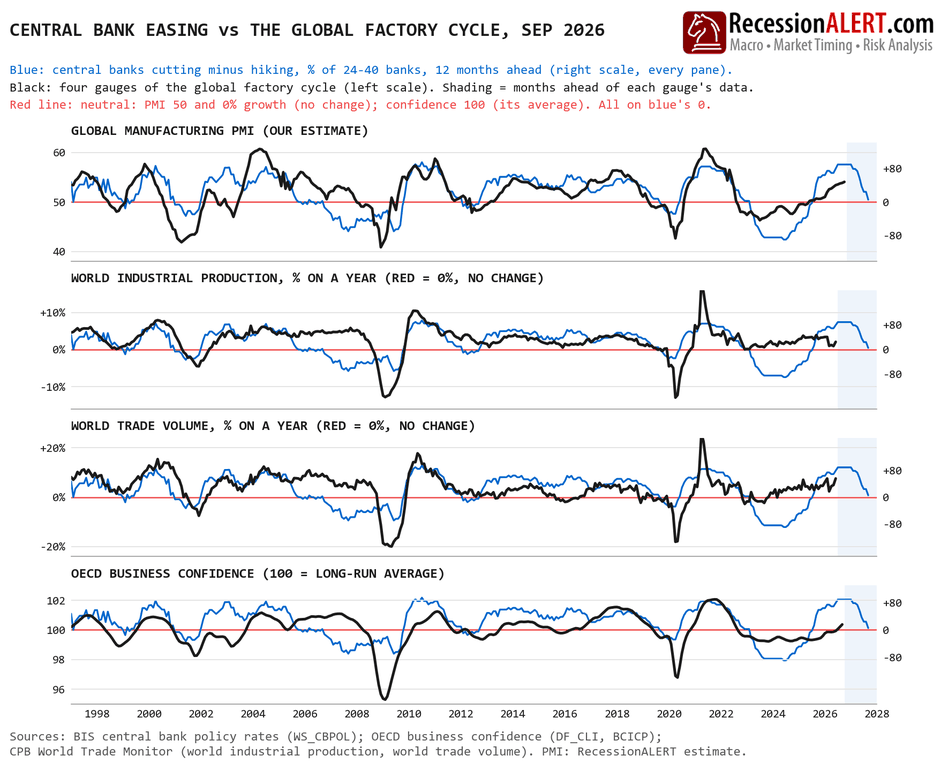
All four factory gauges on this chart sit above neutral, yet the policy support behind them is nearly gone. Our estimate of the global manufacturing PMI, a purchasing managers’ survey, reads 54.1, and OECD business confidence is above its long-run average for the first time since 2022 — but that strength looks like last year’s easing arriving. The blue line asks each central bank one question: was your last move a cut or a hike? A bank that cuts again adds nothing; the line falls mainly when one changes sides, and 16 of 38 did this year, the Fed, the ECB and Australia among them — only Brazil went the other way. That headcount took net cutting from +89.5 in January to +5.6 in September, the third-fastest swing toward hiking since 1998. Only 2000 and 2022 moved faster, and 2000 is the closer match: its gauges were strong, as now, and all four fell below neutral within two to thirteen months. Nor did that warning rest on one survey’s mood: hard output, trade volumes and confidence all track the same line about a year later. Easier money usually reaches factories with a delay — here four to twenty months — so the drop lands in the shaded 2027 stretch if the lead holds. Two episodes are not a law, and one month under the +23.6 average is not a trend. Today’s upswing is not momentum — it is an echo.
What it means: The factory upturn now rests on easing that stopped in January. Shares tied to factories have already lagged: US industrial shares are up 1.6% since then, against 11.3% for the S&P 500. If the year-long lead holds, factory surveys will soften through 2027, and companies counting on rising orders next year are counting on support that has gone. For the world economy, June’s 2.1% growth in factory output is the starting point for a slower 2027. That changes if central banks turn back to cutting, lifting the share above its long-run average of +23.6.
Market Intelligence Brief (MIB) Ver. 19.89
For professional investors only. Not investment advice.
© 2026 RecessionALERT.com

Comments are closed.