
MARKET INTELLIGENCE BRIEF (MIB)
Friday, October 9, 2026
Software lifted the S&P 500 0.59% back above 7,800 after Bloomberg said OpenAI expects at least $70B in annualized revenue by year-end, but Intel and AMD kept sliding. Michigan long-run inflation expectations hit 3.5%, the highest since May, while the 2-year yield rose 3.7 bps. The White House set a Nov 5 hearing on whether to remove Fed Governor Cook. Treasury licensed Russian diesel imports through April 2027. Apple reportedly cut iPhone 18 Pro component orders at least 15%.
TABLE OF CONTENTS
A. EXECUTIVE SUMMARY
B. MARKET DATA
C. HIGH-IMPACT STORIES (5)
D. MODERATE-IMPACT STORIES (5)
E. ECONOMY WATCH (4)
F. EARNINGS WATCH (0)
G. WHAT’S NEXT
H. CHART OF THE DAY
A. EXECUTIVE SUMMARY -> TOP
Stocks rebounded from Thursday’s AI-revenue scare after Bloomberg reported that OpenAI expects at least $70 billion in annualized revenue by year-end, but the market repriced AI adoption, not AI capacity: software surged while chipmakers extended their slide, and a reported cut to iPhone 18 Pro component orders after a memory-cost-driven price increase added a demand caution to the chip group. Bonds did not share the relief, with the 2-year yield up 3.7 bps against 1.5 bps for the 10-year and December hike odds at 82%, on a day the Michigan survey put long-run inflation expectations at 3.5%, the highest since May. Crude settled flat even after a laden supertanker was struck off the UAE, outside the Hormuz area, so the wider risk zone Iran now claims is not yet in the price. Nine of 11 sectors rose, led by Consumer Cyclical, Healthcare and Basic Materials, yet Technology remains down 1.09% on the week: AI leadership has fractured rather than recovered.
• OpenAI relief splits tech: Bloomberg says OpenAI expects at least $70 billion in annualized revenue by year-end, up from about $50 billion at the end of September. Palantir rose 5.17%, Palo Alto Networks 5.09%, CrowdStrike 4.57% and Microsoft 2.38%, while Intel fell 2.22%, AMD 2.03% and Sandisk 1.72%. The S&P 500 gained 0.59% to 7,811.54.
• Consumer squeeze deepens: Michigan sentiment fell to 46.3 against a 47.6 forecast, with current conditions down to 44.7 from 50.9. Year-ahead inflation expectations rose to 4.7% and long-run to 3.5%, both the highest since May, and only 31% of consumers plan to keep buying as usual where prices have jumped.
• Fed independence on trial: A White House committee will hold a closed hearing on Thursday, November 5 on whether there is “cause” to remove Fed Governor Lisa Cook, between the October 27-28 FOMC meeting and the next one.
• Russian diesel licensed: Treasury’s General License 135 authorizes imports of Russian-origin diesel until April 7, 2027, after President Trump said Russia would immediately supply over 300,000 tons. WTI ($91.50) and Brent ($104.25) were essentially flat.
• Gulf risk zone widens: The fully laden supertanker GEM NO.2 was struck at anchor off the UAE, outside the Hormuz area, as Iran’s Revolutionary Guard said its enforcement would no longer be confined to the strait.
• Apple trims iPhone builds: Apple (-1.10%) cut October iPhone 18 Pro and Pro Max component orders by at least 15% against its original requests after a $100 price increase it blames on AI-driven memory costs, Nikkei Asia reported.
1. The AI trade has split into buyers and builders — A disputed OpenAI run-rate was enough to restore the case for software, which benefits from enterprise adoption, but not for semiconductors, whose valuations rest on capital spending that OpenAI’s revenue must ultimately fund. Apple’s order cut adds a second strain: the memory costs that lift memory suppliers’ margins are now raising handset prices enough to cut volumes. Until hard orders arrive, portfolios should treat the adoption layer and the capacity layer as separate trades rather than one AI exposure.
2. Expectations are making the Fed’s case for it — A second monthly rise in long-run inflation expectations weakens the argument that the Fed can look through the energy shock, and a 2-year yield that rose on an up day for stocks, with December hike odds at 82%, shows the market pricing tighter policy rather than weaker growth. Falling current conditions alongside rising expectations is the awkward mix for equities: slower consumer spending and higher rates at once. The Russian diesel license is the one disinflationary offset, and it only counts if the barrels actually load.
3. Washington is now a direct source of rates and energy risk — The Cook committee gives the administration the notice-and-hearing process the Supreme Court required, making a removal before year-end a realistic outcome; with the 10-year at 5.244%, any repricing of Fed independence into the term premium would be costly. At the same time, Washington is easing sanctions on Moscow’s energy exports less than four weeks before the midterms, and Commerce’s definition of “U.S. content” for the metals tariff on USMCA goods takes effect Wednesday. Policy, not data alone, is setting the path for yields, fuel costs and supply-chain margins.
 — Leading economic indicators. Accurate market forecasts. Apply for membership at join.recessionalert.com
B. MARKET DATA -> TOP
Stocks recovered Thursday’s AI-revenue scare as an overnight Bloomberg report that OpenAI expects about $70 billion in annualized revenue by year-end calmed nerves, lifting the S&P 500 back above 7,800 and the Dow 0.83%. The rebound was a software story, not a chip story: Palantir, Palo Alto Networks and CrowdStrike gained 4.6-5.2% while Intel, AMD and Sandisk extended Thursday’s slide, holding the Nasdaq 100 to a 0.51% gain. Breadth was wide, with nine of 11 sectors higher and Communication Services the laggard as a SpaceX spectrum purchase hit telecom carriers. Metals rallied hard while crude finished flat against Thursday’s settlement, and the 2-year yield rose 3.7 bps on an up day for equities.
CLOSING PRICES – Friday, October 9, 2026:
MAJOR INDICES
The Dow led and the NYSE Composite matched the S&P 500’s 0.59% gain, so the rebound was broad rather than a mega-cap squeeze; the Nasdaq 100 trailed as chip weakness offset the software surge. Transports were flat while the industrials rallied, yet both remain within 2% of their 10-session highs, a Dow Theory bull confirmation that extends into a second session after Wednesday’s break. The S&P 500 and Russell 2000 closed back above 7,800 and 2,800, though the S&P remains below Tuesday’s 7,818.93.
| Index | Close | Change | %Move | Why It Moved |
|---|---|---|---|---|
| S&P 500 | 7,811.54 | +46.18 | +0.59% | Software-led rebound from Thursday’s AI-revenue selloff after a Bloomberg report that OpenAI expects about $70bn in annualized revenue by year-end; closed back above 7,800 |
| Dow Jones | 51,654.95 | +423.31 | +0.83% | Led the major indices on a broad advance, with nine of 11 sectors higher |
| DJ Transportation | 19,804.14 | -4.93 | -0.02% | Flat; no discrete same-day catalyst identified for the index. Delta Air Lines’ results were the session’s notable transport news (earnings-driven) |
| Nasdaq 100 | 30,883.15 | +157.34 | +0.51% | Software (Palantir, Palo Alto Networks, CrowdStrike, Microsoft) rebounded while chipmakers (Intel, AMD) extended Thursday’s slide and Apple fell 1.10% |
| Russell 2000 | 2,806.98 | +12.85 | +0.46% | Joined the broad rebound and closed back above 2,800; still down 1.08% over 10 sessions against +0.88% for the S&P 500 |
| NYSE Composite | 23,939.10 | +141.50 | +0.59% | Matched the S&P 500, confirming the advance was broad rather than mega-cap led |
VOLATILITY & TREASURIES
The VIX fell as equities rebounded, but bonds did not join the relief: the 2-year rose 3.7 bps against 1.5 bps for the 10-year, flattening the 2s10s spread to 45.1 bps from 47.3. A front-end selloff on an up day for stocks is consistent with the hike path already priced, with CME FedWatch showing 82% odds of a December increase. The dollar edged up 0.07%.
| Instrument | Level | Change | Why It Moved |
|---|---|---|---|
| VIX | 14.84 | -0.57 (-3.70%) | Eased as equities recovered Thursday’s AI-revenue selloff |
| 10-Year Treasury Yield | 5.244% | +1.5 bps | No discrete same-day catalyst identified; lagged the front end |
| 2-Year Treasury Yield | 4.793% | +3.7 bps | No discrete same-day catalyst identified; follows St. Louis Fed President Musalem’s Thursday (Oct 8) call for further tightening |
| US Dollar Index (DXY) | 102.21 | +0.08 (+0.07%) | Edged higher; no discrete same-day catalyst identified |
COMMODITIES
Precious and industrial metals rallied together despite a firmer dollar and higher yields, so the move was not a rates or currency trade. Copper rising alongside gold does not fit a pure haven bid, and no single catalyst for the metals complex was confirmed. Bitcoin’s 0.82% gain tracked the equity rebound.
| Asset | Price | Change | %Move | Why It Moved |
|---|---|---|---|---|
| Gold | $4,221.05/oz | $+64.05 | +1.54% | No confirmed catalyst; one outlet credited easing oil, but crude was flat against Thursday’s settlement. Rose despite a firmer dollar and higher yields |
| Silver | $61.09/oz | $+1.67 | +2.80% | No discrete same-day catalyst identified; rose with the broad metals rally |
| Copper | $6.7083/lb | $+0.1398 | +2.13% | Joined the metals rally; UBS reiterated its view that the copper deficit widens in 2027, not established as the driver |
| Platinum | $1,697.70/oz | $+55.70 | +3.39% | No discrete same-day catalyst identified; the largest gain among the metals |
| Bitcoin | $82,467.00 | $+670.00 | +0.82% | Tracked the equity rebound; no crypto-specific catalyst identified |
ENERGY
WTI and Brent finished essentially unchanged against Thursday’s settlement, holding Brent’s 4% jump from the day before rather than giving it back. Natural gas decoupled from crude on both sides of the Atlantic, with Henry Hub up 0.88% and Dutch TTF up 3.13%.
| Asset | Price | Change | %Move | Why It Moved |
|---|---|---|---|---|
| Crude Oil (WTI) | $91.50/bbl | $+0.01 | +0.01% | Flat against Thursday’s settlement. Trump’s Thursday statement that the US would not strike Iran before the midterms and China’s resumption of fuel exports weighed, while Gulf of Mexico shut-ins ahead of Isaias supported |
| Crude Oil (Brent) | $104.25/bbl | $-0.03 | -0.03% | Held Thursday’s 4% jump; the same offsetting forces as WTI |
| Natural Gas (Henry Hub) | $3.196/MMBtu | $+0.028 | +0.88% | Edged up with Isaias nearing the Gulf Coast and producers shutting in Gulf output; the storm’s effect on gas prices was not quantified |
| Natural Gas (Dutch TTF) | $26.72/MMBtu | $+0.81 | +3.13% | No discrete same-day catalyst identified |
S&P 500 SECTORS
Nine of 11 sectors rose, a broad sweep led by Consumer Cyclical, Healthcare and Basic Materials; the holdouts were Communication Services (-0.55%), where telecom carriers sank on the SpaceX spectrum deal, and Energy (-0.03%) with crude flat. Technology’s modest 0.37% gain masks a split between rallying software and falling chips, and it is one of only two sectors down on the week, alongside Industrials.
| Sector | 1-Day | 1-Week | 1-Month | 3-Month | 6-Month | YTD | 12-Month |
|---|---|---|---|---|---|---|---|
| Consumer Cyclical | +1.64% | +3.06% | +1.31% | -2.03% | +0.42% | -5.93% | -6.80% |
| Healthcare | +1.54% | +2.05% | +1.80% | +2.91% | +11.91% | +8.03% | +14.57% |
| Basic Materials | +1.52% | +0.93% | -3.85% | +5.11% | -5.63% | +11.78% | +16.88% |
| Real Estate | +1.37% | +1.09% | -3.94% | -7.90% | -3.18% | +1.68% | -0.40% |
| Utilities | +0.76% | +3.76% | -1.67% | -8.80% | -11.87% | -3.14% | -7.70% |
| Financial | +0.68% | +1.12% | -4.11% | -2.68% | +7.58% | +2.72% | +7.02% |
| Industrials | +0.53% | -0.54% | +0.44% | -4.26% | -2.60% | +9.36% | +9.08% |
| Technology | +0.37% | -1.09% | +5.81% | +10.19% | +32.69% | +31.22% | +27.08% |
| Consumer Defensive | +0.18% | +4.16% | +1.93% | -0.61% | -0.63% | +6.71% | +7.79% |
| Energy | -0.03% | +3.23% | -0.55% | +11.44% | +7.99% | +40.60% | +41.46% |
| Communication Services | -0.55% | +0.85% | +2.73% | -0.63% | +3.35% | +1.17% | +7.18% |
TOP MEGA-CAP MOVERS:
GAINERS
| Company | Ticker | Close | Change | Why It Moved |
|---|---|---|---|---|
| Palantir Technologies | PLTR | $209.05 | +5.17% | No discrete company catalyst identified; software led the tech rebound after a Bloomberg report that OpenAI expects about $70bn in annualized revenue by year-end eased Thursday’s AI-revenue fears |
| Palo Alto Networks | PANW | $418.78 | +5.09% | No discrete company catalyst identified; part of the software-led rebound |
| CrowdStrike Holdings | CRWD | $275.04 | +4.57% | Part of the software rebound; Needham raised its price target to $310 from $250 in a note reported Friday morning, though the report dates the note to Wednesday (unverified) |
| Oracle | ORCL | $141.40 | +4.21% | Rebounded from Thursday’s drop; one outlet cites a company statement that its Project Jupiter campus remains on schedule, but a matching statement dates to late September, so a same-day trigger is unverified |
| Amazon.com | AMZN | $262.48 | +3.31% | No discrete same-day catalyst identified; outpaced Consumer Cyclical (+1.64%) by 1.7 points |
DECLINERS
| Company | Ticker | Close | Change | Why It Moved |
|---|---|---|---|---|
| Intel | INTC | $104.70 | -2.22% | No discrete same-day catalyst identified; chipmakers extended Thursday’s (Oct 8) slide on the FT report that OpenAI’s revenue run-rate trails prior signals and did not join the software rebound |
| Advanced Micro Devices | AMD | $608.10 | -2.03% | No discrete same-day catalyst identified; fell with the chip group as software rebounded |
| Netflix | NFLX | $70.30 | -1.77% | Reuters, citing Puck News, reported Netflix plans to cut about 5% of its workforce (the company declined to comment); not established as the driver of the decline |
| Sandisk | SNDK | $1,581.82 | -1.72% | No discrete same-day catalyst identified; memory and chip names lagged the software rebound |
| Home Depot | HD | $290.74 | -1.60% | No discrete same-day catalyst identified; fell against a Consumer Cyclical sector up 1.64% |
— Institutional-grade intelligence for serious investors. Apply for membership at join.recessionalert.comC. HIGH-IMPACT STORIES -> TOP
BULLISH
1. Bloomberg Says OpenAI Expects at Least $70 Billion in Annualized Revenue by Year-End, and Software Leads the S&P 500 Back Above 7,800 as Chipmakers Keep Falling
The core facts:Bloomberg reported late Thursday, citing people familiar with the matter, that OpenAI expects to reach or exceed $70 billion in annualized revenue by the end of 2026, driven largely by enterprise customers, from roughly $50 billion at the end of September; the figures were shared with investors in talks over its latest fundraising. OpenAI declined to comment. Bloomberg attributed the roughly $20 billion gap reported by the Financial Times on Thursday to investors calculating OpenAI’s run-rate on a method that treats cloud-provider sales differently. The S&P 500 rose 0.59% to 7,811.54 and the Dow 0.83%, but the Nasdaq 100 gained only 0.51% because the recovery split by industry: Palantir rose 5.17%, Palo Alto Networks 5.09%, CrowdStrike 4.57% and Microsoft 2.38%, while Intel fell 2.22%, AMD 2.03% and Sandisk 1.72%.
Why it matters:Thursday’s selloff priced the risk that one of the largest buyers of AI compute was earning far less than assumed; Friday’s report repriced that risk for the software layer but not for semiconductors. That split matters more than the index gain. Software companies benefit from OpenAI’s enterprise traction as a demand signal for AI-enabled applications, whereas chipmakers’ valuations rest on the capital spending that OpenAI’s revenue must ultimately fund, and the market did not treat a disputed run-rate figure as enough to restore that case. Technology rose only 0.37% and remains down 1.09% on the week, so the AI trade has not recovered its leadership: it has fractured into beneficiaries of adoption and suppliers of capacity.
What to watch:ASML on Wednesday, October 14 and Taiwan Semiconductor on Thursday, October 15 give an early hard read of AI capital spending this season; strong orders would test whether the chip group’s lag reflects fundamentals or positioning.
UNCERTAIN
2. White House Sets Up a Committee to Decide Whether There Is “Cause” to Remove Fed Governor Lisa Cook, With a Hearing on November 5
The core facts:A presidential memorandum dated October 7 and first reported Friday establishes a three-member committee of inquiry, made up of the Assistant to the President for Economic Policy, the Chairman of the Equal Employment Opportunity Commission and the Director of the Office of Government Ethics, to investigate the allegations against Governor Cook and report “whether there is ’cause’ for Governor Cook’s removal” under 12 U.S.C. 242, as construed by the Supreme Court in Trump v. Cook. Cook’s written position is due three days before a closed hearing at the White House on Thursday, November 5, limited to four hours, with a post-hearing written statement due by Tuesday, November 10. The memorandum states that it is the President’s job to ensure the laws are faithfully executed, “including by firing subordinates who cannot be trusted to tell the truth.” No market reaction to the announcement was identified.
Why it matters:The Supreme Court’s ruling in Trump v. Cook allowed the administration to try again provided it gave notice and a hearing, and this memorandum supplies that process, which makes a removal decision before year-end a realistic outcome rather than a legal tail risk. The timing is sensitive: the hearing falls between the October 27-28 FOMC meeting and the next one, while the Committee is already debating how many more hikes it needs. A successful removal would establish that a governor can be dismissed through an executive-branch fact-finding process, and investors who price Fed independence into long-dated yields and the dollar would have to treat each Board seat as more exposed to political pressure. With the 10-year Treasury at 5.244%, a larger term premium would be costly.
What to watch:Cook’s written response due Monday, November 2 and any legal challenge to the committee’s process before the November 5 hearing; a widening gap between 10-year and 2-year yields would signal a rising term premium.
BULLISH
3. Treasury Licenses Russian Diesel Imports Through April 2027 After Trump Says Putin Will “Immediately” Supply 300,000 Tons
The core facts:The Treasury’s Office of Foreign Assets Control issued General License 135 on Friday afternoon, authorizing the sale, delivery, offloading and importation, including into the United States, of diesel fuel of Russian origin until 12:01 a.m. on April 7, 2027. The license bars any debits to accounts of Russia’s central bank, National Wealth Fund or Ministry of Finance. It followed a post by President Trump saying Russia “will immediately supply over 300,000 Tons of Diesel Fuel to the American and Global Marketplace,” with another 500,000 tons in November and 1,000,000 tons after that, and calling lower prices for farmers, ranchers and truckers his “Greatest Priority.” Russia had extended its own ban on most diesel exports through October 31.
Why it matters:Diesel has been the tightest part of the energy shock, with Russia, normally one of the world’s largest diesel exporters, restricting exports while its refining has been disrupted. A licensed return of Russian barrels addresses the product shortage directly, which matters more for freight and farm costs than crude does; WTI ($91.50) and Brent ($104.25) were both essentially flat on Friday. It is also a significant policy reversal: Washington is easing sanctions on Moscow’s energy exports less than four weeks before the midterms, so the measure carries political risk alongside its disinflationary effect. For a Fed that has signaled further hikes, lower distillate prices would ease the energy component of inflation and the cost pressures being passed through the economy.
What to watch:Whether the first 300,000 tons actually load, and whether Russia lifts its export ban when it expires on Saturday, October 31; September CPI on Wednesday, October 14 will show how much energy is adding to inflation before any relief arrives.
BEARISH
4. A Fully Laden Supertanker Is Struck Off the UAE, Outside the Hormuz Area, as Iran Says It Will Pursue Vessels Using “Unauthorized” Routes Across the Region
The core facts:The Panama-flagged, fully laden crude supertanker GEM NO.2 was struck by an unknown projectile at 10:00 GMT on Friday while at anchor 13 nautical miles west of Al Jazeera in the United Arab Emirates, according to the UK Maritime Trade Operations center. A fire broke out and was extinguished; the condition of the crew, the extent of damage and any environmental impact were unknown, and no one claimed the attack. Separately, Iran’s Revolutionary Guard navy said through state-affiliated media that it had struck an LPG carrier attempting to transit what it called an unauthorized route south of the Strait of Hormuz, and that enforcement would no longer be confined to the strait. The United States had not confirmed that strike. Crude settled flat, with WTI at $91.50 and Brent at $104.25.
Why it matters:The market has been pricing risk to transits through the strait; an attack on a laden tanker at anchor off the UAE extends that risk to loading and waiting areas that had been treated as safer, and Iran’s statement explicitly claims that wider reach. Crude’s flat close shows that the offsetting forces dominated on the day, including President Trump’s Thursday pledge not to attack Iran before the midterms and China’s resumption of fuel exports. That also means the strikes are not in the price: freight rates and war-risk insurance are the channel through which a wider risk zone reaches delivered costs. With Brent above $100 and Section E reporting year-ahead inflation expectations at 4.7%, a further supply shock would land on an economy where the Fed is already leaning toward hikes.
What to watch:Any US Central Command response or naval escort announcement, and whether Brent holds above $100 if further strikes occur outside the strait.
BEARISH
5. Nikkei Says Apple Cut October iPhone 18 Pro Component Orders by At Least 15% After a $100 Price Increase Driven by Memory Costs Dented Demand
The core facts:Apple reduced October component orders for the iPhone 18 Pro and Pro Max “by at least 15 percent compared with what was originally requested,” Nikkei Asia reported on Friday, citing its own sources. Apple has been more cautious about shipments since early September after demand between late August and October came in softer than expected. The Pro models start at $1,199 and $1,299, $100 more than the models they replace, and Apple has publicly blamed AI-driven memory chip costs for price increases across its lineup. Apple did not comment. Its shares fell 1.10%.
Why it matters:This is concrete evidence that the AI build-out is raising costs for consumer hardware enough to cut volumes. Apple attributes its price increases to AI-driven memory costs; if those costs push handset prices up and unit demand down, the margin gain for memory suppliers comes at the expense of the consumer electronics supply chain. For Apple, a cut against its own original requests implies either lower shipments or lower margins in the holiday quarter. For the market, it adds a demand-side caution to a chip group that already did not join Friday’s software rebound.
What to watch:Taiwan Semiconductor’s results and guidance on Thursday, October 15 for any comment on smartphone demand, and Apple’s next quarterly report for its December-quarter outlook.
— Quantifying recession risk so you don’t have to guess. Apply for membership at join.recessionalert.comD. MODERATE-IMPACT STORIES -> TOP
BEARISH
6. Rising Long-Run Inflation Expectations in the Michigan Survey Strengthen the Case for More Fed Hikes as the 2-Year Yield Climbs 3.7 Bps
The core facts:The University of Michigan’s preliminary October survey, covered in full in Section E, showed sentiment slipping to 46.3 and long-run inflation expectations rising to 3.5%, the highest since May. The 2-year Treasury yield rose 3.7 bps to 4.793% and the 10-year 1.5 bps to 5.244% on a day the S&P 500 gained 0.59%, flattening the 2s10s spread to 45.1 bps from 47.3; no source tied the move directly to the release. Futures put the odds of a December rate increase at 82%.
Why it matters:Long-run expectations are the measure the Fed watches for evidence that the energy shock is becoming entrenched, and a second monthly rise weakens the argument that policymakers can look through a supply shock. A front end that sells off while equities rally is the market pricing tighter policy rather than weaker growth. The combination of falling current conditions and rising expectations is an awkward one for equities: it implies slower consumer spending and higher rates at the same time.
What to watch:September CPI on Wednesday, October 14 (headline expected 3.6%) and the final October Michigan reading on Friday, October 23; a break in the 2-year yield above 4.80% would show markets moving toward a hike at the October 27-28 meeting.
UNCERTAIN
7. Meta Bars ByteDance From Advertising on Its Apps in the US and Six Other Countries, Escalating Its Rivalry With TikTok
The core facts:Meta Platforms has begun enforcing a complete restriction on advertisements and paid marketing messages from ByteDance, the Chinese company that still runs key parts of TikTok in the US, Bloomberg reported Thursday evening. The ban applies in the US, Canada, Egypt, Indonesia, Japan, Thailand and Vietnam, and also covers third-party advertisers running campaigns that link to TikTok and other ByteDance properties in those countries. “We don’t have to run ads from a competitor whose goal is to pull people off our apps,” Meta spokesperson Chris Sgro said. How much ByteDance spends on Meta’s platforms has not been disclosed.
Why it matters:Meta is giving up advertising revenue to deny a rival access to its users, which suggests it considers user acquisition by TikTok more costly than the lost spending. The move follows Meta’s $18 billion settlement with US states in August, which requires new safety features for minors, and its push for TikTok and YouTube to adopt similar changes; Meta is now competing on terms it can control. The direct revenue effect is likely small relative to Meta’s advertising base, but a public dispute between two of the largest social video platforms raises the possibility of retaliation and complicates advertisers’ cross-platform campaigns.
What to watch:Any response from TikTok restricting links to Meta’s apps, and Meta’s third-quarter report for commentary on advertiser demand.
BULLISH
8. Avolon Orders 250 Jets, Including 140 Boeing 737 MAX Aircraft and 110 From Airbus, With Options on 100 More
The core facts:Aircraft lessor Avolon placed firm orders for 250 aircraft on Friday: 140 Boeing 737 MAX jets and 110 from Airbus, comprising 75 A320neo-family narrowbodies and 35 A330-900 widebodies, with options on another 100 Airbus aircraft. Value and delivery schedule were not disclosed. The order requires approval by shareholders of Bohai Leasing, Avolon’s 70% owner, expected before the end of October, and lifts Avolon’s total firm commitments to 749 aircraft. “We continue to see strong demand for new aircraft, and this order further strengthens our long-term delivery pipeline,” said Chief Executive Andy Cronin.
Why it matters:A lessor committing to 140 MAX aircraft is a vote of confidence in Boeing’s ability to deliver at higher rates, since lessors are paid only once aircraft are handed over and placed with airlines. Lessors also order where they expect airline demand years ahead, so an order of this size signals that the industry still sees a shortage of new narrowbodies despite jet fuel costs inflated by the energy shock. For Boeing, firm orders strengthen the backlog that supports its production ramp and cash-flow recovery, although the order remains conditional until Bohai’s shareholders approve it.
What to watch:The Bohai Leasing shareholder vote, expected before the end of October, which turns the order from conditional to firm.
UNCERTAIN
9. CFTC Rules That Sportsbook Wagers and Casino Games Are Not Swaps, Drawing a Line Between State-Regulated Gambling and Federally Regulated Markets
The core facts:The Commodity Futures Trading Commission issued an interim final rule on Friday excluding casino-style gambling products, including sportsbook wagers and casino games, from the definition of a “swap” under the Commodity Exchange Act. The rule takes effect on publication in the Federal Register, with a 30-day comment period afterwards. “Casino-style gambling products are not derivatives,” Chairman Michael Selig said, adding that the Commission was clarifying “the limits of its regulatory remit,” as it has for other products historically regulated by the states.
Why it matters:The fight over sports-related event contracts turns on whether they are federally regulated derivatives or state-regulated gambling. By ruling that traditional sportsbook and casino products fall outside its jurisdiction, the CFTC leaves those businesses with state regulators, which appears to favor licensed sportsbook operators, while leaving open how event contracts traded on prediction markets will be treated. That ambiguity is the key issue for brokers and exchanges that have expanded into prediction markets, so the rule reduces uncertainty for one side of the dispute without resolving it for the other.
What to watch:Federal Register publication, which starts the 30-day comment period, and any CFTC action defining which event contracts do count as swaps.
UNCERTAIN
10. Commerce Defines “U.S. Content” for the Metals Tariff on USMCA Goods From Canada and Mexico, Effective October 14
The core facts:The Commerce Department’s Bureau of Industry and Security filed guidance with the Federal Register on Friday telling US Customs and Border Protection how to assess “U.S. content” in Canadian and Mexican products that qualify for USMCA preferences, for purposes of the steel, aluminum and copper tariffs set under Proclamation 11032 of June 1, 2026. US content is defined as the value of parts wholly obtained, produced or substantially transformed in the United States, plus, where not already counted, the value of steel melted and poured, or aluminum and copper smelted and cast, in the United States. The guidance applies to goods entered from 12:01 a.m. Eastern Time on the date of publication, scheduled for Wednesday, October 14.
Why it matters:The June proclamation ties the metals tariff on USMCA-qualifying goods to how much of their value is US content, but importers could not calculate their liability until Commerce defined that content. The definition rewards supply chains that use US-melted steel and US-smelted aluminum and copper, which favors domestic metal producers and gives automakers and machinery makers with integrated North American supply chains a clearer, and in many cases lower, tariff cost. It does little for products built mainly from imported metal, so the benefit will be uneven across companies.
What to watch:Implementation from Wednesday, October 14, and any comments from automakers in third-quarter results on how the guidance changes their tariff costs.
— Separating signal from noise since 2007. Apply for membership at join.recessionalert.comE. ECONOMY WATCH -> TOP
Consumers are absorbing the inflation shock in their sentiment before it shows up in the spending data. The University of Michigan’s current-conditions gauge fell 12.2% to 44.7 as year-ahead inflation expectations rose to 4.7%, and a companion report found only 31% of consumers plan to keep buying as usual where prices have jumped. Nominal activity has not cracked: wholesale sales rose 1.8% in August, although that figure is not adjusted for prices. Higher mortgage rates are suppressing housing turnover rather than prices, which Cotality puts up 1.8% over the year. Wednesday’s September CPI, expected at 3.6%, and Thursday’s retail sales will show whether cautious intentions are turning into actual cutbacks.
Michigan Sentiment Slips to 46.3, Missing the 47.6 Forecast, as Current Conditions Drop 12.2% and Inflation Expectations Climb to 4.7% (University of Michigan, Oct 9)
What they’re saying:The preliminary October Index of Consumer Sentiment fell to 46.3 from 48.1 in September, below the 47.6 consensus and 13.6% below a year earlier. The weakness was concentrated in the Current Economic Conditions index, which dropped to 44.7 from 50.9 against a 50.5 forecast, while the Index of Consumer Expectations rose to 47.3 from 46.3, beating the 45.9 forecast. Year-ahead inflation expectations rose to 4.7% from 4.6% and long-run expectations to 3.5% from 3.4%, both the highest since May.
The context:Survey director Joanne Hsu said buying conditions for durables “plummeted amid high prices and borrowing costs” and that “frustration over cost-of-living continues to mount,” with the steepest declines among lower-income consumers and those with smaller stock holdings. Year-ahead expectations of 4.7% are well above the 3.4% recorded in February, before the Iran conflict began, and inflation expectations over both horizons have now risen for a second straight month. For a Fed already signalling further hikes, rising long-run expectations are the more consequential part of the release, because they bear directly on whether higher inflation becomes entrenched.
What to watch:September CPI on Wednesday, October 14 (headline expected 3.6% YoY from 3.4%; core expected 2.5% from 2.4%), and September retail sales on Thursday, October 15, which will test whether weaker sentiment is reaching spending. The final October Michigan reading is due Friday, October 23.
Only 31% of Consumers Plan to Keep Buying as Usual Where Prices Have Jumped, as Gasoline Nears $4.50 Again (University of Michigan Special Report, Oct 9)
What they’re saying:In interviews conducted June 23 to September 21, 31% of consumers said they would keep spending as usual over the next year on items with particularly large price increases, 54% said they would cut back and 16% said they would stop buying such items altogether. Citing AAA, the report notes gasoline averaged about $2.93 a gallon before the Middle East conflict began on February 28, rose above $4.50 in May and approached $4.50 again in September.
The context:The 16% planning to stop buying is the highest of the three periods the survey compares, against 13% during the April-July 2025 tariff episode and 8% in mid-to-late 2022 near the post-pandemic inflation peak. The share planning to spend as usual sits between those two periods (26% in 2025, 37% in 2022). The report cautions that consumers may cut back on some items without reducing overall spending, and that they have little room to reduce driving for their commute, so the readings describe intentions rather than measured spending.
What to watch:September retail sales on Thursday, October 15 (control group prior +1.4%) is the first hard test of whether these intentions are reaching actual spending.
Wholesale Sales Jump 1.8% in August While Inventories Are Revised Down to a 0.5% Gain, Leaving the Inventory-to-Sales Ratio at 1.18 (Census Bureau, Oct 8)
What they’re saying:Sales at merchant wholesalers rose 1.8% in August to $817.5 billion and were 15.6% higher than a year earlier, with July’s gain revised up to 1.0% from 0.8%. Inventories rose 0.5% to $964.2 billion, revised down from the 0.7% advance estimate, and were 6.4% above August 2025. The inventory-to-sales ratio stood at 1.18, against 1.28 a year earlier.
The context:The sales figures are not adjusted for price changes, so with headline inflation at 3.4% part of the 15.6% annual gain reflects higher prices rather than volume. The lower inventory revision reduced the Atlanta Fed’s estimate of inventories’ contribution to third-quarter growth to 1.98 percentage points from 2.07, and its GDPNow estimate eased to 3.6% from 3.7%. Stockpiles that are growing more slowly than sales leave distributors lean, which supports future restocking but trims the inventory boost to third-quarter output.
What to watch:August business inventories and September retail sales on Thursday, October 15, together with the Atlanta Fed’s GDPNow update the same day.
Home Prices Rise 1.8% Year Over Year in August but Slip 0.1% on the Month as High Mortgage Rates Hold Down Sales (Cotality, Oct 6)
What they’re saying:Cotality’s single-family home price index rose 1.8% from a year earlier in August and fell 0.1% from July. Prices declined year over year in three states (Texas and Hawaii at -0.7% and Washington at -0.4%), and the firm projects a 1.7% gain over the 12 months to August 2027.
The context:Cotality said that “high mortgage rates continue to suppress transaction volumes, but severe inventory constraints in the Midwest and Northeast are insulating home prices from broader declines.” The August data predate the latest rise in borrowing costs: Freddie Mac’s 30-year rate reached 7.40% this week from 7.28%. With annual price gains below the 3.4% headline inflation rate, real home prices are falling, and a market adjusting through lower volumes rather than lower prices limits the wealth effect on spending but also the risk of forced selling.
What to watch:September existing home sales on Tuesday, October 13 (expected 3.97 million, prior 3.98 million) and the MBA mortgage rate on Wednesday, October 14 (prior 7.49%).
— Know the probability before the market prices in the risk. Apply for membership at join.recessionalert.comF. EARNINGS WATCH -> TOP
YESTERDAY AFTER THE BELL (Markets Reacted Today)
No major earnings yesterday after the bell from companies with >$100B market cap.
TODAY BEFORE THE BELL (Markets Already Reacted)
No major earnings before the bell from companies with >$100B market cap.
TODAY AFTER THE BELL (Markets React Tomorrow)
No major earnings after the bell from companies with >$100B market cap.
WEEK AHEAD PREVIEW:
Q3 2026 earnings season is just beginning (3.8% of the S&P 500 reported as of October 9). The large banks, Johnson & Johnson and UnitedHealth open the season in earnest on Tuesday, October 13; ASML, Bank of America, Morgan Stanley, BlackRock and Progressive follow on Wednesday, October 14; and Charles Schwab and Prologis report on Thursday, October 15.
JPMorgan Chase (JPM) — BMO, Tuesday, October 13 — Consensus EPS $5.93 on revenue of $51.23 billion. Key focus: net interest income guidance with Fed officials signaling more hikes and the 2-year yield at 4.793%, trading revenue in a volatile rates quarter, and credit commentary after its own strategists flagged the most deeply distressed leveraged loans since March 2020.
Johnson & Johnson (JNJ) — BMO, Tuesday, October 13 — Consensus EPS $2.50 on revenue of $25.38 billion. Key focus: medtech exposure to the coming Section 232 device tariffs after Becton Dickinson’s investment-for-relief deal, and pharmaceutical growth guidance for 2027.
UnitedHealth Group (UNH) — BMO, Tuesday, October 13 — Consensus EPS $4.15 on revenue of $111.31 billion. Key focus: medical cost trends and margin guidance for 2027, plus its first comments on the 2027 Medicare Advantage Star Ratings published October 8, which drive quality-bonus revenue.
Goldman Sachs (GS) — BMO, Tuesday, October 13 — Consensus EPS $12.86 on revenue of $16.83 billion. Key focus: advisory and underwriting fees in an active quarter for large mergers and AI-related debt financing, and fixed-income trading revenue with the 10-year above 5.2%.
Wells Fargo (WFC) — BMO, Tuesday, October 13 — Consensus EPS $1.85 on revenue of $22.31 billion. Key focus: management’s first comments on HUD’s new fair-lending investigation, mortgage volumes with Freddie Mac’s 30-year rate at 7.40%, and net interest income guidance.
Citigroup (C) — BMO, Tuesday, October 13 — Consensus EPS $2.65 on revenue of $23.72 billion. Key focus: markets and services revenue, card credit costs, and progress on its return-on-equity targets.
ASML Holding (ASML) — BMO, Wednesday, October 14 — Consensus EPS $12.14 on revenue of $13.16 billion. Key focus: EUV order intake from AI and memory customers after a week in which chipmakers fell on doubts over OpenAI’s revenue and did not join Friday’s software rebound; the outlook for China sales; and 2027 guidance as the first major read on chip-equipment demand this season.
Bank of America (BAC) — BMO, Wednesday, October 14 — Consensus EPS $1.10 on revenue of $30.58 billion. Key focus: net interest income guidance and deposit costs as rates rise, consumer credit quality as Michigan’s current-conditions gauge falls to 44.7, and trading revenue.
Morgan Stanley (MS) — BMO, Wednesday, October 14 — Consensus EPS $2.93 on revenue of $19.93 billion. Key focus: wealth-management net new assets and fee growth, and investment-banking and equities trading revenue.
BlackRock (BLK) — BMO, Wednesday, October 14 — Consensus EPS $14.33 on revenue of $7.43 billion. Key focus: fixed-income fund flows with long-dated yields above 5%, private-markets fundraising, and the base-fee effect of higher equity markets.
Progressive (PGR) — BMO, Wednesday, October 14 — Consensus EPS $4.30 on revenue of $22.61 billion. Key focus: underwriting margins after the August combined ratio worsened to 89.3% from 83.1% a year earlier as premium growth slowed to 6%, and auto policy growth.
Charles Schwab (SCHW) — BMO, Thursday, October 15 — Consensus EPS $1.66 on revenue of $7.20 billion. Key focus: net interest revenue and client cash balances as the Fed signals more hikes, trading activity in a volatile quarter, and net new client assets.
Prologis (PLD) — BMO, Thursday, October 15 — Consensus EPS $0.78 on revenue of $2.18 billion. Key focus: warehouse leasing demand and occupancy as tariff refunds and higher rates reshape importers’ inventory decisions, rent growth on renewals, and progress on its data-center development pipeline.
No company above $100 billion reports on Monday, October 12 (Columbus Day), or Friday, October 16. Taiwan Semiconductor (ADR) reports on Thursday, October 15, and BNY Mellon ($96.83 billion) reports the same morning, just below this section’s threshold.
— US market commentary trusted by family offices and institutions. Apply for membership at join.recessionalert.comG. WHAT’S NEXT -> TOP
UPCOMING RELEASES:
| Date | Event | Why It Matters |
|---|---|---|
| Tue, Oct 13 | Existing Home Sales — Sep (expected 3.97M, prior 3.98M) | Cotality’s August price gain of 1.8% year over year is already below headline inflation, so housing is adjusting through volumes rather than prices; Freddie Mac’s 30-year rate has since climbed to 7.40%. |
| Tue, Oct 13 | Monthly Budget Statement — Sep (prior -$167B) | Deficit financing needs bear on the term premium, with the 10-year already at 5.244% and Fed independence now under a formal White House challenge. |
| Wed, Oct 14 | CPI — Sep (headline expected +0.6% MoM, 3.6% YoY from 3.4%; core expected +0.2% MoM, 2.5% YoY from 2.4%) | The week’s decisive release: it shows how much energy is adding to inflation before any diesel relief arrives, and lands after long-run inflation expectations rose for a second straight month. A hot print would push the 2-year, at 4.793%, toward pricing a hike at the October 27-28 meeting. |
| Wed, Oct 14 | Commerce’s “U.S. content” guidance for the metals tariff on USMCA goods takes effect | Sets how steel, aluminum and copper tariffs are assessed on Canadian and Mexican goods; favors domestic metal producers and integrated North American supply chains, and does little for products built mainly from imported metal. |
| Thu, Oct 15 | Retail Sales — Sep (prior +1.2% MoM; control group prior +1.4%) | The first hard test of whether Michigan’s weak current conditions and spending-cut intentions are reaching actual purchases; only 31% of consumers plan to keep buying as usual where prices have jumped. |
| Thu, Oct 15 | PPI — Sep (prior +0.4% MoM; core prior +0.2%) | Shows whether energy and input costs are still building in the pipeline a day after CPI, a second inflation read for a Fed already signaling further hikes. |
| Thu, Oct 15 | Initial Jobless Claims (expected 197K, prior 197K); Empire State (prior 7.60) and Philadelphia Fed (prior 37.8) Manufacturing — Oct | Claims are expected to hold at 197K, so a jump would be the first sign of labor-market strain; the regional surveys are the first October read on manufacturing. |
| Thu, Oct 15 | Business Inventories — Aug (prior +0.8%) and Atlanta Fed GDPNow — Q3 (prior 3.6%) | The downward revision to August wholesale inventories, to a 0.5% gain, helped trim GDPNow to 3.6% from 3.7%; together with retail sales, these set the third-quarter growth estimate. |
| Fri, Oct 16 | Import Prices — Sep (prior +0.7% MoM); Industrial Production — Sep (expected +0.3%, prior 0%) | Import prices measure imported inflation with Brent above $100; industrial production shows whether output is holding up against higher energy and borrowing costs. |
KEY QUESTIONS:
1. Does Wednesday’s CPI confirm that the energy shock is feeding through to a 3.6% headline rate, and does that push the 2-year yield above 4.80% and turn December hike odds of 82% into a move at the October 27-28 meeting?
2. Is the chip group’s lag behind software a verdict on AI capital spending or only positioning, and does more evidence of memory costs cutting consumer hardware volumes widen the split?
3. Do the first 300,000 tons of Russian diesel actually load, and can that relief outweigh a Gulf risk zone that Iran now says reaches beyond the Strait of Hormuz?
— US market commentary trusted by family offices and institutions. Apply for membership at join.recessionalert.comH. CHART OF THE DAY -> TOP
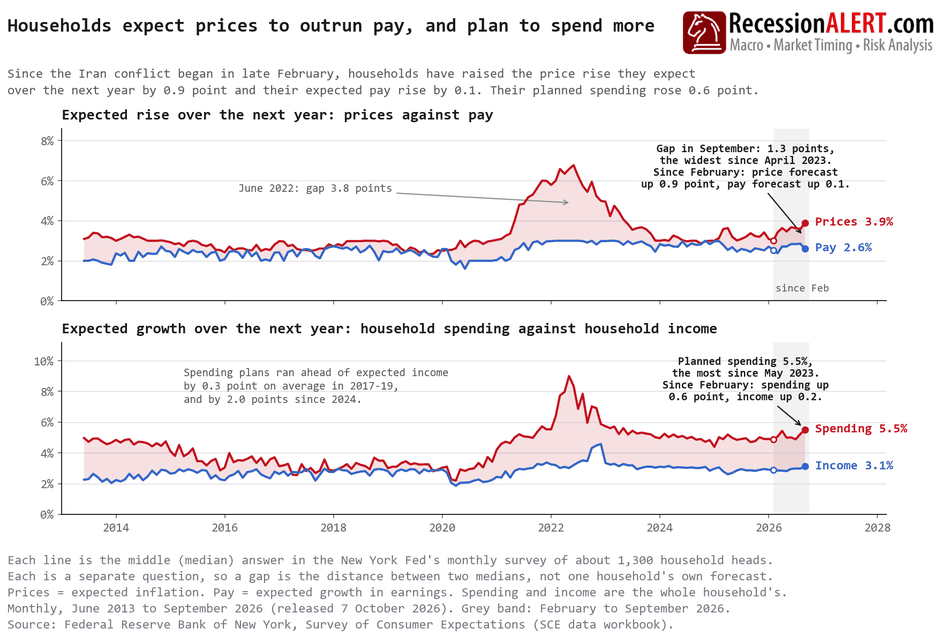
A wage-price spiral needs two halves, and households are supplying only one. They expect prices to outrun their pay by the widest margin since April 2023 — wider than in any month of 2015-20 — and plan to spend more anyway. In 2021-22, while employers competed for scarce workers, the pay forecast rose about a point as the price forecast rose 3.7; since February, 0.08 against 0.9. The shock since February came through the Strait of Hormuz, not the jobs market, where payrolls have grown about 45,000 a month for a year. Yet households feel secure in their own jobs — the average odds they give of losing one are the lowest since December 2024, even as the chance they put on national unemployment rising has climbed to 43.9% from 39.9% — and that may be why their spending plans have not buckled. Counted in dollars, those plans have risen with prices more than with income since February: a bigger bill, not a bigger basket. After the Fed’s September hike, whether this is a spiral or a squeeze matters: higher rates can break a spiral by cooling pay but deepen a squeeze by raising borrowing costs — and Michigan’s survey this morning found buying conditions for durables “plummeted amid high prices and borrowing costs”. Until the pay forecast tops 3%, which it has never done, this is a squeeze, not a spiral — inflation households expect to pay, not to be paid for.
What it means: For households, rising prices will squeeze budgets more than raises ease them, and big purchases like cars and appliances are the first candidates to wait. For stock investors, companies selling those goods carry the most risk, and a retailer’s sales can rise in dollars while it sells fewer items. For the economy, inflation that is not reaching pay is likelier to fade when fuel prices do, though what households actually buy may slow first. What would change this: the gap between expected prices and pay closing back to about half a point, where it sat in February.
Market Intelligence Brief (MIB) Ver. 19.79
For professional investors only. Not investment advice.
© 2026 RecessionALERT.com

Comments are closed.