
MARKET INTELLIGENCE BRIEF (MIB)
Thursday, October 8, 2026
An FT report that OpenAI’s revenue run-rate sits about $20 billion below earlier signals sank chipmakers, dragging the Nasdaq 100 down 1.39% as Oracle fell 5.48%. Hurricane Isaias shut in 63% of Gulf oil output, and WTI settled up $3.21 at $91.49. Trump ruled out striking Iran before the midterms. Waller and Musalem both signaled more hikes, yet the 10-year fell 5.9 bps. After the bell, SpaceX agreed to buy nationwide 800 MHz spectrum, and AT&T fell 6.75% after hours.
TABLE OF CONTENTS
A. EXECUTIVE SUMMARY
B. MARKET DATA
C. HIGH-IMPACT STORIES (5)
D. MODERATE-IMPACT STORIES (6)
E. ECONOMY WATCH (5)
F. EARNINGS WATCH (1)
G. WHAT’S NEXT
H. CHART OF THE DAY
A. EXECUTIVE SUMMARY -> TOP
Thursday’s selloff was a verdict on who pays for the AI build-out: after the FT reported that OpenAI’s revenue run-rate is about $20 billion below earlier signals, Oracle, Intel, Micron and Broadcom each fell more than 4%, dragging the Nasdaq 100 down 1.39% and the S&P 500 down 0.47%. The hit lands on a build-out increasingly funded with debt, which Wednesday’s FOMC minutes linked to higher term premiums. Bonds shrugged off two more hawkish Fed speakers, with the 10-year falling 5.9 bps to 5.229% even as Waller and Musalem signaled further hikes and crude rose about 3% on Hurricane Isaias and Middle East supply risk, a haven bid that leaves the long end exposed to next Wednesday’s CPI. Breadth was healthier: five of eleven sectors rose and the NYSE Composite gained 0.40%, led by Energy (+2.59%) and Consumer Defensive (+2.17%), with Technology (-1.90%) the only heavy loser, a rotation out of AI infrastructure rather than a retreat from risk.
• AI revenue shock: The FT says OpenAI’s annualized revenue is near $50 billion, about $20 billion below earlier signals. Oracle fell 5.48%, Intel 5.34%, Micron 4.79% and Broadcom 4.35%, and Technology (-1.90%) was the worst sector. Palantir rose 2.40% on a Goldman upgrade to Buy with a $230 target.
• Gulf shut-ins and Iran: Hurricane Isaias shut in 62.89% of US Gulf oil output ahead of a Friday-night landfall. WTI settled up $3.21 at $91.49 (Reuters), paring gains after Trump ruled out attacking Iran before the November 3 midterms, while Treasury sanctioned 17 more shadow-fleet tankers. Chevron rose 3.12% and ExxonMobil 2.71%.
• Fed keeps hiking talk alive: Waller anticipates more hikes that “do not need to come at consecutive meetings,” and Musalem sees more firming over the next six to nine months. The 10-year still fell 5.9 bps to 5.229%, and 2s10s flattened about 4 bps to roughly 47 bps.
• Economy running hot: Jobless claims fell to 197,000, near the lowest levels since 1969; GDPNow slipped to 3.6% for Q3, with inventories supplying more than half; and Freddie Mac’s 30-year mortgage rate rose to 7.40% from 6.30% a year ago.
• SpaceX takes on the carriers: After the close, SpaceX agreed to buy Grain’s nationwide 800 MHz spectrum for Starlink Mobile. AT&T fell 6.75%, T-Mobile 5.4% and Verizon 5% after hours.
• Deals and enforcement: Chipotle jumped 6.21% on an FT report that Starbucks has worked with advisers on a possible takeover; Devon is selling its Eagle Ford assets to Crescent for $4.2 billion in cash; the OCC fined American Express $350 million over anti-money-laundering failures; and the trade court certified a nationwide class of importers seeking IEEPA tariff refunds.
1. The market is separating AI revenue from AI spending — The FT report goes to the customer side of the build-out: OpenAI’s revenue is the cash flow behind much of the committed compute spending, and a gap of roughly 30% between belief and disclosure falls hardest on suppliers with concentrated exposure, notably Oracle and Broadcom. The funding question is sharper because the build-out is increasingly borrowed: Wednesday’s FOMC minutes named AI-related debt issuance as a source of higher term premiums, and SpaceX is seeking about $40 billion in debt to buy Nvidia chips. Palantir’s 2.40% gain against a falling Technology sector shows investors rewarding revenue already billed over capital spending that depends on a few buyers. Because the cap-weighted indices are concentrated in the names that fell, broader exposure did better: the NYSE Composite rose 0.40% while the Nasdaq 100 fell 1.39%. Taiwan Semiconductor’s results on Thursday, October 15 are the first hard read on chip demand since the report.
2. Supply shocks keep the Fed’s inflation case intact, and the bond rally looks exposed — Crude is being held up from two directions: Hurricane Isaias has shut in most US Gulf oil output, and the US blockade and new sanctions keep Iranian barrels off the market. Trump’s pledge removes the risk of a US strike only until November 3, so the premium could rebuild rather than fade. Waller named Middle East oil pressure among his reasons for more hikes, and claims near the lowest levels since 1969 with GDPNow at 3.6% give the Fed no labor-market reason to pause. Thursday’s Treasury rally priced the growth cost of a longer cycle, not a softer Fed, which leaves duration vulnerable if September CPI on Wednesday, October 14 runs hot ahead of the October 27-28 FOMC. Borrowers are already paying, with the 30-year mortgage rate at 7.40%.
3. The defensive bid is not uniform — Consumer Defensive rose 2.17% and leads the board at +4.25% for the week, a haven rotation running alongside the tech selloff. But two traditional havens met new risks on the same day. The three national carriers, held as defensive income stocks, now face a would-be competitor with the low-band spectrum that indoor coverage requires, and their after-hours losses will land on Friday. In managed care, the 2027 Medicare Advantage star ratings put more enrollees in four-star-plus plans even as the average rating slipped, so quality-bonus revenue will vary sharply by insurer ahead of UnitedHealth’s results on Tuesday, October 13. Defensive allocations need to be selected name by name rather than bought as a sector.
 — Leading economic indicators. Accurate market forecasts. Apply for membership at join.recessionalert.com
B. MARKET DATA -> TOP
A Financial Times report that OpenAI’s annualized revenue is running near $50 billion, about $20 billion below figures previously signaled to investors, knocked the AI trade: chipmakers led Technology to the session’s worst sector and the Nasdaq 100 fell 1.39%, while the Dow, Russell 2000 and NYSE Composite all finished higher. This was a tech-only selloff rather than a broad one, with five of eleven sectors rising and Energy in the lead as crude jumped about 3% on revived Middle East supply worries and Hurricane Isaias, which had shut in about 1.3 million barrels a day of US Gulf output. Treasuries steadied, the 10-year falling 5.9 bps even after a 30-year auction tailed.
CLOSING PRICES – Thursday, October 8, 2026:
MAJOR INDICES
The damage was confined to the cap-weighted tech complex: the Nasdaq 100 fell 1.39% while the NYSE Composite rose 0.40% and the Dow and Russell 2000 closed slightly higher, so the average stock beat the headline. Transports jumped 1.43%, and with both the Dow and the transport average back within 2% of their 10-session highs, a Dow Theory bull confirmation emerges today; on Wednesday transports sat 2.4% below theirs.
| Index | Close | Change | %Move | Why It Moved |
|---|---|---|---|---|
| S&P 500 | 7,765.36 | -36.41 | -0.47% | Technology (-1.90%) dragged after an FT report put OpenAI’s annualized revenue about $20 billion below previously signaled figures; second straight decline |
| Dow Jones | 51,231.64 | +51.77 | +0.10% | Edged higher as gains outside technology offset the chip selloff |
| DJ Transportation | 19,809.07 | +279.77 | +1.43% | No discrete same-day catalyst identified; rebounded from Wednesday’s 0.88% drop |
| Nasdaq 100 | 30,725.81 | -434.27 | -1.39% | Chip stocks led the decline after the FT’s OpenAI revenue report; second straight decline |
| Russell 2000 | 2,794.13 | +0.92 | +0.03% | Flat; small caps sat out the tech selloff after Wednesday’s 1.31% drop |
| NYSE Composite | 23,797.60 | +95.68 | +0.40% | Broader market rose outside tech; five of eleven sectors gained, led by Energy |
VOLATILITY & TREASURIES
Yields fell while the VIX rose, which reads as a modest haven bid for duration rather than an inflation scare, even with crude up about 3%. The 2-year slipped only 1.6 bps against the 10-year’s 5.9 bps, flattening 2s10s by about 4 bps to roughly 47 bps, and the long end held its gains through a 30-year auction that tailed. The dollar eased from Wednesday’s highest close in 122 sessions.
| Instrument | Level | Change | Why It Moved |
|---|---|---|---|
| VIX | 15.42 | +0.34 (+2.25%) | Rose with the tech selloff |
| 10-Year Treasury Yield | 5.229% | -5.9 bps | Fell despite a $22 billion 30-year bond auction that tailed; weekly jobless claims dropped to 197,000 |
| 2-Year Treasury Yield | 4.756% | -1.6 bps | Fell less than the 10-year, flattening the curve |
| US Dollar Index (DXY) | 102.10 | -0.14 (-0.14%) | Eased from Wednesday’s highest close in 122 sessions; no discrete catalyst identified |
COMMODITIES
Gold edged higher while silver and copper each fell more than 1%, splitting the haven metal from the industrial and higher-beta metals on a risk-off day for tech. Platinum barely moved after Wednesday’s 4.1% slide. Bitcoin’s 2.26% drop moved with the tech selloff rather than against it.
| Asset | Price | Change | %Move | Why It Moved |
|---|---|---|---|---|
| Gold | $4,158.95/oz | $+18.25 | +0.44% | No discrete same-day catalyst identified; held up as other metals fell |
| Silver | $59.43/oz | $-0.86 | -1.43% | No discrete same-day catalyst identified; fell alongside copper |
| Copper | $6.5620/lb | $-0.0875 | -1.32% | No discrete same-day catalyst identified |
| Platinum | $1,647.25/oz | $-2.55 | -0.15% | Little changed against Wednesday’s settlement, after a 4.1% drop that session |
| Bitcoin | $81,710 | $-1,891 | -2.26% | Fell alongside the tech selloff; no crypto-specific catalyst identified |
ENERGY
Brent outran WTI, widening the spread to about $12.70 from $11.92 at Wednesday’s settlements, while Henry Hub and Dutch TTF both fell, so gas did not follow crude. Reuters tied the crude rally to revived Middle East supply worries and Hurricane Isaias; prices came off their highs after President Trump said the US would not strike Iran before the November 3 midterms.
| Asset | Price | Change | %Move | Why It Moved |
|---|---|---|---|---|
| Crude Oil (WTI) | $90.83/bbl | $+2.55 | +2.89% | Settled up $3.21 at $91.49 (Reuters) on revived Middle East worries and Hurricane Isaias, which shut in about 1.3 million bpd of US Gulf output; pared gains after Trump ruled out an Iran strike before the midterms |
| Crude Oil (Brent) | $103.52/bbl | $+3.32 | +3.31% | Settled up $4.08 at $104.28 (Reuters) on the same drivers; the US also sanctioned 17 vessels carrying Iranian oil |
| Natural Gas (Henry Hub) | $3.129/MMBtu | $-0.074 | -2.31% | Fell as crude rallied; Thursday’s EIA report showed an 85 Bcf storage build for the week to October 2 (consensus not confirmed) |
| Natural Gas (Dutch TTF) | $25.37/MMBtu | $-0.25 | -0.98% | No discrete same-day catalyst identified; fell with Henry Hub |
S&P 500 SECTORS
Five of eleven sectors rose, led by Energy (+2.59%), whose 40.62% YTD gain keeps it the year’s clear leader; Technology (-1.90%) was the only heavy loser, though it still carries a 33.09% six-month gain. Consumer Defensive (+2.17%) extended its week to +4.25%, the best 1-Week reading on the board, a defensive bid that ran alongside the tech selloff.
| Sector | 1-Day | 1-Week | 1-Month | 3-Month | 6-Month | YTD | 12-Month |
|---|---|---|---|---|---|---|---|
| Energy | +2.59% | +3.76% | -0.91% | +14.50% | +8.15% | +40.62% | +40.76% |
| Consumer Defensive | +2.17% | +4.25% | +1.82% | -0.40% | -2.03% | +6.52% | +7.19% |
| Real Estate | +0.72% | +0.07% | -6.11% | -8.74% | -4.25% | +0.31% | -2.21% |
| Financial | +0.49% | +0.66% | -5.00% | -3.13% | +6.13% | +2.03% | +6.05% |
| Basic Materials | +0.34% | +0.74% | -8.07% | +2.37% | -6.15% | +10.09% | +16.99% |
| Communication Services | -0.03% | +2.22% | +3.54% | -1.14% | +3.66% | +1.73% | +7.82% |
| Utilities | -0.19% | +3.52% | -3.46% | -9.08% | -12.70% | -3.87% | -7.75% |
| Consumer Cyclical | -0.27% | +2.49% | -0.84% | -4.34% | -0.86% | -7.44% | -7.83% |
| Healthcare | -0.54% | +0.48% | -0.43% | +1.14% | +8.87% | +6.39% | +13.28% |
| Industrials | -0.60% | +0.81% | -0.92% | -6.14% | -3.32% | +8.79% | +9.65% |
| Technology | -1.90% | -0.22% | +4.08% | +7.14% | +33.09% | +30.73% | +28.81% |
TOP MEGA-CAP MOVERS:
GAINERS
| Company | Ticker | Close | Change | Why It Moved |
|---|---|---|---|---|
| Philip Morris International | PM | $200.50 | +4.05% | No discrete same-day catalyst identified; Consumer Defensive was the session’s second-best sector (+2.17%) |
| Home Depot | HD | $295.47 | +3.39% | No discrete same-day catalyst identified |
| Chevron | CVX | $211.55 | +3.12% | Rose with crude (WTI +2.89%); Energy was the session’s best sector (+2.59%) |
| IBM | IBM | $226.61 | +2.77% | Rose against a falling tech sector; Barron’s highlighted its selection, announced Wednesday, for Stage C of DARPA’s quantum benchmarking program, though no source tied the move to it (unverified) |
| ExxonMobil | XOM | $168.50 | +2.71% | Rose with crude (WTI +2.89%); Energy was the session’s best sector (+2.59%) |
DECLINERS
| Company | Ticker | Close | Change | Why It Moved |
|---|---|---|---|---|
| Oracle | ORCL | $135.69 | -5.48% | No Oracle-specific same-day catalyst identified; fell alongside debt-funded AI-capacity names CoreWeave and Nebius as the FT’s OpenAI revenue report hit AI stocks (link unverified) |
| Intel | INTC | $107.08 | -5.34% | Fell in the chip selloff that followed the FT’s report on OpenAI’s revenue |
| SanDisk | SNDK | $1,609.46 | -4.90% | Memory names fell with the chip selloff after the FT’s OpenAI revenue report; no SanDisk-specific catalyst identified |
| Micron Technology | MU | $1,035.84 | -4.79% | Fell in the chip selloff that followed the FT’s report on OpenAI’s revenue |
| Broadcom | AVGO | $360.14 | -4.35% | Fell with the chip selloff after the FT’s OpenAI revenue report, though no source tied Broadcom’s drop to it directly (unverified); Broadcom is co-developing OpenAI’s custom AI chip, for which the WSJ reported Wednesday it was gathering more than $50 billion in financing |
— Institutional-grade intelligence for serious investors. Apply for membership at join.recessionalert.comC. HIGH-IMPACT STORIES -> TOP
BEARISH
1. FT Says OpenAI’s Revenue Run-Rate Is Near $50 Billion, About $20 Billion Below Earlier Signals; Chipmakers Drag the Nasdaq 100 Down 1.39%
The core facts:The Financial Times reported Thursday that OpenAI’s annualized revenue “is about $20bn less than has been previously signalled, according to financial documents shared with investors.” OpenAI recently told investors its revenue was approaching $50 billion on an annualized basis at the end of September, against the roughly $70 billion reported by the FT and other outlets late last month. No response from OpenAI had surfaced by the close. Technology fell 1.90%, the session’s worst sector, and the Nasdaq 100 dropped 1.39% to 30,725.81, while the S&P 500 slipped 0.47% to 7,765.36. The losses concentrated in AI infrastructure: Oracle fell 5.48%, Intel 5.34%, SanDisk 4.90%, Micron 4.79% and Broadcom 4.35%, with Nvidia and AMD also lower. The rest of the market held up, with the Dow up 0.10%, the Russell 2000 up 0.03% and the NYSE Composite up 0.40%. The VIX rose 2.25% to 15.42 and Bitcoin fell 2.26%.
Why it matters:OpenAI’s revenue is the cash flow behind a large share of the AI build-out’s committed spending, so a gap of roughly 30% between what the market believed and what investors were told goes straight to the question of who funds the compute. The hardest-hit names were those with the most direct exposure to that build-out: Oracle, whose cloud expansion leans on OpenAI demand, and Broadcom, which is co-developing OpenAI’s custom chip and for which the WSJ reported Wednesday it was gathering more than $50 billion in financing. The report also lands on an AI complex that is increasingly debt-funded: Wednesday’s FOMC minutes named AI-related debt issuance as a source of higher term premiums, and SpaceX is seeking about $40 billion in debt to buy Nvidia chips. This was a rotation rather than a liquidation, with five of eleven sectors rising and the NYSE Composite higher, but the cap-weighted indices are concentrated in exactly the names that fell.
What to watch:Any correction or clarification from OpenAI, and Taiwan Semiconductor’s third-quarter results on Thursday, October 15, the first hard read on AI chip demand since the report.
UNCERTAIN
2. Hurricane Isaias Shuts In 63% of US Gulf Oil Output and Crude Jumps About 3%, Making Energy the Session’s Best Sector
The core facts:As of Thursday, 62.89% of US Gulf of Mexico oil production and 57.35% of its natural gas output were shut in ahead of Hurricane Isaias, according to the federal offshore regulator, up from about a quarter of oil output a day earlier. Personnel were evacuated from 121 of 371 manned platforms (32.61%). BP evacuated its Na Kika and Thunder Horse platforms, and Shell and Chevron curtailed offshore operations. Isaias, the first hurricane of the 2026 Atlantic season, is forecast to make landfall near the Mississippi-Alabama-Florida border on Friday night, and about 0.5 million barrels a day of refining capacity, including the Pascagoula refinery, lies in its path. WTI settled up $3.21 at $91.49 and Brent up $4.08 at $104.28, according to Reuters. Energy rose 2.59%, with Chevron up 3.12% and ExxonMobil up 2.71%. Henry Hub natural gas fell 2.31% despite the gas shut-ins.
Why it matters:The Gulf supplies roughly 15% of US crude output, and Reuters estimates about 9 million barrels of production will be lost over the storm. Production shut-ins usually come back within days once platforms are reboarded, so the lasting risk is damage, particularly to Gulf Coast refining at a time when fuel supply is already tight. The macro cost is the more important one: crude above $90 adds directly to the inflation the Fed is raising rates against, and on the same day Governor Waller named persistent Middle East oil pressure as one of his reasons for expecting more hikes.
What to watch:Updated shut-in figures on Friday and post-landfall damage reports from Gulf Coast refineries over the weekend; WTI holding above $90 into Monday would signal the market is pricing damage rather than a temporary outage.
UNCERTAIN
3. Trump Rules Out Attacking Iran Before the Midterms, as Treasury Sanctions 17 More Shadow-Fleet Tankers
The core facts:President Trump posted on Truth Social on Thursday: “We are having productive discussions with the Islamic Republic of Iran. We will not be attacking Iran at any time prior to the midterm elections to be held in the United States on November 3rd.” The same day, Treasury’s “Operation Economic Outcast” designated 17 shadow-fleet tankers and 13 companies under Executive Order 13902. Treasury Secretary Bessent said Treasury “is starving the tyrannical regime in Tehran of the money it uses to wage war in the region, and we will continue exposing those who enable the regime’s oil sales.” The US naval blockade of Iranian ports has largely cut off Iran’s oil exports, and only seven vessels transited the Strait of Hormuz on Tuesday, the fewest in more than two months. Crude came off its highs after the post but still closed sharply higher, with Brent at $103.52, up 3.31%.
Why it matters:The pledge reverses the direction of Wednesday’s reports that the White House had asked the Pentagon for Iran strike options before the midterms. It removes the most acute escalation risk, a US strike, for about four weeks, which is why crude pared its gains. It does nothing for physical supply: the blockade, the new sanctions and attacks on tankers keep Iranian barrels off the market and Hormuz traffic thin. The pledge also has a fixed end date, so the geopolitical risk premium could rebuild as November 3 approaches rather than fade.
What to watch:Daily Hormuz transit counts and Brent’s hold above $100; any Iranian response to the pledge or new tanker incidents would test how much of the risk premium the statement removed.
UNCERTAIN
4. Waller and Musalem Both Signal More Rate Hikes, Yet Treasuries Rally, With the 10-Year Down 5.9 Bps to 5.229%
The core facts:Governor Waller said Thursday that he anticipates additional hikes but that they “do not need to come at consecutive meetings.” Later in the day, St. Louis Fed President Alberto Musalem, speaking at a Bloomberg event in New York, said: “To bring inflation back to target in a timely manner, more monetary policy firming will be required.” He added: “If a timely manner is something like 18 months, that kind of suggests that rates ought to be going up further in an appropriate period of time in the next six to nine months.” He declined to commit on the October meeting, saying “I haven’t prejudged what the outcome of that meeting is going to be,” and said that “financial conditions remain accommodative and supportive of economic growth.” Treasuries rallied anyway: the 10-year yield fell 5.9 bps to 5.229% and the 2-year 1.6 bps to 4.756%, flattening 2s10s by about 4 bps to roughly 47 bps.
Why it matters:Two officials now describe the same path: more tightening, with flexibility on timing rather than a hike at every meeting. Musalem’s six-to-nine-month window extends the hiking cycle into 2027, consistent with the futures pricing Waller cited of nearly 80% odds of at least two more hikes by March. The bond market did not treat this as news. The rally, alongside a falling tech sector and a firmer VIX, reads as a haven bid for duration, and the flattening is the curve pricing the growth cost of a longer cycle. That leaves the long end vulnerable if the inflation data confirm the officials’ concern, since crude rose about 3% on the same day.
What to watch:September CPI on Wednesday, October 14, the last major inflation print before the October 27-28 FOMC meeting; a hot reading would test whether the “no consecutive meetings” flexibility survives.
BEARISH
5. SpaceX Agrees to Buy Grain’s Nationwide 800 MHz Spectrum for Starlink Mobile; AT&T, T-Mobile and Verizon Fall 5% to 7% After Hours
The core facts:After Thursday’s close, SpaceX announced a definitive agreement to acquire all of Grain Management’s nationwide 800 MHz spectrum, up to 14 megahertz of paired low-band frequencies, for its Starlink Mobile service. Terms were not disclosed and the deal needs FCC approval. Grain acquired the licenses from T-Mobile for $2.9 billion and was reported in August to be seeking about $6 billion for them. The low-band spectrum lets Starlink Mobile build a terrestrial coverage layer that reaches indoors, alongside its satellite network. Most existing phones already support the band. Earlier this week, the FCC approved Starlink Mobile’s second-generation constellation of 15,000 satellites. In after-hours trading AT&T fell 6.75%, T-Mobile 5.4% and Verizon 5%, according to Investing.com at 16:33 ET, after all three had closed higher in the regular session. SpaceX closed down 4.19% before the announcement.
Why it matters:This turns SpaceX from a satellite partner into a would-be carrier with the low-band spectrum that indoor coverage requires, a direct threat to the subscriber base of the three national networks. The carriers are held as defensive income stocks, so a credible new competitor goes to the core of their valuation, and the threat comes from a $2.18 trillion listed company that is seeking about $40 billion in new debt. Communication Services was flat in regular trading, so the after-hours losses will land on Friday.
What to watch:Whether the carriers’ after-hours losses hold at Friday’s open, any response from AT&T, Verizon or T-Mobile, and the FCC review timetable for the transfer.
— Quantifying recession risk so you don’t have to guess. Apply for membership at join.recessionalert.comD. MODERATE-IMPACT STORIES -> TOP
BULLISH
6. Trade Court Certifies a Nationwide Class of Importers Seeking IEEPA Tariff Refunds, Extending Relief Beyond More Than 4,000 Individual Suits
The core facts:In an opinion dated Thursday, October 8 (Freestyle World v. U.S. Customs and Border Protection, Slip Op. 26-123), Judge Richard K. Eaton of the Court of International Trade certified a class of “all importers of record who paid duties imposed by the Challenged Tariff Orders between February 1, 2025, and February 19, 2026, excluding any entity that has separately filed an action seeking to recover IEEPA duties payments.” The class seeks an injunction directing liquidation or reliquidation of entries without the IEEPA duties that the Supreme Court found unlawful in Learning Resources v. Trump. The court noted it has already ordered reliquidation of entries in more than 4,000 lawsuits brought by individual importers. The government opposed certification.
Why it matters:Until now, refunds have gone to importers that sued. The class extends the same relief to every importer that paid and did not litigate, a group likely weighted toward smaller and mid-sized companies without trade counsel. The refunds are already showing up in earnings: PepsiCo said a 4-point favorable tariff-refund impact helped its third-quarter core operating profit. On the other side of the ledger, a wider refund pool adds to Treasury outlays while the 10-year yield sits above 5.2%.
What to watch:Whether the government seeks to appeal the certification, and how many companies cite tariff refunds in third-quarter results as the reporting season gets underway on Tuesday, October 13.
BEARISH
7. OCC Fines American Express $350 Million and Regulators Issue Cease-and-Desist Orders Over Anti-Money-Laundering Failures
The core facts:The Office of the Comptroller of the Currency on Thursday assessed a $350 million civil money penalty against American Express National Bank and issued a cease-and-desist order. The OCC found systemic breakdowns in suspicious-activity monitoring, which led the bank to fail to identify and report, in a timely way, approximately $13 billion of suspected trade-based money laundering over the past decade. It also cited insufficient staff expertise, weak internal controls and inadequate testing. The Federal Reserve Board issued a concurrent cease-and-desist order against American Express Company and American Express Travel Related Services. The OCC said it “expects banks of American Express’s size and complexity to devote sufficient resources to ensure compliance with laws and regulations designed to detect and prevent money laundering.”
Why it matters:The penalty itself is manageable for a company of Amex’s size; the orders are the larger cost. Enforcement orders from both the bank’s primary regulator and the holding-company supervisor bring mandated remediation, ongoing compliance spending and closer supervision, which can constrain new products and growth initiatives until they are lifted. The orders arrive ahead of Amex’s third-quarter results.
What to watch:Amex’s share reaction on Friday and any remediation-cost estimate or reserve it discloses with third-quarter results.
UNCERTAIN
8. CMS’s 2027 Medicare Advantage Star Ratings Put 71% of Enrollees in Four-Star-Plus Plans, Up From 67%, Even as the Average Rating Edges Down
The core facts:The Centers for Medicare & Medicaid Services published the 2027 Medicare Advantage and Part D Star Ratings on Thursday. About 37% of Medicare Advantage prescription-drug contracts (188) earned four stars or higher, and about 71% of their enrollees are in contracts that will carry four or more stars in 2027, up from roughly 67% for 2026. The enrollment-weighted average rating slipped to 3.99 from 4.01. Fifteen contracts earned five stars. Among standalone drug plans, about 22% of enrollees are in four-star-plus contracts for 2027, up from 2% in 2026. Open enrollment runs from October 15 to December 7.
Why it matters:Star ratings determine Medicare Advantage quality-bonus payments, one of the largest swing factors in managed-care earnings, so the insurer-level distribution matters far more than the national averages. A higher share of members in four-star-plus plans is broadly positive for the sector’s bonus revenue. The lower average rating shows the gains were uneven, and plans that fell below four stars lose both bonus payments and marketing advantages during open enrollment.
What to watch:Insurer disclosures of the share of members in four-star-plus plans and Friday’s trading in Humana, CVS Health, Elevance and UnitedHealth, which reports third-quarter results on Tuesday, October 13.
UNCERTAIN
9. FT: Starbucks Has Worked With Advisers on a Possible Takeover of Chipotle; Chipotle Jumps 6.2%
The core facts:The Financial Times reported Thursday, citing people familiar with the matter, that Starbucks “has worked with advisers in recent months on a takeover proposal for Chipotle.” The report did not indicate that a formal offer had been made. Starbucks told Reuters it was focused on its turnaround under CEO Brian Niccol, who ran Chipotle before joining Starbucks. Chipotle did not respond to requests for comment. Chipotle closed up 6.21%, while Starbucks recovered from an intraday drop of about 3% to close down 0.40%. Reuters put Chipotle’s market value near $39 billion and Starbucks’ around $107 billion.
Why it matters:A bid for a target worth more than a third of Starbucks’ own value would be a very large deal for a company still in a turnaround, and financing it with debt at today’s rates would be expensive. Starbucks’ partial recovery suggests investors see the approach as exploratory rather than imminent. The report puts a takeover premium under Chipotle on a day the broader consumer discretionary sector fell 0.27%.
What to watch:Any formal approach, confirmation or denial from either company, and how much of Chipotle’s 6.2% gain holds if neither side comments.
BULLISH
10. Goldman Upgrades Palantir to Buy With a $230 Target, and the Stock Rises 2.4% Against a Falling Tech Sector
The core facts:Goldman Sachs analyst Gabriela Borges upgraded Palantir to Buy from Neutral with a 12-month price target of $230, implying about 18% upside from Wednesday’s close of $194.12. Borges wrote that “the stock is setting up for another phase of outperformance into 2027,” and pointed to a “step function change in depth” driven by demand for sovereign AI, bespoke software development and specialized vertical sales. She also pushed back on concerns that Palantir’s forward-deployed engineer model cannot scale. Palantir closed up 2.40%, while Technology fell 1.90% and the Nasdaq 100 dropped 1.39%.
Why it matters:On the day an FT report questioned the revenue behind the AI infrastructure build-out, a software company selling AI applications to governments and enterprises rose while chipmakers fell. That divergence suggests the market is separating AI revenue that is already being billed from capital spending that depends on a few customers. A Buy rating from a major bank also gives cover to investors who have stayed away because of the stock’s valuation.
What to watch:Whether Palantir keeps outperforming if the chip selloff extends; sustained relative strength would confirm the application-versus-infrastructure split.
BULLISH
11. Devon Energy Sells Its Eagle Ford Assets to Crescent Energy for $4.2 Billion in Cash to Fund Buybacks and Debt Reduction
The core facts:Devon Energy agreed Thursday to sell its Eagle Ford position, about 90,000 net acres in Karnes, DeWitt and Gonzales counties, Texas, to Crescent Energy for $4.2 billion in cash, subject to customary adjustments. The assets account for about 4% of Devon’s total oil-equivalent production. After-tax proceeds will fund accelerated share repurchases and debt reduction. The deal is effective July 1, 2026, and is expected to close around year-end, subject to regulatory approvals. CEO Clay Gaspar said the sale “sharpens our focus on the highest-return, longest-duration assets.”
Why it matters:Selling a small share of production for a large share of cash, with WTI above $90, lets Devon lock in today’s prices for an asset base it no longer considers core, and convert the proceeds into buybacks. The deal continues the consolidation of US shale into fewer, larger operators. With Energy the year’s best sector at +40.62%, it also shows how producers are spending the windfall: on capital returns rather than new drilling.
What to watch:Antitrust clearance and the size and pace of the accelerated buyback Devon outlines at its next quarterly results.
— Separating signal from noise since 2007. Apply for membership at join.recessionalert.comE. ECONOMY WATCH -> TOP
Thursday’s data pointed the same way from three directions: a labor market that will not loosen, growth running well above trend, and a Fed preparing to lean harder against both. Initial claims fell to 197,000, near the lowest levels since 1969, and GDPNow held at 3.6%, though inventories supply more than half of that estimate. Governor Waller said he anticipates additional hikes, with flexibility on timing, with core PCE inflation at 3%. The cost is landing on borrowers: the 30-year mortgage rate rose to 7.40%, more than a point above a year ago, and a 30-year bond reopening cleared at 5.618%. September CPI on October 14 is the next test of how fast the Fed moves.
Waller Anticipates Additional Rate Hikes but Says They “Do Not Need to Come at Consecutive Meetings” (Federal Reserve, Oct 8)
What they’re saying:Speaking at the Istanbul Economic Forum, Governor Christopher Waller said: “If the economic data continue to come in as expected, I anticipate additional hikes to support a timelier return of inflation to our 2 percent goal.” He added that “the hikes do not need to come at consecutive meetings, but they should be in place in an acceptable period of time.” He cited August core PCE inflation of 0.25% on the month and 3% over 12 months, and said that “for at least the near term, policy will be focused on the inflation side of our mandate.”
The context:Waller said September’s 25 bp hike, to 3.75%–4%, was the result of a year of evidence rather than a reaction to one CPI print. He named persistent Middle East oil pressure, AI-driven high-tech prices and tariff risk. He noted that 16 of the 18 participants submitting September projections anticipated at least one more hike this year. Citing fed funds futures as of Wednesday, he put the odds of at least one more hike by the December meeting at 85%, and of at least two hikes by March 2027 at nearly 80%. Treasuries rallied on the day regardless, with the 10-year yield down 5.9 bps to 5.229%.
What to watch:September CPI on Wednesday, October 14, is the first inflation print since these remarks; a hot reading would narrow the flexibility on timing that Waller described. Fed’s Collins speaks Friday, October 9.
Jobless Claims Fall to 197,000, Holding Near the Lowest Levels Since 1969 (Department of Labor, Oct 8)
What they’re saying:Initial jobless claims fell 2,000 to 197,000 in the week ending October 3, below the 200,000 expected, with the prior week revised up to 199,000. The four-week average fell 2,500 to 198,000. Continuing claims rose 17,000 to 1,716,000 in the week ending September 26, and the insured unemployment rate held at 1.1%.
The context:Claims have stayed close to the 187,000 reached in July, the lowest since September 1969, as employers continue to hold on to staff. That matches Governor Waller’s description the same day of a labor market that “continued to be solid and stable,” which leaves the Fed free to concentrate on inflation. The 17,000 rise in continuing claims is the one softer detail in the release.
What to watch:Next week’s claims on Thursday, October 15, arrive alongside September retail sales and PPI.
Atlanta Fed GDPNow Edges Down to 3.6% for Q3, With Inventories Supplying More Than Half of the Estimate (Atlanta Fed, Oct 8)
What they’re saying:The GDPNow model’s estimate of third-quarter real GDP growth slipped to 3.6% (seasonally adjusted annual rate) from 3.7% on October 6, following Thursday’s wholesale trade report from the Census Bureau. The nowcast of inventory investment’s contribution fell to 1.98 percentage points from 2.07.
The context:At 1.98 points, inventory building accounts for about 55% of the 3.6% estimate, leaving roughly 1.6 points from everything else. The headline remains well above trend and supports Waller’s view that activity is strengthening in the second half. But a quarter carried by stockbuilding is less durable than one carried by final demand, because inventory gains tend to reverse in later quarters.
What to watch:September retail sales on Thursday, October 15, the largest remaining input to the consumption estimate.
30-Year Mortgage Rate Climbs to 7.40%, More Than a Point Above Year-Ago Levels (Freddie Mac, Oct 8)
What they’re saying:Freddie Mac’s 30-year fixed mortgage rate averaged 7.40% this week, up from 7.28% last week and 6.30% a year ago. The 15-year fixed rate rose to 6.73% from 6.60%.
The context:The increase follows the Fed’s September hike and a climb in long-term yields; the 10-year Treasury closed Thursday at 5.229%. It comes a day after MBA data put the average 30-year contract rate at 7.49%. With the Fed signaling further increases, mortgage costs are unlikely to ease soon, a direct drag on housing turnover; August existing-home sales ran at a 3.98 million annual pace.
What to watch:September existing-home sales on Tuesday, October 13, and the MBA’s weekly mortgage rate on Wednesday, October 14.
$22 Billion 30-Year Bond Reopening Clears at 5.618% as Indirect Bidders Take 72% (Treasury Auction Results, Oct 8)
What they’re saying:Treasury sold $22 billion of reopened 30-year bonds at a high yield of 5.618%, with a bid-to-cover ratio of 2.54. Indirect bidders, a proxy for foreign and institutional demand, took 72.3% of the competitive allotment, direct bidders 20.9% and primary dealers 6.8%.
The context:Primary dealers were left with less than 7% of the competitive allotment, so end investors took nearly all of the supply at yields above 5.6%. The sale completes the week’s 3-, 10- and 30-year coupon auctions. Long-dated Treasuries held their gains through the close, with the 10-year down 5.9 bps and the 2s10s curve flattening by about 4 bps to roughly 47 bps.
What to watch:September CPI on Wednesday, October 14, the key test of whether demand at these yields holds.
— Know the probability before the market prices in the risk. Apply for membership at join.recessionalert.comF. EARNINGS WATCH -> TOP
YESTERDAY AFTER THE BELL (Markets Reacted Today)
No major earnings yesterday after the bell from companies with >$100B market cap.
TODAY BEFORE THE BELL (Markets Already Reacted)
UNCERTAIN
12. PepsiCo (PEP): +3.73% | Q3 Beats on Revenue and Core EPS, but Full-Year Core EPS Growth Is Cut to 2.5%–3.5%
The Numbers:Released: BMO, Thursday, October 8. Revenue $25.27 billion vs. $24.95 billion expected (+5.6% year over year; organic +3.1%). Core EPS $2.34 vs. $2.29 expected (+2%); reported EPS $2.23 (+17%). Currency added 0.7 points to revenue growth. Fiscal 2026 guidance updated: organic revenue growth about 3% (prior 2%–4%), net revenue growth about 6% (prior 4%–6%), core EPS growth 2.5%–3.5% (prior: low end of 5%–7%) and core constant-currency EPS growth 1%–2% (prior: low end of 4%–6%).
The Problem/Win:International markets carried the quarter: organic revenue grew 9% in EMEA, 9% in Asia Pacific Foods, 7% in International Beverages and 6% in Latin America Foods, with Asia Pacific volume up 11%. North America was flat, as PepsiCo Foods North America and PepsiCo Beverages North America each posted flat organic revenue, and beverage volume fell 3%. Core operating profit rose 3% despite 35 basis points of margin contraction, helped by productivity savings, net pricing and a 4-point favorable tariff-refund impact. CEO Ramon Laguarta said the company will invest more in North American innovation, funded by “additional structural cost reduction actions.”
The Ripple:Consumer Defensive rose 2.17%, the session’s second-best sector, with Coca-Cola up 2.27% and Philip Morris up 4.05%; no source tied those moves to PepsiCo’s report.
What It Means:The market rewarded the beat and the accelerating international volume over a sharp cut to full-year earnings growth, treating the lower guidance as reinvestment rather than deterioration. North America, flat in both foods and beverages, is still the problem the new spending has to fix.
What to watch:The size and timing of the promised structural cost actions, and whether North American organic growth turns positive next quarter.
TODAY AFTER THE BELL (Markets React Tomorrow)
No major earnings after the bell from companies with >$100B market cap.
WEEK AHEAD PREVIEW:
Q3 2026 earnings season is just beginning (1.8% of the S&P 500 reported as of October 2). The large banks, Johnson & Johnson and UnitedHealth open the season in earnest on Tuesday, October 13; ASML, Bank of America, Morgan Stanley, BlackRock and Progressive follow on Wednesday, October 14; and Charles Schwab and Prologis report on Thursday, October 15.
JPMorgan Chase (JPM) — BMO, Tuesday, October 13 — Consensus EPS $5.93 on revenue of $51.23 billion. Key focus: net interest income guidance with Governor Waller and St. Louis Fed President Musalem both signaling more hikes, trading revenue in a volatile rates quarter, and credit commentary after its own strategists flagged the most deeply distressed leveraged loans since March 2020.
Johnson & Johnson (JNJ) — BMO, Tuesday, October 13 — Consensus EPS $2.67 on revenue of $25.38 billion. Key focus: medtech exposure to the coming Section 232 device tariffs after Becton Dickinson’s investment-for-relief deal, and pharmaceutical growth guidance for 2027.
UnitedHealth Group (UNH) — BMO, Tuesday, October 13 — Consensus EPS $4.12 on revenue of $111.31 billion. Key focus: medical cost trends and margin guidance for 2027, plus its first comments on the 2027 Medicare Advantage Star Ratings published October 8, which drive quality-bonus revenue.
Goldman Sachs (GS) — BMO, Tuesday, October 13 — Consensus EPS $13.07 on revenue of $16.84 billion. Key focus: advisory and underwriting fees in an active quarter for large mergers and AI-related debt financing, and fixed-income trading revenue with the 10-year above 5.2%.
Wells Fargo (WFC) — BMO, Tuesday, October 13 — Consensus EPS $1.85 on revenue of $22.31 billion. Key focus: management’s first comments on HUD’s new fair-lending investigation, mortgage volumes with Freddie Mac’s 30-year rate at 7.40%, and net interest income guidance.
Citigroup (C) — BMO, Tuesday, October 13 — Consensus EPS $2.65 on revenue of $23.72 billion. Key focus: markets and services revenue, card credit costs, and progress on its return-on-equity targets.
ASML Holding (ASML) — BMO, Wednesday, October 14 — Consensus EPS $12.13 on revenue of $13.16 billion. Key focus: EUV order intake as AI and memory customers expand capacity, now tested by the FT’s report on OpenAI’s revenue; the outlook for China sales; and 2027 guidance as the first major read on chip-equipment demand this season.
Bank of America (BAC) — BMO, Wednesday, October 14 — Consensus EPS $1.10 on revenue of $30.58 billion. Key focus: net interest income guidance and deposit costs as rates rise, consumer credit quality, and trading revenue.
Morgan Stanley (MS) — BMO, Wednesday, October 14 — Consensus EPS $2.94 on revenue of $19.96 billion. Key focus: wealth-management net new assets and fee growth, and investment-banking and equities trading revenue.
BlackRock (BLK) — BMO, Wednesday, October 14 — Consensus EPS $14.32 on revenue of $7.43 billion. Key focus: fixed-income fund flows with long-dated yields above 5%, private-markets fundraising, and the base-fee effect of equity markets near record highs.
Progressive (PGR) — BMO, Wednesday, October 14 — Consensus EPS $4.30 on revenue of $22.61 billion. Key focus: underwriting margins after the August combined ratio worsened to 89.3% from 83.1% a year earlier as premium growth slowed to 6%, and auto policy growth.
Charles Schwab (SCHW) — BMO, Thursday, October 15 — Consensus EPS $1.66 on revenue of $7.20 billion. Key focus: net interest revenue and client cash balances as the Fed signals more hikes, trading activity in a volatile quarter, and net new client assets.
Prologis (PLD) — BMO, Thursday, October 15 — Consensus EPS $0.78 on revenue of $2.18 billion. Key focus: warehouse leasing demand and occupancy as tariff refunds and higher rates reshape importers’ inventory decisions, rent growth on renewals, and progress on its data-center development pipeline.
No company above $100 billion reports on Friday, October 9, or Monday, October 12 (Columbus Day). Taiwan Semiconductor (ADR) reports on Thursday, October 15, and BNY Mellon ($97.44 billion) reports the same morning, just below this section’s threshold.
— US market commentary trusted by family offices and institutions. Apply for membership at join.recessionalert.comG. WHAT’S NEXT -> TOP
UPCOMING RELEASES:
| Date | Event | Why It Matters |
|---|---|---|
| Fri, Oct 9 | University of Michigan Consumer Sentiment, preliminary October (expected 47.6, prior 48.1) | Lands with WTI settled above $91 and the 30-year mortgage rate at 7.40%; the inflation-expectations detail matters to a Fed that says it is focused on the inflation side of its mandate. |
| Fri, Oct 9 | Fed’s Collins speaks (4:00 PM ET) | Tests whether a third official backs the path Waller and Musalem described on Thursday: more hikes, but not necessarily at consecutive meetings, ahead of the October 27-28 FOMC. |
| Fri, Oct 9 | Hurricane Isaias landfall, forecast near the Mississippi-Alabama-Florida border Friday night | About 0.5 million barrels a day of refining capacity, including Pascagoula, lies in its path. Shut-in production usually returns within days; refinery damage would keep WTI above $90 and add to the inflation the Fed is leaning against. |
| Mon, Oct 12 | Columbus Day: US bond market closed, stock market open. Monthly Budget Statement, September (prior -$167B) | The cash Treasury market is shut for the holiday, so weekend hurricane or Iran news reaches bonds on Tuesday. The deficit print lands with the 10-year above 5.2% and the trade court’s class certification widening the pool of IEEPA tariff refunds Treasury must pay. |
| Tue, Oct 13 | Existing Home Sales, September (prior 3.98M annualized) | Gauges housing turnover as Freddie Mac’s 30-year rate climbs to 7.40%, more than a point above a year ago, with the Fed signaling further hikes. |
| Wed, Oct 14 | CPI, September (prior 0.4% MoM and 3.4% YoY; core prior 0.3% MoM) | The last major inflation print before the October 27-28 FOMC. A hot reading would narrow the timing flexibility Waller described and test a Treasury rally that ignored Thursday’s hike signals. |
| Thu, Oct 15 | Retail Sales, September (prior 1.2% MoM); PPI, September (prior 0.4% MoM); Initial Jobless Claims | Retail sales are the largest remaining input to GDPNow’s 3.6% Q3 consumption estimate, PPI shows how much of the crude rally is reaching producer prices, and claims test whether filings stay near their lowest levels since 1969. |
| Thu, Oct 15 | Empire State Manufacturing, October (prior 7.60); Philadelphia Fed Manufacturing, October (prior 37.8) | The first October factory reads, and an early check on whether second-half strength extends beyond inventory building. |
KEY QUESTIONS:
1. Does OpenAI correct or clarify the FT’s revenue figures, and does Taiwan Semiconductor’s report on Thursday, October 15 show AI chip demand holding up regardless?
2. Does Hurricane Isaias damage Gulf Coast refining after Friday night’s landfall, keeping WTI above $90 into Monday and adding to the inflation pressure behind the Fed’s hiking bias?
3. Will Wednesday’s September CPI confirm Waller’s and Musalem’s concern and end a Treasury rally that has so far ignored their calls for more hikes?
— US market commentary trusted by family offices and institutions. Apply for membership at join.recessionalert.comH. CHART OF THE DAY -> TOP
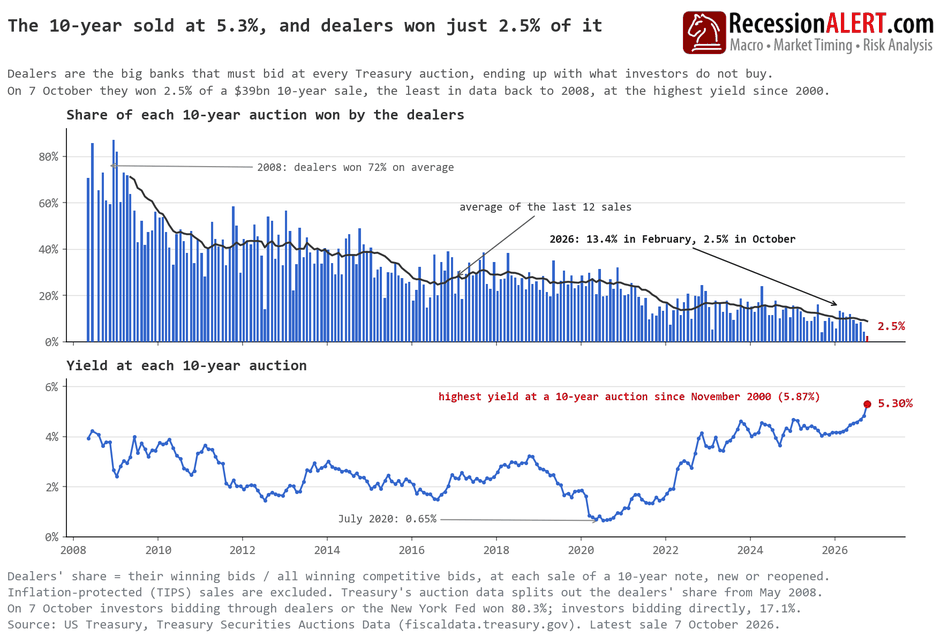
Yields this high are usually read as a buyers’ strike, but Wednesday’s 10-year auction shows buyers setting the price. With the amount on offer fixed, a shortage of buyers shows up in one of two ways: the primary dealers — banks obliged to bid at every Treasury auction — keep the leftovers, or the yield rises until investors take nearly the lot. Wednesday was the second: dealers were left the smallest share of 221 such sales since 2008, and $2.77 was bid per dollar sold, matching the highest since January 2016. Treasury fills bids from the lowest yield up, and the last one accepted sets every winner’s yield — so 5.3% was the price investors themselves named. Fed minutes released an hour later suggest why: they cite market commentary naming one rival for investors’ money — heavy private borrowing for AI infrastructure, lifting term premiums, the extra yield demanded to lend for years. SpaceX’s reported $40bn borrowing talks are the latest example. That is crowding out — a higher price, not unsold bonds — and it is no one-off: the three smallest 10-year dealer shares since 2008 all came in the last 13 months. Thursday’s 30-year is the edge to watch: at 5.618%, its highest auction yield since 1999, it left dealers 6.79% — still the third-smallest since 2008, but nearly three times the 10-year’s, on a bond that loses almost twice as much for the same rise in yields. Treasury will not run out of buyers — only out of cheap ones.
What it means: For homebuyers, cheaper mortgages will need investors to accept lower yields — buyers are not what is missing. Freddie Mac’s 30-year rate hit 7.40% today, the highest since November 2023, from about 6% in February. For stock investors, companies borrowing to fund AI pay a premium over that 5.3%, so their build-out will get dearer as yields rise. For the economy, Treasury now borrows for ten years at 5.3% against an average 3.4% on its notes, so its interest bill will keep climbing. What would change this: a 10-year sale leaving dealers over 10%, last seen in May.
Market Intelligence Brief (MIB) Ver. 19.79
For professional investors only. Not investment advice.
© 2026 RecessionALERT.com

Comments are closed.