
MIB WEEKLY DIGEST
Week of Aug 31–Sep 4, 2026
The September FOMC was repriced three times in five sessions and ended where it started: Barr said hike, Waller said hold, and Friday’s 162,000-payroll blowout against a 56,000 consensus flipped implied odds back to 58–60%. Underneath it, five straight days of US–Iran exchanges put WTI up 9.22% and took retail diesel to an all-time record $5.850 — six days before the CPI on which Waller staked his vote. Technology split in half: Sandisk (SNDK) +17.17% on the memory shortage against Palo Alto (PANW) −10.32% after a beat. And three arms of government repriced three unrelated companies by directive, taking 16.68% off Fair Isaac (FICO) in a session.
TABLE OF CONTENTS
A. WEEK AT A GLANCE
B. WEEK IN MARKETS
C. WEEK’S TOP STORIES (9)
D. WEEK IN THE ECONOMY (5)
E. WEEK IN EARNINGS (3)
F. NEXT WEEK SETUP
G. CHART OF THE WEEK
A. WEEK AT A GLANCE -> TOP
The S&P 500 finished the week 0.09% higher and the Nasdaq 100 0.38%, index moves that conceal five sessions in which the September FOMC was repriced three separate times and US and Iranian forces exchanged fire every day. The dominant driver was the Fed’s own dispersion — four officials took four positions between Monday and Friday, and the market moved on whoever had spoken most recently rather than on the data in front of it. What arrived underneath is a cost shock no rate decision can address: WTI added 9.22% and retail diesel set an all-time record six days before the CPI print on which a governor has staked his September vote.
• Biggest single session was Thursday’s +1.06% S&P rally on Governor Waller’s conditional-hold signal, which cut implied September hike odds from 63.2% to roughly 50% — and was fully reversed within 24 hours by Friday’s payrolls.
• Sandisk (SNDK) +17.17% led the week and Palo Alto (PANW) −10.32% trailed it — one on a NAND shortage and MSCI World Index inclusion, the other after beating both lines and adding nearly $1 billion of net new security ARR in a quarter.
• WTI rose 9.22% to $91.18 and Dutch TTF 9.12% across five consecutive days of US–Iran exchanges in which not one refinery, terminal or loading facility was hit — a transit premium rather than a supply loss.
• August payrolls printed 162,000 against a 56,000 consensus, flipping implied September hike odds from roughly 49% to 58–60% in a single session and returning Polymarket’s 2026 hike contract to 72% after a round trip through 61%.
• Dell (DELL) beat EPS by 43.3% and disclosed a $95 billion AI-server backlog against $16.4 billion recognised in the quarter, raising full-year revenue guidance by $25 billion and drawing target increases from at least fifteen firms the next morning.
• Fair Isaac (FICO) fell 16.68% on Friday after the FHFA director opened VantageScore to every GSE lender by evening social-media post and floated cutting the tri-merge credit report — taking Equifax down 6.37% and TransUnion 5.93% with it.
1. A Market With No Anchor — September was marked three separate ways in five sessions and finished four points higher on Polymarket than it began, because four Fed officials held four positions and a Beige Book supplied evidence for all of them, leaving the market repricing off whoever spoke last rather than off the data.
2. The Commodity and Its Equities Stopped Agreeing — Crude gained 9.22% while Energy equities captured barely a quarter of it and finished the day’s worst sector twice, which means the companies that produce the barrel are declining to price a risk premium the barrel itself is carrying.
3. One Sector Line, Two Entirely Different Assets — Technology’s +1.36% week is the net of a 27-point spread, because memory and wafer-fab equipment rallied 5–12% on the most hawkish session of the week while high-multiple software fell on the same tape: a physical shortage does not discount against the ten-year and a multiple does.
4. Policy Risk Arrived Faster Than Rulemaking — Three unrelated companies in three unrelated sectors were repriced by double digits in five sessions by three arms of government acting outside the ordinary process: a legislature that adjourned without passing a wildfire bill, a regulator who rewrote mortgage-scoring policy by evening post, and an agency that opened an audit query on day one of paid robotaxi service.
 — Leading economic indicators. Accurate market forecasts. Apply for membership at join.recessionalert.com
B. WEEK IN MARKETS -> TOP
The S&P 500 finished 0.09% higher, the least informative number the tape produced all week. Underneath it the September FOMC was repriced three times in five sessions — Governor Barr’s “act decisively” on Tuesday, Governor Waller’s conditional hold on Thursday, and Friday’s 162,000-payroll print against a 56,000 consensus — leaving implied hike odds almost exactly where they started and Polymarket’s contract back at 72% after a round trip through 61%. Alongside it, US and Iranian forces exchanged fire across four Gulf states and WTI added 9.22%. Breadth held throughout: the NYSE Composite tracked the S&P to within 13 basis points, so the week’s violent moves were idiosyncratic rather than systemic. The divergence worth keeping is crude against the companies that sell it — Energy led every sector at +2.26% while finishing as the single worst performer on two separate sessions.
FRIDAY CLOSE & WEEK-ON-WEEK CHANGE — Fri, Sep 4, 2026:
MAJOR INDICES
Dow Theory flashed its non-confirmation on a single session rather than across the week: Tuesday’s DJIA fell 0.79% against DJTA’s 2.51%, a 1.72-point spread opened by diesel landing on carriers, and transports never made it back — DJTA finished −1.72% on the week against the Dow’s −0.27%. Neither the large-versus-small nor the growth-versus-broad signal crossed threshold; the S&P, Nasdaq 100 and Russell 2000 ended within 0.29 points of one another. That convergence is the week’s real index story — five sessions of violent repricing, and the benchmarks that measure different things all arrived at the same place.
| Index | Fri Close | WoW Change | WoW % | Why It Moved (Week) |
|---|---|---|---|---|
| S&P 500 | 7,718.60 | +6.84 | +0.09% | Four repricings of the September FOMC netted to almost nothing. Tuesday’s oil-and-yield shock and Friday’s payrolls beat were offset by Wednesday’s yield reversal and Thursday’s Waller-driven 1.06% gain, the week’s largest single session. |
| Dow Jones | 53,414.25 | −145.74 | −0.27% | Blue-chip cyclicals carried the Hormuz premium: Monday and Tuesday cost 1.49% between them on industrial and transport exposure, and Thursday’s 1.18% rebound recovered only part of it. |
| DJ Transportation | 21,011.73 | −367.02 | −1.72% | The week’s worst benchmark, and the damage was one session: Tuesday’s 2.51% drop, three times the Dow’s, as WTI rose 5.82%. Gains on three of the remaining four days did not recover it. |
| Nasdaq 100 | 29,544.15 | +110.72 | +0.38% | Held a net gain only because memory and wafer-fab equipment carried it on the two hawkish sessions that hit software hardest; Tuesday’s 1.29% fall was the week’s worst index print. |
| Russell 2000 | 2,975.65 | +3.28 | +0.11% | A pure rate round trip — down 1.23% Tuesday on the yield spike, up 1.13% Wednesday when the 10-year reversed, and it captured only 0.51% of Thursday’s dovish rally. |
| NYSE Composite | 24,639.25 | +54.07 | +0.22% | Breadth tracked the S&P closely on every session, confirming that the week’s violent single-name moves — PG&E, Fair Isaac, Tesla, Palo Alto — were idiosyncratic rather than a market-wide de-rating. |
VOLATILITY & TREASURIES
The week’s entire policy argument is legible in one number: the VIX ended ten cents higher, after spiking 9.45% Tuesday on the CENTCOM strikes and collapsing 5.86% Thursday on Waller. Yields ran the same round trip and finished up, 10Y +5.5 bps against 2Y +2.3 bps, so 2s10s steepened 3.2 bps across a week in which September was repriced three separate times. A curve that steepens through a hike scare is not ratifying one — the long end paid for the oil premium while the front end kept changing its mind.
| Instrument | Fri Level | WoW Change | Why It Moved (Week) |
|---|---|---|---|
| VIX | 14.52 | +0.10 (+0.69%) | A 9.45% Tuesday spike on the CENTCOM strikes fully unwound by Thursday. Ending ten cents higher after a live shooting war and a hike scare is the week’s cleanest complacency signal. |
| 10-Year Treasury Yield | 4.784% | +5.5 bps | Touched 4.818% Wednesday, the highest since November 2023, on the oil-driven inflation premium; Waller’s Thursday hold-signal took it back before Friday’s payrolls beat pushed it up again. |
| 2-Year Treasury Yield | 4.377% | +2.3 bps | Moved less than the long end despite doing more work: it confirmed the hike Tuesday, unwound it Thursday on Waller, and re-priced it Friday on payrolls, finishing 2.3 bps from where it began. |
| US Dollar Index (DXY) | 99.17 | −0.50 (−0.50%) | Fell on the week despite higher yields. Thursday’s 0.60% slide on Waller outweighed the hawkish sessions, and the dollar never caught a haven bid through the Iran escalation. |
COMMODITIES
Gold fell 2.39% on the day the United States struck targets inside Iran and rose 2.34% on the day a Fed governor floated a hold — a two-session sequence that settles what the metal is actually pricing, and it is not war. Copper’s 2.31% Tuesday decline alongside it rules out an industrial-demand reading; the whole complex was trading real rates. Bitcoin’s +5.06% Thursday and −2.09% Friday put it in the same bucket. Four assets routinely held as diversifiers spent the week as one levered bet on the September FOMC.
| Asset | Fri Price | WoW Change | WoW % | Why It Moved (Week) |
|---|---|---|---|---|
| Gold | $4,476.11/oz | −$32.33 | −0.72% | Down 2.39% Tuesday as the US struck Iran — real rates beat the haven bid — then up 2.34% Thursday on Waller and a softer dollar. Net-flat through a war is the year’s clearest demonstration of what gold hedges. |
| Silver | $66.763/oz | +$0.323 | +0.49% | Ran gold’s round trip at a wider amplitude — 3.50% down Tuesday, 3.15% up Thursday — and finished marginally higher on the weaker dollar. |
| Copper | $6.6685/lb | +$0.1285 | +1.96% | Fell 2.31% with the precious complex Tuesday, which rules out an industrial-demand story for that session, then led the metals back as the dollar softened into Thursday. |
| Platinum | $1,829.05/oz | −$3.80 | −0.21% | Round-tripped with the complex, 2.51% down Tuesday and 3.54% up Thursday, and ended the week essentially unchanged. |
| Bitcoin | $79,788.00 | +$2,300.00 | +2.97% | Gained 5.06% Thursday on the dovish Waller signal with no crypto-specific catalyst dated to the session, and gave part of it back Friday on payrolls. Traded as a duration asset all week. |
ENERGY
The chokepoint priced itself in Europe, not America. Dutch TTF broke €70/MWh Monday for the first time since January 2023 and finished +9.12%, matching WTI’s +9.22%, while Henry Hub managed +2.50% and got there on Wednesday cooling demand rather than on Iran. The Brent-WTI spread narrowed to $4.64 from $4.81 even though a shipping chokepoint was the catalyst — the premium went into the barrel generally, not the seaborne benchmark. Crude rising while the S&P went nowhere is the cost-push signature, and it lands on the CPI due September 11.
| Asset | Fri Price | WoW Change | WoW % | Why It Moved (Week) |
|---|---|---|---|---|
| Crude Oil (WTI) | $91.18/bbl | +$7.70 | +9.22% | Monday’s strikes on IRGC launchers and Tuesday’s full CENTCOM campaign added 9.5% in two sessions. The level held all week because no energy infrastructure was hit — this is a risk premium, not a supply loss. |
| Crude Oil (Brent) | $95.82/bbl | +$7.53 | +8.53% | Took slightly less of the Hormuz premium than WTI, narrowing the spread to $4.64 from $4.81 — unusual given a shipping chokepoint was the trigger, and a sign the bid was for barrels generally. |
| Natural Gas (Henry Hub) | $2.947/MMBtu | +$0.072 | +2.50% | Barely participated in the crude shock. Wednesday’s 3.20% jump to a five-week high was a domestic cooling-demand story on above-normal temperature forecasts, unrelated to Hormuz. |
| Natural Gas (Dutch TTF) | $24.66/MMBtu | +$2.06 | +9.12% | Broke €70/MWh Monday for the first time since January 2023 and reached its highest level since then on Wednesday, on fears Gulf LNG cargoes would be stranded. Europe priced the chokepoint; the US did not. |
S&P 500 SECTORS — WEEKLY ROTATION
Energy led on every horizon the table carries — one week, one month, three, six, year-to-date and twelve — which is regime leadership rather than a war premium, and not one of the ten largest weekly movers sits in it, so the +2.26% was broad rather than single-name. Technology’s +1.36% is the opposite case and conceals a 27-point spread: Sandisk +17.17%, Micron +8.98% and Intel +7.07% against Palo Alto −10.32% and Broadcom −2.95%, all inside one line. Consumer Cyclical’s sector-worst −1.92% carries Amazon −2.97% and Home Depot −2.77% directly.
| Sector | 1-Week | 1-Month | 3-Month | 6-Month | YTD | 12-Month |
|---|---|---|---|---|---|---|
| Energy | +2.26% | +7.10% | +8.38% | +11.46% | +38.96% | +41.33% |
| Technology | +1.36% | +1.90% | +5.13% | +31.71% | +25.89% | +35.45% |
| Utilities | +0.84% | −1.37% | −3.67% | −7.94% | −0.12% | +3.81% |
| Financial | +0.77% | +0.70% | +11.50% | +16.77% | +9.27% | +13.47% |
| Healthcare | +0.35% | +3.89% | +11.74% | +11.82% | +10.21% | +23.63% |
| Industrials | +0.10% | −2.33% | −2.78% | +1.62% | +11.37% | +15.17% |
| Communication Services | −0.49% | −1.51% | −3.85% | +1.72% | −1.01% | +5.75% |
| Consumer Defensive | −0.60% | −1.76% | −0.21% | −2.78% | +6.32% | +4.05% |
| Basic Materials | −1.11% | +5.78% | +8.12% | +5.03% | +19.99% | +34.86% |
| Real Estate | −1.23% | −2.00% | −0.52% | +2.61% | +8.22% | +4.06% |
| Consumer Cyclical | −1.92% | −2.71% | +0.82% | +1.65% | −4.60% | −3.10% |
TOP WEEKLY MOVERS:
Both ends of the leaderboard are drawn from one sector, and the split inside it is mechanical. Four of the five gainers are Technology — memory and equipment names riding a physical shortage, with Sandisk at +633% year-to-date and +2,684% over twelve months, Micron +256% and +718% — while Palo Alto and Palantir are the high-multiple half that discounts against the ten-year, and Palo Alto lost 10.32% in the week it grew recurring revenue 63%. The underlying screener puts Sandisk’s half-year at +229.96% and Micron’s at +174.53%: momentum continuation, not a counter-trend bounce. Energy topped the sector table above without placing a single name here.
TOP 5 WEEKLY GAINERS
| Ticker | Week | YTD | Year | Why It Moved |
|---|---|---|---|---|
| SNDK | +17.17% | +633.00% | +2684.00% | Two catalysts compounded. Sandisk joined the MSCI World Index on August 31, bringing mechanical passive demand, on top of the AI-driven NAND shortage that has been re-rating the name since its August investor day. It closed Friday +11.90% on a session the S&P fell, with no company news. |
| DELL | +14.88% | +316.38% | +313.78% | Fiscal Q2 results after Tuesday’s close: record revenue of $46.97 billion and adjusted EPS of $7.04 against a $4.91 consensus, a $95 billion AI-server backlog and a $25 billion full-year guidance raise. The stock had fallen 6.80% that same afternoon on duration risk before the print reversed it. |
| MU | +8.98% | +256.19% | +718.44% | The same NAND and DRAM shortage lifting Sandisk, with a long-term supply agreement signed with Ford for next-generation vehicle memory adding a second demand channel. Micron’s fiscal fourth quarter closed August 31, so the print itself is still ahead. |
| INTC | +7.07% | +159.62% | +289.27% | Progress reporting on the 14A process node mid-week plus renewed interest in server-CPU demand from agentic-AI deployment. It rose 4.51% Friday on a day Mizuho cut its target to $92 — below the market price. |
| META | +6.70% | −6.65% | −17.62% | The release of Muse Spark 1.3, a flagship model Meta claims reaches parity with Anthropic and OpenAI, alongside analyst commentary that its $18 billion child-safety settlement clears the path for new AI products. The only gainer here that is negative on both longer horizons — a counter-trend bounce, not momentum. |
TOP 5 WEEKLY DECLINERS
| Ticker | Week | YTD | Year | Why It Moved |
|---|---|---|---|---|
| PANW | −10.32% | +80.92% | +73.26% | Beat both lines after Tuesday’s close — revenue up 34% and nearly $1 billion of net new security ARR — and fell 9.28% on Wednesday anyway, on a first-quarter guide implying a sequential revenue decline. Still +80.92% year-to-date, which is the setup that made the bar unclearable. |
| PLTR | −6.42% | −1.92% | +11.65% | Profit-taking after an August run from roughly $126 to $186, amplified by ARK Invest selling around 139,000 shares on August 31. An expanded PwC alliance recovered 7.71% on Thursday before Friday’s rate repricing took 4.49% back off. |
| RTX | −5.16% | +9.48% | +26.54% | No single catalyst — broad-sector or momentum move. Company news ran positive during the week, including a $25 million Pratt & Whitney plant expansion in Poland announced Friday, and Industrials finished the week roughly flat, so the decline is unexplained by either. |
| PM | −4.88% | +13.80% | +13.27% | No single catalyst — broad-sector or momentum move. Philip Morris fell on four of five sessions with no dated company news; Consumer Defensive was down 0.60% on the week, so the name underperformed its own sector by more than four points. |
| NFLX | −4.25% | −16.54% | −37.77% | Profit-taking and caution on near-term growth, with UK price increases announced during the week and reports of regulatory delay to European increases tempering the offset. The whole weekly loss and more landed on Friday alone, when it fell 5.35% as the highest-multiple name in the mega-cap decliner list. |
— Institutional-grade intelligence for serious investors. Apply for membership at join.recessionalert.comC. WEEK’S TOP STORIES -> TOP
Five threads, and only one of them is about the economy. The policy round trip (#1) ran all week on four Fed voices and two prints. The energy squeeze runs on two clocks (#2, #3) — a transit risk that can decompress and a refining shortage that cannot. AI capex acquired denominators (#4, #6). And three separate bodies repriced three unrelated companies by directive or omission (#5, #7, #9), none through rulemaking, while trade escalation acquired a date (#8). The week’s shape is institutional: four of five threads were set by governments, not by companies.
UNCERTAIN
1. The September FOMC Was Repriced Three Times in Five Sessions and Finished Almost Exactly Where It Started
The core facts:Monday, Chair Kevin Warsh told the G20 in Asheville that the world is in a “global investment surge” and came closer than before to acknowledging that rate increases may be needed; Polymarket’s 2026-hike contract moved to 72% from 68%, but the 2-year yield fell 0.2 bps and declined to confirm. Tuesday, Governor Michael Barr said that “if inflation appears not to be moderating sufficiently, then I think we should act decisively to raise rates,” and the front end did confirm: the 2-year added 4.8 bps and the 10-year hit a one-year high of 4.799%, with CME September hike odds at 66%. Wednesday the 10-year touched 4.818%, its highest since November 2023, then reversed, while New York Fed President John Williams attributed the yield surge to economic strength rather than inflation risk and said he remained “wait-and-see.” Thursday, Governor Christopher Waller said he “would be inclined to support holding the target for the federal funds rate at its current setting” if the next two weeks of data cooperate, adding “but if inflation comes in hot, I would consider a rate hike”; hike odds fell from 63.2% to roughly 50% and Polymarket dropped to 61%. Friday, August payrolls printed 162,000 against a 56,000 consensus, with June and July revised up a combined 55,000 and unemployment steady at 4.1%; odds jumped back to 58–60% and Polymarket returned to 72%. Cleveland Fed President Beth Hammack added that “the longer it stays above our objective, the harder it will be to bring it back down.”
Why it matters:Four Fed voices, two major prints, three complete repricings, and the week ended with Polymarket four points higher than it began. The net figure is the least interesting thing here; what the path reveals is that the Committee has no internal consensus and the data supplied no anchor, so the market has been repricing off whoever spoke most recently. That is a specific and tradeable condition rather than a general observation about uncertainty: it means the information content of the September meeting is arriving in discrete jumps on named dates rather than accumulating, which raises realised volatility around each of them and lowers it in between. The equity market’s response is the part that should worry a risk committee. The VIX finished the week ten cents higher (see Volatility & Treasuries table in Section B) after a 9.45% spike and a 5.86% collapse, and the S&P closed up 0.09% — equity options are not pricing a meeting the rates market repriced three times in five days. One of those two markets is wrong.
What to watch:August CPI on Friday, September 11 — Waller tied his own vote to it explicitly, which makes it the single deciding input rather than one release among several. The FOMC meets September 15–16, and the pre-meeting blackout closes the window on further Fed commentary in the days before it.
BEARISH
2. Five Straight Sessions of US–Iran Exchange Put Crude Up 9.22% Without a Single Energy Asset Being Hit
The core facts:US forces struck two IRGC rocket-launcher positions on Larak Island off Bandar Abbas on Sunday, August 30, after observing preparations to fire rockets carrying sea mines into the Strait of Hormuz; Iran answered overnight against air bases in Jordan and a drone toward the UAE, and Monday’s WTI closed +3.50%. Tuesday two very large crude carriers each carrying roughly 2 million barrels of Saudi crude — the Sidr and the Senegal Prosperity — were struck within minutes of one another northeast of Khasab, Oman, and CENTCOM confirmed US forces “began striking Islamic Revolutionary Guard Corps targets in Iran at noon ET,” hitting Chabahar, Konarak, sites east of Bandar Abbas and around Qeshm Island; WTI settled +5.82% at $90.75 and Brent +5.01% at $95.25. Wednesday Iran fired on Bahrain, Kuwait, Jordan and Iraq — Jordan reported 13 ballistic missiles with 10 intercepted — and Kpler put Tuesday’s Hormuz commodity-vessel crossings at four, against ten on Monday and a ten-day average near 13, while Energy Secretary Chris Wright said 17 million barrels transited on Monday. Thursday brought a second consecutive night of attacks on Gulf states with no damage reported to any oil facility, refinery, port or energy installation, and Mitsui O.S.K. Lines chief executive Jotaro Tamura abandoned his own company’s restart assumption, telling Bloomberg “it’s difficult to see operations resuming in any form by the end of the year” — reversing MOL guidance from last month that projected resumption from October. WTI ended the week at $91.18 and Brent at $95.82.
Why it matters:Nothing has been destroyed, and that is the single most important fact about this premium. Five sessions of live exchanges produced no damage to a refinery, a terminal or a loading facility, so what the barrel is carrying is transit and insurance risk rather than lost production — a premium that can decompress as fast as it built. The reason it has not is MOL: at a chokepoint the binding constraint is willing tonnage and insurable passage, not reserves in the ground, and a major owner extending its exclusion to year-end removes capacity that no producer decision can replace. That is also why the counterweight signed this week does not offset it. Eight energy agreements were concluded at Miraflores in Caracas on Wednesday with US Energy Secretary Wright present, Chevron committing more than $7 billion over five years toward roughly 600,000 barrels per day against 275,000–300,000 today, Eni taking Junin 5, and OFAC widening sanctions relief into coal, minerals and gold the same day. A second supply channel is opening on a five-year fuse while the first is closing on a five-day one. The market has priced this correctly and the receipts are in Section B: crude added 9.22% on the week while Energy equities captured barely a quarter of it, and Dutch TTF matched crude almost exactly at +9.12% because Europe, not America, is where a stranded Gulf cargo actually lands.
What to watch:The seven core OPEC+ producers meet virtually on Sunday, September 6 to set October levels, with output widely expected to hold. Any confirmed strike on Gulf energy infrastructure — Fujairah, the Saudi East-West pipeline, Basra or ADNOC facilities — breaks the contained-disruption pricing immediately, and it is the only thing that would.
BEARISH
3. US Retail Diesel Sets an All-Time Record at $5.850 — Six Days Before the CPI That Decides the FOMC
The core facts:AAA’s national average for retail diesel printed $5.8500 a gallon on Friday, up 6.68 cents in a single session, against $5.6105 a week earlier, $5.3715 a month earlier and $3.7121 a year ago — a 57.6% year-on-year increase. AAA’s own page labels it the highest average it has recorded, taking out the $5.8159 set on June 19, 2022; on Wednesday the series had already closed to within 12.80 cents of that mark. Regular gasoline stands at $4.1474 against $3.2016 a year ago. The supply picture behind it, from Wednesday’s EIA balance sheet: distillate stocks of 104.2 million barrels sit 10.1% below a year ago, refinery utilisation is running at 98.0% against 94.3%, and distillate product supplied has fallen to a four-week average of 3.680 million barrels per day from 3.894. Russia extended its ban on exports of diesel, marine fuel and gasoil through September 30 in a resolution published August 29, having supplied roughly 10% of global diesel before the escalation; Ukraine struck Russian refineries at least 21 times in August, the highest monthly total of the war, with reporting placing more than 30% of actual refining capacity offline. Crude itself was quiet on Friday — WTI $91.18, down 0.13% — and Energy was the fifth-worst sector at −0.76%.
Why it matters:This is a refining and product squeeze, not a crude rally, and the distinction determines whether anything can relieve it. Sunday’s OPEC+ meeting can add barrels; it cannot add distillate capacity, and the capacity that has been physically damaged cannot be restored by a quota decision at all. The composition of the EIA data is what makes it a genuine tightness rather than a high price: demand is falling at the same time as stocks sit 10% below year-ago levels and refineries run at 98% utilisation. Demand destruction alongside minimum inventory and maximum throughput means there is nothing left to run harder. Diesel is also the cost input that propagates furthest, because it moves freight, agriculture, construction and mining rather than commuters — so a 57.6% year-on-year move arrives in goods prices through delivered cost with a lag of weeks to a couple of quarters, which is slower and considerably stickier than a gasoline spike. Wednesday’s Beige Book had already recorded input-cost pressure from energy and transportation across districts. Put those together and the timing is the story: a Fed that is 58–60% priced for a hike is handed a record diesel print in the six days before the CPI on which a governor has staked his vote.
What to watch:August CPI and PPI on and around September 11, specifically the pass-through into core goods and transportation services. Russia’s export ban expires September 30, and whether diesel holds above $5.80 through the Labor Day weekend — when demand seasonally eases — is the cleanest near-term read on whether this is a peak or a level.
BULLISH
4. AI Infrastructure Stopped Being a Narrative and Became a Number — and Nvidia Is on Three Sides of It
The core facts:Monday brought a reported six-year, roughly $35 billion agreement for Anthropic to buy about 350 megawatts of cloud capacity from Lambda at a Hut 8 site in Nueces County, Texas — with Lambda installing Nvidia-purchased chips and Nvidia itself holding the lease — following a separate $45 billion commitment to Nscale in West Virginia earlier in the month, roughly $80 billion of contracted compute from one private developer in four weeks. The same day Nvidia bought $3.5 billion of MediaTek’s $3.9 billion zero-coupon convertible, priced at a 115% conversion premium, with MediaTek adopting Nvidia’s NVLink Fusion as a prequalified design foundation. Tuesday, Google signed a 396-megawatt enhanced-geothermal power purchase agreement with Fervo Energy at Cape Station, Utah, delivering from 2028 with an option to expand toward 1 gigawatt by June 2030. Wednesday, Microsoft collapsed three reporting segments into two and said it will break out Azure revenue for the first time, and Vertiv agreed to buy UtilityInnovation Group for up to $2.6 billion — $1.45 billion upfront plus up to $1.15 billion in EBITDA-linked earnouts — moving from inside the building to grid interconnection. Thursday, Nvidia confirmed the Hugging Face acquisition at exactly $12,930,300,000, roughly $11.9 billion cash plus up to $1 billion of retention equity, about $1.1 billion below the figure the press had been carrying. Friday, Bloomberg and the Financial Times reported Anthropic finalising a $15 billion revolver led by Morgan Stanley with Goldman Sachs, JPMorgan and Citigroup, and an IPO filing possible as soon as next week.
Why it matters:For two years the AI capital-expenditure debate has been conducted in guidance and anecdote. This week it acquired denominators, and they arrived from five independent directions at once: contracted compute with a counterparty and a term, a power purchase agreement with a delivery date, an acquisition confirmed to the dollar by the acquirer rather than described by reporters, a segment recut that will finally supply Azure’s revenue base, and — in Section E — two order books large enough to model against. Sizing has been the missing input in every serious objection to the capex cycle, and it is now partially supplied. What has not improved is the counterparty structure, and the same week made that worse rather than better. In the Lambda transaction Nvidia is the chip vendor, an investor in the cloud provider and the leaseholder on the building; in the MediaTek transaction it is the financier of a partner adopting its own interconnect standard. Both are defensible individually — a 115% conversion premium is lock-in bought cheaply, not equity underwritten generously — and both compress the distance between a demand signal and a supply commitment. The Vertiv and Fervo deals point at where the real constraint now sits: not silicon, but power and the ability to connect it.
What to watch:An Anthropic S-1 reaching EDGAR would convert the largest prospective listing of the cycle from reporting into audited fact, and would disclose the customer-concentration and Nvidia-relationship terms these deals only hint at. Oracle reports Thursday, September 10 — remaining performance obligations and OCI gross margin are the two lines that test whether the contracted backlog converts at a profit.
BEARISH
5. California’s Wildfire Bill Arrives Without the Liability Cap — and by Wednesday PG&E Had Cut $2 Billion of Grid Investment
The core facts:SB 492 emerged on Monday without the protections utility investors had positioned for: no $6 billion per-event liability cap, no bar on insurer subrogation claims, no repeal of the 2028 sunset on the continuation fund, and no mechanism to replenish the state Wildfire Fund once drawn down. PG&E closed down 18% at $13.57, Edison International fell 23% to $54.22 and Sempra 2%. Downgrades followed within hours — BMO cut PG&E to Market Perform at $21 from $28; Mizuho cut PG&E to Neutral at $16 from $21, Sempra to Neutral at $84 from $104 and Edison to Neutral at $70 from $86; Wells Fargo also cut PG&E. On Tuesday Bank of America downgraded PG&E to Neutral and cut its target 46% to $13 from $24, saying the legislation “fails to address utility financing risks.” The California Assembly then adjourned on September 1 without passing wildfire legislation at all. On Wednesday PG&E responded: the 2027 capital plan drops to $11.4 billion from $13.4 billion, cutting 2027 debt needs by roughly $2 billion, and the company launched a strategic review. Chief executive Patti Poppe said California’s framework “continues to create financing risks that drive higher costs, affect customer affordability, and limit investment in the energy system.” JPMorgan cut PG&E to $18 from $25 and Sempra to $102 from $113 the same day, keeping Overweight on both; PCG closed at $13.33, down 5.19%.
Why it matters:Three sessions delivered the complete transmission chain from a legislature declining to act to a utility cancelling the investment that legislature wanted made, which is rare enough to be worth watching in full. A liability cap is what makes the bond-proxy framing of a regulated utility defensible in a state where one ignition event can generate claims larger than the equity; without a cap and without a replenishment mechanism the downside is unbounded, the cost of equity rises, and at some point an incremental grid-hardening project stops clearing its hurdle rate. Wednesday is that point arriving, on the record, five weeks after the fire season it is meant to address. Note what this is not: no demand problem, no regulatory disallowance, no operational failure. It is purely the price of capital. The read-through is also broader than two names, and the paired Sempra cut from the same analyst on the same day says the market agrees — if the most fire-exposed jurisdiction in the country has demonstrated that legislative relief does not arrive even after two decades of catastrophic losses, wildfire liability becomes a permanent feature of Western utility equity rather than a transitional problem awaiting a fix. Utilities finished the week up 0.84% (see sector rotation table in Section B), which makes the California names clear negative outliers inside a sector the market was otherwise buying.
What to watch:PG&E’s next debt issuance and the spread it clears at is the direct market test of the financing-risk claim. The scope of the strategic review matters more than its existence — asset sales would be a materially different signal from a financing restructure — and any move by California regulators toward an administrative workaround is now the only remaining route to relief.
BULLISH
6. Memory and Wafer-Fab Equipment Decoupled From the Rate Trade — and Won the Week on Its Most Hawkish Day
The core facts:On Friday, the session that flipped September back toward a hike, the memory and semiconductor-capital-equipment complex was the only meaningful source of upside: Sandisk +11.90% to $1,740.00, KLA +7.32%, Micron +6.10%, Lam Research +5.12%, Advanced Micro Devices +4.69% and Intel +4.51% to $95.80 — the last on a day Mizuho cut its Intel target to $92, below the market price. No discrete same-day catalyst was identified for any of the five. The cohort carried the Nasdaq 100 to +0.21% and Technology to a sector-leading +0.77% while every other sector except Industrials and Utilities finished red. Across the week Sandisk gained 17.17% to top the mega-cap leaderboard, Micron 8.98% and Intel 7.07%; Sandisk also joined the MSCI World Index on August 31, adding mechanical passive demand to the AI-driven NAND shortage that has been re-rating the group since its August investor day. The contrast on the same tape is exact: Netflix fell 5.35% and Palantir 4.49% on Friday, and on Tuesday, when the 10-year reached a one-year high, CrowdStrike fell 6.90%, Dell 6.80%, Palo Alto 5.24% and Oracle 5.23%. Apple fell 2.51% Friday on a Nikkei Asia report that foldable iPhone production was running at a few hundred units a day against an 8–10 million annual target, with the constraint attributed in part to industry-wide memory shortages driven by the AI buildout.
Why it matters:A cohort that rallies 5–12% with no news on the week’s most hawkish session is not being bought as a long-duration growth asset. It is being bought as a supply-constrained commodity cycle, and that is precisely why it separated from software on the identical tape — the same discount rate that compresses a multiple does nothing to a physical shortage. The distinction has a falsifiable consequence for positioning, which is what makes it worth more than an observation: this trade should keep working while shortages persist even if the Fed hikes, and it should break on evidence of capacity returning rather than on anything the Fed does. Apple is the cleanest confirmation available, and it arrives from the other side of the same constraint — the shortage enriching Micron and Sandisk is the shortage throttling Apple’s most important new product in a decade, which is not a coincidence a narrative-driven rally would produce. The Intel detail is the week in miniature: a stock up 4.5% through a target cut is momentum operating independently of published estimates. Technology’s +1.36% weekly print (see sector rotation table in Section B) is the net of a 27-point spread between the best and worst names inside it.
What to watch:Contract DRAM and NAND spot prices are the cleanest weekly read, and any capacity-addition announcement from the Korean or Japanese producers is what ends this — not the rate path. Apple’s launch event next week either gives the foldable a ship date and a price or confirms availability as constrained, and either answer settles in a sentence what supply-chain reporting has been contradicting itself about since April.
BEARISH
7. A Regulator’s Evening Post Takes 16.68% Off Fair Isaac and 6% Off Both Credit Bureaus
The core facts:FHFA Director Bill Pulte posted on Thursday evening that he was instructing Fannie Mae and Freddie Mac to approve all lenders to use VantageScore, effective immediately — ending a pilot that had been capped at 50 lenders since May 1 — and separately that the agency is “seriously considering bi-merge, and stronger solutions.” On Friday he added that FHFA is “also studying the usage of just one credit report.” Fair Isaac closed at $932.26, down 16.68%, having traded as low as $885.00 intraday, a 20.9% decline. Equifax closed down 6.37% and TransUnion 5.93%, on a session the S&P fell 0.38%. Pulte’s assertion that FICO has raised its per-score price 1,800% since 2020 is his own claim and is uncorroborated. An independent study by Deep Future Analytics estimates full VantageScore rollout across GSE originations would produce more than $930 million of first-year market-wide savings; VantageScore 4.0 reached only 4.4% of loan volume in July, and lenders have reported 40–50% average increases in credit-reporting costs for 2026. FHFA published no formal news release — the directive exists as the Director’s posts, as reported by multiple outlets.
Why it matters:The two limbs point in opposite directions and conflating them misreads the trade entirely. VantageScore is a joint venture of Equifax, Experian and TransUnion, so opening it to every GSE lender is not adverse to the bureaus at all — it is adverse to FICO’s scoring monopoly and to nothing else. Bi-merge is the bureau-negative limb, and it is the more consequential one: cutting the standard tri-merge to two credit reports removes a third of report revenue on every conforming origination, which is why two companies that stand to gain from the VantageScore decision fell 6% on the same day. For the mortgage market the cost relief is real but slow, given that the new score sits at 4.4% of volume. The wider signal is the mechanism rather than the names, and it is what earns this a place above several larger companies this week: a regulator reset the pricing structure of national mortgage credit infrastructure by directive and social-media post, with no rulemaking, no comment period and no published release. That is considerably faster than the alternative and considerably less predictable, and it is the third time in five sessions a single-name equity was repriced double digits by an arm of government rather than by a market.
What to watch:Whether FHFA converts the bi-merge study into a formal directive — the prior administration’s bi-merge plan was put on indefinite hold in January 2025, so there is precedent for it stalling. VantageScore 4.0’s share of loan volume rising from 4.4% is the measure of whether the scoring change is real in practice rather than only on paper.
BEARISH
8. Trade Escalation Acquires a Date: Canadian Retaliation Lands September 8, and the President Attaches It to the Rate Decision
The core facts:Commerce Secretary Howard Lutnick told CNBC on Wednesday that the administration is building a framework for semiconductor tariffs and that “all of the companies know they’re coming,” setting the test as “If you build here, you don’t pay, but if you don’t build here, expect to pay” — with no rate, no product scope and no effective date, and nothing corresponding filed for public inspection at the Federal Register. On Thursday Prime Minister Mark Carney said in Thunder Bay that Canada is “ready to sit down and strike that deal when the Americans are ready,” adding “I don’t think, with all respect, appointed, unelected Cabinet members in the United States are experts on Canadian politics”; Canada’s dollar-for-dollar retaliation covering steel, dairy, agricultural equipment, and pulp and paper takes effect September 8, with no negotiations under way. On Friday, hours after the payrolls release, President Trump said he would halt trade with countries running surpluses with the United States unless the Fed lowered rates, calling it “better than tariffs.” In Learning Resources, Inc. v. Trump, decided 6-3 on February 20, 2026, the Supreme Court held that the International Emergency Economic Powers Act’s authority to “regulate importation” does not extend to tariffs — but expressly left untouched IEEPA’s separate powers to impose embargoes, sanctions and asset freezes.
Why it matters:Markets have spent 2026 treating February’s ruling as a ceiling on executive trade power, and on this particular threat it is not one — an embargo rests on statutory ground the Court declined to disturb. That is the reason to take Friday’s post more seriously than the rhetoric alone would justify, and the collision is sharper than an ordinary Fed-independence story: the demand for cuts landed on the single day this year when the data pushed the market decisively toward a hike, and it targets a Chair the President appointed himself. The Canadian half is the nearer and more concrete problem, because retaliation with a fixed date and a named product list is a scheduled event rather than a risk, and Thursday established that nothing is being negotiated to prevent it — both leaders spent the day assigning blame for a collapse rather than describing a route back. The four categories run directly into US industrial and agricultural cost structures at a moment when diesel has just set a record and the Beige Book is already recording input-cost pressure. The uncomfortable part is that none of it is in the price. Neither the equity nor the rates market moved on any of these three developments; the tape moved on payrolls. This is unhedged rather than discounted.
What to watch:September 8, and whether any negotiating channel reopens before it. On the semiconductor framework, a Federal Register filing or a new Section 232 investigation is the moment rhetoric becomes an instrument — until one appears, treat the framework as unscoped.
BEARISH
9. NHTSA Asks How Tesla Self-Certified a Car With No Steering Wheel — on the Day Paid Rides Began
The core facts:The National Highway Traffic Safety Administration announced on Friday that it has opened Audit Query AQ26002 into Tesla’s certification that the Cybercab meets all applicable Federal Motor Vehicle Safety Standards, covering roughly 1,000 vehicles. The Cybercab carries no permanently attached manual controls — no steering wheel, brake pedal, accelerator pedal or mirrors. US manufacturers are not pre-approved by a regulator; they self-certify, and NHTSA may investigate afterwards. The agency said it will examine the technical data and processes Tesla relied on, and specifically “the extent to which Tesla’s certification depended on determinations that certain FMVSS are inapplicable to the Cybercab.” Tesla closed at $354.08, down 5.92% — the session’s largest mega-cap decline and the visible driver beneath Consumer Cyclical’s sector-worst −1.06% day. Goldman Sachs reiterated Neutral and GLJ Research maintained Sell at $25. The week traced a complete round trip in the name: Tesla rose 5.51% on Monday and 5.42% on Thursday into the Cybercab rider-launch event at Gigafactory Texas, then gave all of it back on Friday.
Why it matters:The question the audit asks is not whether the Cybercab is safe. It is whether a self-certification regime written around vehicles with steering wheels can accommodate a vehicle built specifically to omit the controls several standards assume exist — a structural challenge to the business model rather than a defect inquiry, and it arrived on day one of revenue service. A finding that Tesla wrongly deemed particular standards inapplicable would not simply produce a fine; it would put the vehicle’s legality in service in question and force either a redesign or a formal exemption process measured in quarters rather than weeks. That is the difference between a robotaxi fleet scaling on the current timetable and one that does not, which is a large share of what the multiple currently capitalises. The read-through also extends well past Tesla, because the same certification logic underpins every developer planning control-free vehicles. Worth noting the mechanical point too: a single name moved its sector by more than a point on a day the broad market fell less than half of one, and Consumer Cyclical finished the week the worst of the eleven at −1.92% (see sector rotation table in Section B).
What to watch:NHTSA’s public docket for AQ26002 — an audit query escalating into a formal defect or non-compliance investigation is the step that moves the stock again. Watch also whether Tesla continues paid Austin service uninterrupted while the query is open, which is the cheapest available read on how the company rates its own exposure.
— Separating signal from noise since 2007. Apply for membership at join.recessionalert.comD. WEEK IN THE ECONOMY -> TOP
The week’s tension is policy-vs-data divergence, and it was literal: four Fed voices took four positions in five sessions while the data argued both ways. Barr would “act decisively” on Tuesday; Williams read the yield surge as economic strength rather than inflation risk on Wednesday; Waller offered a conditional hold on Thursday; Hammack warned on Friday that persistent inflation only gets harder to unwind. Beneath them ADP printed 38,000 and JOLTS missed with a 177,000 downward revision, while ISM Services beat at 55.4 with prices paid at 72.6 and payrolls closed the week at 162,000 against a 56,000 consensus. The market resolved none of it — the 2-year finished 2.3 bps higher after three repricings, Polymarket’s hike contract returned to 72% having traversed 61%, and its cut contract fell to 7.1% from 11.2%. August CPI on Friday, September 11 is the print Waller tied his vote to.
POLYMARKET ODDS — WEEK-ON-WEEK SHIFT:
| Market | Last Friday | This Friday | Δ |
|---|---|---|---|
| US Recession by end-2026 | 8.0% | 7.0% | −1.0 pp |
| Fed rate hike in 2026 | 68.0% | 72.0% | +4.0 pp |
| Fed rate cuts ≥1 in 2026 | 11.2% | 7.1% | −4.1 pp |
UNCERTAIN
1. August Payrolls Surge 162,000 Against a 56,000 Consensus — Nearly Triple (BLS, Fri Sep 4)
What they’re saying:Nonfarm payrolls rose 162,000 in August against a consensus near 56,000, while the unemployment rate held at 4.1% as expected. June and July payrolls were revised up by a combined 55,000. Average hourly earnings rose 0.3% month-on-month, in line, and 3.1% year-on-year, a step down from 3.2%. The labour force participation rate ticked up to 61.6% from 61.4%. Beneath the headline the composition was narrow: food services and drinking places added 59,000 and local government education 42,000, while the information sector shed jobs.
The context:The print arrived at the end of a week whose other three labour readings all pointed the other way, and it overwrote every one of them within minutes. CME-implied odds of a September hike moved from roughly 49% to 58–60%, and Polymarket’s 2026 hike contract leapt 11 points to 72% — the second double-digit swing in that market inside three sessions, after Waller had pushed it the other way on Thursday. The 2-year rose 4.3 bps to 4.377% and the 10-year 2.2 bps to 4.784% (see Volatility & Treasuries table in Section B), a front-end-led flattening that reprices near-term policy rather than growth. Equities took it narrowly rather than broadly: the S&P fell 0.38% and the Dow 0.51%, but the Nasdaq 100 rose 0.21% and the Russell 2000 0.25%. The composition is the caveat that does not go away — a tightening decision justified by hospitality and local-government education hiring, in a week the information sector shed jobs, rests on the least cyclical parts of the payroll.
What to watch:August CPI on September 11, which Waller named as his deciding input. Watch also the first revision to this print — the preliminary annual benchmark published the previous Friday cut March 2026 payrolls by 79,000 against an expected upward revision of 183,000.
BEARISH
2. The ISM Pair Disagree on Growth and Agree on Prices — Manufacturing 54.6 Miss, Services 55.4 Beat, Prices Paid 71.1 and 72.6 (ISM, Tue Sep 1 / Thu Sep 3)
What they’re saying:Manufacturing PMI fell to 54.6% in August from 55.6%, below the 55.2% consensus — an eighth straight month of expansion but a broadly weaker one. New Orders dropped to 53.7% from 56.7%, Employment to 51.2% from 52.8% and Backlog of Orders to 51.8% from 55.0%, while Prices held at an elevated 71.1%. ISM Chair Susan Spence said 58% of survey comments were negative, citing pricing volatility, the Iran conflict, lengthening lead times and tariffs. Two days later Services PMI rose to 55.4% from 54.1%, beating the 54.3% consensus for a 26th consecutive month of expansion: business activity 61.7% from 59.1%, new orders 60.9% from 57.2%, employment improving to 47.8% from 47.4% but still below breakeven, and prices paid climbing to 72.6% from 70.3%. S&P Global’s final August manufacturing PMI told a firmer story at 53.9%.
The context:The two headlines disagree and the two price gauges do not. Prices paid at 71.1 in factories and 72.6 in services, with the services reading accelerating rather than easing, is the inflation side of the mandate rearming in the same week the Committee was arguing about whether to hike — and services inflation is the component the Fed has repeatedly named as its obstacle. What the market did with Thursday’s beat matters more than the beat. A services print of that strength would ordinarily push yields higher on stronger-for-longer growth; the 10-year fell 2.2 bps instead (see Volatility & Treasuries table in Section B), because Waller had spoken ninety minutes earlier. That ordering is the tell: positioning is anchored to the Fed’s stated reaction function rather than to the data feeding it, which is a fragile arrangement with CPI a week out. Note also that both employment sub-indices deteriorated or stayed in contraction, which is the thread connecting this box to the one below.
What to watch:Whether the services prices-paid strength shows up in August core CPI on September 11. A hot reading forces a second repricing on top of the one Friday’s payrolls already delivered.
BEARISH
3. The Labour Internals That Lost the Argument: ADP 38,000, JOLTS Missing With June Cut 177,000, Claims at 206,000 (Sep 1–3)
What they’re saying:ADP private payrolls rose just 38,000 in August against 47,000 expected and 44,000 in July — the slowest pace since January. Education and health services led with 45,000 new positions, while goods-producing industries shed 10,000 (manufacturing down 17,000) and professional and business services cut 16,000. July JOLTS job openings came in at 7.271 million, below the roughly 7.3 million consensus, with June revised down 177,000 to 7.182 million, the largest downward revision since 2025. Initial jobless claims for the week ended August 29 rose to 206,000 against a 205,000 consensus and a revised 204,000 prior; the four-week average climbed to 207,250 and continuing claims to 1.779 million from 1.771 million.
The context:Three separate labour readings across three days, all soft, all buried by Friday’s headline. What they did to the market at the time is the finding: nothing. CME September hike odds sat at 66% on Tuesday against 66.1% on Monday, and yields rose rather than fell. A reaction function whose binding constraint has switched from employment to inflation does not respond to soft labour data at all — and that removes the hedge most balanced portfolios implicitly carry, because bad growth news has stopped being good news for bonds. The composition is the part that survives Friday. ADP’s losses were in goods production, manufacturing and professional services while its gains were in education and health; Friday’s BLS beat was in hospitality and local-government education. Two prints that disagree violently on the headline agree precisely on which parts of the labour market are shedding, and it is the cyclical ones.
What to watch:The next JOLTS release for whether the downward-revision pattern continues, and the weekly ADP series that now resumes on Tuesday, September 8. Claims holding in the 200–230K range keeps this a composition story rather than a level story.
BULLISH
4. Growth Tracking Stays Well Above Trend — GDPNow 4.7%, Factory Orders +0.9%, and a Deficit Widening on Record Capital Goods (Atlanta Fed / Census / BEA, Sep 1–3)
What they’re saying:The Atlanta Fed’s GDPNow model raised its Q3 2026 tracking estimate to 4.8% on Tuesday from 4.6%, then eased marginally to 4.7% on Thursday — well above the economy’s longer-run trend on either reading, after an August in which the running estimate ranged from roughly 6% down to 4.0%. July factory orders rose 0.9%, beating a 0.6% consensus and reversing a revised 0.2% June decline, driven by a 2.3% jump in transportation equipment including a 12.7% surge in civilian aircraft and parts; orders were up 6.5% year over year, though non-defence capital goods excluding aircraft were flat rather than the previously reported 0.2% gain. The July goods-and-services trade deficit widened to $88.6 billion from a revised $71.2 billion but landed narrower than the $90.0 billion consensus, with imports rising to $399.3 billion from $388.0 billion on a record surge in capital goods.
The context:The composition inverts the headline. A deficit widening on capital goods rather than consumer goods reads as investment rather than weakness, and the import surge is largely AI datacentre equipment arriving on US soil — a domestic capital-expenditure cycle that appears in the national accounts as a subtraction from GDP precisely because it is being bought abroad. That produces the week’s neatest contradiction: the same equipment flow mechanically dragging on published growth is direct evidence of the investment boom underpinning a 4.7% nowcast. The practical value is forward-looking. The capital-goods import line is becoming a cleaner and more timely read on aggregate AI infrastructure spending than most individual company disclosure, which is guided, segment-aggregated and quarterly — and it is the macro counterpart to the contracted commitments in Section C.
What to watch:The capital-goods import line in the August trade report, due early October, for whether July’s record is a level shift or a single month. Whether GDPNow holds above 4% as September data is incorporated ahead of the FOMC.
BEARISH
5. Five Fed Voices, Four Positions, One Beige Book That Supports All of Them — and a President Who Ties Rates to Trade (Aug 31 – Sep 4)
What they’re saying:Chair Warsh told the G20 in Asheville on Monday that a “global investment surge” has reversed the prior savings glut and came closer to acknowledging that increases may be needed. Governor Barr said Tuesday the Fed “should act decisively to raise rates” if inflation does not moderate sufficiently, while allowing it “can take a bit more time” if the data cooperate. New York Fed President Williams said Wednesday that the yield surge reflects “a strong U.S. economy and a strong economic outlook fueled by big investments in AI and data centers,” not inflation fear, and that he remains “wait-and-see.” Governor Waller said Thursday he “would be inclined to support holding” absent an inflation surprise. Cleveland’s Hammack said Friday that “the longer it stays above our objective, the harder it will be to bring it back down.” Wednesday’s Beige Book found activity growing modestly in 10 of 12 districts and prices rising in 8 of 12. On Friday President Trump said the Fed must cut or he will halt trade with surplus countries.
The context:Five voices, four distinct positions, and a Beige Book that supplies evidence for every one of them. This is not the ordinary diversity that precedes a live meeting — it is the absence of a shared reaction function, and it is the mechanical reason a market with no anchor repriced September three times in five sessions. The political overlay makes it materially worse rather than merely noisier. An explicit demand for cuts, directed at a Chair the President appointed himself, landing on the single day the data argued for a hike, means a September hold now carries a credibility cost it would not otherwise have carried. Polymarket’s cut contract fell to 7.1% from 11.2% across the week, so the market is emphatically not pricing capitulation — it is pricing a Committee that will have to defend whatever it chooses, in either direction.
What to watch:Whether further FOMC voters echo Williams or Hammack before the pre-meeting blackout closes the window. Any White House follow-through beyond social media — in particular an instrument reaching the Federal Register — would move this from rhetoric to constraint.
— Know the probability before the market prices in the risk. Apply for membership at join.recessionalert.comE. WEEK IN EARNINGS -> TOP
TOP EARNINGS OF THE WEEK
BULLISH
1. Dell Technologies (DELL): +14.88% | A $95 Billion Backlog, a $25 Billion Guidance Raise, and the Margin Guide Nobody Expected
The Numbers:Released AMC Tuesday, September 1. Fiscal Q2 2027 revenue of $46.97 billion against $44.89 billion expected, up 58% year over year and a company record. Non-GAAP diluted EPS of $7.04 versus $4.91 consensus — a 43.3% beat, up 203% year over year; GAAP EPS $6.34. ISG revenue rose 89% to $31.8 billion, with $16.40 billion of AI server revenue recognised in the quarter, $60.90 billion of record AI server orders, and a $95.00 billion ending backlog. Traditional servers and networking grew 122% and storage 26%; CSG rose 20% for an eighth consecutive quarter of growth. Full-year revenue guidance was raised by $25 billion to $192 billion, with non-GAAP EPS guided to $25.50. Market capitalisation $275.52 billion.
The Problem/Win:The order book rather than the quarter. Booking $60.9 billion against $16.4 billion shipped is a ratio of roughly 3.7 to one, and the resulting backlog is now larger than the raised full-year guidance for the entire server segment — a supply-constrained problem, not a demand one. But the number that actually re-rated the stock is the margin guide: management guided the ISG operating income rate up just over a point year over year even as AI server revenue more than triples. That is the single most contested figure in AI hardware, because the standing bear case on server assemblers has always been that AI volume arrives at margins which destroy the mix.
The Ripple:At least fifteen firms raised targets the following session — JPMorgan to $635 from $565, Melius to $735 from $650, Bernstein to $650 from $500, Raymond James to $617, Barclays to $603, Bank of America to $600, Citigroup to $600, Mizuho to $600, Evercore to $575, Goldman Sachs to $570, Piper Sandler to $558, Truist to $505 from $360, UBS to $500, TD Cowen to $500 and Morgan Stanley to $499. Dell finished the week the second-largest mega-cap gainer at +14.88%, and the print reset the bar for Broadcom the following evening.
What It Means:A backlog of this size converts Dell from a cyclical box assembler into something closer to a contracted revenue stream, and it is the ISG margin guide rather than the estimate revisions that moved the multiple. The risk in the position has shifted accordingly — from whether demand arrives to whether Dell can deliver against concentration in a handful of very large customers.
What to watch:Whether the ISG operating income rate actually expands as guided across the next two prints — the entire re-rating rests on that one line — and the conversion rate of the $95 billion backlog into recognised revenue.
UNCERTAIN
2. Broadcom (AVGO): −2.95% | AI Revenue Triples to $16.7 Billion and the Stock Falls on Five Points of Gross Margin
The Numbers:Released AMC Wednesday, September 2. Fiscal Q3 2026 revenue of $29.59 billion against a $29.24 billion consensus, a 1.20% surprise; adjusted EPS of $3.32 versus $3.22, a 3.25% surprise and a ninth consecutive beat; GAAP EPS $2.68. AI semiconductor revenue of $16.70 billion grew 221% year over year and 54% sequentially, clearing the $16 billion management had guided at the prior report. Fourth-quarter guidance is where the reaction came from: total revenue of $34.8 billion against a consensus near $35.0 billion, AI semiconductor revenue of $21.7 billion (up 236% year over year), and consolidated gross margin guided to 73% against 78% a year earlier, following a 210 basis point sequential decline in Q3. The full-year fiscal 2026 AI revenue outlook was raised to $58 billion from $56 billion. Market capitalisation $1,699.22 billion.
The Problem/Win:A sub-1% revenue guidance shortfall would not on its own explain the reaction; five points of year-over-year gross margin compression does. Custom AI silicon carries structurally lower margin than Broadcom’s legacy semiconductor and infrastructure software franchises, so the faster the AI business scales the more it dilutes the blended margin — the growth story and the margin problem are the same fact viewed from opposite ends. Raising the full-year AI outlook by $2 billion did not offset it.
The Ripple:AVGO traded as low as roughly $342.61 intraday on Thursday before closing at $357.16, recovering more than half the decline, while nine firms turned more constructive on it in the same session — Macquarie upgrading to Outperform at a $490 target on the argument that Google TPU-insourcing risk is now priced in, and forecasting Anthropic purchases above $40 billion by fiscal 2028. Read-through to the wider complex was muted rather than negative: Nvidia closed +1.80% on its own news and Technology finished +1.24%, so the market declined to treat the margin guide as a sector signal.
What It Means:Broadcom has become a margin story rather than a growth story, and a $58 billion AI revenue outlook could not offset a 73% gross margin guide. Macquarie’s thesis is the part worth interrogating rather than the target: it makes the stock a levered bet on one private customer’s capital plan five years out, a concentration no public disclosure currently allows an investor to monitor.
What to watch:Consolidated gross margin against the 73% fourth-quarter guide at the next report — the single number both camps are underwriting — and the split between AI networking and AI compute revenue on the call, which determines how much of the $21.7 billion is defensible against custom silicon.
UNCERTAIN
3. Palo Alto Networks (PANW): −10.32% | Beat Both Lines, Added $1 Billion of Net New ARR, and Was the Week’s Worst Mega-Cap
The Numbers:Released AMC Tuesday, September 1. Fiscal Q4 2026 revenue of $3.41 billion versus $3.35 billion expected, up 34% year over year; adjusted EPS of $1.02 against $0.98 consensus, a 4.35% beat, with GAAP EPS of −$0.35. Next-Generation Security ARR grew 63% year over year to $9.10 billion, with nearly $1 billion of net new NGS ARR added in a single quarter and remaining performance obligations at a record $14.2 billion. Fiscal 2027 guidance was set at $14.10–$14.20 billion of revenue and $4.16–$4.19 of EPS. The company also announced plans to acquire the agentic AI startup Console, terms undisclosed. Shares closed Tuesday at $362.09, already down 5.24% before the print, then fell 9.28% on Wednesday to $328.48. Market capitalisation $295.10 billion.
The Problem/Win:Nothing in the demand data explains the decline. NGS ARR up 63% to $9.1 billion, with a billion dollars of net new added in one quarter and record RPO, is the strongest platformisation evidence the company has produced. The objection is to shape and to cost: fiscal Q1 guidance implies a sequential revenue decline, and the market is reading the fiscal 2027 EPS range against the expense of both the platform build and the Console acquisition. This is multiple compression, not an estimate cut.
The Ripple:Six firms raised price targets on Wednesday while the stock fell 9.28% — RBC to $475, DA Davidson to $420, Susquehanna to $415, Rosenblatt to $415, Citigroup to $410 and BTIG to $404 — every one of them well above the close. The selling travelled too: CrowdStrike fell 5.42% the same session with no company-specific news of its own, and Palo Alto ended the week the largest mega-cap decliner in the market at −10.32%, having entered it up more than 80% year to date.
What It Means:Set it against Dell in the same 24 hours: a 43% beat bought a 15.81% gain, a 4% beat bought a further 9% decline. The market is still paying for AI-driven upside, but the beat now has to be enormous rather than merely solid. A company repriced on the discount rate rather than the business is a rates trade wearing a fundamentals costume — which cuts both ways if the 10-year retreats from 4.8%.
What to watch:Whether fiscal Q1 revenue lands above the sequential decline the guide implies, and fiscal 2027 NGS ARR guidance — the metric that has driven this multiple for two years. Consideration for the Console acquisition has still not been disclosed.
WEEK AHEAD PREVIEW:
Q2 2026 earnings season is effectively complete at 97% reported, and the coming week is among the quietest of the year — US markets are closed Monday for Labor Day, and across the five business days from Tuesday, September 8 through Monday, September 14 exactly two companies above the $100 billion threshold are scheduled to report, both on the same evening.
Oracle (ORCL) — AMC, Thursday, September 10 — consensus $1.74 EPS on $19.13B revenue; $457.36B market cap. The most consequential print of the month for the AI-capex trade. Key focus: FY2027 guidance of 34% constant-currency revenue growth with Q1 cloud revenue up 58-64%, with remaining performance obligations and OCI gross margin the two lines that decide the reaction. The stock has advanced in each of the last two sessions and drew fresh sell-side attention Friday — Morgan Stanley nudged its target to $210 from $207 while staying Equal-Weight, writing that it sees “an attractive tactical set-up into F1Q27,” and RBC held Sector Perform at $190. Both September 4 targets sit above the market price, after the two most recent prior calls were cuts.
Adobe (ADBE) — AMC, Thursday, September 10 — consensus $6.08 EPS on $6.69B revenue; $105.94B market cap. This print now lands nine days after a named CEO succession: Adobe announced late Thursday that Anil Chakravarthy becomes president and chief executive effective December 1, with Shantanu Narayen moving to executive chair, and the entire price reaction landed in Friday’s session, where the stock fell 6.73% to $266.51. That decline has taken the market cap to within 6% of the $100 billion coverage floor, which is noted here so the session that covers the print does not have to re-derive whether the name was in scope. Key focus: Creative freemium monthly active users above 90 million and Firefly ARR near $300 million against a 10.2% FY2026 ending-ARR growth target — and, newly, what the incoming chief executive is prepared to say on the call.
Below the threshold, the week’s largest reporters are Sunbelt Rentals ($28.12B, BMO Wednesday), Casey’s General Stores ($27.98B, AMC Tuesday), Kroger ($35.90B, BMO Friday) and Copart ($31.22B, AMC Thursday). The macro calendar, not the earnings calendar, owns the week: August CPI on September 11 and PPI in the same week are the deciding inputs into the September 15-16 FOMC.
— US market commentary trusted by family offices and institutions. Apply for membership at join.recessionalert.comF. NEXT WEEK SETUP -> TOP
UPCOMING RELEASES:
| Date | Event | Why It Matters |
|---|---|---|
| Mon, Sep 7 | US market holiday — Labor Day | Four trading sessions, not five, and every release below is compressed into the back half of them. A shortened week around a data-decisive CPI tends to amplify rather than dampen the reaction. |
| Tue, Sep 8 | ADP Employment Change Weekly (prior 11.75K) | The weekly series resumes after a monthly print that missed at 38,000. With BLS and ADP disagreeing violently on August, the higher-frequency read is the first chance to see which one September is tracking. |
| Wed, Sep 9 | MBA 30-Year Mortgage Rate (prior 6.79%) | Mortgage rates reached four-week highs on Friday’s yield move. This is the cleanest weekly read on whether the payrolls repricing is reaching household borrowing costs rather than staying in the front end. |
| Wed, Sep 9 | API Crude Oil Stock Change (prior −2.6M) | The first inventory read after a week in which Hormuz vessel crossings fell to four from a ten-day average near 13. A second consecutive draw would say the transit disruption is physical rather than positional. |
| Thu, Sep 10 | Core PPI MoM (expected 0.3%) | Producer prices are where a record diesel print and ISM prices paid at 72.6 should surface first. Core strips the energy line, so an upside surprise here means the cost shock is already in the goods pipeline. |
| Thu, Sep 10 | Initial Jobless Claims (prior 206K) | Claims have held in a 200–230K band for a year, so the level tells you little. What matters is whether the four-week average keeps drifting up alongside the softening ADP and JOLTS internals. |
| Thu, Sep 10 | PPI MoM (expected 0.3%) | The headline carries the energy pass-through the core version excludes, which makes the gap between the two the direct measure of how much of the week’s diesel record is reaching producers. |
| Thu, Sep 10 | Existing Home Sales (expected 4.03M) | Housing is the sector most directly exposed to a 10-year near 4.8%, and the one place a hike would bite fastest. A miss here is the first hard evidence that the yield backup is doing real economic work. |
| Thu, Sep 10 | Existing Home Sales MoM (prior −1.7%) | The monthly rate distinguishes a soft level from a deteriorating trend. Two consecutive negative months would matter considerably more to the Fed’s growth read than the absolute annualised figure. |
| Thu, Sep 10 | EIA Crude Oil Stocks Change (prior −4.45M) | Last week’s draw was four times consensus with refinery utilisation at 98%. Another outsized draw against that backdrop would mean the physical market is tightening while a war is still running. |
| Thu, Sep 10 | EIA Gasoline Stocks Change (prior −1.173M) | Gasoline is the consumer-facing half of the refining squeeze that took diesel to a record. Post-Labor-Day demand normally eases, so a further draw would point at supply rather than seasonal demand. |
| Fri, Sep 11 | Core Inflation Rate MoM (expected 0.2%) | The single most consequential number of the month. Governor Waller tied his September vote explicitly to the August inflation data, so this line decides a meeting the market has repriced three times in five sessions. |
| Fri, Sep 11 | Core Inflation Rate YoY (prior 2.5%) | The annual core rate is the number the Committee argues about in public. A print that fails to fall from 2.5% removes the disinflation Waller cited as his reason for contemplating a hold at all. |
| Fri, Sep 11 | CPI (prior 333.92) | The index level itself, unadjusted, which is what benefit and contract escalators reference. It matters less to the rate decision than to the cost base of every wage agreement indexed against it. |
| Fri, Sep 11 | CPI s.a (prior 332.81) | The seasonally adjusted index is what the monthly rates are computed from, so it is the line to check if the headline and core percentages appear inconsistent with each other on the day. |
| Fri, Sep 11 | Inflation Rate MoM (expected 0.4%) | A 0.4% expectation against a 0.2% core expectation is the market already assuming energy does the damage. The headline-minus-core gap is the direct test of how much of the diesel and crude move has landed. |
| Fri, Sep 11 | Inflation Rate YoY (prior 3.4%) | Headline inflation at 3.4% against a 2% target is the number Chair Warsh has cited when saying the Fed has “work to do.” It is the figure the hawkish case rests on and the one a hold has to explain away. |
| Fri, Sep 11 | Michigan Consumer Sentiment Prel (prior 51.7) | Sentiment fell 11% year on year in August on entrenched inflation worries, before the diesel record. The embedded year-ahead inflation expectations matter more to the Fed than the headline index does. |
| Fri, Sep 11 | Monthly Budget Statement (prior −$432B) | Coupon supply is one of the three candidate explanations for a 10-year near 4.8%, and the New York Fed took a second — foreign official retreat — apart this week. The deficit path is what remains. |
WHAT TO WATCH NEXT WEEK:
1. Does Friday’s CPI end the repricing, or start a fourth one? The September meeting has now been marked three separate ways in five sessions and finished where it began. Waller staked his vote on this print, so a core reading at or below 0.2% hands him his hold and a hot one hands the hawks a hike — but the market enters the week 58–60% priced for the second, which is the more expensive side to be wrong on.
2. Does a record diesel price reach the goods basket before the Fed has to decide? Diesel is up 57.6% year on year and the pass-through into delivered cost normally runs a quarter or more. If Thursday’s PPI shows it arriving early, the Committee is being handed a supply-side inflation it cannot fix with a hike, six days before it votes.
3. Does the memory trade survive a hawkish CPI? The cleanest claim to come out of this week is that the semiconductor shortage names are a commodity cycle rather than a duration asset, and they demonstrated it on Friday by rallying into a hike scare. A hot CPI is the direct test: if they hold while software falls again, the decoupling is real and tradeable rather than a one-session artefact.
4. Does anything close the gap between crude and the companies that produce it? WTI added 9.22% on the week and Energy equities captured barely a quarter of it, with the sector finishing worst on two separate sessions. OPEC+ meets Sunday and is expected to hold output; if it does and crude stays near $91, the equity discount becomes a positioning story rather than a fundamental one.
5. Do Canadian tariffs land on Tuesday with nothing in the price? Retaliation on steel, dairy, agricultural equipment and pulp and paper takes effect September 8 with no negotiations under way, and neither the equity nor the rates market moved on any of last week’s trade developments. This is the week’s clearest example of a scheduled event that is unhedged rather than discounted.
— US market commentary trusted by family offices and institutions. Apply for membership at join.recessionalert.comG. CHART OF THE WEEK -> TOP
WHY THIS CHARTFour of this week’s five charts examined one sector each — the leading index, housing, regional manufacturing, construction. This one examines the data itself, showing a 2025 slowdown that was invisible in real time and became visible only once the payroll count was restated from 1,208,000 jobs added to 116,000. That is the mechanism sitting underneath the entire week: a market that repriced the September FOMC three separate times off numbers the government will revise twice more.
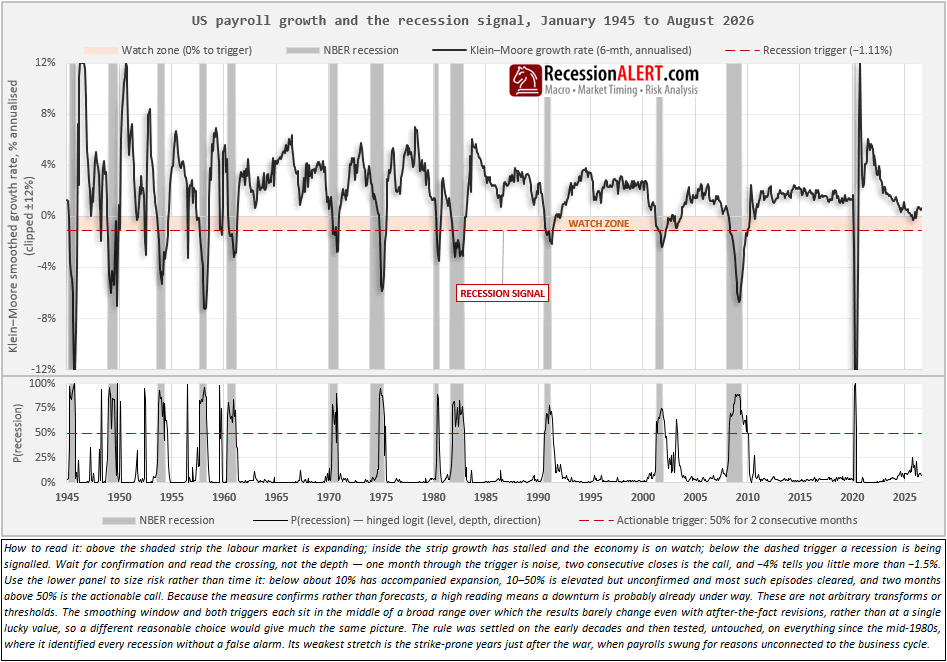
ORIGINAL CHART ANALYSIS — FROM FRIDAY’S MIBThe stall you are looking at was invisible while it was happening. Trace the amber dip through late 2025 on the numbers as they were printed at the time, month by month, and it is not there: the growth rate closed below zero exactly twice in fourteen months, four months apart and never back to back, so the two-consecutive-closes rule the chart’s caption describes never armed. What put the dip on the chart was arithmetic done afterwards. This measure compares the level of payrolls against its own recent average, so it is not fed by the monthly job gain the headlines report — it is fed by the employment count itself, and when the statisticians restate that count they silently restate every growth rate computed from it, back through history. Calendar 2025 was first reported as 1,208,000 jobs added; on today’s data it is 116,000, a full year of essentially no net hiring with no recession anywhere in it. Feed the smaller count back through and October 2025 falls from -0.020% to -0.251% — a real slowdown, made visible late, and still only 23% of the way to the -1.11% trigger, the second-mildest of twelve such stalls since 1945. Calling that a dodged recession flatters it. This morning the arithmetic ran the other way: 162,000 against 53,000 expected, June and July revised up a combined 55,000, and futures now near 60% odds of a September hike. The exposure being carried is not a downturn that arrives. It is one that keeps refusing to. What it means: one weak jobs month is not information yet — the government rewrites each month’s number twice more, and last year’s were cut by over a million. A portfolio built for rate cuts is leaning on data that keeps being withdrawn, and the ten-year is at 4.77%, rising rather than falling. What would change that is the recession-odds line holding above 50%, last seen in 2020.
MIB Weekly Digest Ver. 2.02
For professional investors only. Not investment advice.
© 2026 RecessionALERT.com

Comments are closed.