
MARKET INTELLIGENCE BRIEF (MIB)
Tuesday, September 8, 2026
Houthi strikes halted Saudi energy operations and pushed Brent within a dollar of $100 — stocks fell, yields rose, and that combination says inflation, not recession. Novartis cratered 13.93% on its second Phase III miss in five days, dragging Amgen down 10.08%. GPT-6 Astra’s rollout finished over the holiday and enterprise software de-rated: ServiceNow -4.99%, Shopify -7.57%. Amazon handed Qualcomm a warrant over 25 million shares. Consumer credit smashed estimates; balances hit records. CPI Friday, FOMC next week.
TABLE OF CONTENTS
A. EXECUTIVE SUMMARY
B. MARKET DATA
C. HIGH-IMPACT STORIES (6)
D. MODERATE-IMPACT STORIES (8)
E. ECONOMY WATCH (5)
F. EARNINGS WATCH (0)
G. WHAT’S NEXT
H. CHART OF THE DAY
A. EXECUTIVE SUMMARY -> TOP
Equities fell on a cost-push shock rather than a growth scare, and the bond market made the distinction explicit: the S&P lost 0.58% and the Dow 1.18% while both the 10Y (+1.1 bps) and 2Y (+1.7 bps) rose — the inverse of the bid a demand shock produces. The trigger — Houthi strikes that halted operations at several southern Saudi energy sites, lifting Brent 2.35% to $99.28 — carries no disclosed barrel loss, making this a risk-premium repricing rather than a physical outage, and more fragile in both directions. It lands three days before August CPI and a week before an FOMC already pricing roughly 60% hike odds, with OPEC+ having declined on Sunday to add October barrels and Canada’s $27.6B counter-tariffs live the same morning. Breadth was narrow and the leadership diagnostic: Energy (+1.18%) and Utilities (+0.93%) were the two largest gainers, the defensive-plus-energy signature of an oil shock, while Healthcare’s -2.54% was single-name pharma damage rather than a sector-wide reversal.
• Oil carried the tape. Brent closed $99.28 (+2.35%) and WTI $94.21 (+2.98%) after strikes on southern Saudi energy facilities, with no barrels-per-day loss disclosed. Europe wears more of it than the US — Dutch TTF gas +6.60% against Henry Hub -2.22%.
• Healthcare took the worst of the damage (-2.54%). Novartis -13.93% on a second Phase III miss in five days, Amgen -10.08% on a rival’s failed Lp(a) outcomes trial, Stryker -8.81% on a manufacturing timeline slipping into Q4, Boston Scientific -5.23% after declaring its August cyberattack material.
• The AI displacement trade ran hard in one session. GPT-6 Astra finished rolling out over the closed holiday, and enterprise software de-rated on the first tape able to price it: Shopify -7.57%, ServiceNow -4.99%, Accenture -4.12%, Salesforce -3.90%, Adobe -3.47%. Semis went the other way — Intel +9.05%, AMD +5.90%.
• Two large capacity commitments landed on the compute side. Amazon gave Qualcomm (+3.17%) a warrant over 25 million shares for custom inference silicon, with $60B a vesting ceiling rather than an order; Verizon reserved 80m+ miles of Corning fibre through 2032, sending GLW +7.46% on no disclosed contract value.
• The consumer is spending on credit. July consumer credit rose $18.06B against a ~$11.8B consensus, with revolving balances at a record $1.357T and non-revolving at a record $5.186T. The NY Fed’s survey has inflation expectations anchored at 3.6% but the perceived odds of higher unemployment at 44.4%, the highest since April 2020.
• Trade policy moved on two fronts. Canada’s counter-tariffs on $27.6B of US goods took effect at 12:01 a.m., at 15-50% across steel, aluminium, dairy and equipment; separately the USITC opened a public docket on how to run Section 338, conceding it “does not currently have an established practice” for the authority already collecting the duties.
1. The market repriced inflation risk, not growth risk — and handed the Fed a problem with no clean answer — Yields rising alongside falling equities is the signature of a supply shock, and it arrives with August CPI on Friday and the FOMC on Sept 15-16 already priced near 60% for a hike. The commentary split cleanly today: Deutsche Bank called for two hikes to 4.1% to reverse 2025’s insurance cuts, while El-Erian argued Treasury and hyperscaler issuance — not policy — is what is lifting yields, in which case a hike tightens conditions without touching the cause. The NY Fed survey makes it harder still: inflation expectations anchored, but the perceived probability of higher unemployment at a six-year high. Both halves of the mandate now argue for holding, for opposite reasons.
2. Buying the bottleneck has become the dominant capital-allocation behaviour — Three unrelated industries did the same thing today. Amazon paid Qualcomm in equity rather than cash to secure a second source of inference silicon. Verizon committed to 80m+ miles of Corning fibre through 2032 because it expects the physical interconnect to be scarce. GE Aerospace paid $11.75B — roughly 26x EBITDA before synergies — for precision castings capacity that has constrained engine output for three years. None of these are priced on near-term earnings; all three are purchases of volume visibility. For portfolios the read-through is that the AI cycle’s returns are migrating toward whoever owns the constraint, which is why chips rallied on a day software fell.
3. Healthcare’s premium is being re-underwritten in public — The sector’s -2.54% was not one event. Novartis lost 13.93% on two Phase III misses in five days across unrelated therapeutic areas; Amgen lost 10.08% on a competitor’s failure in a drug class where its own candidate does not report until 2027, and fell despite announcing a successful Phase 3 of its own that morning; Stryker and Boston Scientific fell on execution and disclosure rather than science. What connects them is a market that has stopped extending the sector the benefit of the doubt — on late-stage productivity, on recovery timelines, on unearned optionality — after Healthcare ran +19.78% over twelve months. Position for dispersion within the sector, not a directional call on it.
 — Leading economic indicators. Accurate market forecasts. Apply for membership at join.recessionalert.com
B. MARKET DATA -> TOP
Equities sold off broadly as Houthi drone and missile strikes on Saudi Arabia’s Jizan refinery and other Aramco energy facilities sent Brent within a dollar of $100/bbl, reviving an inflation-fear trade that pushed both the 10Y and 2Y yields higher even as stocks fell. The Dow’s -1.18% decline outpaced the S&P’s -0.58% and the Nasdaq 100’s -0.12%, dragged down by two of its own components — Amgen’s -10.08% plunge on a rival’s failed cholesterol trial and Salesforce’s -3.90% slide — while an Intel upgrade and a reported ~10% CPU price hike lifted the chip complex (Intel +9.05%, AMD +5.90%) and cushioned tech. Energy (+1.18%) and Utilities (+0.93%) were the session’s two largest sector gainers; Healthcare (-2.54%) led losses on the Amgen-driven pharma selloff.
CLOSING PRICES – September 8, 2026:
MAJOR INDICES
The Dow’s underperformance (-1.18% vs the S&P’s -0.58%) was a single-name story, not a market-wide rout — Amgen (-10.08%) and Salesforce (-3.90%), both Dow components, did the damage. The Nasdaq 100 (-0.12%) was the most resilient index, cushioned by the Intel-led chip rally. Small-caps (Russell -0.52%) and NYSE breadth (-0.67%) tracked the broader tape, confirming this was concentrated single-name pressure atop a genuine broad risk-off tone.
| Index | Close | Change | %Move | Why It Moved |
|---|---|---|---|---|
| S&P 500 | 7,673.52 | -45.08 | -0.58% | Oil-driven inflation-fear selloff after Houthi strikes on Saudi energy facilities; healthcare (Amgen) weighed heaviest |
| Dow Jones | 52,786.07 | -628.18 | -1.18% | Underperformed on Amgen (-10.08%) and Salesforce (-3.90%), both Dow components, amid the broader oil-driven selloff |
| DJ Transportation | 20,800.70 | -211.03 | -1.00% | Tracked the broader risk-off tone; no distinct transport-sector catalyst identified |
| Nasdaq 100 | 29,507.70 | -36.45 | -0.12% | Cushioned by a broad semiconductor rally (Intel, AMD) that offset software/healthcare weakness |
| Russell 2000 | 2,960.20 | -15.44 | -0.52% | Small-caps tracked the broader risk-off tape, roughly in line with the S&P |
| NYSE Composite | 24,473.06 | -166.19 | -0.67% | Broad-based decline consistent with the oil-driven risk-off tone across the tape |
VOLATILITY & TREASURIES
VIX rose 2.81% alongside both the 10Y (+1.1 bps) and 2Y (+1.7 bps) — an inflation-fear signature, not a growth scare; in a recession scare yields fall as bonds catch a bid. The front-end tracking the long end higher confirms the market is repricing near-term inflation risk from the oil shock. DXY’s modest -0.32% dip is the one disconnect — no safe-haven dollar bid despite the equity selloff.
| Instrument | Level | Change | Why It Moved |
|---|---|---|---|
| VIX | 15.73 | +0.43 (+2.81%) | Fear gauge rose alongside yields — an inflation-fear signature tied to the oil spike, not a recession scare |
| 10-Year Treasury Yield | 4.795% | +1.1 bps | Yields rose on inflation-fear from the oil spike despite the equity selloff |
| 2-Year Treasury Yield | 4.396% | +1.7 bps | Front-end tracked the 10Y higher, confirming a hawkish inflation read rather than a growth scare |
| US Dollar Index (DXY) | 98.85 | -0.32 (-0.32%) | Modestly softer despite the risk-off tone; no clear safe-haven dollar bid today |
COMMODITIES
Gold fell 1.70% even as Mideast tensions escalated — Yahoo Finance attributed the drop directly to the fresh Iran-linked escalation, an inverted safe-haven read that instead tracked the day’s higher yields. Silver (-0.70%) and platinum (-0.15%) drifted lower in sympathy. Copper (+1.31%) diverged, confirming industrial-demand resilience rather than a broad metals selloff. Bitcoin’s modest -0.90% decline tracked the risk-off tape rather than decoupling.
| Asset | Price | Change | %Move | Why It Moved |
|---|---|---|---|---|
| Gold | $4,400.55/oz | -$76.05 | -1.70% | Fell despite the Mideast escalation as rising yields outweighed safe-haven demand (per Yahoo Finance) |
| Silver | $66.28/oz | -$0.47 | -0.70% | Tracked gold lower in modest sympathy |
| Copper | $6.770/lb | +$0.087 | +1.31% | Diverged from precious metals on industrial-demand resilience |
| Platinum | $1,823.30/oz | -$2.70 | -0.15% | Roughly flat, tracking the softer precious-metals tone |
| Bitcoin | $78,606 | -$717 | -0.90% | Modest decline tracking the broader risk-off tone rather than decoupling |
ENERGY
WTI (+2.98%) and Brent (+2.35%) moved in lockstep on a pure supply shock — Houthi strikes disabled Saudi Aramco’s Jizan refinery — confirming a global disruption. Oil rising while equities fell is a supply-shock, cost-pressure signal, not a demand story. Henry Hub (-2.22%) sat out the rally entirely, unrelated to the Mideast risk. Dutch TTF’s +6.60% surge reflects Europe’s greater exposure to the same supply shock.
| Asset | Price | Change | %Move | Why It Moved |
|---|---|---|---|---|
| Crude Oil (WTI) | $94.21/bbl | +$2.73 | +2.98% | Houthi drone/missile strikes halted operations at Saudi Aramco’s Jizan refinery and other energy facilities near the Yemen border, wounding 73 |
| Crude Oil (Brent) | $99.28/bbl | +$2.28 | +2.35% | Same Houthi-strike supply shock; global benchmark neared $100/bbl |
| Natural Gas (Henry Hub) | $2.909/MMBtu | -$0.066 | -2.22% | Decoupled from the crude spike; domestic supply/demand dynamics unrelated to the Mideast disruption |
| Natural Gas (Dutch TTF) | $26.13/MMBtu | +$1.62 | +6.60% | European gas far outpaced Henry Hub, reflecting Europe’s greater exposure to Mideast supply risk |
S&P 500 SECTORS
Energy (+1.18% today, +45.14% 12M) and Utilities (+0.93%) were the day’s only sizeable gainers — a clean defensive-plus-energy pattern matching the oil shock. Healthcare’s -2.54% today is still +19.78% over 12 months despite the Amgen-driven selloff, reading as single-name pressure rather than a structural reversal. Financial (-1.22%) lagged despite a strong 3-month run (+10.52%), a session-specific pullback rather than a trend break.
| Sector | 1-Day | 1-Week | 1-Month | 3-Month | 6-Month | YTD | 12-Month |
|---|---|---|---|---|---|---|---|
| Energy | +1.18% | +1.60% | +9.56% | +8.63% | +12.75% | +40.58% | +45.14% |
| Utilities | +0.93% | +2.72% | -1.06% | -1.04% | -7.38% | +0.82% | +4.91% |
| Industrials | +0.26% | +1.06% | -3.90% | -2.28% | +0.95% | +11.73% | +15.68% |
| Technology | +0.20% | +1.34% | +0.87% | +3.60% | +29.55% | +26.13% | +35.34% |
| Basic Materials | +0.01% | -0.35% | +3.01% | +8.87% | +4.02% | +20.03% | +33.27% |
| Real Estate | -0.22% | -0.53% | -2.75% | +0.58% | +2.25% | +7.99% | +2.74% |
| Communication Services | -0.31% | +0.71% | -1.60% | -3.26% | +0.38% | -1.32% | +4.88% |
| Consumer Defensive | -0.61% | -0.94% | -2.46% | -0.65% | -3.81% | +5.66% | +3.23% |
| Consumer Cyclical | -0.65% | -1.82% | -4.62% | -0.37% | +0.81% | -5.22% | -3.95% |
| Financial | -1.22% | +0.09% | -0.35% | +10.52% | +15.50% | +7.94% | +13.64% |
| Healthcare | -2.54% | -1.76% | +0.11% | +9.45% | +7.75% | +7.41% | +19.78% |
TOP MEGA-CAP MOVERS:
GAINERS
| Company | Ticker | Close | Change | Why It Moved |
|---|---|---|---|---|
| Intel Corp | INTC | $104.47 | +9.05% | Northland Securities upgraded to Outperform (PT $120) on turnaround progress and tight server-CPU supply, alongside a DigiTimes report of a ~10% CPU price hike — the third this year; Intel Foundry/ASML also passed 1M High-NA EUV wafers processed |
| Advanced Micro Devices Inc | AMD | $505.74 | +5.90% | Swept up in the same semiconductor optimism as the Intel pricing and upgrade news, plus bullish analyst commentary on AMD’s data-center TAM |
| Lam Research Corp | LRCX | $320.42 | +4.15% | Semiconductor-equipment sympathy rally tied to the Intel upgrade and CPU price-hike report; no distinct company-specific catalyst confirmed |
| Tesla Inc | TSLA | $368.16 | +3.98% | No discrete same-day catalyst identified |
| Applied Materials Inc | AMAT | $472.79 | +3.98% | Semiconductor-equipment sympathy rally tied to the Intel upgrade and CPU price-hike report; no distinct company-specific catalyst confirmed |
DECLINERS
| Company | Ticker | Close | Change | Why It Moved |
|---|---|---|---|---|
| Amgen Inc | AMGN | $393.17 | -10.08% | Novartis’ pelacarsen Lp(a) drug failed its Phase 3 cardiovascular trial, raising doubts about Amgen’s own olpasiran candidate; BMO Capital downgraded Amgen to Market Perform |
| Salesforce Inc | CRM | $249.12 | -3.90% | Enterprise software de-rated on AI-displacement fears after OpenAI’s GPT-6 Astra completed its enterprise rollout over the closed weekend (ServiceNow -4.99%, Shopify -7.57%); higher yields and post-earnings profit-taking compounded it |
| Abbvie Inc | ABBV | $248.78 | -2.99% | Tracked the broader healthcare-sector selloff (Novartis trial failure weighing on the group) |
| Palantir Technologies Inc | PLTR | $170.30 | -2.31% | No discrete same-day catalyst identified; high-multiple growth names pressured by the day’s higher yields |
| Home Depot Inc | HD | $313.70 | -2.29% | No discrete same-day catalyst identified; continuation of the housing-market/demand concerns weighing on the stock since its early-August earnings |
— Institutional-grade intelligence for serious investors. Apply for membership at join.recessionalert.comC. HIGH-IMPACT STORIES -> TOP
BEARISH
1. Houthi Missiles and Drones Halt Saudi Energy Operations and Push Brent Within a Dollar of $100 — With No Barrel Loss Disclosed
The core facts:Houthi forces launched a coordinated ballistic-missile and drone offensive against southern Saudi Arabia overnight, striking Abha, Jazan, Najran and the King Khalid air base at Khamis Mushait. The Houthi military spokesperson claimed Aramco facilities at Abha, Najran and Jizan. Saudi Arabia’s energy ministry confirmed fires at several locations and that operations were halted at several southern energy facilities; 73 people were wounded, reported independently by Reuters, NBC and NPR. Brent closed $99.28, +2.35%, and WTI $94.21, +2.98% — on a Friday-close basis, which is the relevant span because crude traded through the holiday, Brent gained 3.61% and WTI 3.32%. The Saudi Foreign Ministry affirmed its “legitimate right to take all necessary measures to defend its sovereignty.” Critically, no crude export or production impact was disclosed by Saudi authorities and no barrels-per-day loss figure has been published; Abha and Najran serve domestic consumption.
Why it matters:This is the cleanest cost-push shock the tape has produced this year, and its signature is unmistakable in the cross-asset moves. Equities fell (S&P -0.58%, Dow -1.18%) while both the 10Y (+1.1 bps) and 2Y (+1.7 bps) yields rose — the inverse of a growth scare, in which bonds catch a bid. The front end tracking the long end higher says the market is repricing near-term inflation risk, not recession risk, three days before an August CPI print and a week before an FOMC meeting already pricing roughly a 60% chance of a hike. Energy (+1.18%) and Utilities (+0.93%) were the session’s two largest sector gainers. The absence of a disclosed barrel loss is the analytically important detail: a 3% crude move on confirmed facility damage but unquantified supply loss is a risk-premium repricing, which is more fragile in both directions than a physical outage. Europe is more exposed than the US on this vector — Dutch TTF gas surged 6.60% against Henry Hub’s -2.22%.
What to watch:Any Aramco or Saudi energy ministry disclosure quantifying lost throughput or export volumes — the first hard barrels-per-day figure will decide whether the risk premium holds. The EIA Short-Term Energy Outlook lands Wednesday Sept 9 and the OPEC monthly report Thursday Sept 10.
BEARISH
2. US Destroys Three Iranian Tankers Under an Explicit “Tanker for Tanker” Doctrine, and Washington Quietly Strips the Sanctions Carve-Out for Emergency Ship Repairs
The core facts:On Saturday Sept 5, after the IRGC fired ballistic missiles at a US aircraft carrier and a guided-missile destroyer — both evaded, no personnel hurt — CENTCOM struck three Iranian tankers: the M/T Downy off Kharg Island and the M/T Stark 1 near Jask, both permanently disabled, and the M/T Kylo in the Gulf of Oman. CENTCOM commander Adm. Brad Cooper framed the response in explicitly economic terms, saying the US would “impose an even higher economic cost” by taking out three vessels for two, and described the tankers as part of a shadow network funding the IRGC and its proxies. Iran vowed a “faster, heavier and more painful” response on Sunday. Then on Tuesday, filed at 16:15 ET, OFAC stayed indefinitely three Iranian Transactions and Sanctions Regulations general licences and General Licence J-1, effective the same day. The stayed provisions include 31 CFR 560.529 — bunkering and emergency repairs — with a stated rationale citing Iran’s “continued disruptions to global energy markets” and “efforts to monetize the Strait of Hormuz.”
Why it matters:Read the two actions together and a doctrine emerges: the US is now treating Iranian tonnage itself as the target set and simultaneously removing the humanitarian-adjacent legal cover that let vessels in Iranian waters take on fuel or emergency repairs. That combination raises the insurance and operating cost of every hull in the region, not only the three that were hit, and it does so through a channel that does not require further military action. For US portfolios, this is the structural leg underneath the day’s crude move — the Houthi strike supplies the headline, but a declared exchange-rate policy against tanker traffic in the world’s most important chokepoint is what keeps a risk premium in the curve after the fires are out. It also cuts directly against the one de-escalatory thread in the window: Iran said Monday a Hormuz shipping accord with Oman was “days away.”
What to watch:Whether Iran’s promised response targets commercial shipping rather than US naval assets — that is the escalation step that would reprice tanker rates and Gulf insurance outright. Also watch whether the Iran–Oman corridor talks survive the week.
BEARISH
3. Amgen Announces a Successful Phase 3 and Falls 10.08% Anyway — the Market Marks Down a Drug That Has Not Reported Yet
The core facts:Amgen closed $393.17, down $44.06 or 10.08%, on volume near three times its one-month average — the largest decline in the day’s mega-cap movers table and, alongside Salesforce, the reason the Dow’s -1.18% underperformed the S&P’s -0.58%. The company had good news of its own that morning: Phase 3 DeLLphi-305 showed a statistically significant overall-survival benefit for IMDELLTRA plus IMFINZI versus durvalumab alone in first-line maintenance for extensive-stage small cell lung cancer, though the release is topline only, with no hazard ratio, median OS, p-value or confidence interval disclosed and no congress named. The stock fell regardless, on read-through from a competitor: Novartis’s pelacarsen, the first cardiovascular outcomes trial of an Lp(a)-lowering drug, missed its primary endpoint. Investors marked down Amgen’s own Lp(a) candidate olpasiran, whose late-stage data is not due until 2027 or early 2028. BMO Capital cut Amgen to Market Perform while leaving its $450 target intact — a downgrade justified by compressed upside rather than a lowered valuation, and it cut BioNTech the same day.
Why it matters:A 10% single-day repricing of a $213 billion company on someone else’s failed trial is a statement about how much unearned optionality the market had capitalised into a drug class. The pelacarsen result did not merely fail to help Amgen; it called into question the central hypothesis of the whole Lp(a) field — that lowering the lipoprotein translates into fewer cardiovascular events. Lowering it worked; the outcomes did not follow. That is a mechanism problem, not a molecule problem, and it is why the selling ignored Amgen’s own positive oncology readout on the same day. Healthcare fell 2.54%, the worst sector on the tape, with AbbVie -2.99% caught in the downdraft. The read-through has a third leg the market has not obviously priced: Lilly’s lepodisiran sits in the same class, and while LLY fell 2.21%, no source this session tied that move to the class question.
What to watch:Any Amgen guidance on whether olpasiran’s Phase 3 design or endpoint changes in response — and whether Lilly comments on lepodisiran. Detailed DeLLphi-305 data at a medical congress, venue and date still unnamed, is the offsetting catalyst.
BEARISH
4. Novartis Posts Its Second Phase III Failure in Five Days as the HARBOR Myotonic Dystrophy Trial Misses — Shares Fall 13.93%
The core facts:Novartis announced Tuesday that the Phase III HARBOR trial of del-desiran (delpacibart etedesiran) in myotonic dystrophy type 1 did not demonstrate statistically significant improvement versus placebo on its primary endpoint, video hand opening time. The trial enrolled roughly 150 DM1 patients over 54 weeks with dosing every eight weeks; the company reported evidence of clinical activity in secondary and exploratory endpoints, safety consistent with prior data, and confirmed the trial was not stopped early. Shreeram Aradhye, President of Development and Chief Medical Officer, said in the release that “despite decades of research, there are still no approved treatment options for DM1, and patients and caregivers continue to face a significant daily burden.” NVS closed $137.70, down 13.93% from a prior close of $159.99, on a market capitalisation of $294.81 billion. That single move prices two distinct failures: HARBOR on Tuesday and pelacarsen, announced after Friday’s close, which US markets had no session in which to react to until today.
Why it matters:Two Phase III misses in five days in unrelated therapeutic areas — cardiovascular and neuromuscular — is a pipeline-quality signal rather than a single-programme setback, and the market treated it as one. A near-14% decline in a $295 billion pharmaceutical company is among the largest moves any company of that size has produced this year, and it dragged an entire sector: Healthcare’s -2.54% was the worst on the board, with Amgen and AbbVie following it down. For US portfolio managers the transmission runs two ways. Directly, Novartis is a widely held ADR and an index constituent in global healthcare benchmarks. Indirectly, and more importantly, two failed outcome trials in a week reopens the question of whether large-pharma late-stage productivity justifies the sector’s premium — a question that had gone quiet while Healthcare ran +19.78% over twelve months.
What to watch:Whether Novartis quantifies any impairment or pipeline reprioritisation, and whether the secondary-endpoint activity in HARBOR is enough to support a follow-on trial rather than a programme discontinuation.
UNCERTAIN
5. The USITC Opens a Public Docket on How to Operate Section 338 — and Concedes It Has No Established Practice for the Authority Now Carrying US Tariff Policy
The core facts:The US International Trade Commission opened Investigation No. MISC-053, “Request for Comments Regarding Implementation of 19 U.S.C. 1338(g),” on Tuesday. The Commission states it “has a duty to ascertain and at all times to be informed of discriminations against the commerce of the United States” and concedes it “does not currently have an established practice for identifying applicable discriminatory actions.” It asks the public what makes foreign conduct “unreasonable” or “discriminatory,” how it should gather information — including “what barriers or impediments may prevent members of the public from providing relevant information,” naming “the risk… of direct or indirect reprisal from a foreign government” — and whether its reports to the President should be public. The notice records that after 1947 some policymakers questioned whether Section 338 was “a dead letter,” but that Congress retained it. No countries or products are named. Separately and on the same day, Canada’s counter-tariffs on US$27.6 billion of US goods entered into force, explicitly framed as a dollar-for-dollar response to US Section 338 duties.
Why it matters:Section 338 is the statute the administration turned to after the Supreme Court struck down the IEEPA tariffs in February, and it is already live — it was invoked against Canada in July. What this docket reveals is that the agency charged with identifying the discriminatory conduct that triggers the authority is only now building the machinery to do so, in public, after the tariffs are collecting revenue. Two things follow for portfolios. First, the legal architecture underneath the current tariff regime is being constructed retrospectively, which is precisely the condition under which litigation risk accumulates — the IEEPA reversal is the template. Second, a formal process for nominating foreign “discrimination” invites petitions, and the Commission’s own question about reprisal risk tells you it expects the respondents to be large trading partners. This is the quiet structural story of the session and the one with the longest tail.
What to watch:The comment deadline, 60 days after publication, and who files — an early docket dominated by domestic steel, aluminium and agricultural petitioners would signal the next wave of country actions.
BULLISH
6. Amazon Hands Qualcomm a Warrant Over 25 Million Shares to Win an Inference-Silicon Supplier — but the $60 Billion Everyone Quoted Is a Ceiling, Not an Order
The core facts:Qualcomm announced a multi-generational product collaboration with Amazon covering customised inference silicon for large-scale AI data centres and optical connectivity supporting up to 1.6T bandwidth. Alongside it, Qualcomm issued AWS warrants to buy 25,000,000 shares at $161.26, expiring Sept 3, 2036. The press release discloses no dollar value at all. The $60 billion figure in every headline comes from the same-day 8-K, which states the warrant vests in tranches tied to the execution of commercial arrangements, the placement of binding purchase orders and actual purchases, up to “a maximum amount of $60 billion in payments” by Amazon Data Services and affiliates. Only about 3.75 million warrant shares vested on issuance. QCOM closed $174.09, +3.17%, on 25.55 million shares against 8.49 million on Sept 4 — but it opened at $180.40 and touched an intraday high of $183.49 before fading, which is where the widely circulated “+9.5%” comes from. Amazon closed -0.60%.
Why it matters:Strip out the headline number and what remains is still significant: the largest US cloud provider has structurally committed to a second merchant source for AI inference silicon and paid for it in equity rather than cash, aligning Qualcomm’s upside with its own purchasing. That is the same warrant architecture Nvidia and others have used to lock in strategic supply, and it is becoming the standard instrument of the AI capex cycle. The nuance the tape caught and the headlines did not is the fade: a stock that opened +7% and closed +3.17% has been told by its own shareholders that a vesting ceiling stretching to 2036 is not a revenue forecast. For the sector, the read-through runs against Nvidia’s position in inference specifically — training remains untouched — and it lands the same week the software complex is being marked down on AI displacement. Capital is rotating toward whoever supplies the compute.
What to watch:The first disclosed tranche vesting beyond the initial 3.75 million shares — that is the only observable confirmation that binding purchase orders are actually being placed against the ceiling.
— Quantifying recession risk so you don’t have to guess. Apply for membership at join.recessionalert.comD. MODERATE-IMPACT STORIES -> TOP
BULLISH
7. Intel Rises 9.05% on Its Third CPU Price Increase of the Year and a Northland Upgrade — a Pricing Pivot, Not a Volume Story
The core facts:Intel closed $104.47, +9.05%, the largest gain among names above $200 billion and enough on its own to cushion the Nasdaq 100 to -0.12% against the S&P’s -0.58%. Two same-day catalysts drove it. Northland Capital Markets analyst Gus Richard upgraded Intel to Outperform from Market Perform with a $120 target, citing turnaround progress and tight server-CPU supply, and naming the Tesla “Terafab” partnership as a potential material benefit to Intel Foundry. Separately, DigiTimes reported Intel could raise CPU prices by as much as 10%, which would be the third such increase this year after rises in the first quarter and again in July. Intel Foundry also passed one million wafers processed on High-NA EUV with ASML. AMD rose 5.90% and equipment makers followed — Lam Research +4.15%, Applied Materials +3.98% — though no company-specific catalyst was confirmed for the latter two.
Why it matters:The market read the price increase, not the upgrade, as the signal — and read it as a decision to defend margin per chip rather than chase volume. A third increase in a single year from the dominant x86 supplier is only possible if server-CPU supply is genuinely tight, which makes this a demand indicator dressed as a pricing announcement. It also lands awkwardly on a day whose dominant theme is inflation: a hardware vendor raising prices 10% into constrained supply is the microeconomic version of the oil shock moving the front end of the curve. For portfolios, the more durable point is that Intel is being repriced on operating discipline rather than on the AI narrative that has carried the sector, which makes the move less correlated with the rest of the complex than the sympathy rally in equipment names suggests.
What to watch:Confirmation of the price increase from Intel itself or from OEM channel checks in October — DigiTimes is a supply-chain report, not a company disclosure, and the whole thesis rests on it holding.
BEARISH
8. GPT-6 Astra Finishes Rolling Out Over the Holiday Weekend and the Enterprise Software Complex De-Rates on the First Session Able to Price It
The core facts:OpenAI shipped GPT-6 Astra on Sept 3 with a staged, permission-gated rollout — a limited set of organisations on day one, then Plus, Pro, Business and Enterprise tiers, the API and AWS. That rollout completed across the closed weekend: Microsoft’s Foundry model catalogue marked gpt-6-astra generally available with a Sept 7, 5:02 p.m. Pacific stamp, hours before Tuesday’s US open. The model’s headline capability is “computer use” — navigating a computer as a person would — which OpenAI called a generational leap for software engineering and professional work. Tuesday’s tape marked the consequence: Salesforce -3.90%, ServiceNow -4.99%, Shopify -7.57%, Accenture -4.12%, Adobe -3.47%, with Intuit also down around 5%. Several of those fell on days their price targets were raised — Shopify’s was lifted to $180 by Piper Sandler, ServiceNow’s to $170 by BTIG. Semiconductors moved the other way, with Intel +9.05% and AMD +5.90%.
Why it matters:This is the clearest expression yet of the trade that has been forming all year: capital rotating out of application software and into the compute that might replace it. The tell is the divergence between price and analyst opinion — when a stock falls 7.57% on the day its target is raised, the sell side and the tape are pricing different time horizons, and the tape is pricing displacement risk that no model in a broker’s spreadsheet yet contains. The long weekend concentrated the effect: a rollout that finished on a federal holiday had no session to be absorbed gradually, so four days of repricing landed at once. Whether the fear is correct is a separate question — agentic capability that can navigate software is not obviously the same thing as replacing the systems of record underneath it — but the positioning consequence is immediate for anyone overweight enterprise SaaS.
What to watch:Oracle’s results Thursday Sept 10 — it sits on the compute side of this trade rather than the application side, and its cloud commentary is the first management view of the split from a company with a foot in both.
BEARISH
9. Stryker Falls 8.81% After Telling a Conference That March’s Manufacturing Disruption Will Now Run Into Q4 — Six Months After Management Called It Addressed
The core facts:Speaking at the Wells Fargo 21st Annual Healthcare Conference on Tuesday, Stryker CFO Preston Wells disclosed that manufacturing constraints in the company’s peripheral-vascular business remain unresolved and are now expected to persist into the fourth quarter. The constraints stem from Stryker’s own network disruption in March 2026, whose full manufacturing shutdown hit the smaller peripheral-vascular organisation hardest. Wells said the issues are “not allowing us to reach a full supply of inventory at all of our customers and quite frankly, not allowing us to go out and really win new business.” That contradicts the CEO’s July statement that the problem had been addressed and would resolve in Q3. Importantly, the company reaffirmed 2026 organic growth guidance at 8.3% to 9.3% — the numeric outlook was maintained, and items circulating as a guidance cut are describing commentary, not a guidance change. SYK closed $276.43, -8.81%, on 5.87 million shares against 2.35 million, on a market capitalisation of $106.03 billion.
Why it matters:An 8.81% decline on commentary that left the numbers untouched is the market pricing management credibility rather than earnings. The July “addressed” statement is now the second consecutive quarter in which the recovery timeline has slipped, and the specific admission that the constraint is costing new business — not merely delaying existing shipments — converts a supply problem into a share-loss problem that outlasts the fix. For medtech investors the wider signal is about disclosure quality: a disruption first described in March is still moving guidance-adjacent commentary in September, and the company’s own reaffirmed organic growth range now carries a visible tail risk it did not appear to carry a week ago.
What to watch:Whether the 8.3% to 9.3% organic growth range survives the Q3 report — that is the number this commentary has put in question without formally changing.
BEARISH
10. Boston Scientific Declares Its August Cyberattack Material and Says It Will Miss Full-Year Guidance — the Only Item 1.05 Filing of the Window
The core facts:In an Item 1.05 8-K filed Tuesday, Boston Scientific determined that the cyberattack detected on Aug 25 “is likely to have a material impact on the Company’s results of operations for the third quarter and full year 2026” and that it is “unlikely to meet the net sales growth and adjusted EPS guidance ranges” previously provided, while stating it “does not expect the incident will have a material impact on its long-term financial condition.” A parallel newsroom update at 07:05 ET reported that its distribution network “has been substantially restored,” all sterilisation facilities are operational, manufacturing “has resumed across most facilities globally,” remote monitoring activation capability is restored, and product quality analyses indicate no impairment to product function. The earlier Aug 26 filing was an Item 8.01; Tuesday’s materiality determination is a distinct and new disclosure. BSX closed $45.30, -5.23%, on 21.12 million shares against 15.40 million. Its market capitalisation now reads $65.19 billion — itself a consequence of this incident. Across the entire four-day window this was the only Item 1.05 filing on EDGAR.
Why it matters:This is the disclosure regime working exactly as designed and it produces an uncomfortable result: a company can restore its operations and still be obliged to tell the market it will miss the year. The gap between the operational update — substantially restored, manufacturing resumed, no product impairment — and the financial determination is the whole story. Revenue lost during a two-week distribution outage in implantable devices does not come back, because the procedures were scheduled elsewhere. For investors the case is now the cleanest available quantification of what a cyber incident costs a medtech manufacturer, and the answer is a full-year guidance range. It is also a reminder that Item 1.05 materiality determinations lag detection by roughly two weeks, so the absence of filings in any given window is not evidence of an absence of incidents.
What to watch:The revised guidance ranges themselves, which the filing does not provide — the size of the cut is the number that has not yet been disclosed.
BULLISH
11. Verizon Locks Up 80 Million Miles of Corning Fibre Through 2032 and Corning Gains 7.46% — With No Dollar Figure Disclosed
The core facts:Verizon and Corning announced at 09:00 ET a “multi-year, multi-billion dollar” agreement covering “80+ million miles of high-density optical fiber and connectivity solutions from 2027 to 2032,” for broadband expansion and AI infrastructure. Kyle Malady, CEO of Verizon Business, said in the release that “securing this volume of fiber allows us to continue building the network of the future at an unprecedented scale.” No dollar figure was disclosed — “multi-billion dollar” is the exact and only wording, and any specific number attached to this deal downstream is unsourced. GLW closed $165.81, +7.46%, on 10.69 million shares against 7.86 million; Verizon closed +0.54%. Corning had already risen 5.68% on Sept 4, so the run predates the announcement. Separately and on the same day, China Renaissance initiated coverage of Corning at Buy with a $238 target — that initiation landed on top of the deal and is not the cause of the move.
Why it matters:A six-year volume commitment of this size is a capacity reservation, not a purchase order, and that is what makes it interesting: Verizon is paying to guarantee supply through 2032 because it expects fibre to be scarce. The scarcity is not coming from consumer broadband, which is mature, but from AI data-centre interconnect — the same demand that has Qualcomm and Amazon building optical connectivity to 1.6T on the other side of today’s tape. Corning is one of the few listed pure-plays on that physical bottleneck, and a 7.46% move on an undisclosed-value contract tells you the market is valuing the volume visibility rather than the revenue. The absence of a dollar figure is the discipline point: with no contract value, no margin assumption, and a start date in 2027, the earnings translation is entirely inferred.
What to watch:Whether Corning quantifies the agreement in its next quarterly disclosure or capacity-expansion plans — until then the “multi-billion” framing is the only figure that exists.
BULLISH
12. GE Aerospace Buys Consolidated Precision Products for $11.75 Billion — Its Largest Deal as a Standalone Company, at 18x EBITDA With Synergies
The core facts:GE Aerospace agreed pre-market Tuesday to acquire Consolidated Precision Products for $11.75 billion, with $7 billion financed in cash and the remainder in new debt. The company’s release values CPP at “approximately 18x 2027 EBITDA including expected net synergies, compared to ~26x without synergies,” says the deal will be accretive to adjusted EPS and free cash flow in the first full year, and expects closing in the second half of 2027 subject to regulatory approvals. The release explicitly states “no change to GE Aerospace’s capital allocation plans.” This is the largest acquisition since GE Aerospace became a standalone company. The sellers are Warburg Pincus and Berkshire Partners. A roughly $200 million net synergy figure and a headcount of about 6,600 across 20-plus facilities appear in secondary coverage but not in the primary release. GE closed $334.91, -0.66%, on a market capitalisation of $347.49 billion.
Why it matters:The multiple is the disclosure that matters. Paying 26x EBITDA before synergies for a castings and structural-components supplier is an aggressive price for an unglamorous business, and GE has pre-empted the criticism by publishing both numbers — which tells you management expects the gap to be the argument. The strategic logic is supply-chain control: aerospace engine output has been constrained by precision-casting capacity for three years, and buying the constraint is faster than qualifying around it. The near-two-year close is the risk investors marked, along with the modest -0.66% reaction: a deal that does not complete until the second half of 2027 carries regulatory exposure through an entire political cycle, and the explicit reassurance on capital allocation suggests GE anticipated a buyback question it wanted answered before it was asked.
What to watch:Antitrust review scope — CPP supplies multiple engine makers, so remedies limiting supply to GE’s competitors are the plausible condition.
UNCERTAIN
13. OPEC+ Holds October Output at September Levels the Day Before the Missiles Landed — Seven Countries, No Barrel Figure, Next Meeting October 4
The core facts:Per OPEC press release 613, issued Sunday Sept 6, Saudi Arabia, Russia, Iraq, Kuwait, Kazakhstan, Algeria and Oman “decided to maintain September 2026 required production for October 2026.” The release gives no barrels-per-day figure of any kind. The next meeting is set for October 4, 2026. Two framings circulating alongside this decision do not belong to it: the widely quoted 188,000 bpd September increase was first published in OPEC’s Aug 2 release and is not a property of Sunday’s decision, and the “1.65 mb/d tranche fully unwound” characterisation appears in neither release. A JMMC statement of concern over attacks on energy infrastructure surfaced in aggregator summaries and appears in neither release either. The decision landed roughly 24 hours before the Houthi strikes on Saudi facilities.
Why it matters:The sequencing is what gives an otherwise routine rollover its edge. The group chose not to add October barrels on Sunday; on Tuesday its largest member had energy facilities on fire and crude was 3% higher. That leaves the market entering October with no incremental supply scheduled and a live risk premium — and it removes the automatic stabiliser that a pre-committed increase would have provided. For US inflation the transmission is direct and near-term: a flat OPEC+ quota into a supply scare is what turns a one-day crude spike into a sustained pass-through to retail fuel, which is already at record diesel levels. The group’s own next decision point, October 4, now falls after the FOMC has already moved.
What to watch:Whether OPEC+ signals an emergency review before October 4 — an off-cycle statement would be the clearest indication the group reads the Saudi strikes as a genuine supply event rather than a risk-premium one.
UNCERTAIN
14. A BASF Subsidiary Asks the ITC to Bar iPhone and iPad Imports — the Exclusion-Order Track the Coverage Missed
The core facts:The ITC docketed a Section 337 complaint on Tuesday — “Certain Mobile Electronic Devices and Components Thereof,” Docket No. 3934 — filed on behalf of trinamiX Sensing LLC and trinamiX GmbH, a BASF subsidiary, naming Apple as the sole proposed respondent. The complaint requests “a limited exclusion order, cease and desist orders, and impose a bond upon the respondent alleged infringing articles during the 60-day Presidential review period.” A parallel district-court suit in the Western District of Texas asserts seven patents covering skin detection and material identification in face unlock, accusing the iPhone 15, 16 and 17 families, iPhone Air and several iPad Pro models; that suit broke into circulation on Sept 7 and 8. The ITC track itself appears largely uncovered in the trade press. This report rests on the Federal Register public-inspection document; no second source corroborates the exclusion-order request, which is a strength of provenance and a weakness of corroboration.
Why it matters:The two tracks are not equivalent and the market is watching the wrong one. A district-court patent suit ends in damages, which for Apple is a rounding error. A Section 337 exclusion order ends in an import ban, and Apple’s entire US iPhone supply is imported — which makes the ITC the materially more dangerous forum by a wide margin. Historically these cases settle precisely because the remedy is disproportionate to the dispute, and that asymmetry is the point: the leverage a credible exclusion-order petition creates is worth far more than the patents. The timing is also awkward, arriving the day before an Apple product event. Note the base rate honestly, though — the ITC institutes most complaints and excludes very few, and any order faces a 60-day Presidential review.
What to watch:The institution decision, due within 30 days of publication, and public-interest comments due roughly Sept 17 — institution is the step that converts this from a filing into a live import risk.
— Separating signal from noise since 2007. Apply for membership at join.recessionalert.comE. ECONOMY WATCH -> TOP
Consumer credit surged to $18.06B in July, more than 50% above consensus, even as NY Fed survey data showed household anxiety about job security climbing to a six-year high — a releveraging-under-stress signal. That same tension runs through the Fed debate: Deutsche Bank forecasts two more hikes to 4.1% by year-end, while Mohamed El-Erian argues Treasury and hyperscaler bond issuance, not Fed policy, is the real driver of higher yields, and that a hike would compound the error. Canada’s new retaliatory tariffs add a fresh cost-push channel just as Friday’s CPI becomes the data point both camps are waiting on before the Sept 15-16 FOMC meeting.
Consumer Credit Smashes Estimates as Credit Card and Auto/Student Debt Hit Record Highs (Federal Reserve G.19 Report, Sept 8, 2026)
What they’re saying:US consumer credit rose $18.06B in July, far above the ~$11.7-11.9B consensus and up from June’s $14.17-14.6B gain — a 4.2% annualized pace. Revolving credit (mostly credit cards) rose $2.8B to a record $1.357T outstanding, while non-revolving credit (auto and student loans) jumped $15.3B, the largest one-month increase in over three years, to a record $5.186T.
The context:The beat signals resilient consumer spending heading into the Sept 15-16 FOMC meeting, but both revolving and non-revolving balances hitting fresh records simultaneously also reads as households releveraging to sustain spending — a dynamic that raises delinquency risk if the labor market weakens further (see NY Fed survey below).
What to watch:Delinquency trends in the NY Fed’s next quarterly Household Debt and Credit Report for early signs of stress in these record balances.
NY Fed Survey: Inflation Expectations Anchored, But Job-Loss Anxiety Hits Six-Year High (New York Fed, Sept 8, 2026)
What they’re saying:The New York Fed’s August Survey of Consumer Expectations, released today, showed one-year-ahead inflation expectations unchanged at 3.6% and five-year expectations flat at 3.0%, while three-year expectations eased 0.1 point to 3.2%. Mean unemployment expectations — the perceived probability the jobless rate will be higher in 12 months — jumped 1.6 points to 44.4%, the highest reading since April 2020, even as the perceived probability of losing one’s own job fell 0.4 point to 13.8%.
The context:The divergence is the story: consumers see stable prices ahead but a much more fragile aggregate labor market than a month ago — anchored inflation expectations argue against a hike, while rising macro-level unemployment fear argues against one too, for the opposite reason, complicating the Fed’s calculus ahead of Sept 15-16.
What to watch:August CPI, due Friday, Sept 11 — the next hard data point that could move either the inflation or labor side of this survey’s read-through.
Deutsche Bank: Fed Must Undo 2025’s “Insurance Cuts” With Two More Hikes to 4.1% (Deutsche Bank, Sept 8, 2026)
What they’re saying:Deutsche Bank economists said today that persistently high inflation and a rebounding labor market mean the Fed will need to reverse 2025’s three 25-bp “insurance cuts” (September, October, December) with new hikes. The bank expects the Fed to raise rates twice this year to a 4.1% fed funds rate, pause through 2027, and hold off on cuts until 2028, citing core PCE close to a 34-year high.
The context:This is among the most hawkish institutional calls on the Street heading into the Sept 15-16 meeting, where markets have priced roughly a 60% probability of a hike at that specific meeting (multiple outlets, Sept 5), while Polymarket’s separate full-year “Fed rate hike in 2026” contract sits at 71% Yes (Polymarket, Sept 8) — down slightly from 72% a week ago. A Deutsche Bank-style path would extend the tightening cycle well beyond what is currently priced.
What to watch:August CPI (Friday, Sept 11) — the data point both hawks and doves are waiting on before the Sept 15-16 decision.
El-Erian: Treasury and Hyperscaler Bond Issuance — Not the Fed — Is Driving Yields Higher (CNBC Interview, Sept 8, 2026)
What they’re saying:Mohamed El-Erian told CNBC today that Treasury and corporate “hyperscaler” bond issuance, not Fed policy, is the primary driver of higher yields: “the amount of issuance that’s coming from governments, from hyperscalers, from companies far exceeds what you can count on in terms of reliable buyers.” He said the Fed should hold rates steady given stable inflation expectations and housing-market risk, and called the Trump administration’s pressure on the Fed and market interventions “unfortunate” and “too far.”
The context:El-Erian’s framing directly cuts against Deutsche Bank’s hike call above — if issuance rather than policy is driving real rates higher, a Fed hike would tighten financial conditions without addressing the underlying bond-market supply/demand imbalance, and could deepen housing-market stress. Today’s own 3-Year Note auction stopped out at 4.474%, up from 4.291% prior, a same-day data point consistent with rising issuance pressure on yields.
What to watch:Friday’s CPI print (Sept 11) — the next hard data point markets and the Fed will weigh alongside the issuance dynamics described here.
Canada’s $27.6B Retaliatory Tariffs on US Goods Take Effect (Multiple Outlets, Sept 8, 2026)
What they’re saying:Canada’s counter-tariffs on $27.6B of US goods took effect at 12:01 a.m. today, with duties of 15-50% across steel, aluminum, dairy, appliances, agricultural equipment, pulp and paper, furniture, motorcycles, clothing and beauty products. Ottawa called it a “dollar for dollar” response to US Section 338 tariffs on Canadian exports; steel, aluminum and iron face the top 50% rate. The move follows the collapse of US-Canada trade talks last month.
The context:This is a fresh cost-push channel for US exporters into Canada, historically among the largest single destination markets for many of these categories, layering onto an economy already facing an oil-driven inflation scare (Section B) and a hawkish institutional Fed outlook (above). Sector exposure concentrates in steel, aluminum, dairy and industrial-equipment exporters.
What to watch:Any US response or further escalation, and Canadian PM Carney’s public comments on additional measures.
— Know the probability before the market prices in the risk. Apply for membership at join.recessionalert.comF. EARNINGS WATCH -> TOP
YESTERDAY AFTER THE BELL (Markets Reacted Today)
No major earnings from companies with >$100B market cap during the entire market-closed span. Because Monday, September 7 was Labor Day, this subsection covers Friday, September 4 after the close through Tuesday’s open — four calendar days. Each date was checked individually: Friday’s calendar carried no name above $1.45B, and Saturday September 5, Sunday September 6 and Monday September 7 returned no scheduled reporters at all. Berkshire Hathaway, the recurring Saturday case, was checked by name — its Q2 results were released August 8 and the next report is due in November.
TODAY BEFORE THE BELL (Markets Already Reacted)
No major earnings before the bell from companies with >$100B market cap. The largest pre-market reporter on the session was GameStop (GME) at $8.48B, which matched consensus at $0.27 on revenue of $790.20M, a 4.41% beat.
TODAY AFTER THE BELL (Markets React Tomorrow)
No major earnings after the bell from companies with >$100B market cap. The largest after-hours reporter on the session was Casey’s General Stores (CASY) at $27.14B — roughly a quarter of the inclusion threshold — followed by ServiceTitan at $7.78B and Braze at $3.41B. No ADR of any size on today’s calendar reached the threshold, so nothing was excluded on ADR grounds.
WEEK AHEAD PREVIEW:
Q2 2026 earnings season is effectively complete at 97% reported, and the forward calendar is correspondingly thin. All five business days after the report date were checked individually — September 9, 10, 11, 14 and 15 — and exactly two companies above $100B market cap report across the entire window, both after the close on Thursday.
Oracle (ORCL) — AMC, Thursday September 10 — $468.13B market cap; consensus $1.74 EPS on $19.13B revenue. The deciding lines are FY2027 guidance of 34% constant-currency revenue growth, Q1 cloud revenue guided up 58-64%, and the RPO and OCI gross-margin disclosures beneath them. Today sharpens the question: Oracle sits on the compute side of the split that pulled application software down and semiconductors up this session, so its cloud-capacity commentary is the first management view of that divergence. Sell-side positioning into the print is cautious — Morgan Stanley nudged its target to $210 from $207 while holding Equal-Weight, and RBC held Sector Perform at $190.
Adobe (ADBE) — AMC, Thursday September 10 — $102.26B market cap; consensus $6.08 EPS on $6.69B revenue. Note the cap: Adobe now sits just 2.26% above the $100B inclusion floor, down from $105.94B on Friday and $113.59B a week ago, so it is carried as a borderline name and remains in scope for Thursday on the basis of its standing at the session that placed it in this list. The print lands nine days after Adobe named Anil Chakravarthy president and CEO effective December 1, with Shantanu Narayen moving to Executive Chair — which changes what the call will be about. It also lands with the stock caught in today’s software de-rating, closing $257.26, down 3.47%. Key focus: Creative freemium MAUs above 90 million and Firefly ARR near $300 million against a 10.2% FY2026 ending-ARR growth target.
Kroger ($35.04B, BMO Friday September 11) is the largest name outside the threshold and reports alongside the August CPI print. Q3 2026 earnings season begins in mid-October.
— US market commentary trusted by family offices and institutions. Apply for membership at join.recessionalert.comG. WHAT’S NEXT -> TOP
UPCOMING RELEASES:
| Date | Event | Why It Matters |
|---|---|---|
| Wed, Sep 9 | EIA Short-Term Energy Outlook | First official supply and price revision published since the strikes on Saudi facilities. With no barrels-per-day loss disclosed by Riyadh, the EIA’s balance is the nearest thing to an independent estimate of what was actually lost. |
| Wed, Sep 9 | MBA 30-Year Mortgage Rate (prior 6.79%) | The transmission channel from this week’s yield backup into housing. El-Erian singled out housing-market stress as the reason the Fed should hold; this is the first weekly read on whether the long end is already doing the tightening. |
| Thu, Sep 10 | PPI MoM (expected 0.4%) and Core PPI MoM (expected 0.3%) | The producer-side preview of Friday’s CPI, and the first print that can carry any of the crude move. A headline beat on energy pass-through with core in line would sharpen exactly the argument the FOMC is having next week. |
| Thu, Sep 10 | Initial Jobless Claims (expected 205K) | The labour side of the Fed’s problem. The NY Fed survey put the perceived probability of higher unemployment at 44.4%, a six-year high, against a still-low claims level — a gap the hard data has yet to validate. |
| Thu, Sep 10 | Existing Home Sales (expected 3.99M; prior MoM -1.7%) | Housing has been the clearest interest-rate-sensitive casualty of the cycle. A second consecutive monthly decline would strengthen the case that policy is already restrictive without a further hike. |
| Thu, Sep 10 | EIA Crude and Gasoline Stocks (prior -4.45M / -1.173M) | Two consecutive draws into a supply scare is what converts a risk premium into a physical story. This is the week’s most direct test of whether the crude move survives past the headlines. |
| Thu, Sep 10 | OPEC Monthly Oil Market Report | The group held October output flat on Sunday, a day before the strikes. This report is the first published view of its own demand and supply balance since — and any signal of an off-cycle review before the Oct 4 meeting would be significant. |
| Fri, Sep 11 | August CPI — headline expected 0.4% MoM / 3.4% YoY; core expected 0.2% MoM / 2.4% YoY | The event of the week and the last hard data before the FOMC. Every argument aired today — Deutsche Bank’s two-hike call, El-Erian’s hold, the market’s ~60% hike probability — resolves against this print. Note the shape of the expectation: a hot headline against a benign core is precisely the split an oil shock produces. |
| Fri, Sep 11 | Michigan Consumer Sentiment Prel (expected 51) | Sentiment near historic lows while consumer credit balances hit records is the central tension in the household data. The embedded inflation expectations matter as much as the headline given the Fed’s focus on anchoring. |
| Fri, Sep 11 | Monthly Budget Statement (expected -$202.5B) | Usually ignored, relevant this week because of El-Erian’s argument that issuance rather than policy is driving yields. A wider deficit means more supply into a market that already stopped today’s 3-Year auction at 4.474%, up from 4.291%. |
| Tue-Wed, Sep 15-16 | FOMC meeting and rate decision | Markets price roughly a 60% probability of a hike, with Polymarket’s full-year contract at 71%. A move would be the first since the 2025 cuts it would begin to reverse, and the statement language on energy pass-through will matter more than the decision itself. |
KEY QUESTIONS:
1. If Friday’s CPI arrives as expected — headline 3.4% on energy, core 2.4% — which number does the Fed respond to on Sept 16, and does an oil-driven beat count as the inflation persistence the hawks are describing?
2. How long does the crude risk premium hold if no barrels-per-day loss is ever disclosed — and with October output already fixed, does OPEC+ wait until Oct 4 to respond?
3. Was the enterprise-software de-rating a one-session repositioning around a model launch the holiday delayed, or the start of a durable rotation out of applications and into the compute that might displace them?
— US market commentary trusted by family offices and institutions. Apply for membership at join.recessionalert.comH. CHART OF THE DAY -> TOP
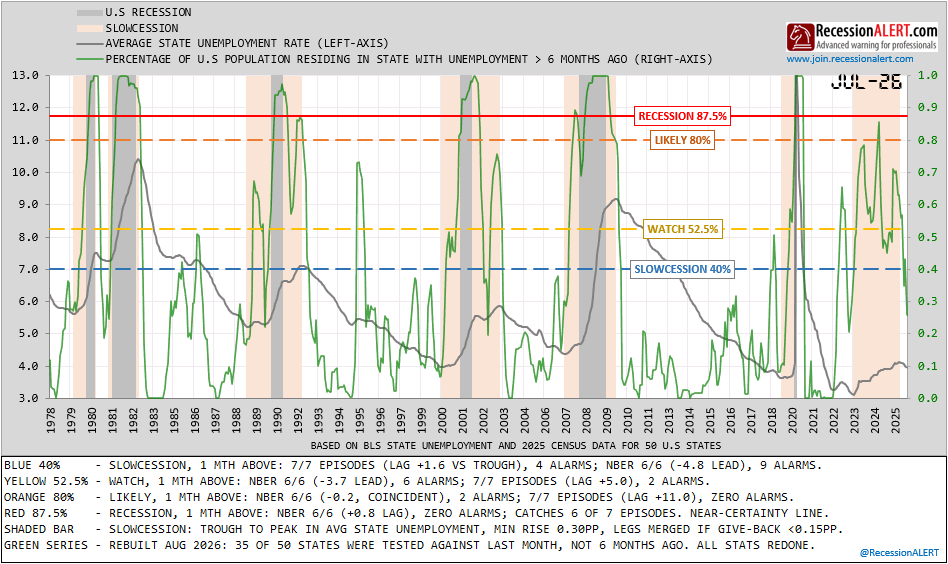
A thirty-six-month slowcession just ended — not on the chart, but in the rule behind it. July’s average state unemployment rate fell to 3.951%, under the 3.9735% exit line set by February’s 4.1235% peak. The peach shading stops in February; the band runs only trough-to-peak and never overhangs a decline, so it can’t show what followed. The rule stayed armed five more months while the rate retraced just 16.9% of its 1.02pp climb, waiting on the give-back threshold. It just cleared it, by a margin thin enough for a routine revision to reopen it. Breadth and level measure different things, which is why they moved on different clocks. Breadth counts how many places are still getting worse; the level measures how much worse things got. A state can stop deteriorating the moment its rate stalls, long before it gives back the increase — so breadth collapsed from an 85.6% peak to 26.0% of the population in months, while the level needed years to retrace a sixth of its climb. That residual 26% is concentrated too: Texas and Florida, up two- and one-tenths respectively, supply three-fifths of it, while Ohio, New Jersey and Pennsylvania are already improving. History’s one relapse after a similar close, in November 1980, re-fired with breadth at 68%. Today’s 26% is a different starting line — but breadth is the fast gauge. The level, still five-sixths unrepaired, is the one with the longer memory.
What it means: inflation is near 3.7% and August hiring came in three times forecast. A soft job market was the main argument against a rate rise this month, and this chart weakens it. The exposure is anything bought on the view that rates are about to fall. What would reverse it: unemployment rising in more states two months running, last seen in August 2025.
Market Intelligence Brief (MIB) Ver. 19.58
For professional investors only. Not investment advice.
© 2026 RecessionALERT.com

Comments are closed.