
The S&P 500, Nasdaq, and Russell 2000 hit simultaneous all-time highs Tuesday as Apple–Intel US chip manufacturing talks (INTC +13%) and Iran’s failure to strike energy infrastructure drove WTI –3.65% to $102. Project Freedom’s first Hormuz commercial ship transits confirmed the ceasefire is intact. ISM Services held at 53.6% but New Orders plunged 7.1pp — highest-since-2022 Prices Paid (70.7%) signal stagflation risk persists. JOLTS hires surged +655K to 5.6M; GDPNow Q2 upgraded to 3.7%; AMD reports after close tonight.
TABLE OF CONTENTS
A. EXECUTIVE SUMMARY
B. MARKET DATA
C. HIGH-IMPACT STORIES (5)
D. MODERATE-IMPACT STORIES (5)
E. ECONOMY WATCH (6)
F. EARNINGS WATCH (5)
G. WHAT’S NEXT
H. CHART OF THE DAY
A. EXECUTIVE SUMMARY -> TOP
Two catalysts converged Tuesday to push the S&P 500, Nasdaq, and Russell 2000 to simultaneous all-time highs: a Bloomberg report that Apple is exploring US chip manufacturing with Intel lit the semiconductor complex (INTC +13%, MU +11%, SNDK +12%), while Iran’s strikes failed to hit energy infrastructure, sending WTI –3.65% to $102 and unwinding the near-term Hormuz fear premium. The oil-equity dynamic was the session’s cleanest signal — crude falling while stocks rose means easing cost-push pressure, not demand destruction — confirmed by VIX –4.87% and yields falling 2 bps simultaneously, a textbook geopolitical-relief signature rather than a growth scare. Russell 2000’s +1.73% small-cap leadership is the most structurally significant print: the market’s most rate- and oil-cost-sensitive segment breaking to a record signals investors are pricing in Hormuz normalization and eventual Fed easing even without confirmation of either. The persistent caveat: Dow Theory non-confirmation extended into its 4th consecutive session, with DJTA trading 16% below its 10-session high despite industrials gaining — transport skepticism has not been resolved.
• S&P 500, Nasdaq, and Russell 2000 close at simultaneous all-time highs: All 11 sectors finished green for the first time since the Iran conflict began; semiconductor sweep (INTC +13%, MU +11%, SNDK +12%) and WTI –3.65% merged into a single broad risk-on catalyst; NDX outpaced the S&P by 3pp over the prior 10 sessions, marking the first confirmed tech-growth leadership breakout of 2026.
• Project Freedom delivers first Hormuz commercial transits — WTI falls to $102: Two US-escorted commercial ships successfully transited the strait; Defense Secretary Hegseth confirmed ceasefire remains intact; throughput at 4 ships/day vs. 120+ pre-crisis normal, meaning oil inventories cannot yet be replenished and the supply-disruption premium is narrowed — not eliminated.
• Apple explores US chip manufacturing with Intel and Samsung (INTC +13%, YTD +175%): Early-stage talks on Intel’s 18A foundry node and Samsung’s Texas facility; no orders placed; Apple as a trial customer would validate Intel Foundry Services in a way no other customer could replicate — the $600B US manufacturing commitment and CHIPS Act tailwinds create powerful political alignment between Cook and Trump.
• ISM Services holds at 53.6% but New Orders plunge 7.1pp to 53.5%; Prices Paid 70.7% (highest since 2022): The demand-price divergence is the report’s danger signal — services firms are working down backlogs (Business Activity +2pp to 55.9%) while fresh order flow decelerates; with services at 80% of US GDP, a sustained New Orders trough translates directly into slower growth and payroll contraction within 1-2 quarters.
• JOLTS hires surge +655K to 5.6M; GDPNow Q2 upgraded to 3.7%: One of the largest single-month hiring jumps on record directly contradicts the manufacturing employment deterioration narrative; the openings-to-unemployed ratio remains above 1.0; GDPNow’s 9.1% investment nowcast reflects AI capex imports at record levels — the hard data is winning over survey-based lead indicators, at least in the near term.
• AMD earnings tonight after a 59% YTD run; analyst issues earnings-eve downgrade citing ~5% downside risk: Consensus at $9.84B revenue and $5.56B data center revenue (+51.5% YoY); the gross margin ceiling concern (55% floor flagged as a structural cap) and valuation bar set the tone for AI chip earnings season ahead of NVIDIA’s May 20 print — AMD’s miss risk could pressure the entire complex.
1. Hormuz Relief Is Real but Structurally Incomplete — Project Freedom’s first successful commercial transits prove the US military can escort ships through the strait — a meaningful capability demonstration that the oil market immediately priced in. But 4 ships per day is 3% of normal Hormuz traffic: oil inventories cannot be replenished at this rate, global petrochemical supply chains remain disrupted, and WTI at $102 is still 28% above pre-crisis levels. Today’s all-time equity high is pricing in a partial-relief scenario. The risk remains asymmetric: any Iranian military action against an escorted vessel would end Project Freedom, invalidate today’s record, and send WTI back above $110 within hours.
2. The US Semiconductor Reshoring Trade Is Now Investment-Grade — Apple exploring US chip manufacturing with Intel is not a political gesture — it is a supply-chain diversification strategy by the world’s largest silicon buyer, backed by $600B in committed capital and bipartisan policy support. Intel’s +175% YTD reflects the market repricing its foundry business from “probable failure” to “viable challenger.” Copper’s +2.35% surge alongside semiconductor stocks is the industrial ecosystem being repriced in parallel: US chip fabrication is copper-intensive, and the material and infrastructure implications of domestic manufacturing at scale are only beginning to be absorbed by markets.
3. The NFP Verdict Will Resolve the Stagflation Debate — Tuesday’s data left the macro picture in productive tension: JOLTS hires at a record +655K and GDPNow at 3.7% versus ISM Services New Orders plunging 7.1pp and Prices Paid locked at 70.7% — the highest since 2022. Friday’s April NFP is the decisive read. A print above 175K validates the hard-data resilience thesis, cements no 2026 rate cuts, and extends the bull case for equities at record valuations. A sub-150K print reopens the labor-side cut argument — but in a context where services inflation is entrenching, that creates the classic stagflation trap the Fed has least capacity to navigate.
 — Leading economic indicators. Accurate market forecasts. Apply for membership at join.recessionalert.com
B. MARKET DATA -> TOP
A Bloomberg report that Apple is exploring a US chip manufacturing partnership with Intel ignited the semiconductor value chain — INTC surged 13%, MU +11%, SNDK +12% — lifting the Nasdaq 100 +1.31% to a new intraday record while the S&P 500 closed at an all-time high. Iran’s weekend strikes against US and UAE targets failed to escalate into attacks on energy infrastructure, driving WTI down 3.65% and providing a second broad tailwind for equities. Breadth was total — all 11 sectors closed in the green — though the hierarchy was clear: Basic Materials (+1.47%), Technology (+1.34%), and Industrials (+1.21%) led while Energy (+0.09%) lagged despite being the structural YTD leader, as lower oil prices weighed directly on energy stocks even as they buoyed the rest of the market. Yields fell -2.4 bps alongside oil, reinforcing a geopolitical-relief read rather than a growth-acceleration signal.
CLOSING PRICES – Tuesday, May 5, 2026:
MAJOR INDICES
The move was broad — all 11 sectors green, Russell 2000 +1.73% outpacing the Dow’s +0.73% and S&P’s +0.81% — but the Nasdaq 100’s +1.31% tells the truer story: this was semiconductor-driven, not a blue-chip rotation. The Dow Theory non-confirmation extends into its 4th consecutive session: DJIA sits just 0.71% below its 10-session high while DJTA trades 16.3% below its peak — transport underperformance persisting even as industrials gain. Over the past 10 sessions, NDX has outpaced the S&P 500 by 3.03% for the first time, confirming a concentrated tech/growth leadership pattern that emerges today.
| Index | Close | Change | %Move | Why It Moved |
|---|---|---|---|---|
| S&P 500 | 7,259.23 | +58.48 | +0.81% | Apple-Intel chip partnership report ignites semiconductor rally; Iran strikes fail to escalate into energy infrastructure attacks; crude falls 3.65%; S&P closes at all-time high |
| Dow Jones | 49,298.34 | +356.44 | +0.73% | Blue-chips participated in the broad risk-on rally; Industrials led (+1.21%); lagged tech-heavy Nasdaq as semiconductor gains concentrated in NDX names |
| DJ Transportation | 20,020.3 | +414.6 | +2.11% | Session’s standout index; oil’s 3.65% decline cuts fuel-cost outlook for airlines and trucking; Iran non-escalation removes near-term supply-chain disruption risk |
| Nasdaq 100 | 28,015.06 | +363.24 | +1.31% | Semiconductor sweep on Apple-Intel partnership report (INTC +13%, MU +11%, SNDK +12%); NDX sets new intraday record alongside S&P ATH |
| Russell 2000 | 2,844.43 | +48.43 | +1.73% | Small-caps outperformed large-caps; intraday record set; broad risk-on tone benefits domestically focused companies; oil decline reduces input cost pressure |
| NYSE Composite | 23,008.67 | +115.21 | +0.50% | Broad-market participation confirmed; total 11-of-11 sector breadth; NYSE Composite advance consistent with S&P but trails small-cap leadership |
VOLATILITY & TREASURIES
VIX’s 4.87% decline alongside falling yields (10Y -2.4 bps, 2Y -2.2 bps) delivers a clean geopolitical-relief signature — vol drops and bonds catch a bid simultaneously when supply-disruption fear lifts. The 10Y–2Y spread holds at 48.5 bps with no curve movement, confirming neither a growth-acceleration nor a recession narrative is being repriced. The dollar’s near-flat +0.10% close suggests safe-haven unwind remains partial; Iran tensions persist as a live background tail risk.
| Instrument | Level | Change | Why It Moved |
|---|---|---|---|
| VIX | 17.40 | -0.89 (-4.87%) | Geopolitical relief compresses fear premium; Iran’s strikes did not escalate to energy infrastructure attacks; semiconductor enthusiasm adds to bullish sentiment |
| 10-Year Treasury Yield | 4.425% | -2.4 bps | Yields fell as geopolitical risk eased and oil-driven inflation concern moderated; bonds partially confirm the equity rally without signaling a growth scare |
| 2-Year Treasury Yield | 3.940% | -2.2 bps | Short-end fell in parallel with the 10Y; Fed rate path expectations stable; yield curve unchanged at ~48.5 bps spread — no repricing of near-term rate expectations |
| US Dollar Index (DXY) | 98.44 | +0.10 (+0.10%) | Dollar marginally firmer; residual safe-haven demand persists amid partial Iran uncertainty; broad equity rally not triggering dollar weakness — geopolitical risk premium not fully unwound |
COMMODITIES
Gold (+0.78%) and copper (+2.35%) rising together is an unusual combination — gold tracks safe-haven demand while copper tracks industrial activity — yet both gained as the session blended geopolitical relief (gold retains a bid) with industrial confidence (semiconductor capex and US reshoring momentum). Silver’s marginal -0.19% decline mutes the precious-metals signal slightly. Bitcoin’s +2.13% tracked the broader risk-on move, functioning as a beta amplifier rather than a safe-haven alternative.
| Asset | Price | Change | %Move | Why It Moved |
|---|---|---|---|---|
| Gold | $4,568.69/oz | +$35.39 | +0.78% | Safe-haven bid persists despite equity rally; Iran uncertainty not fully resolved; dollar flat removes FX headwind; gold retains geopolitical risk premium |
| Silver | $73.385/oz | -$0.137 | -0.19% | Minor divergence from gold; silver’s industrial component slightly weighed by oil sector weakness; marginal move, not a directional signal |
| Copper | $5.9838/lb | +$0.1373 | +2.35% | Industrial metals rally on Apple-Intel US chip manufacturing news; expanded domestic semiconductor fabrication is copper-intensive; growth signal confirmed |
| Platinum | $1,969.45/oz | +$7.95 | +0.41% | Modest gains tracking the broader risk-on tone; industrial demand outlook improving alongside copper; auto-catalyst demand supported by US reshoring narrative |
| Bitcoin | $81,618 | +$1,702 | +2.13% | Risk-on beta amplifier; BTC tracking equities in lockstep, confirming broad sentiment rather than a crypto-specific catalyst; no regulatory or on-chain catalyst identified |
ENERGY
WTI (-3.65%) and Brent (-3.57%) fell in near-perfect lockstep — no spread widening — confirming this is a global supply-disruption premium receding, not a regional story. Iran’s strikes yesterday did not target energy infrastructure, removing the fear premium priced in over the prior week. Critically, oil fell while equities rose — a demand-benign read that is unambiguously bullish for corporate margins and consumer spending. Henry Hub (-3.63%) echoed crude; Dutch TTF’s smaller decline (-2.51%) points to persistent European structural gas-market tightness that doesn’t yet fully unwind on Middle East relief alone.
| Asset | Price | Change | %Move | Why It Moved |
|---|---|---|---|---|
| Crude Oil (WTI) | $102.54/bbl | -$3.88 | -3.65% | Iran’s strikes against US/UAE targets failed to hit energy infrastructure; supply-disruption fear premium collapses; risk-off oil premium unwound as geopolitical scenario degrades from worst-case |
| Crude Oil (Brent) | $110.35/bbl | -$4.09 | -3.57% | Same Iran non-escalation driver as WTI; Brent-WTI spread holds near $7.81 — no regional disruption signal; global crude demand outlook unimpaired |
| Natural Gas (Henry Hub) | $2.763/MMBtu | -$0.104 | -3.63% | Fell alongside crude on broad geopolitical-relief selling; US nat gas remains structurally low despite energy sector YTD strength; no weather or LNG export catalyst today |
| Natural Gas (Dutch TTF) | $16.08/MMBtu | -$0.41 | -2.51% | European gas eased on Iran relief but declined less than Henry Hub; structural European supply tightness cushions the downside; TTF-Henry Hub premium ($13.32) persists, reflecting ongoing US LNG export demand |
S&P 500 SECTORS
All 11 sectors closed green — a macro flush, not a rotation — as geopolitical relief and the Apple-Intel report converged into a single broad catalyst. Basic Materials led (+1.47%) despite being the only sector in the red on a 1-week basis (-0.37%), a sharp single-day reversal off the week’s laggard position worth monitoring. Energy brought up the rear (+0.09%): lower oil prices lifted the broader market but directly suppressed the structural YTD leader (+34.90%). Healthcare and Financials — the structural laggards (YTD -4.43% and -3.44%) — participated but remain deep in the hole across every horizon.
| Sector | 1-Day | 1-Week | 1-Month | 3-Month | 6-Month | YTD | 12-Month |
|---|---|---|---|---|---|---|---|
| Basic Materials | +1.47% | -0.37% | +0.78% | -2.18% | +24.91% | +14.17% | +47.02% |
| Technology | +1.34% | +2.87% | +17.72% | +14.23% | +5.41% | +11.40% | +46.31% |
| Industrials | +1.21% | +1.27% | +6.04% | +3.39% | +13.51% | +13.88% | +33.60% |
| Consumer Defensive | +0.95% | +1.53% | +2.14% | -1.23% | +12.44% | +9.52% | +6.79% |
| Real Estate | +0.38% | +0.04% | +5.79% | +6.12% | +6.50% | +7.82% | +5.84% |
| Consumer Cyclical | +0.35% | +1.47% | +9.72% | -2.18% | -3.23% | -1.15% | +16.45% |
| Financial | +0.31% | -0.49% | +3.87% | -3.66% | +1.72% | -3.44% | +10.89% |
| Utilities | +0.31% | +0.36% | +1.93% | +6.95% | +6.92% | +10.56% | +21.93% |
| Healthcare | +0.29% | +1.11% | -0.26% | -4.71% | +1.80% | -4.43% | +8.16% |
| Communication Services | +0.26% | +3.50% | +14.13% | +4.20% | +11.13% | +6.95% | +42.70% |
| Energy | +0.09% | +2.96% | +0.23% | +18.08% | +36.51% | +34.90% | +49.05% |
TOP MEGA-CAP MOVERS:
GAINERS
| Company | Ticker | Close | Change | Why It Moved |
|---|---|---|---|---|
| Intel Corp | INTC | $108.18 | +12.95% | Bloomberg reported Apple is exploring a US chip manufacturing partnership with Intel (and Samsung) as an alternative to TSMC; stock hits all-time high; INTC now up ~175% YTD following April’s +114% surge on Google and Terafab partnership announcements |
| Sandisk Corp | SNDK | $1,406.00 | +11.96% | Memory and storage name rallied on read-through from Apple-Intel partnership report and broad US semiconductor enthusiasm; US chip manufacturing expansion benefits the full value chain |
| Micron Technology | MU | $640.45 | +11.10% | Memory chip rally driven by Apple-Intel US manufacturing partnership news; US semiconductor reshoring narrative accelerates demand for domestic memory production capacity |
| Lam Research Corp | LRCX | $275.80 | +6.66% | Semiconductor equipment rallied on Apple-Intel partnership; expanded US-based chip fabrication requires significant Lam etching and deposition equipment; direct capital expenditure beneficiary |
| Applied Materials | AMAT | $410.82 | +4.97% | Same semiconductor equipment read-through as LRCX; US chip manufacturing expansion drives demand for AMAT deposition, etch, and inspection tools; reshoring capex cycle accelerates |
DECLINERS
| Company | Ticker | Close | Change | Why It Moved |
|---|---|---|---|---|
| Palantir Technologies | PLTR | $135.91 | -6.93% | Q1 beat (revenue +84.7% YoY to $1.63B, FY guidance raised +6.5% to $7.66B) met with classic sell-the-news reaction; RBC Capital renewed bearish stance, flagging declining government contract values and extreme valuation (~50x 2026 revenue estimates) |
| Netflix Inc | NFLX | $87.89 | -3.44% | Continued post-Q1 selling pressure; stock down ~32% from 52-week high after missing Q2 revenue guidance ($12.5B vs $12.6B est) and Reed Hastings’ board exit in mid-April; no new catalyst today |
| UnitedHealth Group | UNH | $363.87 | -1.86% | Ongoing Healthcare sector structural weakness; YTD sector laggard (-4.43%); elevated medical cost ratio concerns persist; sector participated in the broad rally but UNH underperformed peers |
| Mastercard | MA | $497.08 | -1.52% | Capital rotated from Financial/credit services into semiconductor names; sector YTD -3.44%; credit card networks underperformed on a day dominated by a tech-capex catalyst |
| Visa Inc | V | $322.03 | -1.47% | Same sector rotation dynamics as Mastercard; Financial sector YTD -3.44%; both Visa and MA trade near similar valuations with no company-specific catalyst; structural underperformance continues |
— Institutional-grade intelligence for serious investors. Apply for membership at join.recessionalert.comC. HIGH-IMPACT STORIES -> TOP
UNCERTAIN
1. Project Freedom Delivers First Transit — Two Ships Through Hormuz, WTI Drops 3.9% to $102
The core facts:Two US-flagged commercial ships transited the Strait of Hormuz today under escort from the US military’s “Project Freedom” operation — the first successful commercial transits since the Iran conflict effectively closed the strait. US guided-missile destroyers accompanied the vessels. Defense Secretary Hegseth confirmed the US-Iran ceasefire remains intact despite the Monday UAE missile intercept incident. However, Strait throughput remains at roughly 4 ships per day versus a pre-crisis average of 120+ ships. WTI crude fell 3.9% to $102.27; Brent fell 4.0% to $109.87 — the largest single-day oil drop in weeks. Iran’s Foreign Minister called for diplomacy while simultaneously threatening ships; Trump warned Iran would be “blown off the face of the earth” if US vessels were targeted.
Why it matters:This is the first empirical proof that Project Freedom can deliver commercial ship transits, and the oil market immediately priced in partial supply-chain relief. But the rally is structurally limited: 4 ships per day is 3% of normal Hormuz traffic — oil inventories cannot be replenished at this rate, and global petrochemical supply chains remain disrupted. WTI at $102 is still 28% above its pre-crisis level (~$80). For US portfolio managers, the Hormuz signal is a positive inflection point, not a resolution: the inflation premium embedded in energy costs has narrowed but has not reversed. Airlines, chemicals, and consumer discretionary companies facing elevated fuel costs get meaningful but partial relief. The ceasefire-intact confirmation from Hegseth matters more than the ship count — it prevents the market from pricing in an immediate return to active hostilities. Iran’s simultaneous call for diplomacy and threats to shipping reflects the dual-track pressure that characterizes this conflict and keeps uncertainty elevated.
What to watch:Daily ship transit count through Hormuz published by S&P Global Market Intelligence — movement from 4 toward 20+ ships would signal genuine reopening; any Iranian military action against escorted vessels would end Project Freedom and send WTI back above $110. Also watch the Iran-US diplomatic channel: a formal written counter-proposal from the US to Iran’s 14-point plan would indicate the diplomatic track is alive.
BEARISH
2. ISM Services Prices Paid Surges to 70.7 — Highest Since 2022, Locking the Fed Out of 2026 Cuts
The core facts:The ISM Services PMI for April 2026 registered 53.6 — the 22nd consecutive month in expansion territory — but the critical sub-index was the Prices Paid gauge, which held at 70.7, its highest level since 2022. Companies cited higher fuel, gasoline, diesel, copper, aluminum, lumber, and freight costs driven by the Iran war and tariff-related import levies. Business Activity ticked up 2.0 points to 55.9%, while New Orders decelerated from 60.6% to 53.5% — suggesting demand is beginning to soften even as prices stay elevated.
Why it matters:The services sector is where inflation either gets entrenched or breaks — and at Prices Paid 70.7, it is entrenching. Even with today’s WTI drop from $106 to $102, services firms are reporting that fuel and materials costs are baked into contracts, wage agreements, and supplier pricing for the next 2-3 quarters. The Fed’s dual-mandate calculus is clear: cutting rates into a Prices Paid reading above 70 risks a second-wave inflation episode that would be far harder to reverse than the current oil-driven spike. The New Orders deceleration from 60.6 to 53.5 is the dangerous signal — it points toward a classic stagflationary dynamic where demand slows before prices do. For fixed-income investors, this reading confirms that the rate cut window that seemed plausible in Q1 2026 is now closed for the remainder of the year absent a dramatic geopolitical resolution in the Strait of Hormuz.
What to watch:The May ISM Services Prices Paid print (released early June) — a reading below 67 (below the elevated oil-shock zone) would signal that the Hormuz partial reopening is transmitting into services cost relief; above 70 would lock in the “no 2026 cuts” scenario for the full year.
BULLISH
3. S&P 500, Nasdaq, and Russell 2000 Simultaneously Hit New All-Time Records — Broad Risk-On Breakout
The core facts:All three major US equity benchmarks closed at simultaneous all-time highs Tuesday: the S&P 500 gained 0.81% to 7,259.22; the Nasdaq Composite rose 1.03% to 25,326.13; the Russell 2000 led all indices with a gain of approximately 1.41%, setting a new intraday and closing record. The Dow Jones Industrial Average advanced 356 points (+0.73%) to 49,298.25. The rally was driven by the oil price drop (WTI -3.9%) following the Hormuz transit progress, combined with resilient economic data (ISM Services 53.6, JOLTS hiring surge). VIX declined alongside oil prices. The 10-year Treasury yield held near 4.44%.
Why it matters:The simultaneous record across large-cap, tech-heavy, and small-cap indices is a breadth signal that has not appeared since before the Iran conflict began. Small-cap leadership (+1.41% Russell vs. +1.03% Nasdaq) is the most structurally important element of today’s session: the Russell 2000 is the most rate-sensitive and oil-cost-sensitive segment of the US equity market. Its record close signals the market is beginning to price in the probability of Hormuz normalization and eventual Fed easing — even without confirmation of either. For portfolio managers, this breadth expansion argues for rebalancing toward domestic cyclicals (regionals, energy users, industrials) and away from the defensive mega-cap positioning that dominated April. The S&P 500 at 7,259 with Q1 2026 earnings growing +27.1% YoY and GDPNow Q2 tracking at 3.7% provides a fundamentally supportive backdrop. The risk: the market is now simultaneously pricing in oil relief (Hormuz reopening), earnings strength (AI-driven), and eventual rate cuts — if any one leg fails, the triple-record valuation becomes vulnerable.
What to watch:Russell 2000 follow-through above today’s record close — sustained small-cap leadership over 3-5 sessions would confirm a genuine rotation rather than a one-day oil-driven bounce; Friday’s April NFP as the next test of the economic resilience thesis.
BULLISH
4. Intel Surges ~13% as Apple Explores TSMC Alternative — Early-Stage Talks With Intel and Samsung on US Chip Manufacturing
The core facts:Bloomberg reported today that Apple held early-stage discussions with both Intel and Samsung about manufacturing the main processors for its devices in the US — offering supply-chain diversification beyond longtime partner TSMC. Apple has visited Samsung’s Texas plant under development and has explored Intel’s 18A foundry node for potential Apple Silicon production. No orders have been placed and talks remain preliminary. Apple CEO Tim Cook’s existing $600B US manufacturing commitment and the Trump administration’s stake in Intel create strong political tailwinds for a US-domestic chip deal. Intel stock surged approximately 13% on the report, extending its year-to-date gain to roughly 175%. Samsung’s US operations also saw positive sentiment.
Why it matters:Apple is the world’s single largest buyer of advanced silicon — its chip orders from TSMC have historically funded TSMC’s leading-edge process development. Any meaningful volume shift from TSMC to Intel or Samsung would be transformative for US semiconductor manufacturing competitiveness. Intel’s 18A process node is the company’s first credible sub-2nm challenge to TSMC’s N2 node — but it has yet to win a major high-volume customer. Apple as a trial partner would validate Intel Foundry Services (IFS) in a way that no other customer could replicate. The strategic motivation is clear on both sides: Apple diversifies supply chain and hedges AI-driven chip shortages; Intel gains a brand anchor that would attract other foundry customers. For investors, Intel at +175% YTD reflects the foundry pivot being repriced from “probable failure” to “possible success” — the Apple talks push that repricing further. TSMC is the obvious loser on any volume share loss, though TSMC ADR (TSM) has its own AI data center demand tailwinds that provide offset.
What to watch:Any formal statement from Apple or Intel confirming a manufacturing trial or qualification run on Intel’s 18A node; Intel’s Q2 2026 foundry pipeline commentary; TSMC’s May investor call for any acknowledgment of Apple supply diversification risk or pricing concessions to retain the relationship.
BULLISH
5. Micron +5% as DA Davidson Sets Street-High $1,000 Target — HBM Capacity Fully Sold Out Through 2026
The core facts:Micron Technology (MU) rose approximately 5% Tuesday after DA Davidson initiated coverage with a Street-high price target of $1,000, citing structural AI demand for high-bandwidth memory (HBM). Micron has locked in pricing and volume agreements for its entire calendar 2026 HBM capacity — including next-generation HBM4 products — leaving no available supply for incremental AI customers. The company’s CEO highlighted that AI inference expansion requires faster, higher-capacity memory, with supply constraints in both HBM and DRAM expected to persist through 2027. Micron has raised its HBM total addressable market forecast to grow at 40% annually through 2028, reaching approximately $100 billion — two years ahead of prior estimates. MU is up approximately 70% year-to-date.
Why it matters:HBM is the memory architecture that makes NVIDIA’s Blackwell, AMD’s MI450, and Google’s TPU v6 chips viable for large-scale AI training and inference — without adequate HBM supply, the GPU buildout is physically constrained regardless of capital availability. Micron’s sold-out status through 2026 means that every incremental AI data center order placed today by a hyperscaler is contingent on HBM allocation commitments that must be secured 12-18 months in advance. This supply bottleneck is the single most important physical constraint on the AI infrastructure buildout — and it confirms that AMD’s and NVIDIA’s ambitious 2026 revenue guidance is credible because the memory supply to support their chip deployments is already committed. For portfolio managers, a DA Davidson $1,000 target on a $200B+ market cap company is not merely a price target — it is a structural declaration that the AI memory supercycle is accelerating rather than plateauing. The TAM upgrade ($35B in 2025 to $100B by 2028) implies HBM is becoming a commodity-scale market within this cycle, not a niche.
What to watch:NVIDIA Q1 2026 earnings on May 20 — any commentary on HBM allocation constraints or Blackwell chip availability would validate or challenge Micron’s supply narrative; also watch for Micron’s fiscal Q3 2026 results (expected June) for the first HBM4 revenue contribution and gross margin expansion data.
— Quantifying recession risk so you don’t have to guess. Apply for membership at join.recessionalert.comD. MODERATE-IMPACT STORIES -> TOP
BEARISH
6. US Trade Deficit Widens to $60.3B in March — Pre-Tariff Import Surge Casts Doubt on Trade Policy Efficacy
The core facts:The Bureau of Economic Analysis released US international trade data for March 2026 today: the goods and services deficit widened to $60.3 billion, up $2.5 billion from $57.8 billion in February. The goods deficit increased $4.1 billion to $88.7 billion while the services surplus partially offset, rising $1.6 billion to $28.4 billion. Exports grew $6.2 billion to $320.9 billion, but imports outpaced exports. Key bilateral deficits: Taiwan $20.6 billion, Vietnam $19.2 billion, Mexico $16.4 billion, China $14.0 billion. On a year-over-year basis, the average goods and services deficit has narrowed by $70.4 billion from March 2025 levels.
Why it matters:March data reflects import activity before many of the 2026 tariff escalations — the 25% EU auto tariff was announced May 1 and the broader tariff structure was still phasing in. The fact that the deficit widened in March despite early tariff signaling suggests importers were front-running price increases, a dynamic that inflated Q1 GDP (net exports is a drag in the calculation). The $88.7 billion goods deficit is the structural challenge: Taiwan, Vietnam, and Mexico are at the top of the bilateral deficit list and all face US tariff scrutiny, but the data shows import demand has not materially retreated. For investors tracking the tariff-as-trade-fix narrative, the YoY improvement ($70.4B narrowing) is a favorable comparison base — 2025 had pre-tariff import acceleration that has partially unwound. April data will be the first clean read on whether tariffs are changing import behavior or simply raising consumer prices while demand persists.
What to watch:April 2026 trade balance (released early June) — the first full month of major tariff enforcement; if the deficit widens further despite tariffs, the trade policy narrative faces a credibility challenge with direct implications for further escalation risk.
BULLISH
7. Atlanta Fed GDPNow Q2 2026 Upgraded to 3.7% — Investment Surge Offsets Oil-Shock Drag
The core facts:The Atlanta Fed’s GDPNow model for Q2 2026 was updated today to 3.7% (seasonally adjusted annual rate), up from 3.5% on May 1 and 3.2% at the quarter’s start. The upgrade was driven by data releases from the Census Bureau, BEA, and ISM: nowcasts of Q2 real personal consumption expenditures growth increased from 2.5% to 2.7%, while gross private domestic investment growth jumped from 8.3% to 9.1%. The 9.1% investment growth nowcast reflects the ongoing AI data center and grid infrastructure buildout absorbing the macro headwinds from elevated energy prices.
Why it matters:3.7% GDP growth in Q2 — if the GDPNow model’s current read holds — would be exceptional in a $100+ oil, 3.5-3.75% rate environment. It signals the US economy is absorbing the Iran oil shock better than feared through two channels: (1) services consumption is resilient despite high fuel costs (ISM Services at 53.6, 22nd consecutive expansion month), and (2) AI/grid investment is structurally accelerating, offsetting manufacturing weakness. The 9.1% investment nowcast is particularly notable — it is the AI infrastructure supercycle directly showing up in national accounts data. For equity investors, a 3.7% GDP backdrop with S&P 500 earnings growing +27.1% YoY is a fundamentally supportive combination; the challenge is that such a strong economy removes the Fed’s rationale for cuts, keeping the rate environment restrictive for bond-sensitive sectors. This GDPNow reading, combined with the JOLTS hiring surge and ISM Services expansion, paints a picture of bifurcated resilience: services/tech thriving; manufacturing/energy-intensive sectors stressed.
What to watch:Friday’s April NFP — if payrolls print above 200K, the Q2 GDP resilience thesis strengthens; ADP Wednesday will provide the first employment data point for the week and set NFP expectations.
UNCERTAIN
8. GameStop Secures TD Bank $20B Financing for eBay Bid — EBAY +5.1% as Deal Gains Credibility
The core facts:GameStop confirmed it has received a commitment letter from TD Bank for approximately $20 billion in debt financing through a bond issuance to support its $55.5 billion unsolicited bid for eBay at $125 per share (50% cash, 50% GME stock). GameStop also revealed it has accumulated a 5% stake in eBay since February 2026. The company’s approximately $9 billion cash position combined with the $20 billion TD Bank commitment gives GameStop roughly $29 billion in available cash for the deal. eBay shares rose 5.1% on Tuesday, building on Monday’s ~10% surge. GameStop’s strategic rationale: 1,600 US stores become eBay drop-off and shipping nodes; live in-store sales broadcasts featuring eBay products; $2 billion in projected annual cost synergies within one year of closing. eBay’s board has not issued a formal response.
Why it matters:The TD Bank commitment letter transforms what initially appeared to be an aspirational meme-stock announcement into a credibly financed bid. A major bank extending $20 billion in committed debt implies TD Bank’s credit analysts saw sufficient asset value (eBay generates $2.5B+ in annual free cash flow) to backstop the deal. For M&A market observers, this confirms that activist-style deals — building strategic stakes quietly then launching with committed financing — remain viable in a 3.5-3.75% rate environment where traditional LBO math is challenging. eBay’s total return since the announcement: ~15% over two sessions, now trading near $115 versus the $125 offer price — a roughly $10 spread that reflects approximately 20-30% deal completion probability being priced in. The fundamental challenge remains: integrating a brick-and-mortar video game retailer into eBay’s $55 billion marketplace platform is operationally without precedent, and the half-stock consideration means eBay shareholders are exposed to GME equity risk.
What to watch:eBay board’s formal response — a definitive rejection triggers a hostile proxy fight; acceptance or exploration narrows the deal spread significantly; any competing bid from a credible strategic acquirer (Amazon, PE-backed) would be a material upside catalyst for EBAY shares above the GameStop offer price.
BULLISH
9. JOLTS March 2026: Hires Surge +655K to 5.6M — Labor Market Resilience Strengthens Pre-NFP Picture
The core facts:The Bureau of Labor Statistics released JOLTS data for March 2026 today. Job openings were little changed at 6.866 million, slightly above the 6.835 million consensus estimate. The headline figure was the hires component: hires surged 655,000 to 5.6 million, one of the largest single-month increases in recent history. Quits held steady at 3.2 million, signaling worker confidence in the labor market. Layoffs and discharges were little changed at 1.9 million, though the year-over-year increase of 272,000 warrants monitoring. Total separations were 5.4 million.
Why it matters:The +655K hiring surge directly contradicts the “labor market deterioration” narrative that has been building from ISM Manufacturing Employment (46.4% in April, contraction territory) and elevated initial jobless claims. The services sector — where the vast majority of JOLTS hiring occurs — is adding workers at an accelerating pace even as the manufacturing sector cools, reinforcing the bifurcated economy story. For Fed policy, strong JOLTS hiring data eliminates the employment-side rationale for rate cuts — the Fed’s dual mandate requires seeing both elevated inflation AND labor market softening to justify easing. With Prices Paid at 70.7 (inflation elevated) and hires surging +655K (employment strong), the FOMC has zero cover to cut in 2026. The approaching April NFP (Friday) will be the key confirmation: if payrolls print 200K+ consistent with the JOLTS hiring surge, the “strong labor market, no 2026 cuts” thesis becomes consensus.
What to watch:Friday April NFP consensus is approximately 185K — a print above 200K consistent with the JOLTS hiring surge would reinforce the no-cut narrative; a sub-150K print would suggest the JOLTS hires were concentrated in sectors already decelerating and reopen the labor-side of the cut argument.
BEARISH
10. Top Analyst Issues “Earnings Eve” Downgrade on AMD — Sees 5% Downside Risk Ahead of Tonight’s Q1 Report
The core facts:A prominent analyst issued an “earnings eve” downgrade on Advanced Micro Devices (AMD) Tuesday — the day AMD is set to report Q1 2026 results after market close — citing valuation concerns and flagging approximately 5% downside risk at current levels. AMD entered the session up 59% year-to-date, with the market pricing in a clean beat of the $9.84 billion revenue consensus and the $5.56 billion data center revenue estimate (+51.5% year-over-year). The downgrade focused on the 55% gross margin guidance floor as a potential structural ceiling and questioned whether AI chip demand can sustain current valuation multiples even if AMD delivers consensus results.
Why it matters:An earnings-eve downgrade on a $579 billion market cap company signals a critical dynamic in AI semiconductor investing: the valuation bar has risen so high that beating consensus may not be sufficient to move the stock meaningfully higher, while missing on any single metric risks a sharp correction. AMD has signed landmark AI deals this year — a 6GW MI450 deployment with Meta and a 1GW Instinct MI450 commitment with OpenAI — yet the stock’s 59% YTD gain means these deals are largely priced in. The analyst’s gross margin concern reflects a real structural tension: AMD is selling more chips but AI chip development, HBM procurement, and competitive R&D costs are compressing margins at the unit level. For sector investors, this downgrade is a warning that AMD’s earnings tonight is a binary event: a significant data center beat with raised guidance could add 5-8%; anything short of exceptional — even a consensus beat — risks a “sell the news” reaction. The implications extend to Nvidia’s May 20 report, which faces an even higher bar.
What to watch:AMD’s Q1 data center revenue vs. the $5.56B consensus (the most closely watched single metric); AMD’s gross margin guidance vs. the 55% floor; AMD’s Q2 revenue guidance as the forward signal — consensus is approximately $10.6B, and any shortfall would pressure the entire AI chip sector heading into NVDA’s May 20 print.
— Separating signal from noise since 2007. Apply for membership at join.recessionalert.comE. ECONOMY WATCH -> TOP
Hard data held firm on May 5 but the demand pipeline is thinning: GDPNow lifted Q2 to 3.7% on strong JOLTS (6.9M openings, hires +655K), yet ISM Services new orders plunged 7.1pp to 53.5 — the sharpest drop since early 2024. Spirit Airlines’ liquidation — the first major U.S. airline failure in 25 years — shows where $116 Brent and $4.51 jet fuel are already extracting systemic damage; services Prices Paid at 70.7 and new-home median prices at a 2021 low confirm the margin squeeze is broadening. Friday’s NFP (consensus ~175K) is the decisive read: a miss resets the soft-landing narrative.
ISM Services PMI Holds at 53.6% But New Orders Plunge 7.1pp, Signaling Demand Softening Ahead (ISM, May 5, 2026)
What they’re saying:The ISM Services PMI registered 53.6% in April — the 22nd consecutive month in expansion — slipping 0.4pp from March’s 54.0% and missing the 53.7% consensus. The headline masks a sharp bifurcation: Business Activity surged 2pp to 55.9% while New Orders fell 7.1pp to 53.5%, the largest single-month drop in over a year. Employment rebounded to 48.0% from 45.2% but remains in contraction. Prices Paid held at 70.7%, unchanged and well above the 55% historical average.
The context:The New Orders collapse is the critical signal — services firms are delivering on existing backlogs (hence strong Business Activity) but seeing fresh order flow dry up. With Prices Paid elevated at 70.7, providers are absorbing cost pressure without demand support to pass it through. Services account for roughly 80% of U.S. GDP; a sustained New Orders decline flows directly into slower GDP growth and payroll contraction within 1–2 quarters. The Fed’s core concern — services inflation persisting while demand softens — is exactly what this print reflects.
What to watch:May ISM Services PMI (June release) — if New Orders fails to rebound above 57–58%, the demand trough is deepening. Thursday’s Jobless Claims (expected 205K vs. prior 189K) for early labor deterioration signals in services-heavy sectors.
JOLTS: Job Openings Firm at 6.9M, Hires Surge 655K in March — Labor Market More Durable Than Feared (BLS, May 5, 2026)
What they’re saying:Job openings held at 6.866 million in March, beating the 6.84M consensus and down only modestly from February’s revised 6.922M. More notably, hires surged to 5.55 million — a gain of 655,000 from February — the largest single-month jump in recent quarters. Quits held steady at 3.2 million, signaling sustained worker confidence, while layoffs remained flat at 1.9 million with a stable 1.2% layoff rate.
The context:The hiring surge undercuts the deteriorating labor narrative that has driven recession probability estimates toward 45–50%. With quits stable and layoffs unchanged, both employers and workers are holding position — not the pre-recession pattern of falling quits and rising layoffs. The JOLTS data directly supported today’s GDPNow upgrade to 3.7% for Q2 and sets a constructive base for Friday’s April NFP release. The openings-to-unemployed ratio remains above 1.0, a threshold associated with sustained wage growth and consumer spending resilience.
What to watch:April Nonfarm Payrolls (Friday, May 8, 8:30 AM ET, consensus ~175K) — the decisive confirmation or refutation of the JOLTS signal. A beat above 175K validates labor resilience and the soft-landing case; a miss below 150K revives the recessionary read and likely triggers a Fed policy reassessment timeline.
Spirit Airlines Liquidates All Operations — First Major U.S. Airline Failure in 25 Years as Jet Fuel Hits $4.51/Gal (May 2, 2026)
What they’re saying:Spirit Airlines ceased all operations on May 2 after a $500 million federal bailout collapsed. CEO Dave Davis said the airline “ran out of runway” as jet fuel costs hit $4.51/gallon — more than double the $2.24/gallon assumption in its turnaround plan. Brent crude at approximately $116/barrel, driven by Iran war disruptions in the Strait of Hormuz, rendered the model structurally unviable. All 17,000 employees are terminated; all flights are cancelled indefinitely. Spirit filed a 500-page liquidation plan on May 4.
The context:This is the first major U.S. airline to fold from financial causes in 25 years and the clearest demonstration that sustained energy inflation is extracting systemic damage from marginal operators. Budget carriers operate on the thinnest margins in aviation; Spirit’s failure is an early-cycle warning for any energy-intensive sector — trucking, shipping, chemicals — that embedded fuel normalization in 2025–2026 projections. The failed federal bailout attempt signals both political sensitivity around airline consolidation and the limits of government rescue capacity at current fiscal deficits.
What to watch:Frontier Airlines and other ultra-low-cost carriers for stress signals in Q2 earnings guidance. Wednesday’s EIA crude oil inventory report — any inventory drawdown above consensus would push Brent toward $120, intensifying sector-wide pressure across energy-intensive industries.
GDPNow Upgrades Q2 2026 Nowcast to 3.7% as JOLTS and Trade Data Boost Consumer and Investment Estimates (Atlanta Fed, May 5, 2026)
What they’re saying:The Atlanta Fed’s GDPNow model raised its Q2 2026 real GDP growth estimate to 3.7% on May 5, up from 3.5% on May 1. The upgrade reflects today’s data releases: the Q2 personal consumption nowcast rose to 2.7% (from 2.5%) and the gross private domestic investment nowcast surged to 9.1% (from 8.3%), driven by the record capital goods imports captured in the March trade report. The next GDPNow update is Thursday, May 7, after ADP and Q1 productivity data.
The context:At 3.7%, the Q2 nowcast sits well above Q1’s final 2.0% GDP print, underscoring the disconnect between improving hard data and the bearish survey readings (ISM New Orders plunging, recession odds at 42–48%). This divergence is the defining macro tension: hard data winning short-term, but survey-based lead indicators have historically resolved toward the soft-data signal with a 2–3 quarter lag. The AI infrastructure investment boom — visible in the record capital goods imports — is a structural support that could extend the current expansion beyond what commodity and rate headwinds would typically permit.
What to watch:Thursday GDPNow update (May 7) after ADP Employment (expected 99K) and Q1 Nonfarm Productivity (expected 1.4%). Friday’s NFP is the most significant single input for Q2 revision — payrolls above 175K would likely push the nowcast toward 4.0%.
Trade Deficit Widens to $60.3B in March as AI Infrastructure Build Drives Capital Goods Imports to Record High (BEA, May 5, 2026)
What they’re saying:The U.S. goods and services deficit widened to $60.3 billion in March — slightly better than the $60.9B consensus but up $2.5B from February’s $57.8B. The goods deficit expanded $4.1B to $88.7B, driven by a record surge in capital goods imports (computer accessories tied to AI data center buildout), auto imports (+$3.6B), and consumer goods (+$2.4B). Exports rose 2.0% to $320.9B. Year-to-date, the deficit is $211.2 billion — 55% narrower than the same period in 2025, reflecting structural export growth and tariff-driven import substitution.
The context:The import surge has two distinct components: genuine AI-driven capex acceleration (bullish for domestic productivity long-term, directly lifting the GDPNow investment nowcast to 9.1%) and pre-tariff front-running from auto and consumer goods importers (a pull-forward that will reverse and widen deficits in Q3). The 55% YTD improvement versus 2025 reflects both structural gains and the statistical overhang from last year’s import surge during early tariff panic. The record capital goods imports signal that corporate AI spending has not slowed despite tighter financial conditions — a key pillar of the bull case for sustained growth.
What to watch:April trade balance (June release) — whether imports normalize as tariff front-running fades. A sharp reversal in capital goods imports would signal AI capex deceleration, a critical risk to both the GDPNow estimate and tech sector earnings estimates.
New Home Sales Beat at 682K as Builders Slash Prices to 2021 Lows — Volume Up, Margins Compressed (Census Bureau, May 5, 2026)
What they’re saying:New single-family home sales hit a seasonally adjusted annual rate of 682,000 in March, beating the 650,000 consensus and rising 7.4% from February’s 635,000. Year-over-year, sales are up 3.3%. The volume came at a steep cost: the median sales price fell to $387,400 — the lowest since 2021, down 5.3% from February and 6.2% year-over-year. The average price fell 3.4% to $503,100. Months of supply tightened to 8.5 from 9.2 a year ago as builders accelerated inventory clearance.
The context:Builders are choosing volume over margin — discounting aggressively to clear backlogs in a rate-constrained environment where 30-year mortgage rates remain near 6.3–6.4%. The median price at a five-year low confirms affordability is being restored through builder concessions rather than rate relief. While the volume beat positively contributes to housing sector GDP, the accelerating price decline signals that demand at current mortgage rates is insufficient to sustain prices — a pattern historically preceding builder earnings compression and new project cutbacks.
What to watch:April New Home Sales (May release) — watch whether median price stabilizes above $390K or continues declining. Wednesday MBA 30-Year Mortgage Rate (prior 6.37%) and Thursday’s Consumer Inflation Expectations (prior 3.4%) for affordability and rate path signals heading into the peak spring selling season.
— Know the probability before the market prices in the risk. Apply for membership at join.recessionalert.comF. EARNINGS WATCH -> TOP
YESTERDAY AFTER THE BELL (Markets Reacted Today)
BULLISH
11. Palantir Technologies (PLTR): +1.47% AH | US Revenue +104% YoY, FY 2026 Guide Crushed to +71%
The Numbers:Revenue $1.63B vs $1.54B est (+85% YoY, beat); Adjusted EPS $0.33 vs $0.28 est (+17.9% beat); GAAP net income $871M (53% margin); US revenue +104% YoY to $1.282B; US commercial revenue +133% YoY to $595M. FY2026 guide raised to $7.65-7.66B (+71% YoY, vs $7.27B consensus). Q2 guide: $1.80B (7.4% above consensus). Adjusted FCF raised to $4.2-4.4B. Released: AMC May 4.
The Problem/Win:The win is unambiguous: US commercial revenue growth of 133% YoY is the product of AI platform adoption by US enterprises finally crossing the “proof of concept to production” threshold. Palantir’s AIP (Artificial Intelligence Platform) is the engine — companies are deploying it in operational workflows at a scale that generates compounding revenue as usage expands. The US government segment also accelerated, benefiting from defense AI initiatives. The market’s initial +1.47% AH reaction was followed by a -5% regular session decline Tuesday — a classic “beats are priced in at 59x forward revenue” dynamic where valuation concerns overwhelmed genuine fundamental outperformance.
The Ripple:Palantir’s US commercial acceleration validates the AI enterprise software adoption thesis for the broader sector. C3.ai and ServiceNow both saw positive sympathy moves. Government AI contract demand signals suggest defense tech spending remains robust despite broader discretionary cuts, benefiting companies like Booz Allen Hamilton and Leidos.
What It Means:PLTR is transitioning from a high-growth speculative holding to a cash-generative AI infrastructure business — the 53% GAAP net income margin and $4.2-4.4B FCF guidance reflect a durably profitable model, not accounting sleight-of-hand. At current valuations, the market is essentially pricing in a decade of 50%+ growth continuation; the -5% session decline suggests some investors view that as a stretch even after a blowout quarter.
What to watch:US commercial revenue trajectory in Q2 2026 guidance — whether the 133% YoY pace sustains or reverts toward the 80-90% range; PLTR’s next earnings call commentary on enterprise deal sizes as an indicator of whether AIP is penetrating mid-market or remaining concentrated in Fortune 500.
UNCERTAIN
12. Vertex Pharmaceuticals (VRTX): -1.14% AH | EPS Beat, Revenue Miss — CF Franchise Steady, Growth Catalysts Slim
The Numbers:Revenue $2.99B vs $3.09B est (-3.2% miss, +8% YoY); Non-GAAP EPS $4.47 vs $4.33 est (+3.2% beat); Cash position $13B (after $344M share repurchases); FY2026 revenue guidance reiterated at $12.95-13.1B. CF franchise grew 6% YoY; KASJEVY (pain) $43M; GERNAVICS $29M in Q1 (newer indications). Released: AMC May 4.
The Problem/Win:The win is the EPS beat on operational efficiency; the problem is the revenue miss signals the CF franchise — which generates nearly all of Vertex’s cash flow — is reaching penetration saturation in its core markets. New non-CF products (KASJEVY for pain, GERNAVICS for kidney disease) contribute approximately 25% of YoY growth but remain small in absolute terms relative to the overall revenue base. Guidance reiteration rather than a raise signals management sees no acceleration catalyst in the near term.
The Ripple:Vertex’s mixed results had limited sector ripple — CF is a specialized market without direct competitive read-across. Broader biotech/pharma names were largely unchanged. The $13B cash position and buyback pace signal Vertex will likely return capital rather than pursue a transformative acquisition in the near term.
What It Means:VRTX remains a high-quality cash-generative pharma franchise but the growth narrative has shifted from “underappreciated CF monopoly” to “mature CF cash cow searching for its next blockbuster.” The pipeline — particularly VX-548 for acute pain and the next-gen CF combinations — will determine whether VRTX can sustain premium multiples.
TODAY BEFORE THE BELL (Markets Already Reacted)
UNCERTAIN
13. Pfizer (PFE): +0.57% | Non-COVID Growth Offsets Vaccine Declines — FY2026 Guidance Intact
The Numbers:Revenue $14.45B vs $13.84B est (+4.41% beat, +5% YoY); Non-GAAP EPS $0.75 vs $0.72 est (+3.92% surprise); GAAP EPS $0.47 vs $0.57 est (-17.83% miss, restructuring charges); FY2026 guidance reaffirmed: revenue $59.5-62.5B, adjusted EPS $2.80-3.00. Key drivers: Eliquis +13% to $2.17B; Padcev (cancer) +39% to $591M; RSV vaccine +37% to $180M. COVID headwinds: Comirnaty -59% to $232M; Paxlovid -62% to $186M. Released: BMO May 5.
The Problem/Win:The win is non-COVID product growth accelerating to +22% operationally — Pfizer’s post-pandemic diversification strategy is working. Padcev’s 39% growth signals Pfizer’s oncology build-out is generating meaningful revenue; Eliquis (co-owned with BMS) remains the company’s largest franchise. The problem is the GAAP EPS miss (-17.83%) from restructuring charges — while these are one-time in nature, they reflect ongoing transformation costs that reduce near-term cash generation. Guidance reiteration (not raised) despite the revenue beat suggests management is hedging against COVID product uncertainty in Q2-Q4.
The Ripple:Pfizer’s beat provides modest read-across for large-cap pharma peers reporting later in the quarter. Bristol-Myers Squibb (Eliquis co-commercialization partner) saw slight positive sympathy. The overall pharmaceutical sector read is neutral-to-positive: COVID headwinds are shrinking year-over-year as the comparison base normalizes, and new product launches are beginning to generate real revenues.
What It Means:Pfizer is successfully executing its post-COVID transformation but is doing so slowly — the revenue beat over a conservative guidance is encouraging, but the GAAP restructuring charges and flat guidance suggest investors should expect gradual improvement rather than acceleration. At a mid-single-digit P/E on adjusted earnings, PFE remains a value play on the transformation thesis, not a growth story.
TODAY AFTER THE BELL (Markets React Tomorrow)
UNCERTAIN
14. Advanced Micro Devices (AMD): AH: pending | Q1 2026 — Data Center Execution vs. Elevated Expectations
The Numbers:Reporting AMC tonight. Consensus: Revenue $9.84B (+33% YoY, est range $9.54-10.14B); Adjusted EPS $1.29; Data center segment: $5.56B est (+51.5% YoY). Management prior guidance: $9.8B ±$300M. Gross margin floor guidance: 55%. Released: AMC May 5.
The Problem/Win:The key structural win is AMD’s 2026 AI chip pipeline: a 6GW MI450 deployment committed by Meta and a 1GW Instinct MI450 commitment from OpenAI (first deployment H2 2026) provide multi-year revenue visibility that the market has not fully discounted. The problem is the stock’s 59% YTD rally means the data center beat is priced in — AMD needs not just a beat but a raise on Q2 guidance (consensus ~$10.6B) to move the stock meaningfully higher. Tonight’s downgrade by a prominent analyst flagging 5% downside on valuation reflects the binary nature of this earnings event: exceptional = +5-8%; in-line = flat to -5%.
The Ripple:AMD’s data center result is a sector bellwether ahead of NVIDIA’s May 20 report. A strong data center beat would confirm the AI chip upcycle has legs; a miss on data center would pressure the entire semiconductor complex and raise questions about the Blackwell deployment timeline. Intel, Broadcom, and Marvell would all move in sympathy.
What It Means:AMD has structurally arrived as NVIDIA’s most credible competitor in data center AI compute — the Meta and OpenAI deals prove it. Tonight’s report will determine whether the market credits AMD’s path to $40B+ in annual data center revenue (2027 consensus) or demands a haircut on the timeline given gross margin and supply chain constraints.
What to watch:Q1 data center revenue vs. $5.56B consensus; Q2 revenue guidance vs. $10.6B est; gross margin guidance vs. 55% floor; any commentary on MI450 production ramp timeline and HBM4 allocation.
UNCERTAIN
15. Arista Networks (ANET): AH: pending | Q1 2026 — AI Networking Leader Faces High Bar After 90% YoY Rally
The Numbers:Reporting AMC tonight. Consensus: Revenue $2.62B (+30% YoY); Non-GAAP EPS $0.81 (vs $0.65 in Q1 2025). Management guidance: $2.6B revenue; non-GAAP gross margins 62-63%; non-GAAP operating margins ~46%. Released: AMC May 5.
The Problem/Win:Arista is the dominant networking infrastructure provider for hyperscaler AI data centers — Meta, Microsoft, and other hyperscalers account for over 70% of sales and are deploying Arista’s EOS platform (hardware + software integration) at accelerating rates as AI cluster sizes grow. The key focus tonight: Q2 2026 guidance. Investors want confirmation that hyperscaler capex commitments of $650B+ for 2026 are translating into Arista order pipelines for H2. The risk: Arista’s 50x forward P/E creates a narrow tolerance for any revenue guidance shortfall. A Q2 guide at $2.75-2.85B would be bullish; anything below $2.70B risks a correction.
The Ripple:Arista’s quarterly result provides a real-time read on hyperscaler AI network infrastructure spending — a direct barometer for whether the $650B capex commitment is being converted into hardware orders. A strong result would lift Cisco (which is competing for AI networking share), while a guidance miss would raise questions about the broader networking buildout timeline.
What It Means:Arista at its current valuation is a bet on sustained hyperscaler capex acceleration — specifically the build-out of 100K+ GPU AI clusters that require Ethernet-based networking at massive scale. If tonight’s guidance confirms that Meta’s and Microsoft’s AI buildouts are proceeding as communicated, Arista is a core holding in any AI infrastructure portfolio.
What to watch:Q2 2026 revenue guidance vs. ~$2.75B consensus; any commentary on concentration risk with Meta and Microsoft (together ~40%+ of revenue); gross margin trajectory above or below the 62-63% guidance range.
WEEK AHEAD PREVIEW:
Q1 2026 earnings season is 63% complete with exceptional results (+27.1% blended EPS growth YoY, highest since Q4 2021). Wednesday, May 6 brings a major slate of reporting — Walt Disney’s first earnings call under new CEO D’Amaro, Uber’s quarterly update with its Waymo robotaxi progress, CVS’s insurance and pharmacy margins read, and AppLovin’s AI-powered advertising platform results after market close.
Walt Disney (DIS) — BMO Wednesday, May 6 — Focus: streaming profitability (~$500M Q2 operating income est from Disney+/Hulu, targeting 10% SVOD operating margin for FY2026); parks attendance and margins (international softness expected amid geopolitical headwinds); first earnings call for new CEO Josh D’Amaro who took over March 18; FY2026 adjusted EPS guidance raised to +16% growth. Consensus: $24.84B revenue, EPS $1.49.
Uber Technologies (UBER) — BMO Wednesday, May 6 — Focus: adjusted EBITDA expansion (record guidance midpoint ~$2.42B for Q1); Waymo robotaxi update — AV trip volume in Austin and Atlanta, and any third-city announcement; fuel cost headwinds (~$100+ WTI elevating driver operating costs in Mobility segment). Consensus: $13.27B revenue (+15% YoY), EPS $0.69.
CVS Health (CVS) — BMO Wednesday, May 6 — Focus: insurance segment medical cost ratio (Aetna exited public exchanges effective January 2026; Medicaid risk adjustment and flu provisions); pharmacy revenue (+9.8% YoY est); CVS has beaten EPS estimates in recent quarters but consistently missed revenue targets. Consensus: ~$95B revenue, EPS $2.18.
AppLovin Corporation (APP) — AMC Wednesday, May 6 — Focus: Q2 2026 guidance as the primary catalyst (Q1 likely beats easily given 53% YoY revenue growth pace); AI-powered MAX in-app bidding adoption; adjusted EBITDA margin (~84% expected). Consensus: $1.78B revenue, EPS $3.44; Q2 guide will determine whether the stock’s elevated valuation is sustainable.
Beyond Wednesday, the week’s dominant macro events are ADP Employment (Wednesday) and the April Nonfarm Payrolls report (Friday, May 8) — the key NFP consensus is approximately 185K, with the JOLTS hiring surge raising upside risk. A strong NFP would confirm the no-2026-cuts regime; a miss would reignite cut expectations.
— US market commentary trusted by family offices and institutions. Apply for membership at join.recessionalert.comG. WHAT’S NEXT -> TOP
UPCOMING RELEASES:
| Date | Event | Why It Matters |
|---|---|---|
| Wed, May 6 | ADP Employment Change — Apr (exp. 99K, prior 62K) | The first hard employment data point of the week ahead of Friday’s NFP. The expected 99K print is nearly 60% above the prior month’s 62K — if ADP delivers above 120K it strongly supports the JOLTS hires signal (+655K) and raises Friday’s NFP bar. A miss below 80K would open questions about whether the JOLTS hiring surge reflects genuine demand or statistical noise. |
| Wed, May 6 | EIA Weekly Petroleum Inventory Report | With WTI at $102 following today’s Project Freedom-driven decline, the EIA weekly inventory data is the real-time gauge of whether the Hormuz partial reopening is translating into US domestic supply recovery. A large drawdown would signal inventories are still being depleted despite the transit progress, putting a floor under oil prices; a surprise build would validate the partial-relief read and extend today’s decline. |
| Wed, May 6 | Treasury Refunding Announcement | Treasury’s quarterly financing plan sets auction sizes across maturities and signals the government’s funding strategy in an elevated-deficit environment. Any shift toward longer-duration issuance would pressure the 10Y yield — already at 4.425% — and weigh on rate-sensitive sectors (regional banks, homebuilders, utilities) that are just beginning to recover from the oil shock. |
| Thu, May 7 | Initial Jobless Claims — May 2 (exp. 205K, prior 189K) | The consensus expects a 16K jump from the prior week’s 189K — if confirmed, it would be the highest weekly print in months and the first tangible labor deterioration signal that ISM Manufacturing Employment (46.4%) and Spirit Airlines’ 17,000 layoffs are beginning to register. A sub-195K print would counter the deterioration narrative and support Friday’s NFP bull case. |
| Thu, May 7 | Nonfarm Productivity Q1 Prelim (exp. +1.4%, prior +1.8%) + Unit Labor Costs Q1 Prelim (exp. +2.6%, prior +4.4%) | Together these releases define the Fed’s wage-inflation calculus: if productivity decelerates to 1.4% while labor costs remain elevated, real unit costs are rising — a structural inflation input. The expected ULC deceleration from 4.4% to 2.6% would be constructive, but the combo of lower productivity and still-elevated labor costs keeps services inflation sticky regardless of oil price relief. |
| Thu, May 7 | Consumer Inflation Expectations — Apr (prior 3.4%) + Fed Hammack Speech (2:05 PM ET) + Fed Williams Speech (3:30 PM ET) | Inflation expectations anchoring is the Fed’s primary 2026 concern: a reading above 3.5% would indicate the oil shock is feeding into household expectation formation, which historically feeds into wage demands and makes disinflation harder. Two Fed speakers the same day — including Williams, who raised his 2026 PCE view to 3% on Monday — will set the official communication tone heading into Friday’s NFP and the next FOMC meeting. |
| Fri, May 8 | April Nonfarm Payrolls (consensus ~175K) | The week’s decisive macro event. A print above 175K validates the JOLTS hires surge, cements the GDPNow 3.7% Q2 resilience thesis, and locks in no 2026 rate cuts — supporting equities at record valuations. A sub-150K print reopens the labor-side cut argument but in a context of entrenched services inflation (Prices Paid 70.7%), creating the classic stagflation trap where the Fed cannot cut without reigniting inflation or hold without deepening the slowdown. The unemployment rate and average hourly earnings are equally important: AHE above 4% YoY would reinforce the no-cut scenario regardless of the headline. |
KEY QUESTIONS:
1. Can Friday’s April NFP deliver above 175K to validate JOLTS’s +655K hiring surge and GDPNow’s 3.7% Q2 estimate — or will manufacturing contraction and Spirit’s 17,000 layoffs drag the headline below 150K, reopening the labor-side rate-cut argument in a context where services inflation is entrenching?
2. As Project Freedom delivers commercial transits at 4 ships/day (vs. 120+ pre-crisis), will Hormuz throughput meaningfully accelerate toward 20+ ships over the coming week — the threshold at which global oil inventories can begin recovering — or does Iran’s dual-track diplomacy-and-threat posture keep throughput capped and WTI anchored above $95?
3. Does AMD’s after-close earnings report tonight — with consensus at $9.84B revenue and $5.56B data center revenue on a 59% YTD gain — establish that AI chip valuations can absorb the earnings bar, or does a miss on gross margins or Q2 guidance pressure the AI semiconductor complex ahead of NVIDIA’s May 20 print?
— US market commentary trusted by family offices and institutions. Apply for membership at join.recessionalert.comH. CHART OF THE DAY -> TOP
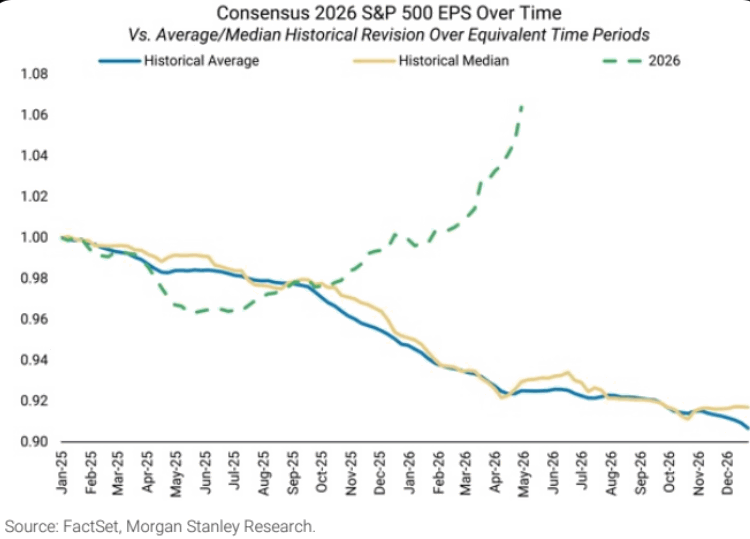
Chart of the Day: Why the S&P keeps grinding higher: 2026 EPS estimates are being revised up ~7% versus the historical median of -8% cuts by this point — a ~15-point positive divergence with no analog. The index, with 50% of earnings derived from AI is simply tracking its earnings tape, which is why Hormuz, breadth deterioration, and macro stress aren’t biting. But the setup is mean-reversion-loaded: a catch-down toward the 0.92 historical path implies 13-15% downward EPS revisions ahead — the repricing event the tape is pretending isn’t on the table.
Market Intelligence Brief (MIB) Ver. 17.85
For professional investors only. Not investment advice.
© 2026 RecessionALERT.com

Comments are closed.