
US Navy seized Iranian tanker Touska in Gulf of Oman, spiking WTI +4.35% and snapping the Nasdaq’s historic 13-session streak. Russell 2000 hit a record close (+0.58%) as small-caps diverged sharply from mega-cap tech. Fed chair nominee Warsh faces Senate grilling Tuesday — Sen. Tillis blocks vote as Powell’s May 15 term looms. CBP opened a $166B tariff refund portal (IEEPA duties ruled unconstitutional). Amazon commits $25B more to Anthropic in 2026’s largest AI infrastructure deal.
TABLE OF CONTENTS
A. EXECUTIVE SUMMARY
B. MARKET DATA
C. HIGH-IMPACT STORIES (5)
D. MODERATE-IMPACT STORIES (5)
E. ECONOMY WATCH (6)
F. EARNINGS WATCH (0)
G. WHAT’S NEXT
H. CHART OF THE DAY
A. EXECUTIVE SUMMARY -> TOP
MARKET SNAPSHOT:
US large-cap indices closed modestly lower as the US Navy’s seizure of the Iranian tanker Touska in the Gulf of Oman reignited Middle East supply risk and snapped the Nasdaq’s 13-session winning streak — the longest since 1992. The S&P 500 fell 0.24% to 7,109.17, the Nasdaq 100 lost 0.31%, and the Dow was effectively flat, while the Russell 2000 rose 0.58% to 2,793.12 for a new record close — a divergence that points to a geopolitical-tech rotation rather than a broad risk-off move. WTI crude surged 4.35% to $86.18/bbl and the VIX jumped 8% to 18.88, while short-end yields edged higher on inflation risk rather than recession fear. Sector breadth was narrow and sentiment-driven — Energy (+0.44%) and Industrials (+0.38%) led, Communication Services (-1.08%) and Healthcare (-0.84%) lagged, and six of eleven sectors moved less than ±0.5%.
TODAY AT A GLANCE:
• Iranian cargo ship seized by USS Spruance in Gulf of Oman — ceasefire expires Wednesday April 22; Brent +4.44% to $94.39/bbl, WTI +4.35% to $86.18/bbl, Strait of Hormuz flows collapsed to 3.8 million bpd.
• Russell 2000 closes at record 2,793.12 (+0.58%) as Nasdaq’s 13-day streak ends — clearest signal yet of domestic small-cap rotation away from globally-exposed mega-cap tech.
• Warsh Senate hearing Tuesday — prepared remarks pledge Fed “stay in its lane” independence; Sen. Tillis continues to block confirmation pending DOJ Powell probe, with Powell’s term expiring May 15.
• CBP launches CAPE portal for $166B in tariff refunds — unconstitutional IEEPA duties now claimable; 60–90 day payout window creates a one-time margin tailwind for import-heavy S&P 500 names.
• Amazon commits up to $25B more to Anthropic (total ~$33B); Anthropic locks in $100B of AWS spend and 5 GW of Trainium capacity — largest AI infrastructure deal of 2026.
• Cleveland Fed April CPI nowcast jumps to 3.58% from 3.28% on April 1 — energy shock pushes inflation further from the Fed’s 2% target, pressuring the remaining 2026 rate-cut path.
• Earnings superweek begins Tuesday — GE, UNH, RTX, DHR, NOC, MMM (BMO) plus ISRG, CB, COF (AMC); TSLA Wednesday AMC; GOOGL/MSFT/META/AMZN all report the following week.
KEY THEMES:
1. Geopolitical Energy Shock Reasserts Itself – Friday’s 11–13% crude plunge on peace-deal optimism reversed in a single session after the tanker seizure, proving that Middle East risk premium is not being priced out. With Brent pushing $95 and the ceasefire expiring Wednesday, energy markets face a binary setup — a renewed framework, or a path toward $100–$115/bbl that would force further upward revisions to CPI and defer rate cuts into 2027.
2. Fed Leadership Vacuum Collides with Stagflation Signal – Warsh’s “stay in its lane” doctrine arrives at the worst possible macro moment: Cleveland Fed CPI tracking 3.58% while GDPNow sits at just 1.3%. If Tillis’s block keeps the confirmation vote past May 15, Powell stays — extending the White House pressure campaign precisely as energy-driven inflation reaccelerates and bond markets lose anchor.
3. AI Capex Arms Race Accelerates Beneath the Surface – Amazon’s $25B Anthropic commitment and Google’s Marvell chip partnership show hyperscalers racing to lock in multi-year compute and silicon capacity even as headline indices wobble. The supply chain is actively being reshuffled — MRVL +4–6%, AVGO -1.5% on a $1T+ market cap — underscoring that AI-chip concentration risk now moves billions per headline.
 — Leading economic indicators. Accurate market forecasts. Apply for membership at join.recessionalert.com
B. MARKET DATA -> TOP
A US Navy seizure of an Iranian-flagged tanker in the Gulf of Oman reignited Middle East supply risk on Monday, sending crude oil up more than 4% and snapping the Nasdaq’s 13-session winning streak. The Dow closed nearly flat and the Russell 2000 hit a new record close, with small-caps insulated from oil-market geopolitics while mega-cap tech and communications weighed on large-cap benchmarks. Energy led all sectors, reversing a week of peace-deal-driven losses in a single session, while Communication Services fell more than 1% as META and Netflix pulled sharply lower. The VIX spiked 8% to 18.88 and short-end yields edged higher — flagging oil-driven inflation risk rather than recession fear, a distinction that matters for portfolio positioning.
CLOSING PRICES – April 20, 2026:
MAJOR INDICES
| Index | Close | Change | %Move | Why It Moved |
|---|---|---|---|---|
| S&P 500 | 7,109.17 | -16.89 | -0.24% | US-Iran naval confrontation reignited geopolitical risk-off; Nasdaq snapped 13-session winning streak |
| Dow Jones | 49,442.56 | -4.87 | -0.01% | Effectively flat; blue-chip defensives and energy names offset tech and communications sector weakness |
| Nasdaq 100 (NDX) | 26,590.34 | -82.09 | -0.31% | INTC, META, and NFLX among largest drags; risk-off rotation hit high-multiple growth names |
| Russell 2000 | 2,793.12 | +16.22 | +0.58% | New closing record; small-caps insulated from geopolitical risk — domestic revenue base shielded from Middle East oil shock |
| NYSE Composite | 23,178.35 | -19.39 | -0.08% | Broad market index; mixed session reflecting energy and small-cap gains offset by tech and communications losses |
VOLATILITY & TREASURIES
| Instrument | Level | Change | Why It Moved |
|---|---|---|---|
| VIX | 18.88 | +1.40 (+8.01%) | Spiked on US-Iran naval confrontation; elevated concern but well below panic thresholds |
| 10-Year Treasury Yield | 4.254% | +1.1 bps | Modest rise; oil-driven inflation expectations offset flight-to-safety bond buying |
| 2-Year Treasury Yield | 3.727% | +2.7 bps | Short end led higher; oil price surge raised near-term inflation concerns; front-end curve pressure |
| US Dollar Index (DXY) | 98.10 | -0.04 (-0.04%) | Broadly unchanged; geopolitical safe-haven demand offset by euro strength on EUR/USD bounce |
COMMODITIES
| Asset | Price | Change | %Move | Why It Moved |
|---|---|---|---|---|
| Gold | $4,840.26/oz | -$39.34 | -0.81% | Modest pullback; risk-off flows directed to energy rather than gold; profit-taking near record levels |
| Silver | $79.893/oz | -$1.950 | -2.38% | Industrial metals sold on global demand uncertainty; silver underperformed gold on industrial exposure |
| Copper | $6.0468/lb | -$0.0677 | -1.11% | Global growth concerns weighed; geopolitical uncertainty dampened industrial demand outlook |
| Platinum | $2,098.85/oz | -$42.85 | -2.00% | Auto sector demand uncertainty weighed; industrial precious metals broadly weak alongside copper and silver |
| Bitcoin | $76,285 | +$1,643 | +2.20% | Diverged from equity risk-off; mild alternative-asset safe-haven demand amid geopolitical uncertainty |
ENERGY
| Asset | Price | Change | %Move | Why It Moved |
|---|---|---|---|---|
| Crude Oil (WTI) | $86.18/bbl | +$3.59 | +4.35% | US Navy seized Iranian tanker in Gulf of Oman; geopolitical supply disruption risk repriced sharply higher |
| Crude Oil (Brent) | $94.39/bbl | +$4.01 | +4.44% | Same catalyst; Strait of Hormuz supply disruption fears drove global benchmark sharply higher |
| Natural Gas (Henry Hub) | $2.677/MMBtu | +$0.003 | +0.11% | Largely insulated from Middle East oil shock; bearish US supply fundamentals persist |
| Natural Gas (Dutch TTF) | $13.92/MMBtu | +$0.55 | +4.13% | European gas followed oil higher on Middle East supply risk; winter storage concerns re-emerged |
S&P 500 SECTORS
Energy (+0.44%) snapped a 4-point weekly underperformance in one session as oil surged on the Iranian ship seizure. Communication Services flipped from 1-week leader (+4.3%) to today’s worst (-1.08%) on concentrated META and Netflix selling. Healthcare deepens its structural drag — weakest across 3-month, 6-month, and YTD horizons.
| Sector | 1-Day | 1-Week | 1-Month | 3-Month | 6-Month | YTD | 12-Month |
|---|---|---|---|---|---|---|---|
| Energy | +0.44% | -3.72% | -4.90% | +18.69% | +31.74% | +25.71% | +43.18% |
| Industrials | +0.38% | +1.20% | +7.84% | +5.07% | +16.77% | +14.70% | +45.40% |
| Real Estate | +0.26% | +3.68% | +6.45% | +4.10% | +6.01% | +9.21% | +12.33% |
| Technology | +0.18% | +5.90% | +11.73% | +5.33% | +5.59% | +6.50% | +56.39% |
| Financial | 0.00% | +1.96% | +8.83% | -2.07% | +5.83% | -1.20% | +22.89% |
| Basic Materials | -0.11% | +0.42% | +14.41% | +8.23% | +24.70% | +19.93% | +59.28% |
| Consumer Defensive | -0.21% | +0.78% | +1.93% | +1.91% | +6.64% | +7.34% | +7.46% |
| Consumer Cyclical | -0.50% | +5.14% | +10.30% | -2.89% | +1.82% | -0.44% | +29.36% |
| Utilities | -0.75% | -0.90% | +0.13% | +5.78% | +1.67% | +8.13% | +23.02% |
| Healthcare | -0.84% | +0.31% | +2.99% | -3.71% | +4.91% | -2.31% | +14.75% |
| Communication Services | -1.08% | +4.30% | +7.80% | +3.11% | +9.13% | +3.01% | +51.49% |
TOP MEGA-CAP MOVERS:
Selection criteria: US-listed companies with market cap above $200 billion that moved ±1.5% or more during the session. Movers are ranked by percentage change and capped at 5 gainers and 5 decliners. On muted trading days when fewer than 3 names meet the threshold, the largest moves are shown regardless. Moves driven by earnings, M&A, analyst actions, sector rotation, or macro catalysts are prioritized over low-volume or technical moves.
GAINERS
| Company | Ticker | Close | Change | Why It Moved |
|---|---|---|---|---|
| JPMorgan Chase & Co | JPM | $316.99 | +2.16% | Q1 earnings beat momentum (reported April 14); JPM’s bullish 13% EPS season forecast lifted broad bank sentiment |
| Goldman Sachs Group | GS | $941.74 | +1.71% | Q1 earnings season positive momentum lifted financials; capital markets activity beat expectations |
| Cisco Systems | CSCO | $87.71 | +1.69% | AI networking infrastructure demand; buy-the-dip into technology sector outperformer amid broad market weakness |
| Texas Instruments | TXN | $233.70 | +1.69% | Pre-earnings optimism ahead of Q1 report (April 22 AMC); analog semiconductor cycle recovery thesis |
| Arista Networks | ANET | $166.85 | +1.60% | AI data center networking demand supported by hyperscaler capex commitments; outperformed technology sector |
DECLINERS
| Company | Ticker | Close | Change | Why It Moved |
|---|---|---|---|---|
| Intel Corp | INTC | $65.70 | -4.09% | Pre-Q1 earnings repositioning ahead of April 23 report; profit-taking after 85%+ YTD surge from multi-year lows |
| Meta Platforms | META | $670.91 | -2.56% | Risk-off rotation amid US-Iran escalation; largest Communication Services component drove sector’s 1.08% decline |
| Netflix | NFLX | $94.83 | -2.55% | Communication Services sector rotation; profit-taking after sector’s strong 4.3% weekly gain |
| AbbVie | ABBV | $203.71 | -2.24% | Healthcare sector weakness; rotation out of defensive pharma names as energy risk-on dominated session |
| Tesla | TSLA | $392.50 | -2.03% | Pre-Q1 earnings anxiety (reports April 22 AMC); EV demand and margin concerns heading into results |
— Institutional-grade intelligence for serious investors. Apply for membership at join.recessionalert.comC. HIGH-IMPACT STORIES -> TOP
UNCERTAIN
1. Warsh Releases Senate Hearing Remarks: Fed Must “Stay in Its Lane” on Independence
The core facts:Federal Reserve Chair nominee Kevin Warsh released prepared remarks Monday for his Senate Banking Committee confirmation hearing scheduled for Tuesday, April 21. Warsh committed to strict Fed independence from the executive branch while pledging to work with the administration on “non-monetary” matters — effectively drawing a line between monetary policy and broader economic policy. He criticized the Fed for “institutional overreach” and vowed to keep the central bank focused narrowly on its statutory mandate. He also disclosed over $100 million in personal financial assets and pledged to sell all holdings if confirmed. The path to confirmation remains uncertain: Sen. Thom Tillis (R-NC) has publicly vowed to vote against Warsh until the DOJ drops its ongoing criminal investigation into Chairman Powell over renovation cost overruns — an investigation Powell has called a pretext for political pressure.
Why it matters:Powell’s term expires May 15. If Warsh is not confirmed by then, Powell has said he intends to remain — creating a prolonged leadership vacuum that could unsettle bond markets and complicate the Fed’s ability to respond to an economy facing simultaneous inflation reacceleration (CPI now tracking 3.7%, per the Cleveland Fed), rising oil prices, and trade policy flux. Warsh’s confirmation could be positive for markets if it re-establishes clear Fed independence and a credible monetary framework; a prolonged standoff — or a confirmation fight that escalates the Trump-Fed conflict — carries significant risk for dollar credibility and Treasury yields. The “stay in its lane” framing also signals that Warsh would resist political pressure for emergency rate cuts, which matters in an environment where the White House has pressed aggressively for lower rates.
What to watch:Tuesday’s Senate Banking Committee hearing (April 21) for signals on confirmation vote count, particularly Sen. Tillis’s position, and Warsh’s answers on the timing and magnitude of rate cuts. A Senate floor vote timeline remains unclear — watch for any whip count leaks from the Banking Committee.
BEARISH
2. US Seizes Iranian Cargo Ship; Ceasefire Teeters as Oil Surges 5-6%
The core facts:The USS Spruance intercepted and seized the Iranian-flagged cargo ship Touska in the Gulf of Oman on Sunday, April 19, reversing a brief period of ceasefire optimism that had sent oil prices plunging 11-13% last Friday. Iran immediately withdrew from scheduled peace talks in Islamabad and threatened retaliation, throwing the fate of the two-week ceasefire into serious doubt — it is set to expire Wednesday, April 22. Brent crude surged 5.33% to $95.20/bbl; WTI rose 6.03% to $88.91/bbl. The Strait of Hormuz remains effectively closed, with shipping data showing only three crossings in the past 12 hours. The EIA estimates Middle East production shut-ins now stand at 9.1 million barrels per day in April, creating a 5.1 million bpd global inventory draw in Q2 2026. The IEA has previously warned of “unprecedented disruption” to global fuel markets, with Strait of Hormuz flows at just 3.8 million bpd — down from over 20 million bpd pre-conflict.
Why it matters:The cargo seizure effectively negated last week’s peace rally and resets the geopolitical risk premium in oil markets. With Brent pushing toward $95 and the ceasefire expiring in 48 hours, energy markets face a binary outcome: a renewed framework that allows Hormuz flows to gradually resume, or a full ceasefire collapse that could push Brent toward or above $100/bbl — and potentially $115/bbl as the EIA’s Q2 peak scenario. For US equity markets, the direct transmission is through energy inflation (already reaccelerating per the Cleveland Fed nowcast), airline and shipping cost pressures, and a general risk-off sentiment that is weighing on large-cap tech and consumer stocks. The energy sector (XOP +1.1%) and defense names are the clear beneficiaries; consumer discretionary, industrials, and any company with Middle East supply chain exposure are at risk.
What to watch:The April 22 ceasefire expiry deadline is the immediate binary trigger — watch for any White House statement or Iranian diplomatic signal before Wednesday. A Brent sustained break above $100/bbl would be the next market-moving threshold, signaling a full ceasefire collapse is being priced.
BULLISH
3. CBP Opens $166 Billion Tariff Refund Portal — Unconstitutional Duties Now Claimable
The core facts:U.S. Customs and Border Protection (CBP) officially launched the Consolidated Administration and Processing of Entries (CAPE) portal Monday, allowing businesses to file claims for tariff refunds on duties the Supreme Court ruled unconstitutional in February 2026. The Supreme Court found 6-3 that President Trump illegally issued tariffs under the International Emergency Economic Powers Act (IEEPA), ruling that tariff-setting authority rests with Congress, not the executive. CBP estimates a total of $166 billion in refunds are owed across the US importing base. The portal currently covers “unliquidated” duties and tariffs finalized within the past 80 days; CBP has committed to issue approved refunds within 60 to 90 days of claim approval, though claims with errors may take longer.
Why it matters:$166 billion in potential corporate refunds represents a significant, one-time improvement in cash flow and cost structures for US importers — a broad category that includes retailers, manufacturers, technology assemblers, and industrial companies. For S&P 500 companies with heavy import exposure (consumer electronics, automotive, apparel, machinery), the refunds function as an unexpected margin tailwind. This also removes a persistent legal overhang: companies that have been accruing tariff expenses or building contingency reserves against IEEPA duties can now see a defined path to cash recovery. The precedent — a Supreme Court ruling that executive emergency tariff authority is constitutionally limited — also constrains the administration’s ability to reimpose similar blanket tariffs without congressional authorization, providing a degree of structural trade policy clarity that markets had long sought.
What to watch:Watch for S&P 500 companies to begin quantifying expected refunds in upcoming Q1 2026 earnings calls (April 21–30); large retailers and tech assemblers with high import volumes are most likely to disclose material amounts. Monitor for any executive or congressional challenge to the portal’s scope or the CBP’s refund process.
UNCERTAIN
4. Nasdaq’s Historic 13-Day Win Streak Snapped; Russell 2000 Closes at All-Time High
The core facts:US equity markets posted a split session Monday, April 20. The Nasdaq Composite fell 0.26% to 24,404.39, ending its 13-consecutive-session winning streak — the longest since 1992 — as renewed Iran tensions overshadowed continued AI and earnings tailwinds. The S&P 500 shed 0.24% to 7,109.14, snapping a five-day win streak. The Dow Jones was effectively flat, off 0.01% to 49,442.56. In sharp contrast, the small-cap Russell 2000 rose 0.58% to 2,792.96, notching a new all-time closing high. Sector performance reflected the divergence: communications, utilities, and healthcare led declines, while materials, financials, and energy posted gains. The session’s tone was set Sunday night when stock futures sold off sharply after news broke of the Iranian cargo ship seizure.
Why it matters:The Russell 2000 reaching an all-time high on the same day the Nasdaq’s historic streak ends signals a meaningful market rotation underway — from large-cap tech (more exposed to international supply chains, global trade, and premium valuations) into domestic small-caps (less Iran/tariff exposure, benefiting from US-centric revenue). This is a structurally significant development: if the Russell 2000’s breakout holds and broadens, it would confirm that the rally is becoming more internally inclusive and less dependent on a handful of mega-cap tech names. However, the rotation is being driven partly by risk-off concerns (geopolitical uncertainty, inflation reacceleration), which tempers the bullish read. A sustained Nasdaq pullback — if the Warsh hearing or ceasefire developments add uncertainty this week — could mean the small-cap outperformance is more defensive rebalancing than genuine broad-market strength.
What to watch:Watch whether Russell 2000 sustains above 2,790 on a closing basis over the next three sessions — a confirmed breakout would draw significant institutional reallocation. Monitor the Nasdaq 100’s reaction to Tuesday’s Warsh hearing and Wednesday’s ceasefire expiry for clues on whether the streak’s end is a pause or a more durable rotation inflection.
BEARISH
5. Cleveland Fed Inflation Nowcast Climbs to 3.7% — Energy Shock Stalls Rate-Cut Hopes
The core facts:The Federal Reserve Bank of Cleveland’s real-time inflation nowcasting tool updated Monday, showing the April annual CPI forecast at approximately 3.71% year-over-year — up sharply from 3.25% in March. The PCE nowcast rose to 3.58% from 3.28%. The primary driver of the uptick is energy prices, which have surged as the Strait of Hormuz disruption has kept global oil markets under supply stress. The nowcast model incorporates daily commodity price data, meaning the Sunday cargo-ship seizure and Monday oil spike are already being partially reflected in the forward projection. Importantly, the nowcast is tracking inflation re-acceleration, not deceleration — moving in the opposite direction from what the Fed would need to justify any near-term rate cut.
Why it matters:The market had entered 2026 expecting the Fed to resume its cutting cycle mid-year, priced on a path of gradually normalizing inflation. An April CPI nowcast of 3.7% — a full 45 basis points above March’s actual print — materially pushes that timeline further out. If the ceasefire collapses and oil approaches $100-$115/bbl (EIA’s Q2 peak scenario), the May and June CPI prints could accelerate further, eliminating the possibility of a 2026 rate cut entirely and raising questions about whether the Fed would eventually need to reverse course and hike. This creates a direct equity headwind: higher-for-longer rates compress valuation multiples on long-duration assets (growth stocks, real estate, utilities) and increase refinancing risk for levered companies. The timing is particularly acute with a new Fed chair taking office in May and the Warsh confirmation hearing set for Tuesday — any ambiguity in his rate-cut timeline will be viewed through this accelerating inflation lens.
What to watch:Watch the official April CPI release (expected mid-May) for confirmation of the nowcast trajectory. If Brent oil remains above $95/bbl through the end of April, expect further upward revisions to the nowcast in the coming days — each uptick incrementally reduces the probability of a 2026 rate cut.
— Quantifying recession risk so you don’t have to guess. Apply for membership at join.recessionalert.comD. MODERATE-IMPACT STORIES -> TOP
BULLISH
6. Amazon Commits Up to $25 Billion More to Anthropic in Year’s Largest AI Infrastructure Deal
The core facts:Amazon announced Monday it will invest up to an additional $25 billion in AI startup Anthropic — $5 billion immediately at Anthropic’s latest $380 billion valuation, with up to $20 billion more tied to commercial milestones. This brings Amazon’s total committed investment in Anthropic to approximately $33 billion since their partnership began. As part of the expanded deal, Anthropic committed to spend more than $100 billion on Amazon Web Services technology over the next 10 years and will secure up to 5 gigawatts of capacity using Amazon’s Trainium AI chips to train and power its Claude models. Amazon was already Anthropic’s primary cloud partner; this deal locks in that exclusivity at unprecedented scale. KeyBanc Capital Markets maintained its Overweight rating on Amazon following the announcement, raising its price target to $325.
Why it matters:This is the largest single AI infrastructure commitment of 2026 and the clearest statement yet that Amazon views its Anthropic partnership — and by extension AWS’s AI cloud positioning — as the central competitive battleground against Microsoft/Azure-OpenAI. For AWS, a $100 billion guaranteed revenue commitment from Anthropic over 10 years (~$10B/year) is a structural demand signal that de-risks the massive AI capex cycle Amazon has undertaken. For Anthropic at a $380 billion valuation (larger than Goldman Sachs), the deal validates Claude as the institutional-grade AI model of choice and provides the compute resources needed to remain competitive with GPT-5 and Google Gemini. Broader market implication: the deal accelerates the race among hyperscalers (AMZN, MSFT, GOOGL) to secure AI model partnerships and lock in cloud spending commitments — a capital allocation dynamic that directly benefits GPU/chip suppliers (NVDA, AMD) and cloud infrastructure providers.
What to watch:Watch Amazon’s Q1 2026 earnings call (week of April 28) for AWS revenue growth guidance and any commentary on Trainium chip demand and AI model utilization — the key metrics that will validate whether this $25B commitment is driving near-term monetization or remains a long-dated infrastructure bet.
UNCERTAIN
7. Marvell Surges 4-6% on Google AI Chip Partnership; Broadcom Slides on Competitive Threat
The core facts:Alphabet’s Google is reportedly in advanced deal talks with Marvell Technology (MRVL, ~$65B market cap) to co-develop two new custom AI chips: (1) a memory processing unit (MPU) designed to work alongside Google’s Tensor Processing Unit (TPU), and (2) a new TPU built specifically for AI inference workloads. The companies aim to finalize the memory chip design as early as next year before moving to test production. Marvell shares surged 4-6% on the news — a significant move on a day when the broader tech market was under modest pressure. Broadcom (AVGO), currently Google’s primary TPU partner with a market cap exceeding $1 trillion, slid 1.5% on concerns the Marvell partnership diversifies Google away from Broadcom’s custom silicon dominance. Celestica (CLS) also declined approximately 1%.
Why it matters:Google’s move to bring Marvell into its AI chip ecosystem is part of a deliberate strategy to reduce dependence on any single silicon partner — and, more broadly, to position its TPU infrastructure as a credible alternative to Nvidia’s GPU dominance in AI training and inference. For portfolio managers, the Marvell-Broadcom dynamic illustrates how the AI chip supply chain is being actively reshuffled: hyperscalers are building multi-vendor strategies that create meaningful winners and losers within the semiconductor sector even on days when headline index moves are muted. Marvell’s win signals an expansion of its custom silicon business beyond its traditional networking-chip roots; Broadcom’s decline at a $1 trillion market cap means even a 1.5% move represents $15+ billion in market cap erosion on a single news item — underscoring the concentration risk in current AI semiconductor positioning.
What to watch:Watch Alphabet’s Q1 2026 earnings call (week of April 28) for any TPU deployment update or commentary on custom silicon partnerships — the first opportunity for Google management to formally address the Marvell collaboration. Monitor AVGO for further institutional repositioning given the $1T+ market cap sensitivity to Google concentration risk.
BEARISH
8. Lockheed Martin Falls 2.5% as War-Premium Unwind Continues Ahead of April 23 Earnings
The core facts:Lockheed Martin (LMT) declined 2.52% Monday, closing at $592.19. The aerospace and defense giant, with a market cap of approximately $140 billion, has now lost approximately 4.7% in the past month and 4.1% in the past week — a notable reversal following a 26% year-to-date surge that reflected the war-premium demand for defense spending after the US-Iran conflict began. The pullback comes despite Monday’s renewed Iran tensions, which might logically support defense names; investors appear to be rotating out of defense and taking profits on the outsized YTD gains rather than adding new exposure. Lockheed’s LTM EBIT margin has been running at 9.3%, below the ~12% the stock’s valuation implies as a normalized target, raising program execution concerns. Quarterly earnings are scheduled for April 23, 2026 — three sessions away.
Why it matters:Lockheed is the bellwether for US defense spending and program execution. The selloff despite sustained geopolitical risk suggests the market may be pricing in margin disappointment rather than revenue upside — a shift from the “defense spending is going up” narrative that drove the 26% YTD rally to a “can LMT actually deliver on those contracts profitably?” question. This matters for the broader defense sector (RTX, NOC, GD): if LMT’s April 23 results show margin compression or delivery delays, it could trigger a sector-wide reassessment of defense premiums that have been baked in since the conflict began. The earnings call will be the first opportunity for management to address program cost overruns, labor availability, and supply chain normalization in the current geopolitical environment.
What to watch:LMT earnings on April 23 — specifically operating margins, F-35 program delivery numbers, and any guidance revision to the full-year outlook. Watch for RTX and NOC earnings (also this week) as cross-checks on whether the defense margin pressures are company-specific or sector-wide.
BEARISH
9. US Weighs Tougher Auto Import Content Rules That Could Impose Effective 10% USMCA Tariff
The core facts:The Trump administration is internally weighing new North American auto trade rules that would require imported vehicles to contain a higher minimum proportion of US-manufactured components in order to avoid tariffs — a change that could subject USMCA-compliant vehicle imports to an effective tariff rate of approximately 10%. The proposals have been discussed internally and with auto industry stakeholders ahead of a planned review of the US-Mexico-Canada Agreement. Importantly, no formal proposals have yet been made to trade negotiators in Canada or Mexico. The USMCA extension decision — whether to continue, renegotiate, or terminate — must be made by July 1, 2026. Current USMCA rules require 75% of a vehicle’s content to originate from the US, Canada, or Mexico to qualify for duty-free treatment.
Why it matters:The Big Three US automakers (GM, Ford, Stellantis) operate highly integrated North American production networks that depend on USMCA’s existing content rules to keep vehicles cost-competitive. A rule change imposing effective 10% tariffs on currently duty-free vehicles from Canada and Mexico would increase production costs, force supply chain restructuring, and potentially reduce vehicle sales volumes — the exact reverse of the “buy American” reshoring effect the administration intends. For investors, this creates uncertainty for GM and Ford specifically (large Mexican and Canadian production exposure), and for US auto-parts suppliers that have built supply chains optimized for the existing USMCA framework. The July 1 USMCA decision deadline makes this a near-term catalyst: any formal proposal between now and then could trigger significant sector volatility.
What to watch:Watch for any formal USTR proposal or White House announcement of USMCA renegotiation positions before the July 1 extension deadline. Monitor GM and Ford earnings (late April) for management commentary on USMCA exposure and contingency planning — the first opportunity for the Big Three to address this publicly.
BULLISH
10. BNP Paribas Upgrades Apple to Outperform as AI Monetization Thesis Gains Traction
The core facts:BNP Paribas Exane upgraded Apple (AAPL) to Outperform from Neutral Monday, making it a fresh institutional buy recommendation on the world’s largest public company — a market cap exceeding $3 trillion. The upgrade reflects growing conviction that Apple’s AI monetization strategy, primarily through its Apple Intelligence platform and broader ecosystem integration, creates a durable upgrade cycle and services revenue expansion opportunity that was not adequately captured in the prior Neutral rating. Apple has been one of the notable mega-cap holdouts this year relative to peers like Nvidia and Microsoft, creating what BNP Paribas views as an attractive relative-value entry point ahead of the company’s earnings season and the continued rollout of AI-powered iPhone features globally.
Why it matters:An upgrade from neutral to outperform on a $3 trillion company by a major global investment bank carries outsized weight — institutional portfolio managers who track BNP Paribas research will see this as a directional signal on the largest single-name position in most large-cap indices. More broadly, the upgrade reflects a broader re-rating thesis for Apple: the bear case (slowing iPhone unit growth, China market exposure, regulatory headwinds) is being increasingly offset by the bull case (AI-driven supercycle, services margin expansion, ecosystem monetization). For the S&P 500 and Nasdaq, Apple’s direction matters disproportionately given its index weighting: a sustained institutional re-rating of AAPL would provide meaningful upward pressure on both indices independent of the broader macro environment.
What to watch:Watch Apple’s fiscal Q2 2026 earnings call (expected late April/early May) for iPhone unit guidance and Apple Intelligence adoption metrics — the data points that will validate or invalidate the BNP Paribas upgrade thesis. Monitor whether other major banks follow with similar upgrades, which would amplify the institutional buy signal.
— Know the probability before the market prices in the risk. Apply for membership at join.recessionalert.comF. EARNINGS WATCH -> TOP
Selection criteria: This section covers only market-moving earnings from large-cap companies (>$50B market cap) with sector significance or systemic implications. The S&P 500 scorecard above tracks all 500 index components, but individual stories below focus on names large enough to move markets and provide economic signals relevant to US large-cap portfolio managers. On any given day, 30-80+ companies may report earnings, but MIB filters for the 2-5 names most relevant to institutional investors.
YESTERDAY AFTER THE BELL (Markets Reacted Today)
No major earnings yesterday after the bell from companies with >$50B market cap.
TODAY BEFORE THE BELL (Markets Already Reacted)
No major earnings before the bell from companies with >$50B market cap. Monday, April 20 reporters were predominantly small regional banks and specialty financials — none meeting the $50B market cap threshold for inclusion.
TODAY AFTER THE BELL (Markets React Tomorrow)
No major earnings after the bell from companies with >$50B market cap. Steel Dynamics (STLD, ~$30B market cap) reports AMC today — below the threshold for individual coverage.
WEEK AHEAD PREVIEW:
Q1 2026 earnings season accelerates sharply this week, with Tuesday bringing the heaviest single-day lineup of the quarter — nine companies above $50B market cap report, spanning aerospace, healthcare, defense, and financial sectors. The scorecard stands at 10% reported, leaving the bulk of S&P 500 results ahead.
GE Aerospace (GE) — BMO Tuesday, April 21 — $317B market cap; consensus EPS $1.60 GAAP $1.68, revenue ~$10.7B; key focus: commercial engine demand, defense backlog, and tariff/supply chain impact on margins given Middle East disruption.
UnitedHealth Group (UNH) — BMO Tuesday, April 21 — $294B market cap; consensus EPS $6.58 GAAP $6.34, revenue ~$109B; key focus: medical loss ratio normalization, Medicare Advantage pricing, and any updated FY2026 guidance after elevated utilization.
RTX Corp (RTX) — BMO Tuesday, April 21 — $264B market cap; consensus EPS $1.51 GAAP $1.21, revenue ~$21.5B; key focus: defense backlog, Pratt & Whitney engine delivery progress, and geopolitical demand signals.
Danaher Corp (DHR) — BMO Tuesday, April 21 — $138B market cap; consensus EPS $1.94, revenue ~$6.0B; key focus: bioprocessing recovery timeline and life sciences demand outlook.
Northrop Grumman (NOC) — BMO Tuesday, April 21 — $93B market cap; consensus EPS $6.06, revenue ~$9.8B; key focus: B-21 program progress, defense budget allocation, margin guidance.
3M Co (MMM) — BMO Tuesday, April 21 — $80B market cap; consensus EPS $1.98, revenue ~$6.0B; key focus: restructuring progress, litigation reserve updates, and industrial demand signals.
Intuitive Surgical (ISRG) — AMC Tuesday, April 21 — $165B market cap; consensus EPS $2.12 GAAP $1.97, revenue ~$2.6B; key focus: da Vinci 5 system placements and procedure volume growth.
Chubb Limited (CB) — AMC Tuesday, April 21 — $129B market cap; consensus EPS $6.60, revenue ~$13.6B; key focus: catastrophe loss exposure and pricing environment in commercial P&C.
Capital One Financial (COF) — AMC Tuesday, April 21 — $127B market cap; consensus EPS $4.50 GAAP $3.89, revenue ~$15.4B; key focus: credit loss provisions, delinquency trends, and any Discover integration update.
Tesla (TSLA) — AMC Wednesday, April 22 — key focus: Q1 delivery volumes (already reported: 336,681 units, -13% YoY), gross margin recovery, energy storage growth, and robotaxi commercialization timeline. China EV pricing pressure will be a central theme.
Alphabet (GOOGL), Microsoft (MSFT), Meta Platforms (META), Amazon (AMZN) — all reporting week of April 28; collectively the most consequential earnings week of Q1 2026, with AI capex guidance, cloud growth trajectories, and advertising demand all under the microscope. Warsh’s monetary policy stance and oil-driven inflation will provide the macro backdrop against which all four reports are interpreted.
— Separating signal from noise since 2007. Apply for membership at join.recessionalert.comE. ECONOMY WATCH -> TOP
Labor held firm — claims fell to 207K last week, the biggest single-week drop since February — while the Cleveland Fed’s own nowcast ticked up to 3.58%, capturing the week’s central tension: the economy is neither collapsing nor cleanly cooling. Into that bind steps Kevin Warsh, whose prepared Senate testimony today vowed to “stay in its lane” with an inflation-first doctrine, even as a Republican blockade leaves his confirmation timeline unresolved. Commercial loan growth and Oxford Economics argue for resilience; Saks Global rushing to close 15 luxury stores as it exits bankruptcy argues the opposite. Q1 GDP advance estimate (April 25) will deliver the first hard verdict on whether 1.3% GDPNow is a floor or a ceiling.
Jobless Claims Plunge to 207K, Sharpest Drop Since February, Signaling Labor Market Holds Firm (DOL, April 17)
What they’re saying:Initial jobless claims for the week ending April 12 fell to 207K, down 11K from the prior week’s revised 218K and well below the 215K consensus estimate. The print marks the largest single-week decline since February, confirming that actual layoffs have not accelerated despite elevated macro uncertainty stemming from the Iran war, energy shock, and tariff disruptions.
The context:Claims data is the highest-frequency leading indicator of labor market deterioration, and the absence of a sustained spike suggests corporate behavior has shifted toward hiring freezes rather than outright layoffs — a distinction that matters for consumer spending durability. The Fed, which has cited labor market resilience as its primary justification for holding rates steady, can point to this print as reinforcement of its wait-and-see posture. A claims surge above 240K sustained over multiple weeks would be the clearest early signal of recession entry.
What to watch:Claims for the week ending April 19, released April 24 — the first full post-holiday week of data. A spike above 230–240K would signal that layoff activity is beginning to emerge beyond isolated sector stress.
Warsh Prepared Testimony: Fed Must “Stay in Its Lane” — Senate Hearing Starts Tuesday Amid Confirmation Uncertainty (CNBC, April 20)
What they’re saying:Fed Chair nominee Kevin Warsh released prepared Senate Banking Committee testimony today emphasizing strict central bank independence through a “stay in its lane” doctrine. Warsh signaled a firm inflation-fighting priority with minimal reference to the labor market, criticizing past Fed overreach into fiscal and social policy. His confirmation hearing begins Tuesday at 10 a.m. ET, but the path to confirmation is not clear — Republican Sen. Thom Tillis has vowed to block the vote until a DOJ investigation into outgoing Chair Powell is resolved, and without Tillis the nomination cannot advance out of committee.
The context:A Warsh-led Fed would represent a meaningful policy shift: a harder inflation mandate with less tolerance for labor market tradeoffs, potentially keeping rates elevated longer than markets currently price. The confirmation uncertainty compounds the problem — a prolonged Senate standoff would leave Powell in place beyond his intended exit, prolonging the White House pressure campaign that has already damaged Fed credibility with bond markets. Warsh’s Silicon Valley background and extensive financial holdings ($100M+ disclosed) will also face Democratic scrutiny over independence conflicts.
What to watch:Sen. Tillis’s public stance after Tuesday’s hearing; any Senate Banking Committee vote timeline; the Fed’s May 7 FOMC meeting — the last one under guaranteed Powell leadership regardless of confirmation outcome.
Cleveland Fed Inflation Nowcast Rises to 3.58%, Up 30 Basis Points Since April 1 as Energy Costs Filter Through (Cleveland Fed / Motley Fool, April 20)
What they’re saying:The Cleveland Fed’s real-time inflation tracking model revised its April CPI estimate upward to 3.58% TTM today, up from 3.28% at the start of the month — a 30 basis point increase in less than three weeks. The acceleration reflects energy cost pass-through driven by Middle East supply disruptions, consistent with a broader pattern of goods inflation re-emerging after a period of disinflation through late 2025.
The context:The Cleveland Fed nowcast is one of the Fed’s own high-frequency tools for monitoring inflation trajectory between official CPI releases. A 3.58% annual pace exceeds the Fed’s 2% target by 158 basis points and, if sustained into the formal BLS release, reinforces the case for keeping rates on hold despite growth at just 1.3% per the GDPNow tracker. This is the stagflationary bind the Fed explicitly fears: inflation reaccelerating while growth decelerates, eliminating the option to cut without signaling a surrender on price stability.
What to watch:BLS April CPI release, expected mid-May — the first formal print to capture the full energy shock impact. If the Cleveland nowcast proves accurate, expect a meaningful miss relative to Street estimates and a repricing of rate cut timing.
Oxford Economics: US Recession Probability “Pretty Low” — Strong Base Growth Can Absorb Q1 Softness (Benzinga, April 20)
What they’re saying:Oxford Economics analyst Ben May argues that the probability of a US recession in 2026 remains “pretty low,” citing strong underlying growth momentum entering the year. May attributes Q1 2026 softness to temporary factors — adverse weather, inventory drawdowns — and projects the economy to return to above-trend growth in subsequent quarters. He also argues the US is better insulated from the Middle East energy shock than European or emerging market peers.
The context:Oxford Economics’ optimism stands in contrast to institutional risk management signals — consumer sentiment at a 74-year record low, the Cleveland Fed nowcast pushing toward 3.6%, and Polymarket holding recession odds at 26%. The key analytical fault line is temporal: Oxford sees near-term weakness as transitory; bears see compounding pressures (energy prices, fading fiscal support, credit tightening) building toward a structural slowdown. Moody’s Zandi last pegged recession risk at approximately 50% in late March, a materially more cautious view than Oxford’s.
What to watch:Q1 2026 advance GDP estimate (April 25) — the first hard print on whether Q1 softness was truly transitory. A sub-1.0% print would undermine Oxford’s base case; a 1.5%+ print would validate it.
Robust US Commercial Loan Growth Eases Near-Term Recession Fears as Business Borrowing Accelerates (Reuters, April 20)
What they’re saying:Reuters reports that US commercial and industrial loan growth has accelerated in recent weeks, easing near-term concerns about an imminent economic slowdown. Corporate borrowing has expanded despite broader macro uncertainty — elevated energy prices, consumer sentiment collapse, and ongoing Middle East conflict — suggesting business investment intentions remain intact and banks are not tightening credit standards aggressively.
The context:C&I loan growth is a classic leading indicator of corporate confidence — companies borrow to invest, hire, and expand inventory. Sustained credit demand at this stage of the cycle signals that CFOs have not yet entered a contraction posture. The flip side: aggressive pre-tariff and pre-conflict borrowing could be front-running rather than reflecting genuine optimism, in which case the credit growth is borrowed demand that will slow sharply in Q2. The distinction between these interpretations will be visible in the upcoming Fed SLOOS survey.
What to watch:Fed Senior Loan Officer Opinion Survey (SLOOS), typically released early May — the authoritative read on whether banks are tightening lending standards despite current volume growth. Tightening standards with sustained volume would confirm front-running; loosening standards would confirm genuine demand.
Saks Global Secures $500M Exit Financing, Plans to Close 15 Luxury Stores as Bankruptcy Restructuring Targets Summer Exit (CTV News / Luxury Daily, April 20)
What they’re saying:Saks Global — parent of Saks Fifth Avenue, Neiman Marcus, and Bergdorf Goodman — has secured $500 million in exit financing as it targets emergence from Chapter 11 bankruptcy by summer 2026. The restructuring plan includes the closure of 12 Saks Fifth Avenue and 3 Neiman Marcus locations, with Bergdorf Goodman expected to remain fully operational. The company filed for Chapter 11 in January 2026 carrying approximately $3.4 billion in debt.
The context:The Saks Global restructuring is the largest US luxury retail failure in over a decade, and the closure of 15 flagship locations signals a permanent contraction in physical luxury retail driven by the dual shock of structural e-commerce migration and the 2025–2026 energy-cost squeeze on upper-income discretionary spending. Affected locations include major urban flagship stores, creating secondary pressure on high-end commercial real estate landlords and luxury goods brands — including LVMH and Kering labels — that depend on Saks as a wholesale distribution channel.
What to watch:Bankruptcy court approval of the exit financing and closure plan; whether Bergdorf Goodman retains all locations; signals from luxury goods earnings (LVMH, Tapestry, Capri) on wholesale channel impact.
— US market commentary trusted by family offices and institutions. Apply for membership at join.recessionalert.comG. WHAT’S NEXT -> TOP
UPCOMING RELEASES:
| Date | Event | Why It Matters |
|---|---|---|
| Tue, Apr 21 | Retail Sales MoM (Mar) — expected +1.4%, prior +0.6% | Highest-impact consumer read of the week; a +1.4% print would suggest pre-tariff front-running, while a miss would confirm the sentiment-collapse narrative. |
| Tue, Apr 21 | Retail Sales Ex Autos & Control Group (Mar) | Control Group feeds directly into GDPNow; a soft print compounds the Q1 advance-GDP downside risk on April 25. |
| Tue, Apr 21 | ADP Weekly Employment Change — prior +39K | High-frequency labor read; continued softness would align with claims data and pressure Fed-hold rhetoric if growth deteriorates. |
| Tue, Apr 21 | Pending Home Sales MoM (Mar) — expected +0.1%, prior +1.8% | Housing remains the sole negative WLEI component; weak pending sales would reinforce the rate-sensitivity drag on construction and REIT earnings. |
| Tue, Apr 21 | Fed Gov. Waller Speech (2:30 PM ET) | First FOMC voter commentary after the Cleveland Fed nowcast jumped to 3.58%; watch for any hint on how energy-driven CPI reshapes the 2026 rate path. |
| Tue, Apr 21 | Warsh Senate Banking Committee Hearing (10:00 AM ET) | Fed chair nominee’s first live testimony — answers on rate-cut timing and Tillis’s stance will drive Treasury and dollar volatility into the close. |
| Wed, Apr 22 | MBA 30-Year Mortgage Rate & Applications — prior 6.42% / +1.8% | Weekly housing-demand pulse; any tick higher in rates with softening apps would confirm the rate-sensitivity stall evident in WLEI’s housing component. |
| Wed, Apr 22 | EIA Crude Oil Stocks Change (week of Apr 18) | First inventory print to capture the tanker-seizure supply shock; a sharp draw would validate the $95 Brent move and keep upward pressure on CPI nowcasts. |
| Wed, Apr 22 | Iran Ceasefire Expiry Deadline | Binary geopolitical trigger — a renewed framework lets Hormuz flows resume; a collapse opens the path to Brent $100–$115/bbl and a broader equity risk-off. |
KEY QUESTIONS:
1. Does the ceasefire survive Wednesday’s expiry, or does Brent push through $100/bbl and force a full repricing of the Fed’s 2026 rate-cut path?
2. If Sen. Tillis maintains his block after Tuesday’s hearing, does bond market confidence hold into a May 15 Powell-Warsh leadership vacuum — and how wide does the term-premium spread?
3. Is the Russell 2000’s record close a durable small-cap rotation or a defensive rebalance — and does Tuesday’s retail sales print confirm or break the thesis?
— US market commentary trusted by family offices and institutions. Apply for membership at join.recessionalert.comH. CHART OF THE DAY -> TOP
Compelling chart witnessed by our team either on social media, the internet or from our own models.
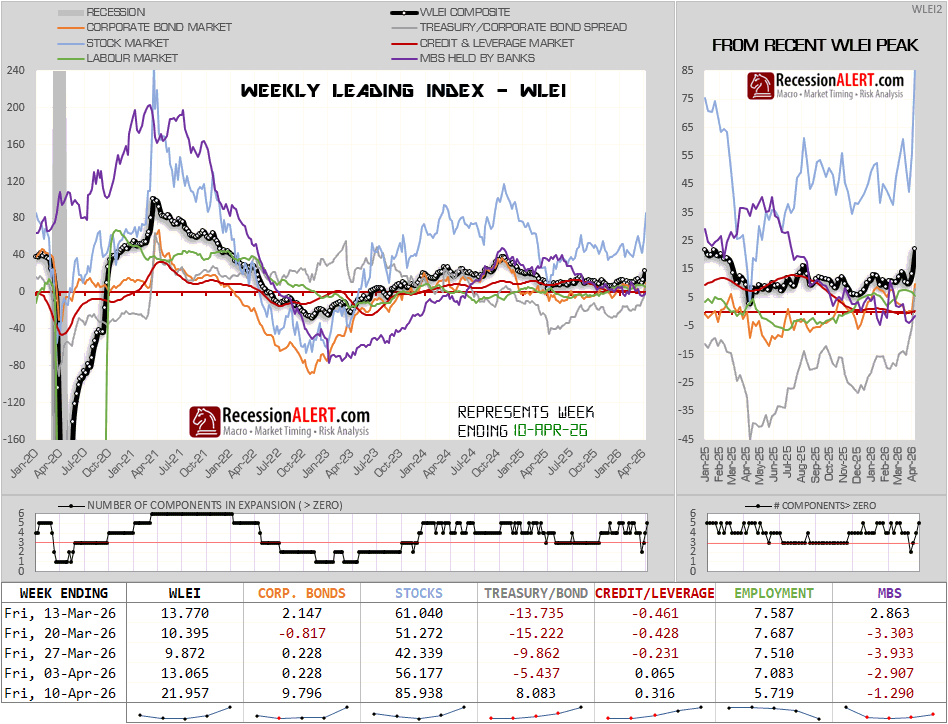
Chart of the Day: The Weekly Leading Economic Index (WLEI) surged to 21.957 for the week ending April 10th — its strongest reading in several months — driven primarily by the eye-watering ~13% S&P 500 rally off the March 30th trough, which single-handedly pushed the Stocks component from 42.3 to 85.9. While the headline jump is impressive, it’s worth noting the broader picture remains mixed. The Treasury/Corporate Bond Spread component, although still negative at -13.7 as recently as mid-March, has improved markedly to +8.1, suggesting credit market stress is beginning to ease. Employment remains quietly resilient in the +5–7 range. Corporate Bonds turned positive this week at +9.8 after flirting with contraction. Credit & Leverage, while still marginally positive at +0.3, has been essentially flat-lining near zero. The one persistent laggard remains MBS (housing), which has been stubbornly negative for four consecutive weeks and is now the sole component in contraction — a reminder that the rate-sensitive housing sector continues to struggle despite the equity market’s exuberance. The WLEI composite remains well above zero and trending higher off its recent peak decline, which is an encouraging signal — but the index’s current strength is largely a one-component story. A more durable expansion signal would require broader participation, particularly from credit markets and housing.
Market Intelligence Brief (MIB) Ver. 17.10
For professional investors only. Not investment advice.
© 2026 RecessionALERT.com

Comments are closed.