
MARKET INTELLIGENCE BRIEF (MIB)
Thursday, September 3, 2026
Waller put a September hold on the table and hike odds collapsed from 63% to roughly 50% — the S&P jumped 1.06%, the VIX sank 5.86%. ISM services beat at 55.4 with prices paid at 72.6, and yields fell anyway. NVIDIA confirmed Hugging Face at $12.93 billion. Iran struck Gulf states a second night; WTI hit six-week highs while Energy finished the only red sector. Canadian retaliation lands September 8. Bitcoin added 5.06% and Palantir surged 7.71% on a PwC alliance.
TABLE OF CONTENTS
A. EXECUTIVE SUMMARY
B. MARKET DATA
C. HIGH-IMPACT STORIES (5)
D. MODERATE-IMPACT STORIES (8)
E. ECONOMY WATCH (5)
F. EARNINGS WATCH (2)
G. WHAT’S NEXT
H. CHART OF THE DAY
A. EXECUTIVE SUMMARY -> TOP
A single Fed governor moved a coin-flip meeting: Waller’s conditional hold lifted the S&P 500 1.06%, the Dow 1.18% and the Nasdaq 100 1.16%, pulled the 2-year yield down 4.6 bps against the 10-year’s 2.2 bps, and knocked September hike odds from 63% to roughly 50%. The tape then ignored its own data — ISM services beat at 55.4 with prices paid accelerating to 72.6, the strongest available argument for the hike Waller explicitly left on the table, and yields fell regardless. Breadth flatters the move only on a sector count: ten of eleven closed green behind Industrials (+1.86%) and Financials (+1.69%), but the Russell 2000 managed +0.51% and DJ Transports +0.71% against the Dow’s +1.18%, which is duration relief for mega-caps rather than broadening risk appetite. Energy was the lone decliner at -0.67% on a day WTI closed at a six-week high, with Iran striking Gulf states for a second night.
• Waller conditions a September hold on the next two weeks of data — September hike odds fell from 63.2% to roughly 50%, the VIX collapsed 5.86% to 14.31 and the dollar index shed 0.60%; he kept a hike explicitly on the table if August inflation comes in hot.
• ISM services beat at 55.4 with prices paid at 72.6 — against a 54.3 consensus and a 26th straight month of expansion, the day’s hard data argued for the hike, not the hold; the 10-year fell 2.2 bps to 4.772% anyway, while the employment sub-index stayed below 50 at 47.8.
• Iran strikes Gulf states for a second consecutive night — no energy infrastructure hit in either exchange, which is the whole basis for contained-disruption pricing; WTI closed at $91.73 (+0.79%) and Brent $95.83, six-week highs, yet Energy was the only red sector at -0.67%. Mitsui O.S.K. abandoned its own Hormuz restart assumption for the rest of the year.
• NVIDIA confirms Hugging Face at exactly $12.93 billion — roughly $11.9 billion cash plus up to $1 billion in retention equity, about $1.1 billion below the press figure this report carried yesterday; closing is expected in the first half of 2027. NVDA +1.80% to $228.45.
• Canada’s dollar-for-dollar retaliation takes effect September 8 — steel, dairy, agricultural equipment and pulp and paper, with no negotiations under way and both leaders spending the day assigning blame; a further doubling of tariffs on Canadian vehicles and parts is scheduled for January 1, 2027.
• Palantir +7.71% to $182.53, Broadcom -2.74% to $357.16 — PLTR on a PwC alliance with no disclosed economics; AVGO the session’s steepest mega-cap decliner on a day nine firms turned more bullish on it, the disagreement resting on a 73% fiscal Q4 gross margin guide against 78% a year ago.
1. The market has priced a framing, not the data — positioning is now anchored to the Fed’s stated reaction function rather than to the inputs feeding it. Waller moved September by roughly thirteen points on a hold he has not yet earned, while the session’s own high-impact print pointed the other way. That leaves the arrangement carrying two-sided risk into a very short window: if August core CPI corroborates a 72.6 prices-paid reading, the unwind has to cover today’s move and the conditional hold now embedded inside it, and payrolls arrive first.
2. Everything rallied on one trade, which is the opposite of diversification — Bitcoin +5.06% to $81,411 with no crypto catalyst, gold +2.34%, silver +3.15%, platinum +3.54% and copper +1.20%, all alongside equities. That pairing only makes sense if a weaker dollar and falling real yields are doing the lifting rather than safe-haven demand, which makes each of them a duration asset priced off the same variable. Assets that rise together on a dovish signal fall together on a hot print, at the same time as the equity book.
3. The scheduled risks are not rate risks, and the leadership does not reflect them — Industrials led at +1.86% on a repricing that has nothing to say about input costs, five days before Canadian retaliation hits steel and agricultural equipment. Energy was sold into a six-week-high barrel because a 40% year-to-date gain makes it the natural funding source for a rotation into rate-sensitives, not because anything improved at Hormuz. Both gaps are mechanical flow overriding fundamentals, and both have fixed dates attached.
 — Leading economic indicators. Accurate market forecasts. Apply for membership at join.recessionalert.com
B. MARKET DATA -> TOP
US equities rallied broadly after Fed Governor Christopher Waller signaled he would hold rates steady barring an inflation surprise, sending the S&P 500 up 1.06% and the Dow up 1.18% as Treasury yields eased across the curve. Ten of eleven sectors closed green — Industrials, Financials and Consumer Cyclical led — with Energy the lone laggard even as WTI and Brent both firmed. Palantir (+7.71%) topped mega-cap gainers on an expanded PwC AI alliance, and rate-sensitive software names CrowdStrike and Oracle reversed Wednesday’s yield-driven selloff; Broadcom (-2.74%) was the session’s outlier, slipping on its own earnings. Gold’s 2.34% surge reflected both a weaker dollar and the active Iran conflict.
CLOSING PRICES – September 3, 2026:
MAJOR INDICES
Gains were broad but uneven — the Dow (+1.18%) and Nasdaq 100 (+1.16%) led, while Russell 2000 (+0.51%) and DJ Transportation (+0.71%) lagged well behind, with NYSE Composite breadth (+0.92%) landing in between. The muted small-cap and transport response suggests today’s rally leaned on mega-cap rate-sensitivity rather than a genuine broadening of risk appetite.
| Index | Close | Change | %Move | Why It Moved |
|---|---|---|---|---|
| S&P 500 | 7,747.71 | +81.11 | +1.06% | Broad rally as Fed Gov. Waller signaled holding rates steady barring an inflation surprise; Treasury yields eased. |
| Dow Jones | 53,686.11 | +624.16 | +1.18% | Led by Industrials and Financials on the dovish Fed repricing; best point gain of the majors. |
| DJ Transportation | 20,861.52 | +148.04 | +0.71% | Lagged the mega-cap indices; no discrete same-day catalyst beyond the broad rally. |
| Nasdaq 100 | 29,482.32 | +338.99 | +1.16% | Software/AI-infrastructure names (Palantir, Oracle, CrowdStrike) led as falling yields eased pressure on high-multiple growth stocks. |
| Russell 2000 | 2,968.27 | +15.10 | +0.51% | Underperformed the mega-cap benchmarks; small-caps captured only a fraction of the dovish-Fed rally. |
| NYSE Composite | 24,720.15 | +224.60 | +0.92% | Broad-based advance across the exchange, trailing the more rate-sensitive mega-cap indices. |
VOLATILITY & TREASURIES
VIX’s 5.86% collapse alongside falling yields is a clean risk-on signal — bonds fully confirmed the equity rally rather than diverging from it. The curve barely shifted (10Y -2.2bps vs 2Y -4.6bps), a modest bull-steepening consistent with reduced near-term hike risk rather than a growth-scare repricing. DXY’s 0.60% slide corroborates the same dovish-Fed story.
| Instrument | Level | Change | Why It Moved |
|---|---|---|---|
| VIX | 14.31 | -0.89 (-5.86%) | Fear gauge fell sharply as the dovish Fed signal lifted risk appetite. |
| 10-Year Treasury Yield | 4.772% | -2.2 bps | Eased on Fed Gov. Waller’s dovish remarks, reducing near-term hike odds. |
| 2-Year Treasury Yield | 4.340% | -4.6 bps | Fell further than the 10-year — a modest bull-steepening consistent with reduced hike risk. |
| US Dollar Index (DXY) | 98.91 | -0.60 (-0.60%) | Weakened as hike odds fell; tailwind to dollar-denominated commodities. |
COMMODITIES
Precious and industrial metals rallied in lockstep — gold +2.34%, silver +3.15%, platinum +3.54%, copper +1.20% — an unusual pairing with equities that points to a weaker dollar and falling real yields doing the lifting rather than safe-haven flight alone; gold’s move also carried a geopolitical bid from the active Iran conflict. Bitcoin’s 5.06% gain tracked the broader risk-on tape.
| Asset | Price | Change | %Move | Why It Moved |
|---|---|---|---|---|
| Gold | $4,518.11/oz | +$103.51 | +2.34% | Rallied on a weaker dollar and falling real yields, plus a safe-haven bid from the active Iran conflict. |
| Silver | $67.53/oz | +$2.07 | +3.15% | Tracked gold higher, outpacing it on the day. |
| Copper | $6.6723/lb | +$0.0793 | +1.20% | Gained alongside the broader metals complex on a weaker dollar. |
| Platinum | $1,827.10/oz | +$62.50 | +3.54% | Led the metals complex higher, tracking gold and silver. |
| Bitcoin | $81,411 | +$3,919 | +5.06% | Tracked the broader risk-on tape and weaker dollar; no discrete idiosyncratic catalyst identified. |
ENERGY
WTI (+0.79%) and Brent (+0.21%) firmed only modestly despite the active Iran conflict threatening Strait of Hormuz flows, suggesting the market is pricing a contained disruption rather than a supply shock. Henry Hub (-1.32%) and Dutch TTF (-3.05%) both fell, decoupling entirely from crude. Energy equities (-0.67%) still lagged the broader tape — the session’s only red sector despite firmer oil.
| Asset | Price | Change | %Move | Why It Moved |
|---|---|---|---|---|
| Crude Oil (WTI) | $91.73/bbl | +$0.72 | +0.79% | Firmed modestly on the active Iran conflict near the Strait of Hormuz; market pricing a contained disruption. |
| Crude Oil (Brent) | $95.83/bbl | +$0.20 | +0.21% | Held a similar modest gain to WTI; no material spread widening. |
| Natural Gas (Henry Hub) | $2.917/MMBtu | -$0.039 | -1.32% | Fell, decoupling from the crude complex; no discrete same-day catalyst identified. |
| Natural Gas (Dutch TTF) | $24.25/MMBtu | -$0.76 | -3.05% | Fell in dollar terms, driven primarily by the day’s euro/dollar move rather than a European-specific gas catalyst. |
S&P 500 SECTORS
Ten of eleven sectors closed green, with Industrials (+1.86%), Financial (+1.69%) and Consumer Cyclical (+1.40%) leading a broad, Fed-driven rally. Energy (-0.67%) was the lone holdout, decoupling from its own commodity complex as crude firmed — a sector-specific laggard rather than a genuine risk-off signal, and notable against Energy’s strong 12-month (+42.99%) and YTD (+40.02%) trend.
| Sector | 1-Day | 1-Week | 1-Month | 3-Month | 6-Month | YTD | 12-Month |
|---|---|---|---|---|---|---|---|
| Industrials | +1.86% | -1.28% | -2.89% | -4.64% | -0.50% | +10.95% | +16.05% |
| Financial | +1.69% | +1.67% | +1.06% | +11.82% | +15.73% | +9.97% | +15.37% |
| Consumer Cyclical | +1.40% | +0.48% | -2.27% | -0.70% | +0.86% | -3.59% | -0.31% |
| Communication Services | +1.37% | +1.90% | -1.16% | -4.55% | +1.68% | -0.08% | +7.77% |
| Technology | +1.24% | -0.84% | +1.13% | -2.07% | +28.04% | +24.93% | +35.31% |
| Real Estate | +0.93% | -1.02% | -2.29% | +0.64% | +1.98% | +8.81% | +5.48% |
| Utilities | +0.78% | -0.44% | -1.95% | -3.49% | -8.53% | -0.27% | +3.62% |
| Basic Materials | +0.53% | -1.89% | +5.85% | +3.41% | +3.78% | +20.89% | +35.84% |
| Healthcare | +0.26% | +0.55% | +5.06% | +12.99% | +11.98% | +11.29% | +25.05% |
| Consumer Defensive | +0.18% | +0.88% | -1.06% | +2.31% | -1.77% | +7.30% | +5.31% |
| Energy | -0.67% | +3.10% | +9.59% | +6.84% | +12.91% | +40.02% | +42.99% |
TOP MEGA-CAP MOVERS:
GAINERS
| Company | Ticker | Close | Change | Why It Moved |
|---|---|---|---|---|
| Palantir Technologies Inc | PLTR | $182.53 | +7.71% | Expanded its PwC US alliance for enterprise AI, announced today; extends the rebound from Wednesday’s rate-driven pullback. |
| Space Exploration Technologies Corp | SPCX | $149.69 | +6.38% | No discrete same-day catalyst identified; source data on the day’s price action conflicted and should be independently re-verified. |
| Oracle Corp | ORCL | $154.04 | +5.69% | No discrete same-day catalyst identified; second consecutive gain ahead of the September 10 earnings report. |
| Crowdstrike Holdings Inc | CRWD | $214.97 | +5.68% | No discrete same-day catalyst identified; reversed Wednesday’s rate-driven pullback as yields eased. |
| Tesla Inc | TSLA | $376.36 | +5.42% | Rallied into tonight’s Cybercab robotaxi rider-launch event at Gigafactory Texas. |
DECLINERS
| Company | Ticker | Close | Change | Why It Moved |
|---|---|---|---|---|
| Broadcom Inc | AVGO | $357.16 | -2.74% | Earnings-driven (FQ3 report, Wed AMC). |
| ExxonMobil Corp | XOM | $162.21 | -1.18% | No discrete same-day catalyst identified; lone red name among mega-cap Energy despite firmer crude. |
| Philip Morris International Inc | PM | $186.17 | -0.94% | No discrete same-day catalyst identified; defensive laggard amid the broad risk-on rotation. |
| Cisco Systems Inc | CSCO | $108.68 | -0.71% | No discrete same-day catalyst identified. |
| Applied Materials Inc | AMAT | $435.91 | -0.58% | No discrete same-day catalyst identified. |
— Institutional-grade intelligence for serious investors. Apply for membership at join.recessionalert.comC. HIGH-IMPACT STORIES -> TOP
BULLISH
1. Waller Puts a September Hold on the Table and Conditions It on Two Weeks of Inflation Data — Hike Odds Collapse From 63% to Roughly 50%
The core facts:In a Reuters NEXT Newsmaker interview in Washington on Thursday morning, Fed Governor Christopher Waller said he “would be inclined to support holding the target for the federal funds rate at its current setting” if incoming data over the next two weeks cooperate — while explicitly keeping the alternative open: “If inflation comes in hot, I would consider a rate hike.” He framed the September decision as “heavily influenced by what we learn about August inflation,” citing three-month core inflation falling from 4.76% in February to 3.05% through July as evidence that “we are finally seeing some signs of disinflation.” The remarks moved the entire tape: the S&P 500 closed +1.06%, the Dow +1.18% and the Nasdaq 100 +1.16%, with the 10-year yield down 2.2bps to 4.772%, the 2-year down 4.6bps to 4.340%, the dollar index down 0.60% and the VIX down 5.86% to 14.31. Market-implied odds of a September hike fell from 63.2% on Wednesday to roughly 50%, with contemporaneous same-day readings ranging from 48.4% to 54.6% depending on the time of capture.
Why it matters:The repricing is the event: one governor moved a genuinely coin-flip meeting by roughly thirteen points in a single morning, which is a measure of how little conviction was in the September pricing to begin with. But the hold Waller described is conditional and the condition is unmet — he pinned it to data that has not been released. The curve’s response was internally consistent rather than euphoric: the 2-year fell further than the 10-year, a modest bull-steepening that reads as reduced near-term hike risk rather than a growth scare, and the VIX collapse alongside falling yields means bonds confirmed the equity rally instead of diverging from it. What undercuts the risk-on interpretation is the rally’s composition. The Russell 2000 managed only +0.51% and DJ Transports +0.71%, against +1.18% for the Dow — small caps and cyclical freight captured a fraction of a move that was supposedly about cheaper money. That is duration relief for mega-caps, not a broadening of risk appetite, and it leaves the market’s September position resting on two data prints in the next eight days.
What to watch:Tomorrow’s 08:30 ET August employment report (consensus +58,000 nonfarm payrolls, unemployment 4.1%) and August CPI the week of September 7 — Waller named both as his conditions, and the FOMC meets September 15-16.
UNCERTAIN
2. ISM Services Beats at 55.4 With Prices Paid at 72.6 — and the Tape Ignores Both Halves
The core facts:The ISM Services PMI rose to 55.4 in August against a 54.3 consensus and 54.1 prior — a high-impact print on the day’s calendar and a 26th consecutive month of expansion — while the prices-paid subindex rose to 72.6 from 70.3. The release landed at 10:00 ET, ninety minutes after Waller’s remarks. The 10-year yield fell anyway, closing down 2.2bps at 4.772%. Section E carries the full data layer.
Why it matters:What the market did with this print matters more than the print. A firm services reading with an accelerating price component is, on its own terms, an argument for precisely the hike Waller left on the table — services inflation is the stickiest component of core and the one the Fed has repeatedly named as the obstacle. Yields fell regardless. That tells you positioning is now anchored to the Fed’s stated reaction function rather than to the data feeding it, which is a fragile arrangement three days before payrolls and a week before CPI. It also sharpens the asymmetry into next week: the market has priced a conditional hold on the strength of a governor’s framing, while the day’s own hard data pointed the other way. If August core CPI corroborates the 72.6 prices-paid reading, the unwind has to cover both today’s move and the conditional hold now embedded in it. Note too that a 55.4 services print sits comfortably with the Atlanta Fed’s GDPNow at 4.7% for Q3 — this is not an economy asking for relief.
What to watch:Whether the services prices-paid strength shows up in August core CPI during the week of September 7 — a hot print forces a second repricing on top of today’s.
UNCERTAIN
3. Iran Strikes Gulf States for a Second Straight Night; Crude Closes at Six-Week Highs While Energy Equities Finish Red
The core facts:Kuwait, Bahrain and the UAE intercepted a second consecutive night of Iranian missile and drone attacks aimed at US military bases, with Kuwait’s army stating that “Kuwaiti air defenses are currently engaging hostile missile and drone attacks.” No damage to any oil facility, refinery, port or energy infrastructure was reported in either country. WTI closed at $91.73 (+0.79%) and Brent at $95.83 (+0.21%) — the highest closes for each since July 23 and July 24 respectively. Separately, Mitsui O.S.K. Lines chief executive Jotaro Tamura abandoned his own company’s restart assumption for the Strait of Hormuz, telling Bloomberg that “given the current situation, it’s difficult to see operations resuming in any form by the end of the year.” That reverses guidance in MOL’s quarterly financial report last month, which projected navigation resuming gradually from October and normalising by January 2027; the company now requires de-escalation plus guarantees of safe passage.
Why it matters:Three facts point in different directions and the divergence is the signal. Crude reaching six-week highs on a 0.79% session is a story about accumulated risk premium, not about today — the level was built over the preceding week, and Thursday merely confirmed it. Two nights of exchanges without a single energy asset struck is the entire basis for the market pricing a contained disruption rather than a supply shock, and it explains why the move was 79 basis points rather than five percent. Against that, MOL’s write-off is the first named operator publicly abandoning a restart timetable, and it matters more than the barrels: at Hormuz the binding constraint is willing tonnage and insurable passage, not reserves in the ground, so a major owner extending its exclusion to year-end removes capacity that no producer decision can replace. Meanwhile the equity market declined to follow the commodity at all — Energy was the session’s only red sector at -0.67% with ExxonMobil down 1.18%, on a day ten of eleven sectors closed green. When a risk premium is supply-driven rather than demand-driven, that gap has historically closed in the commodity’s direction, though Energy’s 40.02% year-to-date gain also makes it the obvious funding source for a rotation into rate-sensitives.
What to watch:Whether any strike touches energy infrastructure — two nights without damage is the sole basis for contained-disruption pricing. OPEC+ core members meet virtually on September 6, with October output widely expected to hold unchanged.
BULLISH
4. NVIDIA Confirms the Hugging Face Acquisition at Exactly $12.93 Billion — About $1.1 Billion Below the Figure the Press Had Been Carrying
The core facts:NVIDIA published its own confirmation on Thursday that it has agreed to acquire Hugging Face for $12,930,300,000, with an 8-K filed the same day covering an agreement dated September 2. The structure is roughly $11.9 billion in cash to Hugging Face shareholders plus up to $1 billion in equity-based retention awards for employees joining NVIDIA, with closing expected in the first half of 2027 subject to regulatory approval. NVIDIA committed to keeping the platform open and consistent with Hugging Face’s existing practices. The platform carries more than 18 million developers, researchers and creators sharing over 3 million models, 500,000 datasets and 1 million applications. Chief executive Clement Delangue told CNBC’s Squawk Box on Thursday morning that “during the summer, I think we realized that Hugging Face and open-source AI in general was at the turning point, and that it needed more, more resources, more scale, more visibility,” describing NVIDIA as “a perfect home.” NVDA closed at $228.45, +1.80%.
Why it matters:This report carried the deal yesterday at a press-sourced “roughly $14 billion.” The confirmed consideration is $12.93 billion, and the gap between the two is the practical case for treating a company’s own filing as a different class of evidence from coverage of it. On substance, NVIDIA is not buying a model or a chip — it is buying the distribution layer of open-source AI. Hugging Face is where models are discovered, benchmarked and downloaded, which places it at the top of the funnel for workloads that eventually consume accelerators. That makes this a vertical integration of demand generation rather than of supply, and it is a materially different kind of transaction from NVIDIA’s usual silicon and networking tuck-ins. The open-platform commitment is the tension at the centre of it: neutrality is the source of Hugging Face’s value and the constraint on monetising it, and the two cannot both be maximised. The modest 1.80% move — barely above the Technology sector’s 1.24% — says the market is reading this as strategic positioning for 2027 and beyond rather than a near-term earnings event.
What to watch:The regulatory review through the first half of 2027 — the dominant accelerator vendor acquiring the neutral hub of open-source AI invites an obvious antitrust question. Watch whether the open-platform commitment is ever made binding rather than stated.
BEARISH
5. Carney Answers Lutnick From Thunder Bay as Canadian Retaliation Comes Into View on September 8
The core facts:Prime Minister Mark Carney, at a news conference in Thunder Bay, Ontario on Thursday, said Canada is “ready to sit down and strike that deal when the Americans are ready,” adding: “I don’t think, with all respect, appointed, unelected Cabinet members in the United States are experts on Canadian politics.” President Trump posted on Truth Social on Thursday morning that “it is very good for Canadian Politicians like Prime Minister Carney to make President Donald J. Trump ‘the enemy,’ until their Economy collapses.” The exchange answers Commerce Secretary Howard Lutnick’s claim on Wednesday that Canada “blew up the deal.” Canada’s announced dollar-for-dollar retaliation — covering steel, dairy, agricultural equipment, and pulp and paper — takes effect on September 8, five days away, and no negotiations are currently under way.
Why it matters:The market-relevant content is the calendar rather than the rhetoric. Retaliation with a fixed date and a named product list is a scheduled event, and Thursday’s exchange establishes that nothing is being negotiated to stop it — both leaders spent the day assigning blame for a collapse rather than describing a path back. Canada is the largest single US trading partner, and the four affected categories run directly into US industrial and agricultural cost structures: steel into the machinery and construction chain, agricultural equipment into a farm sector already absorbing tariff costs, pulp and paper into packaging. That lands awkwardly against the day’s tape, where Industrials led the entire market higher at +1.86% on a Fed repricing that has nothing to say about input costs. This is also the near end of a staged escalation rather than an isolated dispute — the two sides are already carrying tariffs imposed on Canadian consumer goods last month, and a further announced doubling of tariffs on Canadian cars, trucks and auto parts is scheduled for January 1, 2027. The competing accounts of who ended the talks remain in direct conflict, which is itself a signal about how quickly they can restart.
What to watch:September 8, when Canadian retaliation takes effect, and whether any negotiating channel reopens before it.
— Quantifying recession risk so you don’t have to guess. Apply for membership at join.recessionalert.comD. MODERATE-IMPACT STORIES -> TOP
BULLISH
6. Palantir Jumps 7.71% as PwC Expands Its Alliance Into M&A and ERP Transformation
The core facts:PwC US and Palantir announced an expanded strategic alliance on Thursday, initially targeting three transformation areas: scaling enterprise AI, transforming mergers and acquisitions, and modernising enterprise resource planning systems. The firms introduced an AI-native deals platform they say can execute transactions up to 50% faster while reducing one-time transaction costs by up to 45%. PwC was recently named a leader in the Palantir ecosystem for AI engineering and managed services. PLTR closed at $182.53, +7.71% — the session’s top mega-cap gainer at a $438.63 billion market capitalisation — extending a rebound from Wednesday’s 5.81% rate-driven pullback.
Why it matters:The distribution channel is the news here, not the technology. Palantir’s structural constraint has always been its deployment model: the platform requires forward-deployed engineers to configure it against a customer’s data, which caps how fast commercial accounts can be added regardless of demand. A Big Four firm putting its own transformation practice behind the platform attempts to solve that by proxy — PwC’s consultants become the delivery capacity Palantir cannot hire quickly enough, and PwC’s existing relationships become a pipeline that does not require Palantir’s own sales motion. The choice of M&A and ERP as the entry points is deliberate and favourable: both are recurring, budgeted, board-sponsored programmes rather than discretionary AI experiments, which makes them far more durable than pilot spending. The size of the move is its own datapoint — a 7.71% gain at a $438 billion company on a partnership with no disclosed economics says the market is starved of evidence on commercial growth and will pay generously for any.
What to watch:US commercial customer count and commercial revenue growth at the next quarterly report — the alliance only justifies today’s move if it converts into accounts.
UNCERTAIN
7. AbbVie Closes the $10.9 Billion Apogee Acquisition and Puts a Number on the Dilution: $0.14 This Year, $0.46 Next, Accretive in 2032
The core facts:AbbVie completed its acquisition of Apogee Therapeutics on Thursday, with Apogee common stock ceasing to trade on Nasdaq before the open. Shareholders received $135.11 per share in cash for a total equity value of approximately $10.9 billion — AbbVie’s largest acquisition in five years, agreed on June 22. In the completion release AbbVie quantified the earnings impact for the first time: a $0.14 reduction to adjusted diluted EPS in 2026, approximately $0.46 in 2027, and accretion beginning in 2032. AbbVie reaffirmed its 2026 full-year adjusted diluted EPS guidance range of $13.87 to $14.07, which already absorbs the $0.14. The transaction adds multiple clinical-stage candidates across inflammatory and immunological disease, including atopic dermatitis and asthma, and accelerates AbbVie’s presence in respiratory.
Why it matters:A six-year path to accretion is the number that deserves attention, and it is long even by large-pharma standards. What AbbVie is buying is duration — clinical-stage immunology assets positioned to sit behind Humira’s erosion and, further out, behind Skyrizi and Rinvoq — and it is paying for that with near-term earnings in a period when the sector’s patent-cliff arithmetic is already the dominant investor concern. The reaffirmed guidance is the reassuring half: management chose to absorb the dilution inside an existing range rather than reset expectations, which is a statement of confidence in the base business and removes the most obvious near-term overhang. The unresolved half is 2027, where $0.46 is roughly three times this year’s charge and no guidance yet exists to house it. Read alongside the day’s other transaction, the pattern is consistent: mega-caps are spending balance sheet on pipeline and platform rather than returning it, and accepting multi-year dilution to do so.
What to watch:Whether 2027 guidance, when issued, absorbs the $0.46 inside the trajectory the street already carries or resets the range downward.
UNCERTAIN
8. Nine Firms Turn More Bullish on Broadcom — On the Day It Was the Steepest Mega-Cap Decliner
The core facts:Macquarie’s Arthur Lai upgraded Broadcom to Outperform from Neutral with a $490 target, arguing that Google TPU-insourcing and MediaTek diversification risk is now priced in and that Broadcom is the cleanest listed exposure to Anthropic’s compute build — forecasting Anthropic purchases exceeding $40 billion from Broadcom by fiscal 2028. Eight further firms moved targets the same day: Cantor $525 to $600, Rosenblatt to $600, BMO $455 to $575, Susquehanna at $490, Evercore ISI $582 to $578, Raymond James $450 to $475, Truist $550 to $520, and William Blair a Buy with no target. AVGO closed at $357.16, -2.74% — the session’s steepest mega-cap decliner on a day ten of eleven sectors finished green — having traded as low as roughly $342.61 intraday. The quarter itself is covered in Section F.
Why it matters:A nine-firm bullish cluster landing on a 2.74% decline is a disagreement about horizon, not about facts, and both sides are looking at the same page. The sell-side is underwriting a fiscal 2028 AI revenue ramp; the tape is trading a fiscal Q4 gross margin guided to 73% against 78% a year earlier. Both can be correct simultaneously, because the AI ASIC business is growing at triple digits precisely while diluting company margin — custom silicon carries structurally lower margin than Broadcom’s legacy semiconductor and infrastructure software franchises, so the growth and the margin compression are the same fact seen from two ends. Lai’s Anthropic thesis is the more consequential claim and the least discussed: it makes Broadcom a levered bet on a single private customer’s capital plan five years out, a concentration risk that the $600 targets do not obviously discount and that no public disclosure allows an investor to monitor. The stock recovering more than half its intraday loss into the close suggests the market ended the day closer to the analysts than the opening print implied.
What to watch:Consolidated gross margin against the 73% fiscal Q4 guide — the margin path, not the AI revenue line, is what the two camps actually disagree about.
UNCERTAIN
9. Piper Sandler Raises Five Energy Targets by 17-34% Into the Session’s Only Red Sector
The core facts:Piper Sandler’s John Royall raised price targets across integrateds and refiners on Thursday: ExxonMobil $158 to $185 (Hold), Chevron $207 to $243 (Buy), Marathon Petroleum $344 to $462 (Buy), Valero $329 to $435 (Buy) and Phillips 66 $209 to $264 (Hold) — increases of 17% to 34%. Chevron drew three further same-day actions: BMO $205 to $235, Wells Fargo $226 to $230, and a maintained BofA Buy. Energy closed at -0.67%, the only red sector, with ExxonMobil down 1.18% at $162.21 and Chevron at $211.32. Not every call ran the same way: SEB Equities downgraded Equinor to Sell from Hold the same day.
Why it matters:The refiner targets are the aggressive half and they are the tell. Raising Marathon Petroleum by 34% and Valero by 32% is a call on crack spreads rather than on crude, and the underlying thesis is coherent: in a Hormuz-constrained market it is refined product, not crude, that a shipping disruption actually strands, so cracks widen even where the barrel does not. That is a defensible reading of exactly the facts the equity market spent the session refusing to price — Energy fell on a day WTI closed at a six-week high, which is not a fundamental judgement so much as a positioning one. With Energy up 40.02% year to date and 42.99% over twelve months, it is the natural funding source for a rotation into rate-sensitives on a dovish Fed headline, and that mechanical flow can override sector news for days at a time. The divergence between one analyst marking his models to a $91.73 crude world and a market selling the sector into it is the kind of gap that resolves quickly once the rotation exhausts itself.
What to watch:Refining crack spreads rather than crude prices — the Piper thesis stands or falls on product margins, not on the barrel.
UNCERTAIN
10. OpenAI, Anthropic and xAI All Degrade Inside the Same Three-Hour Window — With No Published Cause
The core facts:Three separately owned frontier-model providers entered elevated-error states within roughly an hour of each other on Thursday, according to their own published status feeds. xAI’s Grok logged a models outage opening at 13:30 GMT across eight components simultaneously — iOS, Android, Web, Build, Office plugins, Grok in X, and both API regions — resolving between 17:04 and 17:09 GMT, roughly three and a half hours. Anthropic reported elevated errors from 13:26 UTC across Claude Mythos 5.1, Fable 5.1 and Opus 5, widening to Opus 4.8 and 4.6, with impact ending at 16:16 UTC. OpenAI reported elevated errors across ChatGPT and Codex resolving at 16:55 UTC, spanning an unusually broad component list including Codex Web, CLI and API, login, search, file uploads, voice mode and image generation; it published no start timestamp, so its impact window cannot be stated. Bloomberg reported tens of thousands of OpenAI reports on Downdetector. No root cause has been published by any of the three, and none has been established. Cloudflare is ruled out as the shared dependency: its only sizeable Thursday incident ran roughly twelve hours before the window.
Why it matters:The correlation is the risk, not the downtime. Enterprise AI adoption has been underwritten on the premise that multi-vendor architectures supply redundancy — the standard mitigation for provider risk is precisely the failover that Thursday appears to have defeated, since a customer routing around OpenAI to Anthropic or xAI would have found both degraded in the same window. Whether the cause was a shared upstream dependency, a common infrastructure pattern independently adopted, or genuine coincidence is unknown and should not be assumed; but the procurement question does not wait on the answer, because the observed correlation is what a risk committee prices. The transmission path that matters is not the consumer chatbots but the layer above them: downstream agent tooling including Cursor also reported downtime, and that software is increasingly embedded in production workflows at companies with no visibility into which provider sits underneath. That no equity move was attributable to any of this is itself informative — the market currently treats frontier-model availability as infrastructure it does not need to price.
What to watch:Whether any of the three publishes a post-incident review naming a shared dependency. None had done so as of the close.
BULLISH
11. Bitcoin Adds 5.06% to Its Highest Close Since May — With No Crypto Catalyst Behind It
The core facts:Bitcoin closed at $81,411, up $3,919 or 5.06% — its highest close since May 11, when it settled at $81,852. The move came with no crypto-specific development behind it: no regulatory, legislative or enforcement action was dated Thursday, and the SEC’s press and litigation-release listings and the CFTC’s press listing carried no crypto item for the date. Every live matter in the sector predates the session — the CFTC’s motion to dismiss CME Group’s suit over Kalshi’s Bitcoin perpetual futures on September 2, the SEC’s proposed Regulation Crypto Assets on August 18, and a Senate procedural vote on the CLARITY Act scheduled for September 15.
Why it matters:A 5% move with no idiosyncratic driver is a statement about what Bitcoin currently is rather than about Bitcoin news. It rose on precisely the inputs that lifted equities and metals — a weaker dollar, falling real yields and a receding hike — which makes it a duration asset trading on the Fed’s reaction function, not an uncorrelated store of value. The company it kept is the evidence: gold gained 2.34%, silver 3.15%, platinum 3.54% and copper 1.20%, all rallying alongside equities in a pairing that only makes sense if the dollar and real yields are doing the lifting rather than safe-haven demand. For a portfolio manager the practical implication cuts against the diversification case that has justified allocations: an asset that rallies 5% on a dovish Fed signal is an asset that falls on a hot CPI print through the same mechanism, at the same time as the equity book. Note also what the move was not — it does not rank among the largest one-day gains of recent months, so this was a broad risk-on tide rather than anything unusual in crypto itself.
What to watch:Whether Bitcoin holds the move through tomorrow’s payrolls — a same-direction reaction to the labour data would confirm the duration read.
UNCERTAIN
12. Adobe Names Anil Chakravarthy CEO Effective December 1, Ending an Eight-Month Search — a Week Before Earnings
The core facts:Adobe announced at 16:15 ET on Thursday that Anil Chakravarthy — currently president of Customer Experience Orchestration and worldwide field operations — becomes president and chief executive on December 1, 2026, and joins the board. Shantanu Narayen, chief executive since 2007, becomes Executive Chair; Frank Calderoni continues as lead independent director and chaired the search committee. Adobe disclosed Narayen’s intention to step down and launched the search on March 12; that announcement named no successor, and press coverage had treated David Wadhwani as the presumed favourite. ADBE closed at $285.75, +2.13%, at a $113.59 billion market capitalisation — the release crossed after the close, so the day’s move is not attributable to it. Barclays raised its target to $295 from $250 on Thursday. Adobe reports fiscal Q3 after the close on September 10.
Why it matters:The identity of the choice is the signal, because the board had a genuine fork. Chakravarthy runs the Digital Experience side and worldwide field operations rather than Creative Cloud, so Adobe has selected an enterprise go-to-market operator over the product executive the market expected. That is a considered bet that Adobe’s problem is monetisation and distribution rather than product — a defensible read of a company with Creative freemium monthly active users above 90 million and Firefly annual recurring revenue near $300 million set against a 10.2% fiscal 2026 ending-ARR growth target. The gap between enormous AI engagement and modest revenue conversion is precisely a field-operations problem, and the appointment says the board agrees. It also means the incoming chief executive owns the AI monetisation question personally from day one rather than inheriting it as a product roadmap. The timing is the awkward part: a leadership transition and a quarterly print land one week apart, and the print comes first.
What to watch:Adobe’s fiscal Q3 report on September 10 — the first guidance commentary with a named successor in place, and specifically any revision to the ending-ARR growth target.
UNCERTAIN
13. The July Trade Deficit Widens to $88.6 Billion on Record Capital Goods Imports — and Still Beats Consensus
The core facts:The July goods-and-services trade deficit widened to $88.6 billion from a revised $71.2 billion in June, but came in narrower than the $90.0 billion consensus. Imports rose to $399.3 billion from $388.0 billion, driven by a record surge in capital goods imports. Section E carries the full data layer.
Why it matters:A deficit widening on capital goods rather than consumer goods reads as investment, not weakness, and the distinction changes the sign of the signal entirely. The import surge is largely AI datacentre equipment arriving on US soil — a domestic capital expenditure cycle wearing a trade-deficit costume, and one that shows up in the national accounts as a subtraction from GDP precisely because it is being bought abroad. That produces the day’s neatest contradiction: the Atlanta Fed’s GDPNow held at 4.7% for the third quarter, with net exports named as one of the components offsetting a stronger consumption nowcast, so the same equipment flow that mechanically drags on the published growth number is direct evidence of the investment boom underpinning it. The forward implication is practical. The capital goods import line is becoming a cleaner and more timely read on aggregate AI infrastructure spending than most individual company disclosures, which are guided, segment-aggregated and reported quarterly.
What to watch:The capital goods import line in the August report — whether July’s record is a level shift or a single month.
— Separating signal from noise since 2007. Apply for membership at join.recessionalert.comE. ECONOMY WATCH -> TOP
Thursday’s data leaned decisively toward growth: ISM Services vaulted to 55.4 — a 26th straight month of expansion — while GDPNow held at a robust 4.7% for Q3, even as Fed Governor Waller signaled he’d hold rates steady absent an inflation surprise, pulling Polymarket’s 2026 hike odds down 11 points to 61%. The dissonance is in the details: ISM’s prices-paid gauge jumped to 72.6 from 70.3, and July’s trade deficit widened to $88.6B on record AI-driven capital-goods imports — both signs the expansion is generating its own price and import pressure even as claims (206K) keep the labor market historically tight. The Fed’s near-term path now hinges entirely on the August CPI print Waller flagged as decisive ahead of the September 15-16 FOMC.
ISM Services PMI Jumps to 55.4 in August, Topping Estimates for 26th Straight Month of Expansion (ISM/Reuters, Sept 3, 2026)
What they’re saying:The ISM Services PMI rose to 55.4 in August from 54.1 in July, beating the 54.3 consensus estimate. Business activity jumped to 61.7 from 59.1 and new orders to 60.9 from 57.2, while the employment sub-index improved to 47.8 from 47.4 but stayed below the 50 breakeven line. Prices paid climbed to 72.6 from 70.3, the report’s clearest inflation signal.
The context:A services beat this size would typically pressure Treasury yields higher on stronger-for-longer growth and inflation risk, but the 10-year instead eased 2.2 bps to 4.772% on the day (per Section B) — Waller’s earlier dovish remarks dominated the tape ahead of the print. The rising prices-paid reading keeps the inflation side of the Fed’s dual mandate live even as growth data stays firm.
What to watch:The August CPI print (due before the Sept 15-16 FOMC) is now the swing factor Waller himself named; a hot reading would reintroduce the hike risk today’s PMI alone did not.
Fed Governor Waller Signals Rate Hold Barring Inflation Surprise; Hike Odds Fall 11 Points (Federal Reserve, Sept 3, 2026)
What they’re saying:In a Reuters NEXT Newsmaker interview, Governor Christopher Waller said: “If this continues in the data due over the next two weeks, I would be inclined to support holding the target for the federal funds rate at its current setting… But if inflation comes in hot, I would consider a rate hike.” He cited July PCE at +0.2% headline and +0.2% core, and flagged upside inflation risk from energy prices “significantly higher than they were at the beginning of 2026.”
The context:Polymarket’s “Fed rate hike in 2026” contract fell to 61% Yes from 72% in the prior session — an 11-point drop — while the “0 cuts in 2026” contract held near-steady at 88.7% (vs. 88.9% prior), meaning the repricing is entirely about a hike becoming less certain, not a cut becoming more likely. The remarks anchored the session’s broad equity rally and the pullback in yields and the VIX documented in Section B.
What to watch:The August CPI release and the September 15-16 FOMC meeting, which Waller explicitly tied his decision to.
US Trade Deficit Widens to $88.6B on Record AI-Driven Capital Goods Imports, Narrower Than Forecast (Census Bureau/BEA, Sept 3, 2026)
What they’re saying:The July goods-and-services deficit rose to $88.6B, up $17.4B from a revised $71.2B in June, but came in narrower than the $90.0B Reuters consensus. Exports fell to $310.7B from $314.7B; imports rose to $399.3B from $388.0B, driven by a record surge in capital goods imports. The goods deficit widened $17.6B to $119.6B while the services surplus edged up $0.2B to $31.0B.
The context:A widening deficit is a mechanical drag on GDP arithmetic, but the composition matters more than the headline here — record capital-goods imports point to continued heavy AI-infrastructure capex rather than consumer-demand weakness, and the beat-vs-consensus print kept the market’s reaction muted.
What to watch:Whether the capital-goods import pace persists into the August trade report (due early October) as a read on AI capex durability.
Atlanta Fed GDPNow Ticks Down to 4.7% for Q3, Still Signals Robust Growth (Atlanta Fed, Sept 3, 2026)
What they’re saying:The Atlanta Fed’s GDPNow model now tracks Q3 2026 real GDP growth at 4.7%, a marginal step down from the 4.8% reading published September 1 but still well above the economy’s longer-run trend pace.
The context:The nowcast corroborates today’s ISM services beat — growth momentum remains strong heading into the FOMC’s September decision, reinforcing why Waller’s “hold barring a surprise” framing leans on the incoming inflation data rather than any sign of a slowdown.
What to watch:Subsequent GDPNow updates as September data (CPI, retail sales) is incorporated ahead of the FOMC meeting.
Initial Jobless Claims Tick Up to 206K, Still Near Historic Lows (Dept. of Labor, Sept 3, 2026)
What they’re saying:Initial jobless claims for the week ended August 29 rose to 206,000, above the 205,000 consensus and up from a revised 204,000 the prior week. The four-week average climbed to 207,250, and continuing claims rose to 1.779 million from 1.771 million.
The context:The miss is marginal — claims have held in a 200K-230K range for a year, roughly 30,000 below the same week in 2025 — but the uptick arrives a day ahead of Friday’s August payrolls report, keeping labor-market softening on the Fed’s radar alongside the inflation data Waller flagged as decisive.
What to watch:Friday’s August Non Farm Payrolls report (consensus 58K, prior -23K) and the unemployment rate (consensus 4.1%).
— Know the probability before the market prices in the risk. Apply for membership at join.recessionalert.comF. EARNINGS WATCH -> TOP
YESTERDAY AFTER THE BELL (Markets Reacted Today)
UNCERTAIN
14. Broadcom (AVGO): -2.74% | A Ninth Straight Beat Undone by a Soft Q4 Guide and Five Points of Margin Compression
The Numbers:Fiscal Q3 2026 revenue $29.59B against a $29.24B consensus, a 1.20% surprise; adjusted EPS $3.32 versus $3.22, a 3.25% surprise and a ninth consecutive beat; GAAP EPS $2.68. AI semiconductor revenue $16.70B, up 221% year over year and 54% sequentially, clearing the $16B guided at the prior report. Q4 guidance is where the reaction came from: total revenue $34.8B against a consensus near $35.0B, AI semiconductor revenue $21.7B (+236% YoY), and consolidated gross margin guided to 73% against 78% a year earlier, following a 210 basis point sequential decline in Q3. The full-year fiscal 2026 AI revenue outlook was raised to $58B from $56B. Released: Wednesday, September 2, AMC. Market capitalisation $1,699.22B.
The Problem/Win:The guide, and specifically the margin inside it. Revenue guidance of $34.8B against roughly $35.0B is a sub-1% shortfall that would not on its own explain the move; a five-point year-over-year gross margin compression does. Custom AI silicon carries structurally lower margin than Broadcom’s legacy semiconductor and infrastructure software franchises, so the faster the AI business scales, the more it dilutes the blended margin — the growth story and the margin problem are the same fact. Raising the full-year AI revenue outlook by $2B did not offset it.
The Ripple:AVGO traded as low as roughly $342.61 intraday before closing at $357.16, recovering more than half the decline. Nine firms moved on it during the session, all constructive, with Macquarie upgrading to Outperform at a $490 target (Section D, story 8). Read-through to the wider AI complex was muted rather than negative: NVIDIA closed +1.80% on its own news and Technology finished +1.24%, so the market declined to treat Broadcom’s margin guide as a sector signal.
What It Means:Broadcom has become a margin story rather than a growth story, and a $58B AI revenue outlook could not offset a 73% gross margin guide. The intraday recovery suggests the market finished the day nearer the sell-side’s position than the opening print implied.
What to watch:Consolidated gross margin against the 73% Q4 guide at the next report — the single number both bulls and bears are underwriting.
BULLISH
15. Snowflake (SNOW): +16.55% | A 38% EPS Beat, a Third Straight Quarter of Product Revenue Acceleration, and a 500bp Guidance Raise
The Numbers:Fiscal Q2 2027, for the quarter ended July 31: revenue $1.55B against a $1.48B consensus, a 4.29% surprise and up 35% year over year; adjusted EPS $0.62 versus $0.45, a 38.76% surprise; GAAP EPS -$0.55. Product revenue $1.49B, up 37% year over year and a third consecutive quarter of acceleration. Non-GAAP operating margin expanded 400 basis points year over year to 15%. Customer metrics: 828 customers with trailing-twelve-month product revenue above $1 million, up 27% year over year, and 829 Forbes Global 2000 customers. Full-year fiscal 2027 product revenue growth guidance raised by more than 500 basis points to 36% year over year, with Q3 product revenue guided to $1.59B against a $1.5B FactSet consensus. Released: Wednesday, September 2, AMC. Market capitalisation $123.55B.
The Problem/Win:Acceleration and margin expansion in the same quarter. Moving product revenue growth from deceleration to a third consecutive quarter of acceleration is the hardest outcome for a consumption-model software business to manufacture, because revenue follows customer workloads rather than contracted seats. Delivering it while adding 400 basis points of operating margin removes the standard objection that the growth was purchased. The guidance raise is the confirmation: management lifted the full-year number by more than 500 basis points rather than beating and maintaining.
The Ripple:Eight firms reset targets on Thursday — UBS $425 to $500, Scotiabank $320 to $440, Monness $380 to $450, Raymond James $275 to $425, Truist $375 to $425, Cantor $405 to $430, Deutsche Bank $350 to $400, and William Blair a Buy with no target — leaving 46 of 52 covering analysts at Buy or Strong Buy. The stock reached $384.55 intraday, up as much as 26%, before closing at $356.47. Oracle (+5.69%) and CrowdStrike (+5.68%) also finished sharply higher, though both moves are better explained by the day’s yield decline than by any Snowflake read-through.
What It Means:Snowflake has re-established itself as an AI-workload beneficiary rather than a legacy data warehouse facing consumption pressure. Giving back roughly a third of the intraday gain into the close is the market pricing the guidance raise rather than the beat, which is the correct emphasis.
What to watch:Whether the Q3 product revenue guide of $1.59B is beaten — a fourth consecutive quarter of acceleration would make the re-rating durable.
TODAY BEFORE THE BELL (Markets Already Reacted)
No major earnings before the bell from companies with >$100B market cap. The largest name reporting today was CIENA Corp at a $44.94 billion market capitalisation, roughly two-fifths of the threshold.
TODAY AFTER THE BELL (Markets React Tomorrow)
No major earnings after the bell from companies with >$100B market cap. The largest after-the-bell reporter today was Zscaler at $28.75 billion, followed by Samsara at $22.65 billion and Guidewire Software at $16.89 billion.
WEEK AHEAD PREVIEW:
Q2 2026 earnings season is effectively complete at 97% reported, and the mega-cap calendar is empty until next Thursday, when both qualifying names of the coming fortnight report on the same evening.
Oracle (ORCL) — AMC, Thursday, September 10 — consensus $1.73 EPS on $19.13B revenue at a $443.71B market capitalisation; closed Thursday at $154.04, +5.69%, a second consecutive advance into the print. Key focus: fiscal 2027 guidance calls for 34% constant-currency revenue growth with Q1 cloud revenue up 58-64%, and remaining performance obligations alongside OCI gross margin are the deciding lines — the RPO figure has driven the last several reactions in this name.
Adobe (ADBE) — AMC, Thursday, September 10 — consensus $6.08 EPS on $6.69B revenue at a $113.59B market capitalisation; closed Thursday at $285.75, +2.13%. Key focus: AI monetisation, with Creative freemium monthly active users above 90 million and Firefly ARR near $300 million set against a 10.2% fiscal 2026 ending-ARR growth target. The print now arrives one week after Thursday’s announcement that Anil Chakravarthy becomes chief executive on December 1 (Section D, story 12), so succession framing will sit alongside the numbers.
No company above $100 billion market capitalisation reports on Friday, September 4 (largest: KNOT Offshore Partners, $388.03M), Tuesday, September 8 (largest: Casey’s General Stores, $28.07B), Wednesday, September 9 (largest: Sunbelt Rentals Holdings, $27.05B) or Friday, September 11 (largest: Kroger, $35.85B). US markets are closed Monday, September 7 for Labor Day. Q3 2026 earnings season begins mid-to-late October.
— US market commentary trusted by family offices and institutions. Apply for membership at join.recessionalert.comG. WHAT’S NEXT -> TOP
UPCOMING RELEASES:
| Date | Event | Why It Matters |
|---|---|---|
| Fri, Sep 4 | August Employment Report — nonfarm payrolls (cons. +58K, prior -23K), unemployment 4.1%, average hourly earnings +0.3% m/m and 3.0% y/y | The first of the two prints Waller named as conditions for a September hold. A second consecutive negative payroll month would set a softening labour market directly against services prices paid at 72.6, and force the Fed to choose which side of the mandate it is answering. |
| Sun, Sep 6 | OPEC+ core members meet virtually — October quotas widely expected unchanged | The only scheduled supply decision inside a market already carrying six-week-high crude on Hormuz risk. With a major shipowner now excluding the strait through year-end, the group’s willingness to add barrels is the sole offset available to a tonnage-driven premium. |
| Mon, Sep 7 | US markets closed — Labor Day | A long weekend immediately after payrolls, with an active Iran conflict running through it. Gap risk into Tuesday’s open is carried unhedged for three days. |
| Tue, Sep 8 | Canadian retaliatory tariffs take effect — steel, dairy, agricultural equipment, pulp and paper | A scheduled, dated cost shock with no negotiating channel open to stop it. The four categories run straight into US machinery, construction, farm and packaging cost structures — the same Industrials complex that led today’s rally at +1.86% on a rate story that says nothing about input prices. |
| Thu, Sep 10 | August PPI (prior 0.0% m/m) and core PPI (prior +0.2% m/m) | The producer-side check on whether the ISM services prices-paid jump to 72.6 is showing up upstream. A firm print raises the odds that August CPI does the same, and CPI is the release Waller tied his vote to. |
| Thu, Sep 10 | Existing home sales (prior 4.06M, -1.7% m/m); initial jobless claims (prior 206K) | Housing is the cleanest read on whether a 10-year near 4.77% is finally binding on real activity. Claims matter more than usual this week — the four-week average has drifted up to 207,250 and a second weak labour signal after payrolls would harden the case for a hold. |
| Week of Sep 7 | August CPI (date not yet on the fetched economic calendar) | The single decisive input. Waller named August inflation as what the September decision is “heavily influenced by,” and today’s entire repricing rests on it cooperating. A hot core print forces a second repricing on top of this one. |
| Tue, Sep 15 – Wed, Sep 16 | FOMC meeting | A genuinely coin-flip meeting, with hike odds around 50% after moving thirteen points in a single morning. Every release above is priced as an input to this decision rather than on its own merits. |
KEY QUESTIONS:
1. If August core CPI corroborates the 72.6 prices-paid reading, does the unwind have to cover both today’s move and the conditional hold now embedded in September pricing — and does a market anchored to the Fed’s reaction function rather than its data have anywhere to stand?
2. Tomorrow’s payrolls consensus is +58,000 after an outright 23,000 loss. Does a second negative month read as the labour softening that justifies the hold, or as the growth scare that a 4.7% GDPNow nowcast and a 55.4 services print say is not happening?
3. Energy fell 0.67% on a day crude closed at a six-week high. Does that gap close in the commodity’s direction, as supply-driven risk premia historically have, or does rotation out of a sector up 40% year to date keep overriding the barrel until the Fed trade exhausts itself?
— US market commentary trusted by family offices and institutions. Apply for membership at join.recessionalert.comH. CHART OF THE DAY -> TOP
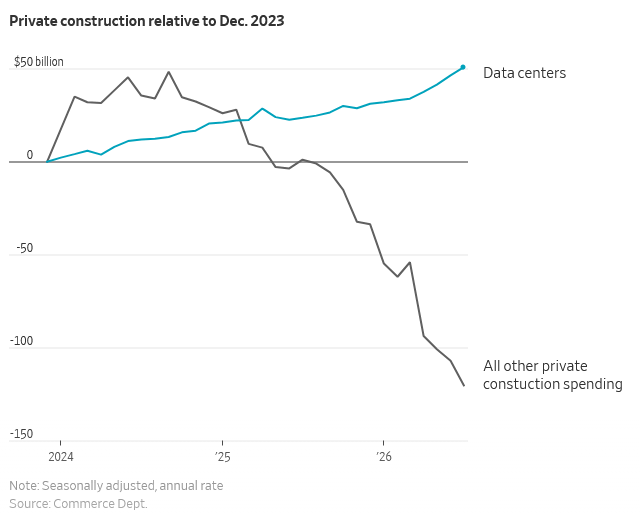
Half of the hole in this chart was dug by factories, not by houses. Private factory building has fallen $62.1bn since December 2023 and $81.3bn — close to a third — from its September 2024 high, which on its own accounts for roughly half of the -$120bn grey line. Housing is the loud story and the smaller one: residential is down $33.2bn against the base. What the falling side and the rising side have in common is nothing at all, and that is the point. Factories are finishing what they started — the plants announced across 2022 and 2023 were poured, framed and completed, and construction spending records the pouring rather than the announcing, so a wave of groundbreakings arrives as a wave of finished buildings two years later and then as silence. Nothing of comparable size queued up behind it, and factory building has not managed two consecutive monthly increases since September 2024. Houses answer to borrowing costs. Data centres answer to a capital cycle indifferent to both. The offsetting line is a filing artefact: the Census Bureau counts data centres inside “office”, which is why office reads +21.3% on the year while conventional office building has shrunk by roughly $15bn since December 2023. Netted, private construction still runs $69.4bn a year below where it began. Two booms crossing is not the same as one boom continuing.
What it means: the headline construction number is not a health check on the industry. Take data centres out and what is left — houses, factories, shops — is shrinking at nearly twice the -3.8% headline rate. That is the market homebuilders and contractors actually sell into. Two straight months of rising factory building would say it has turned; it has not happened since September 2024.
Market Intelligence Brief (MIB) Ver. 19.48
For professional investors only. Not investment advice.
© 2026 RecessionALERT.com

Comments are closed.