
MARKET INTELLIGENCE BRIEF (MIB)
Monday, July 20, 2026
Iran’s IRGC torched two tankers in the Strait of Hormuz and declared it sealed — then Yemen’s Houthis opened a second front, blockading Saudi Arabia’s export lifeline. Gasoline just crossed $4/gallon, landing days before Fed Chair Warsh’s “no tolerance” inflation stance faces its July 28-29 test. A judge blocked Paramount Skydance’s $110B Warner Bros. Discovery deal. AMD surged 5% on a new Azure AI mega-deal; Oracle sank another 4% on data-center cost overruns. Stocks fell a third day, though chips rebounded.
TABLE OF CONTENTS
A. EXECUTIVE SUMMARY
B. MARKET DATA
C. HIGH-IMPACT STORIES (3)
D. MODERATE-IMPACT STORIES (5)
E. ECONOMY WATCH (3)
F. EARNINGS WATCH (0)
G. WHAT’S NEXT
H. CHART OF THE DAY
A. EXECUTIVE SUMMARY -> TOP
US equities fell for a third straight session as the Mideast crisis widened into a second maritime front — Iran’s IRGC set two tankers ablaze in the Strait of Hormuz and declared the waterway “completely closed,” while Yemen’s Houthis separately declared a naval blockade against Saudi Arabia’s primary workaround export route, together threatening to remove the last relief valve keeping oil prices in check. The S&P fell 0.19% and the Dow 0.59%, with the escalation already visible at the pump as national gasoline prices crossed $4/gallon for the first time since June — a direct inflation input arriving days before the Fed’s July 28-29 meeting, where Chair Warsh reiterated the FOMC has “no tolerance” for elevated inflation. The decline was broad rather than narrow: Industrials and Healthcare led losses (the latter reversing a strong one-month run), while a partial rebound in beaten-down chip names (Intel, Micron, Sandisk) left Technology alone roughly flat, masking rather than offsetting the day’s overall risk-off tone.
• Dual chokepoint escalation: Iran’s IRGC set two tankers ablaze in the Strait of Hormuz and declared it “completely closed,” while Yemen’s Houthis separately declared a naval blockade of Saudi Arabia — opening a second maritime front that could remove up to 7% of global oil supply if both hold; Brent +0.87-1.03%, WTI +0.44-0.90%.
• Gasoline crosses $4/gallon for the first time since mid-June, up from $3.872 a week ago — a visible inflation input landing one week before the Fed’s July 28-29 meeting.
• Paramount Skydance/WBD deal blocked: a federal judge issued a 14-day TRO halting the $110B Warner Bros. Discovery acquisition (Paramount Skydance -1.1%, WBD -1.7%); preliminary injunction hearing set for August 3.
• AI infrastructure deals diverge: AMD (+~5%) and Microsoft expanded their Azure AI partnership via a new “Helios” infrastructure deal, while Alphabet (+1.15%) was reported to be developing a Gemini-embedded “Frozen v2” AI chip.
• Deal and IPO activity: Brookfield and CPP Investments agreed to acquire LXP Industrial Trust for $5.2B at a 12.3% premium; Jersey Mike’s filed for a US IPO targeting up to a $7.94B valuation.
• Recession watch: US large-company bankruptcies hit a 16-year high in H1 2026 (372 filings) even as credit spreads stayed calm — a divergence worth watching for signs of contagion.
1. Dual Maritime Chokepoints Raise the Oil-Shock Ceiling — Iran’s tanker attack and the Houthi blockade of Saudi Arabia together threaten both of the Gulf’s primary export routes simultaneously, a scenario the market has not yet fully priced (Brent +0.87-1.03% is a contained move relative to the risk). If Bab el-Mandeb closes fully alongside an already-curtailed Hormuz, the combined supply loss could push oil, and by extension gasoline and headline CPI, meaningfully higher from here.
2. Inflation Risk Is Building Right as the Fed Digs In — Gasoline crossing $4/gallon lands one week before the July 28-29 FOMC, reinforcing Chair Warsh’s “no tolerance” stance on elevated inflation even as the Conference Board’s LEI miss signals softening forward momentum — a stagflationary tension that argues against near-term rate relief regardless of growth wobbles.
3. AI Capex Narrative Splits Along Execution Lines — AMD’s Helios deal with Microsoft (+~5%) and reports of Google’s silicon-embedded “Frozen v2” chip show hyperscaler AI infrastructure spend still accelerating, even as Oracle (-3.98%, 35% YTD decline) and Dell (-3.65%) sell off on data-center cost overruns — the market is now discriminating between AI infrastructure winners and cost-overrun losers rather than trading the theme as one block.
 — Leading economic indicators. Accurate market forecasts. Apply for membership at join.recessionalert.com
B. MARKET DATA -> TOP
US equities closed lower for a third straight session as fresh U.S.-Iran military escalation and a Yemeni “maritime embargo” threat against Saudi crude exports kept risk appetite in check, even as a partial rebound in beaten-down chip names (Intel +2.16%, Micron +2.04%, Sandisk +2.59%) left Technology roughly flat after its worst week in a month. The Dow underperformed the S&P (-0.59% vs -0.19%) as Industrials and Healthcare led sector declines, while AI-capex exposure split the tape sharply: Oracle (-3.98%) extended a 35%-YTD slide on data-center cost overruns, and newly-public SpaceX (-3.33%) fell further after scrubbing a Starship test. Yields rose modestly even as VIX eased, and crude firmed toward $82-89 on the same Mideast supply risk.
CLOSING PRICES – Monday, July 20, 2026:
MAJOR INDICES
Nasdaq’s near-flat close against the Dow’s -0.59% and Russell’s -0.64% marks a tech-specific stabilization, not blue-chip strength — Industrials and Healthcare, not tech, drove the Dow’s underperformance. NYSE Composite’s -0.62% decline tracked the Dow closely, confirming breadth was negative rather than narrow. Over the past 10 sessions, the S&P 500 has outperformed the Nasdaq 100 by 2.4%, now in its 4th consecutive session — a broadening rotation as value/cyclical resilience offsets growth-stock weakness, even as today’s chip bounce complicates the pattern.
| Index | Close | Change | %Move | Why It Moved |
|---|---|---|---|---|
| S&P 500 | 7,443.47 | -14.22 | -0.19% | Broad risk-off tone from renewed Iran-linked Mideast tension offset a partial chip-sector rebound |
| Dow Jones | 51,841.28 | -305.14 | -0.59% | Underperformed on weakness in Industrials and Healthcare components |
| DJ Transportation | 22,458.0 | -265.8 | -1.17% | Tracked broader industrial weakness amid Mideast-linked freight and energy-cost uncertainty |
| Nasdaq | 28,604.24 | +11.58 | +0.04% | Chip rebound (INTC, MU, SNDK) offset AI-capex-linked software/hardware weakness (ORCL, DELL) |
| Russell 2000 | 2,943.28 | -18.94 | -0.64% | Small-caps underperformed amid the broader risk-off tone |
| NYSE Composite | 23,669.66 | -147.31 | -0.62% | Broad-market decline reflecting Mideast-linked risk aversion |
VOLATILITY & TREASURIES
VIX eased 0.48% even as both Treasury yields rose ~4-5bps — an inflation-repricing signature, not a recession scare, since a growth shock would typically pull yields down alongside equities. The curve shift was roughly parallel, so no meaningful steepening or flattening signal. DXY’s modest 0.18% gain suggests mild safe-haven positioning amid Mideast tension, though the muted magnitude implies markets aren’t yet pricing a serious escalation.
| Instrument | Level | Change | Why It Moved |
|---|---|---|---|
| VIX | 18.65 | -0.09 (-0.48%) | Eased despite Iran-linked headlines; options markets not pricing near-term escalation risk |
| 10-Year Treasury Yield | 4.591% | +5.0 bps | Rose on inflation-risk repricing tied to firmer oil prices |
| 2-Year Treasury Yield | 4.211% | +3.9 bps | Tracked the long end higher; roughly parallel curve shift |
| US Dollar Index (DXY) | 100.95 | +0.18 (+0.18%) | Firmed modestly on safe-haven demand amid Mideast tension |
COMMODITIES
Gold and copper diverged from Bitcoin’s gain — gold slipped 0.15% and copper fell 1.33% on soft industrial-demand signals, while Bitcoin’s 1.22% gain tracked the broader risk-asset bounce rather than acting as a safe-haven hedge. Silver’s modest gain broke from gold, suggesting the metals complex isn’t reading today’s headlines as a coordinated flight to safety.
| Asset | Price | Change | %Move | Why It Moved |
|---|---|---|---|---|
| Gold | $4,012.75/oz | -$6.05 | -0.15% | Held roughly flat despite geopolitical tension — a muted safe-haven bid |
| Silver | $56.68/oz | +$0.352 | +0.62% | Edged higher, tracking industrial-metal resilience |
| Copper | $6.34/lb | -$0.0852 | -1.33% | Slipped on demand-growth concerns |
| Platinum | $1,600.75/oz | -$11.75 | -0.73% | Declined in sympathy with broader industrial-metals softness |
| Bitcoin | $65,337 | +$787.0 | +1.22% | Gained modestly, tracking a partial risk-asset rebound |
ENERGY
WTI and Brent moved in lockstep (+0.90%/+1.03%), pointing to a global rather than regional supply-risk premium tied to the Iran-Yemen escalation. Henry Hub’s 2.47% decline confirms domestic natural gas sat out the move entirely, while Dutch TTF’s 1.86% gain shows Europe pricing in the same Mideast risk that US gas ignored — a transatlantic energy-security split. Oil rising alongside a modestly lower equity tape reads as a cost-pressure signal, not demand strength.
| Asset | Price | Change | %Move | Why It Moved |
|---|---|---|---|---|
| Crude Oil (WTI) | $82.52/bbl | +$0.74 | +0.90% | Firmed on fresh U.S.-Iran military escalation and a Yemeni “maritime embargo” threat against Saudi crude exports |
| Crude Oil (Brent) | $89.01/bbl | +$0.91 | +1.03% | Tracked WTI higher on the same Mideast supply-risk premium |
| Natural Gas (Henry Hub) | $2.84/MMBtu | -$0.072 | -2.47% | Declined on ample domestic supply, decoupled from the crude-driven geopolitical premium |
| Natural Gas (Dutch TTF) | $19.60/MMBtu | +$0.36 | +1.86% | Rose on European supply-risk pricing tied to the same Mideast tensions |
S&P 500 SECTORS
Healthcare’s reversal is the standout: the best 1-month performer (+5.58%) is today’s and this week’s biggest laggard (-1.42% / -1.50%), a sharp mean-reversion after a strong run. Technology’s near-flat session, after a -2.03% week, aligns with the chip-sector bounce — stabilization, not a new leadership signal, since 1-month Technology remains negative (-3.77%) despite a 9.55% 3-month gain.
| Sector | 1-Day | 1-Week | 1-Month | 3-Month | 6-Month | YTD | 12-Month |
|---|---|---|---|---|---|---|---|
| Communication Services | +0.92% | -0.45% | -0.56% | -1.67% | +1.55% | +3.43% | +31.58% |
| Energy | +0.16% | +1.68% | +5.47% | +2.49% | +21.92% | +28.33% | +33.63% |
| Technology | +0.05% | -2.03% | -3.77% | +9.55% | +15.51% | +16.66% | +26.40% |
| Consumer Cyclical | -0.26% | -0.53% | +1.16% | -4.55% | -7.46% | -4.56% | +2.45% |
| Utilities | -0.51% | -1.54% | +1.14% | -4.40% | +2.72% | +5.22% | +11.87% |
| Consumer Defensive | -0.55% | +0.16% | +0.81% | +0.07% | +2.19% | +7.64% | +5.68% |
| Real Estate | -0.65% | +1.57% | +4.45% | +2.79% | +8.08% | +12.09% | +10.06% |
| Basic Materials | -0.73% | -1.96% | -9.59% | -12.85% | -6.16% | +4.57% | +26.32% |
| Financial | -0.74% | -0.33% | +3.22% | +6.38% | +4.39% | +5.19% | +13.00% |
| Industrials | -1.15% | -2.82% | -7.91% | -2.79% | +2.38% | +11.06% | +14.49% |
| Healthcare | -1.42% | -1.50% | +5.58% | +5.07% | +1.42% | +3.39% | +20.57% |
TOP MEGA-CAP MOVERS:
GAINERS
| Company | Ticker | Close | Change | Why It Moved |
|---|---|---|---|---|
| Sandisk Corp | SNDK | $1,389.93 | +2.59% | Rebounded with the broader memory/chip complex after a recent rout |
| Microsoft Corp | MSFT | $402.53 | +2.21% | Bounced off depressed 2026 lows ahead of July 29 fiscal Q4 earnings |
| Intel Corp | INTC | $97.10 | +2.16% | Led the chip-sector rebound after a multi-week slide |
| Micron Technology Inc | MU | $866.29 | +2.04% | Gained with the memory-chip recovery |
| GE Vernova Inc | GEV | $1,079.18 | +2.02% | Rallied ahead of Wednesday’s Q2 earnings; options price an outsized post-report swing |
DECLINERS
| Company | Ticker | Close | Change | Why It Moved |
|---|---|---|---|---|
| Oracle Corp | ORCL | $121.38 | -3.98% | Extended a 35%-YTD slide on AI data-center cost overruns, permitting delays, and securities litigation risk |
| Dell Technologies Inc | DELL | $381.88 | -3.65% | Fell with a broader AI-hardware valuation pullback despite strong 2026 returns |
| Space Exploration Technologies Corp | SPCX | $119.86 | -3.33% | Extended its post-IPO slide after scrubbing a Starship test flight, ~45% off its June peak |
| Tesla Inc | TSLA | $369.57 | -2.96% | Slipped ahead of Wednesday’s Q2 report amid mixed analyst signals, including a still-bearish Wells Fargo target revision |
| Palo Alto Networks Inc | PANW | $348.66 | -2.79% | Pulled back on valuation concerns just days after notching an all-time high |
— Institutional-grade intelligence for serious investors. Apply for membership at join.recessionalert.comC. HIGH-IMPACT STORIES -> TOP
UNCERTAIN
1. Houthis Declare Naval Blockade of Saudi Arabia, Opening Second Maritime Front Alongside Hormuz
The core facts:Yemen’s Houthi movement declared an immediate maritime embargo against Saudi Arabia Monday, with military spokesperson Yahya Saree describing it as an “eye for an eye” response to a Saudi blockade of Yemen and a strike on Sanaa International Airport that reportedly targeted a flight carrying Houthi leaders returning from Ayatollah Khamenei’s funeral in Iran. A full closure of the Bab el-Mandeb strait would halt Saudi oil exports to Asia and could cut global oil supply by up to 7% — a critical relief valve, since Saudi Arabia has been diverting crude through a Red Sea pipeline terminal to bypass the already-disrupted Strait of Hormuz. Brent settled +0.87% at $88.87/bbl and WTI +0.44% at $82.85/bbl.
Why it matters:With Hormuz transit already severely curtailed, a second chokepoint threat aimed at Saudi Arabia’s primary workaround route would remove the last significant relief valve keeping oil prices in check — a risk the market has not yet fully priced given today’s relatively contained oil move. The declaration also draws Saudi Arabia directly into hostilities it had largely avoided, widening the conflict’s scope and raising the stakes for any further US escalation.
What to watch:Whether Saudi Arabia responds militarily or diplomatically, and whether Bab el-Mandeb transit data shows an actual disruption to Saudi Red Sea exports in the coming days.
BEARISH
2. Iran’s Revolutionary Guard Sets Tankers Ablaze in Strait of Hormuz, Declares Waterway “Completely Closed”
The core facts:Iran’s IRGC targeted two tankers attempting to transit the southern route of the Strait of Hormuz off the coast of Oman early Saturday, with UK Maritime Trade Operations confirming a vessel fire near Kumzar; Iranian state media said the tankers caught fire after striking naval mines. The IRGC described the waterway as “now highly unsafe and completely closed.” The incident came amid what has stretched into more than a week of nightly US airstrikes against Iranian military targets.
Why it matters:This is the most direct attack yet on tanker traffic itself, rather than a threat or rhetorical blockade — a physical interdiction of vessels in the world’s most important oil chokepoint, which carries roughly a fifth of global oil consumption. With confirmed Hormuz transit already down sharply from pre-crisis levels, an actual attack on vessels raises the odds that shipping insurers and operators begin rerouting or suspending transits altogether — a materially larger and more persistent supply shock than current pricing reflects.
What to watch:Whether major tanker operators or insurers publicly suspend Hormuz transits, and next week’s EIA/API inventory data for early evidence of physical supply disruption.
BEARISH
3. Federal Judge Temporarily Blocks Paramount Skydance’s $110 Billion Warner Bros. Discovery Acquisition
The core facts:US District Judge Araceli Martínez-Olguín issued a 14-day temporary restraining order Monday barring Paramount Skydance from closing its $110 billion acquisition of Warner Bros. Discovery, siding with a 12-state coalition led by California AG Rob Bonta that sued July 13 alleging the deal would violate Section 7 of the Clayton Antitrust Act by uniting two of Hollywood’s five remaining major studios. A hearing on the states’ request for a preliminary injunction is scheduled for August 3. Paramount Skydance shares fell 1.1% and Warner Bros. Discovery fell 1.7% on the news.
Why it matters:A state-coalition antitrust challenge succeeding at the TRO stage is a meaningful setback for one of the largest media mergers ever attempted, and signals state attorneys general are willing to act as an independent check on consolidation even where federal enforcement might otherwise defer — a dynamic that could complicate other pending or contemplated media/tech mergers. The 14-day pause itself is a modest near-term cost, but the August 3 preliminary-injunction hearing is now the real event risk for deal completion.
What to watch:The August 3 preliminary injunction hearing, and whether Paramount Skydance offers asset-divestiture concessions to address the states’ competition concerns.
— Quantifying recession risk so you don’t have to guess. Apply for membership at join.recessionalert.comD. MODERATE-IMPACT STORIES -> TOP
BEARISH
4. Retail Gasoline Prices Cross $4/Gallon as Middle East Oil Rally Reaches Consumers
The core facts:The national average price for a gallon of regular gasoline rose to $4.003 Monday per AAA data, crossing the $4 threshold for the first time since mid-June and up from $3.872 a week earlier. The increase follows a roughly 16% surge in crude prices over the past week tied to Iranian attacks on Hormuz shipping, more than a week of continuous US airstrikes on Iran, and Iranian missile strikes on US-allied Gulf states including Kuwait, Jordan, and Bahrain. Prices remain well above the year-ago level of $3.141/gallon.
Why it matters:A return to $4 gasoline is a direct, highly visible cost-of-living increase that feeds straight into headline CPI and consumer sentiment just as the Fed weighs its July 28-29 decision — reinforcing the inflation-risk argument from the hawkish wing of the FOMC. Unlike tariff-driven core-goods pass-through, gasoline price increases are immediately visible to consumers and have historically moved inflation expectations quickly.
What to watch:Weekly AAA national-average readings for confirmation the increase is sustained rather than a one-day spike, and July CPI (due next month) for energy-driven upside surprise.
BULLISH
5. Brookfield and CPP Investments to Acquire LXP Industrial Trust for $5.2 Billion
The core facts:Brookfield Asset Management and Canada Pension Plan Investment Board announced Monday a definitive agreement to acquire LXP Industrial Trust in an all-cash transaction valued at approximately $5.2 billion including debt, with LXP shareholders receiving $61.20 per share — a 12.3% premium to the 30-day volume-weighted average price. LXP owns roughly 53 million square feet of warehouse and logistics space across 108 properties concentrated in Sunbelt and Midwest industrial markets. The deal carries unanimous board approval, includes a 40-day go-shop period ending August 28, and is expected to close in Q4 2026.
Why it matters:A top-tier institutional buyer group paying a double-digit premium for a pure-play industrial REIT signals continued confidence in warehouse/logistics fundamentals even as e-commerce growth normalizes and rate uncertainty persists — a read-through for industrial REIT valuations broadly. The go-shop provision leaves open a competing bid, which could pressure Brookfield to raise terms.
What to watch:Whether the 40-day go-shop period surfaces a competing offer before August 28, and read-through for peer industrial REIT valuations.
BULLISH
6. Google Reportedly Developing “Frozen v2” AI Chip That Bakes Gemini Directly Into Silicon
The core facts:Bloomberg reported Monday that Google is developing a next-generation AI chip, internally known as “Frozen v2,” that embeds its Gemini model architecture directly into the chip circuitry rather than relying on general-purpose GPU/TPU designs — an approach intended to cut computational overhead and deliver 6-10x greater power efficiency per token than Google’s current TPUs. Google has not confirmed the project, and per the report the chip remains years from deployment (as soon as 2028). Alphabet shares rose 1.15% on the report.
Why it matters:A workload-specific AI chip that outperforms general-purpose accelerators by an order of magnitude on efficiency would meaningfully reduce Google’s dependence on third-party GPU suppliers and lower its long-run AI infrastructure cost curve — a negative read-through for merchant GPU/accelerator vendors if the approach proves out and is replicated by other hyperscalers already pursuing custom silicon.
What to watch:Any official Google confirmation of the Frozen v2 project, and Nvidia or Broadcom commentary on hyperscaler custom-silicon competitive risk on upcoming earnings calls.
BULLISH
7. AMD and Microsoft Expand Azure AI Partnership With New “Helios” Infrastructure Deal
The core facts:AMD and Microsoft announced Monday an expanded strategic partnership under which Microsoft will deploy AMD’s new Helios Rackscale platform — combining AMD’s Instinct MI455X GPUs, sixth-generation EPYC “Venice” CPUs, Pensando networking, and ROCm software — to power Azure AI inference and training capacity, with Microsoft also adding two new AMD EPYC-powered VM series. Helios system shipments to customers are set to begin in the second half of 2026. AMD shares rose approximately 5% on the announcement.
Why it matters:A large-scale, multi-generation infrastructure commitment from one of the three major hyperscalers is a concrete validation of AMD’s AI accelerator roadmap against Nvidia’s continued dominance of the training/inference market, and provides visibility into AMD’s data-center revenue ramp through the Helios shipment window in the back half of 2026.
What to watch:Specific capacity/dollar commitments disclosed on AMD’s upcoming earnings call, and whether other hyperscalers announce comparable AMD deployments.
BULLISH
8. Jersey Mike’s Targets $7.94 Billion Valuation in US IPO
The core facts:Jersey Mike’s Subs filed Monday to raise up to $1.09 billion by offering 43.5 million shares priced between $21 and $25, targeting a valuation of up to $7.94 billion in its planned NYSE listing under ticker “JMKE.” The offering is expected to price and debut in the coming weeks.
Why it matters:A billion-dollar-plus IPO from a profitable, well-known consumer brand signals continued receptivity in the new-issue window even amid this week’s broader risk-off tone, following a string of 2026 mega-IPOs — a datapoint for whether the pipeline stays open through a period of Middle East-driven volatility.
What to watch:Final pricing and first-day trading performance once JMKE debuts, as a read on investor appetite for consumer-sector new issues.
— Separating signal from noise since 2007. Apply for membership at join.recessionalert.comE. ECONOMY WATCH -> TOP
Monday’s calendar was largely bare, but three threads underscored the tension between soft-landing optimism and building stress. The Conference Board’s Leading Economic Index slipped 0.2% in June, missing estimates and reversing May’s gain, even as its coincident measure improved and the Board raised its 2026 GDP forecast to 1.9% — a split verdict on the cycle. Corporate bankruptcies hit a 16-year high in H1 2026, yet credit spreads have barely moved. Fed Chair Warsh reiterated the Fed has “no tolerance” for elevated inflation ahead of the July 28-29 meeting, keeping a hold-with-hawkish-bias stance intact.
Conference Board’s Leading Economic Index Falls 0.2% in June, Missing Estimates as Weak Permits and Consumer Expectations Offset Financial Gains (The Conference Board, July 18, 2026)
What they’re saying:The Conference Board’s Leading Economic Index (LEI) fell 0.2% in June to 99.1, missing the -0.1% consensus estimate and partially reversing May’s 0.1% gain. Weak consumer expectations and a drop in building permits drove the decline, only partly offset by a positive contribution from the yield spread and other financial components.
The context:The miss is a soft signal on forward momentum, but it comes alongside resilience elsewhere: the Conference Board’s Coincident Economic Index rose 0.2% for a second straight month as employment, income, industrial production, and sales all improved, and the Board actually raised its 2026 GDP growth forecast to 1.9% from 1.8%, citing AI-related business investment offsetting softer consumer and housing activity.
What to watch:The July LEI release (due mid-August) for confirmation of the trend, and building permits data in upcoming housing releases.
Fed Chair Warsh Reiterates “No Tolerance” for Elevated Inflation, Calls Cooling Expectations “Not Good Enough” (Bloomberg, July 18, 2026)
What they’re saying:Fed Chair Kevin Warsh said the central bank has “no tolerance for persistently elevated inflation” and that recent easing in inflation expectations is “not good enough,” reiterating he does not view 2% as a ceiling the Fed can tolerate slipping above.
The context:The comments elaborate on Warsh’s July 14-15 congressional testimony, his first as chair, and reinforce the market’s expectation that the Fed holds rates steady at the July 28-29 meeting while preserving optionality to tighten further if inflation proves sticky.
What to watch:FOMC meeting, July 28-29 — no Summary of Economic Projections at this meeting, but watch the statement language and any dissents.
US Corporate Bankruptcies Hit 16-Year High in First Half of 2026 as Bond Markets Stay Calm (S&P Global, July 20, 2026)
What they’re saying:Large-company Chapter 11 filings reached 372 in H1 2026, the highest first-half total in 16 years and the fourth straight annual increase, per S&P Global. Industrial companies led with 50 filings, followed by consumer discretionary (35) and healthcare (26); small-business filings jumped 50% year-over-year to 1,663.
The context:Despite the record pace of corporate distress, credit spreads and bond markets have stayed calm — a divergence from prior bankruptcy waves, when rising filings typically coincided with spread widening. That gap suggests investors are treating the distress as idiosyncratic and sector-specific rather than a systemic credit event, for now.
What to watch:High-yield credit spreads for signs of contagion; Q3 filing pace, particularly in industrials and consumer discretionary.
— Know the probability before the market prices in the risk. Apply for membership at join.recessionalert.comF. EARNINGS WATCH -> TOP
YESTERDAY AFTER THE BELL (Markets Reacted Today)
No major earnings yesterday after the bell from companies with >$100B market cap.
TODAY BEFORE THE BELL (Markets Already Reacted)
No major earnings before the bell from companies with >$100B market cap.
TODAY AFTER THE BELL (Markets React Tomorrow)
No major earnings after the bell from companies with >$100B market cap.
WEEK AHEAD PREVIEW:
Q2 2026 earnings season is just getting underway (~10% reported), with the pace accelerating sharply this week as 86 S&P 500 companies — including 4 Dow 30 components — are scheduled to report, headlined by Tesla and Alphabet Wednesday.
Charles Schwab (SCHW) — BMO, Tue Jul 21 — consensus EPS $1.56. Key focus: net interest margin trajectory and client cash sorting trends, with this week’s Fed rate-hike repricing sharpening scrutiny on NII guidance.
Danaher (DHR) — BMO, Tue Jul 21 — consensus EPS $1.84. Key focus: bioprocessing and life-sciences instrument order recovery, including China demand trends.
Capital One Financial (COF) — AMC, Tue Jul 21 — consensus EPS $4.69. Key focus: consumer credit quality and Discover integration synergies, key inputs to card-loan growth guidance.
Following Tuesday’s financials-heavy slate, Tesla and Alphabet headline Wednesday’s mega-cap reporters, with ServiceNow, IBM, AT&T, Verizon, Lockheed Martin, and RTX also on deck this week.
— US market commentary trusted by family offices and institutions. Apply for membership at join.recessionalert.comG. WHAT’S NEXT -> TOP
UPCOMING RELEASES:
| Date | Event | Why It Matters |
|---|---|---|
| Tue, Jul 21 | ADP Employment Change, Weekly (prior 19.75K) | Early read on labor-market momentum ahead of Thursday’s jobless claims, feeding into the Fed’s growth-vs-inflation calculus before the July 28-29 FOMC |
| Tue, Jul 21 | API Crude Oil Stock Change (prior -0.056M) | First read on US crude inventories amid the Hormuz/Saudi supply-shock backdrop; a larger-than-expected draw would reinforce the physical-disruption narrative |
| Wed, Jul 22 | 20-Year Bond Auction (prior yield 4.927%) | Gauges demand for long-duration Treasury debt amid yields rising on inflation-risk repricing tied to the oil-driven price shock |
| Thu, Jul 23 | Chicago Fed National Activity Index (prior -0.10) | Broad monthly activity read that signals whether the Conference Board’s June LEI softness is broadening across the economy |
| Thu, Jul 23 | Initial Jobless Claims (prior 208K) | Weekly labor-market pulse check ahead of the FOMC meeting; a durable rise would strengthen the case for easing despite Warsh’s hawkish rhetoric |
| Thu, Jul 23 | Continuing Jobless Claims (prior 1,805K) | Tracks how quickly the unemployed are finding work; a rising trend would signal a cooling labor market |
| Fri, Jul 24 | Building Permits, Final (expected 1.367M) | Final permits read follows the weak preliminary print that dragged down June’s LEI; confirms whether housing activity is stabilizing or deteriorating further |
| Fri, Jul 24 | New Home Sales (expected 0.61M) | Direct read on housing demand amid elevated mortgage rates and now-rising input costs from the energy-price shock |
KEY QUESTIONS:
1. Will the Houthi blockade of Saudi Arabia and the Hormuz tanker attack translate into an actual physical drop in oil supply, or will diplomatic or military de-escalation contain the disruption before it reaches consumers?
2. With gasoline above $4/gallon and Chair Warsh insisting on “no tolerance” for inflation, does the Fed hold firm at the July 28-29 meeting even as the Conference Board’s LEI signals softening growth momentum?
3. Does the federal court’s TRO on Paramount Skydance’s Warner Bros. Discovery deal foreshadow a broader state-level check on media/tech consolidation ahead of the August 3 injunction hearing?
— US market commentary trusted by family offices and institutions. Apply for membership at join.recessionalert.comH. CHART OF THE DAY -> TOP
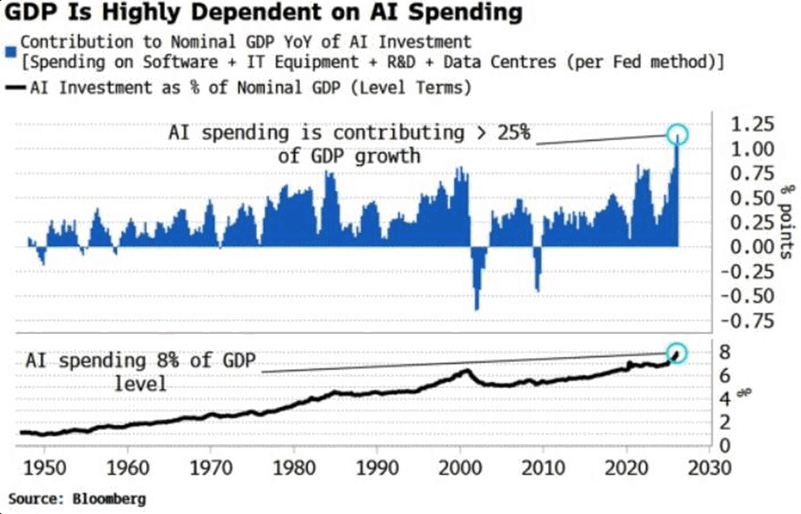
A contribution to growth is a first difference, not a level — so AI capex does not have to fall for this line to collapse. It only has to stop rising. Big-four hyperscaler capex goes from roughly $410bn in 2025 to about $725bn guided for 2026, up 77%. Merely holding today’s 1.1pp contribution through next year demands another increment of that size, layered onto a base already 77% larger. Flat spending at an all-time record — no bust, no writedowns, no glut — mechanically subtracts that contribution from nominal growth. The level stays at 8% of GDP, a record; the impulse goes to zero. That is how both deep negative prints in this seventy-five-year history were manufactured, each following the prior peak in the level below. Nothing broke in 2001 either; the second derivative simply turned, and the recession that followed was a capex event with an employed consumer watching it happen. The uncomfortable part is concentration: that 8% is producing more than a quarter of the growth. The marginal US growth print is now set inside a handful of board meetings, by executives optimising for competitive position rather than macro stability — and no rate path pre-empts a budget that is simply not renewed. Watch guidance revisions and interconnect queues, not bankruptcies. The danger was never that the boom ends — only that it steadies.
Market Intelligence Brief (MIB) Ver. 18.43
For professional investors only. Not investment advice.
© 2026 RecessionALERT.com

Comments are closed.