
MARKET INTELLIGENCE BRIEF (MIB)
Tuesday, July 21, 2026
Memory chips ignite a broad market rally — Micron +12%, SanDisk +14% — pushing the Nasdaq 1.93% higher on 9-of-11 green sectors. But the backdrop turned hostile: Fed officials’ hawkish pre-blackout chorus erased 2026 rate-cut odds to zero and priced in 47% hike odds ahead of next week’s FOMC. Oil jumped to a five-week high on a tanker strike near the Strait of Hormuz. Trump also slapped 50% tariffs on Canada, with a global tariff overhaul looming as Friday’s stopgap expires.
TABLE OF CONTENTS
A. EXECUTIVE SUMMARY
B. MARKET DATA
C. HIGH-IMPACT STORIES (5)
D. MODERATE-IMPACT STORIES (4)
E. ECONOMY WATCH (2)
F. EARNINGS WATCH (4)
G. WHAT’S NEXT
H. CHART OF THE DAY
A. EXECUTIVE SUMMARY -> TOP
Equities rallied broadly Tuesday even as the macro backdrop turned more hostile: a fresh tanker strike near the Strait of Hormuz pushed oil to a five-week high, Trump imposed fresh 50% tariffs on Canada under rarely-used Section 338 authority, and hawkish pre-blackout Fed commentary drove 2026 rate-cut odds to zero with hike odds near 47% — yet stocks rallied anyway. The disconnect suggests investors are treating the memory-chip demand story as durable enough to look through near-term policy and geopolitical risk, at least for now, though gold’s simultaneous rise alongside a collapsing VIX signals hedging rather than complacency. This is a market pricing rate risk and trade risk separately from AI-cycle conviction — a distinction that could prove fragile heading into next week’s FOMC and Friday’s tariff deadline. Breadth was genuine, however: nine of eleven sectors advanced, with technology and basic materials — last month’s two worst performers — leading the reversal, while Communication Services and Consumer Defensive lagged as capital rotated into cyclicals.
• S&P 500 +0.89% (7,509.21), Nasdaq +1.93% (29,155.18), Dow +0.74% (52,224.64) — Micron (MU) +12.2% and SanDisk (SNDK) +14.3% led a memory-chip-driven rally with 9 of 11 sectors closing green.
• Oil surged to a five-week high — WTI +1.22% ($85.37), Brent near $91-92 — after a fresh tanker strike near the Strait of Hormuz extended the US-Iran conflict; the national gasoline average crossed $4/gallon Monday.
• Trump signed 50% Section 338 tariffs on Canadian goods (effective Aug 19) with no USMCA carve-out, while USTR previewed a new global tariff regime covering ~99% of trade as the 10% stopgap levy expires Friday.
• 2026 Fed rate-cut odds have collapsed to zero, with ~47% odds now priced for a hike, after hawkish pre-blackout remarks from Cleveland’s Hammack, Dallas’s Logan, and Vice Chair Jefferson; the 10-Year yield sits at a two-month high of 4.631%.
• Nvidia disclosed a 9.3% stake in Nebius Group (NBIS) worth nearly $5B; shares jumped as much as 17%. AMD (+8.1%) extended Monday’s Microsoft AI-partnership gains.
• ADP weekly data show private payroll growth slowing to just 16,500/week — the fourth straight week of deceleration — while API reported a surprise 2.6M-barrel crude build, snapping a 13-week drawdown streak.
1. Rate Risk Is Being Repriced Faster Than Trade or Geopolitical Risk — Markets have erased 2026 rate-cut expectations entirely and now price near-coinflip odds of a hike, even as oil spikes on Hormuz tanker strikes and tariff escalation adds a second inflationary vector. The Fed’s hawkish pre-blackout chorus suggests officials are validating this repricing rather than pushing back on it, raising the bar for next week’s FOMC to deliver a dovish surprise.
2. Trade Policy Is Entering a More Aggressive, Less Predictable Phase — Section 338’s first invocation in decades against Canada, layered on top of Friday’s deadline for a ~99%-of-trade tariff regime, signals Washington is moving from targeted actions to broad-based leverage. The absence of a USMCA carve-out specifically undercuts the assumption that existing trade pacts insulate North American supply chains from further escalation.
3. The AI Hardware Trade Is Broadening, Not Just Rotating — Today’s rally wasn’t merely money moving from software to hardware: Micron, SanDisk, and the broader semiconductor complex surged on a genuine demand signal corroborated by South Korean export data, while Nvidia’s Nebius stake and the Oklo/X-Energy nuclear-for-AI initiative both point to continued capital deployment across the AI supply chain, even as high-multiple AI software names like Palantir and Palo Alto Networks continue to lag.
 — Leading economic indicators. Accurate market forecasts. Apply for membership at join.recessionalert.com
B. MARKET DATA -> TOP
Wall Street rallied broadly as a memory-chip surge — Micron +12%, SanDisk +14% — powered the Nasdaq 100 to a 1.93% gain after Morgan Stanley flagged rising memory prices and strong AI-linked South Korean export data; nine of eleven S&P sectors finished green. Basic Materials joined Technology atop the leaderboard, reversing recent monthly weakness, while Communication Services and Consumer Defensive were the lone laggards as capital rotated out of defensives. Gold pushed to $4,118 (+1.03%) even as the VIX collapsed 8.6% — a rare pairing pointing to pre-Fed-meeting positioning rather than fear. High-multiple AI software names (Palantir, Palo Alto Networks) continued to lag the hardware-led rotation.
CLOSING PRICES – Tuesday, July 21, 2026:
MAJOR INDICES
The Nasdaq 100’s 1.93% surge dwarfed the Dow’s 0.74% gain, but NYSE Composite breadth (+0.93%) confirms this wasn’t a narrow mega-cap rally — money moved broadly into cyclicals and hardware, not just headline tech names. Dow Theory bull confirmation emerges today: both the DJIA and DJ Transportation Average closed within 2% of their 10-session highs, the first such alignment this cycle, adding technical confirmation to the risk-on tone.
| Index | Close | Change | %Move | Why It Moved |
|---|---|---|---|---|
| S&P 500 | 7,509.21 | +65.93 | +0.89% | Memory-chip rally led broad risk-on gains ahead of next week’s Fed meeting |
| Dow Jones | 52,224.64 | +385.38 | +0.74% | Blue-chips lagged tech but still advanced on the broad chip-led risk-on tone |
| DJ Transportation | 22,667.4 | +209.6 | +0.93% | Tracked the broad rally, confirming a Dow Theory bull signal alongside the DJIA |
| Nasdaq | 29,155.18 | +550.94 | +1.93% | Memory-chip surge (Micron +12%, SanDisk +14%) powered the tech-heavy index |
| Russell 2000 | 2,984.41 | +41.98 | +1.43% | Small-caps participated broadly in the day’s risk-on rally |
| NYSE Composite | 23,890.19 | +220.53 | +0.93% | Breadth-weighted gauge confirms the rally extended well beyond mega-cap tech |
VOLATILITY & TREASURIES
VIX’s 8.6% plunge came with Treasury yields essentially unchanged (10Y +0.3bps, 2Y flat) — a pure vol-compression event, not a growth or inflation repricing; bonds are neither confirming nor fighting the equity rally. DXY’s marginal 0.03% dip suggests the dollar sat out the move entirely.
| Instrument | Level | Change | Why It Moved |
|---|---|---|---|
| VIX | 17.05 | -1.60 (-8.58%) | Vol collapsed as risk appetite returned on the chip-led rally |
| 10-Year Treasury Yield | 4.631% | +0.3 bps | Essentially unchanged — the bond market sat out the equity rally |
| 2-Year Treasury Yield | 4.261% | 0.0 bps | Unchanged — no shift in near-term rate expectations ahead of next week’s Fed meeting |
| US Dollar Index (DXY) | 101.14 | -0.04 (-0.03%) | Little-changed, sidelined by the day’s equity-led move |
COMMODITIES
Precious metals moved as one: Gold (+1.03%), Silver (+1.70%) and Platinum (+1.72%) all firmed together ahead of next week’s Fed meeting, while Copper’s muted +0.28% shows industrial metals lagging the precious-metals bid. Bitcoin’s 1.77% gain tracked equities, confirming broad risk-on rather than a crypto-specific catalyst.
| Asset | Price | Change | %Move | Why It Moved |
|---|---|---|---|---|
| Gold | $4,118.45/oz | $42.05 | +1.03% | Firmed ahead of next week’s Fed meeting |
| Silver | $60.115/oz | $1.007 | +1.70% | Tracked gold’s advance, slightly outpacing it |
| Copper | $6.5488/lb | $0.0183 | +0.28% | Industrial metal lagged the precious-metals bid |
| Platinum | $1,664.85/oz | $28.15 | +1.72% | Firmed alongside the broader precious-metals complex |
| Bitcoin | $66,435.0 | $1,154.0 | +1.77% | Tracked the equity risk-on move |
ENERGY
Oil rose alongside equities — WTI +1.22%, Brent +0.86% — a demand/growth read rather than a supply-shock, cost-push signal. Natural gas sat out entirely (Henry Hub +0.24%, Dutch TTF roughly flat), confirming the day’s energy move was a broad risk-on tailwind for crude, not a gas-specific or European supply story.
| Asset | Price | Change | %Move | Why It Moved |
|---|---|---|---|---|
| Crude Oil (WTI) | $85.37/bbl | $1.03 | +1.22% | Rose alongside equities in a demand/growth read, not a supply shock |
| Crude Oil (Brent) | $92.26/bbl | $0.79 | +0.86% | Tracked WTI higher; spread little-changed |
| Natural Gas (Henry Hub) | $2.901/MMBtu | $0.007 | +0.24% | Sat out the crude rally |
| Natural Gas (Dutch TTF) | $19.58/MMBtu | $0.01 | +0.07% | European gas benchmark also decoupled from oil’s move |
S&P 500 SECTORS
Nine of eleven sectors closed green — a genuine macro flush, not rotation — with Communication Services and Consumer Defensive the lone holdouts as capital left defensives. Today’s top two gainers, Technology and Basic Materials, were also the past month’s two worst performers (-3.81%, -6.54%), a sharp reversal of recent laggards rather than a continuation of any existing trend.
| Sector | 1-Day | 1-Week | 1-Month | 3-Month | 6-Month | YTD | 12-Month |
|---|---|---|---|---|---|---|---|
| Technology | +2.94% | -0.99% | -3.81% | +12.57% | +18.73% | +20.09% | +30.46% |
| Basic Materials | +2.24% | -1.23% | -6.54% | -10.81% | -3.47% | +6.90% | +28.97% |
| Energy | +1.31% | +2.62% | +8.34% | +3.38% | +22.74% | +30.01% | +35.94% |
| Industrials | +1.06% | -1.82% | -7.25% | -2.13% | +2.80% | +12.24% | +16.05% |
| Healthcare | +0.99% | +1.12% | +7.30% | +7.00% | +2.88% | +4.32% | +22.52% |
| Financial | +0.61% | -0.17% | +4.22% | +7.01% | +4.81% | +5.83% | +13.84% |
| Real Estate | +0.08% | +1.82% | +4.54% | +2.63% | +6.90% | +12.18% | +9.86% |
| Utilities | +0.05% | -1.61% | +0.73% | -3.85% | +3.21% | +5.27% | +10.28% |
| Consumer Cyclical | +0.03% | -0.48% | -0.37% | -4.03% | -6.96% | -4.54% | +1.56% |
| Communication Services | -0.95% | -2.54% | -2.50% | -1.50% | +1.39% | +2.45% | +30.40% |
| Consumer Defensive | -0.96% | +0.36% | +0.30% | -0.67% | +1.22% | +6.61% | +4.99% |
TOP MEGA-CAP MOVERS:
GAINERS
| Company | Ticker | Close | Change | Why It Moved |
|---|---|---|---|---|
| Sandisk Corp | SNDK | $1,589.40 | +14.27% | Soared as Morgan Stanley flagged rising memory chip prices amid AI-driven demand |
| Micron Technology Inc | MU | $970.82 | +12.17% | Jumped as strong South Korea AI-linked export data and rising memory prices fueled a memory-chip rally |
| Intel Corp | INTC | $105.45 | +8.64% | Rallied with the broader semiconductor complex (SOXX +5.2%) on AI-demand optimism |
| Advanced Micro Devices Inc | AMD | $544.43 | +8.11% | Extended Monday’s gains following its AI partnership deal with Microsoft, plus broad chip-sector strength |
| Applied Materials Inc | AMAT | $564.55 | +7.39% | Gained alongside chip-equipment peers as the semiconductor rally broadened |
DECLINERS
| Company | Ticker | Close | Change | Why It Moved |
|---|---|---|---|---|
| T-Mobile US Inc | TMUS | $190.77 | -2.49% | Slipped as capital rotated out of defensive/telecom names into the day’s chip-led rally |
| Philip Morris International Inc | PM | $188.04 | -2.43% | Declined with Consumer Defensive, the session’s weakest sector, as risk appetite favored cyclicals |
| Palo Alto Networks Inc | PANW | $342.15 | -1.87% | Extended a pullback as high-multiple AI software names see valuation-driven profit-taking |
| Mastercard Incorporated | MA | $538.30 | -1.67% | Pulled back amid the day’s rotation into hardware/semiconductors; no company-specific catalyst identified |
| Palantir Technologies Inc | PLTR | $132.66 | -1.62% | Continued a broader 2026 AI-software repricing as capital favors semiconductor hardware |
— Institutional-grade intelligence for serious investors. Apply for membership at join.recessionalert.comC. HIGH-IMPACT STORIES -> TOP
UNCERTAIN
1. Fed Rate Expectations Reprice Sharply as Markets Price Out Cuts, Price In Possible 2026 Hike
The core facts:CME FedWatch data Tuesday showed roughly 83.4% odds of a hold at the Fed’s 3.50%-3.75% target range at next week’s July 28-29 FOMC meeting, but traders now assign roughly 47% odds to an outright rate hike sometime in 2026, with rate-cut expectations for the year having collapsed to zero. The repricing follows a hawkish pre-blackout chorus from Fed officials — Cleveland’s Hammack, Dallas’s Logan, and Vice Chair Jefferson all struck a hawkish tone in remarks ahead of the communications blackout — and a three-year-high May CPI print of +4.2% y/y. Futures now imply a policy path toward roughly 3.8% by October and near 4% by year-end.
Why it matters:A market that has fully abandoned rate-cut expectations and now assigns nearly even odds to a 2026 hike marks a material shift from the policy outlook portfolio managers had been positioned against for much of the year — raising the cost-of-capital assumption embedded in equity valuations and extending the 10-year Treasury yield’s climb to a two-month high of 4.64%. The timing compounds an already fragile setup, with energy-driven inflation risk from the Middle East crisis reinforcing the hawkish case just as the Fed goes silent ahead of next week’s decision.
What to watch:Next week’s July 28-29 FOMC statement and press conference for confirmation of the hold, and any signal on the odds of a 2026 hike.
BEARISH
2. Fresh Tanker Strike Near Strait of Hormuz Pushes Oil to Five-Week High as Mideast Conflict Grinds On
The core facts:A tanker carrying oil products was struck near the Strait of Hormuz Tuesday, UK Maritime Trade Operations and multiple outlets confirmed, extending more than a week of hostilities between the US/Israel and Iran that have included nightly US airstrikes and Iranian retaliation across the Gulf. Brent crude settled near $91.01/bbl (+2%) and WTI near $84.51-$84.91/bbl (+2%), both the highest closes since mid-June, extending gains for a third consecutive session. The incident follows Monday’s Houthi declaration of a naval blockade against Saudi Arabia and last weekend’s IRGC tanker attacks — a widening pattern of direct interdiction rather than rhetorical threats against the world’s most important oil chokepoint, which carries roughly a fifth of global oil consumption.
Why it matters:Each successive incident narrows the odds that shipping insurers and tanker operators continue normal transit through Hormuz, and a genuine capacity reduction — rather than a risk premium — would be a materially larger and more persistent supply shock than current pricing reflects. The energy spike is already showing up at the pump (the national average for gasoline crossed $4/gallon Monday) and is reinforcing the hawkish side of next week’s Fed decision by keeping inflation risk elevated.
What to watch:Whether major tanker operators or insurers publicly suspend Hormuz transits, and next week’s EIA/API inventory data for early evidence of a physical supply disruption rather than a pure risk-premium move.
BEARISH
3. Trump Invokes Rarely-Used Section 338 “Nuclear Option,” Signs 50% Tariffs on Canadian Goods
The core facts:President Trump signed three proclamations Tuesday under Section 338 of the Tariff Act of 1930 — an authority unused for decades — imposing an additional 50% tariff on a wide range of Canadian goods including wine, hockey sticks, cement, motor vehicles and dairy, citing Canadian discrimination against US autos, alcohol and dairy exports. The tariffs carry no exemption for USMCA/CUSMA-compliant goods and take effect in 30 days (Aug 19), leaving a negotiation window; auto parts are explicitly excluded. Canadian PM Carney vowed to “intensify” trade talks in response.
Why it matters:Section 338 authorizes tariffs up to 50% on any country found to be discriminating against US commerce and had gone unused for decades — its invocation against a top-three US trading partner signals a materially more aggressive phase of trade policy than markets had priced, and the lack of a USMCA carve-out undercuts assumptions that the trade pact offers reliable protection from further escalation. The 30-day effective window leaves room for a negotiated resolution, but also creates a month of overhang for autos, consumer staples, and building-materials supply chains with Canadian exposure.
What to watch:Whether Canada announces retaliatory tariffs before the Aug 19 effective date, and whether the White House extends similar Section 338 treatment to other trading partners.
BULLISH
4. Memory-Chip Rally Ignites Broadest Market Rebound in Weeks as Semiconductors Surge
The core facts:Micron surged 12% and SanDisk soared 14% Tuesday after Morgan Stanley predicted rising memory-chip prices on sustained AI demand, reinforced by strong South Korean AI-linked export data; the PHLX Semiconductor Index jumped roughly 5.2%-5.4% in its best single session in over a month. The rally pushed the Nasdaq 100 +1.93%, S&P 500 Technology to the day’s top sector, and lifted the broader tape — S&P 500 +0.89%, Dow +0.74% (+385 pts), Russell 2000 +1.37%-1.43% — snapping a three-session losing streak. Breadth was genuinely wide: 9 of 11 S&P sectors closed green, with only Communication Services and Consumer Defensive in the red.
Why it matters:A broad-based, breadth-confirmed rally led by hardware/semis rather than narrow mega-cap strength is a healthier technical signal than recent sessions, and Dow Theory bull confirmation (DJIA and Transportation both within 2% of 10-session highs) adds to the case that this is more than a single-day bounce — even as it unfolds against a backdrop of rising oil prices, a hawkish Fed repricing, and an escalating tariff regime that would normally weigh on risk appetite.
What to watch:Whether South Korean export strength is corroborated by upcoming memory-chip earnings, and whether the semiconductor rally holds through the volatile pre-FOMC week.
UNCERTAIN
5. White House Preps New Global Tariff Regime Covering 99% of US Trade as Stopgap Duties Expire Friday
The core facts:USTR Jamieson Greer said Tuesday that additional tariffs are coming “soon” as Trump’s temporary 10% global import levy is set to expire Friday; the administration is preparing to impose fresh Section 301 duties of up to 12.5% on roughly 60 economies — including China, the UK, Japan and Brazil — citing forced-labor concerns, with Greer noting the new duties would cover “about 99% of our trade.” Separately, Mexico, Canada and the EU would face an additional 10% tariff under the proposal. No formal timeline was given; Greer cited outstanding obligations to brief Congress before any announcement.
Why it matters:The expiration of the stopgap 10% global levy without a confirmed replacement creates a multi-day window of genuine trade-policy uncertainty for nearly all US trade — a distinct and larger-scale escalation than today’s Canada-specific action, arriving on top of an already-hawkish Fed repricing and Middle East energy shock. Markets have not yet had to price a scenario where the replacement tariffs are delayed or scaled back, making Friday’s deadline a binary near-term event risk.
What to watch:Whether the White House formalizes the new Section 301 tariffs before Friday’s expiration or extends the stopgap levy, and reaction from major trading partners named in the proposal.
— Quantifying recession risk so you don’t have to guess. Apply for membership at join.recessionalert.comD. MODERATE-IMPACT STORIES -> TOP
UNCERTAIN
6. Gold Firms Toward $4,120 as Investors Position Ahead of Next Week’s Fed Decision
The core facts:Gold rose 1.03% to $4,118.45/oz Tuesday, with silver (+1.70%) and platinum (+1.72%) also firming, as investors positioned ahead of next week’s FOMC meeting. Gold rallied alongside equities (S&P +0.89%) while the VIX plunged roughly 8.6% — a pattern more consistent with pre-Fed positioning than a fear-driven flight to safety.
Why it matters:Gold advancing in tandem with a risk-on equity session and a falling VIX suggests investors are hedging policy-path uncertainty specifically — the collapse in rate-cut odds and rising hike risk detailed above — rather than broad market stress, a distinction that matters for how the move should be read heading into next week’s decision.
What to watch:Gold’s reaction to next week’s FOMC statement, and whether the metal holds gains if the Fed confirms a hold with hawkish forward guidance.
BULLISH
7. Russell 2000 Extends Record 27-Session Low-Volatility Streak as Rally Broadens Beyond Mega-Caps
The core facts:The Russell 2000 gained 0.37% Tuesday, extending an active streak of 27 consecutive sessions without a single daily decline of 1% or more — its longest stable stretch since January 2020. The streak comes as today’s rally showed genuine breadth (9 of 11 S&P sectors green), a contrast to the narrow mega-cap leadership that has characterized much of 2026’s advance.
Why it matters:A small-cap complex trading with unusually low volatility while participating in a broadening rally is a constructive signal for market health, suggesting risk appetite extends beyond the handful of AI-linked mega-caps that have driven most of this year’s gains — though the flip side is that such low realized volatility can also reflect complacency heading into a week with a Fed decision and a Friday tariff deadline both in play.
What to watch:Whether the streak survives next week’s FOMC decision and Friday’s tariff deadline, two catalysts capable of ending the run.
BULLISH
8. Nvidia Discloses 9.3% Stake in AI Cloud Firm Nebius, Shares Surge Double Digits
The core facts:Nvidia disclosed a 9.3% passive ownership stake in Nebius Group (NBIS) via a Schedule 13G filing, comprising roughly 1.19 million common shares plus a warrant tied to Nvidia’s previously announced $2 billion strategic investment (exercisable no earlier than September 11). The stake, valued at nearly $5 billion, extends Nvidia’s pattern of taking equity positions across the AI compute supply chain; Nebius shares jumped as much as 13%-17% on the disclosure.
Why it matters:A deepening financial tie between Nvidia and one of the fastest-growing “neocloud” AI infrastructure providers reinforces the compute-supply-chain investment pattern and signals continued confidence in third-party AI cloud capacity even as hyperscalers pursue custom silicon — a positive read-through for the broader AI infrastructure buildout theme.
What to watch:Any further disclosure on the scope of Nvidia-Nebius commercial ties beyond the equity stake, and whether other neocloud providers see similar strategic-investor interest.
BULLISH
9. Oklo, X-Energy Join Trump Administration’s $200 Million Nuclear-for-AI Power Initiative
The core facts:Oklo and X-Energy are joining a Trump administration-led effort — alongside Microsoft and Nvidia, previously involved — to speed development of new nuclear reactors to power AI data centers, Bloomberg reported Tuesday. The $200 million federal effort allocates $60 million over three years across DOE national laboratories and academic institutions including the University of Texas at Austin, explicitly aimed at addressing rising electricity prices tied to the AI data-center buildout. X-Energy shares rose as much as 12% and Oklo gained as much as 9.9% in extended trading.
Why it matters:Direct federal backing for next-generation nuclear reactor development is a concrete policy signal that Washington views AI-driven electricity demand as a national priority worth subsidizing — an incremental positive for the emerging small-modular-reactor cohort and for the broader thesis that power availability, not just chip supply, is a binding constraint on the AI buildout.
What to watch:Program milestones from the DOE national laboratories involved, and whether additional SMR developers are added to the initiative.
— Separating signal from noise since 2007. Apply for membership at join.recessionalert.comE. ECONOMY WATCH -> TOP
Today’s economic tape was thin on scheduled releases but consistent in tone. Private-sector hiring cooled for a fourth straight week (ADP weekly print averaging 16.5K, down from 19.8K), reinforcing recent Fed commentary describing a low-hiring, low-firing labor market. Separately, US crude inventories posted a surprise 2.6M-barrel build — breaking a 13-week drawdown streak — even as Brent pushed to a five-week high near $91 on escalating Iran/Hormuz tensions, a split between softening physical fundamentals and a rising geopolitical risk premium. Neither indicator alone moves the needle, but the combination — cooling labor against energy-driven inflation risk — keeps the Fed’s near-term bias two-sided, with Polymarket hike odds ticking up to 61% (+6pp) even as cut odds held near 15%.
ADP Weekly Employment Growth Slows to 16,500, Fourth Straight Week of Deceleration (FXStreet, July 21, 2026)
What they’re saying:For the four weeks ending July 4, 2026, U.S. private employers added an average of just 16,500 jobs per week, according to the ADP NER Pulse — a weekly update to the monthly ADP National Employment Report. That is down from a prior 4-week average of 19,800 and marks the fourth consecutive week of deceleration.
The context:While a lesser-followed weekly gauge with no fixed consensus estimate, the persistent slowdown corroborates recent Fed commentary — including Richmond Fed’s Barkin describing “modest jobs growth within a low-hiring environment” — and adds to evidence that private hiring momentum is cooling incrementally rather than abruptly.
What to watch:The next monthly ADP National Employment Report and BLS nonfarm payrolls print for confirmation that the weekly deceleration is translating into the official monthly series.
US Crude Stockpiles Post Surprise 2.6M-Barrel Build, Snapping 13-Week Drawdown Streak (API / OilPrice.com, July 21, 2026)
What they’re saying:The American Petroleum Institute reported U.S. commercial crude inventories rose 2.603 million barrels for the week ended July 18, sharply reversing consensus expectations of a 1.5 million barrel drawdown and breaking a streak of 13 consecutive weekly declines. The Strategic Petroleum Reserve drew down a further 5.1 million barrels to 316.5 million barrels.
The context:The build lands even as Brent crude pushed to a five-week high near $91 and WTI rose 2.46% to $84.51 amid escalating US-Iran tensions and Strait of Hormuz shipping risk — a rare divergence between softening physical supply/demand data and a rising geopolitical risk premium. For a US portfolio manager, the mixed signal complicates the read on energy-driven inflation pass-through even as headline crude prices climb.
What to watch:Wednesday’s official EIA weekly petroleum status report for confirmation, and further Strait of Hormuz shipping developments.
— Know the probability before the market prices in the risk. Apply for membership at join.recessionalert.comF. EARNINGS WATCH -> TOP
YESTERDAY AFTER THE BELL (Markets Reacted Today)
No major earnings yesterday after the bell from companies with >$100B market cap.
TODAY BEFORE THE BELL (Markets Already Reacted)
UNCERTAIN
10. Charles Schwab (SCHW): -2.52% | Record Quarter Overshadowed by Rising Expenses
The Numbers:Q2 adjusted EPS $1.62 vs $1.56 est (+4.17% surprise); revenue $7.07B vs $6.90B est (+2.56% surprise), up 21% YoY. Net interest margin expanded 12bps QoQ to 3.00%. Trading revenue +28% to $1.2B on a record 11.9M daily average trades (+57% YoY). Core net new assets +49% to $119.8B; total client assets $13.08T (+22% YoY).
The Problem/Win:Despite record revenue, trading volume, and asset growth across every headline metric, total non-interest expenses rose 12% YoY to $3.4B (adjusted +11% to $3.23B) — outpacing what investors expected, and shares fell as the market focused on cost growth rather than the broad-based beat.
The Ripple:A strong retail-trading and net-new-asset quarter from the largest US discount broker is a positive read for trading-volume-driven revenue across the brokerage sector, though the expense-growth concern may prompt scrutiny of similar cost trajectories at peers.
What It Means:The results confirm Schwab’s underlying franchise strength remains intact, but the market’s expense-driven pullback signals investors are demanding tighter cost discipline even amid record top-line growth.
What to watch:Management commentary on expense guidance for the back half of 2026 on the earnings call.
UNCERTAIN
11. Danaher (DHR): -10.99% | Beat and Raised EPS Guidance, But Narrowed Revenue Outlook Spooks Market
The Numbers:Q2 adjusted EPS $1.94 vs $1.83 est (+6.0% surprise); revenue $6.27B vs $6.1B est (+3.3% surprise), core revenue +5.5% YoY. Diagnostics core growth +2% (+5% ex-respiratory); Biotechnology/Bioprocessing core growth +2.5%. Full-year adjusted EPS guidance raised to $8.45-$8.60 (from $8.35-$8.55); full-year core revenue growth range narrowed to +3-4% (from prior +3-6%).
The Problem/Win:Adjusted operating margin contracted roughly 9.3 points YoY to 18%, and over $100M of bioprocessing revenue shifted into 2027 on customer project timing even as bioprocessing orders grew mid-teens — the market focused on the narrower revenue growth range and margin compression rather than the EPS beat and raise.
The Ripple:The bioprocessing timing delay is a data point peer life-sciences tool makers and CDMOs will be watched against on their own upcoming reports.
What It Means:A beat-and-raise quarter that still triggers an 11% decline shows how sensitive life-sciences/diagnostics names have become to any sign of decelerating order-to-revenue conversion, even with underlying demand intact.
What to watch:Whether the delayed bioprocessing revenue materializes in Q3/Q4 as management indicated, and margin trajectory on the next print.
TODAY AFTER THE BELL (Markets React Tomorrow)
BULLISH
12. Chubb (CB): AH: n/a | Underwriting Strength Drives Double-Digit Earnings Growth
The Numbers:Q2 core operating income $2.8B, or $7.26/share, up 14.6%/18.2% YoY. P&C underwriting income >$1.9B, up almost 19%; P&C combined ratio 83.8% (82.2% ex-CAT on a current accident year basis).
The Problem/Win:Consolidated premium growth outpaced incurred losses and expenses, with CEO Evan Greenberg citing “disciplined” underwriting as the core driver of the quarter’s strength — a continuation of Chubb’s multi-year underwriting-profitability trend rather than a one-off beat.
The Ripple:A strong combined ratio from one of the largest global P&C insurers is a positive read-through for pricing discipline across the commercial insurance cycle, relevant to peer underwriters reporting in the coming weeks.
What It Means:Sustained underwriting profitability at this scale supports Chubb’s capital-return capacity and reinforces the broader insurance sector’s earnings resilience even amid a volatile macro backdrop.
What to watch:Peer P&C insurer combined ratios in the coming weeks for confirmation the pricing environment remains disciplined industry-wide.
BULLISH
13. Capital One (COF): +0.52% | Discover Integration Pays Off as Credit Quality Improves
The Numbers:Q2 net income $3.0B, or $4.73/share GAAP; adjusted EPS $5.81 vs $4.69 est (+24.36% surprise). Domestic card purchase volume +26% YoY (Discover-driven); net charge-off rate improved 22bps QoQ to 3.23%; provision for credit losses fell $1.1B QoQ to $3.0B.
The Problem/Win:Credit performance improved broadly even as the loan book grew sharply from the Discover acquisition, with the reserve release reflecting management’s confidence in asset quality rather than a one-time accounting benefit.
The Ripple:Improving consumer credit trends at one of the largest US card issuers is a constructive signal for consumer-lending peers and for broader consumer-spending health heading into the back half of 2026.
What It Means:Fourteen months into the Discover integration, Capital One is delivering the scale benefits without the credit deterioration bears had flagged as the key acquisition risk, keeping the $2.5B synergy target on track.
What to watch:Further progress on the $2.5B Discover synergy target disclosed on upcoming quarterly calls.
WEEK AHEAD PREVIEW:
Q2 2026 earnings season accelerates this week with several of the market’s largest reporters, including Wednesday’s headline Mag-7 pairing of Tesla and Alphabet.
Alphabet (GOOGL/GOOG) — AMC, Wed Jul 22 — Cloud growth trajectory, Gemini/AI monetization progress, and capex guidance following peers’ AI-infrastructure spending updates.
Tesla (TSLA) — AMC, Wed Jul 22 — Delivery trends, margin trajectory amid price competition, and updates on FSD/robotaxi timeline.
Philip Morris International (PM) — BMO, Wed Jul 22 — Smoke-free transformation momentum (IQOS, ZYN), pricing power across combustible and smoke-free products, and Japan IQOS growth pace following recent excise-driven pricing actions.
GE Vernova (GEV) — BMO, Wed Jul 22 — AI-driven power-demand order momentum (backlog ~$163B), gas-turbine sold-out capacity, and full-year guidance given today’s federal nuclear-for-AI announcement involving sector peers Oklo and X-Energy.
Texas Instruments (TXN) — AMC, Wed Jul 22 — Analog chip demand recovery, channel inventory normalization, and whether Q2 analog revenue clears the $4B threshold traders are pricing in.
AT&T (T) — BMO, Wed Jul 22 — Wireless subscriber growth, fiber broadband expansion, and free cash flow trajectory.
ServiceNow (NOW) — AMC, Wed Jul 22 — Subscription revenue growth and AI-agent product momentum amid the broader “SaaSpocalypse” software-valuation rotation weighing on peers.
IBM (IBM) — AMC, Wed Jul 22 — Consulting bookings, hybrid-cloud/Red Hat growth, and AI-related software momentum.
RTX (RTX) — BMO, Thu Jul 23 — Aerospace aftermarket demand, defense backlog, and margin trajectory amid elevated geopolitical demand for defense products.
Lockheed Martin (LMT) — BMO, Thu Jul 23 — F-35 production/delivery cadence, defense backlog, and margin guidance.
Verizon (VZ) — BMO, Fri Jul 24 — Wireless subscriber trends, broadband/Fios growth, and debt-reduction progress.
Q2 2026 earnings season remains in full swing through early August.
— US market commentary trusted by family offices and institutions. Apply for membership at join.recessionalert.comG. WHAT’S NEXT -> TOP
UPCOMING RELEASES:
| Date | Event | Why It Matters |
|---|---|---|
| Wed, Jul 22 | EIA Crude Oil Stocks Change (exp -1.5M) & Gasoline Stocks Change | First official confirmation after Tuesday’s API report showed a surprise 2.6M-barrel build, snapping a 13-week drawdown streak — will clarify whether physical supply is genuinely diverging from the Hormuz-driven price rally |
| Thu, Jul 23 | Initial Jobless Claims (exp 212K, prior 208K) | Key labor-market read following four straight weeks of ADP deceleration to just 16,500 weekly jobs; a miss would reinforce the Fed’s “modest jobs growth” narrative into next week’s decision |
| Thu, Jul 23 | Chicago Fed National Activity Index (prior -0.10) & Fed Balance Sheet (prior $6.743T) | Last balance-sheet print before the FOMC blackout ends; watched for any shift in the pace of QT run-off |
| Fri, Jul 24 | New Home Sales (exp -3% MoM) & Building Permits Final (exp 1.367M) | Housing-demand read against rising mortgage-rate expectations tied to the Fed’s hawkish repricing |
| Fri, Jul 24 | Expiration of the 10% global tariff stopgap levy | Binary trade-policy event risk — USTR has signaled replacement Section 301 duties covering ~99% of trade but given no confirmed timeline, leaving markets exposed to a delay or scale-back scenario |
| Tue-Wed, Jul 28-29 | FOMC Meeting & Rate Decision | Markets price ~83% odds of a hold but roughly 47% odds of a 2026 hike at some point this year; forward guidance following the hawkish Hammack/Logan/Jefferson pre-blackout commentary will be the week’s dominant catalyst |
KEY QUESTIONS:
1. Will the Fed’s pre-blackout hawkish chorus translate into an actual shift in forward guidance at next week’s FOMC, or does the market’s ~47% 2026-hike pricing overshoot what officials ultimately deliver?
2. Does the Strait of Hormuz tanker strike escalate into a genuine capacity reduction — with insurers or operators suspending transits — or does the current move remain a risk-premium repricing that fades once headlines cool?
3. Will Friday’s expiration of the 10% global tariff stopgap be replaced on schedule by the ~99%-of-trade Section 301 regime, or does the lack of a confirmed timeline leave markets exposed to a multi-day policy vacuum?
— US market commentary trusted by family offices and institutions. Apply for membership at join.recessionalert.comH. CHART OF THE DAY -> TOP
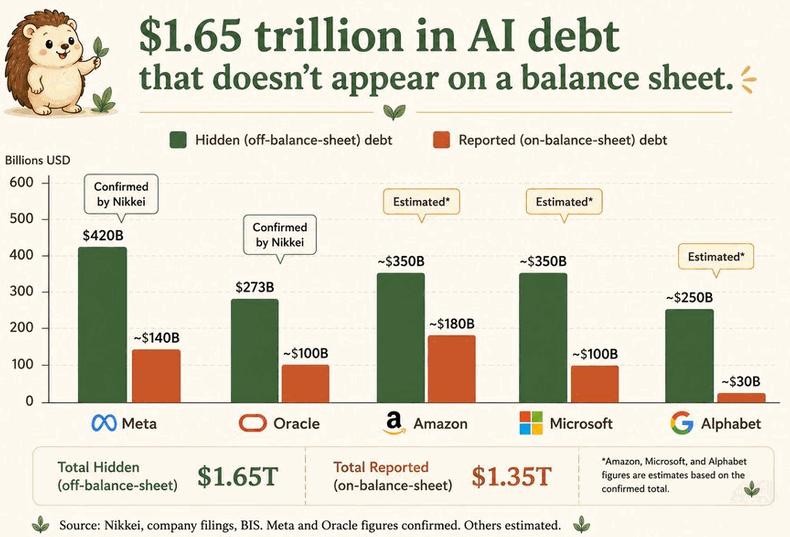
Nothing on the green side of this chart is hidden — it is scheduled. Every dollar sits in a footnote, non-cancellable and binding today; what has been deferred is the recognition, not the obligation. Under lease accounting the liability books at commencement, when the lessor hands over the asset, so a fifteen-year lease on a data centre still under construction sits in disclosure as not yet commenced, and GPU orders stay executory until delivery. Morgan Stanley counts more than $800B of these pre-operational leases industry-wide; the trigger is a construction milestone, not a market event. But the paper runs five to twenty years against silicon with an 18-to-36-month competitive life, and you cannot refinance out of a non-cancellable lease when the chip generation turns — leverage is computed on the term of the debt, never the half-life of what it financed. Oracle carries that mismatch concentrated into one credit: ~$273B off the books, more than thirty times its level four years ago, resting on essentially one private, pre-profit counterparty, with S&P already holding it at the lowest investment-grade rung. And the terminal holder sits outside the tech complex entirely: placed privately, the paper lands in insurance general accounts and pension allocations — equity risk on a chip cycle, wearing the coupon of an annuity. Alphabet reports tomorrow: read the commencement note, not the debt line. This debt will not appear when risk rises — it appears when the concrete cures.
Market Intelligence Brief (MIB) Ver. 18.43
For professional investors only. Not investment advice.
© 2026 RecessionALERT.com

Comments are closed.