
MARKET INTELLIGENCE BRIEF (MIB)
Wednesday, September 16, 2026
The Fed hiked for the first time since 2023 and 16 of 18 officials see more — October is now a coin-flip and the 10-Year closed above 5%. August retail sales smashed forecasts at +1.2% while import prices ran hottest since 2022. Transports sank 2.78% as J.B. Hunt (-13.3%) warned on diesel and driver costs. Goldman (-4.0%) and Huntington (-5.6%) dragged banks. Crude fell 3.4% on Saudi pipeline repair hopes. GE Vernova (+4.8%) and Intel (+4.0%) bucked the tape.
TABLE OF CONTENTS
A. EXECUTIVE SUMMARY
B. MARKET DATA
C. HIGH-IMPACT STORIES (5)
D. MODERATE-IMPACT STORIES (7)
E. ECONOMY WATCH (5)
F. EARNINGS WATCH (0)
G. WHAT’S NEXT
H. CHART OF THE DAY
A. EXECUTIVE SUMMARY -> TOP
The Fed’s first hike since 2023 was fully priced, so markets traded the path instead: with 16 of 18 officials pencilling in at least one more move this year and Chair Warsh declining to guide October, the 2-Year jumped 7.3bp, October hike odds settled at a 51-49 coin-flip and the Dow fell 1.21%. The data argued for tightening — August retail sales rose 1.2%, the control group 1.4%, GDPNow climbed to 5.1% and import prices posted their fastest annual gain since 2022 — which is why Polymarket recession odds fell to 12% on a hike day. Cheaper crude brought no relief: WTI’s 3.40% drop tracked a report that Saudi Arabia can restore half its East-West pipeline within days, yet the 10-Year still logged an eighth straight higher close at 5.021%. Seven of 11 sectors fell, led by Energy (-2.77%) and Financials (-1.35%), while Industrials and Technology held green; transports’ 2.78% slide was a diesel-cost shock, not a demand signal.
• Fed hikes 25bp to 3.75%-4.00%, unanimously — first increase since July 2023; 12 of 18 dots see one more hike in 2026 and four see two; CME FedWatch puts an October hike at 51%; 2Y +7.3bp to 4.736%, DXY +0.66%
• Consumer and price data both run hot — August retail sales +1.2% vs. +0.8% expected, control group +1.4% vs. +0.4%; GDPNow Q3 to 5.1%; import prices +7.0% YoY, the fastest since 2022; Polymarket recession odds down to 12% from 20%
• Transports -2.78% on cost warnings — J.B. Hunt (JBHT) -13.30% after flagging a 5%-10% sequential Q3 earnings decline on driver and diesel costs; American Airlines signals fuel-driven capacity adjustments as diesel sets a $6.31 record
• Banks sell off into the hike — Financials -1.35%; Goldman Sachs (GS) -3.96% on a softer Q3 in fixed income; Huntington (HBAN) -5.55% after cutting its outlook on deposit costs and loan pricing; homebuilder sentiment falls to 32 as 38% of builders cut prices
• Crude gives back 3.40% — WTI $102.23 on a thin EIA draw and a single-source report that Saudi Arabia can restore half its East-West pipeline within days; Energy -2.77%, Diamondback (FANG) -8.03% on a $1.9B block sale
• Single-name movers and policy — GE Vernova (GEV) +4.79% on a $200B backlog “very early in 2027”; Intel (INTC) +4.03% on SK Hynix Ohio talks; Boeing (BA) -3.69% on slower 737 MAX stabilisation; SEC proposes rescinding shareholder-proposal Rule 14a-8
1. The Fed is tightening into the supply shock, not looking through it — Import prices ex-fuel rose 0.8% on industrial supplies and capital goods, the kind of broad-based pressure that feeds producer and consumer prices, and a 1.4% control-group gain removed any demand-destruction cover for waiting. The market’s verdict was a bear flattener, a firmer dollar and a 10-Year that rose even as crude fell more than 3% — so the easiest argument for a pause, cheaper oil, has already failed once. With Warsh declining to guide October, the front end stays hostage to every print: favour short duration and mega-cap growth over rate-sensitive cyclicals, which is exactly where today’s losses concentrated (Dow -1.21% vs. Nasdaq 100 +0.02%).
2. Energy costs have moved from the CPI release to the earnings call — Record diesel is now a named line in J.B. Hunt’s warning and in American and United’s fourth-quarter fuel math, while homebuilders cite labor and materials costs compressing margins. Yet every company that spoke said demand is holding, retail sales confirmed it and recession odds fell. That makes this a margin shock rather than a volume scare, despite the Dow Theory optics of transports falling twice as far as industrials: own the operators with pricing power to pass costs through, avoid those that must absorb them, and watch whether fares or freight rates start to fall — that would overturn the benign read.
3. Higher rates are not helping the banks this time — A hike should widen margins, but Huntington said deposit costs and tighter loan pricing are competing the benefit away, Goldman guided trading softer two sessions after Bank of America did the same, and a flatter curve squeezes the spread further. With mortgage rates near 7% pushing builder sentiment to 32 and commercial real estate paying down faster than planned, the rate-sensitive credit chain is absorbing the hike rather than monetising it — mid-October net interest margin guidance is the test.
 — Leading economic indicators. Accurate market forecasts. Apply for membership at join.recessionalert.com
B. MARKET DATA -> TOP
A hawkish Fed dominated the tape: a 25bp hike to 3.75%-4.00% and Chair Warsh’s taciturn press conference signaling another increase sent the Dow down 1.21% and the S&P 500 0.45%, while the Nasdaq 100 held flat. Breadth was mixed rather than uniformly negative — seven of eleven sectors fell, led by Financials (-1.35%, extending a Bank of America-triggered bank selloff) and Energy (-2.77%, as crude tumbled on a disappointing EIA draw) — while Industrials (+0.62%) and Technology (+0.18%) bucked the tape on GE Vernova’s Venezuela contract and a semiconductor rally (Intel, Marvell, Dell). The sharpest divergence: DJ Transportation’s 2.78% plunge dwarfed the Dow’s own decline, a growth-scare signal the broader indices aren’t yet confirming.
CLOSING PRICES – September 16, 2026:
MAJOR INDICES
DJIA (-1.21%) and DJTA (-2.78%) split by 1.57 points — a same-day Dow Theory divergence that emerges today, with transports signaling recession risk the industrials aren’t yet pricing. Small-caps (RUT -0.40%) and mega-cap tech (NDX +0.02%) held closer to flat than either blue-chip average; NYSE Composite (-0.81%) tracked between the S&P and Dow — a rate-sensitive, cyclicals-led selloff rather than a broad flush across market caps.
| Index | Close | Change | %Move | Why It Moved |
|---|---|---|---|---|
| S&P 500 | 7,551.81 | -33.92 | -0.45% | Broad decline on the Fed’s hawkish 25bp hike and forward-guidance signal. |
| Dow Jones | 51,461.90 | -631.21 | -1.21% | Financials and industrials-linked cyclicals led blue-chip losses on the Fed decision. |
| DJ Transportation | 20,075.41 | -574.39 | -2.78% | Sharpest index decline of the session — a growth-scare signal diverging from the Dow. |
| Nasdaq 100 | 28,945.06 | +7.22 | +0.02% | Held flat as Intel, Marvell and Dell gains offset broader rate-hike pressure. |
| Russell 2000 | 2,858.81 | -11.47 | -0.40% | Small-caps held up better than blue-chips despite rate-hike headwinds. |
| NYSE Composite | 23,934.15 | -194.31 | -0.81% | Broad-market decline tracking the Fed’s hawkish hike. |
VOLATILITY & TREASURIES
VIX’s 2.97% jump alongside rising yields (10Y +2.5bps, 2Y +7.3bps) is a rate-shock signature, not a recession-fear one — bonds sold off rather than catching a bid, confirming markets are repricing the Fed’s path rather than fleeing to safety. The 2Y outpaced the 10Y, flattening the curve slightly. DXY’s 0.66% rise confirms a genuine hawkish repricing rather than a risk-off dollar bid.
| Instrument | Level | Change | Why It Moved |
|---|---|---|---|
| VIX | 17.71 | +0.51 (+2.97%) | Spiked on the hawkish Fed decision and broad equity selloff. |
| 10-Year Treasury Yield | 5.021% | +2.5 bps | Rose as the Fed signaled a higher-for-longer rate path. |
| 2-Year Treasury Yield | 4.736% | +7.3 bps | Led the curve higher, repricing near-term Fed policy expectations. |
| US Dollar Index (DXY) | 100.25 | +0.66 (+0.66%) | Strengthened on the hawkish Fed rate path. |
COMMODITIES
Precious metals moved together — gold -0.77%, silver -0.71%, platinum -1.06% — all pressured by dollar strength and the higher-for-longer rate path, a rates story rather than a safe-haven bid. Copper barely moved (-0.06%), decoupling from the metals complex and suggesting industrial-demand expectations are unshaken by today’s hike. Bitcoin’s modest +0.31% gain against a risk-off equity tape is a mild decoupling worth flagging.
| Asset | Price | Change | %Move | Why It Moved |
|---|---|---|---|---|
| Gold | $4,299.25/oz | -$33.55 | -0.77% | Fell on dollar strength and higher real yields from the hawkish Fed. |
| Silver | $63.400/oz | -$0.456 | -0.71% | Tracked gold lower on dollar strength and rate-path repricing. |
| Copper | $6.4398/lb | -$0.0038 | -0.06% | Essentially flat — decoupled from the broader metals pullback. |
| Platinum | $1,758.20/oz | -$18.80 | -1.06% | Fell alongside gold and silver on dollar strength. |
| Bitcoin | $76,240.0 | +$236.0 | +0.31% | Modest gain, decoupling mildly from the day’s risk-off equity tape. |
ENERGY
WTI (-3.40%) and Brent (-2.86%) moved in near lockstep on a disappointing EIA draw (640k bbls vs. a larger expected drawdown) plus dollar strength — a demand-side move, not a regional disruption. Henry Hub (-1.06%) and Dutch TTF (-3.75%) both eased alongside crude rather than decoupling, arguing against a gas-specific driver. Oil falling while equities also fell is a demand-fear read, not the bullish growth signal a rising-oil/rising-equities pairing would send.
| Asset | Price | Change | %Move | Why It Moved |
|---|---|---|---|---|
| Crude Oil (WTI) | $102.23/bbl | -$3.60 | -3.40% | EIA reported a smaller-than-expected 640k-bbl crude draw; dollar strength compounded the move. |
| Crude Oil (Brent) | $105.64/bbl | -$3.11 | -2.86% | Tracked WTI lower on the same EIA draw and dollar strength — no spread widening. |
| Natural Gas (Henry Hub) | $2.888/MMBtu | -$0.031 | -1.06% | Softer alongside the broader energy pullback; no discrete same-day catalyst identified. |
| Natural Gas (Dutch TTF) | $26.06/MMBtu | -$1.02 | -3.75% | Fell with the broader energy complex and a firmer dollar against the euro. |
S&P 500 SECTORS
Seven of 11 sectors closed lower; Healthcare (+0.03%), Industrials (+0.62%), Technology (+0.18%) and Utilities (+0.20%) held green. Financials (-1.35%) and Energy (-2.77%) led declines despite both carrying positive 12-month gains (+9.03%, and Energy’s sector-best +41.60%) — a pullback within an uptrend, not a trend break. Industrials’ one-day bounce is notable against its own -8.31% 1-month and -11.30% 3-month slide — a reversal, not a confirmation.
| Sector | 1-Day | 1-Week | 1-Month | 3-Month | 6-Month | YTD | 12-Month |
|---|---|---|---|---|---|---|---|
| Industrials | +0.62% | -1.50% | -8.31% | -11.30% | +0.27% | +8.02% | +11.18% |
| Utilities | +0.20% | -3.75% | -6.47% | -8.77% | -12.27% | -4.17% | -2.72% |
| Technology | +0.18% | -2.46% | -3.03% | +0.67% | +26.87% | +22.48% | +25.70% |
| Healthcare | +0.03% | +0.23% | -0.56% | +8.26% | +10.83% | +7.09% | +20.73% |
| Consumer Defensive | -0.45% | +0.77% | -1.65% | -3.30% | -3.15% | +5.46% | +4.13% |
| Consumer Cyclical | -0.56% | -2.09% | -5.61% | -5.57% | -2.00% | -8.60% | -9.91% |
| Communication Services | -0.72% | +2.68% | +2.87% | -2.99% | +3.62% | +0.86% | +3.51% |
| Real Estate | -0.76% | -1.96% | -5.12% | -4.79% | +0.01% | +4.75% | -0.42% |
| Basic Materials | -0.90% | -5.34% | -2.22% | -3.68% | +1.67% | +13.43% | +23.78% |
| Financial | -1.35% | -1.77% | -2.80% | +2.97% | +14.42% | +5.26% | +9.03% |
| Energy | -2.77% | -1.99% | +1.83% | +12.79% | +7.15% | +39.08% | +41.60% |
TOP MEGA-CAP MOVERS:
GAINERS
| Company | Ticker | Close | Change | Why It Moved |
|---|---|---|---|---|
| Space Exploration Technologies Corp | SPCX | $150.88 | +5.15% | Set Sept. 22 launch date for Starship Flight 14 — first orbital attempt and first live Starlink V3 deployment; market value topped $2 trillion. |
| GE Vernova Inc | GEV | $925.09 | +4.79% | Signed a Venezuela power-grid rebuild agreement (1GW in 24 months, 5GW over four years); rebounded after this week’s selloff. |
| Intel Corp | INTC | $101.05 | +4.03% | Reports of a ~10% October PC-CPU price hike, SK Hynix partnership talks, and analyst target increases to $145. |
| Dell Technologies Inc | DELL | $563.29 | +3.64% | Rose despite a fresh Silver Lake share-sale filing, as investors rewarded its ~$95B AI-server backlog. |
| Marvell Technology Inc | MRVL | $229.71 | +3.61% | Semiconductor-sector strength plus Street target hikes (Susquehanna to $265) on the AI-opportunity thesis. |
DECLINERS
| Company | Ticker | Close | Change | Why It Moved |
|---|---|---|---|---|
| International Business Machines Corp | IBM | $237.49 | -4.38% | No discrete same-day catalyst identified; broader mega-cap tech profit-taking into the Fed decision. |
| Goldman Sachs Group Inc | GS | $937.98 | -3.96% | Continuation of the bank selloff triggered by Bank of America’s Sept. 14 Q3 trading-revenue warning, compounded by the Fed hike. |
| American Express Co | AXP | $312.43 | -3.70% | No discrete same-day catalyst identified; financials broadly pressured by the Fed decision. |
| ExxonMobil Holdings Corp | XOM | $163.32 | -3.54% | Tracked the Energy sector (-2.77%) lower as crude tumbled on a smaller-than-expected EIA draw. |
| Verizon Communications Inc | VZ | $49.76 | -3.28% | No single confirmed catalyst; high-dividend telecom pressured as Treasury yields rose on the Fed hike. |
— Institutional-grade intelligence for serious investors. Apply for membership at join.recessionalert.comC. HIGH-IMPACT STORIES -> TOP
BEARISH
1. Markets Mark the Fed’s First Hike Since 2023 as the Start of a Path, Not an Event — Two-Year Yield Jumps 7.3bp and October Becomes a Coin-Flip
The core facts:The FOMC’s unanimous 25 basis-point hike to 3.75%-4.00% — the data, statement and dot plot are carried in full in Section E — was fully priced going in, and the tape reacted to the path rather than the decision. The 2-Year Treasury yield rose 7.3 basis points to 4.736% against a 2.5 basis-point rise in the 10-Year to 5.021%, flattening the curve by roughly five basis points on the day. The 10-Year close is the highest in the price record running back to April 15 and its eighth consecutive higher close, checked leg by leg. The dollar index rose 0.66% to 100.25, the VIX rose 2.97% to 17.71 and gold fell 0.77%. The Dow fell 631.21 points, or 1.21%, to 51,461.90 and the S&P 500 lost 0.45% to 7,551.81, while the Nasdaq 100 finished flat at +0.02%. After the decision, CME FedWatch put the odds of another 25 basis-point hike at the October 27-28 meeting at 51% against 49% for no change, per Fox Business. At his press conference Chair Kevin Warsh said “The plain fact is that inflation is too high and has been for too long,” and, asked about market pricing, “Sometimes the market tries to prejudge our outcomes, I’ll observe market prices.”
Why it matters:The shape of the move is the information. A hike that was priced near certainty cannot surprise on its own; what repriced was the next step, and it repriced at the front of the curve, which is where policy expectations live. A bear flattener of this kind says the market now believes the Fed is willing to keep tightening into a supply shock rather than look through it, and Warsh declining to guide the October meeting leaves that belief unchallenged. The dollar confirms it: a 0.66% gain alongside higher real yields and weaker gold is a policy-divergence bid, not a flight to safety, and the VIX’s modest rise says equity investors are repricing a discount rate rather than a recession. The Dow’s 1.21% decline against a flat Nasdaq 100 is the cleanest expression of where that bites — rate-sensitive financials and cyclicals rather than the mega-cap growth complex. The 10-Year holding above 5% on an eighth straight higher close also means long-end relief has not arrived even on a day crude fell more than 3%, which removes the easiest argument for a pause.
What to watch:Whether October hike odds move decisively away from 50% as the blackout ends at 23:59 ET on September 17 and Governor Bowman speaks at 09:30 ET on September 18 — the first post-meeting commentary from the Committee.
BEARISH
2. Dow Transports Fall 2.78% as J.B. Hunt Warns on Driver and Diesel Costs and American Airlines Flags Fuel-Driven Capacity Cuts
The core facts:The Dow Jones Transportation Average fell 574.39 points, or 2.78%, to 20,075.41, more than twice the Dow Jones Industrial Average’s 1.21% decline. The day’s two named catalysts in the transport complex were both cost warnings delivered at Morgan Stanley conferences. J.B. Hunt Transport Services chief financial officer Brad Delco said third-quarter earnings could fall 5% to 10% from the second quarter, citing about $25 million of additional driver recruiting, onboarding, training and sign-on costs and a roughly $10 million sequential fuel drag with diesel above $6 a gallon; the stock closed down 13.30% at $236.73. At the Laguna conference, American Airlines chief executive Robert Isom said fuel prices at current levels would require adjustments to capacity planning, and chief financial officer Devon May said fourth-quarter fuel had risen roughly $1 a gallon from the level assumed in July; United Airlines said it expects to recover all of the higher fuel cost in the fourth quarter, with a lag. Executives said demand remained strong even after fare increases. AAA’s national average diesel price set an all-time record of $6.3103 a gallon today. Union Pacific, upgraded to Buy at UBS this morning, still closed down 1.08%.
Why it matters:A transports-led break from the industrials is the textbook Dow Theory warning, and it is tempting to read today’s split as the freight economy flagging a slowdown. The companies that moved the index said something different: J.B. Hunt’s warning is about the cost of drivers and fuel, and the airlines said in terms that demand is holding up. That makes this a margin shock rather than a volume signal, and the distinction matters for positioning — a demand scare argues for leaving the sector, while a cost shock argues for owning the carriers with pricing power to pass fuel through and avoiding those without it. It also closes the loop on the diesel story: the record pump price is no longer a consumer-inflation statistic but a named line in a large-cap earnings warning, which is the channel through which an energy shock becomes an earnings-revision cycle. The risk to the benign reading is duration — United’s own “with a lag” is the admission that booked capacity absorbs the cost before fares can.
What to watch:Whether other truckload and less-than-truckload carriers pre-announce into quarter-end, and whether American or United specify fourth-quarter capacity cuts — a volume cut paired with steady fares confirms the cost-shock reading; falling fares would overturn it.
UNCERTAIN
3. Crude Gives Back 3.40% on a Thin EIA Draw and a Report That Saudi Arabia Can Restore Half Its East-West Pipeline Within Days
The core facts:WTI settled at $102.23 a barrel, down 3.40%, and Brent at $105.64, down 2.86%, reversing most of Tuesday’s rally. Two catalysts landed in sequence. At 10:30 ET the EIA’s Weekly Petroleum Status Report showed commercial crude stocks falling only about 0.6 million barrels in the week ending September 11, against a Reuters poll for a draw of about 1.6 million, while gasoline and distillate inventories both rose. Then, around midday New York time, Bloomberg reported that Saudi Arabia is seeking to restore about half the capacity of its 7 million barrel-a-day East-West pipeline within days and full capacity in about six weeks, with Aramco building a bypass around the damaged section; the report rests on one person familiar with the matter, and Aramco and the energy ministry did not respond to requests for comment. Earlier in the session, Saudi Arabia’s offer of additional crude to Asian refiners through ship-to-ship transfers near Sohar, Oman, was described by UBS’s Giovanni Staunovo as “easing fears that the disruption could become even larger.” Energy was the worst S&P 500 sector at -2.77%; ExxonMobil fell 3.54% and Chevron 2.86%, while EOG Resources fell 5.73% and Devon Energy 5.63%.
Why it matters:The decline was as much about the disruption premium coming out as about US inventories: the pipeline report goes directly at the outage that drove crude above $100, and a restoration timeline measured in days rather than months is exactly the variable a supply-shock premium is priced on. That makes the move fragile in both directions — it rests on a single unnamed source, and it arrived while vessel transits through Hormuz remain far below their recent average. The US data is more ambiguous than the headline draw suggests. Product stocks building is a demand-softness signal at the margin, but distillate inventories remain well below their five-year average on the same day diesel set a pump-price record, so the domestic squeeze in the fuel that matters most for freight has not eased. For portfolios the lesson is that energy equities are now trading the premium rather than the barrel: the E&P names with the highest beta to the spot price fell nearly twice as hard as the integrated majors. And the macro payoff of cheaper crude did not show up where the Fed would need it — the 10-Year yield still rose.
What to watch:An on-the-record Aramco or energy-ministry statement on the bypass timeline, and the roughly one-week deadline Libya’s Petroleum Facilities Guard has set before threatening to shut seven oilfields including Sharara and El Feel.
BEARISH
4. Financials Fall 1.35% on Hike Day as Goldman Flags a Softer Q3 in Fixed Income and Huntington Cuts Its Outlook at the Barclays Conference
The core facts:The Financial sector fell 1.35%, among the session’s worst, with Goldman Sachs down 3.96% to $937.98 and American Express down 3.70% among the largest mega-cap decliners; Wells Fargo fell 2.98% and Bank of America 2.72%. At the Barclays Global Financial Services Conference, Goldman Sachs chief executive David Solomon said the firm expects its fixed income, currencies and commodities business to be slightly softer in the third quarter, against very strong performance in equities, and urged investors to look past quarterly fluctuation to the next five to ten years. Earlier at the same conference, Huntington Bancshares chief executive Steve Steinour and chief financial officer Zach Wasserman said higher deposit costs, tighter loan pricing and faster commercial real estate payoffs had reduced near-term profit expectations; Huntington closed down 5.55% and Wells Fargo’s Mike Mayo cut his target to $21 from $23 while keeping Overweight. Banks including Wells Fargo, BNY, KeyCorp and Huntington raised their prime rates to 7.00% after the decision. The selloff extends a move that began with Bank of America’s September 14 warning on third-quarter trading and advisory revenue.
Why it matters:A rate hike is supposed to be a tailwind for bank earnings, and today’s price action says investors do not believe it will be one this time. Huntington supplied the mechanism in its own words: deposit costs are rising and loan pricing is tightening at the same time, which means the asset-side repricing from a higher policy rate is being competed away before it reaches net interest income. Goldman’s comment points to the other half of the franchise — the trading and markets revenue that carried bank earnings through the first half is now being guided softer at two of the largest houses in three sessions. Put together, the sector is losing both of the arguments that justified its gains over the past six months at once. The hike itself adds a third pressure: a flatter curve narrows the spread between what banks pay and what they earn on longer assets, and higher-for-longer raises the refinancing stress on commercial real estate books that Huntington already flagged as running off faster than planned.
What to watch:Mid-October third-quarter results from the large banks — specifically net interest margin guidance and deposit beta, which will show whether the hike widened or compressed spreads.
UNCERTAIN
5. SEC Proposes Rescinding the Shareholder-Proposal Rule, Rule 14a-8, and Overhauling Proxy Solicitation
The core facts:The Securities and Exchange Commission issued two proposing releases. The first would rescind Rule 14a-8, the rule that requires companies to include qualifying shareholder proposals in their proxy materials, on the Commission’s stated determination that the rule exceeds its statutory authority and intrudes on state corporate law, and would amend Rule 14a-4(c) to give companies flexibility over discretionary proxy voting authority. The second would modernise proxy solicitation: eliminating the annual report delivery requirement and Notices of Exempt Solicitation, removing the delivery deadline for documents incorporated by reference, and cutting the broker search period from 20 to 5 business days. Both proposals carry a 60-day comment period running from Federal Register publication, which had not occurred as of today. Chairman Paul Atkins issued a statement on the releases; the vote tally was not stated in the Commission’s release. The plan had been signalled earlier in the month; the proposal itself is today’s action.
Why it matters:Rule 14a-8 is the single mechanism through which shareholders can put a question to a vote at every US public company without running their own proxy contest, and it has been the channel for the climate, political-spending, board-declassification and majority-voting campaigns of the past two decades. Removing it at the federal level does not abolish shareholder proposals — it hands the question to state law, and principally to Delaware and Texas, which are already competing on how management-friendly their corporate codes are. For large-cap portfolios the near-term effect is a lower governance-activism cost and fewer proxy-season distractions for management; the longer-term effect is that stewardship shifts from the ballot to private engagement and to proxy fights, where only the largest holders have leverage. The statutory-authority framing is also what makes this uncertain rather than settled: it invites litigation from institutional investors and pension funds, and a rescission justified on legal grounds is more exposed to reversal by a future Commission than one justified on cost.
What to watch:Federal Register publication, which starts the 60-day comment clock, and whether large asset managers and public pension funds file opposition or signal a legal challenge.
— Quantifying recession risk so you don’t have to guess. Apply for membership at join.recessionalert.comD. MODERATE-IMPACT STORIES -> TOP
BULLISH
6. Intel Rises 4.03% on a Reuters Report That SK Hynix Is in Talks to Make Memory Chips at Its Ohio Site
The core facts:Intel closed at $101.05, up 4.03%, one of the session’s largest mega-cap gains, after Reuters reported that SK Hynix is negotiating what would be its first memory-chip manufacturing in the United States. Two structures were reported: a lease at Intel’s chip-making site in Ohio, or a joint venture with Intel and major cloud providers to secure a steady supply of memory. SK Hynix told Reuters it was looking at “a number of measures, including the establishment of further production bases” and that no agreement had been reached. Intel declined to comment on what it called speculation and said it is still investing in preparing the Ohio site. SK Hynix’s US-listed shares rose about 3% in overnight trading on the report.
Why it matters:The Ohio campus has been the most visible symbol of Intel’s foundry overreach — a multi-billion-dollar site repeatedly delayed for want of a customer to fill it. A memory tenant would convert a stranded asset into a utilised one without Intel having to win a leading-edge logic customer first, which is the harder and slower route to the same outcome. The joint-venture variant is the more interesting one for the AI supply chain: cloud providers co-investing in domestic memory capacity would be the clearest sign yet that high-bandwidth memory, rather than accelerators, is the binding constraint on data-center buildouts. The caveat is the one both companies stated — these are talks, with no agreement and an explicit non-comment from Intel — so the move prices optionality rather than a contract.
What to watch:Any formal announcement naming the Ohio site and a structure — a lease is a real-estate outcome, a joint venture with cloud providers is a capacity commitment.
BULLISH
7. GE Vernova Gains 4.79% as CEO Strazik Says the $200 Billion Backlog Mark Could Arrive “Very Early in 2027”
The core facts:GE Vernova closed at $925.09, up 4.79%, rebounding from an 8.62% fall on Monday. Speaking at Morgan Stanley’s Laguna Conference, chief executive Scott Strazik said the company could reach a $200 billion backlog “very early in 2027,” describing it as a humble milestone relative to the trajectory he sees; GE Vernova ended the second quarter with a $176 billion backlog. The comment pulls forward a milestone the company had previously framed for 2027 generally, and is conference commentary rather than a formal guidance revision. Electrical-equipment peers moved with it, with Eaton and Quanta Services each up about 2%. The session also carried coverage of GE Vernova’s agreement to help rebuild Venezuela’s power grid — 1 gigawatt within 24 months and a further 5 gigawatts over four years — whose signing date could not be established as today’s.
Why it matters:Monday’s selloff was a valuation argument — a Street-low Sell initiation contending that the company’s turbine economics are mispriced as an AI-power compounder. Today’s rebound is the operational rebuttal: a backlog milestone arriving earlier is a statement about order intake in the current quarter, and backlog is the one number in this business that converts directly into multi-year revenue visibility. The peer read-through matters as much as the single name. Eaton and Quanta moving on the same comment says the market is treating Strazik’s order book as a proxy for US electricity demand generally, which is the thesis that has carried the grid-equipment complex through a quarter in which AI-capex skepticism has de-rated almost everything else linked to data centers.
What to watch:Third-quarter orders and the reported backlog figure at GE Vernova’s October results — a print well above $176 billion validates the pulled-forward timeline.
BEARISH
8. Boeing Falls 3.69% After CEO Ortberg Says Stabilising 737 MAX Output at 47 a Month Is Taking Longer Than Expected
The core facts:Boeing closed at $201.96, down 3.69%, on a $159.62 billion market capitalisation, after trading roughly 5% lower intraday following chief executive Kelly Ortberg’s appearance at Morgan Stanley’s Laguna Conference. Ortberg said it is taking longer than expected to stabilise 737 MAX production at 47 aircraft a month. He identified wing production at the Renton facility as the constraint rather than the broader supply chain, and said Boeing has not seen the flow improvements it expected there, which has slowed the planned move from 47 to 52 a month. The 777X remains on course for first deliveries in 2027.
Why it matters:Boeing’s recovery case is a rate case: free cash flow over the next two years depends almost entirely on how quickly the 737 line reaches and holds its target cadence, and every month spent below it defers cash that the balance sheet is waiting for. A constraint located inside Boeing’s own factory is in one sense better news than a supplier problem, because it is within management’s control — but it also removes the explanation that the delay is somebody else’s, and it lands in the one program where the market had begun to price execution as solved. The read-through runs to the aerospace supply base, whose second-half volume assumptions are built on the 52-a-month step, and to airlines already rationing capacity on fuel costs, for whom delayed deliveries tighten fleet plans further.
What to watch:Boeing’s monthly delivery figures for September and the October 6 expiry of its SPEEA engineering-union contract, which bears directly on the production-stability timeline.
BEARISH
9. White House Orders Agencies to Move Canadian-Origin Goods Out of Federal Civil Procurement
The core facts:The President signed a memorandum, “Restoring Reciprocity in Government Procurement,” directing officials to “identify and take all steps toward removing or otherwise making non-available for purchase Canadian-origin items” in the federal civil procurement system. The accompanying fact sheet names the Director of the Office of Management and Budget, the US Trade Representative and the Federal Acquisition Regulatory Council, and directs USTR to monitor Canada’s treatment of American goods in Canadian government procurement. The stated rationale is Canada’s “Buy Canadian” policy and provincial content preferences, and the fact sheet states that “Canadian companies have preferential access to over $280 billion of the U.S. government procurement system.” No deadline or effective date is given. The action widens a narrower September 8 directive aimed at the General Services Administration’s schedules.
Why it matters:This moves the US-Canada dispute from tariffs, which are paid at the border and can be absorbed or passed through, into procurement exclusion, which removes the sale entirely. The $280 billion figure is the size of the procurement market Canadian firms can access, not the value of what they sell into it, so the direct revenue at risk is far smaller — but the instrument matters more than the number, because it is administrative, needs no tariff proclamation and can be widened agency by agency. It lands the day after the modified Section 338 tariffs on Canadian goods took effect and as Ontario threatens funding cuts to municipalities that do not follow its own “Buy Ontario” rules, so both governments are now escalating through procurement at once. For US portfolios the exposure sits with Canadian industrial and technology suppliers to federal agencies and with US contractors whose supply chains run through Canadian components.
What to watch:Implementing guidance from OMB or the FAR Council setting a timeline, and any retaliatory procurement measure from Ottawa.
BEARISH
10. Morgan Stanley Rates Expedia Underweight With a $235 Target, Citing Zero User Growth and AI-Exposed Inventory
The core facts:Morgan Stanley rated Expedia Underweight with a $235 price target, roughly 20% below the prior close, in a reset of its online-travel coverage; sources differ on whether the action was a downgrade from Equal Weight or an initiation. The firm said Expedia’s monthly active users grew 0% in the second quarter of 2026, against 6% at Booking.com and 10% at Airbnb, and that its inventory is concentrated in chain hotels and air travel, “categories viewed as more commoditized and increasingly vulnerable to disruption from AI-powered travel tools,” which places it “at the weakest end of the competitive spectrum.” In the same coverage change the firm rated Booking Holdings Overweight and Airbnb Equal Weight. Expedia closed down 2.08% at $286.97 on a $34.44 billion market capitalisation.
Why it matters:This is one of the first bulge-bracket calls to rank online travel agencies explicitly by exposure to AI agents, and its logic generalises beyond travel. The argument is that commoditised inventory — a chain hotel room, an airline seat — is precisely what an AI booking agent can compare and transact without an intermediary, while differentiated inventory like a private home is harder to disintermediate. Paired with the user-growth gap, it frames Expedia’s problem as structural rather than cyclical. The same framework is already being applied across the software complex, where the pacing debate has turned exposure to agentic substitution into a valuation factor; today’s call extends that factor into consumer internet.
What to watch:Expedia’s third-quarter active-user and room-night growth against Booking and Airbnb — a second quarter of flat users would confirm the share-loss thesis.
BEARISH
11. Diamondback Energy Falls 8.03% as the Endeavor Founder’s Family Office Sells a $1.9 Billion Block
The core facts:SGF Capital, the family office managing the investments of the late Endeavor Energy Resources founder Autry Stephens, sold 9.1 million Diamondback Energy shares at $205.80 each, about $1.9 billion, a 2.7% discount to Tuesday’s close of $211.53, with Morgan Stanley handling the sale. The stake was acquired in Diamondback’s 2024 merger with Endeavor, and a Form 144 notice of the proposed sale was filed with Morgan Stanley named as broker. Diamondback closed down 8.03% on a $54.48 billion market capitalisation, on a day the Energy sector fell 2.77% and WTI 3.40%, so the share of the decline attributable to the block rather than the crude selloff cannot be separated.
Why it matters:Legacy holders from the shale consolidation wave are sitting on some of the largest single-name stakes in the sector, and a seller choosing to exit a meaningful slice with crude above $100 is a view on where the cycle’s price is, whatever the family office’s own reasons. The overhang question is the more durable one: a block of this size at a discount resets where the marginal buyer sits, and the remaining stake is now a known source of future supply. The timing also sharpened the day’s energy selloff — Diamondback fell roughly three times as far as the sector, which is the signature of forced absorption meeting a falling tape rather than of a change in the company’s fundamentals.
What to watch:Any lock-up terms disclosed on the sale and further Form 144 filings from the same holder, which would establish whether this is a one-off or a staged exit.
UNCERTAIN
12. Salesforce Suffers a Global Service Outage Across Hundreds of Instances as Dreamforce Gets Under Way
The core facts:A Salesforce outage beginning at about 08:30 UTC (04:30 ET) affected hundreds of instances worldwide, including in the United States, Japan, India, the United Kingdom, France and Germany. A Salesforce status update attributed it to requests “stalling while waiting on a response from an internal login service, which is using up available server resources.” A fix was validated and rolled out region by region from late morning UK time, and the incident was declared resolved at 19:20 UTC (15:20 ET). It coincided with the company’s Dreamforce conference in San Francisco, which has more than 40,000 in-person attendees. Salesforce closed down 2.00% at $250.54; nothing established links the move to the outage on a Fed-decision day, and a Mizuho target raise to $280 was also reported for the stock today.
Why it matters:The cause is the notable part. An internal login service exhausting server resources is a single point of failure in the authentication path, and it took down a platform that sells itself as the system of record for its customers’ revenue operations. That is an awkward message during the conference at which Salesforce is pitching its agentic AI products, whose value proposition depends on enterprises trusting the platform to act autonomously and continuously. It was an availability failure rather than a disclosed security incident, so there is no regulatory filing obligation, but enterprise buyers weighing consolidation onto a single vendor’s AI stack will read resilience as part of the price.
What to watch:Whether Salesforce publishes a root-cause analysis and service credits, and whether the outage is raised by management or analysts at its next earnings call.
— Separating signal from noise since 2007. Apply for membership at join.recessionalert.comE. ECONOMY WATCH -> TOP
The Fed delivered its first rate hike since 2023 — a unanimous 25bp move to 3.75%-4.00% with a hawkish dot plot pointing to at least one more increase this year — even as the data underneath told a split story. Retail sales surged 1.2% in August, pushing Atlanta Fed GDPNow to 5.1% for Q3, while import prices rose to a 7.0% year-over-year pace, the fastest since 2022, validating Chair Warsh’s inflation concern. Housing kept weakening: the NAHB index fell to 32 as builders cut prices and buyer traffic thinned under rising mortgage rates. Prediction markets read the outcome as net de-risking — recession odds fell 8 points to 12%.
Fed Raises Rates for First Time Since 2023, Hawkish Dot Plot Signals More to Come (Federal Reserve, Sept 16, 2026)
What they’re saying:The FOMC voted unanimously, 12-0, to raise the federal funds rate target range by 25 basis points to 3.75%-4.00% — the first increase since July 2023. The Committee’s statement said “today’s policy action will support a timelier return to the Committee’s 2 percent goal.” The updated dot plot showed 12 of 18 officials expecting one more 25bp hike this year to 4.125%, four expecting two more hikes to 4.375%, and two seeing no further increases in 2026.
The context:Chair Kevin Warsh said the Fed “cannot affect any individual price” on items like oil and groceries, but that the Committee’s role is to ensure relative price shocks “don’t broaden out” into second- and third-order effects on the economy. The move puts Warsh — appointed partly on the expectation he would cut rates — at odds with the White House; President Trump wrote on Truth Social that “High interest rates put the U.S.A. at a very unfair disadvantage, and I won’t allow that to happen!” The unanimous vote, following a July meeting where three members already favored a hike, signals the full Committee has coalesced around the inflation-first read.
What to watch:Whether October CPI and PCE prints validate or undercut the hawkish dot plot’s 12-of-18 hike majority; the next FOMC meeting date was not on the fetched economic calendar window.
Retail Sales Jump 1.2% in August, Smashing Forecasts and Reversing July’s Decline (Census Bureau via FXStreet, Sept 16, 2026)
What they’re saying:Retail sales rose 1.2% in August, beating the 0.8% consensus forecast and reversing a revised 0.5% July decline — the largest monthly gain in five months, taking sales to $773.9 billion. The core control group, which feeds directly into GDP calculations, surged 1.4% against a 0.4% forecast, a full percentage point beat.
The context:The Atlanta Fed’s GDPNow model jumped to 5.1% for Q3 growth immediately following the release, up from 4.4% the prior week, as its consumption and government-spending nowcasts both moved higher. Economists cautioned the pace may not hold — pump prices have since climbed and real wages have softened — but the print landed the same day the Fed cited economic resilience as grounds for tightening rather than easing.
What to watch:Whether September retail sales confirm the rebound or August’s strength proves a one-month pop, given deteriorating University of Michigan sentiment readings tied to inflation concerns.
Homebuilder Confidence Falls to 32 as Mortgage Rates Bite, Builders Slash Prices (NAHB/Wells Fargo, Sept 16, 2026)
What they’re saying:The NAHB/Wells Fargo Housing Market Index fell three points to 32 in September, missing the 34 consensus and down from 35 in August. Current sales conditions fell four points to 35 and six-month sales expectations dropped six points to 37; prospective-buyer traffic held flat at 23.
The context:Rising mortgage rates — the MBA’s 30-year rate ticked up to 6.97% this week from 6.85% — along with worsening labor shortages, rising material costs, and immigration enforcement affecting workforce availability are compressing builder margins. 38% of builders reported cutting prices in September, up from 35% in August, maintaining an average 6% reduction — the clearest sign yet that affordability strain is showing up in pricing behavior rather than just sentiment surveys.
What to watch:Housing Starts and Building Permits data, due Thursday Sept 17, for whether the sentiment decline is showing up in actual construction activity.
Import Prices Post Fastest Annual Gain Since 2022, Reinforcing the Fed’s Inflation Case (BLS, Sept 16, 2026)
What they’re saying:Import prices rose 0.7% in August, beating the 0.4% forecast and reversing a 0.3% July decline; export prices rose 0.6% versus 0.5% expected. Over the 12 months through August, import prices climbed 7.0% — the largest year-over-year increase since the 7.7% rise recorded through August 2022 — while export prices advanced 8.6% year-over-year.
The context:Excluding fuel, import prices rose a stronger 0.8%, driven by a 2.0% jump in nonfuel industrial supplies and materials and a 0.9% rise in capital-goods prices — broad-based increases economists say have a higher chance of working through supply chains into producer and consumer prices than a fuel-driven spike. Natural gas import costs alone were up 102.6% year-over-year. The data landed hours before the Fed’s hike, giving the Committee same-day confirmation of the price pressure it cited.
What to watch:September PPI and CPI prints for whether nonfuel import-price pressure is already visible in downstream producer and consumer prices.
Prediction Markets Cut Recession Odds to 12% Even as Fed Hikes (Polymarket, Sept 16, 2026)
What they’re saying:Polymarket’s “US recession by end of 2026” contract priced Yes at 12% today, down 8 percentage points from 20% in the prior session — its largest one-day move in recent weeks. The Fed rate-hike contract sits at 100% Yes, confirming today’s move was fully priced ahead of the decision; the “zero cuts in 2026” contract sits at 94.7%, implying roughly a 5% chance of any cut this year.
The context:The recession-odds decline is notable set against the hike itself; it suggests traders are reading today’s strong retail sales print and GDPNow’s jump to 5.1% as outweighing the tightening impulse — an economy resilient enough to absorb a rate hike rather than one being pushed toward contraction by it.
What to watch:Whether recession odds hold near 12% once October data (payrolls, CPI) tests the durability of August’s consumption strength.
— Know the probability before the market prices in the risk. Apply for membership at join.recessionalert.comF. EARNINGS WATCH -> TOP
Scorecard note: the figures above are carried unchanged from FactSet’s September 11 Earnings Insight; the next weekly update is due September 18. Only two S&P 500 companies have reported Q3 actuals, so the beat rates rest on a sample of two and carry no signal. The estimated +28.7% growth rate is the meaningful figure, up from 26.6% on June 30 — analysts raised estimates 1.4% during the quarter against a five-year average decline of 2.2%, and 72 of the 114 companies issuing Q3 EPS guidance were positive, against a five-year average of 41%. The forward 12-month P/E is 19.1, below the 5-year average of 19.8.
YESTERDAY AFTER THE BELL (Markets Reacted Today)
No major earnings yesterday after the bell from companies with >$100B market cap. Tuesday’s calendar was re-fetched live at this session’s runtime and returned the same six rows captured yesterday, with no late arrivals. The largest after-the-bell reporter on September 15 was Trip.com Group (TCOM) at $26.26B, which fails both the size test and the ADR test; it beat on adjusted EPS ($1.08 against $0.89 expected) and closed up 3.01% today.
TODAY BEFORE THE BELL (Markets Already Reacted)
No major earnings before the bell from companies with >$100B market cap. The largest before-the-bell reporter today was LuxExperience (LUXE), a $1.21B ADR, which fails both tests. Nothing was excluded on ADR grounds at or above the floor.
TODAY AFTER THE BELL (Markets React Tomorrow)
No major earnings after the bell from companies with >$100B market cap. The largest after-the-bell reporter today is Lennar (LEN) at $18.83B, whose early calendar read shows revenue of $8.05B against $8.32B expected, a 3.28% miss — well below the coverage floor, but a homebuilder reporting hours after a rate hike and on the day builder confidence fell to 32 is the most direct read on rate transmission to housing.
WEEK AHEAD PREVIEW:
Q3 2026 earnings season has barely begun — two S&P 500 companies have reported — and no company above $100 billion in market capitalisation reports on any of the next five business days. This is the fifth consecutive session with an empty forward list. All five days were fetched individually at this session’s runtime, one request per date.
Thursday, September 17 — one row on the entire calendar: Innate Pharma ADR (IPHA), $224.52M, before the bell.
Friday, September 18 — no reporters on the calendar.
Monday, September 21 — one row: Abivax ADR (ABVX), $8.93B, after the bell, failing both the size and ADR tests. The date matters more as the effective date of the S&P 500 September rebalance.
Tuesday, September 22 — largest reporter AutoZone (AZO), $46.51B, before the bell, consensus EPS $54.32 on revenue $6.71B; then Thor Industries ($3.63B) and KB Home ($2.98B, after the bell).
Wednesday, September 23 — largest reporter Cintas (CTAS), $79.82B, before the bell, consensus EPS $1.35 on revenue $2.98B; then Paychex ($41.55B) and General Mills ($19.68B), both before the bell. Cintas is the largest forward name across the five days and still sits more than 20% below the floor.
No name across the five days sits within 5% of the $100B floor. Q3 2026 reporting begins in earnest mid-October with the large banks.
— US market commentary trusted by family offices and institutions. Apply for membership at join.recessionalert.comG. WHAT’S NEXT -> TOP
UPCOMING RELEASES:
| Date | Event | Why It Matters |
|---|---|---|
| Thu, Sep 17 | Housing Starts (exp. 1.31M) & Building Permits (exp. 1.41M) | First hard-activity test of the NAHB drop to 32; with mortgage rates near 7% and 38% of builders cutting prices, weak starts would show the hike’s transmission reaching construction rather than just sentiment. |
| Thu, Sep 17 | Initial Jobless Claims (exp. 208K) | A low print keeps the labor market alongside retail sales as grounds for a second hike; any jump would be the first crack in the resilience case the Fed cited today. |
| Thu, Sep 17 | Philadelphia Fed Manufacturing Index (exp. 30.5) | Its prices-paid component tests whether the broad nonfuel import-price pressure in August is reaching US manufacturers’ input costs; the Fed blackout also ends at 23:59 ET. |
| Fri, Sep 18 | Fed Governor Bowman Speech (09:30 ET) | The first post-meeting commentary from the Committee, and the first chance for October’s 51-49 hike odds to move decisively after Warsh declined to guide. |
| Fri, Sep 18 | Industrial Production MoM (exp. +0.3%) | Gauges whether factory output is holding up under record diesel and rising materials costs — relevant to the transports and industrials split that opened today. |
| Mon, Sep 21 | Fed President Goolsbee Speech | A second post-meeting voice; whether he endorses the dot plot’s majority for further hikes is a read on how durable the 12-0 consensus is heading into October. |
| Tue, Sep 22 | Fed Speakers: New York Fed President Williams & Vice Chair Jefferson | Leadership-level guidance on October; with the market split evenly, a clear signal either way reprices the front end of the curve. |
| Wed, Sep 23 | EIA Crude & Gasoline Stocks; MBA 30-Year Mortgage Rate (prior 6.97%) | Another thin crude draw or product build would extend today’s energy selloff; a mortgage rate through 7% would deepen the housing drag the NAHB already flagged. |
KEY QUESTIONS:
1. Does Governor Bowman’s speech on Friday push October hike odds decisively away from 51%, or does the Committee leave the front end hostage to every data print until the October 27-28 meeting?
2. Is the transports selloff a margin shock carriers can price through, as J.B. Hunt and the airlines say with demand intact — or will other truckers pre-announce and falling fares turn it into a volume signal?
3. Does Aramco confirm the East-West pipeline bypass timeline on the record before Libya’s oilfield shutdown deadline, or does crude’s 3.40% decline — resting on a single unnamed source — reverse?
— US market commentary trusted by family offices and institutions. Apply for membership at join.recessionalert.comH. CHART OF THE DAY -> TOP
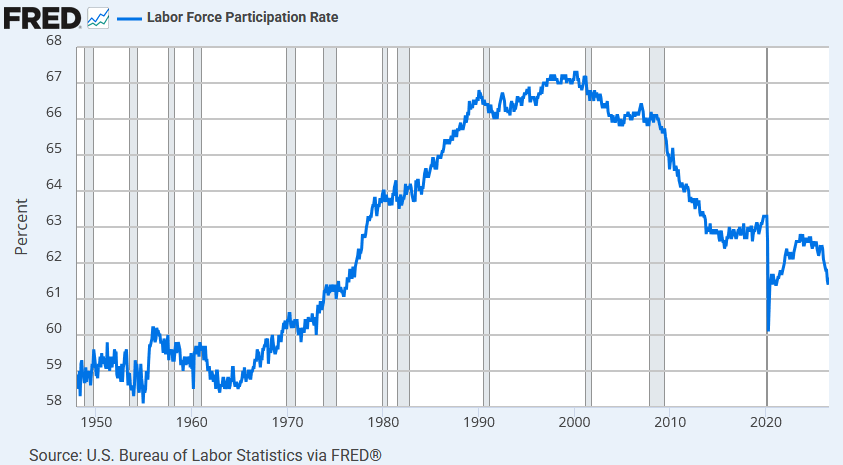
More than two-fifths of this year’s slide was not people quitting work — it was a recount. The St. Louis Fed traces 43% of the fall from December to June to January’s population revision, built on lower estimates of net immigration. Counting fewer immigrants, who participate at 65.7% against 60.9% for the native-born and skew toward working age, made the country older on paper in a single month, by more than a typical year’s aging. Steady aging adds another 16%. The rest — people within the same age groups taking part less — arrived almost entirely in June among workers aged 25 to 54, whose participation has since held at 83.4%, still above 2019’s 83.0%. What the recount cannot explain is what came after it. Since January, when the new counts took effect, unemployment has slipped from 4.3% to 4.1% while the number of people employed fell by 351,000 — the rate counts only those inside the labor force, and it dropped because jobseekers left that pool, not because of net hiring. Today the Fed raised rates to 3.75–4.00% on a statement that “job gains have kept pace with the workforce” — a yardstick that is itself shrinking, against which even modest hiring reads as tightness. Watch workers aged 25 to 54: if their participation holds, this is not a weakening economy — it is a smaller one.
What it means: a weak jobs report no longer proves the economy is cracking. June and July added just 31,000 and 21,000 jobs, and the Fed still raised rates. Don’t count on soft hiring to deliver rate cuts — bonds and rate-sensitive stocks feel that most. The warning sign is participation among workers aged 25 to 54 falling below 83%, last seen in January 2023.
Market Intelligence Brief (MIB) Ver. 19.68
For professional investors only. Not investment advice.
© 2026 RecessionALERT.com

Comments are closed.