
MARKET INTELLIGENCE BRIEF (MIB)
Tuesday, September 15, 2026
The Senate killed crypto market structure 46-43 — Lummis: “I think we’re done. It’s over.” Bitcoin fell 3.84% to $76,058. The 10-year posted its first 5%-handle close, a seventh straight, on the eve of a hike priced at 96%. WTI +4.10% to $105.55 with Saudi’s pipeline up to six weeks from repair; EIA weekly diesel broke $6 at $6.285. Empire State collapsed to 7.6 from 20.60. Carlyle likened AI-infrastructure lending to subprime. Thermo Fisher +4.53%; Wells Fargo cut its S&P target to 7,700.
TABLE OF CONTENTS
A. EXECUTIVE SUMMARY
B. MARKET DATA
C. HIGH-IMPACT STORIES (5)
D. MODERATE-IMPACT STORIES (8)
E. ECONOMY WATCH (5)
F. EARNINGS WATCH (0)
G. WHAT’S NEXT
H. CHART OF THE DAY
A. EXECUTIVE SUMMARY -> TOP
Equities fell for a second session — S&P 500 -0.45% to 7,585.73, Nasdaq 100 -0.65% — but the mechanism was the rate complex rather than the tape: the 10-Year closed at 5.006%, a seventh consecutive higher close and the first 5%-handle close in the tape’s record, on the eve of a hike priced at better than nine-in-ten. What makes this a discount-rate event rather than a fear event is the company it kept — the VIX rose only 0.64%, gold fell 0.44% despite an active Middle East supply disruption, and the dollar firmed, the signature of an inflation shock being marked into real rates. Crude did the marking: WTI +4.10% to $105.55 with the Saudi East-West pipeline facing a three-to-six-week repair, leaving the Fed to meet a supply shock policy cannot fix. Breadth confirms the read — nine of eleven sectors fell, Energy (+1.98%) and Basic Materials alone higher, Consumer Cyclical (-1.72%) worst and structurally so at -8.03% YTD.
• The Senate killed crypto market-structure legislation for 2026 — cloture on the CLARITY Act failed 46-43 on an unofficial webcast count, far short of the 60 required, after seven Democrats who had spent months negotiating the bill voted no; Bitcoin closed at $76,058 (-3.84%), with Coinbase -6.7%, Circle -8% and Robinhood -3.6% on intraday readings. Senator Lummis, a principal architect: “I think we’re done. It’s over.”
• The 10-Year posted the first 5%-handle close in the tape’s record — 5.006%, up 4.5 basis points and a seventh consecutive higher close, with the 2-Year up 3.9bps in a parallel shift rather than a steepening; the VIX rose just 0.64% to 17.21, which marks this as repricing of the path rather than fear of the decision.
• The EIA’s weekly diesel survey printed its first $6 handle at $6.285 a gallon, up 31.8 cents on the week, and Senate Majority Leader Thune said he is open to considering a US export ban — the supply mechanism is Russian rather than domestic, with half of Russia’s six leading diesel refineries cut or halted during September after Ukrainian drone strikes, the latest on Rosneft’s Syzran plant overnight.
• Empire State manufacturing collapsed to 7.6 against a 14.75 consensus, down from 20.60 in August — a near-13-point deceleration arriving a day before the FOMC, while ADP’s weekly hiring gauge improved to 16.25K from 12.25K; goods and labour are sending opposite signals into the decision.
• Carlyle put AI-infrastructure lending and the pre-crisis mortgage playbook in the same sentence — Jason Thomas, its head of global research, drew the line from data-center special-purpose vehicles to shale-era SPV financing, with hyperscaler PP&E up 50-200% since late 2023; Oracle -3.07% and SpaceX -3.15% were among the five largest mega-cap decliners, CrowdStrike +3.02% a top-five gainer.
• Thermo Fisher +4.53% was the day’s largest mega-cap gain on a JPMorgan upgrade to Overweight with a $730 target and a Goldman Buy reiteration at $750 — while Wells Fargo’s Ohsung Kwon cut the year-end S&P 500 target to 7,700 from 7,950, roughly 1.5% above today’s close.
1. The Fed meets a supply shock it cannot reach, and the curve has stopped arguing about the decision — the hike is priced at 96%, so what moved today was the path. A seventh consecutive higher close in the 10-Year, a parallel 2s/10s shift rather than a steepening, and a VIX up 0.64% together say the whole curve is being marked to a higher resting rate rather than hedged into an event. The cause is not domestic demand: WTI +4.10% on an outage three-to-six weeks from repair, and diesel +31.8 cents to a first $6 handle in the EIA weekly series, are a producer-price shock running through freight, agriculture and construction at once. Monetary policy cannot add barrels but must still answer for what they cost — which makes Wednesday’s dot plot, not the decision, the event.
2. Every long-duration financing structure was underwritten against a rate that no longer exists — Carlyle’s Jason Thomas and Wells Fargo’s Ohsung Kwon reached the same place from opposite directions today. Thomas’s subprime analogy is really a cost-of-capital argument: data-center SPVs sit off the hyperscaler balance sheet, so the leverage is invisible while the capex is not, and shale failed on financing assumptions rather than on demand. Kwon’s 7,700 target cites late-cycle positioning and AI worries in a single revision, which is evidence the two are being priced as one risk rather than two. The tape agrees — Oracle -3.07%, SpaceX -3.15%, the Nasdaq 100 underperforming the S&P, and capital paying up for CrowdStrike (+3.02%) instead.
3. Washington chose enforcement over rules for digital assets, and did it inside one session — the Senate refused to advance market-structure legislation at 14:15 ET, and the Southern District of New York moved the same day to seize $61 million it says represents Iranian oil proceeds laundered through Binance accounts. The juxtaposition is the whole regulatory forecast: custody, exchange registration and the securities-versus-commodities boundary now get settled by filings rather than by statute, for at least a year. Direct exposure in US large-cap books is narrow — Robinhood at $109.78bn is the only affected name of real size — but this is a durable compliance-cost input rather than a headline, and it sets a low prior for every financial-services bill queued behind CLARITY.
 — Leading economic indicators. Accurate market forecasts. Apply for membership at join.recessionalert.com
B. MARKET DATA -> TOP
US equities fell for a second straight session as the 10-Year Treasury yield surged to its highest level since 2007 (5.01%) ahead of Wednesday’s FOMC decision, with a Saudi pipeline outage driving WTI crude up 4.10%. The decline was broad — nine of eleven S&P sectors closed lower, led by Consumer Cyclical (-1.72%) — but not uniform: Energy (+1.98%) and Basic Materials (+0.14%) held green on the oil spike. Individual tech names diverged sharply from their sector: Oracle (-3.07%) and SpaceX (-3.15%) extended AI-capex valuation concerns even as Technology as a whole (-0.43%) outperformed the tape. Bitcoin tumbled 3.84% after the Senate’s CLARITY Act cloture vote failed, while Thermo Fisher (+4.53%) bucked the selloff on a fresh JPMorgan upgrade.
CLOSING PRICES – Tuesday, September 15, 2026:
MAJOR INDICES
All six major gauges fell in a broad, low-dispersion decline — Russell 2000 (-0.76%) underperformed slightly, extending small-caps’ recent softness, while the NYSE Composite’s smaller -0.32% loss reflected energy-sector support. The Dow (-0.63%) and DJ Transportation (-0.39%) moved within 0.24 points of each other, showing no meaningful Dow Theory divergence. This was a market-wide repricing ahead of the Fed, not a sector-rotation story.
| Index | Close | Change | %Move | Why It Moved |
|---|---|---|---|---|
| S&P 500 | 7,585.73 | -34.25 | -0.45% | Broad risk-off as the 10Y yield hit its highest level since 2007 ahead of Wednesday’s FOMC decision |
| Dow Jones | 52,093.11 | -328.09 | -0.63% | Same pre-FOMC risk-off tone; GE Aerospace’s -3.31% weighed on blue-chip exposure |
| DJ Transportation | 20,649.80 | -79.99 | -0.39% | Tracked broader indices; higher fuel costs from the oil spike offered a modest headwind |
| Nasdaq 100 | 28,937.84 | -189.32 | -0.65% | Weighed down by AI-capex valuation concerns in select mega-cap names (Oracle, SpaceX) despite the broader Technology sector holding up better |
| Russell 2000 | 2,870.29 | -21.95 | -0.76% | Small-caps underperformed, sensitive to the higher-for-longer rate repricing ahead of the Fed |
| NYSE Composite | 24,128.46 | -76.93 | -0.32% | Broadest measure held up best, aided by the Energy sector’s oil-driven strength |
VOLATILITY & TREASURIES
The 10-Year yield’s climb to 5.01% — its highest since 2007 — came with only a modest VIX uptick (+0.64%), signaling repricing of the Fed path rather than acute fear. The 2Y rose in lockstep (+3.9bps vs +4.5bps on the 10Y), a parallel shift rather than curve steepening. DXY firmed alongside yields, typical pre-FOMC positioning rather than a distinct dollar story.
| Instrument | Level | Change | Why It Moved |
|---|---|---|---|
| VIX | 17.21 | +0.11 (+0.64%) | Modest volatility uptick ahead of the Fed decision, not a fear spike |
| 10-Year Treasury Yield | 5.006% | +4.5 bps | Hit its highest level since 2007 as markets priced a higher-for-longer Fed path ahead of Wednesday’s decision |
| 2-Year Treasury Yield | 4.673% | +3.9 bps | Front-end yields rose alongside the long end ahead of the Fed decision |
| US Dollar Index (DXY) | 99.65 | +0.26 (+0.26%) | Firmed alongside the yield surge, typical pre-FOMC positioning |
COMMODITIES
Gold slipped 0.44% even as nominal yields surged, an unusual pairing suggesting rising real rates are outweighing Middle East safe-haven demand. Silver held flat while copper (+0.82%) and platinum (+0.18%) firmed, industrial metals shrugging off the broader equity selloff. Bitcoin’s 3.84% drop was the session’s clearest decoupling — a regulatory catalyst (the failed CLARITY Act cloture vote) rather than a risk-sentiment read-through.
| Asset | Price | Change | %Move | Why It Moved |
|---|---|---|---|---|
| Gold | $4,332.84/oz | -$19.06 | -0.44% | Rising real yields outweighed Middle East safe-haven demand |
| Silver | $64.143/oz | +$0.004 | +0.01% | Essentially flat, diverging from gold’s pullback |
| Copper | $6.4567/lb | +$0.0522 | +0.82% | Industrial metal firmness at odds with the broader risk-off equity tape |
| Platinum | $1,782.95/oz | +$3.15 | +0.18% | Modest gain, tracking copper’s industrial-demand resilience |
| Bitcoin | $76,058.00 | -$3,037.00 | -3.84% | Sold off after the Senate’s CLARITY Act cloture vote failed to advance the crypto market-structure bill |
ENERGY
WTI (+4.10%) outran Brent (+2.66%), widening the spread as Saudi Arabia’s East-West bypass pipeline — offline since last week’s drone strikes — squeezes domestic routing more than the global benchmark. Natural gas sat out the rally entirely (Henry Hub +1.52%, well below crude’s move), confirming this is a geopolitical supply-disruption story rather than a broad energy-inflation trade. Dutch TTF fell 3.84%, underscoring a US/European divergence.
| Asset | Price | Change | %Move | Why It Moved |
|---|---|---|---|---|
| Crude Oil (WTI) | $105.55/bbl | +$4.16 | +4.10% | Saudi Arabia’s East-West bypass pipeline remained offline after last week’s drone strikes, tightening alternative routes around the Strait of Hormuz |
| Crude Oil (Brent) | $108.49/bbl | +$2.81 | +2.66% | Tracked WTI higher on the same Saudi supply-disruption risk premium |
| Natural Gas (Henry Hub) | $2.940/MMBtu | +$0.044 | +1.52% | Modest gain, decoupled from the crude-driven rally |
| Natural Gas (Dutch TTF) | $26.87/MMBtu | -$1.07 | -3.84% | Eased even as crude surged, reflecting ample European storage levels heading into autumn |
S&P 500 SECTORS
Energy (+1.98% today, +43.05% YTD) extended its multi-month leadership as the crude spike compounds an already-dominant 2026 trend. Basic Materials was the session’s other green sector despite a rough month (-0.71%) and week (-4.66%) — a reversal worth watching. Nine of eleven sectors fell; Consumer Cyclical (-1.72%) led declines and is also the year’s worst performer (-8.03% YTD), confirming its weakness is structural, not a one-day rotation.
| Sector | 1-Day | 1-Week | 1-Month | 3-Month | 6-Month | YTD | 12-Month |
|---|---|---|---|---|---|---|---|
| Energy | +1.98% | +1.76% | +5.63% | +15.27% | +11.63% | +43.05% | +45.90% |
| Basic Materials | +0.14% | -4.66% | -0.71% | -2.30% | +2.63% | +14.47% | +25.41% |
| Healthcare | -0.36% | -0.27% | -0.54% | +7.91% | +9.85% | +6.11% | +16.33% |
| Real Estate | -0.42% | -2.26% | -5.24% | -3.91% | +1.11% | +5.54% | +0.02% |
| Technology | -0.43% | -2.68% | -3.21% | -2.04% | +27.12% | +22.27% | +26.70% |
| Financial | -0.58% | -1.15% | -2.32% | +5.63% | +16.62% | +6.70% | +10.51% |
| Communication Services | -0.80% | +2.96% | +2.15% | -1.93% | +5.06% | +1.60% | +6.52% |
| Consumer Defensive | -0.88% | +0.24% | -2.68% | -2.63% | -3.11% | +5.93% | +3.55% |
| Industrials | -0.94% | -3.91% | -8.49% | -10.84% | +0.12% | +7.35% | +11.00% |
| Utilities | -1.11% | -5.14% | -7.08% | -8.55% | -12.62% | -4.35% | -2.59% |
| Consumer Cyclical | -1.72% | -3.01% | -5.94% | -5.36% | -0.59% | -8.03% | -8.29% |
TOP MEGA-CAP MOVERS:
GAINERS
| Company | Ticker | Close | Change | Why It Moved |
|---|---|---|---|---|
| Thermo Fisher Scientific | TMO | $641.39 | +4.53% | JPMorgan upgraded to Overweight ($730 PT) and Goldman Sachs reiterated Buy ($750 PT), citing earnings momentum and resilient life-sciences demand |
| CrowdStrike Holdings | CRWD | $242.49 | +3.02% | Extends Monday’s AI-safety-driven rotation into cybersecurity, sparked by Anthropic CEO Dario Amodei’s essay urging a slower AI development pace |
| Arista Networks | ANET | $192.84 | +2.68% | No discrete same-day catalyst identified |
| Chevron | CVX | $217.77 | +2.64% | Tracking the broader Energy sector (+1.98%) as the Saudi pipeline disruption lifted crude prices |
| ExxonMobil | XOM | $169.32 | +2.57% | Tracking the broader Energy sector as crude surged on the Saudi supply disruption |
DECLINERS
| Company | Ticker | Close | Change | Why It Moved |
|---|---|---|---|---|
| GE Aerospace | GE | $307.05 | -3.31% | No discrete same-day catalyst identified; broader Industrials-sector weakness compounds lingering concerns over Middle East-exposed flight departures |
| Space Exploration Technologies (SpaceX) | SPCX | $143.49 | -3.15% | Extends a multi-session slide on AI-capex valuation concerns and a reported large bond sale to fund AI/data-center expansion |
| Oracle | ORCL | $140.35 | -3.07% | Continuing AI-capex and cloud-demand concerns plus Sept. 14 layoff reports, compounded by today’s broad pre-FOMC risk-off tone |
| Netflix | NFLX | $77.90 | -3.01% | No discrete same-day catalyst identified; continuation of an ongoing structural decline |
| Amazon.com | AMZN | $248.42 | -2.02% | Tracking the broader Consumer Cyclical sector’s -1.72% decline |
— Institutional-grade intelligence for serious investors. Apply for membership at join.recessionalert.comC. HIGH-IMPACT STORIES -> TOP
BEARISH
1. Senate Cloture Vote on the CLARITY Act Fails 46-43, Ending Crypto Market-Structure Legislation for 2026 — Bitcoin Closes Down 3.84%
The core facts:The Senate’s cloture motion on H.R. 3633, the Digital Asset Market Clarity Act, was called at 14:15 ET and failed 46-43 on an unofficial webcast count, far short of the 60 votes required to proceed; the tally has not been checked against the official roll call. Democrats who had spent months negotiating the bill — Gillibrand, Warner, Booker, Warnock, Gallego, Alsobrooks and Cortez Masto — voted no after Republicans rejected a counteroffer circulated late Monday. Senator Cynthia Lummis, one of the bill’s principal architects, said afterwards: “I think we’re done. It’s over.” Bitcoin closed at $76,058, down 3.84%, after trading as high as $79,530 earlier in the session. Crypto-linked equities fell through the vote on intraday readings — Coinbase -6.7%, Circle -8%, Bullish -4.6% and Robinhood -3.6% — though no closing prints were established for the group. Prediction-market odds on CLARITY becoming law in 2026 roughly halved from 30-34% on Monday to 14-18% by the time the vote was called.
Why it matters:This is the second limb of a two-part story whose first limb — the release of the final 635-page bill text with a White House-backed ethics deal — was covered in yesterday’s report as a step toward passage. The vote reverses that read entirely. Digital-asset market structure has been the sector’s central regulatory ask for three years, and its failure leaves custody, exchange registration and the securities-versus-commodities boundary to be settled by enforcement rather than statute — which is precisely the regime the industry has been lobbying to escape. For portfolio managers the transmission is narrow but real: the listed crypto complex re-prices on regulatory optionality rather than on earnings, and that optionality has just been written down for at least a year. The broader signal is about legislative capacity in an election year: a bill with bipartisan negotiating history, a presidential endorsement and a Senate floor slot still could not reach 60, which sets a low prior for every other financial-services bill queued behind it.
What to watch:Whether any sponsor files a revised text before the chamber’s year-end calendar closes; absent that, watch SEC and CFTC enforcement filings as the de facto rule-making channel, and Robinhood (HOOD, $109.78bn) as the only affected name large enough to register in large-cap portfolios.
UNCERTAIN
2. Senate Majority Leader Thune Opens the Door to a US Diesel Export Ban as the National Average Prints $6.285 a Gallon
The core facts:Senate Majority Leader John Thune said he is open to considering an export ban on diesel to relieve record pump prices. The trigger for the remark is the EIA’s own weekly survey, which put the US average on-highway diesel price at $6.285 a gallon, up 31.8 cents on the week from $5.967 for the week ending September 7 and up from $5.599 as recently as August 31 — the first print above a $6 handle in the series. Regular gasoline rose 16.2 cents to $4.319. The supply mechanism is Russian rather than domestic: Ukrainian drone strikes hit Rosneft’s Syzran refinery in Samara Oblast overnight, with reported direct hits on the primary crude unit and the tank farm, and a wire calculation drawing on fuel-market participants finds that half of Russia’s six leading diesel refineries have cut or halted output during September after drone damage. Claims circulating alongside that strike — that Ukraine has now hit all eleven of Russia’s largest refineries and disabled 42% of designed capacity — are cumulative-to-date totals from a single outlet and are not properties of last night’s attack.
Why it matters:An export ban floated by the Senate Majority Leader is a different order of event from a price complaint. The US is a structural net exporter of distillate, and refiners on the Gulf Coast earn a meaningful share of margin on cargoes that clear into Latin America and Europe; a ban would redirect that barrel into a domestic market that is already short, compressing the domestic crack while widening it everywhere else. The read-through is therefore two-sided and genuinely unresolved — bearish for refiner export economics, bullish for the domestic distillate balance — which is why the day’s refining complex did not trade as a single block. The macro point is harder: diesel is the input cost of freight, agriculture and construction simultaneously, so a 31.8-cent weekly move is a broad producer-price shock arriving the day before a Fed decision already complicated by a crude spike. This is the supply-side mirror of the energy story the market has been pricing as a crude story.
What to watch:Tomorrow’s EIA Weekly Petroleum Status Report at 10:30 ET, specifically the distillate stocks line, and the next Gasoline and Diesel Fuel Update on September 22 for whether the $6 handle holds or extends.
BEARISH
3. Crude Jumps 4.10% With the Saudi East-West Pipeline Still Down — Capital Economics Sketches a Path to $130 Brent
The core facts:WTI settled at $105.55 a barrel, up 4.10%, outrunning Brent at $108.49, up 2.66% — a widening spread that says the outage is squeezing routing more than it is squeezing global supply. Energy was the session’s best sector at +1.98% and is now +43.05% year to date; Chevron (+2.64%) and ExxonMobil (+2.57%) were two of the five largest mega-cap gainers on a day nine of eleven sectors fell. Natural gas sat the rally out entirely, with Henry Hub +1.52% and Dutch TTF -3.84%, confirming a crude-specific supply event rather than a broad energy-inflation trade. Sell-side quantification arrived into the session: Hamad Hussain of Capital Economics, quoted today, said that “in the absence of an adjustment in demand or greater oil flows through the Strait of Hormuz, several weeks of the East-West Pipeline being closed could lift Brent crude prices towards $130 per barrel.” Kpler preliminary data has commodity vessel transits through Hormuz falling to four on Monday from ten the day before — a single-provider reading that no second tracker has yet corroborated. Section E carries the repair timeline and the recession debate in full.
Why it matters:The market-impact layer is what has changed today, and it is the correlation rather than the level. Neither benchmark is at a window high — Brent peaked at $113.88 on May 4 and WTI at $108.18 on April 29 — so this is not yet a price extreme. What is new is that crude is now driving the rates market rather than trading alongside it: the 10-Year closed above 5% on the same session, gold fell 0.44% despite the Middle East risk, and the dollar firmed. That combination is the signature of an inflation shock being priced into real rates, not a safe-haven bid. For equity positioning it means the energy overweight that has carried the year is now a hedge against the discount rate rather than a play on demand, and it means the Fed meets tomorrow with a supply shock that monetary policy cannot address but must still respond to.
What to watch:A second vessel-tracking provider confirming or refuting the Kpler transit collapse, and whether Brent takes out its $113.88 May 4 window high — the level at which the Capital Economics $130 path stops being a scenario.
BEARISH
4. The 10-Year Posts Its First 5%-Handle Close on Record in the Tape Window, a Seventh Straight Higher Close, on the Eve of a Priced-In Hike
The core facts:The 10-Year Treasury yield closed at 5.006%, up 4.5 basis points. Checked against the full 106-session price history running back to April 15, that is the only close at or above 5.000% in the record and the highest close in it; Monday’s 4.999% sat three thousandths below, which means the widely circulated “10-year tops 5%” attached to Monday described an intraday print and today is the first close. It is also the seventh consecutive higher close, a run beginning September 4 and verified leg by leg rather than taken from any source’s framing. The 2-Year rose 3.9 basis points to 4.673%, a parallel shift rather than a steepening. Equities fell for a second session — S&P 500 -0.45% to 7,585.73, Nasdaq 100 -0.65%, Russell 2000 -0.76% — while the Dow’s 328.09-point decline to 52,093.11 was its sixth loss in seven sessions and leaves it -2.05% month to date against its August 31 close. The VIX rose only 0.64% to 17.21. Reporting describing the level as the highest since 2007 is widely carried but cannot be confirmed from the price history available here, which does not reach that far back.
Why it matters:The composition of this move is more informative than its size. A 4.5 basis-point day is unremarkable; a seventh consecutive higher close into a meeting where a 25 basis-point hike is already priced at better than nine-in-ten is not, because it says the market is repricing the path beyond the decision rather than the decision itself. The VIX confirms it: a 0.64% uptick alongside a 5% handle is repricing, not fear. The parallel 2s/10s shift matters for the same reason — a steepening would have signalled term-premium demand, while a parallel move says the whole curve is being marked to a higher resting rate. The practical consequence is a discount-rate problem for every long-duration equity in the index, which is why the Nasdaq underperformed the S&P and why the AI-capex complex is de-rating fastest.
What to watch:Tomorrow’s 14:00 ET statement and Summary of Economic Projections — the dot plot rather than the decision is the event — followed by Chair Warsh’s press conference at 14:30 ET.
BEARISH
5. Carlyle’s Head of Global Research Says AI Infrastructure Lending Is Running the Pre-Crisis Mortgage Playbook
The core facts:Jason Thomas, Managing Director and Head of Global Research and Investment Strategy at Carlyle Group, published research arguing that the financing structures behind the AI data-center buildout mirror the mortgage-finance playbook that preceded the 2008 crisis. Carlyle’s own data has hyperscalers increasing property, plant and equipment by between 50% and 200% since late 2023. Thomas’s central comparison is structural rather than rhetorical: he observes that big-technology AI “appears to be using the exact same playbook that the energy industry used,” drawing the line between today’s data-center special-purpose-vehicle arrangements and the SPV financing that characterised the shale era — an era that ended with capital destruction rather than with a demand failure. This is commentary from a named executive at a major alternative-asset manager rather than a market event, and it rests on the firm’s published research rather than on a regulatory finding.
Why it matters:Credit stress is a first-order trigger in its own right, and this is the first time in the current cycle that a major alternative-asset manager has put the AI buildout and subprime in the same sentence on the record. The timing is what gives it teeth. Every one of those SPV structures was underwritten against a discount rate that no longer exists: the 10-Year closed above 5% for the first time in the tape’s history today, and the shale analogy is precise on exactly this point — shale did not fail because demand disappeared, it failed because the financing structures assumed a cost of capital that moved. The off-balance-sheet character of the SPV arrangement is the mechanism that makes this hard to monitor from the outside, because the capex shows up in the hyperscaler’s PP&E while the leverage sits somewhere else. That is the same opacity problem that made 2007 a surprise rather than a forecast.
What to watch:Data-center SPV and private-credit spreads relative to investment-grade corporates, and whether any hyperscaler’s next 10-Q expands its disclosure of unconsolidated financing vehicles.
— Quantifying recession risk so you don’t have to guess. Apply for membership at join.recessionalert.comD. MODERATE-IMPACT STORIES -> TOP
BEARISH
6. DOJ Moves to Seize $61 Million in Crypto It Says Came From Iranian Oil Sold to Chinese Buyers Through Binance Accounts
The core facts:The US Attorney’s Office for the Southern District of New York filed a civil forfeiture complaint seeking roughly $61 million in cryptocurrency that prosecutors say represents the proceeds of black-market sales of Iranian crude and refined products. Two Chinese companies are named: Blessed Trust Limited, which presented itself as a digital-asset custody and wealth-management business, and Hexa Whale Trading Limited, which presented itself as a commodities broker. The complaint alleges both laundered much of the money through Binance accounts, and places the wider network at more than $1.5 billion in illicit oil proceeds moved for the benefit of the Iranian military and the Islamic Revolutionary Guard Corps. Binance is not named as a defendant; the exchange said it does not permit transactions with sanctioned parties and that it is cooperating with law enforcement. The action sits inside Operation Economic Outcast, the Treasury-led campaign against Iran’s financial networks launched in August 2026.
Why it matters:The dollar figure is immaterial to any listed company; the timing and the theory are not. This landed on the same session the Senate killed crypto market-structure legislation, and the juxtaposition is the point — the government demonstrated on the same day both that it will not write rules for the sector and that it will litigate against it. That is the enforcement-first regime the industry spent three years lobbying to replace, illustrated inside a single trading day. The specific theory matters too: prosecutors are treating exchange accounts as the laundering venue for state-sanctioned oil evasion, which raises the compliance burden on every venue with a US nexus regardless of whether it is charged. For US large-cap portfolios the direct exposure is small, but the sanctions channel is now explicitly wired to the crypto rails, and that is a durable regulatory-cost input rather than a headline.
What to watch:Whether Operation Economic Outcast produces a designation or action naming an exchange as a respondent rather than as a venue — that is the step that would re-price listed exchange compliance costs.
BEARISH
7. Four Banks Cut McDonald’s Price Targets Across Two Sessions as Traffic Concerns Harden Into Its Investor Day
The core facts:McDonald’s closed at $252.78, down 1.83%, on a $178.88bn market capitalisation. Jefferies’ Andy Barish cut his target to $325 from $350 while maintaining Buy; RBC Capital’s Logan Reich cut to $290 from $295 at Hold; Morgan Stanley cut to $308 from $319 at Equal-Weight; and Deutsche Bank cut to $300 from $325 while keeping a Buy. The four actions span September 14 and 15, and two of them carry conflicting datelines across sources — the Morgan Stanley and Deutsche Bank cuts appear in a September 15 round-up that quotes an after-hours print at 19:59 ET on September 14, inside the window. The reported common cause is US traffic and comparable-sales softness, with the specific concern that spend per visit rather than customer growth is carrying results. No primary instrument for the underlying traffic data was reached, so that driver is as reported rather than independently established.
Why it matters:What makes this more than a target-shuffle is that three of the four houses cut targets while leaving their ratings alone, and two of them are still at Buy. That is the shape of a valuation reset rather than a thesis change — the analysts still like the franchise and have marked down what they will pay for it. The traffic-versus-ticket distinction is the substantive worry and it generalises well beyond one restaurant chain: if comparable sales are being carried by price rather than by visits, the print is a lagging read on a consumer that has already stopped showing up. That reads directly onto Consumer Cyclical, the day’s worst sector at -1.72% and the year’s worst at -8.03%, whose weakness Phase 1’s own sector work describes as structural rather than rotational.
What to watch:McDonald’s Investor Day on September 23 — specifically whether management splits comparable sales into traffic and ticket, which is the disclosure the four cuts are implicitly demanding.
UNCERTAIN
8. Guggenheim Launches Aerospace, Space and Defence Coverage on Roughly 14 Names in a Single Morning
The core facts:Guggenheim Securities opened equity research coverage of aerospace, space and defence under Michael Ciarmoli, whose hire was announced in May 2026 and who started in July. Northrop Grumman was initiated at Buy with a $612 target, closing $531.25, up 0.73%, on a $75.47bn capitalisation; L3Harris at Buy with a $365 target, closing $249.66, up 0.29%; Howmet Aerospace at Buy with a $350 target, closing $224.67, down 1.08%; and TransDigm at Neutral with no target disclosed, closing $1,085.00, down 2.36% — the weakest move among the larger names in the launch. The sharpest price reactions came in names too small to qualify for coverage here: Karman closed up 7.86% and VSE Corp down 5.08%. This is a single house, so it is a coverage launch rather than a multi-bank cluster, and it is a separate event from the Melius Research downgrade of the commercial-aerospace aftermarket carried in yesterday’s report.
Why it matters:A fourteen-name launch is a bank buying an opinion on an entire sector at once, and the distribution of that opinion is the information. Three Buys against a Neutral on TransDigm splits the sector exactly along the platform-versus-aftermarket line that Melius cut a day earlier — primes and structural suppliers rated positively, the aftermarket compounder marked neutral. Two independent houses landing on the same seam in two sessions is worth more than either call alone, because the aftermarket names have carried the sector’s multiple for several years on the argument that their earnings are annuity-like. The price response validates the reading: TransDigm was the only one of the four to fall meaningfully. Industrials was the day’s third-worst sector at -0.94% and is -8.49% over a month, so this lands on a complex already under pressure.
What to watch:Whether a third house cuts the aftermarket within the next fortnight — that would convert two independent calls into a genuine multi-bank cluster and a sector de-rating.
BULLISH
9. Thermo Fisher Rises 4.53% on a JPMorgan Upgrade and a Goldman Reiteration, the Day’s Largest Mega-Cap Gain
The core facts:Thermo Fisher Scientific closed at $641.39, up 4.53% — the largest gain among mega-cap movers on a session when nine of eleven sectors fell. JPMorgan upgraded the stock to Overweight from Neutral with a $730 price target, and Goldman Sachs reiterated Buy with a $750 target. Both cited earnings momentum and resilient life-sciences demand. Healthcare as a sector fell 0.36% on the day, so this was a single-name re-rating rather than a sector bid, and Thermo Fisher was the only life-sciences name to register in the session’s mega-cap movers in either direction.
Why it matters:A 4.53% move on a rating change is large for a name this size, which tells you the upgrade resolved a disagreement rather than confirming a consensus — JPMorgan was at Neutral, so the marginal buyer had been waiting for a reason. The specific reason matters for the sector: life-sciences tools have spent two years de-rating on pharma capex discipline and China weakness, and a bulge-bracket house moving to Overweight on demand resilience is the first substantive push against that. It is also a notable place for money to go on a risk-off day. Capital rotating into a long-duration, capex-exposed tools name while the 10-Year prints a 5% handle is not a defensive trade, and it argues the buyer is underwriting company-specific earnings rather than hiding from the tape.
What to watch:Whether peer tools names follow within the week — a single-name move that does not pull Danaher and Agilent with it is an idiosyncratic call rather than a sector turn.
UNCERTAIN
10. Microsoft Publishes a 37-Page AI Code of Conduct as the Pacing Dispute Moves From Essay to Rulebook
The core facts:Microsoft published a 37-page code of conduct governing its AI models, including a provision forbidding them from resisting shutdown. Anthropic, Google and OpenAI have separately discussed forming a standards body to test frontier models before release. Separately, the President telephoned Nvidia chief executive Jensen Huang onto the stage at the All-In Summit in Los Angeles, where Huang said on speakerphone that “the robots will not be taking over” and that “the whole thing is a hoax” — remarks that follow the President’s own Truth Social post dismissing AI risk, which was covered in yesterday’s report and is not restated here. The corporate limb is what is new today: the essay that opened the dispute was published Saturday, and a governing document with an enforceable shutdown provision is an action rather than a response to one.
Why it matters:This dispute is currently the largest dispersion engine in the US tape, and it is worth separating the noise from the mechanism. The rhetoric moves nothing; a published rulebook and a pre-release testing body would both sit directly on the frontier-model release cadence, which is the variable the entire AI capex schedule is underwritten against. The price evidence across two sessions is unambiguous about where the market thinks that lands: CrowdStrike (+3.02%) was a top-five mega-cap gainer on the rotation into cybersecurity, while Oracle (-3.07%) and SpaceX (-3.15%) were two of the five largest decliners on AI-capex concerns, and Wells Fargo’s strategist cited mounting AI worries when cutting the index target on the same day. The trade being expressed is that pacing is a transfer from the builders of capacity to the sellers of safety.
What to watch:Whether the Anthropic-Google-OpenAI standards body is formally constituted with a named testing protocol — a voluntary body with no gate is rhetoric, one with a pre-release gate is a capex variable.
BEARISH
11. Wells Fargo’s Strategist Cuts the Year-End S&P 500 Target to 7,700 From 7,950 on Late-Cycle and AI Concerns
The core facts:Wells Fargo strategist Ohsung Kwon cut the firm’s year-end S&P 500 target to 7,700 from 7,950, warning that the economy is entering the late innings of the cycle and citing mounting AI worries in technology. The index closed at 7,585.73, so the revised target implies roughly 1.5% upside over the remainder of the year. This is an index-level strategy call rather than a single-name rating action, and it is distinct from the separate Wells Fargo corporate development on the same session in which the bank’s own chief financial officer guided 2026 loan growth above its prior mid-single-digit forecast — the two are unrelated and should not be read together.
Why it matters:Index targets are usually a lagging indicator of sentiment rather than a driver of it, and the interesting feature here is the size of what is left. A 7,700 target against a 7,585.73 close is not a bearish call in the ordinary sense — it is a house saying the remaining upside is roughly a rounding error, which is functionally an instruction to stop adding. The stated reasoning also bridges the two stories carrying this tape: late-cycle positioning speaks to the rate complex and the 5% handle, while the AI caveat speaks to the pacing dispute, and a strategist naming both in one revision is evidence they are being priced as one risk rather than two. Watch for whether other houses follow, because a single cut is a view and three is a consensus shift.
What to watch:Whether a second and third major house revise year-end targets below 7,800 before quarter-end.
BULLISH
12. Johnson & Johnson Reports Phase 2b Tolerability Data for Subcutaneous Rybrevant Plus Lazcluze at WCLC
The core facts:Johnson & Johnson released Phase 2b COPERNICUS data at the World Conference on Lung Cancer, covering 214 US patients of a 300-patient target at a median 8.3 months of follow-up. With subcutaneous amivantamab plus prophylactic strategies, discontinuation for adverse events ran at 8%, rash at 25%, administration-related reactions at 3% and venous thromboembolism at 3%. Dr Balazs Halmos of Montefiore Einstein, quoted today, said that “with subcutaneous administration, less frequent dosing and prophylactic strategies, the regimen has been developed with the treatment experience in mind.” The comparator rates widely quoted alongside this readout — 55% rash, 55% administration-related reactions and 23% venous thromboembolism in the first four months — belong to the earlier MARIPOSA trial and are not properties of today’s data.
Why it matters:This is a tolerability readout rather than an efficacy one, and in this particular franchise that is the binding constraint rather than a secondary consideration. The amivantamab combination has efficacy data the oncology community already accepts; what has limited uptake is an adverse-event profile severe enough to drive discontinuation, and the subcutaneous route plus prophylaxis is the specific intervention aimed at it. An 8% discontinuation rate is the number that determines whether the regimen is prescribed in the community setting or stays confined to academic centres, which is the difference between a specialty product and a franchise. For a company of this size no single readout moves the stock, but this one sits on the commercial ceiling of an asset J&J has positioned as central to its oncology pipeline.
What to watch:The full 300-patient COPERNICUS dataset, and whether the 8% discontinuation rate holds as follow-up extends beyond the current 8.3-month median.
BULLISH
13. Two Banks Upgrade Enbridge on the Same Morning on Its Financing and Acquisition Programme
The core facts:Enbridge closed at $48.36, up 0.42%, on a $105.62bn market capitalisation. BMO Capital Markets raised the stock to Outperform from Market Perform, lifting its target to C$79.50 from C$79.00 and citing negligible commodity-price exposure, a diversified North American footprint and improving growth visibility. National Bank Financial resumed coverage at Outperform from Sector Perform with a C$82.00 target. The shared driver is Enbridge’s recent financing and acquisition programme — the US$2.55bn Tallgrass crude transportation acquisition and its associated bought-deal equity financing, announced September 9, and the roughly US$0.6bn Salt Creek Midstream acquisition on August 26 — and the National Bank action is a post-syndicate coverage resumption rather than an independent fresh view. The reported size of the bought deal differs across sources between C$2.6bn and roughly $3.0bn and is not established here.
Why it matters:The BMO rationale is the notable part, because it inverts the day’s dominant energy trade. Crude rose 4.10% and the Energy sector gained 1.98%, and the case being made for Enbridge is explicitly that it has negligible commodity-price exposure — a toll-road on volume rather than a bet on price. That is a defensible position to take when the barrel has moved on a supply disruption rather than on demand, since disruption premia are the component of the price most likely to reverse. The counterweight is the rate environment: a levered, equity-funding midstream name is exactly what a 5%-handle 10-Year argues against, and the stock’s 0.42% gain against a sector up 1.98% suggests the market discounted the upgrades for precisely that reason.
What to watch:The Tallgrass transaction’s closing terms and the final size of the associated equity financing, which will determine how much of the growth case is funded by dilution.
— Separating signal from noise since 2007. Apply for membership at join.recessionalert.comE. ECONOMY WATCH -> TOP
Today’s data cut against each other on the eve of the Fed: the Empire State Manufacturing Index badly missed (7.6 vs. 14.75 expected) while ADP’s weekly hiring gauge ticked up for a second straight period. The dominant story is energy — a Saudi pipeline outage that may take three to six weeks to fully repair pushed WTI to $105.55/bbl and the 10-Year Treasury yield to 5.006%, its highest since 2007, reopening a recession debate Goldman had recently closed. Layered on top, modified Section 338 tariffs on Canadian goods took effect today, adding fresh trade friction just as regional manufacturing cools. The Fed decides Wednesday under genuine stagflationary tension.
Empire State Manufacturing Index Slumps to 7.6, Well Below Forecast (FXStreet, Sept 15, 2026)
What they’re saying:The New York Fed’s Empire State Manufacturing Index registered 7.6 in September, badly missing the 14.75 consensus estimate and down sharply from August’s 20.60 reading — a nearly 13-point deceleration in regional factory activity.
The context:The reading lands a day before the FOMC decision and adds to signs that manufacturing momentum is cooling even as headline growth trackers have stayed elevated — a divergence the Fed will have to weigh alongside the oil-driven inflation shock described below.
What to watch:Thursday’s Philadelphia Fed Manufacturing Index (expected 32.5, prior 47.4) for confirmation of whether the regional-survey softness is broadening beyond New York.
Weekly ADP Hiring Gauge Ticks Up to 16.25K, a Second Straight Improvement (FXStreet, Sept 15, 2026)
What they’re saying:ADP’s weekly companion series (the “NER Pulse”) showed private-sector hiring averaging 16.25K per week over the four weeks ending August 29, up from a prior 4-week average of 12.25K.
The context:The pace remains modest next to the monthly national ADP report’s typical scale, but the improving trend cuts against the manufacturing-sector weakness in today’s Empire State report — labor and goods-producing indicators are sending different signals into Wednesday’s Fed decision.
What to watch:Thursday’s initial jobless claims (expected 205K, prior 206K) for a broader labor-market read.
Saudi Pipeline Repair Could Take Up to Six Weeks, Reopening the Recession Debate Hours Before the Fed Decides (Reuters/AP via PBS & Middle East Eye, Sept 14-15, 2026)
What they’re saying:Regional officials cited by Reuters and the AP say Saudi Arabia’s East-West bypass pipeline — struck by drones last Thursday — may need three to six weeks for full repair, with only partial flow restored in the interim. The disruption pushed WTI crude up 4.10% to $105.55/bbl Tuesday and drove the 10-Year Treasury yield to 5.006% — its highest level since 2007 — a day before the FOMC decision.
The context:The combination revives a debate several banks had recently stepped back from: Goldman Sachs is widely reported to have cut its 12-month US recession-probability estimate to roughly 15% earlier this year (from about 30% in March, near the height of the initial oil shock), while cautioning that a fresh energy-supply disruption could push the estimate back up. Prediction markets are already moving that direction — Polymarket’s “US recession by end of 2026” contract has doubled to 20% Yes from 10% a session ago, even as Fed rate-hike odds (96%) and any-cut odds (6.5%) barely budged. Wednesday’s Fed decision now falls squarely into this scenario, forcing policymakers to weigh oil-driven inflation risk against the decelerating regional manufacturing data above.
What to watch:Wednesday’s FOMC rate decision, Economic Projections and press conference (2:00-2:30pm ET) for how the Committee balances the oil-driven inflation impulse against growth risk; Saudi Arabia’s progress restoring partial pipeline flow.
Modified Section 338 Tariffs on Canadian Goods Take Effect, Widening and Narrowing Coverage at Once (CBP guidance; GHY International, Holland & Knight; effective 12:01am ET Sept 15, 2026)
What they’re saying:Two presidential proclamations signed September 8 modified the scope of the existing 50% Section 338 tariffs on Canadian motor vehicles, alcoholic beverages and dairy, effective 12:01am ET today — removing items such as rock salt and cement from coverage while adding all-terrain vehicles, additional dairy products, wood products, furniture and motorboats.
The context:The US Trade Representative puts total exposure at close to $20 billion, about 5.2% of 2025 US goods imports from Canada. Canadian motor-vehicle exports to the US have already fallen roughly 22% year-over-year and Canadian purchases of US alcohol have dropped about 81% after provinces halted American purchases, while Ottawa’s retaliatory tariffs on steel, dairy, appliances, agricultural equipment, pulp/paper and electronics remain in place.
What to watch:A further scope expansion — an import ban on select Canadian goods — is scheduled to take effect September 29; any USMCA-related negotiation developments that could unwind the escalation.
2026 Tech Layoffs Surpass 210,000, With Nearly Half Now Citing AI Directly (layoff-tracking data, as of Sept 14, 2026)
What they’re saying:Layoff-tracking data show 383 tech-sector layoff events affecting 210,741 workers globally so far in 2026, already above 2025’s full-year total of roughly 122,600 job cuts across 278 companies; 49% of this year’s events (188 of 383) explicitly cite AI, automation or machine-learning-driven restructuring as a contributing factor.
The context:Oracle — down 3.07% Tuesday partly on Monday’s fresh layoff reports — leads 2026’s tracked cuts at roughly 21,000 positions, with Amazon, Dell, Meta, Microsoft and PayPal also among the largest reducers. The pattern points to a white-collar-specific softening that has not yet shown up as broad deterioration in aggregate labor data such as today’s ADP weekly reading.
What to watch:Thursday’s initial and continuing jobless claims for any spillover from tech-sector cuts into broader unemployment-insurance data.
— Know the probability before the market prices in the risk. Apply for membership at join.recessionalert.comF. EARNINGS WATCH -> TOP
Scorecard note: the figures above are carried unchanged from FactSet’s September 11 Earnings Insight; the next weekly update is due September 18. Only two S&P 500 companies have reported Q3 actuals, so the beat rates rest on a sample of two and carry no signal. The estimated +28.7% growth rate is the meaningful figure, up from 26.6% on June 30 — analysts raised estimates 1.4% during the quarter against a five-year average decline of 2.2%, and 72 of the 114 companies issuing Q3 EPS guidance were positive, against a five-year average of 41%. The forward 12-month P/E is 19.1, below the 5-year average of 19.8.
YESTERDAY AFTER THE BELL (Markets Reacted Today)
No major earnings yesterday after the bell from companies with >$100B market cap. Monday’s calendar was re-fetched live at this session’s runtime and returned 15 rows against the 13 captured yesterday — Uranium Royalty Corp ($1.63B) and Benitec Biopharma ($379.57M) arrived late, and both sit far below the coverage floor. Uranium Royalty is therefore the largest after-the-bell reporter on September 14, short of the $100B threshold by roughly two orders of magnitude. Nothing was excluded on ADR grounds and there was no borderline case on the date.
TODAY BEFORE THE BELL (Markets Already Reacted)
No major earnings before the bell from companies with >$100B market cap. The largest before-the-bell reporter today was Forgent Power Solutions (FPS) at $9.55B, which beat on both lines and closed up 9.50% — a factor of ten below the coverage floor. Nothing was excluded on ADR grounds in this bucket.
TODAY AFTER THE BELL (Markets React Tomorrow)
No major earnings after the bell from companies with >$100B market cap. The largest after-the-bell reporter today is Trip.com Group (TCOM) at $25.50B, which fails both the size test and the ADR test; then Evolution Petroleum at $148.36M. The full September 15 calendar carried six rows, the largest of which was Trip.com — no name on the date came within a factor of four of the $100B floor.
WEEK AHEAD PREVIEW:
Q3 2026 earnings season has barely begun — two S&P 500 companies have reported — and no company above $100 billion in market capitalisation reports on any of the next five business days. This is the fourth consecutive session with an empty forward list. All five days were fetched individually at this session’s runtime, one request per date.
Wednesday, September 16 — largest reporter Lennar (LEN), $19.25B, after the bell, consensus EPS $1.28 on revenue $8.32B. Below the coverage floor, but a homebuilder printing hours after the Fed decision is the cleanest same-day read available on rate transmission to housing.
Thursday, September 17 — one row on the entire calendar: Innate Pharma ADR (IPHA), $207.76M, before the bell.
Friday, September 18 — no reporters at all. This date has now returned an empty calendar on four separate requests across three sessions, so the empty is confirmed rather than a fetch failure.
Monday, September 21 — largest and only reporter Abivax ADR (ABVX), $9.32B, after the bell, failing both the size and ADR tests. The date is more relevant as the effective date of the S&P 500 September rebalance, a flow event rather than an earnings one.
Tuesday, September 22 — largest reporter AutoZone (AZO), $46.69B, before the bell, consensus EPS $54.32 on revenue $6.71B; then Thor Industries ($3.71B) and KB Home ($3.04B, after the bell). All below the floor, though AutoZone reporting into the weakest sector of the year and KB Home reporting six days after a rate decision both carry more signal than their size suggests.
No name on any of the five days sits within 5% of the $100 billion floor — the largest forward reporter across the whole span is AutoZone at less than half the threshold — so no borderline forward carry is recorded. Q3 2026 reporting begins in earnest in mid-October with the large banks.
— US market commentary trusted by family offices and institutions. Apply for membership at join.recessionalert.comG. WHAT’S NEXT -> TOP
UPCOMING RELEASES:
| Date | Event | Why It Matters |
|---|---|---|
| Wed, Sep 16 | FOMC rate decision and Summary of Economic Projections, 14:00 ET (expected 4.00%, prior 3.75%) | The hike is priced at roughly 96%, so the decision itself carries little information. The dot plot is the event: how many members mark a further move in 2027, and whether the Committee treats the oil shock as a price level or a path. |
| Wed, Sep 16 | Chair Warsh press conference, 14:30 ET | The first opportunity to hear how the Committee frames a supply-driven inflation impulse it cannot offset, against regional manufacturing data that decelerated sharply this morning. |
| Wed, Sep 16 | Retail Sales MoM (expected 0.9%, prior -0.6%); Ex-Autos 0.6%; Control Group 0.4% | Lands hours before the decision and speaks directly to the consumer question the McDonald’s target cuts raised. Consumer Cyclical is the year’s worst sector at -8.03%; a control-group miss would make that weakness a demand story rather than a positioning one. |
| Wed, Sep 16 | EIA Weekly Petroleum Status Report, 10:30 ET (crude stocks prior -0.391M) | The distillate stocks line is the one to read. Diesel just took its first $6 handle in the EIA weekly series on a 31.8-cent move, and a further draw would harden the case Thune is responding to with an export-ban remark. |
| Wed, Sep 16 | NAHB Housing Market Index (expected 34, prior 35) | A real-time read on builder sentiment with the 10-Year at a 5% handle — the first sector to register the new resting rate in activity rather than in price. |
| Thu, Sep 17 | Housing Starts (expected 1.31M, prior 1.239M); Building Permits Prel (expected 1.41M, prior 1.433M) | Starts are expected to rebound from a -12.4% month, but permits are forecast lower — a split that would say the recovery is completions of existing pipeline rather than new commitments at 5% financing. |
| Thu, Sep 17 | Initial Jobless Claims (expected 205K, prior 206K) | The broadest weekly labour read, and the first place tech’s 210,741 tracked 2026 job cuts would show up if white-collar softening is spilling into aggregate data. It has not so far. |
| Thu, Sep 17 | Philadelphia Fed Manufacturing Index (expected 32.5, prior 47.4) | The confirmation test for today’s Empire State collapse to 7.6 from 20.60. Two regional surveys decelerating together makes factory weakness a national signal rather than a New York one. |
| Fri, Sep 18 | Industrial Production MoM (expected 0.3%, prior 0.2%); Fed Bowman speech, 9:30 ET | The national counterpart to the regional surveys, and the first Fed speaker after the decision — the earliest read on whether the statement’s language survived contact with the Committee’s own hawks. |
| Mon, Sep 21 | Fed Goolsbee speech, 6:30 ET; Chicago Fed National Activity Index (prior -0.08) | A below-trend CFNAI alongside post-decision guidance would sharpen the growth-versus-inflation tension the oil shock has created. |
| Tue, Sep 22 | Fed Williams, 10:05 ET and Fed Jefferson, 10:20 ET; EIA Gasoline and Diesel Fuel Update | Two senior officials within fifteen minutes, with the week’s diesel print landing the same day — the clearest signal of whether a $6-plus pump price is changing the Committee’s reaction function. |
| Tue, Sep 29 | Scheduled expansion of Section 338 measures to an import ban on select Canadian goods | Today’s modified 50% tariffs already cover close to $20bn, about 5.2% of 2025 US goods imports from Canada. A ban is a step up in kind rather than in degree, and Ottawa’s retaliatory tariffs remain in place. |
KEY QUESTIONS:
1. With a 25 basis-point move already priced at 96%, does Wednesday’s dot plot mark a terminal rate above 4% — and does the Committee treat the pipeline outage as a one-off price level or as an inflation path it must lean against?
2. Does the 10-Year hold its 5% handle after the decision, or was a seventh consecutive higher close the point at which the path finished repricing? The parallel 2s/10s shift argues the whole curve has moved, not just the front end.
3. Does Saudi Arabia restore partial East-West flow at the three-week end of the repair window or the six-week end — and if it is the latter, does Brent take out its $113.88 May 4 high, the level at which Capital Economics’ path to $130 stops being a scenario?
— US market commentary trusted by family offices and institutions. Apply for membership at join.recessionalert.comH. CHART OF THE DAY -> TOP
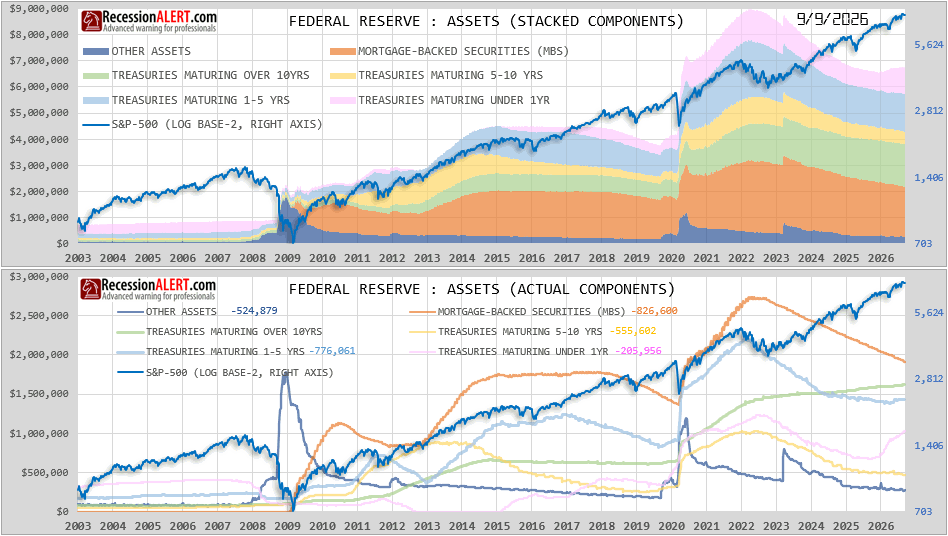
The Fed stopped shrinking its balance sheet last December and has been buying ever since — and what it is buying is the whole story. Total assets are $6.74tn, down from $8.97tn in 2022, and every dollar of the $351bn added over the past year is Treasury bills maturing inside twelve months. No long bonds, no mortgages; the mortgage book is $189bn smaller, while holdings maturing beyond ten years sit at their all-time peak, untouched by three years of runoff. This is plumbing, not stimulus. Banks keep a cushion of cash at the Fed, called reserves, to settle payments with each other, and it drains continuously: currency in circulation grows every year, and the Treasury pulls reserves out whenever it rebuilds the cash it parks there. Buying bills simply holds that cushion still. Reserves are near $3tn, about 9.2% of the economy — and the 10% often called a floor is a convention adopted after 2019, not the level where anything broke. In 2019 the cushion was 6.7% when overnight borrowing rates spiked and the Fed had to step in within days. What has changed is the buffer: money funds used to park spare cash at the Fed overnight, and that pool absorbed four years of tightening. It is empty now, and the $350bn still on that line is foreign central banks’ cash held for safekeeping. The next squeeze lands on reserves directly.
What it means: the three-year monetary headwind is gone. But bills do not push money into shares the way bond buying did, so expect support rather than a melt-up, and no relief on long-term borrowing or mortgage rates. That changes the day the Fed starts buying paper maturing beyond a year. It has bought none.
Market Intelligence Brief (MIB) Ver. 19.68
For professional investors only. Not investment advice.
© 2026 RecessionALERT.com

Comments are closed.