
MARKET INTELLIGENCE BRIEF (MIB)
Monday, September 21, 2026
Crude fell a fourth session, Brent slipping below $100 (-3.77%) as Saudi tankers massed in the Gulf and Iran relayed its Hormuz terms; the S&P 500 rose 1.49% to within 0.4% of its record. Intel (+12.17%), AMD (+9.95%) and Meta (+11.34%) lifted the Nasdaq 100 2.83%. Fed’s Musalem said more hikes are likely; the 2-year rose as the 10-year fell 4.2 bps. Paramount settled the states’ suit, sending WBD up 10.79%. Bitcoin jumped 7.57% to an eight-month high.
TABLE OF CONTENTS
A. EXECUTIVE SUMMARY
B. MARKET DATA
C. HIGH-IMPACT STORIES (7)
D. MODERATE-IMPACT STORIES (6)
E. ECONOMY WATCH (5)
F. EARNINGS WATCH (0)
G. WHAT’S NEXT
H. CHART OF THE DAY
A. EXECUTIVE SUMMARY -> TOP
The S&P 500 gained 1.49% to within 0.4% of its record and the Nasdaq 100 rose 2.83% as a fourth straight fall in crude let the 10-year yield ease 4.2 bps to 4.954%. The relief is diplomatic rather than physical: Iran has passed its Hormuz reopening conditions through mediators, yet only a dozen commodity vessels crossed the strait over the weekend and Treasury moves to shut Iranian airlines out worldwide on Wednesday. The front end did not join the rally — the 2-year rose 1.0 bp as Musalem, Kashkari and Goolsbee framed inflation as broad and demand-driven — so equities are pricing an end to the oil shock that the Fed is declining to price. Leadership was narrow: Communication Services (+3.45%) and Technology (+2.51%) did the work while Energy fell 2.09%, the NYSE Composite added only 0.37% and the Russell 2000 0.52%.
• Crude down, pump prices up: Brent fell 3.77% to $99.95 and WTI 4.36% to $91.89, dragging ExxonMobil down 3.20% and Chevron down 2.79% — but AAA gasoline rose to $4.48 (up 41% year over year) and GasBuddy diesel rose 30.7 cents on the week to $6.49.
• Fed stays hawkish after last week’s hike: Musalem said further rate increases are likely needed and Kashkari called inflation too high “in all aspects” of the economy; the 2-year rose 1.0 bp to 4.753% even as the Chicago Fed activity index slipped to -0.04.
• Chips and Meta lead: Intel rose 12.17%, AMD 9.95% and Qualcomm 9.28% with no dated catalyst; Meta rose 11.34% after Wells Fargo lifted its target to $796 ahead of Connect, even as Amazon blocked Meta’s Muse shopping agent.
• WBD +10.79%: Paramount Skydance settled the 12-state antitrust suit over its $111 billion takeover, pending court approval, in exchange for theatrical-output and US production commitments.
• Healthcare splits: Novo Nordisk’s ADR fell 7.96% on a peer-level 2026-2030 growth outlook, Moderna rose 12.27% on an ESMO Presidential Symposium slot, and after the close Commerce zero-rated eight specialty-drug categories from 19 jurisdictions ahead of the September 29 step-up to a 100% tariff.
• Bitcoin +7.57% to $87,248: its highest level since January, lifting Strategy 9.47%, while gold fell 1.03%.
1. Equities and the Fed are reading different inflation stories — The rally treats falling crude as the end of the inflation problem; three regional Fed presidents in two days said the opposite, locating price pressure in demand and in non-energy goods and services. The data side with the Fed for now: diesel rose 30.7 cents on the week and gasoline sits 41% above a year ago even as crude falls, which is the pass-through Musalem calls a commodity shock beyond oil. With the 2-year about 75 bps above the top of the new range, board-level remarks from Jefferson on Tuesday and Barr on Wednesday, plus Thursday’s jobless claims, decide whether October-hike pricing hardens underneath a market within 0.4% of its high.
2. Diplomacy is carrying risk assets, and it is running alongside escalation — Iran’s Hormuz conditions, Trump’s openness to meeting Pezeshkian at the UN and “constructive” US-China talks before Thursday’s Trump-Xi summit all lowered tail risk on Monday. But weekend Houthi strike claims on Saudi facilities are followed this week by a worldwide shutdown of Iranian airlines under secondary sanctions on Wednesday and a likely extension of Russia’s diesel export ban. Greer’s statement that chip export controls are unchanged also caps what the summit can deliver for the semiconductor names that led the day.
3. Momentum is outrunning catalysts — Meta’s 11% gain precedes Connect rather than following news, the chip rally has no dated trigger, Bitcoin’s move carries a short-squeeze profile, and CoreWeave and Nebius rose despite fresh Sell initiations. The S&P 500 has outpaced the Russell 2000 by about 4 points over ten sessions, so the index is leaning on a narrow, high-beta group heading into event risk from Connect on September 23-24 and the Thursday summit. A disappointment in either would hit the stocks that did the most work on Monday.
 — Leading economic indicators. Accurate market forecasts. Apply for membership at join.recessionalert.com
B. MARKET DATA -> TOP
Falling oil and easing Treasury yields revived risk appetite, lifting the S&P 500 to within 0.4% of its record and the Nasdaq Composite to a record close. The advance was led by technology and communication services: the Nasdaq 100 gained 2.83% against 0.71% for the Dow and 0.52% for the Russell 2000, while transports slipped. Energy was the only sector with a sizable decline as crude fell roughly 4%, and Intel and Meta each jumped more than 11%. Bitcoin’s surge to an eight-month high was the standout move outside equities, while gold slipped despite a lower 10-year yield.
CLOSING PRICES – Monday, September 21, 2026:
MAJOR INDICES
Mega-cap tech carried the tape: the S&P 500 has now outpaced the Russell 2000 by about 4 points over ten sessions (+0.60% vs -3.37%), a narrow-leadership signal that emerges today. The NYSE Composite’s +0.37% trailed the S&P’s +1.49%, and the Nasdaq 100 (+2.83%) closed back above 30,000 while the S&P and Dow reclaimed 7,700 and 52,000.
| Index | Close | Change | %Move | Why It Moved |
|---|---|---|---|---|
| S&P 500 | 7,764.70 | +114.20 | +1.49% | Oil and Treasury yields eased; AP has the index within 0.4% of its record. Communication services and technology led the sector table. |
| Dow Jones | 52,048.83 | +366.19 | +0.71% | Rose less than the S&P 500 and Nasdaq 100 on the same oil-and-yields easing (AP); no discrete same-day catalyst identified. |
| DJ Transportation | 19,970.90 | -108.20 | -0.54% | No discrete same-day catalyst identified; the index slipped while the broader tape rallied. |
| Nasdaq 100 | 30,482.35 | +838.18 | +2.83% | Chip-led: Intel +12.17%, AMD +9.95% and Meta +11.34% (see movers below). The Nasdaq Composite closed at a record, per Reuters and Barron’s headlines. |
| Russell 2000 | 2,875.36 | +14.96 | +0.52% | Rose far less than the Nasdaq 100; no discrete same-day catalyst identified. |
| NYSE Composite | 24,086.66 | +87.91 | +0.37% | Lagged the S&P 500 (+1.49%) with Energy (-2.09%) the session’s weakest sector. |
VOLATILITY & TREASURIES
VIX finished essentially unchanged near 14.9 despite the S&P 500’s 1.49% rally, so volatility did not compress with the advance. The 10-year fell 4.2 bps while the 2-year edged up 1.0 bp, narrowing the 2s10s spread to about 20 bps from about 24 bps Friday; the dollar firmed 0.17% alongside the lower long-end yield.
| Instrument | Level | Change | Why It Moved |
|---|---|---|---|
| VIX | 14.86 | +0.05 (+0.34%) | Little changed despite the S&P 500’s 1.49% rally; no discrete same-day catalyst identified. |
| 10-Year Treasury Yield | 4.954% | -4.2 bps | Eased as oil retreated; AP attributes the decline to easing oil concerns after last week’s move above 5% for the first time in three years. |
| 2-Year Treasury Yield | 4.753% | +1.0 bps | Edged higher while the 10-year fell; no discrete same-day catalyst identified. |
| US Dollar Index (DXY) | 100.43 | +0.17 (+0.17%) | Firmed despite the risk-on tape and a lower 10-year yield; no discrete same-day catalyst identified. |
COMMODITIES
Gold (-1.03%) and silver (-0.97%) slipped together while copper gained 1.33%, a split between the haven metals and the growth-sensitive one that fits the risk-on tape. Bitcoin’s 7.57% surge to an eight-month high outran every equity index, alongside a rally in crypto-linked stocks (AP has Coinbase and Robinhood up more than 4% in its afternoon tally).
| Asset | Price | Change | %Move | Why It Moved |
|---|---|---|---|---|
| Gold | $4,379.37/oz | $-45.53 | -1.03% | No discrete same-day catalyst identified; fell despite a lower 10-year yield, alongside a firmer dollar (DXY +0.17%). |
| Silver | $66.495/oz | $-0.654 | -0.97% | Moved with gold; no discrete same-day catalyst identified. |
| Copper | $6.7803/lb | $+0.0888 | +1.33% | Rose with the risk-on tape; no discrete same-day catalyst identified. |
| Platinum | $1,805.50/oz | $-0.90 | -0.05% | Little changed; no discrete same-day catalyst identified. |
| Bitcoin | $87,248 | $+6,142 | +7.57% | Reached an eight-month high above $85,000, its highest since January (AP). Coverage cites ETF inflows, regulatory signals and roughly $648M of short liquidations – aggregator-sourced, unverified. |
ENERGY
WTI (-4.36%) and Brent (-3.77%) fell together, with AP citing profit-taking after last week’s jump and some Middle East crude able to transit Hormuz. Dutch TTF’s 7.24% drop far outpaced Henry Hub’s 2.68%, though the TTF quote is stamped 11:50 ET and so reflects the European session rather than the US close.
| Asset | Price | Change | %Move | Why It Moved |
|---|---|---|---|---|
| Crude Oil (WTI) | $91.89/bbl | $-4.19 | -4.36% | Profit-taking after last week’s jump and some Middle East crude able to transit Hormuz (AP, on Brent). The source’s prior close of $96.08 differs from Friday’s $100.30 October settle (Rio Times); a contract-month roll is likely but unconfirmed. |
| Crude Oil (Brent) | $99.95/bbl | $-3.92 | -3.77% | Profit-taking after last week’s jump and some Middle East crude able to sail through the Strait of Hormuz (AP). |
| Natural Gas (Henry Hub) | $2.834/MMBtu | $-0.078 | -2.68% | No discrete same-day catalyst identified. |
| Natural Gas (Dutch TTF) | $24.83/MMBtu | $-1.94 | -7.24% | Fell alongside crude; no discrete same-day catalyst identified. Quote stamped 11:50 ET (European session). |
S&P 500 SECTORS
Seven of eleven sectors closed higher and four lower. Technology (+5.52% 1W, +6.13% 1M) extended its multi-week lead while Communication Services (+3.45%) topped the day; Energy (-2.09%) was the lone large decliner, its -2.84% week a pullback inside a +12.32% three-month advance.
| Sector | 1-Day | 1-Week | 1-Month | 3-Month | 6-Month | YTD | 12-Month |
|---|---|---|---|---|---|---|---|
| Communication Services | +3.45% | +1.51% | +6.82% | +5.69% | +10.48% | +3.97% | +6.00% |
| Technology | +2.51% | +5.52% | +6.13% | +3.77% | +39.05% | +29.57% | +32.13% |
| Consumer Cyclical | +1.42% | +0.22% | -3.45% | -0.24% | +6.15% | -6.28% | -8.25% |
| Real Estate | +0.93% | -0.82% | -5.33% | -2.98% | +5.70% | +5.12% | +0.51% |
| Financial | +0.52% | -1.31% | -0.34% | +3.92% | +17.49% | +5.91% | +8.85% |
| Healthcare | +0.49% | +0.69% | -2.39% | +10.10% | +15.59% | +8.21% | +20.78% |
| Industrials | +0.28% | +0.67% | -2.88% | -8.00% | +4.75% | +9.06% | +11.45% |
| Consumer Defensive | -0.14% | -2.23% | -2.06% | -1.13% | +0.40% | +4.50% | +3.26% |
| Utilities | -0.27% | -1.46% | -5.95% | -9.04% | -7.90% | -4.69% | -2.08% |
| Basic Materials | -0.39% | -0.26% | -4.47% | +0.45% | +12.00% | +14.01% | +25.98% |
| Energy | -2.09% | -2.84% | -1.87% | +12.32% | +3.58% | +36.25% | +37.27% |
TOP MEGA-CAP MOVERS:
GAINERS
| Company | Ticker | Close | Change | Why It Moved |
|---|---|---|---|---|
| Intel | INTC | $121.81 | +12.17% | Led the chip rally. Reported analyst actions: Tigress Financial raised its target to $145 from $118 and Northland upgraded to Outperform (single aggregator source). Earlier-reported SK Hynix fab talks and a planned CPU price increase remain in the background (dates unverified). |
| Meta Platforms | META | $741.24 | +11.34% | Wells Fargo raised its target to $796 from $640 (Overweight) ahead of the Sept. 23-24 Connect event; Meta also announced its Petal subsea cable Monday and the Muse AI agent is drawing attention. No single confirmed catalyst explains the full move. |
| Advanced Micro Devices | AMD | $615.52 | +9.95% | Rode the semiconductor rally led by Intel; no discrete same-day company catalyst identified. Piper Sandler and Stifel reportedly maintained positive ratings (aggregator). |
| Qualcomm | QCOM | $194.21 | +9.28% | No discrete same-day catalyst identified; continuation of the re-rating since the Sept. 8 Amazon/AWS agreement, amid the chip rally. |
| Marvell Technology | MRVL | $257.38 | +5.38% | Chip rally; the company said it will showcase 2nm optical interconnect technology at ECOC 2026, a modest catalyst that does not by itself explain the move. |
DECLINERS
| Company | Ticker | Close | Change | Why It Moved |
|---|---|---|---|---|
| ExxonMobil | XOM | $158.30 | -3.20% | Crude fell (Brent -3.77%) and Energy was the session’s weakest sector at -2.09%. |
| Chevron | CVX | $203.67 | -2.79% | Crude fell (Brent -3.77%) and Energy was the session’s weakest sector at -2.09%. |
| Berkshire Hathaway (Class B) | BRK-B | $502.01 | -1.52% | No discrete same-day catalyst identified; follows the Sept. 18 announcement that Warren Buffett is stepping back as chairman (attribution by aggregators, unverified). |
— Institutional-grade intelligence for serious investors. Apply for membership at join.recessionalert.comC. HIGH-IMPACT STORIES -> TOP
BULLISH
1. Crude Falls a Fourth Straight Session and Brent Slips Below $100 as Saudi Gulf Loadings Jump and Iran Sends Its Hormuz Conditions to Washington
The core facts:Brent fell 3.77% to $99.95 and WTI 4.36% to $91.89, the fourth consecutive decline for both benchmarks (Phase 1 notes WTI’s change is measured against a prior close that points to a contract-month roll). Satellite imagery reported by Bloomberg on Monday showed supertankers with capacity to lift about 14 million barrels at Saudi Gulf terminals over the weekend, the highest Saudi Gulf loadings since at least June, as Aramco shifts exports back through the Strait of Hormuz; that figure is loading capacity, not confirmed volume. On Sunday Iran’s parliament speaker Ghalibaf said Tehran’s conditions for reopening the strait, including an end to the war on all fronts, release of frozen funds and an end to the US naval blockade, had been “clearly conveyed to the other party through mediators,” and President Trump told Fox he is open to meeting Iranian President Pezeshkian at the UN General Assembly. The supply risks did not disappear: the Houthis claimed missile and drone strikes on Riyadh and Aramco’s Yanbu facility overnight into Saturday (the Saudi-led coalition says it intercepted them, and there is no Saudi or Aramco damage statement), and Ukraine’s largest drone attack of the year set Gazpromneft’s Moscow refinery on fire.
Why it matters:Oil is the variable the rate market has been trading for a month, and its retreat did the heavy lifting on Monday: the 10-year yield fell 4.2 bps to 4.954%, which AP attributes to easing oil concerns, while Energy was the weakest S&P sector at -2.09% with ExxonMobil -3.20% and Chevron -2.79%. But the diplomacy is conditional and the physical flows are still thin — OilPrice counted only 12 commodity vessels crossing Hormuz over the weekend against 35 a week earlier — so the move prices a path to reopening, not a reopening. Relief also has not reached the pump (see Section E), which is why the Fed commentary in story 2 does not treat lower crude as the end of the inflation problem.
What to watch:Pakistan’s interior minister Naqvi is due in Tehran on Tuesday, September 22, as UNGA high-level week opens; a Brent close back above $100 would signal the market has stopped pricing a reopening.
BEARISH
2. Fed’s Musalem Says More Rate Hikes Are Likely Needed as Kashkari Calls Inflation Too High “in All Aspects” of the Economy
The core facts:St. Louis Fed President Alberto Musalem told Reuters in an interview on Monday that the Fed will likely need to raise rates further to lower inflation driven by strong demand and a commodity shock that has moved beyond oil: “without further policy restraint on inflation it is more likely to be substantially above our 2% target in 18 months than at target.” He said firms are “reporting sharply higher non-labor input costs,” but that tighter policy need not raise unemployment, describing the job market as “stable and balanced and around full employment.” On Sunday, Minneapolis Fed President Neel Kashkari, a 2026 voter who backed last week’s hike to 3.75%-4.00%, told Fox’s “Sunday Morning Futures” that “even if we strip out energy … and strip out food … inflation is still too high,” adding: “It’s in all aspects of the economy.” Chicago Fed President Goolsbee’s same-day warning on overheating demand is covered in Section E.
Why it matters:Three regional presidents over two days framed inflation as broad and demand-driven rather than an oil story, which directly contests the market’s reading of falling crude as a reason for the tightening cycle to stop. The front end took the message even as the long end rallied: the 2-year yield rose 1.0 bp to 4.753% while the 10-year fell 4.2 bps, narrowing the 2s10s spread to about 20 bps. Equities ignored it, and that gap between the rate path the Fed is describing and the one equities are pricing is the risk to carry into the week.
What to watch:Vice Chair Jefferson speaks at the NY Fed Treasury Market Conference on Tuesday at 10:20 ET and Governor Barr on Wednesday; board-level endorsement of “further restraint” would harden October-hike pricing.
BULLISH
3. Paramount Skydance Settles the 12-State Antitrust Suit, Clearing the Last Legal Block on Its $111 Billion Warner Bros. Discovery Takeover — WBD Jumps 10.79%
The core facts:California Attorney General Rob Bonta announced on Monday that Paramount Skydance has settled the antitrust suit brought by a 12-state coalition over its acquisition of Warner Bros. Discovery; the settlement requires court approval. Paramount must release 30 films a year theatrically in years one and two (at least 20 wide) and 32 in years three to five (at least 21 wide), including at least four independent films a year, with $30 million per missed film payable to union health and retirement funds. It also commits at least $1.5 billion of added US production over five years, a $47.5 million workforce fund, a $25 million independent film fund and a compliance monitor. Bonta said “this settlement is not a vote of support for this merger.” The case had been set for trial in March, which would have left the deal in limbo into mid-2027. Warner Bros. Discovery closed at $30.80, up 10.79%.
Why it matters:A $111 billion media merger moves from a litigated outcome to a near-certain close, collapsing WBD’s merger-arbitrage spread and ending a year-long overhang. The price of clearance is behavioral: fixed theatrical output and production spending commitments constrain the cost synergies a combined studio would otherwise pursue, so the settlement is better news for WBD holders taking the offer than for the combined company’s margin story. It also sets a template in which state attorneys general, not federal antitrust enforcers, extract conduct remedies on a mega-deal.
What to watch:Court approval of the settlement, and David Ellison’s indication to Deadline that the deal could close in approximately two weeks.
BULLISH
4. US and Chinese Negotiators Call New York Talks “Constructive” Ahead of Thursday’s Trump-Xi Summit, Moving to Operationalize Tariff Cuts on Non-Sensitive Goods
The core facts:Chinese Vice Premier He Lifeng met Treasury Secretary Scott Bessent and Trade Representative Jamieson Greer in New York on Sunday. China’s Xinhua described “candid, in-depth and constructive exchanges” and “dialogues on AI-related issues”; Bessent said on X that “these talks help lay the groundwork for President Trump to advance America’s economic interests.” Per NBC, both sides agreed to put into operation the Board of Trade announced at Trump’s May visit to Beijing and discussed tariff cuts on “non-sensitive” goods, and the US proposed a mechanism for notifying national-security-level AI incidents. Greer said the AI talks do not change advanced-chip export controls. The current tariff truce expires November 10, with an extension under negotiation; Chinese farm purchases and Boeing orders remain unresolved. Xi’s state visit runs September 23-25, with the summit at the White House on Thursday, September 24.
Why it matters:A constructive pre-summit readout lowers the tail risk of the truce lapsing on November 10 into a renewed tariff escalation, which is the trade scenario US multinationals and the semiconductor supply chain are most exposed to. The substance so far is modest — low-tech Chinese consumer goods against US energy, agriculture and medical devices — and Greer’s statement that chip export controls are unchanged caps the upside for the semiconductor names that led Monday’s rally (story 5). Aggregators linked Monday’s risk appetite partly to the talks; that connection is not established.
What to watch:Whether Thursday’s summit produces a dated truce extension beyond November 10, and any movement on China’s rare-earth export-control reprieve, which expires November 20.
BULLISH
5. Intel Jumps 12.17% to Lead a Chip Rally, With AMD and Qualcomm Each Up More Than 9%, as the Nasdaq 100 Gains 2.83%
The core facts:Intel rose 12.17% to $121.81, Advanced Micro Devices 9.95% to $615.52, Qualcomm 9.28% to $194.21 and Marvell 5.38% to $257.38, while Nvidia added 2.24%. Arm Holdings, which trades in the US as an ADR, closed 17.16% higher at $322.90. Technology rose 2.51% and is up 5.52% over the past week. The Nasdaq 100 gained 2.83%, against 0.71% for the Dow and 0.52% for the Russell 2000, and Reuters and Barron’s reported a record close for the Nasdaq Composite. No single dated catalyst explains the move: Intel has been supported by earlier reports that SK Hynix may use its planned Ohio fab and that it plans CPU price increases of up to 10% in October, neither of which is dated to Monday, and no discrete company catalyst was identified for AMD or Qualcomm.
Why it matters:This was a rates-and-risk-appetite rally concentrated in the highest-beta part of the market, not a broad advance: the S&P 500 has outpaced the Russell 2000 by about 4 points over ten sessions, and the NYSE Composite rose only 0.37%. Chip leadership rests on pricing power and AI demand narratives that remain intact, but a rally with no dated catalyst is exposed to the two risks in stories 2 and 4 — a Fed that is not finished tightening and a China summit that has already ruled out any change to export controls.
What to watch:The Philadelphia Semiconductor Index’s reaction to Thursday’s Trump-Xi summit, and confirmation of Intel’s October CPU price increase.
BULLISH
6. Meta Jumps 11.34% as Wells Fargo Lifts Its Target to $796 Ahead of Connect — While Amazon Blocks Meta’s Muse Shopping Agent
The core facts:Meta closed at $741.24, up 11.34%, the second-largest gain among $200 billion-plus US names on Monday. Wells Fargo raised its price target to $796 from $640 with an Overweight rating, valuing the stock at 25 times 2027 earnings ahead of Meta’s Connect event on September 23-24. Meta also announced “Petal,” a roughly 7,000 km, 1-petabit-per-second France-US subsea cable built with NEC and Sumitomo Electric and due in service in 2029. Separately, Amazon cut off Meta’s Muse AI agent from shopping on Amazon.com late Sunday, telling users that “continued access by an unauthorized AI agent violates Amazon’s Conditions of Use”; Amazon says Meta did not disclose that Muse would access its store and that it is “in direct conversation with Meta.” Communication Services led the sector table at +3.45%, and Amazon itself rose 1.87%.
Why it matters:No single confirmed catalyst explains a move of this size, which makes it a positioning trade into Connect: investors are paying up in advance for evidence that Meta’s AI spending is producing products, and Muse is the first of them to reach real commerce. Amazon’s block puts two mega-caps in open conflict over whether an AI agent or the retail platform controls the checkout, and the outcome will shape how much of agentic commerce any single assistant can capture.
What to watch:Meta’s Connect keynote on September 23-24, and whether Amazon pursues legal action over Muse; a Connect that disappoints would leave an 11% pre-event gain exposed.
BULLISH
7. Bitcoin Surges 7.57% to $87,248, an Eight-Month High, Lifting Strategy 9.47%
The core facts:Bitcoin rose $6,142, or 7.57%, to $87,248, which AP describes as its highest level since January. It is also the highest close in MIB’s own price record, which begins in mid-April, clearing the prior high of $81,852 set on May 11. Crypto equities followed: Strategy closed 9.47% higher at $168.50 and Coinbase 3.50% higher at $201.05. No dated catalyst has been established; coverage cites ETF inflows, favorable regulatory signals and roughly $648 million of short liquidations, all from aggregators and unverified.
Why it matters:Bitcoin outran every equity index on the day, and it diverged sharply from gold, which fell 1.03% despite a lower 10-year yield — a split that marks this as a risk-appetite move rather than a debasement hedge. A move to fresh highs without an identifiable catalyst and with short liquidations cited as a driver is the profile of a squeeze, which tends to reverse faster than flow-driven advances.
What to watch:Whether Bitcoin holds above $85,000, and daily spot-ETF flow data to test the inflow explanation.
— Quantifying recession risk so you don’t have to guess. Apply for membership at join.recessionalert.comD. MODERATE-IMPACT STORIES -> TOP
BEARISH
8. Novo Nordisk Falls 7.96% as Its Capital Markets Day Promises New Blockbusters by 2030 but Only Peer-Level Growth
The core facts:At its capital markets day in London on Monday, Novo Nordisk said it aims to launch more than five new medicines with blockbuster potential by 2030 and to generate more than DKK 150 billion (about $23 billion) in pipeline sales by 2035, framing both as strategic ambitions rather than formal guidance. It expects revenue growth from 2026 to 2030 to be consistent with industry peers, with a broadly stable operating margin. Executives faced sustained questioning on pricing power and dealmaking ahead of patent expiries, and the US-listed ADR closed at $39.80, down 7.96%, after the Copenhagen shares fell as much as 9% intraday. “Investors hoped for a project ‘miracle’ that could turn the momentum around short term,” Nordnet’s Per Hansen told CNBC.
Why it matters:“Growth in line with peers” is a concession from the company that defined the GLP-1 market, and it confirms that obesity-drug pricing, not volume, now sets the trajectory for the category. That matters for US portfolios through the obesity trade’s other leg and through US healthcare budgets: a market leader guiding to ordinary growth is a signal that net prices are falling faster than patients are being added.
What to watch:Whether sell-side estimates for 2027-2030 are cut toward the peer-level framework over the coming week.
BULLISH
9. Moderna Jumps 12.27% as Its Personalized Cancer Vaccine Wins an ESMO Presidential Symposium Slot
The core facts:Moderna closed at $172.94, up 12.27%, after announcing on Monday that three abstracts on intismeran autogene, its individualized mRNA neoantigen therapy developed with Merck, were accepted for the ESMO Congress in Madrid on October 23-27. Late-breaking Phase 3 data from INTerpath-001, testing intismeran plus Keytruda against Keytruda alone as adjuvant treatment for resected melanoma, will be presented at a Presidential Symposium on October 24, with pancreatic and non-small cell lung cancer posters alongside. No new efficacy data were released on Monday; the trial’s success on its endpoints was announced in August.
Why it matters:Presidential Symposium placement is reserved for results organizers judge practice-changing, so the market is treating it as a signal about the size of the effect before the numbers are public. For Moderna, oncology is now the core of the investment case; for Merck it would extend Keytruda’s franchise into combination use ahead of the drug’s patent expiry.
What to watch:The October 24 presentation and Moderna’s same-day investor webcast.
UNCERTAIN
10. Rothschild & Co Redburn Starts CoreWeave and Nebius at Sell and Equinix at Buy, Saying the Credit Market Is “Sending the More Important Signal”
The core facts:Rothschild & Co Redburn initiated coverage of the AI infrastructure complex on Monday, starting CoreWeave at Sell with a $54 target and Nebius at Sell with an $84 target, citing the sustainability of unit economics and demanding valuations. It started Equinix at Buy with a $1,261 target, calling traditional data-center REITs “underappreciated second-derivative beneficiaries” of the AI buildout, and put several AI-pivoting bitcoin miners at Neutral. Both neoclouds closed higher regardless: CoreWeave rose 5.00% to $85.43 and Nebius 4.14% to $232.80, while Equinix gained 3.52% to $1,057.32.
Why it matters:The note’s core argument is that credit markets are already pricing risks equities ignore, and it lands days after CoreWeave had to price its upsized convertible at the expensive end of its ranges. Sell initiations that fail to move the stocks on a strong tape show how much momentum is carrying the group, but they also set a public valuation anchor that will matter the first time AI-infrastructure credit spreads widen.
What to watch:Trading in CoreWeave’s new convertible after it settles on September 22, as a direct read on the credit signal Redburn cites.
UNCERTAIN
11. Bessent Says All Iranian Airlines Will Be “Shut Down Around the World” on September 23 Under Secondary Sanctions
The core facts:Treasury Secretary Scott Bessent said in a CNBC interview on Monday that on September 23 all Iranian airlines will be shut down worldwide: “If they land, you cannot provide them with fuel. You cannot provide them with landing services, you cannot sell them tickets, or you will be knocked out of the dollar system.” The US sanctioned all remaining Iranian airlines earlier this month, along with firms outside Iran supporting its aviation sector. In the same interview Bessent said that once the conflict ends, oil markets should be better supplied than before “and rates should come down.”
Why it matters:Enforcing sanctions against third-country fuel suppliers and airports raises compliance exposure for airlines, fuel handlers and banks in the Gulf and Asia, and it tightens pressure on Tehran in the same week Iran has passed its conditions for reopening Hormuz through mediators (story 1). It is a reminder that the administration is running escalation and negotiation in parallel, which is why oil’s diplomatic relief rally remains fragile.
What to watch:Treasury guidance or designations on or around Wednesday, September 23, and any Iranian retaliation threat tied to them.
BULLISH
12. Commerce Names 19 Jurisdictions Whose Specialty Drugs Qualify for a Zero Rate Under the Section 232 Pharmaceutical Tariff, Ahead of the September 29 Step-Up to 100%
The core facts:The Commerce Department’s Bureau of Industry and Security filed a Federal Register notice for public inspection at 16:15 ET on Monday, after the close, naming 19 jurisdictions whose specialty drugs qualify for a zero rate under the Section 232 pharmaceutical tariff. The zero rate covers eight categories: orphan drugs, nuclear medicines, plasma-derived products, fertility treatments, cell and gene therapies, antibody-drug conjugates, chemical, biological, radiological and nuclear countermeasures, and animal health. The jurisdictions include the EU, Japan, Korea, Switzerland and Liechtenstein, the UK, India and Taiwan. A new heading zero-rates clinical-trial and R&D products, and the notice restates that generics are not covered. The notice publishes on September 23; the tariff steps up to 100% for non-designated companies on September 29.
Why it matters:With the 100% rate eight days away, the notice defines which high-value, low-volume therapies escape it, and it spares exactly the categories — rare-disease, cell and gene therapy, ADCs — where European and Japanese manufacturers supply the US market and substitution is hardest. It narrows the tariff’s practical reach and removes a supply risk for US hospitals and specialty distributors, though the filing landed after the close and has not yet been priced.
What to watch:The Federal Register publication on September 23 and the September 29 step-up date for companies without a designation.
BEARISH
13. Russia Is Set to Extend Its Diesel Export Ban Beyond September as US Diesel Climbs to $6.49 a Gallon
The core facts:Russia is set to extend its ban on most diesel exports beyond the end of September, Bloomberg reported on Monday, citing people familiar who said there is “an understanding that the ban will be extended” for a month or more; no decree has been issued. The report came a day after Ukraine’s drone attack set Gazpromneft’s Moscow refinery on fire. In the US, GasBuddy’s weekly survey put the national average diesel price at $6.490 a gallon, up 30.7 cents on the week, with Great Lakes prices up more than 30 cents on refinery outages.
Why it matters:Diesel is the fuel for freight, farming and construction, so a tighter global distillate market feeds directly into goods prices and transport costs even while crude falls. The divergence — crude down four straight sessions, diesel up sharply on the week — is exactly the non-oil, pass-through inflation the Fed officials in story 2 are describing, and the Dow Jones Transportation Average fell 0.54% on a day the broad market rallied.
What to watch:A formal Russian government decree on the extension, and next week’s EIA distillate inventory data.
— Separating signal from noise since 2007. Apply for membership at join.recessionalert.comE. ECONOMY WATCH -> TOP
The Fed’s first hike since 2023 has not softened its message: Chicago’s Goolsbee said there is “no ambiguity” about the response if demand overheats, and Kansas City’s Schmid said inflation excluding energy “has also been running hot.” Activity is cooling underneath, with the Chicago Fed’s national activity index slipping to -0.04 as production turned negative, while gasoline at $4.48 is up 41% from a year ago and adding to household strain. Markets are splitting the difference: the 10-year eased to 4.954% but the 2-year held near 4.75%, narrowing the curve to about 20 bps. The tension is a hawkish Fed facing softening activity and an energy-driven price shock.
Chicago Fed National Activity Index Slips to -0.04 in August as Production Turns Negative (Chicago Fed, Sept 21)
What they’re saying:The Chicago Fed National Activity Index fell to -0.04 in August from an upwardly revised +0.08 in July, indicating growth slightly below its historical trend. Production-related indicators swung to -0.07 from 0.00, and sales, orders and inventories dropped to 0.00 from +0.15, while employment (+0.01, from -0.01) and personal consumption and housing (+0.01, from -0.06) improved. The three-month moving average rose to +0.01 from -0.01.
The context:The production drag echoes Friday’s Federal Reserve industrial production report, which showed output flat in August and manufacturing down 0.3%. The reading also sits against a strong nowcast: the Atlanta Fed’s GDPNow put third-quarter growth at 5.1% as of September 17. The economic calendar carried no consensus for the index, and the move from July is small, with the improving three-month average keeping this from reading as a break in trend.
What to watch:Friday’s August durable goods orders (8:30 AM ET; headline expected -0.3% vs +1.1% prior, ex-transportation +0.6% vs +0.4%) and the final September Michigan sentiment reading (10:00 AM ET; 47.5 expected vs 51.7 prior) will test whether the softening in production spreads to demand.
Fed’s Goolsbee: Strong Demand May Be Adding to Inflation, “No Ambiguity” on Response if Demand Overheats (Reuters, Sept 21)
What they’re saying:Chicago Fed President Austan Goolsbee said U.S. inflation may now be driven by strong demand on top of the tariff and energy shocks of the past 18 months, telling an OMFIF event that “If demand overheats, there is no ambiguity about how the Fed needs to respond.” He described supply shocks as “spilling out of its own lane and raising aggregate output beyond what the economy can absorb,” and said “In environments like that, the only way back is the hard way,” meaning higher rates with risks to growth and employment. Reuters put inflation at 3.7% (July estimate).
The context:Goolsbee is not a voter this year and did not comment on last week’s quarter-point increase to 3.75%-4.00% or offer his own policy view, so the remarks are a framework rather than a signal of dissent. Markets are already leaning the same way: the 2-year Treasury yield closed at 4.753%, about 75 bps above the top of the new range, a level consistent with further hikes being priced, and Polymarket puts the odds of at least one rate cut in 2026 at 4%.
What to watch:Fed speakers on the calendar include Williams (Tuesday 10:05 AM ET), Jefferson (Tuesday 10:20 AM), Barr (Wednesday 10:05 AM) and Hammack (Thursday 8:50 AM and Friday 2:00 PM), and whether any of them echoes the demand-overheating framing.
Kansas City Fed’s Schmid Backs September Hike, Says Inflation Excluding Energy Is “Running Hot” (Kansas City Fed remarks, Sept 18)
What they’re saying:In prepared remarks in Vail, Colorado, Kansas City Fed President Jeff Schmid said “The Fed has work to do on inflation and this week’s action was a step in that direction.” He said inflation excluding energy “has also been running hot,” with “a broad range of goods and services” showing price growth inconsistent with the Fed’s price stability mandate, and described the labor market as “appearing in balance” and growth as “solid.” He added that he “probably would have supported a hike back in July,” when the committee voted 9-3 to hold.
The context:The September 16 increase was unanimous and the first since 2023, and Schmid’s view that price pressure extends beyond oil weakens the case that the tightening is a one-off response to energy. The committee’s projections point to one more increase in 2026, and Polymarket puts the odds of at least one rate cut in 2026 at 4%.
What to watch:Thursday’s initial jobless claims (8:30 AM ET; 203K expected vs 196K prior) will test his description of a labor market “appearing in balance,” and Hammack (Thursday 8:50 AM ET, Friday 2:00 PM), one of the July hike dissenters, speaks twice this week.
U.S. Gasoline Reaches $4.48 a Gallon, Up 16 Cents in a Week and 41% From a Year Ago (AAA, Sept 21)
What they’re saying:AAA’s national average for regular gasoline was $4.4786 a gallon on September 21, against $4.3163 a week ago, $4.1092 a month ago and $3.1834 a year ago. That is a gain of about 16 cents in a week, 37 cents in a month and 41% year over year, leaving the price about 11% below the June 2022 record of $5.0165.
The context:Crude reversed lower today, with WTI down 4.36% to $91.89 a barrel and Brent down 3.77% to $99.95, yet the pump average moved less than a quarter of a cent from Sunday’s $4.4761. Energy is one strand of the inflation debate, since Schmid said inflation excluding energy is running hot and Goolsbee said demand may now be adding to inflation, while household sentiment is already weak, with the final September Michigan reading forecast at 47.5 against a prior 51.7.
What to watch:Tuesday’s API crude stocks (4:30 PM ET; prior +7.14M), Wednesday’s EIA gasoline stocks (10:30 AM ET; prior +0.794M) and crude stocks (prior -0.64M), and Friday’s final September Michigan sentiment (10:00 AM ET; 47.5 expected vs 51.7 prior).
10-Year Treasury Yield Eases to 4.954% as 2s10s Curve Narrows to About 20 bps (Treasury market close, Sept 21)
What they’re saying:The 10-year Treasury yield fell 4.2 bps to 4.954% on Monday while the 2-year edged up 1.0 bp to 4.753%, narrowing the 2s10s spread to about 20 bps from about 24 bps on Friday. CNBC reported that the benchmark touched 5.041% last week. The move came as WTI crude fell 4.36% to $91.89 a barrel and Brent fell 3.77% to $99.95.
The context:The 2-year sits about 75 bps above the top of the Fed’s new 3.75%-4.00% target range, consistent with further hikes being priced, while the long end eased with oil. A flatter curve is typically read as the market pricing tighter policy against slower long-run growth, which fits the hawkish tone from Goolsbee and Schmid alongside the softer activity data.
What to watch:Thursday’s initial jobless claims (8:30 AM ET; 203K expected vs 196K prior), Wednesday’s EIA crude stocks (10:30 AM ET) for the oil leg, and Friday’s durable goods orders (8:30 AM ET; headline -0.3% expected vs +1.1% prior) as the next hard data with the 2-year near 4.75%.
— Know the probability before the market prices in the risk. Apply for membership at join.recessionalert.comF. EARNINGS WATCH -> TOP
YESTERDAY AFTER THE BELL (Markets Reacted Today)
No major earnings yesterday after the bell from companies with >$100B market cap.
TODAY BEFORE THE BELL (Markets Already Reacted)
No major earnings before the bell from companies with >$100B market cap.
TODAY AFTER THE BELL (Markets React Tomorrow)
No major earnings after the bell from companies with >$100B market cap.
WEEK AHEAD PREVIEW:
Q3 2026 earnings season has barely begun (0.6% of the S&P 500 reported), and only one company above $100 billion reports over the next five business days.
Costco Wholesale (COST) — AMC, Thursday, September 24 — consensus EPS $6.53; the first mega-cap consumer read of the quarter. Key focus: comparable sales excluding gasoline, since pump prices near $4.48 a gallon inflate headline comps, alongside membership renewal rates and how much tariff and freight cost the company is passing through to shelf prices.
The next S&P 500 scorecard update from FactSet is due September 25; the bulk of Q3 reporting begins in mid-October with the large banks.
— US market commentary trusted by family offices and institutions. Apply for membership at join.recessionalert.comG. WHAT’S NEXT -> TOP
UPCOMING RELEASES:
| Date | Event | Why It Matters |
|---|---|---|
| Tue, Sep 22 | Fed speakers: Williams (10:05 AM ET), Vice Chair Jefferson (10:20 AM ET), Barkin (1:00 PM ET) | First board-level read after Musalem, Kashkari and Goolsbee framed inflation as broad and demand-driven; an endorsement of further restraint would harden October-hike pricing |
| Tue, Sep 22 | API Crude Oil Stock Change, 4:30 PM ET (prior +7.14M) | First inventory read after crude’s four-session slide; tests whether the Hormuz relief is showing up in physical supply |
| Wed, Sep 23 | Fed Governor Barr Speech, 10:05 AM ET | Second board voice of the week on whether last week’s hike to 3.75%-4.00% is the last |
| Wed, Sep 23 | EIA Crude (prior -0.64M) and Gasoline Stocks (prior +0.794M), 10:30 AM ET | Gasoline at $4.48 has not followed crude lower; a gasoline draw would support the pump-price pass-through the Fed is flagging |
| Wed, Sep 23 | Worldwide shutdown of Iranian airlines under US secondary sanctions takes effect (per Treasury Secretary Bessent) | Escalation running alongside Hormuz diplomacy; any Iranian retaliation threat would test Brent’s move back below $100 |
| Thu, Sep 24 | Trump-Xi summit at the White House | A dated extension of the November 10 tariff truce is the prize; chip export controls are off the table per Greer, capping semiconductor upside |
| Thu, Sep 24 | Initial Jobless Claims, 8:30 AM ET (expected 203K, prior 196K); Fed Hammack Speech, 8:50 AM ET | Tests the balanced labor market Musalem and Schmid both describe, which they are using to justify tightening without job losses |
| Thu, Sep 24 | New Home Sales Aug, 10:00 AM ET (expected 0.62M, prior 0.607M) | Housing’s response to a 10-year near 5% and 30-year mortgage rates near 7% |
| Fri, Sep 25 | Durable Goods Orders Aug, 8:30 AM ET (headline expected -0.3%, prior +1.1%; ex-transportation expected +0.6%, prior +0.4%) | Tests whether the production softness in the Chicago Fed index (-0.04) is spreading to demand |
| Fri, Sep 25 | Michigan Consumer Sentiment Final Sep, 10:00 AM ET (expected 47.5, prior 51.7) | Household strain from $4.48 gasoline; inflation expectations inside the report matter to a Fed focused on demand |
| Tue, Sep 29 | Section 232 pharmaceutical tariff steps up to 100% for non-designated companies | Monday’s after-close zero-rate list for 19 jurisdictions has yet to be priced; generics are not covered |
KEY QUESTIONS:
1. Will Jefferson on Tuesday or Barr on Wednesday endorse the “further restraint” three regional presidents called for, and can an S&P 500 within 0.4% of its record hold if October-hike pricing hardens?
2. Does Thursday’s Trump-Xi summit deliver a dated truce extension beyond November 10 — and with export controls ruled out, how much upside is left in chips after Monday’s 9-12% gains in Intel, AMD and Qualcomm?
3. Can Brent stay below $100 once the Iranian airline shutdown takes effect on Wednesday, and will gasoline and diesel finally start following crude lower?
— US market commentary trusted by family offices and institutions. Apply for membership at join.recessionalert.comH. CHART OF THE DAY -> TOP
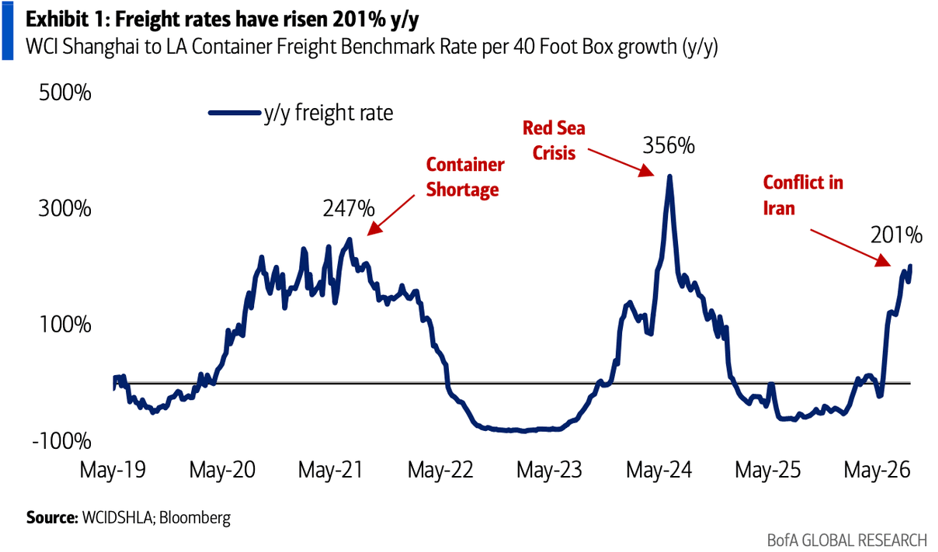
The Iran war raised the cost of moving a box everywhere, but it did not decide who pays most. Ship fuel is up 66% since the eve of the war, to $901.50 a tonne, and carriers recover it through surcharges on every route. Yet a 40-foot box from Shanghai to Los Angeles now costs $7,712 on the spot market, the rate an uncontracted box pays. That is more than twice the $3,626 to Rotterdam, on roughly half the voyage. Last week Los Angeles rose 5% while Rotterdam fell 9%, as services drift back through Suez into weak European demand. If the war were setting prices, the long European route would pay most, and a cost every lane pays cannot explain a gap between lanes. Pricing power does. Carriers cut Asia-to-US East Coast capacity 9% in August. They have also announced nine blank sailings, which are voyages cancelled to tighten supply, for the week before China’s Golden Week. They did it into US demand that has barely flinched: August imports were the third-highest month on record. Expensive freight at near-record volume is a spending economy paying up, not a recession signal. The bill reaches importers through spot bookings and surcharges, so either retailer margins thin or core goods prices firm into early 2027. The test comes after 7 October. If rates hold while sailings stay cancelled, the premium belongs to the carriers, not the calendar.
What it means: shipping goods from Asia costs more, so store chains that import heavily face a holiday-season choice — accept thinner profits or raise prices. Smaller importers that book shipping week to week feel it first; big retailers move much of their cargo on annual contracts. If US import volumes start to fall, carriers lose their leverage and these rates should follow.
Market Intelligence Brief (MIB) Ver. 19.70
For professional investors only. Not investment advice.
© 2026 RecessionALERT.com

Comments are closed.