
Trump confirmed Apple will build chips at Intel’s foundry, sending SOX up 6% to a record and INTC +10.6% — AI hardware is now rate-cycle-agnostic as Nasdaq gained 2.48% on the day Warsh signaled a 2026 rate hike. Gold plunged 3.51% and silver 7.05% as Iran MOU execution unwound two risk premiums simultaneously. Accenture collapsed 16-18% on a guidance cut, crystallizing AI’s bifurcation: hardware thrives while IT consulting implodes. Housing starts plunged 15.4% in May; Philly Prices Paid surged to 53.2.
TABLE OF CONTENTS
A. EXECUTIVE SUMMARY
B. MARKET DATA
C. HIGH-IMPACT STORIES (5)
D. MODERATE-IMPACT STORIES (6)
E. ECONOMY WATCH (5)
F. EARNINGS WATCH (0)
G. WHAT’S NEXT
H. CHART OF THE DAY
A. EXECUTIVE SUMMARY -> TOP
Thursday’s dual narrative — AI hardware rerate and geopolitical de-risk — arrived simultaneously with Warsh’s hawkish FOMC debut, creating a rare dynamic where risk assets rallied despite tighter monetary signals. The Apple-Intel foundry deal reanchors US semiconductor reshoring as a structural policy trade; institutional money is now treating AI infrastructure capex as rate-cycle-agnostic, discounting Warsh’s hike risk against the earnings trajectory of the AI hardware complex. Meanwhile, Iran MOU execution extracted geopolitical premium from energy and precious metals simultaneously — gold’s 3.51% decline and silver’s 7.05% plunge represent the unwinding of two distinct risk premiums (rate-hedge + geopolitical safe-haven) in a single session. The breadth verdict: Technology (+2.98%) and Consumer Cyclical (+1.57%) led; Energy (−1.38%) and Basic Materials (−1.11%) declined on dollar strength, leaving 5 of 11 sectors negative — a theme-driven day, not a macro risk-on advance.
• SOX +6% to record; INTC +10.6%, SNDK +11.5%, MU +8.7%: Trump confirmed Apple will use Intel’s foundry for domestic chip production — the most significant US semiconductor reshoring validation since the CHIPS Act. AMD blowout earnings provided a dual catalyst; AI hardware capex is now pricing as rate-cycle-agnostic.
• Warsh FOMC hawkish debut: Rates held at 3.50–3.75% but dot plot now signals majority-favored 2026 hike (66% September probability); VIX −11% as leadership-transition uncertainty resolved; dollar +0.73% confirmed hawkish read. Short-end 2Y +2 bps; long-end 10Y −1 bps — bond market not confirming equity rally.
• Gold −3.51%, silver −7.05%, platinum −5.38%: Dual risk-premium unwind — hawkish Fed removes rate-hedge appeal; Iran MOU removes geopolitical safe-haven demand. Both premiums extracted in a single session; GDX miners face compounding operational leverage pressure.
• Accenture −16–18%, IBM −5.05%: ACN cut FY26 revenue growth guidance to 3–4%; new bookings −2% signals AI is cannibalizing consulting pipelines faster than AI deal revenue scales. The hardware-vs-services bifurcation is now in the P&L — Infosys, Wipro, and Cognizant face the same structural dynamic.
• Energy sector −1.38% (weekly −5.96%): WTI $76.58 at 3-month low as Iran Strait of Hormuz reopens; first tanker re-transits underway; E&P valuation models built on $85–90 oil assumptions require immediate revision. IEA projects 5 mb/d surplus in 2027.
• Housing starts −15.4% in May; Philly Prices Paid 53.2: The worst monthly groundbreaking collapse in a year arrives alongside the sharpest factory-gate inflation acceleration in over a year — Warsh’s rate-hike path just received two additional data points of cover; the housing plunge is the first hard evidence of tighter financial conditions landing in the real economy.
1. AI Is Rate-Cycle Agnostic — The Bond Market Disagrees — The SOX record on a hawkish FOMC day confirms that institutional equity money is treating AI infrastructure capex as structurally protected from rate headwinds. Apple-Intel + AMD blowout + analyst PLTR/DDOG upgrades construct an end-to-end AI stack thesis across silicon, storage, and analytics software. The risk: the 10-year Treasury declined 1 bps even as near-term hike odds climbed to 66%, and the NYSE Composite gained just 0.13% — the bond and broad-market signals are declining to confirm the mega-cap tech narrative. When equities and bonds diverge this sharply post-Fed, history suggests one of them is pricing incorrectly.
2. Iran De-escalation: Markets Are Pricing Permanence History Doesn’t Guarantee — The defense and precious metals selloff, the energy sector’s −6% week, and WTI’s slide to $76 all price a high probability of deal permanence in what remains a 60-day MOU bridging a decades-long nuclear standoff. Portfolios rotating out of energy (XOM, CVX), defense (RTX, LMT), and gold are making an implicit bet that Friday’s Geneva signing holds and that follow-on nuclear talks succeed. The asymmetric risk: a deal collapse would rapidly reprice all three sectors back toward conflict-premium levels before the next open.
3. Warsh’s Hawkish Data Cascade Is Accumulating — Philly Fed Prices Paid surging to 53.2 one day after the FOMC removed its easing bias locks in an uncomfortable sequence: manufacturing recovering, factory-gate inflation accelerating, GDPNow at 3.0%, retail sales +0.9%. The good-news/bad-news dynamic gives Warsh cover for September. But the housing starts plunge (−15.4% in May) is the first hard evidence that tighter financial conditions are already compressing real-economy activity — Warsh will need to weigh whether hiking into a housing contraction risks tipping a soft landing into something harder.
 — Leading economic indicators. Accurate market forecasts. Apply for membership at join.recessionalert.com
B. MARKET DATA -> TOP
The Trump-confirmed Apple-Intel foundry deal drove a historic semiconductor surge — SOX up 6% to a record — lifting Nasdaq +2.48% and S&P 500 +1.09% while the broad market barely registered: NYSE Composite +0.13% and just 5 of 11 sectors advanced. Warsh’s FOMC debut held rates at 3.50–3.75% but delivered a hawkish surprise — removing cut guidance and signaling a potential 2026 hike via the dot plot — driving gold down 3.5%, silver down 7%, and the dollar up 0.73%; markets absorbed the shift as ambiguity resolved. The session’s defining split: chip hardware up 8–12% complex-wide versus IBM -5.05% on Accenture’s guidance cut, as AI turbocharges silicon while compressing IT consulting margins.
CLOSING PRICES – Thursday, June 18, 2026:
MAJOR INDICES
The rally was semiconductor-driven and breadth-thin: Nasdaq +2.48% vs NYSE Composite +0.13%, with 5 of 11 sectors declining despite headline S&P 500 gains. Russell 2000 outperformed at +1.98%, extending a second consecutive session of RUT/SP500 10-session outperformance (+2.46% cumulative RUT lead), consistent with broad market participation building beneath the large-cap surface. The Dow’s near-flat +0.14% — dragged by IBM (-5.05%) and RTX (-3.62%) — confirms this was a semiconductor story, not a broad cyclical advance. DJIA sits within 1% of its 10-session high; DJTA remains 4.2% below its own 10-session high, holding short of Dow Theory bull confirmation threshold.
| Index | Close | Change | %Move | Why It Moved |
|---|---|---|---|---|
| S&P 500 | 7,500.65 | +80.55 | +1.09% | Apple-Intel foundry deal + AMD blowout earnings drove semiconductor complex up 7–12%; Warsh FOMC held rates but signaled 2026 hike — markets absorbed hawkish shift as certainty replacing ambiguity |
| Dow Jones | 51,564.70 | +72.15 | +0.14% | Lagged as IBM (-5.05% on Accenture guidance cut) and RTX (-3.62% on Iran ceasefire) offset semiconductor gains; blue-chip index diverged sharply from Nasdaq |
| DJ Transportation | 21,637.9 | +103.4 | +0.48% | Modest gains; Iran oil de-escalation supports transport cost outlook; aerospace/defense drag (RTX) partially offset by logistics names benefiting from lower fuel costs |
| Nasdaq 100 | 30,406.19 | +735.25 | +2.48% | Semiconductor surge (SNDK +11.5%, INTC +10.6%, MU +8.7%, KLAC +8.7%, MRVL +7.3%) on Apple-Intel foundry deal confirmed by Trump and AMD blowout earnings; Philadelphia SOX hit record high |
| Russell 2000 | 2,975.86 | +57.88 | +1.98% | Small-caps outperformed as FOMC certainty replaced uncertainty; Iran de-escalation supporting domestic growth sentiment; 2nd consecutive session of RUT/SP500 10-session outperformance |
| NYSE Composite | 23,499.74 | +29.98 | +0.13% | Broad composite nearly flat despite headline gains; only 5 of 11 sectors advanced; semiconductor rally concentrated in large-cap tech names, not captured in broad NYSE breadth |
VOLATILITY & TREASURIES
Warsh’s hawkish dot plot pressed the 2Y yield +2 bps while the 10Y dipped -1 bps — mild curve flattening consistent with “higher near-term rates, growth uncertainty beyond.” VIX cratered -11% despite the hawkish signal because the FOMC resolved the leadership-transition uncertainty premium. The dollar’s +0.73% gain confirms markets read Warsh as dollar-positive; the bond market is declining to confirm the equity rally — long-end yields unable to rise even as near-term rate hike odds climbed to 66%.
| Instrument | Level | Change | Why It Moved |
|---|---|---|---|
| VIX | 16.40 | -2.04 (-11.06%) | FOMC decision removed leadership-transition uncertainty premium; Iran 60-day ceasefire continues; semiconductor risk-on momentum pulled implied volatility sharply lower |
| 10-Year Treasury Yield | 4.447% | -1 bps | Modest decline despite hawkish Warsh FOMC; long-end more skeptical of growth prospects than short-end; bond market not confirming the equity rally |
| 2-Year Treasury Yield | 4.179% | +2 bps | Rose on Warsh’s hawkish debut — dot plot now shows majority favor a 2026 rate hike vs. prior cut projection; short-end directly pricing Fed policy path shift |
| US Dollar Index (DXY) | 100.82 | +0.73 (+0.73%) | Hawkish Warsh FOMC surprise boosted dollar demand; rate hike signal lifted dollar vs. EM and risk currencies; pressuring commodities and precious metals broadly |
COMMODITIES
Gold’s -3.51% plunge and silver’s -7.05% collapse are textbook “hawkish Fed + stronger dollar” repricing — not demand destruction. Platinum (-5.38%) amplified the precious metals selloff; copper (-1.78%) shed modestly despite risk-on equities, showing dollar strength outweighed any growth optimism. Bitcoin -1.91% tracked dollar strength rather than the equity risk-on mood — decoupled from the semiconductor rally, behaving as a dollar-inverse asset under today’s DXY surge.
| Asset | Price | Change | %Move | Why It Moved |
|---|---|---|---|---|
| Gold | $4,227.75/oz | -$153.65 | -3.51% | Hawkish Warsh FOMC (rate hike signal + dot plot removal of cuts) + DXY +0.73% triggered “Fed hangover” selloff; Iran de-escalation reducing geopolitical risk premium |
| Silver | $65.778/oz | -$4.989 | -7.05% | Amplified gold’s decline with added industrial-metal sensitivity; dollar strength compounded the move across the entire precious metals complex |
| Copper | $6.3780/lb | -$0.1155 | -1.78% | Dollar strength (+0.73%) outweighed risk-on equity sentiment; modest decline despite semiconductor-driven market gains; industrial demand outlook steady |
| Platinum | $1,696.40/oz | -$96.50 | -5.38% | Precious metals complex decline on hawkish Fed; auto catalyst demand concerns persist; dollar strength amplifying the move |
| Bitcoin | $62,906 | -$1,224 | -1.91% | Mild decline tracking dollar strength rather than equity risk-on mood; decoupled from semiconductor rally; behaving as dollar-inverse asset under today’s DXY surge |
ENERGY
WTI and Brent are near-flat today, masking the week’s bruising: Energy sector -5.96% on the week as the Iran 60-day Strait of Hormuz ceasefire extracts the geopolitical premium built since April. Oil declining alongside equities climbing is a demand-neutral read — the supply-fear premium is being removed, not a growth signal. Henry Hub +2.29% decoupled from crude on domestic seasonality; Dutch TTF flat at $13.61 confirms European markets are digesting the Iran deal at a measured pace.
| Asset | Price | Change | %Move | Why It Moved |
|---|---|---|---|---|
| Crude Oil (WTI) | $76.58/bbl | -$0.21 | -0.27% | Near-flat after this week’s sharp decline; Iran 60-day ceasefire continues pricing out geopolitical supply risk; WTI down from $84+ to $76 over the past week |
| Crude Oil (Brent) | $79.38/bbl | -$0.05 | -0.06% | Same Iran ceasefire dynamic; WTI/Brent spread stable — disruption priced as global not regional; both benchmarks consolidating after this week’s losses |
| Natural Gas (Henry Hub) | $3.217/MMBtu | +$0.072 | +2.29% | Domestic supply constraints and early summer cooling demand supporting prices; decoupled from crude oil on US-specific supply/demand dynamics |
| Natural Gas (Dutch TTF) | $13.61/MMBtu | +$0.01 | +0.05% | Essentially flat; European gas market absorbing Iran Strait of Hormuz ceasefire at measured pace; TTF repriced significantly from prior highs as risk premium unwinds |
S&P 500 SECTORS
Technology has led every time horizon from 1-day to 12-month (+47.72%), with today’s Apple-Intel catalyst extending a structural run. Energy’s -1.38% deepens a punishing near-term collapse — worst across 1-day, 1-week, 1-month, and 3-month — yet it remains +23.5% over six months; Iran de-escalation is systematically returning April-May’s geopolitical premium to sellers. The 5-green/5-red split (Real Estate -0.01% essentially flat) confirms this was theme-driven, not a macro risk-on day.
| Sector | 1-Day | 1-Week | 1-Month | 3-Month | 6-Month | YTD | 12-Month |
|---|---|---|---|---|---|---|---|
| Technology | +2.98% | +3.95% | +7.75% | +30.74% | +26.48% | +24.77% | +47.72% |
| Consumer Cyclical | +1.57% | +0.44% | -0.03% | +6.34% | -5.25% | -4.03% | +8.04% |
| Communication Services | +0.98% | +0.93% | -4.55% | +6.60% | +3.13% | +1.86% | +24.93% |
| Utilities | +0.46% | +1.08% | +0.04% | -3.63% | +4.24% | +4.48% | +13.71% |
| Industrials | +0.34% | +4.59% | +9.26% | +13.71% | +20.53% | +20.92% | +33.62% |
| Real Estate | -0.01% | -2.23% | +0.07% | +4.49% | +7.04% | +7.30% | +6.15% |
| Financial | -0.36% | +2.24% | +5.78% | +12.08% | +2.25% | +1.54% | +15.70% |
| Consumer Defensive | -0.45% | -2.21% | -5.21% | +0.93% | +4.58% | +6.28% | +5.01% |
| Healthcare | -0.62% | -2.28% | +1.61% | +2.71% | -2.09% | -2.66% | +12.91% |
| Basic Materials | -1.11% | +1.77% | +3.35% | +9.20% | +16.16% | +14.37% | +41.99% |
| Energy | -1.38% | -5.96% | -11.94% | -9.25% | +23.48% | +20.00% | +22.20% |
TOP MEGA-CAP MOVERS:
GAINERS
| Company | Ticker | Close | Change | Why It Moved |
|---|---|---|---|---|
| Sandisk Corp | SNDK | $2,184.75 | +11.54% | AI memory trade surge on AMD blowout earnings; analyst notes citing AI memory demand in “mid-innings”; semiconductor complex broadly rerated on foundry/AI investment thesis |
| Intel Corp | INTC | $133.99 | +10.64% | Trump confirmed Apple will use Intel’s foundry services — historic validation of Intel’s foundry strategy; 2nd day of gains (+6.48% BofA upgrade Wednesday, +10.64% Apple deal Thursday) |
| KLA Corp | KLAC | $259.56 | +8.73% | Semiconductor equipment surge on Apple-Intel foundry deal — more domestic chip manufacturing = more demand for KLAC’s process control and inspection equipment |
| Micron Technology | MU | $1,133.99 | +8.70% | AI memory demand narrative re-accelerating on AMD blowout; HBM and AI DRAM tailwinds; analysts cite mid-innings position in AI memory demand cycle |
| Marvell Technology | MRVL | $310.58 | +7.27% | Custom AI chip/ASIC demand lifted on semiconductor complex rerate; beneficiary of Apple foundry investment in US semiconductor supply chain; AI infrastructure spending narrative |
DECLINERS
| Company | Ticker | Close | Change | Why It Moved |
|---|---|---|---|---|
| International Business Machines | IBM | $249.10 | -5.05% | Accenture narrowed full-year revenue guidance, triggering IT services sector selloff; IBM’s own study showed 91% of enterprise execs lack visibility into AI dependencies — raising concerns about consulting revenue durability |
| RTX Corp | RTX | $185.60 | -3.62% | Iran 60-day ceasefire rotating investors out of munition-restock beneficiaries; RTX has highest sensitivity to munition orders, which slow when shooting stops; defense names broadly under pressure |
| Space Exploration Technologies | SPCX | $185.00 | -3.56% | Profit-taking follow-through after historic Nasdaq debut surge (Jun 12: +19.34%); IPO valuation digestion; aerospace sector headwinds from Iran ceasefire adding modest pressure |
| Johnson & Johnson | JNJ | $228.39 | -2.48% | Healthcare sector weakness (-0.62%); rotation away from defensive dividend names on reduced geopolitical risk; hawkish Fed weighing on rate-sensitive defensive equities |
| JPMorgan Chase & Co | JPM | $325.22 | -2.48% | Financial sector pressure (-0.36%); hawkish Warsh FOMC raising rate hike uncertainty weighs on credit environment and loan-book quality outlook; rotation away from banks on potential growth slowdown risk |
— Institutional-grade intelligence for serious investors. Apply for membership at join.recessionalert.comC. HIGH-IMPACT STORIES -> TOP
BULLISH
1. Trump Confirms Apple-Intel Foundry Partnership — SOX +6% to Record High, INTC +10.6%, SNDK +11.5%; Semiconductor Complex Rerates on Domestic AI Foundry Thesis
The core facts:President Trump announced on Truth Social that Apple has agreed to work with Intel to design and manufacture chips domestically — a landmark validation of Intel’s foundry strategy. The deal, not yet formally confirmed by either Apple or Intel, is believed to involve Apple’s M7 SoC built on Intel’s 18A-P process node, targeting MacBook Air and entry-level iPad Pro production with mass manufacturing expected in late 2027. The announcement triggered a historic semiconductor complex surge: the Philadelphia SOX index rose approximately 6% to a record high. Individual moves: INTC +10.6%, SanDisk/Western Digital (SNDK) +11.5%, Micron (MU) +8.7%, KLA Corporation (KLAC) +8.7%, Marvell Technology (MRVL) +7.3%. AMD’s strong overnight earnings report amplified the move, providing a dual catalyst that reinforced the AI semiconductor supercycle narrative heading into the session.
Why it matters:The Apple-Intel deal is geopolitically and strategically transformative for the US semiconductor sector. Apple is the world’s most demanding chip customer — securing Apple as an anchor customer for Intel Foundry Services (IFS) provides the revenue visibility and yield-discipline pressure that Intel has been unable to obtain since announcing its foundry pivot. More broadly, the deal represents the most significant step yet in US semiconductor reshoring: Apple, the company that built its supply chain advantage on TSMC’s Taiwan fabs, is now committing production to domestic manufacturing. For institutional investors, the implications cascade across the chip ecosystem: (1) INTC validates a foundry thesis that was previously theoretical; (2) the AI supply chain is increasingly domestic-centric, reducing geopolitical Taiwan-strait risk; (3) the surrounding complex (SNDK, MU, KLAC, AMAT) rerated on the thesis that domestic AI infrastructure investment is accelerating across silicon, storage, and manufacturing equipment. The SOX at a record high on an otherwise mixed macro backdrop — with the 2Y yield elevated and FOMC hawkish — signals that AI hardware demand is structurally decoupled from rate-cycle concerns in institutional portfolios.
What to watch:Whether Apple issues formal confirmation and any technical details on the chip scope; Intel’s first 18A-P yield milestones as the critical execution risk for the deal; TSMC’s response and any changes to Apple’s allocation split between TSMC and IFS as a leading indicator of how much volume this partnership actually represents.
BULLISH
2. Markets Erase FOMC-Day Losses — S&P 500 +1.08% Above 7,500, Nasdaq +1.91%, Russell 2000 +2.1%; Iran Resolution and AI Hardware Surge Drive Broad Risk-On Reversal
The core facts:US equity indices staged a broad recovery Thursday, fully erasing Wednesday’s FOMC-day losses. The S&P 500 rose 1.08% (80.48 points) to 7,500.58, reclaiming the psychologically significant 7,500 level and posting a +2.4% gain for the holiday-shortened week. The Nasdaq Composite surged 1.91% (496.28 points) to 26,517.93. The Russell 2000 led all major indices with a 2.1% gain to 2,979.77 — small-cap outperformance that is rare in hawkish rate environments. The Dow Jones added 0.14% (72.15 points) to 51,564.70. The recovery was driven by the Apple-Intel foundry partnership announcement (semiconductors leading), the execution phase of the Iran-US MOU (geopolitical risk premium unwinding), and a post-FOMC recalibration as markets digested Warsh’s hawkish communication as uncertainty-resolved rather than new risk.
Why it matters:The structure of Thursday’s rally carries more analytical weight than the headline index returns. Three signals stand out: (1) Russell 2000 +2.1% outperforming large-caps is historically a risk-appetite confirmation signal — small-caps are more rate-sensitive and economically cyclical than mega-cap tech, so their leadership suggests markets are not reading the Warsh FOMC as a recession threat but as growth-with-inflation management. (2) The S&P 500 reclaiming 7,500 on the same day as the Apple-Intel announcement means AI infrastructure remains the dominant valuation anchor — the market is discounting Warsh’s hike risk against the earnings growth trajectory driven by AI capital expenditure cycles. (3) The weekly gain of +2.4% for the Nasdaq on a week that included a hawkish FOMC confirms that mega-cap technology’s AI revenue thesis is regarded as rate-resistant at the institutional level. For portfolio managers, the key question is sustainability: whether the post-FOMC fear premium in rate-sensitive sectors (utilities, REITs, homebuilders) has been adequately priced or will continue to compress on any additional hawkish data.
What to watch:S&P 500 holding above 7,500 in next week’s trading as the first test of whether the recovery is structural or reflexive; Russell 2000 approaching and potentially breaching 3,000 as a broadening rally confirmation threshold.
UNCERTAIN
3. Philly Fed Surges to 10.3 From -0.4 — Manufacturing Recovery Accelerates But Prices Paid Spike to 53.2, Handing Warsh a Second Consecutive Hawkish Data Point
The core facts:The Federal Reserve Bank of Philadelphia’s June manufacturing index surged to 10.3 — a 10.7-point swing from May’s -0.4 reading and the end of a two-month contraction streak. The headline beat consensus of 10.0. New Orders jumped to 27.3 from -1.7 in May; Employment improved to 7.9 from -2.8. The market-moving element: Prices Paid spiked to 53.2 from 47.9 — the sharpest monthly acceleration in factory-gate inflation in over a year. The dollar extended its post-FOMC gains on the data; gold fell further; industrials and materials rotated higher while rate-sensitive equities faced renewed pressure.
Why it matters:The Philly Fed Prices Paid spike arriving one day after Warsh’s inaugural hawkish FOMC creates a data cascade that reinforces rather than complicates his rate-hike signaling. Manufacturing activity recovering (+10.7 points) is inherently good news for economic growth, but at the cost of re-accelerating input inflation (Prices Paid 53.2 = above the critical 50 expansion threshold by the widest margin in over a year). This is the precise scenario Warsh’s committee invoked to justify stripping the easing bias: supply-side activity is rebounding, demand remains strong (retail sales +0.9% yesterday, GDPNow 3.0%), and now factory-gate prices are accelerating. For equity portfolios, the Philly Fed Prices Paid surge has two implications: (1) Industrials and Materials benefit from the manufacturing recovery signal and can command pricing power in a rising-Prices-Paid environment; (2) rate-sensitive equity sectors face a compounding headwind — the data removes any remaining hope that inflation data would give Warsh cover to moderate his hawkish tone before September. The good news/bad news dynamic is now firmly entrenched.
What to watch:ISM Manufacturing Prices Paid (next full-sample national read) for confirmation that the Philly Fed regional surge reflects a national trend; June PPI (due mid-July) as the first hard data read on whether factory-gate Prices Paid are translating into pipeline inflation.
BEARISH
4. Energy Sector Extends Losses as Iran MOU Executes — WTI ~$76.75 at 3-Month Low, XLE Down ~-6% Weekly; Oil Market Transitions From War-Risk Premium to Supply-Surplus Reality
The core facts:WTI crude settled near $76.75 per barrel — its lowest level since early March — as markets continued pricing the execution phase of the US-Iran MOU signed Wednesday. Brent settled near $79.50. The energy sector (XLE) extended its weekly decline to approximately -6%, with the monthly drawdown reaching approximately -12%. The Strait of Hormuz, effectively closed for most of the last 3.5 months, is in the process of reopening to commercial shipping with the first vessels beginning re-transit. Oil-leveraged equities across E&P, refining, and integrated majors continued to underperform, with the energy sector as the worst-performing major GICS category for the week.
Why it matters:Thursday’s energy sector declines are not a reaction to Wednesday’s Iran MOU announcement — they are the market pricing what the announcement means for the next 3–12 months. The transition from “deal announced” to “Strait physically reopening” is an execution phase: Iranian crude is now beginning the 4–8 week ramp to full export capacity; oil tankers are re-transiting the Strait; and the IEA’s June OMR projection of a 5 mb/d supply surplus in 2027 is becoming the fundamental anchor. For institutional portfolios with energy exposure: the valuation models underlying E&P names (XOM, CVX, COP, DVN) are built on oil price assumptions that were set during the Iran conflict at $85-90+. At $76-77 WTI — and with a clear structural downtrend thesis now established — those models require immediate revision. The XLE monthly decline of -12% represents real P&L impact for passive index funds (energy is approximately 4% of the S&P 500) and active energy-overweight managers. Refiners face a secondary effect: crude stock depletion at 40-year lows means thin inventory margins even as feedstock becomes cheaper. The sector is now caught between oil price deflation (bearish revenue) and inventory scarcity (bullish crack spreads) — a genuinely difficult earnings environment.
What to watch:WTI holding above $70/barrel as the floor below which widespread E&P profitability becomes impaired; next week’s EIA inventory report (Wednesday, June 24) for the first signal of whether Iranian crude is materializing in US supply data; Friday’s formal Geneva signing ceremony outcome as the geopolitical tail risk for oil prices.
BEARISH
5. Precious Metals Plunge on Fed Hangover and Iran De-escalation — Gold -3.51% to $4,227.75, Silver -7.05% to $65.78, Platinum -5.38%; Dual Risk-Premium Unwind Hits Complex Simultaneously
The core facts:The precious metals complex suffered a broad-based rout Thursday, with gold falling 3.51% to $4,227.75 per ounce, silver declining 7.05% to $65.778 per ounce, and platinum losing 5.38% to $1,696.40 per ounce. The selloff occurred simultaneously across all three metals — a pattern characteristic of institutional de-risking rather than commodity-specific drivers. The dual catalysts are Warsh’s inaugural FOMC hawkish pivot (signaling a potential 2026 rate hike, removing gold’s rate-hedge appeal) and the US-Iran peace deal execution (removing the Middle East conflict geopolitical risk premium that had supported precious metals as safe-haven assets). The US dollar strengthened further on the combination of hawkish Fed signals and positive risk sentiment from the Iran resolution. Gold ETFs (GLD) declined in sympathy, and gold mining stocks (GDX, GDXJ) faced amplified pressure via operational leverage.
Why it matters:The precious metals selloff is a structural repricing of two distinct risk premiums that had been embedded in prices simultaneously. For institutional portfolios with precious metals allocations: (1) the rate-hedge thesis for gold — that rising inflation would force the Fed to keep rates low, benefiting non-yielding assets — has inverted. Warsh’s rate hike signal means gold must now compete against Treasury yields that are rising, not falling. (2) The geopolitical risk premium embedded since the Iran-Hormuz conflict began in late February has been removed in a single week. The silver move (-7.05%) is particularly instructive: silver’s sharper decline relative to gold suggests the selloff is not purely monetary (rate-hedge unwind) but also reflects the receding oil-shock narrative — silver’s industrial demand outlook improves when Iran oil normalizes energy inputs, but the monetary safe-haven demand disappears simultaneously, producing the asymmetric -7% move. For miners (GDX, GDXJ, individual royalty streams), the repricing is existential in the near term: production costs are sticky while spot prices fall. Platinum’s -5.38% move signals the industrial precious metals sub-complex is also repricing as Middle East supply disruptions ease and oil-linked industrial activity normalizes.
What to watch:Gold sustaining above $4,000 per ounce as the key psychological support level now that the dual risk-premium catalyst has unwound; the GDX mining equity index for confirmation of how deeply the repricing penetrates the operating leverage chain; whether any central bank buying (historically a floor for gold) re-emerges at these levels.
— Quantifying recession risk so you don’t have to guess. Apply for membership at join.recessionalert.comD. MODERATE-IMPACT STORIES -> TOP
BEARISH
6. Accenture Plunges 16-18% on Guidance Cut — FY26 Revenue Growth Trimmed to 3-4%; AI Compresses Consulting Model as IBM Falls -5% Sympathetically
The core facts:Accenture (ACN) reported fiscal Q3 2026 earnings that beat EPS estimates ($3.80 actual vs. $3.71 estimated, +2.43% surprise) but cut its full-year revenue growth guidance to 3-4% in local currency, down from the prior range of 3-5%. Q4 revenue guidance ($17.75-$18.4B) fell short of the $18.47B analyst consensus. New bookings declined 2% for the quarter ended May 31. The company cited artificial intelligence disruption to the consulting model, cautious enterprise spending, and a significant drag from its US federal government business as the drivers of the guidance reduction. ACN shares fell 16-18% — its worst single-day decline in years. IBM fell approximately 5% sympathetically as markets repriced the broader IT services and enterprise consulting sector. Note: ACN is an Irish-domiciled plc with a market cap of $78.57B (below the $100B Section F threshold) and is therefore not covered in Earnings Watch; the company’s market signal is the relevant story here.
Why it matters:Accenture’s guidance cut on a day when the semiconductor sector surged 6% crystallizes the defining intra-technology bifurcation of 2026: AI is simultaneously creating massive demand for hardware infrastructure (chips, servers, networking) and destroying demand for the human services layer (IT consulting, systems integration, managed services). The specific mechanism: enterprise clients are pausing or reducing discretionary IT projects — the kind that traditionally required armies of Accenture consultants — while they evaluate whether generative AI agents can perform that work at lower cost. New bookings falling 2% is the forward signal: the order pipeline is contracting even as Accenture announces record AI deal announcements, suggesting that AI deal revenue has not yet scaled to replace traditional consulting revenue that AI is simultaneously cannibalizing. For portfolio managers with IT services exposure, the Accenture print is a sector-wide warning: CRM, SAP, IBM, Infosys, Wipro, and Cognizant all face variations of the same structural dynamic. The 16-18% single-day decline indicates institutional holders did not have this risk priced.
What to watch:IBM Q2 2026 earnings call (late July) for first direct evidence of AI-driven consulting revenue compression; Oracle and SAP earnings guidance updates as the next read on whether the enterprise IT spending pause is Accenture-specific or sector-wide.
BEARISH
7. SpaceX (SPCX) Extends Post-IPO Losses — Down Up to 10.3% Intraday as Options Trading Enables First Shorts; $4.9B Annual Net Loss Disclosed in IPO Filing Scrutinized
The core facts:SpaceX (SPCX) fell as much as 10.3% intraday Thursday — its second consecutive day of losses following Wednesday’s 5% first-ever decline from a post-IPO high of approximately 50% above the $135 offering price. Options on SPCX began trading Wednesday, giving institutional bears their first practical mechanism to bet against the stock. The IPO prospectus discloses net losses of $4.9 billion in 2025 and $4.28 billion in Q1 2026 alone, with Starlink remaining the company’s only profitable segment. SpaceX’s market capitalization at the IPO price implied a value of approximately $2.52 trillion. Despite the drawdown, shares remain approximately 30% above the $135 IPO price from June 14, 2026.
Why it matters:The SPCX post-IPO correction illustrates a structural dynamic that repeats across mega-valuation IPOs: the absence of options in the first days of trading removes institutional bears from the price discovery process, allowing retail and momentum buyers to push prices well above fundamental valuation anchors. Options unlocking restores the full two-sided market. At a $2.52T implied valuation with $9B+ in annual losses across 2025 and Q1 2026, the stock is pricing in extraordinary future profitability from Starlink global satellite expansion and Starship heavy-lift commercialization — timelines measured in years, not quarters. The analyst characterization of SPCX as having “traded more like a meme stock” is analytically significant: meme-stock dynamics produce violent mean reversion when options-enabled shorts re-enter. For institutional managers who participated in the IPO at $135 with now a 30% gain: the risk calculus is whether to book gains before lock-up expiration creates a secondary supply wave.
What to watch:SPCX sustaining above the $135 IPO price as the psychological support floor; Starlink subscriber growth and monthly ARPU as the near-term fundamental validation metric; lock-up expiration dates (typically 180 days post-IPO, approximately December 2026) as the next large potential supply event.
UNCERTAIN
8. Jobless Claims Ambiguous in First Post-FOMC Labor Read — Initial 226K (Improved/Inline), Continuing Claims 1,810K; Gradual Softening Fails to Move Rate Odds
The core facts:Weekly initial jobless claims for the week ending June 13 came in at 226K — improved from the prior 230K reading and broadly in line with the 225K consensus. Continuing claims for the prior week rose to 1,810K, up approximately 50K since mid-April and trending higher over the past six weeks. The data represents the first post-Warsh labor market signal and was closely watched as a potential dovish offset to Wednesday’s hawkish FOMC.
Why it matters:Markets needed the first post-FOMC labor read to calibrate whether Warsh’s hawkish pivot is sustainable or whether deteriorating jobs data would force a course correction. The result is deliberately ambiguous: no layoff surge (initial claims healthy at 226K, down from 230K) but gradually rising continuing claims (1,810K, +50K since mid-April) suggesting that workers are taking longer to find new jobs once unemployed. This is the goldilocks zone that makes the Fed’s rate path most uncertain — not enough weakness to argue against hiking, not enough strength to confirm a hike with conviction. For rate markets: the continuing claims drift provides a modest dovish offset to yesterday’s hawkish FOMC, but the data alone is insufficient to materially move September hike probability. For the broader economy: the divergence between strong initial claims (no mass layoffs) and rising continuing claims (slower re-hiring) is consistent with a labor market where job openings are gradually tightening — a healthy adjustment rather than a disruptive contraction.
What to watch:Continuing claims approaching the 2,000K level as the threshold where labor market softening becomes a meaningful dovish argument against a September rate hike; next week’s initial claims print for confirmation of the trend or reversal.
BEARISH
9. Defense Sector Rotates Out as Iran De-escalation Deepens — RTX -3.62%, LMT and NOC Under Pressure; Munition Restock Thesis Evaporates With Ceasefire
The core facts:The US defense and aerospace sector continued its broad Iran-driven rotation Thursday, with Raytheon Technologies (RTX) declining 3.62%, among the steeper single-day drops for a mega-cap name on a broadly positive market day. Lockheed Martin (LMT), Northrop Grumman (NOC), and related defense contractors also traded lower. The selloff extends a trend that began with the June 15 MOU announcement: institutional fund managers are rotating out of defense names that had been bid up on the Iran conflict war-risk premium. RTX has the highest sensitivity to munition restock cycles within the sector, as elevated conflict intensity directly generates emergency procurement orders for missiles, guidance systems, and ammunition that slow immediately when ceasefire conditions take hold.
Why it matters:The defense sector rotation reflects an inverse of the same logic driving energy lower: war-risk premia embedded during active conflict are being systematically de-risked as the Iran MOU progresses from announcement to execution. For institutional portfolios with defense overweights (common in funds that positioned on geopolitical risk), the rotation creates realized losses on positions that were predicated on sustained elevated conflict. The practical timing question is critical: the Iran MOU is a 60-day bridging framework, not a permanent peace agreement. If follow-on nuclear talks break down, munition restock orders and defense sector positioning would reprice rapidly back toward conflict-premium levels. The current defense sector selloff is therefore pricing a relatively high probability of deal permanence — perhaps too high for the risk-adjusted reality of Iran nuclear negotiations. LMT and NOC face a different secondary dynamic: their long-cycle aerospace and satellite programs are largely unaffected by ceasefire timelines, making the sector-wide selloff a potential entry point for investors who distinguish between munition-cycle names (RTX, GD) and long-cycle aerospace names (LMT, NOC).
What to watch:Friday’s formal Geneva signing ceremony outcome — any breakdown in the final signing terms would reprice defense names back toward conflict-premium levels immediately; RTX’s next earnings call for quantification of how much of its current backlog is conflict-driven versus structural defense spending.
BULLISH
10. Analyst Calls — Citi Upgrades PLTR to Buy/$235, MS Upgrades DDOG to Overweight/$180; AI Software Analytics Layer Gains Institutional Conviction as WFC Cut to Underperform
The core facts:Citi upgraded Palantir Technologies (PLTR) to Buy with a $235 price target (raised from $210), citing accelerating enterprise AI deployment demand. Morgan Stanley upgraded Datadog (DDOG) to Overweight with a $180 price target, citing expanding AI observability use cases and platform adoption momentum. B. Riley upgraded Airbnb (ABNB) to Buy with a $170 price target. On the negative side, Baird downgraded Wells Fargo (WFC) to Underperform with a $90 price target, the most bearish call in the financial sector today, citing credit quality deterioration risk in a potentially rate-hiking environment.
Why it matters:The simultaneous Citi/PLTR and MS/DDOG upgrades on the same day as the semiconductor complex’s 6% surge signals that institutional analysts are widening the AI beneficiary thesis beyond hardware into the analytics and data infrastructure software layer. Palantir and Datadog represent the data-operationalization tier — the platforms enterprises need to actually deploy and monitor AI agents at scale. This is the next leg of the AI investment thesis: chips and infrastructure build-out (now confirmed by Apple-Intel) requires data platforms and observability tools to function, and that demand is accelerating in parallel. The PLTR/DDOG upgrades on a semiconductor surge day is not coincidence — analysts are writing the end-to-end AI stack thesis in real time. The WFC downgrade by Baird reflects a different risk: in a potential rate-hiking environment, the initial NII benefit of higher rates may be offset by credit quality deterioration if higher borrowing costs stress overleveraged consumer and commercial loan books — a concern that becomes more acute as the FOMC signals a possible September hike.
What to watch:PLTR and DDOG Q2 2026 earnings calls (late July/early August) for first quantification of AI-agent demand in analytics software; WFC’s next loan quality disclosures and charge-off trends as the credit risk signal Baird is flagging.
BULLISH
11. Meta Secures AI Computing Deal With Crusoe — Infrastructure Investment Accelerates Despite AI Product Leadership Gap; Counters Bearish Narrative From Wednesday
The core facts:Meta Platforms secured AI computing agreements with Crusoe, a data center and AI compute infrastructure provider, advancing its artificial intelligence infrastructure buildout. The deal adds GPU compute capacity to Meta’s AI training and inference pipeline. The announcement comes one day after Reuters reported the departure of Emily Dalton Smith, Meta’s recently appointed Head of AI Product, which had triggered a -5.44% decline in Meta’s stock Wednesday. Meta’s $125-145B 2026 capital expenditure commitment to AI infrastructure remains in place.
Why it matters:The Crusoe deal provides an important counterweight to Wednesday’s bearish Meta narrative. The key analytical distinction: AI product leadership (the layer Emily Dalton Smith managed) and AI infrastructure investment (what the Crusoe deal represents) are operating in parallel, not sequentially. Meta’s $125-145B capex commitment is not contingent on having all product leadership positions filled — infrastructure orders are placed years in advance of the revenue they generate. The Crusoe deal signals that Meta’s AI strategy execution at the infrastructure layer is proceeding regardless of organizational uncertainty at the product layer. For institutional investors, this bifurcation matters: the product leadership gap creates near-term execution risk for AI-agent product launches, but the infrastructure investments create long-term AI capability that is not easily reversible. The risk/reward on Meta therefore depends on time horizon — near-term organizational uncertainty vs. multi-year AI infrastructure asset accumulation.
What to watch:Whether Meta appoints a new Head of AI Product and the timing of that announcement as a signal of organizational health; Meta Q2 2026 earnings call (late July) for first AI-agent product revenue metrics and capex guidance confirmation.
— Separating signal from noise since 2007. Apply for membership at join.recessionalert.comE. ECONOMY WATCH -> TOP
Manufacturing staged a dramatic comeback — Philly Fed surged to 10.3 from -0.4 in May, with new orders and employment both flipping positive — while housing starts collapsed 15.4% MoM to 1,177K, the Warsh Fed’s higher-for-longer posture biting new construction even as factories revive. Claims held near historic lows (initial 226K, roughly inline) but continuing claims crept to 1.810M, a quiet upward drift of roughly 50K since mid-April. US-Iran peace optimism is pressing 30-year mortgage rates to a one-month low of 6.47%, a potential H2 housing relief valve, and the Conference Board LEI rose 0.1% (inline), its six-month deterioration rate slowing sharply from -1.3% to -0.3%. Net read: divergent sector speeds, with Prices Paid at 53.2 in the Philly report keeping the Warsh Fed anchored firmly hawkish.
Philadelphia Fed Manufacturing Index Surges to 10.3 in June, Reversing May’s Negative Read — but Prices Paid Jump to 53.2 (Philadelphia Federal Reserve, Jun 18, 2026)
What they’re saying:The Philadelphia Fed’s General Activity Index surged to 10.3 in June — exactly in line with the 10.0 consensus estimate but a massive swing from May’s -0.4. Sub-components confirmed the breadth of the turnaround: New Orders jumped to 27.3 (prior -1.7), Employment recovered to 7.9 (prior -2.8), and CAPEX rose to 41.2 (prior 30.9). The inflation shadow, however, darkened: Prices Paid climbed to 53.2 from 47.9 in May, the sharpest monthly jump since early 2025.
The context:The return to positive territory breaks a two-month contraction streak and signals that the manufacturing sector — battered by tariff front-running and Iran-related supply chain disruptions — is stabilizing faster than feared. But the Prices Paid surge is the complication: a reading of 53.2 indicates that factory-gate inflation is accelerating, not retreating, which reinforces Chair Warsh’s hawkish tilt from Wednesday’s FOMC. Gold fell on the data; the dollar extended gains. Markets are reading this as “activity good, but the Fed has more reason to hike, not less.”
What to watch:S&P Global Flash US Manufacturing PMI for June (expected around Jun 23) — will confirm or refute the Philly bounce. If Prices Paid in the ISM Manufacturing report (Jul 1) stays above 50, the stagflationary manufacturing signal will be hard for the Fed to ignore heading into the July meeting.
US Housing Starts Plunge 15.4% in May to 1.177M — Biggest Monthly Drop Since Last Year, Permits Flat (Census Bureau / HUD, Jun 16, 2026)
What they’re saying:Privately-owned housing starts fell to a seasonally adjusted annual rate of 1,177,000 in May — down 15.4% from the revised April rate of 1,392,000 and 8.7% below the May 2025 pace of 1,289,000. Single-family starts declined 1.9% to 882,000. Building permits were relatively stable at 1,413,000 (-0.7% MoM), with single-family permits actually ticking up 0.6% to 886,000 — suggesting the construction pullback may be temporary rather than structural.
The context:The 15.4% headline plunge reflects the compounding effect of 30-year mortgage rates that peaked near 6.75% in May — driven by Iran-related energy fears — alongside FOMC uncertainty heading into Warsh’s debut. Builders pulled back sharply on groundbreakings even as permitting held steady, consistent with a “wait-and-see” posture rather than a structural demand collapse. The sharp divergence between starts (-15.4%) and permits (-0.7%) is the key signal: if mortgage rates sustain their current decline toward 6.47% post-Iran deal, suppressed starts from May could recover quickly in July and August. Homebuilder stocks and lumber futures are sensitive to this gap closing.
What to watch:June housing starts (released mid-July) will be the first read on whether the permit-starts divergence closes. Also watch Existing Home Sales (Jun 19 — markets closed for Juneteenth; next read mid-July) for signs that buyer demand is recovering alongside falling rates.
Jobless Claims Hold Near Lows but Continuing Claims Creep Higher — First Post-Warsh Labor Read (BLS / DOL, Jun 18, 2026)
What they’re saying:Initial jobless claims for the week ending June 13 came in at 226,000 — down from 230,000 the prior week and just 1,000 above the 225,000 consensus, essentially inline. Continuing claims for the week ending June 6 rose 24,000 to 1,810,000 — a 10,000 miss against the 1,800,000 estimate and 24,000 above the prior 1,786,000. Continuing claims have now climbed approximately 50,000 since mid-April.
The context:The first post-FOMC labor data point offered limited comfort to either hawks or doves. Initial claims remain well below the 250,000 level historically associated with labor market softening — a feature Chair Warsh has cited as justification for the hawkish tilt. But continuing claims tell a more nuanced story: the persistent drift upward since mid-April suggests that workers who lose jobs are taking incrementally longer to find new ones. The 4-week average of 223,250 remains historically low, but the directional trend in continuing claims — if sustained — would eventually complicate the Fed’s “labor market is fine” narrative heading into fall.
What to watch:A continuing claims print above 1,850,000 or initial claims above 240,000 would represent a material deterioration. Next initial claims release: Thursday, June 25. June nonfarm payrolls: Friday, July 3 (first major post-FOMC labor test).
Conference Board Leading Economic Index Rises 0.1% in May — Six-Month Deterioration Rate Slows Sharply (Conference Board, Jun 18, 2026)
What they’re saying:The Conference Board’s Leading Economic Index rose 0.1% in May to 99.3 (2016=100), exactly matching the 0.1% consensus estimate. The gain followed a 0.2% increase in April. The six-month change through May stands at -0.3%, a sharp improvement from the -1.3% six-month deterioration recorded over the prior six-month period through November 2025. The gain was driven primarily by financial components — notably stock prices and the interest rate spread.
The context:The LEI has historically been a reliable leading indicator of recession risk — sustained six-month declines in the -1% to -2% range have preceded every recession since 1970. The slowing of the six-month deterioration rate from -1.3% to -0.3% is a significant de-escalation signal, suggesting that the worst of the economic headwinds from early 2026 (Iran oil shock, tariff uncertainty) may have peaked. The caveat is that the gain was entirely financial in origin — equity rally and the yield curve steepening account for most of the lift — while real-economy components (new orders, hours worked) remain subdued. A financially-driven LEI recovery is less durable than one backed by hard activity data.
What to watch:Next LEI release: July 17 (June data). If real-economy components begin contributing alongside financial ones, the stability signal becomes significantly more credible.
30-Year Mortgage Rate Falls to One-Month Low of 6.47% as US-Iran Peace Deal Eases Energy and Inflation Pressures (Freddie Mac, Jun 18, 2026)
What they’re saying:The average 30-year fixed mortgage rate fell to 6.47% for the week ending June 19 — down from 6.52% the prior week and the lowest reading since May 29, according to Freddie Mac’s Primary Mortgage Market Survey. The 15-year fixed rate also declined to 5.81%. Rates had surged from roughly 6.09% in late April to near 6.75% in May during the Iran conflict, as oil price spikes drove inflation expectations higher and pushed the 10-year Treasury yield up with them.
The context:The tentative US-Iran peace agreement announced June 15 reopened the Strait of Hormuz and sent oil prices lower, relieving the inflation premium embedded in Treasury yields and — by extension — mortgage rates. The 28-basis-point retreat from the May peak is meaningful at the margin for homebuyer affordability, though rates remain well above the 5.5%-6.0% range that would materially unlock pent-up demand. The relief arrives in direct contrast to Wednesday’s hawkish FOMC decision, where the Fed stripped its easing bias and projected a potential hike — the geopolitical tailwind on rates is doing what the Fed cannot. If the Iran deal holds and oil stabilizes below $70/bbl, mortgage rates could drift further toward 6.2%-6.3% into Q3.
What to watch:Freddie Mac weekly rate survey (next: Jun 26). Watch the Juneteenth formal peace signing ceremony in Geneva on Friday — any breakdown would reprice energy immediately and reverse the mortgage rate relief. The 10-year Treasury yield (currently ~4.49%) is the fulcrum.
— Know the probability before the market prices in the risk. Apply for membership at join.recessionalert.comF. EARNINGS WATCH -> TOP
YESTERDAY AFTER THE BELL (Markets Reacted Today)
No major earnings yesterday after the bell from companies with >$100B market cap.
TODAY BEFORE THE BELL (Markets Already Reacted)
No major earnings before the bell from companies with >$100B market cap. Accenture (ACN, $78.57B, Irish plc/ADR) and Kroger (KR, $34.90B) reported BMO but are excluded under MIB selection criteria.
TODAY AFTER THE BELL (Markets React Tomorrow)
No major earnings after the bell from companies with >$100B market cap.
WEEK AHEAD PREVIEW:
Q1 2026 earnings season is effectively complete (89% reported as of June 17). No major reporters are expected Friday, June 19 — Juneteenth National Independence Day, a federal holiday on which US equity markets are closed. The formal US-Iran peace signing ceremony is scheduled for Geneva on Friday; any breakdown in final terms would be the primary market risk event of the holiday weekend. Q2 2026 earnings season opens approximately mid-to-late July, with the first major financials and technology reporters expected around July 11-15, 2026.
— US market commentary trusted by family offices and institutions. Apply for membership at join.recessionalert.comG. WHAT’S NEXT -> TOP
UPCOMING RELEASES:
| Date | Event | Why It Matters |
|---|---|---|
| Fri, Jun 19 | Juneteenth — US Markets Closed; Iran-US Geneva Formal Signing Ceremony | No US trading, but the Geneva signing is the most critical near-term geopolitical event: a breakdown would reprice WTI, defense stocks (RTX, LMT), and precious metals sharply at Monday’s open. A successful signing extends the Iran de-escalation trade into next week. |
| Tue, Jun 23 | S&P Global Flash US Manufacturing PMI (June) | First national manufacturing read since Philly Fed’s 10-point surge and Prices Paid spike to 53.2. Confirms or refutes whether factory-gate inflation acceleration is a regional signal or a national trend — the critical data point for pricing September FOMC hike probability. |
| Wed, Jun 24 | EIA Crude Oil Inventory Report | First inventory signal of whether Iranian crude is beginning to materialize in US supply data. A build would accelerate the WTI selloff toward $70; a draw would suggest the supply surplus thesis is arriving more slowly than markets priced, providing a floor for energy equities. |
| Thu, Jun 25 | Initial Jobless Claims (week ending Jun 21) | Continuing claims have risen ~50K since mid-April to 1,810K — the directional trend Warsh is watching. A print above 1,850K continuing claims would be the first materially dovish labor signal since the hawkish FOMC; a stable or declining read confirms Warsh’s hike runway. |
| Fri, Jul 3 | June Nonfarm Payrolls | First major post-FOMC labor market test. Warsh cited a tight labor market as justification for the hawkish pivot — a soft payroll print (sub-150K) would immediately challenge September hike odds and reprice rate markets. A strong print (200K+) locks in the rate-hike trajectory and accelerates dollar/yield normalization. |
KEY QUESTIONS:
1. Does the Geneva formal signing ceremony hold Friday — and if not, how sharply does WTI, RTX, and gold reprice at Monday’s open as the Iran de-escalation trade unwinds?
2. Can the S&P 500 sustain above 7,500 on semiconductor-narrow leadership, or does the 5-of-11 sector advance and NYSE Composite’s near-flat +0.13% signal that the rally lacks the breadth needed to hold at these levels?
3. At what continuing claims level does labor market softening force a Warsh course correction — and with continuing claims already up 50K since mid-April to 1,810K, is the Fed’s hawkish runway shorter than the dot plot implies?
— US market commentary trusted by family offices and institutions. Apply for membership at join.recessionalert.comH. CHART OF THE DAY -> TOP
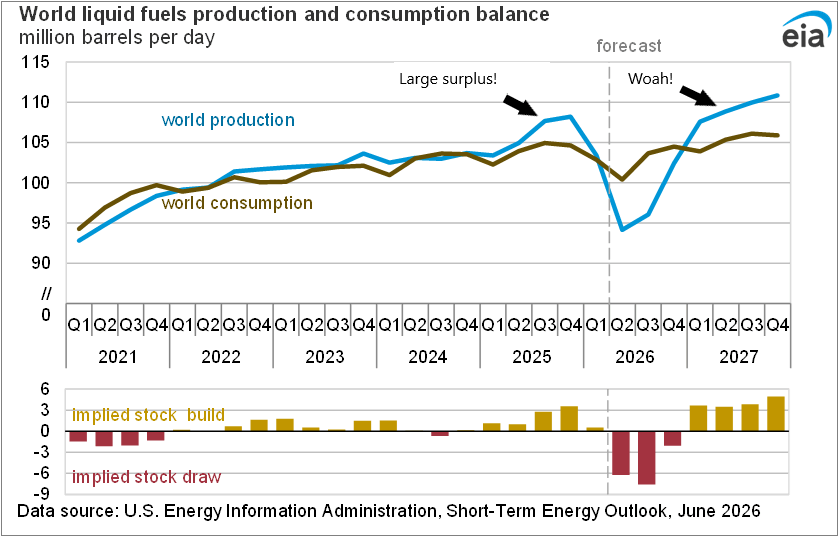
The left arm of this chart is data; the right arm is a single assumption wearing a forecast’s clothing. The collapse is observed — Hormuz’s closure has stranded north of 11.3 mb/d since May, climbing as Iranian storage fills. With one line doing all the moving — production swinging ~16 mb/d while consumption barely flinches off 101 — this is almost purely a supply event, and the gap is bridged the only way the lower panel can: by burning inventory at -6.3 mb/d this quarter and -7.6 next, the steepest draws in the series. That is why Brent sits at “only” ~$105 against a chokepoint carrying a fifth of global transit — a tank being emptied doesn’t bid against a tank being refilled. But a buffer is a quotient, not a faucet; those draws measure cover in months, not years. Every point on the right arm — the surplus reopening, Brent easing to $79-89 — rests on one EIA premise: the Strait reopens Q3 2026 and those barrels are shut-in, not destroyed. Take that premise and the glut is the trade; break it and the right half is fiction. Either way, the hinge is a calendar entry. Watch Q3.
Market Intelligence Brief (MIB) Ver. 18.40
For professional investors only. Not investment advice.
© 2026 RecessionALERT.com

Comments are closed.