
Fed Chair Warsh’s inaugural FOMC strips the easing bias; 9 of 18 members project a 2026 rate hike, dismantling the rate-cut thesis that anchored 2025 equity valuations — S&P -1.21%, 2Y yield to a 14-month high. Retail sales +0.9% handed Warsh hawkish cover; good news is now market-negative. US-Iran peace MOU opens Hormuz, WTI -5% to $75; IEA projects an 8 mb/d 2027 supply glut. AI hardware (AVGO +4.30%, GEV +6.77%) defied the selloff; META -5.44% on AI product executive departure.
TABLE OF CONTENTS
A. EXECUTIVE SUMMARY
B. MARKET DATA
C. HIGH-IMPACT STORIES (5)
D. MODERATE-IMPACT STORIES (7)
E. ECONOMY WATCH (5)
F. EARNINGS WATCH (1)
G. WHAT’S NEXT
H. CHART OF THE DAY
A. EXECUTIVE SUMMARY -> TOP
New Fed Chair Warsh’s inaugural FOMC stripped all easing bias and shifted the dot plot to 9 of 18 members projecting a 2026 rate hike — a structural break from the rate-cut thesis that underpinned 2025’s equity expansion. The S&P 500 fell 1.21%, the Dow ‑507 pts, but the signature is in rates: the 2Y yield surged +16 bps to a 14-month high of 4.21% while the 10Y rose just +6 bps — classic curve-flattening, confirming markets are pricing near-term Fed action, not growth deterioration. Morning’s retail sales beat (+0.9% MoM, 4th consecutive; YoY +6.9%) handed Warsh hawkish cover — at 4.2% PCE, strong consumer spending removes any data-driven argument for easing. The sell-off was broad, with all 11 sectors declining, though AI hardware (AVGO +4.30%, AMAT +4.35%, GEV +6.77%) staged a counter-trend rally on earnings-visibility conviction, while Communication Services (‑2.90%) and rate-sensitive Real Estate (‑2.42%) led sector losses.
• FOMC hawkish pivot: Warsh’s inaugural dot plot shows 9 of 18 members project a 2026 rate hike; median year-end 2026 FFR moves to 3.8% from 3.4%; rate-cut narrative officially dismantled in one session; 2Y yield surges to 14-month high of 4.21%
• Retail sales +0.9% MoM: 4th consecutive beat, YoY +6.9%, GDPNow revised to 3.0% — “good news is bad news” as strong consumer data at 4.2% PCE hands the Fed full justification to strip the easing bias
• US-Iran interim peace MOU: 60-day ceasefire, Strait of Hormuz reopens, Iran oil exports resume; WTI ‑5% to ~$75; formal signing June 19 in Geneva; EIA’s 10th consecutive crude draw (40-year inventory low) provides near-term price floor even as IEA projects +8 mb/d 2027 supply surge
• AI hardware decouples from rate shock: AVGO +4.30%, AMAT +4.35%, MRVL +3.90%, GEV +6.77% rally against a ‑1.21% S&P tape; market votes that AI infrastructure earnings visibility overrides rate-driven multiple compression; legacy SaaS and software bleed as AI substitution fears accelerate
• META ‑5.44%: AI head of product Emily Dalton Smith departs a freshly-appointed role central to the $125–145B CapEx thesis; school addiction bellwether trial strips Section 230 design protections; Communication Services worst S&P sector at ‑2.90%
• IEA June OMR: 2026 global oil demand contracts ‑1.1 mb/d YoY (first annual decline since 2020); 2027 supply surge of +8 mb/d projects a 5 mb/d surplus; structural ceiling on energy earnings multiples regardless of near-term price stabilization
1. Rate-hike era is back — and this is not a recession signal — Today’s market signature — VIX +12.31%, DXY +0.87%, 2Y yield +16 bps, equities lower, gold ‑1.68% with no safe-haven bid — is the textbook rate-repricing pattern, not a growth scare. Polymarket recession odds held at 13% even as hike probability surged to 58%, confirming markets interpret Warsh’s hawkish pivot as confidence in demand rather than a precursor to overtightening. The investment framework shifts from “position for rate cuts” to “position for higher-for-longer with a potential 2026 hike” — long-duration assets, REITs, utilities, leveraged buyouts, and high-multiple growth face systematic discount-rate repricing.
2. AI infrastructure is the only risk-on trade that works at higher rates — AVGO, AMAT, MRVL, and GEV rallying 4–7% on a hawkish FOMC day reflects an explicit portfolio judgment: AI infrastructure beneficiaries have contractually embedded earnings growth that justifies premium valuations even as discount rates rise. Dell’s $3B debt offering succeeding on the same day 2Y yields surged 16 bps confirms capital markets share this conviction. The trade is increasingly precise: sell seat-based SaaS (AI substitution compresses per-seat revenue growth), buy AI infrastructure silicon, storage, and power grid equipment — assets whose demand curves are anchored in hyperscaler CapEx commitments, not economic cycles.
3. Oil faces a structural ceiling — near-term floor vs. 12-month gravity — The EIA’s 10th consecutive crude draw at a 40-year inventory low provides near-term price support, but the Iran peace MOU (supply normalization over 4–8 weeks) combined with IEA’s 2027 +8 mb/d supply projection creates a structural medium-term ceiling. Energy sector earnings models built on $80+ WTI need revision; TOMS Capital’s activist push on Devon Energy signals the market is already stress-testing whether the Marathon merger premium remains justified at $75 oil. The shale consolidation thesis deteriorates with every dollar WTI moves toward $70.
 — Leading economic indicators. Accurate market forecasts. Apply for membership at join.recessionalert.com
B. MARKET DATA -> TOP
New Fed Chair Kevin Warsh signaled an increasing bias toward rate hikes later in 2026 at his inaugural FOMC press conference, driving a broad selloff with all 11 S&P 500 sectors declining as stocks hit session lows in the final minutes. A sharp internal split emerged: AI hardware names (AVGO +4.30%, AMAT +4.35%, MRVL +3.90%) rallied against the tape on chip demand momentum, while internet platforms (META -5.44%) and mega-cap growth (MSFT -3.79%, AMZN -3.46%) bore the brunt of rate repricing. The 2Y yield’s +15 bps surge to 4.197% — more than double the 10Y’s +6.2 bps gain — signals the market is pricing near-term Fed action more aggressively than the long-run growth outlook, a combination historically unfavorable for equity duration.
CLOSING PRICES – Wednesday, June 17, 2026:
MAJOR INDICES
The DJTA’s -2.97% plunge vs. the DJIA’s -0.97% loss flags a same-day Dow Theory divergence (2.00% gap), emerging today — transports led by SPCX’s -4.95% pullback after its historic debut as a pressure point. Over the past 10 sessions, small caps (RUT +0.96%) have outperformed the S&P 500 (-1.78%) by 2.74%, a breadth signal suggesting domestic cyclicals are holding ground even as large-cap growth revalues on the rate shock. Today’s RUT -0.60% vs. S&P -1.21% continues to confirm that small-cap resilience — a pattern that emerged today (first session of signal).
| Index | Close | Change | %Move | Why It Moved |
|---|---|---|---|---|
| S&P 500 | 7,420.13 | -91.22 | -1.21% | Fed Chair Warsh’s inaugural FOMC press conference signaled late-2026 rate hike bias; stocks sold off hard into the close after morning’s positive retail sales data briefly supported mixed trading |
| Dow Jones | 51,493.16 | -506.51 | -0.97% | Blue-chips relatively cushioned vs. tech-heavy indices; FOMC rate hike signal weighs broadly |
| DJ Transportation | 21,534.6 | -659.6 | -2.97% | SPCX (-4.95%) pullback after historic Nasdaq debut weighs heavily; broader transport names pressured by rate outlook; led declines among major indices |
| Nasdaq 100 | 29,670.95 | -297.18 | -0.99% | FOMC rate repricing pressures growth/tech valuations; AI hardware names (AVGO, AMAT, MRVL) partially offset decline within the index |
| Russell 2000 | 2,921.59 | -17.60 | -0.60% | Domestic small-caps best-performing major index; partially insulated from long-duration repricing; 10-session relative outperformance vs. S&P 500 (+2.74%) continues |
| NYSE Composite | 23,469.76 | -234.27 | -0.99% | Broad-based selloff across all market caps following FOMC hawkish tilt; broad market decline confirms no narrow-sector story |
VOLATILITY & TREASURIES
VIX +12.31% alongside rising yields is the rate-fear signature — when recession fear dominates, yields fall; here bonds sold off in lockstep with equities, confirming the market is repricing Fed timing, not growth risk. The 2Y’s +15 bps surge to 4.197% far outpaced the 10Y’s +6.2 bps gain, flattening the 2Y-10Y spread by ~9 bps to 28.6 bps — classic front-loaded rate-hike pricing rather than long-run inflation concern. DXY +0.87% to 100.41 cements the hawkish dollar bid.
| Instrument | Level | Change | Why It Moved |
|---|---|---|---|
| VIX | 18.43 | +2.02 (+12.31%) | FOMC-driven fear spike; options market pricing higher equity risk as rate hike probability rises; highest close since early June |
| 10-Year Treasury Yield | 4.483% | +6.2 bps | Yields rise on FOMC rate hike bias; long-end repricing more modest than short-end — curve flattening signal |
| 2-Year Treasury Yield | 4.197% | +15.0 bps | Front-end surges aggressively on near-term rate hike repricing; most sensitive to Fed path; +15 bps far exceeds 10Y move — flattened 2Y-10Y spread by ~9 bps to 28.6 bps |
| US Dollar Index (DXY) | 100.41 | +0.87 (+0.87%) | Dollar strengthens on hawkish Fed outlook; higher US rate differential vs. major currencies; EUR/USD -0.90% |
COMMODITIES
Gold’s -1.68% decline removes any safe-haven interpretation — rising real yields erode gold’s holding cost advantage, and no flight-to-safety bid materialized. Precious metals fell in unison (Silver -2.74%, Platinum -3.94%), and Copper’s -2.07% adds an industrial demand caution signal. Bitcoin’s -2.21% tracked the equity tape without any crypto-specific catalyst, confirming risk-off sentiment rather than any idiosyncratic digital-asset driver.
| Asset | Price | Change | %Move | Why It Moved |
|---|---|---|---|---|
| Gold | $4,281.09/oz | -$73.31 | -1.68% | Higher real yields erode gold’s holding cost advantage; no safe-haven demand — fear is rate-driven, not growth-driven; dollar strength adds headwind |
| Silver | $68.095/oz | -$1.918 | -2.74% | Precious metals broadly sold; industrial use component amplifies decline beyond gold; rate-shock weighs |
| Copper | $6.3690/lb | -$0.1345 | -2.07% | Industrial demand concerns on hawkish FOMC; rate-shock impact on growth expectations weighs; China demand outlook cautious |
| Platinum | $1,743.20/oz | -$71.50 | -3.94% | Auto-catalyst and industrial demand concerns; precious metals complex broadly weak; largest decliner in the complex today |
| Bitcoin | $64,330 | -$1,452 | -2.21% | Risk assets broadly sold; crypto tracks equity tape with no independent catalyst — pure risk-off follow-through |
ENERGY
Crude barely moved (WTI -0.51%, Brent -0.38%) despite a broad risk-off tape — the oil market is not pricing today’s FOMC hawkishness as a demand-destruction event. Natural gas decoupled with Henry Hub -1.76%, driven by seasonal demand moderation rather than macro fear. WTI-Brent spread holds near $3.00, signaling no regional supply disruption; Dutch TTF -0.56% continues the post-Iran deal compression of European gas risk premiums.
| Asset | Price | Change | %Move | Why It Moved |
|---|---|---|---|---|
| Crude Oil (WTI) | $75.66/bbl | -$0.39 | -0.51% | Oil market not pricing FOMC hawkishness as demand-destruction; post-Iran deal supply normalization continues; minimal reaction to equity selloff |
| Crude Oil (Brent) | $78.66/bbl | -$0.30 | -0.38% | Global crude demand viewed as resilient to rate shock; WTI-Brent spread near $3.00 — no regional supply disruption signal |
| Natural Gas (Henry Hub) | $3.182/MMBtu | -$0.057 | -1.76% | Seasonal demand moderation; mild selloff unrelated to FOMC; weather demand peak fading as summer heat expectations ease |
| Natural Gas (Dutch TTF) | $14.13/MMBtu | -$0.08 | -0.56% | Post-Iran deal European gas risk premium continues to compress; EUR/USD -0.90% adds FX headwind to USD-converted price |
S&P 500 SECTORS
All 11 sectors declined — a macro flush rather than rotation, consistent with a Fed rate-shock event. Technology was the sole holdout at -0.31%, cushioned by AI hardware names rallying within the sector. Communication Services led the decline (-2.90%), deepening its -6.89% one-month slide as META absorbed legal and CapEx headwinds. Rate-sensitive Real Estate (-2.42%) and Utilities (-1.37%) confirmed the rate-driven nature of the selloff — both repricing to higher discount rates.
| Sector | 1-Day | 1-Week | 1-Month | 3-Month | 6-Month | YTD | 12-Month |
|---|---|---|---|---|---|---|---|
| Technology | -0.31% | +4.18% | +4.00% | +27.14% | +23.06% | +21.14% | +42.31% |
| Financial | -0.43% | +4.08% | +5.02% | +12.40% | +1.96% | +1.90% | +15.04% |
| Healthcare | -0.91% | -0.41% | +3.10% | +3.17% | -2.54% | -2.06% | +11.80% |
| Industrials | -1.00% | +7.96% | +7.50% | +12.78% | +19.49% | +20.50% | +31.98% |
| Energy | -1.35% | -5.71% | -10.21% | -6.50% | +21.66% | +21.68% | +24.97% |
| Utilities | -1.37% | +1.07% | +0.06% | -4.33% | +3.22% | +4.01% | +12.53% |
| Basic Materials | -1.86% | +7.28% | +1.80% | +7.28% | +16.75% | +15.55% | +41.73% |
| Consumer Defensive | -2.09% | -1.92% | -4.53% | +0.66% | +4.49% | +6.76% | +4.69% |
| Real Estate | -2.42% | -2.17% | +0.31% | +4.14% | +6.17% | +7.26% | +5.69% |
| Consumer Cyclical | -2.47% | +1.24% | -2.71% | +3.50% | -6.52% | -5.57% | +4.37% |
| Communication Services | -2.90% | +0.36% | -6.89% | +4.89% | +2.23% | +0.86% | +22.67% |
TOP MEGA-CAP MOVERS:
GAINERS
| Company | Ticker | Close | Change | Why It Moved |
|---|---|---|---|---|
| GE Vernova Inc | GEV | $1,048.86 | +6.77% | AI electrification and data center power demand narrative; Africa Energy Forum presence highlights global power infrastructure opportunity; largest mover against a down tape |
| Western Digital Corp | WDC | $712.13 | +4.56% | AI data center hardware demand rebound; bouncing with semiconductor complex from prior-session weakness |
| Applied Materials Inc | AMAT | $592.92 | +4.35% | Semiconductor equipment demand rebound; AI chip capacity buildout narrative intact despite FOMC headwinds |
| Broadcom Inc | AVGO | $392.90 | +4.30% | Rebound from prior-session -4.6% drop; JPMorgan reiterated Overweight with $580 price target; AI chip demand narrative intact |
| Marvell Technology Inc | MRVL | $289.54 | +3.90% | AI data center networking chip demand; semiconductor complex rebound day; moving against broader market selloff |
DECLINERS
| Company | Ticker | Close | Change | Why It Moved |
|---|---|---|---|---|
| Meta Platforms Inc | META | $567.58 | -5.44% | Federal multidistrict school addiction bellwether trial (began June 15) stripped Section 230 design protections; CapEx guidance raised to $125–145B; senior AI executive departure adds execution risk |
| Space Exploration Technologies Corp | SPCX | $191.82 | -4.95% | Pullback after historic +19.34% Nasdaq debut rally; FOMC-driven selloff adds pressure to high-multiple newcomer; normal post-debut consolidation |
| Microsoft Corp | MSFT | $378.91 | -3.79% | Mega-cap growth repriced on hawkish Fed rate hike signals; enterprise cloud valuations sensitive to long-duration discount rate expansion |
| Amazon.com Inc | AMZN | $237.50 | -3.46% | Rate-sensitive mega-cap hit by hawkish FOMC; consumer discretionary concern amplifies growth valuation pressure |
| International Business Machines Corp | IBM | $262.35 | -3.12% | Enterprise tech valuations pressured by FOMC hawkish shift; long-duration discount rate expansion weighs on legacy tech names |
— Institutional-grade intelligence for serious investors. Apply for membership at join.recessionalert.comC. HIGH-IMPACT STORIES -> TOP
BEARISH
1. Warsh’s Inaugural FOMC Delivers Hawkish Shock — 9 of 18 Members Project 2026 Rate Hike, Easing Bias Stripped; S&P -1.21%, Dow -507 pts, 2Y Yield at 14-Month High
The core facts:The FOMC voted 12-0 to hold the federal funds rate at 3.50–3.75% — the fourth consecutive hold — but the surrounding communication delivered a decisive hawkish pivot. In the updated dot plot, 9 of 18 committee members projected at least one rate hike before year-end 2026; the median year-end 2026 dot moved to 3.8% from 3.4% in March, signaling the committee’s base case now includes an additional 25-basis-point hike. Chair Warsh chose not to submit his own dot plot projection. All language indicating a bias toward future rate cuts was removed from the dramatically shortened policy statement. Warsh also signaled a shift in communication philosophy — hinting at fewer press conferences, stating that “when you have one, you want to make sure you have something important to say.” This was Warsh’s inaugural FOMC meeting as Chair following his confirmation earlier this year. The S&P 500 fell 1.21%, the Nasdaq declined 1.34%, and the Dow Jones fell 507 points. The 2-year Treasury yield surged 16 basis points to 4.21%, its highest level in over 14 months.
Why it matters:Warsh’s inaugural meeting resets the 2026 interest rate calculus entirely. Markets entered the session pricing some probability of rate cuts; they exited pricing potential rate hikes. The removal of the easing bias — combined with 9 of 18 members projecting a hike — marks a structural break from the prior rate-cutting narrative that was the foundational thesis for 2025’s equity expansion and the early 2026 multiples. The compressed statement and “fewer press conferences” signal is a deliberate communications overhaul: Warsh is imposing policy opacity, which structurally increases the rate uncertainty premium in equity and bond markets for the remainder of the year. The hawkish posture is well-grounded in the data: May’s 6.7% YoY import prices, 4.2% PCE inflation, and today’s blowout retail sales (+0.9% MoM, fourth consecutive beat) gave the committee full justification to shift from “hold with a cutting bias” to “hold with a hiking bias.” For equity investors, this removes the rate-cut catalyst that anchored growth-equity valuations in 2025 and raises the discount rate for all long-duration assets. Rate-sensitive sectors — REITs, utilities, homebuilders, and high-multiple tech — face systematic repricing.
What to watch:The September FOMC meeting as the most likely window for a hike if PCE inflation remains above 4%; CME FedWatch pricing for September and November as real-time calibration. Warsh’s public speeches and congressional testimony for signals on how he operationalizes “fewer press conferences” — future meeting outcomes will carry higher surprise risk. July FOMC — whether the hawkish tone is sustained or moderated by incoming data.
BULLISH
2. US-Iran Interim Peace Accord Announced — 60-Day Ceasefire MOU, Strait of Hormuz Reopens, Tehran to Resume Oil Exports; WTI Falls ~5% to ~$75, Formal Signing June 19
The core facts:The United States and Iran reached a Memorandum of Understanding (MOU) on June 17, 2026, committing to extend the existing ceasefire for 60 days and reopen the Strait of Hormuz to toll-free passage. Key MOU terms: immediate military de-escalation, removal of the US naval blockade of Iranian ports, and resumption of Iranian crude oil exports to global markets. The US agreed to waive (not eliminate) certain broad-ranging economic sanctions as a concession. The formal signing ceremony is scheduled for June 19 in Geneva, Switzerland. Follow-on talks covering Iran’s nuclear program, permanent sanctions relief, and regional issues (Lebanon, Houthi interdiction) are to commence immediately after signing. WTI crude fell approximately 5% to roughly $75/barrel — its fifth consecutive losing session and lowest level since early March — while Brent crude settled near $79. The MOU is a 60-day bridging framework; it does not constitute a permanent peace agreement.
Why it matters:The Strait of Hormuz carries approximately 20% of global oil trade; its reopening removes the supply-disruption risk premium that had been embedded in energy markets since the conflict began. For US portfolio managers: (1) integrated oil and E&P stocks face immediate headwinds as the war-risk premium unwinds — the oil price path lower is now the base case, not the exception; (2) Industrials and Transportation benefit from lower fuel costs, reinforcing the June 16 session’s industrial rotation; (3) consumers benefit from lower gasoline prices, which partially offsets the tariff-driven import price inflation. However, the 60-day MOU structure introduces material political uncertainty: follow-on nuclear talks are notoriously complex, and a breakdown would reimpose supply-disruption risk rapidly. Iran’s physical crude infrastructure requires 4–8 weeks to ramp to full export capacity, so the supply impact is weeks away rather than immediate. Combined with today’s IEA June Oil Market Report (see Section D) projecting an 8 mb/d supply surge in 2027, this MOU materially amplifies the developing oil market supply/demand imbalance — structural pressure on energy names through end of year.
What to watch:June 19 formal signing ceremony in Geneva as the next confirmation point — failure to sign would send oil prices sharply higher. Saudi Arabia’s production response to Iranian supply normalization as the OPEC+ cohesion test. Iran’s crude export ramp timeline — first shipments visible in EIA/IEA weekly data 4–6 weeks from now. Any breakdown in nuclear-program talks that could trigger MOU voiding.
BEARISH
3. May Retail Sales +0.9% — Fourth Consecutive Beat, GDPNow Revised to 3.0% — “Good News Is Bad News” as Strong Consumer Hands Warsh Hawkish Cover Hours Before FOMC
The core facts:The Census Bureau’s May 2026 advance retail sales print (+0.9% MoM vs. +0.5% expected, control group +0.7% vs. +0.4%) arrived at 8:30 AM ET — hours before the 2:00 PM FOMC decision — and immediately triggered a broad equity rally as strong-economy bulls dominated early trading. The beat was the fourth consecutive monthly retail sales upside surprise, with YoY growth at 6.9% (fastest since Q4 2022). The Atlanta Fed’s GDPNow model revised Q2 2026 real GDP growth up to 3.0% from 2.8% on the data, erasing last week’s housing-collapse scare. Full data coverage in Section E.
Why it matters:The session’s sequence is the key insight: retail sales beat → equity rally → FOMC hawkish pivot → equity reversal. Strong consumer spending at 6.9% YoY is structurally incompatible with rate cuts when PCE inflation sits at 4.2% — it hands Warsh’s committee precisely the demand-side evidence needed to justify removing the easing bias and shifting the dot plot toward a 2026 hike. This is the classic “good news is bad news” dynamic: strong consumption data = Fed justified in maintaining or tightening its restrictive posture = higher rates = equity multiple compression. The GDPNow revision to 3.0% is doubly significant: it confirms the consumer as the dominant 2026 growth engine, but simultaneously confirms the Fed has no data-driven reason to ease. For rate-sensitive sectors (REITs, utilities, homebuilders), the retail sales beat compounded today’s hawkish FOMC — strong growth + sticky inflation = prolonged higher rates. The 4-quarter streak of retail sales beats also undermines any soft-landing narrative that requires consumption moderation to bring inflation down.
What to watch:June PCE report (due late June) as the next critical datapoint — if consumer spending is accelerating, PCE inflation pressures will build further. July FOMC meeting — back-to-back strong retail sales prints narrow the probability of any dovish pivot, keeping the “hiking bias” intact.
BEARISH
4. 2-Year Treasury Yield Surges 16 bps to 4.21% — Highest in 14 Months; Yield Curve Flattens to 28.6 bps as Markets Front-Load Rate Hike Expectations
The core facts:The 2-year Treasury yield surged 16 basis points to 4.21% following the FOMC decision — its largest single-day move in months and the highest closing level in over 14 months. The 10-year Treasury yield rose approximately 6 basis points to 4.48%. The resulting yield curve narrowed to approximately 28.6 basis points (10Y minus 2Y), flattening by roughly 9 basis points intraday. The DXY US Dollar Index rose 0.87%. The VIX jumped 12.31%, closing in fear territory, as the rate shock reverberated through risk assets. The 2Y-vs-10Y spread differential — with the 2Y surging more than twice as fast as the 10Y — is the textbook signal of front-loaded rate hike pricing: markets believe the Fed will act on near-term hikes while discounting the long-run neutral rate impact.
Why it matters:The 2Y yield at 4.21% directly reprices the cost of short-duration borrowing for corporations, consumers, and financial institutions. The distinction between this move and yesterday’s yield decline (when housing collapse drove a flight-to-safety bid) is analytically critical: yesterday the bond market was pricing slower growth; today it is pricing higher near-term rates. This is NOT a recession signal — it is a rate-hike-fear signal. The VIX at +12.31% and dollar at +0.87% confirm: markets interpreted today’s FOMC as an inflation/rate event, not a growth scare. For institutional portfolios: (1) short-duration fixed income faces mark-to-market losses; (2) leveraged buyout economics deteriorate as financing costs rise; (3) dividend-paying equities (utilities, REITs, consumer staples) face increased competition from Treasury yields as cash alternatives; (4) the inverted carry trade on long-duration bonds becomes more punishing. The curve flattening to 28.6 bps signals the bond market is not yet pricing a full inversion — it sees near-term hikes, not a recession-inducing tightening cycle.
What to watch:Whether the 2Y yield breaks above 4.25% — a sustained move above that level would reprice mortgage rates, corporate credit, and leveraged loan costs at scale. The 2Y-10Y spread narrowing below 20 bps would reintroduce curve-inversion recession signaling. CME FedWatch September and November meeting odds for first hike probability — the market’s real-time interpretation of Warsh’s credibility.
UNCERTAIN
5. EIA Weekly Crude Draw -8.262M Barrels — 10th Consecutive Weekly Draw, Commercial Crude Stocks at Lowest Level Since March 1985; Counters Iran Peace Deal Oil Narrative
The core facts:The EIA’s weekly petroleum status report released Wednesday morning showed US commercial crude oil inventories fell 8.262 million barrels for the week ending June 13 — more than double the 4.6 million barrel draw expected by analysts. Gasoline inventories declined an additional 0.906 million barrels. This marks the 10th consecutive week of US crude inventory draws. Commercial crude stocks are now at their lowest absolute level since March 1985 — a 40-year trough. The supply drawdown is occurring simultaneously with Iranian oil production disrupted by the US-Iran conflict now entering its resolution phase.
Why it matters:The combination of today’s Iran Peace MOU (bearish oil, more supply coming) and today’s EIA data (bullish oil, stocks at 40-year low) creates a genuinely uncertain near-term oil market outlook. The physical inventory deficit is extreme by any historical measure — commercial crude at March 1985 levels means the US has almost no buffer against supply disruptions. Iran’s oil ramp takes 4–8 weeks to meaningfully reach global markets; until then, the structural inventory deficit remains operative. For oil majors and E&P names: the Iran deal is bearish on a 3–6 month supply normalization view, but the 40-year storage low provides a near-term support floor for prices. For refiners: thin crude stocks at low absolute levels compress refining margins when crude-to-product spreads tighten. The 10th consecutive weekly draw also casts doubt on the demand-destruction narrative embedded in the IEA’s 2026 demand-contraction forecast (released today, see Section D) — US demand destruction is not visible in the weekly inventory data.
What to watch:Next week’s EIA report (Wednesday June 24) for the first signal of whether the Iran deal is moderating crude draws or whether the inventory deficit deepens further. Iran’s first post-MOU crude export manifest as confirmation the supply ramp is actually materializing. WTI price holding or breaching $73/barrel as the near-term technical support floor.
— Quantifying recession risk so you don’t have to guess. Apply for membership at join.recessionalert.comD. MODERATE-IMPACT STORIES -> TOP
BEARISH
6. Meta Platforms -5.44% — AI Head of Product Departure, $125–145B CapEx Overhang, and School Addiction Trial Backdrop Compound the FOMC Selloff
The core facts:Meta Platforms fell 5.44% — the largest single-day decline among mega-cap technology names and notably greater than the Nasdaq’s 1.34% broad decline. The primary company-specific catalyst: Reuters reported that Emily Dalton Smith, Meta’s head of product for its “AI for Work” transformation initiative, is leaving the company. Smith was appointed approximately two months ago as part of a company-wide reorganization to center AI agents across Meta’s product stack; her departure creates a leadership vacuum in Meta’s highest-priority AI execution track. The news arrived against an existing backdrop of concern about Meta’s 2026 capital expenditure guidance of $125–145 billion — nearly double 2025 spending — and the ongoing federal multidistrict school addiction bellwether trial (which commenced June 15) where Meta has been stripped of Section 230 liability shields for platform design choices.
Why it matters:The Emily Dalton Smith departure is significant because her specific mandate — leading product work to improve internal AI tooling and external AI-agent capabilities — is central to the thesis that justifies Meta’s $145B capex commitment. Losing the product lead on the AI-agent transformation raises the question: is the strategy intact, or is there internal disagreement about execution approach? This is not a routine executive transition; it is a departure from a freshly appointed role within the company’s flagship AI reorganization, which is characteristic of either a strategic pivot or management friction. For institutional investors, Meta presents an increasingly complex risk profile: (1) $125–145B capex is a multi-year drag on free cash flow at a time when advertising revenue growth faces macro headwinds (post-FOMC consumer sensitivity); (2) the school addiction trial creates open-ended legal liability that is impossible to model precisely; (3) the AI product leadership gap creates execution risk at the moment when Zuckerberg’s AI-agent bet needs to deliver ROI. The stock’s outperformance earlier this year now faces a convergence of risks that the market has not yet fully priced.
What to watch:Who Meta appoints to replace Smith as AI product lead — and the timing of that announcement as a signal of organizational continuity. Q2 2026 earnings (late July) for first quantification of whether AI-agent products are generating measurable revenue. Any jury verdict or settlement in the school addiction trial creating precedent-setting financial liability.
BULLISH
7. AI Hardware Defies FOMC Selloff While Legacy Software Bleeds — AVGO +4.30%, AMAT +4.35%, MRVL +3.90%, WDC +4.56% Versus XLK -2%+ as Rotation Within Tech Sharpens
The core facts:On a day when the S&P 500 fell 1.21% and the Nasdaq declined 1.34%, a distinct intra-tech rotation produced sharply divergent outcomes: AI infrastructure hardware names surged while legacy application software sold off. AI hardware winners: Broadcom (AVGO) +4.30% (JPMorgan reiterated Overweight, $580 price target), Applied Materials (AMAT) +4.35%, Marvell Technology (MRVL) +3.90%, Western Digital (WDC) +4.56%. Simultaneously, the Technology Select Sector ETF (XLK) fell more than 2%, dragged by seat-based software providers as fund managers rotated out of legacy SaaS names — Microsoft, Salesforce, ServiceNow, Oracle — on fears that generative AI is compressing the pricing power of subscription-based software seats. The rotation mirrors the dynamic from June 16 (where WDC was upgraded by Morgan Stanley on HDD structural demand), extending it into a broader hardware-vs-software divergence.
Why it matters:The AI hardware vs. legacy software rotation — both occurring simultaneously within the same broad technology sector on a hawkish FOMC day — carries significant portfolio construction implications. FOMC-driven multiple compression should, in theory, hit all high-multiple technology stocks equally. That AI hardware names are rallying 4%+ while legacy SaaS is declining 2%+ suggests fund managers are making a specific judgment: AI infrastructure beneficiaries have earnings growth visibility that justifies premium valuation even at higher discount rates, while seat-based software names do not. The AVGO rally (on a JPMorgan reiterate, not earnings) signals institutional conviction in the AI custom silicon and networking semiconductor thesis despite macro headwinds. The XLK decline specifically targeting legacy software is the market’s forward-looking verdict on AI substitution: if agentic AI reduces the number of software seats required per employee, per-seat licensing revenue faces structural compression. For portfolio managers, the trade is increasingly explicit: sell SaaS, buy AI infrastructure silicon and storage.
What to watch:Salesforce and ServiceNow Q2 2026 earnings calls (late July/early August) for management commentary on whether AI is actually compressing seat growth or if the substitution thesis is premature. AVGO sustaining above $560 as confirmation that the JPMorgan upgrade is buy-side consensus rather than sell-side noise.
BULLISH
8. GE Vernova +6.77% to $1,048.86 — Top Mega-Cap Gainer on FOMC Down Day; AI Data Center Power Demand Narrative Drives Stock to +101% Year-Over-Year
The core facts:GE Vernova (GEV) surged 6.77% to close at $1,048.86 — the top-performing mega-cap name on a broad down-day (-1.21% S&P 500). The move was driven by the AI data center electrification narrative: as hyperscalers and AI compute operators expand their capacity, demand for grid infrastructure, power generation, and electrical equipment is accelerating at a pace that outstrips traditional utility capital cycle planning. GE Vernova’s management reinforced the thesis with a presence at the Africa Energy Forum in Cape Town, where GEV is positioning its gas turbine and grid modernization technology as critical infrastructure for AI power buildout across emerging markets and US data center hubs alike. The stock is now up 101.35% year-over-year, establishing GEV as one of the clearest AI-infrastructure adjacent beneficiaries beyond the semiconductor complex.
Why it matters:GEV’s +6.77% counter-trend gain on a hawkish FOMC day when the S&P declined 1.21% signals the depth of institutional conviction in the AI power demand theme. Unlike semiconductor names — which can be pressured by “crowded trade” narratives and macro sentiment — grid infrastructure is a regulated capital expenditure cycle with multi-year contracting visibility. Hyperscalers must physically build power generation and grid connectivity for every data center they open; that demand is contractually embedded in GEV’s order book. The Iran deal’s oil price decline (WTI to ~$75) adds a further tailwind: lower natural gas prices reduce GEV’s input costs for gas turbine operations. For institutional investors, GEV represents AI infrastructure exposure with a fundamentally different risk profile than semiconductors — regulated infrastructure, long-cycle contracts, tariff-insulated domestic manufacturing — making it a natural diversifier within AI-themed positions.
What to watch:GEV’s next earnings call for order book growth quantification — specifically new data-center power contracts and grid modernization backlog. Natural gas price trajectory as the primary input-cost lever for GEV’s generation business. Hyperscaler capex guidance from MSFT, GOOGL, AMZN, and META in Q2 earnings calls (late July) as the primary demand-signal for GEV’s forward visibility.
BEARISH
9. IEA June Oil Market Report — 2026 Global Demand Contracts -1.1 mb/d YoY (First Annual Fall Since 2020), Q2 Down -5 mb/d; 2027 Supply Surge of +8 mb/d Points to Massive Glut
The core facts:The International Energy Agency released its June 2026 Oil Market Report on Wednesday, delivering a stark revision to its demand outlook. The IEA now projects 2026 global oil demand at 103.3 mb/d — a contraction of 1.1 mb/d year-over-year, and a 700,000 b/d downgrade from May’s estimate. Q2 2026 demand fell approximately 5 mb/d below year-ago levels — the first quarterly demand decline since the pandemic year of 2020 — driven by higher prices and the disruption to product availability from the US-Iran conflict. On the supply side: 2026 global supply is expected to fall 3.9 mb/d to 102.4 mb/d due to Iran disruptions, but then rebound by 8 mb/d in 2027 to reach 110.3 mb/d as Iranian supply normalizes and OPEC+ spare capacity deploys. The IEA explicitly flagged “a significant overhang emerging” in 2027, projecting supply of 110.3 mb/d against demand of only 105.3 mb/d.
Why it matters:The IEA’s 2027 supply/demand projection — a 5 mb/d surplus — is structurally bearish for all oil-price-exposed equities on a 12–18 month investment horizon. For US integrated oil majors (XOM, CVX) and E&P names, the combination of today’s Iran Peace MOU (near-term supply normalization) and the IEA’s 2027 glut projection (structural oversupply) means the current ~$75 WTI price may represent a ceiling rather than a floor for the medium-term oil cycle. Energy sector earnings models built on $80+ oil need immediate revision. The Q2 2026 demand collapse (-5 mb/d YoY) is also significant because it contradicts the US consumer data narrative (strong retail sales, GDPNow 3.0%) — demand destruction is occurring in oil markets even as US consumers spend; the explanation is that Iran-war supply disruptions to product availability artificially suppressed consumption, which reverses with the MOU. For natural gas and LNG names, the Iran oil deal’s displacement of Middle East supply risk could reduce the risk premium embedded in gas prices.
What to watch:OPEC+ June/July production meeting response to the Iran supply normalization — whether Saudi Arabia cuts to defend price or allows the glut to develop. IEA July OMR (next month) for 2027 supply/demand revision as more Iran data becomes available. WTI sustaining above $70/barrel as the floor that separates industry-wide profitable operations from widespread E&P distress.
UNCERTAIN
10. Pending Home Sales +3.8% vs. +0.8% Expected — All Four Regions Rise, Demand Shows Resilience at 6%+ Mortgage Rates, But Post-FOMC Rate Hike Path Threatens Recovery
The core facts:May 2026 pending home sales rose 3.8% MoM versus the 0.8% expected — a significant upside surprise across all four US census regions (Northeast +8.7%, Midwest +8.1%). Year-over-year, pending sales are up 4.8%. NAR Chief Economist Lawrence Yun attributed the activity to “pent-up demand” and buyers “accepting” the 6%+ mortgage rate environment as the new normal. Full data in Section E.
Why it matters:The pending home sales beat creates a significant demand/supply split in housing market signals: buyers are demonstrating willingness to transact at 6%+ mortgage rates (bullish for homebuilder demand), but last week’s Housing Starts -15.4% collapse showed builders are not building at a pace to meet that demand (bearish for near-term inventory). The net effect: homebuyer demand may be recovering, but the supply pipeline is contracting — this is a recipe for sustained price inflation in existing home sales rather than a balanced market recovery. Today’s hawkish FOMC is the pivotal counterfactor: if Warsh’s dot-plot signals a 2026 rate hike, mortgage rates will likely push toward 6.75–7.0%, potentially capping the pending sales recovery before it becomes self-sustaining. The sequence is: today’s data shows buyers adapted to 6.0–6.5% rates; but the FOMC hawkish pivot today resets that adaptation process at a higher level. Homebuilder stocks (DHI, LEN, TOL) face conflicting signals: better demand visibility vs. deteriorating rate outlook.
What to watch:Mortgage rate trajectory in coming weeks as markets price in Warsh’s hawkish dot plot — a sustained move above 6.75% would likely reverse pending home sales recovery. June Existing Home Sales (due mid-July) as the first data read of whether May’s pending sales converted to closings.
UNCERTAIN
11. TOMS Capital Takes Top-5 Stake in Devon Energy — Activist Pushes Newly Merged Shale Giant to Accelerate Divestitures or Explore Full Sale; Post-Iran Deal Oil Complexity Looms
The core facts:Activist investor TOMS Capital Management disclosed a top-five stake in Devon Energy, the newly merged shale producer created from Devon’s acquisition of Marathon Oil. TOMS is pushing the combined company to accelerate non-core asset divestitures to return capital, or to explore an outright strategic sale. The activist engagement comes as Devon integrates the Marathon assets and faces a challenging oil price environment — WTI at approximately $75/barrel following today’s Iran Peace MOU, down significantly from levels that justified the Marathon merger premium.
Why it matters:TOMS Capital’s engagement arrives at a structurally difficult moment for Devon: the merged entity’s asset base is now being stress-tested at $75 oil on the same day the IEA projects a massive 2027 supply glut (see Story 9). The timing of activist pressure for divestitures or a sale during a price downturn is tactically significant — assets fetching maximum value when oil is at $90 may find fewer bidders at $75. A full-sale scenario would pit Devon against integrated majors (XOM, CVX) and private equity buyers who must underwrite the deal against an IEA 2027 glut backdrop. For the E&P sector: activist pressure on Devon signals that the Marathon merger may not have delivered the capital efficiency or return of capital thesis that justified the deal premium — a warning sign for the broader shale consolidation narrative of 2024–2025. If TOMS forces a sale process, any buyer must contend with the Iran normalization timeline and the structural oil demand contraction the IEA flagged today.
What to watch:Devon management response to TOMS’s engagement — whether they adopt a formal strategic alternatives review or defend the status quo. Any M&A interest from XOM or CVX, both of which have capacity for large shale acquisitions following earlier consolidations. DVN stock price relative to peer E&Ps (PXD, FANG, COP) as a signal of whether the market is pricing a deal premium.
BULLISH
12. Dell Technologies Launches $3B Senior Notes Offering, Shares +3.5% — Debt Restructuring Bucks Broad Tech Selloff as Capital Markets Confidence Remains Intact
The core facts:Dell Technologies (DELL) launched a $3 billion senior notes offering on June 17, using proceeds to restructure its existing debt stack. Dell shares rose approximately 3.5% — one of the few technology names in positive territory on a day when the XLK sector ETF fell more than 2% and the Nasdaq declined 1.34%. The debt restructuring comes as Dell’s AI server business experiences strong demand — the company has been a primary beneficiary of enterprise AI infrastructure procurement cycles, supplying PowerEdge AI servers to major corporate and hyperscaler clients.
Why it matters:Dell’s ability to successfully access the investment-grade debt market on a day when the 2-year Treasury yield surged 16 basis points and credit spreads widened is a significant data point: capital markets remain functional and receptive to high-quality corporate issuers even under hawkish FOMC conditions. The +3.5% share reaction to a debt restructuring is unusual — it signals that institutional investors interpreted the offering as a sign of financial discipline and balance sheet optimization rather than distress financing. From a sector rotation perspective, Dell bucking the XLK selloff reinforces the intra-tech differentiation thesis (Story 7): AI infrastructure hardware — even in the enterprise server segment — retains demand visibility and capital-market confidence that legacy application software names lack. Dell’s AI-server revenue growth also provides a read on enterprise AI adoption rates that supplements hyperscaler capex as a demand signal.
What to watch:Dell’s Q2 2026 earnings call (mid-August) for AI server order backlog and revenue growth data as an enterprise AI infrastructure demand gauge. The coupon pricing on the $3B notes as an indicator of credit market conditions for investment-grade technology issuers in a hawkish-FOMC environment.
— Separating signal from noise since 2007. Apply for membership at join.recessionalert.comE. ECONOMY WATCH -> TOP
Consumer spending delivered a fourth straight beat — retail sales +0.9% vs. +0.5% expected, YoY +6.9% — nudging GDPNow to 3.0%, but the Fed answered with its sharpest hawkish pivot since the hiking cycle: Chair Warsh’s debut FOMC stripped easing bias, produced a barebones statement, and saw 9 of 18 members project a 2026 rate hike (median year-end dot: 3.8% vs. 3.4% in March). Two-year yields surged 13 bps to 4.178% and markets repriced hike probability to 58% from 37%. Housing remains split — pending sales jumped 3.8% on pent-up demand even as starts cratered yesterday — while El-Erian warns a capital shortage is quietly building. Thursday’s jobless claims and Philly Fed (exp. 10 vs. −0.4 prior) are the next reads before Juneteenth closes markets Friday.
Fed Holds at 3.75%, Strips Easing Bias and Projects 2026 Hike in Warsh’s Debut FOMC (Federal Reserve, Jun 17, 2026)
What they’re saying:The FOMC voted 12-0 to hold the federal funds rate at 3.50%–3.75% for a fourth consecutive meeting. The post-meeting statement was stripped of all forward guidance and easing bias language — a notably barebones release reflecting Chair Warsh’s philosophy of less communication. Nine of 18 members submitted dot-plot projections forecasting a rate hike before year-end 2026, with six projecting two 25 bps hikes. The median year-end 2026 Fed funds rate projection moved to 3.8%, up from 3.4% in March. Warsh, in his first FOMC meeting (sworn in as the 17th Chair on May 22), did not submit his own dot forecast.
The context:With core inflation persisting around 4.2% YoY and tariff pass-through risk ongoing, the shift from neutral-to-dovish guidance to a near-explicit hike signal represents the most significant recalibration of 2026. Two-year Treasury yields surged 13 bps to 4.178% and 10-year yields rose 4 bps to 4.465% on the announcement. The S&P 500 fell 1.06%, the Dow shed 410 points, and the Nasdaq dropped 1.0% — markets are now pricing the possibility of a higher-for-longer regime extending into active tightening. The FOMC’s removal of “additional rate adjustments” language and Warsh’s own absence from the dot plot creates maximum optionality heading into fall — but the 9-member hike bloc sends an unmistakable directional signal.
What to watch:Fed press conference tone and whether Warsh clarifies his own rate view; June CPI and PCE (next major inflation prints) — further acceleration would harden the hike case; September FOMC meeting as the earliest plausible hike date.
Retail Sales Jump 0.9% in May — Nearly Double Consensus, Control Group +0.7%; GDPNow Revised to 3.0% (Census Bureau / Atlanta Fed, Jun 17, 2026)
What they’re saying:Advance retail sales for May rose 0.9% MoM, nearly doubling the 0.5% consensus and extending a fourth consecutive monthly gain. YoY growth accelerated to 6.9%. The control group (ex-autos, gas, food services, building materials) — the cleanest GDP proxy for consumer spending — rose 0.7% vs. the 0.4% consensus. Retail sales ex-autos rose 0.8% vs. 0.5% expected. On the data, the Atlanta Fed GDPNow model raised its Q2 2026 tracking estimate to 3.0% from 2.8% on June 16, reversing the prior session’s downward revision from Housing Starts.
The context:The broad-based beat signals consumers remain resilient despite 6%+ mortgage rates and persistent inflation (~4.2% YoY). Warm weather and modest gas price relief supported the headline, but the control group beat strips out both factors — the underlying consumer is still spending. The 6.9% YoY figure is the fastest annualized pace since Q4 2022. Critically, this data arrived hours before the FOMC decision and appears to have reinforced the committee’s hawkish shift: a consumer still spending freely removes the most pressing argument for easing. The retail beat is simultaneously a positive economic signal and a direct contributor to the hawkish rate repricing.
What to watch:June retail sales (July 15) for durability; PCE consumer spending component; whether Iran-related energy inflation begins to erode real purchasing power in H2 2026.
Prediction Markets Reprice Fed Path Post-FOMC: Hike Odds Surge to 58% From 37%, Cut Odds Collapse to 18.5% From 30% (Polymarket, Jun 17, 2026)
What they’re saying:Following the June 17 FOMC, Polymarket prediction markets moved sharply: the probability of a Fed rate hike in 2026 jumped 21 percentage points to 58% (from 37% prior session), while the probability of at least one rate cut in 2026 fell 11.7 points to 18.5% (from 30.2%). Recession probability held steady at 13%, unchanged from the prior session, suggesting markets see the hawkish pivot as demand-driven tightening rather than a recessionary signal.
The context:Both moves materially exceed the ≥10pp threshold that signals a true regime change in rate expectations. The rapid repricing reflects the dot plot shock: 9 of 18 FOMC members now favor a hike and the median year-end dot jumped to 3.8% from 3.4% in March. The rate-cut narrative that underpinned equity and bond rallies in early 2026 has been effectively dismantled in a single session. Notably, recession odds held at 13% — markets still discount a soft-landing scenario and appear to interpret the hawkish hold as a sign of confidence in growth rather than a precursor to overtightening.
What to watch:Whether recession odds drift higher as the market absorbs potential tightening implications; September FOMC as the likely decision point for an actual hike; any Fed speaker commentary clarifying the hike threshold.
Pending Home Sales Surge 3.8% in May — Nearly 5x Consensus, All Four Regions Rise, NAR Cites Pent-Up Demand (NAR, Jun 17, 2026)
What they’re saying:Pending home sales rose 3.8% MoM in May, nearly five times the 0.8% consensus, and 4.8% YoY. Gains were broad-based: the Northeast led with +8.7% MoM, the Midwest +8.1%, with South and West also positive. NAR Chief Economist Lawrence Yun attributed the jump to “a late spring buyer rush — an indication of pent-up housing demand and consumers’ acceptance of above-6% mortgage rates as the new normal.” Separately, MBA data released Wednesday showed the 30-year mortgage rate at 6.6% (week of Jun 13) with applications down 3.8%.
The context:The pending sales surge contrasts sharply with yesterday’s housing starts plunge (−15.4% to 1.177M, weakest since May 2020), revealing a demand-supply split: buyers are engaging but builders are retrenching. Pending sales are a leading indicator of existing home closings 1–2 months forward, so the strong May reading supports June and July existing sales even as new construction contracts. The FOMC’s hawkish turn complicates the picture — mortgage rates are likely to move higher from 6.6%, potentially capping this demand recovery in H2 2026.
What to watch:30-year mortgage rate trajectory post-FOMC (6.6% currently, watch for move toward 6.75%–7.0% if the hike narrative holds); June existing home sales closings (Jul 23); June pending home sales (Jul 22) for whether demand persists despite the rate shock.
El-Erian Warns of Looming U.S. Capital Shortage as AI Build-Out and Treasury Issuance Compete for a Shrinking Pool (Allianz / Seeking Alpha, Jun 15, 2026)
What they’re saying:Mohamed El-Erian, chief economic adviser at Allianz, warned on June 15 that the U.S. faces an approaching capital shortage as simultaneous funding demands from AI infrastructure build-out, corporate refinancing, and government debt issuance collide with a diminished supply of capital. The federal government is running an approximately 6% deficit (CBO projects $1.9T for FY2026), requiring massive external funding. Meanwhile, Gulf sovereign wealth funds — historically reliable buyers of U.S. assets — are redirecting capital to domestic reconstruction following the Iran conflict, reducing a key traditional source.
The context:El-Erian’s warning arrives as the Fed has just signaled potential tightening — a combination that forces Treasury to issue more debt into a market where foreign demand is constrained by geopolitical reallocation. Reduced foreign demand for Treasuries would push yields higher, adding to the Fed’s tightening impulse even without additional rate hikes. The concern is structural, not cyclical: U.S. capital requirements are growing (AI capex, national security, entitlement costs) while global capital available to meet them is narrowing. The 10-year Treasury at 4.465% and an FOMC dot plot signaling further tightening suggest this dynamic may already be pricing in.
What to watch:Foreign holder data in the June TIC flow report (typically 6 weeks post-month-end); 10-year Treasury yield — a sustained move above 4.6% would signal the supply-demand imbalance is pricing in; Q3 Treasury refunding announcement.
— Know the probability before the market prices in the risk. Apply for membership at join.recessionalert.comF. EARNINGS WATCH -> TOP
YESTERDAY AFTER THE BELL (Markets Reacted Today)
No major earnings yesterday after the bell from companies with >$100B market cap.
TODAY BEFORE THE BELL (Markets Already Reacted)
BULLISH
13. Progressive Corp (PGR): -0.12% | Net Income +36% YoY, Combined Ratio Improves 4.8 pts — Strong Underwriting Profitability Offset by FOMC Macro Headwinds
The Numbers:Released: BMO | Progressive reported May 2026 monthly operational results. Net premiums written: $7.027B (+6% YoY). Net income: $1.445B (+36% YoY). Combined ratio: 82.1 (down 4.8 percentage points YoY — a significant underwriting profitability improvement). Policies in force: 39.97 million (+8% YoY). Note: Progressive releases monthly operational metrics; Q2 2026 quarterly results are scheduled for July 9, 2026.
The Problem/Win:The combined ratio of 82.1 — down 4.8 points year-over-year — is the headline win. A combined ratio below 100 indicates underwriting profitability; an 82.1 reading means Progressive earns $0.18 of pre-investment underwriting profit for every $1.00 of premium collected, and the improvement of 4.8 points signals that prior-year rate increases are now flowing through with reduced loss frequency and severity. Net income of $1.445 billion is a standout number for a single month. Policy-in-force growth of 8% demonstrates that Progressive is gaining market share as a lower-cost provider, not sacrificing premium volume for underwriting quality.
The Ripple:Progressive’s strong combined ratio compresses the investment thesis for Allstate (ALL), Travelers (TRV), and State Farm’s competitive position in personal auto. PGR’s 8% policy growth while maintaining superior underwriting profitability signals that competitors are either ceding market share or accepting higher loss ratios to defend it. Within the broader Financials sector, PGR’s results provide a counterweight to rate-driven anxiety — insurance underwriting profitability is not rate-sensitive in the same way as bank NIM, making PGR a unique defensive quality name within the sector.
What It Means:Progressive continues to operate at the top of the auto insurance industry’s profitability cycle. The -0.12% stock reaction is purely FOMC macro noise, not a reflection of underlying business quality — these results confirm that PGR’s earnings trajectory remains intact and the stock should be held on any FOMC-driven broad Financials weakness as a quality anchor in the sector.
What to watch:Q2 2026 quarterly earnings on July 9, 2026, for the cumulative quarter view on combined ratio trends. Competitor combined ratios from ALL and TRV in July earnings for market-share implications.
TODAY AFTER THE BELL (Markets React Tomorrow)
No major earnings after the bell from companies with >$100B market cap.
WEEK AHEAD PREVIEW:
Q1 2026 earnings season is effectively complete at 89% reported, with the remaining stragglers delivering no ≥$100B US-domiciled names this week. On Thursday, June 18, Accenture (ACN, $95.78B) and Kroger (KR, $38.12B) report — both are excluded under MIB selection criteria (Accenture is incorporated under Irish law as a plc and classified as an ADR; Kroger falls below the $100B market cap threshold). No qualifying ≥$100B US-domiciled reporters are visible in the earnings calendar for Friday, June 19.
Q2 2026 earnings season is expected to begin in the week of July 11–14, 2026, opening with the major banks (JPMorgan, Wells Fargo, Citigroup, Goldman Sachs). Given Warsh’s hawkish FOMC pivot today — with 9 of 18 members projecting a 2026 rate hike — the Q2 earnings season will arrive under materially different rate assumptions than Q1. Key focus areas entering Q2: (1) bank net interest margin guidance under a potential-hike scenario; (2) technology company CapEx-versus-AI-revenue ROI validation; (3) consumer spending durability given the 6.9% YoY retail sales pace vs. rising mortgage costs from post-FOMC rate repricing.
— US market commentary trusted by family offices and institutions. Apply for membership at join.recessionalert.comG. WHAT’S NEXT -> TOP
UPCOMING RELEASES:
| Date | Event | Why It Matters |
|---|---|---|
| Thu, Jun 18 | Initial Jobless Claims (exp. 225K) | First post-FOMC labor read; any uptick above 230K would complicate Warsh’s hawkish case by introducing labor softening — a key moderator the committee would need to weigh against the rate-hike dot plot |
| Thu, Jun 18 | Continuing Jobless Claims (exp. 1,800K) | Measures duration of unemployment; elevated readings would undercut the strong-labor-market narrative that gave Warsh’s committee confidence to strip the easing bias; watch for trend vs. single-week noise |
| Thu, Jun 18 | Philadelphia Fed Manufacturing Index (exp. 10) | Regional manufacturing sentiment gauge; a below-zero reading would signal contraction and test whether today’s FOMC hawkishness is creating immediate business confidence damage; negative would deepen the “good data vs. bad data” market narrative |
| Thu, Jun 18 | CB Leading Economic Index MoM (exp. +0.1%) | Composite forward-looking indicator; a negative print the day after Warsh’s hawkish debut would fuel recession-watch commentary despite today’s Polymarket recession odds holding at 13% — watch for the narrative it generates even if the single data point is not decisive |
| Fri, Jun 19 | Juneteenth National Independence Day — Markets Closed | US equity and bond markets closed; no settlement; note that the US-Iran formal signing ceremony is scheduled for June 19 in Geneva — any developments (signing confirmed, breakdown, last-minute conditions) will price into Monday’s open |
KEY QUESTIONS:
1. Does Warsh’s hawkish dot-plot push the 30-year mortgage rate above 6.75% in coming weeks — and if so, does May’s pending home sales rebound (+3.8%) stall before those contracts close in June and July?
2. Does the US-Iran 60-day MOU survive the June 19 formal signing and early nuclear-program talks, or does a breakdown rapidly reimpose Hormuz supply-disruption risk — reversing WTI’s $75 level and reigniting energy-sector inflation?
3. With 9 of 18 FOMC members projecting a 2026 hike and PCE at 4.2%, does the late-June PCE print harden or soften the September rate-hike case — and will Thursday’s jobless claims provide the first post-FOMC signal on whether the labor market can sustain the committee’s hawkish confidence?
— US market commentary trusted by family offices and institutions. Apply for membership at join.recessionalert.comH. CHART OF THE DAY -> TOP
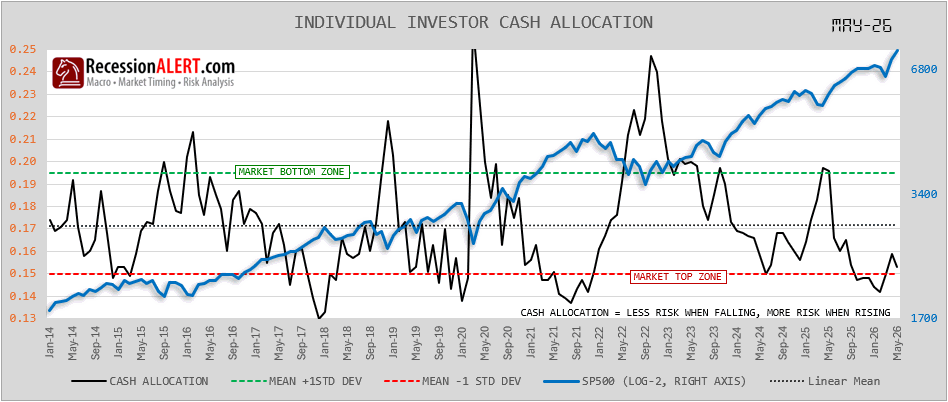
Cash is a position only when fear forces the trade — and that asymmetry is the indicator. The high-cash extreme times bottoms on a short fuse: 2016, 2018, the COVID panic, 2022 each cleared selling in weeks, because fear is acute and self-extinguishing — it spikes, then it’s spent. The low-cash end is the opposite animal. Complacency is not an event but an accretion, built slowly as a rising tape teaches investors to keep less in reserve, and it has to be actively unwound. So the market-top zone is an early warning — it sat at the lows for months ahead of both the 2018 correction and the 2022 bear, humbling anyone who read the level as a clock. But the level was never the trigger. The turn is. This winter cash hit its lowest since 2021, then did the thing that matters: it began to rise even as the S&P printed new records, refusing to drain the way a melt-up demands — institutions emptied in parallel, BofA cash through its own sell line at 3.9%. That is deliberate de-risking into strength, the first hands toward the exit while the tape still prints green. The danger was never the low — it’s the lift.
Market Intelligence Brief (MIB) Ver. 18.40
For professional investors only. Not investment advice.
© 2026 RecessionALERT.com

Comments are closed.