
MARKET INTELLIGENCE BRIEF (MIB)
Friday, November 20, 2026
The AI rout became an index-level correction: the S&P 500 fell 3.70% for a seventh straight loss, 11.6% below its October 6 close, and the Nasdaq 100 sank 5.61% to the edge of a bear market. Nvidia plunged 14.01% on a Reuters report of SEC accounting scrutiny; Broadcom fell 12.19% on a reported Google TPU cut. The VIX jumped 26.20% to 35.89. Treasuries rallied, the 2-year down 11.5 bps, but gold fell 4.00%. Michigan year-ahead inflation expectations eased to 3.7%.
TABLE OF CONTENTS
A. EXECUTIVE SUMMARY
B. MARKET DATA
C. HIGH-IMPACT STORIES (5)
D. MODERATE-IMPACT STORIES (6)
E. ECONOMY WATCH (5)
F. EARNINGS WATCH (0)
G. WHAT’S NEXT
H. CHART OF THE DAY
A. EXECUTIVE SUMMARY -> TOP
Friday turned an AI-sector correction into an index-level one: the S&P 500 capped an 8.6% weekly loss 11.6% below its October 6 close, and the Nasdaq 100 ended 19.8% below its own October 6 close, about 49 points from bear-market territory. Two company shocks, Reuters’ report of SEC scrutiny of Nvidia’s accounting and a reported Google cut to Broadcom-designed TPU orders, landed on an AI trade that was already falling, and President Trump’s threatened tax on overseas data centers added policy risk to the same group. The 2-year yield’s 11.5 bp drop, on the day Governor Cook argued one hike may not be enough, shows bonds treating the rout as a growth risk that limits the Fed, while gold, silver and Bitcoin fell with stocks in broad de-risking rather than a flight to safety. Breadth was near-total: ten of eleven sectors fell, led by Technology’s 7.26% slide, and only Consumer Defensive (+0.43%) rose.
• Correction, and nearly a bear market: S&P 500 -3.70% to 6,910.39, its seventh straight loss and an 8.6% weekly drop; Nasdaq 100 -5.61% to 25,028.98, about 49 points above the level 20% below its October 6 close; Dow -1.93%. The VIX rose 26.20% to 35.89, its highest close since at least April 15, after touching 40.03 intraday.
• Nvidia’s accounting in question: NVDA -14.01% to $125.53 after Reuters reported SEC enforcement staff are examining potential accounting issues; the SEC declined to comment and the issues were not identified. MU -13.89%, AMD -13.25%, ANET -11.59%. President Trump said he would like to see ousted CEO Jensen Huang return.
• Custom silicon cracks: AVGO -12.19% after analyst Ming-Chi Kuo said Google cut planned 2027 shipments of its Broadcom-designed TPU 8i by about 20%, shifting volume to a MediaTek design; neither company has commented. Separately, Trump threatened a “tremendous tax” on US companies building data centers abroad, with no mechanism named.
• Fed talks tough, bonds rally: Governor Cook, who dissented for a hike in October, said she is skeptical September’s single hike will be enough; Bessent pushed back on a bigger move. The 2-year yield fell 11.5 bps to 4.651% and the 10-year fell 10.5 bps to 4.941%, back below 5%. Polymarket odds of another 2026 hike eased to 92% from 97%.
• No shelter outside Treasuries: Gold -4.00% to $3,538.20, silver -7.41%, copper -2.98%, all at their lowest closes since at least April 15; Bitcoin -4.64% to $59,305, below $60,000 for the first time since July. WTI rose 1.39% to $83.59 after Houthi threats against Saudi Red Sea ports and a projectile strike on a tanker inside the Strait of Hormuz.
• Households less worried about prices: Michigan final sentiment rose to 51.5 from 48.0 in October; year-ahead inflation expectations fell to 3.7% from 4.7%, against 4.3% expected. The Kansas City Fed manufacturing composite rose to 18 from 11. UNH +2.84% on a TD Cowen upgrade, the largest gain among US companies above $200 billion.
1. The AI trade is now being questioned on several fronts at once — Friday’s shocks each hit a different link in the chain. The SEC report questions whether Nvidia’s reported numbers, the benchmark for sizing AI capital spending, can be relied on. The Kuo survey questions whether custom-silicon share is locked in at Google. The data-center tax threat questions where the build-out can happen, and Oxford Economics’ warning about AI-financed debt, with Goldman Sachs estimating $500 billion issued in 2026 so far, questions how it is paid for. Each is still unresolved: the SEC has not named the issues, Google and Broadcom have not commented, and no mechanism for the tax has been set out. Together they explain why selling that began in the AI leaders has spread to the index. The near-term line is the Nasdaq 100’s 24,980, 20% below its October 6 close; a close beneath it would make this a bear market.
2. Officials and bonds read the selloff in opposite directions — Cook’s case for more tightening rests partly on financial conditions she called “too accommodative” and on equity prices that support spending, yet the S&P 500 closed 11.6% below its October 6 close while she spoke. The front end’s 11.5 bp rally prices the rout as a growth risk that limits how far the Fed can go, and Michigan’s drop in year-ahead inflation expectations to 3.7% weakens one argument for going further. A December hike remains the base case; its size is the open question, with Bessent publicly opposing a half-point move. Wednesday’s October PCE, the first official check on Cook’s 3.8% headline and 3.2% core estimates, is the arbiter before the December 8-9 FOMC.
3. Diversification failed outside Treasuries and crude — Gold fell 4.00% on a day the 2-year yield fell 11.5 bps and the dollar was flat, conditions that normally help it, and silver and Bitcoin fell with stocks. That pattern is consistent with selling to raise cash or cut leverage, though no source has confirmed the motive. Crude was the exception, rising on the Houthi threat to Saudi Red Sea ports, the export route that avoids Hormuz, and on a tanker strike inside the strait. With Brent closing a fourth straight weekly decline from $116.62 on October 23, the market had been pricing de-escalation, leaving room for a sharper move if the threats are carried out.
 — Leading economic indicators. Accurate market forecasts. Apply for membership at join.recessionalert.com
B. MARKET DATA -> TOP
An AI-hardware rout drove a broad Friday selloff, leaving the S&P 500 11.6% below its October 6 close and capping an 8.6% weekly drop. Nvidia’s 14% slide, deepened by a Reuters report of SEC scrutiny of its accounting that could not be independently confirmed, led a chip complex in which Micron, AMD and Broadcom each lost 12-14%. Selling was near-universal, with only Consumer Defensive finishing green. The haven trade was split: Treasuries rallied and the VIX closed at its highest since at least April 15, but gold and silver sold off alongside equities instead of catching a bid.
CLOSING PRICES – Friday, November 20, 2026:
MAJOR INDICES
A concentrated tech collapse with broad collateral damage: the Nasdaq 100’s 5.61% drop nearly tripled the Dow’s 1.93%, as the price-weighted Dow drew partial support from UnitedHealth’s gain. All five broad gauges (the S&P 500, Dow, Nasdaq 100, Russell 2000 and NYSE Composite) closed at their lowest since at least April 15. Transports fell broadly in line with industrials, so no Dow Theory or relative-performance signal crossed its threshold.
| Index | Close | Change | %Move | Why It Moved |
|---|---|---|---|---|
| S&P 500 | 6,910.39 | -265.44 | -3.70% | Tech-led rout as chip stocks collapsed (Technology -7.26%); lowest close since at least April 15 and 11.6% below its October 6 close |
| Dow Jones | 48,147.33 | -949.73 | -1.93% | Goldman Sachs (-6.71%), Caterpillar (-5.01%) and Nvidia (-14.01%) weighed; UnitedHealth (+2.84%) cushioned; lowest close since at least April 15 |
| DJ Transportation | 19,625.11 | -507.33 | -2.52% | Fell with the broad market; no transport-specific catalyst identified |
| Nasdaq 100 | 25,028.98 | -1,488.07 | -5.61% | Semiconductor collapse: Nvidia, Micron, AMD and Broadcom each fell 12-14%; lowest close since at least April 15 |
| Russell 2000 | 2,581.79 | -73.32 | -2.76% | Broad risk-off selling; lowest close since at least April 15 |
| NYSE Composite | 22,657.82 | -481.99 | -2.08% | Broad selling, with 10 of 11 S&P sectors lower; lowest close since at least April 15 |
VOLATILITY & TREASURIES
Classic risk-off in the bond market: both yields fell more than 10 bps as equities sold off, with the 2-year slightly outpacing the 10-year, a modest bull steepening that widened the 2s10s spread to 29 bps. The VIX’s 26% jump alongside falling yields is a growth-and-risk fear signature, not an inflation scare. The dollar’s flat close shows no haven bid in currencies.
| Instrument | Level | Change | Why It Moved |
|---|---|---|---|
| VIX | 35.89 | +7.45 (+26.20%) | Highest close since at least April 15 as the chip rout deepened; touched 40.03 intraday |
| 10-Year Treasury Yield | 4.941% | -10.5 bps | Investors bought Treasuries during the equity selloff; closed back below 5% |
| 2-Year Treasury Yield | 4.651% | -11.5 bps | Led the rally; Investing.com read it as the market trimming near-term Fed hike bets, not independently confirmed |
| US Dollar Index (DXY) | 103.81 | -0.06 (-0.05%) | Little changed, just below Thursday’s close, its highest since at least April 15; no haven bid in the dollar |
COMMODITIES
Metals offered no refuge: gold, silver, platinum and copper all closed at their lowest since at least April 15, falling with equities even as Treasury yields dropped. Gold’s slide does not fit a rates story on a day the 2-year fell 11.5 bps, and silver fell nearly twice as far as gold. Bitcoin’s break below $60,000 tracked equities, confirming it traded as a risk asset.
| Asset | Price | Change | %Move | Why It Moved |
|---|---|---|---|---|
| Gold | $3,538.20/oz | $-147.30 | -4.00% | Fell with risk assets to its lowest close since at least April 15; wire reports cited Fed hike bets, which the falling 2-year yield does not support today; no discrete same-day catalyst identified |
| Silver | $41.073/oz | $-3.287 | -7.41% | Fell harder than gold; lowest close since at least April 15; no discrete same-day catalyst identified |
| Copper | $5.4658/lb | $-0.1677 | -2.98% | Lowest close since at least April 15; Investing.com tied the slide to an unwinding AI data-center demand premium, not independently confirmed |
| Platinum | $1,285.50/oz | $-62.00 | -4.60% | Fell with the precious metals; lowest close since at least April 15 |
| Bitcoin | $59,305.0 | $-2,887.0 | -4.64% | Fell below $60,000 for the first time since July as AI-valuation worries weighed on risk assets, per Reuters |
ENERGY
Energy rose against the equity rout, with all four contracts higher and gas leading crude. Reuters attributed crude’s late gain to renewed US-Iran war worries and short-covering before next week’s Thanksgiving holiday, with Brent still on track for a fourth straight weekly decline. Henry Hub closed at its highest since at least April 15 with no discrete catalyst identified.
| Asset | Price | Change | %Move | Why It Moved |
|---|---|---|---|---|
| Crude Oil (WTI) | $83.59/bbl | $+1.15 | +1.39% | Gained late on renewed US-Iran war worries and pre-Thanksgiving short-covering, per Reuters, which put the expiring December contract’s settle at $83.98, up 77 cents |
| Crude Oil (Brent) | $92.49/bbl | $+0.51 | +0.55% | Settled $92.57, up 59 cents, per Reuters, on the same Iran worries; still headed for a weekly decline as Strait of Hormuz shipments return to roughly pre-war levels |
| Natural Gas (Henry Hub) | $3.465/MMBtu | $+0.197 | +6.03% | No discrete same-day catalyst identified; highest close since at least April 15 |
| Natural Gas (Dutch TTF) | $28.51/MMBtu | $+1.36 | +5.03% | Rose with crude after missile strikes on Riyadh and mine blasts in the Strait of Hormuz, per Investing.com; not independently confirmed |
S&P 500 SECTORS
A near-total sweep: 10 of 11 sectors fell, with Consumer Defensive (+0.43%) the lone holdout. Technology’s 7.26% drop deepened a 13.08% weekly and 18.03% monthly slide and turned its year-to-date return negative. Healthcare, Utilities, Energy and Real Estate each lost about 1% or less, while Basic Materials’ 11.54% weekly loss tracks the metals rout.
| Sector | 1-Day | 1-Week | 1-Month | 3-Month | 6-Month | YTD | 12-Month |
|---|---|---|---|---|---|---|---|
| Consumer Defensive | +0.43% | -2.41% | +0.36% | +5.72% | +5.57% | +15.04% | +17.93% |
| Healthcare | -0.57% | -6.20% | -2.70% | -1.32% | +13.10% | +9.66% | +11.31% |
| Utilities | -0.84% | -3.52% | -1.42% | -1.74% | -7.49% | -1.51% | -4.28% |
| Energy | -0.91% | -7.40% | -12.07% | -7.11% | -3.81% | +27.76% | +27.13% |
| Real Estate | -1.03% | -4.09% | -0.59% | -7.63% | -5.23% | +3.15% | +3.12% |
| Financial | -2.07% | -7.43% | -5.33% | -8.65% | +1.31% | -0.84% | +6.19% |
| Communication Services | -2.90% | -9.07% | -12.38% | -15.24% | -21.28% | -16.18% | -11.71% |
| Basic Materials | -3.39% | -11.54% | -11.76% | -22.86% | -16.57% | -4.89% | +4.26% |
| Consumer Cyclical | -3.39% | -6.91% | -3.17% | -6.84% | -8.02% | -9.00% | -4.25% |
| Industrials | -3.90% | -7.70% | -6.84% | -11.78% | -13.18% | -1.47% | +2.94% |
| Technology | -7.26% | -13.08% | -18.03% | -17.41% | -17.29% | -0.62% | +0.68% |
TOP MEGA-CAP MOVERS:
GAINERS
Muted session for gainers: only two names rose 1.5% or more, so the largest gains are shown.
| Company | Ticker | Close | Change | Why It Moved |
|---|---|---|---|---|
| UnitedHealth Group | UNH | $339.85 | +2.84% | TD Cowen upgraded it to Buy, raised its price target to $455 from $402 and named it a 2027 best idea, per Investing.com; rebounded from Thursday’s -5.55% |
| Walmart | WMT | $127.95 | +1.52% | No discrete same-day catalyst identified; follows its November 19 quarterly report, in the only sector to close higher |
| Johnson & Johnson | JNJ | $270.47 | +1.25% | No discrete same-day catalyst identified; the company released Tremfya psoriatic-arthritis data on November 20 |
| AbbVie | ABBV | $286.20 | +0.94% | No discrete same-day catalyst identified |
| Coca-Cola | KO | $96.99 | +0.94% | No discrete same-day catalyst identified; Consumer Defensive was the only sector to close higher |
DECLINERS
| Company | Ticker | Close | Change | Why It Moved |
|---|---|---|---|---|
| NVIDIA | NVDA | $125.53 | -14.01% | Selling deepened after Reuters reported SEC enforcement staff were examining potential accounting issues, per Investing.com, not independently confirmed; follows the Wall Street Journal’s November 17 report of an SEC disclosure probe and the turmoil since Jensen Huang’s departure |
| Micron Technology | MU | $594.51 | -13.89% | No discrete same-day catalyst confirmed; Investing.com tied the drop to Anthropic’s reversal after its Thursday debut, as Micron committed $1.0 billion in the IPO’s private placement, not independently confirmed |
| Advanced Micro Devices | AMD | $424.39 | -13.25% | Extended Thursday’s -7.72% slide after Hunterbrook’s short report; Investing.com also cited export-license data the House Foreign Affairs Committee released November 19, not independently confirmed |
| Broadcom | AVGO | $304.41 | -12.19% | TF International analyst Ming-Chi Kuo reported Google cut planned 2027 shipments of Broadcom-designed TPU 8i chips by about 1 million units, roughly 20%, per Investing.com; not independently confirmed |
| Arista Networks | ANET | $167.62 | -11.59% | No discrete same-day catalyst identified; fell with AI-hardware names |
— Institutional-grade intelligence for serious investors. Apply for membership at join.recessionalert.comC. HIGH-IMPACT STORIES -> TOP
BEARISH
1. S&P 500 Falls 3.70% Into Correction Territory for a Seventh Straight Loss as the Nasdaq 100 Closes Within 0.2% of a Bear Market
The core facts:The S&P 500 fell 3.70% to 6,910.39, its seventh straight daily loss and an 8.6% drop for the week. The close sits 11.6% below the October 6 close of 7,818.93, the highest since at least April 15, beyond the 10% decline that marks a correction. The Nasdaq 100 fell 5.61% to 25,028.98, 19.8% below its own October 6 close, and the Dow fell 1.93% to 48,147.33, 11.4% below its August 5 close. All five broad gauges (the S&P 500, Dow, Nasdaq 100, Russell 2000 and NYSE Composite) closed at their lowest since at least April 15. Technology fell 7.26% and ten of eleven sectors finished lower; only Consumer Defensive rose, by 0.43%. The selling centred on AI hardware: Nvidia fell 14.01%, Micron 13.89%, AMD 13.25%, Broadcom 12.19% and Arista Networks 11.59%. The VIX jumped 26.20% to 35.89, its highest close since at least April 15, after touching 40.03 intraday.
Why it matters:The rout has moved from a sector correction to an index-level one. The Nasdaq 100’s loss was nearly three times the Dow’s, so the damage is still concentrated in the AI complex. But a week in which the S&P 500 lost 8.6% and only one sector rose on Friday means the selling is no longer confined to the names that led the rally. Two company-specific shocks, Reuters’ report of SEC scrutiny of Nvidia’s accounting and a reported cut to Google’s Broadcom-designed chip orders, landed on an AI trade that was already falling. The haven signal was split: Treasuries rallied, but gold, silver and Bitcoin fell with stocks. That pattern points to broad de-risking rather than a rotation into safety, and a VIX near 36 means options markets are pricing daily swings of roughly 2% or more.
What to watch:The Nasdaq 100 closed about 49 points above 24,980, the level 20% below its October 6 close; a close beneath it would put the index in a bear market. October PCE inflation and the second estimate of third-quarter GDP on Wednesday, November 25 are the next macro tests before the Thanksgiving holiday.
BEARISH
2. Nvidia Falls 14.01% After Reuters Reports SEC Enforcement Staff Are Examining Potential Accounting Issues
The core facts:Reuters reported on Friday, citing two people briefed on the matter, that SEC enforcement staff are scrutinizing potential accounting issues at Nvidia. Reuters said it could not determine when the SEC opened its inquiry or exactly which accounting issues are being examined; the SEC declined to comment and Nvidia did not immediately respond. The Wall Street Journal had reported on Tuesday that the SEC was probing Nvidia but could not establish the investigation’s focus. Per Reuters, citing LSEG data, the shares were down more than 6% before its report and about 13% afterwards; they closed at $125.53, down 14.01%. At his Friday press conference, President Trump said of the company’s ousted chief executive, Jensen Huang, “I would love to see him back,” adding, “I’d like to see Jensen make a big apology and go back because he created something with Blackwell,” per CBS News.
Why it matters:The report changes the question about Nvidia from what it disclosed to whether its reported numbers are reliable, and Nvidia’s results are the benchmark investors use to size the whole AI capital-spending cycle. Reuters notes that investigations are not evidence of wrongdoing and that many close without enforcement action. But with an interim chief executive, a Justice Department review of its Hugging Face deal and now an accounting focus at the SEC, the company faces governance uncertainty on several fronts at once. Its 14% fall led a chip selloff that took the Nasdaq 100 to the edge of a bear market. The president’s public call for Huang’s return adds political pressure on a board already under scrutiny.
What to watch:Any Nvidia statement or SEC filing addressing the inquiry, and whether the board responds to the president’s call for Huang’s return; a disclosure that names the accounting issues would determine whether the selloff deepens or stabilizes.
BEARISH
3. Broadcom Falls 12.19% as Analyst Ming-Chi Kuo Says Google Cut 2027 Orders for Broadcom-Designed TPU Chips by About 20%
The core facts:TF International Securities analyst Ming-Chi Kuo wrote on X on Friday that his survey shows Google cut planned 2027 shipments of its Broadcom-designed TPU 8i series by about 1 million units, or roughly 20%, with most of the cut falling on the higher-priced 8i Max, per 24/7 Wall St. and StockAnalysis. Kuo said Google plans to ship more of its TPU 8t, a chip designed with Taiwan’s MediaTek, and that the details are not final. Neither Google nor Broadcom has commented. Broadcom closed at $304.41, down 12.19%. StockAnalysis had Marvell Technology down 9.2% in afternoon trading.
Why it matters:Broadcom’s AI growth case rests on custom accelerators built for a handful of hyperscalers, and Google’s TPU programme is the most established of them. A reported shift of volume to a second design partner at that customer challenges the assumption that custom-silicon share is locked in, and it suggests even AI buyers are now managing costs and supply. How much of Friday’s drop belongs to the report is uncertain: Nvidia, Micron and AMD each fell by a similar 13% to 14% without it. The claim rests on a single analyst’s supply-chain survey, and the companies have neither confirmed nor denied it.
What to watch:Any comment from Google or Broadcom on 2027 TPU volumes, and Broadcom’s next quarterly guidance for AI semiconductor revenue, which would show whether the reported cut reaches its numbers.
UNCERTAIN
4. Cook Says One Hike Is Unlikely to Be Enough and Bessent Pushes Back on a Bigger Move, but Treasuries Rally as the 2-Year Yield Falls 11.5 bps
The core facts:Governor Lisa Cook, who dissented for a hike in October, said in Santiago that she is “skeptical that September’s single 1/4 point rate increase will be enough,” that she sees holding steady as “as much a monetary policy action as the act of increasing the rate,” and that falling behind could require “additional and larger rate increases” later. She called financial conditions “too accommodative” and said equity prices “continue to support consumer spending.” On Thursday evening, Philadelphia Fed President Anna Paulson called the October hold “a matter of pace, not direction.” Treasury Secretary Scott Bessent told CNBC on Friday that the Fed should not embrace a big hike, saying a governor now backing a 50 basis point increase had wanted a similar cut within the past year: “So it seems somewhat peripatetic to now want a the bigger hike just 12 months or 11 months later,” per Reuters. Bonds ignored the hawkish talk: the 2-year yield fell 11.5 bps to 4.651% and the 10-year 10.5 bps to 4.941%, back below 5%.
Why it matters:The officials and the market are now reading the same equity selloff in opposite ways. Cook’s case for further tightening leans in part on loose financial conditions and equity prices that support spending, yet the S&P 500 closed Friday 11.6% below its October 6 close, so conditions tightened sharply while she spoke. The front end’s 11.5 bp drop shows traders treating the rout as a growth risk that limits how far the Fed can go. Bessent’s remark is also a public sign that a half-point hike is being argued inside the Board, and that the Treasury opposes it. A December hike remains the market’s base case; the open question has shifted to its size and to what comes after.
What to watch:October PCE inflation on Wednesday, November 25, the first official check on Cook’s estimate of 3.8% headline and 3.2% core, ahead of the December 8-9 FOMC meeting.
BEARISH
5. Houthis Threaten Saudi Red Sea Ports and a Tanker Is Struck Inside the Strait of Hormuz as Crude Rises Against the Equity Rout
The core facts:Houthi military spokesman Yahya Saree said on Friday the group would attack Saudi Red Sea ports if Saudi-led coalition forces struck Yemen’s Hodeidah port, warning “all employees, workers, and those in the vicinity of these ports to evacuate them immediately,” urging shipping companies to move their ships out, and telling airlines that Saudi airspace “will be the scene of our operations in the coming hours,” per Reuters. The coalition then struck what spokesman Maj. Gen. Turki Al Malki called “operational capabilities at Hodeidah port that were used in smuggling operations,” along with targets in Sanaa, and Saudi air defences intercepted two ballistic missiles fired toward the Jazan region, per The National. Separately, UKMTO reported that at 1500 UTC an outbound tanker 8 nautical miles north of Khasab, Oman, inside the Strait of Hormuz, was struck on the port bow by an unknown projectile and caught fire; no casualties were reported. WTI closed at $83.59, up 1.39%, and Brent at $92.49, up 0.55%.
Why it matters:Saudi Arabia’s Red Sea coast is its export outlet that avoids Hormuz, so a credible threat to those ports would expose the route the market relies on if the strait is disrupted. A projectile strike inside the strait on the same day keeps that disruption risk live. Crude rose on a day when equities, metals and Bitcoin all fell, and Reuters tied the late gain to renewed US-Iran war worries and short-covering before the holiday. Even so, Brent’s Friday close of $92.49 was its fourth straight weekly decline from $116.62 on October 23, a sign the market had been pricing de-escalation, which leaves room for a sharper reaction if the threats are carried out.
What to watch:Whether shipping lines suspend calls at Saudi Red Sea ports over the weekend, and whether Brent holds above $90 when trading resumes Monday.
— Quantifying recession risk so you don’t have to guess. Apply for membership at join.recessionalert.comD. MODERATE-IMPACT STORIES -> TOP
BULLISH
6. UnitedHealth Rises 2.84% on a TD Cowen Upgrade as It Sues CMS to Overturn Its 2027 Medicare Advantage Star Ratings
The core facts:TD Cowen upgraded UnitedHealth to Buy from Hold on Friday and upgraded Humana to Buy as well. Investing.com reported that the firm raised its UnitedHealth price target to $455 from $402 and named the stock a 2027 best idea. UnitedHealth closed at $339.85, up 2.84%, the largest gain among US companies above $200 billion, after falling 5.55% on Thursday. Separately, in a complaint filed late on Thursday, UnitedHealth sued the federal government, alleging that the Centers for Medicare & Medicaid Services improperly used 26 measures to calculate 2027 star ratings for 45 of its contracts, and arguing the agency lacked statutory authority, did not give it a chance to object, or both, per Reuters. CMS declined to comment. Reuters puts UnitedHealth’s Medicare Advantage enrolment at 7.61 million; STAT puts it at more than 9 million and counts the suit as at least the 15th by a plan over 2027 ratings.
Why it matters:Star ratings decide which plans earn Medicare Advantage bonus payments, so the suit goes directly to 2027 revenue at the largest MA insurer. It follows Thursday’s selloff on the formal publication of CMS’s CRUSH proposal. The upgrade gave the managed-care group a valuation case on a day when defensive sectors were the only shelter, and UnitedHealth’s gain helped cushion the price-weighted Dow’s fall. More than a dozen plans are now litigating, which makes the ratings a contested policy question rather than a settled hit to earnings.
What to watch:Early rulings in the star-ratings suits and any CMS response before Medicare’s annual enrolment period closes on December 7.
UNCERTAIN
7. Trump Threatens a “Tremendous Tax” on US Companies That Build Data Centers Abroad
The core facts:At a White House press conference on Friday, President Trump said of US companies that build data centers overseas, “If they do that, we’re going to put a tremendous tax on them,” adding, “We’re not going to allow our companies to build data centers outside of our country,” per CBS News. CBS did not report any mechanism, legal authority or timeline for the tax. Asked about the reported rift between Commerce Secretary Howard Lutnick and Treasury Secretary Scott Bessent over chip sales to China, Trump said, “I have not lost confidence” in Lutnick.
Why it matters:The largest US cloud and AI companies build capacity abroad to serve local customers, meet data-residency rules and reach cheaper power, so a penalty on overseas builds would raise the cost of the AI expansion on which chip and equipment demand depends. The threat came on a day when AI-hardware stocks led a 3.70% drop in the S&P 500, adding policy risk to the valuation and accounting doubts already hitting the group. With no mechanism named, the market impact depends on whether it turns into an executive action or legislation.
What to watch:Any executive order, Treasury guidance or legislative text defining the tax, and comments from the major cloud providers on their overseas data-center plans.
BEARISH
8. Citigroup Underestimated the Size of a UK Subsidiary by $35 Billion After Trade-Handling Mistakes, WSJ Reports
The core facts:Citigroup underestimated the size of a UK subsidiary by $35 billion after mistakes in how it handled trades, the Wall Street Journal reported on Friday, citing people familiar with the matter. After spotting the problem, the bank injected extra capital into the subsidiary over the summer, a Citi spokeswoman said in a statement. The report landed on a day when the Financial sector fell 2.07%.
Why it matters:A $35 billion misstatement of an operating subsidiary’s size is a data and controls failure, the same category of weakness Citi’s multi-year transformation programme was meant to fix. The capital top-up suggests the error was material to the subsidiary’s regulatory ratios, though the bank has not said by how much. It is a reputational setback rather than a balance-sheet threat for a bank of Citi’s size, but it adds risk of fresh supervisory action at a time of market stress.
What to watch:Any statement from the Bank of England’s Prudential Regulation Authority or US regulators, and whether Citi quantifies the capital injection in its next regulatory disclosure.
BULLISH
9. Merck’s Sac-TMT Improves Overall Survival in a Phase 3 Gastroesophageal Cancer Trial but Misses on Progression-Free Survival
The core facts:Merck said at 6:45 a.m. ET on Friday that the Phase 3 TroFuse-015 trial of sacituzumab tirumotecan (sac-TMT), an investigational TROP2-directed antibody-drug conjugate licensed from Kelun-Biotech, met its primary endpoint of overall survival. In 473 patients with gastroesophageal adenocarcinoma who had received two or more prior lines of therapy, sac-TMT showed a “statistically significant and clinically meaningful improvement” in survival compared with treatment of physician’s choice, with results generally consistent regardless of TROP2 expression. It did not meet the secondary endpoint of progression-free survival assessed by blinded independent central review. No hazard ratio or median survival figures were disclosed. The data will be presented at an upcoming medical meeting and shared with regulators.
Why it matters:Overall survival is the endpoint regulators weigh most, so a positive readout gives sac-TMT a path to approval in a late-line setting with few options. That supports Merck’s push to build an antibody-drug-conjugate franchise beyond Keytruda. The progression-free survival miss and the lack of disclosed effect sizes mean the commercial value cannot be judged until the full data are shown. Activity regardless of TROP2 expression would widen the eligible population if confirmed.
What to watch:The hazard ratio and median overall survival when the data are presented, and the timing of a regulatory filing.
BULLISH
10. SEC Proposes Taking Direct Control of the Consolidated Audit Trail and Funding It Through Congressional Appropriations
The core facts:The SEC on Friday proposed rescinding Rule 613 of Regulation NMS, which requires the exchanges and FINRA to build and run the Consolidated Audit Trail, and replacing it with a new Exchange Act Rule 17a-26. Under the new rule, self-regulatory organizations and broker-dealers would report “substantially the same information” to the Commission or its designee, bringing the CAT under the SEC’s direct control. The Commission said it intends to pay its CAT costs from funds appropriated by Congress rather than by industry. Chairman Paul Atkins said the proposal addresses “persistent concerns with cost overruns, funding, and governance” and is intended to put the CAT “on a sustainable footing.” Comments are due 60 days after publication in the Federal Register.
Why it matters:CAT funding has been a long-running fight between the SEC and the industry over who pays for the system, and moving the cost to appropriations would remove a recurring expense from exchange operators and broker-dealers. It would also shift governance and data-security responsibility for the market’s largest trade database to the regulator. The reporting obligation itself stays broadly the same, so the change is about cost and control rather than less surveillance.
What to watch:Federal Register publication, which starts the 60-day comment period, and whether Congress provides the appropriations the plan depends on.
BEARISH
11. Gold Falls 4.00% and Silver 7.41% as Metals Sell Off With Stocks Despite an 11.5 bps Drop in the 2-Year Yield
The core facts:Gold fell 4.00% to $3,538.20 an ounce, after a 3.05% drop on Thursday. Silver fell 7.41% to $41.073, platinum 4.60% to $1,285.50 and copper 2.98% to $5.4658 a pound, and all four closed at their lowest since at least April 15. The moves came as the 2-year Treasury yield fell 11.5 bps and the dollar index was little changed, down 0.05% at 103.81. Bitcoin fell 4.64% to $59,305, below $60,000 for the first time since July. Wire reports attributed gold’s fall to Fed hike bets, an explanation the falling 2-year yield does not support, and no discrete same-day catalyst was identified. Basic Materials fell 3.39%.
Why it matters:Gold normally gains when real yields and the dollar fall, so a 4% drop on a day both moved in its favour shows it trading as a risk asset alongside equities. The pattern is consistent with selling to raise cash or cut leverage across portfolios, though no source has confirmed that motive. Investing.com tied copper’s slide to an unwinding AI data-center demand premium, which could not be independently confirmed. Either way, Friday left the haven role to Treasuries alone.
What to watch:Whether gold holds $3,500 an ounce, and whether it resumes moving inversely to Treasury yields once equity volatility eases.
— Separating signal from noise since 2007. Apply for membership at join.recessionalert.comE. ECONOMY WATCH -> TOP
The week closed on an inflation-versus-growth fault line. Consumers’ year-ahead inflation expectations fell to 3.7% from 4.7% in the final November Michigan survey and Kansas City Fed factory activity accelerated, yet Governor Cook, who dissented for a hike in October, warned that holding rates steady risks “increasing inflationary pressure.” Treasuries told a growth story instead: the 2-year yield fell 11.5 bps as equities slid, Polymarket’s odds of another 2026 hike eased to 92% from 97%, and Oxford Economics warned that the “seeds of the next recession are being sown” in AI-financed debt. Wednesday’s PCE inflation and GDP releases, both due before Thanksgiving, are the next test of which story the data supports.
Michigan Sentiment Final Rises to 51.5 as Year-Ahead Inflation Expectations Drop to 3.7% vs. 4.3% Expected (University of Michigan, Nov 20)
What they’re saying:The final November University of Michigan consumer sentiment index came in at 51.5, matching expectations, revised up from a preliminary 51.0 and up from 48.0 in October. The expectations index rose to 52.9 against 50.9 expected, while current conditions came in at 49.4 against 51.6 expected. Median year-ahead inflation expectations fell to 3.7% from 4.7% in October, well below the 4.3% expected, and long-run expectations eased to 3.3% from 3.5%.
The context:Year-ahead expectations fell a full percentage point in one month, though the survey’s commentary notes the level “remains meaningfully above the 3.4% seen in February,” and long-run expectations remain above their 2024 range of 2.8% to 3.2%. Survey director Joanne Hsu attributed the sentiment gain to “substantial post-election gains in both short- and long-run expected business conditions,” while sentiment remains 9% below February, before the start of the Iran conflict. Easing household inflation expectations weaken one of the arguments for tightening beyond the Fed’s September hike.
What to watch:The Conference Board’s consumer confidence index on Tuesday, November 24 (expected 92, prior 91.7), and October PCE inflation on Wednesday, November 25.
Kansas City Fed Manufacturing Composite Jumps to 18 From 11, With Production and Employment at Multi-Year Highs (Federal Reserve Bank of Kansas City, Nov 19)
What they’re saying:The Tenth District month-over-month composite index rose to 18 in November from 11 in October and 14 in September. The production and employment indexes reached 23 and 20, respectively, both multi-year highs, and the year-over-year composite climbed to 19 from 11, its highest since November 2022. The six-month expectations composite stood at 21.
The context:The reading runs directly against Thursday’s Philadelphia Fed survey, which slumped to 6.3 against 20.0 expected, leaving the regional factory picture split heading into month-end. The Kansas City Fed said raw materials price increases “eased slightly but continued to outpace finished product price growth,” pointing to pressure on margins, and contacts flagged supply constraints, with one reporting that “raw material lead times continue to stretch out beyond industry norms.”
What to watch:Durable goods orders on Wednesday, November 25 (expected 0%, prior 1.8%), then the Chicago PMI (prior 55.3) and the Dallas Fed Manufacturing Index (prior 13.4) on Monday, November 30.
Cook Says She Dissented for a Hike in October, Warns Holding Steady Risks “Increasing Inflationary Pressure” (Federal Reserve, Nov 20)
What they’re saying:Governor Lisa Cook, in a keynote at the Central Bank of Chile’s annual conference in Santiago, said of the October decision to hold the policy rate steady: “I dissented from that decision. I preferred to raise the target range another 1/4 percentage point.” She warned that “holding our policy rate steady will lead to a positive and widening output gap and increasing inflationary pressure,” and said she is “skeptical that September’s single 1/4 point rate increase will be enough to change the path of inflation.”
The context:Cook said that, based on inflation data released last week, 12-month PCE inflation is estimated at 3.8 percent in October, with core prices up 3.2 percent, and cited unemployment of 4.1 percent and October payroll growth of 165,000. Her central theme was that “waiting to act when a policy adjustment is required has a cost”; she did not address the December meeting directly. Governor Waller’s remarks the same morning, opening the College Fed Challenge finals, contained no policy guidance. Polymarket’s market on another Fed rate hike in 2026, which settles at the December 9 FOMC, stood at 92% Friday, down from 97% Thursday.
What to watch:October PCE and core PCE on Wednesday, November 25 (core expected 0.3% month over month), the first official check on Cook’s 3.8% estimate.
Oxford Economics Warns “Seeds of the Next Recession Are Being Sown” in AI-Financed Debt (Fortune / Oxford Economics, Nov 18)
What they’re saying:Michael Pearce, chief U.S. economist at Oxford Economics, wrote in a note titled “Icarus is flying towards the sun” that the “seeds of the next recession are being sown,” pointing to the debt financing AI spending, weaker hiring among small businesses and an AI-related labor-market adjustment that has “barely begun.” He warned the next downturn will be “deeper and more painful” because deficits and interest payments leave less room for fiscal support, and drew a comparison with the dot-com cycle.
The context:The warning concerns vulnerability, not timing: Pearce also wrote that “2027 should be another strong year for the economy, with growth comfortably above the consensus.” Current gauges remain benign, with the New York Fed’s model putting the chance of a recession before October 2027 at 12.4% and the Sahm Rule at 0.00% for September and October. Goldman Sachs estimates $500 billion of AI-related debt has been issued in 2026 so far, and Friday’s 7.26% drop in technology stocks puts that financing channel into sharper focus.
What to watch:The second estimate of third-quarter GDP on Wednesday, November 25 (expected 3.4%), and that morning’s weekly jobless claims (prior 203,000) for any crack in hiring.
Two-Year Yield Drops 11.5 Basis Points as Equity Rout Lifts Treasuries; 10-Year Closes Back Below 5% (Treasury Market, Nov 20)
What they’re saying:The 2-year Treasury yield fell 11.5 basis points to 4.651% and the 10-year fell 10.5 basis points to 4.941%, closing back below 5%, as investors bought Treasuries during the equity selloff. The 2s10s spread widened to 29 basis points in a modest bull steepening, while the VIX jumped 26.20% to 35.89 and the dollar index was little changed at 103.81.
The context:Falling yields alongside a surging VIX and a flat dollar mark a growth-and-risk fear rather than an inflation scare. The front end led the rally, and Polymarket’s market on another Fed rate hike in 2026 eased to 92% from 97%, but a December hike remains the market’s base case, and Governor Cook argued the same day that further tightening is warranted.
What to watch:Whether the rally holds through Wednesday, November 25, when October PCE inflation and the second estimate of third-quarter GDP are both released ahead of the Thanksgiving holiday.
— Know the probability before the market prices in the risk. Apply for membership at join.recessionalert.comF. EARNINGS WATCH -> TOP
YESTERDAY AFTER THE BELL (Markets Reacted Today)
No major earnings yesterday after the bell from companies with >$100B market cap.
TODAY BEFORE THE BELL (Markets Already Reacted)
No major earnings before the bell from companies with >$100B market cap.
TODAY AFTER THE BELL (Markets React Tomorrow)
No major earnings after the bell from companies with >$100B market cap.
WEEK AHEAD PREVIEW:
Q3 2026 earnings season is nearly complete, with 91% of the S&P 500 reported as of November 13, per FactSet. The next five sessions carry four in-scope reporters above $100 billion: Dell Technologies, Analog Devices and Medtronic on Tuesday, November 24, and Deere on Wednesday, November 25.
Dell Technologies (DELL) — AMC, Tuesday, November 24 — consensus EPS $6.62 and about $49.3 billion of revenue, against company guidance of $49 billion, plus or minus $500 million; key focus: AI server revenue against a fiscal 2027 outlook of $74 billion and the AI server backlog, now tested by an AI-hardware rout that has taken the Nasdaq 100 to the edge of a bear market and a reported cut to Google’s 2027 TPU orders, plus GPU and high-bandwidth memory costs as supply stays tight.
Analog Devices (ADI) — BMO, Tuesday, November 24 — consensus EPS $3.89 and about $4.32 billion of revenue, against company guidance of about $4.3 billion; key focus: whether demand that strengthened across regions in the third quarter holds into the first-quarter outlook, how much of this year’s price increases reach margins, and any comment on China demand as US chip export controls tighten.
Medtronic (MDT) — BMO, Tuesday, November 24 — consensus EPS about $1.33 and about $9.48 billion of revenue, against company guidance of $1.32 to $1.34; key focus: organic revenue growth against fiscal 2027 guidance of 7.25% to 7.75%, the timing of the diabetes business separation, and Hugo robotic procedure volumes.
Deere (DE) — BMO, Wednesday, November 25 — consensus EPS about $4.03 and about $10.38 billion of revenue; key focus: whether the fiscal 2027 outlook confirms fiscal 2026 as the trough of the farm-equipment downturn, and any read on US farm exports after the Trump-Xi push for more Chinese agricultural purchases.
No in-scope company above $100 billion reports on Monday, November 23, Friday, November 27 or Monday, November 30, and US markets are closed on Thursday, November 26 for Thanksgiving.
— US market commentary trusted by family offices and institutions. Apply for membership at join.recessionalert.comG. WHAT’S NEXT -> TOP
UPCOMING RELEASES:
| Date | Event | Why It Matters |
|---|---|---|
| Mon, Nov 23 | Chicago Fed National Activity Index (prior 0.07) | A broad read on October activity. A reading near zero signals growth at trend, the backdrop against which Oxford Economics’ warning that AI-financed debt is sowing “the seeds of the next recession” will be weighed. |
| Tue, Nov 24 | Conference Board Consumer Confidence (expected 92, prior 91.7) | Tests whether Michigan’s November gain survives a week in which the S&P 500 lost 8.6%. Governor Cook cited equity prices as a support for consumer spending, so a drop here would undercut part of her case for further hikes. |
| Wed, Nov 25 | October PCE and Core PCE Price Index (core expected 0.3% m/m, prior 0.3%; headline expected 0.3% m/m, prior 0.5%; headline y/y prior 3.6%), with Personal Income (prior 0.2%) and Spending (prior 0.5%) | The day’s main event and the first official check on Cook’s estimate of 3.8% headline and 3.2% core 12-month inflation for October. A print at or above it supports a December hike and the case for a half-point move; a softer one backs the bond market’s 11.5 bp rally in the 2-year. |
| Wed, Nov 25 | Q3 GDP, Second Estimate (expected 3.4%), with Preliminary Corporate Profits (prior 7.7%) | Shows how much growth momentum the economy carried into the equity rout. The profits figure is the first official economy-wide read on third-quarter corporate earnings. |
| Wed, Nov 25 | Durable Goods Orders (expected 0%, prior 1.8%; ex-transportation prior 0.5%) | A read on business equipment spending at a moment when the AI capital-spending cycle is being questioned on accounting, customer and policy grounds. |
| Wed, Nov 25 | Initial Jobless Claims (prior 203K), moved to Wednesday by the holiday | The Sahm Rule read 0.00% for September and October. A rise in claims would be the first hard sign of the labour-market adjustment Oxford Economics says has “barely begun.” |
| Thu, Nov 26 | US market holiday — Thanksgiving Day | Markets closed. Wednesday’s inflation, growth and labour data all land just before the holiday, so any surprise must be absorbed in a shortened week. |
| Fri, Nov 27 | Advance Goods Trade Balance (prior -$135.1B), Wholesale Inventories (prior 0.7%) and Retail Inventories ex Autos (prior 0.5%) | Early inputs to fourth-quarter GDP tracking. Trade and inventories often swing early GDP estimates. |
| Mon, Nov 30 | Chicago PMI (prior 55.3) and Dallas Fed Manufacturing Index (prior 13.4) | Two more regional reads to settle a factory picture split between the Philadelphia Fed’s 6.3 and the Kansas City Fed’s 18, where production and employment hit multi-year highs. |
KEY QUESTIONS:
1. Does the Nasdaq 100 hold above 24,980, the level 20% below its October 6 close, or does a close beneath it confirm a bear market and push selling further beyond AI hardware into the ten sectors that already fell on Friday?
2. Will Nvidia or the SEC say which accounting issues are being examined, and will the board respond to President Trump’s call for Jensen Huang’s return? Either would decide whether Friday’s 14.01% drop is a floor or a first leg.
3. Does Wednesday’s October PCE confirm Cook’s 3.8% headline estimate, and is that enough to keep a half-point December hike in play after Friday’s 11.5 bp drop in the 2-year yield and the fall in Michigan year-ahead inflation expectations to 3.7%?
— US market commentary trusted by family offices and institutions. Apply for membership at join.recessionalert.comH. CHART OF THE DAY -> TOP
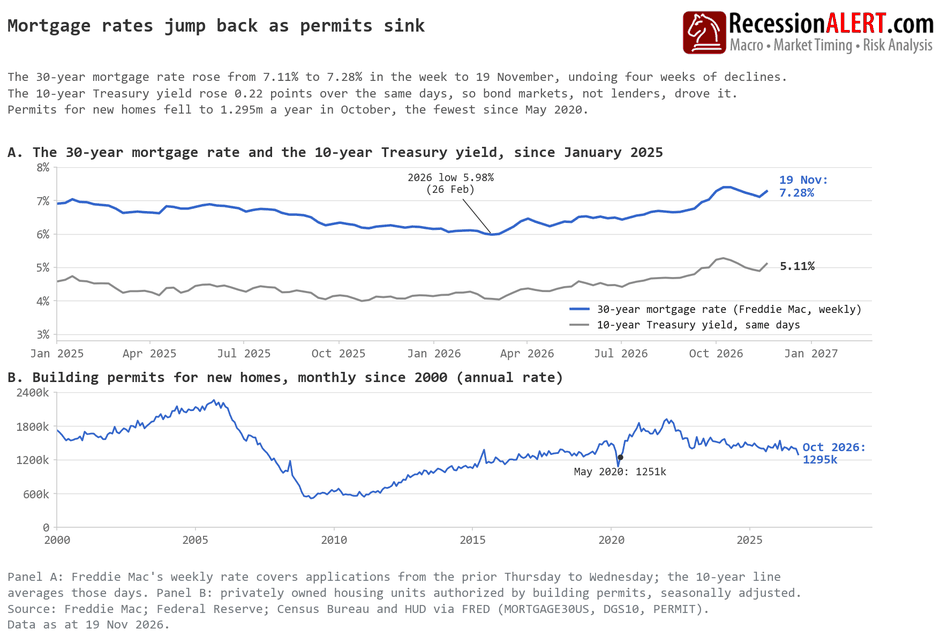
Borrowing got dearer again in the same week the homebuilding pipeline hit its thinnest since 2020. One week undid most of a month’s relief and added $46 to the monthly payment on a $400,000 loan. At $2,737, that payment is $344 above February’s low, about $4,100 a year that a buyer must find before signing. But lenders did not do this. Mortgage rates follow the 10-year Treasury yield, the rate the government pays to borrow for a decade, and over the same days it rose 0.22 point while the margin lenders charge above it narrowed slightly. So relief now waits on Treasury yields falling, something no lender can deliver. Builders feel the same payment: permits for new homes, the licence a builder needs before breaking ground, fell 7.4% in October to the fewest since May 2020. The Conference Board’s leading index, a gauge built to turn before the economy does, fell 0.3% with those permits weighing on it. Yet October’s housing starts rose, so this month’s building sites are busy; the thinning is in the queue behind them. A builder deciding whether to file for next spring weighs the same $2,737 as their buyers. If yields hold here, the slowdown would show in next year’s construction, not this month’s. Housing is not breaking now; it is quietly cancelling appointments with the future.
What it means: For households, a buyer borrowing $400,000 now pays about $344 a month more than in February, and lenders cannot cut that until Treasury yields fall. For stock investors, homebuilders and building-material suppliers are the companies most tied to the permit queue, so their orders for next year depend on it refilling. For the economy, fewer permits now would mean fewer homes started, fewer construction jobs and less spent on furnishings next year. The read changes if permits climb back above 1.4 million a year, as they were as recently as August.
Market Intelligence Brief (MIB) Ver. 20.10
For professional investors only. Not investment advice.
© 2026 RecessionALERT.com

Comments are closed.