
MARKET INTELLIGENCE BRIEF (MIB)
Thursday, November 19, 2026
Anthropic’s record IPO jumped 17.07% in its Nasdaq debut, but it could not stop the S&P 500 falling 2.02% for a sixth straight loss as the Dow closed below 50,000. AMD sank 7.72% on a short seller’s China export-control allegations. Fed officials cast the AI boom as an overheating risk, with a December hike priced at 96.4%. Gold fell 3.05% and the VIX jumped to 28.47. UnitedHealth fell 5.55%; Insmed soared 20.58% on Sanofi takeover talk.
TABLE OF CONTENTS
A. EXECUTIVE SUMMARY
B. MARKET DATA
C. HIGH-IMPACT STORIES (7)
D. MODERATE-IMPACT STORIES (7)
E. ECONOMY WATCH (5)
F. EARNINGS WATCH (2)
G. WHAT’S NEXT
H. CHART OF THE DAY
A. EXECUTIVE SUMMARY -> TOP
The S&P 500 fell 2.02% for a sixth straight loss as the market treated the AI boom as a rate problem rather than a growth story; Anthropic’s record IPO closed 17.07% above its offer, showing demand for new AI paper and none for the AI stocks investors already hold. The policy backdrop removed any cushion: Goolsbee warned the AI boom risks overheating the economy, Jefferson said it is lifting demand and inflation, and a December hike is priced at 96.4%; the 10-year yield fell only 2.1 basis points and held above 5%. Export-control risk added a second, chip-specific weight, as Commerce’s remote-access rule took effect, TSMC and Samsung paused some China shipments and a short-seller report sent AMD down 7.72%. All 11 sectors fell, Energy least at -0.93% and Communication Services most at -2.92%, while gold, silver and Treasuries offered little shelter, pointing to liquidation across portfolios rather than rotation out of one theme.
• Anthropic’s debut: ANT +17.07% to $97.17 against its $83 offer, after opening at $111.50 and reaching about $115. The offering raised $81.3 billion, per CBS News, and Reuters called it the largest IPO on record; Wolfe, Melius, Citizens JMP and Needham all initiated with buy-equivalent ratings.
• Chips under export pressure: AMD -7.72% after short seller Hunterbrook alleged its firmware kept reaching IEIT Systems, a blacklisted Chinese server maker; the claims are untested. TSMC and Samsung paused some China shipments as Commerce’s remote-access rule took effect. NVDA -3.30%, AMAT -3.80%, LRCX -3.77%.
• Fed leans against AI: Goolsbee said the AI boom is contributing to “the potential of overheating,” and Jefferson said the buildout is lifting demand and inflation; CME FedWatch prices a December hike at 96.4%, per Reuters. The Philly Fed index fell to 6.3 against 20.0 expected, while prices received rose to their highest since June 2022.
• No shelter: Gold -3.05% to $3,627.90 and silver -4.92%, with all four metals at their lowest closes since at least April 15. The VIX rose 15.92% to 28.47, the 10-year eased only 2.1 bps to 5.046%, and Freddie Mac’s 30-year mortgage rate jumped 17 bps to 7.28%.
• Healthcare split: UNH -5.55% for a third straight loss as CMS’s CRUSH audit proposal was published in the Federal Register. Insmed +20.58% on a Bloomberg report that Sanofi is weighing a takeover, with no price reported and no confirmation from either company.
• Hormuz and LNG: Iran claimed four tankers hit mines in and near Hormuz, none independently verified, and WTI rose 1.00% to $83.13. The IEA’s Birol said he sees no credible pathway back to the pre-crisis energy world, and FERC approved Cheniere’s three-train Sabine Pass expansion.
1. The AI trade has become a rate trade — Goolsbee and Jefferson now describe AI investment as a source of demand and inflation to lean against, and the Philly Fed survey shows firms raising prices received to a June 2022 high while new orders fall for a fourth month. That turns AI strength into an argument for tighter policy rather than support for equities. The market bought Anthropic’s new shares but sold Nvidia and the chip index, and Anthropic itself faded from 38.6% above its offer to 17.1% by the close. Until Friday’s Waller and Cook remarks and Wednesday’s PCE settle how large December’s hike will be, AI exposure and duration are not offsetting each other.
2. Export controls are now a chip risk in their own right — Commerce’s remote-access rule became an operating constraint the day it took effect, as TSMC and Samsung paused some China shipments, and Hunterbrook’s AMD report targets regulatory exposure rather than competitive position. AMD bills more than 20% of its revenue to China and Hong Kong, per Investing.com. The Trump-Xi talks in Shenzhen produced no tariff or rare-earth terms, so the January 10, 2027 truce expiry, which is also when a suspended affiliates rule lapses, stays the binding date. China revenue now needs to be priced alongside AI demand, for designers and equipment makers alike.
3. The hedges failed because the shock is about rates — Gold fell more than the S&P 500, Treasuries caught only a small bid and the dollar firmed, so balanced portfolios lost on both sides. With the 10-year above 5%, mortgage rates at 7.28% and building permits at their weakest since May 2020, housing and rate-sensitive cyclicals carry the domestic cost; continuing jobless claims rose 70,000, but Goolsbee called the job market stable and said the failure has been “entirely on the inflation side.” Energy was the shallowest decliner, and the IEA’s case for lasting damage to Gulf flows, alongside FERC’s LNG approvals, supports a structural premium there that the rest of the market lacks.
 — Leading economic indicators. Accurate market forecasts. Apply for membership at join.recessionalert.com
B. MARKET DATA -> TOP
Anthropic’s record Nasdaq debut failed to revive the AI trade: the stock faded from 38.6% above its offer price to 17.1% by the close, and the S&P 500 fell for a sixth straight session as the Dow closed below 50,000. The selloff was a broad flush rather than a tech-only story, with all 11 sectors lower, decliners outnumbering advancers more than four to one on the NYSE, and the Russell 2000 at its lowest close since at least April 15. The anomaly was the absence of shelter: gold, silver, copper and platinum all closed at their lowest since at least April 15, while Treasuries rallied only modestly with a December Fed hike almost fully priced. AMD’s slide on a short-seller report sharpened the chip losses.
CLOSING PRICES – Thursday, November 19, 2026:
MAJOR INDICES
This was broad liquidation, not a mega-cap story: the Nasdaq 100 and Russell 2000 fell almost equally, and the NYSE Composite confirms the damage ran well beyond the AI leaders. Transports held up best but sent no Dow Theory signal either way. The Dow’s fourth straight lower close took it through 50,000, and small caps closed at their lowest since at least April 15.
| Index | Close | Change | %Move | Why It Moved |
|---|---|---|---|---|
| S&P 500 | 7,175.83 | -147.80 | -2.02% | Sixth straight loss as Anthropic’s record IPO failed to revive the AI trade, per Reuters |
| Dow Jones | 49,097.06 | -1,101.11 | -2.19% | Closed below 50,000 on its fourth straight lower close; broad losses across sectors |
| DJ Transportation | 20,132.44 | -258.47 | -1.27% | Smallest decline of the six indices; no discrete transport catalyst identified |
| Nasdaq 100 | 26,517.05 | -599.21 | -2.21% | Chip and AI stocks led losses; the Philadelphia Semiconductor Index fell 2.4%, per Reuters, with AMD down 7.72% on a short-seller report |
| Russell 2000 | 2,655.11 | -59.20 | -2.18% | Lowest close since at least April 15; small caps fell in step with large caps |
| NYSE Composite | 23,139.81 | -419.80 | -1.78% | Decliners outnumbered advancers by 4.37 to 1 on the NYSE, per Reuters |
VOLATILITY & TREASURIES
The VIX closed at its highest since at least April 15, yet Treasuries caught only a small bid, with the 2-year falling more than the 10-year and the curve steepening slightly. With a December hike priced at 96.4%, bonds are not pricing a growth scare. The dollar edging higher alongside lower yields fits a safe-haven bid rather than a rate repricing.
| Instrument | Level | Change | Why It Moved |
|---|---|---|---|
| VIX | 28.47 | +3.91 (+15.92%) | Highest close since at least April 15 as the selloff broadened |
| 10-Year Treasury Yield | 5.046% | -2.1 bps | Modest bid as equities fell; CME FedWatch prices a 96.4% chance of a December hike, per Reuters |
| 2-Year Treasury Yield | 4.766% | -3.8 bps | Fell more than the 10-year, steepening the 2s10s spread to 28 bps |
| US Dollar Index (DXY) | 103.95 | +0.09 (+0.08%) | Highest close since at least April 15; no discrete same-day catalyst identified |
COMMODITIES
Gold, silver, copper and platinum all closed at their lowest since at least April 15, so this was no safe-haven-versus-growth split; the whole metals complex sold off together. Silver’s drop outpaced gold’s. Bitcoin fell far less than equities, neither tracking the selloff nor hedging it.
| Asset | Price | Change | %Move | Why It Moved |
|---|---|---|---|---|
| Gold | $3,627.90/oz | $-114.00 | -3.05% | Lowest close since at least April 15; spot gold hit an over 14-month low on December Fed hike expectations and the AI-trade rout, per Investing.com |
| Silver | $42.843/oz | $-2.216 | -4.92% | Fell with gold to its lowest close since at least April 15; no separate catalyst identified |
| Copper | $5.5915/lb | $-0.0770 | -1.36% | Lowest close since at least April 15; no discrete same-day catalyst identified |
| Platinum | $1,335.20/oz | $-25.80 | -1.90% | Fell with the precious-metals complex to its lowest close since at least April 15 |
| Bitcoin | $61,760.0 | $-525.0 | -0.84% | Smaller decline than equities; no discrete same-day catalyst identified |
ENERGY
Crude rose against the equity rout, with WTI and Brent moving by similar amounts and no spread widening. Gas split sharply across the Atlantic: Henry Hub fell while Dutch TTF rose by a similar margin in percentage terms.
| Asset | Price | Change | %Move | Why It Moved |
|---|---|---|---|---|
| Crude Oil (WTI) | $83.13/bbl | $+0.82 | +1.00% | January contract; the expiring December contract settled $83.21, down 5 cents, per Reuters, as reports of tanker disruptions in the Strait of Hormuz offset rising US crude inventories and surplus forecasts |
| Crude Oil (Brent) | $92.71/bbl | $+0.76 | +0.83% | Settled $91.98, up 3 cents, per Reuters, and gained after the settlement; Iran’s navy said two tankers hit naval mines in Hormuz, which Reuters could not independently verify |
| Natural Gas (Henry Hub) | $3.243/MMBtu | $-0.129 | -3.83% | Fell on the day the EIA reported a 20 Bcf storage build for the week to November 13; no other discrete catalyst identified |
| Natural Gas (Dutch TTF) | $27.15/MMBtu | $+1.14 | +4.40% | No discrete same-day catalyst identified |
S&P 500 SECTORS
All 11 sectors fell, a macro flush rather than rotation; Energy was the shallowest decliner and Communication Services the deepest. Technology’s one-month slide has deepened past 14% and Basic Materials is down 20% over three months, while Consumer Defensive is the only sector still positive over one, three and six months.
| Sector | 1-Day | 1-Week | 1-Month | 3-Month | 6-Month | YTD | 12-Month |
|---|---|---|---|---|---|---|---|
| Energy | -0.93% | -5.79% | -11.93% | -7.07% | -2.89% | +28.93% | +26.94% |
| Utilities | -1.31% | -2.37% | +1.11% | -0.10% | -6.12% | -0.68% | -4.15% |
| Financial | -1.49% | -4.87% | -2.88% | -5.96% | +3.42% | +1.23% | +8.61% |
| Consumer Defensive | -1.52% | -1.51% | +3.06% | +7.03% | +4.86% | +14.54% | +16.64% |
| Real Estate | -1.76% | -3.05% | +1.75% | -6.17% | -4.22% | +4.23% | +3.33% |
| Healthcare | -1.91% | -5.31% | -1.03% | -0.93% | +14.49% | +10.28% | +11.39% |
| Technology | -2.14% | -7.84% | -14.49% | -12.49% | -10.20% | +7.10% | +9.44% |
| Industrials | -2.19% | -4.41% | -5.32% | -9.14% | -9.00% | +2.52% | +7.51% |
| Basic Materials | -2.27% | -8.99% | -11.07% | -20.04% | -13.59% | -1.56% | +8.61% |
| Consumer Cyclical | -2.69% | -3.88% | -1.04% | -3.70% | -4.67% | -5.81% | -0.93% |
| Communication Services | -2.92% | -6.10% | -11.89% | -11.95% | -19.36% | -13.68% | -8.67% |
TOP MEGA-CAP MOVERS:
GAINERS
| Company | Ticker | Close | Change | Why It Moved |
|---|---|---|---|---|
| Anthropic PBC | ANT | $97.17 | +17.07% | Nasdaq debut, measured from the $83 IPO price set late Wednesday; opened at $111.50 and reached $115 before paring gains, per Reuters, which called it the largest IPO on record |
| Palo Alto Networks | PANW | $361.73 | +6.42% | Earnings-driven; reported after Wednesday’s close |
| CrowdStrike Holdings | CRWD | $243.46 | +2.71% | Cybersecurity peers rose after Palo Alto’s results, per an Investing.com report; no company-specific catalyst identified |
| Intel | INTC | $55.72 | +1.92% | CEO Lip-Bu Tan said on Wednesday evening that Intel had signed its first external customer for its 18A process, per an Investing.com report; not independently confirmed |
DECLINERS
| Company | Ticker | Close | Change | Why It Moved |
|---|---|---|---|---|
| Advanced Micro Devices | AMD | $489.19 | -7.72% | Hunterbrook Capital disclosed a short position, per Reuters, and its report alleged business ties to Chinese entities subject to US export restrictions |
| UnitedHealth Group | UNH | $330.48 | -5.55% | Extended a three-session slide; CMS’s “CRUSH” Medicare Advantage audit rule, proposed November 16, was published in the Federal Register on Thursday, per an Investing.com report; not independently confirmed |
| Amazon.com | AMZN | $257.37 | -3.87% | No discrete same-day catalyst identified; fell more than the Consumer Cyclical sector |
| Caterpillar | CAT | $537.37 | -3.83% | No discrete same-day catalyst identified; fell more than the Industrials sector |
| Applied Materials | AMAT | $338.93 | -3.80% | Reversed a premarket gain as chip stocks sold off; the Philadelphia Semiconductor Index fell 2.4%, per Reuters; no company-specific catalyst identified |
— Institutional-grade intelligence for serious investors. Apply for membership at join.recessionalert.comC. HIGH-IMPACT STORIES -> TOP
BEARISH
1. Anthropic’s Record IPO Fails to Revive the AI Trade as the S&P 500 Falls 2.02% for a Sixth Straight Loss and the Dow Closes Below 50,000
The core facts:Anthropic opened on Nasdaq at $111.50 shortly before noon ET, against an $83 offer price set late Wednesday, and reached about $115, 38.6% above the offer, before fading to close at $97.17, up 17.07%. Per CBS News, the offering raised $81.3 billion at a valuation of about $1.5 trillion at the offer price; Reuters called it the largest IPO on record. Four brokers initiated coverage on the debut day, all with buy-equivalent ratings: Wolfe Research (Outperform, $135 target), Melius Research (Buy, $155), Citizens JMP (Market Outperform, $125) and Needham (Buy, $150). The rest of the market fell hard. The S&P 500 lost 2.02% to 7,175.83, its sixth straight decline, and the Dow fell 2.19% to 49,097.06, closing below 50,000 on its fourth straight lower close. The Nasdaq 100 fell 2.21% and the Russell 2000 2.18%, to its lowest close since at least April 15. All 11 sectors fell, led by Communication Services at -2.92%, and NYSE decliners outnumbered advancers 4.37 to 1, per Reuters.
Why it matters:The market had demand for new AI paper and none for the AI stocks it already owned. Nvidia fell 3.30% and the Philadelphia Semiconductor Index 2.4%, per Reuters, on the day the sector’s most anticipated listing priced above its range and opened 34% higher. Anthropic’s own fade, from 38.6% above its offer price to 17.1% by the close, shows how quickly buyers are now taking profits on any AI strength. The S&P 500 has lost 5.82% in six sessions since its November 11 close, and this selloff has no rate cushion beneath it. With a December hike priced at 96.4% on CME FedWatch, per Reuters, the VIX closed at 28.47, its highest close since at least April 15. The breadth matters as much as the depth: small caps fell in step with large caps and no sector held up, which points to de-risking across portfolios rather than rotation out of one theme.
What to watch:Whether Anthropic holds above its $83 offer price in its first full week of trading, and whether the S&P 500 can break a losing streak that has already taken 5.82% off the index since November 11.
BEARISH
2. AMD Falls 7.72% After Short Seller Hunterbrook Alleges Its Firmware Kept Reaching a Blacklisted Chinese Server Maker
The core facts:Hunterbrook Capital disclosed a short position in Advanced Micro Devices on Thursday morning. Its report alleges that IEIT Systems, a Chinese server maker the Commerce Department placed on its Entity List in March 2025, has incorporated at least six newer versions of AMD firmware into its products since the listing, most recently on October 19. Hunterbrook says three IEIT-linked companies, Maginfra in China, Kaytus in Singapore and Aivres in California, sell AMD-based servers under their own brands with nearly identical firmware, and that AMD’s website lists Aivres among the makers of servers built on its Instinct AI chips. It also traced $67 million of AMD’s 2025 licensing income to two Chinese chip ventures blacklisted in 2019, according to Investing.com’s account of the report. AMD fell 7.72% to $489.19, the worst decline among mega-caps, and the Philadelphia Semiconductor Index fell 2.4%, per Reuters. Applied Materials fell 3.80% and Lam Research 3.77%. The allegations are Hunterbrook’s own and have not been tested, and no regulatory action has been announced.
Why it matters:The report targets AMD’s regulatory exposure, not its competitive position, and that exposure is large. Per Investing.com, AMD bills more than 20% of its revenue to customers in China and Hong Kong, and billed $4.28 billion to customers in Singapore in fiscal 2025, more than 10% of sales. A suspended rule that would extend export restrictions to companies at least 50% owned by blacklisted entities is due to lapse on January 10, 2027. The allegations landed on the day Commerce’s remote-access chip rule took effect and TSMC and Samsung paused some China shipments (Story 4), so export-control enforcement is now a live risk for chip stocks in its own right, separate from AI demand.
What to watch:Any response from AMD or inquiry by the Commerce Department into the IEIT-linked server makers, and the January 10, 2027 expiry of the suspended affiliates rule.
BEARISH
3. Fed Officials Cast the AI Boom as an Overheating Risk, Leaving a December Hike Priced at 96.4% Even as Stocks Fall 2%
The core facts:Chicago Fed President Austan Goolsbee told reporters that “the AI boom is contributing to the potential of overheating in the economy,” and warned of “a high danger that the economy’s capacity cannot handle that kind of a pig through the python,” per Reuters. He did not say whether he would support a half-point hike. Vice Chair Philip Jefferson’s prepared remarks described the AI buildout as lifting demand and inflation, and Governor Michael Barr said inflation has been too high and policy will need to adjust further, according to an Investing.com report of his closing remarks at a Washington symposium. CME FedWatch put the probability of a December hike at 96.4%, per Reuters.
Why it matters:The Fed is now treating AI investment as a source of inflation to lean against, not as support for growth, so the AI selloff gives the Fed no reason to ease. Bonds reflected that. On a day the S&P 500 fell 2.02%, the 2-year yield fell only 3.8 basis points to 4.766% and the 10-year 2.1 basis points to 5.046%: a modest bid, not the rally a growth scare would bring, with the dollar index up 0.08% to its highest close since at least April 15. Reuters reports the Fed is widely expected to raise rates by a quarter point at the December 8-9 meeting. With Waller having raised the possibility of a half point this week, the question is no longer whether the Fed hikes but how far.
What to watch:Waller at 08:25 ET and Cook at 12:15 ET on Friday, November 20, for any move toward a half-point hike, and the October PCE price index on Wednesday, November 25.
BEARISH
4. TSMC and Samsung Pause Some Chip Shipments to Chinese Customers as Commerce’s Remote-Access Rule Takes Effect
The core facts:TSMC instructed that orders from Chinese chip designers using 16-nanometer or more advanced processes be halted unless the customers obtain US export licenses, per Reuters, citing two people familiar with the matter. Affected customers are generally restricted to 28nm and 40nm processes without high-bandwidth memory or advanced packaging. The Financial Times, which first reported the pauses on Thursday, said Samsung and TSMC told some consumer-electronics customers that shipments are on hold while licenses are processed, and an industry source told the paper that licenses for consumer processors were likely to be approved. The Commerce Department rules, announced November 16, took effect Thursday. They close a route that had let some Chinese designers obtain advanced manufacturing without individual licenses.
Why it matters:The foundries’ response turns a rule announced on Monday into an operating constraint, and it shows Washington’s chip controls now reach manufacturing services, not just the export of finished chips. That widens the set of US-listed companies with China revenue at risk, from chip designers to the equipment makers whose tools run those foundry lines. Applied Materials and Lam Research both fell more than 3.7%, though no company-specific catalyst was identified for either. With the Trump-Xi talks in Shenzhen producing no announced trade terms (Story 6), the rule stands as a live friction point between the two governments.
What to watch:How quickly Commerce grants the consumer-processor licenses the FT’s source expects, and any Chinese retaliation against US chipmakers.
UNCERTAIN
5. Iran Claims Four Tankers Hit Mines In and Near Hormuz as the IEA Calls the Crisis “a Huge Shock to the System”
The core facts:The navy of Iran’s Revolutionary Guards said two supertankers struck naval mines on a “restricted route” in the Strait of Hormuz and exploded. By its account the ships were carrying more than 4 million barrels; Reuters could not independently verify the claim. Late in the day Iran’s regular army made a separate claim that two more tankers caught fire after hitting mines east of the strait, also unverified. No ship names, flags or casualties were given in either case. The IEA’s World Energy Outlook, released the same day, found that in a case where shipping risks persist, Hormuz flows fall from about 20 million barrels a day before the crisis to 8.5 million in 2030 and under 2 million by 2035. Executive Director Fatih Birol said he did not “see any credible pathway for the energy world to return to the way it was before.” The IEA put cumulative losses from the conflict at 2.8 billion barrels of oil, per Reuters. January WTI closed at $83.13, up 1.00%, and Brent at $92.71, up 0.83%; Dutch TTF gas rose 4.40% to $27.15/MMBtu.
Why it matters:Claims of four tankers mined in a day moved crude by about 1%, because, per Reuters, the disruptions were weighed against rising US crude inventories and forecasts of a supply surplus. The market appears to be discounting unverified Iranian claims until vessels are identified. The IEA’s long-range case is what changes the analysis. It describes a permanent loss of Gulf export capacity rather than a temporary disruption, which supports a structural risk premium in crude and in European gas even when near-term balances look loose. Energy was the smallest sector decliner, down 0.93%, on a day every sector fell.
What to watch:Whether shipping trackers or insurers confirm the tanker incidents; a confirmed loss of laden vessels would test how far crude’s risk premium can stay this muted.
UNCERTAIN
6. Trump and Xi Agree in Shenzhen to Draft a “Strategic Stability” Action Plan but Announce No Tariff or Rare-Earth Terms
The core facts:China’s Foreign Ministry readout of Thursday’s bilateral in Shenzhen says the two sides “agreed to formulate an action plan on building a constructive relationship of strategic stability.” It records Trump saying fentanyl cooperation “has been productive” and asking to expand cooperation in farm products, energy and “super intelligence.” The readout does not mention tariffs. Trump told NBC that “a lot” of trade agreements will be signed soon; the only agreement signed on the trip so far is a joint statement with Thailand. Trump, Xi and Putin also held their first trilateral meeting and issued a joint declaration stating that “a nuclear war cannot be won and must never be fought.” The US-China tariff truce runs to January 10, 2027.
Why it matters:The talks lowered the temperature without settling anything markets can price. With no tariff, quota or rare-earth terms, the January 10 truce expiry stays the binding date, and the chip controls that took effect the same day (Story 4) show the technology dispute is hardening while trade talks drift. The push for farm and energy purchases is the most concrete US ask in the readout, which matters for agriculture names and LNG exporters if it turns into orders. Equities showed no sign of relief.
What to watch:Any signed purchase agreements or a US readout of the meeting, and progress toward extending the truce before January 10, 2027.
BEARISH
7. No Shelter: Gold Falls 3.05% and All Four Metals Close at Their Lowest Since at Least April 15 as the VIX Jumps to 28.47
The core facts:Gold fell 3.05% to $3,627.90 an ounce, after a 3.52% drop on Wednesday, and is now about 9% below its November 11 close. Silver fell 4.92% to $42.843, copper 1.36% to $5.5915 a pound and platinum 1.90% to $1,335.20, and each closed at its lowest since at least April 15. Investing.com said spot gold hit an over 14-month low and attributed the drop to December Fed hike expectations and the AI-trade rout. The VIX rose 15.92% to 28.47 and the dollar index rose 0.08% to 103.95, both at their highest closes since at least April 15. Bitcoin fell 0.84% to $61,760.
Why it matters:On a 2% equity selloff the usual hedges did not work. Gold fell more than the S&P 500, and Treasuries caught only a modest bid, so investors who held both stocks and hedges lost on both. That is what happens when the shock is about rates: with a December hike priced at 96.4% and the 10-year yield above 5%, the cost of holding a non-yielding asset rises while the dollar firms. Basic Materials fell 2.27% and is down 20.04% over three months, the worst three-month performance of any sector. A market that cannot find shelter in metals is liquidating rather than rotating.
What to watch:Whether gold holds $3,600 through Friday’s Waller and Cook remarks; a hawkish read on a half-point hike would extend the pressure on the metals complex.
— Quantifying recession risk so you don’t have to guess. Apply for membership at join.recessionalert.comD. MODERATE-IMPACT STORIES -> TOP
BEARISH
8. UnitedHealth Falls 5.55% for a Third Straight Loss as CMS’s CRUSH Proposal Is Formally Published in the Federal Register
The core facts:UnitedHealth Group fell 5.55% to $330.48, its third straight decline. Elevance Health fell 2.66%, CVS Health 1.61% and Humana 1.50%, per Seeking Alpha. On Thursday the Federal Register published CMS’s proposed rule, “Comprehensive Regulations To Uncover Suspicious Healthcare (CRUSH)” (document 2026-23461), which CMS announced on Monday. It calls for tougher audits and recovery of improper payments across Medicare, Medicaid and the ACA marketplaces, and CMS says it would save nearly $90 billion. Seeking Alpha also tied the insurers’ slide to a Democratic push for Medicare for All. No single catalyst for Thursday’s move was confirmed. Healthcare fell 1.91%.
Why it matters:Publication adds nothing new to the proposal, but the selling has not stopped, after Wednesday’s 10.21% drop in UnitedHealth. That suggests investors are still working through how far back the audit recoveries could reach rather than waiting for the rule to be finalized. UnitedHealth’s weight in the price-weighted Dow makes it an index event, on a day the Dow fell 2.19% and closed below 50,000.
What to watch:Company or industry estimates of how much past payment the audits could reach, and any change to the proposal before public comments close on January 19, 2027.
BULLISH
9. Insmed Jumps 20.58% on a Bloomberg Report That Sanofi Is Weighing a Takeover
The core facts:Sanofi is studying a bid for Insmed, maker of the lung drug Brinsupri, and is talking with advisers, Bloomberg reported Thursday. Deliberations are ongoing, a deal could be weeks away and rival bidders may emerge; no price was reported. Bloomberg said a deal could be the biggest in biopharma since Pfizer’s $43 billion purchase of Seagen. Sanofi said it does not comment on speculation, and Insmed declined to comment. Reuters, relaying the report, gave Insmed a market value of $26.28 billion according to LSEG data. Insmed rose as much as 24% and closed at $144.46, up 20.58%. Sanofi fell about 2.9% in Paris, and its US-listed shares closed down 2.25% at $46.06.
Why it matters:A takeover of a company valued at more than $26 billion would show large-cap pharma still willing to pay for commercial-stage respiratory assets as patent cliffs approach, and it would keep mid-cap biotech valuations supported even in a falling market. Insmed rose 20.58% on a day the Healthcare sector fell 1.91%. The story rests on a single report, with no price and no confirmation from either company, so the stock now carries deal risk in both directions.
What to watch:Any confirmation, price or rival bidder in the coming weeks; a formal offer would set the takeover premium for mid-cap respiratory biotech.
UNCERTAIN
10. JPMorgan, Visa and Mastercard Confirm a Cyberattack on Third-Party Vendors That Exposed Some Customer Marketing Data
The core facts:JPMorgan Chase said on Thursday that “third parties who provide services to the firm were the target of a cyber attack” and that the attackers accessed marketing data held by those vendors, which “may include some customer names and email addresses.” It said its services were not disrupted, offered free credit monitoring, and said the incident had “no connection” to Monday’s software-related outage. Mastercard told NBC there was “no impact to the Mastercard payment network,” with email addresses exposed for a small subset of cardholders in one benefit program. Visa said its systems “were not involved and were not impacted.” None of the three has filed a material cybersecurity incident disclosure with the SEC. Researchers’ estimates of the number of customers affected have not been confirmed by any of the companies.
Why it matters:The direct financial exposure appears small: names and email addresses, not account credentials or payment data, and no network outage. The concentration risk is the real story. A single vendor compromise reached the largest US bank and both dominant card networks at once, in a week already marked by system outages at major US institutions. That makes third-party vendor oversight, rather than the banks’ own systems, the exposure to watch.
What to watch:Whether any of the three files a material cybersecurity incident disclosure with the SEC, or names the vendor and the number of customers affected.
UNCERTAIN
11. German Appeals Court Lifts the Injunction Barring Merck’s Keytruda SC in Germany; Halozyme Says It Will Sue for Infringement
The core facts:The Munich Higher Regional Court reversed the December 2025 preliminary injunction that had barred Merck from distributing Keytruda SC, the under-the-skin version of its cancer drug, in Germany, Halozyme said Thursday. Halozyme’s chief legal officer Mark Snyder said the company “will immediately file an infringement lawsuit against Merck in Germany.” An October 2026 Dutch order covering eight other countries and Merck’s pending challenge to the validity of the patent are unaffected. Merck closed down 3.61% at $132.81 and Halozyme down 2.88% at $93.04; nothing ties Merck’s decline to the ruling.
Why it matters:The subcutaneous version is central to Merck’s plan to hold Keytruda’s franchise as the intravenous drug approaches loss of exclusivity. Reopening Germany, Europe’s largest drug market, removes one obstacle to that switch. The Dutch order still blocks eight countries, and Halozyme’s new suit restarts the dispute in Germany, so the European rollout of Keytruda SC remains a court-by-court process.
What to watch:Halozyme’s German infringement filing and the outcome of Merck’s patent-validity challenge, which would decide the dispute across all affected markets.
BULLISH
12. FERC Approves Cheniere’s Three-Train Sabine Pass Expansion and Four Other Gas Projects
The core facts:The Federal Energy Regulatory Commission unanimously authorized Cheniere’s Sabine Pass Liquefaction and Sabine Pass Stage V to build and operate three additional liquefaction trains at the existing Cameron Parish, Louisiana terminal, at its November open meeting on Thursday. It also approved an expansion of the Cheniere Creole Trail Pipeline and a new interstate Sabine Crossing Pipeline to serve the terminal. In the same meeting FERC approved Mountain Valley Pipeline’s MVP Boost (600,000 dekatherms a day of firm capacity), Columbia Gas Transmission’s Southeast Virginia Energy Storage LNG plant, the Forza Pipeline (up to 750,000 dekatherms a day between New Mexico and Texas) and a Texas Eastern Line 31 extension. Chairman Laura Swett said “FERC is delivering results that will shape America’s energy future.” Cheniere has not yet taken a final investment decision on the expansion.
Why it matters:Regulatory approval removes the main federal hurdle to the next wave of US export capacity at a moment when the IEA projects lasting damage to Gulf energy flows (Story 5). Buyers looking to replace Hormuz-exposed supply now have a clearer path to long-term US contracts. The pipeline approvals add capacity in the Appalachian and Permian gas systems. More export demand supports US gas prices over time, even as Henry Hub fell 3.83% to $3.243 on the day the EIA reported a 20 Bcf storage build.
What to watch:Cheniere’s final investment decision on the Sabine Pass expansion, which would turn the approval into committed construction.
UNCERTAIN
13. Intuit Agrees to Sell Mailchimp to Bending Spoons for About $3.68 Billion and Plans Buybacks With the Proceeds
The core facts:Intuit agreed after Thursday’s close to sell Mailchimp to Bending Spoons for about $3.68 billion: $3.31 billion in cash plus $368 million in Bending Spoons stock. Closing is expected in early 2027. Intuit said it “intends to use cash proceeds to repurchase shares” after the close, and its guidance excludes the sale. Intuit bought Mailchimp for about $12 billion in 2021. The sale was announced alongside Intuit’s quarterly results, which are outside the scope of this section; Intuit, with a market value of $82.85 billion, closed down 1.03% at $310.02 before the release.
Why it matters:Selling for less than a third of the 2021 purchase price is a large write-down of a pandemic-era software deal, and it marks Intuit’s retreat from marketing tools to its core tax and small-business finance products. It also shows how far the value of software assets bought at 2021 prices has fallen. Returning the cash through buybacks rather than reinvesting it suggests management sees better returns in its own shares.
What to watch:The size and timing of the buyback once the sale closes in early 2027.
UNCERTAIN
14. Alphabet Upsizes a Canadian Bond Sale to C$6 Billion as SpaceX Reportedly Seeks at Least $32 Billion of Debt to Buy AI Chips
The core facts:Alphabet sold C$6 billion (about US$4.2 billion) of Canadian-dollar bonds on Thursday in a four-part deal with maturities from 3 to 40 years, Bloomberg reported. The 40-year tranche priced at 185 basis points over Canadian government bonds, about 5 basis points inside initial talk, and a floating-rate tranche was dropped during syndication. The deal launched at a minimum of C$5 billion, so the final size is an upsizing; it is Alphabet’s second Canadian-dollar deal after May’s C$8.5 billion. Separately, SpaceX is seeking at least $32 billion from a debt sale to fund AI chip purchases, according to a Bloomberg report relayed by MT Newswires; its structure and pricing were not reported. SpaceX shares closed down 3.53% at $138.43.
Why it matters:The AI buildout is increasingly financed with debt, and borrowers are going beyond the US dollar market to find buyers. A St. Louis Fed analysis published Thursday found that hyperscalers have funded AI capital spending mostly from internal resources, while data-center builders, whose investment now nearly matches their operating cash flow, have turned increasingly to borrowing. Alphabet’s ability to upsize and tighten pricing shows investment-grade demand is intact even as AI equities sell off. A $32 billion raise from a non-hyperscaler would be a test of how much more leverage the credit market will finance as policymakers warn the boom risks overheating (Story 3).
What to watch:Whether the SpaceX deal launches and the spread it pays relative to investment-grade technology issuers.
— Separating signal from noise since 2007. Apply for membership at join.recessionalert.comE. ECONOMY WATCH -> TOP
Thursday’s data sharpened the stagflation split Fed officials keep flagging. The Philadelphia Fed survey put factory activity at a six-month low with new orders contracting, yet prices received rose to their highest since June 2022, while the Conference Board’s leading index fell 0.3% on the weakest building permits since May 2020. Labor is holding but softening at the edges, with continuing claims up 70,000 to 1.763 million. Goolsbee said the Fed’s failure “has been entirely on the inflation side” and Jefferson said the AI buildout is pushing up demand and inflation, consistent with the 96.4% probability of a December hike that CME FedWatch assigns, per Reuters. With 30-year mortgage rates at 7.28%, the October PCE report on November 25 is the next test.
Philly Fed Index Slumps to 6.3 vs. 20.0 Expected as Prices Received Hit Highest Since June 2022 (Federal Reserve Bank of Philadelphia, Nov 19)
What they’re saying:The Philadelphia Fed’s current general activity index fell to 6.3 in November from 20.9 in October, well short of the 20.0 consensus and its lowest reading since May. The new orders index dropped 5 points to -0.4, its fourth consecutive decline, while shipments rose 10 points to 25.7 and employment rose 3 points to 11.6.
The context:Prices moved the other way: prices paid rose 15 points to 58.2, the highest since April, and prices received rose 7 points to 47.0, the highest since June 2022, so firms are passing on more increases even as demand cools. That combination of stalling orders and rising output prices is the mix that keeps a December hike in play rather than easing it. The Kansas City Fed’s composite index moved in the opposite direction, rising to 18 from 11.
What to watch:Durable goods orders and the October PCE price index on Wednesday, November 25, for whether the regional slowdown in orders and the rise in pricing show up in national data.
Jobless Claims Edge Up to 203,000 vs. 197,000 Expected as Continuing Claims Jump 70,000 (U.S. Department of Labor, Nov 19)
What they’re saying:Initial jobless claims rose 1,000 to 203,000 in the week ending November 14, above the 197,000 consensus, after the prior week was revised up 2,000 to 202,000. The 4-week average rose 2,000 to 197,750. Continuing claims rose 70,000 to 1,763,000 in the week ending November 7, and their 4-week average rose 10,250 to 1,717,000.
The context:Layoffs remain low, but the jump in continuing claims suggests laid-off workers are taking longer to find new jobs, consistent with Chicago Fed President Goolsbee’s description of a job market that “might not be great, but it’s pretty stable.” The insured unemployment rate held at 1.1%. A slowly cooling labor market without layoffs leaves the Fed’s attention on inflation.
What to watch:Next week’s claims report on Wednesday, November 25; a second straight large rise in continuing claims would mark a clearer slowdown in hiring.
Goolsbee Says Fed’s Failure Has Been “Entirely on the Inflation Side”; Jefferson Says AI Buildout Is Lifting Demand and Inflation (Chicago Fed / Federal Reserve, Nov 19)
What they’re saying:Chicago Fed President Austan Goolsbee, an alternate FOMC voter, told the Economic Club of Indiana that “the job market is stable. It might not be great, but it’s pretty stable. And the failure has been entirely on the inflation side.” He warned that data-center building and consumer spending out of future wealth “can easily overheat the economy now,” and that “rising persistent inflation in services industries is a bad sign of overheating.” Vice Chair Philip Jefferson said in prepared remarks in Brasília that “Currently, the AI buildout is exerting upward pressure on demand and inflation.”
The context:Both officials framed the AI investment boom as an inflationary demand shock today, with any productivity payoff a later effect, which argues against easing. Jefferson’s text did not state a view on the December 8-9 meeting, but the framing is consistent with markets: CME FedWatch puts the probability of a December hike at 96.4%, per Reuters, and Polymarket holds the odds of another hike in 2026 at 97%.
What to watch:Fed Waller and Fed Cook speeches on Friday, November 20, and the October PCE price index on Wednesday, November 25, the last major inflation reading before the December meeting.
Leading Economic Index Falls 0.3% in October on Weakest Building Permits Since May 2020 (The Conference Board, Nov 19)
What they’re saying:The Conference Board Leading Economic Index fell 0.3% in October to 99.3 (2016=100), against a flat consensus, after being unchanged in September. The Conference Board’s Justyna Zabinska-La Monica said the decline was “mostly fueled by fewer building permits,” which were at their weakest since May 2020, with consumer expectations for business conditions, average manufacturing hours and new orders for nondefense capital goods also subtracting.
The context:The index still rose 0.1% over the six months to October, reversing a 0.6% decline in the prior six months, which the Conference Board said indicates “continued economic expansion ahead, but increasingly investment-led with softer household demand.” It expects real GDP growth of 2.3% in 2026. The signal is a slowdown in housing and household demand rather than a recession warning.
What to watch:The Chicago Fed National Activity Index on Monday, November 23, and new home sales on Wednesday, November 25.
30-Year Mortgage Rate Jumps 17 Basis Points to 7.28% (Freddie Mac, Nov 19)
What they’re saying:Freddie Mac’s 30-year fixed-rate mortgage averaged 7.28% as of November 19, up from 7.11% a week earlier and 6.26% a year ago. The 15-year fixed rate rose to 6.66% from 6.45%, against 5.54% a year ago. The Mortgage Bankers Association’s 30-year contract rate rose to 7.35% from 7.21% in the week ending November 14.
The context:Borrowing costs are tracking a 10-year Treasury yield above 5%; it closed Thursday at 5.046% despite a 2.1 basis point decline. The increase lands on a housing market already weakening, with pending home sales down 4.7% in October and building permits at their lowest since May 2020, and a December rate hike would add to the pressure.
What to watch:The S&P/Case-Shiller home price index on Tuesday, November 24, and new home sales on Wednesday, November 25.
— Know the probability before the market prices in the risk. Apply for membership at join.recessionalert.comF. EARNINGS WATCH -> TOP
YESTERDAY AFTER THE BELL (Markets Reacted Today)
BULLISH
15. Palo Alto Networks (PANW): +6.42% | Revenue Up 39% With Next-Generation Security ARR Up 66% and Full-Year Guidance Raised
The Numbers:Released: AMC, Wednesday, November 18. Fiscal first-quarter revenue $3.45 billion against a $3.31 billion estimate (+4.17% surprise), up 39% year on year; non-GAAP EPS $1.05 against $0.97 (+8.06%); GAAP EPS $0.58 against $0.37. Next-Generation Security annual recurring revenue rose 66% to $9.73 billion. Full-year revenue guidance raised to $14.52 billion to $14.57 billion. Palo Alto also announced a $4.5 billion stock deal for Applied Compute. Shares rose 6.42% to $361.73.
The Problem/Win:The win is acceleration in the recurring base. Next-Generation Security ARR growth of 66% shows customers consolidating spending onto Palo Alto’s platform, and the guidance raise shows management expects that to continue through the fiscal year. Analysts raised targets broadly on Thursday: Mizuho to $440 from $415, Rosenblatt to $460 from $415, Susquehanna to $425, D.A. Davidson to $430 and Northland to $379 from $360.
The Ripple:CrowdStrike rose 2.71% after the results, per Investing.com, and Palo Alto and CrowdStrike were two of only four mega-caps to rise 1.5% or more on a day the S&P 500 fell 2.02% and Technology fell 2.14%.
What It Means:Security spending held up as a protected budget line while the broader AI complex sold off, which makes the platform consolidators one of the few parts of technology still being rewarded for growth.
What to watch:Whether Next-Generation Security ARR growth holds above 60% next quarter as the Applied Compute deal is integrated.
TODAY BEFORE THE BELL (Markets Already Reacted)
UNCERTAIN
16. Walmart (WMT): -1.04% | Narrow Adjusted EPS and Revenue Beat; GAAP EPS Below Estimate
The Numbers:Released: BMO, Thursday, November 19. Fiscal third-quarter adjusted EPS $0.65 against a $0.64 estimate (+1.85% surprise), above company guidance of $0.62 to $0.64; GAAP EPS $0.62 against $0.64. Revenue $188.84 billion against $187.38 billion (+0.78%). Shares fell 1.04%.
The Problem/Win:Adjusted earnings beat the top of Walmart’s own range and revenue came in ahead of forecasts, but the GAAP figure fell short of its estimate. Walmart U.S. comparable sales, eCommerce growth and any change to full-year guidance could not be confirmed from the coverage available at the time of writing, so the quarter’s drivers are not characterized here.
The Ripple:Walmart’s 1.04% decline was smaller than the Consumer Defensive sector’s 1.52% fall and well short of the S&P 500’s 2.02% drop.
What It Means:On the figures available, the quarter was a narrow beat rather than a decisive one, and the shares held up better than the market without rallying.
What to watch:Walmart U.S. comparable sales and the full-year outlook, the key questions going into the release after the second quarter’s 2.6% comparable-sales gain missed expectations.
TODAY AFTER THE BELL (Markets React Tomorrow)
No major earnings after the bell from companies with >$100B market cap.
WEEK AHEAD PREVIEW:
Q3 2026 earnings season is nearly complete, with 91% of the S&P 500 reported as of November 13, per FactSet. The next five sessions carry four in-scope reporters above $100 billion: Dell Technologies, Analog Devices and Medtronic on Tuesday, November 24, and Deere on Wednesday, November 25.
Dell Technologies (DELL) — AMC, Tuesday, November 24 — consensus EPS $6.62 and about $49.25 billion of revenue, against company guidance of $49 billion, plus or minus $500 million; key focus: AI server revenue against a fiscal 2027 outlook of $74 billion and the AI server backlog, now tested by an AI-equity selloff that has run six sessions, plus GPU and high-bandwidth memory costs as supply stays tight.
Analog Devices (ADI) — BMO, Tuesday, November 24 — consensus EPS $3.89 and about $4.32 billion of revenue, against company guidance of about $4.3 billion; key focus: whether demand that strengthened across regions in the third quarter holds into the first-quarter outlook, how much of this year’s price increases reach margins, and any comment on China demand as US chip export controls tighten.
Medtronic (MDT) — BMO, Tuesday, November 24 — consensus EPS about $1.33 and about $9.48 billion of revenue, against company guidance of $1.32 to $1.34; key focus: organic revenue growth against fiscal 2027 guidance of 7.25% to 7.75%, the timing of the diabetes business separation, and Hugo robotic procedure volumes.
Deere (DE) — BMO, Wednesday, November 25 — consensus EPS about $4.03 and revenue of about $10.3 billion to $10.4 billion; key focus: whether the fiscal 2027 outlook confirms fiscal 2026 as the trough of the farm-equipment downturn, and any read on US farm exports after the Trump-Xi push for more Chinese agricultural purchases.
No in-scope company above $100 billion reports on Friday, November 20, Monday, November 23 or Friday, November 27, and US markets are closed on Thursday, November 26 for Thanksgiving.
— US market commentary trusted by family offices and institutions. Apply for membership at join.recessionalert.comG. WHAT’S NEXT -> TOP
UPCOMING RELEASES:
| Date | Event | Why It Matters |
|---|---|---|
| Fri, Nov 20 | Fed Waller speech (8:25 AM ET) and Fed Cook speech (12:15 PM ET) | With a December hike priced at 96.4% and Waller having raised the possibility of a half point this week, the question is size, not direction. Any move toward 50 bps would extend pressure on equities and a metals complex already at its lowest closes since at least April 15. |
| Fri, Nov 20 | Michigan Consumer Sentiment, final (expected 51.5, prior 48.0) | The Conference Board’s leading index points to growth that is increasingly investment-led with softer household demand; sentiment shows whether a six-session equity slide and 7.28% mortgage rates are reaching consumers. |
| Mon, Nov 23 | Chicago Fed National Activity Index (prior 0.07) | The first national activity read after the Philly Fed index fell to 6.3 against 20.0 expected; a second weak print would test whether the slowdown in regional orders is spreading. |
| Tue, Nov 24 | S&P/Case-Shiller Home Price YoY (prior 2.7%) and CB Consumer Confidence (prior 91.7) | Home prices meet a housing market with permits at their weakest since May 2020 and the 30-year rate up 17 bps in a week; confidence adds a second read on household demand. |
| Wed, Nov 25 | October PCE Price Index: Core MoM (prior 0.3%), headline MoM (prior 0.5%) and YoY (prior 3.6%); Personal Income (prior 0.2%) and Spending (prior 0.5%) | The last major inflation reading before the December 8-9 FOMC meeting. With the Philly Fed’s prices-received gauge at its highest since June 2022, a hot core print would strengthen the case for a half-point hike. |
| Wed, Nov 25 | GDP Growth Rate QoQ, 2nd estimate (expected 3.4%, prior 2.2%) and Durable Goods Orders (prior 1.8%) | Growth near the expected pace would support the Fed’s overheating case. Durables test the AI-driven capex boom after nondefense capital goods orders subtracted from October’s leading index. |
| Wed, Nov 25 | Initial Jobless Claims (moved up for Thanksgiving) and New Home Sales (prior 0.676M) | Continuing claims jumped 70,000 to 1,763,000 in the latest report; a second large rise would mark a clearer slowdown in hiring. New home sales show how builders are absorbing rates above 7%. |
| Thu, Nov 26 | US market holiday: Thanksgiving Day | Markets closed, so the PCE, GDP, durables and claims data all land together on Wednesday, ahead of the holiday break. |
| Fri, Nov 27 | Advance Goods Trade Balance (prior -$135.1B) | The Trump-Xi talks produced no tariff terms and the truce runs to January 10, 2027; the trade gap shows how flows are positioned while that deadline stands. |
KEY QUESTIONS:
1. Will Waller or Cook on Friday move the debate from a quarter-point to a half-point December hike, and can equities absorb that with the 10-year yield already above 5%?
2. Does Wednesday’s October PCE confirm the price pressure in the Philly Fed survey, or do the slowdown in regional orders and the jump in continuing claims show up in the national data first?
3. Can Anthropic hold above its $83 offer price and the S&P 500 break a six-session, 5.82% slide before Thanksgiving, or will export-control risk keep chip stocks under pressure whatever happens to AI demand?
— US market commentary trusted by family offices and institutions. Apply for membership at join.recessionalert.comH. CHART OF THE DAY -> TOP
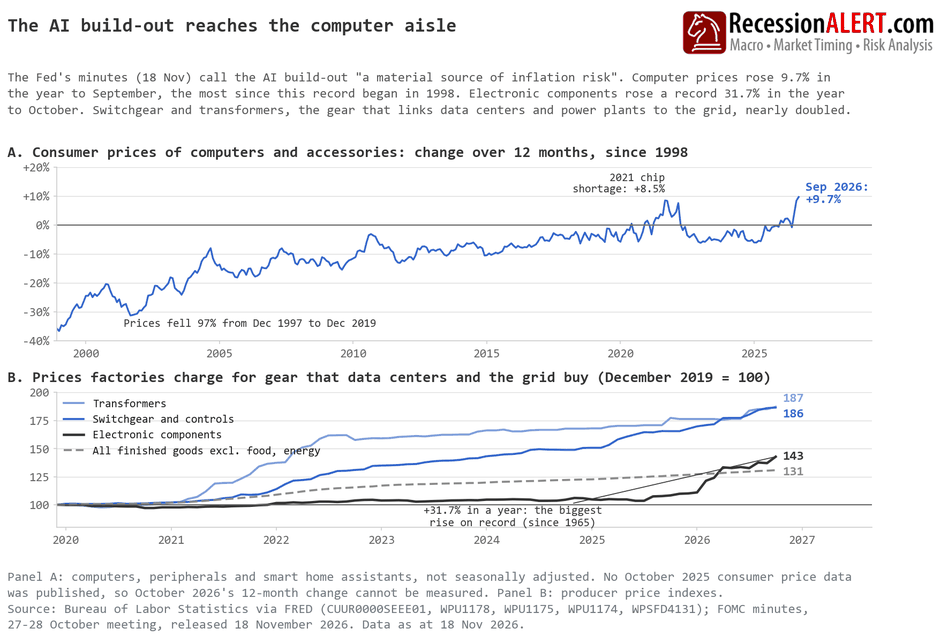
Computers got cheaper nearly every year for two decades; in the year to September their prices rose 9.7%, the most since the measure began in 1998. Computers are a small slice of what households buy, so they are not driving overall inflation. What matters is the route. The Fed’s minutes, released 18 November, tie “upward pressure on consumer goods prices” to the AI build-out and say demand for its products “was continuing to strain supply.” The trail runs back to the factory gate. What manufacturers charge for electronic components, the parts inside the equipment, barely moved for a decade, then rose a record 31.7% in the year to October, and was still climbing after shop prices turned up in July. The grid gear the build-out needs was stretched before it arrived: transformer prices rose fastest in 2022. But 2021 offers a precedent: the chip-shortage spike had faded within eight months. The minutes expect the AI boost to inflation to “mostly fade” but flag the risk that it does not, and name the off switch: slower AI spending. The computer aisle used to be where inflation went to die; until component prices stall, it is where the Fed’s AI worry shows up at the till.
What it means: For households, a new computer already costs more than a year ago, and with its parts still rising at the factory, it could cost more yet. For stock investors, the question is who pays the parts bill: computer makers can pass it on, as shop prices suggest is starting, or absorb it in profits. For the economy, this is price pressure from business spending, not shoppers, so it can hold goods prices up even if households slow. The read changes if component prices fall two months in a row, which has not happened since February’s jump.
Market Intelligence Brief (MIB) Ver. 20.08
For professional investors only. Not investment advice.
© 2026 RecessionALERT.com

Comments are closed.