
MARKET INTELLIGENCE BRIEF (MIB)
Friday, July 17, 2026
Chip stocks cratered into a bear market as China’s Moonshot unveiled Kimi K3, an AI model rivaling US systems — erasing $3.3T in sector value since June. Oil hit a four-week high on a sixth night of US Iran strikes and a hit on Kuwait’s desalination plant. Cleveland Fed’s Hammack turned hawkish as China import prices posted their steepest jump since 2008. FAA restored Boeing’s MAX/787 self-certify authority. Coca-Cola’s fairlife halted output after a ransomware hit; SpaceX scrubbed Starship Flight 13.
TABLE OF CONTENTS
A. EXECUTIVE SUMMARY
B. MARKET DATA
C. HIGH-IMPACT STORIES (6)
D. MODERATE-IMPACT STORIES (5)
E. ECONOMY WATCH (5)
F. EARNINGS WATCH (2)
G. WHAT’S NEXT
H. CHART OF THE DAY
A. EXECUTIVE SUMMARY -> TOP
Equities fell broadly Friday — the Nasdaq’s 1.49% drop led the S&P’s 1.01% and the Dow’s 0.77% declines — as a Chinese AI breakthrough deepened the semiconductor selloff into a technical bear market for the SOX while a sixth night of US strikes on Iran and a first attack on Gulf infrastructure outside Iran (Kuwait’s desalination plant) pushed oil to a four-week high near $88 Brent. The two shocks compound rather than offset: Moonshot’s Kimi K3 model threatens the AI-capex return-on-spend thesis underpinning chip valuations, even as Cleveland Fed’s Hammack joins Dallas Fed’s Logan in the hawkish camp — reintroducing two-sided rate-path uncertainty as China import prices post their steepest jump since 2008, evidence tariff pass-through is reaching border data. Ten of 11 S&P sectors closed red in a near-total risk-off flush — only Energy, the direct beneficiary of the oil spike, held green — while the yield curve flattened (10Y down, 2Y up), a growth-scare signature distinct from a pure inflation trade.
• SOX enters bear market — down over 20% from its June peak (-5.7% Friday alone) after China’s Moonshot unveiled Kimi K3, an AI model claiming frontier parity; Applied Materials (AMAT) -5.57%, Sandisk (SNDK) -3.99%.
• Oil jumps to a four-week high — WTI +4.46% to $82.47, Brent +4.63% to $88.13 — as the US completes a sixth night of Iran strikes and Kuwait’s desalination plant is hit; Chevron (CVX) +1.91%.
• FAA restores Boeing’s self-certify authority for the 737 MAX and 787 effective July 20, ending federal oversight dating to 2019.
• Hawkish Fed chorus builds — Cleveland’s Hammack joins Dallas’s Logan in floating rate hikes ahead of the July 28-29 FOMC; 2-year yield +2.7bps to 4.183%.
• Coca-Cola (KO) -3.96% after a ransomware attack forces a US production halt at its fairlife dairy subsidiary.
• SpaceX (SPCX) -5.43% as Starship Flight 13 is scrubbed on Raptor engine failures — its first launch attempt since June’s IPO, with shares now trading below the $135 IPO price.
1. The AI-Capex Thesis Faces Its First Credible Challenge — Moonshot’s Kimi K3 is the clearest signal yet that frontier AI capability can be replicated far more cheaply than the West’s chip-heavy buildout assumes, striking at the return-on-spend math behind hundreds of billions in planned AI infrastructure capex. The SOX’s slide into a technical bear market, alongside the Nasdaq’s fourth straight session of underperformance versus the S&P, shows this concern is broadening beyond a single stock into a sustained rotation out of AI-capex-exposed growth names.
2. Middle East Escalation Is Widening, Not Resolving — Kuwait’s desalination plant attack extends the conflict beyond direct US-Iran exchanges, while Iran’s threat to close the Bab al-Mandeb Strait via the Houthis if the US strikes Iran’s power grid raises the stakes of further escalation. US energy majors’ $60 billion in Iraq bypass-pipeline deals signals markets are treating Hormuz chokepoint risk as durable rather than transient — a structural hedge, not a bet on quick resolution.
3. A Hawkish Fed Chorus Now Has Hard Data Behind It — Hammack and Logan’s two-day hawkish run is no longer just rhetoric: China import prices posting their steepest jump since 2008 is concrete evidence tariff costs are reaching border-price data, exactly the upside inflation risk the Fed has flagged. That reintroduces two-sided rate-path uncertainty just as AI-capex doubts and an oil-driven growth scare are already pressuring risk assets ahead of the July 28-29 FOMC.
 — Leading economic indicators. Accurate market forecasts. Apply for membership at join.recessionalert.com
B. MARKET DATA -> TOP
Equities sold off broadly as an AI-capex-driven semiconductor rout deepened and a Strait of Hormuz naval blockade sent crude surging over 4% on escalating US-Iran tensions — the Nasdaq’s 1.49% drop outpaced the S&P’s 1.01% and the Dow’s 0.77% decline. Breadth was a near-total risk-off flush: Energy was the only S&P sector to close green, with the chip complex dragging everything else lower. The clearest anomaly is stagflationary — oil rallying against falling equities and a falling 10-year yield, even as the 2-year rose, a flattening move that points to growth-scare positioning rather than an inflation trade. SpaceX’s 5.4% slide, tied to a scrubbed Starship test and mounting Chinese competition, compounds Netflix’s post-earnings rout as a second AI-adjacent casualty.
CLOSING PRICES – Friday, July 17, 2026:
MAJOR INDICES
The Dow’s 0.77% decline vs. the Nasdaq’s 1.49% drop reflects the semiconductor-concentrated nature of today’s selloff — a tech story at the index level, though NYSE breadth (10 of 11 sectors red) says otherwise beneath the headline. Dow Theory bull confirmation remains in force for a fourth straight session, DJIA and DJTA both within 1% of their 10-session highs. More persistent: the S&P has outperformed the Nasdaq 100 by roughly 2.2 points over the trailing 10 sessions for a fourth consecutive session — a sustained broadening-rotation pattern as capital rotates out of AI-capex-exposed mega-cap growth.
| Index | Close | Change | %Move | Why It Moved |
|---|---|---|---|---|
| S&P 500 | 7,457.68 | -76.09 | -1.01% | Broad risk-off on the chip-sector rout and oil-driven stagflation fears |
| Dow Jones | 52,146.42 | -406.55 | -0.77% | Outperformed peers as selloff concentrated in semiconductors, not blue-chips |
| DJ Transportation | 22,723.90 | -102.70 | -0.45% | Tracked the broader market lower; no distinct catalyst |
| Nasdaq | 28,592.66 | -433.11 | -1.49% | Led losses as the semiconductor selloff deepened on AI capex spending doubts |
| Russell 2000 | 2,960.95 | -13.62 | -0.46% | Small-caps declined roughly in line with large-caps |
| NYSE Composite | 23,816.97 | -135.30 | -0.56% | Broad-market decline mirrored the S&P 500’s risk-off tone |
VOLATILITY & TREASURIES
VIX spiked 12% as the 10Y yield fell 4bps while the 2Y rose nearly 3bps — a flattening move consistent with growth-scare positioning rather than an inflation shock; long-end demand for safety persisted even as short rates price a firmer near-term Fed path. DXY held flat, offering no confirming safe-haven dollar bid despite the equity selloff and vol spike.
| Instrument | Level | Change | Why It Moved |
|---|---|---|---|
| VIX | 18.74 | +2.01 (+12.01%) | Spiked as equities sold off on chip-sector weakness and geopolitical oil risk |
| 10-Year Treasury Yield | 4.551% | -1.8 bps | Fell as investors sought safety amid the equity selloff |
| 2-Year Treasury Yield | 4.183% | +2.7 bps | Rose slightly, pricing a firmer near-term Fed path even as growth-scare flows hit the long end |
| US Dollar Index (DXY) | 100.77 | 0.00 (0.00%) | Held flat, offering no confirming safe-haven dollar bid |
COMMODITIES
Gold’s modest gain against sliding Platinum (-2.27%) and Copper (-1.13%) is a clean safe-haven-vs-industrial-demand split, consistent with today’s equity selloff and Middle East tensions. Silver sat between the two, essentially flat. Bitcoin’s negligible 0.04% move shows no meaningful correlation to the equity selloff — muted rather than a risk-asset proxy today.
| Asset | Price | Change | %Move | Why It Moved |
|---|---|---|---|---|
| Gold | $4,023.00/oz | +$30.90 | +0.77% | Modest safe-haven bid amid equity selloff and Middle East tensions |
| Silver | $56.22/oz | +$0.03 | +0.06% | Essentially flat, caught between safe-haven and industrial-demand crosscurrents |
| Copper | $6.27/lb | -$0.07 | -1.13% | Declined on industrial-demand concerns tied to the broader risk-off tone |
| Platinum | $1,603.50/oz | -$39.00 | -2.27% | Fell sharply on industrial-demand concerns, diverging from gold’s safe-haven bid |
| Bitcoin | $64,211 | +$27 | +0.04% | Essentially flat, showing no meaningful correlation to today’s equity selloff |
ENERGY
WTI and Brent surged in near lockstep (+4.46%/+4.63%) after the US reinstated a naval blockade near the Strait of Hormuz amid escalating Iran tensions — a global, not regional, supply shock. Oil rallying while equities fell is a supply-driven, cost-push signal with stagflationary undertones, not a demand story. Henry Hub followed higher but Dutch TTF sat flat, confirming the move is Mideast-crude-centric rather than a broad energy-inflation trade.
| Asset | Price | Change | %Move | Why It Moved |
|---|---|---|---|---|
| Crude Oil (WTI) | $82.47/bbl | +$3.52 | +4.46% | Strait of Hormuz naval blockade amid escalating US-Iran tensions |
| Crude Oil (Brent) | $88.13/bbl | +$3.90 | +4.63% | Rose in tandem with WTI on the same Strait of Hormuz supply-risk escalation |
| Natural Gas (Henry Hub) | $2.916/MMBtu | +$0.058 | +2.03% | Rose alongside the broader energy complex |
| Natural Gas (Dutch TTF) | $18.87/MMBtu | -$0.01 | -0.04% | Held roughly flat, decoupling from the US-centric crude supply shock |
S&P 500 SECTORS
Ten of 11 sectors closed red — a broad risk-off flush rather than rotation — with Energy (+1.46%) the lone holdout, extending its 1-week (+4.28%) and 1-month (+3.87%) leadership as the crude supply shock keeps compounding. Technology’s -1.09% session sits oddly against its market-leading +11.34% 3-month run, hinting at profit-taking within an intact uptrend rather than a trend break.
| Sector | 1-Day | 1-Week | 1-Month | 3-Month | 6-Month | YTD | 12-Month |
|---|---|---|---|---|---|---|---|
| Energy | +1.46% | +4.28% | +3.87% | -0.91% | +20.71% | +28.11% | +33.91% |
| Real Estate | -0.11% | +2.69% | +2.58% | +5.10% | +9.58% | +12.83% | +10.55% |
| Healthcare | -0.24% | -0.28% | +6.11% | +8.26% | +2.05% | +4.88% | +21.04% |
| Utilities | -0.47% | -0.75% | +0.27% | -4.17% | +4.24% | +5.75% | +12.73% |
| Basic Materials | -0.65% | -2.29% | -10.53% | -10.98% | -5.13% | +5.37% | +27.83% |
| Consumer Defensive | -0.82% | +1.12% | -0.76% | +2.03% | +2.65% | +8.22% | +6.90% |
| Financial | -0.96% | +0.61% | +3.53% | +8.45% | +5.67% | +5.97% | +15.00% |
| Industrials | -1.03% | -3.11% | -7.77% | +0.30% | +4.74% | +12.35% | +17.04% |
| Technology | -1.09% | -4.41% | -4.12% | +11.34% | +16.34% | +16.59% | +27.69% |
| Consumer Cyclical | -1.56% | -1.02% | -1.08% | -2.31% | -6.77% | -4.32% | +3.20% |
| Communication Services | -2.13% | -2.43% | -4.24% | -1.59% | -0.03% | +2.49% | +30.95% |
TOP MEGA-CAP MOVERS:
GAINERS
| Company | Ticker | Close | Change | Why It Moved |
|---|---|---|---|---|
| GE Vernova Inc | GEV | $1,057.84 | +2.09% | Climbing into its July 22 earnings report on AI-driven power-demand optimism |
| Cisco Systems Inc | CSCO | $114.94 | +2.08% | Rotation into non-chip tech as the semiconductor selloff deepened |
| Chevron Corp | CVX | $187.38 | +1.91% | Energy-sector beneficiary of the crude spike on Strait of Hormuz supply fears |
| Oracle Corp | ORCL | $126.41 | +1.77% | Software names outperformed as investors rotated out of AI-capex-exposed chipmakers |
| Philip Morris International Inc | PM | $192.98 | +1.65% | Defensive rotation as investors sought shelter from the broader risk-off tape |
DECLINERS
| Company | Ticker | Close | Change | Why It Moved |
|---|---|---|---|---|
| Netflix Inc | NFLX | $68.95 | -7.26% | Extended after-hours post-earnings slide after forecasting another quarter of slowing sales |
| Applied Materials Inc | AMAT | $529.66 | -5.57% | Caught in the deepening chip-sector selloff on AI infrastructure spending doubts |
| Space Exploration Technologies Corp | SPCX | $123.99 | -5.43% | Scrubbed Starship test flight on Raptor engine failures, plus new Chinese reusable-rocket competition |
| Sandisk Corp | SNDK | $1,354.82 | -3.99% | Swept up in the broader semiconductor/storage selloff |
| Coca-Cola Co | KO | $81.56 | -3.96% | Fell after a ransomware attack forced a production halt at fairlife, its dairy subsidiary |
— Institutional-grade intelligence for serious investors. Apply for membership at join.recessionalert.comC. HIGH-IMPACT STORIES -> TOP
BEARISH
1. Semiconductor Rout Deepens as PHLX Index Enters Bear Market on Chinese AI Breakthrough
The core facts:The Philadelphia Semiconductor Index (SOX) fell as much as 5.7% Friday, pushing its decline from a late-June record to more than 20% and confirming a technical bear market. The 30-stock benchmark, which had surged 105% between its March low and last month’s peak, has erased roughly $3.3 trillion in global chip-sector market value since June 22; Marvell Technology, ARM Holdings, and Intel have each plunged more than 30% over that span. The selloff intensified after Chinese AI startup Moonshot unveiled Kimi K3, an open model it claims is the world’s largest and rivals frontier systems from OpenAI and Anthropic. The Nasdaq Composite fell 1.4%, the S&P 500 lost about 1%, and the Dow shed roughly 0.8%, with the Nasdaq down 2.9% for the week.
Why it matters:A Chinese model credibly claiming parity with the best US frontier systems strikes directly at the bull case for hundreds of billions in planned AI-infrastructure capex — if state-of-the-art capability can be replicated more cheaply, the return-on-spend assumptions behind chip demand forecasts come under real pressure. This is the second sharp semiconductor reversal in a matter of days, reinforcing that elevated volatility around AI-linked names is becoming a recurring feature of the tape, with the rotation into Staples and out of tech signaling broad de-risking rather than a single-stock story.
What to watch:Whether the SOX stabilizes or extends its slide into next week, and any incremental commentary from Nvidia, Broadcom, or hyperscalers responding directly to the Moonshot model’s capability claims.
UNCERTAIN
2. Sixth Night of US Strikes on Iran and Kuwait Desalination-Plant Attack Push Oil to a Four-Week High
The core facts:The US completed a sixth consecutive night of strikes against Iranian military and logistics targets, while Kuwait said Iran struck one of its power and water desalination plants, escalating the conflict beyond direct US-Iran exchanges. Brent crude rose about 4.6% to roughly $88/bbl and WTI gained more than 3% to around $81/bbl, putting both benchmarks on pace for weekly gains near 12% — Brent’s third straight weekly advance. Confirmed crude transit through the Strait of Hormuz has fallen 62% versus pre-crisis levels.
Why it matters:Targeting civilian infrastructure in a third country (Kuwait) signals the conflict’s spillover risk is rising, not stabilizing, even though today’s price move remains within the range of the past week’s volatility. Energy was again the only S&P sector to close higher, underscoring how the trade has become a straightforward hedge against further escalation — but sustained supply disruption at current transit-collapse levels raises genuine stagflationary risk if it persists into next month’s data.
What to watch:Whether Kuwait or other Gulf states see further attacks on energy-adjacent infrastructure, and next week’s EIA inventory data for confirmation physical supply is being affected.
BULLISH
3. FAA Restores Boeing’s Authority to Self-Certify 737 MAX and 787 Jets as Airworthy
The core facts:The FAA said Friday that Boeing can resume issuing its own airworthiness certificates for all 737 MAX and 787 aircraft starting July 20, ending federal oversight that began in 2019 for the MAX (after two fatal crashes) and 2022 for the 787 (over production-quality concerns). The agency cited eight months of comparable production-quality findings between Boeing’s own checks and the FAA’s parallel reviews as the basis for returning the authority.
Why it matters:This is the clearest regulatory signal yet that Boeing’s post-crisis production-quality remediation has satisfied its primary safety regulator, removing a multi-year overhang on delivery cadence and margin normalization for both jet programs. Faster self-certification should support Boeing’s ability to accelerate delivery rates, a key driver of the free-cash-flow recovery the market has been waiting on.
What to watch:Boeing’s delivery cadence in the weeks following the July 20 effective date for early evidence the restored authority is translating into a faster production ramp.
BEARISH
4. Cleveland Fed’s Hammack Joins Hawkish Chorus, Says Inflation Fight Isn’t Over
The core facts:Cleveland Fed President Beth Hammack said Friday that persistently high inflation is her “bigger concern” and that, for the first time in her tenure, businesses are telling her the Fed needs to act — echoing Dallas Fed’s Logan a day earlier and setting up a more contentious debate at the July 28-29 FOMC meeting. Treasury yields rose across the curve on the remarks, with the 2-year note up 8bps to 4.12% and the dollar strengthening; equity futures pared earlier gains.
Why it matters:A second regional Fed president in two days publicly floating rate hikes — with Hammack citing direct business feedback rather than just data — signals the hawkish camp’s momentum is building ahead of the July meeting, not fading. Markets had largely priced a cut later this year; this reintroduces two-sided rate-path uncertainty just as AI-capex doubts are already pressuring risk assets.
What to watch:Whether additional FOMC voters echo Hammack and Logan before the July 28-29 meeting, and the CME FedWatch-implied hike probability for confirmation of the repricing.
BULLISH
5. US Energy Majors Sign $60 Billion in Iraq Deals to Build a Hormuz-Bypass Pipeline
The core facts:US companies signed roughly $60 billion in agreements and partnerships with the Iraqi government Friday, including a Chevron deal covering stakes in two Iraqi oil fields and membership in a consortium studying revival of the Kirkuk-Baniyas pipeline to Syria’s Mediterranean coast — a direct alternative to shipping through the Strait of Hormuz. Iraq and Syria separately signed a bilateral agreement the same day to rebuild the pipeline, whose projected capacity is roughly 300,000 barrels per day; formal unveiling is expected around Iraqi PM Ali al-Zaidi’s mid-July White House visit.
Why it matters:The scale of the commitment shows US energy majors treating Hormuz chokepoint risk as durable rather than transient, a structural hedge against a conflict many had hoped would resolve quickly. For Chevron, entry into new Iraqi fields plus a stake in the bypass-pipeline consortium extends its reserve base and gives it a first-mover position if the Hormuz risk premium becomes permanent.
What to watch:Confirmation of deal terms at the al-Zaidi-Trump White House meeting, and any Iranian response given the pipeline directly undercuts its Hormuz leverage.
UNCERTAIN
6. Iran Directs Houthis to Threaten Red Sea Shipping Closure if US Strikes Power Grid
The core facts:Iran has told Yemen’s Houthis to close the Bab al-Mandeb Strait — the Red Sea’s southern chokepoint, carrying roughly 7% of global oil output — if the US follows through on a Trump-floated strike against Iran’s power network. Houthi forces have reportedly positioned drones and missiles near the strait, and the group broke a four-year truce with Saudi Arabia earlier in the week with missile strikes.
Why it matters:With the Strait of Hormuz already effectively shut, a simultaneous Red Sea closure would knock out both of the Middle East’s primary oil export routes at once — a materially larger supply shock than the market has priced through this week’s roughly 12% weekly oil gain. The threat is explicitly contingent on a US strike that hasn’t happened yet, but it raises the stakes of further American escalation and gives Iran a credible deterrent against the infrastructure-strike option the administration has floated.
What to watch:Whether the US proceeds with a strike on Iran’s power grid, and any early warning signs of Houthi vessel targeting in the Bab al-Mandeb Strait.
— Quantifying recession risk so you don’t have to guess. Apply for membership at join.recessionalert.comD. MODERATE-IMPACT STORIES -> TOP
BEARISH
7. SpaceX Scrubs Starship Flight 13 as Engines Fail to Ignite, Stock Extends Post-IPO Slide
The core facts:SpaceX scrubbed Thursday’s Starship Flight 13 launch attempt in the final seconds after four of the Super Heavy booster’s 33 Raptor 3 engines failed to ignite; two engines will be replaced before a retry expected as soon as early next week. It was the company’s first Starship launch attempt since its June IPO. Shares fell roughly 3.5% Thursday on top of a 3%-plus decline Wednesday, trading near $126.58 before Friday’s open — about $9 below the $135 IPO price.
Why it matters:This was the market’s first live test of how newly public SpaceX shares react to an operational setback, and the answer was a further leg down rather than a shrug — the stock is now underwater versus its IPO price entirely on two days of pre-launch jitters and a scrub, without a single catastrophic failure. That sensitivity suggests investors are pricing Starship execution risk aggressively now that it shows up in a tradeable equity.
What to watch:The rescheduled Flight 13 attempt, expected as soon as early next week, for whether a successful launch reverses the two-day slide.
BEARISH
8. Coca-Cola’s fairlife Dairy Halts US Production After Ransomware Attack
The core facts:Coca-Cola disclosed that its fairlife LLC dairy subsidiary detected unauthorized third-party access to a portion of its systems, including production-related systems, in a ransomware event that forced a temporary halt to US fairlife manufacturing (Canadian operations are unaffected). The company activated incident-response and business-continuity protocols and notified law enforcement; no ransomware group has claimed responsibility, and Coca-Cola says product quality and safety have not been compromised. Shares fell nearly 4% even as the stock had been outperforming the S&P 500 year-to-date (+22% vs. +11%) heading into the incident.
Why it matters:fairlife has been one of Coca-Cola’s fastest-growing brands, so a production halt of unknown duration creates a direct, quantifiable near-term revenue risk in its high-growth dairy segment, distinct from the more typical reputational-only fallout of a data breach. The lack of clarity on both duration and whether customer or business data was exfiltrated leaves the size of the eventual financial impact — and any extortion demand — unresolved.
What to watch:Any Coca-Cola update on fairlife production-restart timing, and whether a ransomware group claims responsibility or leaks stolen data.
UNCERTAIN
9. Consumer Sentiment Hits Five-Month High, but Good News Is Overshadowed by Risk-Off Tape
The core facts:The University of Michigan’s preliminary July sentiment index jumped to 54.4 from 49.5 in June, blowing past the 51.0 consensus to reach its highest level since February, with all five subcomponents improving and buying conditions for durable goods up roughly 20%. Despite the beat, S&P 500 and Nasdaq futures fell further on the day, as the positive read was overshadowed by the semiconductor selloff and escalating Middle East tensions.
Why it matters:The data reinforces a soft-landing narrative — easing gas prices lifting household sentiment even as headline inflation risk from tariffs and oil builds elsewhere — but today’s price action shows positive consumer data cannot currently overcome AI-capex and geopolitical risk as the market’s dominant driver. That hierarchy matters for how much support “good news” can offer if either situation worsens further.
What to watch:The final University of Michigan reading later this month, and whether consumer-discretionary shares begin tracking the sentiment improvement once the current risk-off episode fades.
BEARISH
10. China Import Prices Post Steepest Jump Since 2008 as Tariff Pass-Through Reaches Border Data
The core facts:June import prices from China rose 0.9% month-over-month — the sharpest increase since January 2008 — confounding expectations for a 0.8% decline, while Chinese export prices fell 0.6%. Federal Reserve research published this month estimates tariffs implemented through November 2025 have already added 3.1 percentage points to core goods PCE prices through February, and a New York Fed survey found 47% of service firms and 44% of manufacturers plan further price increases over the next year.
Why it matters:This is concrete evidence that tariff costs are now flowing through to border-price data rather than being absorbed by exporters or importers — an upside inflation risk the Fed has explicitly flagged. Combined with this week’s hawkish commentary from Dallas’s Logan and Cleveland’s Hammack, it adds a data-driven argument, not just rhetoric, for the rate-hike camp ahead of the July 28-29 FOMC meeting.
What to watch:July’s CPI and PCE prints for confirmation the pass-through is broadening into headline consumer inflation, and whether Fed officials cite today’s import-price data explicitly in FOMC commentary.
UNCERTAIN
11. Trump Threatens Higher Canada Tariffs Over Wildfire Smoke
The core facts:President Trump said Friday he would add the cost of Canadian wildfire smoke — which has triggered air-quality alerts for more than 100 million people across 18 states and Washington, DC — to tariffs Canada is “currently paying,” calling the situation “totally unacceptable” and saying he planned to call Canadian PM Mark Carney to demand action. It remains legally unclear how smoke, rather than a physical good, could be tariffed.
Why it matters:The mechanism is undefined and may be more rhetorical than immediately actionable, but it adds a fresh, unpredictable variable to the US-Canada trade relationship at a moment when tariff policy is already a live inflation risk — sectors with significant Canadian supply-chain exposure (autos, lumber, energy) face incremental headline risk until the administration clarifies intent.
What to watch:Any follow-up from the Trump-Carney call referenced today, and whether the administration proposes a concrete tariff mechanism or lets the threat lapse.
— Separating signal from noise since 2007. Apply for membership at join.recessionalert.comE. ECONOMY WATCH -> TOP
Friday’s data cut in two directions: housing starts blew past estimates (1.427M vs. 1.31M) and consumer sentiment jumped to a five-month high on cheaper gas, yet the details undercut both — permits fell to a 10-month low and industrial production stayed flat for a second straight month. Underneath, China import prices rose 0.9%, the sharpest monthly jump since 2008, evidence that tariff costs are reaching consumers just as Cleveland Fed’s Hammack cited businesses demanding the Fed act on inflation. The mix — soft manufacturing, resilient consumers, and rising import-price pass-through — strengthens the hawkish case heading into the July 28-29 FOMC meeting.
Housing Starts Surge 19% on Multifamily Rebound as Permits Slide to 10-Month Low (Census Bureau, July 17, 2026)
What they’re saying:Housing starts jumped to a seasonally adjusted annual rate of 1.427 million in June, up 19.0% from May and well above the 1.310 million consensus. The headline was driven almost entirely by multifamily construction (5+ unit starts surged to a 513K pace), while single-family starts — the more economically meaningful category — were essentially flat, slipping 0.2% to 895K. Building permits fell 3.0% to 1.367 million, a 10-month low, missing the 1.40 million estimate.
The context:The gap between a volatile, multifamily-driven starts beat and a broad-based permit decline is the clearest signal yet that builders are pulling back as mortgage rates sit at multi-month highs. Permits are forward-looking; their 10-month low points to less supply in the construction pipeline over the coming year even as this month’s starts print looked strong on its face.
What to watch:New home sales (July 24) and existing home sales for demand-side confirmation; mortgage rate trajectory into Q3.
Consumer Sentiment Jumps to Five-Month High as Gas Prices Ease (University of Michigan, July 17, 2026)
What they’re saying:The University of Michigan’s preliminary July Consumer Sentiment Index rose to 54.4, up from 49.5 in June and well above the 51.0 consensus — a 10% monthly jump to the highest reading since February. All five index components improved, led by ~20% gains in buying conditions for durable goods and year-ahead business conditions, with gains broad-based across age, income, and political affiliation.
The context:Easing gasoline prices are doing the heavy lifting behind this second straight monthly increase following May’s record low, rather than a durable shift in household finances — sentiment remains 12% below year-ago levels. One-year inflation expectations eased alongside the improvement, a data point the Fed can point to even as officials debate further tightening.
What to watch:Final July Michigan reading at month-end for confirmation; whether gas prices hold near current levels through August.
Industrial Production Barely Rises, Manufacturing Output Flat for Second Straight Month (Federal Reserve, July 17, 2026)
What they’re saying:Industrial production rose just 0.1% in June, below the 0.2% consensus, while manufacturing output was flat at 0.0% against a 0.1% estimate — the second consecutive month manufacturing failed to grow. Capacity utilization held at 76.1%, essentially unchanged and just below the 76.2% expected.
The context:Back-to-back flat manufacturing prints undercut the narrative that tariff-driven reshoring and business investment are lifting the factory sector — industrial production is still up 1.7% year-over-year, but that growth is increasingly concentrated outside manufacturing proper. The stagnation adds to evidence that higher input costs and borrowing costs are weighing on factory activity even as regional surveys like this week’s Philly Fed print showed a sharp headline surge.
What to watch:Early-August ISM Manufacturing PMI for national confirmation of the regional divergence.
Import Prices From China Post Largest Monthly Jump Since 2008 as Export Prices Fall (BLS, July 17, 2026)
What they’re saying:U.S. import prices rose 0.3% in June on higher nonfuel costs, while export prices fell 0.6% — the first monthly export-price decline since May 2025. Within the import data, prices on goods from China jumped 0.9%, the largest monthly increase since January 2008, pushing the China import index up 1.3% year-over-year, also the biggest 12-month gain since November 2022. Overall import prices are up 7.1% year-over-year, the fastest pace since August 2022.
The context:The China price jump is the clearest evidence yet of tariff cost pass-through reaching border-price data rather than being absorbed by exporters or margins — a dynamic the Fed has flagged as a key upside inflation risk. The export-price decline, driven by nonagricultural goods, suggests U.S. exporters are losing pricing power abroad even as import costs climb, pressuring the trade balance without offering the inflation relief a stronger dollar might otherwise provide.
What to watch:June CPI/PPI goods components for confirmation of the pass-through; the new 100% pharmaceutical tariff taking effect July 31 for large companies.
Fed’s Hammack Says Inflation Is Her “Bigger Concern,” Joins Growing Hawkish Chorus Ahead of July Meeting (Bloomberg, July 17, 2026)
What they’re saying:Cleveland Fed President Beth Hammack said persistently high inflation is her primary concern as consumer spending holds up and unemployment stays low, estimating core PCE inflation likely rose 3.3% year-over-year in June. For the first time in her tenure, she said businesses are telling her the Fed needs to act to curb inflation, citing pressures from energy costs, supply chains, insurance premiums, and AI-driven demand.
The context:Hammack joins a small but growing group of policymakers — including Dallas Fed’s Logan — arguing the Fed may need to raise rates rather than hold or cut, landing just ahead of the July 28-29 FOMC meeting. A widening chorus of regional Fed presidents citing business-level inflation complaints, rather than just top-down CPI prints, raises the bar for the doves at the meeting.
What to watch:July 28-29 FOMC statement and dot plot; whether other voting members echo Hammack’s stance before the blackout period begins.
— Know the probability before the market prices in the risk. Apply for membership at join.recessionalert.comF. EARNINGS WATCH -> TOP
YESTERDAY AFTER THE BELL (Markets Reacted Today)
BEARISH
12. Netflix (NFLX): -9% | Q3 Revenue Guidance Undershoots Despite In-Line Q2 Beat
The Numbers:Q2 revenue $12.56B (+13.4% YoY, roughly in line with the $12.6B consensus); EPS $0.80 vs. $0.79 estimate; operating margin 33.4%, down from 34.1% a year ago. Q3 guidance of $12.86B (+11.7% YoY) came in below the roughly $13B analysts had modeled; full-year 2026 revenue range narrowed to $51.0-51.4B from $50.7-51.7B.
The Problem/Win:Netflix discontinued regular subscriber-count disclosure after Q1, leaving the ad-supported tier — now over 250 million monthly active viewers and more than 60% of new sign-ups — as the main growth signal investors can still see, and even that (ad revenue on track to roughly double to $3B) wasn’t enough to offset the soft Q3 revenue guide.
The Ripple:The stock’s decline dragged on the broader streaming and media-adjacent complex already unsettled by this week’s semiconductor rout.
What It Means:The market read the guidance miss as evidence that membership and pricing growth are decelerating faster than the ad business can compensate, even though the quarter itself was broadly in line.
What to watch:Netflix’s Q3 report for confirmation of whether the guided deceleration materializes or proves conservative.
BEARISH
13. Intuitive Surgical (ISRG): -12.4% | Guidance Concerns Overshadow Broad-Based Beat
The Numbers:Q2 revenue $2.89B (+19% YoY), beating estimates alongside EPS; da Vinci procedures +15%, Ion procedures +36%, with 468 da Vinci systems placed (vs. 395 a year ago), including 246 da Vinci 5 units. Full-year da Vinci procedure-growth guidance held at 13.5%-15.5%, while non-GAAP gross margin guidance was raised to 68%-69%.
The Problem/Win:Despite the beat-and-raise on margins, US procedure growth slowed to 12% from 14% in Q1, with management citing ACA subsidy expiry, deferred procedures, and bariatric-category pressure — the kind of granular deceleration a stock priced for perfection after a 30% YTD slide couldn’t absorb.
The Ripple:The sharp reversal — following an initial after-hours pop before the earnings call — is a reminder that premium-valued medtech/robotics names remain vulnerable to any procedure-growth wobble, even alongside genuine margin improvement.
What It Means:Investors are prioritizing the trajectory of US procedure growth over headline beats and raised margin guidance — a signal that the volume story, not profitability, is currently the swing factor for the stock.
What to watch:Q3 US procedure-growth data for confirmation whether the Q2 deceleration was a one-quarter blip tied to ACA-subsidy timing or a more durable trend.
TODAY BEFORE THE BELL (Markets Already Reacted)
No major earnings before the bell from companies with >$100B market cap.
TODAY AFTER THE BELL (Markets React Tomorrow)
No major earnings after the bell from companies with >$100B market cap.
WEEK AHEAD PREVIEW:
Q2 2026 earnings season is just getting underway (~10% of the S&P 500 reported), with the pace accelerating sharply next week.
Charles Schwab (SCHW) — BMO, Tue Jul 21 — EPS est. $1.56; net interest income trends will be closely watched given this week’s hawkish Fed repricing (Logan, Hammack) and its potential to reshape the rate-cut timeline baked into brokerage and asset-gathering estimates.
Danaher (DHR) — BMO, Tue Jul 21 — EPS est. $1.84; first full quarter post-Masimo acquisition, with integration progress and life-sciences demand trends in focus.
Capital One Financial (COF) — AMC, Tue Jul 21 — EPS est. $4.69; Discover integration synergies remain the central focus, with today’s hawkish Fed repricing also relevant for NII-sensitive card lenders.
Earnings season accelerates further the following week, as 86 S&P 500 companies — including 4 Dow 30 components — are scheduled to report.
— US market commentary trusted by family offices and institutions. Apply for membership at join.recessionalert.comG. WHAT’S NEXT -> TOP
UPCOMING RELEASES:
| Date | Event | Why It Matters |
|---|---|---|
| Mon, Jul 20 | CB Leading Index MoM (Jun) | Forward-looking growth gauge — watched for confirmation of the housing-permit and flat-manufacturing softness already showing in this week’s data. |
| Tue, Jul 21 | ADP Employment Change (Weekly) | Labor-market pulse check ahead of the FOMC blackout — a weak print would complicate the case for the hawkish Hammack/Logan camp. |
| Wed, Jul 22 | MBA 30-Year Mortgage Rate | Tests whether mortgage rates ease from multi-month highs, a key driver of this week’s slide in building permits to a 10-month low. |
| Wed, Jul 22 | EIA Crude Oil Stocks Change | First hard inventory read since the Strait of Hormuz transit collapse — a build or draw will help confirm whether physical supply is actually being affected. |
| Wed, Jul 22 | EIA Gasoline Stocks Change | Downstream read on the same Hormuz-driven crude spike; a sharp draw would signal the supply shock reaching consumer fuel markets. |
| Thu, Jul 23 | Chicago Fed National Activity Index (Jun) | Broad activity check against this week’s divergent industrial-production and housing-starts signals. |
| Thu, Jul 23 | Initial Jobless Claims | Weekly labor-market check ahead of the July 28-29 FOMC, with the hawkish camp citing tight labor conditions as inflation-fight justification. |
| Fri, Jul 24 | New Home Sales (Jun) | Demand-side confirmation for this week’s starts/permits divergence — a weak print would reinforce the pullback signaled by permits’ 10-month low. |
KEY QUESTIONS:
1. Does the SOX stabilize next week, or does Moonshot’s Kimi K3 trigger a broader repricing of AI-capex-exposed names heading into the July 28-29 FOMC?
2. Does the conflict spread to the Bab al-Mandeb Strait, and does next Wednesday’s EIA inventory data confirm the Hormuz transit collapse is translating into an actual physical supply shock?
3. Do additional FOMC voters join Hammack and Logan’s hawkish stance before the blackout period, and does the China import-price jump begin showing up in July’s CPI and PCE prints?
— US market commentary trusted by family offices and institutions. Apply for membership at join.recessionalert.comH. CHART OF THE DAY -> TOP
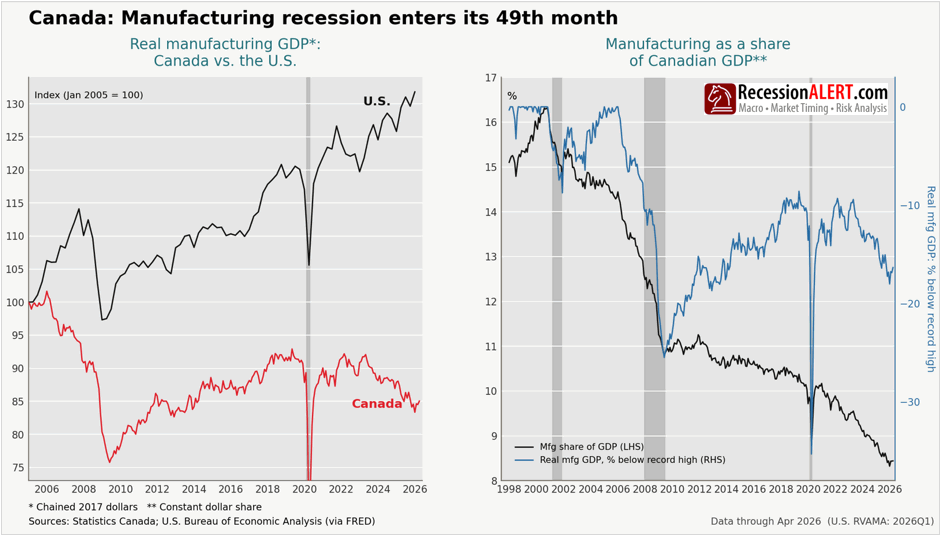
Canada’s manufacturing sector last set a record before the iPhone existed, and has never been back. The most boring line in developed-economy macro — a manufacturing share sliding from 16.3% toward a record-low 8.5% — is, here, the most alarming. It normally means services simply compounded faster while factories kept climbing to records: the American case exactly, US output at all-time highs. Canada’s share halved because the numerator shrank. Identical shape, inverted diagnosis. The timing indicts capital. Statistics Canada dates the business investment slowdown to “after the mid-2000s” — precisely when the record was set. Machinery and equipment intensity fell from above 90% of the US level to roughly 75% by 2007 and kept sliding; Canadian workers now receive about 55 cents of new capital per American dollar, on business R&D of 0.9% of GDP against 2.6%. Starve a tradable sector of capital and it does not collapse — it drifts. Productivity stalls, unit costs creep, share migrates to whoever kept building. That share has a destination. The two panels are not independent national stories; a sliver of the black line’s ascent walked up from Ontario, and Statistics Canada expects another 4% of Canadian production to leave in 2026. The red line has been falling since April 2022, three years before the first tariff schedule; the 2025 measures merely steepened it — vehicle output -15% y/y against US +1.2%, relocation and accelerant in one number. Households banked the bill first: output per capita since 2005, US +10%, Canada -30%. A trade deal fixes the accelerant, not the arithmetic.
Market Intelligence Brief (MIB) Ver. 18.42
For professional investors only. Not investment advice.
© 2026 RecessionALERT.com

Comments are closed.