
MARKET INTELLIGENCE BRIEF (MIB)
Tuesday, November 10, 2026
Hot October CPI moved the Fed debate from whether to how fast: core rose 0.3% for a third month, meeting Waller’s half-point condition, while the 2-year jumped 18.2 bps and the 10-year briefly retook 5%. Logan wants at least two more hikes. Nvidia sank 5.47% on a report that Huang’s relationship aided at least $7.5B of chip shipments to Chinese firms. Anthropic set a $70-$78 IPO range valuing it at up to about $1.4T. Brent briefly broke below $90.
TABLE OF CONTENTS
A. EXECUTIVE SUMMARY
B. MARKET DATA
C. HIGH-IMPACT STORIES (5)
D. MODERATE-IMPACT STORIES (5)
E. ECONOMY WATCH (6)
F. EARNINGS WATCH (0)
G. WHAT’S NEXT
H. CHART OF THE DAY
A. EXECUTIVE SUMMARY -> TOP
A hotter-than-expected October CPI moved the Fed debate from whether it hikes in December to how fast it tightens afterward: the 2-year yield jumped 18.2 bps, its largest one-day rise since at least April 15, and the 10-year briefly retook 5%, while the S&P 500 fell 0.38% and the Nasdaq 100 lost 0.60%. Core’s 0.3% print met Governor Waller’s condition for weighing a half-point hike, Dallas Fed President Logan wants at least two more increases, and Deutsche Bank now sees hikes in December, January and March. Equities took it as a valuation hit rather than a risk event, with the VIX down 2.31% and Polymarket recession odds steady at 4%, while Nvidia’s 5.47% slide on a China-shipments report concentrated the damage in mega-cap tech. Sector losses were concentrated: Basic Materials (-2.14%) and Technology (-1.15%) led six decliners, while Financials (+0.35%) and Consumer Defensive (+0.21%) rose, a mild defensive tilt beneath a modest headline loss.
• October CPI rose 0.4% against a 0.3% forecast and core rose 0.3% against 0.2%, a third straight 0.3% core print; the 2-year yield rose 18.2 bps to 4.748% and the 10-year rose 10.8 bps to 4.994% after trading as high as 5.023%.
• CME FedWatch now fully prices at least a 25 bp December hike, with half-point odds at 11.8%; Polymarket odds of another 2026 hike rose to 96% from 82%, while Vice Chair for Supervision Bowman said further tightening must be weighed against its costs.
• NVDA fell 5.47% to $168.89 after The Information reported that Jensen Huang’s relationship aided at least $7.5 billion of chip shipments to Chinese firms; House Foreign Affairs Chair Mast is prepared to subpoena him. AVGO rose 3.91% on a JPMorgan note tying it to Google’s TPU 8i Max.
• Anthropic set a $70-$78 IPO range, raising up to $64.4 billion at a valuation of up to about $1.4 trillion, with a $26 billion placement from Nvidia, Google and five other tech companies; MSFT fell 2.20% as Anthropic launched Claude Sheets.
• GEV fell 3.89% after SoftBank booked a $3.7 billion charge on power equipment it prepaid for US AI data centers; Bowman said AI-related debt is on track to exceed $800 billion this year.
• Brent traded below $90 for the first time since August before closing down 0.60% at $92.01, its lowest close since August 31, as US officials downplayed further Iran strikes even though two vessels were hit near Hormuz.
1. The Fed’s pace, not its direction, is now the debate — October’s core print met the condition Waller set for weighing a half-point move, Logan wants at least two more increases and possibly faster this winter, and Deutsche Bank now expects hikes at three consecutive meetings. That the bear flattening was led by the 2-year while the VIX fell and recession odds held at 4% says markets read this as inflation-fighting, not a growth threat. For portfolios the exposure is valuation: with the 10-year near 5%, long-duration growth loses discount-rate support, and Technology is already down 12.40% over the past month. Thursday’s five Fed speakers and Friday’s PPI (headline expected 0.4%) decide whether 50 bp enters the base case.
2. The AI trade is being tested on governance, competition and credit at once — Nvidia faces an export-control allegation, Anthropic is moving into Microsoft’s application layer, SoftBank wrote off prepayments on data-center power equipment, and the Fed’s top bank supervisor warned of “circular financing” on the day Anthropic’s chip and cloud suppliers committed $26 billion to its stock. Yet investors discriminated rather than fled: Broadcom, Texas Instruments and AMD rose while the semiconductor index slipped only about 0.4%, so the market is pricing company-specific and financing risk, not exiting AI hardware. Anthropic’s IPO pricing, with trading as soon as November 19, and Nvidia’s November 17 results are the next tests.
3. Tariffs keep goods inflation sticky, and oil is the only offset — A White House official said the administration is “just getting started” on tariffs a week after midterm losses, despite a Reuters/Ipsos poll showing 62% support for repeal, while Glenmede’s Jason Pride noted core goods prices excluding used cars rose 0.4% in October, the most since January. The relief valve is crude: Edward Jones cited lower oil as a reason the Fed may stop at 25 bp rather than 50 in December, but that depends on Brent sustaining a move below $90 while physical flows through Hormuz remain impaired.
 — Leading economic indicators. Accurate market forecasts. Apply for membership at join.recessionalert.com
B. MARKET DATA -> TOP
A hotter-than-expected October CPI and Fed Governor Waller’s call for a December hike, with a half-point move on the table if inflation worsens, sent the front end of the curve sharply higher and stocks modestly lower. The decline was narrow rather than broad: Nvidia’s slide on mounting scrutiny of CEO Jensen Huang dragged the Nasdaq 100 lower, while the NYSE Composite was nearly flat and the Dow Transports finished green. The sharpest divergence sat inside semiconductors itself, where Broadcom, Texas Instruments and AMD rose as Nvidia fell. Gold’s drop alongside a firmer dollar shows the hawkish repricing reaching well beyond equities, even as crude eased on lower odds of further US strikes on Iran.
CLOSING PRICES – Tuesday, November 10, 2026:
MAJOR INDICES
A narrow, rate-and-Nvidia decline: the Nasdaq 100 and Russell 2000 led lower while the NYSE Composite barely moved and the Dow Transports edged up. Over the past 10 sessions the Russell 2000 has outperformed the S&P 500 by 2.70 points, an 11-session small-cap leadership pattern that is now entrenched, and the S&P 500 has beaten the Nasdaq 100 by 3.83 points, a broadening rotation away from mega-cap growth now in its seventh session.
| Index | Close | Change | %Move | Why It Moved |
|---|---|---|---|---|
| S&P 500 | 7,520.93 | -29.01 | -0.38% | October CPI rose 0.4% against a 0.3% forecast, per Reuters, and Governor Waller backed a December hike; Nvidia’s slide led technology lower |
| Dow Jones | 52,231.89 | -157.86 | -0.30% | Same rate repricing after the hot CPI print; blue chips fell less than the tech-heavy indices |
| DJ Transportation | 20,416.58 | +20.73 | +0.10% | Edged higher against the tape; no discrete same-day catalyst identified |
| Nasdaq 100 | 27,740.80 | -166.83 | -0.60% | Nvidia’s 5.47% drop on the Huang scrutiny and Microsoft’s 2.20% fall weighed on top of the rate repricing |
| Russell 2000 | 2,821.38 | -19.44 | -0.68% | Fell most among the major indices; no small-cap-specific catalyst identified beyond the session’s rate repricing |
| NYSE Composite | 24,462.33 | -10.29 | -0.04% | Nearly flat even though decliners outnumbered advancers 2.27-to-1 on the NYSE, per Reuters |
VOLATILITY & TREASURIES
A bear flattening: the 2-year rose nearly twice as far as the 10-year, narrowing the 2s10s spread to about 25 bps from 32, which is the front end repricing December hike odds rather than a growth scare. VIX fell anyway, so the selloff read as orderly rate repricing, not fear. The dollar’s gain fits the same hawkish read.
| Instrument | Level | Change | Why It Moved |
|---|---|---|---|
| VIX | 19.46 | -0.46 (-2.31%) | Fell even as stocks declined, a third straight lower close since 28.15 on Nov 5 |
| 10-Year Treasury Yield | 4.994% | +10.8 bps | Rose after the hot CPI print and Waller’s hike comments; traded above 5% intraday (session high 5.023%) |
| 2-Year Treasury Yield | 4.748% | +18.2 bps | Led the move as December hike pricing firmed: CME FedWatch fully priced at least 25 bps and put half-point odds at 11.8%, per Reuters |
| US Dollar Index (DXY) | 102.24 | +0.59 (+0.58%) | Rose with Treasury yields on the hawkish rate repricing |
COMMODITIES
Precious metals sold off as a group on the hawkish repricing, with gold, silver and platinum all down more than 1% and silver hit hardest, while copper’s decline offered no growth counter-signal from industrial metals. Bitcoin fell with equities rather than decoupling, consistent with a rates-driven pullback in risk.
| Asset | Price | Change | %Move | Why It Moved |
|---|---|---|---|---|
| Gold | $4,040.50/oz | $-74.00 | -1.80% | Fell as the hot CPI print and Waller’s comments lifted Fed hike bets, alongside a firmer dollar and higher yields |
| Silver | $51.53/oz | $-1.16 | -2.21% | Fell with gold on the hawkish rate repricing |
| Copper | $6.27/lb | $-0.0745 | -1.17% | Fell with the metals complex; no discrete same-day catalyst identified |
| Platinum | $1,541.35/oz | $-20.35 | -1.30% | Fell with the precious metals complex; no separate catalyst identified |
| Bitcoin | $73,678.0 | $-1,591.0 | -2.11% | Fell with equities on rate worries; no crypto-specific catalyst identified |
ENERGY
Crude eased while both natural gas benchmarks rose, splitting oil from gas on the day. Brent fell further than WTI, narrowing the spread to about $5.57, as US officials downplayed the need for further military action against Iran, per Reuters.
| Asset | Price | Change | %Move | Why It Moved |
|---|---|---|---|---|
| Crude Oil (WTI) | $86.44/bbl | $-0.41 | -0.47% | Eased as US officials downplayed further military action against Iran; settled $86.04, down 81 cents, per Reuters |
| Crude Oil (Brent) | $92.01/bbl | $-0.56 | -0.60% | Same Iran de-escalation driver; settled $91.49, down $1.08, per Reuters |
| Natural Gas (Henry Hub) | $3.294/MMBtu | $+0.076 | +2.36% | No discrete same-day catalyst identified; extended Monday’s 7.6% gain |
| Natural Gas (Dutch TTF) | $27.800/MMBtu | $+0.807 | +2.99% | Reversed an early slide to a one-month low, per Investing.com, to close near the session high; no discrete catalyst identified for the recovery |
S&P 500 SECTORS
Losses were concentrated rather than broad: six of 11 sectors fell, four edged up and Healthcare finished flat, with Basic Materials and Technology carrying most of the damage. Technology’s slide deepens a 12.40% one-month decline, while Energy’s small gain barely dents a 6.68% weekly loss. Consumer Defensive rising on a down day hints at a mild defensive tilt beneath the headline.
| Sector | 1-Day | 1-Week | 1-Month | 3-Month | 6-Month | YTD | 12-Month |
|---|---|---|---|---|---|---|---|
| Financial | +0.35% | +2.26% | +4.10% | -1.17% | +10.64% | +7.46% | +12.49% |
| Consumer Defensive | +0.21% | +2.08% | +7.91% | +7.96% | +5.88% | +16.54% | +18.52% |
| Energy | +0.15% | -6.68% | -6.33% | -0.49% | +2.07% | +33.29% | +33.29% |
| Consumer Cyclical | +0.09% | +3.31% | +5.78% | +1.15% | +0.20% | -1.14% | -1.60% |
| Healthcare | 0.00% | +2.50% | +9.34% | +9.19% | +23.29% | +17.49% | +22.77% |
| Industrials | -0.06% | -0.99% | -1.89% | -8.65% | -6.46% | +7.33% | +8.88% |
| Communication Services | -0.21% | +3.72% | -10.75% | -6.92% | -14.84% | -8.98% | -3.84% |
| Utilities | -0.32% | +0.99% | +4.34% | -0.63% | -4.63% | +1.62% | -2.78% |
| Real Estate | -0.33% | +2.07% | +5.84% | -1.36% | -0.50% | +8.43% | +6.12% |
| Technology | -1.15% | -4.05% | -12.40% | -9.40% | -2.53% | +13.68% | +12.35% |
| Basic Materials | -2.14% | +3.53% | -1.02% | -5.38% | -8.70% | +10.30% | +21.83% |
TOP MEGA-CAP MOVERS:
GAINERS
| Company | Ticker | Close | Change | Why It Moved |
|---|---|---|---|---|
| Broadcom Inc | AVGO | 331.98 | +3.91% | Rose against Nvidia’s slide after JPMorgan reiterated Overweight, linking Broadcom to Google’s newly unveiled TPU v8i Max, per Investing.com; the broker note was not independently confirmed |
| Berkshire Hathaway Inc | BRK-A | 875,654.62 | +2.60% | No discrete same-day catalyst identified; Class A trades thinly (185 shares on the session) and Class B rose a smaller 1.41% |
| RTX Corp | RTX | 200.27 | +2.02% | No single confirmed catalyst; presented at the Baird Global Industrial Conference on Nov 10 with backlog central to its outlook, per Investing.com |
| Unitedhealth Group Inc | UNH | 405.12 | +1.89% | No discrete same-day catalyst identified; the Healthcare sector finished flat |
| Texas Instruments Inc | TXN | 300.52 | +1.62% | No discrete same-day catalyst identified; rose with Broadcom and AMD while the Philadelphia semiconductor index slipped 0.4%, per Reuters |
DECLINERS
| Company | Ticker | Close | Change | Why It Moved |
|---|---|---|---|---|
| NVIDIA Corp | NVDA | 168.89 | -5.47% | Mounting concern over CEO Jensen Huang after an internal probe into spy claims; The Information reported his relationship aided at least $7.5B of chip shipments through Chinese firms, per Reuters, which put the two-session drop at 9.6% |
| GE Vernova Inc | GEV | 797.04 | -3.89% | SoftBank reported a roughly $7B quarterly net loss on Nov 10; Investing.com attributes GEV’s fall to a $3.7B charge in it on pre-purchased power hardware for US AI data centers (unverified, not corroborated by a second source) |
| Dell Technologies Inc | DELL | 334.38 | -3.44% | No discrete same-day catalyst identified; continuation of the AI-infrastructure selloff that followed the Nov 3 midterms |
| Caterpillar Inc | CAT | 584.57 | -2.39% | No discrete company-specific catalyst identified; gave back part of Monday’s 7.2% surge as the hot CPI print hit the tape, per Investing.com |
| Microsoft Corp | MSFT | 533.16 | -2.20% | Fell after Bloomberg reported Anthropic is preparing AI workplace tools including Claude Sheets, an Excel rival, per Investing.com |
— Institutional-grade intelligence for serious investors. Apply for membership at join.recessionalert.comC. HIGH-IMPACT STORIES -> TOP
BEARISH
1. Hot October CPI Lifts the 2-Year Yield 18.2 bps, Its Largest One-Day Rise Since at Least April, as the 10-Year Briefly Retakes 5%
The core facts:October’s consumer prices rose 0.4% against a 0.3% forecast and core prices 0.3% against 0.2% (the data are covered in Section E). The bond market took the print hardest: the 2-year Treasury yield rose 18.2 bps to 4.748%, its largest one-day rise since at least April 15 and its highest close since October 21, and the 10-year rose 10.8 bps to 4.994% after trading as high as 5.023%, above 5% for the first time since the end of October, per Investing.com. The 2s10s spread narrowed to about 25 bps from 32. The dollar index rose 0.58% to 102.24 and gold fell 1.80% to $4,040.50, with silver down 2.21%. Stocks fell less: the S&P 500 lost 0.38% to 7,520.93, the Nasdaq 100 0.60% and the Russell 2000 0.68%, while the NYSE Composite slipped just 0.04% even though decliners outnumbered advancers 2.27-to-1 on the NYSE, per Reuters.
Why it matters:A bear flattening led by the 2-year is the market repricing the Fed’s path, not a growth scare, and the VIX’s 2.31% fall to 19.46 says equity investors treated it as an orderly rate adjustment rather than a risk event. “The underlying data screams stubborn and sticky inflation,” RSM chief economist Joseph Brusuelas told Investing.com. That leaves equities exposed on valuation rather than on sentiment: with the 10-year back at 5% and the front end pricing tighter policy, long-duration growth stocks lose the discount-rate support that underpinned Monday’s rebound, and Technology is already down 12.40% over the past month. Stocks held up partly because the day’s heaviest selling was concentrated in Nvidia (Story 3); Baird’s Michael Antonelli said markets are “still digesting Nvidia news, the midterm results, and whether or not the AI trade is over.”
What to watch:October PPI on Friday, November 13 at 8:30 AM ET (headline expected 0.4%). The bond market is closed Wednesday for Veterans Day; a 10-year close above 5% would be the first since October 28 (5.051%).
BEARISH
2. Waller’s Half-Point Condition Is Met and Logan Wants “At Least Two More” Hikes: A December Increase Is Fully Priced and Deutsche Bank Now Sees Three in a Row
The core facts:Governor Waller said in London, before the CPI release, that he would back a 25 bp December hike and that a 50 bp move “should be considered” if core inflation ran around 0.3% or higher; core then printed 0.3%. Dallas Fed President Logan later said the FOMC needs “at least two more” quarter-point increases and could move faster this winter (both speeches are covered in Section E). CME FedWatch moved to fully pricing at least a 25 bp December hike, with half-point odds at 11.8% from none on Monday, per Reuters; Yahoo Finance put them at 15% at midday and Investing.com near 10% at the close. Deutsche Bank chief economist Matt Luzzetti added a January hike to his forecast and now expects 25 bp at each of the December, January and March meetings, per Yahoo Finance, while Capital Economics’ Thomas Ryan said the data “should all but confirm a December hike.”
Why it matters:The debate has moved from whether the Fed hikes in December to how fast it tightens after that. A path of back-to-back meetings is a different regime from the gradual pace officials appeared to favor before Tuesday, and Luzzetti said the hot report “complicates” that strategy, which had tried to balance inflation against recent market volatility and souring AI sentiment. That is the crux for equities: the AI selloff and wider credit spreads were reasons for the Fed to go slowly, and the inflation data now argue the other way. Vice Chair for Supervision Bowman was the day’s counterweight, saying further tightening must be weighed against its costs (Story 9), but she stated no December preference. Edward Jones still sees 25 bp as most likely, citing lower oil prices and volatile financial conditions.
What to watch:Thursday’s speakers (Hammack, Barr, Goolsbee, Daly and Williams) for any endorsement of a 50 bp move, October PPI on Friday, November 13, and the October FOMC minutes on Wednesday, November 18, ahead of the December 9 decision.
BEARISH
3. Nvidia Falls 5.47% to $168.89 After The Information Reports Huang’s Relationship Aided at Least $7.5 Billion of Chip Shipments to Chinese Firms; a House Chair Threatens a Subpoena
The core facts:The Information reported on Tuesday, citing two people who know her, that CEO Jensen Huang’s affair with Alice Huang, a businesswoman alleged to be a spy for Beijing, facilitated the shipment of at least $7.5 billion of Nvidia chips to Chinese firms, per Reuters. The report says she, her husband and her sister built a network of companies across China and Singapore centered on Shanghai Century Litong, which won preferred cloud partner status with Nvidia within months of its June 2023 founding, and helped move about 240,000 H100, H200 and some A100 chips into China. Nvidia did not immediately respond to Reuters. House Foreign Affairs Committee Chair Brian Mast told ABC News he is prepared to subpoena Huang if he does not respond by Wednesday to a request for a closed-door briefing on November 18, the day after Nvidia’s earnings, and The New York Times reported that Secretary of State Rubio briefed President Trump on the intelligence about Huang in May, which the White House disputed on background. Polymarket traders put the chance that Huang is removed or resigns before the end of 2026 at 14%, per Investing.com.
Why it matters:The story has moved from a governance question to an export-control one. Monday’s board probe concerned whether Huang was targeted; Tuesday’s report alleges a specific diversion channel through a preferred Nvidia partner, which is the kind of finding that invites Commerce or Justice Department action and congressional pressure for tighter China controls. For a company worth about $4 trillion, a 5.47% fall erased more than $200 billion of market value, and it was the main reason the Nasdaq 100 fell 0.60%. The selling was Nvidia-specific: the Philadelphia semiconductor index slipped only about 0.4%, while Broadcom (+3.91%, Story 8), Texas Instruments (+1.62%) and AMD (+1.30%) rose, so investors are discounting key-person and legal risk at Nvidia rather than exiting AI hardware.
What to watch:Huang’s answer to the House request, due Wednesday, November 11, then Nvidia’s third-quarter results after the close on Tuesday, November 17 (call at 5:00 PM ET), where any disclosure on China sales or the board’s review will matter as much as the numbers.
UNCERTAIN
4. Anthropic Sets a $70-$78 IPO Range, Valuing It at Up to About $1.4 Trillion, With a $26 Billion Placement From Nvidia, Google and Five Other Tech Companies
The core facts:Anthropic set a price range of $70 to $78 per share in an amended prospectus filed on Tuesday and began its roadshow, per Yahoo Finance; the offering of 825 million Class A shares would raise up to $64.4 billion, per Reuters, and the range values the company at as much as about $1.4 trillion counting every share that could exist. Alongside the IPO, Nvidia and Google are each buying $10 billion of stock at the IPO price as part of a $26 billion private placement that also includes AMD, Broadcom, Micron, Microsoft and TSMC. Trading could start as soon as November 19, according to reports. In the same filing Anthropic said it had determined that a threshold in its Responsible Scaling Policy, covering AI accelerating its own research, has been met, based on “what we expect from future models and our overall rate of progress, rather than on what we have observed from current models.”
Why it matters:At the top of the range this would be the largest IPO on record, and it arrives a week after the post-midterm AI selloff, so its pricing is a direct test of how much risk appetite remains for the AI trade. It also adds a large new AI equity competing for the same allocations as existing AI holdings. The placement is the more contentious element: Anthropic’s chip and cloud suppliers are buying its stock at the same time as they sell to it, the kind of arrangement Fed Vice Chair for Supervision Bowman said on Tuesday creates “the appearance of circular financing” (Story 9). The same day, Anthropic’s new office software knocked 2.20% off Microsoft (Story 6), a reminder that the company is a competitor as well as a customer to several of its investors.
What to watch:Whether the deal prices inside, above or below the $70-$78 range, and its first-day trading as soon as Thursday, November 19.
BULLISH
5. Brent Briefly Breaks Below $90 for the First Time Since August as US Officials Downplay Further Iran Strikes, Even as Two Vessels Are Hit Near Hormuz
The core facts:Brent traded as low as $89.16 during the session, its first time below $90 since August, per CNBC, before closing at $92.01, down 0.60% and its lowest close since August 31. WTI closed at $86.44, down 0.47%, narrowing the Brent-WTI spread to about $5.57. Prices eased after US officials downplayed the need for further military action against Iran, per Reuters. Attacks on shipping continued: the UK Maritime Trade Operations center reported a tanker struck by an unidentified projectile about 19 nautical miles northeast of Lima, Oman, at 13:38 UTC, with the crew safe, and a vessel operated by ADNOC Logistics & Services was damaged in an attack in UAE waters, per gCaptain. The Joint Maritime Information Center keeps the Hormuz threat level at SEVERE, with daily transits in the single digits to low double digits against a 2025 average of about 138.
Why it matters:Crude is trading the diplomacy, not the shipping lane. “The market has continued to unwind some of the geopolitical risk premium built into prices in recent weeks,” ING strategists wrote, per CNBC, yet Tuesday’s attacks show physical supply through Hormuz is still impaired, so the downside rests on officials’ statements holding. For the inflation outlook the direction is helpful: energy rose 0.7% in October’s CPI, and Edward Jones cited the recent fall in oil as a reason the Fed may stop at 25 bp rather than 50 in December (Story 2). The bond market did not give that much weight on Tuesday, but a sustained Brent move below $90 would start to show up in headline inflation and gasoline prices within weeks. Energy (+0.15%) barely dented a 6.68% weekly loss, while natural gas rose, with Henry Hub up 2.36% and Dutch TTF 2.99%.
What to watch:The EIA’s weekly petroleum report on Thursday, November 12 (delayed by Veterans Day). A Brent close below $90.71 would be its lowest since August 28.
— Quantifying recession risk so you don’t have to guess. Apply for membership at join.recessionalert.comD. MODERATE-IMPACT STORIES -> TOP
BEARISH
6. Microsoft Falls 2.20% as Anthropic Launches Claude Sheets and Other Workplace Tools, Taking Aim at Excel
The core facts:Microsoft fell 2.20% to $533.16 after Bloomberg reported that Anthropic would unveil a suite of AI workplace tools at an event on Tuesday, including a video-call assistant, a data dashboard and Claude Sheets, a spreadsheet that closely resembles Excel and Google Sheets with Anthropic’s AI built in, per Investing.com. Anthropic released Claude Sheets and Claude Whiteboards in beta and made Claude Data generally available later the same day, according to its launch post and multiple reports. Microsoft is also one of the seven companies buying stock in Anthropic’s $26 billion private placement alongside its IPO (Story 4).
Why it matters:The move is less about one beta spreadsheet than about AI model developers moving into the application layer, where Microsoft’s Office franchise earns recurring per-seat revenue. Microsoft has been building AI into Office through its own assistant, so a model provider shipping a competing front end directly to business users challenges the assumption that incumbents capture most of the value AI adds to productivity software. The reaction shows how tightly investors now link Anthropic’s expansion to incumbent software multiples, and it came on a day when rising yields were already pressing on long-duration technology stocks (Story 1).
What to watch:Any usage or enterprise adoption figures Anthropic discloses during its IPO roadshow, and whether Microsoft responds with pricing or bundling changes to its Office AI tools.
BEARISH
7. GE Vernova Falls 3.89% After SoftBank Books a $3.7 Billion Charge on Power Equipment It Prepaid for US AI Data Centers
The core facts:SoftBank Group reported a net loss of ¥1.115 trillion ($7.0 billion) for the quarter ended September 30 and booked a $3.7 billion charge on electricity-generating hardware intended for its US AI server campuses, per Quartz. SoftBank said it had paid in advance because it feared supplies would run short and has since revised its procurement strategy; the charge covers non-refundable advance payments, of which $2.9 billion had already been paid, and changes to signed contracts. Advance payments for its PORTS-Pike project in Ohio and other sites totaled $9.5 billion, leaving a $6.6 billion balance. Its chief financial officer said SoftBank is not scaling back the Ohio project, which has a 20-year lease with OpenAI covering 8 gigawatts but is undergoing “a thorough reassessment,” including of how it buys equipment, per Bloomberg. GE Vernova closed down 3.89% at $797.04, a move coverage including Investing.com tied to the charge.
Why it matters:The bull case for gas turbines has rested on scarcity: AI developers prepaying years ahead to secure equipment. A major buyer writing off prepayments and rethinking how it procures is the first visible crack in that ordering behavior, even if the Ohio project itself continues, and it lands days after a Financial Times report that Anthropic had taken over $3.4 billion of Caterpillar generator orders. Whether this is reallocation or retrenchment matters: delayed slots can be resold to other customers in a tight market, so the earnings impact on suppliers may be smaller than the share move implies. Other AI-infrastructure names also fell, Dell by 3.44% and Caterpillar by 2.39%, though no company-specific catalyst was identified for either.
What to watch:The outcome of SoftBank’s Ohio reassessment and any change to its equipment orders, and whether other data-center developers disclose similar prepayment write-downs in their next filings.
BULLISH
8. Broadcom Rises 3.91% Against Nvidia’s Slide as JPMorgan Ties It to Google’s TPU 8i Max and Sees Revenue Visibility Through 2031
The core facts:JPMorgan analyst Harlan Sur reiterated his Overweight rating on Broadcom, saying Google’s latest TPU design aligns with the Broadcom 3-nanometer roadmap set out in the bank’s autumn research, per Invezz and Investing.com. Sur expects Google’s TPU 8i Max, which combines two TPU 8i chips in a single package, to begin ramping in the second half of 2027, said Google’s next-generation 2-nanometer TPU remains on track for mid-2028, and argued that Broadcom continues to supply Google’s highest-performance TPU programs, giving it revenue visibility through 2031. Broadcom closed up 3.91% at $331.98, the session’s largest gain among US companies worth more than $200 billion, while Nvidia fell 5.47%.
Why it matters:The day’s split inside AI hardware ran along a clear line: custom chips built for hyperscalers rose while the merchant GPU leader fell. That reflects Nvidia’s company-specific troubles (Story 3), but it also shows investors willing to pay for a supplier whose AI revenue is tied to long-dated design programs at one of the largest buyers. Broadcom is also one of the companies investing in Anthropic’s private placement (Story 4), tying it more closely to the AI developers whose spending drives its custom-chip business.
What to watch:Applied Materials’ results on Thursday, November 12 after the close, the next read on AI chip demand, and Nvidia’s results on Tuesday, November 17, which will show whether the gap between custom and merchant AI chips persists.
UNCERTAIN
9. Bowman Says AI-Related Debt Is on Track to Exceed $800 Billion This Year and Warns Its Financing Structures Make Counterparty Risk Hard to Assess
The core facts:In her speech at the Council on Foreign Relations (her policy remarks are covered in Section E), Fed Vice Chair for Supervision Michelle Bowman said AI-related debt “has been rising rapidly, with notable gains in corporate bonds, private credit, and project finance,” and “is on track to exceed $800 billion this year,” with lease and contract commitments estimated at more than three times that amount. She said hyperscalers have taken on off-balance-sheet liabilities that smaller, riskier companies use as collateral for data-center construction, and that equity investments by hyperscalers and chip designers in smaller AI companies are “creating the appearance of circular financing.” The largest US banks, life insurers, pension funds, private credit and mutual funds all have exposure; most are well capitalized, she said, “But the complex nature of the financing structures makes it difficult to properly assess counterparty risk.”
Why it matters:This is the Fed’s top bank supervisor naming the AI financing web as a source of risk on the same day the market saw it in action: SoftBank wrote off prepayments on data-center power equipment (Story 7) and Anthropic’s chip and cloud suppliers committed $26 billion to its stock (Story 4). She stressed that most exposed institutions are well capitalized, but the remarks show supervisors are now examining bank and insurer exposure to data-center finance, and they add a credit dimension to an AI trade that has so far been judged mainly on earnings. She also noted that the cost of financing has been rising notably as investors see more risk, which is the channel through which higher Fed rates (Story 2) would slow AI construction.
What to watch:Bowman speaks again on Friday, November 13 at 10:50 AM ET; listen for whether supervisory reviews of AI-related lending are planned.
BEARISH
10. White House Says It Is “Just Getting Started” on Tariffs a Week After Midterm Losses, as a Reuters/Ipsos Poll Finds 62% Support Repeal
The core facts:Jim Goyer, director of the White House Office of Public Liaison, defended tariffs at the B20 summit hosted by the US Chamber of Commerce in Washington on Tuesday: “And we are just getting started. Our ambition is to continue this pace for the remainder of the president’s term in office,” per CNBC. Later on the same stage, Gary Cohn, Trump’s chief economic adviser in his first term, said “Tariffs are a consumption tax on the U.S. consumer.” A Reuters/Ipsos poll released Tuesday found 62% of Americans support repealing the tariffs and 21% approve of Trump’s handling of the cost of living. CNBC also cited a New York Fed study estimating that about 26% of tariff increases have passed through to consumer prices.
Why it matters:Roughly two-thirds of midterm voters said Trump’s policies contributed to inflation, per the CNBC Voter Poll, yet the White House’s message is that tariff policy will not change. That keeps tariff pass-through in the inflation outlook just as October’s CPI showed core goods prices excluding used cars rising 0.4%, the most since January, per Glenmede’s Jason Pride. That makes a December rate hike more likely (Story 2) and keeps margin pressure on retailers and importers. It also sets up a confrontation with the incoming Democratic Congress, adding policy uncertainty heading into 2027.
What to watch:Any new tariff action ahead of January 10, 2027, when the current US-China truce instruments lapse.
— Separating signal from noise since 2007. Apply for membership at join.recessionalert.comE. ECONOMY WATCH -> TOP
October’s price data and the Fed’s response pointed the same way: the question has moved from whether the Fed hikes again to how fast. Consumer prices rose 0.4% and core 0.3%, a third straight 0.3% core print and exactly the level at which Governor Waller said a half-point December move should be considered. Dallas Fed President Logan called for at least two more quarter-point increases, possibly faster this winter, while Vice Chair for Supervision Bowman stressed weighing the costs of further tightening. Polymarket odds of another 2026 hike jumped to 96% and the 2-year yield rose 18.2 bps, yet recession odds held at 4%, and households are absorbing higher rates for now even as the delinquent share of debt edged up to 5.0%.
October CPI Rises 0.4% Against a 0.3% Forecast as Core Prints 0.3% for a Third Straight Month (BLS, Nov 10)
What they’re saying:The Consumer Price Index rose 0.4% in October on a seasonally adjusted basis, above the 0.3% consensus, after 0.6% in September. Core CPI, which excludes food and energy, rose 0.3% against a 0.2% forecast, the same pace as in September and August. Energy rose 0.7%, food 0.5% and shelter 0.3%, with shelter accounting for more than 30% of the monthly increase, while used cars and trucks fell 1.2%.
The context:The BLS published no 12-month rate for headline or core CPI because it did not collect survey data for October 2025 during the lapse in appropriations, so the monthly figures carry the whole signal this time. The gains were broad, from electricity (+0.9%) and motor vehicle insurance (+0.7%) to hospital services and recreation (both +0.8%). Treasuries repriced sharply: the 2-year yield rose 18.2 bps to 4.748% and the 10-year rose 10.8 bps to 4.994%, after trading as high as 5.023% during the session.
What to watch:October PPI on Friday, Nov 13 (headline expected 0.4% after 1.3%; core expected 0.3% after 0.7%), then October import prices and retail sales on Tuesday, Nov 17.
Waller Backs a December Hike and Says a Half-Point Move “Should Be Considered” if Core CPI Runs Near 0.3% (Federal Reserve, Nov 10)
What they’re saying:Speaking in London hours before the CPI release, Governor Christopher Waller said “I would still support a 25 basis point increase in the FOMC’s policy rate at our December meeting.” With “core CPI inflation around 0.3 percent or even higher,” he said, “a 50 basis point hike in the policy rate should be considered,” adding: “Hiking only 25 basis points would put our credibility at risk, a risk I am not eager to take.”
The context:October core CPI came in at 0.3%, meeting the condition he set. Waller cited core PCE inflation of 3.1% over the 12 months to September and said “More than 70 percent of the components of core PCE service prices saw 12-month increases above 3 percent.” He called the labor market “stable”, with unemployment at 4.1%, but worries that its “low hire, low fire equilibrium” has cost it dynamism. CME FedWatch fully priced at least a quarter-point December increase and put half-point odds at 11.8%, per Reuters.
What to watch:A heavy run of Fed speakers: Hammack, Barr, Goolsbee, Daly and Williams on Thursday, Nov 12, then Bowman, Daly and Jefferson on Friday, Nov 13, ahead of the December 9 FOMC decision.
Logan Says the FOMC “Needs to Implement at Least Two More 25-Basis-Point Rate Increases” and Could Move Faster This Winter (Dallas Fed, Nov 10)
What they’re saying:Dallas Fed President Lorie Logan said “the FOMC needs to implement at least two more 25-basis-point rate increases,” and that “It may be possible to move more rapidly this winter than the FOMC has moved so far this fall.” She added that “After two more increases are in place, it would make sense in my view to pause” and examine economic and financial developments.
The context:Logan spoke at the Dallas and Kansas City Feds’ joint energy conference, where she noted that October CPI “was higher than expected” and cited core PCE inflation of 3.1% over the 12 months through September. The call for two more increases repeats the view she set out on Oct 30; what is new is the pace, since she left room to tighten faster than the Fed has since its September increase. Kansas City Fed President Jeffrey Schmid also spoke at the conference.
What to watch:October PPI on Friday, Nov 13, and whether Thursday’s speakers (Hammack, Barr, Goolsbee, Daly and Williams) echo the case for moving faster.
Bowman Says Policy “Is Not on a Preset Course” and Further Tightening Must Be “Carefully Weighed Against Its Costs” (Federal Reserve, Nov 10)
What they’re saying:At the Council on Foreign Relations, Vice Chair for Supervision Michelle Bowman said “the benefit of additional policy tightening has to be carefully weighed against its costs” and that “monetary policy is not on a preset course.” She estimated that “12-month core PCE inflation likely moved up further to 3.3 percent in October,” while forecasting that it will “move closer to 2 percent next year.”
The context:Bowman did not state a December preference, which set her apart from Waller and Logan on the same day. She said “Progress on lowering inflation has stalled over the past two years or so,” noted that AI-related debt “is on track to exceed $800 billion this year,” and warned that “An escalation of geopolitical tensions could have more meaningful effects on real activity.” She described a labor market that “does not appear to be tight,” with job gains averaging about 80,000 a month through October.
What to watch:Bowman speaks again on Friday, Nov 13 (10:50 AM ET), the same morning as October PPI.
Polymarket Odds of Another Fed Rate Hike in 2026 Jump to 96% From 82% (Polymarket, Nov 10)
What they’re saying:The Polymarket contract on another Fed rate hike in 2026, which settles at the December 9 FOMC meeting, rose to 96% from 82% at the prior session, a 14-point move. Odds of at least one rate cut in 2026 held at 2%, and odds of a US recession by the end of 2026 were unchanged at 4%.
The context:The repricing followed October’s hotter-than-expected CPI and Waller’s comments putting a half-point move on the table. CME FedWatch fully priced at least a quarter-point December hike, with half-point odds at 11.8%, per Reuters. The 2-year yield’s 18.2 bp rise was nearly twice the 10-year’s, narrowing the 2s10s spread to about 25 bps from 32, a bear flattening led by the front end. Steady recession odds suggest markets read the tightening as a response to inflation rather than a threat to growth.
What to watch:Weekly jobless claims on Thursday, Nov 12 (expected 195K) and October PPI on Friday, Nov 13 (headline expected 0.4%).
Household Debt Rises $334 Billion to $19.1 Trillion in Q3 as the Delinquent Share Climbs to 5.0% (New York Fed, Nov 10)
What they’re saying:Total household debt rose $334 billion, or 1.8%, in the third quarter to $19.1 trillion, led by mortgages, up $257 billion to $13.4 trillion. HELOC balances rose $23 billion to $481 billion, the largest increase since 2005; credit cards rose $22 billion to $1.29 trillion, auto loans $21 billion to $1.73 trillion and student loans $5 billion to $1.66 trillion. The share of debt in some stage of delinquency rose 0.3 percentage point to 5.0%.
The context:Transitions into early delinquency ticked up for auto loans and mortgages but improved slightly for credit cards, and transitions into serious delinquency improved slightly for cards and student loans. The New York Fed’s Donghoon Lee said that although delinquency transition rates for housing debts have crept up, “the overall credit quality of these loans remains strong.” Mortgage originations of $595 billion show credit still flowing even as the Fed tightens.
What to watch:October retail sales on Tuesday, Nov 17, for whether higher borrowing costs are reaching consumer spending.
— Know the probability before the market prices in the risk. Apply for membership at join.recessionalert.comF. EARNINGS WATCH -> TOP
YESTERDAY AFTER THE BELL (Markets Reacted Today)
No major earnings yesterday after the bell from companies with >$100B market cap.
TODAY BEFORE THE BELL (Markets Already Reacted)
No major earnings before the bell from companies with >$100B market cap.
TODAY AFTER THE BELL (Markets React Tomorrow)
No major earnings after the bell from companies with >$100B market cap.
WEEK AHEAD PREVIEW:
Q3 2026 earnings season is in its final stretch, with 88% of the S&P 500 reported as of November 6. The next five sessions carry six reporters above $100 billion: AI hardware on Thursday, then Nvidia, Home Depot and Disney on Tuesday, November 17.
Brookfield Corporation (BN) — BMO, Thursday, November 12 — consensus EPS $0.69 ($103.96 billion market cap, within about 4% of the line); key focus: distributable earnings growth against its 15%-20% long-term target and progress on combining with its insurance business.
Cisco Systems (CSCO) — AMC, Thursday, November 12 — consensus EPS $1.33, against company guidance of $1.32 to $1.34; key focus: whether orders were pulled forward ahead of price increases, as Morgan Stanley warned in its November 5 downgrade, and cloud-business margins.
Applied Materials (AMAT) — AMC, Thursday, November 12 — consensus EPS $4.06 and about $10.3 billion of revenue; key focus: whether equipment orders held through the chip selloff, and China’s share of sales (28% last quarter) and export-control exposure, sharpened by Tuesday’s report of Nvidia chips diverted to China.
Home Depot (HD) — BMO, Tuesday, November 17 — consensus EPS $3.84; key focus: whether comparable sales build on the second quarter’s 1.7% gain (US +1.3%), its best since 2022, when transactions fell 1% and growth came from higher ticket, against full-year guidance for comparable sales flat to up 2%, with the 10-year yield back near 5% weighing on housing demand.
Walt Disney (DIS) — BMO, Tuesday, November 17 — consensus EPS $1.69; key focus: delivery on guidance for about $4.9 billion of fourth-quarter segment operating income and about 16% full-year adjusted EPS growth including a 53rd week, softer domestic streaming advertising, weaker Asian park attendance, and the first fiscal 2027 outlook.
NVIDIA (NVDA) — AMC, Tuesday, November 17 — -5.47% today; consensus EPS $2.47 against company revenue guidance of $108.0 billion, plus or minus 2%, and a 74.0% gross margin; key focus: data-center revenue after $89.0 billion (+117%) last quarter, China exposure and any export-control fallout from the Huang allegations, and any update on the board’s independent review, the day before a requested House briefing.
No company above $100 billion reports on Wednesday, November 11, Friday, November 13 or Monday, November 16. The largest name on those days is Franco-Nevada ($49.33 billion, Wednesday), below the line.
— US market commentary trusted by family offices and institutions. Apply for membership at join.recessionalert.comG. WHAT’S NEXT -> TOP
UPCOMING RELEASES:
| Date | Event | Why It Matters |
|---|---|---|
| Wed, Nov 11 | Veterans Day: bond market closed; MBA 30-Year Mortgage Rate (prior 7.3%) | Treasuries cannot extend Tuesday’s repricing until Thursday, leaving equities to trade the hot CPI without a bond-market signal. Also the deadline for Nvidia’s Huang to answer the House Foreign Affairs Committee’s briefing request. |
| Thu, Nov 12 | Initial Jobless Claims (expected 195K, prior 189K) | Claims near 190K would confirm the “low hire, low fire” labor market Waller described, removing any labor-side reason for the Fed to go slowly. |
| Thu, Nov 12 | Fed speakers: Hammack, Barr, Goolsbee, Daly, Williams | The first Fed reaction after the CPI print beyond Logan and Bowman. Any endorsement of a 50 bp December move would push half-point odds well above 11.8%. |
| Thu, Nov 12 | Existing Home Sales (Oct; expected 3.98M, prior 3.99M) | A read on housing demand with the MBA 30-year mortgage rate at 7.3%; a 10-year near 5% keeps pressure on affordability into winter. |
| Thu, Nov 12 | EIA Weekly Petroleum Status Report (delayed by Veterans Day; prior crude -0.865M) | Tests whether Brent’s slide toward $90 reflects looser physical supply or only easing Iran rhetoric while Hormuz transits stay in the single digits to low double digits. |
| Fri, Nov 13 | PPI MoM (Oct; expected 0.4%, prior 1.3%); Core PPI (expected 0.3%, prior 0.7%) | The week’s decisive print. Pipeline prices at or above forecast after a hot CPI would strengthen the case for a half-point December hike. |
| Fri, Nov 13 | Fed speakers: Bowman (10:50 AM ET), Daly, Jefferson | Bowman was Tuesday’s counterweight and stated no December preference; whether she or Jefferson leans toward 50 bp after PPI will shape the leadership’s signal for December 9. |
| Mon, Nov 16 | NY Empire State Manufacturing Index (Nov; prior 25.50) | An early November gauge of factory activity and prices paid, as tariff pass-through keeps core goods inflation elevated. |
| Tue, Nov 17 | Retail Sales MoM (Oct; prior 0.8%); Control Group (prior 0.1%) | Shows whether higher borrowing costs are reaching consumer spending, after household debt rose $334 billion in Q3 and the delinquent share climbed to 5.0%. |
| Tue, Nov 17 | Import Prices MoM (Oct; prior 1.1%); Industrial Production MoM (Oct; prior 0.7%) | Import prices are the direct read on tariff and dollar effects on goods inflation; the October FOMC minutes follow on Wednesday, November 18. |
KEY QUESTIONS:
1. Do Thursday’s five Fed speakers and Friday’s PPI move a 50 bp December hike from an 11.8% tail toward the base case, and does Waller’s “credibility” argument find support beyond Logan?
2. When Treasuries reopen on Thursday, does the 10-year close above 5% for the first time since October 28, and how much further can Technology’s 12.40% one-month decline run if it does?
3. Is the market pricing Nvidia-specific risk or a wider retreat from AI, and will Huang’s answer to Congress on Wednesday and demand in Anthropic’s IPO book settle the question before Nvidia reports on Tuesday, November 17?
— US market commentary trusted by family offices and institutions. Apply for membership at join.recessionalert.comH. CHART OF THE DAY -> TOP
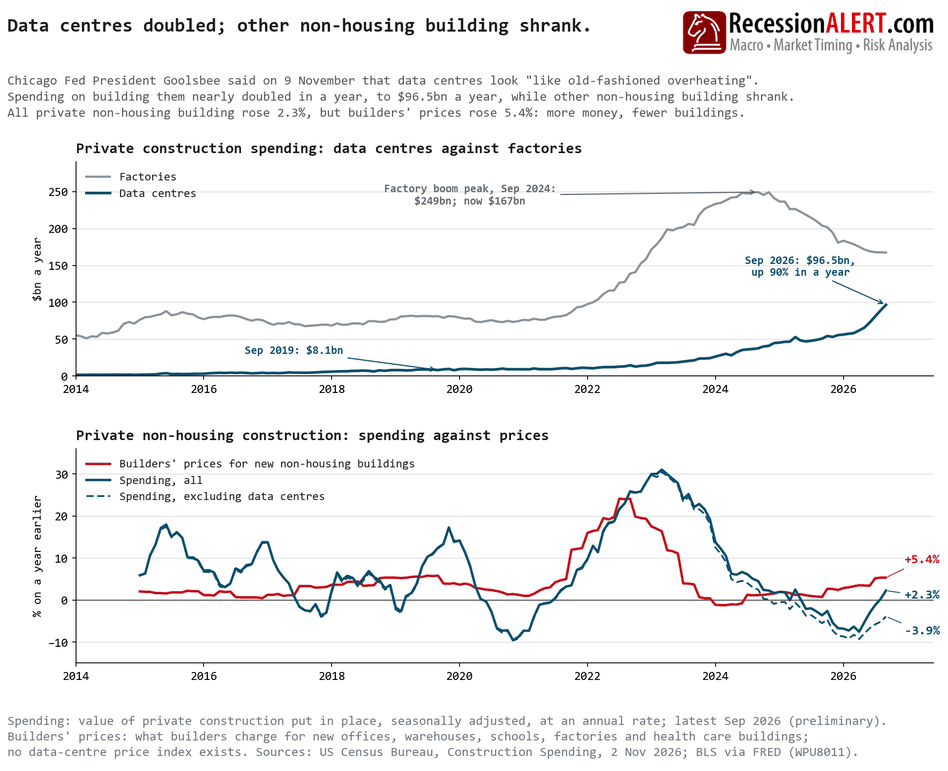
The headline calls AI a building boom; the totals say it is a swap. Data centres are about one-eighth of US private non-housing construction (12.2%, up from 1.6% in 2019), and their $45.8bn rise in a year came as factory building fell $36.5bn. Together the two run at $263.7bn a year, below the $286.7bn of the September 2024 factory peak, and warehouses, shops, schools and ordinary offices all shrank; only power projects joined data centres in growing. Strip data centres out and spending is down 3.9%. That reframes Chicago Fed President Austan Goolsbee’s charge of “old-fashioned overheating”. Overheating is output and prices climbing together; here spending is up 2.3% while builders’ prices are up 5.4%, the fastest since June 2023, so real building is down about 3%. The bottom pane has seen both shapes: in 2022 prices nearly kept pace with spending and inflation ate the boom; in 2023 spending outran prices 22% to 4% and real factories got built. Today is the 2022 shape, smaller, with builders’ own input costs, energy and tariffed metals included, up 11.2%: as much a cost squeeze as excess demand. A December rate rise, priced at 84.2%, would bite first on the borrowed money behind the warehouses and offices already contracting, and data-centre builders are not fully insulated either: Meta’s capital spending outran its operating cash flow last quarter. Tightening a swap does not cool the hot side — it shrinks the cold one.
What it means: For stock investors, building demand is shifting, not growing: data-centre and power suppliers have a rising market, and those serving warehouses, offices and shops a shrinking one. For the economy, business building cut growth for four straight quarters to early 2026, then added 0.15 points in the third; if real building keeps falling, that drag returns. For households, the near-term cost is dearer schools and clinics, not lost trade jobs, which are still up 3.5%. The test: if builders’ price rises ease while data-centre spending keeps climbing, this was costs, not overheating.
Market Intelligence Brief (MIB) Ver. 20.03
For professional investors only. Not investment advice.
© 2026 RecessionALERT.com

Comments are closed.