
MARKET INTELLIGENCE BRIEF (MIB)
Friday, June 26, 2026
OpenAI may delay its IPO to 2027 — WDC -13%, STX -12%, Nasdaq -1.09% — as markets rotated into enterprise software (MSFT +5.71%, PLTR +5.28%). Kashkari flipped to a 2026 hike, completing a unanimous FOMC hawk chorus; the trade deficit exploded to $105.8B vs. $85B, lifting September cut odds to 55%. LLY +7.13% on EU leukemia approval drove healthcare to a record weekly outperformance. Iran struck a Hormuz vessel but oil fell -2.73%. Trump threatened 100% tariffs on DST nations.
TABLE OF CONTENTS
A. EXECUTIVE SUMMARY
B. MARKET DATA
C. HIGH-IMPACT STORIES (6)
D. MODERATE-IMPACT STORIES (5)
E. ECONOMY WATCH (5)
F. EARNINGS WATCH (0)
G. WHAT’S NEXT
H. CHART OF THE DAY
A. EXECUTIVE SUMMARY -> TOP
Friday exposed a structural fracture in the AI investment thesis: OpenAI’s reported IPO delay to 2027 implicitly signals hardware capex may be front-loaded into a build-out that lacks the revenue model to sustain it — the hardware-to-software rotation that followed (storage/memory −10–13%, enterprise software +5–6%) has lasting valuation implications for data center and semiconductor equities. Simultaneously, Kashkari’s flip to a 2026 hike eliminated the last FOMC dovish voice, shifting the Committee’s operative question from “cut or hold” to “hold or hike” — a structural constraint on long-duration assets. The May trade deficit ($105.8B vs. $85B expected) adds 0.75–1.0 ppts in Q2 GDP drag while paradoxically lifting September cut odds to 55%, creating a bimodal rate path that compresses positioning margins into July. Breadth was constructive: 7 of 11 sectors advanced, with healthcare and defensives leading — this was an AI hardware selloff, not a systemic event.
• OpenAI IPO delay to 2027 reported — WDC −13.17%, STX −12.24%, SNDK −10.46%, TXN −8.46%, NVDA −6% collapsed the Nasdaq −1.09%; enterprise AI software (MSFT +5.71%, PLTR +5.28%, IBM +4.91%) surged as markets repriced AI monetization from hardware capex to recurring software revenue
• Kashkari flips to 2026 hike — joins 9 of 18 FOMC officials projecting at least one hike; Williams delays 2% inflation return to 2028; Goolsbee says inflation is “going the wrong way” — the FOMC is now unanimously hawkish for the first time this cycle
• US trade deficit explodes to $105.8B vs. $85B expected (+27.4% monthly jump) — Q2 GDP net export drag ~0.75–1.0 ppts; September rate cut odds rise to 55% despite concurrent hike signals, creating a bimodal rate path
• LLY +7.13% after EU CHMP recommends Jaypirca for all-line CLL; FDA decision expected H2 2026; healthcare (+2.68%) posts record weekly outperformance vs. S&P 500 (+7.59% WoW)
• Iran drone strikes Hormuz vessel, Trump declares ceasefire violation — WTI still −2.73% to $69.96; markets weigh deal durability over incident; binary escalation risk elevated over 48–72 hours
• Trump threatens 100% tariffs on all countries with digital services taxes (France, UK, India, Spain, Austria) — GOOG −2.19%; reintroduces acute trade war risk against allied partners at a moment of normalization
1. AI Monetization Bifurcation — The market has cleanly split AI investing into two categories with opposite risk profiles: hardware capex (memory, storage, GPUs) is de-risking on demand uncertainty as the OpenAI IPO delay questions the revenue sustainability of the AI infrastructure build-out; enterprise software (MSFT, PLTR, IBM) is re-rating on revenue certainty as AI monetization is demonstrated through recurring cloud and contract revenue. This divergence — hardware −10–13% vs. software +5–6% in a single session — has structural portfolio allocation implications that extend beyond a one-day rotation trade.
2. Bimodal Rate Path Compresses Q3 Positioning Margins — The FOMC has reached unanimous hawkish consensus (Kashkari, Williams, Goolsbee, Warsh all signaling hold-or-hike) while the same day’s data (trade deficit blowout, Michigan near record low, September cut odds at 55%) argues for easing. This bimodal rate regime — where a single week’s data simultaneously supports a hike and a cut — maximizes volatility around every July data print (CPI July 15, PCE July 31). Portfolio positioning must account for both tails; the “soft landing” middle scenario carries the narrowest probability band.
3. Iran Deal Binary Unresolved at $69 Oil — Oil’s continued decline through a vessel strike and “ceasefire violation” declaration confirms markets are pricing deal durability as the base case. But the binary is live: any US escalatory response re-restricts 1.0–1.5M bpd of Iranian crude and produces a rapid $5–10 recovery from current $69 WTI — the energy sector carries asymmetric upside risk that no fundamental model fully captures at this juncture.
 — Leading economic indicators. Accurate market forecasts. Apply for membership at join.recessionalert.com
B. MARKET DATA -> TOP
Healthcare (+2.68%) surged on EU approval of Eli Lilly’s leukemia therapy, while Technology (-0.96%) was dragged lower by a 10–13% collapse in storage and memory names — an ongoing Korean market contagion and OpenAI’s reported IPO delay threatening AI data-center capex timelines. The S&P 500 closed essentially flat (-0.06%) and NYSE actually gained +0.33%, as defensive rotations offset the Nasdaq 100’s -1.09% drop — this was a sector-specific selloff, not a systemic one. Oil slid -2.73% on continued Iran-deal supply expectations despite a vessel being struck off Oman, while gold gained +0.99% as a precautionary safe-haven. With Technology down -5.54% on the week but its 3-month lead (+27.97%) still substantial, the rotation into healthcare and defensives bears watching into Q3.
CLOSING PRICES – Friday, June 26, 2026:
MAJOR INDICES
Small-cap outperformance versus mega-cap tech is now an entrenched 7-session trend: Russell 2000 has returned +2.85% over the past 10 sessions versus the S&P 500’s -0.55%, a 3.4-percentage-point spread driven by domestic cyclical resilience while AI-exposed mega-caps bear the correction. Today reinforced that divergence — the Nasdaq (-1.09%) bore the brunt of the storage/AI selloff while the Russell (-0.18%) and NYSE (+0.33%) held firm. No Dow Theory signal fires: DJIA sits within 0.3% of its 10-session high while DJTA is 3.4% below — not yet the 5% non-confirmation threshold, but the transport gap is widening.
| Index | Close | Change | %Move | Why It Moved |
|---|---|---|---|---|
| S&P 500 | 7,353.15 | -4.34 | -0.06% | Defensive/healthcare gains offset Nasdaq-led tech decline; effectively flat close |
| Dow Jones | 51,865.52 | -55.10 | -0.11% | Blue-chip composition partially buffered tech selloff; industrials (-1.38%) the main drag |
| DJ Transportation | 21,822.4 | -110.1 | -0.50% | Freight/logistics names softened on oil decline and macro growth uncertainty |
| Nasdaq 100 | 29,118.24 | -322.08 | -1.09% | Storage/memory names collapsed 10–13% on Korean market contagion and OpenAI IPO delay; software AI names partially offset |
| Russell 2000 | 3,002.57 | -5.29 | -0.18% | Small-caps resilient vs mega-cap tech; domestic exposure less AI hardware-dependent; 7-session outperformance streak continues |
| NYSE Composite | 23,689.23 | +78.51 | +0.33% | Broad market positive; healthcare/defensive/REIT rotation outweighed tech drag; breadth constructive |
VOLATILITY & TREASURIES
VIX falling -2.70% while equities barely moved confirms a narrow, sector-specific selloff — genuine fear would show up in VIX even on mild down-days. Yields fell modestly (10Y -1.6 bps, 2Y -2.7 bps) with the short end leading, a mild rate-cut-friendly signal; the 2Y–10Y spread ticked to +27.9 bps from +26.0 bps yesterday, a slight steepening. DXY -0.11% moved with yields — no safe-haven dollar bid, confirming bond markets are declining to validate the tech selloff as a systemic risk event.
| Instrument | Level | Change | Why It Moved |
|---|---|---|---|
| VIX | 18.38 | -0.51 (-2.70%) | Narrow tech-specific selloff; options market not pricing systemic risk despite Nasdaq -1.09% |
| 10-Year Treasury Yield | 4.373% | -1.6 bps | Modest safe-haven demand; Iran Strait vessel incident; rate-cut expectations persisting |
| 2-Year Treasury Yield | 4.094% | -2.7 bps | Short end fell more than long end; mild dovish Fed signal; yield curve steepened slightly |
| US Dollar Index (DXY) | 101.32 | -0.11 (-0.11%) | Mild dollar weakness tracking yield decline; no flight-to-safety dollar bid |
COMMODITIES
Gold (+0.99%) and precious metals advanced as the Oman vessel incident maintained a thin safe-haven bid despite oil’s decline. Copper (+0.92%) diverged positively from WTI (-2.73%), confirming the energy weakness is supply-driven rather than a global demand collapse — industrial metals do not see demand destruction in an Iran sanctions-relief scenario. Bitcoin (+0.35%) remained a mild risk proxy, tracking broadly with equities rather than generating its own narrative.
| Asset | Price | Change | %Move | Why It Moved |
|---|---|---|---|---|
| Gold | $4,087.85/oz | +$40.25 | +0.99% | Safe-haven bid; vessel struck off Oman; oil decline and Strait of Hormuz uncertainty |
| Silver | $58.505/oz | +$0.144 | +0.25% | Co-movement with gold; modest precious metals advance |
| Copper | $6.1300/lb | +$0.0560 | +0.92% | AI/electrification demand narrative intact; industrial metals diverge from oil weakness |
| Platinum | $1,619.00/oz | +$16.00 | +1.00% | Precious metals broadly supported; safe-haven and industrial demand crossover |
| Bitcoin | $59,667.0 | +$208.0 | +0.35% | Mild risk-proxy tracking; no crypto-specific catalyst; decoupled from tech hardware selloff |
ENERGY
WTI and Brent fell in near-lockstep (-2.73%/-2.89%) — a tight spread confirms globally supply-driven pressure from Iran Strait of Hormuz normalization rather than a regional disruption; rising shipping through the Strait is the primary driver. A vessel struck by a projectile off Oman added uncertainty but failed to reverse the trajectory. Dutch TTF gained +1.11% in dollar terms while Henry Hub fell -0.24% — European gas continues to trade at a significant premium, reflecting the Iran deal’s limited effect on European supply chains.
| Asset | Price | Change | %Move | Why It Moved |
|---|---|---|---|---|
| Crude Oil (WTI) | $69.96/bbl | -$1.96 | -2.73% | Iran Strait of Hormuz supply normalization; rising shipping activity through strait despite Oman incident |
| Crude Oil (Brent) | $73.32/bbl | -$2.18 | -2.89% | Same supply normalization factors; near-lockstep with WTI confirms global rather than regional driver |
| Natural Gas (Henry Hub) | $3.287/MMBtu | -$0.008 | -0.24% | Near-neutral; summer demand normal; unaffected by Iran deal dynamics |
| Natural Gas (Dutch TTF) | $13.61/MMBtu | +$0.15 | +1.11% | European gas premium persists; Iran deal has limited effect on European supply chains; EUR/USD +0.15% added to dollar-denominated price |
S&P 500 SECTORS
Healthcare is the clear rotation beneficiary: +2.68% today, +7.59% this week, +7.74% this month — the only sector with sustained strength across all near-term horizons. Technology (+27.97% 3M) is the mirror image: a multi-quarter dominance story cracking badly, -5.54% this week and -0.96% today. Energy (-12.19% 3M) declined again (-0.47%) despite being the YTD leader (+19.46%) — the Iran-deal supply shock is structurally repricing the sector lower into its second consecutive month of losses.
| Sector | 1-Day | 1-Week | 1-Month | 3-Month | 6-Month | YTD | 12-Month |
|---|---|---|---|---|---|---|---|
| Healthcare | +2.68% | +7.59% | +7.74% | +10.79% | +3.91% | +4.68% | +21.25% |
| Consumer Cyclical | +1.59% | -2.42% | -7.13% | +4.32% | -8.48% | -6.41% | +3.99% |
| Real Estate | +1.54% | +4.02% | +2.35% | +12.33% | +11.63% | +11.62% | +10.97% |
| Consumer Defensive | +0.97% | +1.90% | -0.08% | +3.28% | +8.30% | +8.29% | +6.71% |
| Utilities | +0.78% | +3.53% | +1.42% | +1.77% | +7.97% | +8.18% | +17.01% |
| Financial | +0.29% | +0.07% | +4.08% | +11.98% | +0.38% | +1.60% | +12.86% |
| Communication Services | -0.10% | -5.43% | -11.09% | +7.11% | -3.98% | -3.66% | +17.98% |
| Basic Materials | -0.23% | -4.22% | -5.62% | +3.09% | +7.09% | +9.64% | +37.27% |
| Energy | -0.47% | -0.45% | -6.26% | -12.19% | +19.99% | +19.46% | +26.95% |
| Technology | -0.96% | -5.54% | -2.87% | +27.97% | +16.70% | +17.91% | +34.77% |
| Industrials | -1.38% | -2.71% | +1.65% | +12.16% | +15.67% | +17.68% | +28.41% |
TOP MEGA-CAP MOVERS:
GAINERS
| Company | Ticker | Close | Change | Why It Moved |
|---|---|---|---|---|
| Lilly (Eli) & Co | LLY | $1,208.12 | +7.13% | EU backed use of its leukemia therapy (BTK inhibitor); healthcare sector leadership; pulled defensive pharma names higher |
| Microsoft Corp | MSFT | $372.97 | +5.71% | Enterprise AI software rotation; Azure cloud growth narrative; software AI names benefited as storage/hardware AI complex sold off |
| Palantir Technologies Inc | PLTR | $112.93 | +5.28% | AI software/data analytics rotation; enterprise and government AI demand; hardware-to-software AI shift on OpenAI IPO delay |
| International Business Machines Corp | IBM | $271.63 | +5.17% | Enterprise AI software rotation; cloud and AI services; benefited from pivot away from hardware AI capex plays |
| Abbvie Inc | ABBV | $253.35 | +4.20% | Healthcare sector rotation; LLY EU approval lifted broader pharma/biotech segment; defensive positioning |
DECLINERS
| Company | Ticker | Close | Change | Why It Moved |
|---|---|---|---|---|
| Western Digital Corp | WDC | $586.45 | -13.17% | Multi-day correction from record highs; Korean memory market contagion (KOSPI -10%); AI data center storage demand uncertainty on OpenAI IPO delay |
| Seagate Technology Holdings Plc | STX | $899.90 | -12.24% | Storage sector contagion; HDD demand uncertainty; Korean DRAM/NAND market correction spillover |
| Sandisk Corp | SNDK | $2,090.71 | -10.46% | NAND flash memory correction; WDC NAND spinoff facing same Korean supply-chain contagion; AI capex uncertainty |
| Texas Instruments Inc | TXN | $285.42 | -8.46% | Semiconductor sector selloff; analog/embedded chip demand concerns amid AI capex uncertainty and Korean market contagion |
| Micron Technology Inc | MU | $1,132.33 | -6.69% | Post-Q3 FY2026 blowout earnings “sell the news” correction (reported Jun 24: record $41.5B revenue, 85% margins); Korean DRAM contagion continues |
— Institutional-grade intelligence for serious investors. Apply for membership at join.recessionalert.comC. HIGH-IMPACT STORIES -> TOP
BEARISH
1. OpenAI Delays IPO to 2027 as AI Capex Uncertainty Triggers Semiconductor Selloff — Nasdaq -1.09%, WDC -13%, STX -12%, SNDK -10%, NVDA -6%
The core facts:Reports from The New York Times and Bloomberg, citing OpenAI advisers, indicate the company is weighing a delay of its planned public offering until 2027, citing recent tech stock volatility and insufficient market appetite to support CEO Sam Altman’s stated $1 trillion valuation target. OpenAI’s hesitation was reportedly triggered in part by SpaceX’s post-IPO decline of more than 20% from its June 12 peak, which undermined confidence in investor appetite for high-growth, pre-profit AI assets at extreme valuations. The report triggered a broad semiconductor selloff: WDC -13.17%, STX -12.24%, SNDK -10.46%, TXN -8.46%, MU -6.69%, NVDA -6%; AMD also fell sharply. SoftBank — which holds approximately 13% of OpenAI via a cumulative ~$65 billion investment — fell more than 12%. The Nasdaq Composite closed -1.09%, its second consecutive session of losses; the S&P 500 was approximately -0.06%, confirming the selloff was concentrated in AI-exposed tech rather than the broad market.
Why it matters:The OpenAI IPO delay reframes the “AI capex supercycle” narrative that has driven semiconductor valuations to record levels. The specific concern is structural: OpenAI’s hardware consumption is the downstream demand anchor for HBM, NAND, server storage, and GPU supply chains. If OpenAI is pulling back its IPO timeline because of valuation uncertainty, it implicitly signals that AI infrastructure spending may be front-loaded into a speculative build-out that lacks the proven revenue model to sustain it at current scale. For investors, WDC -13% and STX -12% on a single unconfirmed report suggest the storage and memory complex was priced for perfection and is acutely sensitive to demand signal deterioration. SoftBank’s -12% is a direct mark-to-market consequence of its $65B OpenAI position. The divergence between hardware AI names (down 7–13%) and enterprise AI software names (MSFT +5.71%, PLTR +5.28%, IBM +4.91%) is the market’s immediate re-pricing of where AI monetization actually resides — in software revenue streams, not capital expenditure cycles.
What to watch:Any direct OpenAI statement confirming or denying the 2027 timeline; Micron’s Q4 FY2026 results (~September 2026) as the first hard data test of whether the IPO delay translates to actual demand reduction from the $50B guidance; NVIDIA’s next earnings call for explicit hyperscaler capex commentary post-IPO delay report.
BULLISH
2. Eli Lilly’s Jaypirca Gets EU CHMP Recommendation for All-Line CLL — LLY +6%, Healthcare Posts Record Weekly Outperformance vs. S&P 500
The core facts:The European Medicines Agency’s Committee for Medicinal Products for Human Use (CHMP) issued a positive opinion recommending approval of Lilly’s Jaypirca (pirtobrutinib) for adults with chronic lymphocytic leukemia (CLL) across all lines of therapy — including patients who have previously received BTK inhibitor treatment. The recommendation is backed by Phase 3 data from the BRUIN CLL-313 and BRUIN CLL-314 trials. The European Commission is expected to issue a final decision within 1–2 months. Lilly has separately submitted the CLL data to the FDA, with a US regulatory decision expected in the second half of 2026. LLY rose approximately 6% to approximately $1,208 on Friday. ABBV gained approximately 4.20% on sector rotation tailwinds. The healthcare sector (XLV) posted its strongest weekly performance relative to the S&P 500 on record — gaining approximately +2.68% on the day, +7.59% for the week, and +7.74% for the month.
Why it matters:The Jaypirca CHMP recommendation extends Lilly’s oncology franchise into commercially important territory: “all lines” CLL approval removes the prior constraint limiting Jaypirca to later-line use after BTK inhibitor failure, and first-line CLL eligibility substantially expands the addressable market. The EU recommendation validates the Phase 3 data supporting the FDA’s parallel US filing, creating a regulatory risk-reduction catalyst as investors price the probability of a US approval in H2 2026. The broader healthcare dynamic is equally significant: healthcare’s record weekly relative outperformance vs. S&P 500 reflects a structural rotation driven by GLP-1 momentum, oncology pipeline catalysts, and defensive positioning amid AI hardware volatility. Healthcare simultaneously offers defensive characteristics (lower rate sensitivity vs. growth tech) and growth optionality (GLP-1, oncology) — a rare configuration in the current rate environment.
What to watch:FDA decision on Jaypirca CLL filing in H2 2026 as the US market entry catalyst; Lilly’s Q2 2026 earnings (late July) for Mounjaro/Zepbound revenue guidance and Jaypirca launch trajectory; European Commission final approval (within ~2 months) as the formal EU commercial trigger.
UNCERTAIN
3. Iran Drone Strikes Cargo Vessel in Hormuz — Trump Alleges Ceasefire Violation; IMO Pauses Evacuation Plan; WTI -3.74%, Brent -4.34%
The core facts:Iran’s military conducted a drone strike on a Singapore-flagged cargo vessel in the Strait of Hormuz area near the coast of Oman on June 26, according to a US official. The UK Maritime Trade Operations confirmed the vessel reported no casualties and no environmental damage. Following the attack, the International Maritime Organization temporarily paused its ongoing vessel evacuation plan to reassess safety conditions. President Trump publicly stated that “Iran had violated the ceasefire with drone attacks,” characterizing it as “a foolish violation of our Ceasefire Agreement.” Despite the military escalation, WTI crude oil settled down 3.74% to approximately $69.23/bbl and Brent settled down 4.34% to approximately $71.99/bbl, as overall tanker traffic through the Strait of Hormuz continued to increase following the US–Iran accommodation reached over the past week — oil has fallen approximately 22% over the past month and is down four consecutive weeks.
Why it matters:The vessel strike introduces meaningful ambiguity about whether the US–Iran accommodation is durable or represents a temporary commercial window that Iran can selectively open and close. Trump’s explicit “ceasefire violation” language — in public, specific terms — creates two binary scenarios for energy markets: (1) the US responds with escalatory military or sanctions action, Iranian crude access (potentially 1–1.5 million bpd) is re-restricted, and WTI recovers sharply from $69, which fully prices a functional deal; (2) the strike is assessed as an isolated provocation outside official Iranian policy, the accommodation holds, and WTI continues at $68–72 or lower. Markets are currently weighting scenario (2) — oil fell further despite the attack — but the IMO evacuation pause and Trump’s “ceasefire violation” declaration introduce acute headline risk. Any escalatory US response would produce a rapid $5–10 oil price reversal from current levels. For energy equities: XLE has declined four consecutive weeks pricing the deal; a deal fracture now has an explicit triggering event. For safe-haven assets: the strike provided brief support for gold (+1.13%) and limited the dollar’s decline.
What to watch:US government official response over the next 48–72 hours — whether military or sanctions action follows Trump’s “ceasefire violation” declaration; daily tanker tracking data through Hormuz as the continuous supply flow indicator; the 60-day sanctions waiver expiration timeline as the hard binary event for Iranian crude market access.
UNCERTAIN
4. US Advance Goods Trade Deficit Blows Out to $105.8B vs. $85B Expected — Net Export Drag Sharpens Q2 GDP Risk; September Rate Cut Odds Jump to 55%
The core facts:The US Census Bureau released the Advance Goods Trade Balance for May 2026 on June 26: -$105.8 billion versus -$85.0 billion consensus and -$83.0 billion prior — a $20.8 billion monthly miss (+27.4% deficit jump). Exports declined -5.4% and imports increased +3.6%. Tariff front-running — businesses pulling forward imports ahead of potential tariff increases — is the dominant explanation for the import surge. Net exports are now on track to subtract approximately -0.75 to -1.0 percentage points from Q2 2026 GDP. The market reaction: September rate cut probability moved from approximately 45% to approximately 55% on the data — the first time September has become a base-case (>50%) cut scenario in recent months, even as Kashkari simultaneously projected a 2026 rate hike (see Story 5), creating a bimodal rate path in bond markets.
Why it matters:The $105.8B deficit is a textbook tariff distortion: when businesses front-run tariffs by pulling forward imports, the trade balance deteriorates mechanically, dragging GDP even as underlying domestic demand may be unaffected. The result is a GDP miss caused by policy that was intended to improve the trade balance — precisely the perverse dynamic that economists flagged when Q1’s headline GDP beat (2.1%) was driven entirely by import compression from the prior quarter’s tariff front-running. The September rate cut repricing to 55% is structurally significant because it directly contradicts Kashkari’s concurrent hike projection — bond markets are simultaneously pricing a trade-deficit-driven cut scenario AND a hike risk scenario. This bimodal positioning explains the anomalous short-end Treasury behavior (2-year yields falling despite a hike signal) and compresses the margin for policy error. For equity portfolio managers: the divergence between a widening trade deficit, a hawkish Fed, and markets near all-time highs concentrates volatility risk in the July data calendar — PCE, CPI, retail sales, and trade data all arrive within six weeks.
What to watch:Atlanta Fed GDPNow Q2 update within 48 hours of this release for quantification of the net export drag; July 15 CPI and July 31 PCE as the convergence data points determining whether September is a live cut or hike; June trade balance (balance of goods and services) to confirm whether May’s $105.8B is a one-month tariff anomaly or trend.
BEARISH
5. Kashkari Flips from Cut to Hike — Historically Dovish Fed Voice Joins 9 FOMC Officials Projecting ≥1 Rate Hike in 2026; FOMC Now Unanimously Hawkish
The core facts:Minneapolis Federal Reserve President Neel Kashkari said at the Aspen Ideas Festival on June 26 that he now expects one rate increase in 2026, reversing his March projection of one rate cut. Kashkari is historically among the FOMC’s most dovish regional presidents — his reversal carries significant signaling weight. The June 17 FOMC dot plot had already shown 9 of 18 officials projecting at least one 2026 rate hike, with the median forecast rising to 3.8% from 3.4% in March. Kashkari specifically cited AI and data center capital expenditure as a near-term inflation driver alongside tariffs. Fed Governor Williams (June 25) extended the 2% inflation return timeline to 2028; Goolsbee characterized inflation as “going the wrong way.” Together, June 25–26 Fed communication represents a full Committee sweep toward tightening bias — no dovish dissent voice remains. Polymarket 2026 hike probability sits at approximately 52%.
Why it matters:Kashkari’s flip eliminates the last visible “dovish dissent” within the FOMC. When the Committee’s historically most dovish public voice endorses a hike, the distribution of plausible outcomes has shifted materially — the question is no longer “cut or hold” but “hold or hike.” This has structural implications for all long-duration assets (equities, REITs, utilities, long-dated bonds) that have been rebounding from early 2026 underperformance in anticipation of eventual rate relief. Kashkari’s explicit identification of “AI and data center capex” as an inflation driver adds an unusual dimension: tech sector investment — the primary driver of equity market performance in 2024–2026 — is now explicitly identified by a Fed official as a near-term inflationary force. This creates a self-referential pressure: AI capex drives inflation, inflation justifies hikes, hikes compress the multiples that justified AI capex investment, which reduces AI capex, which eventually reduces the inflation driver. The complete Fed communication arc — Chair Warsh drops easing bias (June 17), Williams “unquestionably elevated” (June 25), Goolsbee “going the wrong way” (June 25), Kashkari flips to hike (June 26) — represents an extraordinary consensus shift in under two weeks.
What to watch:Fed Chair Warsh’s next public statement for explicit September language; September FOMC (September 15–16) as the first live hike window; CME FedWatch probability above 50% for September hike as the equity multiple re-pricing threshold.
BEARISH
6. Trump Threatens Immediate 100% Tariffs on All Goods from Countries Imposing Digital Services Taxes — Meta, Alphabet, Amazon Directly Exposed
The core facts:President Trump announced on June 26 that the US would immediately impose 100% tariffs on all goods imported from any country that levies a “digital services tax” on US technology companies. Trump’s statement: “any Country that imposes such a Tax will immediately be met with a 100% TARIFF on any and all Goods sent to the United States of America.” Digital services taxes — designed to tax large US tech platforms on local revenues where they lack a physical taxable presence — are currently in effect in more than a dozen countries including France, Italy, Spain, the United Kingdom, India, and Austria. The primary exposed companies are Meta (Facebook/Instagram/WhatsApp), Alphabet (Google/YouTube/Search), and Amazon (AWS/marketplace), all of which operate at scale in digital services tax jurisdictions. GOOG fell -2.19% on the day. The legal basis for an “immediate” 100% tariff through executive action without a USTR investigation was not specified in Trump’s announcement.
Why it matters:A 100% tariff on all goods from France, the UK, India, Spain, and other digital services tax jurisdictions would represent the broadest single-day US trade escalation since the April 2025 universal tariff announcement — this time explicitly targeting allied trading partners in retaliation for taxation of US tech companies. The digital services tax issue has been a persistent US–Europe friction point since 2019; Trump’s 100% tariff language (versus the 25% retaliatory framing of prior administrations) represents qualitative escalation in both magnitude and speed. For US tech companies: digital services taxes are primarily a cost-center (typically 2–5% levies on local revenues) but the precedent that the US will impose country-wide 100% goods tariffs in retaliation creates an existential risk for any country considering DST expansion — this is explicitly coercive trade policy. For broader markets: the threat reintroduces acute tariff uncertainty at a moment when risk assets were beginning to price in trade normalization following the US–Iran oil deal and partial US–China tariff rollback discussions. European luxury goods (LVMH, Hermès), UK defense exporters, and Indian IT services companies are among the sectors most exposed to a 100% retaliatory regime.
What to watch:European Union and France’s formal response — whether they expand, pause, or rescind DST plans in response to Trump’s threat; USTR’s identification of the statutory authority cited for immediate 100% tariff imposition; Alphabet and Meta Q2 2026 earnings (mid-July) for commentary on international revenue risk from DST expansion.
— Quantifying recession risk so you don’t have to guess. Apply for membership at join.recessionalert.comD. MODERATE-IMPACT STORIES -> TOP
BULLISH
7. SpaceX and CoreWeave Join Russell 1000 in Annual Reconstitution — $22–27B in Forced Mechanical Index Buying Triggered at Friday Close
The core facts:FTSE Russell’s annual index reconstitution took effect at the close of trading on June 26, adding SpaceX (SPCX) and CoreWeave (CRWV) to the Russell 1000 and Russell 3000 under the exchange’s newly adopted fast-track entry rule, which allows companies with investable market caps above the Russell Top 500 breakpoint to enter Russell indexes after just five trading days of listing. SpaceX, which debuted on Nasdaq on June 12 (+19.34% first-day), enters with a multi-hundred-billion dollar market capitalization. Combined mechanical buying from Russell inclusion and parallel MSCI fast-track inclusion is estimated at $22–27 billion in forced institutional purchases of SPCX at Friday’s closing prices. SPCX gained approximately +1.5% during the session on anticipation of the closing buy imbalance. CoreWeave (CRWV), the GPU cloud computing company that went public in March 2026, joins simultaneously. Note: S&P 500 inclusion requires GAAP profitability, which SpaceX lacks — S&P 500 entry is not part of this event.
Why it matters:SpaceX’s Russell 1000 inclusion is one of the largest-ever single-name forced index buying events. Every ETF and passive fund tracking Russell 1000, Russell 3000, and MSCI US indexes must acquire SPCX proportional to its index weight — creating a mechanical demand event independent of fundamental analysis or price discovery. The $22–27 billion in forced buying is a one-session price catalyst that may produce a gap between SPCX’s post-inclusion price and fundamental valuation, consistent with the well-documented “index inclusion premium.” CoreWeave’s simultaneous entry provides a second AI infrastructure name in these benchmarks, permanently institutionalizing AI infrastructure as a passive allocation. The combination creates an ongoing structural demand for both names beyond the one-session buying event: all future passive fund flows will include SPCX and CRWV allocations proportional to their index weights.
What to watch:SPCX’s first post-inclusion session (Monday June 29) for the reversal or follow-through pattern characteristic of index inclusion events; MSCI official fast-track inclusion confirmation as the second tranche of forced buying; Nasdaq 100 inclusion timeline requiring a later review given market cap composition rules.
BULLISH
8. Enterprise AI Software Rallies as Hardware Capex Risk Rises — IBM JP Morgan Upgrade, MSFT +5.71%, PLTR +5.28%, IBM +4.91%
The core facts:Enterprise AI software stocks outperformed sharply on June 26 as the OpenAI IPO delay report triggered rotation away from hardware-linked AI names. Microsoft (MSFT) gained 5.71%, recovering significant ground from Thursday’s -3.46% decline. Palantir Technologies (PLTR) gained 5.28%. IBM gained 4.91% after J.P. Morgan upgraded the stock from Neutral to Overweight, raising its price target, with analysts citing IBM’s hybrid-cloud OpenShift platform, AI-driven container adoption, and the fact that software generates approximately two-thirds of IBM’s consolidated profits despite being a minority of total revenue. Microsoft’s AI business has reached a $37 billion annualized run rate (+123% year-over-year); Azure grew 31% in the most recent quarter. The three names combined represent meaningful S&P 500 and Dow Jones index weight.
Why it matters:The enterprise software outperformance on June 26 encodes a direct market thesis: if AI infrastructure capex timelines are extending and uncertain (OpenAI delay), then the winners are companies monetizing AI through recurring software revenue rather than hardware-dependent capex cycles. Microsoft’s Azure, IBM’s hybrid-cloud platform, and Palantir’s AI deployment contracts are revenue-generating today rather than contingent on future capex build-out. The JP Morgan IBM upgrade adds fundamental validation: an analyst is explicitly recommending IBM because its software mix and hybrid-cloud positioning are undervalued relative to its peers. MSFT’s 5.71% single-day recovery (full round-trip from Thursday’s -3.46% hardware-cost-driven selloff) signals that the market’s framing is shifting from “AI hardware costs” to “AI enterprise monetization.” For portfolio managers, the rotation creates a clear tactical pair trade: long enterprise AI software (MSFT, IBM, PLTR, NOW, ADSK) versus reduced exposure to AI hardware capex names (storage, memory, data center construction).
What to watch:Microsoft Azure constant-currency growth guidance at next earnings (late July) as the revenue inflection test for the software-over-hardware thesis; IBM’s hybrid-cloud bookings in Q2 2026 results; PLTR’s next government and commercial contract pipeline update.
UNCERTAIN
9. Michigan Consumer Sentiment Final June 49.5 — 5-Year Inflation Expectations Ease to 3.3% from Record 3.9%; Consumer Confidence Stabilizes After Record Low
The core facts:The University of Michigan’s final Consumer Sentiment for June 2026 came in at 49.5 — slightly below the 50.0 consensus but materially above the May 2026 record low of 44.8. The 5-year inflation expectations reading eased to 3.3% from the prior 3.9%, while near-term 1-year expectations fell slightly to 4.6% from 4.8% prior. The 5-year reading is the Federal Reserve’s most closely watched consumer inflation gauge and a primary input into the “inflation de-anchoring” risk assessment. The June headline reading represents a 4.7-point recovery from the record low — the largest single-month rebound in the survey’s recent history.
Why it matters:The Michigan 5-year reading easing from 3.9% to 3.3% is a marginally cut-supportive signal that directly conflicts with Kashkari’s concurrent hike narrative: if consumers believe inflation will moderate over five years, the risk of a self-sustaining wage-price spiral declines, giving the Fed more flexibility to respond to growth weakness without triggering a credibility crisis. This creates an unusual analytical fork: Kashkari projects a hike based on backward-looking realized inflation (Core PCE 3.4%, wages +0.7%), while the 5-year expectations easing suggests forward-looking consumer inflation psychology is actually improving. The headline 49.5 recovery from 44.8 adds to this picture — May’s record low was set at peak tariff-driven pessimism; any stabilization signals that consumer confidence has not collapsed further, which is important for Q3 spending trajectory. The confluence of easing 5-year expectations (dovish signal), rising September cut odds (dovish), and Kashkari’s hike flip (hawkish) represents precisely the data-dependent bimodal rate regime that maximizes near-term equity volatility — markets cannot price a single scenario.
What to watch:July Michigan preliminary reading (late July) for directional confirmation of the 3.9%→3.3% easing in 5-year expectations; Core CPI July 15 and Core PCE July 31 as the hard data tests determining whether the rate market resolves the cut vs. hike binary.
UNCERTAIN
10. Baker Hughes US Rig Count +10 — Largest Weekly Gain in Four Years — Supply Expansion Continues at $69 WTI
The core facts:Baker Hughes released its weekly US rig count on June 26, showing a net increase of 10 active rigs — the largest single-week gain in approximately four years — bringing total US active rigs to approximately 500. The increase occurred despite WTI crude oil trading near $69/bbl, approximately a 22-month low and 22% below its level one month ago. The energy sector (XLE) was down approximately 0.47% on the day and -12.19% over the past three months. The rig count increase spanned both oil and natural gas categories.
Why it matters:Rising US rig counts at $69/bbl runs counter to the typical price-volume response and requires explanation. US shale operators are likely sustaining activity because: (1) rigs were booked and wells hedged at $75–80+ prices before the Iran deal repriced the market; (2) multi-year development programs cannot be economically suspended at a single quarter’s spot price; (3) forward hedging programs on many wells maintain sufficient unit economics at current prices. For oil markets, the supply implication compounds the downward oil price pressure: more US rigs at $69 means incremental US production volume is increasing precisely when Iranian crude is also returning to global markets. The dual supply headwind — Hormuz normalization plus US rig count expansion — makes a sustained WTI recovery above $75 structurally harder without a major supply disruption. For energy services companies (SLB, HAL, BKR), the rig count increase is a positive demand signal even in a declining price environment. The divergence — XLE equity prices down 12% while operational activity expands — reflects the market discounting near-term margin compression from low realized prices even as operators maintain production growth.
What to watch:Next week’s rig count for continuation confirmation; WTI holding below $70 as the sustainability test for current drilling programs; SLB and HAL Q2 2026 earnings (mid-July) for North American activity level guidance.
BEARISH
11. Bitcoin Spot ETFs Record ~$1.35B in Weekly Outflows — Institutional Redemptions Deepen as Real Rate Hike Risk Undermines Non-Yield Crypto Thesis
The core facts:US-listed Bitcoin spot ETFs recorded approximately $1.35 billion in net outflows for the week ending June 26 — among the largest weekly redemption totals since the category launched in January 2024. Bitcoin traded essentially flat on Friday (-0.05%) after a prolonged multi-session decline that has left the cryptocurrency significantly below its 2026 highs. The macro drivers cited by analysts: Core PCE at 3.4% (June 25), Kashkari’s June 26 hike projection, and rising real yields that increase the opportunity cost of holding non-yielding crypto assets relative to Treasury bills and money market funds now yielding 4%+. Bitcoin ETF holders who entered at higher prices are increasingly carrying mark-to-market losses, generating incremental redemption pressure.
Why it matters:The $1.35 billion in weekly ETF outflows is a qualitative shift from the net-positive inflow dynamic that characterized Bitcoin ETF behavior through the first five months of 2026. Spot Bitcoin ETFs became the dominant institutional access vehicle for the asset after their January 2024 launch — cumulative inflows through April 2026 reportedly exceeded $50 billion. Meaningful weekly redemptions signal that institutional allocators are actively exiting, not just pausing. The rate environment is the key macro driver: Bitcoin’s “digital gold” narrative — the central bull case for 2024–2025 — depends on low real yields diminishing the relative attractiveness of yield-bearing alternatives. With the Fed signaling potential 2026 hikes and Core PCE above 3%, real yields are rising, directly undermining the non-yield Bitcoin allocation rationale. The $1.35B outflow figure also has a secondary equity market read-through: institutional funds carrying Bitcoin ETF losses face potential portfolio rebalancing pressure, creating indirect contagion to other risk assets in portfolios where Bitcoin was a high-conviction position. The Iran geopolitical escalation (vessel attack, Trump ceasefire violation claim) notably failed to provide Bitcoin with a safe-haven bid — gold gained +1.13% on the same news, confirming Bitcoin’s decoupling from traditional store-of-value dynamics in rising rate environments.
What to watch:Next week’s Bitcoin ETF flow data for whether outflows accelerate; September FOMC rate path as the primary macro determinant of crypto allocation sentiment; any major institutional or corporate treasury announcement of Bitcoin reduction as a position-size signal.
— Separating signal from noise since 2007. Apply for membership at join.recessionalert.comE. ECONOMY WATCH -> TOP
The week’s macro picture splits between tariff-distorted trade flows and a Fed signaling no retreat on rates. Today’s advance goods trade deficit blew out to -$105.8B (vs -$85B expected) — a potential -0.75% Q2 GDP drag that moved September cut odds from 45% to 55%. That dovish tilt runs directly into FOMC messaging: Kashkari flipped his dot to a hike, Williams extended his 2% inflation timeline to 2028, and both cited broad, durable price pressures. Against that backdrop, the week’s most constructive reads — consumer sentiment bouncing from May’s record low (44.8 → 49.5) and 5-year inflation expectations easing to 3.3% — look credible but fragile. The central tension: markets pricing a September cut while the Fed signals hold-or-hike.
Goods Trade Deficit Explodes to $105.8B in May — Biggest Miss in Years, Q2 GDP Under Threat (Census Bureau, June 26, 2026)
What they’re saying:The advance goods trade deficit widened sharply to $105.8 billion in May — a 27.4% jump from April’s $83.0 billion and well beyond the $85 billion consensus. Exports fell 5.4% ($11.8 billion), led by declines in industrial supplies, while imports rose 3.6% ($10.9 billion). The miss versus expectations was $20.8 billion, one of the largest single-month surprises on record.
The context:The blowout deficit reflects tariff front-running distortions extending into May, as importers rush goods ahead of expected escalation. Net exports are now on track to shave roughly 0.75 percentage points from Q2 real GDP — pressuring Atlanta Fed’s GDPNow (2.5% as of June 25) ahead of the July 1 update. Markets repriced immediately: federal funds futures moved September rate cut odds from 45% to 55%, as the trade shock refocuses attention on slowing growth rather than sticky inflation.
What to watch:Atlanta Fed GDPNow update Wednesday July 1 (will incorporate today’s trade data); advance retail inventories June 30; Q2 GDP advance release (late July).
Michigan Consumer Sentiment Bounces From Record Low But Misses at 49.5; 5-Year Inflation Expectations Ease to 3.3% (University of Michigan, June 26, 2026)
What they’re saying:The University of Michigan Consumer Sentiment Index final reading for June came in at 49.5 — up 10.5% from May’s record low of 44.8, but just short of the 50.0 consensus. The split was notable: Current Conditions missed (47.7 vs 48.9 expected) while Consumer Expectations slightly beat (50.7 vs 50.5). Long-run 5–10 year inflation expectations fell to 3.3% (vs 3.4% expected; prior 3.9%), while near-term 1-year expectations held at 4.6% (down from 4.8% in May).
The context:The bounce from record lows is meaningful but fragile. Sentiment at 49.5 remains 18.5% below pre-tariff-shock levels from June 2025 (60.7), reflecting durable consumer unease despite the equity market recovery. The 5-year inflation expectations at 3.3% is the Fed’s most closely watched consumer measure — its decline removes one acute pressure point for a near-term hike while still remaining well above the 2.5%–3.0% range that defined the pre-2022 environment. The gap between expectations (50.7) and current conditions (47.7) suggests consumers expect improvement ahead but don’t yet feel it.
What to watch:CB Consumer Confidence Tuesday June 30 (prior 93.1) for confirmation or divergence; July Michigan preliminary (typically mid-July).
Kashkari Pencils In One Rate Hike for 2026, Cites Broad Inflation and AI Capex Pressure (Minneapolis Fed / Aspen Ideas Festival, June 26, 2026)
What they’re saying:Minneapolis Fed President Neel Kashkari said Friday at the Aspen Ideas Festival that he penciled in one rate hike for 2026 in June’s FOMC dot plot — reversing his March projection of one rate cut. He cited broad inflationary pressures beyond Middle East energy supply disruption, including near-term inflation from AI-related data center investment and surging capital allocation demand. Across the full FOMC, 9 of 18 officials now project at least one 2026 rate hike; the median dot for the federal funds rate rose to 3.8% from 3.4% in March.
The context:Kashkari’s flip is the most explicit retail-facing FOMC confirmation of the dot plot shift since the June 17 meeting. The AI capex inflation angle is new: his argument that near-term supply constraints from massive data center buildout represent a non-tariff inflation source adds complexity to the Fed’s hike calculus and extends the inflationary narrative well beyond the current geopolitical backdrop. With Polymarket Fed hike probability at 52% — essentially a coin flip — Friday’s Aspen remarks tilt the balance modestly hawkish heading into Q3. Kashkari’s reference to his dot being “in pencil” leaves optionality for reversal on weak data, but the direction of travel is now unmistakable.
What to watch:Fed Chair Warsh speech Wednesday July 1 (first tier-1 FOMC event post-PCE and post-trade data); September 16 FOMC meeting.
NY Fed’s Williams Delays 2% Inflation Target to 2028, Signals No Path to Rate Cuts (Federal Reserve Bank of New York, June 25, 2026)
What they’re saying:New York Federal Reserve President John Williams, in prepared remarks (he did not appear in person as originally planned), said the Fed’s monetary policy stance is “well positioned” to restore inflation to 2% — but extended his timeline for reaching that target by a full year to 2028 (previously 2027). He projects inflation moderating to approximately 3.5% by year-end 2026 and real GDP growth of 2.25% across 2026 through 2028. Unemployment, currently at 4.3%, is expected to edge to 4.0% by 2028. AI investment and Middle East supply disruptions remain risks to both growth and inflation.
The context:The 2028 timeline extension is the most significant element. At 3.5% projected year-end inflation and a 2% target not achieved until 2028, the Fed has no operational optionality for rate cuts within any standard portfolio planning horizon — a durable structural constraint on equity multiples and bond durations. Williams’ “well positioned” phrasing is a deliberate signal against premature easing expectations. His decision to cancel his in-person appearance and deliver via prepared text adds a note of uncertainty about FOMC internal communications dynamics ahead of Chair Warsh’s July 1 speech.
What to watch:Warsh’s July 1 speech for alignment or divergence with Williams’ 2028 timeline; any guidance on the pace of inflation decline over the next two to three quarters.
Kansas City Manufacturing Surges to 4-Year High in June, But Price Pressures Accelerate Sharply (Federal Reserve Bank of Kansas City, June 25, 2026)
What they’re saying:The Kansas City Federal Reserve Manufacturing Composite Index jumped to 19 in June from 9 in May — its highest reading since April 2022. Shipments surged to 20 from 7, employment rebounded to 10 from -4 (back into expansion territory), and new orders held steady at 13. On price pressures: the raw materials prices paid index rose to 68 from 63, and prices received for finished products climbed to 33 from 29.
The context:The KC Fed composite adds to a patchwork of regional signals suggesting manufacturing has re-accelerated after spring 2026’s tariff-shock disruptions. The simultaneous acceleration of prices paid and received suggests firms are absorbing and passing on cost pressures — consistent with a reflation narrative rather than a clean expansion. The divergence between this bullish regional read and today’s blowout trade deficit (-$105.8B) illustrates the difficulty reading through tariff-distorted data: domestic production strengthening while trade flows reflect front-running and retaliatory dynamics.
What to watch:ISM Manufacturing PMI Wednesday July 1 (national equivalent, prior 54.0) — the definitive read on whether June manufacturing momentum is broad-based.
— Know the probability before the market prices in the risk. Apply for membership at join.recessionalert.comF. EARNINGS WATCH -> TOP
YESTERDAY AFTER THE BELL (Markets Reacted Today)
No major earnings yesterday after the bell from companies with >$100B market cap.
TODAY BEFORE THE BELL (Markets Already Reacted)
No major earnings before the bell from companies with >$100B market cap.
TODAY AFTER THE BELL (Markets React Tomorrow)
No major earnings after the bell from companies with >$100B market cap.
WEEK AHEAD PREVIEW:
Q1 2026 earnings season is effectively complete (~89% of S&P 500 reported), with blended earnings growth of +27.7% YoY — the strongest quarter since Q4 2021. Q2 2026 earnings season begins in mid-July, approximately two to three weeks after the quarter-end (June 30, 2026), with the major US banks expected to report first around July 14–15.
No S&P 500 companies with market cap above $100B are scheduled to report earnings during the week of June 29 – July 3, 2026. The earnings calendar transitions to Q2 reporting beginning the week of July 14, when JPMorgan Chase, Wells Fargo, and Citigroup are expected to kick off the new season. Key focus for Q2 bank earnings: net interest income trajectory, loan loss reserve builds, and any commentary on commercial real estate exposure amid elevated rates.
Q2 2026 earnings season begins ~July 14, 2026.
— US market commentary trusted by family offices and institutions. Apply for membership at join.recessionalert.comG. WHAT’S NEXT -> TOP
UPCOMING RELEASES:
| Date | Event | Why It Matters |
|---|---|---|
| Mon, Jun 29 | Dallas Fed Manufacturing Index Jun (prior 0.4) | First June regional manufacturing read of the week; follows today’s KC Fed jump to a 4-year high of 19; directional preview for the national ISM print on Wednesday |
| Tue, Jun 30 | JOLTs Job Openings May (prior 7.618M) | Key Fed labor-market indicator; the openings-to-unemployed ratio is central to Kashkari’s tightness argument; any sustained decline below 7.0M would strengthen the September cut case against the consensus hike projection |
| Tue, Jun 30 | CB Consumer Confidence Jun (prior 93.1) | Divergence check against Michigan’s 49.5 bounce from record lows; CB historically leads spending decisions; a sharp miss below 88 would re-introduce consumer recession risk into the Q3 equity narrative |
| Tue, Jun 30 | Chicago PMI Jun (prior 62.7) | Highly correlated ISM Manufacturing preview; prior 62.7 was a multi-year high; confirms or challenges KC Fed’s June surge before the national read Wednesday |
| Tue, Jun 30 | S&P/Case-Shiller Home Price MoM Apr (prior 1.0%) | Rate-sensitive housing data; real estate is the second-best 3-month performing sector (+12.33%) driven by rate-cut expectations — any deceleration signals 10Y at 4.37% is beginning to weigh on residential demand |
| Wed, Jul 1 | Fed Chair Warsh Speech (9:00 AM ET) | Most critical event of the week; first Tier-1 Fed communication after Core PCE, the trade deficit blowout, and Kashkari’s hike flip; any explicit September language forces immediate CME FedWatch repricing and sets the equity multiple tone for Q3 |
| Wed, Jul 1 | ADP Employment Change Jun (prior 122K) | NFP preview; Fed is explicitly data-dependent on labor conditions; a miss below 100K strengthens the September cut case; a beat above 150K reinforces Kashkari’s hike narrative heading into the July 3 NFP report |
| Wed, Jul 1 | ISM Manufacturing PMI Jun (prior 54.0) | National manufacturing benchmark; a second consecutive print above 53 validates KC Fed’s 4-year high and narrows the GDP headwind story; the prices paid sub-index (prior 82.1) directly feeds the inflation hike calculus |
| Wed, Jul 1 | ISM Manufacturing Prices Paid Jun (prior 82.1) | Already at 82.1 — a level cited by Kashkari as evidence of non-tariff inflation from AI data center buildout; any acceleration above 84 reinforces the hike case; a decline toward 75 would be the first credible cut-supportive manufacturing data point |
KEY QUESTIONS:
1. Will Fed Chair Warsh’s Wednesday speech explicitly endorse September as a live hike meeting, or signal a data-dependent hold — and does July CPI (July 15) or Core PCE (July 31) resolve the bimodal rate path before the FOMC’s September 15–16 meeting?
2. If ISM Manufacturing PMI holds above 54 and JOLTs openings stay near 7.6M, does “strong labor + hawkish Fed” force a Q3 equity multiple compression — or does the Q2 GDP net export drag (~0.75–1.0 ppt from the $105.8B trade deficit) provide sufficient growth cover for the September cut case to prevail?
3. Will the US escalate beyond rhetoric following Trump’s “ceasefire violation” declaration over Iran’s Hormuz drone strike, or does the accommodation hold — and what is the remaining timeline on the 60-day sanctions waiver, the hard binary event that determines whether Iranian crude’s return to global markets is durable?
— US market commentary trusted by family offices and institutions. Apply for membership at join.recessionalert.comH. CHART OF THE DAY -> TOP
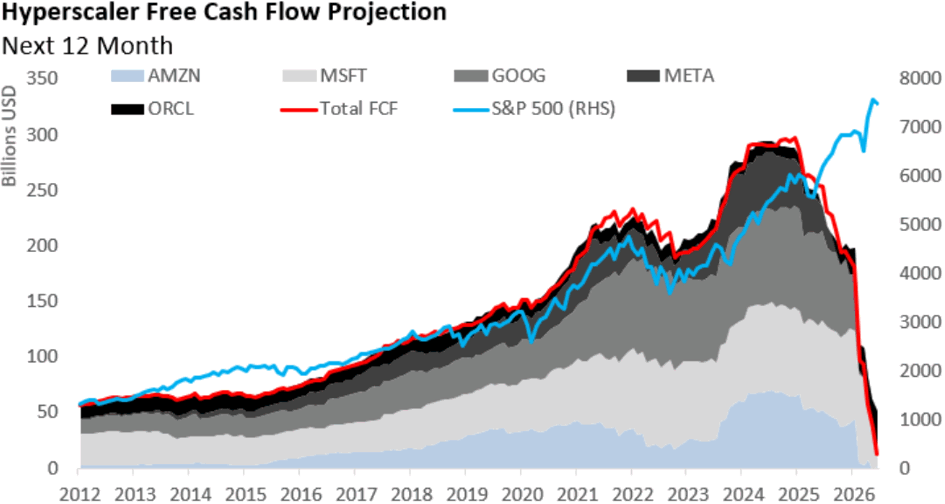
Two lines welded together for thirteen years just tore apart at the seam. The S&P 500 prints fresh records while hyperscaler forward free cash flow falls off a cliff toward zero — the index racing higher precisely as the cash that historically underwrote it vanishes. But capex ate the cliff: the businesses haven’t weakened, the cash is being consumed. Capex has gone from roughly 40% of operating cash flow, the decade norm, to 94–100% in 2026 on ~$725B of guidance, tripled from $226B in two years, with the street modeling past $1T in 2027. FCF is operating cash minus capex; when capex swallows the numerator, FCF mechanically prints near zero — Amazon’s turns negative, Alphabet’s drops about 90%. Around Q3 capex overtakes operating cash flow, and past that line the build can no longer self-fund. It migrates to debt — $108B of hyperscaler bonds in 2025 — vendor financing, SPVs. The 2022 dip recovered because OCF grew into the spend; this build is three times larger and bridged with obligations that must be serviced whether or not the revenue arrives. Watch the operating-cash-flow line. The market is still pricing optionality. It is now holding obligations.
Market Intelligence Brief (MIB) Ver. 18.40
For professional investors only. Not investment advice.
© 2026 RecessionALERT.com

Comments are closed.