
MARKET INTELLIGENCE BRIEF (MIB)
Tuesday, September 29, 2026
WTI slid 3.98% to $88.91 as Kpler counted 12.5 million barrels loaded at Saudi Arabia’s Yanbu, while Iran awaits a formal US reply through Qatar. NY Fed’s Williams saw “no need for urgency,” pulling October hike odds to about a coin flip, but Barr and Goolsbee held the tightening line. The 30-year still touched its highest since 2002 intraday. Confidence sank to 81.9 against 89.2 expected. Axios put OpenAI’s run-rate near $70B as chip-equipment names lifted the Nasdaq 100.
TABLE OF CONTENTS
A. EXECUTIVE SUMMARY
B. MARKET DATA
C. HIGH-IMPACT STORIES (5)
D. MODERATE-IMPACT STORIES (7)
E. ECONOMY WATCH (4)
F. EARNINGS WATCH (0)
G. WHAT’S NEXT
H. CHART OF THE DAY
A. EXECUTIVE SUMMARY -> TOP
Stocks slipped as the Fed’s rate debate split the Treasury curve: October hike odds fell to just over 50% after New York Fed President John Williams said there is “no need for urgency,” and the 2-year yield fell 4.7 bps, yet the 30-year touched its highest level since 2002 intraday, a sign investors do not read a later hike as an easier inflation outcome. Governor Barr’s “base case” for further adjustments and Goolsbee’s challenge to looking through supply shocks kept the tightening bias intact, blunting the policy relief from WTI’s 3.98% slide below $90 on resumed Saudi loadings at Yanbu. September confidence at 81.9 and August job openings at 7.08 million, both below forecasts, sharpened the stagflationary shape of the Fed’s problem. Breadth was narrow: seven of 11 sectors fell, Energy and Consumer Defensive lagged, and a chip-equipment rebound lifted the Nasdaq 100 0.21% as small caps extended their 10-session underperformance.
• Crude back below $90: WTI fell 3.98% to $88.91 and December Brent fell 2.19% to $95.69 as Kpler counted 12.5 million barrels loaded at Yanbu over three days, though it still puts Hormuz flows at about 77% of baseline; Energy was the weakest sector, down 1.13%, and the Energy Department offered up to 40 million SPR barrels in a sixth exchange.
• Fed split on timing, not direction: Williams said a further hike “may be appropriate late this year” with “no need for urgency,” while Barr said further adjustments are likely “in my base case” and Goolsbee called 5-1/2 years above target “playing with fire.”
• Curve steepens from the front: The 2-year fell 4.7 bps to 4.881% and the 10-year was essentially unchanged at 5.242%, widening 2s10s by 4.8 bps to 36.1 bps; the 30-year rose 3 bps to 5.59% on Treasury’s par curve after touching 5.62% intraday, the highest since 2002.
• Two data misses: Conference Board confidence fell 6.7 points to 81.9 against 89.2 expected, with fuel costs cited as the main drag, and JOLTS openings fell to 7.08 million against 7.23 million expected, though the layoff rate was a low 1.0%.
• AI complex steadies: Axios put OpenAI’s revenue run-rate near $70 billion; Oracle (ORCL) rose 3.91% after being up about 8% intraday, a move aggregators tied to the report, and Applied Materials (AMAT) gained 5.19%, KLA (KLAC) 3.89% and Lam Research (LRCX) 2.99%.
• Consumer names under pressure: Apple (AAPL) fell 2.66% as Bank of America flagged Meta’s Muse shopping agent as a threat to iPhone commerce, and JPMorgan downgraded PepsiCo (PEP) to Neutral with a $138 target, the third bank action on the stock in two days.
1. A later hike is not an easier one — Williams moved the next increase from October toward year-end, and the front end repriced accordingly, but the long end kept selling off. Barr’s base case and Goolsbee’s challenge to the Fed’s habit of looking through oil shocks mean crude’s retreat buys less policy relief than it normally would, and Goolsbee’s remark that the Fed’s job is not to keep the bond market happy suggests long-end pressure will not stay the committee’s hand. For portfolios, that leaves little discount-rate relief for long-duration equities and rate-sensitive small caps: the Russell 2000 is down 2.17% over 10 sessions against a 1.12% gain for the S&P 500.
2. Energy relief is partial, and the household squeeze has already arrived — Yanbu loadings and a sixth SPR exchange ease prompt supply, but Hormuz flows remain roughly a quarter below baseline and the Saudi reroute shifts risk to the Red Sea rather than removing it. Meanwhile consumers cited fuel costs as confidence fell to 81.9, and three bank actions on PepsiCo in two sessions point to volumes weakening under price increases. Consumer Defensive fell 0.82%, second-worst of 11 sectors; Wednesday’s August personal spending, expected up 0.8%, tests whether the squeeze is reaching actual outlays.
3. AI demand looks funded, but the value capture is moving — An OpenAI run-rate approaching $70 billion, if confirmed, supports the compute commitments behind Oracle’s backlog and the chip-equipment order book, and the Nasdaq 100 rose while seven sectors fell. The same shift threatens incumbents: Bank of America’s note moves Apple’s AI risk from a hardware-cycle question to its high-margin services toll, as agents that transact for users sit above the operating system. Micron’s results Wednesday are the next hard read on whether AI memory demand keeps pace.
 — Leading economic indicators. Accurate market forecasts. Apply for membership at join.recessionalert.com
B. MARKET DATA -> TOP
Stocks finished slightly lower in a split session as the 30-year Treasury yield touched 5.62% intraday, its highest level since 2002 according to Yahoo Finance, and September consumer confidence fell to 81.9 against expectations of 89. Breadth was soft, with seven of 11 sectors lower, while the Nasdaq 100 edged up as chip-equipment names led a semiconductor rebound. Energy supplied the sharpest move: WTI fell 3.98% after Saudi Arabia resumed tanker loadings at Yanbu through its East-West Pipeline and U.S. and Iranian officials met with mediators. At the front end, the 2-year yield fell 4.7 bps while the 10-year was essentially unchanged, steepening the curve even as the long end stayed under pressure.
CLOSING PRICES – Tuesday, September 29, 2026:
MAJOR INDICES
A split tape: the Nasdaq 100 and DJ Transportation rose while the S&P 500, Dow, Russell 2000 and NYSE Composite slipped, a narrow chip-led bid rather than broad participation. Narrow mega-cap leadership is now a seven-session pattern (S&P 500 +1.12% vs Russell 2000 -2.17% over 10 sessions), and Nasdaq 100 concentration (+4.84% vs the S&P 500’s +1.12% over 10 sessions) is now in its fourth session.
| Index | Close | Change | %Move | Why It Moved |
|---|---|---|---|---|
| S&P 500 | 7,670.84 | -12.85 | -0.17% | Slipped as long-dated Treasury yields climbed and consumer confidence fell; closed off session lows |
| Dow Jones | 51,349.92 | -131.59 | -0.26% | Fell with the broad market, trimming bigger losses from earlier in the day |
| DJ Transportation | 19,650.37 | +67.83 | +0.35% | Rose on a day crude fell nearly 4%; no transport-specific catalyst identified |
| Nasdaq 100 | 30,339.33 | +62.52 | +0.21% | Rose as semiconductor and chip-equipment names rebounded |
| Russell 2000 | 2,807.92 | -9.99 | -0.35% | Fell, extending small caps’ 10-session underperformance |
| NYSE Composite | 23,709.60 | -47.71 | -0.20% | Broad but shallow decline, with seven of 11 sectors lower |
VOLATILITY & TREASURIES
The curve steepened from the front: the 2-year fell 4.7 bps while the 10-year closed essentially unchanged, widening 2s10s by 4.8 bps to 36.1 bps. The long end got no relief, with the 30-year touching its highest level since 2002 intraday, so the rally was confined to the short end. VIX was flat and the dollar edged higher, so options markets priced little stress.
| Instrument | Level | Change | Why It Moved |
|---|---|---|---|
| VIX | 16.03 | -0.04 (-0.25%) | Little changed as equities moved in a narrow range |
| 10-Year Treasury Yield | 5.242% | +0.1 bps | Essentially unchanged after trading as high as 5.296% intraday, as the 30-year touched its highest level since 2002 |
| 2-Year Treasury Yield | 4.881% | -4.7 bps | Fell on a day both September consumer confidence and August job openings came in below expectations; no source directly attributes the move |
| US Dollar Index (DXY) | 101.37 | +0.19 (+0.19%) | Edged higher; no discrete catalyst identified |
COMMODITIES
Metals split rather than moving as a block: gold recovered part of Monday’s slide while platinum fell further and silver and copper barely moved. Gold’s gain came with the dollar slightly firmer and the 10-year flat, so neither a weaker dollar nor lower long yields accounts for it. Bitcoin was flat alongside a flat equity tape.
| Asset | Price | Change | %Move | Why It Moved |
|---|---|---|---|---|
| Gold | $4,209.00/oz | $+40.60 | +0.97% | Recovered part of Monday’s 4.02% drop; no discrete same-day catalyst identified |
| Silver | $61.788/oz | $+0.069 | +0.11% | Little changed after Monday’s 5.83% drop; no discrete catalyst identified |
| Copper | $6.6600/lb | $+0.0265 | +0.40% | Edged higher; no discrete catalyst identified |
| Platinum | $1,722.10/oz | $-22.60 | -1.30% | Extended Monday’s 3.46% decline; no discrete same-day catalyst identified |
| Bitcoin | $83,665.0 | $+94.0 | +0.11% | Little changed; no discrete crypto catalyst identified |
ENERGY
Every energy benchmark fell, with WTI dropping harder than Brent and the WTI-Brent spread widening to $6.78 from $5.31. Crude’s slide followed Saudi Arabia’s resumption of tanker loadings at Yanbu through its East-West Pipeline and a U.S.-Iran meeting with mediators. Henry Hub and Dutch TTF fell alongside, and oil dropped while equities were little changed.
| Asset | Price | Change | %Move | Why It Moved |
|---|---|---|---|---|
| Crude Oil (WTI) | $88.91/bbl | $-3.69 | -3.98% | Fell as Saudi Arabia resumed tanker loadings at Yanbu through its East-West Pipeline and U.S. and Iranian officials met with mediators |
| Crude Oil (Brent) | $95.69/bbl | $-2.14 | -2.19% | Fell on the same Saudi supply recovery and U.S.-Iran talks; the quote is the December contract |
| Natural Gas (Henry Hub) | $3.012/MMBtu | $-0.094 | -3.03% | No discrete same-day catalyst confirmed; wire reports citing milder weather forecasts could not be dated to today |
| Natural Gas (Dutch TTF) | $22.96/MMBtu | $-1.52 | -6.19% | Fell 5.91% in euro terms, with a weaker euro adding to the dollar-terms decline; no discrete European catalyst identified |
S&P 500 SECTORS
Seven of 11 sectors fell; Utilities, Industrials, Communication Services and Technology were the four risers. Utilities led despite the deepest 3-month decline of any sector (-12.02%), and Industrials rose against a -10.95% quarter, rebounds in the quarter’s two weakest sectors rather than an established trend. Energy was the laggard as crude fell, though it remains the YTD leader (+33.84%).
| Sector | 1-Day | 1-Week | 1-Month | 3-Month | 6-Month | YTD | 12-Month |
|---|---|---|---|---|---|---|---|
| Utilities | +1.01% | -2.15% | -6.11% | -12.02% | -12.68% | -6.99% | -7.38% |
| Industrials | +0.37% | -1.35% | -2.80% | -10.95% | +6.62% | +8.18% | +10.94% |
| Communication Services | +0.25% | -2.02% | +1.33% | +1.67% | +14.29% | +0.80% | +4.90% |
| Technology | +0.14% | -1.11% | +4.43% | +4.52% | +45.60% | +29.26% | +30.78% |
| Real Estate | -0.08% | -2.54% | -6.65% | -6.20% | +3.37% | +2.28% | -1.61% |
| Consumer Cyclical | -0.13% | -3.48% | -7.00% | -5.54% | +4.00% | -9.56% | -10.90% |
| Basic Materials | -0.25% | -4.89% | -8.59% | +1.85% | +3.49% | +10.95% | +20.45% |
| Healthcare | -0.34% | -0.15% | -1.00% | +4.24% | +16.53% | +8.73% | +22.98% |
| Financial | -0.40% | -1.66% | -5.38% | +0.86% | +14.86% | +2.79% | +6.25% |
| Consumer Defensive | -0.82% | -1.39% | -2.54% | -1.93% | -1.64% | +4.25% | +4.50% |
| Energy | -1.13% | -0.98% | -1.48% | +12.97% | -2.28% | +33.84% | +31.36% |
TOP MEGA-CAP MOVERS:
GAINERS
| Company | Ticker | Close | Change | Why It Moved |
|---|---|---|---|---|
| Applied Materials | AMAT | $512.01 | +5.19% | No discrete same-day catalyst identified; led a chip-equipment rebound alongside KLA (+3.89%) and Lam Research (+2.99%) |
| Marvell Technology | MRVL | $263.27 | +4.51% | No discrete same-day catalyst identified; rebounded with chip stocks after Monday’s 3.83% drop |
| Oracle | ORCL | $137.79 | +3.91% | Pared an intraday gain of about 8%; aggregators tie the move to an Axios report that OpenAI’s annualized revenue is nearing $70 billion (OpenAI is a major Oracle compute customer; link not independently confirmed) |
| KLA | KLAC | $196.53 | +3.89% | No discrete same-day catalyst identified; rose with Applied Materials and Lam Research in a chip-equipment rebound |
| Meta Platforms | META | $738.79 | +3.24% | Recovered part of Monday’s 4.79% drop; no Meta-specific same-day catalyst confirmed. A WSJ report that OpenAI shelved a new model after internal safety tests landed overnight (link to Meta’s move not established) |
DECLINERS
| Company | Ticker | Close | Change | Why It Moved |
|---|---|---|---|---|
| Apple | AAPL | $329.40 | -2.66% | Fell after a Bank of America note (Buy rating kept) flagged AI shopping agents such as Meta’s Muse as a risk to Apple’s ecosystem; a Bloomberg report that CEO John Ternus is weighing management changes also circulated |
| Walmart | WMT | $106.80 | -1.78% | No discrete same-day catalyst identified; aggregator reports of a Mizuho price-target cut to $125 (Outperform kept) could not be dated to today |
| Johnson & Johnson | JNJ | $267.57 | -1.61% | No discrete same-day catalyst identified; no company release found |
— Institutional-grade intelligence for serious investors. Apply for membership at join.recessionalert.comC. HIGH-IMPACT STORIES -> TOP
BULLISH
1. WTI Slides 3.98% to $88.91 as Kpler Data Show Saudi Crude Flowing From Yanbu and Iran Awaits a Formal US Reply Through Qatar
The core facts:West Texas Intermediate fell 3.98% to $88.91 a barrel and Brent (December contract) fell 2.19% to $95.69, widening the WTI-Brent spread to $6.78 from $5.31. Kpler data reported by CNBC late Monday counted 12.5 million barrels loaded at Saudi Arabia’s Red Sea port of Yanbu across nine tankers from Saturday through Monday, and put the seven-day average of Strait of Hormuz crude flows at 13.2 million barrels a day, about 77% of a 17 million b/d baseline. On the diplomatic track, Iranian Foreign Minister Abbas Araghchi said Tehran was “waiting for the official US response through the mediators,” and Qatar said it was continuing “meetings and exchange of messages” aimed at “restoring full freedom of navigation.” Henry Hub natural gas fell 3.03% and Dutch TTF 6.19%, and Energy was the weakest of the 11 S&P 500 sectors at -1.13%.
Why it matters:Crude is the channel through which the Iran war reaches US inflation. Governor Barr said on Tuesday that the Middle East conflict “drove energy prices and inflation higher still,” and the Conference Board tied September’s confidence slump to fuel costs. A move back below $90 WTI therefore matters to the October FOMC debate as much as any single speech. The relief is supply-side and partial, though: on Kpler’s count Hormuz flows are still roughly a quarter below baseline, and routing Saudi exports through Yanbu shifts the risk to the Red Sea rather than removing it. The widening WTI-Brent spread shows US crude absorbing the supply news faster than the global benchmark.
What to watch:Whether the formal US reply reaches Iran through Qatar, Wednesday’s EIA weekly petroleum report at 10:30 ET, and the OPEC+ seven-country meeting on October 4.
UNCERTAIN
2. Williams’ “No Need for Urgency” Pulls October Hike Odds to About a Coin Flip; the 2-Year Yield Falls 4.7 bps While the 30-Year Keeps Climbing
The core facts:New York Fed President John Williams, the FOMC’s vice chair and a permanent voter, said a further hike “may be appropriate late this year” but that “there is no need for urgency” (Section E carries the full speech). Seeking Alpha reported that market expectations for an October hike “tumbled to just over 50%” after the remarks. The 2-year Treasury yield fell 4.7 bps to 4.881%, while the 10-year closed essentially unchanged at 5.242% after trading as high as 5.296%, steepening 2s10s by 4.8 bps to 36.1 bps. The long end got no relief: Treasury’s daily par yield curve put the 30-year at 5.59%, up 3 bps on the day and 30 bps above its 5.29% of September 22. Yahoo Finance reported that the 30-year touched 5.62% intraday, which it described as the highest level since 2002.
Why it matters:The day’s rates action split cleanly by maturity. The front end repriced timing, as Williams moved the next hike from October toward “late this year,” while the long end kept selling off. That says investors are not reading a later hike as an easier inflation outcome. The combination is the harder one for equities: it removes little discount-rate pressure from long-duration assets and keeps mortgage and corporate borrowing costs anchored to long yields near 5.6%. Small caps, the most rate-sensitive cohort, fell 0.35% and have lagged the S&P 500 by more than three percentage points over 10 sessions (Russell 2000 -2.17% against the S&P 500’s +1.12%).
What to watch:Wednesday’s August PCE (headline expected at 3.7% year over year) and Williams’ second appearance Thursday at 3:30 PM ET; a 30-year close above Tuesday’s 5.62% intraday high would confirm the long end is trading independently of Fed timing.
BEARISH
3. Barr’s “Base Case” and Goolsbee’s “Playing With Fire” Warning Keep the Fed’s Tightening Bias Intact as Williams Counsels Patience
The core facts:Governor Michael Barr told the Detroit Economic Club that “in my base case, further policy adjustments are likely to be needed” (Section E carries the full remarks). Chicago Fed President Austan Goolsbee, speaking at a moderated Q&A in Champaign, Illinois, said “the fact we have been 5-1/2 years above inflation target is playing with fire,” that the Fed needs to “revisit the logic of looking through supply shocks,” and that “nothing in the Federal Reserve Act says make sure bond market is happy, stock markets aren’t surprised.” St. Louis Fed President Alberto Musalem’s prepared text at the London School of Economics addressed how the Fed communicates its decisions and carried no rate outlook.
Why it matters:The officials who addressed policy on Tuesday pointed the same way, so the committee’s argument is about when to tighten, not whether. Goolsbee’s supply-shock line has the longest reach. The Fed’s standard response to an oil shock is to look through it, and questioning that doctrine means the next energy spike could be met with tighter policy rather than patience, which weakens the link between today’s crude slide and a softer Fed path. His bond-market remark also reads as a signal that a selloff at the long end, with the 30-year near 5.6%, will not by itself stay the committee’s hand.
What to watch:Goolsbee speaks again Wednesday alongside Barkin and Kashkari; the minutes of the September FOMC meeting on October 7 will show how many participants share Barr’s base case.
BEARISH
4. Confidence and Job-Openings Misses Sharpen the Fed’s Stagflation Dilemma; Consumer Defensive Falls 0.82%, the Second-Worst Sector
The core facts:Section E carries both releases in full. The Conference Board index fell to 81.9 against an 89.2 consensus, with fuel costs cited as the main drag, and August job openings came in at 7.08 million against 7.23 million expected. On the tape, Consumer Defensive fell 0.82%, the second-worst of the 11 sectors after Energy, while Consumer Cyclical slipped 0.13%. No source was found directly linking either release to a specific market move.
Why it matters:The two releases sharpen the stagflationary shape of the Fed’s problem. Households are reporting the energy shock as a cost-of-living squeeze on the same day two Fed officials argued for further hikes, and softer job openings cut against Governor Cook’s Monday case that the labor market can absorb higher rates. For equities the read is sector-specific rather than index-wide: consumer staples carry the most exposure to a squeezed household and to the pricing fatigue analysts flagged at PepsiCo (Story 7), while the S&P 500 slipped only 0.17% as technology held up.
What to watch:Wednesday’s August personal spending (expected +0.8%) and ADP employment (expected 72,000), then Friday’s September payrolls (expected 84,000) with unemployment expected at 4.1%.
BULLISH
5. OpenAI’s Revenue Run-Rate Nears $70 Billion; Oracle Rises 3.91% as Chip-Equipment Names Rebound and the Nasdaq 100 Outpaces the S&P 500
The core facts:Axios reported on Tuesday that OpenAI’s annualized revenue run-rate is approaching $70 billion, up more than 70% since the start of the third quarter, with enterprise sales more than doubling since July. Oracle, a major OpenAI compute provider, closed up 3.91% at $137.79 after being up about 8% intraday; aggregators tied the move to the report, though the link could not be independently confirmed. Chip-equipment stocks led a semiconductor rebound, with Applied Materials up 5.19%, KLA 3.89% and Lam Research 2.99%, and Marvell rose 4.51%, none of them on a discrete same-day catalyst. The Nasdaq 100 gained 0.21% while the S&P 500 fell 0.17%. Separately, Reuters reported late Monday that it had reviewed a draft Anthropic IPO prospectus that has not been publicly filed.
Why it matters:OpenAI’s revenue is the variable that underwrites much of the AI capex cycle. Oracle’s backlog, the chip-equipment order book and this week’s memory results all rest on AI labs being able to pay for compute. A run-rate approaching $70 billion, if confirmed, is evidence that demand is monetising fast enough to service those commitments. The report arrived as the AI complex steadied after Monday’s selloff, on a day the tech-heavy Nasdaq 100 rose while seven of 11 sectors fell.
What to watch:Micron’s results after the bell Wednesday (consensus revenue $51.33 billion) are the first hard read on whether AI memory demand is keeping pace with the labs’ revenue growth.
— Quantifying recession risk so you don’t have to guess. Apply for membership at join.recessionalert.comD. MODERATE-IMPACT STORIES -> TOP
BEARISH
6. Apple Falls 2.66% as Bank of America Flags Meta’s Muse Shopping Agent as a Threat to iPhone Commerce
The core facts:Apple closed down 2.66% at $329.40. Bank of America’s Wamsi Mohan kept a Buy rating but warned, according to 24/7 Wall St., that “Meta’s Muse agent could pull online commerce activity away from the iPhone ecosystem,” putting Apple’s “product discovery, referrals and transaction” revenue at risk while leaving device sales intact. He added that “Apple’s updated Siri currently lacks some of Muse’s background task capabilities.” Separately, Bloomberg reported that CEO John Ternus is planning a structural overhaul aimed at faster product development, including removing layers of middle management and moving away from fixed spring and fall launch cycles. Meta rose 3.24%.
Why it matters:The note moves the AI risk to Apple from a hardware-cycle question to a services-economics one. If agents that browse, fill in forms and transact on a user’s behalf sit above the operating system, Apple’s toll on commerce is exposed even if iPhone demand holds. Muse has already gained access to Shopify, Expedia and PayPal, while Amazon has blocked it, so the threat is concrete rather than hypothetical, and it lands on the highest-margin part of Apple’s business.
What to watch:Whether Apple accelerates agent capabilities in Siri, and Services growth in its next quarterly report.
BEARISH
7. JPMorgan Downgrades PepsiCo to Neutral and Cuts Its Target to $138, the Third Bank Action on the Stock in Two Days
The core facts:JPMorgan’s Andrea Teixeira downgraded PepsiCo to Neutral from Overweight and cut her price target to $138 from $170. Investrade quoted the note as saying tracked channel data and recent price-increase announcements indicate that PepsiCo’s North American trends “have likely continued to underperform management expectations.” The call followed a Deutsche Bank downgrade and a TD Cowen target cut on Monday. PepsiCo shares finished little changed, while the Consumer Defensive sector fell 0.82%.
Why it matters:Three bank actions in two sessions ahead of an October 8 report point to a consensus shift on the core problem for staples: pricing has carried revenue growth, and channel data now suggest volumes are not holding up under it. That matters beyond PepsiCo, because the same squeeze appears in Tuesday’s confidence survey, where households cited the high cost of goods and services.
What to watch:PepsiCo’s third-quarter results on October 8, particularly North American beverage and snack volumes.
BULLISH
8. TD Cowen Starts SpaceX at Buy With a $200 Target and Citi Calls Starship’s Orbital Flight a Step Toward $900 a Share; SpaceX Rises 2.59%
The core facts:TD Cowen’s John Blackledge initiated coverage of SpaceX with a Buy rating and a $200 price target. Citi’s John Godyn wrote that Starship’s 14th flight was a “step” toward SpaceX shares being worth $900 or more, according to MarketWatch, which puts that at a valuation of roughly $12.2 trillion. SpaceX closed up 2.59% at $149.24. CLSA initiated coverage at Outperform on Monday, the day Starship reached orbit for the first time.
Why it matters:SpaceX is a roughly $2 trillion name still gathering its first sell-side coverage, so initiations carry more weight than usual in setting its valuation anchor. Citi’s note ties that anchor to Starship execution specifically, making each flight a valuation event rather than just an engineering milestone and raising the stakes on the program’s cadence.
What to watch:Further coverage initiations and the timing of Starship’s next flight.
BULLISH
9. AT&T Signs a Multi-Year Fiber and Cable Supply Deal With Corning Worth More Than $3 Billion, Backed by Expanded North Carolina Manufacturing
The core facts:AT&T and Corning announced a multi-year agreement worth more than $3 billion under which Corning will supply fiber and cable for AT&T’s network expansion, with Corning expanding fiber and cable manufacturing at its North Carolina facilities. AT&T is targeting 60 million fiber locations by the end of 2030. AT&T CEO John Stankey said “fiber remains the gold standard for superior internet connectivity,” and Corning CEO Wendell Weeks pointed to pairing “our large, U.S.-based advanced manufacturing with AT&T’s network leadership.” Corning’s closing move was not established.
Why it matters:The deal gives Corning multi-year volume visibility in carrier fiber at a time when its optical business is also serving AI data-center buildouts, and it adds to the onshoring theme because the new capacity is being built in the US. For AT&T, locking in supply at scale supports a fiber build that remains one of the few telecom capex programs expanding in a 5%-plus long-rate environment.
What to watch:AT&T’s fiber net additions in its next quarterly report, and any further carrier supply agreements for Corning.
BULLISH
10. AstraZeneca Takes a $2 Billion, Roughly 12% Stake in Summit Therapeutics and Will Test Its ADC With Ivonescimab in GI Cancers
The core facts:AstraZeneca disclosed in a Form 6-K dated September 29 a $2 billion investment in newly issued Summit Therapeutics equity: approximately 109,000 preferred shares convertible into Summit common stock at a 1:1,000 ratio, equal to about 12.0% of Summit’s outstanding common stock (about 10.6% fully diluted). Closing of the preferred investment is expected within a week, and conversion to common stock is subject to customary regulatory clearances. The companies also agreed a clinical collaboration combining AstraZeneca’s antibody-drug conjugate sonesitatug vedotin with Summit’s ivonescimab in gastrointestinal cancers, with plans for a broader collaboration pairing ivonescimab with additional ADCs.
Why it matters:A top-tier oncology franchise is paying for strategic exposure to Summit’s PD-1/VEGF bispecific through equity rather than an acquisition, which validates the asset while leaving Summit independent. For US-listed biotech it is a template for large pharma securing next-generation immunotherapy combinations early, and a reminder that partnership capital, not only M&A, is funding the sector.
What to watch:Closing of the preferred investment, expected within a week, and the regulatory clearance required before AstraZeneca can convert to common stock.
UNCERTAIN
11. Energy Department Offers Up to 40 Million Barrels of SPR Crude in a Sixth Exchange, With Bids Due October 6
The core facts:The Department of Energy issued a request for proposals to exchange up to 40 million barrels of crude from the Strategic Petroleum Reserve’s Big Hill and Bryan Mound sites, for delivery in November and December 2026, with bids due at 11:00 a.m. Central on Tuesday, October 6. Companies will return the borrowed barrels plus premium barrels; DOE said earlier exchanges achieved a 25% premium. It is the sixth solicitation, and the previous five awarded more than 133 million barrels. Secretary Chris Wright said “the United States continues to lead the coordinated efforts to stabilize oil markets for the benefit of Americans and people around the world.”
Why it matters:An exchange adds prompt supply in November and December while committing the market to return more barrels later, so it eases near-term prices without permanently drawing down the reserve. Arriving on a day crude fell almost 4%, it reinforces the supply-side relief, but it also shows Washington still sees a need to lean on emergency stocks with Hormuz flows below normal.
What to watch:Bid results after the October 6 deadline, and whether demand fills the full 40 million barrels now that crude is back below $90.
BULLISH
12. Fed and FDIC Find No Shortcomings or Deficiencies in the Resolution Plans of 15 Banks With More Than $250 Billion in Assets
The core facts:In a release at 4:00 p.m. ET, after the close, the Federal Reserve and FDIC said they “did not identify any shortcomings or deficiencies” in the resolution plans of 15 banking organizations with more than $250 billion in assets. American Express, Barclays, BNP Paribas, Deutsche Bank and UBS received individual feedback letters, and the agencies said a shortcoming identified in BNP Paribas’s 2021 plan “has been satisfactorily addressed.”
Why it matters:A clean result means none of the 15 firms faces a remediation requirement that could constrain capital return or force structural changes, removing a regulatory overhang for large domestic and foreign banks. It lands as the Financial sector trails, down 0.40% on Tuesday and 5.38% over the past month.
— Separating signal from noise since 2007. Apply for membership at join.recessionalert.comE. ECONOMY WATCH -> TOP
Tuesday split the economy’s signals from the Fed’s message. Households soured sharply, with Conference Board confidence falling to 81.9 against an 89.2 forecast as fuel costs bit, and August job openings slipped to 7.08 million, below consensus. Yet the Fed officials who spoke debated when to tighten, not whether: Governor Barr said further adjustments are likely needed, while New York Fed President Williams saw one more hike late this year with “no need for urgency,” and October hike pricing slid to just over 50%. Wednesday’s August PCE, expected at 3.7% year over year, now decides whether October stays live.
Consumer Confidence Drops to 81.9 in September, Far Below the 89.2 Forecast, as Fuel Costs Weigh (Conference Board, Sept 29)
What they’re saying:The Conference Board’s Consumer Confidence Index fell 6.7 points to 81.9 in September from 88.6 in August, against a consensus of 89.2. The Present Situation Index dropped 7.9 points to 109.3 and the Expectations Index fell 5.9 points to 63.6. Chief Economist Dana Peterson said “references to prices, the high cost of goods and services, and oil and gas prices in particular, rose to new heights, reflecting September’s surge in fuel costs.”
The context:The 7.3-point miss against consensus came as Peterson said the index “deteriorated notably in September, following two prior months of softening.” The labor differential narrowed to +1.7 points, with 23.6% of consumers saying jobs are plentiful and 21.9% saying they are hard to get, while average 12-month inflation expectations stood at 6.1%. The 2-year Treasury yield fell 4.7 bps to 4.881% on the session, though no source directly attributes that move to the release.
What to watch:Wednesday’s August personal spending (expected +0.8% vs +0.2% prior) tests whether falling confidence is reaching actual outlays; Friday’s September payrolls (expected 84K) and unemployment rate (expected 4.1%) test the softer labor read in the survey.
Job Openings Fall to 7.08 Million in August, Below the 7.23 Million Forecast, as Hires Edge Up and Layoffs Stay Low (BLS JOLTS, Sept 29)
What they’re saying:Job openings fell to 7.079 million in August from an upwardly revised 7.335 million in July, missing the 7.23 million consensus; the openings rate was 4.3%. The BLS said openings were “little changed,” while hires rose to 5.2 million (a 3.3% rate), quits held at 3.1 million (1.9%), and layoffs and discharges came in at 1.6 million (1.0%).
The context:The 256,000 decline undercuts one plank of Governor Cook’s Monday argument that the labor market can absorb higher rates, in which she said job openings “have ticked up.” Against that, a 1.0% layoff rate and slightly higher hiring show no sign of firms cutting staff, so the report points to softer labor demand rather than a deteriorating labor market.
What to watch:ADP employment Wednesday (expected 72K vs 38K prior), initial jobless claims Thursday (expected 200K), and Friday’s September payrolls (expected 84K vs 162K prior) with unemployment expected at 4.1%.
NY Fed’s Williams Sees One More Hike “Late This Year” but “No Need for Urgency,” and October Hike Pricing Slips to Just Over 50% (New York Fed; Seeking Alpha, Sept 29)
What they’re saying:New York Fed President John Williams said “one further upward adjustment of the federal funds target range may be appropriate late this year to support a timelier return of inflation to target,” but added that after the September increase “there is no need for urgency, and we have time to gather more information.” He said “at 3.7 percent, inflation is unquestionably too high,” and projected inflation of 3-1/2 percent this year, just above 2 percent next year and 2 percent in 2028, with GDP growth of about 2-1/4 percent and unemployment edging down to about 4 percent.
The context:Seeking Alpha reported that market expectations for an October Fed rate hike “tumbled to just over 50%” after the remarks, compared with 65.9% in money-market pricing reported by FXStreet before Monday’s open. As FOMC vice chair and a permanent voter, Williams framing the next hike as a year-end possibility rather than an October requirement carries unusual weight. The 2-year yield fell 4.7 bps to 4.881% while the 10-year was essentially unchanged at 5.242%, steepening the 2s10s curve by 4.8 bps to 36.1 bps.
What to watch:Wednesday’s August core PCE (expected +0.3% m/m vs +0.2% prior) and headline PCE (expected 3.7% y/y); Williams speaks again Thursday at 3:30 PM ET, ahead of the October 27-28 FOMC meeting.
Governor Barr Says “Further Policy Adjustments Are Likely to Be Needed” as the AI Buildout Adds to Inflation (Federal Reserve Board, Sept 29)
What they’re saying:Speaking at the Detroit Economic Club, Fed Governor Michael Barr said “in my base case, further policy adjustments are likely to be needed to ensure inflation comes down to target in a timely fashion,” and that “risks to achieving our inflation target have increased, while risks to the labor market have receded.” He said “I count only two months of data consistent with 2 percent core PCE inflation over the past 20 months,” and that demand from the AI buildout “is having a measurable effect on prices.”
The context:Barr’s “base case” language is firmer than Williams’ “may be appropriate late this year,” leaving the committee’s debate about timing rather than direction. His AI argument echoes Governor Cook’s remarks on Monday, and Seeking Alpha reported that Chicago Fed President Austan Goolsbee also warned on Tuesday that AI hype risks fueling inflation. Barr put job creation at “around 80,000 a month this year, close to reasonable estimates of its breakeven pace,” with unemployment at 4.1%.
What to watch:August core PCE on Wednesday (expected +0.3% m/m); Fed speakers Barkin, Goolsbee and Kashkari on Wednesday, and Barkin, Collins, Schmid, Williams and Logan on Thursday.
— Know the probability before the market prices in the risk. Apply for membership at join.recessionalert.comF. EARNINGS WATCH -> TOP
YESTERDAY AFTER THE BELL (Markets Reacted Today)
No major earnings yesterday after the bell from companies with >$100B market cap.
TODAY BEFORE THE BELL (Markets Already Reacted)
No major earnings before the bell from companies with >$100B market cap.
TODAY AFTER THE BELL (Markets React Tomorrow)
No major earnings after the bell from companies with >$100B market cap.
WEEK AHEAD PREVIEW:
Q3 2026 earnings season is just getting under way (1.8% of the S&P 500 reported as of FactSet’s September 25 data), and no company above $100B reported on Monday after the bell or on Tuesday. The day’s largest reporter was Carnival (CCL), at a $34.39B market cap. Two mega-caps report over the rest of the week.
Micron Technology (MU) — AMC, Wednesday, September 30 — Consensus EPS $31.72 on revenue of $51.33B, against company guidance of $50.0B plus or minus $1.0B. The first hard read on AI memory demand, now set against Tuesday’s report that OpenAI’s revenue run-rate is nearing $70 billion; focus on HBM pricing and supply, data-center DRAM and NAND demand, and whether guidance confirms that AI capex is still accelerating.
Accenture (ACN) — BMO, Thursday, October 1 — Consensus EPS $3.18 on revenue of $18.03B. Market cap $108.39B, within about 8% of the $100B threshold. Focus on generative-AI bookings, consulting demand as enterprise budgets absorb higher rates, and fiscal 2027 guidance.
No reporters above $100B are scheduled for Friday, October 2, Monday, October 5 or Tuesday, October 6. Nike reports after the bell on Thursday, October 1 but sits below the threshold at about $53B.
— US market commentary trusted by family offices and institutions. Apply for membership at join.recessionalert.comG. WHAT’S NEXT -> TOP
UPCOMING RELEASES:
| Date | Event | Why It Matters |
|---|---|---|
| Wed, Sep 30 | August PCE: core MoM (expected +0.3%, prior +0.2%); headline YoY (expected 3.7%, prior 3.7%) | The Fed’s preferred gauge, arriving with October hike odds at just over 50%. Williams called 3.7% inflation “unquestionably too high” and Barr counts only two months consistent with 2% core in the past 20; a hot core print strengthens the case for acting in October rather than “late this year.” |
| Wed, Sep 30 | August Personal Spending MoM (expected +0.8%, prior +0.2%) and Personal Income MoM (expected +0.4%, prior +0.4%) | Tests whether September’s confidence slump to 81.9, driven by fuel costs, is reaching actual outlays; a spending miss would add a demand leg to the stagflation read. |
| Wed, Sep 30 | ADP Employment Change Sep (expected 72K, prior 38K); Q2 GDP final estimate (expected 1.5%, prior 2.1%); Chicago PMI Sep (expected 51, prior 47.1) | First private-payroll read ahead of Friday; follows August job openings falling to 7.08 million, which undercut Governor Cook’s case that the labor market can absorb higher rates. |
| Wed, Sep 30 | EIA weekly crude and gasoline stocks (10:30 AM ET; prior crude +2.969M barrels) | First inventory read after WTI’s 3.98% slide below $90 on resumed Saudi loadings at Yanbu. |
| Wed, Sep 30 | Fed speakers: Barkin (1:30 PM ET), Goolsbee (5:10 PM ET), Kashkari (6:00 PM ET) | Goolsbee follows Tuesday’s warning that 5-1/2 years above target is “playing with fire” and his call to revisit looking through supply shocks; all three speak after the PCE print, making them the first policymaker reactions to it. |
| Thu, Oct 1 | ISM Manufacturing PMI Sep (expected 54.9, prior 54.6); Initial Jobless Claims (expected 200K, prior 197K) | Manufacturing strength and low claims would support Barr’s view that labor-market risks “have receded,” keeping the committee focused on inflation. |
| Thu, Oct 1 | Fed speakers: Barkin, Collins, Schmid (9:05 AM ET); Williams (3:30 PM ET); Logan (6:45 PM ET) | Williams’ second appearance, after PCE, shows whether “no need for urgency” survives the data; five speakers in one day will test how widely Barr’s “base case” is shared. |
| Fri, Oct 2 | Nonfarm Payrolls Sep (expected 84K, prior 162K); Unemployment Rate (expected 4.1%, prior 4.1%); Average Hourly Earnings MoM (expected +0.3%, prior +0.3%) | Barr put job creation at around 80,000 a month, close to breakeven; a print near consensus keeps the Fed’s focus on inflation, while a clear miss would be the first hard evidence for Williams’ patience. |
| Sun, Oct 4 | OPEC+ seven-country meeting | Output policy with Hormuz flows still about a quarter below baseline on Kpler’s count; lands ahead of Monday’s open. |
| Mon, Oct 5 | ISM Services PMI Sep (prior 55.4) | Services prices are where energy costs pass through to core inflation; the survey’s price component matters as much as the headline. |
| Tue, Oct 6 | SPR exchange bids due (up to 40 million barrels, 11:00 AM CT); August Balance of Trade (prior -$88.6B) | Demand for the sixth SPR exchange shows how tight bidders see November-December supply now that crude is back below $90. |
KEY QUESTIONS:
1. Does Wednesday’s August core PCE, expected at +0.3% month over month, push October hike odds back above a coin flip, or does Williams’ “no need for urgency” still hold when he speaks again Thursday?
2. Is the long end now trading independently of Fed timing, and would a 30-year close above Tuesday’s 5.62% intraday high force equities to reprice the discount rate that Tuesday’s tech rebound ignored?
3. Does crude’s retreat below $90 survive the formal US reply to Iran and Sunday’s OPEC+ meeting, or does Goolsbee’s challenge to looking through supply shocks mean the Fed gives little credit for it either way?
— US market commentary trusted by family offices and institutions. Apply for membership at join.recessionalert.comH. CHART OF THE DAY -> TOP
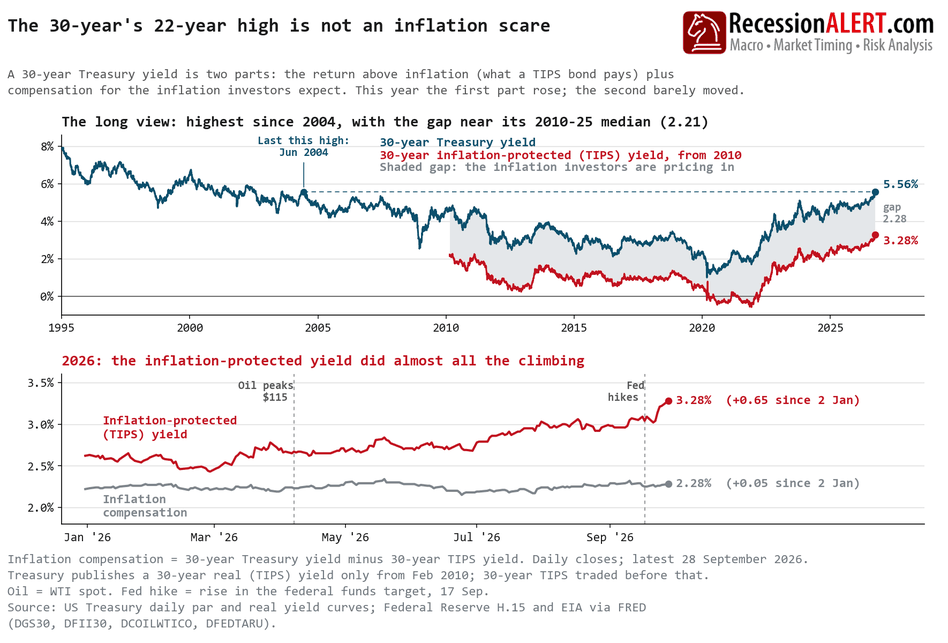
Oil ran from $57 to $115 and inflation tops 3%, yet the 30-year Treasury bond barely charges more for it. Its yield is up 0.70 point since January, to 5.56%, and that rise splits in two. The return after inflation — what inflation-protected bonds (TIPS) pay — rose 0.65. The part of the yield that charges for inflation rose just 0.05. In the 2023 and 2024-25 selloffs, that part supplied over a quarter of the climb. The market is pricing the Fed’s cure, not the disease. Two-year yields are already priced for the Fed to raise rates further, even after this month’s hike. And the flat inflation charge on 30-year bonds suggests investors expect the cure to work. Oil tested that confidence only at shorter range: the inflation priced in for the next five years jumped, then fell back, while the 30-year charge held steady. That leaves the rise in the return after inflation — the expensive kind. Inflation will not wear it down: borrowers pay it in full, and a 30-year mortgage already costs 7.03%. The day the 30-year starts charging more for inflation, the market will have stopped trusting the cure. Until then, oil prices the next five years — the Fed prices the next thirty.
What it means: homebuyers and refinancers shouldn’t count on cooler inflation to cut mortgage rates. Since spring, inflation eased from 4.2% to 3.35%; mortgage rates rose from 6.3% to 7.03%. Stocks face a higher bar: a risk-free 10-year inflation-protected Treasury pays 2.90% above inflation, the most since 2008. Shares, up 12% this year, must earn more to justify the risk. For an economy that grew at a 1.5% pace in the second quarter, rates this high are a headwind, starting with housing. If the 30-year’s inflation charge tops 2.40%, investors are doubting the Fed — a second push on long rates.
Market Intelligence Brief (MIB) Ver. 19.73
For professional investors only. Not investment advice.
© 2026 RecessionALERT.com

Comments are closed.