
MARKET INTELLIGENCE BRIEF (MIB)
Wednesday, September 30, 2026
A cooler August PCE cut October hike odds to about 37% from 51%, and Goldman pushed its next-hike call to December. Bonds balked: the 10-year rose 5.0 bps to 5.292%, highest since April 2002 per Investing.com, and 30-year mortgage rates hit 7.30%. A late selloff left only the Nasdaq 100 higher. The Fed finalized a stress-test overhaul over Barr’s dissent, CMS tied Part B drug rebates to international prices, and Amazon signed a 20-year nuclear deal with Constellation.
TABLE OF CONTENTS
A. EXECUTIVE SUMMARY
B. MARKET DATA
C. HIGH-IMPACT STORIES (5)
D. MODERATE-IMPACT STORIES (6)
E. ECONOMY WATCH (6)
F. EARNINGS WATCH (1)
G. WHAT’S NEXT
H. CHART OF THE DAY
A. EXECUTIVE SUMMARY -> TOP
A cooler August PCE report gave the Fed room to pause — October hike odds fell to about 37% from 51% and Goldman Sachs pushed its next-hike call to December — yet a late selloff left the S&P 500 down 0.25%, with the Nasdaq 100 (+0.23%) the only major index higher. The constraint is at the long end: the 10-year rose 5.0 bps to 5.292% while the 2-year added just 1.0 bp, a bear steepening that suggests investors are demanding more to hold duration rather than pricing a more hawkish Fed — pressure a pause cannot talk down. That tightening is already reaching households, with the MBA 30-year mortgage rate at 7.30%, its highest since November 2023. Breadth was poor: Technology was the lone gaining sector as defensives led a 10-of-11 decline, and the NYSE Composite’s 0.92% drop — nearly four times the S&P 500’s — shows how little of the market is sharing tech’s gains.
• Inflation cools, hike odds fall: Core PCE rose 0.2% in August against 0.3% expected, for 3.0% year over year, and headline annual inflation came in at 3.4% against a 3.7% forecast; October hike odds fell to about 37% from 51% (CME FedWatch), and Goldman Sachs moved its next-hike call to December.
• Long end sells off anyway: The 10-year rose 5.0 bps to 5.292%, which Investing.com puts at its highest since April 2002, while the 2-year rose just 1.0 bp, widening 2s10s to about 40 bps; the MBA 30-year mortgage rate rose to 7.30%, its highest since November 2023, and mortgage applications fell 6%.
• Data run mostly firm: Chicago PMI jumped to 58.8 against 51.2 expected, ADP private payrolls rose 90,000 against 70,000 expected, and final Q2 GDP was revised up to 2.2%; the one miss was the advance goods trade deficit, which widened to $132.6 billion against $115 billion expected.
• Washington rewrites three rulebooks: The Fed finalized its stress-test overhaul over Governor Barr’s dissent, cutting year-to-year volatility in capital requirements by about half; CMS finalized the mandatory GLOBE model tying Medicare Part B drug rebates to international prices from 2027; and the SEC proposed widening retail access to private markets.
• Crude firms as talks stall: WTI rose 1.05% to $90.32 and December Brent rose 1.81% to $97.90, with US-Iran talks stuck on “the sequencing of measures” even as Kpler puts September Middle East crude exports near 80% of pre-war levels.
• Deals and single names: A judge cleared the last legal hurdle to Paramount’s $110 billion Warner Bros. Discovery deal; Amazon (AMZN) signed a 20-year, 690-megawatt nuclear power deal with Constellation (CEG) after the close; Citi downgraded Moderna (MRNA) to Sell after a near-590% run in 2026; and BofA named Intel (INTC, +3.71%) among its top chip picks.
1. The bond market is tightening for the Fed — Softer inflation pulled front-end hike pricing lower, yet the 10-year still rose to 5.292% and the curve bear-steepened, and Goldman Sachs explicitly cites the tightening already delivered by higher yields as a reason the Fed can wait. For portfolios, a pause is not an easing: financing costs keep rising without the Fed moving, and rate-sensitive sectors offer little shelter — Utilities are down 11.24% over three months and Real Estate fell 1.36% on the day. Friday’s payrolls report (consensus 90,000) is the test: a firm print could rebuild October hike odds and add to long-end pressure at the same time.
2. A tech-only tape meets a policy reset — Technology was the lone gaining sector and the NYSE Composite fell nearly four times as much as the S&P 500, leaving index-level resilience dependent on a narrow group. On the same day, three large sectors got new rules: banks gain capital predictability that can eventually support buybacks, alternative-asset managers gain a pathway to retail wealth, and large-cap pharma faces a binding international price benchmark in Medicare Part B. Financials (-1.14%) and Healthcare (-1.18%) both fell, but no source tied either move to the rules — the first read on their impact will come on third-quarter earnings calls.
3. Energy is the inflation risk the PCE print missed — August PCE predates September’s run in crude, when the expiring November Brent contract gained 14.4% and WTI gained 5.3%, and US-Iran talks remain stuck on sequencing even as Middle East exports recover. Falling US gasoline and distillate stocks alongside a crude build point to product tightness at home. Meanwhile capital is chasing firm power: Amazon’s 20-year Calvert Cliffs deal and South Korea’s reported $120 billion for eight US reactors and more than $50 billion for Alaska LNG turn AI power demand into long-dated utility and engineering spending — though Calvert Cliffs’ new capacity does not arrive until 2030-2032, so near-term grid constraints persist.
 — Leading economic indicators. Accurate market forecasts. Apply for membership at join.recessionalert.com
B. MARKET DATA -> TOP
A cooler-than-expected August PCE report cut October rate-hike odds to about 37% and lifted stocks early, but a selloff in the final half hour left the Nasdaq 100 as the only major index higher. It was a tech-only session: Technology was the lone sector to rise, with Intel (+3.71%) and Lam Research (+1.44%) both named among BofA’s top chip picks in a note reported Wednesday by Yahoo Finance. The bond market did not share the relief — the 10-year climbed 5.0 bps to 5.292%, a level Investing.com puts at its highest since April 2002, while the 2-year rose just 1.0 bp. Crude gained on stalled US-Iran peace talks and tightening US fuel markets, even as Middle East export flows kept recovering.
CLOSING PRICES – Wednesday, September 30, 2026:
MAJOR INDICES
The split was tech against everything else: the Nasdaq 100 rose while the NYSE Composite fell 0.92%, nearly four times the S&P 500’s loss, showing how little of the market shared the gain. DJ Transportation closed at its lowest level since at least mid-April. Narrow mega-cap leadership — the S&P 500 ahead of the Russell 2000 by more than 3 points over 10 sessions — is entrenched at eight sessions, and concentrated tech leadership, the Nasdaq 100 ahead of the S&P by more than 3 points, is now a 5-session pattern.
| Index | Close | Change | %Move | Why It Moved |
|---|---|---|---|---|
| S&P 500 | 7,651.54 | -19.30 | -0.25% | Early gains on a cooler-than-expected August PCE were undone by selling in the final half hour; Technology was the only sector to rise |
| Dow Jones | 50,906.05 | -443.87 | -0.86% | Broad losses across financials, healthcare, industrials and consumer staples weighed on the blue-chip average in the late selloff |
| DJ Transportation | 19,382.09 | -268.28 | -1.37% | Lowest close since at least mid-April; no discrete same-day catalyst identified |
| Nasdaq 100 | 30,408.50 | +69.17 | +0.23% | Tech held gains as October hike odds fell to about 37% from 51% after the PCE report (CME FedWatch) |
| Russell 2000 | 2,796.86 | -11.06 | -0.39% | Small caps did not share tech’s gain and slipped with the broader market |
| NYSE Composite | 23,490.80 | -218.80 | -0.92% | Broad decline, with 10 of 11 sectors lower |
VOLATILITY & TREASURIES
A bear steepener: the 10-year rose 5.0 bps while the 2-year added just 1.0 bp, widening the 2s10s spread to about 40 bps from 36. Softer inflation pulled front-end hike pricing lower, yet the long end kept climbing — the pressure is coming from longer maturities rather than from the expected policy path. VIX rose modestly and the dollar edged up 0.10%.
| Instrument | Level | Change | Why It Moved |
|---|---|---|---|
| VIX | 16.32 | +0.28 (+1.75%) | Edged up as the late selloff erased early equity gains |
| 10-Year Treasury Yield | 5.292% | +5.0 bps | Dipped after the PCE report, then resumed its climb; Investing.com puts it at its highest since April 2002 |
| 2-Year Treasury Yield | 4.891% | +1.0 bps | Lagged the long end as October hike odds fell after the cooler PCE print |
| US Dollar Index (DXY) | 101.47 | +0.10 (+0.10%) | Edged higher; no discrete catalyst identified |
COMMODITIES
Metals split: platinum (+1.26%) led and copper rose 0.58%, while silver slipped 0.59% and gold edged up 0.28% — a mixed tape with no consistent safe-haven or industrial signal. Bitcoin was flat, sitting out both the tech gain and the broader equity decline.
| Asset | Price | Change | %Move | Why It Moved |
|---|---|---|---|---|
| Gold | $4,191.25/oz | $+11.55 | +0.28% | Little changed; no discrete same-day catalyst identified |
| Silver | $60.790/oz | $-0.363 | -0.59% | No discrete same-day catalyst identified |
| Copper | $6.6415/lb | $+0.0380 | +0.58% | No discrete same-day catalyst identified |
| Platinum | $1,722.45/oz | $+21.45 | +1.26% | No discrete same-day catalyst identified |
| Bitcoin | $83,675.0 | $-16.0 | -0.02% | Flat; no discrete same-day catalyst identified |
ENERGY
WTI and Brent rose together, with Brent (+1.81%) outpacing WTI (+1.05%) and the spread widening to about $7.60, on stalled US-Iran peace talks and tightening US fuel markets even as Middle East export flows recovered. Henry Hub was flat while Dutch TTF jumped 3.70%, a European move with no US counterpart.
| Asset | Price | Change | %Move | Why It Moved |
|---|---|---|---|---|
| Crude Oil (WTI) | $90.32/bbl | $+0.94 | +1.05% | Rose on stalled US-Iran peace talks and tightening US fuel markets; up about 5% for September (Reuters) |
| Crude Oil (Brent) | $97.90/bbl | $+1.74 | +1.81% | December contract rose on the same drivers; the expiring November contract settled 0.9% higher at $103.50, and Brent gained about 14% in September (Reuters) |
| Natural Gas (Henry Hub) | $3.010/MMBtu | $-0.001 | -0.03% | Flat; no discrete same-day catalyst identified |
| Natural Gas (Dutch TTF) | $23.95/MMBtu | $+0.86 | +3.70% | No discrete same-day catalyst identified |
S&P 500 SECTORS
Ten of 11 sectors fell; Technology (+0.34%) was the lone gainer and the only sector still positive on the week. Defensives led the decline — Consumer Defensive (-1.56%) is negative across every horizon through six months, and Utilities’ three-month slide deepened to -11.24%. Real Estate (-1.36%) fell on a day the 10-year closed at its highest level since at least mid-April.
| Sector | 1-Day | 1-Week | 1-Month | 3-Month | 6-Month | YTD | 12-Month |
|---|---|---|---|---|---|---|---|
| Technology | +0.34% | +0.04% | +4.56% | +7.42% | +39.83% | +29.71% | +30.64% |
| Consumer Cyclical | -0.03% | -2.01% | -6.33% | -6.39% | +0.55% | -9.60% | -11.54% |
| Communication Services | -0.07% | -0.27% | +2.80% | -0.98% | +9.62% | +0.73% | +4.87% |
| Energy | -0.08% | -1.89% | -3.34% | +14.01% | -1.61% | +33.73% | +33.50% |
| Utilities | -0.54% | -0.86% | -5.76% | -11.24% | -13.35% | -7.50% | -8.27% |
| Basic Materials | -0.74% | -3.44% | -8.58% | +1.71% | -1.38% | +10.14% | +18.54% |
| Industrials | -0.87% | -1.53% | -2.99% | -9.66% | +2.07% | +7.25% | +9.77% |
| Financial | -1.14% | -1.87% | -5.95% | -1.82% | +10.70% | +1.62% | +4.74% |
| Healthcare | -1.18% | -0.15% | -1.72% | +2.80% | +12.32% | +7.45% | +21.06% |
| Real Estate | -1.36% | -2.39% | -7.06% | -7.81% | +0.64% | +0.89% | -2.98% |
| Consumer Defensive | -1.56% | -2.59% | -3.81% | -2.97% | -3.31% | +2.62% | +2.74% |
TOP MEGA-CAP MOVERS:
GAINERS
| Company | Ticker | Close | Change | Why It Moved |
|---|---|---|---|---|
| Intel | INTC | $120.23 | +3.71% | Named among BofA’s top chip picks in a note reported Wednesday by Yahoo Finance, which raised its AI data-center systems market estimate to $2.2 trillion from $1.8 trillion; the note’s own release date and timing relative to the move were not confirmed |
| Palo Alto Networks | PANW | $397.31 | +2.29% | No discrete same-day catalyst identified; continuation of the cybersecurity rally that followed Nvidia’s AI-agent safety launch on September 28 |
| Lam Research | LRCX | $328.51 | +1.44% | Named among BofA’s top chip picks in the same note, citing share-gain potential across memory and logic |
| Apple | AAPL | $333.02 | +1.10% | Rose on a same-day report that it will unveil a new smart-home hub at an October 13 event |
| SpaceX | SPCX | $150.86 | +1.09% | No discrete same-day catalyst identified |
DECLINERS
| Company | Ticker | Close | Change | Why It Moved |
|---|---|---|---|---|
| Walmart | WMT | $103.92 | -2.70% | No discrete same-day catalyst identified; Consumer Defensive was the weakest sector |
| Merck | MRK | $145.31 | -2.66% | Fell despite same-day Phase 2b data showing tulisokibart met its primary endpoint in hidradenitis suppurativa; no confirmed driver of the decline |
| Morgan Stanley | MS | $188.08 | -2.43% | No discrete same-day catalyst identified; Goldman Sachs (-1.73%) also fell |
| Eli Lilly | LLY | $1,157.08 | -2.33% | Fell despite same-day EloraTZP data showing up to 23% weight loss, with more side effects than tirzepatide alone; no confirmed driver of the decline |
| Mastercard | MA | $551.47 | -2.15% | No discrete same-day catalyst identified; Visa (-1.79%) also fell |
— Institutional-grade intelligence for serious investors. Apply for membership at join.recessionalert.comC. HIGH-IMPACT STORIES -> TOP
BULLISH
1. Cooler August PCE Pulls October Hike Odds to About 37% From 51%; Goldman Sachs Moves Its Next-Hike Call to December
The core facts:Wednesday’s softer-than-expected August inflation report shifted the rate outlook within hours: the probability of an October rate hike fell to about 37% from 51%, according to CME FedWatch. Goldman Sachs then moved its call for the Fed’s next hike to December from October, citing New York Fed President John Williams’ view that there is “no need for urgency” after September’s increase, the political sensitivity of a hike days before November’s midterm elections, and the tightening in financial conditions already delivered by higher bond yields. The 2-year Treasury yield, the maturity most sensitive to policy expectations, rose just 1.0 bp to 4.891%.
Why it matters:Markets now lean toward a pause at the Fed’s next meeting rather than a second consecutive hike, which lowers the near-term risk of a policy shock for equities and credit. Goldman’s reasoning is the more important signal: it treats the rise in long-term yields as a substitute for Fed action, meaning the bond market is doing part of the Fed’s tightening for it. The relief did not travel far on the day — the Nasdaq 100 (+0.23%) was the only major index to finish higher — and core inflation at 3.0% is still well above the 2% target, so a pause is a delay rather than the end of the tightening cycle.
What to watch:September nonfarm payrolls on Friday, October 2 at 8:30 AM ET (consensus 90,000) — a strong print would rebuild October hike odds — and the FOMC minutes on Wednesday, October 7 at 2:00 PM ET.
BEARISH
2. 10-Year Yield Climbs 5.0 bps to 5.292% Despite Softer Inflation, and a Late Selloff Leaves the Nasdaq 100 as the Only Major Index Higher
The core facts:The 10-year Treasury yield rose 5.0 bps to 5.292% while the 2-year added only 1.0 bp, widening the 2s10s spread to about 40 bps from 36 — a bear steepening on the same day softer inflation data pulled front-end hike pricing lower. It is the highest 10-year close since at least April 15, and Investing.com puts it at the highest since April 2002. Stocks rose early after the inflation data, but selling in the final half hour left the S&P 500 down 0.25% at 7,651.54, the Dow down 0.86% and the NYSE Composite down 0.92%. Ten of 11 sectors fell, with Real Estate down 1.36%, and the Dow Jones Transportation Average dropped 1.37% to 19,382.09, its lowest close since at least April 15 (the prior low was 19,477.71 on September 24). No single catalyst was identified for the late selloff.
Why it matters:A cooler inflation print and falling hike odds would normally pull the whole curve lower; instead, the long end rose while the front end barely moved. That suggests the pressure is coming from the premium investors demand to hold longer-dated bonds rather than from the expected Fed path — a source of tightening the Fed cannot talk down by signalling a pause. It is already reaching the real economy: the MBA 30-year mortgage rate hit 7.30%, its highest since November 2023. For equities, a 10-year near 5.3% raises the discount rate on long-duration earnings, and the NYSE Composite falling nearly four times as much as the S&P 500 shows how narrow the market’s support has become outside technology.
What to watch:Whether the 10-year breaks above 5.3%, and Friday’s September payrolls report at 8:30 AM ET, which will test whether long-end selling persists if the labor data come in firm.
UNCERTAIN
3. Kpler Puts September Middle East Crude Exports Near 80% of Pre-War Levels as Iran Weighs a US Reply Delivered Through Qatar; US Crude Stocks Rise 0.9 Million Barrels
The core facts:Middle East crude exports averaged 16.328 million barrels a day in September, according to Kpler data cited by Al Jazeera — just under 80% of pre-war levels and about 3.2 million b/d below February’s 19.513 million — with Saudi exports rebounding to about 5.4 million b/d from 2.446 million in August. Iran’s foreign minister, Abbas Araghchi, has received US feedback on Tehran’s proposal through Qatari mediators; an official briefed on the talks said the main disagreement now centres on “the sequencing of measures rather than the components of the plan.” In the US, EIA data showed commercial crude stocks rose 0.922 million barrels to 427.320 million in the week ending September 25, while gasoline fell 1.683 million barrels and distillates 2.251 million. WTI rose 1.05% to $90.32 and December Brent 1.81% to $97.90; the expiring November Brent contract settled at $103.50, up 14.4% for September, and WTI gained 5.3% on the month, per Investing.com.
Why it matters:The physical supply picture and the diplomatic picture are now pulling in opposite directions. A Saudi rebound that more than doubled exports in a month shows pipelines around Hormuz are absorbing much of the disruption, which caps the upside for crude. But with exports still around 3 million b/d short of February and US-Iran talks stuck on sequencing, the risk premium has not gone away — September’s 14.4% gain in Brent is the inflation input that today’s softer PCE report did not yet capture. Falling US distillate and gasoline stocks alongside a crude build point to product tightness rather than crude scarcity at home.
What to watch:Iran’s formal response to the US reply, and the next EIA weekly petroleum report on Wednesday, October 7 at 10:30 AM ET for whether US crude stocks keep building.
UNCERTAIN
4. Fed Finalizes Its Stress-Test Overhaul Over Governor Barr’s Dissent, Cutting Year-to-Year Capital Requirement Volatility by About Half
The core facts:The Federal Reserve Board finalized two rules at 9:00 AM ET Wednesday. The first requires annual public comment on stress-test scenarios and material model changes, updates the scenario-design framework, adopts the 2027 models, and tests banks with large trading books against two global market shocks each year, using whichever produces the larger loss. The second averages the results of the two most recent stress tests to set the stress capital buffer, beginning in 2028. The Board said the changes cut year-over-year volatility in capital requirements by about 50% without materially affecting aggregate capital, and proposed separate revisions to its noninterest-income model. Vice Chair for Supervision Michelle Bowman said the changes preserve the test’s resilience “by ensuring that it is transparent, granular, and risk-sensitive.” Governor Michael Barr dissented, warning the rule will “significantly weaken the stress test and consequently, bank resilience.”
Why it matters:For the largest banks, the prize is predictability rather than a lower capital bar: averaging two tests and publishing the models removes the year-to-year swings that have forced banks to hold extra management buffers, which can be released gradually into buybacks and lending. Barr’s objection — that disclosed models let banks optimise around a fixed test and concentrate risk — sets up a regulatory reversal risk if supervisory leadership changes. Financials fell 1.14% on the day, but no source linked the decline to the rule.
What to watch:Large-bank buyback and capital-return commentary on upcoming third-quarter earnings calls, and the 60-day comment period on the noninterest-income model proposal once it is published in the Federal Register.
BEARISH
5. CMS Finalizes the Mandatory GLOBE Model, Tying Medicare Part B Drug Rebates to International Prices From 2027
The core facts:The Centers for Medicare & Medicaid Services on Wednesday finalized the GLOBE Model, which tests a new rebate formula for separately payable Medicare Part B drugs — the clinician-administered drugs and biologics given in doctors’ offices and hospital outpatient settings — benchmarked to prices in “economically comparable countries.” Participation is mandatory. The model runs from January 1, 2027 to March 31, 2032, covers about 25% of Original Medicare beneficiaries in randomly selected areas, and could lower patients’ out-of-pocket costs from April 1, 2027. Biosimilars and their reference biologics (once a biosimilar launches), orphan-only drugs, plasma-derived products and certain cell and gene therapies are excluded. The release gives no savings estimate. CMS Administrator Dr. Mehmet Oz said Part B patients and taxpayers “have paid significantly more for prescription medications than people in comparable countries.”
Why it matters:This turns the administration’s international drug-price benchmarking from a negotiating stance into a binding payment rule, and it targets the most concentrated revenue pools in large-cap pharma: infused and injected oncology and immunology franchises. The initial scope is limited — a quarter of beneficiaries, with carve-outs — but a model that works in test areas is the template for a wider rollout. Healthcare was among the weakest sectors on Wednesday (-1.18%), with Merck (-2.66%) and Eli Lilly (-2.33%) among the largest mega-cap decliners, though no source linked those moves to the rule.
What to watch:Large-cap pharma’s upcoming quarterly reports for the first company estimates of GLOBE’s revenue impact.
— Quantifying recession risk so you don’t have to guess. Apply for membership at join.recessionalert.comD. MODERATE-IMPACT STORIES -> TOP
BULLISH
6. Judge Approves Paramount’s Settlement With 12 State Attorneys General, Clearing the Last Legal Hurdle to Its $110 Billion Warner Bros. Discovery Deal
The core facts:US District Judge Araceli Martínez-Olguín on Wednesday approved the consent decree between Paramount Skydance and 12 state attorneys general who had sued over its $110 billion merger with Warner Bros. Discovery, finding it “a fair, reasonable, and good faith approach to address the competitive harms alleged in the Complaint.” The ruling clears the final legal hurdle to closing, which Paramount has indicated for early October; the combined company’s Class B stock is set to move to the NYSE on October 5-6, with a warrant distribution on October 13, according to TheWrap.
Why it matters:A $110 billion media deal is now a matter of mechanics rather than litigation, which removes a binary risk for Warner Bros. Discovery holders and for the lenders and bond buyers financing the takeover. It also sets a template for state-level antitrust: the states extracted a settlement through the courts rather than blocking the deal, a path other large mergers facing state challenges can now point to.
What to watch:Confirmation of the closing date and the NYSE listing of the combined company’s Class B shares on October 5-6.
BULLISH
7. Amazon Signs a 20-Year, 690-Megawatt Nuclear Power Deal With Constellation at Calvert Cliffs, Including 190 Megawatts of New Capacity
The core facts:Constellation Energy and Amazon announced after Wednesday’s close (4:00 PM ET) a 20-year power purchase agreement for 690 megawatts from the Calvert Cliffs nuclear plant in Maryland, including 190 megawatts of new capacity from uprates expected online between 2030 and 2032. The companies said the deal supports more than $3 billion of investment in Maryland and enables a 20-year relicensing of the 1,790-megawatt plant. AWS Vice President Kerry Person said the agreement “sustains the continued operation and expansion of Maryland’s largest source of carbon-free energy.”
Why it matters:Hyperscalers are now underwriting the life extension and expansion of existing nuclear plants with long-dated contracts, which converts AI power demand into financeable utility capital spending. For Constellation, a 20-year offtake from a creditworthy buyer de-risks both the relicensing and the uprate investment. The 2030-2032 timeline for the new capacity is also a reminder that incremental firm power for data centers arrives slowly, keeping near-term grid constraints in place.
What to watch:Constellation’s reaction in Thursday’s session and whether other hyperscalers announce comparable uprate-backed agreements.
UNCERTAIN
8. Trade Court Hears the Challenge to the Section 301 Forced-Labor Tariffs on 60 Trading Partners; Written Ruling Expected Within Weeks
The core facts:A three-judge panel of the US Court of International Trade heard arguments Wednesday in Manhattan on the 10%-12.5% tariffs imposed in July on imports from 60 trading partners, including the EU and China, under Section 301 authority tied to forced labor. The plaintiffs — four small businesses and 25 Democratic-led states — argue the administration skipped the required country-specific findings; their counsel, Pratik Shah, said a global tariff “still [has] to satisfy the statutory requirements.” DOJ’s Eric Hamilton countered that USTR did not need to show “with metaphysical certainty” that forced labor burdened US commerce. The panel is expected to issue a written ruling in the coming weeks.
Why it matters:These tariffs are the administration’s replacement for the broad tariff authority the Supreme Court struck down in February, so a loss would strip out a second legal foundation for across-the-board duties and reopen the question of refunds. A ruling against the tariffs would be a disinflationary impulse and a margin tailwind for importers and retailers; a ruling upholding them would lock in the current tariff level as a lasting cost input.
What to watch:The court’s written ruling, expected within weeks, and whether the administration signals a further legal basis in advance of it.
BULLISH
9. Trump and Lutnick Unveil South Korean Investment in Alaska LNG and Eight Large US Nuclear Reactors Under the 2025 Trade Deal
The core facts:President Trump and Commerce Secretary Howard Lutnick on Wednesday announced South Korean investments in US energy infrastructure, confirmed by the White House, drawn from the $350 billion in US investment South Korea pledged in its 2025 trade deal. According to Korean broadcaster SBS, the package includes more than $50 billion for the Alaska LNG project — an 807-mile pipeline from the North Slope to an export terminal — and $120 billion to build eight large nuclear reactors across the US, alongside Texas gas-fired power generation. SBS noted its English report was AI-translated.
Why it matters:This moves part of a headline trade-deal pledge into named projects, and it is aimed squarely at the two capacity constraints behind the AI buildout and energy exports: firm power and LNG. If funded as described, it supports orders for US engineering, construction, turbine and nuclear-supply companies over a multi-year horizon. The caveat is execution — Alaska LNG has been proposed in various forms for decades, and large nuclear builds are notoriously prone to delays and cost overruns.
What to watch:Official US and Korean term sheets naming reactor sites, contractors and financing, and the timeline for a final investment decision on Alaska LNG.
BULLISH
10. SEC Proposes Opening Private Markets to More Individual Investors, Including New Accredited-Investor Pathways and Multi-Class Closed-End Funds
The core facts:The Securities and Exchange Commission on Wednesday voted to propose a package to expand retail access to private markets. It would widen advisers’ ability to charge performance-based fees to regulated funds (Rule 205-3), modernise interval-fund repurchase schedules (Rule 23c-3), and replace case-by-case exemptive orders with a rules-based framework letting closed-end funds and BDCs issue multiple share classes. It also seeks comment on new accredited-investor routes, including a FINRA-developed exam and professional credentials such as the CPA, CFA and CFP. Comments are due 60 days after Federal Register publication. Chairman Paul Atkins said facilitating individual participation in private markets is “one of my priorities for the Commission.”
Why it matters:Retail wealth is the largest untapped funding pool for private equity and private credit, and this package lowers the structural barriers — fee rules, product structures and eligibility — that have kept it out. The main beneficiaries are the large alternative-asset managers and BDC sponsors building semi-liquid retail products. The risk it raises is the one critics will press in the comment period: moving illiquid, opaquely valued assets into retail vehicles just as higher long-term rates are pressuring private-market valuations.
What to watch:Federal Register publication, which starts the 60-day comment clock, and whether the proposal broadens the accredited-investor definition itself or keeps it to a request for comment.
BEARISH
11. Citi Downgrades Moderna to Sell After a Near-590% Run in 2026, Sending the Stock Down About 6% in Early Trading
The core facts:Citi analyst Geoff Meacham downgraded Moderna to Sell on Wednesday, while raising his price target to $80 from $60 — still far below a share price of about $191 — arguing that “the recent rally has pushed the valuation well ahead of what its pipeline can reasonably support.” The stock had climbed nearly 590% in 2026 on its cancer vaccine with Merck, intismeran autogene, which Citi says has shown efficacy in melanoma but lacks the detailed trial data needed to judge its use across other cancers. Moderna fell about 6% to $191.36 in early trading, per 24/7 Wall St.
Why it matters:A Sell rating with a target less than half the share price is an unusually direct challenge to one of the year’s biggest large-cap winners, and it lands on a stock whose valuation now rests almost entirely on a single programme. It also bears on Merck, Moderna’s partner on the vaccine. The call frames the question for the next data release: detailed results outside melanoma either justify the re-rating or expose it.
What to watch:Publication of detailed intismeran autogene trial data and whether other brokers follow Citi’s valuation call.
— Separating signal from noise since 2007. Apply for membership at join.recessionalert.comE. ECONOMY WATCH -> TOP
Wednesday’s data split into cooling prices and firm activity. Core PCE rose 0.2% in August against 0.3% expected, taking the annual rate to 3.0%, while spending jumped 0.9% and the Chicago PMI leapt 11.7 points to 58.8 — a combination that eases pressure for an immediate hike without signalling a slowdown. The market’s read was split: October rate-hike odds fell to about 37% from 51% (CME FedWatch), yet the 10-year yield rose 5.0 bps to 5.292% and the MBA 30-year mortgage rate reached 7.30%, its highest since November 2023. Friday’s payrolls, expected at 90,000 after ADP’s 90,000 beat, now decide whether the case for an October pause holds.
Core PCE Rises 0.2% in August vs 0.3% Expected; Headline Inflation Holds at 3.4% Against 3.7% Forecast (BEA, Sept 30)
What they’re saying:The core PCE price index rose 0.2% in August, below the 0.3% consensus, putting the year-over-year core rate at 3.0%. Headline PCE prices rose 0.3% against 0.4% expected, leaving annual inflation at 3.4% versus a 3.7% forecast. Personal spending jumped 0.9% (0.8% expected; real spending +0.6%), while personal income rose only 0.2% against 0.4% expected, and the personal saving rate stood at 4.1%.
The context:The softer print cut the probability of an October rate hike to about 37% from 51%, per CME FedWatch, and the 2-year yield rose just 1.0 bp to 4.891%. But headline inflation at 3.4% remains well above the 2% target, and spending growing more than four times as fast as income draws down the saving rate rather than being funded by earnings. The long end did not share the relief: the 10-year yield climbed 5.0 bps to 5.292%.
What to watch:September nonfarm payrolls on Friday, October 2 at 8:30 AM ET (consensus 90,000), and the FOMC minutes on Wednesday, October 7 at 2:00 PM ET — the two main scheduled inputs before the October rate decision.
Chicago PMI Jumps to 58.8 in September vs 51.2 Expected, Strongest Pace Since May (ISM-Chicago; Trading Economics, Sept 30)
What they’re saying:The Chicago Business Barometer rose 11.7 points to 58.8 in September from 47.1 in August, far above the 51.2 consensus and the strongest pace of growth since May. Production expanded 15.5 points to its highest level since May, returning to expansion after contracting in August, and new orders rose 13.3 points, with some respondents citing a seasonal improvement in demand.
The context:The rebound fully reverses August’s contraction, but the internals are uneven. Employment fell 4.3 points, returning to contraction after one month of expansion, and prices paid eased 3.7 points to around July’s level while remaining elevated. Output rising while hiring retreats suggests firms are meeting stronger orders without adding staff.
What to watch:ISM Manufacturing PMI on Thursday, October 1 at 10:00 AM ET (consensus 55, prior 54.6), and its employment sub-index (prior 51.2) for confirmation of the hiring weakness.
Q2 GDP Revised Up to 2.2% in Final Estimate, Above 1.5% Consensus (BEA; Seeking Alpha, Sept 30)
What they’re saying:The third and final estimate of second-quarter real GDP put growth at a 2.2% annualized rate, up from 1.5% in the second estimate and above the 1.5% consensus. The GDP price index was put at 6.1% annualized, below the 6.4% expected.
The context:The 0.7-point upgrade came with the government’s yearly revision of the figures, which reached back to 2021, and it confirms the economy entered the third quarter with steady momentum. The 6.1% price index, even after coming in below forecast, underlines how hot second-quarter inflation ran.
What to watch:September nonfarm payrolls on Friday, October 2 at 8:30 AM ET as the next read on third-quarter momentum, then the advance estimate of third-quarter GDP.
Goods Trade Deficit Unexpectedly Widens to $132.6 Billion in August vs $115 Billion Expected (Census Bureau; Seeking Alpha, Sept 30)
What they’re saying:The advance goods trade deficit widened to $132.6 billion in August from $118.8 billion in July, well beyond the $115 billion consensus. Advance wholesale inventories rose 0.7% against 1.1% expected, after 1.3% in July, and retail inventories excluding autos rose 0.1% after 0.8%.
The context:A $13.8 billion widening in the goods gap subtracts from third-quarter GDP through net exports, and slower inventory building offers less offset. Alongside August’s 0.9% jump in consumer spending, the wider deficit is consistent with part of that demand being met by imports rather than domestic output.
What to watch:The full August trade report on Tuesday, October 6 at 8:30 AM ET (prior goods-and-services deficit $88.6 billion), and August factory orders on Friday, October 2 (consensus +0.1%).
ADP: Private Employers Add 90,000 Jobs in September vs 70,000 Expected (ADP; Seeking Alpha, Sept 30)
What they’re saying:Private-sector employment rose by 90,000 in September according to ADP, above the 70,000 consensus and more than double August’s 38,000 gain.
The context:The beat sets up Friday’s official report, where consensus looks for 90,000 nonfarm payrolls after 162,000 in August and an unchanged 4.1% unemployment rate. ADP and the official count often diverge month to month, but a firmer private print weakens the argument that hiring is cracking under higher rates — and a strong Friday number would work against the October pause case that today’s inflation data strengthened.
What to watch:Initial jobless claims on Thursday, October 1 at 8:30 AM ET (consensus 200,000, prior 197,000), and September nonfarm payrolls, unemployment and average hourly earnings on Friday, October 2 at 8:30 AM ET.
30-Year Mortgage Rate Hits 7.30%, Highest Since November 2023; Applications Fall 6% (MBA; Trading Economics, Sept 30)
What they’re saying:The average rate on 30-year fixed mortgages with conforming balances rose to 7.30% from 7.12% in the week ending September 25, its highest level since November 2023. Total mortgage applications fell 6%, with refinance applications down 9% and purchase applications down 4%.
The context:Mortgage rates are tracking the long end of the Treasury curve rather than near-term Fed pricing: the 10-year yield rose another 5.0 bps on Wednesday to 5.292%, which Investing.com puts at its highest since April 2002, even as October hike odds fell. That leaves housing with no relief from a softer inflation print, and Real Estate (-1.36%) was among the weakest S&P 500 sectors on the day.
What to watch:The next MBA weekly survey on Wednesday, October 7 (prior 30-year rate 7.30%), and whether the 10-year yield pushes beyond 5.3%.
— Know the probability before the market prices in the risk. Apply for membership at join.recessionalert.comF. EARNINGS WATCH -> TOP
YESTERDAY AFTER THE BELL (Markets Reacted Today)
No major earnings yesterday after the bell from companies with >$100B market cap.
TODAY BEFORE THE BELL (Markets Already Reacted)
No major earnings before the bell from companies with >$100B market cap.
TODAY AFTER THE BELL (Markets React Tomorrow)
BULLISH
12. Micron Technology (MU): AH: n/a | Record $54.2B Quarter Beats by 5.6%, and a $61.5B Guide Points to Another Step Up
The Numbers:Released: AMC. Fiscal Q4 revenue $54.23B vs. $51.33B expected (+5.6%), up from $11.32B a year earlier; non-GAAP EPS $33.42 vs. $31.72 expected (+5.3%); GAAP EPS $32.87. Non-GAAP gross margin 87.0%. Fiscal 2026 revenue $133.19B. Fiscal Q1 2027 guidance: revenue $61.5B ± $1.5B, non-GAAP gross margin about 86.25%, non-GAAP EPS $38.15 ± $1.00. Quarterly dividend $0.15, payable October 29.
The Problem/Win:AI-driven demand for memory. Data-center businesses dominated the quarter — Core Data Center $18.00B and Cloud Memory $16.28B, together about 63% of revenue — against Mobile and Client at $13.11B and Automotive and Embedded at $6.82B. Revenue cleared the top of the company’s own $50B ± $1B guidance range by more than $3B. CEO Sanjay Mehrotra: “Micron delivered record fiscal 2026 results, and we expect an even stronger fiscal 2027.”
The Ripple:At a $1.2 trillion market cap, Micron’s report is one of the clearest reads on AI hardware spending. A guide calling for revenue to rise another ~13% sequentially supports memory peers and the chip-equipment makers that supply capacity additions, on a day Technology (+0.34%) was already the only S&P 500 sector to gain.
What It Means:Memory pricing power at 87% gross margins shows AI demand is still outrunning supply; the question for investors is no longer demand but how long margins this far above historical norms can last.
What to watch:Thursday’s opening reaction in Micron and semiconductor peers, and management commentary on how long HBM and DRAM supply stays tight.
WEEK AHEAD PREVIEW:
Q3 2026 earnings season is in its opening days (1.8% of the S&P 500 reported as of FactSet’s September 25 update); the next five sessions carry a single $100B+ reporter.
Accenture (ACN) — BMO, Thursday, October 1 — Consensus EPS $3.18 on revenue of $18.03B. Market cap $112.21B. Focus on generative-AI bookings, consulting demand as enterprise budgets absorb higher rates, and fiscal 2027 guidance.
No $100B+ companies are scheduled to report on Friday, October 2, Monday, October 5, Tuesday, October 6 or Wednesday, October 7.
— US market commentary trusted by family offices and institutions. Apply for membership at join.recessionalert.comG. WHAT’S NEXT -> TOP
UPCOMING RELEASES:
| Date | Event | Why It Matters |
|---|---|---|
| Thu, Oct 1 | Initial Jobless Claims (8:30 AM ET; expected 200K, prior 197K) | Last weekly labor read before Friday’s payrolls; claims near 200K would back ADP’s 90,000 beat and argue against a cracking job market. |
| Thu, Oct 1 | ISM Manufacturing PMI (10:00 AM ET; Sep; expected 55, prior 54.6) and Employment sub-index (prior 51.2) | Tests whether Chicago PMI’s jump to 58.8 is national; the employment sub-index checks the regional survey’s signal that output is rising while hiring retreats. |
| Thu, Oct 1 | Fed speakers: Barkin, Collins, Schmid (9:05 AM ET), Williams (3:30 PM ET), Logan (6:45 PM ET) | First Fed reactions to the cooler PCE print; Williams’ “no need for urgency” view is one of the reasons Goldman gave for its December call, so a change in his tone would bear directly on October odds. |
| Fri, Oct 2 | September Nonfarm Payrolls (8:30 AM ET; expected 90K, prior 162K), Unemployment Rate (expected 4.1%, prior 4.1%), Average Hourly Earnings (expected 0.3% m/m, prior 0.3%) | The swing input for the October decision: a firm print would rebuild hike odds from about 37%, while a weak one would cement the pause case — and either way it tests whether long-end selling persists. |
| Mon, Oct 5 | ISM Services PMI (10:00 AM ET; Sep; prior 55.4) | Services activity check after the manufacturing read; a firm number alongside strong payrolls would weaken the case for an extended Fed pause. |
| Tue, Oct 6 | Full August Trade Balance (8:30 AM ET; prior goods-and-services deficit $88.6B) | Confirms the scale of the net-export drag on third-quarter GDP after the advance goods deficit widened to $132.6 billion against $115 billion expected. |
| Wed, Oct 7 | MBA 30-Year Mortgage Rate (7:00 AM ET; prior 7.30%) and EIA Crude and Gasoline Stocks (10:30 AM ET) | Whether mortgage rates climb past last week’s 7.30%, already the highest since November 2023, and whether US crude stocks keep building while gasoline and distillate inventories draw. |
| Wed, Oct 7 | FOMC Minutes (2:00 PM ET) | The September meeting’s debate on the pace of further hikes, and whether policymakers view the rise in long-term yields as tightening that substitutes for rate action. |
KEY QUESTIONS:
1. If Friday’s payrolls come in firm, does the market rebuild October hike odds from about 37% — and does that add to the pressure on a 10-year yield already at 5.292%, or does the long end keep rising regardless of the Fed path?
2. With Technology the only sector to rise on Wednesday, can index-level resilience hold into third-quarter earnings season, or do rate-sensitive and newly regulated sectors — banks and large-cap pharma — drag leadership narrower still?
3. Does Iran’s formal response to the US reply ease the crude risk premium, or does September’s 14.4% gain in the expiring November Brent contract become the inflation input that keeps an October hike on the table?
— US market commentary trusted by family offices and institutions. Apply for membership at join.recessionalert.comH. CHART OF THE DAY -> TOP
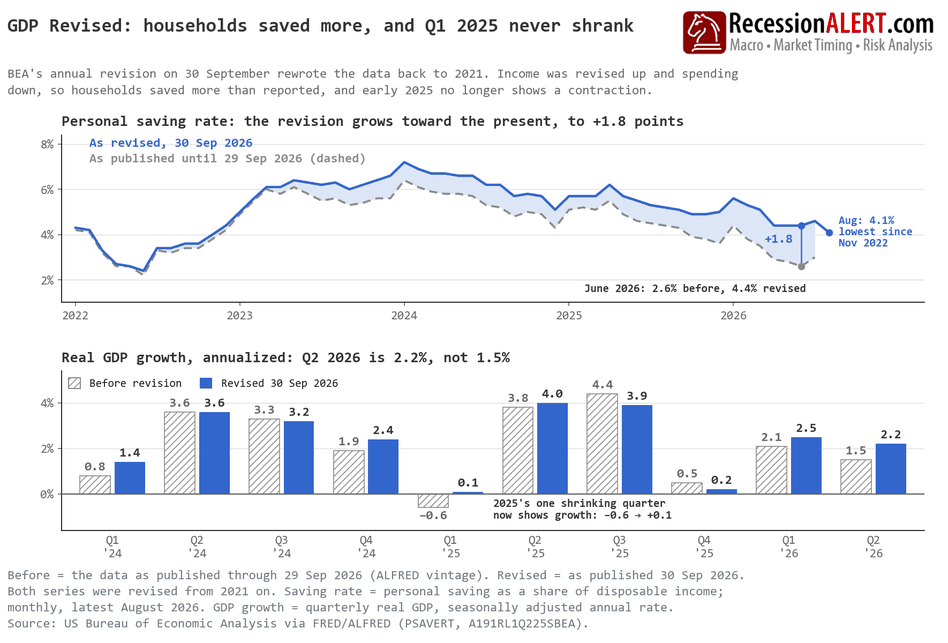
One income line more than explains all the saving the revision found. At June 2026 interest income was revised up $466bn a year, above the entire $425bn saving upgrade; wages added $120bn, while dividends lost $104bn and households paid $144bn more tax than counted. Interest does not arrive in a paycheck — it flows to households holding deposits, bonds and retirement savings — so the bigger cushion is mostly a return on savings already held. Even the contraction the rewrite erased was a docks story, not a checkout one. Q1 2025’s minus was always the shadow of a pre-tariff shipping surge — imports still subtract 4.3 points — and net exports supplied 0.64 of the 0.7-point lift, while consumer spending added under half a point that quarter. None of it reverses the saving rate’s slide. June’s 2.6% — an alarm, as the lowest reading outside 2022 since April 2008 — is now 4.4%, yet in August spending rose 0.9% against income’s 0.2%, real disposable income went nowhere and the rate fell to 4.1%. That 4.1% is the least-finished number here — a first estimate in the stretch the rewrite moved most, lifting saving 1.54 points on average in 2026 against about 0.85 in 2024–25. The test for that cushion is whether wages, not interest, start carrying income growth. The revision found the saving — in what savings earn, not in what work pays.
What it means: Nothing in any bank account changed today. For a family living on its pay, the higher national saving rate likely overstates its own buffer, so plan around wages. For stock investors, a bigger cushion makes a sudden consumer pullback less likely, but firms selling to wage-dependent shoppers still live on pay, up about 4% a year against spending’s 6%. For an economy that grew at a 2.2% pace in the second quarter, that gap can run for a while, not forever. The warning sign: a saving rate back below 3.5%, last seen in August 2022.
Market Intelligence Brief (MIB) Ver. 19.77
For professional investors only. Not investment advice.
© 2026 RecessionALERT.com

Comments are closed.