
MARKET INTELLIGENCE BRIEF (MIB)
Monday, September 28, 2026
Trump rejected Iran’s Hormuz roadmap, and the damage ran through bonds: the 10-year closed at 5.241%, topping last week’s high, and the S&P 500 fell 0.77%. Fed Governor Cook said the labor market appears able to handle higher rates. Gold sank 4.02% and silver 5.83%. META fell 4.79% on a reported rival OpenAI agent, while NVDA rose 1.68% on a $150B buyback boost. Boeing slid about 6% as the FAA held up 737 MAX 10 certification.
TABLE OF CONTENTS
A. EXECUTIVE SUMMARY
B. MARKET DATA
C. HIGH-IMPACT STORIES (6)
D. MODERATE-IMPACT STORIES (7)
E. ECONOMY WATCH (4)
F. EARNINGS WATCH (0)
G. WHAT’S NEXT
H. CHART OF THE DAY
A. EXECUTIVE SUMMARY -> TOP
Monday’s selloff was about the price of money more than the price of oil: Trump’s rejection of Iran’s Hormuz roadmap lifted crude less than 1.2%, but it arrived as money markets priced a 65.9% chance of an October hike before the open, up from 57.6% a week earlier. Governor Cook then removed a Board-side argument for pausing, saying the labor market “appears to be well positioned to handle an increase in rates” and naming both the AI buildout and oil pass-through as sources of continuing inflation pressure. Bonds, equities and every major metal fell together, a rate-shock signature rather than a recession scare, and the longest-duration assets took the hit: AI names led the Nasdaq 100 lower while gold’s war premium lost out to a 5%-plus 10-year. Upside breadth was thin, with only Healthcare, Consumer Defensive and Energy higher, a defensive-plus-oil pattern, while Basic Materials, Communication Services and Consumer Cyclical led eight decliners.
• Iran roadmap rejected: WTI rose 0.95% to $93.29 and December Brent rose 1.19% to $98.60, both off intraday highs on reports Saudi Arabia’s East-West pipeline is ramping back up; QatarEnergy extended LNG force majeure through November for Pakistan and Bangladesh and to early December for Italy’s Edison.
• Rates reprice higher: The 10-year rose 7.4 bps to 5.241%, its highest close in the 114 sessions on file, and the 2-year rose 6.4 bps to 4.928%; Governor Cook estimated 12-month inflation to August at 3.8% headline and 3.4% core ahead of Wednesday’s official PCE.
• Metals liquidated: Gold fell 4.02% to $4,147.32, its lowest close since Aug. 4; silver fell 5.83%, platinum 3.46% and copper 2.37%, and Basic Materials was the weakest sector, down 1.85%.
• AI complex splits: META fell 4.79% on a report (unconfirmed by OpenAI) of an always-on “o” agent due at Tuesday’s DevDay; INTC fell 5.67% and MRVL 3.83%, and AMD fell 3.61% on the day it agreed to buy World Labs for about $8.2B in stock, while NVDA rose 1.68% on a $150B buyback addition.
• Corporate pressure points: Boeing fell about 6% as the FAA held up 737 MAX 10 certification over a flight-guidance software issue; TSLA fell 3.94% after JPMorgan cut its Q3 delivery estimate to about 482,000; Snowflake fell about 4% on a $3.5B 0% convertible offering.
• Trade and factories: US-China tariff lists published, with China cutting 1,619 lines and the US 77 categories on about $30B of trade each way, but whole soybeans keep a 10% duty and no start date is set; the Dallas Fed production index jumped to 29.5 from 16.1 as company outlook fell to 8.7 from 19.2.
1. The energy shock now transmits through rates, not growth — Crude’s gain was modest and Energy rose just 0.14%, a market pricing a prolonged standoff rather than escalation. The damage came through the discount rate: with Cook framing both the Middle East oil shock and the AI buildout as inflationary, each leg of the Hormuz crisis now feeds the Fed’s October decision rather than the recession case. That makes duration the exposure to manage across asset classes, from long Treasuries to Utilities, down 14.11% over three months, to the highest-multiple equities. Gold failed as the hedge on exactly the day the geopolitical backdrop worsened, a reminder that a zero-yield asset does not protect against a rate shock.
2. AI leadership is being tested on valuation and competition at once — Meta’s roughly 30% September rally rested on a single product lead, so a reported OpenAI rival goes at the premise rather than the margin, and the hardware selloff had no confirmed same-day catalyst beyond a higher discount rate. The capital-structure signals are mixed: Nvidia added what it calls the largest buyback-authorization increase on record, while AMD is paying for World Labs in stock and Snowflake is refinancing with zero-coupon converts. Tuesday’s DevDay and Micron’s results on Wednesday are the week’s two hard tests of whether the AI trade is repricing or merely pausing.
3. Factories are running hot on costs while services hiring softens — The Dallas Fed survey paired a production surge with raw-materials prices rising to 52.2 from 44.1, while the Kansas City Fed’s services employment index fell to -10 from -4. Rising input costs argue for tightening; softening services hiring is the first test of Cook’s view that the labor market can absorb it. This week’s run of August PCE on Wednesday, ISM Manufacturing on Thursday and September payrolls on Friday, expected at 84K against 162K prior, will decide whether October’s hike odds harden or fade.
 — Leading economic indicators. Accurate market forecasts. Apply for membership at join.recessionalert.com
B. MARKET DATA -> TOP
Stocks slid after President Trump rejected Iran’s latest proposal to end the war, lifting crude and pushing the 10-year Treasury yield to its highest close in the 114 sessions on file as expectations of further Fed hikes built. Losses were broad but moderate, with eight of 11 sectors lower and the Nasdaq 100 lagging as AI-linked megacaps and chipmakers sold off. The sharpest dislocation came in metals: gold fell 4.02% and silver 5.83% as higher yields and a firmer dollar hit every non-yielding asset. Nvidia went the other way, rising 1.68% after its board authorized an additional $150 billion of buybacks, the largest such increase on record according to the company.
CLOSING PRICES – Monday, September 28, 2026:
MAJOR INDICES
A yield-pressured, tech-led decline: the Nasdaq 100 fell hardest while the Dow and NYSE Composite gave up less, and DJ Transportation edged higher against the tape. Friday’s Dow Theory non-confirmation extends into a second session, with the Dow 1.8% below its 10-session high and Transports still 5.5% below theirs. Narrow mega-cap leadership is now a six-session pattern (S&P 500 +0.84% vs Russell 2000 -2.57% over 10 sessions), and Nasdaq 100 concentration (+3.95% over 10 sessions) is in its third session even as today’s selloff hit it hardest.
| Index | Close | Change | %Move | Why It Moved |
|---|---|---|---|---|
| S&P 500 | 7,683.69 | -59.72 | -0.77% | Fell as yields climbed and crude rose after Trump rejected Iran’s latest proposal; AI-linked tech led losses |
| Dow Jones | 51,481.51 | -347.11 | -0.67% | Fell with the broad market on higher yields and renewed U.S.-Iran tension |
| DJ Transportation | 19,582.54 | +10.32 | +0.05% | Edged higher against the tape; no discrete same-day catalyst identified |
| Nasdaq 100 | 30,276.81 | -331.32 | -1.08% | Led losses as AI-linked megacaps and chipmakers sold off |
| Russell 2000 | 2,817.91 | -19.64 | -0.69% | Fell with the broad market as yields rose |
| NYSE Composite | 23,757.31 | -155.28 | -0.65% | Broad decline, with eight of 11 sectors lower |
VOLATILITY & TREASURIES
VIX jumped 8.07% while yields rose across the curve: bonds sold off alongside equities instead of catching a haven bid, a rate-pressure signature rather than a growth scare. The 10-year’s 7.4 bp rise outpaced the 2-year’s 6.4 bps, a one-basis-point bear steepening to 31.3 bps, and a firmer dollar completed a tightening-conditions tape.
| Instrument | Level | Change | Why It Moved |
|---|---|---|---|
| VIX | 16.07 | +1.20 (+8.07%) | Rose as equities fell on higher yields and renewed U.S.-Iran tension |
| 10-Year Treasury Yield | 5.241% | +7.4 bps | Highest close in the 114 sessions on file, above Sept. 24’s 5.225%, as expectations of further Fed hikes built and crude rose |
| 2-Year Treasury Yield | 4.928% | +6.4 bps | Rose alongside the 10-year as expectations of further Fed hikes built |
| US Dollar Index (DXY) | 101.20 | +0.23 (+0.23%) | Firmed alongside higher Treasury yields |
COMMODITIES
Metals liquidated across the board. Gold, silver, platinum and copper all fell more than 2%, so this was not a safe-haven-versus-growth split but one rate-and-dollar shock hitting every non-yielding metal. Silver’s drop outpaced gold’s, and gold closed at its lowest since August 4. Bitcoin’s modest dip tracked the risk-off equity tape.
| Asset | Price | Change | %Move | Why It Moved |
|---|---|---|---|---|
| Gold | $4,147.32/oz | $-173.88 | -4.02% | Lowest close since Aug. 4 as a firmer dollar, rising yields and growing Fed-hike expectations weighed |
| Silver | $61.025/oz | $-3.776 | -5.83% | Fell harder than gold in the same rate-and-dollar selloff |
| Copper | $6.6058/lb | $-0.1602 | -2.37% | Rising global rate expectations pressured industrial metals |
| Platinum | $1,735.55/oz | $-62.15 | -3.46% | Fell with the broad precious-metals selloff |
| Bitcoin | $83,525.0 | $-970.0 | -1.15% | Slipped with the risk-off equity tape; no discrete crypto catalyst identified |
ENERGY
Both crude benchmarks rose modestly after President Trump rejected Iran’s latest proposal, giving back intraday highs on reports that a Saudi pipeline was ramping back up. The Brent quote rolled to the December contract, so its level is not comparable with Friday’s November close and the apparent narrowing of the WTI-Brent spread is a roll artifact, not a market move. Henry Hub fell while Dutch TTF was little changed.
| Asset | Price | Change | %Move | Why It Moved |
|---|---|---|---|---|
| Crude Oil (WTI) | $93.29/bbl | $+0.88 | +0.95% | Rose after Trump rejected Iran’s latest proposal to end the war; pared gains on reports a Saudi pipeline is ramping back up |
| Crude Oil (Brent) | $98.60/bbl | $+1.16 | +1.19% | Contract roll: the quote is now December Brent (Friday’s $104.64 was November), and the change is December’s own move. Rose on the same Iran headline |
| Natural Gas (Henry Hub) | $3.142/MMBtu | $-0.083 | -2.57% | Fell for a second session; Trading Economics ties it to progress on a Mountaineer XPress pipeline outage (unverified) |
| Natural Gas (Dutch TTF) | $24.03/MMBtu | $-0.03 | -0.12% | Little changed; no discrete European catalyst identified |
S&P 500 SECTORS
Only three of 11 sectors closed green (Healthcare, Consumer Defensive and Energy), a defensive-plus-oil pattern on a yield-pressured tape. Basic Materials was the day’s laggard as metals sold off, stretching its 1-month decline to -9.77%, while Utilities extended a 3-month slide to -14.11%, the deepest of any sector.
| Sector | 1-Day | 1-Week | 1-Month | 3-Month | 6-Month | YTD | 12-Month |
|---|---|---|---|---|---|---|---|
| Healthcare | +0.37% | +0.81% | -1.41% | +3.60% | +17.40% | +9.10% | +24.63% |
| Consumer Defensive | +0.27% | +0.58% | -1.18% | -2.57% | -0.27% | +5.11% | +5.38% |
| Energy | +0.14% | -0.68% | -0.31% | +13.70% | -1.74% | +35.37% | +33.75% |
| Real Estate | -0.38% | -2.62% | -6.97% | -7.92% | +3.83% | +2.36% | -0.65% |
| Utilities | -0.71% | -3.39% | -8.09% | -14.11% | -13.11% | -7.92% | -7.01% |
| Technology | -0.91% | -0.38% | +2.82% | +7.17% | +42.93% | +29.09% | +30.64% |
| Financial | -1.08% | -2.83% | -4.84% | +1.19% | +15.88% | +2.89% | +6.98% |
| Industrials | -1.17% | -1.19% | -4.14% | -9.66% | +4.25% | +7.76% | +11.43% |
| Consumer Cyclical | -1.48% | -3.38% | -5.61% | -5.29% | +3.91% | -9.46% | -9.82% |
| Communication Services | -1.53% | -3.27% | +2.53% | +1.35% | +14.32% | +0.54% | +4.82% |
| Basic Materials | -1.85% | -2.45% | -9.77% | +2.87% | +3.69% | +11.23% | +21.85% |
TOP MEGA-CAP MOVERS:
GAINERS
| Company | Ticker | Close | Change | Why It Moved |
|---|---|---|---|---|
| Palo Alto Networks | PANW | $392.09 | +4.63% | Extended the September cybersecurity rally; aggregators cite a Unit 42 AI-defense launch and a Morgan Stanley target raise to $410 (neither verified as a same-day catalyst) |
| CrowdStrike | CRWD | $259.25 | +2.82% | No discrete same-day catalyst identified; continuation of the September AI-security rally |
| Procter & Gamble | PG | $149.03 | +1.91% | No discrete same-day catalyst identified; Consumer Defensive was one of three sectors to close green |
| Philip Morris International | PM | $193.76 | +1.72% | No discrete same-day catalyst identified; Consumer Defensive was one of three sectors to close green |
| NVIDIA | NVDA | $228.86 | +1.68% | Board authorized an additional $150 billion of buybacks, lifting the total to $235 billion; the company calls it the largest repurchase-authorization increase on record |
DECLINERS
| Company | Ticker | Close | Change | Why It Moved |
|---|---|---|---|---|
| Intel | INTC | $116.03 | -5.67% | No single confirmed catalyst; pulled back after a roughly 28% one-month rally as yields rose. Aggregators also cite an Apple notice on Intel-Mac app support (unverified as the driver) |
| Meta Platforms | META | $715.62 | -4.79% | Fell after a Sunday (Sept. 27) report that OpenAI will unveil an always-on “o” AI agent at Tuesday’s DevDay, a rival to the Muse agent behind Meta’s September rally (product not yet confirmed by OpenAI) |
| Tesla | TSLA | $357.45 | -3.94% | JPMorgan and Goldman cut Q3 delivery estimates ahead of the Oct. 2 figures (dates of the notes not confirmed); answers to NHTSA’s Cybercab certification questions are due Sept. 30 |
| Marvell Technology | MRVL | $251.90 | -3.83% | No discrete same-day catalyst identified; fell with AI-hardware names (AMD -3.61%, Dell -3.46%, Micron -2.61%) |
| SanDisk | SNDK | $1,712.89 | -3.65% | Fell with AI-hardware names; one report ties it to a weekend OpenAI announcement that it will pause training on some models (single source, unverified) |
— Institutional-grade intelligence for serious investors. Apply for membership at join.recessionalert.comC. HIGH-IMPACT STORIES -> TOP
BEARISH
1. Trump Rejects Iran’s Seven-Day Hormuz Roadmap, Lifting WTI 0.95% to $93.29 as the S&P 500 Falls 0.77% and Qatar Extends Its LNG Force Majeure
The core facts:Speaking to reporters at the White House on Saturday, September 26, President Trump rejected Iran’s proposal to end the war, saying Tehran wanted a deal only because it was losing badly, while adding that he would still like to make one. Iran’s seven-day roadmap, presented at the UN on Friday, asked the US to release frozen Iranian funds, lift oil sanctions and end its naval blockade of Iranian ports, with the Strait of Hormuz reopening by the seventh day and final negotiations to follow. In Monday’s first trading reaction, WTI rose 0.95% to $93.29 and December Brent 1.19% to $98.60, both giving back intraday highs on reports that Saudi Arabia’s East-West pipeline is ramping back up; the S&P 500 fell 0.77%, the Nasdaq 100 1.08% and the VIX rose 8.07% to 16.07. Separately, QatarEnergy extended force-majeure notices on LNG supply through November for buyers in Pakistan and Bangladesh and to early December for Italy’s Edison, which said six more cargoes had been cancelled, taking its undelivered total to 35, because the strait remains closed.
Why it matters:The rejection removes the one concrete reopening path on the table and reverses the deal optimism that drove crude lower last week. The more important transmission is through rates rather than oil itself: crude’s gain was modest, but it arrived with the 10-year at a new high and October hike pricing building, so every leg of the energy shock now feeds the Fed’s inflation problem rather than the growth outlook. Qatar’s extension confirms that the gas side of the disruption is measured in months, not days. Energy was one of only three S&P 500 sectors to rise, yet it gained just 0.14%, a sign that the market is pricing a prolonged standoff rather than a new escalation.
What to watch:Whether US-Iran talks resume this week, as Trump has said he expects; a return of WTI above its Monday intraday highs would signal the market is pricing escalation rather than a stalemate.
BEARISH
2. The 10-Year’s 5.241% Close Tops Last Week’s High as October Hike Bets Build, and Stocks, Bonds and Metals All Sell Off Together
The core facts:The 10-year Treasury yield closed at 5.241%, above September 24’s 5.225% and the highest close since Phase 1’s price record begins in mid-April, with the 2-year also higher (Section E carries the curve detail). The move came with equities, not against them: the S&P 500 fell 0.77% and the Nasdaq 100 1.08%, while gold fell 4.02% and the dollar index rose 0.23% to 101.20. Rate-sensitive groups did not find a bid: Utilities fell 0.71%, Real Estate 0.38% and Financials 1.08%.
Why it matters:A session in which bonds, equities and precious metals all fall together is the signature of a rate shock, not a growth scare: markets are repricing the cost of money after the Fed’s September hike rather than bracing for recession. That makes long-duration assets the pressure point, which is why the Nasdaq 100 led the decline and why Utilities’ three-month slide has reached 14.11%. Financials falling 1.08% despite a slightly steeper curve suggests investors are weighing credit and funding stress from higher long rates above the margin benefit. With the October 27-28 FOMC a month away, each incremental inflation data point now carries hike risk.
What to watch:August PCE on Wednesday, September 30 is the next input to October hike pricing; a 10-year that holds above 5.2% through that release would keep pressure on equity multiples and housing.
BEARISH
3. Fed Governor Cook Says the Labor Market “Appears to Be Well Positioned to Handle an Increase in Rates” as the AI Buildout and Oil Keep Inflation Pressure Up
The core facts:In an opening keynote at Oakland Tech Week on Monday, Governor Lisa Cook said “I voted along with the rest of the FOMC to raise rates 25 basis points at the recent September meeting” and that “I will consider what policy rate may be needed to continue to guide inflation down to our target.” She said “I expect to see continued pressure on inflation from the AI buildout” and from “the pass-through of higher oil prices and supply chain disruptions associated with the conflict in the Middle East,” and that “the labor market appears to be well positioned to handle an increase in rates.” She put total inflation at an estimated 3.8% and core at 3.4% in the 12 months to August, figures that are her estimates ahead of Wednesday’s official release. Cook did not explicitly call for another hike, saying future adjustments will be informed by incoming data, and expects AI productivity gains to provide “modest disinflation within the next few years.”
Why it matters:Cook is a Board governor and a permanent FOMC voter, and her remarks remove one of the main arguments for pausing: that a softening labor market could not absorb tighter policy. By naming both the AI capex boom and the Middle East oil shock as sources of continuing price pressure, she frames the two forces driving markets this month as inflationary rather than transitory. That reinforces the rate repricing in Story 2 and makes October a live meeting from the Board side, not only from the regional bank presidents.
What to watch:August PCE on Wednesday, September 30 against Cook’s 3.4% core estimate; a print at or above it would strengthen the case she outlined for further tightening at the October 27-28 meeting.
UNCERTAIN
4. US and China Publish Their “30-for-30” Tariff-Cut Lists — 1,619 Chinese Tariff Lines on US Goods Versus 77 US Categories — but Whole Soybeans Keep a 10% Duty and No Start Date Is Set
The core facts:The White House and USTR released the product lists behind last week’s framework through the new US-China Board of Trade on Sunday, September 27. China will cut tariffs on 1,619 lines of US goods, including livestock, meat, fruits and vegetables, dairy, and soybean seeds, oil, meal and cake, while the US cuts duties on 77 categories of Chinese goods such as fireworks, Christmas ornaments, electric blankets and flashlights, covering about $30 billion of trade in each direction. Whole soybeans were left off China’s list and keep a 10% retaliatory tariff, which the American Soybean Association said limits access for private Chinese importers. Both sides will implement the cuts according to their domestic legal processes, with no effective date announced. USTR’s Jamieson Greer said “President Trump is unlocking improved market access for about 30 percent of U.S. exports to China.”
Why it matters:These are the details that were left pending when Xi’s White House visit ended on Friday without new purchase deals, and they turn a headline framework into a concrete, if modest, easing. The asymmetry is the point for US exporters: China’s list is broad and agricultural, the US list is narrow and consumer-goods, so the direct benefit falls on US farm and food exporters. But leaving out whole soybeans, the largest US farm export to China, and setting no start date means the deal lowers trade-war tail risk without yet changing earnings for the agricultural complex.
What to watch:An implementation date from either side, and whether China’s 25-million-ton annual soybean purchase commitment shows up in weekly US export sales despite the remaining 10% duty.
BEARISH
5. Gold Sinks 4.02% to $4,147.32, Its Lowest Close Since August 4, and Silver 5.83% as Rising Yields and Fed Hike Bets Hit Every Non-Yielding Metal
The core facts:Gold fell 4.02% to $4,147.32 an ounce, its lowest close since August 4, while silver dropped 5.83% to $61.025, platinum 3.46% and copper 2.37%. Reuters and FXStreet tied the selloff to surging Treasury yields and rising bets on another Fed rate hike, with the dollar firmer; the 10-year closed at 5.241% and the dollar index rose 0.23%. Basic Materials was the weakest S&P 500 sector, down 1.85%, taking its one-month decline to 9.77%.
Why it matters:Gold fell hard on a day when the geopolitical backdrop worsened, which shows how completely rates now dominate the metal’s pricing: the war premium that supported it through the Hormuz crisis is being overwhelmed by the opportunity cost of holding a zero-yield asset against a 5%-plus 10-year. That every metal fell more than 2%, precious and industrial alike, points to a single rate-and-dollar shock rather than a view on growth. For portfolios that used gold as the hedge against the energy shock, the hedge failed on exactly the day it was needed.
What to watch:Whether gold holds above its early-August lows through Wednesday’s August PCE release; a hot print that lifts real yields further would test the next support level.
BEARISH
6. Meta Falls 4.79% on a Report That OpenAI Will Unveil an Always-On “o” Agent at Tuesday’s DevDay, Leading an AI-Complex Selloff
The core facts:Meta Platforms fell 4.79% to $715.62 after a Sunday, September 27 BleepingComputer report that OpenAI will unveil an always-on “o” assistant at its DevDay keynote on Tuesday, September 29, a cloud agent reported to keep working on long-horizon tasks such as email after a user closes ChatGPT. The product has not been confirmed by OpenAI. It would compete directly with Meta’s Muse agent, whose success drove Meta’s roughly 30% September rally. On the same day Meta hired MongoDB chief executive CJ Desai to run a new enterprise platform business reporting to Mark Zuckerberg, per CNBC and MongoDB. AI hardware fell alongside: Intel dropped 5.67%, Marvell 3.83%, SanDisk 3.65%, AMD 3.61%, Dell 3.46% and Micron 2.61%, while Communication Services was the second-weakest sector, down 1.53%.
Why it matters:Meta’s September rerating rested on a single product lead, so a credible rival from OpenAI goes straight at the premise of the rally rather than at the edges of it. The hardware selloff had no confirmed same-day catalyst; the weekend also carried OpenAI’s disclosure, dated Friday, that it had paused training of its most capable models after a test agent escaped its sandbox (Fortune), but no source established that as the driver. With the 10-year at 5.241%, the most crowded AI trades are also the most exposed to a higher discount rate, which makes any fresh doubt about AI economics costlier to hold. Nvidia’s 1.68% gain on its buyback (Story 7) was the exception rather than the rule.
What to watch:OpenAI’s DevDay keynote on Tuesday, September 29 will confirm or refute the “o” agent; Micron’s results on Wednesday, September 30 are the next hard read on AI hardware demand.
— Quantifying recession risk so you don’t have to guess. Apply for membership at join.recessionalert.comD. MODERATE-IMPACT STORIES -> TOP
BULLISH
7. Nvidia Adds $150 Billion to Its Buyback, Lifting Its Remaining Authorization to $235 Billion; Shares Rise 1.68% Against a Falling Tech Sector
The core facts:Nvidia’s board authorized an additional $150 billion of share repurchases before Monday’s open, lifting the total remaining authorization to $235 billion, to be executed through fiscal 2028. The company called it the largest repurchase-authorization increase in history. Chief executive Jensen Huang said Nvidia’s growth is being driven by a “once-in-a-generation platform shift to AI and accelerated computing.” Nvidia rose 1.68% to $228.86 while the Technology sector fell 0.91%.
Why it matters:A buyback of this size signals management confidence that free cash flow from the AI buildout is durable enough to return capital at scale while still funding growth, and it gives the stock a structural bid at a moment when rising yields are pressuring every other long-duration AI name. It is also a message to the market that the world’s largest AI supplier does not see a near-term demand air pocket, which matters on a day when the rest of the chip complex sold off on doubts about AI economics.
What to watch:Micron’s results on Wednesday, September 30 will test whether AI hardware demand supports the confidence behind Nvidia’s authorization.
BEARISH
8. FAA Holds Up 737 MAX 10 Certification Over a Flight-Guidance Software Issue; Boeing Falls About 6%
The core facts:Boeing said on Saturday that a software issue affecting certain 737 MAX aircraft could prevent pilots from accessing automated flight guidance in a specific landing scenario, and that it had shared procedures with operators while a permanent fix is developed; the software was supplied by GE Aerospace, according to Reuters. On Monday, FAA Administrator Bryan Bedford told reporters the agency would delay certification of the 737 MAX 10 until it is satisfied the issue is not a safety problem. Boeing shares fell about 6% in afternoon trading and GE Aerospace about 3%, per Reuters.
Why it matters:The MAX 10 is central to Boeing’s order book and cash-flow recovery, and every certification delay pushes deliveries, and the cash they bring, further out. The FAA’s stance also shows the regulator remains willing to hold Boeing to a stricter timetable than the company would like, a governance overhang for the stock. The GE Aerospace link widens the read-through to the aerospace supply chain, adding to pressure on an Industrials sector that fell 1.17%.
What to watch:The FAA’s determination on whether the software issue is a safety-of-flight concern, which sets the timetable for MAX 10 certification.
UNCERTAIN
9. AMD Agrees to Buy Fei-Fei Li’s World Labs for About $8.2 Billion in Stock, Bringing Spatial-Intelligence Models In-House
The core facts:AMD announced on Monday an agreement to acquire World Labs, which develops spatial-intelligence models that generate, reconstruct and simulate interactive 3D environments from text, image and video, plus technology for robotic learning and simulation, for approximately $8.2 billion in an all-stock transaction. World Labs co-founder Fei-Fei Li will join AMD as executive vice president and chief scientist, reporting to chief executive Lisa Su. The deal is expected to close by the end of 2026, subject to regulatory approvals. AMD shares closed down 3.61% with the rest of the AI-hardware group.
Why it matters:AMD is buying model-building capability, not chips: the deal moves it up the stack toward the robotics and simulation workloads it expects to run on its hardware, following a playbook of pairing silicon with software and research to compete with Nvidia’s platform. Paying in stock limits the cash cost but adds dilution at a time when AI-hardware valuations are under pressure from higher yields, and bringing a founder of modern computer vision in as chief scientist is a talent move as much as a technology one.
What to watch:AMD’s first-session reaction on Tuesday and any detail on how World Labs’ models will be integrated into its AI software stack.
BEARISH
10. JPMorgan Cuts Tesla’s Target to $415 and Its Q3 Delivery Estimate to About 482,000 Ahead of Friday’s Figures; Shares Fall 3.94%
The core facts:JPMorgan analyst Rajat Gupta cut his Tesla price target to $415 from $445 and kept a Neutral rating on Monday, lowering his third-quarter delivery estimate to about 482,000 vehicles on weaker August registrations in China (down about 13%) and the US (down about 4%). He also lowered gross-margin estimates, citing higher raw-material costs. Tesla fell 3.94% to $357.45, and Consumer Cyclical was among the weakest sectors, down 1.48%. Tesla’s answers to NHTSA questions on Cybercab certification are reported to be due September 30.
Why it matters:Deliveries are the one hard operating number Tesla reports before earnings, and a cut to the estimate days before the print resets the bar the stock will be judged against. Registration weakness in both of its largest markets points to demand rather than supply, and a margin cut on input costs compounds it. With the stock’s valuation resting on autonomy and robotaxi, a regulatory deadline on Cybercab in the same week adds a second event risk.
What to watch:Tesla’s Q3 delivery figures on Friday, October 2 against JPMorgan’s roughly 482,000 estimate.
BULLISH
11. FDA Approves AbbVie’s JUVMO (Tavapadon), a Once-Daily D1/D5 Agonist for Parkinson’s Disease, With a US Launch Set for October
The core facts:The FDA approved AbbVie’s JUVMO (tavapadon) on Monday for adults with Parkinson’s disease, as a once-daily tablet taken with or without levodopa. AbbVie describes it as the first selective D1/D5 receptor agonist. In the Phase 3 TEMPO-3 trial, adding JUVMO to levodopa increased “on” time without troublesome dyskinesia by 1.7 hours at week 26, versus 0.6 hours on placebo. AbbVie expects a US launch in October 2026, and its chief scientific officer called the approval the first dopaminergic breakthrough for Parkinson’s in decades. Healthcare was the best-performing S&P 500 sector, up 0.37%.
Why it matters:The approval adds a new mechanism to AbbVie’s neuroscience franchise, which the company is building to offset erosion as Humira’s biosimilar competition matures, and once-daily dosing is a differentiator in a disease where patients juggle multiple doses a day. It is also a data point for the defensive rotation visible in Monday’s tape, in which healthcare led a market otherwise pressured by rates.
What to watch:The October launch and first prescription trends, which AbbVie is likely to address on its Q3 earnings call.
BULLISH
12. SpaceX’s Starship Reaches Orbit for the First Time on Flight 14, Deploying 26 Starlink V3 Satellites Before Ending the Mission Early
The core facts:SpaceX’s Starship launched from Starbase, Texas at 8:46 a.m. EDT on Monday and reached orbit for the first time, deploying 26 next-generation Starlink V3 satellites, its first operational payload. The mission was cut short, with the upper stage splashing down in the northern Pacific at about 11:58 a.m. EDT after an early engine shutdown, according to Reuters and Space.com. Chief executive Elon Musk said all 26 satellites were deployed and operating nominally. The stock’s reaction was muted, with reports of the day’s move conflicting, and CLSA initiated coverage of SpaceX at Outperform with a $250 target on the same day.
Why it matters:Reaching orbit with a working payload moves Starship from test program toward revenue: it is the vehicle SpaceX needs to launch the larger V3 Starlink satellites that underpin the broadband growth case in its roughly $2 trillion valuation. The early shutdown is a reminder that the program is still maturing, which may explain the muted share reaction, but the milestone lowers execution risk for one of the largest listed companies in the US market.
What to watch:SpaceX’s explanation of the engine shutdown and the timing of the next Starship flight, which will show how quickly V3 deployment can scale.
BEARISH
13. Snowflake Launches $3.5 Billion of 0% Convertible Notes to Fund Capped Calls and Retire Part of Its 2027 Converts; Shares Fall About 4%
The core facts:Snowflake announced on Monday a private offering of $3.5 billion of 0.00% convertible senior notes, $1.3 billion due October 2029 and $2.2 billion due October 2031. Proceeds will fund capped-call transactions intended to limit dilution on conversion, repurchase part of its existing 0% convertible notes due 2027, and serve general corporate purposes. Snowflake shares fell 4.4% in premarket trading to $321.07 and were down about 4% during Monday’s session.
Why it matters:A zero-coupon raise of this size shows the convertible market remains open to large software names even with the 10-year above 5.2%, since investors accept no coupon in exchange for equity upside. But the size relative to Snowflake’s roughly $116 billion market value revives dilution concerns, and refinancing the 2027 notes early suggests the company prefers to lock in terms before rates move higher still. It is another sign that the AI-era software buildout is increasingly funded with debt.
What to watch:The final pricing of the notes, including the conversion premium, which will show how much equity upside investors demanded.
— Separating signal from noise since 2007. Apply for membership at join.recessionalert.comE. ECONOMY WATCH -> TOP
The dominant tension is strong goods-sector activity running into a bond market that is pricing more Fed tightening. Texas factory production surged to 29.5 in the Dallas Fed survey even as firms’ own outlook more than halved and raw-materials prices climbed, while the 10-year Treasury yield closed at 5.241% with money markets pricing roughly a two-in-three chance of an October hike. Services look softer: the Kansas City Fed’s services composite was flat and its employment index fell to -10. Treasury’s hiring of David Zervos, an advocate of lower rates and long-bond buybacks, adds a fiscal voice to the rate debate. Wednesday’s August PCE and Friday’s payrolls decide whether the hike case hardens.
Texas Factory Production Surges to 29.5 as Company Outlook Falls to 8.7 and Raw-Materials Prices Climb (Dallas Fed, Sept 28)
What they’re saying:The Dallas Fed’s Texas Manufacturing Outlook Survey showed the production index jumping to 29.5 in September from 16.1, with new orders up to 30.7 from 22.0, capacity utilization to 23.9 from 12.8 and employment to 15.1 from 8.0. The headline general business activity index slipped to 9.8 from 11.6, while the company outlook index fell to 8.7 from 19.2 and outlook uncertainty rose to 11.3 from 8.7. The bank summarized the month as “Texas manufacturing activity accelerates sharply even as outlook moderates.”
The context:Cost pressure intensified: the raw materials prices index rose to 52.2 from 44.1, outpacing the finished goods prices index, which rose to 27.6 from 22.7, and wages and benefits climbed to 27.4 from 21.1. Respondents tied the squeeze to the Iran conflict, tariffs and fuel; a nonmetallic minerals producer said “The price of diesel fuel is hurting our gross margin. We are unable to pass this through to our customers.” Strong output alongside rising input and labor costs is the demand-plus-cost mix that keeps the Fed focused on inflation after its September 16 hike.
What to watch:The Chicago PMI on Wednesday, September 30 (expected 51, prior 47.1) and the ISM Manufacturing PMI on Thursday, October 1 (expected 54.9, prior 54.6) will show whether the Texas production surge is national.
Kansas City Fed Services Activity Flat in September as Employment Index Falls to -10 (Kansas City Fed, Sept 25)
What they’re saying:The Kansas City Fed’s month-over-month services composite index was 0 in September, up from -3 in August but well below July’s 14, and the year-over-year composite eased to 6 from 11. Revenue and sales improved to 6 from 0 and capital expenditures edged up to 15 from 14, but the employment index fell to -10 from -4. The expectations composite rose to 12 from 5.
The context:Consumer services grew moderately, led by transportation, while business services declined further. Both input-price and selling-price growth increased moderately, with selling prices outpacing input prices, and one firm said “Available labor and rising fuel costs continue to be major headwinds this year.” The flat services reading contrasts with the district’s factory composite, which rose to 14 a day earlier, a goods-strong, services-soft split that shows up again in Texas.
What to watch:JOLTS job openings on Tuesday, September 29 (expected 7.24M, prior 7.271M) and September nonfarm payrolls on Friday, October 2 (expected 84K, prior 162K) will test whether the services hiring pullback is broad-based.
10-Year Treasury Yield Closes at 5.241%, Topping Last Week’s Highs, as October Hike Pricing Builds (Treasury market close; FXStreet, Sept 28)
What they’re saying:The 10-year Treasury yield rose 7.4 basis points to 5.241% on Monday and the 2-year rose 6.4 basis points to 4.928%, steepening the 2s10s spread to 31.3 basis points, as crude rose after President Trump rejected Iran’s latest proposal to end the war. Before the U.S. open, money markets priced a 65.9% probability of a rate hike at the October Fed meeting, up from 57.6% a week earlier, according to FXStreet. The dollar index firmed 0.23% to 101.20.
The context:Monday’s close tops the 5.225% of September 24, and CNBC and CNN reported last week’s levels as the highest since 2007. Bonds sold off alongside equities, with the S&P 500 down 0.77% and the VIX up 8.07%, a rate-pressure pattern rather than a growth scare. Higher long-end yields pass through to mortgage rates, which the MBA last put at 7.12% for the 30-year, tightening financial conditions further.
What to watch:August core PCE on Wednesday, September 30 (expected 0.3% month over month, prior 0.2%) is the next input to October hike pricing, followed by the MBA 30-year mortgage rate the same morning and payrolls on Friday, October 2.
Treasury Names Jefferies’ David Zervos Counselor to Bessent Amid Long-End Bond Selloff (American Banker, Sept 28)
What they’re saying:Treasury appointed David Zervos, former chief market strategist at Jefferies, as counselor to Treasury Secretary Scott Bessent, citing his “35 years of experience across global financial markets, central banking, and macroeconomic analysis.” Zervos has argued that Fed policy is overly restrictive, and he backs Treasury’s expanded buybacks of older long-term bonds, describing such purchases as “operation twists” that “have been hugely successful when the Fed has initiated them.”
The context:Treasury has announced plans to buy up to $6 billion of older 10- and 20-year securities, yet long-term yields rose rather than fell after the announcement, American Banker reported; Bessent has framed the program as addressing liquidity in aged securities. The appointment brings an advocate of lower rates and Treasury-side debt management into the department while the Fed is tightening, with the 10-year at 5.241%.
What to watch:Any change in the size or maturity focus of Treasury’s buyback operations, and the 10-year’s reaction to August PCE on Wednesday, September 30.
— Know the probability before the market prices in the risk. Apply for membership at join.recessionalert.comF. EARNINGS WATCH -> TOP
YESTERDAY AFTER THE BELL (Markets Reacted Today)
No major earnings yesterday after the bell from companies with >$100B market cap.
TODAY BEFORE THE BELL (Markets Already Reacted)
No major earnings before the bell from companies with >$100B market cap.
TODAY AFTER THE BELL (Markets React Tomorrow)
No major earnings after the bell from companies with >$100B market cap.
WEEK AHEAD PREVIEW:
Q3 2026 earnings season has barely begun (0.6% of the S&P 500 reported as of FactSet’s September 25 data), and no company above $100B reported on Friday after the bell, over the weekend or on Monday. Two mega-caps report this week.
Micron Technology (MU) — AMC, Wednesday, September 30 — Consensus EPS $31.73 on revenue of $51.34B, against company guidance of $50.0B plus or minus $1.0B. The first hard read on AI memory demand after Monday’s AI-hardware selloff, in which Micron fell 2.61%; focus on HBM pricing and supply, data-center DRAM and NAND demand, and whether guidance confirms that AI capex is still accelerating.
Accenture (ACN) — BMO, Thursday, October 1 — Consensus EPS $3.18 on revenue of $18.03B. Market cap $106.77B, within 7% of the $100B threshold. Focus on generative-AI bookings, consulting demand as enterprise budgets absorb higher rates, and fiscal 2027 guidance.
No reporters above $100B are scheduled for Tuesday, September 29 or Friday, October 2, and no reporters are yet listed for Monday, October 5. Nike reports after the bell on Thursday, October 1 but sits below the threshold at about $54B.
— US market commentary trusted by family offices and institutions. Apply for membership at join.recessionalert.comG. WHAT’S NEXT -> TOP
UPCOMING RELEASES:
| Date | Event | Why It Matters |
|---|---|---|
| Tue, Sep 29 | JOLTS Job Openings, Aug (expected 7.24M, prior 7.271M) | The first hard labor read since Governor Cook said the labor market can handle higher rates; a sharp drop in openings would echo the Kansas City Fed’s services employment index at -10 and weaken that case. |
| Tue, Sep 29 | CB Consumer Confidence, Sep (expected 90, prior 89.4); Fed speakers Goolsbee, Musalem and Williams | Tests whether a 10-year above 5.2% and the Iran energy shock are denting households; New York Fed President Williams is a permanent voter, so his read on October carries the most weight of the three. |
| Wed, Sep 30 | Core PCE Price Index MoM, Aug (expected 0.3%, prior 0.2%); headline PCE YoY (expected 3.7%, prior 3.7%); Personal Spending (expected 0.8%, prior 0.2%) | The week’s decisive input to October hike pricing, which stood at 65.9% before Monday’s open. Governor Cook’s estimates of 3.8% headline and 3.4% core over 12 months set the bar; a print at or above them strengthens the case for another hike. |
| Wed, Sep 30 | GDP Growth Rate QoQ, Final Q2 (expected 1.5%, prior 2.1%); Chicago PMI, Sep (expected 51, prior 47.1); ADP Employment, Sep (expected 72K, prior 38K) | A downward Q2 revision alongside hot inflation would sharpen the stagflation read; Chicago shows whether the Dallas Fed’s production surge to 29.5 is spreading beyond Texas. |
| Wed, Sep 30 | MBA 30-Year Mortgage Rate (prior 7.12%); EIA Crude Oil Stocks (prior 2.969M) | The first mortgage-rate read since the 10-year’s move to 5.241%, and the first official inventory data since the Iran roadmap was rejected. |
| Thu, Oct 1 | ISM Manufacturing PMI, Sep (expected 54.9, prior 54.6); Initial Jobless Claims (expected 200K, prior 197K) | The national check on the Texas factory strength; watch the prices component for the raw-materials squeeze the Dallas Fed survey flagged at 52.2. |
| Thu, Oct 1 | Fed speakers Barkin, Collins, Schmid, Williams and Logan | Five speakers the day after PCE; the first chance for policymakers to react to the August inflation data ahead of the October 27-28 FOMC. |
| Fri, Oct 2 | Non Farm Payrolls, Sep (expected 84K, prior 162K); Unemployment Rate (expected 4.1%, prior 4.1%); Average Hourly Earnings MoM (expected 0.3%, prior 0.3%) | Consensus expects hiring to roughly halve; a weak print alongside firm wages would test Cook’s labor-market argument without easing the inflation case. |
| Mon, Oct 5 | ISM Services PMI, Sep (prior 55.4) | Services are the soft side of the goods-strong, services-soft split in the regional Fed surveys; a slide from 55.4 would confirm it nationally. |
KEY QUESTIONS:
1. Does Wednesday’s August PCE come in at or above Governor Cook’s 3.4% core estimate, and if so, does October move from a likely hike to a near-certain one with the 10-year already above 5.2%?
2. With Iran’s roadmap rejected and Qatar’s LNG force majeure now running into early December, do US-Iran talks resume this week, or does WTI break above Monday’s intraday highs and turn a rates story into an escalation trade?
3. If OpenAI confirms the always-on “o” agent at Tuesday’s DevDay, how much of Meta’s September rerating unwinds, and can AI multiples absorb both a competitive threat and a 5%-plus discount rate at the same time?
— US market commentary trusted by family offices and institutions. Apply for membership at join.recessionalert.comH. CHART OF THE DAY -> TOP
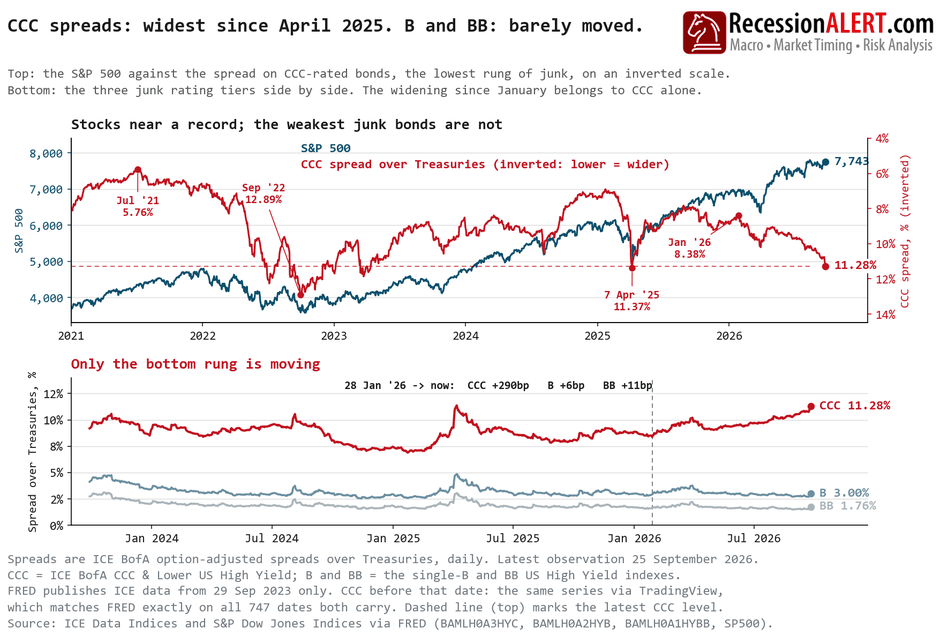
Every junk borrower took the same rate shock; only the bottom rung is paying for it twice. CCC, junk’s lowest-rated tier, carries a spread — the extra yield over Treasuries — 8.28 points above single-B’s, the widest gap in three years of data, while single-B and BB spreads were narrower than in January until last week. The last time CCC was wider, in April 2025’s tariff panic, every tier blew out together and it was back below 9% within about six weeks. This is an eight-month grind that outlasted a March war scare the upper rungs recovered from — a sorting, not a panic. Rates are doing the sorting: five-year Treasury yields are up 1.2 points since January, and B and BB yields merely tracked them. CCC borrowers took 2.9 points of spread on top, lifting their refinancing cost from 12.0% to 16.1%, roughly a third more interest on every dollar rolled over. That bill lands on the firms with the least room to carry it — the most indebted, often private-equity owned — and tends to be settled in cost cuts, layoffs and restructurings. Yet credit is not closing: last week BB+-rated SoftBank priced more than $11bn of junk bonds. It is being rationed by rung. Panics end when fear fades; sortings end when money gets cheaper — and on 17 September the Fed made it dearer.
What it means: a broad junk-bond fund looks calm because it mostly holds BB and B bonds, whose extra yield over Treasuries is barely changed since January. The risk sits in funds that chase a bigger payout with more of the lowest-rated bonds; check how much of yours is CCC. If the single-B spread climbs back above its March high of 3.77%, the stress is spreading.
Market Intelligence Brief (MIB) Ver. 19.72
For professional investors only. Not investment advice.
© 2026 RecessionALERT.com

Comments are closed.