
Trump extended the Iran ceasefire indefinitely — S&P 500 and Nasdaq hit simultaneous all-time records for the first time since the war began Feb. 28. Oil defied the peace signal, surging above $100 as Iran seized two ships in the Strait of Hormuz. GEV +13.75%: Q1 data center orders exceeded all of 2025, validating the AI power thesis. Tesla AMC: EPS beat but delivery miss and energy storage collapse cloud the outlook. CUSMA renewal “unlikely by July 1,” USTR warns.
TABLE OF CONTENTS
A. EXECUTIVE SUMMARY
B. MARKET DATA
C. HIGH-IMPACT STORIES (4)
D. MODERATE-IMPACT STORIES (5)
E. ECONOMY WATCH (6)
F. EARNINGS WATCH (7)
G. WHAT’S NEXT
H. CHART OF THE DAY
A. EXECUTIVE SUMMARY -> TOP
MARKET SNAPSHOT:
The S&P 500 and Nasdaq closed at simultaneous all-time records as Trump’s indefinite ceasefire extension triggered the sharpest geopolitical-relief rally since the Iran war began February 28 — but the session’s defining paradox was the Dow Jones Transportation Average’s -8.40% collapse as Iran simultaneously seized two ships in the Strait of Hormuz, driving Brent crude through $100 even as equities surged. The bond market’s non-participation — 10-year yields barely moved +1.4 bps despite the equity surge — and gold’s persistence at a record $4,758/oz signal that institutional investors are not pricing in a durable ceasefire, treating the diplomatic headline and the physical disruption as two separate market events running in parallel. Mega-cap technology concentration drove the advance: the S&P’s +1.05% gain masked NYSE Composite breadth of just +0.22%, and the acute Dow Theory divergence between the Nasdaq’s all-time high and the Transportation Average’s -8.40% collapse is the clearest structural signal of the session — mega-cap tech and the physical economy splitting apart on the same geopolitical event, entering tomorrow from opposite ends of the ledger.
TODAY AT A GLANCE:
• GEV +13.75%: Q1 Electrification segment booked $2.4B in data center orders — more than all of 2025 combined — validating accelerating AI capex and lifting the full compute and power infrastructure stack (MU +8.48%, AMD +6.67%, AVGO +5.09%); full-year guidance raised.
• Oil above $100: Brent settled at $101.82 despite the ceasefire — traders price the physical Hormuz disruption as separate from the diplomatic headline; oil above $100 locks in elevated PCE and pushes Fed rate cuts to late 2026 (Reuters poll: 103 economists, PCE forecast 3.7% Q2, first cut no sooner than September).
• Boeing Q1 (BA +5.53%): Record $695B backlog, adj EPS -$0.20 vs. -$0.68 est. (+70.8% beat), net loss essentially zero — the turnaround is ahead of Street expectations and transitioning from distressed recovery to aerospace franchise re-rating.
• Capital One -6% (COF): NIM compressed 39 bps to 7.87%, credit provisions $4.1B, GAAP EPS missed -14.2% — a leading indicator of consumer credit stress in the lower-to-middle income segment that will not improve until the Fed cuts, which oil-driven PCE is preventing.
• Tesla AMC: EPS +10.8% beat, but a 50,000-vehicle inventory buildup, delivery miss, and energy storage collapse (-38% sequential to 8.8 GWh vs. 12–14 GWh consensus) cloud the margin recovery story; overnight earnings call tone is the decisive factor for tomorrow’s stock reaction.
• CUSMA at risk: USTR Greer testified renewal is “unlikely by July 1,” threatening $1.3T in annual North American trade; Ford, GM, and Stellantis face the most acute supply chain exposure given their integrated cross-border production architectures.
KEY THEMES:
1. The Hormuz Paradox — A ceasefire and an oil supply shock from the same headline. Equity markets priced the diplomatic announcement (bullish for risk assets) while the oil market priced the physical reality (Hormuz still blocked, ships still being seized). This is not a contradiction — it is a bifurcation between financial assets that trade sentiment and commodity markets that trade supply and demand. Until tanker traffic normalizes and the Navy blockade lifts, the inflationary cost of the conflict is locked in regardless of ceasefire status — and the Fed’s rate-cut path remains frozen at late 2026.
2. AI Infrastructure Demand — The Real-Economy Confirmation — GEV’s $2.4B in single-quarter data center orders exceeding all of 2025 is not sentiment or survey data — it is committed capital from hyperscalers for physical power equipment, the most concrete order-book-verified confirmation of accelerating AI capex to date. Electricity demand forecasts will need to be revised materially higher, with cascading implications for grid investment, utility rate-base growth, and long-term energy price outlooks. The mega-cap tech earnings week of April 28 (Alphabet, Microsoft, Meta, Amazon) is now the critical test of whether the hyperscaler layer confirms or contradicts GEV’s signal.
3. Consumer Credit Stress Beneath the Record High — Capital One’s NIM compression and $4.1B credit provisions, alongside Tesla’s 50K-unit inventory buildup, both reflect the same underlying pressure: the lower-to-middle income consumer is under mounting strain from sustained high energy costs, 21–24% credit card APRs, and stagnant real wage growth. The stagflation trap — Fed frozen by oil-driven inflation, economy softening (GDPNow 1.2%), consumer stress building — is the structural risk beneath today’s record equity close. American Express (Thursday BMO) will clarify whether premium consumer spending is diverging from this stress or also beginning to weaken.
 — Leading economic indicators. Accurate market forecasts. Apply for membership at join.recessionalert.com
B. MARKET DATA -> TOP
Trump’s indefinite extension of the US-Iran ceasefire sent equities to all-time Nasdaq highs, a broad but tech-concentrated advance. The day’s defining anomaly was the Dow Jones Transportation Average’s -8.40% collapse: the index gapped up on peace optimism then reversed violently as Strait of Hormuz shipping disruptions drove WTI crude past $92 and Brent above $100, obliterating airline fuel economics. Gold held near its record high even as geopolitical tail risk nominally eased — a sign the safe-haven premium is not fully unwinding and that the market treats the ceasefire as fragile. Peace optimism and a simultaneous oil supply shock — both from the same Middle East headline — is the cross-asset tension that defines the close.
CLOSING PRICES – April 22, 2026:
MAJOR INDICES
The Nasdaq’s all-time high against the Dow Jones Transportation Average’s -8.40% crash is the most extreme Dow Theory divergence in months — mega-cap tech and the physical economy moving in opposite directions on the same geopolitical event. The S&P 500’s +1.05% gain with NYSE breadth at only +0.22% confirms the advance was narrow and tech-concentrated. Russell 2000 lagged Nasdaq materially (+0.70% vs +1.73%), reinforcing mega-cap concentration as the session’s structural theme.
| Index | Close | Change | %Move | Why It Moved |
|---|---|---|---|---|
| S&P 500 | 7,137.92 | +73.91 | +1.05% | Broad risk-on on Trump’s indefinite US-Iran ceasefire extension; tech and semiconductor leadership drove the advance |
| Dow Jones | 49,490.03 | +340.65 | +0.69% | Gained on ceasefire sentiment; lagged S&P as industrial/A&D earnings-reaction selling and oil-cost pressures on blue-chip transports weighed |
| Nasdaq 100 | 26,937.28 | +457.80 | +1.73% | Hit all-time high; semiconductor names surged as GE Vernova earnings highlighted insatiable AI data center power demand, lifting the entire compute stack |
| Russell 2000 | 2,784.38 | +19.41 | +0.70% | Participated in risk-on but lagged mega-cap tech; small-caps more sensitive to oil cost pressures and industrial headwinds |
| NYSE Composite | 23,001.78 | +49.81 | +0.22% | Narrow advance; aggregate breadth severely dampened by the transportation sector collapse and energy cost pressure across industrials |
VOLATILITY & TREASURIES
VIX fell -3.03% as ceasefire news reduced near-term tail risk, yet 10Y yields barely budged +1.4 bps — the bond market declining to participate in equity euphoria, either unconvinced the ceasefire holds or anchored by sticky inflation expectations. The 2Y rising +2.5 bps vs 10Y +1.4 bps marks a mild curve flattening: near-term rate expectations firmed while long-end bulls stayed sidelined. DXY’s +0.20% minimal gain confirms a confidence-driven rally, not a safe-haven unwind.
| Instrument | Level | Change | Why It Moved |
|---|---|---|---|
| VIX | 18.91 | -0.59 (-3.03%) | Tail risk eased as ceasefire reduced near-term Middle East escalation risk; equity rally further suppressed hedging demand |
| 10-Year Treasury Yield | 4.305% | +1.4 bps | Marginal uptick; bond market unmoved by equity rally — sticky inflation expectations and oil at $92+ limiting any relief rally in duration |
| 2-Year Treasury Yield | 3.804% | +2.5 bps | Front end led higher; near-term rate expectations firmed slightly on stronger macro and risk backdrop |
| US Dollar Index (DXY) | 98.59 | +0.19 (+0.20%) | Minimal movement; dollar barely reacted to risk-on tone — consistent with confidence-driven rally rather than safe-haven unwind |
COMMODITIES
Gold holding at a record $4,758/oz despite a ceasefire is the most telling commodity signal of the session: the geopolitical premium is not unwinding, and the market is treating peace as temporary. Silver and platinum outperformed gold — an industrial demand overlay on top of the safe-haven bid as risk-on sentiment improved growth expectations. Copper’s +2.09% confirmed the growth-optimism narrative cleanly; Bitcoin tracked equities at +3.58%, a clean risk-sentiment read.
| Asset | Price | Change | %Move | Why It Moved |
|---|---|---|---|---|
| Gold | $4,758.14/oz | +$38.54 | +0.82% | Record high; geopolitical premium persisting despite ceasefire — Strait of Hormuz disruptions keeping safe-haven bid alive; market treating peace as fragile |
| Silver | $77.722/oz | +$1.234 | +1.61% | Industrial + precious metals demand; outperformed gold as risk-on growth optimism added industrial demand overlay to safe-haven bid |
| Copper | $6.136/lb | +$0.1255 | +2.09% | Industrial demand confidence; risk-on tone and Middle East resolution optimism supporting global growth and infrastructure spending outlook |
| Platinum | $2,088.70/oz | +$47.90 | +2.35% | Broad precious metals rally with industrial demand overlay; risk-on sentiment amplified the move beyond pure safe-haven positioning |
| Bitcoin | $78,430 | +$2,710 | +3.58% | Tracked risk-on equity tape; clean correlation with broad market risk sentiment rally on ceasefire news |
ENERGY
WTI and Brent moved near-lockstep (+3.57% vs +3.39%), confirming a global rather than regional supply shock — the $8.95 Brent-WTI spread is historically wide, reflecting an ongoing Middle Eastern crude premium from Hormuz disruptions. Henry Hub barely moved (+0.63%) while Dutch TTF was flat in EUR terms, confirming this is pure geopolitical crude risk with no natural gas signal embedded. Supply shock and ceasefire extension running simultaneously on the same event is the unusual combination driving the cross-asset confusion.
| Asset | Price | Change | %Move | Why It Moved |
|---|---|---|---|---|
| Crude Oil (WTI) | $92.87/bbl | +$3.20 | +3.57% | Strait of Hormuz shipping disruptions; Iran vessel seizures threatening ~5% of global oil supply amid stalled peace talks |
| Crude Oil (Brent) | $101.82/bbl | +$3.34 | +3.39% | Crossed $100 psychological level; global supply disruption premium building on Hormuz blockage fears; Asia seaborne supply most affected |
| Natural Gas (Henry Hub) | $2.714/MMBtu | +$0.017 | +0.63% | Minimal move; natural gas supply/demand dynamics fully independent of the geopolitical crude shock; domestic storage levels adequate |
| Natural Gas (Dutch TTF) | $14.38/MMBtu | -$0.05 | -0.33% | Flat in EUR terms (0.00% change); USD price declined solely as EUR/USD weakened -0.33%; European gas fully decoupled from the crude complex |
S&P 500 SECTORS
Technology leads simultaneously across every time horizon — day, week, month, and quarter — a rare convergence that signals trend momentum, not a tactical trade. Energy is 2026’s structural standout (+19.13% 3M, +28.67% YTD), with today’s crude-driven gain adding another data point; its 1-month still negative (-2.76%) against its dominant multi-month trend is a compression that could resolve higher if Hormuz disruptions persist. Healthcare’s 3-month decline (-5.73%) remained the cycle’s structural lag despite today’s token gain.
| Sector | 1-Day | 1-Week | 1-Month | 3-Month | 6-Month | YTD | 12-Month |
|---|---|---|---|---|---|---|---|
| Technology | +2.31% | +4.51% | +14.84% | +9.84% | +6.50% | +8.72% | +64.90% |
| Communication Services | +1.24% | +0.02% | +8.34% | +3.81% | +6.97% | +2.85% | +54.24% |
| Basic Materials | +1.21% | +0.09% | +12.89% | +4.31% | +23.70% | +18.26% | +58.13% |
| Energy | +1.18% | +1.24% | -2.76% | +19.13% | +33.21% | +28.67% | +46.80% |
| Consumer Defensive | +0.44% | +1.27% | +2.42% | +1.33% | +5.38% | +7.20% | +6.36% |
| Consumer Cyclical | +0.22% | +0.77% | +8.89% | -2.67% | -0.78% | -1.21% | +30.89% |
| Healthcare | +0.16% | -1.14% | +2.82% | -5.73% | +2.26% | -3.40% | +15.76% |
| Utilities | +0.09% | -2.34% | +1.41% | +4.16% | +0.06% | +6.26% | +22.18% |
| Financial | -0.21% | -0.41% | +6.72% | -2.09% | +2.69% | -2.44% | +22.87% |
| Industrials | -0.32% | +0.35% | +6.57% | +3.74% | +13.64% | +12.90% | +45.49% |
| Real Estate | -0.72% | +0.19% | +6.41% | +2.51% | +0.88% | +5.93% | +9.47% |
TOP MEGA-CAP MOVERS:
Selection criteria: US-listed companies with market cap above $200 billion that moved ±1.5% or more during the session. Movers are ranked by percentage change and capped at 5 gainers and 5 decliners. On muted trading days when fewer than 3 names meet the threshold, the largest moves are shown regardless. Moves driven by earnings, M&A, analyst actions, sector rotation, or macro catalysts are prioritized over low-volume or technical moves.
GAINERS
| Company | Ticker | Close | Change | Why It Moved |
|---|---|---|---|---|
| GE Vernova | GEV | $1,127.56 | +13.75% | Q1 2026 earnings blowout (BMO): beat on EPS and revenue as AI data center power equipment demand surged; management cited record order backlog and raised full-year outlook |
| Micron Technology | MU | $487.48 | +8.48% | High-beta memory play on AI data center demand wave; GEV’s power infrastructure blowout affirmed the hyperscaler buildout is accelerating, lifting the entire compute stack |
| Philip Morris International | PM | $163.95 | +6.98% | Q1 2026 earnings beat (BMO): adj EPS $1.96 (+16% YoY) vs $1.89 est; revenue $10.1B (+9.1%); IQOS surpassed Marlboro as world’s #1 nicotine brand by volume; FY guidance raised |
| Advanced Micro Devices | AMD | $303.46 | +6.67% | AI GPU and data center semiconductor rally; benefiting from AI infrastructure spending wave confirmed by GEV’s power demand blowout; hyperscaler capex expanding |
| Broadcom Inc | AVGO | $422.65 | +5.09% | Custom silicon (XPU) AI infrastructure rally; hyperscaler data center demand supporting Broadcom’s custom chip pipeline; rides GEV-driven sector momentum |
DECLINERS
| Company | Ticker | Close | Change | Why It Moved |
|---|---|---|---|---|
| GE Aerospace | GE | $276.29 | -3.64% | Q1 2026 beat on every line (adj EPS $1.86, +25% YoY, +16% vs est; revenue +29%; orders +87%) but FY guidance held unchanged — market demanded a raise; classic sell-the-news on guidance disappointment |
| RTX Corp | RTX | $180.91 | -3.34% | Q1 2026 earnings; A&D sector under pressure alongside GE Aerospace’s guidance-hold disappointment; high expectations priced in heading into results |
| T-Mobile US | TMUS | $188.92 | -3.31% | Deutsche Telekom exploring ~$400B stock-for-stock merger creating a new holding company; deal uncertainty, regulatory/political hurdles, and dilution risk pressured shares |
| AbbVie Inc | ABBV | $200.50 | -2.25% | Healthcare sector underperformer; drug pricing regulatory headwinds weighed; no specific single-day catalyst identified |
| Intel Corp | INTC | $65.27 | -1.49% | Structural laggard; AI chip demand concentrated in AMD/AVGO/MU while Intel faces market-share challenges; peer rally widened the competitive gap narrative |
— Institutional-grade intelligence for serious investors. Apply for membership at join.recessionalert.comC. HIGH-IMPACT STORIES -> TOP
BULLISH
1. Trump Extends Iran Ceasefire Indefinitely; S&P 500 and Nasdaq Surge to All-Time Record Closes
The core facts:President Trump announced an indefinite extension of the US-Iran ceasefire on April 22, hours before the original two-week ceasefire was set to expire. Trump cited a request from Pakistani mediators and described Iran’s government as “seriously fractured,” conditioning further negotiations on a unified Iranian proposal to end hostilities with the US and Israel. Markets erupted: S&P 500 +1.05% to 7,137.90 (all-time record), Nasdaq Composite +1.64% to 24,657.57 (all-time record), Dow +0.69% to 49,490.03 — now within 1.4% of its own all-time high. Gains were broad-based, with materials and technology sectors leading.
Why it matters:The indefinite ceasefire extension dramatically reduces the near-term probability of escalation in the Persian Gulf and is the primary catalyst behind today’s broad equity rally. Investor positioning had been weighted defensively since the February 28 outbreak of hostilities — energy and defense overweights, growth underweights — and the ceasefire is forcing a rapid repositioning back toward risk assets. The breadth of today’s gains (materials and technology simultaneously leading) signals genuine economic optimism, not merely short-covering. Critically, the S&P 500 and Nasdaq both closing at all-time highs signals that equity markets no longer carry any war-risk discount — a regime change in sentiment.
What to watch:Whether Iran’s fractured government can produce a unified ceasefire proposal and whether the Strait of Hormuz situation normalizes; any resumption of military activity would quickly reverse the war-risk discount re-removal.
UNCERTAIN
2. Oil Surges Above $100/Barrel Despite Ceasefire; Iran Seizes Two Ships in Strait of Hormuz as US Navy Blockade Continues
The core facts:Despite the ceasefire extension, global benchmark Brent crude surged 3.5% to settle at $101.91/barrel — its first close above $100 in two weeks. WTI advanced 2% to approximately $91.81/barrel. Iran’s Revolutionary Guard seized two container ships in the Strait of Hormuz on April 22, claiming the vessels crossed “without authorization.” The US Navy is maintaining its naval blockade of Iranian ports in parallel with the ceasefire framework. Iran’s state news agency Tasnim confirmed the seizures occurred after Trump’s ceasefire announcement — a direct contradiction of ceasefire spirit. The Strait of Hormuz disruption, through which roughly 20% of global oil and LNG typically transits daily, has been described as the largest oil supply disruption in history.
Why it matters:The oil market’s refusal to fall on ceasefire news is the most important signal of the day. It means traders do not believe the Hormuz supply disruption will normalize quickly — and they are right: the Navy blockade continues, Iran’s military is seizing ships, and Middle East Gulf producer exports have collapsed. For the US economy, oil at $100+ keeps the Iran energy shock alive: retail gasoline prices remain elevated, transportation and manufacturing costs stay high, and producer price inflation is embedded. Most critically for monetary policy: the Fed cannot meaningfully cut rates while energy is delivering this persistent inflationary shock. Rate cut expectations that were pulling forward on ceasefire optimism will fade if oil remains above $100.
What to watch:Whether the seized ships are released and whether the Navy blockade is eased as ceasefire negotiations progress; a sustained Brent crude break below $90/barrel would signal genuine supply normalization. Monitor weekly EIA crude oil inventory data for demand-destruction signals.
BULLISH
3. S&P 500 and Nasdaq Close at Simultaneous All-Time Records; Equity Markets Fully Erase Iran War Losses for First Time Since Conflict Began
The core facts:The S&P 500 closed at 7,137.90 and the Nasdaq Composite at 24,657.57 on April 22 — simultaneous all-time record closes for both indexes, the first since the Iran war began on February 28, 2026. The S&P 500 had briefly dipped as much as 8-9% from its pre-war level at the peak of conflict anxiety; today’s close confirms a complete V-shaped recovery above pre-war levels. The US technology sector is up approximately 11% in April alone, its best monthly performance in nearly two years. Year-to-date, the S&P 500 has now returned to positive territory. The rally was supported by three simultaneous tailwinds: ceasefire optimism, Q1 2026 earnings season opening at historically strong levels (88% EPS beat rate, 84% revenue beat on 10% reporting), and the AI infrastructure investment thesis being validated in real time.
Why it matters:For institutional portfolio managers, the simultaneous S&P 500 and Nasdaq all-time record close is a portfolio milestone that changes risk calculus. Drawdown periods are ended — cash positions deployed defensively during the Iran war shock face immediate opportunity cost pressure to re-engage. Equity managers who reduced exposure will need to close underweights. The breadth of today’s record (materials AND technology leading simultaneously, not just one sector) confirms this is a fundamental re-rating, not a momentum chase. Additionally, the 88% Q1 EPS beat rate through the first 10% of reporters — driven by names like GE Vernova, Boeing, and Philip Morris — is providing an earnings foundation under the geopolitical-relief rally. Forward EPS estimates are likely to be revised higher this week as earnings revisions filter through.
What to watch:Whether the S&P 500 holds above 7,000 on the next pullback — that level now becomes key technical support for the post-war recovery; the mega-cap tech earnings week of April 28 (Alphabet, Microsoft, Meta, Amazon) will be the critical test of whether earnings fundamentals can sustain the record valuations.
BEARISH
4. CUSMA at Risk: USTR Greer Testifies Talks “Unlikely” to Resolve by July 1; US-Canada Trade Systems “Don’t Fit Together Very Well”
The core facts:US Trade Representative Jamieson Greer testified before the House Ways and Means Committee on April 22, delivering a pointed warning about the Canada-US trade relationship. Greer accused Canada of “doubling down on globalization” — expanding trade with China and other partners — while the US is trying to “correct for the problems of globalization.” He said the two countries’ systems “don’t fit together very well” and signaled CUSMA renewal is “unlikely to be resolved by July 1.” The July 1 deadline is the point at which officials must decide whether to renew the Canada-US-Mexico Agreement for a 16-year period or trigger an annual review process. Canadian Prime Minister Carney has separately stated he will make “no further concessions” to advance talks.
Why it matters:CUSMA governs approximately $1.3 trillion in annual trilateral trade between the US, Canada, and Mexico — by far the largest trade framework in the world. Failure to renew or the move to an annual review process would inject sustained tariff uncertainty into supply chains that span all three countries. Key US exposed sectors: automotive (nearly 40% of US vehicle production crosses the Canadian border multiple times during manufacturing), agriculture (Canada absorbs 17% of all US exports), steel and aluminum (already tariffed separately), and lumber. US automakers (Ford, GM, Stellantis) face the most acute risk: their North American manufacturing architectures assume frictionless cross-border movement. Any escalation to trade dispute procedures would require rapid and costly supply chain restructuring. This is a threat to be taken seriously: Greer’s congressional testimony is not rhetoric — it is a formal policy signal from the USTR.
What to watch:July 1 CUSMA deadline — whether negotiators produce even a framework agreement before then; monitor Ford (F) and GM (GM) guidance revisions for North American tariff exposure disclosures; any statement from Canadian Trade Minister Mary Ng on negotiation status.
— Quantifying recession risk so you don’t have to guess. Apply for membership at join.recessionalert.comD. MODERATE-IMPACT STORIES -> TOP
BULLISH
5. Adobe Approves $25 Billion Stock Buyback Program Through 2030; ADBE +2.5% as Board Signals Deep Confidence in Cash Flow
The core facts:Adobe’s board authorized a new $25 billion share repurchase program running through April 30, 2030, announced on April 22 in conjunction with the Adobe Summit event. ADBE shares rose 2.5% in premarket and closed approximately 2% higher. Adobe’s market cap is approximately $110 billion — the $25 billion authorization represents roughly 23% of current market cap over four years. Adobe’s stock has fallen 29% year-to-date, pressured by investor fears that generative AI tools will commoditize creative software. The company generates approximately $6-7 billion in annual free cash flow, making the buyback math credible. CFO Dan Durn called it “a direct expression of confidence in our robust cash flow and the long-term value we are delivering to investors.”
Why it matters:Adobe’s $25 billion authorization — its largest ever — is a high-conviction shareholder signal that management believes the stock is deeply undervalued at current levels. The decision to return capital aggressively rather than accelerate defensive AI investment reflects management’s view that the AI-disruption narrative has overcorrected. For the market, this is a meaningful counterpoint to the bear thesis: if AI were genuinely displacing Adobe’s franchise, rational management would be investing heavily in differentiation, not buying back stock. The buyback also puts a credible floor under ADBE — the company has the cash flow and stated intent to absorb shares at current prices over four years. Enterprise software peers facing similar AI-disruption concerns (Salesforce, Workday) face renewed pressure to announce similar capital return signals.
What to watch:Adobe’s next earnings report for evidence of AI revenue contribution and whether the buyback pace accelerates if the stock remains at current depressed levels; also watch for competitive AI creative tools from Canva, Figma, and OpenAI’s Sora impacting Adobe’s subscription renewal rates.
BULLISH
6. Palantir Signs $300 Million Blanket Purchase Agreement with USDA to Safeguard US Food Supply; PLTR +3.6%
The core facts:Palantir Technologies announced a $300 million blanket purchase agreement with the US Department of Agriculture on April 22 to implement the National Farm Security Action Plan — a data and operational platform to improve supply chain resilience, reduce fraud and waste, and protect farmers and farm programs from security risks. The BPA allows USDA to draw against the $300 million ceiling repeatedly over the life of the agreement without recompeting each task. USDA bypassed competitive bidding through a sole-source justification, citing Palantir as the only vendor with the required federal accreditations and integrations to meet the timeline. Full rollout is expected by 2028. PLTR stock rose 3.55% to $151.20 on the news, materially outperforming the broader software sector (+1.22%).
Why it matters:Palantir’s USDA deal is the latest in a series of sole-source government blanket purchase agreements that validate the company’s strategy of positioning its AI platform as essential civilian federal infrastructure — not just a defense/intelligence tool. At a market cap of approximately $332 billion, Palantir is increasingly priced as critical national AI infrastructure. The sole-source justification is key: it means the USDA determined there is no viable alternative, effectively creating a moat against competitive displacement in the food security domain. The deal also aligns with the Trump administration’s strategic priorities around food security and supply chain sovereignty — a political tailwind for future government AI contracts. For investors, the 3.6% stock gain on a $300M contract (tiny relative to Palantir’s market cap) signals that the market is pricing in a sustained pipeline of similar agreements.
What to watch:Congressional scrutiny of sole-source government AI contracts for competitive fairness; Palantir’s upcoming Q1 2026 earnings for government contract revenue mix and pipeline visibility; any competitive protests filed by other AI vendors.
BEARISH
7. EIA Reports Surprise 1.9 Million Barrel Crude Build; Analysts Had Expected a 1.2 Million Barrel Draw
The core facts:The EIA’s weekly petroleum status report, released April 22 for the week ending April 17, showed US commercial crude oil inventories rose by 1.925 million barrels — a significant miss versus analyst expectations for a 1.2 million barrel draw. The effective swing of +3.1 million barrels relative to consensus is one of the larger inventory surprises in recent months. Gasoline and distillate inventories saw draws in the same week. Despite the crude build, Brent crude still settled higher on the session (+3.5% to $101.91), driven by the Hormuz ship seizures rather than domestic inventory dynamics. WTI crude similarly advanced.
Why it matters:A crude inventory build when analysts expected a large draw typically signals one of two things: either US refiners are reducing crude runs (processing margins declining), or domestic crude demand is softer than expected — both are subtly bearish for the US economy. In the context of oil at $100+ Brent, a build of this magnitude could be an early signal that high energy prices are already beginning to dampen US economic activity — the demand-destruction feedback loop that the Fed would need to see before cutting rates. However, the fact that oil prices surged despite the inventory build confirms that the dominant force is supply disruption (Hormuz/Iran), not demand strength. For inflation watchers, the inventory build is a mild positive: if demand is softening, eventual price relief may be closer than the $100+ oil price implies.
What to watch:Next week’s EIA report (released April 29) — whether the build is a one-week anomaly due to refinery scheduling or the beginning of a sustained demand pullback trend.
UNCERTAIN
8. Warsh Fed Chair Confirmation Stalls: Tillis Blocks Senate Floor Vote Until DOJ Drops Powell Investigation; Earliest Vote Now Week of May 11
The core facts:Post-hearing analysis following Kevin Warsh’s contentious April 21 Senate Banking Committee confirmation hearing has confirmed a significant obstacle: Senator Thom Tillis (R-NC) has pledged to block the floor vote until the Department of Justice drops its investigation into current Fed Chair Jerome Powell. With the Senate schedule, the earliest possible confirmation vote is now the week of May 11. Warsh testified he would not be Trump’s “sock puppet,” and stated the president never asked him to predetermine any rate decision. Jerome Powell is serving in a holdover capacity as Chair since his four-year term as Chair has expired; the Board Member term runs through 2028.
Why it matters:An extended period of Fed Chair vacancy — or holdover uncertainty — is a persistent headline risk for fixed income markets. The May FOMC meeting occurs before the week of May 11 (the earliest Warsh vote date), meaning the Fed enters its next policy meeting with the Chair succession question unresolved. For bond markets, sustained uncertainty about Fed leadership direction is classically associated with steeper yield curves and wider credit spreads as the market prices in governance risk. Additionally, the hearing confirmed that Warsh’s “regime change” plan for the Fed — reducing its role in non-monetary matters and overhauling the policy framework — remains on track if confirmed. Markets face dual uncertainty: who leads the Fed and what direction the new Chair takes policy.
What to watch:Whether Tillis’s conditions are met (DOJ dropping the Powell investigation) before the week of May 11; Powell’s language at the May FOMC press conference regarding the independence of the institution; any bipartisan Senate compromise that breaks the log-jam.
BULLISH
9. Robinhood Ventures Fund Invests $75 Million in OpenAI, Giving Retail Investors First Public Market Access to Pre-IPO Equity
The core facts:Robinhood announced on April 22 that its Robinhood Ventures Fund I (RVI) — a closed-end fund that began trading on the NYSE in March 2026 — has taken a $75 million stake in OpenAI, purchasing common stock. The investment makes OpenAI one of RVI’s largest holdings alongside Databricks, Revolut, Stripe, and others. The RVI stake marks the first time retail investors can gain indirect public-market exposure to OpenAI equity before an IPO. The deal represents a notable reconciliation: OpenAI and Sam Altman had publicly pushed back on Robinhood’s earlier plans to offer “tokenized” equity stakes in private companies.
Why it matters:The RVI-OpenAI deal carries two distinct market implications. First, it democratizes access to OpenAI equity — previously available only to institutional investors in private funding rounds — creating a new class of retail investors with economic exposure to the most consequential AI company. This retail demand pipeline could support OpenAI’s valuation narrative and ease the eventual IPO process by expanding the universe of pre-committed buyers. Second, it signals that the private AI investment ecosystem is beginning to seek broader distribution channels, which is characteristic of a maturing sector approaching public markets. For Robinhood, the deal validates the RVI concept as a differentiated product (retail pre-IPO exposure) that competitors cannot easily replicate. The $75 million stake is small relative to OpenAI’s multi-billion dollar fundraising rounds but meaningful as a signal of intent.
— Know the probability before the market prices in the risk. Apply for membership at join.recessionalert.comF. EARNINGS WATCH -> TOP
Selection criteria: This section covers only market-moving earnings from large-cap companies (>$50B market cap) with sector significance or systemic implications. The S&P 500 scorecard above tracks all 500 index components, but individual stories below focus on names large enough to move markets and provide economic signals relevant to US large-cap portfolio managers. On any given day, 30-80+ companies may report earnings, but MIB filters for the 2-5 names most relevant to institutional investors.
YESTERDAY AFTER THE BELL (Markets Reacted Today)
BULLISH
10. Intuitive Surgical (ISRG): +7% | Record Procedure Volumes Drive Revenue Beat of 23% YoY
The Numbers:Released: AMC April 21. Revenue $2.77B (+23% YoY), beating estimates. Adj EPS $2.50 vs. $2.12 est. (+17.9% surprise). 431 da Vinci systems placed in Q1. Da Vinci procedure volumes +16% YoY. Ion bronchoscopy procedures +39% YoY. Company raised 2026 procedure volume guidance and gross margin outlook.
The Problem/Win:Win across the board: every key metric beat or met estimates. The +23% YoY revenue growth on record procedure volumes demonstrates that robotic surgery adoption is accelerating, not plateauing. Ion bronchoscopy (+39%) is emerging as a significant second growth vector alongside da Vinci. System placements of 431 grow the installed base that drives the high-margin instrument and consumable revenue stream.
The Ripple:ISRG’s blowout results boosted the broader medtech/surgical robotics sector. Stryker and Medtronic, both developing competitive robotic platforms, face renewed urgency to close the competitive gap. Hospital systems that have been deferring capital equipment purchases face increased pressure to deploy robotic surgery infrastructure.
What It Means:Intuitive Surgical’s Q1 results confirm the surgical robotics franchise remains in a multi-year adoption curve with no signs of saturation. The combination of record volumes, system placements, and raised guidance provides a high-conviction foundation for continued double-digit revenue growth in 2026 and beyond.
What to watch:Da Vinci 5 adoption rate in new placements vs. legacy systems; international market expansion particularly in Asia where robotic surgery penetration remains low.
BEARISH
11. Capital One Financial (COF): -6% | NIM Compression and Credit Provisions Weigh as Revenue and EPS Both Miss
The Numbers:Released: AMC April 21. Revenue $15.23B vs. $15.36B est. (-0.8% miss). Adj EPS $4.42 vs. $4.50 est. (-1.9% miss). GAAP EPS $3.34 vs. $3.89 est. (-14.2% miss). Net Interest Margin compressed 39 basis points to 7.87%. Credit provisions $4.1B. Discover integration proceeding. Stock -6% today.
The Problem/Win:Problem on both top and bottom lines. NIM compression of 39 bps is the critical concern — it signals that high interest rates are squeezing Capital One’s lending profitability as funding costs remain sticky. Credit provisions of $4.1B indicate sustained caution on loan losses, particularly in subprime auto and credit card portfolios — areas where Capital One has outsized exposure. The GAAP EPS miss of -14.2% reflects mark-to-market adjustments that the headline adjusted figure obscured.
The Ripple:Capital One’s NIM compression reinforces a warning sign for the entire consumer banking sector. Other credit card issuers — Synchrony Financial, Discover (now part of COF), American Express — face the same funding cost dynamics. COF’s miss also raises concerns about credit quality in advance of American Express’s BMO report this Thursday, creating pre-earnings pressure.
What It Means:Capital One’s Q1 miss confirms the stress in the lower-to-middle income consumer segment that depends heavily on revolving credit. The NIM compression trend will not improve until the Fed meaningfully cuts rates — which high oil prices are pushing further out. Investors should view COF’s results as a leading indicator of consumer financial health, not just a bank-specific issue.
What to watch:American Express’s Thursday BMO report (AXP, EPS est. $4.00) for a contrast between premium/subprime consumer trends; next Fed meeting and any guidance on rate path for NIM relief timing.
TODAY BEFORE THE BELL (Markets Already Reacted)
BULLISH
12. GE Vernova (GEV): +13.75% | Electrification Segment Books $2.4B in Data Center Orders in Q1 Alone — More Than All of 2025
The Numbers:Released: BMO. Revenue $9.34B vs. $9.25B est. (+0.94%). Full-year 2026 guidance raised: revenue $44.5-45.5B (from $44-45B), adjusted EBITDA margin 12-14% (from 11-13%). Stock +13.75%. Note: Reported EPS of $17.44 vs. $1.95 est. (+792%) is significantly inflated by the consolidation of the Prolec GE transformer joint venture — a one-time accounting event; organic operating earnings were in line with expectations.
The Problem/Win:Win: The Electrification segment — GEV’s highest-growth division — booked $2.4 billion in data center equipment orders in Q1 alone, surpassing all of calendar year 2025 combined. Electrification revenue grew 61% to $3.0 billion with an EBITDA margin of 17.8%. Power segment revenue +12% to $5.0 billion, 16.3% EBITDA margin. Gas turbine backlog targeting 110+ GW by year-end; new 2026 pricing 10-20% above Q4 2025 levels. Problem: Wind segment continues to be a meaningful drag — revenue -23% to $1.43 billion; EBITDA loss widened to -$382 million due to lower volumes, tariff impacts, and offshore contract losses.
The Ripple:GEV’s data center order surge triggered a broad rally in AI infrastructure names — power equipment makers, grid companies, transformer suppliers, and electrical utilities. Eaton, Quanta Services, Vertiv, and NextEra all benefited from the sector rotation back into the AI power trade. Analyst price target upgrades for the entire power infrastructure complex are likely to follow this week.
What It Means:GEV’s single-quarter data center equipment orders exceeding all of 2025 is the most concrete confirmation to date that hyperscaler AI capex is not slowing — it is accelerating dramatically. This has systemic implications: electricity demand forecasts will need to be revised materially higher, which affects utility planning, grid infrastructure investment, and long-term energy price outlooks. The AI power trade — which many had questioned after early-2026 volatility — is now firmly re-established on verifiable order data.
What to watch:NextEra Energy’s Thursday BMO report (NEE, EPS est. $1.03) for utility-side confirmation of the data center demand surge; GEV’s quarterly order flow — whether the $2.4B data center equipment pace is sustained in Q2 2026.
BULLISH
13. Boeing (BA): +5.53% | Adjusted Loss Narrows Dramatically to -$0.20 vs. -$0.68 Est.; Record Backlog of $695 Billion Confirms Multi-Year Recovery
The Numbers:Released: BMO. Revenue $22.22B vs. $21.85B est. (+1.67%). Adj EPS -$0.20 vs. -$0.68 est. (+70.8% beat). GAAP EPS -$0.11 vs. -$0.35 est. (+68.4% beat). Net loss narrowed to -$7M total (essentially breakeven). Free cash flow -$1.5B; full-year FCF guidance $1-3B positive. Stock +5.53%.
The Problem/Win:Win: The adjusted EPS beat of 70.8% is exceptionally large — Boeing is recovering much faster than Street models anticipated. Commercial deliveries of 143 aircraft (+10% YoY) drove commercial revenue of $9.2 billion (+13%). Defense revenue +21% to $7.6 billion; Services +6% to $5.37 billion. Total backlog reached a record $695 billion — commercial at a record $576 billion (6,100+ aircraft); defense at a record $86 billion. Net loss is essentially zero for the quarter. Problem: Still burning cash (-$1.5B FCF in Q1). Commercial unit still operating at a loss despite higher deliveries. The FCF guide assumes a significant H2 improvement that is not yet assured.
The Ripple:Boeing’s results boosted aerospace suppliers and the broader industrial sector. Spirit AeroSystems, Safran, and other Boeing suppliers benefit from the delivery ramp. The defense backlog expansion signals continued Pentagon spending confidence — a positive read-through for Lockheed Martin (reporting Thursday BMO) and Northrop Grumman.
What It Means:Boeing’s Q1 results represent the clearest evidence yet of a genuine operational recovery. The record $695 billion backlog provides multi-year revenue visibility that de-risks the investment case. If Boeing achieves $1-3B in positive FCF in 2026 — ending years of cash burn — the stock’s valuation framework changes fundamentally from “distressed recovery” to “aerospace franchise re-rating.”
What to watch:Q2 2026 delivery rate — whether Boeing can sustain 143+ per quarter or production constraints re-emerge; the trajectory of FCF toward the full-year $1-3B guidance as the critical confirmation metric.
BULLISH
14. Philip Morris International (PM): +6.98% | IQOS Surpasses Marlboro as #1 Nicotine Brand by Volume; Smoke-Free Now 43% of Revenue
The Numbers:Released: BMO. Revenue $10.15B vs. $9.91B est. (+2.41%). Adj EPS $1.96 vs. $1.83 est. (+7.05% beat). GAAP EPS $1.56 (miss vs. $1.76 est., -11.21%) due to a non-cash fair value adjustment on an India equity investment. Full-year 2026 guidance maintained: Adj EPS $8.36-8.51 (+10.9-12.9%), organic revenue +5-7%. Stock +6.98%.
The Problem/Win:Historic milestone: IQOS officially surpassed Marlboro to become the #1 nicotine brand by volume in the markets where it is sold — a landmark achievement in PMI’s decade-long smoke-free transition. International Smoke-Free segment revenue +24.7%, gross profit +28.6%. HTU shipments +11.3% YoY. Smoke-free products now represent 43% of total net revenues. PMI holds a 77% volume share of the global heat-not-burn category. Problem: US weakness — smoke-free shipments -21.2%, ZYN pouches -23.5% to 2.3 billion due to distributor inventory corrections and intensifying competition. The GAAP EPS miss (non-cash, non-operational) was not a real concern for investors.
The Ripple:IQOS overtaking Marlboro by volume validates PMI’s 10-year transformation strategy. Altria (MO), which markets IQOS in the US, will face investor pressure to accelerate its domestic smoke-free pivot. ZYN competitors (Rogue, Zyn rivals) and oral nicotine players may benefit from PMI’s US pouch market share concession.
What It Means:Philip Morris’s Q1 results represent a structural inflection point in the global tobacco industry: for the first time, a smoke-free product has unseated the world’s most iconic cigarette brand by volume. With 43% of revenues now smoke-free and strong international momentum, PMI’s premium valuation is increasingly justified by fundamental growth, not just yield. The 10-12% EPS growth guidance is achievable without heroic volume assumptions.
What to watch:Whether ZYN US pouches recover in Q2 as distributor inventories normalize; Altria’s next report for read-through on US IQOS performance under the PMI licensing agreement.
TODAY AFTER THE BELL (Markets React Tomorrow)
UNCERTAIN
15. Tesla (TSLA): AMC | EPS and Revenue Beat, But Delivery Miss, 50K Inventory Buildup, and Energy Storage Collapse Cloud the Outlook
The Numbers:Released: AMC. Revenue $22.39B vs. $22.10B est. (beat); up 16% YoY. Adj EPS $0.41 vs. $0.37 est. (+10.8% beat). Deliveries: 358,023 vehicles, missing estimates by approximately 7,600 units; company built 50,000+ more vehicles than it sold in the quarter (inventory buildup). Energy storage revenue $2.41B (down from $2.73B prior year); deployment -38% sequentially to 8.8 GWh vs. 12-14 GWh analyst consensus. Management confirmed Cybercab, Tesla Semi, and Megapack 3 on track for volume production in 2026. Note: adjusted earnings include “automotive one-time benefits related to warranty and tariffs.”
The Problem/Win:Win: EPS beat (+10.8%), total revenue beat, year-over-year revenue growth of 16% demonstrates top-line recovery, and Cybercab/Semi pipeline remains on track. Problem: The delivery miss combined with a 50,000-vehicle inventory buildup is a red flag for demand health — particularly notable in California where registrations are reportedly declining. The energy storage collapse (-38% sequential deployment) is the most significant concern: Energy was Tesla’s highest-margin, fastest-growing segment and was supposed to be the next major growth engine. “One-time benefits related to warranty and tariffs” in adjusted earnings obscures true automotive margin quality. Elon Musk’s political controversies have created real brand headwinds in key markets.
The Ripple:Tesla’s AMC results will set the tone for EV and semiconductor supply chain names tomorrow. If the delivery miss and energy storage decline dominate early trading, lithium producers (Albemarle, Livent), EV battery suppliers (Panasonic, CATL ADRs), and EV infrastructure companies could face pressure. Competing EV makers (Rivian, Lucid) and legacy OEMs with EV programs may see bifurcated reactions.
What It Means:Tesla’s Q1 results are the most complex earnings read in today’s session. The headline beats mask real operational concerns — the 50,000-unit inventory buildup suggests the company is producing ahead of actual demand, and energy storage’s collapse removes the key margin expansion story. The earnings call’s tone on demand recovery and Cybercab timelines will be the decisive factor in tomorrow’s stock reaction. Markets will react strongly to whichever narrative dominates: top-line recovery or demand erosion.
What to watch:Q2 2026 delivery guidance from the earnings call; any management commentary on Musk DOGE involvement and brand impact; energy storage deployment recovery timeline for Megapack.
UNCERTAIN
16. IBM (IBM): AMC | Strong Beat on EPS and Revenue; But Guidance Maintained Rather Than Raised — Stock -6% After Hours
The Numbers:Released: AMC. Revenue $15.92B vs. $15.62B est. (+1.9% beat); up 9.5% YoY. EPS $1.91 vs. $1.81 est. (+5.5% beat). Software +11%, Infrastructure +15% (Z mainframe hardware +51%), Consulting +4%. Non-GAAP gross margin 57.7% (+110bps). Full-year 2026 guidance maintained: >5% constant currency revenue growth, +approximately $1B cash flow YoY. Stock -6% after hours.
The Problem/Win:Win: Genuine beat on EPS and revenue; Z mainframe z17 upgrade cycle delivering exceptional infrastructure momentum (+51% hardware revenue); Software growing solidly; margins expanding meaningfully. Problem: Guidance merely maintained (not raised) after a strong beat — investors expected a raise. Consulting revenue growth of +4% (just 1% at constant currency) signals that AI-driven enterprise consulting demand has not yet translated into accelerated IBM contract wins despite the broader AI capex wave. The -6% after-hours reaction shows that in the current market, a beat without a raise is treated as a miss.
The Ripple:IBM’s AH decline is a cautionary read for enterprise software peers reporting later this week — particularly SAP (reporting Thursday AMC) and ServiceNow (AMC tonight). The market’s punishment of IBM for a guidance hold signals that investors require forward estimate elevation, not just a historical beat. Accenture and Infosys face pressure if consulting spend remains at 4% growth or below.
What It Means:IBM’s Q1 quality is improving — revenue growing, margins expanding, the Z mainframe cycle providing near-term cover — but the market wants evidence of an AI-driven consulting inflection that hasn’t yet materialized. The failure to raise guidance despite a strong beat suggests management sees meaningful uncertainty in the second half, likely related to enterprise customer decision timelines and potential macroeconomic softness.
What to watch:SAP’s Thursday AMC result as the enterprise software confirmation or denial of IBM’s consulting stagnation thesis; IBM’s next quarter for evidence of AI consulting revenue acceleration beyond the Z mainframe hardware cycle.
WEEK AHEAD PREVIEW:
Q1 2026 earnings season is in full swing with approximately 10% of the S&P 500 reported. Thursday April 23 is one of the heaviest reporting days of the quarter, followed by the critical mega-cap tech week of April 28. Also reporting tonight (AMC April 22, results after MIB publication): Lam Research (LRCX, $332B, EPS est. $1.36, Rev est. $5.75B), Texas Instruments (TXN, $215B, EPS est. $1.36, Rev est. $4.53B), and ServiceNow (NOW, $108B, EPS GAAP est. $0.50, Rev est. $3.75B).
American Express (AXP) — BMO, Thursday April 23 — $228B market cap — EPS est. $4.00. Key premium consumer spending bellwether; after COF’s miss, AXP’s result will clarify whether credit stress is concentrated in the sub-prime segment or spreading upmarket.
Intel (INTC) — AMC, Thursday April 23 — $328B market cap — EPS est. $0.02. The semiconductor recovery signal; after LRCX’s chip equipment demand read, INTC confirms or denies whether the data center and AI semiconductor investment cycle is reaching the leading-edge chip layer.
Lockheed Martin (LMT) — BMO, Thursday April 23 — $128B market cap — EPS est. $6.74. Defense sector bellwether; Boeing’s results validated the defense backlog thesis — LMT confirms whether F-35, PAC-3, and missile defense programs are delivering to expectations amid the Iran war spending surge.
Honeywell (HON) — BMO, Thursday April 23 — $140B market cap — EPS est. $2.32. Industrial and aerospace conglomerate; HON is a broad economic read-through for aerospace aftermarket, building automation, and industrial process markets.
NextEra Energy (NEE) — BMO, Thursday April 23 — $188B market cap — EPS est. $1.03. Utility bellwether and renewable energy leader; after GEV’s data center power order surge, NEE will be closely watched for commentary on AI-driven electricity demand growth and its impact on grid investment plans.
Also Thursday April 23: Blackstone (BX, BMO, $159B), Union Pacific (UNP, BMO, $148B), Thermo Fisher Scientific (TMO, BMO, $191B), Comcast (CMCSA, BMO, $106B), Freeport-McMoRan (FCX, BMO, $101B — copper/materials read-through), SAP SE (AMC, $203B).
Week of April 28 — Mega-Cap Tech Week: Alphabet (GOOGL), Microsoft (MSFT), Meta Platforms (META), and Amazon (AMZN) all reporting — the most consequential earnings week of Q1 2026. Combined market cap exceeds $10 trillion. AI capex guidance from Microsoft (Azure), Alphabet (Google Cloud), and Amazon (AWS) will determine whether the AI infrastructure thesis validated by GEV’s data center orders today holds through the hyperscaler layer.
— Separating signal from noise since 2007. Apply for membership at join.recessionalert.comE. ECONOMY WATCH -> TOP
April’s data delivered a split verdict: flash PMI activity surprised to the upside — manufacturing expanding for the first time in six months, composite at 52.1 — yet cost inflation accelerated to its fastest pace since November, and a Reuters poll of 103 economists pushed the first expected rate cut to late 2026 with the Q2 PCE forecast now at 3.7%. GDPNow holds at 1.2% ahead of the April 29 advance release, a figure that would mark the weakest Q1 since 2023. Mortgage demand jumped 7.9% on a 7-bps rate dip — a short-term tailwind — while Spirit Airlines’ pending federal rescue underscores the direct corporate fallout from sustained oil-shock conditions. The central read: an economy showing pockets of resilience but increasingly boxed in by an inflation regime the Fed cannot yet move past.
S&P Global Flash PMI: U.S. Manufacturing Expands for First Time in Six Months, but Cost Inflation Surges to Fastest Pace Since November (S&P Global, April 22)
What they’re saying:The S&P Global Flash U.S. Manufacturing PMI rose to 50.4 in April, its first expansionary reading in six months, as output, employment, and new orders all improved. The Composite Output Index climbed to 52.1 from 50.6 in March. The gains came with a catch: input cost inflation accelerated at the fastest pace since November 2025, and selling prices rose sharply. Export orders fell at a solid pace as foreign client demand weakened further.
The context:The manufacturing reversal after six months of contraction suggests domestic demand is holding despite elevated energy costs — but the simultaneous surge in input costs reinforces the Fed’s stagflation dilemma. With PCE already running above 3% and energy prices elevated by the Iran-war supply shock, accelerating cost pressures in manufacturing make it politically and economically harder for the Fed to cut. The composite at 52.1 still sits in expansion territory, but the price components are moving in the wrong direction for the rate path.
What to watch:April ISM Manufacturing PMI (due May 5) — the more market-followed hard read — will either confirm or contradict today’s flash signal. Track whether the services price components of next month’s data show the goods-price inflation bleeding through.
Reuters Poll: Fed Rate Cut Pushed to Late 2026 as War-Driven Energy Shocks Lift PCE Forecast to 3.7% (Reuters, April 22)
What they’re saying:A Reuters survey of 103 economists conducted April 17-21 found that a slim majority now expect the Fed’s benchmark rate (currently 3.50%–3.75%) to remain unchanged through at least September — up from roughly 30% holding that view in the late-March survey. Nearly one-third of respondents see zero rate cuts in 2026, almost double the share from the prior poll. Economists raised their PCE inflation forecast by approximately 30 basis points across quarters: 3.7% in Q2, 3.4% in Q3, and 3.2% in Q4. The trigger is war-driven energy shocks that have reignited already-elevated inflation.
The context:The March FOMC held rates at 3.50–3.75% and signaled one cut in its dot plot — the survey now suggests even that single cut is at risk. Higher-for-longer borrowing costs compress consumer spending (credit card APRs currently 21–24%) and corporate investment simultaneously. The consensus from major forecasters reflects the same trap: Moody’s Analytics at 49% recession probability, JPMorgan at 35%, Goldman Sachs at 30% — all elevated but none calling for an outright downturn yet, precisely because the labor market has not yet cracked. Dovish policymakers have specifically warned that underlying inflation, excluding tariff and energy effects, has been running closer to 2% — suggesting the oil shock is the primary determinant of the policy hold.
What to watch:May FOMC (May 6–7) for any shift in forward guidance language. Q1 GDP advance estimate (April 29) — a sub-1% print would sharpen stagflation debate considerably. PCE inflation release (May 28) for Q1 actual vs. forecast.
Atlanta Fed GDPNow Edges Down to 1.2% for Q1 2026, Diverging Sharply from NY Fed’s 2.3% Nowcast (Atlanta Fed, April 21)
What they’re saying:The Atlanta Fed’s GDPNow model revised its Q1 2026 real GDP growth estimate to 1.2% from 1.3%, following weaker-than-expected data on personal consumption expenditures and gross private domestic investment. The tracker has declined steadily from 1.9% as of April 1. The New York Fed Staff Nowcast, which uses a different modeling methodology, sits at 2.3% for Q1 — a 110-basis-point gap between the two real-time estimates, reflecting genuine uncertainty about the quarter’s economic momentum.
The context:A confirmed Q1 print near 1.2% would represent the weakest quarter since 2023. Q4 2025 GDP came in at 2.3%, so a drop to 1.2% would be a significant deceleration — and it arrives simultaneously with the Reuters poll showing PCE accelerating. The 110-bp spread between Atlanta and NY Fed trackers is unusually wide, reflecting genuine model-level uncertainty around trade flows, oil-shock transmission, and investment behavior during the Iran conflict. The advance GDP release (April 29) is now among the week’s highest-consequence macro prints.
What to watch:Q1 2026 GDP Advance Estimate (BEA, April 29) — the first official read. A print near 1.2% validates the GDPNow signal and will likely reprice rate-cut expectations. A print near 2.3% would validate the NY Fed model and provide a bullish growth narrative heading into Q2.
MBA Mortgage Applications Jump 7.9% as 30-Year Rate Falls to 6.35%; Purchase Index Surges 10% (MBA, April 22)
What they’re saying:Mortgage applications increased 7.9% for the week ending April 17, the Mortgage Bankers Association’s largest weekly gain since mid-February. The 30-year fixed mortgage rate fell 7 basis points to 6.35% — the lowest in five weeks. The Purchase Index rose sharply to 175.6 from 159.5 (up 10.1%), and the Refinance Index climbed to 1,023.1 from 966.8 (up 5.9%). Both purchase and refinance demand responded meaningfully to the rate dip.
The context:The 7-bps rate dip to 6.35% reflects Treasury yield easing from the prior week, temporarily unlocking pent-up housing demand. Even so, purchase applications at 175.6 remain significantly below pre-pandemic norms, and the NAHB Housing Market Index fell to 34 in April (vs. 37 estimate) — the lowest since September 2025 — reflecting ongoing builder caution about buyer affordability and economic uncertainty. Today’s data provides a near-term positive for housing-linked equities (homebuilders, lumber, mortgage REITs) but does not reverse the structural affordability challenge.
What to watch:Weekly MBA applications (next Wednesday). The 10-year Treasury yield at 4.28% — any reversal above 4.40% would push the 30-year mortgage back above 6.50%, quickly reversing this week’s demand boost. March Housing Starts (rescheduled to April 29).
Trump Administration Nears $500M Rescue Deal for Spirit Airlines; Federal Intervention Signals Depth of Oil-Shock Fallout (CNN / NBC / Bloomberg, April 22)
What they’re saying:The Trump administration is in advanced talks to provide Spirit Airlines — currently in Chapter 11 bankruptcy — with a $500 million federal loan in exchange for warrants to purchase up to 90% of the reorganized entity. The deal, reported across multiple outlets and described by sources as near-finalized but not yet signed, would allow Spirit to exit bankruptcy and preserve approximately 14,000 jobs. The airline’s position has worsened materially since the Iran war: jet fuel costs are running approximately $4.24/gallon, roughly double pre-conflict levels. Transportation Secretary Sean Duffy publicly questioned the logic of using “good money after bad.”
The context:Spirit meets Section E’s bankruptcy coverage criteria: a Chapter 11 carrier with 14,000+ employees facing outright liquidation without intervention. More broadly, the deal marks the first significant federal aviation bailout since the COVID-era airline relief packages — and sets a precedent that carries real precedent risk. Analysts warned Wednesday that JetBlue and Frontier, facing similar cost pressures, could seek equivalent terms. The rescue illustrates the direct fiscal channel through which the oil shock is transmitting into government balance sheets and the political economy of the energy crisis.
What to watch:Formal announcement of the deal (potentially this week). Congressional response to executive branch bailout authority without legislative authorization. Watch JBLU and ULCC for market pricing of potential follow-on rescue requests.
EIA: Unexpected Crude Build of 1.9M Barrels as Gasoline Draws 4.6M; Mixed Signal on Demand vs. Supply Routing (EIA, April 22)
What they’re saying:EIA’s weekly petroleum report showed U.S. commercial crude oil inventories rose by 1.925 million barrels for the week ending April 17 — well above the consensus estimate of a 1.2-million-barrel draw. At the same time, gasoline inventories fell by 4.57 million barrels (vs. -1.5M expected) and distillate fuel stocks drew down 3.43 million barrels (vs. -2.5M expected). WTI crude was trading near $92.50/barrel at the time of the release, up over 3% on the session.
The context:The unexpected crude build suggests U.S. supply channels are finding partial workarounds to the Strait of Hormuz disruption — or that industrial and import-side demand is beginning to soften. The large product draws (gasoline -4.6M, distillate -3.4M) tell the opposite story: consumer and transportation demand is holding firm, indicating the oil-price shock has not yet materially restrained driving behavior or economic activity. This divergence — crude building while product inventories draw — is the core tension in energy markets this week, and any sustained crude build could eventually ease WTI’s upward price pressure even as geopolitical risk remains elevated.
What to watch:Next EIA weekly report (April 29). WTI futures curve for contango/backwardation shift. IEA Global Oil Market Report (May) for assessment of Strait of Hormuz impact on non-US supply routes.
— US market commentary trusted by family offices and institutions. Apply for membership at join.recessionalert.comG. WHAT’S NEXT -> TOP
UPCOMING RELEASES:
| Date | Event | Why It Matters |
|---|---|---|
| Thu, Apr 23 | Initial Jobless Claims (Apr 18 wk, est. 212K, prior 207K); Continuing Claims (Apr 11 wk, est. 1,820K, prior 1,818K) | The labor market is the Fed’s primary justification for keeping rates elevated — any meaningful claims uptick signals oil-shock transmission into employment and would sharpen the stagflation debate heading into the May 6–7 FOMC meeting |
| Thu, Apr 23 | Chicago Fed National Activity Index (Mar, prior -0.11); Kansas City Fed Manufacturing Index (Apr, prior 11); Kansas City Fed Composite (Apr, prior 11) | Regional Fed activity composites; cross-reference against today’s S&P Global Flash PMI expansion signal — a CFNAI near zero or negative would confirm below-trend growth and validate GDPNow’s 1.2% Q1 estimate ahead of the April 29 advance GDP release |
| Fri, Apr 24 | Michigan Consumer Sentiment Final (Apr, est. 47.6 vs. prior 53.3); Consumer Expectations (est. 46.1); Current Conditions (est. 50.1) | Consumer confidence at near-recession levels; the preliminary reading reflected pre-ceasefire Iran war anxiety — the final figure may partially revise upward, but near-47 sentiment signals consumer spending headwinds into Q2 regardless of revision direction |
| Fri, Apr 24 | Michigan 1-yr Inflation Expectations (est. 4.8% vs. prior 3.8%); 5-yr Inflation Expectations (est. 3.4% vs. prior 3.2%) | The Fed-critical sub-index: a confirmed 1-yr expectation at 4.8% — a full percentage point above last month — alongside a rising 5-yr would signal de-anchoring from the 2% target, a hawkish shock that would close the door on 2026 rate cuts and force renewed tightening signals at May FOMC |
KEY QUESTIONS:
1. Will the Strait of Hormuz shipping disruptions normalize before the ceasefire framework collapses — and can oil sustainably break below $90/barrel, the threshold needed to start unwinding PCE inflation and reopen the Fed’s rate-cut path?
2. Do Alphabet, Microsoft, Meta, and Amazon validate GEV’s AI capex signal in the week of April 28 — or will hyperscaler capex commentary disappoint after the power infrastructure blowout priced peak AI-demand optimism into the market?
3. With GDPNow tracking at 1.2% and the Reuters poll consensus at 3.7% PCE for Q2, does the April 29 GDP advance estimate formally confirm the arrival of stagflation — and what does a confirmed sub-1.5% print do to equity valuations at S&P 500 all-time highs?
— US market commentary trusted by family offices and institutions. Apply for membership at join.recessionalert.comH. CHART OF THE DAY -> TOP
Compelling chart witnessed by our team either on social media, the internet or from our own models.
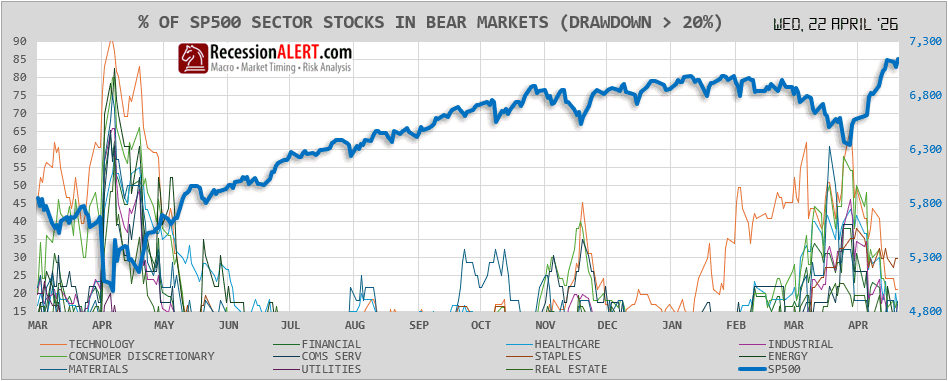
Chart of the Day: This has been one of the more unusual corrections in recent memory. Despite a full-blown war in Iran and all the attendant uncertainty, it unfolded without any of the traditional extreme-fear markers — no Lowry 90% down-days, for example — and nowhere near the magnitude of the April 2025 tariff-shock drawdown visible at the left of the chart. Participation in the selling was also unusually narrow: unlike the 2025 episode, where virtually every sector was dragged into bear-market territory, this time only a handful of sectors saw meaningful damage while others barely budged off the floor. Energy and Materials, for obvious commodity-linked reasons, were on a tear throughout. What IS interesting is the textbook slow rollover that preceded it. The headline index, being a weighted composite, can never truly roll over on its own — there is always a sector or two that takes the first dive and drags the rest along. On the chart above (available from PRO > DAILY CHARTS > BREADTH-B tab), that leader was unmistakably Technology (orange), which began pushing into bear-market territory in late January, weeks before the SP500 itself topped in March — the same pattern visible ahead of the 2025 correction. With nose-bleed multiples and AI stocks priced to perfection, Tech tends to get offloaded first when uncertainty mounts, making it a useful canary in the coal mine.
Market Intelligence Brief (MIB) Ver. 17.17
For professional investors only. Not investment advice.
© 2026 RecessionALERT.com

Comments are closed.