
S&P 500 and Nasdaq reversed off intraday record highs to close -0.41% / -0.57% as ServiceNow plunged 18% on a margin cut, snapping XLK’s 16-day streak. Trump ordered the Navy to “shoot and kill” Iranian boats in Hormuz; WTI spiked +4.35% to $97 as Brent held flat — a rare $9 spread. Meta cut 8,000 jobs and Microsoft launched its first-ever buyout (MSFT -3.97%) to fund AI capex. IBM -8.25% and AXP -4.31% on beat-and-fade; UNP +8.77%, CMCSA +7.73%. Intel crushed AMC. Spirit Airlines heads to court April 30 with 90% US government ownership on the table.
TABLE OF CONTENTS
A. EXECUTIVE SUMMARY
B. MARKET DATA
C. HIGH-IMPACT STORIES (5)
D. MODERATE-IMPACT STORIES (5)
E. ECONOMY WATCH (7)
F. EARNINGS WATCH (9)
G. WHAT’S NEXT
H. CHART OF THE DAY
A. EXECUTIVE SUMMARY -> TOP
MARKET SNAPSHOT:
Two forces collided to drag equities off fresh intraday records: a software-sector margin scare (ServiceNow -18%, XLK’s 16-day streak broken) and a renewed geopolitical oil shock as Trump ordered the Navy to “shoot and kill” Iranian boats in the Strait of Hormuz. The Fed’s dilemma is now acute — oil-driven Q2 PCE forecasts have drifted up to 3.7% just as the CFNAI prints -0.20 and Spirit Airlines heads to bankruptcy with a possible 90% federal equity stake, a stagflationary signature the Fed cannot cut into. Sector breadth was narrow-defensive: Utilities +2.52%, Industrials +1.44%, Consumer Defensive +1.35% led; Tech -1.39% and Consumer Cyclical -1.14% lagged — rate-sensitive names rallying while yields rose is a geopolitical-hedge signal, not rate optimism, and is the day’s most revealing positioning anomaly.
TODAY AT A GLANCE:
• Software sector cracked: ServiceNow -18% on a Q2 margin guide to 26.5% dragged MSFT -3.97%, ORCL -5.98%, PLTR -7.24%; IBM -8.25% after maintained-not-raised guidance.
• Hormuz escalation, WTI-only shock: WTI +4.35% to $97 while Brent closed flat at $106.43 — a ~$9 spread confirming a US-specific tanker-routing disruption, not a global supply event.
• AI-funded layoffs go mainstream: Meta cut 8,000 (10%) to fund a doubling of AI capex to ~$135B; Microsoft launched its first-ever voluntary buyout (~8,750 US employees).
• Beat-and-fade pattern: AXP -4.31%, TMO -9.20%, BX -5.70% all fell on clean beats without guidance raises — bar is now “beat-and-raise.” UNP +8.77% and CMCSA +7.73% rewarded for operational turnarounds.
• Stagflation signature in the tape: VIX +2.06%, 10Y +3.1 bps, 2Y +3.8 bps — bonds and equities sold off together; gold -0.93%, silver -3.23% with no safe-haven bid confirms the market priced Hormuz as a supply shock, not a systemic crisis.
• Intel AMC surprise: INTC Data Center & AI $5.05B (+22% YoY) crushed $4.41B consensus; non-GAAP EPS $0.29 vs $0.02 est — should extend the semi divergence versus software tomorrow.
KEY THEMES:
1. AI capex is now funded on the headcount line – Meta’s 10% cut and Microsoft’s unprecedented buyout on the same day mark the end of the 2024–2025 “AI adds jobs” narrative. With mega-cap tech week (GOOGL/MSFT/META/AMZN) approaching, AI-capex guidance — not revenue — will dictate multiples, and the software/semi divergence (XLK streak broken; SOXX on its 12th straight record) is the clearest expression of a tiered AI thesis favoring hardware over application-layer SaaS.
2. The oil shock is already rewriting corporate credit – Spirit Airlines’ nearing-90% federal ownership, the DJ Transportation’s -3.80% collapse, and the IEA’s “largest energy security threat in history” declaration are three independent signals that sustained crude above $100 is now cracking the weakest balance sheets before the macro data catches up. This is a faster transmission channel than PCE — watch JBLU, ULCC, and the ULCC-model carriers for sympathy moves.
3. Beat-and-raise is the new pricing minimum – AXP, TMO, IBM and BX all delivered clean top/bottom-line beats and still sold off because full-year guides were merely maintained. This reaction function — on a day with the heaviest earnings calendar of the quarter — means next week’s mega-caps must deliver upside surprises on both results AND forward guidance. Anything short of a raise risks disproportionate multiple compression against already-stretched valuations.
 — Leading economic indicators. Accurate market forecasts. Apply for membership at join.recessionalert.com
B. MARKET DATA -> TOP
Iran war uncertainty dominated Thursday, with the US interception of Iranian oil tankers in Asian waters pushing WTI crude up +4.35% while equity markets pulled back modestly. The session was a defensive rotation, not a broad selloff: Utilities (+2.52%), Industrials (+1.44%), and Consumer Defensive (+1.35%) gained as investors sought safety, while Technology (-1.39%), Basic Materials (-1.18%), and Consumer Cyclical (-1.14%) declined — 5 of 11 sectors closed green. The day’s defining anomaly was the WTI/Brent spread: WTI surged +4.35% while Brent closed nearly flat (-0.01%), signaling a US-specific crude routing disruption rather than a global demand shock. The DJ Transportation’s -3.80% collapse — against a DJIA decline of just -0.36% — was the clearest signal that surging oil costs are already pressuring freight and airline economics.
CLOSING PRICES – April 23, 2026:
MAJOR INDICES
The DJ Transportation’s -3.80% collapse against DJIA’s -0.36% decline is a textbook Dow Theory warning: transports are signaling that surging crude costs are already hitting freight and airline economics while the broader industrials component held. Nasdaq 100’s -0.57% underperformance confirmed tech drove the session’s equity drag — IBM’s -8.25% and software sector sentiment pulled the index below its major-index peers, while the S&P and Russell 2000 tracked closely, reflecting a tech-concentrated rather than market-wide story.
| Index | Close | Change | %Move | Why It Moved |
|---|---|---|---|---|
| S&P 500 | 7,108.33 | -29.57 | -0.41% | Iran war uncertainty + software earnings selloff (IBM -8.25%, ServiceNow -18%) partially offset by defensive sector gains |
| Dow Jones | 49,310.32 | -179.71 | -0.36% | Transport component drag from crude surge; broad index cushioned by industrials and defensives strength |
| Nasdaq 100 | 26,782.63 | -154.65 | -0.57% | IBM, MSFT, PLTR, ORCL sold off on earnings disappointments and software sector sentiment; tech-heavy index underperformed peers |
| Russell 2000 | 2,775.19 | -10.19 | -0.37% | Small-caps tracked large-cap direction; mild pullback without meaningful divergence — not a rotation away from small-caps |
| NYSE Composite | 22,952.74 | -49.04 | -0.21% | Broad market declined modestly; milder drop than S&P reflects defensive sector cushioning across the broad-market index |
VOLATILITY & TREASURIES
VIX +2.06% alongside 10Y yields rising +3.1 bps is an inflation-fear signature, not recession fear — in a recession scare bonds catch a bid and yields fall; today both equities and bonds sold off simultaneously, confirming the market is repricing energy-driven near-term inflation. The 2Y rising +3.8 bps outpacing the 10Y’s +3.1 bps marginally flattened the curve, reinforcing near-term inflation repricing from the oil shock rather than long-duration risk premium expansion; the DXY’s mild +0.26% gain was a contained safe-haven bid, not a dollar surge — fear is present but not acute.
| Instrument | Level | Change | Why It Moved |
|---|---|---|---|
| VIX | 19.31 | +0.39 (+2.06%) | Iran war geopolitical uncertainty lifted fear premium; sub-20 level signals elevated but not panic-level uncertainty |
| 10-Year Treasury Yield | 4.325% | +3.1 bps | WTI crude surge lifted inflation expectations; bonds sold off alongside equities — classic energy-driven stagflation concern |
| 2-Year Treasury Yield | 3.832% | +3.8 bps | Short end rose faster than long end — market repricing near-term inflation from the oil shock, not long-duration growth risk |
| US Dollar Index (DXY) | 98.77 | +0.25 (+0.26%) | Mild safe-haven dollar demand on Iran geopolitical escalation; modest gain reflects contained, not acute, risk-off positioning |
COMMODITIES
Gold, silver, and platinum all declined on a day with active geopolitical risk — the absence of any precious metals safe-haven bid confirms the Iran war news was priced as a known crude supply shock, not a new systemic event. Copper’s -1.69% adds an industrial demand concern layer, while Bitcoin’s -1.12% tracked equities lower with no crypto-specific catalyst, reinforcing its current role as a high-beta risk proxy rather than an uncorrelated safe haven.
| Asset | Price | Change | %Move | Why It Moved |
|---|---|---|---|---|
| Gold | $4,708.60/oz | -$44.40 | -0.93% | No safe-haven bid despite Iran tensions; profit-taking after prior session strength; market positioned Iran news as oil-supply shock, not systemic crisis |
| Silver | $75.445/oz | -$2.516 | -3.23% | Industrial demand concerns amplified the decline; silver’s dual precious/industrial nature drove a larger drop than gold |
| Copper | $6.0250/lb | -$0.1035 | -1.69% | Industrial demand caution; tracking global growth uncertainty amplified by Iran war’s impact on trade routes |
| Platinum | $2,017.70/oz | -$70.40 | -3.37% | Auto-catalyst metal under pressure; auto sector demand uncertainty combined with broad precious metals risk-off tone |
| Bitcoin | $77,896.00 | -$883.00 | -1.12% | Tracked equity risk-off session with no crypto-specific catalyst; currently functioning as high-beta risk proxy, not safe haven |
ENERGY
WTI’s +4.35% surge while Brent settled essentially flat is the session’s most anomalous signal — a spread of approximately $9 between benchmarks that normally trade within $2–3 confirms this is a US-specific crude routing disruption (Iranian tanker interceptions) rather than a global supply shock. Henry Hub’s -4.59% collapse on mild weather and ample storage, while European TTF rose +3.15% on geopolitical risk premium, means the two natural gas markets are pricing completely separate realities; the energy sector’s +0.74% gain is a muted response to a +4.35% WTI move, suggesting oil stock investors view the spike as short-lived.
| Asset | Price | Change | %Move | Why It Moved |
|---|---|---|---|---|
| Crude Oil (WTI) | $97.00/bbl | +$4.04 | +4.35% | US intercepted at least three Iranian oil tankers in Asian waters; supply routing disruption spiked US crude benchmark disproportionately |
| Crude Oil (Brent) | $106.43/bbl | -$0.01 | -0.01% | Global benchmark unaffected by US-specific tanker interception; WTI/Brent spread widened to ~$9 — a US supply disruption story, not a global crude shortage |
| Natural Gas (Henry Hub) | $2.597/MMBtu | -$0.125 | -4.59% | Mild spring weather + US storage 7% above 5-year average; fundamentally disconnected from crude’s geopolitical surge |
| Natural Gas (Dutch TTF) | $15.38/MMBtu | +$0.47 | +3.15% | European gas rose on broader Middle East/Iran energy risk premium; diverging sharply from Henry Hub’s weather-driven decline |
S&P 500 SECTORS
Technology’s -1.39% worst daily performance sharply inverts its 1-week leadership (+2.56%) — post-earnings software selling (IBM, ServiceNow) compressed the sector in a single session, though the 58.61% 12-month lead suggests structural damage is unlikely. The day’s most analytically telling signal: rate-sensitive Utilities (+2.52%) and Real Estate (+0.94%) outperformed on a day when yields rose +3 bps — investors bought these sectors as a geopolitical hedge, not on rate optimism, a positioning anomaly that runs against fundamental logic and warrants monitoring if it persists into Friday.
| Sector | 1-Day | 1-Week | 1-Month | 3-Month | 6-Month | YTD | 12-Month |
|---|---|---|---|---|---|---|---|
| Utilities | +2.52% | -0.36% | +3.34% | +7.28% | +3.79% | +8.91% | +22.09% |
| Industrials | +1.44% | +2.22% | +7.36% | +5.44% | +14.51% | +14.52% | +45.03% |
| Consumer Defensive | +1.35% | +2.41% | +3.71% | +2.80% | +7.22% | +8.64% | +5.94% |
| Real Estate | +0.94% | +0.33% | +8.13% | +4.95% | +3.28% | +7.51% | +8.94% |
| Energy | +0.74% | +0.29% | -3.70% | +20.10% | +34.65% | +29.62% | +44.64% |
| Communication Services | -0.54% | -0.97% | +10.22% | +1.80% | +7.20% | +2.30% | +49.18% |
| Healthcare | -0.55% | -0.95% | +2.37% | -6.81% | +1.76% | -3.94% | +12.91% |
| Financial | -0.83% | -0.92% | +5.96% | -3.44% | +2.07% | -3.24% | +18.04% |
| Consumer Cyclical | -1.14% | -0.34% | +8.08% | -4.97% | -2.72% | -2.32% | +25.35% |
| Basic Materials | -1.18% | -1.35% | +10.05% | +1.77% | +26.59% | +16.84% | +53.86% |
| Technology | -1.39% | +2.56% | +13.91% | +7.53% | +5.32% | +7.32% | +58.61% |
TOP MEGA-CAP MOVERS:
Selection criteria: US-listed companies with market cap above $200 billion that moved ±1.5% or more during the session. Movers are ranked by percentage change and capped at 5 gainers and 5 decliners. On muted trading days when fewer than 3 names meet the threshold, the largest moves are shown regardless. Moves driven by earnings, M&A, analyst actions, sector rotation, or macro catalysts are prioritized over low-volume or technical moves.
GAINERS
| Company | Ticker | Close | Change | Why It Moved |
|---|---|---|---|---|
| Texas Instruments | TXN | $282.23 | +19.43% | Q1 earnings (AMC Apr 22) crushed estimates on chip demand recovery; strong revenue and forward guidance lifted the stock sharply |
| NextEra Energy | NEE | $96.25 | +6.94% | Q1 EPS $1.09 beat vs $0.94 est (+16%); record quarterly renewable project origination — 4 GW signed including 1.3 GW storage |
| Caterpillar | CAT | $835.24 | +3.26% | Industrials sector rally on energy capex and infrastructure themes; crude surge supports oil-field heavy equipment demand |
| Philip Morris International | PM | $169.19 | +3.20% | Defensive rotation into consumer staples on Iran war uncertainty; tobacco as classic recession/risk-off defensive play |
| T-Mobile US | TMUS | $194.07 | +2.73% | Telecom’s defensive characteristics attracted risk-off rotation; standout Communication Services gainer on a sector-down day |
DECLINERS
| Company | Ticker | Close | Change | Why It Moved |
|---|---|---|---|---|
| IBM | IBM | $231.08 | -8.25% | Q1 rev $15.92B (+1.9% beat), EPS $1.91 (+5.5% beat), Z mainframe +51%; but full-year guidance merely maintained (not raised) — sell-the-news reaction |
| Palantir Technologies | PLTR | $141.57 | -7.24% | Enterprise software caught in sector-wide selloff following IBM and ServiceNow earnings disappointments; AI premium compressing |
| Oracle | ORCL | $176.28 | -5.98% | Tech/software sector collateral damage; no company-specific catalyst but software sentiment deteriorated broadly on IBM/NOW results |
| American Express | AXP | $318.55 | -4.31% | Q1 EPS $4.28 beat vs $4.00 est (+7%), revenue $18.91B beat; but full-year guidance reaffirmed (not raised) — sell-the-news reaction after strong YTD run |
| Microsoft | MSFT | $415.75 | -3.97% | Tech selloff on software sentiment; pre-earnings positioning ahead of mega-cap week (Apr 28); no company-specific catalyst |
— Institutional-grade intelligence for serious investors. Apply for membership at join.recessionalert.comC. HIGH-IMPACT STORIES -> TOP
BEARISH
1. S&P 500 and Nasdaq Reverse Off Intraday Record Highs to Close Sharply Lower
The core facts:The S&P 500 printed a fresh intraday all-time high of 7,147.52 and the Nasdaq Composite reached 24,613.80 before a late-day reversal dragged both indices into the red. The S&P 500 closed down 0.4% at 7,108.40 and the Nasdaq fell 0.9% to 24,438.50. The reversal was driven almost entirely by a software-sector collapse after ServiceNow’s Q1 guidance disappointment, compounded by a late-session rally in crude that reignited risk-off flows.
Why it matters:Intraday-high reversals that close negative are a classic technical exhaustion signal and often mark near-term inflection points. The reversal came on a day featuring the heaviest earnings calendar of the quarter and fresh geopolitical risk — a combination that institutional desks typically read as distribution rather than healthy consolidation. With Big Tech week (GOOGL, MSFT, META, AMZN) now approaching, the technical damage raises the stakes for those AI-capex guides.
What to watch:Watch whether S&P 500 holds 7,075 (prior swing support) and whether XLK (Technology Select) can retake its broken 20-day moving average on Friday. A failure to recover through Monday’s open would confirm distribution.
BEARISH
2. Trump Orders Navy to “Shoot and Kill” Iranian Boats in Strait of Hormuz; Brent Crude Surges to $105
The core facts:President Trump publicly ordered the U.S. Navy to “shoot and kill” any Iranian small boats laying mines in the Strait of Hormuz, following reports that Iran fired on three commercial vessels and seized two on Wednesday. Brent crude climbed 3.1% to above $105/barrel — its fourth consecutive gain. U.S. Central Command has directed 31 vessels to turn around or return to port since the April 13 blockade. Trump declared the U.S. has “total control” over the waterway, which normally carries 20% of global traded oil.
Why it matters:The rules-of-engagement escalation materially raises the probability of a direct U.S.-Iran kinetic exchange and removes any near-term path to de-escalation. Energy-shock risk is now re-pricing into the curve: every $10 sustained Brent rally typically adds ~30 bps to U.S. headline CPI over six months and is historically associated with consumer-discretionary underperformance. The Fed cannot cut into a supply shock, cementing the “higher-for-longer” thesis already priced into the 2026 rate path.
What to watch:Watch Brent for a decisive break above $108 (prior 2026 high) which would open the path to $120, and the 10Y breakeven inflation rate for a move above 2.60% signaling a durable inflation re-acceleration.
UNCERTAIN
3. Meta to Cut 10% of Workforce (~8,000 Jobs) to Offset Doubling of AI Spending
The core facts:Meta Platforms confirmed in an internal memo sent Thursday that it will cut approximately 8,000 employees — 10% of its workforce — with layoffs effective May 20. The company will also leave 6,000 previously authorized open roles unfilled. Chief People Officer Janelle Gale framed the cuts as efficiency measures “to offset the other investments we’re making” — namely a doubling of 2026 AI spending to roughly $135 billion from $72 billion in 2025.
Why it matters:This is the single-largest Meta layoff since the “year of efficiency” cuts of 2023 and signals that even mega-caps with peerless cash flow are now forced to cannibalize opex to fund AI capex. For the broader S&P 500, the pattern established by Meta today and Microsoft (below) is a reversal of the 2024-2025 “AI adds jobs” narrative — margin compression from capex is now being absorbed on the headcount line. The Q1 earnings call on April 29 will now be dominated by AI-ROI questions rather than the usual ad-revenue cadence.
What to watch:Watch Meta’s April 29 Q1 print specifically for updated 2026 capex guidance and any revision to the $135B figure. A further increase would amplify the layoff-justification narrative; a reduction would raise questions about demand.
UNCERTAIN
4. Microsoft Launches First-Ever Voluntary Buyout Program for Up to 7% of U.S. Workforce
The core facts:Microsoft announced its first voluntary retirement program in its 51-year history, eligible to approximately 8,750 U.S. employees (~7% of the ~125,000 U.S. headcount). Eligibility is limited to workers at senior-director level and below whose age plus years of service equal 70 or more; sales-incentive-plan employees are excluded. Eligible employees will be notified May 7 and have 30 days to decide. Microsoft stock fell 4% on the news. The program was explicitly framed by the company as cost containment amid its massive AI-infrastructure buildup.
Why it matters:That Microsoft — long the most disciplined mega-cap operator — is breaking a half-century precedent to offer buyouts speaks volumes about the scale of the AI-capex funding problem. Unlike forced layoffs, voluntary programs preserve morale but typically lose more high-performers than desired, creating execution risk just as Azure enters a capacity-constrained phase. Combined with Meta’s cuts announced the same day, this establishes “AI-funded headcount reduction” as the dominant Q2 mega-cap theme.
What to watch:Watch Microsoft’s April 29 Q3 FY26 earnings call for Azure capacity/capex commentary and any quantification of severance-program cost in the Q4 guide.
BEARISH
5. Software Sector Slump Snaps XLK’s 16-Day Winning Streak in Broad-Based Sell-Off
The core facts:The Technology Select Sector SPDR ETF (XLK) ended its 16-day winning streak as software names cascaded lower following ServiceNow’s Q1 guidance disappointment (see Section F). The software complex saw broad-based selling — Microsoft -4%, Salesforce, Adobe, Workday and Oracle all finished materially lower as institutional rotation out of high-multiple SaaS names accelerated. The sector drag was the primary driver of the Nasdaq’s 0.9% decline after an intraday record.
Why it matters:XLK’s 16-day winning streak was the longest since 2024 and had carried the sector to valuations roughly 3 turns above the 5-year average forward P/E. A single mid-cap-scale guide cut (NOW’s margin trim) triggering broad sector re-rating is the classic signature of a crowded trade. With roughly $10 trillion of mega-cap tech earnings due next week (GOOGL/MSFT/META/AMZN), today’s reaction function demonstrates that beat-and-raise has become the pricing minimum — anything less risks disproportionate multiple compression.
What to watch:Watch the XLK/SPY relative-strength line — a break below its 50-day moving average would confirm a sector-leadership rotation out of software for the first time in 2026.
— Quantifying recession risk so you don’t have to guess. Apply for membership at join.recessionalert.comD. MODERATE-IMPACT STORIES -> TOP
BULLISH
6. Semiconductor ETF (SOXX) Posts 12th Consecutive Intraday Record in Historic 17-Day Run
The core facts:The iShares Semiconductor ETF (SOXX) notched its 12th consecutive intraday all-time high on Thursday, extending what is now a 17-day advance — the longest uninterrupted streak in the ETF’s history. Semis diverged sharply from software today: while SaaS names collapsed, the semiconductor complex continued to rally on sustained AI-datacenter-capex commentary and Intel’s strong Q1 print (see Section F).
Why it matters:The semi/software divergence is signaling a tiered AI thesis — investors continue to back hardware enablers while rotating out of application-layer software where monetization timelines remain unclear. Historic streak durations rarely survive past day 20 without a 3-5% reset, so the risk/reward is tightening. Next week’s mega-cap capex guides (GOOGL/MSFT/AMZN) are the key input for whether the semi rally extends or resets.
What to watch:Watch SOXX for its first close below the 10-day EMA as the first meaningful tell of streak exhaustion.
UNCERTAIN
7. Canadian PM Carney Signals Tough Stance Ahead of U.S. Trade Renegotiation
The core facts:Canadian Prime Minister Mark Carney publicly stated that Canada “will not let the U.S. dictate terms” in upcoming high-stakes free-trade negotiations, citing ongoing “trade irritants right in front of us.” The statement came alongside continuing Canadian consumer boycotts of U.S. goods that provincial leaders describe as materially impacting cross-border commerce.
Why it matters:Canada is the U.S.’s largest trading partner (~$900B/year bilateral). A prolonged renegotiation under adversarial posture re-introduces USMCA-style tail risk to auto, energy and agricultural supply chains — sectors already navigating steel/aluminum tariff revisions. Carney’s hard-line framing suggests the negotiation will run into Q3 2026 rather than resolve quickly.
What to watch:Watch for a formal negotiating framework announcement and any retaliatory tariff commentary from either side over the next two weeks.
BULLISH
8. Federal Bank Regulators Finalize Modifications to Community Bank Leverage Ratio
The core facts:The Federal Reserve, OCC, and FDIC jointly finalized a rule modifying the Community Bank Leverage Ratio (CBLR) framework to align the capital requirement with the size, risk profile, and business model of community banks. The revised rule provides smaller institutions with greater flexibility and reduces regulatory reporting burden.
Why it matters:Community and regional banks have been under sustained pressure since the 2023 regional-bank episode. A targeted capital-framework easing — coming from all three agencies jointly — signals a measurable rotation in regulatory posture and is modestly positive for regional bank earnings power and credit-availability-to-SMB. The KRE regional-bank ETF tends to respond positively to capital-framework softening announcements.
UNCERTAIN
9. Commerce Department Finalizes Steel & Aluminum Submission Procedures for Tariff Exemptions
The core facts:The Department of Commerce published final procedures in the Federal Register establishing the submission framework for steel and aluminum producers committing to new U.S. production capacity as a condition for tariff exemption. The rule provides a formal documentation path for domestic producers to avoid specific tariff penalties by making verifiable capacity commitments.
Why it matters:Formalizing the exemption process removes a key source of uncertainty for metals-intensive industries (autos, construction, defense). However, the capacity-commitment requirement sets a high bar that only larger producers can realistically meet, accelerating industry consolidation. Downstream users of domestic steel/aluminum (FCX, NUE, AA, X) face divergent outcomes depending on their ability to document commitments.
What to watch:Watch for the first company-specific exemption grant announcement, which will establish the effective benchmark for compliance.
BEARISH
10. IEA Declares Hormuz Closure the “Largest Energy Security Threat” in History
The core facts:The International Energy Agency issued a formal statement describing the combined Middle East war and Strait of Hormuz closure as the largest energy security threat the world has ever faced. The declaration accompanies the agency’s sharpest-ever upward revision to its medium-term price outlook and a call for coordinated strategic-reserve releases by member nations.
Why it matters:The IEA’s language is historically unprecedented — prior peak-threat declarations (1973, 1990, 2022) all corresponded to sustained 40%+ crude rallies. A coordinated SPR release would partially offset near-term price pressure but would also exhaust the buffer needed if the conflict widens further. The institutional investor takeaway: duration-sensitive assets face a binary path — contained escalation allows the Fed’s current stance; widening triggers stagflationary policy paralysis.
What to watch:Watch for a formal coordinated SPR release announcement from IEA members within the next 7-10 days, which would confirm severity assessment.
— Separating signal from noise since 2007. Apply for membership at join.recessionalert.comE. ECONOMY WATCH -> TOP
The week’s data split along a stagflationary seam: labor held firm — initial claims at 214K and ADP’s pulse showing private payrolls still advancing — while hard activity cracked, with the Chicago Fed National Activity Index at -0.20 and Kansas Fed Manufacturing sliding to 10. The Fed path is the dominant tension: Warsh’s Senate testimony telegraphed a framework overhaul just as oil-shock-driven PCE forecasts lift to 3.7% for Q2. Markets still price a soft landing (Polymarket recession odds 27%, ≥1 cut at 60%), but the institutional backdrop — Spirit Airlines nearing 90% government ownership — suggests the Mideast energy shock is already reshaping corporate solvency faster than rate expectations.
Initial Jobless Claims Edge Up to 214K While Continuing Claims Reach 1,821K (DOL/BLS, April 23)
What they’re saying:Initial jobless claims for the week ending April 18 rose to 214K, a modest miss versus the 212K consensus and up from a revised 208K the prior week. Continuing claims climbed to 1,821K (week ending April 11), a 12K increase from the prior week’s 1,809K and slightly above the 1,820K estimate. The four-week moving average on initial claims held at 210.75K.
The context:The layoff side remains historically tame — initial claims have now held in a 200–220K band for nine consecutive weeks, consistent with a stable “low-hire, low-fire” labor regime. But the drift higher in continuing claims to a cycle high is the watch item: workers losing jobs are taking longer to find new ones, matching the softer ADP and JOLTS signals from earlier in the month.
What to watch:April Nonfarm Payrolls (scheduled for release early May) — a material deceleration in monthly hiring would move the continuing claims narrative from “slow rehire” to “softening demand.”
Chicago Fed National Activity Index Prints -0.20 for March, Signaling Below-Trend Growth (Chicago Fed, April 23)
What they’re saying:The Chicago Fed National Activity Index (CFNAI) fell to -0.20 for March from a revised +0.03 in February. The index’s three-month moving average tilted negative as production-related indicators deteriorated most; 52 of 85 underlying components contributed negatively.
The context:A CFNAI reading of zero corresponds to the economy’s historical trend growth rate. At -0.20, March is the weakest print of 2026 and pulls the broader CFNAI-MA3 gauge closer to the -0.70 threshold the Chicago Fed flags as a recession signal. The drag is concentrated in industrial production and hours worked — coincident with the S&P Global flash manufacturing employment contraction flagged in yesterday’s report.
What to watch:The CFNAI-MA3 threshold of -0.70 — a breach would be the cleanest hard-data confirmation that Q2 growth is tracking below trend.
Kansas City Fed Manufacturing Index Slips to 10 in April (Kansas City Fed, April 23)
What they’re saying:The Kansas City Fed Tenth District Manufacturing Survey composite index eased to 10 in April from 11 in March. The Composite Index also printed at 10, indicating continued but slowing expansion across production, new orders, and shipments.
The context:The reading is the third consecutive month of positive — but decelerating — regional manufacturing expansion, diverging from the S&P Global Flash Manufacturing PMI at 54.0 (a near four-year high) flagged yesterday. The divergence reflects the split inside manufacturing: national surveys capture tariff-driven front-running and inventory build, while regional surveys like Kansas City and Dallas more faithfully measure underlying order momentum.
What to watch:May release of the Dallas Fed and Richmond Fed manufacturing surveys — a cluster of regional indices below 10 would challenge the national PMI narrative.
ADP Employment Pulse Shows Private Payrolls Adding ~55K/Week Through Early April (ADP, April 23)
What they’re saying:ADP’s preliminary weekly employment estimate shows private employers adding an average of 54,750 jobs per week for the four-week period ending April 4. The pace is consistent with a monthly NFP run-rate in the 180–220K range if sustained through April.
The context:The ADP Pulse is the highest-frequency labor signal the Fed has and its steadiness argues against the “labor cliff” narrative recession commentators are circulating. Combined with jobless claims still in the low-210Ks, the layoff/hiring balance remains far closer to “stable” than “rolling over” — a meaningful input for FOMC participants weighing whether the next rate move is a cut or a pause.
What to watch:April ADP monthly report (first week of May) — any break below a 150K monthly print would flag a genuine step-down in private hiring.
Warsh Telegraphs Fed “Regime Change” on Inflation Framework in Senate Hearing (Bloomberg/WSJ, April 23)
What they’re saying:Fed Chair nominee Kevin Warsh emerged from Monday’s Senate Banking Committee hearing with his “regime change” plan intact, and follow-up commentary today previewed a major “data project” to reconcile official inflation metrics with household-level experience. Warsh publicly favored a trimmed-mean inflation gauge over core PCE, emphasized Fed independence (“won’t be Trump’s sock puppet”), and argued the Fed needs a new framework for dealing with inflation.
The context:A framework overhaul is institutionally significant — it reopens the debate over which inflation measure the Fed targets, how aggressively it responds to supply shocks (like the current oil spike), and how it interprets expectations data. For markets, the uncertainty is binary: a trimmed-mean regime could signal earlier cuts if headline PCE is dismissed as oil-shock noise, or later cuts if the trimmed measure reveals embedded services inflation the core-PCE narrative is under-weighting.
What to watch:Senate Banking Committee confirmation vote (expected early May) and any follow-up speeches from Warsh that define the trimmed-mean threshold he considers Fed-target-consistent.
Spirit Airlines Nears $500M Rescue With Up to 90% Government Ownership; Bankruptcy Hearing Set for April 30 (CNBC/Bloomberg, April 23)
What they’re saying:Spirit Airlines’ bankruptcy counsel told the court today that existing cash is “not going to last for very much longer” as the Trump administration’s $500 million rescue package advances, with terms including warrants for up to 90% government ownership of the post-bankruptcy entity. A court hearing on April 30 will rule on the proposed terms, and congressional Republicans have publicly criticized the deal.
The context:A 90% federal stake in a US airline would be the largest direct equity intervention in a private carrier since the post-9/11 period and signals the depth of the Middle East oil-shock impact on discount carriers most exposed to jet-fuel volatility. The precedent matters: it telegraphs that federal bailouts may become a policy tool for oil-shock casualties, increasing moral hazard in an already stretched transport credit complex.
What to watch:April 30 bankruptcy court hearing; also watch credit spreads on JetBlue (JBLU), Frontier (ULCC), and other ULCC-model carriers for sympathy moves.
Oil-Shock-Driven PCE Forecasts Lift to 3.7% for Q2 as Iran-US Standoff Pushes Crude Above $100 (Reuters/Fed, April 23)
What they’re saying:Market consensus for Q2 2026 headline PCE inflation has been revised up to 3.7%, roughly 90 basis points above the Fed’s 2% target, driven almost entirely by oil prices holding above $100/bbl amid the prolonged Iran-US standoff. Governor Waller’s April 17 remarks framed “underlying inflation ex-tariffs” as still near target, while Chair Powell has cited the “oil shock” as the primary 2026 inflation driver.
The context:A 3.7% headline PCE print — even if viewed as supply-driven — would complicate any dovish pivot from the FOMC, because surveyed inflation expectations (Michigan 5-year at 3.4%, tomorrow’s release) show households struggle to separate “energy shock” from “broad inflation.” The Fed’s dilemma is timing: cut into the oil-shock and risk un-anchoring expectations, or hold and risk tipping below-trend growth deeper into CFNAI-negative territory.
What to watch:April 24 Michigan Consumer Sentiment Final (Inflation Expectations 1Y est. 4.8%, 5Y est. 3.4%) — a 5-year print at or above 3.5% would confirm expectations are drifting, materially raising the bar for 2026 rate cuts.
— Know the probability before the market prices in the risk. Apply for membership at join.recessionalert.comF. EARNINGS WATCH -> TOP
Selection criteria: This section covers only market-moving earnings from mega-cap companies (>$100B market cap) with sector significance or systemic implications. The S&P 500 scorecard above tracks all 500 index components, but individual stories below focus on names large enough to move markets and provide economic signals relevant to US large-cap portfolio managers. On any given day, 30-80+ companies may report earnings, but MIB filters for the 2-5 names most relevant to institutional investors.
YESTERDAY AFTER THE BELL (Markets Reacted Today)
UNCERTAIN
11. Tesla (TSLA): -2% | EPS Beats, Revenue Beats, But Inventory and Energy Storage Raise Structural Questions
The Numbers:Released: AMC (April 22). EPS $0.41 vs. $0.37 consensus (+10.8% beat). Revenue $22.39B beat by ~16% YoY but came in below the $22.64B specific analyst estimate. Q1 deliveries 358,023, missing consensus by ~7,600 units. Inventory built by 50,000+ units (27 days of supply, up from 15 days in Q4). Energy storage deployment 8.8 GWh, down 38% sequentially from 14.2 GWh and well below 14.4 GWh consensus. Company guided full-year capex $5B above prior guidance.
The Problem/Win:The EPS beat masked deteriorating unit economics. The 50k-vehicle inventory build points to a demand problem, not logistics — and energy storage, the one line bulls had been pointing to as structural offset, collapsed ~40% below expectations. The capex increase of $5B above prior guidance compounded the concern on the call.
The Ripple:Initial +4% extended-hours gain reversed fully as the capex guide emerged; TSLA closed today down approximately 2%. EV suppliers and battery-chemistry names (ALB, LAC) underperformed in sympathy.
What It Means:The AI/robotaxi narrative is now the only remaining support for the valuation multiple. Core auto and energy-storage economics are both deteriorating simultaneously — a configuration that historically compresses forward multiples materially.
What to watch:Watch Q2 delivery guidance (due early July) and Tesla’s first quantified robotaxi-revenue disclosure, expected mid-year.
UNCERTAIN
12. IBM (IBM): -6% AH | Double Beat Offset by Maintained (Not Raised) Full-Year Guidance
The Numbers:Released: AMC (April 22). Revenue $15.92B vs. $15.62B est. (+1.9% beat, +9% YoY). Adjusted EPS $1.91 vs. $1.81 est. (+5.5% beat). Z mainframe hardware +51% YoY; infrastructure segment $3.33B vs. $3.16B StreetAccount consensus. Software growth outlook boosted to 10%+ for full year. Full-year guidance reaffirmed at constant-currency revenue growth of 5%+ and $1B free-cash-flow growth — but not raised.
The Problem/Win:The z17 mainframe cycle is outperforming all prior cycles — fourth consecutive quarter of >100% new-MIPS growth. However, the decision not to raise full-year guide despite clean beats signaled management caution on the consulting pipeline (GenAI backlog penetration ~30%). After-hours reaction was sharp: -6%.
The Ripple:Legacy-enterprise peer read-across was negative: ORCL and ACN traded defensively into the close. Mainframe-supply-chain names (LRCX cluster) were insulated given the z17 strength.
What It Means:Classic “beat-and-fade” — investors priced in a raise that did not come. For IBM specifically, the consulting-acceleration narrative requires a meaningful Q2 print to re-establish credibility.
BEARISH
13. ServiceNow (NOW): -18% | Margin Guidance Cut Triggers Software Sector Sell-Off
The Numbers:Released: AMC (April 22). Subscription revenue $3.671B, +22% YoY. Non-GAAP operating margin 32% (+100 bps YoY). Q1 EPS beat by $0.02. However, full-year 2026 non-GAAP operating margin guided to 31.5% (below prior expectation) — Armis acquisition cited for ~75 bps of headwind. Q2 operating margin guided to just 26.5% (125 bps Armis headwind). Q2 subscription revenue guide $3.815-$3.820B (+21-21.5% YoY). Stock closed down approximately 18% today.
The Problem/Win:Evercore described the guide as “likely to play into the bear narrative.” A ~400 bps sequential compression in Q2 operating margin — even with M&A attribution — was the largest single-quarter degradation in the company’s post-IPO history. Management could not quantify when Armis integration headwinds would fully anniversary, leaving forward-margin visibility impaired.
The Ripple:Single largest contributor to today’s XLK reversal and 16-day streak break. Broad SaaS complex declined: MSFT -4%, CRM, ADBE, WDAY, ORCL all materially lower. Institutional desks began rotating out of high-multiple SaaS into semiconductors and cash.
What It Means:The software sector’s margin-expansion thesis is now impaired. With Big Tech results next week, the risk is that any Azure/GCP/AWS margin softness amplifies a broad multiple reset across the complex.
What to watch:Watch peer reporting sequence — CRM (late May) and ADBE (mid-June) guides will either reinforce or reverse today’s rotation.
TODAY BEFORE THE BELL (Markets Already Reacted)
UNCERTAIN
14. American Express (AXP): -4.31% | Beat and Reaffirm Guide, Yet Stock Falls on Premium-Saturation Concerns
The Numbers:Released: BMO. Revenue $18.91B vs. $18.61B est. (+1.60% beat). EPS $4.28 vs. $4.00 est. (+6.89% beat, +18% YoY). Net income $2.97B, +15% YoY. Billed business +10%; FX-adjusted Card Member spending +9% — highest quarterly growth in three years. Full-year 2026 guidance reaffirmed at 9-10% revenue growth and EPS of $17.30-$17.90.
The Problem/Win:A clean double-beat with robust premium engagement and raised-expectation billings — yet stock fell 4.31%. The market appears to have priced in a guidance raise that did not materialize and is questioning whether premium-card spending growth has peaked. Goldman Sachs reiterated Buy, noting the sell-off looked overdone.
The Ripple:Consumer-finance peers (V, MA, COF, DFS) traded mixed. The broader tape read AXP’s move as a tell on premium-consumer health rather than a company-specific issue.
What It Means:The reaction is a clean example of beat-and-fade under peak expectations — a pattern likely to repeat through the remainder of Q1 earnings season given the bar is now “beat-and-raise.”
UNCERTAIN
15. Thermo Fisher (TMO): -9.20% | Revenue Beat and Guidance Raise Overshadowed by Organic-Growth Miss
The Numbers:Released: BMO. Revenue $11.01B vs. $10.86B est. (+1.29% beat). Adjusted EPS $5.44 vs. $5.25 est. (+3.65% beat). GAAP EPS $4.43 missed $4.54 est. (-2.45%). Organic revenue growth of just 1% vs. 1.2% forecast. Full-year 2026 guidance raised: revenue $47.3-$48.1B (from $46.3-$47.2B); adjusted EPS $24.64-$25.12 (8-10% rise vs. 2025).
The Problem/Win:Headline beat and a raised full-year guide, yet stock -9.20%. The market focused on the 1% organic growth figure — the lowest in multiple quarters — suggesting core demand across life-sciences tools and bioproduction is softer than headline optics imply. Inorganic contribution is masking underlying weakness.
The Ripple:Life-sciences tools peers weakened: DHR, A, MTD, WAT all closed lower in sympathy. Bioprocessing read-through was negative.
What It Means:The 9%+ decline on a headline beat is a warning signal for the broader life-sciences-tools complex, and reinforces that sub-2% organic growth is unacceptable at current sector multiples.
BULLISH
16. Union Pacific (UNP): +8.77% | Strong Pricing Power Offsets Volume Decline; Norfolk Southern Merger Advances
The Numbers:Released: BMO. Revenue $6.2B (+3% YoY). EPS $2.87 (GAAP) vs. $2.84 est. (+0.92% beat); adjusted EPS $2.93 vs. $2.86 est. (+2.41% beat, +9% ex-merger costs). Volume -1%; core pricing/mix contributed +325 bps to freight revenue, offsetting -75 bps volume drag. Operating ratio 59.9% (-80 bps). Norfolk Southern revised merger application filing due April 30; deal closing expected 2027.
The Problem/Win:Pure pricing-power story — despite declining volumes, mix and disciplined pricing delivered revenue growth and a better operating ratio. The +8.77% stock response reflects both the clean beat and progress on the Norfolk Southern deal.
The Ripple:Rail peers (CSX, NSC, CP) traded higher; transport-sector ETF (IYT) was among the day’s outperformers. Capital-goods read-through was modestly positive.
What It Means:UNP’s pricing-discipline execution confirms the industry’s operating-leverage upside if the merger closes on 2027 timeline. The transport sector broadly provides a cyclical counterweight to software-sector weakness.
What to watch:Watch the April 30 revised merger filing and any STB pre-clearance signals.
UNCERTAIN
17. Blackstone (BX): -5.70% | Record $1.3T AUM and 25% DE Growth, But Stock Drops on Forward-Deployment Concerns
The Numbers:Released: BMO. Distributable earnings $1.8B, $1.36/share (+25% YoY); vs. $1.34 est. (+1.67% beat). GAAP EPS $0.83 vs. $1.31 est. (-36.64% miss). Revenue $3.43B vs. $3.41B est. (+0.73% beat). Total AUM record $1.3T (+12% YoY); fee-earning AUM $937.6B (+9%). Q1 inflows $69B; LTM inflows nearly $250B. Fee-related earnings +23%; net realizations +26%. Dividend $1.16/share declared.
The Problem/Win:Record AUM and strong distributable earnings offset by concerns that the market-volatility environment will delay realization activity and new-deal deployment. The GAAP miss (-36.64%) on mark-to-market was the immediate catalyst for the -5.70% move.
The Ripple:Alt-asset peers (KKR, APO, ARES) all traded lower in sympathy; BDC complex softened.
What It Means:The sell-off on a record-AUM print reflects peak-cycle anxiety about deployment velocity. The fee-engine remains intact but forward realization visibility is now impaired.
BULLISH
18. Comcast (CMCSA): +7.73% | Broadband Losses Shrink Dramatically; NBC Sports and Wireless Drive Beat
The Numbers:Released: BMO. Revenue $31.46B vs. $30.41B est. (+3.43% beat, +10.9% YoY). Non-GAAP EPS $0.79 vs. $0.72 est. (+9% beat). Adjusted EBITDA $7.93B vs. $7.74B est. (+2.4% beat). Residential broadband net-losses only -65,000 vs. -173,700 expected and -183,000 YoY. Record mobile-line additions of 435,000 during the quarter. Peacock expected to approach profitability in Q2 for first time ever.
The Problem/Win:The broadband-subscriber number is the cleanest positive inflection the business has posted in years — losses came in at barely a third of consensus. NBC’s February sports calendar (including Super Bowl) contributed materially. The Peacock path-to-profitability announcement removes a long-standing overhang.
The Ripple:Cable peers (CHTR) traded higher; streaming peers (DIS, WBD, PARA) had mixed reactions. Tower names (AMT, CCI) saw modest support.
What It Means:Comcast is the quarter’s clearest “turnaround confirmation” story. Broadband-stabilization plus wireless-momentum plus Peacock-profitability is the trifecta bulls have waited on.
What to watch:Watch Q2 broadband net-add reporting (late July) — a return to positive territory would be a structural re-rating catalyst.
TODAY AFTER THE BELL (Markets React Tomorrow)
BULLISH
19. Intel (INTC): AMC | Massive EPS Beat on Data Center/AI Strength; Q2 Guide Encouraging
The Numbers:Released: AMC. Revenue $13.6B (+7% YoY); non-GAAP EPS $0.29 vs. $0.02 est. (massive beat; GAAP was -$0.14 est., reported -$0.73 due to $4.1B Mobileye goodwill impairment and restructuring charges). Data Center and AI $5.05B (+22% YoY) crushed $4.41B consensus. Client Computing $7.7B (+1%). Foundry revenue $5.4B (+16% YoY, though much is captive). Q2 guide: revenue $13.8-$14.8B; GAAP EPS $0.08; non-GAAP EPS $0.20.
The Problem/Win:The Data Center and AI segment beat of $640M above consensus is the cleanest confirmation yet that Intel’s AI-accelerator and Xeon 6+ cycles are gaining traction against NVDA hyperscaler concentration. The Mobileye impairment is a backward-looking one-time charge; ex-impairment numbers are strongly positive.
The Ripple:Initial extended-hours reaction strongly positive. Semi peers (AMD, MU) should see positive read-through at tomorrow’s open. SOXX streak (see story 6) likely extends to day 18.
What It Means:Confirms the AI hardware thesis and validates the tiered rotation visible today (semis up, software down). Intel re-establishes itself as a genuine data-center-AI player, not just a client-PC residual.
What to watch:Watch tomorrow’s open reaction and the AI-accelerator revenue breakout on the 10-Q; a >$2B quarterly run-rate would reset forward estimates materially higher.
WEEK AHEAD PREVIEW:
Q1 2026 earnings season is still early (~10% reported) but set to accelerate dramatically next week with Mega-Cap Tech Week. AI-capex guidance will be the single most consequential data point for the entire market.
Procter & Gamble (PG) — BMO, Friday April 24 — Consumer-staples bellwether; consensus EPS $1.56, revenue $20.53B. Watch organic growth and pricing-vs-volume mix for read on premium-consumer health.
HCA Healthcare (HCA) — BMO, Friday April 24 — Largest hospital operator; consensus EPS $7.12, revenue $19.09B. Watch same-facility admissions growth and labor-cost trend.
Alphabet (GOOGL) — Week of April 28 — Cloud growth and AI-infrastructure capex disclosure; Google Cloud operating margin trajectory.
Microsoft (MSFT) — Week of April 28 — Azure capacity and capex commentary; impact of today’s voluntary buyout program on near-term cost structure.
Meta Platforms (META) — Week of April 28 — Updated 2026 AI capex guidance; justification for today’s 10% workforce cut.
Amazon (AMZN) — Week of April 28 — AWS revenue growth and commentary on Anthropic commercial milestones; cloud-margin trajectory.
Combined next-week mega-cap tech market cap exceeds $10 trillion. AI-capex guidance from Azure, Google Cloud, and AWS will confirm or contradict the semiconductor-rally thesis and set the tone for all of Q2.
— US market commentary trusted by family offices and institutions. Apply for membership at join.recessionalert.comG. WHAT’S NEXT -> TOP
UPCOMING RELEASES:
| Date | Event | Why It Matters |
|---|---|---|
| Fri, Apr 24 | Michigan Consumer Sentiment Final (Apr, expected 47.6, prior 53.3) | Steep expected drop would confirm consumer confidence cratering under the oil-shock + Hormuz escalation; a sub-50 print is historically recessionary. |
| Fri, Apr 24 | Michigan Consumer Expectations Final (Apr, expected 46.1, prior 51.7) | Forward-looking component; deterioration here foreshadows discretionary spending weakness and compounds the CFNAI -0.20 below-trend signal. |
| Fri, Apr 24 | Michigan Current Conditions Final (Apr, expected 50.1, prior 55.8) | Reads consumer perception of present labor/financial situation; sharp fall would validate the softening continuing-claims narrative. |
| Fri, Apr 24 | Michigan 1-Year Inflation Expectations Final (Apr, expected 4.8%, prior 3.8%) | A 100 bp jump in near-term inflation expectations would confirm households are mapping the oil-shock into broader price expectations — the core Fed dilemma. |
| Fri, Apr 24 | Michigan 5-Year Inflation Expectations Final (Apr, expected 3.4%, prior 3.2%) | The cleanest “expectations un-anchoring” tell. A print at or above 3.5% materially raises the bar for 2026 rate cuts and validates Warsh’s framework-change thesis. |
KEY QUESTIONS:
1. Does tomorrow’s Michigan 5-year inflation print above 3.5% — combined with WTI above $95 — force the FOMC to formally remove the June cut from the base case?
2. With Meta and Microsoft simultaneously cutting headcount to fund AI capex, does next week’s mega-cap tech reporting reveal whether Azure, Google Cloud, and AWS margins can absorb the spend — or does the XLK streak break mark the start of a broader multiple reset?
3. Does the April 30 Spirit Airlines bankruptcy ruling establish a template for federal oil-shock bailouts — and if so, which ULCC carriers (JBLU, ULCC) test that template next?
— US market commentary trusted by family offices and institutions. Apply for membership at join.recessionalert.comH. CHART OF THE DAY -> TOP
Compelling chart witnessed by our team either on social media, the internet or from our own models.
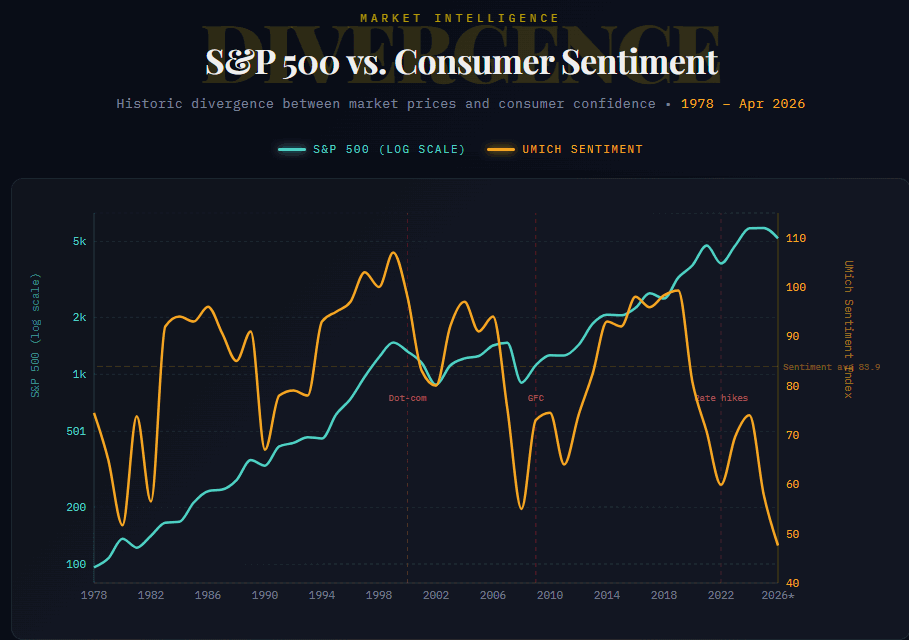
Chart of the Day: The chart plots the S&P 500 (log scale) against the University of Michigan Consumer Sentiment Index from 1978 to April 2026, and the divergence tells a K-shaped story in stark visual terms — asset owners have been rewarded handsomely while wage-dependent consumers have grown increasingly pessimistic. Sentiment has collapsed to 47.6, the third-lowest reading on record, yet equities remain near all-time highs, a combination that would have been historically anomalous in any prior cycle. The K-shape dynamic helps explain why: the top income cohort, whose wealth is concentrated in financial assets, keeps driving markets higher, while middle- and lower-income households — the backbone of the Michigan survey — are being squeezed by persistent inflation, high borrowing costs, and now an energy shock. This isn’t a temporary gap waiting to close; the 2021–2026 period represents the longest sustained divergence on record, suggesting the decoupling between Wall Street and Main Street has become structural rather than cyclical.
Market Intelligence Brief (MIB) Ver. 17.27
For professional investors only. Not investment advice.
© 2026 RecessionALERT.com

Comments are closed.