
MARKET INTELLIGENCE BRIEF (MIB)
Friday, November 27, 2026
Chips led a broad post-Thanksgiving rebound: the S&P 500 rose 1.60% and the Nasdaq 100 gained 2.61%, capping the S&P’s biggest weekly gain since April 2025. MU jumped 7.60% and Anthropic rose 10.98%. Yet the 10-year yield climbed 7.8 bps to 4.943% as traders all but fully priced a December hike. A projectile struck Aramco’s Jazan refinery, but WTI slipped 0.42%. China reserved the right to respond to the proposed Section 301 tariffs. Silver surged 7.92% and gold rose 3.23%.
TABLE OF CONTENTS
A. EXECUTIVE SUMMARY
B. MARKET DATA
C. HIGH-IMPACT STORIES (5)
D. MODERATE-IMPACT STORIES (7)
E. ECONOMY WATCH (5)
F. EARNINGS WATCH (0)
G. WHAT’S NEXT
H. CHART OF THE DAY
A. EXECUTIVE SUMMARY -> TOP
Stocks staged a post-Thanksgiving rebound in Friday’s shortened session, S&P 500 up 1.60% and Nasdaq 100 up 2.61% as chipmakers led, capping the S&P’s biggest weekly gain since April 2025, per Reuters. No single catalyst drove it, and it ran against tighter financial conditions: the 10-year yield rose 7.8 bps to 4.943% as traders all but fully priced a December hike after hotter October inflation and an upward revision of third-quarter growth to 4.3%, so equities are rallying into the hike, not on relief from it. Nor did a holiday of escalation dent risk appetite: a projectile struck Aramco’s Jazan refinery, US forces disabled an Iran blockade-runner and Beijing threatened a response to the Section 301 proposals, yet the VIX fell 15.84% and crude edged lower. All 11 sectors rose, a sentiment flush rather than rotation: Basic Materials led on the metals rebound, Healthcare and Consumer Defensive trailed, and Technology’s 2.72% gain barely dents a 15.71% one-month slide.
• S&P 500 +1.60% to 7,297.49, Nasdaq 100 +2.61% to 26,726.39 and Dow +1.18% to 50,774.94 in a session that closed at 13:00 ET, with all 11 sectors higher; VIX -15.84% to 23.81; the S&P’s 5.6% weekly gain is its biggest since April 2025, per Reuters.
• Chips led: MU +7.60%, DELL +6.70%, ANET +6.55% and INTC +5.38%, with no discrete news behind the mega-cap gainers; Anthropic +10.98% after briefly trading below its November 19 IPO price earlier in the week; PLTR +5.24% as Poland signs a five-year, $300 million Maven contract.
• 10-year +7.8 bps to 4.943% and 2-year +5.8 bps to 4.710% as traders all but fully price a December hike; 2s10s steepens to 23.3 bps from 21.3 bps; dollar index +0.33% to 104.01; gold +3.23% to $3,650 and silver +7.92% rallied with yields, not against them.
• A projectile strikes Aramco’s Jazan refinery, designed for up to 400,000 b/d, killing a worker and halting some operations; US forces disable the blockade-runner Pacific Archer in the Gulf of Oman; WTI -0.42% to $83.33 and Brent -0.99% to $90.76 ahead of Sunday’s OPEC+ meeting.
• October goods trade deficit widens to $149.5B against $133.0B expected as imports jump $21.1B; wholesale inventories +0.9% (0.5% expected); Dallas Fed trimmed-mean PCE edges up to 2.4% against 3.8% headline; Freddie Mac 30-year rate dips to 7.21%.
• Nvidia reportedly halts server shipments to Malaysia, Singapore, Thailand and Indonesia under new licence rules, per the FT; Altria weighs an all-cash offer for Imperial Brands; Verizon is in talks to buy Fidium for about $6B including debt, per the FT.
1. A relief rally on no news, into a hike that is all but priced — The mega-cap gainers had no discrete news of their own, the session was thin and shortened, and every sector rose: that reads as a sentiment flush after a selloff, not a re-rating on new information. Technology’s 2.72% gain leaves it down 15.71% over a month, so the AI trade has stabilised, not recovered, and Nvidia’s reported Southeast Asian shipment halt, alongside Bloomberg’s report that Chinese filings place Blackwell hardware at a Shanghai site, shows its export risk still building. Equities are absorbing tighter financial conditions rather than celebrating looser ones, which makes Marvell’s results on Tuesday, December 1, the first AI-hardware print since the selloff, the first real test of the rebound.
2. Bonds have accepted the hike and are asking for term premium — The 10-year rose faster than the 2-year, a bear steepening alongside a December hike priced at the front end, which points to investors demanding more term premium rather than betting on a policy error. The inflation detail offers no relief: the Dallas Fed’s trimmed mean at 2.4% says the overshoot is narrow, but it is still drifting up, and Polymarket prices a 96% chance of another hike this year. October’s $149.5 billion goods deficit points to a trade drag on fourth-quarter growth, and President Trump’s demand to investigate the upward GDP revision adds political pressure on the very series the Fed is about to set policy on, although Treasuries traded the data at face value. With the blackout starting Saturday, December 4’s payrolls are the last major input.
3. Geopolitical and trade risk is being carried as overhang, not shock — A refinery strike, a kinetic blockade enforcement and a Reuters report that Washington encouraged Venezuela and Iraq to consider leaving OPEC all landed in one holiday, and crude still edged lower: the supply premium is being held in place by repeated incidents, not built on them. Trade follows the same pattern. China “reserves the right” to respond to the Section 301 proposals and urged Washington to implement September’s $30 billion reciprocal tariff arrangement, while the EU and Japan contested the premise. None of it moved Friday’s tape, but each thread stays open into Sunday’s OPEC+ meeting and the January 5 comment deadline, on an inflation backdrop that leaves little room for a supply shock.
 — Leading economic indicators. Accurate market forecasts. Apply for membership at join.recessionalert.com
B. MARKET DATA -> TOP
Battered AI and chip shares led a broad post-Thanksgiving rebound in Friday’s shortened session, and the S&P 500’s 1.60% gain capped its biggest weekly advance since April 2025, per Reuters. It was a growth-led rally rather than a blue-chip one: the Nasdaq 100 outran the Dow by more than a point while transports lagged. Every sector rose. The bond market did not share the relief, with the 10-year yield climbing 7.8 bps as traders, per Reuters, all but fully priced a December Fed hike, while precious metals staged a sharp rebound of their own.
CLOSING PRICES – Friday, November 27, 2026:
MAJOR INDICES
Breadth was broad, with the NYSE Composite up 1.26% and every sector green, but leadership was growth: the Nasdaq 100 beat the Dow by 1.4 points. Dow Theory shows transports leading but industrials unconfirmed for a second session, with DJ Transportation 0.8% below its 10-session high and the Dow 3.0% below its own. Over the past 10 sessions the Russell 2000 (-1.74%) has outpaced the S&P 500 (-3.88%) by about 2.1 points, so the selloff hit mega-caps harder than small caps.
| Index | Close | Change | %Move | Why It Moved |
|---|---|---|---|---|
| S&P 500 | 7,297.49 | +114.71 | +1.60% | AI-linked shares rebounded after Thanksgiving in a shortened session; the index gained 5.6% on the week, its biggest weekly gain since April 2025, per Reuters |
| Dow Jones | 50,774.94 | +591.99 | +1.18% | Broad gains; the S&P bank index rose 1.6% with JPMorgan up almost 2%, per Reuters |
| DJ Transportation | 20,482.17 | +173.60 | +0.85% | Rose with the market but trailed the other indices; no discrete transport catalyst identified |
| Nasdaq 100 | 26,726.39 | +679.49 | +2.61% | Led the rebound as battered chipmakers recovered; the broader chip gauge climbed 4.7%, per Reuters |
| Russell 2000 | 2,750.30 | +46.24 | +1.71% | Small caps rose with the broad rebound, ahead of the S&P 500 |
| NYSE Composite | 23,791.35 | +295.27 | +1.26% | Broad participation, with all 11 S&P sectors higher |
VOLATILITY & TREASURIES
Options and bonds sent opposite signals. The VIX fell 15.84% to finish at its session low, but Treasuries did not confirm the relief: the 10-year rose 7.8 bps and the 2-year 5.8 bps, a bear steepening that widened the 2s10s spread to 23.3 bps from 21.3 bps. Rising yields beside a falling VIX fit a market pricing a December hike rather than fearing growth, and the dollar’s 0.33% gain is consistent with that.
| Instrument | Level | Change | Why It Moved |
|---|---|---|---|
| VIX | 23.81 | -4.48 (-15.84%) | Closed at its session low as stocks rallied; change is from Wednesday’s close of 28.29 |
| 10-Year Treasury Yield | 4.943% | +7.8 bps | Rose in the shortened bond session as stocks rallied; Reuters says traders are almost fully pricing a December Fed hike |
| 2-Year Treasury Yield | 4.710% | +5.8 bps | Rose with December Fed hike pricing, per Reuters, though less than the 10-year |
| US Dollar Index (DXY) | 104.01 | +0.34 (+0.33%) | Firmed alongside higher yields; no discrete catalyst identified |
COMMODITIES
Every metal rallied together, silver and platinum hardest, and the move came alongside rising equities and yields rather than against them. That makes it a broad metals rebound after a bruising stretch, not a safe-haven bid. Bitcoin went the other way, slipping on a strongly risk-on day, so it is decoupled from the equity tape rather than tracking it.
| Asset | Price | Change | %Move | Why It Moved |
|---|---|---|---|---|
| Gold | $3,650.00/oz | $+114.20 | +3.23% | Precious metals recovered from a bruising few sessions, lifting Newmont 5.4%, per Reuters; the change is measured from Wednesday’s December-contract settle, as there was no Thursday settlement |
| Silver | $43.230/oz | $+3.172 | +7.92% | Led the metals rebound; no discrete catalyst confirmed, though UBS called the recent selloff a buying opportunity, per Investing.com |
| Copper | $5.5160/lb | $+0.1795 | +3.36% | Rose with the broad metals rebound; no discrete copper catalyst identified |
| Platinum | $1,316.20/oz | $+73.80 | +5.94% | Joined the precious-metals rebound; no discrete catalyst identified |
| Bitcoin | $59,759.0 | $-802.0 | -1.32% | Slipped despite the equity rally; no discrete catalyst identified |
ENERGY
Crude and gas split: WTI and Brent eased modestly while Henry Hub and Dutch TTF each fell around 5%. The WTI-Brent spread narrowed to $7.43 from $7.99 on Wednesday, on the same contracts. Reuters ties crude’s resilience to attacks on tankers in the Strait of Hormuz and on Saudi energy infrastructure ahead of Sunday’s OPEC+ meeting, and oil fell even as equities rose.
| Asset | Price | Change | %Move | Why It Moved |
|---|---|---|---|---|
| Crude Oil (WTI) | $83.33/bbl | $-0.35 | -0.42% | Settled $83.08, down 60 cents from Wednesday, per Reuters, with no Thursday settlement for the holiday; attacks on Hormuz tankers and Saudi infrastructure kept supply concerns alive |
| Crude Oil (Brent) | $90.76/bbl | $-0.91 | -0.99% | February contract. Reuters quoted the expiring front month at $95.44, down $1.13, but still posting its first weekly gain in November on Middle East supply concerns |
| Natural Gas (Henry Hub) | $3.486/MMBtu | $-0.172 | -4.70% | No discrete same-day catalyst identified; fell on a day crude held up |
| Natural Gas (Dutch TTF) | $26.661/MMBtu | $-1.413 | -5.03% | European gas diverged from crude as desks pared risk premiums in thin post-Thanksgiving trade, per Investing.com; change is from Wednesday’s close |
S&P 500 SECTORS
All 11 sectors rose, a full sweep that marks a sentiment flush rather than rotation, led by Basic Materials on the metals rebound and Technology. The laggards are telling: Healthcare and Consumer Defensive, the two strongest sectors over six months (+18.44% and +11.77%), trailed, while Technology’s gain barely dents a 15.71% one-month slide.
| Sector | 1-Day | 1-Week | 1-Month | 3-Month | 6-Month | YTD | 12-Month |
|---|---|---|---|---|---|---|---|
| Basic Materials | +3.40% | +5.75% | -5.21% | -14.32% | -11.58% | +4.10% | +11.82% |
| Technology | +2.72% | -0.08% | -15.71% | -13.68% | -14.70% | +7.27% | +8.89% |
| Consumer Cyclical | +2.59% | +3.10% | +2.52% | -0.12% | -3.07% | -2.91% | -1.11% |
| Industrials | +2.11% | +1.70% | -2.66% | -6.25% | -9.56% | +4.24% | +6.86% |
| Communication Services | +1.49% | +2.90% | -4.82% | -10.55% | -17.04% | -11.18% | -11.78% |
| Energy | +1.31% | +1.12% | -11.22% | -3.98% | +3.46% | +30.38% | +31.39% |
| Financial | +1.26% | +2.49% | +0.23% | -4.51% | +6.41% | +3.80% | +8.89% |
| Real Estate | +0.57% | +2.96% | +4.34% | -2.13% | -0.50% | +7.23% | +4.76% |
| Utilities | +0.50% | +1.86% | +2.45% | +2.02% | -3.20% | +1.20% | -1.84% |
| Consumer Defensive | +0.46% | +3.16% | +6.67% | +10.76% | +11.77% | +18.12% | +18.18% |
| Healthcare | +0.29% | +4.39% | +2.41% | +5.72% | +18.44% | +14.93% | +12.14% |
TOP MEGA-CAP MOVERS:
GAINERS
| Company | Ticker | Close | Change | Why It Moved |
|---|---|---|---|---|
| Anthropic PBC | ANT | 91.88 | +10.98% | No discrete same-day catalyst confirmed; rebounded with AI shares after briefly falling below its IPO price this week, per Reuters. Reported new broker coverage could not be verified |
| Micron Technology | MU | 646.95 | +7.60% | No discrete same-day catalyst identified; led the rebound in battered chipmakers, with the broader chip gauge up 4.7%, per Reuters |
| Dell Technologies | DELL | 316.96 | +6.70% | No new same-day catalyst identified; extended an earnings-driven rebound after its November 24 results, with Reuters naming it among AI beneficiaries that gained sharply |
| Arista Networks | ANET | 174.73 | +6.55% | No discrete same-day catalyst identified; rose with the rebound in AI-infrastructure hardware |
| Intel Corp | INTC | 57.40 | +5.38% | No discrete same-day catalyst identified; rebounded with chipmakers |
DECLINERS
Muted session – largest moves shown. Only four US companies above $200 billion declined today, none by 1.5% or more.
| Company | Ticker | Close | Change | Why It Moved |
|---|---|---|---|---|
| AbbVie Inc | ABBV | 291.88 | -0.88% | No discrete same-day catalyst identified; Healthcare was the day’s weakest sector |
| Thermo Fisher Scientific | TMO | 683.04 | -0.36% | No discrete same-day catalyst identified; Healthcare was the day’s weakest sector |
| Procter & Gamble | PG | 172.86 | -0.21% | No discrete same-day catalyst identified; Consumer Defensive trailed the rally |
| Coca-Cola Co | KO | 97.40 | -0.19% | No discrete same-day catalyst identified; Consumer Defensive trailed the rally |
— Institutional-grade intelligence for serious investors. Apply for membership at join.recessionalert.comC. HIGH-IMPACT STORIES -> TOP
BULLISH
1. AI and Chip Shares Lead a Post-Thanksgiving Rebound: S&P 500 Gains 1.60% and Caps Its Biggest Weekly Gain Since April 2025
The core facts:In Friday’s shortened session, which closed at 13:00 ET, the S&P 500 rose 1.60% to 7,297.49, the Nasdaq 100 2.61% to 26,726.39 and the Dow 1.18% to 50,774.94, with all 11 sectors higher. Battered chipmakers led: the broader chip gauge climbed 4.7%, per Reuters, Micron gained 7.60%, Dell 6.70%, Arista 6.55% and Intel 5.38%, while Anthropic rose 10.98%. Anthropic had briefly fallen below its November 19 IPO price earlier in the week, per Reuters. The S&P 500 gained 5.6% on the week, its biggest weekly gain since April 2025, per Reuters. Measured from the prior Friday’s close, the Nasdaq 100 rose 6.78% and the Dow 5.46% over the four sessions.
Why it matters:No single catalyst drove the rally. The mega-cap gainers had no discrete news of their own, so this was a sentiment flush in a thin holiday session rather than a re-rating on new information. Technology’s 2.72% gain leaves the sector down 15.71% over one month, so the AI trade has stabilised, not recovered. Leadership was growth: the Nasdaq 100 beat the Dow by more than a point and the defensive sectors trailed, with Healthcare up only 0.29% and Consumer Defensive 0.46%. The rally also ran against rising yields (Story 2). Equities are therefore rebounding into a December Fed hike that is almost fully priced, not on any easing in the rate outlook.
What to watch:Whether the chip rebound holds through Marvell’s results after the bell on Tuesday, December 1, the first AI-hardware print since the selloff, with the VIX’s 23.81 close a gauge of whether the relief is durable.
BEARISH
2. Treasuries Sell Off as Traders All but Fully Price a December Hike: 10-Year Yield Climbs 7.8 bps to 4.943% in a Bear Steepening
The core facts:In the shortened bond session, the 10-year Treasury yield rose 7.8 bps to 4.943% and the 2-year 5.8 bps to 4.710%, both measured from Wednesday’s close. The 2s10s spread widened to 23.3 bps from 21.3 bps. Reuters reported that traders are almost fully pricing a December Fed hike after this week’s data showed faster third-quarter growth and hotter October inflation. The dollar index rose 0.33% to 104.01. The selloff came on a day the VIX fell 15.84% to 23.81 and equities rallied.
Why it matters:Friday reversed Wednesday’s rally, when the 10-year had fallen to 4.865% even as hike odds rose. That leaves the 10-year at 4.943%, almost exactly where it ended the prior Friday (4.941%). The long end rising faster than the short end is the notable part: a bear steepening alongside a hike priced at the front end suggests investors are demanding more term premium, not betting on a policy error. Rising yields beside a falling VIX fit a market that has accepted the hike rather than one that fears it. But they mean the equity rebound in Story 1 is happening against tighter financial conditions, not looser ones.
What to watch:The FOMC’s communications blackout begins Saturday, November 28, ahead of the December 8-9 meeting, so November payrolls on Friday, December 4 are the last major input. Watch whether the 10-year can hold below 5%, a level it last closed above on November 19 (5.046%).
UNCERTAIN
3. Gulf Escalates Over the Holiday as a Projectile Hits Aramco’s Jazan Refinery and US Forces Disable an Iran Blockade-Runner; Crude Eases Ahead of Sunday’s OPEC+ Meeting
The core facts:On Thursday an aerial projectile struck Saudi Aramco’s Jazan refinery, which is designed to process up to 400,000 barrels a day. It killed a Nepali worker, injured several others, started a fire and “temporarily halted some operations,” according to Saudi Arabia’s Energy Ministry as reported by Al Jazeera. The ministry did not name the attacker; the Saudi-led coalition blamed the Houthis. The same day, US Central Command said a US military aircraft struck the stern of the Palau-flagged bulk carrier M/V Pacific Archer in the Gulf of Oman after it left Bandar Abbas and tried to run the US naval blockade despite warnings. The ship’s propulsion was disabled and the crew was unharmed. CENTCOM says it has now redirected 158 vessels and disabled six. Separately, Reuters reported, citing ten people familiar with the matter, that the administration encouraged Venezuela and Iraq to consider leaving OPEC earlier this year. WTI closed at $83.33, down 0.42%, and February Brent at $90.76, down 0.99%, both measured from Wednesday, as there was no Thursday settlement.
Why it matters:A refinery strike, a kinetic blockade enforcement and a reported US push against OPEC’s cohesion all landed in one holiday, and crude still edged lower. The supply premium is being held in place by repeated incidents rather than built on them. Reuters quoted the expiring front-month Brent contract posting its first weekly gain in November on Middle East supply concerns. Damage to Saudi refining affects product markets more than crude availability. The more consequential thread for 2027 balances is OPEC’s internal strain: per the same Reuters report, Iraq’s prime minister raised leaving at a cabinet meeting before the oil ministry persuaded him to stay and seek a higher quota instead. The State Department said talks with Iraq “have focused on improving energy infrastructure to increase production and transportation of energy, not OPEC.” For US portfolios, energy rose 1.31% with the broad rally, not on crude.
What to watch:Sunday’s OPEC+ meeting on November 29, specifically whether Iraq’s quota demand is accommodated or deferred, and any restart timeline for Jazan from the Energy Ministry.
UNCERTAIN
4. Nvidia Reportedly Halts Server Shipments to Four Southeast Asian Countries Under New US Licence Rules, as Bloomberg Finds Blackwell Racks at a Shanghai Site
The core facts:The Financial Times reported Thursday, citing three unnamed sources, that Nvidia’s manufacturing partners, including Dell and Supermicro, have told customers in Malaysia, Singapore, Thailand and Indonesia that Nvidia will not allow their servers to be shipped there, per Forbes. It is unclear whether the suspension is temporary while Nvidia and the server makers address compliance. It follows US export rules that took effect a week earlier, requiring licences to ship advanced AI chips to those four countries and Brazil, with exemptions for qualifying US-based companies. On Friday, Bloomberg reported that Chinese regulatory filings place a GB300 NVL72 rack, among Nvidia’s most powerful products, at a Shanghai data centre linked to Alice Huang and Megaspeed. One firm, Shanghai Shuoyao, pledged the rack as collateral for a 96 million yuan ($14 million) loan. A second firm, Shanghai Kezhan, described a GB200 server at the same site when it took a 90 million yuan loan in late 2025. Bloomberg traced the rack’s serial number to Taiwan’s Gigabyte. Blackwell processors have always required a US licence to ship to China, and how the rack reached the site is unclear.
Why it matters:Together the two reports show the new rules working in both directions: they are halting legitimate shipments to Southeast Asia while evidence surfaces that earlier shipments reached China anyway. That is the worst combination for Nvidia: lost or delayed regional volume now, and more scrutiny of its controls later. Both come as its board has just reinstated Jensen Huang as CEO and set up an independent National Security and Export Control Committee. The market looked past both on Friday, with Dell, one of the partners named, up 6.70% in the chip rebound. But Southeast Asia has been a fast-growing data-centre region, and Bloomberg separately reported on Wednesday that the restrictions have prompted lenders to pause financing for regional projects, per Forbes.
What to watch:Whether Nvidia or the Commerce Department confirms the shipment pause and how quickly licences are granted for the four countries, and any official response to the Shanghai filings.
BEARISH
5. China Formally Opposes the US Section 301 Overcapacity Tariffs and “Reserves the Right” to Respond, as the EU and Japan Push Back
The core facts:At Thursday’s regular briefing, China’s Commerce Ministry spokesperson He Yadong called the US Section 301 investigation “a typical act of unilateralism that seriously disrupts the international economic order.” He said it violates World Trade Organization rules, and that China “reserves the right to take necessary measures to firmly safeguard its legitimate rights and interests.” He named no countermeasure, and urged Washington to implement September’s $30 billion reciprocal tariff reduction arrangement. European Commission spokesperson Olof Gill said: “The EU and the US share a real concern about global overcapacity, much of it state-driven and concentrated in third countries. We regret the lack of joint action.” In Tokyo, Chief Cabinet Secretary Minoru Kihara said: “Japan does not have any non-market policy practices or structural excess production capacity.” The USTR proposal, announced Wednesday, covers 14 economies, with duties of up to 35% for Vietnam, up to 15% for the EU, Japan and Korea, and up to 20% for China on most goods.
Why it matters:Beijing’s response moves the proposal from a unilateral US step to a negotiation with an explicit retaliation threat attached. Its call to implement the September arrangement signals that China sees the 301 action as jeopardising that truce. The allied reactions are also more pointed than diplomatic boilerplate: per the same report, EU trade commissioner Maros Sefcovic said Washington must honour the 15% cap agreed last year, so even partners at the capped rate are contesting the premise. Investors should read this as a tariff overhang that will run through January. It lands on an inflation backdrop where the Fed is already priced to hike.
What to watch:Whether China names specific countermeasures before the January 5, 2027 comment deadline, and the January 25 hearings.
— Quantifying recession risk so you don’t have to guess. Apply for membership at join.recessionalert.comD. MODERATE-IMPACT STORIES -> TOP
UNCERTAIN
6. Altria Confirms It Is Weighing an All-Cash Offer for Imperial Brands, With a Third Party in Talks to Take Part of the Business
The core facts:Responding to press speculation, Altria said on Thursday, November 26, that it is considering a possible offer for UK-listed Imperial Brands and that “any offer, if made, is likely to be solely in cash.” Altria said it is in discussions with a third party about that party possibly acquiring part of Imperial’s business, but no agreement has been reached. It also said there is no certainty an offer will be made. Under the UK Takeover Code, Altria must announce a firm intention to bid, or walk away, by 5:00 p.m. London time on December 24, 2026, unless the Takeover Panel extends the deadline. Friday was the first US session after the announcement.
Why it matters:An all-cash bid with a partner taking part of the business points to a break-up structure: Altria keeps the assets that fit and the partner funds the rest, which limits the debt Altria must raise. For Altria, this would be a major step outside a US cigarette business in volume decline, financed while borrowing costs are rising (Story 2). Cash consideration, not stock, puts the balance sheet and the dividend at the centre of how Altria’s investors judge any firm offer.
What to watch:The identity of the third party and the price of any firm offer before the December 24 put-up-or-shut-up deadline.
UNCERTAIN
7. Trump Calls the Revised GDP Figures “Fake” and Demands an Investigation, Offering No Evidence
The core facts:In a social media post on Thanksgiving morning, President Trump seized on the revision of third-quarter growth to 4.3% annualized, from a 3.4% earlier estimate, Bloomberg reported. He wrote: “It was just revealed that the REAL Numbers on the Economy, published before the Election, were FAKE.” He added: “I am asking for an immediate investigation of this situation. This is not a small error, this is a massive, and purposeful, error.” He offered no evidence. The Bureau of Economic Analysis publishes GDP in stages, and the headline figure routinely moves as more data arrive. Last year Trump fired the head of the Bureau of Labor Statistics after a weak jobs report.
Why it matters:The complaint is unusual because the revision was upward: the President is alleging that growth was under-reported, not flattered. Treasuries did not trade it on Friday. Yields rose on December hike pricing (Story 2), so the market is still taking the official data at face value. The risk is cumulative rather than immediate. A demand to investigate a statistical agency, coming a year after the BLS firing, raises the political cost for data agencies of publishing unwelcome numbers. That matters for a Fed that is about to set policy on exactly these series.
What to watch:Whether the administration opens a formal review of the Bureau of Economic Analysis or makes personnel changes there before the December 8-9 FOMC meeting.
BULLISH
8. Precious Metals Rebound Hard, With Silver Up 7.92%, Platinum 5.94% and Gold 3.23%, Lifting Basic Materials to the Top of the Sector Table
The core facts:Gold closed at $3,650.00 an ounce, up 3.23%, silver at $43.230, up 7.92%, and platinum at $1,316.20, up 5.94%, all measured from Wednesday’s settles, as there was no Thursday settlement. Copper rose 3.36% to $5.5160 a pound. Gold and silver miners rallied as precious metals recovered from a bruising few sessions, with Newmont up 5.4%, per Reuters, and Basic Materials led all 11 sectors with a 3.40% gain. UBS called silver’s recent selloff a buying opportunity, per Investing.com. Measured from the prior Friday’s close, gold rose 3.16% and silver 5.25% over the week.
Why it matters:The metals rallied alongside rising equities and rising yields, not against them, so this was a rebound after forced selling, not a flight to safety. That matters for reading it. A safe-haven bid would have come with falling yields and a weaker dollar; Friday had the opposite, with the 10-year up 7.8 bps and the dollar up 0.33%. Gold rising 3% into a Fed hike that is almost fully priced shows how far the prior selloff had run. Bitcoin went the other way, down 1.32% on a strongly risk-on day.
What to watch:Whether gold holds above $3,600 into the December FOMC, since a hike that is fully priced would leave the metals more exposed to the dollar than to the Fed decision itself.
UNCERTAIN
9. SAP Weighs Cutting at Least 10,000 Jobs in an AI Restructuring, and Separately Confirms a Cybersecurity Incident
The core facts:SAP is preparing a plan to eliminate at least 10,000 positions as it reshapes its software business for AI, Bloomberg reported Thursday, citing people familiar with the matter, per CNBC. SAP told CNBC that “no decisions have been made regarding any further measures. We do not comment on speculation.” Separately, SAP confirmed it is investigating a cybersecurity incident after detecting suspicious activity, saying: “Based on our investigation to date, we have found no evidence of unauthorized access to customer business data.” Der Spiegel reported that hackers used stolen employee tokens to copy and alter source code on GitHub, per SecurityWeek, which said it is unclear whether proprietary code was accessed.
Why it matters:SAP is Germany’s largest software company, so a cut of this size is a reference point for how AI is reshaping software headcount. CNBC places it beside Atlassian’s roughly 1,600 cuts in March and Cloudflare’s more than 1,100 in May. For investors, the cuts are margin-positive. The cyber incident is the more open risk: an intrusion into development infrastructure that reached source code goes to the integrity of software running in customers’ systems, which is a liability question, not a headcount one.
What to watch:Any SAP disclosure on whether altered code reached customer releases, and whether US enterprise-software peers report next week, starting with Salesforce on December 2, frame headcount the same way.
BULLISH
10. Poland Signs a Five-Year, $300 Million Contract for Palantir’s Maven Smart System; Palantir Gains 5.24%
The core facts:Poland’s defence ministry signed a five-year contract for Palantir’s Maven Smart System on Friday, valued at $300 million (1.2 billion zloty), Notes from Poland reported. The report does not say whether that is a total or an annual figure. Palantir CEO Alex Karp attended the signing with Defence Minister Władysław Kosiniak-Kamysz, who said: “This is one of the biggest steps in the transformation of our armed forces.” The deal follows a letter of intent signed in October 2025. Palantir shares rose 5.24%.
Why it matters:The contract is small against Palantir’s revenue. Its significance is that a NATO frontline state is adopting the same targeting and battlefield-analysis platform the US military uses, which strengthens the case for European defence budgets flowing to US software. The share move cannot be credited to the contract alone, since it came on a day Technology rose 2.72% and AI names led the rebound.
What to watch:Whether other European ministries follow Poland onto Maven, a test of how much of Europe’s rearmament spending reaches US defence-software vendors.
UNCERTAIN
11. OpenAI Countersues Apple, Accusing It of “Unlawful, Tortious, and Unfair Business Practices” in Their Trade-Secrets Fight
The core facts:OpenAI filed a countersuit against Apple in Northern California federal court on Friday, CNN reported. It accuses Apple of “unlawful, tortious, and unfair business practices.” The complaint says Apple encourages employees to store work files on personal iCloud and iMessage accounts and asks departing staff to leave the same day. OpenAI argues the policy creates “trapdoors” that let Apple “accuse former employees of trade secret theft.” The dispute began in July, when Apple sued OpenAI and two former Apple employees who had joined OpenAI, alleging theft of trade secrets for an AI device. Apple did not immediately respond to a request for comment.
Why it matters:The case is a proxy for the race to build the first mass-market AI device, where OpenAI is building hardware that would compete with the iPhone. The countersuit turns a defence into an attack on Apple’s employment practices, which raises the cost of Apple’s own suit and makes a quick resolution less likely. For investors it is a rivalry signal, not a financial event: neither side has disclosed damages that would move either company’s outlook.
What to watch:Apple’s formal response and whether the court consolidates the two suits.
UNCERTAIN
12. Verizon in Talks to Buy Fiber Provider Fidium for About $6 Billion Including Debt, per the Financial Times
The core facts:Verizon is in talks to acquire Fidium, the former Consolidated Communications, for about $6 billion including debt, the Financial Times reported Friday, per StockAnalysis. Fidium is owned by Searchlight Capital Partners and British Columbia Investment Management Corporation, which took the company private in 2023 at an enterprise value of about $3.1 billion. An agreement could come within weeks, but a rival bidder may emerge and the talks could end without a deal.
Why it matters:The price is nearly double what the owners paid three years ago, a measure of how much carriers will pay for fiber footprint as they bundle home broadband with wireless to hold customers. For Verizon investors, a debt-inclusive deal of this size is manageable, but it adds leverage at a time when financing costs are rising (Story 2), and it signals that fiber consolidation among US telecoms is continuing.
What to watch:A definitive agreement in the coming weeks, or a rival bid.
— Separating signal from noise since 2007. Apply for membership at join.recessionalert.comE. ECONOMY WATCH -> TOP
The holiday-thinned week’s one fresh release complicates the fourth-quarter growth picture: October’s goods deficit widened to $149.5 billion as imports jumped $21.1 billion, a net-export drag that the same report’s 0.9% wholesale inventory build only partly offsets in the GDP arithmetic. Inflation signals were mixed: the Dallas Fed’s trimmed-mean PCE edged up to 2.4%, far below headline PCE’s 3.8%, which points to an overshoot concentrated in a few categories rather than a broad one, yet Polymarket still prices a 96% chance of another Fed hike in 2026. With mortgage rates easing to 7.21% only before Friday’s 7.8 bp rise in the 10-year yield, next week’s ISM, JOLTS and November payrolls will show whether a December hike lands on a strengthening economy or a slowing one.
Goods trade deficit unexpectedly widens to $149.5 billion in October as imports jump $21.1 billion (Census Bureau, Nov 27)
What they’re saying:The advance goods trade deficit widened by $14.4 billion to $149.5 billion in October from $135.1 billion in September, against a consensus of $133.0 billion. Imports of goods rose $21.1 billion to $365.3 billion, while exports rose $6.7 billion to $215.8 billion.
The context:The miss against consensus was about $16.5 billion, and imports grew more than three times as fast as exports in dollar terms. Net exports subtract from GDP, so a wider gap in the first month of the quarter points to a trade drag on fourth-quarter growth, which the Atlanta Fed’s GDPNow tracker last put at 2.9% on November 25. The advance release does not break out which categories drove the import surge.
What to watch:The Atlanta Fed GDPNow update on Tuesday, December 1, the first to fold in this release, and whether the trade drag pulls the estimate below 2.9%.
Wholesale inventories climb 0.9% in October, beating 0.5% forecast, as retail stocks rise 0.8% (Census Bureau, Nov 27)
What they’re saying:Advance wholesale inventories rose 0.9% to $1,023.4 billion in October, ahead of the 0.5% forecast, and are up 8.5% from a year earlier; September was revised up to 0.8% from 0.7%. Retail inventories rose 0.8% to $893.2 billion, up 5.1% year over year, with September revised to 0.7% from 0.4%; excluding autos, retail stocks rose 0.6%.
The context:Inventory accumulation adds to GDP, so this build partly offsets the trade drag from the same report. The signal cuts both ways, however: stocks are rising faster than expected while October personal spending growth slowed to 0.3% from 0.6%, and a build that outruns demand tends to be worked off later through lower orders. The figures are not adjusted for price changes, so part of the rise may reflect higher costs rather than more goods.
What to watch:The ISM Manufacturing PMI on Tuesday, December 1 (expected 55.2, prior 55.5) and factory orders on Thursday, December 3 (expected 0.4%, prior 1.8%).
Dallas Fed trimmed-mean PCE inflation edges up to 2.4% in October, far below 3.8% headline (Federal Reserve Bank of Dallas, Nov 25)
What they’re saying:The Dallas Fed’s trimmed-mean PCE inflation rate over the 12 months ending in October was 2.4%, up from 2.3% in September. The six-month annualized rate held at 2.4%, and the one-month annualized rate eased to 2.8% from 3.0%. On the Dallas Fed’s own comparison, headline PCE inflation was 3.8% and PCE excluding food and energy was 3.3%.
The context:The trimmed mean drops the most extreme price changes each month, so a 1.4-point gap below headline PCE indicates that the overshoot is being driven by a minority of categories with outsized increases rather than by broad-based pressure. That is a less alarming picture than the headline, but the measure is still drifting up rather than down, so it offers no counterweight to hike pricing: Polymarket prices a 96% chance of another rate hike in 2026, a market that settles at the December 9 FOMC decision.
What to watch:The December 8-9 FOMC meeting, and whether the trimmed mean’s 12-month rate rises again at the Dallas Fed’s next update on December 23.
30-year mortgage rate dips to 7.21% heading into Thanksgiving (Freddie Mac, Nov 25)
What they’re saying:The average 30-year fixed mortgage rate fell to 7.21% in the week to November 25 from 7.28% a week earlier, and the 15-year fixed fell to 6.54% from 6.66%. Freddie Mac said rates “moved back down this week, offering modest relief for prospective homebuyers heading into the Thanksgiving holiday.”
The context:Borrowing costs remain about a percentage point above a year ago, when the 30-year averaged 6.23% and the 15-year 5.51%, so the relief is marginal. It may also prove short-lived: the survey predates Friday’s session, in which the 10-year Treasury yield, the benchmark mortgage rates track, rose 7.8 bps to 4.943%.
What to watch:The MBA’s 30-year mortgage rate on Wednesday, December 2 (prior 7.38%), the first weekly read to capture Friday’s rise in Treasury yields.
Atlanta Fed survey: more than 72% of firms now use AI as revenue growth expectations rise (Federal Reserve Bank of Atlanta, Nov 25)
What they’re saying:The Atlanta Fed’s November Survey of Business Uncertainty, drawn from senior finance executives surveyed November 9-20, found that sales revenue growth expectations have risen over recent months, while firms remain more uncertain about future sales growth than before the pandemic. Over 72% of firms are using artificial intelligence in business functions, more expect to within six months, and the most common uses are IT, administration, finance and accounting, and marketing.
The context:The survey also found expected employment growth in line with pre-pandemic levels, with uncertainty about hiring only slightly elevated. That pairing of firming revenue expectations, broad AI adoption and steady hiring plans does not yet show AI displacing workers at scale, which matters for a Fed weighing whether labor demand is cooling enough to absorb another rate hike.
What to watch:The November jobs report on Friday, December 4, with payrolls expected at 90K against 165K prior and unemployment at 4.1%.
— Know the probability before the market prices in the risk. Apply for membership at join.recessionalert.comF. EARNINGS WATCH -> TOP
YESTERDAY AFTER THE BELL (Markets Reacted Today)
No major earnings yesterday after the bell from companies with >$100B market cap.
TODAY BEFORE THE BELL (Markets Already Reacted)
No major earnings before the bell from companies with >$100B market cap.
TODAY AFTER THE BELL (Markets React Tomorrow)
No major earnings after the bell from companies with >$100B market cap.
WEEK AHEAD PREVIEW:
Q3 2026 earnings season is effectively complete, with 93% of the S&P 500 reported as of FactSet’s November 20 update. Two in-scope mega-caps report next week, both AI-exposed and both after the bell.
Marvell Technology (MRVL) — AMC, Tuesday, December 1 — Consensus EPS $1.10 on revenue of $3.15B. Key focus: data-centre revenue and custom AI accelerator demand, the first AI-hardware print since the chip selloff and Friday’s rebound, and any read-through from the new US licence rules for Southeast Asian AI shipments.
Salesforce (CRM) — AMC, Wednesday, December 2 — Consensus EPS $3.45 on revenue of $11.46B. Key focus: Agentforce AI monetisation, current remaining performance obligations, and whether the full-year outlook holds as enterprise-software peers restructure around AI.
Excluded as foreign listings outside the S&P 500: Bank of Montreal ($110.06B) and Bank of Nova Scotia ($104.60B) before the open on Wednesday, December 2, and Royal Bank of Canada ($262.52B) and Toronto-Dominion Bank ($197.50B) before the open on Thursday, December 3. Snowflake (SNOW, $97.48B, AMC December 2) sits just below the $100B line.
— US market commentary trusted by family offices and institutions. Apply for membership at join.recessionalert.comG. WHAT’S NEXT -> TOP
UPCOMING RELEASES:
| Date | Event | Why It Matters |
|---|---|---|
| Sat, Nov 28 | FOMC communications blackout begins ahead of the December 8-9 meeting | With a December hike all but fully priced, the incoming data now speak for the Fed, and Bowman’s testimony on Tuesday falls inside the blackout window. |
| Sun, Nov 29 | OPEC+ meeting | The test is whether Iraq’s demand for a higher quota is accommodated or deferred, after a Reuters report that Washington encouraged Iraq and Venezuela to consider leaving OPEC. It follows Thursday’s strike on Aramco’s Jazan refinery, with WTI at $83.33. |
| Mon, Nov 30 | Chicago PMI (prior 55.3); Dallas Fed Manufacturing Index (expected 10.2, prior 13.4) | The last regional manufacturing reads before Tuesday’s ISM. October’s faster-than-expected 0.9% wholesale inventory build came as spending growth slowed to 0.3%, so softer orders would suggest stocks are running ahead of demand. |
| Tue, Dec 1 | ISM Manufacturing PMI (expected 55.2, prior 55.5); JOLTS Job Openings (expected 7.45M, prior 7.523M); Atlanta Fed GDPNow (prior 2.9%); Fed’s Bowman testifies (10:00 AM) | GDPNow is the first update to fold in October’s $149.5 billion goods deficit, so it shows how large the trade drag on fourth-quarter growth is. JOLTS opens a labor week that ends with Friday’s payrolls. |
| Wed, Dec 2 | ADP Employment Change (expected 80K, prior 86K); MBA 30-Year Mortgage Rate (prior 7.38%); EIA Crude Oil Stocks (prior 1.11M) | The MBA read is the first weekly mortgage rate to capture Friday’s 7.8 bp rise in the 10-year, after Freddie Mac’s dip to 7.21%. ADP is the first private payroll read before Friday. |
| Thu, Dec 3 | ISM Services PMI (expected 54.5, prior 54.5); Initial Jobless Claims (expected 193K, prior 189K); Factory Orders MoM (expected 0.4%, prior 1.8%) | The services prices component is the broadest read on whether price pressure is spreading beyond the narrow set of categories the Dallas Fed’s 2.4% trimmed mean points to. Factory orders are expected to slow sharply from 1.8%. |
| Fri, Dec 4 | November Nonfarm Payrolls (expected 90K, prior 165K); Unemployment Rate (expected 4.1%, prior 4.1%); Average Hourly Earnings MoM (expected 0.3%, prior 0.4%); Michigan Consumer Sentiment Prel (expected 52.5, prior 51.5) | The last major input before the December 9 decision. The Atlanta Fed’s survey found hiring plans in line with pre-pandemic levels despite AI use at over 72% of firms, so payrolls test whether labor demand is cooling enough to absorb another hike, with 90K expected against 165K. |
KEY QUESTIONS:
1. With a December hike all but fully priced and the 10-year back at 4.943%, does Friday, December 4’s payrolls report push the yield back above 5%, a level it last closed above on November 19?
2. Was Friday’s chip-led rebound more than a thin-session sentiment flush? Technology is still down 15.71% over a month, and Marvell’s results after the bell on Tuesday, December 1 are the first AI-hardware print since the selloff.
3. Does Sunday’s OPEC+ meeting hold together around Iraq’s quota demand, and will a Jazan restart timeline or another Gulf incident finally build a supply premium into crude, which slipped through Thursday’s strike?
— US market commentary trusted by family offices and institutions. Apply for membership at join.recessionalert.comH. CHART OF THE DAY -> TOP
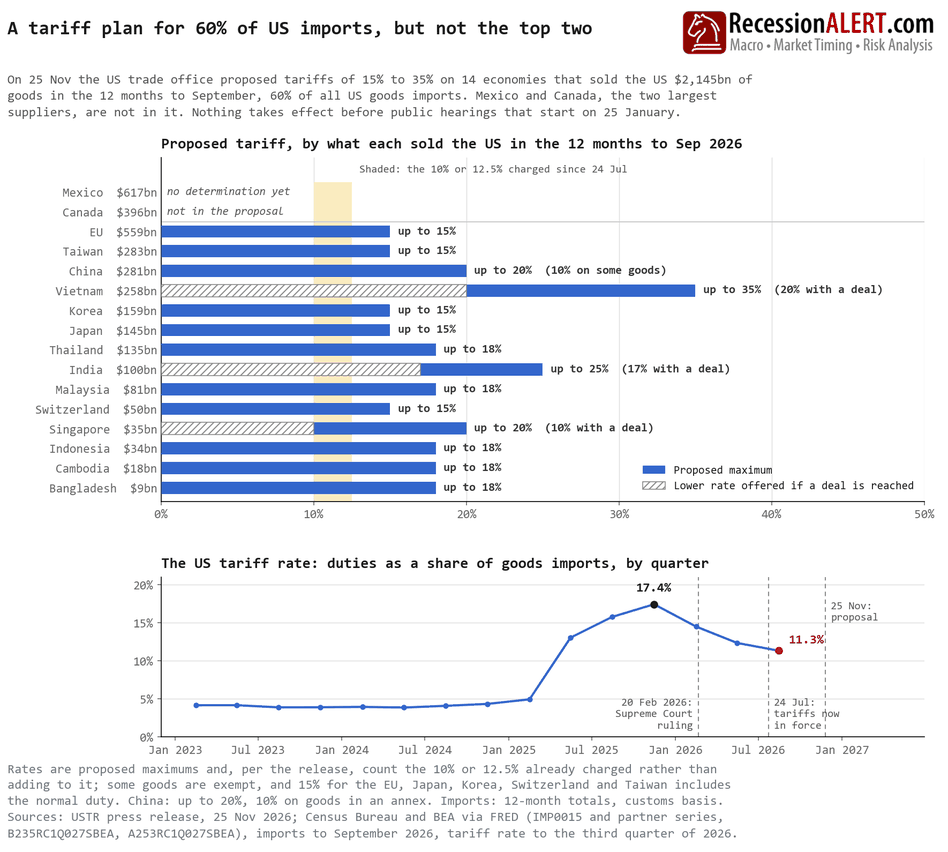
The first round of tariffs took a signature; this one takes a paper trail. After the Supreme Court struck down the emergency-powers tariffs on 20 February, the replacements were lower by design, and duties as a share of goods imports slid from 17.4% in late 2025 to 11.3% in the third quarter. The 25 November proposal uses Section 301, the trade law that lets the US act against a partner’s “unreasonable” practices, which runs on findings, public comment and hearings: these are maximums of 15% to 35% with no effective date, and nothing applies before hearings open on 25 January. They reach 14 economies supplying $2,145bn, 60% of goods imports, yet Mexico ($617bn) has “no determination yet” and Canada ($396bn) is not in the proposal, leaving 28% of the import bill outside it. Within the 60%, each rate counts the 10% or 12.5% charged since July rather than adding to it, and “accounts for” that partner’s trade deal; the five economies supplying 56% of covered trade sit at 15%, normal duty included. The bargaining is printed in the margins: Vietnam 35%, or 20% with a deal; India 25%, or 17%; Singapore 20%, or 10%. Whatever survives the hearings would be paid at the US border by importers, then their customers. For two months, every bar on the chart is an opening bid, not a bill.
What it means: For households, nothing changes at the checkout before the January hearings. If the rates are enacted, importers pay them first and pass some share on in shop prices. For shares, the exposure is US companies that buy heavily from Vietnam and India, whose costs hinge on whether those two reach deals. For the economy, the hearings decide whether these tariffs settle at the 15% to 18% most of the 14 face or step higher. The read widens if a Mexico determination follows, taking the plan to about three-quarters of US goods imports.
Market Intelligence Brief (MIB) Ver. 20.10
For professional investors only. Not investment advice.
© 2026 RecessionALERT.com

Comments are closed.