
MARKET INTELLIGENCE BRIEF (MIB)
Wednesday, November 25, 2026
An AI rout took the Nasdaq 100 down as much as 4.7% before dip buyers cut the loss to 0.64%, yet the VIX still rose 7.44% to 28.32. Nvidia’s AA rating went on CreditWatch negative; NVDA fell 3.91%. USTR proposed Section 301 tariffs of up to 35% on 14 economies. Q3 GDP was revised up to 4.3% and core PCE hit 3.3%, lifting December hike odds to ~98%. WTI rose 2.55% on a claimed Houthi strike on Ras Tanura.
TABLE OF CONTENTS
A. EXECUTIVE SUMMARY
B. MARKET DATA
C. HIGH-IMPACT STORIES (5)
D. MODERATE-IMPACT STORIES (5)
E. ECONOMY WATCH (7)
F. EARNINGS WATCH (2)
G. WHAT’S NEXT
H. CHART OF THE DAY
A. EXECUTIVE SUMMARY -> TOP
MARKET SNAPSHOT
Wednesday’s AI rout, which took the Nasdaq 100 down as much as 4.7% intraday, was a credit story as much as an equity one: CoreWeave’s 2031 bonds at a 17.91% yield and S&P’s CreditWatch negative on Nvidia’s AA rating put a price on the financing and governance risk behind the AI trade. Dip buyers cut the S&P 500’s loss to 0.25% and lifted the Dow 0.33%, but the VIX still closed up 7.44% at 28.32, and Treasuries rallied at both ends, the 10-year down 5.9 bps, even as 4.3% Q3 GDP and 3.3% core PCE left a December hike about 98% priced. That is a haven bid, not an easing signal, arriving alongside Section 301 tariff proposals for 14 economies and a 2.55% WTI jump on the Houthi claim against Ras Tanura. The recovery was broad but excluded AI: eight of 11 sectors rose, led by Basic Materials (+2.27%), while Technology (-0.80%) deepened a 17.15% one-month slide.
TODAY AT A GLANCE
• Nasdaq 100 -0.64% and S&P 500 -0.25% after intraday drops of 4.7% and 3.2%; Dow +0.33%, Russell 2000 +0.71% back above 2,700; VIX +7.44% to 28.32 after touching 34.95.
• NVDA -3.91% to $149.30, after falling as much as 9.1% intraday, as S&P puts its AA rating on CreditWatch negative over governance; LRCX -5.68%, ORCL -5.13% and MU -4.53% led the mega-cap decliners.
• USTR finds 14 economies actionable under Section 301 and proposes duties of up to 35% for Vietnam, 25% for India, 20% for China and 15% for the EU, Japan and Korea; comments are due January 5 and hearings begin January 25, 2027.
• Q3 GDP revised up to 4.3% (3.5% expected); October PCE 3.8% y/y and core 3.3%, with real spending flat; jobless claims fell to 189,000; December hike odds about 98%, yet the 10-year fell 5.9 bps to 4.865%.
• WTI +2.55% to $84.14 and Brent +2.26% to $90.79 as the Houthis claim a strike on Aramco’s Ras Tanura refinery; the Saudi-led coalition says air defences destroyed four drones and did not say the refinery was hit.
• After hours: VRTX -7.82% as the FDA extends its povetacicept review to February 28, 2027; Kinetik +8% and Targa -3% on reported takeover talks.
KEY THEMES
1. AI’s problem has moved to the credit and governance desks — The selloff was led by financing worries, not earnings: CoreWeave’s 2031 bonds fell to 74.23 cents for a 17.91% yield, and S&P opened a watch on Nvidia over board oversight, an overhang no earnings beat can resolve. The recovery ran through cyclicals, small caps and Treasuries rather than chips, and the VIX’s 7.44% gain shows the options market did not trust the rebound. For portfolios, AI hardware now carries a cost-of-capital and governance discount separate from demand. The FCC’s Starmind authorization for SpaceX shows the capacity race continuing, but it grants the right to build, not revenue.
2. A December hike is all but priced, and bonds are hedging what comes after — Growth of 4.3%, core PCE a tenth above forecast at 3.3%, claims at 189,000 and a Beige Book of firmer wages and tariff-cited price increases leave a December 9 hike about 98% priced. Yet the 10-year fell more than the 2-year and 2s10s flattened to 21.3 bps: the market is pricing tightening now and slower growth later, consistent with flat October real spending, GDPNow’s cut to 2.9% for the fourth quarter and the Beige Book’s selective consumers. The cyclicals that led Wednesday’s recovery are the most exposed to a Fed tightening into that consumer.
3. Supply risks are stacking onto the inflation backdrop — The Section 301 proposals put the steepest proposed rates on Southeast Asian and Indian supply chains, and WTI rose 2.55% through a 1.1 million-barrel EIA crude build on a claimed strike against a refinery that handles about 16% of Saudi refining capacity. Neither has an effective date or confirmed damage, so both are overhangs rather than shocks, but both push in the same direction as October’s 3.8% PCE rate two weeks before the FOMC.
 — Leading economic indicators. Accurate market forecasts. Apply for membership at join.recessionalert.com
B. MARKET DATA -> TOP
A morning rout in AI-linked stocks, compounded by proposed US tariffs on 14 trading partners and a heavy slate of growth and inflation data, gave way to a midday dip-buying recovery on the eve of Thanksgiving. The close was split rather than risk-off: eight of 11 sectors finished higher and small caps gained, while semiconductors and AI-infrastructure names absorbed the damage and kept the Nasdaq 100 in the red. The standout divergence was volatility, with the VIX still up 7.44% after the indices had clawed back most of their intraday losses, a sign the options market did not trust the rebound. Treasuries rallied at both ends of the curve, the 10-year falling 5.9 bps even as futures kept a December Fed hike almost fully priced.
CLOSING PRICES – Wednesday, November 25, 2026:
MAJOR INDICES
Blue chips, transports, small caps and the NYSE Composite all closed higher while the tech-heavy Nasdaq 100 and the S&P 500 did not, so the rebound was broad but excluded the AI complex. Transports leading but industrials unconfirmed: the DJ Transportation Average closed within 1.7% of its 10-session high while the Dow sits 4.4% below its own, a signal that emerges today. Over the past 10 sessions the S&P 500 has beaten the Nasdaq 100 by 2.5 points, also emerging today: broadening rotation, with value and cyclicals gaining ground. The Russell 2000 closed back above 2,700.
| Index | Close | Change | %Move | Why It Moved |
|---|---|---|---|---|
| S&P 500 | 7,182.78 | -18.31 | -0.25% | Pared an intraday drop of as much as 3.2% (day’s low 6,970.11) as dip buyers stepped in after the morning AI selloff, proposed US tariffs and the day’s inflation and GDP data |
| Dow Jones | 50,182.95 | +164.25 | +0.33% | Recovered from an intraday drop of as much as 2.2% (day’s low 48,913.74) to close higher as the rebound favoured blue chips over tech |
| DJ Transportation | 20,308.57 | +334.04 | +1.67% | No discrete same-day catalyst identified; led the major averages as the recovery ran through cyclicals |
| Nasdaq 100 | 26,046.90 | -167.27 | -0.64% | AI-linked selloff on financing and spending worries took it down as much as 4.7% intraday (day’s low 24,970.66) before a late recovery; Nvidia fell for a second session |
| Russell 2000 | 2,704.06 | +19.12 | +0.71% | Closed back above 2,700 as small caps joined the recovery; Treasury yields fell at both ends of the curve |
| NYSE Composite | 23,496.08 | +141.40 | +0.61% | Broad-market gain outside tech; eight of 11 S&P sectors closed higher |
VOLATILITY & TREASURIES
The VIX rose 7.44% while yields fell, the safe-haven pattern rather than an inflation scare, even on a day of inflation and GDP data. The 10-year fell more than the 2-year, flattening 2s10s by about 2.4 bps to 21.3 bps, so the bond rally was led by the long end while futures still price a December hike. The dollar barely moved, so the haven bid went to Treasuries, not the greenback.
| Instrument | Level | Change | Why It Moved |
|---|---|---|---|
| VIX | 28.32 | +1.96 (+7.44%) | Spiked as high as 34.95 intraday during the morning AI rout and held most of its gain through the equity recovery |
| 10-Year Treasury Yield | 4.865% | -5.9 bps | Fell as Treasuries rallied through the equity selloff, on a day that brought the Q3 GDP revision, October PCE and weekly jobless claims; CME FedWatch still priced a December hike at about 98%, per Investing.com |
| 2-Year Treasury Yield | 4.652% | -3.5 bps | Fell less than the 10-year as December hike pricing held near fully priced |
| US Dollar Index (DXY) | 103.72 | -0.10 (-0.09%) | Roughly flat; no discrete same-day catalyst identified |
COMMODITIES
Metals sat out the session’s violence: gold, silver, copper and platinum all closed with gains under 0.5%, measured from Tuesday’s settlements, after Tuesday’s steep slide across the complex. Neither the haven bid visible in Treasuries nor the cyclical bounce in equities reached the metals. Bitcoin’s 0.73% gain was similarly muted and did not track the Nasdaq 100’s intraday plunge.
| Asset | Price | Change | %Move | Why It Moved |
|---|---|---|---|---|
| Gold | $3,574.30/oz | $+12.40 | +0.35% | No discrete same-day catalyst identified; small gain after Tuesday’s $89.50 settlement drop |
| Silver | $40.850/oz | $+0.068 | +0.17% | No discrete same-day catalyst identified |
| Copper | $5.3908/lb | $+0.0218 | +0.41% | No discrete same-day catalyst identified; change measured from Tuesday’s $5.3690 settlement |
| Platinum | $1,260.60/oz | $+2.80 | +0.22% | No discrete same-day catalyst identified |
| Bitcoin | $60,373.0 | $+439.0 | +0.73% | No discrete same-day catalyst identified |
ENERGY
WTI and Brent rose together, the spread narrowing slightly to $6.65, and crude gained while equities spent the morning in a rout. Henry Hub edged up while Dutch TTF fell 3.81%, a transatlantic gas split on the day. Crude’s move came as reported attacks on shipping around the Strait of Hormuz continued.
| Asset | Price | Change | %Move | Why It Moved |
|---|---|---|---|---|
| Crude Oil (WTI) | $84.14/bbl | $+2.09 | +2.55% | Rose as attacks on shipping around the Strait of Hormuz continued, with the UK Maritime Trade Operations agency reporting three more vessels struck, per Investing.com (not yet confirmed by a second outlet); Wednesday’s EIA report showed a 1.1M-barrel crude build |
| Crude Oil (Brent) | $90.79/bbl | $+2.01 | +2.26% | Rose with WTI on the continued Hormuz shipping attacks (per Investing.com, not yet confirmed by a second outlet) |
| Natural Gas (Henry Hub) | $3.684/MMBtu | $+0.021 | +0.57% | No discrete same-day catalyst identified |
| Natural Gas (Dutch TTF) | $28.338/MMBtu | $-1.121 | -3.81% | No discrete same-day catalyst identified |
S&P 500 SECTORS
Eight of 11 sectors rose, and the three holdouts were Technology (-0.80%), Consumer Cyclical (-0.42%) and Healthcare (-0.23%). Basic Materials led at +2.27% but remains down 18.45% over three months, so this was a bounce, not a turn. Technology’s loss deepened a 17.15% one-month slide, the quarter’s structural laggard again lagging, while Healthcare slipped despite leading the week (+2.09%).
| Sector | 1-Day | 1-Week | 1-Month | 3-Month | 6-Month | YTD | 12-Month |
|---|---|---|---|---|---|---|---|
| Basic Materials | +2.27% | -0.05% | -8.17% | -18.45% | -14.25% | +0.68% | +9.58% |
| Industrials | +0.98% | -2.58% | -4.77% | -9.10% | -11.96% | +2.09% | +6.29% |
| Real Estate | +0.93% | +0.57% | +3.09% | -3.09% | -1.94% | +6.62% | +5.14% |
| Energy | +0.88% | -1.11% | -11.88% | -5.18% | +1.22% | +28.70% | +29.41% |
| Financial | +0.59% | -0.30% | -0.79% | -5.45% | +5.49% | +2.50% | +8.98% |
| Utilities | +0.48% | +0.02% | +1.09% | +0.38% | -4.26% | +0.69% | -2.47% |
| Consumer Defensive | +0.44% | +1.12% | +5.68% | +10.88% | +9.13% | +17.58% | +19.52% |
| Communication Services | +0.04% | -1.56% | -5.99% | -10.58% | -19.50% | -12.49% | -11.72% |
| Healthcare | -0.23% | +2.09% | +2.66% | +4.64% | +17.38% | +14.77% | +14.13% |
| Consumer Cyclical | -0.42% | -2.20% | -0.07% | -1.31% | -6.43% | -5.36% | -1.96% |
| Technology | -0.80% | -4.80% | -17.15% | -17.17% | -15.54% | +4.43% | +6.11% |
TOP MEGA-CAP MOVERS:
GAINERS
| Company | Ticker | Close | Change | Why It Moved |
|---|---|---|---|---|
| Texas Instruments | TXN | $270.19 | +4.55% | No discrete same-day catalyst identified; rose against a falling Technology sector (-0.80%) |
| Meta Platforms | META | $609.89 | +3.40% | No discrete same-day catalyst identified; reversed a morning decline (-2.2% in early trading, per Investing.com) to close higher |
| IBM | IBM | $243.47 | +3.33% | No discrete same-day catalyst identified; rose against a falling Technology sector (-0.80%) |
| Walt Disney | DIS | $125.60 | +2.52% | No discrete same-day catalyst identified; traded at a 52-week high intraday, per Investing.com |
| Home Depot | HD | $361.26 | +2.14% | No discrete same-day catalyst identified; rose as Treasury yields fell |
DECLINERS
| Company | Ticker | Close | Change | Why It Moved |
|---|---|---|---|---|
| Lam Research | LRCX | $185.01 | -5.68% | Fell with the AI and chip selloff amid reports that lawmakers aim to attach the MATCH Act chip-equipment export controls to the defense bill, per Investing.com (unverified, report undated) |
| Oracle | ORCL | $103.88 | -5.13% | Fell as AI-financing worries resurfaced; Investing.com cited five-year credit default swaps at a record 356 bps, per S&P Global Market Intelligence (unverified) |
| Micron Technology | MU | $601.25 | -4.53% | Fell with the AI and memory selloff; no fresh same-day catalyst identified (the BNP Paribas Exane downgrade to Neutral with a $775 target was Tuesday’s, preceding that session’s 11.01% drop) |
| NVIDIA | NVDA | $149.30 | -3.91% | Second straight decline, pared from as much as 9.1% intraday; S&P Global Ratings placed it on CreditWatch negative Wednesday over management and governance concerns |
| Applied Materials | AMAT | $311.18 | -3.89% | No discrete same-day catalyst identified; fell with chip-equipment peer Lam Research in the AI and semiconductor selloff |
— Institutional-grade intelligence for serious investors. Apply for membership at join.recessionalert.comC. HIGH-IMPACT STORIES -> TOP
BEARISH
1. USTR Finds 14 Economies Actionable Under Section 301 and Proposes Tariffs of Up to 35%, With 15% for the EU, Japan and Korea and Up to 20% for China
The core facts:The Office of the US Trade Representative said Wednesday it had determined that industrial policies in 14 economies (China, the European Union, Singapore, Switzerland, Indonesia, Malaysia, Cambodia, Thailand, Korea, Vietnam, Taiwan, Bangladesh, Japan and India) contribute to structural excess capacity and are actionable under Section 301. Proposed duties run up to 35% for Vietnam (20% under a responsive trade agreement), up to 25% for India (17% with an agreement), up to 20% for Singapore (10% with an agreement) and up to 18% for Indonesia, Malaysia, Thailand, Cambodia and Bangladesh. The EU, Japan, Korea, Switzerland and Taiwan would face up to 15% net of existing duty rates, and China up to 20% on most goods, with 10% on one annex and exemptions in another. No effective date was set: comments and requests to appear are due January 5, 2027, and hearings begin January 25, 2027. USTR made no determinations for Mexico or Norway, the other two economies investigated.
Why it matters:The proposal arrived during the morning selloff and was cited by Investing.com as one of three weights on equities, alongside the AI rout and the day’s inflation data. Peter Tuz of Chase Investment Counsel told Investing.com that “the idea of new tariffs is certainly adding to the market’s worries today.” The 15% level for the EU, Japan and Korea is in line with the trade-deal caps reported before the announcement, so the largest increments fall on Southeast Asia, India and China, the supply chains that have absorbed production shifted away from China. Because the action runs through a comment-and-hearing process into late January, it adds a tariff overhang to an inflation backdrop in which the Fed is already priced to hike in December.
What to watch:Formal responses from Beijing and Brussels ahead of the January 5, 2027 comment deadline, and whether any of the 14 reach the agreements that would cut their proposed rates before the January 25 hearings.
UNCERTAIN
2. AI Rout Sends the Nasdaq 100 Down as Much as 4.7% Before Dip Buyers Cut the Loss to 0.64%; the VIX Still Closes Up 7.44%
The core facts:The Nasdaq 100 fell as much as 4.7% intraday, to a low of 24,970.66, and the S&P 500 as much as 3.2%, to 6,970.11, before a midday recovery left them at 26,046.90 (-0.64%) and 7,182.78 (-0.25%). The Dow (+0.33%), the Russell 2000 (+0.71%, back above 2,700) and eight of 11 sectors closed higher. Investing.com said the Philadelphia Semiconductor Index cut a decline of about 8% to 0.7%, and that financing worries led the selloff: CoreWeave’s October 2031 bonds fell 1.92 cents to 74.23 cents on the dollar, a 17.91% yield, per Tradeweb data cited by Reuters. Lam Research (-5.68%), Oracle (-5.13%), Micron (-4.53%), Nvidia (-3.91%) and Applied Materials (-3.89%) were the largest mega-cap decliners. At the open, CME Group halted trading in E-mini S&P 500 options for 10 minutes from 8:31 a.m. Chicago time after a risk-management system kicked in, a CME spokesperson told Bloomberg.
Why it matters:The close looks benign and the session was not. The VIX finished at 28.32, up 7.44%, after touching 34.95, so the options market kept paying for protection after the indices had recovered most of their losses. A 17.91% yield on a leading AI cloud provider’s bonds shows the credit market charging equity-like returns to fund AI capacity, a concern Investing.com said had returned as the euphoria of Monday’s Nvidia-led rebound faded. The recovery ran through cyclicals, small caps and Treasuries, which rallied at both ends of the curve, rather than through the AI complex. That points to rotation out of AI hardware rather than a return of confidence in it, in a session the day before Thanksgiving.
What to watch:Whether the VIX holds above 25 through Friday’s shortened session, and secondary prices on CoreWeave’s 2031 bonds as a gauge of AI financing stress.
BEARISH
3. S&P Puts Nvidia’s AA Rating on CreditWatch Negative Over Governance; Shares Fall 3.91% After a 9.1% Intraday Drop
The core facts:S&P Global Ratings placed Nvidia’s AA rating on CreditWatch with negative implications on Wednesday, citing rising management and governance risks, Reuters reported. S&P said the departure and reinstatement of CEO Jensen Huang “does not resolve concerns regarding board oversight of the executive code of conduct,” and that the episode “has exposed vulnerabilities in Nvidia’s management and governance framework, especially in regard to board structure, composition and effectiveness.” It expects any downgrade to be limited to one notch unless investigations or other disclosures harm the company’s reputation or business prospects. Nvidia closed at $149.30, down 3.91%, its second straight decline, after falling as much as 9.1% intraday.
Why it matters:A one-notch cut from AA would not threaten Nvidia’s access to funding. The significance is that a rating agency has now formally priced the governance crisis that drove last week’s correction, two days after Huang’s reinstatement had sparked a rebound across the AI trade. A rating watch opened over board structure cannot be resolved by an earnings beat, so the overhang stays with the stock until the board answers it. Nvidia remains the AI trade’s bellwether, so a governance overhang on it weighs on the wider semiconductor complex.
What to watch:Any board-structure or succession changes Nvidia announces, which S&P will weigh in resolving the watch; CreditWatch placements are ordinarily resolved within 90 days.
BEARISH
4. Crude Climbs 2.55% as the Houthis Claim a Strike on Saudi Aramco’s Ras Tanura Refinery and Iran Claims More Tanker Mine Hits in Hormuz
The core facts:WTI closed at $84.14 a barrel, up 2.55%, and Brent at $90.79, up 2.26%. Houthi military spokesman Yahya Saree said a strike on Saudi Aramco’s Ras Tanura refinery was “accurate and direct” and caused fires, and warned that “Jeddah port and all Saudi enemy ports on the Red Sea coast will be targets” if the Saudi-led coalition bombed Hodeidah, per Oilprice.com. Coalition spokesman Turki Al-Maliki said air defences destroyed four drones over Ras Tanura and that fragments fell with no injuries in an initial assessment; he did not say the refinery was hit. Aramco and the Saudi government did not respond to Reuters’ requests for comment. The refinery processes 550,000 barrels a day, about 16% of Saudi refining capacity, according to The National. Iran also claimed further mine strikes on tankers in the Strait of Hormuz; vessel counts differ across reports and none has been independently verified. Wednesday’s EIA report showed a 1.1 million-barrel crude build.
Why it matters:The conflict has now reached a refinery handling about 16% of Saudi refining capacity, adding a direct threat to Saudi processing capacity and Red Sea ports to the existing risk to Hormuz transit. Crude rose through an inventory build and through the morning equity rout, a sign that supply risk is setting the price rather than demand. Energy was among the eight sectors to close higher (+0.88%). For the Fed, a renewed rise in crude two weeks before the December 8-9 meeting adds to an inflation rate that October’s PCE put at 3.8%.
What to watch:Satellite or company confirmation of any damage at Ras Tanura, and whether the Houthis act on the threat to Jeddah and other Red Sea ports.
UNCERTAIN
5. GDP and PCE Lift December Hike Odds to About 98%, Yet Treasuries Rally and the 10-Year Yield Falls 5.9 bps
The core facts:Wednesday’s 8:30 a.m. releases, the upward revision of third-quarter GDP growth to 4.3% and October’s core PCE inflation at 3.3% (against 3.2% expected, per Investing.com), lifted the CME FedWatch probability of a December rate hike to about 98% from about 97% before the data, Investing.com reported. Treasuries rallied anyway: the 10-year yield fell 5.9 bps to 4.865% and the 2-year 3.5 bps to 4.652%, flattening the 2s10s curve by about 2.4 bps to 21.3 bps. Peter Tuz of Chase Investment Counsel told Investing.com the print “almost certainly will prompt the Fed to raise interest rates, perhaps even by 50 basis points.”
Why it matters:Growth above 4% and core inflation running a tenth above forecast removed any data-based case for the Fed to skip December, and futures had little left to price. Bonds rallied regardless, with the long end leading, while the VIX rose and equities fell in the morning. That is a haven bid: investors bought duration as protection from the equity rout, even as a hike stayed close to fully priced. The flatter curve fits a market that expects tightening now and slower growth later, and real consumer spending was flat in October.
What to watch:The November jobs report on Friday, December 4, the last labor read before the December 9 decision, and whether any odds for a 50 bp move appear in futures pricing.
— Quantifying recession risk so you don’t have to guess. Apply for membership at join.recessionalert.comD. MODERATE-IMPACT STORIES -> TOP
BEARISH
6. FDA Extends Its Review of Vertex’s Povetacicept for IgA Nephropathy by Up to Three Months; Shares Drop 7.8% After Hours
The core facts:Vertex Pharmaceuticals said after Wednesday’s close that the FDA had extended the target action date for its Biologics License Application for povetacicept in IgA nephropathy from November 30, 2026 to no later than February 28, 2027. The FDA sent an information request near the end of the review cycle, and classified Vertex’s response as a major amendment requiring more time. Vertex said it “is confident in the data supporting the povetacicept BLA.” Shares closed at $564.12 (+0.04%) and were at $520.00, down 7.82%, in after-hours trading at 5:10 p.m. ET, per stockanalysis.com.
Why it matters:Povetacicept is a lead programme in Vertex’s push beyond cystic fibrosis into kidney disease. A major-amendment extension is a delay, not a rejection: in Vertex’s words, the FDA generally uses this option when new information may resolve outstanding questions within the existing review cycle. But a late-cycle information request raises the question of what the agency found, and a $143 billion company losing nearly 8% after hours shows how much of a stock that touched a 52-week high of $571.75 on Wednesday was priced on an on-time approval. The move came on a day when Healthcare was one of only three sectors to fall (-0.23%).
What to watch:Friday’s regular-session reaction, and any disclosure of the FDA’s information request before the new February 28, 2027 deadline.
BULLISH
7. FCC Authorizes SpaceX’s “Starmind” Constellation of Up to 1,000,000 Orbital Data-Center Modules, the First US Approval of Its Kind
The core facts:The Federal Communications Commission said Wednesday it had granted SpaceX authorization to deploy 1,000,000 orbital compute modules “to process massive amounts of data to be used back here on Earth,” calling it “the first authorization in U.S. history for a constellation of data centers in space.” The FCC said the system operates consistently with its orbital debris rules. Chairman Brendan Carr said: “America is leading the world into the era of super intelligence.”
Why it matters:The authorization gives regulatory standing to a concept that until now existed only in pitch decks: moving AI compute off the power-constrained terrestrial grid. It lands on a day when the market was questioning the financing of ground-based AI capacity, with CoreWeave’s bonds yielding nearly 18%. For SpaceX, the licence turns orbital compute into a regulated business line. Deployment economics, launch cadence and customers remain undisclosed, so the approval establishes the right to build rather than the revenue.
What to watch:Any SpaceX disclosure of a deployment schedule, anchor customers or capital commitment for Starmind.
UNCERTAIN
8. Boehly-Led, DFC-Backed Consortium Signs a Share-Swap Deal for Lukoil’s International Assets, Pending OFAC Approval
The core facts:A consortium led by Todd Boehly’s Eldridge and including the US International Development Finance Corporation, Xtellus Partners and UAE-based Catena Investment Holding signed a deal on Wednesday to acquire Lukoil’s international assets, Reuters reported via The Moscow Times. The deal swaps Lukoil securities worth $10 billion for the assets, with the swapped shares held in escrow in the UAE rather than passing to Lukoil, because the Treasury has prohibited any windfall to the Russian company. The portfolio produces about 350,000 barrels of oil a day across 11 countries and includes refineries in the Netherlands, Bulgaria and Romania and a service-station network, including in the US; two people familiar with the terms put its value at about $16 billion. The deal requires approval from the Treasury’s Office of Foreign Assets Control, and Boehly said closing “could take up to a year.”
Why it matters:A US government development lender taking a stake in sanctioned Russian energy assets is an unusual use of US policy tools, with Washington set to receive a share of future profits after investors recover their capital and a set return. The structure, which pays in shares held in escrow rather than cash to Russia, is a template for transferring sanctioned assets without breaching sanctions. For energy markets the effect is ownership rather than supply: the barrels and refining capacity stay in operation, under Western control.
What to watch:OFAC’s review, and whether the valuation shifts with oil prices before closing, a risk Boehly himself flagged.
UNCERTAIN
9. Targa Resources Reported in Talks to Buy Blackstone-Backed Kinetik; Kinetik Jumps 8% After Hours, Targa Falls 3%
The core facts:Targa Resources is in talks to buy Kinetik Holdings, the pipeline company partly owned by Blackstone, according to a report after Wednesday’s close carried by Seeking Alpha at 4:31 p.m. ET. Kinetik shares rose 8% and Targa’s fell 3% in after-hours trading. No terms were reported.
Why it matters:A Targa bid would extend consolidation among US midstream operators at a time when gas demand from data centers is lifting the value of midstream capacity. The after-hours reaction is the usual one for a reported takeover: the target rises, and the buyer falls on concern about price and dilution. With no terms disclosed, investors are pricing the possibility of a deal rather than an agreed one.
What to watch:Confirmation or denial from either company, and the deal’s form (cash or stock), which will determine how much of Targa’s after-hours decline holds.
UNCERTAIN
10. Last Beige Book Before the December FOMC Shows Rising Wages and Tariff-Driven Prices Beside Selective Consumers, Leaving Hike Pricing Near 98%
The core facts:The Fed’s Beige Book, released at 2:00 p.m. ET and covering information collected through November 16, was the last before the December 8-9 FOMC meeting. It reported moderate price increases with tariff costs cited, an uptick in wage growth and price-sensitive, selective consumers. Futures continued to price a December hike at about 98% after the release.
Why it matters:The report confirms the mix behind the Fed’s hike pricing: firming wages and persistent cost pass-through alongside consumer demand that is losing momentum. That supports a December move while making the case for a sustained tightening cycle harder. Reports of input costs rising faster than selling prices point to margin pressure in the fourth quarter. For equities, a Fed that tightens into a selective consumer is a risk to cyclicals, which led Wednesday’s recovery.
What to watch:The December 9 FOMC statement and the updated Summary of Economic Projections for whether officials signal one hike or the start of a series.
— Separating signal from noise since 2007. Apply for membership at join.recessionalert.comE. ECONOMY WATCH -> TOP
The pre-holiday data dump delivered strong growth and firm inflation at once, leaving no data-based argument against a December hike. Third-quarter GDP was revised up to a 4.3% pace and jobless claims fell to 189,000, while October core PCE rose 0.3% for a 3.3% annual rate and headline PCE inflation reached 3.8%. The softness sat with the consumer: real spending was flat in October, the Beige Book described households as price sensitive and increasingly selective, and GDPNow cut its fourth-quarter estimate to 2.9% from 3.2%. Futures held a December hike near fully priced at about 98%, yet the 10-year yield fell 5.9 bps to 4.865% as Treasuries rallied through the morning’s equity selloff.
Q3 GDP Revised Up to 4.3% on Investment and Consumer Spending, Beating 3.5% Forecast (Bureau of Economic Analysis, Nov 25)
What they’re saying:Real GDP grew at a 4.3% annual rate in the third quarter in the second estimate, up 0.9 percentage point from the 3.4% advance reading and above the 3.5% consensus, after 2.2% in the second quarter. BEA said the revision primarily reflected upward revisions to investment and consumer spending, and real final sales to private domestic purchasers rose 5.8%, revised up from 4.9%. Real gross domestic income grew 4.4%, and corporate profits from current production rose $206.0 billion, after a $384.0 billion gain in the second quarter.
The context:Output and income measures now agree on growth above 4%, which removes any growth-based case against tightening at the December 8-9 FOMC. The quarter’s price detail was softer: the GDP price index rose 1.8% against 2.3% expected, and third-quarter core PCE inflation was unrevised at a 2.5% annual rate. Profit growth slowed by almost half from the second quarter, with the preliminary estimate up 3.8% quarter on quarter after 7.7%.
What to watch:The next Atlanta Fed GDPNow update on Tuesday, December 1, after ISM Manufacturing, for whether fourth-quarter tracking holds near 3%; the FOMC decision on December 9.
October PCE Inflation Climbs to 3.8%, Core to 3.3%, as Real Spending Stalls (Bureau of Economic Analysis, Nov 25)
What they’re saying:The PCE price index rose 0.3% in October and 3.8% from a year earlier, both in line with forecasts, with the annual rate up from 3.7% in September. Core PCE rose 0.3% on the month and 3.3% on the year. Personal income jumped 0.7% ($201.8 billion) against a 0.4% forecast, while spending rose 0.3% against 0.4% expected, and real spending was flat, down $5.8 billion; the saving rate was 4.1%.
The context:This was the last PCE report before the December 8-9 FOMC, and in-line monthly prints still pushed the annual inflation rate higher. CME FedWatch priced a December rate hike at about 98% after the data, per Investing.com, while the 10-year Treasury yield fell 5.9 bps to 4.865%. Real disposable income rose 0.5% after falling 0.2% in September, but households saved the gain rather than spending it, matching the Beige Book’s description of price-sensitive consumers.
What to watch:The FOMC decision on December 9; the November jobs report on Friday, December 4, the last labor read before the meeting.
Initial Jobless Claims Fall 13,000 to 189,000, Below 200,000 Forecast (Department of Labor, Nov 25)
What they’re saying:Seasonally adjusted initial claims fell 13,000 to 189,000 in the week ending November 21, below the 200,000 forecast, and the prior week was revised down 1,000 to 202,000. The four-week moving average fell 1,500 to 196,000. Insured unemployment fell 95,000 to 1,697,000 in the week ending November 14, and the insured unemployment rate eased to 1.1% from 1.2%.
The context:Released a day early for Thanksgiving, the report shows layoffs staying low into late November. Unadjusted claims rose 8.1% to 212,945, about half the 15.5% increase seasonal factors had expected, and were below the 244,713 filed in the same week of 2025. Low layoffs alongside the Beige Book’s reports of hiring hesitancy describe a low-firing, low-hiring labor market rather than a weakening one.
What to watch:Initial claims on Thursday, December 3; November nonfarm payrolls on Friday, December 4 (prior 165,000, unemployment rate 4.1%).
Durable Goods Orders Rise 0.2% in October, Short of 0.6% Forecast (Census Bureau, Nov 25)
What they’re saying:New orders for manufactured durable goods rose $0.8 billion, or 0.2%, to $346.7 billion in October, below the 0.6% forecast, after a 2.0% increase in September. Excluding transportation, orders rose 0.5%, in line with expectations, and excluding defense they rose 0.4%. Machinery led, up $0.8 billion or 1.8% to $46.8 billion, its 21st increase in 22 months.
The context:The headline miss came off a strong September base, while the ex-transportation measure held its 0.5% pace. Shipments rose 0.5% to $338.6 billion, up in ten of the last eleven months, which supports fourth-quarter equipment investment; GDPNow raised its investment nowcast after the morning’s releases. Orders were up in seven of the last eight months.
What to watch:ISM Manufacturing on Tuesday, December 1 (prior 55.5); factory orders on Thursday, December 3.
New Home Sales Jump 14.2% to 701,000 Annual Rate, Topping Forecasts (Census Bureau, Nov 25)
What they’re saying:Sales of new single-family homes rose to a seasonally adjusted annual rate of 701,000 in October, 14.2% above September’s 614,000, above the 650,000 forecast and 7.5% above a year earlier. The median sales price was $391,300, 3.2% below October 2025. Inventory fell to 470,000 homes, or 8.0 months’ supply at the current sales rate, from 9.3 months in September.
The context:The Census Bureau puts the margin of error on the monthly change at plus or minus 22.6%, so the jump is not statistically significant. The gain came with lower prices rather than easier financing: the MBA 30-year mortgage rate rose to 7.38% in the same morning’s survey, and the Beige Book reported construction activity declining amid higher borrowing costs.
What to watch:The MBA 30-year mortgage rate on Wednesday, December 2 (prior 7.38%).
Beige Book: Eight of 12 Districts Grew as Households Turned More Selective (Federal Reserve, Nov 25)
What they’re saying:Eight of the twelve Federal Reserve Districts reported growth in the slight to moderate range and four reported no change, based on information collected on or before November 16. Consumer spending “was little changed, as households remained price sensitive,” with households increasingly selective in discretionary purchases. Employment rose slightly on balance, and wages and benefits rose moderately, an uptick from modest increases in the previous report.
The context:The price section is the hawkish half: prices “increased moderately overall,” contacts cited sustained cost pressure from energy, transportation, healthcare, insurance and tariff-related expenses, and they expected expenses and prices to keep rising in the coming months. Input costs generally outpaced selling prices, a margin squeeze. Auto sales softened, which contacts attributed to elevated fuel prices and higher interest rates, and construction activity declined.
What to watch:ISM Services on Thursday, December 3 (prior 54.5), for its prices component; the FOMC decision on December 9.
Atlanta Fed GDPNow Trims Fourth-Quarter Estimate to 2.9% From 3.2% (Federal Reserve Bank of Atlanta, Nov 25)
What they’re saying:The GDPNow model estimate for fourth-quarter real GDP growth fell to 2.9% on November 25 from 3.2% on November 18. After the day’s Census Bureau, BEA and Federal Reserve Board releases, lower nowcasts for fourth-quarter real consumer spending growth and for the contribution of net exports were partly offset by higher nowcasts for private investment and government spending.
The context:The cut came on the same morning BEA revised third-quarter growth up to 4.3%, so the strength is in the quarter already reported and the softening is in the consumer ahead. The lower consumer nowcast is consistent with October’s flat real spending in the personal income report. At 2.9%, fourth-quarter tracking still points to solid growth going into the December FOMC.
What to watch:The next GDPNow update on Tuesday, December 1, after ISM Manufacturing and JOLTS.
— Know the probability before the market prices in the risk. Apply for membership at join.recessionalert.comF. EARNINGS WATCH -> TOP
YESTERDAY AFTER THE BELL (Markets Reacted Today)
BULLISH
11. Dell Technologies (DELL): +0.60% | Record $132.3 Billion AI Backlog and a Raised $202 Billion Outlook Earn Only a Flat Close After Morning Losses
The Numbers:Released: AMC, Tuesday, November 24, 2026. Fiscal third-quarter revenue a record $54.94 billion, up 103% from a year earlier, against a $49.32 billion estimate; non-GAAP EPS $9.45 against a $6.60 estimate. Fourth-quarter guidance: revenue $56.3 billion and non-GAAP EPS $8.40. Fiscal 2027 guidance raised to revenue of about $202 billion from $192 billion and non-GAAP EPS of $29.68 from $25.50; $25 billion added to the buyback authorization. Shares closed at $297.06 on Wednesday, up 0.60%, after falling in premarket trading.
The Problem/Win:The AI business is accelerating: orders of $60.2 billion were above $60 billion for a second straight quarter, the backlog rose to $132.3 billion from $95 billion in the second quarter, and Infrastructure Solutions margins widened to 17.0%, per Earnings Whispers. The weak spots kept the stock from rerating. Client Solutions (PC) revenue growth slowed to 3% from 20%, the fourth-quarter EPS guide of $8.40 sits below the $9.45 just reported, inventory nearly tripled to $29.4 billion, and $3.5 billion of free cash flow did not cover $4.4 billion of buybacks. Same-day headlines reported a run of analyst price-target cuts on AI-buildout worries.
The Ripple:Dell’s backlog did not lift the AI hardware complex. The Nasdaq 100 fell as much as 4.7% intraday, and Lam Research, Micron, Nvidia and Applied Materials all closed down more than 3.8%, while Dell finished slightly higher after Tuesday’s 11.83% fall.
What It Means:The market now prices AI hardware on financing and cash conversion rather than on demand: a record backlog is not enough when inventory and customer financing are rising faster than free cash flow.
What to watch:Whether fourth-quarter AI shipments convert backlog to revenue as guided despite DRAM, NAND and CPU shortages, and the trend in Dell Financial Services receivables.
TODAY BEFORE THE BELL (Markets Already Reacted)
UNCERTAIN
12. Deere (DE): +4.44% | EPS Misses but a Large-Ag Rebound Forecast for North America Turns an Early Drop Into a Gain
The Numbers:Released: BMO, Wednesday, November 25, 2026. Fiscal fourth-quarter EPS $3.89 against a $4.03 estimate; net sales $10.514 billion against a $10.38 billion estimate; net income $1.051 billion against $1.065 billion a year earlier. Fiscal 2026 net income $4.860 billion, or $17.95 a share, against $5.027 billion in fiscal 2025. Fiscal 2027 net income forecast: $4.50 billion to $5.25 billion, including an estimated $0.25 billion to $0.40 billion one-time, non-cash pension settlement charge. Shares closed at $641.02, up 4.44%.
The Problem/Win:Production and Precision Agriculture sales fell 15% and its operating profit 33%, but Small Agriculture and Turf sales rose 10% and Construction and Forestry 12%. Deere forecast US and Canadian large-ag industry sales up 5% to 15% in fiscal 2027, and CEO John May said “we’re seeing early signs of improvement in large agriculture, led by North America.” The guidance midpoint of $4.875 billion is roughly flat with fiscal 2026, and May said the outlook “reflects a wider range of outcomes.” Shares fell about 3.8% before the open, per a same-day headline, before buyers focused on the rebound forecast.
The Ripple:Deere’s reversal fit the day’s rotation into cyclicals: Industrials rose 0.98% and Basic Materials led all sectors at +2.27% as Technology fell 0.80%.
What It Means:Investors are treating fiscal 2026 as the bottom of the farm-equipment cycle and paying for a North American large-ag recovery, even though Deere’s own profit guidance shows no earnings growth at the midpoint.
What to watch:US farm-export demand as the new Section 301 tariff proposals move toward January hearings, and Deere’s first-quarter large-ag orders for confirmation of the rebound.
TODAY AFTER THE BELL (Markets React Tomorrow)
No major earnings after the bell from companies with >$100B market cap.
WEEK AHEAD PREVIEW:
Q3 2026 earnings season is nearly complete, with 93% of the S&P 500 reported as of November 20, per FactSet. The next five sessions carry two in-scope reporters above $100 billion: Marvell Technology on Tuesday, December 1, and Salesforce on Wednesday, December 2.
Marvell Technology (MRVL) — AMC, Tuesday, December 1 — consensus EPS $1.10 and about $3.15 billion of revenue; key focus: data center and custom AI silicon revenue and the timing of new hyperscaler programs, now read against Dell’s $132.3 billion AI backlog and Wednesday’s AI-financing selloff, in which the Nasdaq 100 fell as much as 4.7% intraday.
Salesforce (CRM) — AMC, Wednesday, December 2 — consensus EPS $3.45 and about $11.46 billion of revenue; key focus: Agentforce adoption and whether bookings are catching up with the AI narrative, and the fiscal 2027 outlook of $45.9 billion to $46.2 billion of revenue.
US markets are closed on Thursday, November 26 for Thanksgiving, and no in-scope company above $100 billion reports on Friday, November 27, Monday, November 30 or Thursday, December 3. Snowflake ($94.5 billion) reports after the close on December 2, below the $100 billion threshold. Bank of Montreal and Bank of Nova Scotia (December 2) and Royal Bank of Canada and Toronto-Dominion Bank (December 3) are excluded as foreign listings.
— US market commentary trusted by family offices and institutions. Apply for membership at join.recessionalert.comG. WHAT’S NEXT -> TOP
UPCOMING RELEASES:
| Date | Event | Why It Matters |
|---|---|---|
| Thu, Nov 26 | US market holiday (Thanksgiving Day) | Markets are closed, and Friday is a shortened session. With the VIX at 28.32, thin holiday liquidity can exaggerate moves on any weekend headline from Saudi Arabia, the Strait of Hormuz or trade partners responding to the Section 301 proposals. |
| Fri, Nov 27 | Advance Goods Trade Balance (expected -$131B, prior -$135.1B); Advance Wholesale Inventories (expected 0.7%, prior 0.7%) | GDPNow cut its fourth-quarter estimate to 2.9% partly on a lower net-exports nowcast, so the trade figure is the first direct test of that cut. Inventories feed the same Q4 tracking. |
| Mon, Nov 30 | Chicago PMI (prior 55.3); Dallas Fed Manufacturing Index (prior 13.4) | The last regional manufacturing reads before Tuesday’s ISM, and an early check on whether October’s machinery-led durable goods strength carried into November. |
| Tue, Dec 1 | ISM Manufacturing PMI (prior 55.5); JOLTS Job Openings (prior 7.523M); Atlanta Fed GDPNow update (prior 2.9%) | ISM’s prices and employment detail tests the Beige Book’s report of tariff-cited cost pressure and firmer wages. JOLTS tests its account of hiring hesitancy, and GDPNow shows whether fourth-quarter tracking holds near 3% after both. |
| Wed, Dec 2 | ADP Employment Change (prior 86K); MBA 30-Year Mortgage Rate (prior 7.38%); EIA Crude Oil Stocks (prior +1.11M bbl) | ADP is the first private payroll read before Friday’s jobs report. The EIA report shows whether crude keeps rising through inventory builds on supply risk alone, as it did on Wednesday. |
| Thu, Dec 3 | ISM Services PMI (prior 54.5); Initial Jobless Claims (prior 189K); Factory Orders MoM (prior 1.8%) | The services prices component is the cleanest read on the cost pass-through the Beige Book described, and claims test whether layoffs stay near 189,000 into December. |
| Fri, Dec 4 | November Nonfarm Payrolls (prior 165,000; unemployment rate 4.1%) | The last labor read before the December 9 FOMC decision, with a hike about 98% priced. A strong print would test whether futures begin to price the 50 bp move Chase Investment Counsel’s Peter Tuz floated on Wednesday. |
KEY QUESTIONS:
1. With a December 9 hike about 98% priced, does Friday, December 4’s payrolls report open the door to 50 bp, and does the long-end bid that flattened 2s10s to 21.3 bps survive a hawkish Summary of Economic Projections?
2. Is Wednesday’s AI selloff a lasting repricing of financing and governance risk, with CoreWeave’s 2031 bonds at a 17.91% yield and Nvidia’s AA rating on watch, or does the VIX at 28.32 fade over the holiday-shortened week?
3. Will any damage at Ras Tanura be confirmed, and will the Houthis act on their threat to Jeddah and other Red Sea ports, keeping WTI above $84 into Wednesday, December 2’s EIA report?
— US market commentary trusted by family offices and institutions. Apply for membership at join.recessionalert.comH. CHART OF THE DAY -> TOP
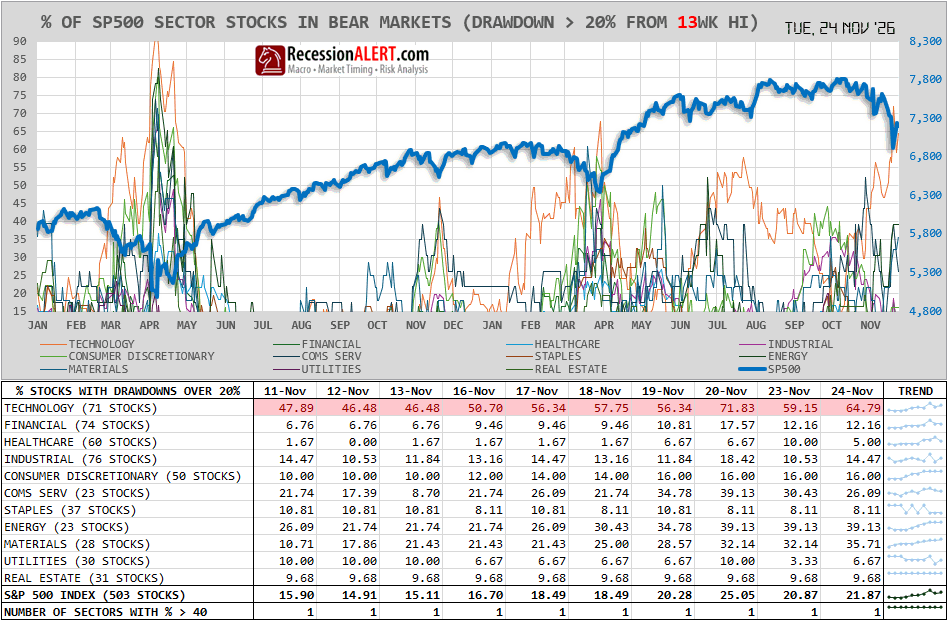
Tech cracks first. In three of the last four S&P 500 sell-offs of 5% or more it was the first of 11 sectors to break. After January’s peak, 40% of tech stocks were more than 20% below their 13-week high within five sessions; the S&P took 27 sessions to lose 3%. This time tech has cracked alone: nearly two-thirds of its stocks, 46 of 71, are that far down, against 21.9% of the whole index, a 42.9-point gap wider only once in data from 2007, last Friday. Why does one sector matter so much? Weight. Tech is 14% of the index by headcount but was more than 35% by value in early November, above its share at the 2000 dot-com peak, built by its price gains. This chart counts stocks, so it shows how deep the damage runs; the index counts dollars, so it shows what it costs everyone else. Last Friday the S&P closed 11.6% below its 6 Oct record, yet the other ten sectors’ median stayed under 20%. The test is whether the cracks spread. Only tech is above 40%, but Energy sits at 39.1% and Materials has jumped from 10.7% to 35.7% in two weeks. Of the three earlier times tech’s gap topped 35 points, one spread market-wide, one partway, one stayed in tech. The index shows where the money sits; this chart shows where the damage is.
What it means: A household in an S&P 500 index fund had more than a third of that money in tech as of early November. It will feel a tech sell-off more than the word “diversified” suggests. For stock investors, how far the index falls now depends on whether the damage stays in one sector. Watch the table’s bottom row. If two more sectors cross 40%, or the share of all S&P stocks this far down passes 30%, up from 22% today, the trouble has left tech.
Market Intelligence Brief (MIB) Ver. 20.10
For professional investors only. Not investment advice.
© 2026 RecessionALERT.com

Comments are closed.