
MARKET INTELLIGENCE BRIEF (MIB)
Monday, November 9, 2026
Chips led a broad rebound: the S&P 500 rose 2.35% and the Nasdaq 100 gained 3.40% as AMD jumped 13.26% on an Oppenheimer upgrade. Nvidia fell 4.27% as its board probes whether CEO Jensen Huang was targeted by foreign intelligence. Brent slid 6.21% after Trump called new Iran strikes “highly unlikely.” Bonds balked: 2-year yields rose 5.4 bps and December hike odds climbed to about 84% before Tuesday’s CPI. Washington and Beijing extended their trade truce to January 10, 2027.
TABLE OF CONTENTS
A. EXECUTIVE SUMMARY
B. MARKET DATA
C. HIGH-IMPACT STORIES (5)
D. MODERATE-IMPACT STORIES (6)
E. ECONOMY WATCH (5)
F. EARNINGS WATCH (1)
G. WHAT’S NEXT
H. CHART OF THE DAY
A. EXECUTIVE SUMMARY -> TOP
Stocks rebounded broadly from last week’s AI selloff, with the S&P 500 up 2.35% and the Nasdaq 100 up 3.40%, as chipmakers recovered from fears that a Democratic Congress would slow data-center construction and a 6.21% fall in Brent on Trump’s Iran comments gave cyclicals a tailwind. Bonds did not share the relief: the 2-year yield rose 5.4 bps and December hike odds climbed to about 84% on a day Goolsbee and Barkin both placed the risk on the inflation side, so the rally runs into Tuesday’s CPI with a hike close to fully priced. Nvidia’s 4.27% fall on its CEO probe, against a semiconductor index up nearly 7%, was the market pricing governance risk rather than weaker demand. All 11 sectors rose, led by Industrials (+4.24%) with Energy (+0.37%) last, but Technology is still down 12.43% on the month: a bounce inside a downtrend, not yet a turn.
• Chips lead the rebound: AMD rose 13.26% to $508.58 after Oppenheimer upgraded it to Outperform with a $600 target, Applied Materials (AMAT) rose 11.37% and Lam Research (LRCX) rose 10.41%. The Philadelphia Semiconductor Index rose nearly 7% after slumping more than 12% last week.
• Nvidia lags its own sector: NVDA fell 4.27% to $178.67 after independent directors opened a probe into whether CEO Jensen Huang was the target of a foreign intelligence effort. A second New York Times report said a Commerce inquiry into suspected chip smuggling by cloud partner Megaspeed had moved to the Justice Department.
• Crude slides on diplomacy: Brent fell 6.21% to $92.21 and WTI fell 4.91% to $86.37 after Trump called renewed Iran strikes “highly unlikely” while talks progress, even though both countries reported shipping hit near the Strait of Hormuz over the weekend.
• Hike odds climb: CME FedWatch put a December hike at about 84%, while Goolsbee said the Fed must “come to terms with inflation failure” and Barkin called inflation “stubbornly elevated.” The 2-year yield rose 5.4 bps to 4.566% and the 10-year rose 3.0 bps to 4.886%; October CPI is due Tuesday, consensus 3.9% year over year.
• Trade truce extended: Formal US and Chinese filings push the truce to January 10, 2027, averting Tuesday’s snap-back of China’s 24% tariff on US goods and US fees on China-linked ships, ahead of a Trump-Xi meeting at APEC next week.
• Corporate movers: Caterpillar (CAT) rose 7.21% after the FT reported Anthropic took over $3.4 billion of its gas-generator orders; Eli Lilly (LLY) rose 4.28% on Foundayo sleep-apnea data despite an FDA class-wide GLP-1 vision-loss warning; Boeing (BA) fell 0.59% as it plans to cut about 5% of its commercial airplanes workforce.
1. Stocks priced relief; the front end priced a hike — Equities treated last week’s risk as passed while the 2-year moved further toward a December hike, and the two cannot both be right for long. Goolsbee’s framing is the important shift: by describing data-center construction as overheating and services inflation as picking up, he locates the problem in demand rather than tariffs, which weakens the case for looking through it. With a hike close to fully priced, Tuesday’s CPI is less about December than about whether markets begin to price a second move, the scenario that would test valuations already shaken by the AI selloff. The dollar’s 0.63% fall means the repricing has not yet tightened financial conditions through the currency.
2. AI capital is rotating, not retreating, but positioning is not clean — Oppenheimer’s AMD call directly rebutted the midterm thesis, arguing any political drag on data-center construction would not arrive before the second half of 2028, and Anthropic’s assumption of $3.4 billion of Caterpillar generator orders shows AI spending now flowing into on-site power and industrials. Nvidia’s governance discount shows investors discriminating within the trade rather than exiting it. Against that, Citi cut US equities and global tech to Neutral, warning Nasdaq positioning could turn net short after another drop of about 5%, and expects global earnings growth to slow by about 20 percentage points in 2027. Thursday’s Applied Materials and Cisco results are the first fundamental test since the selloff.
3. A strong economy with strained households — GDPNow edged up to 3.5% for the fourth quarter and September wholesale sales jumped 2.8%, giving the Fed no reason to wait for a slowdown. The pressure sits with consumers: in the New York Fed’s survey the probability of missing a minimum debt payment rose to 13.8%, unemployment fears reached their highest since April 2020, and expected earnings growth of 2.6% trails the 3.9% inflation households expect. Lower crude helps the headline inflation outlook, but expected rent increases rose to 7.7%, and a hike would land first on the households already showing strain, making Tuesday’s Household Debt and Credit Report a check on whether that stress is reaching actual delinquencies.
 — Leading economic indicators. Accurate market forecasts. Apply for membership at join.recessionalert.com
B. MARKET DATA -> TOP
Stocks rebounded hard from the S&P 500’s worst week since the April 2025 tariff shock, per Investing.com, as chipmakers led a broad risk-on session and crude fell about 5% after President Trump said renewed strikes on Iran were “highly unlikely” while talks progress. All 11 sectors rose and the Russell 2000 (+3.15%) kept pace with the Nasdaq 100 (+3.40%). The exception was Nvidia, down 4.27% after its board opened an investigation into CEO Jensen Huang, while AMD jumped 13.26% on an Oppenheimer upgrade. Treasuries did not join the relief: the 2-year rose 5.4 bps and the 10-year 3.0 bps ahead of this week’s CPI report, even as the dollar fell 0.63%.
CLOSING PRICES – Monday, November 9, 2026:
MAJOR INDICES
This was a broad rebound, not a narrow one: the NYSE Composite (+2.18%) rose almost as much as the S&P 500, and the Russell 2000 nearly matched the Nasdaq 100. Over the past 10 sessions the Russell 2000 (+1.94%) has beaten the S&P 500 (-1.65%) by 3.6 points, an entrenched 10-session pattern, and the S&P 500 has beaten the Nasdaq 100 (-4.67%) by 3.0 points, now in its sixth session. The Dow is within 2% of its 10-session high but DJ Transportation is 2.09% below its own, so no Dow Theory confirmation is in force.
| Index | Close | Change | %Move | Why It Moved |
|---|---|---|---|---|
| S&P 500 | 7,549.94 | +173.08 | +2.35% | Rebounded from its worst week since the April 2025 tariff shock, led by chip stocks and helped by a slide in oil after Trump’s Iran comments, per Investing.com |
| Dow Jones | 52,389.75 | +1,104.02 | +2.15% | Rose with the broad rebound; Industrials (+4.24%) was the strongest S&P sector |
| DJ Transportation | 20,395.85 | +620.98 | +3.14% | Rose on a day crude fell about 5%; no transport-specific catalyst identified |
| Nasdaq 100 | 27,907.63 | +917.63 | +3.40% | Chip stocks led after last week’s slump (the Philadelphia Semiconductor Index rose nearly 7%, per Investing.com), while Nvidia fell 4.27% on its CEO controversy |
| Russell 2000 | 2,840.81 | +86.71 | +3.15% | Rose with the broad rebound; extends its 10-session relative strength against the S&P 500 |
| NYSE Composite | 24,472.56 | +522.19 | +2.18% | Broad gains; all 11 S&P sectors closed higher |
VOLATILITY & TREASURIES
Bonds declined to confirm the equity relief: yields rose across the curve while the VIX fell 22.31% to 19.92, its first close below 20 since November 4. The 2-year again led, rising 5.4 bps against 3.0 bps for the 10-year and flattening 2s10s to about 32 bps, a firmer-policy signal ahead of this week’s CPI report. The dollar fell 0.63% despite the higher yields.
| Instrument | Level | Change | Why It Moved |
|---|---|---|---|
| VIX | 19.92 | -5.72 (-22.31%) | Fell sharply as equities rebounded; first close below 20 since November 4 |
| 10-Year Treasury Yield | 4.886% | +3.0 bps | Rose for a second session ahead of this week’s CPI report, as investors weighed a possible December Fed rate hike after Friday’s payrolls, per Investing.com |
| 2-Year Treasury Yield | 4.566% | +5.4 bps | Led the move higher again; the 2s10s spread flattened to about 32 bps |
| US Dollar Index (DXY) | 101.66 | -0.64 (-0.63%) | Fell even as Treasury yields rose; EUR/USD gained about 0.72%; no discrete same-day catalyst identified |
COMMODITIES
Metals rose together as the dollar fell: gold gained 1.83% and silver, copper and platinum each rose more than 2%, so there was no split between safe-haven and industrial demand. Bitcoin’s 0.71% gain lagged the equity rebound and left it below Friday’s level after a weekend dip, so it did not trade as a risk proxy.
| Asset | Price | Change | %Move | Why It Moved |
|---|---|---|---|---|
| Gold | $4,149.65/oz | $+74.75 | +1.83% | Rose as a weaker dollar provided support, per Investing.com |
| Silver | $53.453/oz | $+1.511 | +2.91% | Rose with gold as the dollar fell |
| Copper | $6.3815/lb | $+0.1440 | +2.31% | No copper-specific catalyst confirmed; rose with other metals as the dollar fell. China extended its US trade truce by two months on Monday, per Reuters |
| Platinum | $1,579.35/oz | $+42.45 | +2.76% | Rose with precious metals; no discrete same-day catalyst identified |
| Bitcoin | $74,991.0 | $+525.0 | +0.71% | Up from Sunday’s close but still below Friday’s $75,823 after a weekend dip; lagged the equity rebound |
ENERGY
Crude fell sharply after Trump said new strikes on Iran were “highly unlikely” while talks progress, with Brent (-6.21%) falling further than WTI (-4.91%) and the Brent-WTI spread compressing to about $5.84 from $7.39 on Friday. Henry Hub went the other way, up 6.90%, while Dutch TTF fell: a US-only gas move.
| Asset | Price | Change | %Move | Why It Moved |
|---|---|---|---|---|
| Crude Oil (WTI) | $86.37/bbl | $-4.46 | -4.91% | Fell after Trump said fresh attacks on Iran were “highly unlikely” as long as talks progress; settled at $86.85, down $3.98, per Reuters, and kept falling after settlement |
| Crude Oil (Brent) | $92.21/bbl | $-6.11 | -6.21% | Settled at $92.57, down $5.75, per Reuters, then kept falling to its lowest since late August; extends last week’s 16% drop |
| Natural Gas (Henry Hub) | $3.205/MMBtu | $+0.207 | +6.90% | Hedge funds covered a record short position as weather forecasts turned cooler, per Investing.com |
| Natural Gas (Dutch TTF) | $27.083/MMBtu | $-0.871 | -3.12% | No discrete same-day catalyst identified; the dollar figure is cushioned by a 0.72% rise in EUR/USD |
S&P 500 SECTORS
All 11 sectors rose, a full sweep rather than rotation. Energy (+0.37%), with crude down about 5%, and Consumer Defensive (+0.64%) gained least. Industrials (+4.24%) led, while Technology (+3.17%) is still down 12.43% on the month: a bounce inside a downtrend.
| Sector | 1-Day | 1-Week | 1-Month | 3-Month | 6-Month | YTD | 12-Month |
|---|---|---|---|---|---|---|---|
| Industrials | +4.24% | +0.38% | -1.87% | -7.27% | -6.96% | +7.40% | +9.46% |
| Basic Materials | +3.47% | +4.05% | +0.86% | -3.63% | -6.58% | +12.71% | +26.02% |
| Technology | +3.17% | -1.68% | -12.43% | -7.08% | -2.67% | +15.01% | +13.18% |
| Consumer Cyclical | +2.60% | +2.95% | +4.98% | -0.25% | -0.97% | -1.23% | -1.75% |
| Healthcare | +2.10% | +2.41% | +9.69% | +9.38% | +25.34% | +17.50% | +22.82% |
| Communication Services | +2.04% | +4.73% | -9.62% | -7.52% | -14.57% | -8.68% | -4.09% |
| Financial | +1.74% | +1.36% | +4.19% | -1.16% | +10.67% | +7.09% | +12.88% |
| Utilities | +1.60% | +0.81% | +5.08% | +0.05% | -4.43% | +1.88% | -1.27% |
| Real Estate | +1.55% | +2.34% | +6.94% | -0.11% | -0.25% | +8.79% | +7.97% |
| Consumer Defensive | +0.64% | -0.06% | +8.95% | +8.15% | +7.23% | +16.29% | +19.65% |
| Energy | +0.37% | -7.43% | -5.26% | -0.53% | +2.72% | +33.09% | +35.13% |
TOP MEGA-CAP MOVERS:
GAINERS
| Company | Ticker | Close | Change | Why It Moved |
|---|---|---|---|---|
| Advanced Micro Devices | AMD | $508.58 | +13.26% | Oppenheimer upgraded the stock to Outperform with a $600 target in a note on Monday, per Investing.com, which also reports that AMD’s EPYC processors will host Google Cloud’s new TPU 8tx systems |
| Applied Materials | AMAT | $370.55 | +11.37% | No discrete same-day catalyst identified; rebounded with chip equipment ahead of its fiscal Q4 report on Thursday, November 12 |
| Lam Research | LRCX | $221.31 | +10.41% | No discrete same-day catalyst identified; continued its rebound after the $25 billion buyback authorization announced Thursday, November 5 |
| Arista Networks | ANET | $186.17 | +9.00% | Rose with the AI-hardware rebound; no discrete same-day catalyst identified |
| Broadcom | AVGO | $319.48 | +8.78% | Rose with the chip rebound; no discrete same-day catalyst identified |
DECLINERS
| Company | Ticker | Close | Change | Why It Moved |
|---|---|---|---|---|
| NVIDIA | NVDA | $178.67 | -4.27% | Fell after CEO Jensen Huang admitted an affair with a businesswoman US intelligence reportedly suspects of being a Chinese spy and the board opened an independent investigation over the weekend, per Investing.com |
| Philip Morris International | PM | $193.12 | -2.41% | No discrete same-day catalyst identified |
| Chevron | CVX | $210.78 | -0.86% | Fell as crude dropped about 5% |
| ExxonMobil | XOM | $164.73 | -0.69% | Fell as crude dropped about 5% |
| Berkshire Hathaway | BRK-A | $853,500.00 | -0.36% | Earnings-driven: third-quarter results were released Saturday, November 7, per Investing.com |
— Institutional-grade intelligence for serious investors. Apply for membership at join.recessionalert.comC. HIGH-IMPACT STORIES -> TOP
BULLISH
1. Chips Lead a Broad Rebound From the S&P 500’s Worst Week Since April 2025: S&P 500 Rises 2.35% and Nasdaq 100 3.40% as All 11 Sectors Gain
The core facts:The S&P 500 rose 2.35% to 7,549.94, the Nasdaq 100 3.40% to 27,907.63, the Dow 2.15% to 52,389.75 and the Russell 2000 3.15%, rebounding from what Investing.com called the S&P 500’s worst week since the April 2025 tariff shock. Investing.com reports the Philadelphia Semiconductor Index rose nearly 7% after slumping more than 12% last week on fears that a Democratic Congress would regulate AI and slow data-center construction. Chip hardware dominated the mega-cap gainers: AMD +13.26% (Story 6), Applied Materials +11.37%, Lam Research +10.41%, Arista Networks +9.00% and Broadcom +8.78%, the last four with no company-specific catalyst identified. All 11 S&P sectors closed higher, led by Industrials (+4.24%), and the VIX fell 22.31% to 19.92, its first close below 20 since November 4.
Why it matters:The breadth makes this more than a short squeeze in a handful of AI names: the Russell 2000 nearly matched the Nasdaq 100 and the NYSE Composite rose 2.18%, and lower crude (Story 3) gave cyclicals a tailwind. But three things argue it is a bounce inside a downtrend rather than a turn. Technology is still down 12.43% over the past month; Treasuries did not join the relief, with the 2-year yield up 5.4 bps as December hike odds rose (Story 4); and the rally came without the sector’s largest company, Nvidia, which fell 4.27% on its CEO probe (Story 2). Citi, the same morning, cut US equities and global tech to Neutral on the view that positioning had further to fall (Story 7). A rally into Tuesday’s CPI report with the front end pricing a hike is exposed to a hot print.
What to watch:October CPI on Tuesday, November 10 at 8:30 AM ET, then Applied Materials and Cisco results after the close on Thursday, November 12, the first earnings test for AI hardware since the post-midterm selloff.
BEARISH
2. Nvidia Falls 4.27% After Its Board Opens an Independent Probe Into Whether CEO Jensen Huang Was the Target of a Foreign Intelligence Effort
The core facts:Nvidia said a committee of independent directors, assisted by outside counsel, will investigate whether Huang was the target of a foreign intelligence effort, after The New York Times reported last month that he had a relationship with Alice Huang, a former executive of Singapore-based Nvidia cloud partner Megaspeed whom US authorities concluded was a Chinese intelligence asset. Reuters said it could not independently verify the Times’ claims. In a message to employees on Sunday, Huang said he had been unfaithful to his wife and took “full responsibility.” Nvidia said the board has “no reason to believe” US national security or company secrets were affected, and that Huang supports the review. On Monday the Times reported that a Commerce Department inquiry into Megaspeed over suspected smuggling of Nvidia chips into China was transferred to the Justice Department late last year after Nvidia’s general counsel contacted investigators. Nvidia fell 4.27% to $178.67, the session’s largest decline among US companies worth more than $200 billion.
Why it matters:Nvidia was valued at about $4.5 trillion on November 6, per Reuters, so its fall cost more market value than most S&P 500 companies are worth, and it came on a day the semiconductor index rose nearly 7%. That gap of roughly 11 percentage points is the market pricing key-person and governance risk, not demand: no change to Nvidia’s business was reported. The second Times report is the more consequential thread for investors, because it moves the issue from Huang’s private conduct toward export-control enforcement on China, where the company already faces congressional scrutiny: senior House Republicans had already sought briefings from Huang after the Times’ first report. Any finding that widens into chip diversion would put Nvidia’s China exposure and its relationship with Washington back in play.
What to watch:Whether Nvidia discloses a timeline or scope for the committee’s review, and whether Huang agrees to the House briefing requested by committee chairs, and whether Nvidia keeps lagging the semiconductor index once the sector rebound fades.
BULLISH
3. Crude Slides as Trump Calls Renewed Iran Strikes “Highly Unlikely”: Brent Falls 6.21% and WTI 4.91% Despite Weekend Attacks on Hormuz Shipping
The core facts:Brent closed at $92.21 a barrel, down 6.21%, and WTI at $86.37, down 4.91%. Per Reuters, President Trump said on Sunday he was highly unlikely to order fresh attacks on Iran while talks progress. On Monday he met Qatar’s Prime Minister, Sheikh Mohammed bin Abdulrahman Al Thani, whose government is leading mediation, called the meeting “excellent,” and said resumed combat “seems to be quite unlikely” and that the US is “seeing positive momentum toward an end to this conflict,” according to Al-Monitor. Secretary of State Rubio was more guarded on Sunday, calling some Iranian demands “outrageous and ridiculous” and saying “I wouldn’t say we’re on the verge of a breakthrough.” Crude fell even though both countries reported shipping hit in or near the Strait of Hormuz over the weekend, per Reuters, and Brent had already fallen 16% last week.
Why it matters:The market is now pricing the diplomatic path rather than the physical one, which is the right call only if talks hold: the weekend’s tanker strikes show supply through Hormuz is still disrupted, so the downside in crude rests on statements, not on restored flows. Brent’s steeper fall compressed the Brent-WTI spread to about $5.84 from $7.39 on Friday, the signature of a falling geopolitical premium on seaborne crude. The fall in oil left Energy the weakest S&P sector (+0.37%), with Chevron down 0.86% and ExxonMobil down 0.69% on a strong day. Lower energy prices ease the headline inflation outlook, but Treasury yields rose anyway, a sign the bond market’s attention is on services and core inflation ahead of Tuesday’s CPI rather than on crude.
What to watch:Washington’s formal response to Iran’s latest proposal, and the EIA’s Short-Term Energy Outlook on Tuesday, November 10 at 12:00 PM ET. A Brent close back above $98 would mean the market is putting the de-escalation premium back.
BEARISH
4. Goolsbee Says the Fed Must “Come to Terms With Inflation Failure” as December Hike Odds Climb to About 84% Ahead of CPI; the 2-Year Yield Rises 5.4 bps
The core facts:Two Fed presidents struck a hawkish note on Monday (their remarks are covered in Section E). Chicago Fed President Austan Goolsbee told a Chicago audience “We’ve got to come to terms with inflation failure” and that “Data centers looking like old-fashioned overheating,” per FXStreet, while Richmond Fed President Tom Barkin said the risk “lies on the inflation side of our dual mandate.” CME FedWatch put the probability of a 25 bp hike at the December 8-9 meeting at about 84%, up from about 76% on Friday. The 2-year Treasury yield rose 5.4 bps to 4.566% and the 10-year 3.0 bps to 4.886%, flattening the 2s10s spread to about 32 bps. No source directly tied Monday’s repricing to the speeches rather than to positioning ahead of CPI.
Why it matters:The bond and equity markets told different stories on Monday: stocks rallied as if last week’s risk had passed, while the front end moved further toward pricing a December hike. Goolsbee’s framing matters because it locates the problem in demand, not tariffs: describing data-center construction as overheating and services inflation as accelerating weakens the argument that recent price rises are a one-time tariff effect the Fed can look through. With a hike close to fully priced, Tuesday’s CPI is less about whether the Fed moves in December than about whether markets begin to price a second move, which is the scenario that would test equity valuations already shaken by the AI selloff. The dollar fell 0.63% despite higher yields, so the hawkish repricing has not yet tightened financial conditions through the currency.
What to watch:October CPI on Tuesday, November 10 at 8:30 AM ET (consensus 0.3% month over month and 3.9% year over year; core 0.2%). The 2-year yield’s 4.566% close is the baseline for measuring the reaction.
BULLISH
5. US and China Formally Extend Their Trade Truce by Two Months to January 10, 2027, Averting Tuesday’s Snap-Back of China’s 24% Tariff and US Port Fees
The core facts:China kept its additional 24% tariff on US goods suspended for two more months, while continuing to charge a 10% additional levy, and its Commerce Ministry said it is continuing to pause certain export controls. On the US side, the Trade Representative further suspended Section 301 actions against China’s maritime, logistics and shipbuilding sectors, including fees on China-linked ships calling at US ports, which had been due to take effect Tuesday, and a separate filing extended all 178 current Section 301 tariff exclusions on Chinese goods. Both sides’ measures now run to January 10, 2027, per Supply Chain Dive. Treasury Secretary Bessent first announced the extension in September; Monday’s filings are the formal instruments. Per Reuters, the extension comes ahead of a Trump-Xi meeting at next week’s APEC summit in China.
Why it matters:Without these filings, a 24% Chinese tariff on US exports and US fees on China-linked shipping would both have taken effect on Tuesday, a cliff that farm exporters, shippers and importers of Chinese goods had been pricing as a tail risk. The two-month term is short, so the truce removes the cliff rather than the risk: it moves the next deadline into January and makes next week’s Trump-Xi meeting the event that decides whether the arrangement becomes durable. China’s Finance Ministry said it will monitor US actions and adjust countermeasures as appropriate, which leaves the door open to escalation if Washington proceeds with plans to replace its court-invalidated tariffs. No market move could be tied to the extension itself; copper rose 2.31% with other metals but without a confirmed trade catalyst.
What to watch:The Trump-Xi meeting at APEC next week, and the Trade Representative’s decision, due before January 10, 2027, on whether to keep the port-fee suspension in place.
— Quantifying recession risk so you don’t have to guess. Apply for membership at join.recessionalert.comD. MODERATE-IMPACT STORIES -> TOP
BULLISH
6. AMD Jumps 13.26% to $508.58 After Oppenheimer Upgrades It to Outperform With a $600 Target, Forecasting 135% Data-Center Growth Next Year
The core facts:Oppenheimer analyst Rick Schafer upgraded Advanced Micro Devices to Outperform from Perform with a $600 price target in a note on Monday, per Investing.com, citing data-center momentum after AMD’s latest earnings call. He said EPYC server processors and initial shipments of MI455 AI chips and Helios server racks drove about a doubling of data-center revenue in the third quarter, and he expects data-center sales to rise 135% next year to 85% of total revenue. Schafer expects AMD’s AI chip sales to overtake its server CPU sales in 2027, and put 2027 capital spending by the five largest cloud providers at about $1.3 trillion, up from $800 billion this year. On midterm risk he wrote: “We see any incremental land/power/shell political (midterm) risk unlikely before 2H28.” AMD closed up 13.26% at $508.58, the session’s largest gain among US companies worth more than $200 billion.
Why it matters:The note directly rebuts the thesis behind last week’s AI selloff, that a Democratic Congress would slow data-center construction, by arguing that most planned capacity is already being built and that any political drag would not arrive before the second half of 2028. Coming on the same day Nvidia fell on its CEO probe, AMD’s rally also shows investors rotating within AI hardware rather than abandoning it. Not all of the 13.26% was the upgrade: the whole chip complex rebounded (Story 1), so the move combines a sector bounce with a stock-specific re-rating of a company now worth about $834 billion.
What to watch:Applied Materials’ results on Thursday, November 12 after the close, the first read on whether equipment orders held through the selloff, and any update on the timing of AMD’s MI455 volume ramp.
UNCERTAIN
7. Citi Tactically Cuts US Equities and Global Tech to Neutral, Warning Nasdaq Positioning Could Turn Net Short; Upgrades Europe Ex-UK to Overweight
The core facts:Citi downgraded US equities, global tech and European tech to Neutral from Overweight on a tactical basis on Monday, citing the risk that investor positioning could fall further, and upgraded European stocks outside the UK to Overweight, per Investing.com. It warned that Nasdaq positioning could slip from roughly neutral into net-short territory and estimated another 5% drop would be needed for positioning to turn properly negative. “We remain constructive on AI over the medium-term but would look for cleaner positioning and more stable AI sentiment (along with steady EPS revisions) before reestablishing our Overweight call,” the bank wrote, adding that “risks appear balanced, rather than significantly skewed to the downside.” Citi expects global earnings growth to slow by about 20 percentage points in 2027 and is now Overweight materials and health care.
Why it matters:The call landed before a 3.40% rally in the Nasdaq 100, so on the day it looked early, but it is a positioning call rather than a fundamental one and its logic survives a single session’s bounce: Citi is saying the AI trade has not yet been cleaned out. The earnings forecast is the more important element for US allocators. A 20-point slowdown in global earnings growth next year would remove the main support for current multiples, and Citi notes that in similar years global stocks have risen only about 4% on average, with defensive and high-quality names outperforming. Its preference for Europe rests on lower tech exposure and the benefit of falling oil, both of which were visible in Monday’s crude decline.
What to watch:Whether the Nasdaq 100 holds Monday’s 27,907.63 close through CPI and Thursday’s AI hardware earnings; a renewed drop of about 5% is the level at which Citi says positioning would turn properly negative.
UNCERTAIN
8. FDA Orders a Class-Wide Vision-Loss Warning on GLP-1 Drugs as Lilly Reports Its Foundayo Pill Cut Sleep-Apnea Severity; Lilly Rises 4.28%
The core facts:The FDA on Monday required GLP-1 drugs, including Eli Lilly’s Mounjaro and Zepbound and Novo Nordisk’s Ozempic and Wegovy, to add information about a potential increased risk of non-arteritic anterior ischemic optic neuropathy (NAION), a cause of sudden vision loss, to the “warnings and precautions” section of their labels, per Reuters. A Lilly spokesperson said the communication “does not reference any findings specific to Lilly medicines,” while Novo said it “continues to believe the data do not establish a cause-and-effect relationship.” Citi’s Geoff Meacham said the action “may temporarily increase patient and investor concern” but should “limit changes to prescribing.” The same morning Lilly said its daily pill Foundayo significantly reduced obstructive sleep apnea severity in a late-stage trial: patients not using PAP therapy had 21.1 fewer breathing events per hour at 52 weeks, against 4.8 on placebo, per CNBC. Lilly plans to file for US approval in that indication by year-end. Lilly closed up 4.28% at $1,411.95.
Why it matters:A class-wide label change is the regulatory outcome the GLP-1 makers had sought to avoid, but its market impact was contained because it singles out no drug and NAION is rare: the European Medicines Agency put it at up to 1 in 10,000 semaglutide users last year. Lilly’s rise shows investors weighting the indication expansion above the label risk; a second sleep-apnea indication extends the oral franchise into a condition that affects an estimated 80 million US adults, according to the National Council on Aging, most of them undiagnosed, according to Lilly. The warning is a slower-burning issue for prescribing and liability, and it falls more heavily on Novo, whose semaglutide is the drug in the European finding.
What to watch:Weekly GLP-1 prescription data over the next month for any slowdown in new starts after the label change, and Lilly’s Foundayo sleep-apnea filing, which it targets by the end of 2026.
BULLISH
9. Anthropic Takes Over $3.4 Billion of Caterpillar Gas-Generator Orders for 1.7 GW of AI Power, FT Reports; Caterpillar Rises 7.21%
The core facts:Anthropic agreed in late September to take over $3.4 billion of orders for 1.7 gigawatts of Caterpillar gas-fired generators placed about two years earlier by OnePWR Solutions, a San Antonio power supplier that needed financing to complete the purchase, the Financial Times reported on Sunday, citing one person with knowledge of the deal. Anthropic did not acquire OnePWR; it assumed the equipment orders and the installation work. Both companies declined to comment to the FT, and where the generators will be used was not disclosed. Caterpillar closed up 7.21% at $598.88 on a day Industrials led all S&P sectors with a 4.24% gain.
Why it matters:The deal is evidence that AI developers are now buying their own power generation rather than waiting for the grid, which makes on-site gas generation a direct beneficiary of AI capex. The qualification matters for Caterpillar, however: these were existing orders moving to a better-funded buyer, so the report de-risks backlog rather than adding to it. It also shows Anthropic, which is preparing for its IPO, committing capital to physical infrastructure on a scale that ties its growth plans to gas supply and turbine availability, a second channel through which AI spending flows into industrials and energy.
What to watch:Any confirmation from Anthropic or Caterpillar of the order and its site, and further disclosures in Anthropic’s IPO filings on its power commitments.
BEARISH
10. Boeing to Cut About 5% of Its Commercial Airplanes Workforce, Saying a Slower 737 Ramp Leaves It “Overstaffed”; Shares Slip 0.59%
The core facts:Boeing Commercial Airplanes chief Stephanie Pope told employees on Monday that the division, which employs about 50,000 people, will cut about 5% of its workforce through attrition and involuntary layoffs, with notices beginning in December, per KOMO News. “Adjusting our production schedules and reducing aircraft output puts us in an overstaffed position,” Pope wrote, adding that the company had made progress on quality and delivery but has “not yet fully recovered.” Boeing has not said how many jobs will go or where. The division builds about 47 737 MAX jets a month and targets 52 a month in the second half of 2027, after CEO Kelly Ortberg told investors last month that MAX output would not rise significantly before then. Boeing closed down 0.59% at $172.38 on a day the Dow rose 2.15%.
Why it matters:The cuts turn last month’s slower ramp guidance into a cost reality: Boeing is resizing to a lower production plan rather than staffing ahead of one, which signals management does not expect the 737 ramp to accelerate soon. That matters beyond Boeing because its build rate sets the pace for the aerospace supply chain, from engines to aerostructures, and it is a key input to US durable-goods and aircraft-export data. Boeing’s lag on a broad up day shows the market reading the memo as confirmation of weaker near-term deliveries rather than as a margin positive.
What to watch:Boeing’s next monthly orders and deliveries reports, the first to reflect the slower ramp after the layoff notices begin.
BULLISH
11. 9th Circuit Blocks California From Enforcing Its Climate-Risk Disclosure Law and Value-Chain Emissions Reporting on First Amendment Grounds
The core facts:A three-judge panel of the 9th US Circuit Court of Appeals on Monday unanimously said California’s law requiring companies with more than $500 million of annual revenue to disclose climate-related financial risks every two years (Senate Bill 261) would likely fail, because it compels “value-laden” judgments on a “politically fraught” subject, per Reuters. The panel also blocked the part of Senate Bill 253 requiring companies with more than $1 billion of revenue to report emissions across their supply chains and customers, while letting the state enforce reporting of companies’ own emissions and of the energy they buy. “The First Amendment, however, limits the government’s ability to compel speech,” Judge Jacqueline Nguyen wrote. The case returns to the district court, and the US Chamber of Commerce said it will seek permanent injunctions.
Why it matters:California’s laws were the most far-reaching climate disclosure regime in the US, and because they apply to any large company doing business in the state, they reached most of the S&P 500 regardless of where it is headquartered. Removing the risk-disclosure and value-chain requirements eliminates the costliest and most litigation-prone parts, especially for companies with long supply chains in consumer goods, autos and retail. The First Amendment reasoning also narrows the legal room for any other state, or a future federal regulator, to mandate similar narrative climate disclosures.
What to watch:Whether California seeks rehearing by the full 9th Circuit, and how the California Air Resources Board revises its compliance timeline for the own-emissions reporting the court left in place.
— Separating signal from noise since 2007. Apply for membership at join.recessionalert.comE. ECONOMY WATCH -> TOP
Monday’s data and Fed commentary pointed the same way: demand is holding up and inflation is not easing. GDPNow edged up to 3.5% for the fourth quarter and September wholesale sales jumped 2.8%, while Richmond Fed President Tom Barkin said the “appropriate direction of monetary policy is relatively straightforward” with inflation “stubbornly elevated.” The strain sits with households: in the New York Fed’s survey, the probability of missing a minimum debt payment rose to 13.8% and unemployment fears reached their highest since April 2020, even as year-ahead inflation expectations held at 3.9%. With CME FedWatch putting the odds of a December rate hike at 84%, per FXStreet, Tuesday’s October CPI (consensus 3.9% year over year) is the next test.
Barkin Says Direction of Policy Is “Relatively Straightforward” With Inflation “Stubbornly Elevated,” but Urges Fed to “Move Policy With Care” (Richmond Fed, Nov 9)
What they’re saying:In a speech in Greer, S.C., Richmond Fed President Tom Barkin said that “with demand healthy and inflation stubbornly elevated, the appropriate direction of monetary policy is relatively straightforward,” adding that “risks to the demand outlook remain easy to envision. Because of that, it is wise to move policy with care.” He said firms report broad-based cost pressures that are “leading them to also try to pass on increases that they’ve absorbed to date,” and that “should the economy remain on its current path, the risk lies on the inflation side of our dual mandate.”
The context:Barkin cited September PCE inflation of 3.6% headline and 3.1% core, third-quarter business investment up 12.7%, and nominal consumption excluding food and energy growing at a 6.9% annualized rate over six months, against unemployment of 4.1% in October. He named AI as the main risk to that resilience in either direction: an underdelivery that hits investment and stock prices, or an overdelivery that displaces workers. Front-end yields rose on the day, with the 2-year up 5.4 bps to 4.566%, ahead of Tuesday’s CPI report.
What to watch:October CPI on Tuesday, November 10 at 8:30 AM ET (consensus 0.3% month over month and 3.9% year over year, from 0.6% and 3.7%; core 0.2% and 2.8%). Governor Waller speaks at 4:00 AM ET that day and Dallas Fed President Logan at 9:35 AM ET.
Goolsbee Warns Services Inflation Is Beginning to “Pick Up” and Has Become a “Big Problem” (FXStreet, Nov 9)
What they’re saying:Chicago Fed President Austan Goolsbee said services inflation is beginning to “pick up” and that it has become a “big problem,” according to FXStreet’s account of his remarks on Monday. Seeking Alpha headlined the same remarks as Goolsbee saying the Fed needs to “come to terms” with inflation.
The context:Goolsbee’s comments came on the same day Barkin said the risk lies on the inflation side of the Fed’s mandate, so two Fed presidents struck a hawkish note on one day. FXStreet reports that the CME FedWatch Tool put the odds of a December rate hike at 84%, up from 76% on Friday, and Polymarket’s market on another 2026 Fed hike rose to 82% from 77%. The 2-year Treasury yield rose 5.4 bps to 4.566% and the 10-year 3.0 bps to 4.886%.
What to watch:Goolsbee speaks again on Thursday, November 12 at 11:30 AM ET, after Tuesday’s October CPI and alongside Cleveland Fed President Hammack (9:00 AM) and Governor Barr (10:00 AM).
NY Fed Survey: Odds of Missing a Debt Payment Rise to 13.8% and Unemployment Fears Hit Highest Since April 2020, as Inflation Expectations Hold at 3.9% (New York Fed, Nov 9)
What they’re saying:The New York Fed’s October Survey of Consumer Expectations showed median inflation expectations unchanged at 3.9% one year ahead, 3.3% three years ahead and 3.0% five years ahead. The mean probability of missing a minimum debt payment over the next three months rose 1.6 percentage points to 13.8%, its highest since December 2025, and the probability that unemployment will be higher a year from now rose 1.4 points to 45.3%, its highest since April 2020.
The context:The labor readings were mixed rather than uniformly weak: the probability of finding a job after a job loss rose to 46.5%, its highest since November 2025, while the expected probability of losing a job rose 0.4 point to 13.9%. Expected rent increases rose 0.9 point to 7.7% and expected gas price increases fell 0.6 point to 4.2%. Median earnings growth expectations held at 2.6%, below the 3.9% inflation households expect, which squares with Barkin’s description of flattening real incomes.
What to watch:The New York Fed’s Q3 2026 Household Debt and Credit Report on Tuesday, November 10 at 11:00 AM ET, which will show whether rising expected payment stress is showing up in actual delinquencies.
Wholesale Sales Jump 2.8% in September as Inventory-to-Sales Ratio Falls to 1.21 From 1.34 a Year Earlier (Census Bureau, Nov 9)
What they’re saying:September wholesale sales rose 2.8% from August to $840.1 billion and were up 19.8% from a year earlier, the Census Bureau reported. Inventories rose 0.7% to $1,013.1 billion, revised up from the advance estimate of 0.6%, and were up 7.6% from a year earlier.
The context:Sales growing far faster than inventories pushed the inventory-to-sales ratio down to 1.21 from 1.34 in September 2025, so wholesalers are carrying lean stocks against demand. The figures are not adjusted for prices, so part of the 19.8% annual sales gain reflects inflation rather than volume. August’s sales gain was also revised up, to 2.0% from 1.8%.
What to watch:October PPI on Friday, November 13 at 8:30 AM ET (consensus 0.4% month over month after 1.3% in September), which will show how much of the nominal strength in goods trade is price.
GDPNow Edges Up to 3.5% for the Fourth Quarter as Investment Nowcast Firms (Atlanta Fed, Nov 9)
What they’re saying:The Atlanta Fed’s GDPNow model estimate for fourth-quarter real GDP growth rose to 3.5% on November 9, up from 3.4% on November 4. After recent releases from the Census Bureau and the Bureau of Labor Statistics, the nowcast of fourth-quarter real gross private domestic investment growth increased to 10.7% from 10.6%.
The context:A 3.5% tracking estimate shows the economy running well above trend going into the year-end, consistent with Barkin’s account of strong earnings and 12.7% third-quarter business investment growth. That strength is what keeps a December hike on the table: growth gives the Fed no reason to wait for a slowdown while inflation remains above target.
What to watch:October existing home sales on Thursday, November 12 at 10:00 AM ET (consensus 3.98 million) and weekly jobless claims the same day (consensus 195K), the next major inputs to the fourth-quarter growth picture.
— Know the probability before the market prices in the risk. Apply for membership at join.recessionalert.comF. EARNINGS WATCH -> TOP
YESTERDAY AFTER THE BELL (Markets Reacted Today)
UNCERTAIN
12. Berkshire Hathaway (BRK-A): -0.36% | Operating Earnings Fall 5.8% as Insurance Underwriting Profit Drops 43%; $9.6 Billion of Buybacks
The Numbers:Released: Saturday, November 7, 2026, with markets reacting Monday. Revenue $105.65 billion against an estimate of $100.96 billion; operating EPS $5.93 per Class B-equivalent share against an estimate of $5.88 ($8,900 per Class A share). Operating earnings, excluding investment gains, fell 5.8% to $12.71 billion from $13.49 billion, per the 10-Q. Net earnings fell 28.2% to $22.11 billion from $30.80 billion, as investment gains dropped to $9.41 billion from $17.31 billion. Berkshire bought back $9.6 billion of its stock in the quarter, per AP. Cash, cash equivalents and Treasury bills totaled $377.4 billion at September 30, including $20.5 billion of Treasury bill purchases not yet settled. No guidance is given.
The Problem/Win:Insurance was the problem. After-tax underwriting earnings fell 42.9% to $1.35 billion, and GEICO’s pre-tax underwriting profit fell to $982 million from $1.77 billion as its loss ratio rose to 76.6% from 71.5%, which the 10-Q attributes to higher claims frequency and severity along with lower average premiums per policy; its expense ratio also rose on higher commissions and advertising. Insurance investment income fell 14.1% to $2.73 billion on lower interest rates. The non-insurance businesses offset part of it: BNSF earnings rose 19.3% to $1.73 billion on higher shipping volumes, Berkshire Hathaway Energy rose 8.3% and manufacturing, service and retailing rose 11.8%.
The Ripple:GEICO’s 5.1-point loss-ratio deterioration is a read-through for personal auto insurers, pointing to rising claims severity in bodily injury coverage across the industry. BNSF’s 19.3% earnings gain is a positive freight-volume signal for the rails. Class A shares slipped 0.36% on a day the S&P 500 rose 2.35%.
What It Means:The quarter’s most telling figure is the $9.6 billion buyback: Berkshire is buying its own stock while still holding about $377 billion of cash and bills, which suggests it sees its own shares as better value than anything else available. The earnings decline is concentrated in insurance underwriting and lower rates, the two lines most exposed to the cycle, while the operating businesses are growing.
What to watch:Berkshire’s third-quarter 13F holdings filing due in mid-November, and whether GEICO’s loss ratio stabilizes in the fourth quarter.
TODAY BEFORE THE BELL (Markets Already Reacted)
No major earnings before the bell from companies with >$100B market cap.
TODAY AFTER THE BELL (Markets React Tomorrow)
No major earnings after the bell from companies with >$100B market cap.
WEEK AHEAD PREVIEW:
Q3 2026 earnings season is in its final stretch, with 88% of the S&P 500 reported as of November 6. This week’s large-cap calendar is concentrated on Thursday, when AI hardware gets its first earnings test since the post-midterm selloff, now set against Monday’s chip rebound.
Brookfield Corporation (BN) — BMO, Thursday, November 12 — consensus EPS $0.69 ($105.37 billion market cap, within about 5% of the line); key focus: distributable earnings growth against its 15%-20% long-term target and progress on combining with its insurance business.
Cisco Systems (CSCO) — AMC, Thursday, November 12 — consensus EPS $1.32, against company guidance of $1.32 to $1.34; key focus: whether orders were pulled forward ahead of price increases, as Morgan Stanley warned in its November 5 downgrade, and cloud-business margins.
Applied Materials (AMAT) — AMC, Thursday, November 12 — +11.37% today; consensus EPS $4.06 and about $10.3 billion of revenue; key focus: whether equipment orders held through the chip selloff, now sharpened by Monday’s rebound and Oppenheimer’s forecast of $1.3 trillion of 2027 hyperscaler capex, and China’s share of sales (28% last quarter) and export-control exposure.
No company above $100 billion reports on Tuesday, November 10, Wednesday, November 11, Friday, November 13 or Monday, November 16. The largest names on those days are Transdigm ($67.37 billion, Tuesday) and Franco-Nevada ($50.81 billion, Wednesday), both below the line.
— US market commentary trusted by family offices and institutions. Apply for membership at join.recessionalert.comG. WHAT’S NEXT -> TOP
UPCOMING RELEASES:
| Date | Event | Why It Matters |
|---|---|---|
| Tue, Nov 10 | October CPI, 8:30 AM ET (headline expected 0.3% MoM and 3.9% YoY, from 0.6% and 3.7%; core expected 0.2% MoM and 2.8% YoY, from 0.3% and 2.6%) | With a December hike priced at about 84%, the print matters less for December than for whether markets start pricing a second move. Monday’s 4.566% close on the 2-year is the baseline, and a hot services reading would support Goolsbee’s warning that inflation is demand-driven rather than a one-time tariff effect. |
| Tue, Nov 10 | Fed speakers: Waller (4:00 AM ET), Logan (9:35 AM ET), Bowman and Schmid (1:30 PM ET), Bowman again (6:30 PM ET) | Logan, Bowman and Schmid give the first Fed reaction to CPI. After two hawkish presidents on Monday, any pushback against a December hike would be the first sign the committee is not aligned behind it. |
| Tue, Nov 10 | New York Fed Q3 2026 Household Debt and Credit Report, 11:00 AM ET | Shows whether the rising expected payment stress in Monday’s consumer survey, a 13.8% probability of missing a minimum debt payment, is already showing up in actual delinquencies. |
| Tue, Nov 10 | EIA Short-Term Energy Outlook, 12:00 PM ET | The first official forecast update after Brent fell 6.21% on Monday on Iran diplomacy while Hormuz shipping remains disrupted; a test of whether the de-escalation discount in crude is justified by supply. |
| Wed, Nov 11 | MBA 30-Year Mortgage Rate, week to Nov 7, 7:00 AM ET (prior 7.3%) | With the 10-year at 4.886%, mortgage rates above 7% keep pressure on housing ahead of Thursday’s existing home sales. |
| Thu, Nov 12 | Initial Jobless Claims, 8:30 AM ET (expected 195K, prior 189K); October Existing Home Sales, 10:00 AM ET (expected 3.98M, prior 3.99M) | The next major inputs to a fourth quarter that GDPNow is tracking at 3.5%. Low claims would reinforce the strong-demand case for a hike even as households report the highest unemployment fears since April 2020. |
| Thu, Nov 12 | Fed speakers: Hammack (9:00 AM ET), Barr (10:00 AM ET), Goolsbee (11:30 AM ET), Daly (1:10 PM ET), Williams (6:30 PM ET) | The first full day of Fed commentary after CPI. Goolsbee’s second appearance will show whether the data moved him further toward a hike, and a broad hawkish chorus would leave little room to price December out. |
| Fri, Nov 13 | October PPI, 8:30 AM ET (expected 0.4% MoM, prior 1.3%; core expected 0.3% MoM, prior 0.7%) | Shows how much of September’s nominal strength in wholesale trade, where sales jumped 2.8%, was price rather than volume, and whether pipeline pressure is easing after September’s 1.3% jump. |
| Mon, Nov 16 | NY Empire State Manufacturing Index, November, 8:30 AM ET (prior 25.50) | The first regional manufacturing read for November, and a check on whether lower crude and the extended US-China truce are feeding through to factory activity. |
KEY QUESTIONS:
1. With a December hike close to fully priced, will Tuesday’s October CPI confirm the services pickup Goolsbee described strongly enough for markets to begin pricing a second hike, and can a rally built on relief absorb that?
2. Is Monday’s chip rebound a re-rating or a positioning bounce: does the Nasdaq 100 hold its 27,907.63 close through the week, or fall the roughly 5% Citi says would turn positioning properly negative?
3. Can crude hold its de-escalation discount without restored flows through Hormuz, and will next week’s Trump-Xi meeting at APEC turn a two-month trade truce into a durable arrangement?
— US market commentary trusted by family offices and institutions. Apply for membership at join.recessionalert.comH. CHART OF THE DAY -> TOP
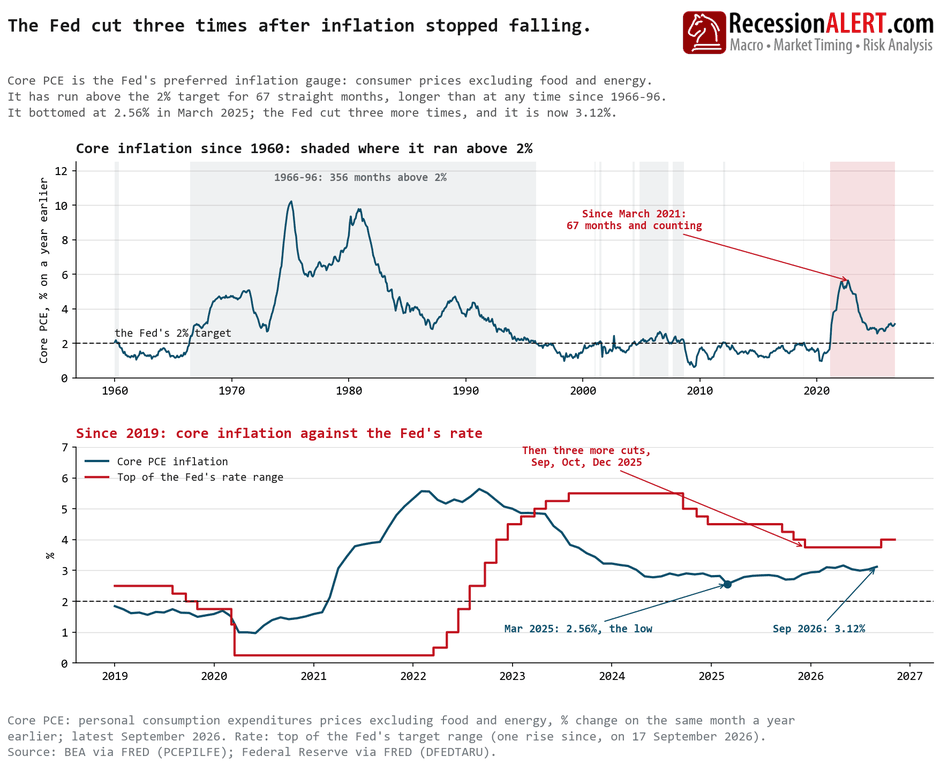
The Fed’s last three cuts all came after inflation had already hit its low. Core PCE, the Fed’s preferred gauge of consumer prices excluding food and energy, bottomed at 2.56% in March 2025, so by the first cut that September the decline had been over for six months, and core is now 3.12%. The timing matters more because of how long inflation has run high: 67 straight months above the 2% target, a run that only 1966-96 has beaten since 1960. The top pane shows what happened the last time. Between 1974 and 1977 the Fed cut its overnight rate from 12.9% to 4.6% while core inflation was still about 6% or higher. Core then climbed back to 9.8% by 1980, and it took a 19.1% funds rate in 1981 to bring it down. Today’s level is a third of that 1970s peak, so the likeness is in the order of events, not the size. That order of events left today’s Fed a thin cushion. The real policy rate, which is the Fed’s rate minus inflation, is just 0.88 points, and every tenth of a point that core inflation adds takes a tenth off it, so when the Fed pauses, policy loosens by itself. September’s rate rise only won back ground that rising inflation keeps taking, and markets now put a 78% probability on a second rise at the 9 December meeting. When inflation rises and rates stand still, standing still is a cut.
What it means: For households, cheaper borrowing has already gone into reverse: the average 30-year mortgage rate is 7.18%, against 6.15% at the end of 2025. A December rise would make a quick return toward 6% less likely. For stock investors, the question is no longer when cuts resume but how far rises go. For the economy, a real rate under one point is only a mild brake, so more than one rise may be needed if prices keep climbing. The test is the next core PCE reading: a drop back below 3% would ease the pressure.
Market Intelligence Brief (MIB) Ver. 20.03
For professional investors only. Not investment advice.
© 2026 RecessionALERT.com

Comments are closed.