
MARKET INTELLIGENCE BRIEF (MIB)
Wednesday, October 7, 2026
Fed minutes show most officials expect another hike by year-end and record market concern that AI borrowing is lifting term premiums. The 10-year yield touched a 24-year intraday high of 5.364% before a strong $39B auction pulled it back. IEA members agreed to speed up emergency oil releases, and WTI settled down $1.16 despite a crude draw. Deere fell 3.8% on a new FTC-USDA farm-equipment inquiry. Platinum dropped 4.1% as the dollar posted its highest close in 122 sessions.
TABLE OF CONTENTS
A. EXECUTIVE SUMMARY
B. MARKET DATA
C. HIGH-IMPACT STORIES (6)
D. MODERATE-IMPACT STORIES (7)
E. ECONOMY WATCH (5)
F. EARNINGS WATCH (0)
G. WHAT’S NEXT
H. CHART OF THE DAY
A. EXECUTIVE SUMMARY -> TOP
Stocks snapped a four-session win streak, and the S&P 500’s 0.22% dip understated the damage: the Russell 2000 fell 1.31% as a renewed long-end selloff lifted the 10-year yield to a 24-year intraday high before a strong $39 billion auction capped it. The pressure ran through two channels the Fed minutes now name, an energy shock the IEA is trying to contain with faster stock releases and heavy AI-related private borrowing, made concrete by SpaceX’s reported $40 billion debt plan, competing with the Treasury for long-dated capital. The curve bear-steepened, with the 2-year down 2.1 bps as the 10-year rose, pointing to term premium and inflation compensation rather than Fed pricing as the source of strain. Breadth was poor: eight of 11 sectors fell, led by Industrials (-2.32%), where Caterpillar and the farm-equipment makers fell hardest, and Basic Materials (-2.22%) as precious metals sold off, while Healthcare (+0.79%) was the only meaningful gainer.
• Fed minutes lean hawkish, the front end does not: Most officials judged another hike “likely” appropriate by year-end after September’s unanimous move to 3.75%-4.00%, yet the 2-year yield fell 2.1 bps to 4.772% and the dollar index rose 0.43% to 102.24, its highest close in 122 sessions.
• Long end tests 24-year highs: The 10-year touched 5.364% intraday before the $39 billion auction stopped through at 5.300% (bid-to-cover 2.77, dealers left with just 2.5%), closing up 1.4 bps at 5.288%; SpaceX’s reported $40 billion borrowing plan to buy Nvidia chips revived crowding-out worries.
• Oil caught between supply and risk: IEA members agreed to accelerate emergency releases and prioritise diesel, and WTI settled down $1.16 at $88.28 despite a 3.2 million-barrel EIA crude draw; tanker attacks around Hormuz hit their highest weekly count since the war began, and Tropical Storm Isaias shut in about 25% of Gulf of Mexico oil output.
• Regulators open two new fronts: A joint FTC-USDA inquiry into farm-equipment practices sent Deere (DE) down 3.80% as Industrials posted the worst sector decline, while HUD opened a fair-lending probe of Wells Fargo’s minority homeownership programs (WFC -1.53%) days before its third-quarter report.
• Metals break, mega-caps split: Platinum fell 4.08%, silver 2.49% and gold 1.23% from Tuesday’s settlements while copper slipped only 0.18%; Caterpillar (CAT -5.75%) was the largest mega-cap decliner and Micron (MU +4.06%) the largest gainer.
• Households cool as expectations heat: NY Fed one-year inflation expectations rose to 3.9%, the highest since May 2023, while August consumer credit rose $8.3 billion against $15 billion expected as revolving balances contracted, and mortgage applications fell 4.2% with the 30-year contract rate at 7.49%.
1. AI is now on both sides of the rates trade — The minutes record market commentary tying part of the rise in term premiums to heavy private borrowing for AI infrastructure, and “some participants” warned the buildout could push demand past supply. SpaceX’s reported plan for $30 billion of investment-grade bonds to buy Nvidia chips is the concrete case, landing the same day the 10-year touched a 24-year intraday high. For portfolios, the long end now carries a term-premium headwind that does not depend on oil or the Fed’s next move, and Thursday’s 30-year auction is the next test of whether real-money buyers will absorb both Treasury and AI supply.
2. Why the Fed hikes matters more than whether — Reuters read the minutes as a split: some officials cite energy and other price shocks, while a more hawkish core sees demand-driven inflation. The IEA’s faster releases and Treasury Secretary Bessent’s view that yields fall once the Iran conflict ends support the energy case, which would fade with fuel prices. Rising Hormuz tanker attacks, a reported White House request for Iran strike options before the midterms, and NY Fed inflation expectations at 3.9% support the other. If the demand case wins, cheaper oil will not rescue bonds, which makes September CPI on Wednesday, Oct 14, the swing input before the October 27-28 meeting.
3. The index hides a weaker average stock and a cooling consumer — The Russell 2000 fell about six times as far as the Nasdaq 100, Basic Materials extended a one-month loss to 8.53%, and new regulatory probes hit farm-equipment makers and a major mortgage lender. Beneath the hawkish inflation signals, card balances are contracting and mortgage demand has fallen for two straight weeks at a 7.49% contract rate. Rate-sensitive and cyclical exposure is absorbing the cost of the long-end selloff while the cap-weighted indices barely move.
 — Leading economic indicators. Accurate market forecasts. Apply for membership at join.recessionalert.com
B. MARKET DATA -> TOP
Wall Street snapped a four-session winning streak a day after the S&P 500’s first close above 7,800, but the major averages ended well off their lows as a strong $39 billion 10-year auction pulled Treasury yields back from their intraday peaks and crude gave up early gains on an accelerated IEA stock release. The selling was concentrated in small caps and cyclicals: the Russell 2000 fell about six times as far as the Nasdaq 100, and Industrials and Basic Materials led an eight-of-eleven sector decline as Caterpillar slid 5.75%. The sharper break came in precious metals, with platinum and silver down 4.1% and 2.5% from Tuesday’s settlements while the dollar index posted its highest close in 122 sessions. Fed minutes showed most officials saw another hike as likely appropriate by year-end.
CLOSING PRICES – Wednesday, October 7, 2026:
MAJOR INDICES
Losses deepened down the capitalization scale: the cap-weighted S&P 500 and Nasdaq 100 barely dipped, while the Russell 2000 and the broader NYSE Composite fell four to six times as far, so the average stock did markedly worse than the headline. Transports and the Dow moved together, with no Dow Theory divergence and no trend signal crossing its threshold.
| Index | Close | Change | %Move | Why It Moved |
|---|---|---|---|---|
| S&P 500 | 7,801.77 | -17.16 | -0.22% | Snapped a four-session win streak a day after its first close above 7,800; trimmed losses after a strong 10-year Treasury auction |
| Dow Jones | 51,179.87 | -341.41 | -0.66% | Weighed by component Caterpillar, whose $49.66-a-share drop is a heavy weight on the price-weighted average |
| DJ Transportation | 19,529.30 | -172.46 | -0.88% | Fell with cyclicals; no discrete sector catalyst identified |
| Nasdaq 100 | 31,160.08 | -64.61 | -0.21% | Held near flat as Micron’s gain offset losses in CrowdStrike, Palo Alto Networks and Applied Materials |
| Russell 2000 | 2,793.20 | -37.09 | -1.31% | Led the decline, falling about six times as far as the Nasdaq 100 |
| NYSE Composite | 23,701.92 | -219.75 | -0.92% | Broad losses ran well beyond the S&P 500’s, with eight of 11 sectors lower |
VOLATILITY & TREASURIES
Yields swung rather than broke: the 10-year traded as high as 5.364% before a strong auction drew buyers, closing only modestly higher while the 2-year fell, steepening the 2s10s curve by 3.5 bps. With the dollar at its highest close in 122 sessions and the VIX barely moving, this was a rates-and-dollar session, not an equity-fear one.
| Instrument | Level | Change | Why It Moved |
|---|---|---|---|
| VIX | 15.08 | +0.07 (+0.47%) | Barely moved as equity losses were trimmed into the close |
| 10-Year Treasury Yield | 5.288% | +1.4 bps | Traded as high as 5.364% intraday before a strong $39 billion 10-year note auction drew buyers and pulled it back (Reuters) |
| 2-Year Treasury Yield | 4.772% | -2.1 bps | Fell as the curve steepened; Fed minutes showed most officials saw another hike as likely appropriate by year-end |
| US Dollar Index (DXY) | 102.24 | +0.44 (+0.43%) | Highest close in 122 sessions as the euro fell 0.58% |
COMMODITIES
Precious metals broke hard while copper barely moved: platinum and silver led the slide and gold fell more modestly, a precious-metals unwind rather than an industrial-demand signal. Bitcoin fell with small caps, trading as a risk asset on a weak day for the average stock.
| Asset | Price | Change | %Move | Why It Moved |
|---|---|---|---|---|
| Gold | $4,135.75/oz | $-51.35 | -1.23% | Fell alongside a firmer dollar, measured from Tuesday’s $4,187.10 settlement; no single confirmed catalyst identified |
| Silver | $60.055/oz | $-1.534 | -2.49% | Led precious metals lower and dragged Canadian miners with it; no single confirmed catalyst identified |
| Copper | $6.6380/lb | $-0.0120 | -0.18% | Little changed, holding apart from the precious-metals selloff |
| Platinum | $1,639.55/oz | $-69.75 | -4.08% | Steepest metals decline; no discrete same-day catalyst identified |
| Bitcoin | $83,575 | $-2,129 | -2.48% | Fell with small caps; no discrete same-day catalyst identified |
ENERGY
Both crude benchmarks settled lower after the IEA agreed to speed up its oil-stock release, then recovered after the settlement, which is why Brent shows a small gain against Tuesday’s settle; the Brent premium over WTI widened to about $12. Henry Hub rose on the day Tropical Storm Isaias formed in the Gulf of Mexico, a link not independently confirmed, and Dutch TTF gained in step.
| Asset | Price | Change | %Move | Why It Moved |
|---|---|---|---|---|
| Crude Oil (WTI) | $88.89/bbl | $-0.55 | -0.61% | Settled down $1.16 at $88.28 (Reuters) after the IEA agreed to accelerate its oil-stock release and France moved to release diesel reserves, despite a surprise 3.2M-barrel EIA crude draw; recovered after the settlement, so the loss against Tuesday’s $89.44 settle is smaller |
| Crude Oil (Brent) | $100.92/bbl | $+0.34 | +0.34% | Settled down $0.38 at $100.20 (Reuters) on the IEA release, with Houthi attacks in Yemen limiting losses; rebounded after the settlement to trade above Tuesday’s $100.58 settle |
| Natural Gas (Henry Hub) | $3.216/MMBtu | $+0.102 | +3.28% | Rose as Tropical Storm Isaias formed in the Gulf of Mexico, forecast to cross offshore oil and gas production areas (Reuters); link to the gas move not independently confirmed |
| Natural Gas (Dutch TTF) | $25.76/MMBtu | $+0.79 | +3.15% | Rose in euro terms, with the dollar gain trimmed by a 0.58% drop in the euro; no discrete same-day catalyst identified |
S&P 500 SECTORS
Eight of 11 sectors fell, led by Industrials and Basic Materials; Healthcare was the only meaningful gainer, with Consumer Defensive and Communication Services barely green. Materials’ slide extends a one-month loss of more than 8%, while Technology’s dip barely dents a 36% six-month run.
| Sector | 1-Day | 1-Week | 1-Month | 3-Month | 6-Month | YTD | 12-Month |
|---|---|---|---|---|---|---|---|
| Healthcare | +0.79% | -0.43% | -0.40% | +0.56% | +9.44% | +6.97% | +13.85% |
| Consumer Defensive | +0.08% | +1.65% | -1.32% | -1.65% | -3.28% | +4.26% | +5.71% |
| Communication Services | +0.07% | +1.08% | +3.18% | -0.26% | +4.53% | +1.82% | +7.61% |
| Utilities | -0.12% | +4.16% | -4.44% | -8.29% | -11.82% | -3.64% | -7.29% |
| Consumer Cyclical | -0.14% | +2.66% | -2.06% | -3.82% | +1.22% | -7.19% | -9.03% |
| Technology | -0.50% | +2.72% | +6.04% | +9.51% | +35.87% | +33.23% | +29.96% |
| Energy | -0.78% | +2.50% | -2.50% | +12.16% | +4.52% | +37.07% | +37.36% |
| Financial | -1.11% | -0.08% | -6.16% | -3.12% | +5.86% | +1.53% | +5.24% |
| Real Estate | -1.39% | -1.28% | -7.77% | -9.16% | -4.20% | -0.41% | -3.23% |
| Basic Materials | -2.22% | -0.28% | -8.53% | +2.86% | -6.48% | +9.72% | +15.60% |
| Industrials | -2.32% | +1.93% | -2.15% | -5.90% | -1.72% | +9.45% | +9.55% |
TOP MEGA-CAP MOVERS:
GAINERS
| Company | Ticker | Close | Change | Why It Moved |
|---|---|---|---|---|
| Micron Technology | MU | $1,088.00 | +4.06% | DA Davidson raised its price target to a Street-high $3,000 from $2,100 on Wednesday, and a same-day Bernstein note put Q3 memory chip prices up nearly 20% (both per Investing.com); shrugged off a Taiwan union’s approval to strike |
| Eli Lilly | LLY | $1,188.72 | +2.70% | No discrete same-day catalyst identified; Healthcare was the session’s strongest sector |
| Amgen | AMGN | $413.08 | +2.60% | No discrete same-day catalyst identified; no company release since September 22 |
| Sandisk | SNDK | $1,692.42 | +1.92% | Moved with Micron on the same-day memory-pricing note; link unverified as the driver |
| AbbVie | ABBV | $271.36 | +1.75% | Reached an all-time high intraday in a firm healthcare tape on the day the FDA granted two Breakthrough Therapy designations to its cancer drug Temab-A; link to the move not independently confirmed |
DECLINERS
| Company | Ticker | Close | Change | Why It Moved |
|---|---|---|---|---|
| Caterpillar | CAT | $813.83 | -5.75% | Zacks Research cut its rating to Hold on Wednesday (per Investing.com), an action that looks too small to explain a drop this size; no larger same-day catalyst identified. Truist cut its target to $1,100 on Monday |
| CrowdStrike | CRWD | $265.44 | -4.81% | No discrete same-day catalyst identified; a $5.4 million CEO share sale disclosed Tuesday is too small to explain the move |
| Palo Alto Networks | PANW | $405.57 | -3.42% | Fell with CrowdStrike; no discrete same-day catalyst identified |
| GE Vernova | GEV | $997.09 | -3.12% | No discrete same-day catalyst identified; gave back part of Tuesday’s surge, which followed an Oppenheimer top-pick note (per Investing.com) |
| Texas Instruments | TXN | $288.98 | -2.78% | No discrete same-day catalyst identified; Applied Materials and Lam Research also fell |
— Institutional-grade intelligence for serious investors. Apply for membership at join.recessionalert.comC. HIGH-IMPACT STORIES -> TOP
UNCERTAIN
1. Fed Minutes Point to Another Hike by Year-End and Name AI Debt Issuance as a Source of Higher Term Premiums, but the 2-Year Yield Slips
The core facts:The minutes of the September 15-16 meeting, released at 2:00 PM ET, showed most officials judged another increase “likely” appropriate by year end, after the unanimous quarter-point hike to 3.75%-4.00% (the data are covered in Economy Watch). Two passages matter most for markets. The minutes recorded market commentary attributing part of the rise in term premiums and Treasury yields to geopolitics, uncertainty over the Treasury’s buyback program, and “competition for capital from heavy private debt issuance to finance the development of artificial intelligence (AI) infrastructure,” and found that changes in real rates accounted for most of the net increase in longer-maturity yields. Separately, “some participants” said the AI buildout could cause aggregate demand to outpace supply over the medium term. Reuters read the minutes as a split over the rationale for hiking: some officials pointed to energy and other price shocks, while a more hawkish core cited emerging demand-driven inflation. The front end did not reprice higher: the 2-year yield fell 2.1 bps to 4.772%, the 10-year rose 1.4 bps to 5.288%, and the dollar index gained 0.43% to 102.24.
Why it matters:“By year end” leaves two meetings, October 27-28 and December, and the minutes add no timing language beyond officials approaching “each meeting with an open mind.” The split rationale is what investors should hold onto. A hike justified by energy shocks can lose its case if the IEA’s accelerated releases and any end to the Iran conflict bring fuel prices down; a hike justified by AI-driven demand does not depend on oil at all. The minutes also put the AI capex boom on both sides of the rates story at once: as a demand source that could keep inflation elevated, and as a borrower competing with the Treasury for long-dated capital. That second channel was on display the same day, when SpaceX’s reported $40 billion financing plan weighed on Treasuries.
What to watch:St. Louis Fed President Musalem on Thursday, Oct 8 (1:40 PM ET) and Boston Fed President Collins on Friday, Oct 9 (4:00 PM ET), then September CPI on Wednesday, Oct 14, the last CPI report before the October 27-28 meeting.
UNCERTAIN
2. 10-Year and 30-Year Yields Touch 24-Year Highs Before a Strong $39 Billion Auction Pulls Them Back; SpaceX’s Financing Plan Revives Crowding-Out Worries
The core facts:Treasuries sold off early as crude jumped above $100, driving the 10-year yield to a 24-year intraday peak of 5.364% and the 30-year to its own 24-year high, Reuters reported; the 30-year was last 2.8 bps higher at 5.669% in afternoon trading. The selling eased after the 10-year auction stopped through, pricing below the expected yield at the bid deadline, with primary dealers left with just 2.5% of the issue, their smallest share since the aftermath of the global financial crisis, according to Reuters (full results are in Economy Watch). The 10-year closed up 1.4 bps at 5.288%, below Monday’s 5.315% close, while the 2-year fell 2.1 bps, and Reuters put the 2s10s spread at 52.2 bps from 48.1 bps after touching 53.7 bps, its steepest since mid-August. Earlier, Treasuries were undermined by a Financial Times report that SpaceX is seeking about $40 billion, roughly $10 billion of bank loans and $30 billion of investment-grade debt, to buy Nvidia chips; Sage Advisory’s Thomas Urano told Reuters private borrowing for long paper has grown enough to create “this crowding-out effect or competition for capital.”
Why it matters:The auction answered the question that has hung over the long end, whether there is end-user demand at these yields, and the answer was yes: TD Securities’ Gennadiy Goldberg said higher yields are prompting investors to “dip their toes.” That kept the S&P 500’s loss to 0.22% after a weaker morning. But the session’s shape was a bear steepener, with the long end rising while the front end fell, which points to term premium and inflation compensation rather than Fed expectations as the source of pressure. That is the channel the minutes flagged, and the one a $30 billion SpaceX bond deal would feed directly. It is also the rate that matters for housing: the 30-year mortgage contract rate is already at 7.49%.
What to watch:Thursday’s 30-year bond auction (1:00 PM ET, Oct 8) is the direct test of long-end demand after the 24-year high, and any formal SpaceX bond launch would test investment-grade supply.
BULLISH
3. IEA Members Agree to Speed Up Emergency Oil Releases and Put Diesel First; Crude Settles Lower Despite a Surprise US Inventory Draw
The core facts:IEA member governments meeting on Wednesday backed accelerating the oil-stock releases announced in the March 2026 Collective Action and prioritising diesel releases “to the extent possible, given the current tightness in diesel markets.” The IEA put releases to date at about 325 million barrels, with about 100 million barrels pledged but not yet released, against public emergency stocks of around 1.1 billion barrels, including more than 200 million barrels of diesel; members will review the situation at next week’s Governing Board meeting. Reuters said the move aims to curb record-high fuel prices. WTI settled down $1.16 at $88.28 and Brent down $0.38 at $100.20, even though the EIA reported a 3.2 million-barrel draw in commercial crude stocks against an expected build of about 1.7 million barrels. Both benchmarks recovered after the settlement, leaving WTI at $88.89 (-0.61%) and Brent at $100.92 (+0.34%) against Tuesday’s settles.
Why it matters:This changes the timing of supply, not the total: the roughly 100 million barrels still pledged were already committed, and accelerating them brings forward barrels the market had expected later, leaving less in reserve for a fresh disruption. The diesel priority targets the product that feeds trucking, farm and freight costs, where energy pass-through into goods prices is most direct. The effect on rates was immediate, as Reuters said falling oil helped Treasury yields drift off their highs. Brent’s rebound above $100 after the settlement shows how much of the release the market is discounting against Gulf shipping risk and the storm now entering Gulf of Mexico production areas.
What to watch:Next week’s IEA Governing Board review, and whether Brent can hold below $100 on a settlement basis once accelerated barrels start to arrive.
BEARISH
4. FTC and USDA Open a Joint Inquiry Into Farm-Equipment Market Practices; Deere Drops Nearly 4% and Industrials Post the Session’s Worst Sector Decline
The core facts:The Federal Trade Commission and the Department of Agriculture launched a joint public inquiry on Wednesday into agricultural equipment manufacturing and distribution, focused on potential anticompetitive conduct. The agencies are seeking information on business models, policies, agreements and contract terms; firsthand accounts of restrictions, penalties or retaliation; and the effects on pricing, market entry, innovation and farmer welfare. Comments are due December 7 (docket FTC-2026-1585). The release cites the FTC’s earlier settlement with Deere and five states over farmer right-to-repair, and a separate settlement with Corteva over pesticides. Deere fell 3.80%, and CNH Industrial and AGCO each fell more than 5% intraday, according to Investing.com. Caterpillar, which is not named in the inquiry, dropped 5.75%, the session’s largest mega-cap decliner, and Industrials fell 2.32%, the weakest of the 11 sectors. No source has established that the inquiry drove Caterpillar’s decline.
Why it matters:This is a request for information, not an enforcement action, but its scope goes beyond the right-to-repair case Deere has already settled. Dealer agreements, contract terms and retaliation against independent repair shops all concern the aftermarket side of the equipment business rather than machine sales, and a joint FTC-USDA inquiry gives the agencies a record on which to build later rules or cases across the whole sector. The market priced it as a sector risk rather than a Deere-specific one, with the smaller manufacturers falling further than Deere, and the selling reached into the wider machinery complex on a day when the Russell 2000 fell about six times as far as the Nasdaq 100.
What to watch:The December 7 comment deadline, and whether the manufacturers or their dealer networks respond publicly before then.
BEARISH
5. Precious Metals Break Lower, With Platinum Down 4.1% and Silver 2.5%, as the Dollar Posts Its Highest Close Since at Least Mid-April
The core facts:Measured from Tuesday’s settlements, platinum fell 4.08% to $1,639.55 an ounce, silver 2.49% to $60.055 and gold 1.23% to $4,135.75, while copper slipped only 0.18%. Investing.com reported that silver fell more than 5% and gold more than 3% at their intraday lows, dragging Canadian miners lower. The dollar index rose 0.43% to 102.24, its highest close since at least April 15, as the euro fell 0.58%. Basic Materials fell 2.22%, the second-weakest sector after Industrials, extending its one-month loss to 8.53%, and Bitcoin fell 2.48% to $83,575. No single confirmed catalyst for the metals selloff has been identified.
Why it matters:The breakdown in copper against precious metals marks this as an unwind in monetary and safe-haven metals, not a growth scare. It coincided with a firmer dollar and with long-dated Treasury yields touching 24-year highs intraday, a rise the Fed minutes attributed mostly to real rates, which raise the cost of holding assets that pay no yield. The intraday losses ran to roughly double the closing ones, and Materials is now the sector carrying the deepest one-month decline on the board.
What to watch:Whether the dollar index holds above 102 into September CPI on Wednesday, Oct 14, and whether gold holds above $4,000 an ounce.
BEARISH
6. Attacks on Tankers Around Hormuz Hit Their Highest Weekly Count of the War, as the White House Asks the Pentagon for Iran Strike Options Before the Midterms
The core facts:At least 12 attacks on oil, LNG and LPG tankers took place around the Strait of Hormuz in the week of September 28 to October 5, the most in any week since the war began on February 28, according to three maritime security sources cited in a Reuters exclusive on Wednesday. Separate International Maritime Organization data showed nine incidents that week, against eight in the closest comparable week, starting July 13. The US Navy-led Joint Maritime Information Center said Revolutionary Guards harassment, including drone overflights and radio hailing, has persisted in the strait. Gulf oil exporters topped pre-war shipment levels for about half of September. Separately, The Atlantic reported at 3:00 PM ET that the White House has asked the Pentagon to develop strike options against Iranian targets that could be used before the November 3 midterm elections; no final decision has been made, and the US has not struck Iran in several weeks.
Why it matters:Gulf export volumes and attacks on the ships carrying them are rising together, so the supply recovery is being achieved under growing physical risk rather than easing it. A resumption of US strikes would end the several-week lull that has coincided with the recovery in flows and with the market’s willingness to look through Hormuz headlines. That risk premium is the counterweight to the IEA’s accelerated releases, and Brent’s return above $100 after settling lower shows it has not been priced out. For rates, it is the energy channel the Fed minutes cited as one reason for hiking.
What to watch:The Joint Maritime Information Center’s next weekly incident note, and any administration statement on Iran before the November 3 election.
— Quantifying recession risk so you don’t have to guess. Apply for membership at join.recessionalert.comD. MODERATE-IMPACT STORIES -> TOP
UNCERTAIN
7. Tropical Storm Isaias Shuts In a Quarter of Gulf of Mexico Oil Output, and Henry Hub Gas Gains 3.3%
The core facts:About 25.08% of Gulf of Mexico oil production and 16.37% of natural gas output were shut in as of Wednesday as Tropical Storm Isaias moved through the Gulf, according to the offshore regulator, as reported by Reuters. Operators evacuated 8 of 371 manned production platforms and 2 of 11 non-dynamically positioned rigs, and moved one dynamically positioned rig off location. Isaias formed in the Gulf on Wednesday and is forecast to strengthen into a hurricane before reaching the northern Gulf Coast around the weekend. Henry Hub natural gas rose 3.28% to $3.216 per MMBtu on the day, though the link to the storm has not been independently confirmed.
Why it matters:Offshore shut-ins are usually reversed within days once a storm passes, so the larger exposure is onshore: Gulf Coast refining, where an outage would hit diesel on the same day the IEA prioritised diesel releases because of tight markets. The storm adds a domestic supply risk to a crude market already balancing accelerated emergency barrels against Hormuz shipping attacks.
What to watch:National Hurricane Center advisories on Isaias’s track and intensity into Friday, Oct 9, and updated shut-in figures from the regulator.
BEARISH
8. HUD Opens a Fair-Lending Investigation of Wells Fargo Over Its Programs to Expand Black Homeownership
The core facts:The Department of Housing and Urban Development on Wednesday sent Wells Fargo Chief Executive Charlie Scharf a letter saying it would examine whether the bank violated fair-lending laws by favoring Black or other minority homeowners, The Wall Street Journal reported, citing a copy of the letter. The probe covers programs and commitments the bank made over nearly a decade to increase homeownership among Black Americans, and the department is treating race-based lending as a potential violation of the Fair Housing Act. Wells Fargo shares fell 1.53%, and the Financial sector fell 1.11%.
Why it matters:This turns fair-lending enforcement around: the Fair Housing Act is being applied to race-conscious programs meant to expand minority lending, rather than to discrimination against minority borrowers. That puts any comparable commitment at other lenders in question and adds a new category of regulatory risk for mortgage businesses already under pressure from a 7.49% contract rate. For Wells Fargo the timing is pointed, arriving days before its third-quarter report.
What to watch:Wells Fargo’s third-quarter results and call before the open on Tuesday, Oct 13, for management’s first comments on the investigation.
UNCERTAIN
9. SpaceX Seeks About $40 Billion in Debt, Including $30 Billion of Investment-Grade Bonds, to Buy Nvidia Chips
The core facts:SpaceX is looking to raise about $40 billion to fund purchases of Nvidia chips, roughly $10 billion in bank loans and $30 billion in investment-grade debt, the Financial Times reported on Tuesday evening, after the previous session’s close. Reuters said the report undermined Treasuries on Wednesday morning, with analysts warning that a SpaceX entry into the investment-grade market could revive concerns that large-scale corporate borrowing is competing with long-dated Treasuries for investor capital. SpaceX shares (SPCX) fell 2.51%.
Why it matters:The deal moves AI infrastructure financing further from cash flow and into the bond market, where it competes directly for the long-dated buyers the Treasury needs. The Fed minutes released the same afternoon named heavy private debt issuance for AI infrastructure as one source of higher term premiums, so a deal of this size is a concrete instance of a risk the Fed is already monitoring. For Nvidia, it is a sign that chip demand is being financed with borrowed money, which lengthens the order book but raises the credit sensitivity of the AI buildout.
What to watch:A formal SpaceX bond launch and its pricing against comparable investment-grade issuers, and Thursday’s 30-year Treasury auction.
UNCERTAIN
10. Trump Says the Fed Board “Would Like to See the Country Do Badly”; Bessent Says Yields Will Fall Once the Iran Conflict Ends
The core facts:Asked about mortgage rates in the Oval Office on Wednesday, President Trump called Fed Chair Kevin Warsh “great” but said the rest of the Board “would like to see the country do badly, in my opinion, because I think interest rates should come down,” Reuters reported. Treasury Secretary Scott Bessent, alongside him, said inflation was high because of the energy shock, and that once “on the other side of this Iran conflict,” the energy market would be well supplied and inflation, mortgage rates “and the 10-year will come back down.” Reuters noted that the 30-year mortgage rate hit its highest point in almost three years last week.
Why it matters:The administration’s case rests on inflation being an energy problem that resolves itself, which is the dovish side of the split the minutes recorded; the more hawkish core of officials sees demand-driven inflation that would outlast the conflict. Singling out the Board while praising the Chair puts political pressure on the governors who will vote on the next move, and it comes as the 10-year sits near 24-year highs. Markets did not react visibly, but the rhetoric raises the cost to the Fed of the hike most officials now expect.
What to watch:Whether Musalem on Thursday or Collins on Friday addresses the comments or reaffirms the year-end hike case.
UNCERTAIN
11. CBP Proposes Rules for the End of De Minimis: Filing Before Importation, a Bond on Every Low-Value Entry and a New Mail Entry Type
The core facts:US Customs and Border Protection placed a proposed “Low-Value Shipments” rule on public inspection on Wednesday, ahead of the statutory end of the de minimis exemption on July 1, 2027, under the One Big Beautiful Bill Act. Informal entries (Entry Type 11) would have to be filed electronically on or before importation rather than within 15 days of arrival, with a new “final deliver-to party” data element. A new Entry Type 13 would replace postal worksheets for mail shipments of $2,500 or less and require tracking numbers and sender information. Every Type 11 and Type 13 entry would need a basic importation bond, with liquidated damages of at least $1,000 per breach. CBP projects about 32.7 million postal and 70.1 million Type 11 shipments a year and puts the rule’s net cost over 2026-2035 at $9.3 billion at a 3% discount rate, or $7.7 billion at 7%. Comments are due 60 days after Federal Register publication.
Why it matters:The rule sets the compliance mechanics that will turn the end of de minimis from a tariff question into an operating cost. Pre-arrival filing and a bond on every entry raise the fixed cost of each low-value parcel, which falls hardest on cross-border e-commerce sellers shipping directly to consumers and shifts work to carriers and customs brokers. For US retailers that compete with direct-from-China platforms, it narrows a cost advantage that had already been suspended by executive order.
What to watch:Federal Register publication on Thursday, Oct 8, which starts the 60-day comment period, and comments from carriers and e-commerce platforms on the bond requirement.
UNCERTAIN
12. The US and 14 Economies Sign a Joint Statement on Manufacturing Overcapacity, With China Absent
The core facts:The United States and 14 economies signed a Joint Ministerial Statement on manufacturing excess capacity on Wednesday, on the margins of the OECD Trade Committee meeting, the US Trade Representative’s office said. The signatories are Argentina, Australia, Canada, the European Union, France, Germany, India, Italy, Japan, Korea, Mexico, Poland, Türkiye, the United Kingdom and the United States; China is not among them. The statement calls for dedicated sectoral platforms to examine and address structural excess capacity, and for all countries to eliminate non-market policies and practices that distort markets. It specifies no tariffs or enforcement measures. Trade Representative Jamieson Greer said that, left unchecked, overcapacity “will continue to cripple domestic industries, displace local production” and hold back living standards.
Why it matters:The statement gives Washington a coalition framework for treating overcapacity as a shared problem, with India and Mexico alongside the G7 economies, rather than as a bilateral US-China dispute. It carries no immediate market consequence, but sector-by-sector platforms are the format in which coordinated trade measures on steel, autos or chemicals could later be agreed, which matters for US producers in those industries and for Chinese exporters looking for alternative markets.
What to watch:Which sectors the first platforms cover, and any Chinese government response.
BULLISH
13. FDA Approves Pfizer’s TUKYSA Regimen as a Chemotherapy-Free, Front-Line Maintenance Treatment in HER2-Positive Metastatic Breast Cancer
The core facts:Pfizer said on Wednesday (12:57 PM ET) that the FDA approved TUKYSA (tucatinib) with trastuzumab and pertuzumab as maintenance treatment for adults with unresectable locally advanced or metastatic HER2-positive breast cancer following induction treatment, moving the drug into the front-line setting. In the Phase 3 HER2CLIMB-05 trial, the regimen cut the risk of disease progression or death against placebo plus trastuzumab and pertuzumab, with a hazard ratio of 0.64 (95% CI 0.51-0.80); median investigator-assessed progression-free survival was 24.9 months versus 16.3 months, a difference of 8.6 months.
Why it matters:Moving TUKYSA from later-line to front-line maintenance greatly expands the number of patients eligible, and maintenance treatment typically runs for long periods, which supports revenue duration as well as volume. For Pfizer, oncology growth from assets like this is the offset to looming patent expiries elsewhere in the portfolio. The approval came on a day when Healthcare, up 0.79%, was the only sector with a meaningful gain.
— Separating signal from noise since 2007. Apply for membership at join.recessionalert.comE. ECONOMY WATCH -> TOP
The Fed is leaning toward more tightening just as household borrowing cools. Minutes of the September meeting, which lifted the target range to 3.75%-4.00%, showed most officials expect another increase by year-end, and the New York Fed’s survey put one-year inflation expectations at 3.9%, the highest since May 2023. Credit demand is softening beneath that: consumer credit rose $8.3 billion in August against $15 billion expected, with card balances contracting, and mortgage applications fell 4.2% as the 30-year contract rate reached 7.49%. Investors still bought duration, taking the 10-year auction at 5.300% on firmer demand. September CPI next Wednesday is the next major input into that year-end decision.
FOMC Minutes: Most Officials Saw Another Rate Increase as Likely Appropriate by Year-End (Federal Reserve, Oct 7)
What they’re saying:Minutes of the September 15-16 meeting, at which the Committee raised the federal funds target range by a quarter point to 3.75%-4.00% on a 12-0 vote, state that “most participants assessed that another increase in the target range for the federal funds rate would likely be appropriate by year end.” Participants “generally assessed inflation risk as skewed to the upside,” and several described the current policy rate as “not restrictive or only mildly restrictive.”
The context:The upside risk is tied to energy and trade: several participants warned that “the longer energy prices remained elevated, the greater the risk that cost pressures could lead to broader price pressures,” and the minutes list further tariff increases as an upside inflation risk, while the labor market was judged “close to maximum employment.” Many participants said financial conditions remained supportive of growth despite the rise in longer-term Treasury yields. By the close, the 2-year yield was down 2.1 bps at 4.772%, the 10-year up 1.4 bps at 5.288%, and the dollar index up 0.43% at 102.24, its highest close in 122 sessions.
What to watch:Fed speakers Musalem (Thursday, Oct 8, 1:40 PM ET) and Collins (Friday, Oct 9, 4:00 PM ET), then September CPI on Wednesday, Oct 14, the last CPI report before the October 27-28 FOMC meeting.
NY Fed Survey: One-Year Inflation Expectations Rise to 3.9%, the Highest Since May 2023 (Federal Reserve Bank of New York, Oct 7)
What they’re saying:The September Survey of Consumer Expectations put median one-year-ahead inflation expectations at 3.9%, up 0.3 percentage point from 3.6% in August. Three-year-ahead expectations rose 0.1 point to 3.3%, while five-year-ahead expectations held at 3.0%.
The context:The rise came alongside a firmer job outlook: the mean perceived probability of losing one’s job fell 0.3 point to 13.5%, the lowest since December 2024, and the probability that unemployment will be higher a year from now fell 0.5 point to 43.9%. Expected earnings growth slipped 0.3 point to 2.6%, while expected household spending growth rose 0.3 point to 5.5%. Rising short-run expectations with a steady labor outlook is the combination behind the upside inflation risk most officials described in the minutes released the same afternoon.
What to watch:The University of Michigan’s preliminary October sentiment survey on Friday, Oct 9 (consensus 47.6, prior 48.1), and September CPI on Wednesday, Oct 14.
Consumer Credit Rises $8.3 Billion in August, Little More Than Half the $15 Billion Expected, as Revolving Balances Contract (Federal Reserve, Oct 7)
What they’re saying:Consumer credit increased $8.28 billion in August, against a $15 billion consensus and a $17.74 billion gain in July, a 1.9% seasonally adjusted annual rate after 4.1%. Revolving credit, mostly credit cards, contracted at a 4.2% annual rate after rising 2.5% in July, while nonrevolving credit, including auto and student loans, grew at 4.1% after 4.7%. Total outstanding consumer credit reached $5,196.8 billion.
The context:The gain was about 55% of the consensus, and all of it came from nonrevolving loans. A fall in card balances can reflect either strained household budgets or deliberate paydown, and the release does not distinguish between them. It sits awkwardly beside the New York Fed survey’s 5.5% expected spending growth, so the September spending data will show which signal holds.
What to watch:The preliminary Michigan sentiment survey on Friday, Oct 9, and September retail sales on Thursday, Oct 15.
Mortgage Applications Fall 4.2% as the 30-Year Contract Rate Climbs to 7.49% (MBA, Oct 7)
What they’re saying:The Mortgage Bankers Association’s market composite index fell 4.2% in the week ending October 3, after a 6.0% drop the prior week, as the average 30-year fixed contract rate rose to 7.49% from 7.30%. The refinance index fell 7.5% to 515.8 and the purchase index fell 2.1% to 145.1.
The context:It is a second straight weekly decline, with refinancing hit hardest as mortgage rates follow the 10-year yield, which closed Wednesday at 5.288%. Some Fed officials already see housing as strained: the September minutes record that “a few participants commented that housing was a sector in which financial conditions did not appear supportive of activity.”
What to watch:September existing home sales on Tuesday, Oct 13 (prior 3.98 million), and the next MBA mortgage rate reading on Wednesday, Oct 14.
$39 Billion 10-Year Auction Clears at 5.300%, Up 46.6 Basis Points From September, on Firmer Demand (Treasury Auction Results, Oct 7)
What they’re saying:The Treasury sold $39 billion of 10-year notes at a high yield of 5.300%, against 4.834% at the September 9 auction. The bid-to-cover ratio rose to 2.77 from 2.71, indirect bidders took 80.3% versus 79.2%, direct bidders 17.1% versus 16.5%, and primary dealers were left with 2.5%, down from 4.3%.
The context:Demand improved even as the auction yield jumped, unlike Tuesday’s 3-year sale, where indirect participation weakened. The 10-year traded as high as 5.364% intraday before the auction drew buyers, and it closed up only 1.4 bps at 5.288% while the 2-year fell, steepening the curve. Firm bidding at these levels eases near-term supply worries but does not reverse a 46.6 basis-point rise in a month.
What to watch:The September Monthly Budget Statement on Monday, Oct 12, which closes the fiscal year, and September CPI on Wednesday, Oct 14, as the next tests for the 10-year near 5.3%.
— Know the probability before the market prices in the risk. Apply for membership at join.recessionalert.comF. EARNINGS WATCH -> TOP
YESTERDAY AFTER THE BELL (Markets Reacted Today)
No major earnings yesterday after the bell from companies with >$100B market cap.
TODAY BEFORE THE BELL (Markets Already Reacted)
No major earnings before the bell from companies with >$100B market cap.
TODAY AFTER THE BELL (Markets React Tomorrow)
No major earnings after the bell from companies with >$100B market cap.
WEEK AHEAD PREVIEW:
Q3 2026 earnings season is just beginning (1.8% of the S&P 500 reported). PepsiCo reports Thursday; the large banks, Johnson & Johnson and UnitedHealth open the season in earnest on Tuesday, October 13, and Bank of America, Morgan Stanley, BlackRock, Progressive and ASML follow on Wednesday, October 14.
PepsiCo (PEP) — BMO, Thursday, October 8 — Consensus EPS $2.29 on revenue of $24.95 billion. Key focus: North American snack and beverage volumes against price increases as high fuel costs squeeze consumer budgets, and whether energy, diesel and freight costs pressure margin guidance.
JPMorgan Chase (JPM) — BMO, Tuesday, October 13 — Consensus EPS $5.90 on revenue of $51.19 billion. Key focus: net interest income guidance with most Fed officials expecting another hike by year-end and the 10-year near 24-year highs, trading revenue in a volatile rates quarter, and credit commentary after its own strategists flagged the most deeply distressed leveraged loans since March 2020.
Johnson & Johnson (JNJ) — BMO, Tuesday, October 13 — Consensus EPS $2.66 on revenue of $25.38 billion. Key focus: medtech exposure to the coming Section 232 device tariffs after Becton Dickinson’s investment-for-relief deal, and pharmaceutical growth guidance for 2027.
UnitedHealth Group (UNH) — BMO, Tuesday, October 13 — Consensus EPS $4.12 on revenue of $111.31 billion. Key focus: medical cost trends and margin guidance for 2027, the first read on managed-care cost pressure this season.
Goldman Sachs (GS) — BMO, Tuesday, October 13 — Consensus EPS $13.30 on revenue of $16.86 billion. Key focus: advisory and underwriting fees in an active quarter for large mergers, and fixed-income trading revenue as long-dated yields hit 24-year highs.
Wells Fargo (WFC) — BMO, Tuesday, October 13 — Consensus EPS $1.84 on revenue of $22.31 billion. Key focus: management’s first comments on HUD’s new fair-lending investigation, mortgage volumes with the 30-year contract rate at 7.49%, and net interest income guidance.
Citigroup (C) — BMO, Tuesday, October 13 — Consensus EPS $2.65 on revenue of $23.71 billion. Key focus: markets and services revenue, card credit costs, and progress on its return-on-equity targets.
ASML Holding (ASML) — BMO, Wednesday, October 14 — Consensus EPS $12.07 on revenue of $13.15 billion. Key focus: EUV order intake as AI and memory customers expand capacity, the outlook for China sales, and 2027 guidance as the first major read on chip-equipment demand this season.
Bank of America (BAC) — BMO, Wednesday, October 14 — Consensus EPS $1.10 on revenue of $30.65 billion. Key focus: net interest income guidance and deposit costs as rates rise, consumer credit quality, and trading revenue.
Morgan Stanley (MS) — BMO, Wednesday, October 14 — Consensus EPS $2.93 on revenue of $19.94 billion. Key focus: wealth-management net new assets and fee growth, and investment-banking and equities trading revenue.
BlackRock (BLK) — BMO, Wednesday, October 14 — Consensus EPS $14.31 on revenue of $7.44 billion. Key focus: fixed-income fund flows with long-dated yields at 24-year highs, private-markets fundraising, and the base-fee effect of equity markets near record highs.
Progressive (PGR) — BMO, Wednesday, October 14 — Consensus EPS $4.30 on revenue of $22.61 billion. Key focus: underwriting margins after the August combined ratio worsened to 89.3% from 83.1% a year earlier as premium growth slowed to 6%, and auto policy growth.
No company above $100 billion reports on Friday, October 9, or Monday, October 12 (Columbus Day).
— US market commentary trusted by family offices and institutions. Apply for membership at join.recessionalert.comG. WHAT’S NEXT -> TOP
UPCOMING RELEASES:
| Date | Event | Why It Matters |
|---|---|---|
| Thu, Oct 8 | Initial Jobless Claims (expected 200K, prior 197K) | The minutes judged the labor market close to maximum employment; continued low claims keep the demand-driven case for a year-end hike intact. |
| Thu, Oct 8 | Atlanta Fed GDPNow, Q3 update (11:00 AM ET, prior 3.7%) | A firm growth tracking estimate supports officials who see demand, not just energy, behind inflation. |
| Thu, Oct 8 | 30-Year Treasury Bond Auction (1:00 PM ET) | The direct test of long-end demand after the 30-year yield touched a 24-year high on Wednesday; a repeat of the 10-year’s strong reception would ease crowding-out fears. |
| Thu, Oct 8 | St. Louis Fed President Musalem speaks (1:40 PM ET) | The first Fed voice after the minutes; watch whether he backs the energy or the demand rationale for another hike, and whether he responds to the President’s criticism of the Board. |
| Fri, Oct 9 | Michigan Consumer Sentiment, Prelim Oct (expected 47.6, prior 48.1) | A second read on household inflation expectations after the NY Fed’s one-year gauge hit 3.9%, and on spending appetite after card balances contracted in August. |
| Fri, Oct 9 | Boston Fed President Collins speaks (4:00 PM ET) | A further test of how firmly officials are committed to the year-end hike most of them expect. |
| Mon, Oct 12 | Monthly Budget Statement, Sep (2:00 PM ET, prior -$167B) | Closes the fiscal year; the deficit sets the Treasury supply that long-end buyers must absorb alongside heavy AI-related corporate borrowing. |
| Tue, Oct 13 | Existing Home Sales, Sep (prior 3.98M, -2% MoM) | Shows how much the climb in mortgage rates toward 7.49% is weighing on housing, the sector a few officials already see as strained. |
| Wed, Oct 14 | CPI, Sep (8:30 AM ET; prior 3.4% YoY and 0.4% MoM; core prior 2.4% YoY and 0.3% MoM) | The last CPI report before the October 27-28 FOMC meeting and the main input into whether the year-end hike comes in October or December. |
| Thu, Oct 15 | Retail Sales, Sep | Settles whether households are spending as the NY Fed survey’s 5.5% expected spending growth implies, or pulling back as August’s credit data suggest. |
KEY QUESTIONS:
1. Will Thursday’s 30-year auction match the 10-year’s strong demand, or will the prospect of a $30 billion SpaceX bond deal push the long end back toward Wednesday’s 24-year highs?
2. Which rationale for the year-end hike prevails, energy shocks or demand-driven inflation, and does September CPI on Wednesday, Oct 14, settle it before the October 27-28 meeting?
3. Can accelerated IEA barrels keep Brent below $100 on a settlement basis while Hormuz tanker attacks rise and Tropical Storm Isaias threatens Gulf Coast supply?
— US market commentary trusted by family offices and institutions. Apply for membership at join.recessionalert.comH. CHART OF THE DAY -> TOP
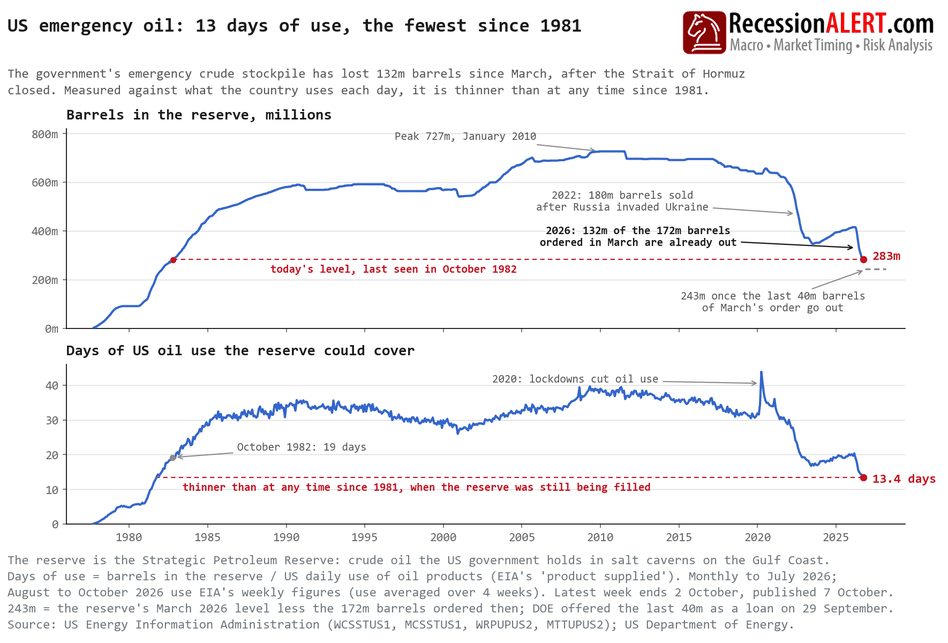
On paper the Strategic Petroleum Reserve — the government’s emergency crude stockpile — holds 283m barrels; far fewer can actually be drawn. Forty million have already been offered as a loan to finish March’s release order, and in May federal auditors found more than a quarter of the reserve unavailable for drawdown. Rapidan Energy, a consultancy, puts at least 103m barrels beyond reach, leaving roughly 140m usable once the order completes — about a week of US oil use, not the chart’s 13 days, which already spread 1982’s barrel count over a country burning roughly 40% more oil a day. The reserve was created in 1975 to replace embargoed imports, and in October 1982 the US net-imported 4.4m barrels a day; in July it net-exported 3.6m of crude and fuels combined. Yet a net exporter still pays the world price at the pump, and undrawable barrels are a lever Washington cannot pull. Chevron’s Mike Wirth made the point on Tuesday: losing the market’s buffers has raised oil’s price floor. The war keeps producing hits, like Sunday’s attack on a Saudi pumping station, and Energy Department officials told the auditors a repeat of 2022’s speed and scale is at risk; the stand-in is the G7’s 100m barrels over four months, front-loaded with diesel and leaning on Europe’s stockpiles. The barrels went back to 1982; the economy did not — and a 1982-sized stockpile, only part of it within reach, will not insure a 2026-sized thirst.
What it means: For households, the next Gulf supply hit would reach the pump with less government oil to soften it. Diesel is already $6.20 a gallon, near its record. For stock investors, a thinner cushion means sharper oil spikes, which would keep favouring energy shares, up 37% this year, over consumer-spending stocks, down 7%. For the economy, dearer fuel works like a tax on spending and feeds the inflation the Fed raised rates against in September. What would change this: the reserve rising in EIA’s weekly figures for a month running, which last happened in January.
Market Intelligence Brief (MIB) Ver. 19.79
For professional investors only. Not investment advice.
© 2026 RecessionALERT.com

Comments are closed.