
MARKET INTELLIGENCE BRIEF (MIB)
Monday, October 5, 2026
Megacap tech carried the Nasdaq to a record close (+1.05%) and Nvidia to its own record (+2.12%) as October Fed-hike odds fell to 24%. Bonds dissented: the 10-year rose to 5.315%, its highest close in over two decades per Reuters. ISM’s services prices index climbed to 74.0, highest since July 2022. Crude fell about 2% on recovering Mideast exports despite weekend Houthi strikes on Aramco. Schneider to buy PTC for $23.7B; PTC +33%. Bolsonaro upset lifts Petrobras ADRs 11.5%.
TABLE OF CONTENTS
A. EXECUTIVE SUMMARY
B. MARKET DATA
C. HIGH-IMPACT STORIES (6)
D. MODERATE-IMPACT STORIES (7)
E. ECONOMY WATCH (3)
F. EARNINGS WATCH (0)
G. WHAT’S NEXT
H. CHART OF THE DAY
A. EXECUTIVE SUMMARY -> TOP
Equities extended Friday’s payrolls relief: the Nasdaq Composite rose 1.05% to a record and the S&P 500 gained 0.66% to within 0.3% of its August 13 record as October Fed-hike odds fell to 24% from 70% a week earlier. Bonds priced a different risk: a bear steepener lifted the 10-year 3.9 bps to 5.315%, its highest close in over two decades per Reuters, while the 2-year slipped, so investors are demanding term premium rather than pricing more hikes. With euro-area debt stress lifting the dollar to an 18-month high and Monday’s services surveys showing price pressure re-accelerating, record valuations now rest on third-quarter earnings against a rising discount rate, with crude’s roughly 2% drop the main inflation offset. Participation was broad but the gains were tech-led: 10 of 11 sectors rose and NYSE advancers outnumbered decliners 1.7 to 1, yet the Dow added just 0.18%, the Russell 2000 lagged and rate-sensitive Real Estate was the lone decliner.
• Bonds: The 10-year rose 3.9 bps to 5.315% and the 2-year fell 1.3 bps to 4.816%, steepening 2s10s to 49.9 bps from 44.7; the dollar index rose 0.22% to 102.15, an 18-month high per Reuters, as the French-German bond spread sits near its widest since the euro debt crisis.
• Services inflation: ISM services eased to 54.9, in line, but its prices index rose 1.4 points to 74.0, the highest since July 2022; S&P Global’s services PMI rose to 58.8, the fastest since July 2021, with input-cost inflation the steepest since November 2022.
• Oil: Brent fell 1.89% to $100.32 and WTI fell 1.84% to $89.43 as Middle East exports topped pre-war levels and Aramco cut November Asian prices to six-year lows, despite Houthi strikes on Aramco sites and a single-source, unconfirmed report that the East-West pipeline was halted again; the SPR fell to 283 million barrels, its lowest since October 1982.
• Deals: Schneider Electric agreed to buy PTC for $205 a share in cash ($23.7 billion enterprise value), and PTC rose about 33%; C.H. Robinson agreed to buy RXO for $5.8 billion, and its shares fell nearly 11%, pulling the Dow Transports down 1.09%.
• Movers: Petrobras ADRs rose 11.50% and Nu Holdings 13.03% after Flavio Bolsonaro topped Brazil’s first round; Merck fell 3.30% after Vaxcyte’s VAX-31 cleared a head-to-head Phase 3 against Prevnar 20 and Capvaxive, though no source tied the move directly to the data; Microsoft rose 1.48% on a Melius upgrade to Buy.
• Labor signals: The Conference Board’s Employment Trends Index fell 0.5% to 107.56 and the share of consumers saying jobs are “hard to get” rose to 21.9%, in line with Friday’s 29,000 payroll gain, while ISM’s services employment index rose 2.3 points to 50.1, back in expansion.
1. Stocks Are Pricing the Fed; Bonds Are Pricing Duration — The front end eased with the softer hike path, and equities followed it to records. The long end did not: a bear steepener took the 10-year to a multi-decade high, which is a term-premium problem the Fed cannot solve by pausing. Add a dollar at an 18-month high on euro-area spread stress, and financial conditions are tightening even as the expected policy path softens. That raises the discount rate on record valuations just as third-quarter earnings season approaches, and makes Tuesday’s $58 billion 3-year auction and Wednesday’s 10-year auction the next test of demand for duration.
2. The October Pause Rests on One Payroll Report — Friday’s 29,000 gain and a falling Employment Trends Index argue for waiting, but both services surveys show prices re-accelerating, and S&P Global’s survey points to growth of around 4% in the third quarter. Cleveland’s Hammack stressed “a lot of information” still to come rather than Friday’s single report, which keeps October live. With hike odds down to 24%, equities have priced the soft side of that split; a hot September CPI before the October 27-28 meeting would leave that pricing exposed.
3. Oil Relief Is Real but Thin, and Policy Is Using Demand-Side Levers — Lower crude is the most direct offset to the services inflation signal, and it came from more barrels reaching market and a Saudi price cut to Asia. But attacks now span the Strait of Hormuz, Saudi onshore infrastructure and the Red Sea approaches, the SPR is at its lowest since October 1982, and Aramco’s CEO says refilling global stockpiles could take two years. A planned executive order widening tax-exempt diesel would lower pump prices without adding supply, so the inflation relief it buys is a one-time level shift, while PVM’s Tamas Varga expects continued attacks to keep the geopolitical risk premium elevated.
 — Leading economic indicators. Accurate market forecasts. Apply for membership at join.recessionalert.com
B. MARKET DATA -> TOP
Megacap tech carried stocks higher for a second session: the Nasdaq Composite set a record close as Nvidia rose to its own record and October Fed-hike odds fell to 24% from 70% a week ago in the wake of Friday’s weak payrolls. The advance was broad, with ten of 11 sectors higher, but the Dow (+0.18%) trailed and the Dow Transports fell 1.09% as C.H. Robinson slid on its deal to buy RXO. The bond market did not join in: the 10-year rose 3.9 bps to 5.315%, its highest close in 120 sessions, even as the 2-year eased and crude fell about 2% on rising Middle East exports and a G7 supply pledge. Equities are rallying on a softer Fed path that the long end of the curve is declining to price.
CLOSING PRICES – Monday, October 5, 2026:
MAJOR INDICES
A broad but tech-led advance: the Nasdaq 100 outran the S&P 500, the NYSE Composite tracked the S&P on a 1.7-to-1 advance-decline ratio, and the Dow and Russell 2000 lagged. Dow Theory bull confirmation extends into a second session, with both the Dow and the Transports within 2% of their 10-session highs despite the Transports’ drop. Neither the large-versus-small nor the growth-versus-broad spread crossed its threshold over 10 sessions.
| Index | Close | Change | %Move | Why It Moved |
|---|---|---|---|---|
| S&P 500 | 7,773.95 | +51.23 | +0.66% | Megacap tech led, with Nvidia +2.12% to a record close and Microsoft +1.48%, as crude eased and October Fed-hike odds fell to 24% (CME FedWatch); about 0.3% below its August 13 record close |
| Dow Jones | 51,267.90 | +90.94 | +0.18% | Lagged the tech-heavy indices with a modest gain |
| DJ Transportation | 19,791.56 | -218.19 | -1.09% | Component C.H. Robinson fell nearly 11% after agreeing to buy RXO for $5.8 billion in stock and cash; RXO jumped more than 22% |
| Nasdaq 100 | 31,076.44 | +268.51 | +0.87% | Closed above 31,000 at its highest close in 120 sessions as Nvidia and Microsoft led; the Nasdaq Composite set a record close |
| Russell 2000 | 2,847.14 | +14.24 | +0.50% | Rose with the broad tape but trailed large caps; no separate catalyst identified |
| NYSE Composite | 23,788.62 | +134.30 | +0.57% | Broad participation: ten of 11 sectors rose and S&P 500 advancers outnumbered decliners 1.7-to-1 |
VOLATILITY & TREASURIES
A bear steepener: the 10-year rose 3.9 bps while the 2-year slipped 1.3 bps, widening the 2s10s spread to 49.9 bps from 44.7. The front end’s dip is consistent with lower Fed-hike odds, but the long end sold off regardless, and falling crude did not pull long yields down. The VIX edged up alongside stocks and the dollar posted its highest close in 120 sessions, so neither bonds nor the currency confirmed the equity rally’s calm.
| Instrument | Level | Change | Why It Moved |
|---|---|---|---|
| VIX | 15.52 | +0.21 (+1.37%) | Edged up despite the equity gain; no discrete catalyst identified |
| 10-Year Treasury Yield | 5.315% | +3.9 bps | Highest close in 120 sessions; the long end sold off while the front end eased. No discrete same-day catalyst identified |
| 2-Year Treasury Yield | 4.816% | -1.3 bps | Eased as October Fed-hike odds fell to 24% from 70% a week earlier (CME FedWatch) following Friday’s payroll miss |
| US Dollar Index (DXY) | 102.15 | +0.22 (+0.22%) | Highest close in 120 sessions as the euro slipped 0.29%; Reuters reported French bond contagion fears weighing on the euro |
COMMODITIES
The metals split from gold: silver, platinum and copper each rose more than 1.3% while gold was nearly unchanged from Friday’s settlement. Bitcoin was flat through the equity rally, offering no risk-on confirmation of its own.
| Asset | Price | Change | %Move | Why It Moved |
|---|---|---|---|---|
| Gold | $4,167.40/oz | $+5.10 | +0.12% | Little changed from Friday’s settlement; no discrete catalyst identified |
| Silver | $61.378/oz | $+0.963 | +1.59% | Outpaced gold; no discrete catalyst identified |
| Copper | $6.6363/lb | $+0.0873 | +1.33% | Rose with the risk-on tape; no discrete catalyst identified |
| Platinum | $1,729.40/oz | $+29.40 | +1.73% | Rose with silver and copper; no discrete catalyst identified |
| Bitcoin | $85,763.0 | $-51.0 | -0.06% | Flat on the session despite the equity rally; no discrete catalyst identified |
ENERGY
WTI and Brent fell in near lockstep, about 2% each, leaving the spread little changed near $11. Gas split across the Atlantic: Henry Hub rose against the crude decline while Dutch TTF fell. Crude’s drop came as Middle East exports rose above pre-war levels and G7 nations pledged to boost supplies.
| Asset | Price | Change | %Move | Why It Moved |
|---|---|---|---|---|
| Crude Oil (WTI) | $89.21/bbl | $-1.90 | -2.09% | Fell as Middle East crude exports rose above pre-war levels and the G7 pledged to boost supplies after Friday’s agreement to release 100 million barrels from emergency reserves; settled at $89.43 |
| Crude Oil (Brent) | $100.26/bbl | $-1.99 | -1.95% | Same supply drivers; Saudi Aramco also unexpectedly cut November crude prices for Asia to six-year lows. Settled at $100.32 |
| Natural Gas (Henry Hub) | $3.071/MMBtu | $+0.036 | +1.19% | Rose against the crude decline; no discrete same-day catalyst identified |
| Natural Gas (Dutch TTF) | $24.09/MMBtu | $-0.57 | -2.30% | Fell with crude, and a weaker euro added to the decline in dollar terms; no discrete same-day catalyst identified |
S&P 500 SECTORS
A near-sweep: 10 of 11 sectors rose, and Real Estate (-0.48%) was the lone decliner on a day the 10-year yield climbed. Energy (+1.06%) gained even as crude fell about 2%. Technology’s lead keeps compounding across horizons (+7.41% 1M, +13.11% 3M), while Utilities’ 1-day gain barely dents an -11.48% three-month slide.
| Sector | 1-Day | 1-Week | 1-Month | 3-Month | 6-Month | YTD | 12-Month |
|---|---|---|---|---|---|---|---|
| Communication Services | +1.18% | +1.01% | +1.65% | -1.36% | +8.44% | +1.56% | +6.99% |
| Energy | +1.06% | +1.67% | -1.69% | +13.01% | +2.55% | +37.63% | +39.73% |
| Industrials | +1.04% | +2.95% | -0.03% | -4.76% | +3.53% | +11.08% | +12.08% |
| Healthcare | +0.77% | -2.21% | -4.11% | -1.01% | +11.37% | +6.46% | +13.67% |
| Technology | +0.77% | +3.53% | +7.41% | +13.11% | +41.06% | +33.69% | +31.66% |
| Consumer Cyclical | +0.71% | +1.52% | -4.64% | -4.50% | +2.28% | -8.07% | -9.76% |
| Financial | +0.71% | -0.86% | -7.19% | -3.10% | +10.07% | +2.30% | +6.85% |
| Consumer Defensive | +0.70% | -1.79% | -3.80% | -4.48% | -3.74% | +3.21% | +3.91% |
| Basic Materials | +0.63% | +0.30% | -7.68% | +3.48% | -1.31% | +11.49% | +18.70% |
| Utilities | +0.50% | +1.93% | -5.91% | -11.48% | -12.75% | -6.15% | -7.83% |
| Real Estate | -0.48% | -2.21% | -8.08% | -9.87% | -1.85% | +0.10% | -3.34% |
TOP MEGA-CAP MOVERS:
GAINERS
| Company | Ticker | Close | Change | Why It Moved |
|---|---|---|---|---|
| Space Exploration Technologies | SPCX | $171.09 | +7.63% | Unverified: attributed to a Morgan Stanley reiteration of its Overweight rating and $300 target, citing Starship Flight 15, and to Musk’s weekend renaming of the AI unit to SpaceXSI; a same-day date for the note was not independently confirmed |
| Seagate Technology | STX | $887.09 | +4.49% | Goldman Sachs named Seagate one of three tactical semiconductor ideas ahead of third-quarter earnings, citing estimate upside in storage |
| Thermo Fisher Scientific | TMO | $676.76 | +3.35% | No discrete same-day catalyst identified; no company release since early September |
| Visa | V | $369.71 | +2.51% | No discrete same-day catalyst identified; rose alongside Mastercard |
| Mastercard | MA | $564.59 | +2.23% | No discrete same-day catalyst identified; rose alongside Visa |
DECLINERS
| Company | Ticker | Close | Change | Why It Moved |
|---|---|---|---|---|
| Merck | MRK | $139.54 | -3.30% | No confirmed same-day catalyst. Fell the morning Vaxcyte reported positive Phase 3 data for a 31-valent pneumococcal vaccine that met non-inferiority to Merck’s Capvaxive; the link is unverified |
| Intel | INTC | $116.19 | -2.63% | Reportedly fell after Musk said on Sunday that TSMC is in early talks on his Terafab chip venture, where Intel has been the named manufacturing partner since April; not independently corroborated |
| Dell Technologies | DELL | $552.29 | -1.82% | No discrete same-day catalyst identified |
— Institutional-grade intelligence for serious investors. Apply for membership at join.recessionalert.comC. HIGH-IMPACT STORIES -> TOP
BULLISH
1. The Nasdaq Sets a Record Close as Nvidia Hits Its Own High, With Lower Oil Offsetting Rising Bond Yields
The core facts:The Nasdaq Composite rose 1.05% to a record close of 27,477.31, and the Nasdaq 100 gained 0.87% to 31,076.44, above Friday’s record close of 30,807.93. Nvidia rose 2.12% to a record close, leaving its market value close to $6 trillion, and Microsoft gained 1.48% after Melius Research upgraded it to Buy. The S&P 500 rose 0.66% to 7,773.95, about 0.3% below its August 13 record close of 7,799.19, with ten of eleven sectors higher and real estate the only decliner; the Dow added just 0.18%. Reuters columnist Jamie McGeever wrote that earnings optimism and lower oil prices offset rising bond yields.
Why it matters:Equities are pricing the softer Fed path that followed Friday’s payrolls miss, with October hike odds at 24% against 70% a week earlier (CME FedWatch), together with lower crude and the approach of third-quarter earnings season. The bond market is not confirming that read: the 10-year yield closed at its highest level in over two decades on the same day (Story 2). Record valuations alongside long yields above 5.3% leave the advance dependent on earnings delivery. Leadership is also concentrated: the Dow’s 0.18% gain and a 1.09% drop in the Dow Transports, driven by a single deal (Story 7), show the gains are coming mainly from megacap technology.
What to watch:Whether the S&P 500 can clear its August 13 record close of 7,799.19, and the FOMC minutes at 2:00 PM ET on Wednesday, October 7.
BEARISH
2. The 10-Year Yield Closes at 5.315%, Its Highest in Over Two Decades, as the Curve Steepens and Euro-Area Bond Stress Lifts the Dollar to an 18-Month High
The core facts:The 10-year Treasury yield rose 3.9 bps to 5.315%, and both the 10-year and the 30-year posted their highest closes in over two decades, Reuters reported. The 2-year yield fell 1.3 bps to 4.816%, widening the 2s10s spread to 49.9 bps from 44.7. The dollar index rose 0.22% to 102.15, an 18-month high according to Reuters, as the euro fell to a 17-month low below $1.12. In Europe, the premium investors demand to hold French over German government bonds is near its widest since the 2010-2012 euro debt crisis, and Spanish Prime Minister Pedro Sanchez called a snap election on Monday. No source established a single same-day catalyst for the move at the long end of the US curve.
Why it matters:A bear steepener with the front end easing means investors are not pricing more Fed hikes; they are demanding more compensation to hold duration. That lifts the discount rate on equities trading near records and pushes up mortgage and corporate borrowing costs even as the expected Fed path softens. The dollar’s strength reflects Europe’s problems as much as US strength. “The bond sell-off is seeing bigger moves in anything that is perceived in any way, shape, or form as more vulnerable,” said Societe Generale’s Kit Juckes, and BofA strategists estimate each further 10 bps of French-German spread widening is associated with a 0.4% fall in the euro against the dollar. A firmer dollar tightens financial conditions and weighs on the translated earnings of US multinationals, though it also restrains imported inflation.
What to watch:Demand at Tuesday’s $58 billion 3-year note auction and Wednesday’s 10-year auction, and whether the 10-year holds above 5.3% into the FOMC minutes on Wednesday, October 7.
BULLISH
3. Crude Falls About 2% as Middle East Exports Recover and Saudi Aramco Cuts Asian Prices to a Six-Year Low, Despite Weekend Attacks
The core facts:Brent crude settled $1.93, or 1.89%, lower at $100.32 a barrel and WTI fell $1.68, or 1.84%, to $89.43, Reuters reported. Shipping data released Monday showed Middle Eastern crude exports rose above pre-war levels on four of the seven days of the final week of September, and Saudi Aramco unexpectedly cut its November crude prices for Asia to six-year lows. Seven OPEC+ members agreed on Sunday to keep November production requirements unchanged, OPEC said. Inventories in the US Strategic Petroleum Reserve fell to 283 million barrels last week, the lowest since October 1982, according to Energy Department data released Monday.
Why it matters:For now, signs of more barrels reaching the market are outweighing the physical risk around the Gulf (Story 4). A Saudi price cut to Asia is a bid to keep volumes moving to its largest customers, and lower crude is the most direct offset to the inflation pressure building in the services data (Story 5). The relief has limits: Raymond James analyst Pavel Molchanov said the market remains sceptical because it is unclear how much of the G7’s 100 million-barrel pledge is new rather than drawn from the 400 million-barrel March release, and a reserve at a 44-year low leaves Washington less room for further releases.
What to watch:The EIA weekly petroleum status report at 10:30 AM ET on Wednesday, October 7, and the next monthly OPEC+ meeting on Sunday, November 1.
BEARISH
4. Houthis Claim Strikes on Saudi Aramco Sites, a Source Says the East-West Pipeline Was Halted Again, and Up to Four Tankers Are Attacked Near Hormuz
The core facts:The Iran-backed Houthis said they attacked Saudi Aramco sites over the weekend, and Reuters published a photograph of smoke rising from a fire at an Aramco refinery south of Riyadh on October 3. An unnamed Saudi energy-sector source told AFP on Monday that “The East-West pipeline was attacked again yesterday. A pumping station east of Riyadh in Khurais… There was big damage and the pipeline stopped again”; the account comes from a single source and could not be independently confirmed. In the Strait of Hormuz, the Joint Maritime Information Center listed up to four attacks in the 72 hours from October 2 to 4, including an October 4 strike on the Liberia-flagged Aframax tanker Lipsi that damaged its engine room; the crew is safe and the vessel was later reported drifting, according to Riviera Maritime Media. Yemeni government forces attacked Houthi positions overlooking the Bab el-Mandeb Strait on Monday, Reuters reported. Saudi Aramco CEO Amin Nasser told the Energy Intelligence conference that crude and fuel supplies would remain stretched and that refilling global stockpiles could take two years.
Why it matters:The East-West pipeline to Yanbu is Saudi Arabia’s main route around Hormuz, so a renewed outage would hit the same export recovery that pushed crude lower on Monday (Story 3). Attacks now span the strait, onshore infrastructure and the Red Sea approaches at once. “Renewed hostilities between Saudi Arabia and the Iran-backed Houthis will ensure that attacks on energy infrastructure and vessels will continue, keeping the geopolitical risk premium at an elevated level,” said PVM Oil Associates’ Tamas Varga. With diesel already the tightest part of the barrel for US freight and farming, that premium feeds directly into the inflation expectations the Fed is watching.
What to watch:Any statement from Saudi Aramco or the Saudi government on the East-West pipeline’s operating status, and further incident reports from the UK Maritime Trade Operations agency.
UNCERTAIN
5. Services Price Gauges Jump While Markets Price a Softer Fed, and Cleveland’s Hammack Says There Is “a Lot of Information” Still to Come Before October
The core facts:Monday’s ISM services survey put its prices index at 74.0, the highest since July 2022, and S&P Global reported services input cost inflation at its steepest since November 2022. Markets did not take a hawkish read: the 2-year yield fell 1.3 bps to 4.816%, and October hike odds stood at 24%, down from 70% a week earlier (CME FedWatch). On Friday evening, after the September payrolls miss, Cleveland Fed President Beth Hammack told PBS NewsHour: “We will still have a lot of information before our meeting at the end of the month.” She added that “We have been missing on our inflation mandate for more than 5.5 years, and it’s really important that we’re able to bring inflation back down to our 2 percent objective,” but did not call for or against an October increase.
Why it matters:The labor data argue for waiting; the price data argue that waiting means deferring the next hike, not abandoning it. Services is where most core inflation sits, and both surveys now show price pressure re-accelerating, which raises the stakes of the September CPI report due before the October 27-28 meeting. Equities have priced the soft side of that split. Hammack’s emphasis on the data still to come, rather than on Friday’s single report, is the posture most likely to keep October live if CPI runs hot.
What to watch:Remarks by New York Fed President John Williams (9:05 AM ET) and Vice Chair for Supervision Michelle Bowman (10:45 AM ET) on Tuesday, October 6, and Dallas Fed President Lorie Logan at 7:00 PM ET the same day, for whether Friday’s jobs data changed her estimate that rates need to rise 50 basis points or more.
UNCERTAIN
6. Schneider Electric Agrees to Buy PTC for $205 a Share in Cash, a $23.7 Billion Deal; PTC Shares Jump About 33%
The core facts:France’s Schneider Electric agreed on Monday to acquire US industrial software maker PTC for $205 a share in cash, an equity value of about $22.6 billion and an enterprise value of $23.7 billion, according to the companies’ announcement filed with the SEC. The price is a 42.3% premium to PTC’s last close and 46.1% to its 30-day volume-weighted average. Schneider plans to fund the deal with €16-17 billion of new debt and a €5-6 billion accelerated bookbuild equity offering, backed by a bridge facility from Morgan Stanley and Societe Generale. It targets €250 million of annual cost synergies by year three and about €800 million of revenue synergies. Closing, expected in the third quarter of 2027, requires PTC shareholder and regulatory approvals. PTC shares rose about 33%.
Why it matters:A strategic buyer paying a 42% premium for US product-lifecycle and design software shows how highly industrial companies value software and AI capabilities for factory and energy management, and it resets valuation benchmarks for US industrial software peers. “The acquisition of PTC represents an important step forward in our ambition to lead the new era of Energy and Industrial Intelligence,” said Schneider CEO Olivier Blum. The financing also matters for credit markets: roughly €16-17 billion of new multi-currency debt will come to market at a time when long-term yields are at multi-decade highs.
What to watch:Pricing of Schneider’s €5-6 billion accelerated bookbuild and the timing of its bond issuance, followed by the PTC shareholder vote.
— Quantifying recession risk so you don’t have to guess. Apply for membership at join.recessionalert.comD. MODERATE-IMPACT STORIES -> TOP
UNCERTAIN
7. C.H. Robinson Agrees to Buy RXO for $5.8 Billion in Stock and Cash; Its Shares Fall Nearly 11% and Pull the Dow Transports Down 1.09%
The core facts:C.H. Robinson agreed to acquire freight broker RXO for $17.25 in cash plus 0.0856 C.H. Robinson shares per RXO share, an implied value of $5.8 billion, creating a company with an enterprise value of over $25 billion, according to the companies’ announcement filed with the SEC. C.H. Robinson expects $300 million of net run-rate cost synergies within two years of closing and has a $4.5 billion bridge loan commitment from Morgan Stanley; RXO shareholders would own about 11% of the combined company. C.H. Robinson shares fell nearly 11% and RXO’s jumped more than 22%. The Dow Jones Transportation Average, of which C.H. Robinson is a component, fell 1.09% to 19,791.56 while the Dow rose 0.18%.
Why it matters:The acquirer’s slide shows investors are wary of a debt-funded consolidation in freight brokerage at a time of high borrowing costs, even with synergies promised. The Transports’ decline was driven by a single component reacting to a deal, not by a change in freight demand, so it should not be read as a Dow Theory warning: both the Dow and the Transports closed within about 1.2% of their 10-session highs.
What to watch:Any credit rating actions on C.H. Robinson tied to the bridge financing, and whether its shares stabilize in coming sessions.
BULLISH
8. Flavio Bolsonaro Tops Brazil’s First Round, Sending Brazilian Assets Sharply Higher; Petrobras Jumps 11.5% in New York
The core facts:Right-wing senator Flavio Bolsonaro upset President Luiz Inacio Lula da Silva in the first round of Brazil’s presidential election on Sunday. Brazilian stocks rose 8%, their biggest gain this century outside the global financial crisis and the pandemic, and the real rose 4%, its biggest gain in four years, according to Reuters, which also cited online betting markets putting Bolsonaro’s chance of winning the runoff in three weeks at 83%. In New York, Petrobras ADRs rose 11.50% to $24.14, Nu Holdings gained 13.03% and MercadoLibre 9.67%.
Why it matters:Investors are pricing a likely change of government toward a more market-friendly fiscal stance, with state-controlled Petrobras the most direct beneficiary because of its exposure to policy on pricing and dividends. For US portfolios, the rally reaches through the largest US-listed Brazilian names and emerging-market funds. Reuters reported that Lula is considering naming Vice President Geraldo Alckmin as finance minister if re-elected to bolster his fiscal credibility, a sign that the runoff will turn on economic policy.
What to watch:Runoff polling over the next three weeks and whether Lula formally names a finance minister before the vote.
BEARISH
9. Vaxcyte’s 31-Valent Pneumococcal Vaccine Clears a Head-to-Head Phase 3 Against Prevnar 20 and Capvaxive; Merck Falls 3.3%
The core facts:Vaxcyte reported at 6:00 AM ET that its VAX-31 vaccine met its primary immunogenicity endpoints in the pivotal OPUS-1 Phase 3 trial of 4,047 participants, compared head to head with Pfizer’s Prevnar 20 and Merck’s Capvaxive. Against Prevnar 20, all 20 shared serotypes met non-inferiority; against Capvaxive, 17 of 19 did, with serotypes 3 and 12F missing the primary threshold but clearing a historical benchmark. Three serotypes unique to VAX-31 met superiority, and safety was similar to both comparators. Vaxcyte plans a biologics license application in the first half of 2028. Merck fell 3.30%, the largest decline among US companies valued above $200 billion, and Pfizer fell 1.40%; no source directly tied either move to the data.
Why it matters:Adult pneumococcal vaccines are a significant franchise for both Pfizer and Merck. VAX-31 covers more serotypes than either incumbent, and Vaxcyte estimates it adds 13-36% of coverage for invasive pneumococcal disease over current adult vaccines. The commercial threat is years away, with filing not planned until 2028, but a clean head-to-head result shortens the expected life of the incumbents’ coverage advantage, which is what investors in Merck appear to be pricing.
What to watch:Results from Vaxcyte’s OPUS-2 and OPUS-3 adult Phase 3 trials, expected in the first half of 2027.
UNCERTAIN
10. Supreme Court Opens Its Term Divided Over Whether Boulder Can Sue Exxon and Suncor Over Climate Change
The core facts:The Supreme Court heard arguments on Monday in ExxonMobil and Suncor Energy’s appeal of a Colorado Supreme Court ruling that allowed Boulder officials to pursue state-law claims seeking damages for climate-change harms. The companies, backed by the Trump administration, argue that federal authority over air pollution precludes the claims. Chief Justice John Roberts pressed both sides, while Justice Brett Kavanaugh cited “a wall of precedent” favoring federal law and Justice Sonia Sotomayor pushed back on the companies’ reading of the Clean Air Act. Justice Samuel Alito has recused himself, and Reuters said the questioning made a 4-4 split possible, which would leave the Colorado ruling in place. A decision is expected by the end of June.
Why it matters:Nearly 60 state and local governments have filed dozens of similar suits seeking billions of dollars from fossil fuel companies, according to Exxon and Suncor. A ruling for the companies could lead to many being dismissed; a tie or a loss would leave the industry facing open-ended state-court liability. That is a long-dated legal risk for US energy equities.
What to watch:The Court’s decision, expected by the end of June 2027.
UNCERTAIN
11. Trump Prepares an Executive Order to Expand Access to Tax-Exempt Diesel as Prices Stay Near Last Month’s Record
The core facts:President Trump is preparing an executive order to expand access to tax-exempt diesel that will be unveiled as soon as Monday, two sources told Reuters. It could make more red-dyed diesel, used by agriculture and some off-road vehicles, available, and a third source said it would likely direct the Department of Transportation to coordinate with states to waive taxes on road diesel. Diesel prices reached a record of about $6.50 a gallon last month, Reuters reported. Bloomberg first reported the plan. Whether the order was signed on Monday was not established.
Why it matters:Diesel moves goods, so its price feeds directly into freight costs and goods inflation, and it is a political risk ahead of the November 3 midterm elections. Tax waivers would lower pump prices without adding supply, so their effect on inflation would be a one-time level shift that does not ease the refining shortfall behind the price surge. Combined with Friday’s G7 release, the administration is using every lever short of an export ban.
What to watch:The text of the order, including the size of any tax waiver and how many states take part.
BULLISH
12. CFTC Opens Rulemaking to Bring Retail Crypto Trading Under Federal Oversight as FinCEN Withdraws Its Crypto-Mixing and Wallet Proposals
The core facts:The Commodity Futures Trading Commission issued an advance notice of proposed rulemaking on Monday covering retail leveraged, margined or financed crypto asset transactions under the Commodity Exchange Act, and proposing a new “crypto asset market” designation for exchanges built for such trading, with comments due 60 days after Federal Register publication. “The American people deserve clarity, certainty, and consumer protections in the crypto asset markets,” the CFTC chairman said. The same day, the Financial Crimes Enforcement Network announced the withdrawal of two proposed digital-asset rules: a special measure treating crypto mixing as a class of transactions of primary money laundering concern, and reporting requirements for certain crypto transactions. Bitcoin was little changed at $85,763.
Why it matters:Together the two actions move toward a single federal framework for crypto trading while removing compliance burdens that exchanges and wallet providers had opposed. That supports US-listed crypto platforms and brokers seeking to offer leveraged crypto products. The CFTC step is an early-stage notice, not a proposed rule, so binding requirements are still months away.
What to watch:Publication of the CFTC notice in the Federal Register, which starts the 60-day comment period.
BULLISH
13. Melius Upgrades Microsoft to Buy With a $665 Target and Morgan Stanley Upgrades Wells Fargo to Overweight
The core facts:Melius Research upgraded Microsoft to Buy from Hold on Monday and set a $665 price target; the shares rose 1.48%. Morgan Stanley upgraded Wells Fargo to Overweight from Equal-Weight and raised its target to $102 from $90; Wells Fargo shares rose 1.23% to $81.44.
Why it matters:The Microsoft upgrade reverses an earlier Melius downgrade to Hold that had flagged AI capital-spending and cash-flow risks, a sign that some analysts who doubted the payback on AI investment are moving back ahead of third-quarter results. The Wells Fargo upgrade lands as large-bank earnings season approaches, with the bank operating free of its asset cap and positioned for a steeper yield curve, which supports net interest margins.
What to watch:Microsoft’s Azure growth when it reports fiscal first-quarter results.
— Separating signal from noise since 2007. Apply for membership at join.recessionalert.comE. ECONOMY WATCH -> TOP
Monday’s surveys sharpened the tension Friday’s payrolls left open: the labor market is cooling, but services inflation is not. ISM’s services prices index jumped to 74.0, its highest since July 2022, even as the headline held near consensus at 54.9, and S&P Global’s services input costs rose at their steepest pace since November 2022 alongside the fastest activity growth since July 2021. Against that, the Conference Board’s Employment Trends Index fell 0.5%, with more consumers saying jobs are hard to get. Odds of an October rate hike have fallen to 24% from 70% a week earlier (CME FedWatch), yet the 10-year still rose 3.9 bps to 5.315%, leaving Wednesday’s FOMC minutes as the next read on how the Committee weighs the two.
ISM Services Index Eases to 54.9, in Line With Forecasts, but Prices Paid Jumps to 74.0, Highest Since July 2022 (ISM, Oct 5)
What they’re saying:The ISM Services PMI registered 54.9 in September, down 0.5 point from August’s 55.4 and in line with the 55.0 consensus, extending expansion to a 27th consecutive month. Business activity fell 5.2 points to 56.5 and new orders slipped 1.1 points to 59.8, while the employment index rose 2.3 points to 50.1, back in expansion for the first time in three months. The Prices Index rose 1.4 points to 74.0, its highest since July 2022 and above 70 for the sixth time in seven months.
The context:The in-line headline hides the inflation signal. Services is where most core inflation sits, and the prices gauge has now held above 60 for 22 straight months, with its 12-month average rising to 69, the highest since March 2023. The employment index returning to 50.1 also sits awkwardly beside Friday’s 29,000 payroll gain, weakening the case that a softening labor market alone will keep the Fed on hold.
What to watch:Fed speeches by Williams (9:05 AM ET) and Bowman (10:45 AM ET) on Tuesday, October 6; the FOMC minutes at 2:00 PM ET on Wednesday, October 7; and preliminary October University of Michigan sentiment on Friday, October 9 (expected 47.6 vs. 48.1 prior).
S&P Global Services PMI Rises to 58.8, Fastest Activity Growth Since July 2021, as Input Cost Inflation Hits Its Steepest Since November 2022 (S&P Global, Oct 5)
What they’re saying:S&P Global’s final US Services PMI Business Activity Index rose to 58.8 in September from 56.5 in August, its fourth straight monthly gain and the fastest expansion since July 2021. New order growth reached a four-and-a-half-year high and job creation was the fastest since June 2022, while input cost inflation, which had eased to a 16-month low in August, accelerated to its steepest since November 2022. The composite index stood at 58.4.
The context:The S&P survey reads far stronger than ISM’s on activity, but the two agree on prices. Chief Business Economist Chris Williamson said the surveys point to economic growth “of around 4% in the third quarter and 5% in September alone,” and warned that “selling price growth has also moved higher again to signal sustained stubbornly high inflation, well above the Fed’s 2% target.” A services sector still hiring and raising prices complicates a pause built on one soft payroll report.
What to watch:ADP’s weekly employment estimate on Tuesday, October 6, and initial jobless claims on Thursday, October 8 (expected 200,000 vs. 197,000 prior), for whether the surveys’ hiring strength shows up in hard labor data.
Conference Board Employment Trends Index Falls 0.5% in September as More Consumers Say Jobs Are Hard to Get (Conference Board, Oct 5)
What they’re saying:The Conference Board’s Employment Trends Index fell to 107.56 in September, down 0.5% from a downwardly revised 108.08 in August and ending two consecutive monthly gains. The share of consumers reporting jobs “hard to get” rose to 21.9% from a revised 20.3%, and the share of small firms with positions they could not fill fell 3 percentage points to 32% from 35%.
The context:The index is a leading composite for payroll employment, so its decline lines up with Friday’s 29,000 payroll print rather than with the services surveys’ hiring signals. The Conference Board’s Conrad Qi noted that “the ETI remains 1.0% above its level one year ago, suggesting moderate payroll employment growth ahead,” and attributed the drop chiefly to weaker consumer and small-business measures.
What to watch:Initial jobless claims on Thursday, October 8 (expected 200,000 vs. 197,000 prior) and ADP’s weekly employment estimate on Tuesday, October 6.
— Know the probability before the market prices in the risk. Apply for membership at join.recessionalert.comF. EARNINGS WATCH -> TOP
YESTERDAY AFTER THE BELL (Markets Reacted Today)
No major earnings yesterday after the bell from companies with >$100B market cap.
TODAY BEFORE THE BELL (Markets Already Reacted)
No major earnings before the bell from companies with >$100B market cap.
TODAY AFTER THE BELL (Markets React Tomorrow)
No major earnings after the bell from companies with >$100B market cap.
WEEK AHEAD PREVIEW:
Q3 2026 earnings season is just beginning (1.8% of the S&P 500 reported), and only one company above $100 billion is scheduled to report over the next five business days.
PepsiCo (PEP) — BMO, Thursday, October 8 — Consensus EPS $2.30 on revenue of $24.96 billion. Key focus: North American snack and beverage volumes against price increases as high fuel costs squeeze consumer budgets, and whether input-cost inflation from energy and freight pressures margin guidance.
No other company above $100 billion reports through Monday, October 12; large-bank third-quarter results begin the following week.
— US market commentary trusted by family offices and institutions. Apply for membership at join.recessionalert.comG. WHAT’S NEXT -> TOP
UPCOMING RELEASES:
| Date | Event | Why It Matters |
|---|---|---|
| Tue, Oct 6 | Fed speakers: Williams (9:05 AM ET), Bowman (10:45 AM ET), Logan (7:00 PM ET) | First read on whether Friday’s payrolls miss or Monday’s services price surge carries more weight; Logan has estimated rates need to rise 50 bps or more, so any retreat from that view would validate the 24% October hike odds. |
| Tue, Oct 6 | $58 billion 3-year note auction | Opens the week’s supply with the 10-year at 5.315%; weak demand would extend the bear steepener that equities have so far ignored. |
| Tue, Oct 6 | Trade Balance, Aug (expected -$102B, prior -$88.6B) | A deficit that wide would subtract from third-quarter GDP just as S&P Global’s surveys point to growth of around 4%, and the dollar at an 18-month high works against exports. |
| Tue, Oct 6 | ADP Weekly Employment Change (prior 20K) | Tests whether the services surveys’ hiring strength or Friday’s 29,000 payroll gain is the better read on labor demand. |
| Wed, Oct 7 | FOMC Minutes (2:00 PM ET) | The week’s main policy event: shows how much support the committee had for further hikes and how it weighed inflation risks before Friday’s soft payrolls, ahead of the October 27-28 meeting. |
| Wed, Oct 7 | 10-year note auction | The direct test of demand for duration at the 10-year’s highest close in over two decades, on the same afternoon as the minutes. |
| Wed, Oct 7 | EIA Crude Oil Stocks Change (10:30 AM ET; prior 0.922M) and MBA 30-Year Mortgage Rate (prior 7.3%) | Shows whether recovering Middle East exports are reaching US balances with the SPR at its lowest since October 1982; the mortgage rate shows how much of the long-end selloff is reaching housing. |
| Thu, Oct 8 | Initial Jobless Claims (expected 200K, prior 197K); Fed Musalem Speech (1:40 PM ET) | Claims near 200,000 would argue against the labor-weakness reading of Friday’s report and could revive October hike pricing. |
| Fri, Oct 9 | Michigan Consumer Sentiment, Prel. Oct (expected 47.6, prior 48.1); Fed Collins Speech (4:00 PM ET) | Watch inflation expectations within the survey as diesel prices sit near last month’s record and services prices re-accelerate. |
KEY QUESTIONS:
1. Will Tuesday’s 3-year and Wednesday’s 10-year auctions find buyers for duration with the 10-year above 5.3%, or does the bear steepener keep pushing up the discount rate on equities trading near records?
2. Do Tuesday’s Fed speakers and Wednesday’s minutes treat the services price surge as reason to keep October live, and are 24% hike odds too low if September CPI runs hot?
3. Will Saudi Aramco confirm whether the East-West pipeline is running, and can recovering Middle East exports keep Brent near $100 if attacks on Gulf energy infrastructure continue?
— US market commentary trusted by family offices and institutions. Apply for membership at join.recessionalert.comH. CHART OF THE DAY -> TOP
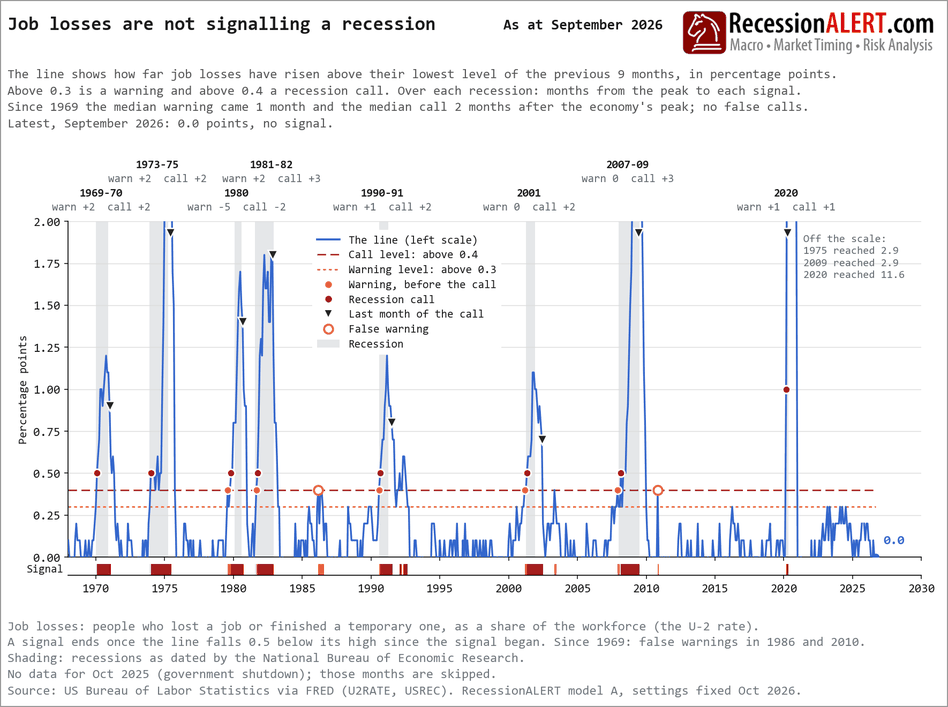
At 1.9%, September’s job-loss rate matches the eve of the 1973–75 recession, and that tells you almost nothing. Recessions have begun with the rate anywhere from 1.4% (1969) to 3.6% (1981); what they share is speed. A layoff ends a paycheck, the household cuts spending, the businesses it buys from cut staff, and those layoffs end more paychecks — a loop that compounds, so recession job losses arrive as a burst. In all eight recessions since 1969 the rate took one to nine months to climb half a point above its nine-month low, always inside the gauge’s window. In 2023–24 it climbed the same half point, 1.6% to 2.1%, but over twelve months — slow enough that its nine-month low rose to 1.8% behind it, so the line never got above the 0.3 warning level. The Sahm rule, the widely followed trigger built on headline unemployment, did fire, at 0.53 on July 2024 data — yet nearly half the unemployment rise behind it came from people entering or returning to the workforce, with no paycheck to lose and no loop to start. No recession followed. With the rate now on its nine-month low, a call needs a 2.4% print, last seen in September 2021 — roughly 800,000 more people out of work after losing a job — and it has to come fast. There is no recession level for job losses — only a recession speed.
What it means: For households, a higher jobless rate on its own will be a weak reason to fear for a job. A quick run of layoffs would be the strong one. For the economy, spending will keep its main support, paychecks, as long as job losses stay this low. For stock investors, a jump in this line is the earnings warning that matters, because lost paychecks cut company sales. A headline-unemployment scare without one is a weaker reason to sell. What would change this: the job-loss rate jumping to 2.3%, the warning level, last seen in October 2021.
Market Intelligence Brief (MIB) Ver. 19.79
For professional investors only. Not investment advice.
© 2026 RecessionALERT.com

Comments are closed.