
MARKET INTELLIGENCE BRIEF (MIB)
Friday, September 4, 2026
August payrolls tripled expectations at 162,000 and flipped September back to a coin-flip hike — implied odds 58-60%. The selloff was narrow: Netflix -5.35%, Palantir -4.49%, while memory ran hard (Sandisk +11.90%, Micron +6.10%). Tesla -5.92% as NHTSA opened an audit query into how it self-certified the Cybercab. FICO -16.68% after FHFA opened VantageScore to every GSE lender. Retail diesel set a record $5.850 a gallon, +57.6% year-on-year. Novartis’s Lp(a) drug failed after the close; Amgen and Ionis fell harder.
TABLE OF CONTENTS
A. EXECUTIVE SUMMARY
B. MARKET DATA
C. HIGH-IMPACT STORIES (5)
D. MODERATE-IMPACT STORIES (7)
E. ECONOMY WATCH (5)
F. EARNINGS WATCH (0)
G. WHAT’S NEXT
H. CHART OF THE DAY
A. EXECUTIVE SUMMARY -> TOP
A blowout August payrolls print — 162,000 against roughly 56,000 consensus — flipped September from a settled hold back to a coin-flip hike, implied odds at 58-60% against 49% a day earlier. The equity response was a valuation reset in a narrow cohort, not a market-wide flush: Netflix (-5.35%) and Palantir (-4.49%) took the multiple compression while NYSE breadth (-0.33%) merely tracked the S&P (-0.38%) and both small-caps and transports finished higher. The curve confirms the character of it — the 2-year (+4.3 bps) outran the 10-year (+2.2 bps) and the VIX rose just 1.40% to 14.52, the signature of a policy repricing rather than a growth scare. Breadth split by duration rather than risk appetite: Technology led at +0.77% on memory and chip-equipment strength while rate-sensitive Financials (-0.63%) and Real Estate (-0.62%) softened and Tesla alone dragged Consumer Cyclical to the session’s worst, -1.06%.
• August payrolls beat by nearly three times and the composition undercuts the headline — 162,000 against roughly 56,000 consensus with unemployment steady at 4.1% and June-July revised up 55,000, but the gains sat in food services (+59,000) and local government education (+42,000) while the information sector shed jobs; September hike odds jumped to 58-60% from 49% and Polymarket’s 2026 hike market gapped 11 points to 72%.
• NHTSA opened Audit Query AQ26002 into Tesla’s Cybercab self-certification on day one of paid Austin service — the vehicle has no steering wheel or pedals and the agency will examine whether Tesla was right to deem certain federal safety standards inapplicable; TSLA closed -5.92% at $354.08, a single name dragging Consumer Cyclical to the session’s worst sector print.
• FHFA opened VantageScore to every GSE lender “effective immediately” and floated cutting the tri-merge — Fair Isaac closed -16.68% at $932.26 after trading 20.9% lower intraday, with Equifax -6.37% and TransUnion -5.93%; the two limbs point in different directions, since VantageScore is the bureaus’ own joint venture and only bi-merge threatens their report revenue.
• Memory and wafer-fab equipment supplied the day’s only real upside, with no fresh catalyst — Sandisk +11.90%, KLA +7.32%, Micron +6.10%, Lam Research +5.12% and AMD +4.69% carried the Nasdaq 100 to +0.21% and Technology to a sector-leading +0.77% on a day eight of eleven sectors closed red.
• Retail diesel set an all-time record at $5.850 a gallon, up 57.6% year-on-year — a 6.68 cent single-session move one week before the CPI that decides the FOMC, and crude itself was quiet (WTI -0.13% at $91.18), which marks this a refining and product squeeze that an OPEC+ quota decision cannot relieve.
• Novartis’s pelacarsen missed its primary endpoint after the close, the first cardiovascular outcomes trial of an Lp(a) drug — Lp(a) fell and events did not, the worst shape of failure for a category; Amgen (-5.34%) and Ionis (-6.40%) fell harder after hours than Novartis itself (-3.89%), which is the market reading it as a class verdict.
1. The tape sorted by duration, not by risk appetite — a cohort that rallies 5-12% on a hawkish repricing day with no news is being bought as a supply-constrained commodity cycle rather than as a long-duration growth asset, which is precisely why memory decoupled from Netflix and Palantir on the same tape. The practical implication is directional: the memory and chip-equipment position should keep working while shortages persist even if rates go higher, and what breaks it is capacity coming back, not the Fed. The same shortage cuts the other way inside one portfolio — it is throttling Apple’s foldable to a few hundred units a day against an 8-10 million annual target.
2. The White House collided with the data on the one day it could least afford to — hours after the print pushed the market decisively toward a hike, the President threatened to halt trade with surplus countries unless the Fed cuts, aimed at a Chair he appointed. The instrument matters more than the rhetoric: February’s 6-3 ruling in Learning Resources stripped the tariff power from IEEPA but expressly left its embargo, sanctions and asset-freeze authority standing, so this threat rests on ground the Court did not disturb. Neither equities nor rates priced any embargo probability today, which makes it unhedged rather than discounted.
3. One inflation print now carries the whole meeting — Governor Waller tied his September vote to the CPI due Friday, September 11, which leaves a 58-60% priced meeting hanging on a single release eleven days before the FOMC. Two things load that print against a hold: record diesel at +57.6% year-on-year enters goods and transportation costs with a lag of weeks, and mortgage rates have already firmed to a four-week high of 6.71%. The uncomfortable part is what a hike would represent — tightening into a labour market whose August gains came from food services and local government education while information payrolls fell.
 — Leading economic indicators. Accurate market forecasts. Apply for membership at join.recessionalert.com
B. MARKET DATA -> TOP
A blowout August jobs report — nonfarm payrolls surged 162,000 against roughly 55,000 consensus — repriced Fed rate-hike odds higher, sending the S&P 500 down 0.38% and the Dow 0.51% as yields and the dollar firmed. The selloff was narrow rather than broad: chip-equipment and memory names lifted the Nasdaq 100 to a modest gain even as high-multiple growth stocks — Netflix (-5.35%), Palantir (-4.49%) — absorbed the brunt of the rate-driven de-rating. Tesla (-5.92%) led mega-cap decliners after a lukewarm reception to its Austin Cybercab robotaxi launch, while gold slid 1.41% on the firmer dollar and real yields. Small-caps and transports posted mild gains, a pocket of resilience against an otherwise cautious tape.
CLOSING PRICES – September 4, 2026:
MAJOR INDICES
A hot jobs print split the tape: the Dow and S&P slipped on rate-hike repricing while the Nasdaq 100 and Russell 2000 eked out small gains, decoupling from the mega-cap growth selloff. Transports (+0.72%) meaningfully outpaced industrials-heavy blue chips, and NYSE breadth (-0.33%) tracked the S&P closely — this was a valuation story in specific high-multiple names, not a market-wide flush.
| Index | Close | Change | %Move | Why It Moved |
|---|---|---|---|---|
| S&P 500 | 7,718.60 | -29.11 | -0.38% | Hot August payrolls (+162K) boosted Fed rate-hike odds |
| Dow Jones | 53,414.25 | -271.86 | -0.51% | Same jobs-driven rate repricing; blue chips lagged |
| DJ Transportation | 21,011.73 | +150.21 | +0.72% | Industrials strength (+0.38%) helped transports outperform the broader tape |
| Nasdaq 100 | 29,544.15 | +61.83 | +0.21% | Chip-equipment and memory strength offset softness in mega-cap software/hardware names |
| Russell 2000 | 2,975.65 | +7.38 | +0.25% | Small-caps decoupled modestly from the mega-cap growth selloff |
| NYSE Composite | 24,639.25 | -80.91 | -0.33% | Broad-based softness tracking the S&P on the jobs-driven repricing |
VOLATILITY & TREASURIES
VIX rose just 1.40% to 14.52 — a mild uptick, not a spike — while both yields firmed, the classic inflation/policy-repricing signature rather than a recession scare. The 2Y (+4.3bps) outpaced the 10Y (+2.2bps), a modest curve-flattening move that confirms the market is repricing near-term Fed policy, not growth risk. DXY firmed 0.26% in line with the hawkish read.
| Instrument | Level | Change | Why It Moved |
|---|---|---|---|
| VIX | 14.52 | +0.20 (+1.40%) | Modest uptick on rate-hike repricing, not a risk-off flush |
| 10-Year Treasury Yield | 4.784% | +2.2 bps | Hot payrolls print reinforced Fed rate-hike bets |
| 2-Year Treasury Yield | 4.377% | +4.3 bps | Front-end led higher on increased near-term hike-odds repricing |
| US Dollar Index (DXY) | 99.17 | +0.26 (+0.26%) | Dollar firmed alongside the hawkish jobs-driven repricing |
COMMODITIES
Gold and silver fell in lockstep (-1.41%, -1.39%) as the firmer dollar and rising real yields pressured precious metals broadly, with no safe-haven/industrial-demand split visible today. Platinum eased more modestly while copper was essentially flat, a rare pocket of calm. Bitcoin’s 2.09% decline tracked the broader risk-off tone in equities rather than signaling a crypto-specific catalyst.
| Asset | Price | Change | %Move | Why It Moved |
|---|---|---|---|---|
| Gold | $4,476.11/oz | -$63.79 | -1.41% | Firmer dollar and real yields on the hawkish jobs repricing |
| Silver | $66.763/oz | -$0.941 | -1.39% | Tracked gold lower on the same rate-driven pressure |
| Copper | $6.6685/lb | +$0.0040 | +0.06% | Essentially flat; no discrete same-day catalyst identified |
| Platinum | $1,829.05/oz | -$4.95 | -0.27% | Modest weakness alongside broader precious metals |
| Bitcoin | $79,788.0 | -$1,703.0 | -2.09% | Tracked the broader risk-off move on hawkish Fed repricing |
ENERGY
WTI and Brent were little changed and moved in step, a quiet session for crude with no supply or demand shock in evidence. Henry Hub firmed modestly while Dutch TTF ticked up alongside a firmer euro; neither gas benchmark decoupled from the other, pointing to no distinct US/European driver today.
| Asset | Price | Change | %Move | Why It Moved |
|---|---|---|---|---|
| Crude Oil (WTI) | $91.18/bbl | -$0.12 | -0.13% | Little changed; no discrete same-day catalyst identified |
| Crude Oil (Brent) | $95.82/bbl | +$0.30 | +0.31% | Modest firming, broadly tracking WTI |
| Natural Gas (Henry Hub) | $2.947/MMBtu | +$0.034 | +1.17% | Modest gain; no discrete same-day catalyst identified |
| Natural Gas (Dutch TTF) | $24.66/MMBtu | +$0.19 | +0.79% | Modest gain tracking a firmer euro; no discrete driver |
S&P 500 SECTORS
Technology’s session lead (+0.77%) extends its week (+1.36%), powered by chip-equipment and memory names even as mega-cap software/hardware lagged. Rate-sensitive Financials (-0.63%) and Real Estate (-0.62%) softened on the hawkish repricing, while Consumer Cyclical’s session-worst -1.06% deepens a rough week (-1.92%) — Tesla’s slide is the visible driver beneath the sector print.
| Sector | 1-Day | 1-Week | 1-Month | 3-Month | 6-Month | YTD | 12-Month |
|---|---|---|---|---|---|---|---|
| Technology | +0.77% | +1.36% | +1.90% | +5.13% | +31.71% | +25.89% | +35.45% |
| Industrials | +0.38% | +0.10% | -2.33% | -2.78% | +1.62% | +11.37% | +15.17% |
| Utilities | +0.15% | +0.84% | -1.37% | -3.67% | -7.94% | -0.12% | +3.81% |
| Real Estate | -0.62% | -1.23% | -2.00% | -0.52% | +2.61% | +8.22% | +4.06% |
| Financial | -0.63% | +0.77% | +0.70% | +11.50% | +16.77% | +9.27% | +13.47% |
| Basic Materials | -0.73% | -1.11% | +5.78% | +8.12% | +5.03% | +19.99% | +34.86% |
| Energy | -0.76% | +2.26% | +7.10% | +8.38% | +11.46% | +38.96% | +41.33% |
| Consumer Defensive | -0.90% | -0.60% | -1.76% | -0.21% | -2.78% | +6.32% | +4.05% |
| Communication Services | -0.92% | -0.49% | -1.51% | -3.85% | +1.72% | -1.01% | +5.75% |
| Healthcare | -0.94% | +0.35% | +3.89% | +11.74% | +11.82% | +10.21% | +23.63% |
| Consumer Cyclical | -1.06% | -1.92% | -2.71% | +0.82% | +1.65% | -4.60% | -3.10% |
TOP MEGA-CAP MOVERS:
GAINERS
| Company | Ticker | Close | Change | Why It Moved |
|---|---|---|---|---|
| Sandisk Corp | SNDK | $1,740.00 | +11.90% | Continuation of the AI-driven memory/NAND-shortage re-rating; no new discrete same-day catalyst identified |
| KLA Corp | KLAC | $185.60 | +7.32% | Same wafer-fab-equipment/AI-capex theme; no discrete same-day catalyst identified |
| Micron Technology Inc | MU | $1,016.59 | +6.10% | Same memory-shortage re-rating theme; no discrete same-day catalyst identified |
| Lam Research Corp | LRCX | $307.65 | +5.12% | Same wafer-fab-equipment/AI-capex theme; no discrete same-day catalyst identified |
| Advanced Micro Devices Inc | AMD | $477.57 | +4.69% | Tracked the broader AI-capex/chip-equipment rally; no discrete same-day catalyst identified |
DECLINERS
| Company | Ticker | Close | Change | Why It Moved |
|---|---|---|---|---|
| Tesla Inc | TSLA | $354.08 | -5.92% | Lukewarm investor/regulatory reception to today’s Austin Cybercab robotaxi launch |
| Netflix Inc | NFLX | $78.25 | -5.35% | High-multiple growth stock hit hardest by the jobs-driven rate repricing; no company-specific catalyst |
| Palantir Technologies Inc | PLTR | $174.33 | -4.49% | Continued multiple compression amid the day’s hawkish repricing; trades near 150x forward earnings, acutely rate-sensitive |
| Apple Inc | AAPL | $319.97 | -2.51% | Reports of production issues with its anticipated foldable iPhone ahead of next week’s launch event |
| Microsoft Corp | MSFT | $499.70 | -2.04% | No discrete same-day catalyst identified; pressured alongside high-multiple tech in the day’s rate-driven de-rating |
— Institutional-grade intelligence for serious investors. Apply for membership at join.recessionalert.comC. HIGH-IMPACT STORIES -> TOP
BEARISH
1. The August Payrolls Beat Flips September Back to a Hike — Implied Odds Jump Roughly Ten Points in a Single Session
The core facts:The 08:30 ET August employment report landed far above expectations and the rates market repriced within minutes. CME FedWatch-implied odds of a 25 basis point hike at the September 15-16 FOMC moved to roughly 58-60% from about 49% the prior day — a move of roughly ten points, and the second double-digit swing in the same market inside three sessions after Governor Waller’s remarks had pushed odds the other way on Thursday. The 2-year Treasury yield rose 4.3 basis points to 4.377% and the 10-year 2.2 basis points to 4.784%, a front-end-led flattening that reprices near-term policy rather than growth. The dollar index firmed 0.26% to 99.17, gold fell 1.41% to $4,476.11 and silver 1.39%. Equities finished mixed and narrow: the S&P 500 -0.38%, the Dow -0.51%, but the Nasdaq 100 +0.21% and the Russell 2000 +0.25%. Section E carries the full data breakdown.
Why it matters:The market is no longer pricing the September meeting as a policy question with a settled answer — it is pricing a coin flip that moves ten points on every incoming print. That has two consequences for positioning. First, the equity response was a valuation reset in a specific cohort rather than a market-wide flush: Netflix -5.35% and Palantir -4.49% led the decliners on multiple compression while chip-equipment and memory names carried the Nasdaq 100 to a gain. Breadth confirms it — NYSE Composite -0.33% tracked the S&P closely and small-caps and transports finished higher. Second, the front-end-led curve move and the 1.40% VIX uptick to 14.52 are the signature of an inflation-and-policy repricing, not a risk-off scare; a genuine growth fright would have bid the long end and spiked volatility. The uncomfortable part is what a hike would represent — a Fed tightening into a labour market whose composition beneath the headline was concentrated in food services and local government education, with the information sector shedding jobs.
What to watch:The August CPI print on September 11 — Governor Waller explicitly conditioned his September vote on the inflation data due over the two weeks after his September 3 remarks, which makes that release the single deciding input. Watch the 2-year yield for a sustained break above 4.40% as confirmation the hike is being priced rather than debated.
UNCERTAIN
2. Trump Threatens to Halt Trade Unless the Fed Cuts — and the Power He Is Reaching For Is the One the Supreme Court Left Standing
The core facts:Hours after the payrolls release, President Trump posted that he would stop trading with countries running deficits with the United States unless the Fed lowered rates, adding that it was “better than tariffs” and that high rates put the country “at a very unfair disadvantage.” The Federal Reserve declined to comment. Section E carries the statement itself; the market-relevant question is what instrument sits behind it. In Learning Resources, Inc. v. Trump, decided 6-3 on February 20, 2026, the Supreme Court held that the International Emergency Economic Powers Act’s authority to “regulate importation” does not extend to tariffs — but the ruling expressly left untouched IEEPA’s separate powers to impose embargoes, sanctions and asset freezes. An embargo threat therefore rests on statutory ground the Court did not disturb, unlike the tariff authority it struck down.
Why it matters:Markets have spent 2026 treating the February ruling as a ceiling on executive trade power. It is not a ceiling on this particular threat, and that distinction is the reason to take the post more seriously than the rhetoric alone would justify. The collision is also sharper than a normal Fed-independence story: the demand for cuts landed on the one day this year when the data pushed the market decisively toward a hike, and it targets a Chair the President himself appointed. Neither the equity nor the rates market priced any embargo probability today — the tape moved on payrolls, not on the post — which means this is unhedged rather than discounted. The near-term transmission runs through the September 8 Canadian retaliation and through any move that would convert a social-media ultimatum into a signed instrument.
What to watch:Any IEEPA-based executive order or proclamation reaching the Federal Register — no presidential trade document has published there since August 25, and publication lags signature by several days, so the Register is a confirming rather than a leading indicator. Watch Chair Warsh’s first public remarks before the pre-FOMC blackout for whether the Board responds at all.
BEARISH
3. NHTSA Opens an Audit Query Into How Tesla Self-Certified the Cybercab — on the Day Paid Rides Began in Austin
The core facts:The National Highway Traffic Safety Administration announced Friday that it has opened Audit Query AQ26002 into Tesla’s certification that the Cybercab meets all applicable Federal Motor Vehicle Safety Standards, covering roughly 1,000 vehicles. The Cybercab carries no permanently attached manual controls — no steering wheel, brake pedal, accelerator pedal or mirrors. In the United States, manufacturers are not pre-approved by a regulator; they self-certify and NHTSA may investigate after the fact. The agency said it will examine the technical data and processes Tesla relied on, and specifically “the extent to which Tesla’s certification depended on determinations that certain FMVSS are inapplicable to the Cybercab.” Tesla closed at $354.08, down 5.92% — the session’s largest mega-cap decline and the visible driver beneath Consumer Cyclical’s sector-worst -1.06%. Goldman Sachs reiterated Neutral on the day and GLJ Research maintained Sell at $25.
Why it matters:The question the audit asks is not whether the Cybercab is safe but whether the self-certification regime can accommodate a vehicle built to omit the controls several standards assume exist. That is a structural challenge to the business model rather than a defect inquiry, and it arrived on day one of revenue service — the worst possible timing for a valuation that capitalises a robotaxi fleet rolling out at scale. A finding that Tesla wrongly deemed particular standards inapplicable would not merely fine the company; it would put the vehicle’s legality in service in question and force a redesign or an exemption process measured in quarters. The read-through extends past Tesla to every developer planning control-free vehicles, because the same certification logic underpins all of them. Note also that a single name at 1.4 trillion dollars moved the Consumer Cyclical sector more than a point on a day the broad market fell less than half of one.
What to watch:NHTSA’s public docket for AQ26002 — an audit query that escalates into a formal defect or non-compliance investigation is the step that would move the stock again. Watch also whether Tesla continues paid Austin service uninterrupted while the query is open.
BEARISH
4. FHFA Opens VantageScore to Every GSE Lender “Effective Immediately” and Floats Cutting the Tri-Merge — FICO Closes Down 16.68%
The core facts:FHFA Director Bill Pulte posted Thursday evening that he was instructing Fannie Mae and Freddie Mac to approve all lenders to use VantageScore, effective immediately — ending a pilot that had been capped at 50 lenders since May 1 — and separately that the agency is “seriously considering bi-merge, and stronger solutions.” On Friday he added that FHFA is “also studying the usage of just one credit report.” Fair Isaac closed at $932.26, down 16.68%, having traded as low as $885.00 intraday, a 20.9% decline that is the source of the widely circulated “plunges 21%” headlines. Equifax closed -6.37% and TransUnion -5.93%. Pulte’s assertion that FICO has raised its per-score price 1,800% since 2020 is his claim and is uncorroborated. An independent study by Deep Future Analytics estimates full VantageScore rollout across GSE originations would produce more than $930 million of first-year market-wide savings. FHFA published no formal news release; the directive exists as the Director’s posts as reported by multiple outlets.
Why it matters:The two limbs point in different directions and conflating them misreads the trade. VantageScore is a joint venture of Equifax, Experian and TransUnion, so opening it to all lenders is not adverse to the bureaus — it is adverse to FICO’s scoring monopoly alone. The bureau-negative limb is bi-merge: cutting the standard tri-merge to two credit reports removes a third of the report revenue on every conforming origination, which is why Equifax and TransUnion fell 6% on a day the S&P fell less than half a point. For the mortgage market the cost relief is real but slow — VantageScore 4.0 reached only 4.4% of loan volume in July, and lenders reported 40-50% average increases in credit-reporting costs for 2026. The wider signal is that a regulator is now willing to reset the pricing structure of mortgage credit infrastructure by directive rather than rulemaking, which is faster and considerably less predictable.
What to watch:Whether FHFA converts the bi-merge study into a formal directive — the prior administration’s bi-merge plan was put on indefinite hold in January 2025, so precedent exists for it stalling. Watch VantageScore 4.0’s share of loan volume rising from 4.4% as the measure of whether the scoring change is real in practice.
BEARISH
5. US Retail Diesel Sets an All-Time Record at $5.850 a Gallon, Up 57.6% Year-on-Year, One Week Before the CPI That Decides the FOMC
The core facts:The AAA national average for retail diesel printed $5.8500 a gallon, against $5.7832 the prior day — a 6.68 cent move in a single session — $5.6105 a week ago, $5.3715 a month ago and $3.7121 a year ago, a 57.6% year-on-year increase. AAA’s own page labels $5.8500 the highest recorded average, so the record is corroborated by the primary source rather than by a single outlet. Regular unleaded stands at $4.1474 against $3.2016 a year ago. Crude itself was quiet on the day — WTI $91.18, down 0.13%, Brent $95.82, up 0.31% — and the Energy sector was the fifth-worst performer at -0.76% despite it. Sell-side forecasts moved up regardless: Citi raised its Q3 average Brent forecast to $86 a barrel from $80 and ANZ raised its short-term Brent forecast to $95.
Why it matters:Diesel is the cost input that propagates furthest and fastest through the price level, because it moves freight, agriculture and construction rather than commuters. A 57.6% year-on-year increase in it is not a consumer-sentiment story; it is a producer-price story that arrives in goods inflation with a lag of weeks. That timing is what makes it high-impact today rather than merely notable: the August CPI on September 11 is the print Governor Waller has tied his September vote to, and a Fed already 58-60% priced for a hike is being handed a record diesel print in the window immediately before it. Note the divergence worth holding onto — crude was flat and energy equities finished red, so this is a refining and product-market squeeze rather than a crude rally, which means it will not be relieved by an OPEC+ quota decision at Sunday’s ministerial.
What to watch:The August CPI and PPI prints on and around September 11 for the pass-through into core goods and transportation services. Watch also whether the AAA diesel average holds above $5.80 through the Labor Day weekend, when demand seasonally eases.
— Quantifying recession risk so you don’t have to guess. Apply for membership at join.recessionalert.comD. MODERATE-IMPACT STORIES -> TOP
BEARISH
6. Novartis’s Pelacarsen Fails the First Cardiovascular Outcomes Trial of an Lp(a) Drug — and Amgen and Ionis Fall Harder After Hours Than Novartis Does
The core facts:Novartis said after the close, at 16:30 ET, that the Lp(a)HORIZON Phase III trial of pelacarsen “did not meet its primary endpoint” — a composite of cardiovascular death, non-fatal myocardial infarction, non-fatal stroke and urgent coronary revascularisation requiring hospitalisation — against placebo, while confirming that lower lipoprotein(a) levels were achieved. No event rates, hazard ratios or p-values were disclosed; data go to an unnamed upcoming medical congress. Development president and chief medical officer Shreeram Aradhye said: “Although lower Lp(a) levels were observed with pelacarsen, the findings did not demonstrate that this translated into reduced cardiovascular risk in the overall study population.” Novartis’s regular-session close of $159.99, -1.90%, is pre-news and unrelated; after hours it traded $153.77, -3.89%. Amgen fell to $413.89, -5.34%, and Ionis — which discovered pelacarsen and licensed it to Novartis in 2019 — to $54.37, -6.40%. Eli Lilly was -0.26% and Alnylam essentially unchanged.
Why it matters:This is the first read on whether lowering Lp(a) — the most prominent remaining genetically validated cardiovascular risk factor without an approved therapy — actually reduces cardiovascular events. The answer, on this trial, is no, and the mechanism was confirmed to work: Lp(a) came down and outcomes did not follow. That is the worst shape of failure for a category, because it does not admit the usual “wrong dose, wrong patients” rescue. The ordering of the after-hours moves is the tell that the market read it as a class verdict rather than a company one — Amgen, whose olpasiran is in the Phase 3 OCEAN(a)-Outcomes study, and Ionis, a far smaller company with royalty exposure, both fell harder than the sponsor that ran the failed trial. Novartis at $304 billion can absorb it; the read-through is what repriced. Note that the Amgen link rests on a single secondary source flagging pelacarsen as read-through for olpasiran, so treat the mechanism of the move as better evidenced than its attribution.
What to watch:Whether Amgen restates its OCEAN(a)-Outcomes timeline or enrolment assumptions in the next filing or conference appearance. Watch also for the congress at which Novartis releases the full dataset — the subgroup detail will decide whether the category is dead or merely narrowed.
BULLISH
7. Memory and Wafer-Fab Equipment Extend Their Re-Rating With No Fresh Catalyst — Sandisk +11.90%, KLA +7.32%, Micron +6.10%
The core facts:The memory and semiconductor-capital-equipment complex was the only meaningful source of upside on the session. Sandisk closed $1,740.00, +11.90%; KLA $185.60, +7.32%; Micron $1,016.59, +6.10%; Lam Research $307.65, +5.12%; Advanced Micro Devices $477.57, +4.69%. Intel rose 4.51% to $95.80 — on a day Mizuho cut its target $17 to $92, which now sits below the market price. The move carried the Nasdaq 100 to +0.21% and Technology to a sector-leading +0.77% while every other sector except Industrials and Utilities finished red. No discrete same-day catalyst was identified for any of the five names; this is the continuation of the AI-capex and NAND-shortage re-rating in place since Sandisk’s August investor day. It received indirect corroboration from an unlikely quarter — reporting on Apple’s foldable production constraints (story 8) placed them alongside industry-wide shortages of memory and other electronic components tied to the AI infrastructure buildout.
Why it matters:A cohort that rallies 5-12% on a hawkish repricing day, with no news, is telling you the marginal buyer is treating memory scarcity as a duration-independent story — it is being bought as a supply-constrained commodity cycle rather than as a long-duration growth asset, which is precisely why it decoupled from Netflix and Palantir on the same tape. That distinction matters for how the position behaves from here: it should keep working while shortages persist even if rates go higher, and it should break on evidence of capacity coming back rather than on the Fed. The Intel detail is the day in miniature — a stock up 4.5% through a target cut is momentum operating independently of published estimates, which is a late-cycle characteristic in any re-rating.
What to watch:Micron’s next NAND and DRAM pricing commentary, and any capacity-addition announcement from the Korean or Japanese producers — a supply response is the thing that ends this, not the rate path. Contract DRAM and NAND spot prices are the cleanest weekly read.
BEARISH
8. Apple Falls 2.51% on a Report the Foldable iPhone Is Stuck at a Few Hundred Units a Day Against an 8-10 Million Annual Target
The core facts:Apple closed $319.97, down 2.51%, having traded as much as 3.2% lower during the session. The catalyst was a Nikkei Asia report that late-August production of the foldable iPhone was running at only a few hundred units a day, against a target of 8-10 million units for the year, with additional durability testing and delayed verification pushing back commercialisation. Coverage tied the constraint in part to industry-wide shortages of memory and other electronic components driven by the AI infrastructure buildout. Separately, Citi analysts published a note projecting a starting price of $2,000 or more for the first foldable model, and Bernstein reiterated Outperform on the view that Apple continues to gain share in China and globally. The company’s launch event is scheduled for next week.
Why it matters:Foldable production has been reported as troubled repeatedly since April and reported as resolved as recently as early August, so the market has learned to discount the headline — which is why a 2.5% move in a $4.67 trillion company is the informative part. What changed is specificity: “a few hundred units a day” against 8-10 million for the year is not a schedule risk, it is an arithmetic impossibility for the launch quarter, and it arrives days before the event rather than months. The read-through cuts two ways. A supply-constrained launch at a $2,000-plus price point protects mix and gross margin even if it caps units, so the earnings damage is smaller than the headline implies. But it also puts Apple on the wrong side of the same memory shortage that made story 7 the day’s best trade — the constraint enriching Micron and Sandisk is the one throttling Apple’s most important new product in a decade.
What to watch:Next week’s launch event for whether Apple gives a ship date and a price for the foldable, or announces availability as constrained. Either would settle in a sentence what supply-chain reporting has been contradicting itself about since April.
BULLISH
9. Anthropic Lines Up a $15 Billion Revolver and a Lead-Left Bank, With an IPO Filing Possible as Soon as Next Week
The core facts:Two reports on consecutive evenings put the largest prospective listing of the cycle onto a near-term clock. Bloomberg reported Thursday evening that Anthropic is finalising a revolving credit facility of $15 billion, expanded from a reported target of around $10 billion, with Morgan Stanley leading the process alongside Goldman Sachs, JPMorgan Chase and Citigroup, and commitment tiers of roughly $1.25 billion for the most active banks, about $1 billion at the next level and $750 million or below for lesser roles. Bank of Montreal, BNP Paribas, Crédit Agricole, Mizuho, MUFG, SMFG and Toronto-Dominion were also named. On Friday afternoon the Financial Times reported that Morgan Stanley is close to being named “lead left” and Goldman Sachs stabilisation agent, with JPMorgan, Citigroup and Barclays in other key roles — and that Anthropic is expected to file its IPO paperwork as soon as next week, with a listing considered as early as October. The FT report notes the lead-left selection has not been finalised and could still change; it is single-sourced.
Why it matters:The revolver is the more reliable signal of the two, because a syndicate of that size with named commitment tiers is a documented process rather than a briefing. A $15 billion facility ahead of a listing does two things: it removes the financing constraint that would otherwise force the IPO to be priced under time pressure, and it distributes a very large fee pool across the bulge bracket at a moment when equity capital markets revenue has been the weakest line at most of them. For the four US names carrying lead roles — Morgan Stanley, Goldman, JPMorgan and Citigroup — an October listing at anything near the private valuation would be a materially positive quarter for ECM. The wider signal is the reopening of a large-cap technology IPO window that has been effectively shut, which matters more for the pipeline behind Anthropic than for Anthropic itself.
What to watch:An S-1 filing on EDGAR next week is the event that converts all of this from reporting into fact, and it will carry the first audited revenue figures the company has published. Watch the underwriter list on the cover page against the reported roles.
UNCERTAIN
10. Twenty Analyst Actions on Zscaler, Seventeen of Them Target Raises — and the Stock Closes Down 4.50%
The core facts:Zscaler drew twenty separate analyst actions on Friday, seventeen of them price-target raises, following Thursday’s results. Macquarie went to $200 from $172, Baird to $230 from $220, Wells Fargo to $215 from $210, RBC to $210 from $200, BMO to $200 from $178, Scotiabank to $200 from $175, Barclays to $200 from $192, Stephens to $225 from $200, Needham to $215 from $180, Morgan Stanley to $165 from $145 and Piper Sandler to $175 from $160, with maintained targets from TD Cowen, Canaccord, Guggenheim, Rosenblatt, Cantor and BTIG. The stock closed $169.80, down 4.50%. The same pattern ran in the opposite direction at Ciena, where seven banks cut targets the morning after a beat — Rosenblatt to $525 from $720, TD Cowen to $400 from $575, Barclays to $475 from $607 — and the stock rose 1.12% after falling 10.36% the previous session.
Why it matters:Two clusters on one day, both moving the opposite way to the price, is a useful reminder of what a target revision is and is not. Seventeen raises did not stop a 4.5% decline because the raises were catch-up to a price that had already moved, while the fundamental question — whether billings growth justifies the multiple — was not what the analysts were revising. For a portfolio manager the practical implication is that post-print analyst clusters carry almost no directional information in the session they land; the information is in the dispersion. Morgan Stanley’s $165 and Stephens’ $225 on the same company after the same numbers is a 36% spread, and a spread that wide after a reported quarter says the disagreement is about the terminal model, not the quarter. Note both names sit below the $100 billion threshold that governs Section F, which is why they appear here as analyst actions rather than as earnings coverage.
What to watch:Whether the Zscaler target dispersion narrows into the next print — convergence would mean the model disagreement is resolving; persistence means the multiple stays volatile regardless of results.
BEARISH
11. Morgan Stanley Calls the Top of the North American Truck Cycle at Month Nine of an Eleven-Month Clock
The core facts:Morgan Stanley published a single note repricing four truck makers at once. Daimler Truck was downgraded to Equal-Weight from Overweight with the target raised to 50 euros from 47; PACCAR was maintained at Equal-Weight with the target lifted to $125 from $119 by analyst Angel Castillo; Volvo AB was held at Equal-Weight with the target raised to 355 Swedish krona from 342; and Traton was maintained at Underweight with the target raised to 36 euros from 34. The thesis is timing rather than fundamentals: truck stocks have historically peaked nine to eleven months after the initial North American Class 8 order inflection, and the cycle is at month nine. The note said “DTG remains our preferred OEM, but think the market will not consistently pay a much higher multiple at this stage of the cycle,” and described risk-reward as “much less attractive than over the past year.” PACCAR closed near $124.70; Daimler Truck’s ADR closed $26.51, -0.19%.
Why it matters:Every target in the note went up and the recommendation went down, which is the honest way to make a cycle call — the earnings are fine and the multiple is the problem. Class 8 orders are one of the better-behaved leading indicators of the US industrial cycle because fleet operators commit capital roughly two to three quarters ahead of freight demand, so a call that the order inflection is nine months old is implicitly a call on where freight is in 2027. That sits awkwardly against Friday’s tape, where transports outperformed by more than a point and industrials rose 0.38% on the jobs beat. The reconciliation is that the jobs report is a coincident read on labour and the Class 8 clock is a forward read on capital spending, and they are allowed to disagree — but only one of them is telling you about next year.
What to watch:Monthly North American Class 8 net order data — a second consecutive month of sequential decline would validate the month-nine framing well before it shows in any of the four companies’ results.
BEARISH
12. CISA Adds a Chrome V8 Zero-Day to the Known Exploited Vulnerabilities Catalog After Google Confirms Exploitation in the Wild
The core facts:The Cybersecurity and Infrastructure Security Agency added CVE-2026-85046 to its Known Exploited Vulnerabilities catalog on Friday, the single item it listed for the date. The flaw is a type-confusion bug in V8, Chrome’s JavaScript and WebAssembly engine, carrying a CVSS score of 8.8 and permitting remote arbitrary code execution inside the sandbox via a crafted HTML page. Google shipped an emergency Stable Channel update — Chrome 152.0.7977.82/.83 on Windows and macOS and 152.0.7977.82 on Linux, on gradual rollout — confirmed that an exploit exists in the wild, and withheld technical detail to give dependent projects time to patch. The bug was reported by researcher Salvatore Gulizia in early August for a $1,000 bounty. Chromium also underlies Microsoft Edge and other browsers; downstream vendor patch status was not established. There were no Item 1.05 material-cybersecurity-incident 8-K filings on the day.
Why it matters:A KEV listing is not a press release — it carries a binding remediation deadline for federal civilian agencies and is treated as a de facto deadline by a large share of regulated private industry, so the operational cost lands on IT organisations across the economy within days rather than on Alphabet’s income statement. The market impact of a Chrome zero-day is therefore almost never in Alphabet’s share price; it is in the enterprise patching cycle and, occasionally, in the breach disclosed six weeks later by whoever did not patch. The detail worth holding is the gap between the bounty and the exposure: a $1,000 award for a flaw permitting remote code execution in the browser used by most of the corporate world is a reminder of how thin the economics of defensive disclosure are relative to the offensive market for the same bug.
What to watch:Microsoft’s Edge security update for the same Chromium base — a lag there widens the exposed population materially. Watch also for Item 1.05 8-K filings over the coming weeks that name a browser-delivered initial access vector.
— Separating signal from noise since 2007. Apply for membership at join.recessionalert.comE. ECONOMY WATCH -> TOP
August’s blowout jobs report — payrolls surged 162,000 against a 56,000 consensus with June-July revised up a combined 55,000 — flipped the Fed narrative overnight: CME-implied September hike odds jumped to roughly 58-60% from 49% a day earlier, and Polymarket’s 2026 hike market leapt 11 points to 72%. Cleveland’s Hammack reinforced the hawkish read, warning persistent inflation only gets harder to unwind, while mortgage rates pushed to four-week highs as yields firmed. The data itself is unambiguously strong — unemployment steady at 4.1%, wages decelerating slightly to 3.1% y/y — but it collides with President Trump’s public ultimatum that the Fed cut rates or face trade retaliation, setting up a September 15-16 FOMC meeting now trading as a coin flip with real political stakes attached.
August payrolls blow past expectations, reviving September hike odds (BLS/CNBC, Sept 4, 2026)
What they’re saying:Nonfarm payrolls rose 162,000 in August, nearly triple the 56,000 consensus, while the unemployment rate held at 4.1% as expected. June and July payrolls were revised up by a combined 55,000, and average hourly earnings rose 0.3% m/m (in line) and 3.1% y/y, a step down from 3.2% prior. The labor force participation rate ticked up to 61.6% from 61.4%.
The context:The beat was driven by food services and drinking places (+59,000) and local government education (+42,000), while the information sector shed jobs — a mixed composition beneath the strong headline. CME FedWatch-implied odds of a September 25bp hike jumped to roughly 58-60% from 49% the day before, and the 2-year Treasury yield rose 4.3 bps to 4.377%; the S&P 500 fell 0.38% and the Dow 0.51% as investors repriced for less accommodative policy.
What to watch:August CPI, due Friday, September 11 — Fed Governor Waller has tied his September vote directly to that print.
Polymarket’s 2026 Fed hike odds whipsaw 11 points higher on jobs shock (Polymarket, Sept 4, 2026)
What they’re saying:Polymarket’s “Fed rate hike in 2026” market jumped to 72% Yes from 61% a session earlier — an 11-point single-day swing. Its “recession by end of 2026” market held roughly flat at 7% (from 8%), and its “zero rate cuts in 2026” market firmed to 92.9%, implying just a 7.1% chance of any 2026 cut, down from 11.3% a day earlier.
The context:Yesterday’s move in the opposite direction followed Governor Waller’s comments signaling a possible hold barring an inflation surprise; today’s reversal shows how sensitive the 2026 rate path has become to each incoming data point, with under two weeks left before the September 15-16 FOMC decision.
What to watch:The September 15-16 FOMC meeting, and any further shift in these odds ahead of the pre-meeting blackout window.
Cleveland Fed’s Hammack: persistent inflation gets harder to unwind the longer it lingers (Seeking Alpha, Sept 4, 2026)
What they’re saying:Cleveland Fed President Beth Hammack said Friday: “Inflation is too high — and the longer it stays above our objective, the harder it will be to bring it back down.”
The context:The remark landed the same day as the blowout jobs report and reinforces the hawkish case building into the September FOMC meeting. It was delivered via broadcast/wire commentary rather than a posted Fed speech — no corresponding text appears on the Federal Reserve’s own speeches page for September 4.
What to watch:Additional FOMC voter commentary ahead of the pre-meeting blackout period, which typically begins in the days ahead of the September 15-16 meeting.
Trump threatens to cut trade with surplus countries unless Fed lowers rates (multiple outlets, Sept 4, 2026)
What they’re saying:President Trump said Friday the Federal Reserve must cut interest rates or he will halt trade with countries running large surpluses with the US, tying the rate decision directly to trade policy in a lengthy social media post issued after the stronger-than-expected jobs report.
The context:The demand escalates pressure on Trump’s own appointed Fed Chair Kevin Warsh, who has signaled a preference for inflation control over near-term rate cuts — a direct collision with the White House just ahead of the September 15-16 FOMC meeting, and a fresh test of the Fed’s independence from political pressure.
What to watch:Any further White House commentary on the Fed, and Chair Warsh’s own public remarks ahead of the September FOMC meeting.
Mortgage rates climb to four-week highs as inflation, yields firm (MBA/Bankrate, Sept 4, 2026)
What they’re saying:The average 30-year fixed mortgage rate rose to 6.71% for the week of September 4, up from 6.66% prior and its highest level in four weeks, while the 15-year rate ticked up to 6.04% from 5.98%.
The context:The rise tracks the broader firming in Treasury yields following the stronger-than-expected jobs report, with elevated government deficits and persistent inflation concerns cited by market participants as additional pressure on long-end rates.
What to watch:Existing home sales data due September 10; any further yield moves into the September FOMC decision.
— Know the probability before the market prices in the risk. Apply for membership at join.recessionalert.comF. EARNINGS WATCH -> TOP
YESTERDAY AFTER THE BELL (Markets Reacted Today)
No major earnings yesterday after the bell from companies with >$100B market cap. The largest Thursday after-the-bell reporter was Zscaler at a $27.46B market cap, roughly a quarter of the threshold, followed by Samsara ($23.50B), Guidewire Software ($13.52B), DocuSign ($13.06B) and Lululemon Athletica ($11.94B).
TODAY BEFORE THE BELL (Markets Already Reacted)
No major earnings before the bell from companies with >$100B market cap. Friday’s calendar carried a single reporter of any size: Virco Manufacturing, at a $102.55M market cap.
TODAY AFTER THE BELL (Markets React Tomorrow)
No major earnings after the bell from companies with >$100B market cap. The Friday before Labor Day is customarily the thinnest reporting session of the quarter, and this one was: no company of any size was scheduled to report after the close.
WEEK AHEAD PREVIEW:
Q2 2026 earnings season is effectively complete at 97% reported, and the coming week is among the quietest of the year — US markets are closed Monday for Labor Day, and across the five business days from Tuesday, September 8 through Monday, September 14 exactly two companies above the $100 billion threshold are scheduled to report, both on the same evening.
Oracle (ORCL) — AMC, Thursday, September 10 — consensus $1.74 EPS on $19.13B revenue; $457.36B market cap. The most consequential print of the month for the AI-capex trade. Key focus: FY2027 guidance of 34% constant-currency revenue growth with Q1 cloud revenue up 58-64%, with remaining performance obligations and OCI gross margin the two lines that decide the reaction. The stock has advanced in each of the last two sessions and drew fresh sell-side attention Friday — Morgan Stanley nudged its target to $210 from $207 while staying Equal-Weight, writing that it sees “an attractive tactical set-up into F1Q27,” and RBC held Sector Perform at $190. Both September 4 targets sit above the market price, after the two most recent prior calls were cuts.
Adobe (ADBE) — AMC, Thursday, September 10 — consensus $6.08 EPS on $6.69B revenue; $105.94B market cap. This print now lands nine days after a named CEO succession: Adobe announced late Thursday that Anil Chakravarthy becomes president and chief executive effective December 1, with Shantanu Narayen moving to executive chair, and the entire price reaction landed in Friday’s session, where the stock fell 6.73% to $266.51. That decline has taken the market cap to within 6% of the $100 billion coverage floor, which is noted here so the session that covers the print does not have to re-derive whether the name was in scope. Key focus: Creative freemium monthly active users above 90 million and Firefly ARR near $300 million against a 10.2% FY2026 ending-ARR growth target — and, newly, what the incoming chief executive is prepared to say on the call.
Below the threshold, the week’s largest reporters are Sunbelt Rentals ($28.12B, BMO Wednesday), Casey’s General Stores ($27.98B, AMC Tuesday), Kroger ($35.90B, BMO Friday) and Copart ($31.22B, AMC Thursday). The macro calendar, not the earnings calendar, owns the week: August CPI on September 11 and PPI in the same week are the deciding inputs into the September 15-16 FOMC.
— US market commentary trusted by family offices and institutions. Apply for membership at join.recessionalert.comG. WHAT’S NEXT -> TOP
UPCOMING RELEASES:
| Date | Event | Why It Matters |
|---|---|---|
| Sun, Sep 6 | OPEC+ ministerial meeting | A quota decision moves crude, but note what it cannot fix: WTI closed -0.13% at $91.18 on the day retail diesel set an all-time record. The squeeze is in refining and product markets, so a supply announcement would not relieve the input now feeding the CPI. |
| Mon, Sep 7 | US markets closed — Labor Day | No cash session. Positioning into a week carrying PPI, existing home sales and the August CPI has to be set on Friday, which thins liquidity around each of those prints. |
| Tue, Sep 8 | Canadian retaliatory tariffs take effect | The first hard trade date since the President tied rate policy to halting trade with surplus countries. It tests whether the administration escalates through the IEEPA authorities February’s ruling left standing, at a moment neither equities nor rates price any of it. |
| Wed, Sep 9 | MBA 30-Year Mortgage Rate (prior 6.79%) | Mortgage rates have already firmed to a four-week high on the back of the jobs-driven yield move. A further rise ahead of Thursday’s existing home sales would tighten housing before the Fed decides anything. |
| Thu, Sep 10 | PPI MoM (expected 0.3%) and Core PPI MoM (expected 0.3%) | The producer-price read is where a 57.6% year-on-year diesel move should surface first, in freight and transportation costs. A hot print the day before CPI would effectively settle the September debate ahead of the consumer number. |
| Thu, Sep 10 | Existing Home Sales (expected 4.03M; prior MoM -1.7%) | The cleanest read on how much damage a 6.71% mortgage rate is doing to transaction volume, and the release most exposed if the market prices a hike rather than a hold. |
| Thu, Sep 10 | Initial Jobless Claims (prior 206K) | The only labour data between today’s beat and the FOMC. Claims at 206K corroborate the payroll strength; a jump would reopen the argument that August’s composition — food services and local government education — was flattering a softening market. |
| Thu, Sep 10 | EIA crude stocks (prior -4.45M) and gasoline stocks (prior -1.173M) | With crude flat and products at record retail prices, the inventory split is the direct test of whether this is a refining bottleneck rather than a crude shortage. Two consecutive product draws would confirm it. |
| Fri, Sep 11 | August CPI — Inflation Rate MoM (expected 0.4%), YoY (prior 3.4%), Core MoM (expected 0.2%), Core YoY (prior 2.5%) | The single deciding input for the September 15-16 meeting. Governor Waller conditioned his vote explicitly on this print, and the market is already 58-60% priced for a hike, so the asymmetry runs in both directions from here. |
| Fri, Sep 11 | Michigan Consumer Sentiment Prel (prior 51.7) | Sentiment near historic lows against a record diesel price and a firm labour market. The inflation expectations components matter more than the headline with a hike on the table. |
| Mon-Tue, Sep 15-16 | FOMC meeting and decision | A meeting the market has repriced by double digits twice in three sessions, currently 58-60% for a 25 bp hike. The pre-meeting blackout closes the window for further Fed commentary within days. |
KEY QUESTIONS:
1. Does the August CPI on Friday, September 11 settle the September meeting, or does a Fed already 58-60% priced for a hike find itself tightening into a labour market whose gains came from food services and local government education?
2. Does the demand to halt trade unless the Fed cuts become a signed instrument? The embargo and sanctions powers under IEEPA survived February’s ruling intact, and no equity or rates market priced any probability of their use today.
3. Does the memory and wafer-fab equipment complex keep decoupling from the rate path, or does the first credible capacity-addition announcement end a re-rating that has now run for weeks without a fresh catalyst?
— US market commentary trusted by family offices and institutions. Apply for membership at join.recessionalert.comH. CHART OF THE DAY -> TOP
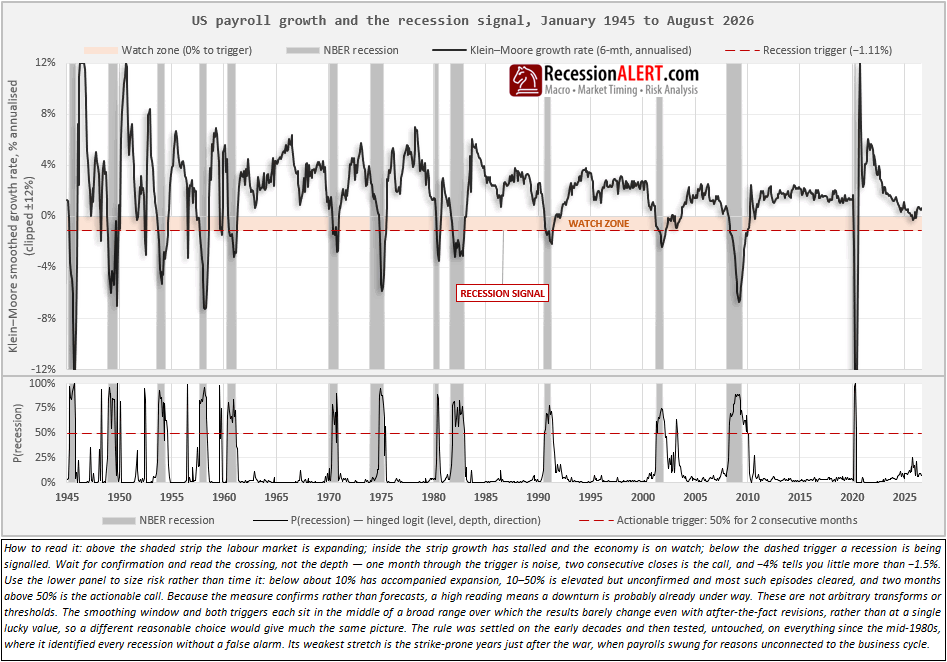
The stall you are looking at was invisible while it was happening. Trace the amber dip through late 2025 on the numbers as they were printed at the time, month by month, and it is not there: the growth rate closed below zero exactly twice in fourteen months, four months apart and never back to back, so the two-consecutive-closes rule the chart’s caption describes never armed. What put the dip on the chart was arithmetic done afterwards. This measure compares the level of payrolls against its own recent average, so it is not fed by the monthly job gain the headlines report — it is fed by the employment count itself, and when the statisticians restate that count they silently restate every growth rate computed from it, back through history. Calendar 2025 was first reported as 1,208,000 jobs added; on today’s data it is 116,000, a full year of essentially no net hiring with no recession anywhere in it. Feed the smaller count back through and October 2025 falls from -0.020% to -0.251% — a real slowdown, made visible late, and still only 23% of the way to the -1.11% trigger, the second-mildest of twelve such stalls since 1945. Calling that a dodged recession flatters it. This morning the arithmetic ran the other way: 162,000 against 53,000 expected, June and July revised up a combined 55,000, and futures now near 60% odds of a September hike. The exposure being carried is not a downturn that arrives. It is one that keeps refusing to.
What it means: one weak jobs month is not information yet — the government rewrites each month’s number twice more, and last year’s were cut by over a million. A portfolio built for rate cuts is leaning on data that keeps being withdrawn, and the ten-year is at 4.77%, rising rather than falling. What would change that is the recession-odds line holding above 50%, last seen in 2020.
Market Intelligence Brief (MIB) Ver. 19.50
For professional investors only. Not investment advice.
© 2026 RecessionALERT.com

Comments are closed.